

ISO 14505-4:2021
(Main)Ergonomics of the thermal environment — Evaluation of thermal environments in vehicles — Part 4: Determination of the equivalent temperature by means of a numerical manikin
General Information
- Abstract
This document provides guidelines for extending the definition of equivalent temperature to predictive purposes and specifies a standard prediction method for the assessment of thermal comfort in vehicles using numerical calculations. Specifically, this document sets forth a simulated numerical manikin as a viable alternative to the thermal manikin for the purpose of calculating the equivalent temperature.
- Status
- Published
- Publication Date
- 14-Sep-2021
- Technical Committee
- ISO/TC 159/SC 5 - Ergonomics of the physical environment
- Drafting Committee
- ISO/TC 159/SC 5/WG 1 - Thermal environments
- Current Stage
- 9020 - International Standard under periodical review
- Start Date
- 15-Jul-2026
- Completion Date
- 15-Jul-2026
Buy Documents




ISO 14505-4:2021 - Ergonomics of the thermal environment -- Evaluation of thermal environments in vehicles


ISO 14505-4:2021 - Ergonomics of the thermal environment — Evaluation of thermal environments in vehicles — Part 4: Determination of the equivalent temperature by means of a numerical manikin/15/2021
Overview
ISO 14505-4:2021 - "Ergonomics of the thermal environment - Evaluation of thermal environments in vehicles - Part 4" specifies a standardized numerical manikin method to determine the equivalent temperature for vehicle thermal comfort assessment. The standard extends the equivalent temperature concept (defined in ISO 14505-2) to predictive, numerical simulations and sets out calculation methods that can be used as an alternative to physical thermal manikins.
Key topics and technical requirements
- Numerical manikin definition: A virtual thermal manikin model that replicates a physical manikin’s thermal behavior for calculation purposes.
- Heat exchange mechanisms: Prescribed treatment of convective, radiant, and conductive heat transfer around the manikin and within the vehicle cabin.
- Calculation frameworks:
- Coupled calculation methods for flow and thermal fields around the manikin.
- Use of thermal factors and options for different calculation modes (constant temperature, constant heat flux, comfort-equation mode).
- CFD integration: Annex A provides guidance on applying computational fluid dynamics (CFD) techniques to simulate airflow and temperature distributions as inputs to the numerical manikin.
- Outputs and metrics: Procedures to compute equivalent temperature and related outputs that integrate local measurements into whole-body thermal assessment.
- Symbols, terms and calibration: Standardized symbols and definitions (aligned with ISO 13731 and ISO 14505-2) and methods for calculating transfer coefficients (h) and segmental heat fluxes.
Applications
ISO 14505-4:2021 is tailored for assessing non-uniform thermal environments in vehicle cabins and other enclosed spaces where thermal comfort is critical. Typical applications include:
- Virtual evaluation of vehicle HVAC designs and climate control strategies.
- Thermal comfort prediction during early-stage prototype development when physical testing is limited.
- CFD-based studies to optimize seat heating/cooling, ventilation outlets, or glazing effects.
- Comparative assessment of design variants to reduce hotspots and passenger complaints.
- Regulatory or ergonomic assessments where reproducible, standardized numerical results are required.
Who should use this standard
- Automotive engineers and HVAC system designers
- CFD specialists and thermal simulation engineers
- Human factors and ergonomics professionals
- Vehicle manufacturers and suppliers involved in cabin climate systems
- Research institutions studying thermal comfort and vehicle microclimates
Related standards
- ISO 14505-2: Determination of equivalent temperature (physical thermal manikin method)
- ISO 13731: Vocabulary and symbols for thermal environment ergonomics
Keywords: ISO 14505-4:2021, numerical manikin, equivalent temperature, thermal comfort, vehicle cabin, CFD, thermal environment, ergonomics.
Buy Documents
ISO 14505-4:2021 - Ergonomics of the thermal environment -- Evaluation of thermal environments in vehicles
ISO 14505-4:2021 - Ergonomics of the thermal environment — Evaluation of thermal environments in vehicles — Part 4: Determination of the equivalent temperature by means of a numerical manikin/15/2021
Get Certified
Connect with accredited certification bodies for this standard

TÜV Rheinland
TÜV Rheinland is a leading international provider of technical services.

TÜV SÜD
TÜV SÜD is a trusted partner of choice for safety, security and sustainability solutions.

BSI Group
BSI (British Standards Institution) is the business standards company that helps organizations make excellence a habit.
Sponsored listings
Frequently Asked Questions
ISO 14505-4:2021 is a standard published by the International Organization for Standardization (ISO). Its full title is "Ergonomics of the thermal environment — Evaluation of thermal environments in vehicles — Part 4: Determination of the equivalent temperature by means of a numerical manikin". This standard covers: This document provides guidelines for extending the definition of equivalent temperature to predictive purposes and specifies a standard prediction method for the assessment of thermal comfort in vehicles using numerical calculations. Specifically, this document sets forth a simulated numerical manikin as a viable alternative to the thermal manikin for the purpose of calculating the equivalent temperature.
This document provides guidelines for extending the definition of equivalent temperature to predictive purposes and specifies a standard prediction method for the assessment of thermal comfort in vehicles using numerical calculations. Specifically, this document sets forth a simulated numerical manikin as a viable alternative to the thermal manikin for the purpose of calculating the equivalent temperature.
ISO 14505-4:2021 is classified under the following ICS (International Classification for Standards) categories: 13.180 - Ergonomics; 43.020 - Road vehicles in general. The ICS classification helps identify the subject area and facilitates finding related standards.
ISO 14505-4:2021 is available in PDF format for immediate download after purchase. The document can be added to your cart and obtained through the secure checkout process. Digital delivery ensures instant access to the complete standard document.
Standards Content (Sample)
INTERNATIONAL ISO
STANDARD 14505-4
First edition
2021-09
Ergonomics of the thermal
environment — Evaluation of thermal
environments in vehicles —
Part 4:
Determination of the equivalent
temperature by means of a numerical
manikin
Ergonomie des ambiances thermiques — Évaluation des ambiances
thermiques dans les véhicules —
Partie 4: Détermination de la température équivalente à l'aide d'un
mannequin numérique
Reference number
©
ISO 2021
© ISO 2021
All rights reserved. Unless otherwise specified, or required in the context of its implementation, no part of this publication may
be reproduced or utilized otherwise in any form or by any means, electronic or mechanical, including photocopying, or posting
on the internet or an intranet, without prior written permission. Permission can be requested from either ISO at the address
below or ISO’s member body in the country of the requester.
ISO copyright office
CP 401 • Ch. de Blandonnet 8
CH-1214 Vernier, Geneva
Phone: +41 22 749 01 11
Email: copyright@iso.org
Website: www.iso.org
Published in Switzerland
ii © ISO 2021 – All rights reserved
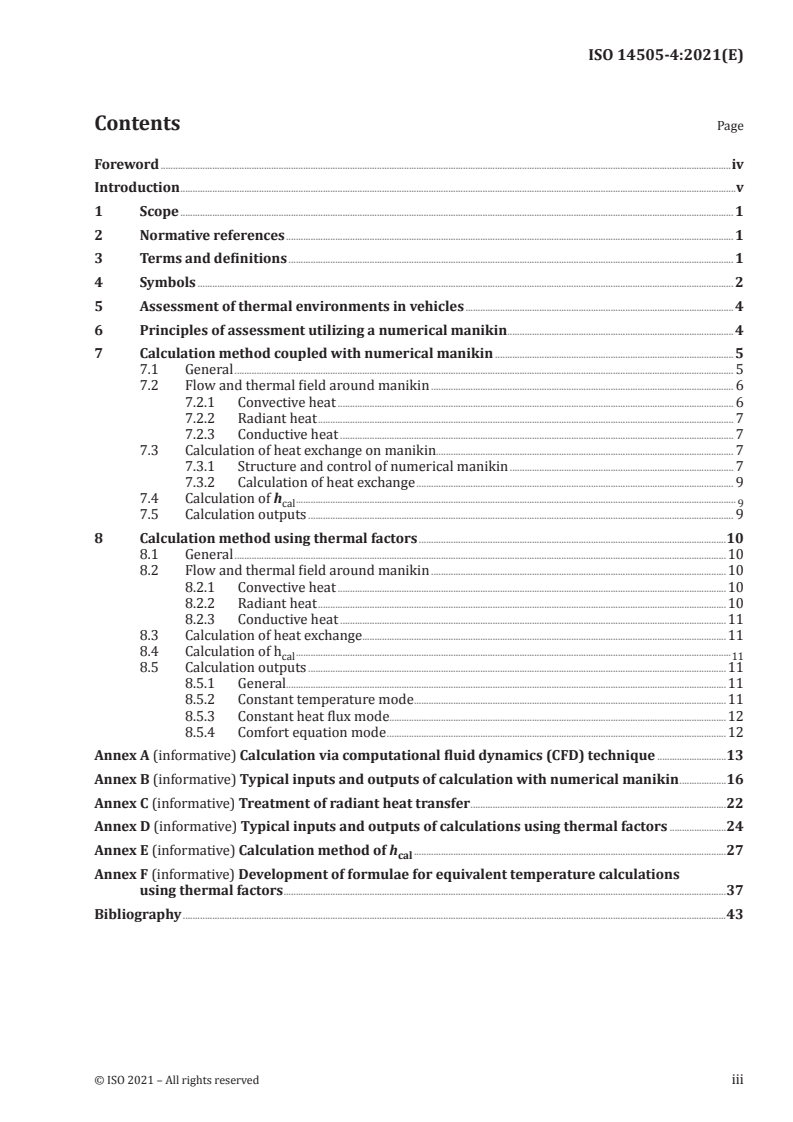
Contents Page
Foreword .iv
Introduction .v
1 Scope . 1
2 Normative references . 1
3 Terms and definitions . 1
4 Symbols . 2
5 Assessment of thermal en vironments in vehicles . 4
6 Principles of assessment utilizing a numerical manikin . 4
7 Calculation method coupled with numerical manikin . 5
7.1 General . 5
7.2 Flow and thermal field around manikin . 6
7.2.1 Convective heat . 6
7.2.2 Radiant heat . 7
7.2.3 Conductive heat . 7
7.3 Calculation of heat exchange on manikin. 7
7.3.1 Structure and control of numerical manikin . 7
7.3.2 Calculation of heat exchange . 9
7.4 Calculation of h .
cal 9
7.5 Calculation outputs . 9
8 Calculation method using thermal factors .10
8.1 General .10
8.2 Flow and thermal field around manikin .10
8.2.1 Convective heat .10
8.2.2 Radiant heat .10
8.2.3 Conductive heat .11
8.3 Calculation of heat exchange .11
8.4 Calculation of h .
cal 11
8.5 Calculation outputs .11
8.5.1 General.11
8.5.2 Constant temperature mode .11
8.5.3 Constant heat flux mode.12
8.5.4 Comfort equation mode .12
Annex A (informative) Calculation via computational fluid dynamics (CFD) technique .13
Annex B (informative) Typical inputs and outputs of calculation with numerical manikin .16
Annex C (informative) Treatment of radiant heat transfer .22
Annex D (informative) Typical inputs and outputs of calculations using thermal factors .24
Annex E (informative) Calculation method of h .27
cal
Annex F (informative) Development of formulae for equivalent temperature calculations
using thermal factors .37
Bibliography .43
Foreword
ISO (the International Organization for Standardization) is a worldwide federation of national standards
bodies (ISO member bodies). The work of preparing International Standards is normally carried out
through ISO technical committees. Each member body interested in a subject for which a technical
committee has been established has the right to be represented on that committee. International
organizations, governmental and non-governmental, in liaison with ISO, also take part in the work.
ISO collaborates closely with the International Electrotechnical Commission (IEC) on all matters of
electrotechnical standardization.
The procedures used to develop this document and those intended for its further maintenance are
described in the ISO/IEC Directives, Part 1. In particular, the different approval criteria needed for the
different types of ISO documents should be noted. This document was drafted in accordance with the
editorial rules of the ISO/IEC Directives, Part 2 (see www .iso .org/ directives).
Attention is drawn to the possibility that some of the elements of this document may be the subject of
patent rights. ISO shall not be held responsible for identifying any or all such patent rights. Details of
any patent rights identified during the development of the document will be in the Introduction and/or
on the ISO list of patent declarations received (see www .iso .org/ patents).
Any trade name used in this document is information given for the convenience of users and does not
constitute an endorsement.
For an explanation of the voluntary nature of standards, the meaning of ISO specific terms and
expressions related to conformity assessment, as well as information about ISO's adherence to the
World Trade Organization (WTO) principles in the Technical Barriers to Trade (TBT), see www .iso .org/
iso/ foreword .html.
This document was prepared by Technical Committee ISO/TC 159, Ergonomics, Subcommittee SC 5,
Ergonomics of the physical environment.
A list of all parts in the ISO 14505 series can be found on the ISO website.
Any feedback or questions on this document should be directed to the user’s national standards body. A
complete listing of these bodies can be found at www .iso .org/ members .html.
iv © ISO 2021 – All rights reserved
Introduction
The interaction of convective, radiant and conductive heat exchange in a vehicle compartment or similar
confined space is highly complex. External thermal loads in combination with the air conditioning
system in a vehicle compartment create non-uniform thermal environments, which are often the
main cause of complaints of thermal discomfort. In vehicles with poor or non-existent air conditioning
systems, non-uniform thermal environments can also be created by the interaction between the
ambient climatic conditions and vehicle structures. While a subjective evaluation reflects the total
sensations of a human body, these often incur great costs while the study phase is being conducted.
Physical measurements provide detailed and accurate local information; however, these results must be
integrated in some way to predict the thermal effects on humans. Furthermore, since specific climatic
factors sometimes play a dominant role in the overall heat exchange of a human body, an evaluation
method that accounts for the relative importance of these factors is required.
This document is part of the ISO 14505 series. To meet the above-stated requirements, this document
provides calculation methods that utilize numerical simulations to assess the total thermal environment
of vehicles. The equivalent temperature, obtained from measurements taken using a thermal manikin,
is defined in ISO 14505-2. This document extends the definition of the ISO 14505 series to include
numerical evaluation when this document is used in conjunction with the equivalent temperature
defined in ISO 14505-2.
As described in ISO 14505-2, an equivalent temperature can be utilized in the assessment of vehicle
cabins and other various enclosed spaces with non-uniform environments. As is the case for
ISO 14505-2, this document can also be applied to vehicle cabins and other enclosed spaces.
This document supposes that the ISO 14505 series will be applied to various situations, such as:
— in the case of experimental facilities that are not prepared;
— in the case of prototypes that are incomplete;
— in the case of conditions that are difficult to simulate in controlled experimental settings;
— in the case that occupants are extrapolated to unknown or virtual environments.
INTERNATIONAL STANDARD ISO 14505-4:2021(E)
Ergonomics of the thermal environment — Evaluation of
thermal environments in vehicles —
Part 4:
Determination of the equivalent temperature by means of
a numerical manikin
1 Scope
This document provides guidelines for extending the definition of equivalent temperature to predictive
purposes and specifies a standard prediction method for the assessment of thermal comfort in vehicles
using numerical calculations. Specifically, this document sets forth a simulated numerical manikin as
a viable alternative to the thermal manikin for the purpose of calculating the equivalent temperature.
2 Normative references
The following documents are referred to in the text in such a way that some or all of their content
constitutes requirements of this document. For dated references, only the edition cited applies. For
undated references, the latest edition of the referenced document (including any amendments) applies.
ISO 13731, Ergonomics of the thermal environment — Vocabulary and symbols
ISO 14505-2, Ergonomics of the thermal environment — Evaluation of thermal environments in vehicles —
Part 2: Determination of equivalent temperature
3 Terms and definitions
For the purposes of this document, the terms and definitions given in ISO 13731 and ISO 14505-2 and
the following apply.
ISO and IEC maintain terminological databases for use in standardization at the following addresses:
— ISO Online browsing platform: available at https:// www .iso .org/ obp
— IEC Electropedia: available at http:// www .electropedia .org/
3.1
numerical manikin
virtual thermal manikin recreating a thermal manikin, or a digital model of a thermal manikin used to
calculate performance
3.2
physical manikin
real thermal manikin to measure real environment
3.3
computational fluid dynamics
CFD
simulation of a series of calculations based on specific boundary conditions and specific parameters
associated with fluid and thermal fields using discrete equations based on the Navier-Stokes/Lattice-
Boltzmann equations as well as heat transfer equations that consider convection, radiation and
conduction, and generally account for the effects of turbulent flow
4 Symbols
A complete list of symbols used in this document is presented in Table 1.
Table 1 — Symbols and units
Symbol Term Unit
α Solar absorptivity on clothing (skin on unclothed area) surface –
A Skin surface area m
C Convective heat loss from clothing (skin on unclothed area) surface W/m °C
f Area factor (ratio of clothed to nude area) –
cl
h Convective heat transfer coefficient W/m °C
c
h Total heat transfer coefficient in a standard environment W/m °C
cal
h Convective heat transfer coefficient in a standard environment W/m °C
cs
h Radiant heat transfer coefficient W/m °C
r
h Radiant heat transfer coefficient in a standard environment W/m °C
rs
I Thermal insulation of clothing m °C/W
cl
Q Total heat loss from skin surface W/m
Q Set value of Q at constant heat flux mode W/m
set
R Radiant heat loss from clothing (skin on unclothed area) surface, including effect of W/m
solar radiation
R Thermal insulation between core and skin assumed by comfort equation m °C/W
cr
R Total thermal resistance between the manikin skin surface and the environment m °C/W
t
S Mean solar radiation reached on clothing (skin on unclothed area) surface W/m
t Air temperature °C
a
t Air temperature at h calculation °C
aset cal
t Clothing (skin on unclothed area) surface temperature °C
cl
t Core temperature assumed by the comfort equation °C
cr
t Equivalent temperature °C
eq
t Operative temperature including the effects of solar radiation °C
o
t Mean radiant temperature °C
r
t Skin surface temperature °C
sk
t Set value of t at constant temperature mode °C
skset sk
v Air velocity m/s
a
Suffix: segment number of each body part –
n
Suffix: whole body –
whole
Symbols used in Annex E
A Body surface area of the manikin m
b
A Elemental surface area of the element i
m
ei,
Segmental surface area of the segment n
A m
n
B
Absorption factor of radiation from surface elements i to j –
ij,
F View factor of radiation from surface elements i to j
–
ij,
Total heat transfer coefficient of segment n for calibration
h
W/m K
caln,
h Total heat transfer coefficient of the entire manikin for calibration W/m K
calw, hole
ij, –
Variable body surface element number
2 © ISO 2021 – All rights reserved
Table 1 (continued)
Symbol Term Unit
–
Variable spatial volume element number for calculation of t
a
k
Variable body surface element number in the recurrence equation of B
ij,
m Number of body surface elements –
b
End body surface element number of segment n –
m
en,
m Start body surface element number of segment n –
sn,
–
m Number of spatial volume elements
v
m Number of wall surface elements –
w
n
Variable local segment number of the manikin –
–
n
Number of manikin segments
seg
Q
Heat flux of element i W/m
ei,
Averaged heat flux over segment n
Q W/m
n
Q Averaged heat flux over the entire manikin W/m
whole
R Thermal insulation between core and skin assumed by comfort equation m K/W
cr
R
Thermal insulation of element i for the comfort equation mode calculation m K/W
cr,,ei
T Averaged air temperature in the standard chamber (in Kelvins) K
a
t Averaged air temperature in the standard chamber (in Celsius) °C
a
t °C
Air temperature of the spatial volume element k
ae,,k
t
Air temperature entering the standard chamber °C
ai, n
t Core temperature assumed by the comfort equation °C
cr
t
Core temperature of element i for the comfort equation mode calculation °C
cr,,ei
t Operative temperature in the standard chamber °C
o
T Mean radiant temperature of the wall of the standard chamber (in Kelvins) K
r
t Mean radiant temperature of the wall of the standard chamber (in Celsius) °C
r
t Skin surface temperature of the manikin °C
sk
Averaged skin surface temperature of segment n
t °C
sk,n
Estimated average skin surface temperature of the segment n from the comfort
t′
°C
sk,n
equation
t
Averaged skin surface temperature of the entire manikin °C
sk,whole
T Wall surface temperature of the standard chamber (in Kelvins) K
w
t Wall surface temperature of the standard chamber (in Celsius) °C
w
u Air flow velocity in the standard chamber m/s
a
3
V Volumetric air flow rate entering the standard chamber m /s
ai, n
V Volume of the spatial volume element k m
ek,
V Volume of the spatial region in the standard chamber m
Correction amount for generated heat of segment n
ΔQ W/m
n
Threshold of difference between t′ and t for iterative convergence
Δt °C
ce sk,n sk,n
Δt Threshold of difference between t and t for iterative convergence °C
o a r
ε –
Emissivity of the surface element j
j
–
ε Emissivity of the manikin
sk
ε Emissivity of the wall of the standard chamber –
w
Table 1 (continued)
Symbol Term Unit
Conversion factor between the actual wall surface temperature and mean radiant –
ξ
m
temperatures
5 Assessment of thermal en vironments in vehicles
The method of assessment by equivalent temperature is defined in ISO 14505-2. The assessment
procedures in ISO 14505-2 are applicable to numerical evaluations, for which “numerical manikin” is
defined in this document. Figure 1 shows the role of this document and its relations with the other
parts of the ISO 14505 series as well as different International Standards.
Figure 1 — Role of numerical evaluation among different International Standards
6 Principles of assessment utilizing a numerical manikin
This document presents two methods for calculating the equivalent temperature. One is a calculation
method coupled with a numerical manikin, as described in Clause 7. The other is a calculation method
using thermal factors, as described in Clause 8. Either method can be used to evaluate the thermal
environment in vehicles.
The former calculation method coupled with a numerical manikin is intended for use with a simulation
tool, such as computational fluid dynamics (CFD). A numerical manikin imitates a physical manikin
to calculate the equivalent temperature. The method of calculation using thermal factors estimates
the equivalent temperature by assuming the existence of the imaginary numerical manikin. In this
method, the equivalent temperature is calculated using the thermal factors, air temperature, radiant
temperature, air velocity and solar radiation. Figure 2 shows a schematic of the two methods.
4 © ISO 2021 – All rights reserved
Figure 2 — Two methods for calculating equivalent temperature
7 Calculation method coupled with numerical manikin
7.1 General
This clause describes the framework of the calculation. To evaluate the indoor environment of a vehicle
numerically, the following issues should be considered and taken account (see Figure 3):
a) heat flow through the shell structure of the vehicle;
b) flow and thermal field in the cabin;
c) radiant field (including solar radiation) in the cabin;
d) conductive heat exchange;
e) heat balance of the thermal manikin model (numerical manikin).
This document is intended to be applied to the region around the manikin, relating to items b) and e).
The heat flow through the structure of the vehicle body is defined as suitable. This document defines
indispensable ideas concerning the above items, which will enable successful and useful calculations in
these situations. However, this document does not define any specific methods for utilization because
all methods present both advantages and disadvantages for particular problems.
Once the environmental state concerning thermal comfort in the cabin is calculated, evaluation
becomes possible. Items a) to d) give the principal local parameters of air velocity, temperature and
radiation, though some simultaneous calculation coupling with the heat balance calculation is required.
This calculation will produce a heat transfer value close to that measured using the physical manikin.
Therefore, the evaluation method described in ISO 14505-2 is applicable.
Key
1 outside of vehicle 5 convection
2 shell structure 6 radiation
3 interior of vehicle 7 conduction
4 thermal manikin
a
Other standards (TC22 related).
b
This document.
NOTE Evaluation of the area in contact with the seat is outside the scope of this document.
Figure 3 — Framework of heat transfer system
7.2 Flow and thermal field around manikin
7.2.1 Convective heat
The flow and thermal field in the cabin are estimated via calculations. One practical option for this is
CFD. The informative concrete contents of this method are represented in Annex A. The outputs are
the air velocity vector and air temperature in a cabin. The heat flux on the wall and surface are also
obtained through this calculation.
The primary problem in CFD calculations is the treatment of boundary conditions. This can be overcome
in practice by selecting any of the following:
a) Calculate the heat transfer on the surface of the manikin using CFD directly.
b) As a preliminary, calculate the heat transfer coefficient on the surface of the manikin using CFD.
Then calculate the flow and thermal field coupling using the heat balance calculation of the manikin.
c) Utilize the heat transfer coefficient obtained by measurement. Then calculate the flow and thermal
field coupling with the heat balance calculation of the manikin, as described in b).
d) Estimate the heat transfer coefficient using a predictive formula based on the air velocity or
temperature. Then calculate the flow and thermal field coupling using the heat balance calculation
for the manikin, as described in b).
6 © ISO 2021 – All rights reserved
7.2.2 Radiant heat
The radiant field is calculated based on the geometric condition in a cabin separated from the flow field
calculation. Regarding long-wave radiation, as a preliminary, the view factor relating to all potential
combinations between different surface elements of the wall and the manikin or human body should
be calculated. Once those factors have been obtained, the radiant heat exchange is calculated when the
temperature of a pair of surface elements is given. As stated previously, the radiant heat is involved in
the boundary conditions of the heat transfer equation, so that the temperature is calculated iteratively
until convergence. For convenience, those factors are converted to the mean radiant heat transfer
coefficient.
Short-wave radiation (solar radiation) can be treated as energy flux striking the surface. Here, the
transmission loss through the window glass should be taken into consideration. Solar radiation can be
regarded as divided into the following components:
a) direct solar radiation;
b) sky solar radiation;
c) reflection on the ground.
The solar radiant heat is also involved in the boundary conditions of the heat transfer equation. In the
case of a climate wind tunnel test performed without use of a solar lamp, it is supposed that the effects
of solar radiation are neglected. Concrete informative treatments are represented in Annex C.
7.2.3 Conductive heat
Evaluation of the contacted segment is outside the scope of this document. The conductive heat transfer
between the manikin and seat is disregarded in the calculations.
7.3 Calculation of heat exchange on manikin
7.3.1 Structure and control of numerical manikin
Figure 4 shows the theoretical structure of the numerical manikin with regard to a human-shaped one.
The centre of each segment is assumed to consist of an adiabatic core. A heat generator is equipped on
the surface of the manikin.
The shape of the manikin is defined by calculation grids for CFD, as shown in Figure 5 a). The partition
is performed to imitate an actual manikin, as in Figure 5 b). Boundary conditions are given for each
segment.
Key
1 adiabatic core
2 heat generator on surface
Figure 4 — Theoretical structure of numerical manikin
a) Full-body model of manikin b) Partition of surface grids (16-segment case
shown)
Key
1 head 6 forearm
2 chest 7 hand
3 back 8 thigh
4 pelvis 9 leg
5 upper arm 10 foot
Figure 5 — Surface grids for numerical calculation
8 © ISO 2021 – All rights reserved
The control model is intended to imitate a physical manikin and includes the following three operating
modes:
a) Controlled surface temperature (constant temperature mode): generally, the surface temperature
of all segments is maintained at 34 °C (see ISO 14505-2).
b) Controlled heat generation (constant heat flux mode): this method uses a metabolic rate to
represent the heat flux for all segments. An example of the metabolic rate during vehicle driving
is shown in ISO/TS 14505-1 and ISO 8996. Note that this method is less commonly used than the
other two.
c) Described by comfort equation (comfort equation mode): generally, the parameter values for all
2 [3]
segments in this mode are t = 36,4 °C and R = 0,054 m °C/W .
cr cr
7.3.2 Calculation of heat exchange
The primary problem for the heat transfer calculation is determining the appropriate treatment of
the boundary condition on the surface of the manikin. Once this has been designated, the following
treatments can be used:
a) Flow field, radiant field and heat transfer on the surface of the manikin are solved simultaneously.
The temperature distribution is calculated directly by solving for entrainment of heat in the
boundary layer; however, the convective heat transfer coefficient is not explicitly calculated. In
this case, the grid size near the surface should be small enough to resolve the heat transfer (the
boundary layer). Otherwise, a well-tuned wall function developed to calculate the heat transfer
near the solid boundary should be adopted.
b) The convective and mean radiant heat transfer coefficients are treated as known values. In this
case, the grid structure near the surface can be determined only to calculate the flow field, resulting
in coarser grids compared to the prior treatment (a).
Regardless of the calculation method used, flow field calculations should account for buoyancy effects
when the air velocity is small (i.e. less than 0,1 m/s). As such, the air motion should be calculated via
coupling with the heat transfer equation.
7.4 Calculation of h
cal
Three methods of calculating and defining the value of h are considered:
cal
a) Apply the CFD calculation to standard conditions to obtain the “calibrated” characteristics of h .
cal
Informative concrete treatments for this are presented in Annex E.
b) Adopt measured data gleaned using a physical manikin corresponding to the “numerical manikin”.
Practical measurement methods for this item are detailed in ISO 14505-2.
c) Estimate it using Formula (10) in 8.3.
7.5 Calculation outputs
The input and output data to or from the numerical manikin is shown in Table 2. The informative
concrete treatments used to calculate the equivalent temperature are presented in Annex B.
Table 2 — Input and output to or from the numerical manikin
Control principle Inputs Outputs
Constant temperature mode (T = T ) T , I Q
sk,n skset skset cl,n n
Constant heat flux mode (Q = Q ) Q , I T
n set set cl,n sk,n
Comfort control mode (Q = (T –T )/R ) T , R , I T , Q
n cr sk,n cr cr cr cl,n sk,n n
The equivalent temperature in each body segment is calculated using Formula (1), as defined in
ISO 14505-2.
Q
n
tt=− (1)
eq,,nskn
h
caln,
The whole-body equivalent temperature is calculated using Formulae (2) to (4), as defined in
ISO 14505-2.
Q
whole
tt=− (2)
eq,,wholeskwhole
h
calw, hole
tA⋅
()
sk,nn
∑
nn∈ ()whole
t = (3)
sk,whole
A
n
∑
nn∈ ()whole
()QA⋅
∑ nn
nn∈ ()whole
Q = (4)
whole
A
n
∑
nn∈ ()whole
The calculated values differ depending on the control mode even if the environmental conditions are the
same (see Clause D.2). As described in ISO 14505-2, it is recommended that either constant temperature
mode (at 34 °C) or comfort equation mode (with t = 36,4 °C and R = 0,054 m °C/W) be used. The
cr cr
calculated t should be presented together with the control mode and its parameter(s).
eq
8 Calculation method using thermal factors
8.1 General
It is also possible to calculate the equivalent temperature without the coupling calculation by assuming
the existence of an imaginary numerical manikin. In this method, the equivalent temperature is
calculated from the thermal factors, air temperature, radiant temperature, air velocity and solar
radiation. It should be noted that the effect of environmental heating by manikin is neglected in this
one-way calculation.
This method can be applied to the calculation of the equivalent temperature on either individual
manikin segments or the whole body. In this document the above method is intended for use with a
numerical calculation tool; however, it can also be applied to calculations using measured thermal
factors.
The formulae discussed in this clause are described in more detail in Annex F.
8.2 Flow and thermal field around manikin
8.2.1 Convective heat
The convective heat loss, C, from the surfaces of clothing and unclothed skin is defined by Formula (5):
Cf=⋅ht⋅−t (5)
()
cl ccla
8.2.2 Radiant heat
The radiant heat loss, R, from the surfaces of clothing and unclothed skin is defined by Formula (6):
Rf=⋅ {}ht()−tS−⋅α (6)
cl rclr
10 © ISO 2021 – All rights reserved
8.2.3 Conductive heat
As described in 7.2.3, the conductive heat transfer between the manikin and seat is neglected.
8.3 Calculation of heat exchange
The total heat loss, Q, from the surfaces of clothing and unclothed skin is expressed using either
Formula (7) or Formula (8):
()tt−
sk cl
Q= (7)
I
cl
QC=+R (8)
The total heat loss, Q, is defined by Formula (9), which is derived from Formulae (5), (6), (7) and (8):
ht⋅+ht⋅+α⋅S
ca rr
t −
sk
hh+
cr
Q= (9)
I +
cl
fh⋅+h
()
cl cr
8.4 Calculation of h
cal
Coefficient h represents the total heat transfer coefficient through clothing, i.e. the amount of total
cal
heat loss per °C of difference between the skin and the environment, in the standard environment
described in ISO 14505-2. This coefficient can be expressed as Formula (10):
h = (10)
cal
I +
cl
fh⋅+h
()
cl cs rs
8.5 Calculation outputs
8.5.1 General
The equivalent temperature, t , is defined by Formula (11), as shown in ISO 14505-2:
eq
Q
tt=− (11)
eq sk
h
cal
The practical methods for calculating t under each manikin control mode are shown in 8.5.2 to 8.5.4.
eq
The calculated values differ depending on the control mode, even if environmental conditions are the
same (see D.2). As described in ISO 14505-2, it is recommended that either constant temperature mode
(at 34 °C) or comfort equation mode (with t = 36,4 °C and R = 0,054 m °C/W) be used. The calculated
cr cr
t should be presented together with the control mode and associated parameter(s).
eq
8.5.2 Constant temperature mode
When the value of t in the constant temperature mode is defined as t , the equivalent temperature,
sk skset
t , is calculated using Formula (12), which is obtained by inserting Formulae (9) and (10) into
eq
Formula (11):
ht⋅+ht⋅+α ⋅S
ca rr
t −
skset
hh+
cr
tt=− ⋅ I ++ (12)
eq skset cl
fh⋅+h
()
cl cs rs
I +
cl
fh⋅+()h
cl cr
8.5.3 Constant heat flux mode
When Q in the constant heat flux mode is set to be Q , t is calculated using Formula (13), which is
set sk
obtained from Formula (9):
ht⋅+ht⋅+α ⋅S
ca rr
tQ=⋅ I + + (13)
sk setcl
fh⋅+h hh+
()
cl cr cr
The equivalent temperature, t , is calculated using Formula (14), which is obtained by inserting
eq
Formulae (10) and (13) into Formula (11):
Q ht⋅+ht⋅+α⋅S
set ca rr
t =⋅ − + (14)
eq
fh +hh +h hh+
cl cr cs rs cr
8.5.4 Comfort equation mode
When the control equation in the comfort control mode is expressed by Formula (15), Q and t are
sk
calculated using Formulae (16) and (17), respectively, which are obtained from Formulae (9) and (15).
tt−
cr sk
Q= (15)
R
cr
ht⋅+ht⋅+α⋅S
ca rr
t −
cr
hh+
cr
Q= (16)
RI++
cr cl
fh⋅+h
()
cl cr
ht⋅+ht⋅+α ⋅S
ca rr
t −
cr
hh+
cr
tt=−R ⋅ (17)
sk cr cr
1
RI++
cr cl
fh⋅+h
()
cl cr
The equivalent temperature, t , is calculated using Formula (18), which is obtained by inserting
eq
Formulae (10), (16) and (17) into Formula (11):
ht⋅+ht⋅+α ⋅S
ca rr
t −
cr
hh+ 1
cr
tt=− ⋅+RI + (18)
eq cr cr ccl
fh⋅+()h
cl cs rs
RI++
cr cl
fh⋅+()h
cl cr
12 © ISO 2021 – All rights reserved
Annex A
(informative)
Calculation via computational fluid dynamics (CFD) technique
A.1 General method
A.1.1 Guidance for CFD calculations
To ensure the success of CFD calculations, an appropriate method should be selected while considering
the purpose and required accuracy. In general, the following factors should be considered:
— geometric model (e.g. shape, mesh size);
— physical model (e.g. calculation model, boundary conditions);
— calculation errors (e.g. round-off error, truncation error).
When calculations are performed, it is essential that a computer with sufficient performance to
accommodate the number of meshes and the calculation model be used. If possible, it is recommended
that the calculation accuracy be experimentally verified before engaging in detailed calculations.
For the treatment of radiant heat transfer, refer to Annex C.
A.1.2 Geometry model
Depending on the development phase, a variety of models can be used from simplified geometric models
useful for approximate evaluation in the early development phase to detailed geometric models just
prior to prototyping. The calculation model should be selected based on the intended purpose.
There are two ways to simulate air flow from an outlet:
a) Set an air flow rate at the root of the air duct or in the HVAC system to simulate the air flow in the
duct and that from the outlet.
b) Set an air velocity and direction on a surface of an outlet.
To accurately simulate air flow in the vehicle cabin, it is important to specify the positions of drafters or
inlets for circulation, together with the corresponding air flow rates.
A.1.3 Calculation of flow field
The flow field inside the cabin is supposed to be solved based on the Reynolds averaged Navier-Stokes
[4] [5]
equations (RANS). Commonly, the following typical specifications are applied :
a) fluid: incompressible fluid (air);
b) solving method: finite volume method (FVM);
c) solution of velocity and pressure: SIMPLE type method;
d) discretization scheme: high order up-wind scheme for convection term;
e) turbulence model: two-equation model (e.g. k-ω SST, k-ε model);
f) treatment of the boundary layer: standard wall function;
g) grid system: unstructured grid system.
The above menu is not an exclusive one required for successful calculation. It is possible to adopt the
finite element method (FEM) instead of using FVM. It is further possible to solve the velocity-pressure
field using the coupled method. Higher accuracy can be achieved through exact calculations of the
boundary layer, using a method such as the low Reynolds number model. With regards to the grid
system, a structured grid system can also be applied.
It should be noted that the accuracy of a calculation depends on the resolution of the grids. While
decreasing the grid size generally improves accuracy, this increases the calculation cost. Therefore, it is
recommended that the grid size be selected while considering the balance between the calculation cost
and accuracy.
A.1.4 Calculation of thermal field
The thermal field in the cabin is calculated using the Reynolds averaged turbulent heat transfer
equation coupled with the RANS equations. To simulate the effects of buoyancy, a gravitation term is
added to the RANS equations. The turbulent heat flux is estimated using the turbulent Prandtl number
based on the similarity in heat transfer. Generally, the following typical specifications will be applied:
a) solution: common to the flow field solution;
b) treatment of the buoyancy effects: Boussinesq approximation;
c) treatment of the boundary layer: standard wall function for thermal boundary layer.
The effects of radiation are included in the boundary condition. The temperature on the surface of the
manikin is determined by the heat balance equation, which consists of the terms of heat convection,
radiation and heat conduction. Annex C describes the treatment of the radiation in greater detail. Once
the surface temperature has been calculated, it is used as a boundary condition in calculating the
thermal field. Therefore, calculation of the thermal field should be coupled with the flow field and heat
balance calculations if the surface temperature is not given as a boundary condition.
A.2 Treatment of the boundary condition
Adoption of the wall function, based on Prandtl's log-law, is a convenient and basic technique for
boundary layer calculations. The non-dimensional parameter y+ should be suppressed to less than an
order of several hundred. When y+ becomes less than 10, a higher precision model is recommended
because the wall function is no longer applicable to the region. This is commonly seen in environments
such as that in close proximity to the surface, called the viscous sub layer. The wall function of the
thermal boundary layer is consistent with that of the velocity boundary layer.
The performance of convective heat transfer on the surface is dominated by the precision of calculated
turbulence strength very close to the surface. Thus, a higher precision model is required for the
calculation of heat transfer relative to the wall function when accurate calculation is desired. Two
typical models for this process are:
— low Reynolds number model;
— two-layer model.
It should be noted that the accuracy of these calculations depends on the resolution of the grids very
close to the surface, even if the above models are adopted. Furthermore, sufficient computer resources
are required for intensive calculations.
There is another way that the coefficient of convective heat transfer is given as the boundary condition.
The advantage of this method is that it is possible to obtain the practical and realistic heat transfer
performance as long as the flow condition is not changed significantly from when the value of this
coefficient was determined. Additionally, the calculation of the flow and thermal fields can be separated
14 © ISO 2021 – All rights reserved
completely, although the results from the flow field calculation are required for calculating the thermal
field.
A.3 Calculated results
Typical outputs of the CFD calculations are the pressure, velocity and temperature fields. It is also
possible to obtain the temperature distribution, heat loss or both on the surface of the manikin, which
is then used to calculate the equivalent temperature, t . The typical form of this output is shown in
eq
Annex B.
Annex B
(informative)
Typical inputs and outputs of calculation with numerical manikin
B.1 Typical inputs and outputs of the calculation
B.1.1 General
As mentioned in ISO 14505-2, the evaluation method utilizing equivalent temperature, t , is applied to
eq
[6][7]
both clothed and unclothed surfaces. The inputs and outputs of such dually applicable calculations
are described in this annex.
The treatment of clothing conditions in these calculations are classified in two typical ways: an exact
method and an approximate method. When an exact method is used, digital data from the surface
configuration of the clothed manikin and detailed calculations for the gaps between these clothes
and the skin surface of the manikin are required. This method requires complex, often impractical,
calculations. Conversely, the approximate method described in this annex is convenient and practical
when the skin surface temperature, t , or heat loss, Q, can be calculated using the thermal insulation,
sk
I , and area factor, f , of the clothing. In this method, the surface of the numerical manikin is assumed
cl cl
to be the surface of the clothing if a given segment is covered with clothing. The following three cases
are available for
...
INTERNATIONAL ISO
STANDARD 14505-4
First edition
2021-09
Ergonomics of the thermal
environment — Evaluation of thermal
environments in vehicles —
Part 4:
Determination of the equivalent
temperature by means of a numerical
manikin
Ergonomie des ambiances thermiques — Évaluation des ambiances
thermiques dans les véhicules —
Partie 4: Détermination de la température équivalente à l'aide d'un
mannequin numérique
Reference number
©
ISO 2021
© ISO 2021
All rights reserved. Unless otherwise specified, or required in the context of its implementation, no part of this publication may
be reproduced or utilized otherwise in any form or by any means, electronic or mechanical, including photocopying, or posting
on the internet or an intranet, without prior written permission. Permission can be requested from either ISO at the address
below or ISO’s member body in the country of the requester.
ISO copyright office
CP 401 • Ch. de Blandonnet 8
CH-1214 Vernier, Geneva
Phone: +41 22 749 01 11
Email: copyright@iso.org
Website: www.iso.org
Published in Switzerland
ii © ISO 2021 – All rights reserved
Contents Page
Foreword .iv
Introduction .v
1 Scope . 1
2 Normative references . 1
3 Terms and definitions . 1
4 Symbols . 2
5 Assessment of thermal en vironments in vehicles . 4
6 Principles of assessment utilizing a numerical manikin . 4
7 Calculation method coupled with numerical manikin . 5
7.1 General . 5
7.2 Flow and thermal field around manikin . 6
7.2.1 Convective heat . 6
7.2.2 Radiant heat . 7
7.2.3 Conductive heat . 7
7.3 Calculation of heat exchange on manikin. 7
7.3.1 Structure and control of numerical manikin . 7
7.3.2 Calculation of heat exchange . 9
7.4 Calculation of h .
cal 9
7.5 Calculation outputs . 9
8 Calculation method using thermal factors .10
8.1 General .10
8.2 Flow and thermal field around manikin .10
8.2.1 Convective heat .10
8.2.2 Radiant heat .10
8.2.3 Conductive heat .11
8.3 Calculation of heat exchange .11
8.4 Calculation of h .
cal 11
8.5 Calculation outputs .11
8.5.1 General.11
8.5.2 Constant temperature mode .11
8.5.3 Constant heat flux mode.12
8.5.4 Comfort equation mode .12
Annex A (informative) Calculation via computational fluid dynamics (CFD) technique .13
Annex B (informative) Typical inputs and outputs of calculation with numerical manikin .16
Annex C (informative) Treatment of radiant heat transfer .22
Annex D (informative) Typical inputs and outputs of calculations using thermal factors .24
Annex E (informative) Calculation method of h .27
cal
Annex F (informative) Development of formulae for equivalent temperature calculations
using thermal factors .37
Bibliography .43
Foreword
ISO (the International Organization for Standardization) is a worldwide federation of national standards
bodies (ISO member bodies). The work of preparing International Standards is normally carried out
through ISO technical committees. Each member body interested in a subject for which a technical
committee has been established has the right to be represented on that committee. International
organizations, governmental and non-governmental, in liaison with ISO, also take part in the work.
ISO collaborates closely with the International Electrotechnical Commission (IEC) on all matters of
electrotechnical standardization.
The procedures used to develop this document and those intended for its further maintenance are
described in the ISO/IEC Directives, Part 1. In particular, the different approval criteria needed for the
different types of ISO documents should be noted. This document was drafted in accordance with the
editorial rules of the ISO/IEC Directives, Part 2 (see www .iso .org/ directives).
Attention is drawn to the possibility that some of the elements of this document may be the subject of
patent rights. ISO shall not be held responsible for identifying any or all such patent rights. Details of
any patent rights identified during the development of the document will be in the Introduction and/or
on the ISO list of patent declarations received (see www .iso .org/ patents).
Any trade name used in this document is information given for the convenience of users and does not
constitute an endorsement.
For an explanation of the voluntary nature of standards, the meaning of ISO specific terms and
expressions related to conformity assessment, as well as information about ISO's adherence to the
World Trade Organization (WTO) principles in the Technical Barriers to Trade (TBT), see www .iso .org/
iso/ foreword .html.
This document was prepared by Technical Committee ISO/TC 159, Ergonomics, Subcommittee SC 5,
Ergonomics of the physical environment.
A list of all parts in the ISO 14505 series can be found on the ISO website.
Any feedback or questions on this document should be directed to the user’s national standards body. A
complete listing of these bodies can be found at www .iso .org/ members .html.
iv © ISO 2021 – All rights reserved
Introduction
The interaction of convective, radiant and conductive heat exchange in a vehicle compartment or similar
confined space is highly complex. External thermal loads in combination with the air conditioning
system in a vehicle compartment create non-uniform thermal environments, which are often the
main cause of complaints of thermal discomfort. In vehicles with poor or non-existent air conditioning
systems, non-uniform thermal environments can also be created by the interaction between the
ambient climatic conditions and vehicle structures. While a subjective evaluation reflects the total
sensations of a human body, these often incur great costs while the study phase is being conducted.
Physical measurements provide detailed and accurate local information; however, these results must be
integrated in some way to predict the thermal effects on humans. Furthermore, since specific climatic
factors sometimes play a dominant role in the overall heat exchange of a human body, an evaluation
method that accounts for the relative importance of these factors is required.
This document is part of the ISO 14505 series. To meet the above-stated requirements, this document
provides calculation methods that utilize numerical simulations to assess the total thermal environment
of vehicles. The equivalent temperature, obtained from measurements taken using a thermal manikin,
is defined in ISO 14505-2. This document extends the definition of the ISO 14505 series to include
numerical evaluation when this document is used in conjunction with the equivalent temperature
defined in ISO 14505-2.
As described in ISO 14505-2, an equivalent temperature can be utilized in the assessment of vehicle
cabins and other various enclosed spaces with non-uniform environments. As is the case for
ISO 14505-2, this document can also be applied to vehicle cabins and other enclosed spaces.
This document supposes that the ISO 14505 series will be applied to various situations, such as:
— in the case of experimental facilities that are not prepared;
— in the case of prototypes that are incomplete;
— in the case of conditions that are difficult to simulate in controlled experimental settings;
— in the case that occupants are extrapolated to unknown or virtual environments.
INTERNATIONAL STANDARD ISO 14505-4:2021(E)
Ergonomics of the thermal environment — Evaluation of
thermal environments in vehicles —
Part 4:
Determination of the equivalent temperature by means of
a numerical manikin
1 Scope
This document provides guidelines for extending the definition of equivalent temperature to predictive
purposes and specifies a standard prediction method for the assessment of thermal comfort in vehicles
using numerical calculations. Specifically, this document sets forth a simulated numerical manikin as
a viable alternative to the thermal manikin for the purpose of calculating the equivalent temperature.
2 Normative references
The following documents are referred to in the text in such a way that some or all of their content
constitutes requirements of this document. For dated references, only the edition cited applies. For
undated references, the latest edition of the referenced document (including any amendments) applies.
ISO 13731, Ergonomics of the thermal environment — Vocabulary and symbols
ISO 14505-2, Ergonomics of the thermal environment — Evaluation of thermal environments in vehicles —
Part 2: Determination of equivalent temperature
3 Terms and definitions
For the purposes of this document, the terms and definitions given in ISO 13731 and ISO 14505-2 and
the following apply.
ISO and IEC maintain terminological databases for use in standardization at the following addresses:
— ISO Online browsing platform: available at https:// www .iso .org/ obp
— IEC Electropedia: available at http:// www .electropedia .org/
3.1
numerical manikin
virtual thermal manikin recreating a thermal manikin, or a digital model of a thermal manikin used to
calculate performance
3.2
physical manikin
real thermal manikin to measure real environment
3.3
computational fluid dynamics
CFD
simulation of a series of calculations based on specific boundary conditions and specific parameters
associated with fluid and thermal fields using discrete equations based on the Navier-Stokes/Lattice-
Boltzmann equations as well as heat transfer equations that consider convection, radiation and
conduction, and generally account for the effects of turbulent flow
4 Symbols
A complete list of symbols used in this document is presented in Table 1.
Table 1 — Symbols and units
Symbol Term Unit
α Solar absorptivity on clothing (skin on unclothed area) surface –
A Skin surface area m
C Convective heat loss from clothing (skin on unclothed area) surface W/m °C
f Area factor (ratio of clothed to nude area) –
cl
h Convective heat transfer coefficient W/m °C
c
h Total heat transfer coefficient in a standard environment W/m °C
cal
h Convective heat transfer coefficient in a standard environment W/m °C
cs
h Radiant heat transfer coefficient W/m °C
r
h Radiant heat transfer coefficient in a standard environment W/m °C
rs
I Thermal insulation of clothing m °C/W
cl
Q Total heat loss from skin surface W/m
Q Set value of Q at constant heat flux mode W/m
set
R Radiant heat loss from clothing (skin on unclothed area) surface, including effect of W/m
solar radiation
R Thermal insulation between core and skin assumed by comfort equation m °C/W
cr
R Total thermal resistance between the manikin skin surface and the environment m °C/W
t
S Mean solar radiation reached on clothing (skin on unclothed area) surface W/m
t Air temperature °C
a
t Air temperature at h calculation °C
aset cal
t Clothing (skin on unclothed area) surface temperature °C
cl
t Core temperature assumed by the comfort equation °C
cr
t Equivalent temperature °C
eq
t Operative temperature including the effects of solar radiation °C
o
t Mean radiant temperature °C
r
t Skin surface temperature °C
sk
t Set value of t at constant temperature mode °C
skset sk
v Air velocity m/s
a
Suffix: segment number of each body part –
n
Suffix: whole body –
whole
Symbols used in Annex E
A Body surface area of the manikin m
b
A Elemental surface area of the element i
m
ei,
Segmental surface area of the segment n
A m
n
B
Absorption factor of radiation from surface elements i to j –
ij,
F View factor of radiation from surface elements i to j
–
ij,
Total heat transfer coefficient of segment n for calibration
h
W/m K
caln,
h Total heat transfer coefficient of the entire manikin for calibration W/m K
calw, hole
ij, –
Variable body surface element number
2 © ISO 2021 – All rights reserved
Table 1 (continued)
Symbol Term Unit
–
Variable spatial volume element number for calculation of t
a
k
Variable body surface element number in the recurrence equation of B
ij,
m Number of body surface elements –
b
End body surface element number of segment n –
m
en,
m Start body surface element number of segment n –
sn,
–
m Number of spatial volume elements
v
m Number of wall surface elements –
w
n
Variable local segment number of the manikin –
–
n
Number of manikin segments
seg
Q
Heat flux of element i W/m
ei,
Averaged heat flux over segment n
Q W/m
n
Q Averaged heat flux over the entire manikin W/m
whole
R Thermal insulation between core and skin assumed by comfort equation m K/W
cr
R
Thermal insulation of element i for the comfort equation mode calculation m K/W
cr,,ei
T Averaged air temperature in the standard chamber (in Kelvins) K
a
t Averaged air temperature in the standard chamber (in Celsius) °C
a
t °C
Air temperature of the spatial volume element k
ae,,k
t
Air temperature entering the standard chamber °C
ai, n
t Core temperature assumed by the comfort equation °C
cr
t
Core temperature of element i for the comfort equation mode calculation °C
cr,,ei
t Operative temperature in the standard chamber °C
o
T Mean radiant temperature of the wall of the standard chamber (in Kelvins) K
r
t Mean radiant temperature of the wall of the standard chamber (in Celsius) °C
r
t Skin surface temperature of the manikin °C
sk
Averaged skin surface temperature of segment n
t °C
sk,n
Estimated average skin surface temperature of the segment n from the comfort
t′
°C
sk,n
equation
t
Averaged skin surface temperature of the entire manikin °C
sk,whole
T Wall surface temperature of the standard chamber (in Kelvins) K
w
t Wall surface temperature of the standard chamber (in Celsius) °C
w
u Air flow velocity in the standard chamber m/s
a
3
V Volumetric air flow rate entering the standard chamber m /s
ai, n
V Volume of the spatial volume element k m
ek,
V Volume of the spatial region in the standard chamber m
Correction amount for generated heat of segment n
ΔQ W/m
n
Threshold of difference between t′ and t for iterative convergence
Δt °C
ce sk,n sk,n
Δt Threshold of difference between t and t for iterative convergence °C
o a r
ε –
Emissivity of the surface element j
j
–
ε Emissivity of the manikin
sk
ε Emissivity of the wall of the standard chamber –
w
Table 1 (continued)
Symbol Term Unit
Conversion factor between the actual wall surface temperature and mean radiant –
ξ
m
temperatures
5 Assessment of thermal en vironments in vehicles
The method of assessment by equivalent temperature is defined in ISO 14505-2. The assessment
procedures in ISO 14505-2 are applicable to numerical evaluations, for which “numerical manikin” is
defined in this document. Figure 1 shows the role of this document and its relations with the other
parts of the ISO 14505 series as well as different International Standards.
Figure 1 — Role of numerical evaluation among different International Standards
6 Principles of assessment utilizing a numerical manikin
This document presents two methods for calculating the equivalent temperature. One is a calculation
method coupled with a numerical manikin, as described in Clause 7. The other is a calculation method
using thermal factors, as described in Clause 8. Either method can be used to evaluate the thermal
environment in vehicles.
The former calculation method coupled with a numerical manikin is intended for use with a simulation
tool, such as computational fluid dynamics (CFD). A numerical manikin imitates a physical manikin
to calculate the equivalent temperature. The method of calculation using thermal factors estimates
the equivalent temperature by assuming the existence of the imaginary numerical manikin. In this
method, the equivalent temperature is calculated using the thermal factors, air temperature, radiant
temperature, air velocity and solar radiation. Figure 2 shows a schematic of the two methods.
4 © ISO 2021 – All rights reserved
Figure 2 — Two methods for calculating equivalent temperature
7 Calculation method coupled with numerical manikin
7.1 General
This clause describes the framework of the calculation. To evaluate the indoor environment of a vehicle
numerically, the following issues should be considered and taken account (see Figure 3):
a) heat flow through the shell structure of the vehicle;
b) flow and thermal field in the cabin;
c) radiant field (including solar radiation) in the cabin;
d) conductive heat exchange;
e) heat balance of the thermal manikin model (numerical manikin).
This document is intended to be applied to the region around the manikin, relating to items b) and e).
The heat flow through the structure of the vehicle body is defined as suitable. This document defines
indispensable ideas concerning the above items, which will enable successful and useful calculations in
these situations. However, this document does not define any specific methods for utilization because
all methods present both advantages and disadvantages for particular problems.
Once the environmental state concerning thermal comfort in the cabin is calculated, evaluation
becomes possible. Items a) to d) give the principal local parameters of air velocity, temperature and
radiation, though some simultaneous calculation coupling with the heat balance calculation is required.
This calculation will produce a heat transfer value close to that measured using the physical manikin.
Therefore, the evaluation method described in ISO 14505-2 is applicable.
Key
1 outside of vehicle 5 convection
2 shell structure 6 radiation
3 interior of vehicle 7 conduction
4 thermal manikin
a
Other standards (TC22 related).
b
This document.
NOTE Evaluation of the area in contact with the seat is outside the scope of this document.
Figure 3 — Framework of heat transfer system
7.2 Flow and thermal field around manikin
7.2.1 Convective heat
The flow and thermal field in the cabin are estimated via calculations. One practical option for this is
CFD. The informative concrete contents of this method are represented in Annex A. The outputs are
the air velocity vector and air temperature in a cabin. The heat flux on the wall and surface are also
obtained through this calculation.
The primary problem in CFD calculations is the treatment of boundary conditions. This can be overcome
in practice by selecting any of the following:
a) Calculate the heat transfer on the surface of the manikin using CFD directly.
b) As a preliminary, calculate the heat transfer coefficient on the surface of the manikin using CFD.
Then calculate the flow and thermal field coupling using the heat balance calculation of the manikin.
c) Utilize the heat transfer coefficient obtained by measurement. Then calculate the flow and thermal
field coupling with the heat balance calculation of the manikin, as described in b).
d) Estimate the heat transfer coefficient using a predictive formula based on the air velocity or
temperature. Then calculate the flow and thermal field coupling using the heat balance calculation
for the manikin, as described in b).
6 © ISO 2021 – All rights reserved
7.2.2 Radiant heat
The radiant field is calculated based on the geometric condition in a cabin separated from the flow field
calculation. Regarding long-wave radiation, as a preliminary, the view factor relating to all potential
combinations between different surface elements of the wall and the manikin or human body should
be calculated. Once those factors have been obtained, the radiant heat exchange is calculated when the
temperature of a pair of surface elements is given. As stated previously, the radiant heat is involved in
the boundary conditions of the heat transfer equation, so that the temperature is calculated iteratively
until convergence. For convenience, those factors are converted to the mean radiant heat transfer
coefficient.
Short-wave radiation (solar radiation) can be treated as energy flux striking the surface. Here, the
transmission loss through the window glass should be taken into consideration. Solar radiation can be
regarded as divided into the following components:
a) direct solar radiation;
b) sky solar radiation;
c) reflection on the ground.
The solar radiant heat is also involved in the boundary conditions of the heat transfer equation. In the
case of a climate wind tunnel test performed without use of a solar lamp, it is supposed that the effects
of solar radiation are neglected. Concrete informative treatments are represented in Annex C.
7.2.3 Conductive heat
Evaluation of the contacted segment is outside the scope of this document. The conductive heat transfer
between the manikin and seat is disregarded in the calculations.
7.3 Calculation of heat exchange on manikin
7.3.1 Structure and control of numerical manikin
Figure 4 shows the theoretical structure of the numerical manikin with regard to a human-shaped one.
The centre of each segment is assumed to consist of an adiabatic core. A heat generator is equipped on
the surface of the manikin.
The shape of the manikin is defined by calculation grids for CFD, as shown in Figure 5 a). The partition
is performed to imitate an actual manikin, as in Figure 5 b). Boundary conditions are given for each
segment.
Key
1 adiabatic core
2 heat generator on surface
Figure 4 — Theoretical structure of numerical manikin
a) Full-body model of manikin b) Partition of surface grids (16-segment case
shown)
Key
1 head 6 forearm
2 chest 7 hand
3 back 8 thigh
4 pelvis 9 leg
5 upper arm 10 foot
Figure 5 — Surface grids for numerical calculation
8 © ISO 2021 – All rights reserved
The control model is intended to imitate a physical manikin and includes the following three operating
modes:
a) Controlled surface temperature (constant temperature mode): generally, the surface temperature
of all segments is maintained at 34 °C (see ISO 14505-2).
b) Controlled heat generation (constant heat flux mode): this method uses a metabolic rate to
represent the heat flux for all segments. An example of the metabolic rate during vehicle driving
is shown in ISO/TS 14505-1 and ISO 8996. Note that this method is less commonly used than the
other two.
c) Described by comfort equation (comfort equation mode): generally, the parameter values for all
2 [3]
segments in this mode are t = 36,4 °C and R = 0,054 m °C/W .
cr cr
7.3.2 Calculation of heat exchange
The primary problem for the heat transfer calculation is determining the appropriate treatment of
the boundary condition on the surface of the manikin. Once this has been designated, the following
treatments can be used:
a) Flow field, radiant field and heat transfer on the surface of the manikin are solved simultaneously.
The temperature distribution is calculated directly by solving for entrainment of heat in the
boundary layer; however, the convective heat transfer coefficient is not explicitly calculated. In
this case, the grid size near the surface should be small enough to resolve the heat transfer (the
boundary layer). Otherwise, a well-tuned wall function developed to calculate the heat transfer
near the solid boundary should be adopted.
b) The convective and mean radiant heat transfer coefficients are treated as known values. In this
case, the grid structure near the surface can be determined only to calculate the flow field, resulting
in coarser grids compared to the prior treatment (a).
Regardless of the calculation method used, flow field calculations should account for buoyancy effects
when the air velocity is small (i.e. less than 0,1 m/s). As such, the air motion should be calculated via
coupling with the heat transfer equation.
7.4 Calculation of h
cal
Three methods of calculating and defining the value of h are considered:
cal
a) Apply the CFD calculation to standard conditions to obtain the “calibrated” characteristics of h .
cal
Informative concrete treatments for this are presented in Annex E.
b) Adopt measured data gleaned using a physical manikin corresponding to the “numerical manikin”.
Practical measurement methods for this item are detailed in ISO 14505-2.
c) Estimate it using Formula (10) in 8.3.
7.5 Calculation outputs
The input and output data to or from the numerical manikin is shown in Table 2. The informative
concrete treatments used to calculate the equivalent temperature are presented in Annex B.
Table 2 — Input and output to or from the numerical manikin
Control principle Inputs Outputs
Constant temperature mode (T = T ) T , I Q
sk,n skset skset cl,n n
Constant heat flux mode (Q = Q ) Q , I T
n set set cl,n sk,n
Comfort control mode (Q = (T –T )/R ) T , R , I T , Q
n cr sk,n cr cr cr cl,n sk,n n
The equivalent temperature in each body segment is calculated using Formula (1), as defined in
ISO 14505-2.
Q
n
tt=− (1)
eq,,nskn
h
caln,
The whole-body equivalent temperature is calculated using Formulae (2) to (4), as defined in
ISO 14505-2.
Q
whole
tt=− (2)
eq,,wholeskwhole
h
calw, hole
tA⋅
()
sk,nn
∑
nn∈ ()whole
t = (3)
sk,whole
A
n
∑
nn∈ ()whole
()QA⋅
∑ nn
nn∈ ()whole
Q = (4)
whole
A
n
∑
nn∈ ()whole
The calculated values differ depending on the control mode even if the environmental conditions are the
same (see Clause D.2). As described in ISO 14505-2, it is recommended that either constant temperature
mode (at 34 °C) or comfort equation mode (with t = 36,4 °C and R = 0,054 m °C/W) be used. The
cr cr
calculated t should be presented together with the control mode and its parameter(s).
eq
8 Calculation method using thermal factors
8.1 General
It is also possible to calculate the equivalent temperature without the coupling calculation by assuming
the existence of an imaginary numerical manikin. In this method, the equivalent temperature is
calculated from the thermal factors, air temperature, radiant temperature, air velocity and solar
radiation. It should be noted that the effect of environmental heating by manikin is neglected in this
one-way calculation.
This method can be applied to the calculation of the equivalent temperature on either individual
manikin segments or the whole body. In this document the above method is intended for use with a
numerical calculation tool; however, it can also be applied to calculations using measured thermal
factors.
The formulae discussed in this clause are described in more detail in Annex F.
8.2 Flow and thermal field around manikin
8.2.1 Convective heat
The convective heat loss, C, from the surfaces of clothing and unclothed skin is defined by Formula (5):
Cf=⋅ht⋅−t (5)
()
cl ccla
8.2.2 Radiant heat
The radiant heat loss, R, from the surfaces of clothing and unclothed skin is defined by Formula (6):
Rf=⋅ {}ht()−tS−⋅α (6)
cl rclr
10 © ISO 2021 – All rights reserved
8.2.3 Conductive heat
As described in 7.2.3, the conductive heat transfer between the manikin and seat is neglected.
8.3 Calculation of heat exchange
The total heat loss, Q, from the surfaces of clothing and unclothed skin is expressed using either
Formula (7) or Formula (8):
()tt−
sk cl
Q= (7)
I
cl
QC=+R (8)
The total heat loss, Q, is defined by Formula (9), which is derived from Formulae (5), (6), (7) and (8):
ht⋅+ht⋅+α⋅S
ca rr
t −
sk
hh+
cr
Q= (9)
I +
cl
fh⋅+h
()
cl cr
8.4 Calculation of h
cal
Coefficient h represents the total heat transfer coefficient through clothing, i.e. the amount of total
cal
heat loss per °C of difference between the skin and the environment, in the standard environment
described in ISO 14505-2. This coefficient can be expressed as Formula (10):
h = (10)
cal
I +
cl
fh⋅+h
()
cl cs rs
8.5 Calculation outputs
8.5.1 General
The equivalent temperature, t , is defined by Formula (11), as shown in ISO 14505-2:
eq
Q
tt=− (11)
eq sk
h
cal
The practical methods for calculating t under each manikin control mode are shown in 8.5.2 to 8.5.4.
eq
The calculated values differ depending on the control mode, even if environmental conditions are the
same (see D.2). As described in ISO 14505-2, it is recommended that either constant temperature mode
(at 34 °C) or comfort equation mode (with t = 36,4 °C and R = 0,054 m °C/W) be used. The calculated
cr cr
t should be presented together with the control mode and associated parameter(s).
eq
8.5.2 Constant temperature mode
When the value of t in the constant temperature mode is defined as t , the equivalent temperature,
sk skset
t , is calculated using Formula (12), which is obtained by inserting Formulae (9) and (10) into
eq
Formula (11):
ht⋅+ht⋅+α ⋅S
ca rr
t −
skset
hh+
cr
tt=− ⋅ I ++ (12)
eq skset cl
fh⋅+h
()
cl cs rs
I +
cl
fh⋅+()h
cl cr
8.5.3 Constant heat flux mode
When Q in the constant heat flux mode is set to be Q , t is calculated using Formula (13), which is
set sk
obtained from Formula (9):
ht⋅+ht⋅+α ⋅S
ca rr
tQ=⋅ I + + (13)
sk setcl
fh⋅+h hh+
()
cl cr cr
The equivalent temperature, t , is calculated using Formula (14), which is obtained by inserting
eq
Formulae (10) and (13) into Formula (11):
Q ht⋅+ht⋅+α⋅S
set ca rr
t =⋅ − + (14)
eq
fh +hh +h hh+
cl cr cs rs cr
8.5.4 Comfort equation mode
When the control equation in the comfort control mode is expressed by Formula (15), Q and t are
sk
calculated using Formulae (16) and (17), respectively, which are obtained from Formulae (9) and (15).
tt−
cr sk
Q= (15)
R
cr
ht⋅+ht⋅+α⋅S
ca rr
t −
cr
hh+
cr
Q= (16)
RI++
cr cl
fh⋅+h
()
cl cr
ht⋅+ht⋅+α ⋅S
ca rr
t −
cr
hh+
cr
tt=−R ⋅ (17)
sk cr cr
1
RI++
cr cl
fh⋅+h
()
cl cr
The equivalent temperature, t , is calculated using Formula (18), which is obtained by inserting
eq
Formulae (10), (16) and (17) into Formula (11):
ht⋅+ht⋅+α ⋅S
ca rr
t −
cr
hh+ 1
cr
tt=− ⋅+RI + (18)
eq cr cr ccl
fh⋅+()h
cl cs rs
RI++
cr cl
fh⋅+()h
cl cr
12 © ISO 2021 – All rights reserved
Annex A
(informative)
Calculation via computational fluid dynamics (CFD) technique
A.1 General method
A.1.1 Guidance for CFD calculations
To ensure the success of CFD calculations, an appropriate method should be selected while considering
the purpose and required accuracy. In general, the following factors should be considered:
— geometric model (e.g. shape, mesh size);
— physical model (e.g. calculation model, boundary conditions);
— calculation errors (e.g. round-off error, truncation error).
When calculations are performed, it is essential that a computer with sufficient performance to
accommodate the number of meshes and the calculation model be used. If possible, it is recommended
that the calculation accuracy be experimentally verified before engaging in detailed calculations.
For the treatment of radiant heat transfer, refer to Annex C.
A.1.2 Geometry model
Depending on the development phase, a variety of models can be used from simplified geometric models
useful for approximate evaluation in the early development phase to detailed geometric models just
prior to prototyping. The calculation model should be selected based on the intended purpose.
There are two ways to simulate air flow from an outlet:
a) Set an air flow rate at the root of the air duct or in the HVAC system to simulate the air flow in the
duct and that from the outlet.
b) Set an air velocity and direction on a surface of an outlet.
To accurately simulate air flow in the vehicle cabin, it is important to specify the positions of drafters or
inlets for circulation, together with the corresponding air flow rates.
A.1.3 Calculation of flow field
The flow field inside the cabin is supposed to be solved based on the Reynolds averaged Navier-Stokes
[4] [5]
equations (RANS). Commonly, the following typical specifications are applied :
a) fluid: incompressible fluid (air);
b) solving method: finite volume method (FVM);
c) solution of velocity and pressure: SIMPLE type method;
d) discretization scheme: high order up-wind scheme for convection term;
e) turbulence model: two-equation model (e.g. k-ω SST, k-ε model);
f) treatment of the boundary layer: standard wall function;
g) grid system: unstructured grid system.
The above menu is not an exclusive one required for successful calculation. It is possible to adopt the
finite element method (FEM) instead of using FVM. It is further possible to solve the velocity-pressure
field using the coupled method. Higher accuracy can be achieved through exact calculations of the
boundary layer, using a method such as the low Reynolds number model. With regards to the grid
system, a structured grid system can also be applied.
It should be noted that the accuracy of a calculation depends on the resolution of the grids. While
decreasing the grid size generally improves accuracy, this increases the calculation cost. Therefore, it is
recommended that the grid size be selected while considering the balance between the calculation cost
and accuracy.
A.1.4 Calculation of thermal field
The thermal field in the cabin is calculated using the Reynolds averaged turbulent heat transfer
equation coupled with the RANS equations. To simulate the effects of buoyancy, a gravitation term is
added to the RANS equations. The turbulent heat flux is estimated using the turbulent Prandtl number
based on the similarity in heat transfer. Generally, the following typical specifications will be applied:
a) solution: common to the flow field solution;
b) treatment of the buoyancy effects: Boussinesq approximation;
c) treatment of the boundary layer: standard wall function for thermal boundary layer.
The effects of radiation are included in the boundary condition. The temperature on the surface of the
manikin is determined by the heat balance equation, which consists of the terms of heat convection,
radiation and heat conduction. Annex C describes the treatment of the radiation in greater detail. Once
the surface temperature has been calculated, it is used as a boundary condition in calculating the
thermal field. Therefore, calculation of the thermal field should be coupled with the flow field and heat
balance calculations if the surface temperature is not given as a boundary condition.
A.2 Treatment of the boundary condition
Adoption of the wall function, based on Prandtl's log-law, is a convenient and basic technique for
boundary layer calculations. The non-dimensional parameter y+ should be suppressed to less than an
order of several hundred. When y+ becomes less than 10, a higher precision model is recommended
because the wall function is no longer applicable to the region. This is commonly seen in environments
such as that in close proximity to the surface, called the viscous sub layer. The wall function of the
thermal boundary layer is consistent with that of the velocity boundary layer.
The performance of convective heat transfer on the surface is dominated by the precision of calculated
turbulence strength very close to the surface. Thus, a higher precision model is required for the
calculation of heat transfer relative to the wall function when accurate calculation is desired. Two
typical models for this process are:
— low Reynolds number model;
— two-layer model.
It should be noted that the accuracy of these calculations depends on the resolution of the grids very
close to the surface, even if the above models are adopted. Furthermore, sufficient computer resources
are required for intensive calculations.
There is another way that the coefficient of convective heat transfer is given as the boundary condition.
The advantage of this method is that it is possible to obtain the practical and realistic heat transfer
performance as long as the flow condition is not changed significantly from when the value of this
coefficient was determined. Additionally, the calculation of the flow and thermal fields can be separated
14 © ISO 2021 – All rights reserved
completely, although the results from the flow field calculation are required for calculating the thermal
field.
A.3 Calculated results
Typical outputs of the CFD calculations are the pressure, velocity and temperature fields. It is also
possible to obtain the temperature distribution, heat loss or both on the surface of the manikin, which
is then used to calculate the equivalent temperature, t . The typical form of this output is shown in
eq
Annex B.
Annex B
(informative)
Typical inputs and outputs of calculation with numerical manikin
B.1 Typical inputs and outputs of the calculation
B.1.1 General
As mentioned in ISO 14505-2, the evaluation method utilizing equivalent temperature, t , is applied to
eq
[6][7]
both clothed and unclothed surfaces. The inputs and outputs of such dually applicable calculations
are described in this annex.
The treatment of clothing conditions in these calculations are classified in two typical ways: an exact
method and an approximate method. When an exact method is used, digital data from the surface
configuration of the clothed manikin and detailed calculations for the gaps between these clothes
and the skin surface of the manikin are required. This method requires complex, often impractical,
calculations. Conversely, the approximate method described in this annex is convenient and practical
when the skin surface temperature, t , or heat loss, Q, can be calculated using the thermal insulation,
sk
I , and area factor, f , of the clothing. In this method, the surface of the numerical manikin is assumed
cl cl
to be the surface of the clothing if a given segment is covered with clothing. The following three cases
are available for
...