

ISO/TR 11225:2012
(Main)Space environment (natural and artificial) — Guide to reference and standard atmosphere models
General Information
- Abstract
ISO/TR 11225:2012 provides guidelines for selected reference and standard atmospheric models for use in engineering design or scientific research. It describes the content of the models, uncertainties and limitations, technical basis, databases from which the models are formed, publication references, and sources of computer code where available for over seventy (70) Earth and planetary atmospheric models, for altitudes from surface to 4 000 km, which are generally recognized in the aerospace sciences. ISO/TR 11225:2012 is intended to assist aircraft and space vehicle designers and developers, geophysicists, meteorologists, and climatologists in understanding available models, comparing sources of data, and interpreting engineering and scientific results based on different atmospheric models. ISO/TR 11225:2012 summarizes the principal features of the models to the extent the information is available: - model content; - model uncertainties and limitations; - basis of the model; - publication references; - dates of development, authors and sponsors; - model codes and sources.
- Status
- Published
- Publication Date
- 02-Oct-2012
- Technical Committee
- ISO/TC 20/SC 14 - Space systems and operations
- Drafting Committee
- ISO/TC 20/SC 14/WG 4 - Space environment (natural and artificial)
- Current Stage
- 9092 - International Standard to be revised
- Start Date
- 23-Jan-2024
- Completion Date
- 29-Aug-2026
Overview
ISO/TR 11225:2012 - "Space environment (natural and artificial) - Guide to reference and standard atmosphere models" is a technical report that compiles practical information on more than 70 Earth and planetary reference atmosphere models. Covering altitudes from the surface up to 4 000 km, the report summarizes model content, technical basis, data sources, uncertainties and limitations, publication references, and where available the computer code. ISO/TR 11225:2012 is intended for engineering design and scientific research in the space environment and aerospace fields.
Key technical topics and requirements
ISO/TR 11225:2012 does not mandate a single method; rather it provides guidance and standardized summaries. Main technical topics covered include:
- Model content: physical variables (temperature, pressure, density, composition, winds where available) and applicable altitude ranges.
- Model uncertainties and limitations: documented caveats and recognized gaps (the report highlights that many models lack quantitative standard deviations and frequency-of-occurrence data).
- Basis of the model: empirical, theoretical or hybrid foundations and the primary datasets used (satellite, ground, in situ).
- Bibliographic and development metadata: publication references, dates of development, authors and sponsoring organizations.
- Model codes and sources: pointers to software implementations and repositories when available.
- Classification and scope: models are grouped as global, middle-atmosphere, thermosphere, range, or regional models.
Important normative references cited include ISO 5878:1982 (Reference atmospheres for aerospace use) and its addenda.
Applications and typical users
ISO/TR 11225:2012 is useful for professionals who need to select or compare atmosphere models for engineering or research:
- Aerospace designers and developers: atmospheric inputs for vehicle aerodynamics, structural heating, drag and trajectory analysis.
- Satellite operators & mission planners: upper-atmosphere density and composition models for orbit prediction and re-entry planning.
- Geophysicists, meteorologists and climatologists: comparative model assessments and choice of climatologies for studies.
- Ballistics and range safety specialists: range-specific reference atmospheres for launch and re-entry corridors.
Practical use cases include model selection for simulations (e.g., GRAM, NRLMSISE-00, JB2006/JB2008, MET models), comparing regional reference atmospheres, and locating implementation code for integration into engineering workflows.
Related standards and models
The report catalogs widely used models such as COSPAR International Reference Atmosphere (CIRA), US/ISO standard atmospheres, International Reference Ionosphere (IRI), NRLMSISE-00, GRAM variants (Earth, Mars, Venus, Titan), Mars Climate Database (MCD), and many AFGL/Jacchia/JB thermospheric models. ISO/TR 11225:2012 explicitly notes it does not imply endorsement of any particular model and recommends users verify current model status before application.
Keywords: ISO/TR 11225:2012, reference atmosphere models, space environment, standard atmosphere, aerospace engineering, thermosphere, atmospheric models, CIRA, NRLMSISE-00, GRAM.
Get Certified
Connect with accredited certification bodies for this standard

BUREAU VERITAS Certification Germany
Bureau Veritas certification in Germany.

Element Materials Technology
Materials testing and product certification.

AQMS Ltd.
AQMS provides ISO certification to SMEs across the UK.
Sponsored listings
Frequently Asked Questions
ISO/TR 11225:2012 is a technical report published by the International Organization for Standardization (ISO). Its full title is "Space environment (natural and artificial) — Guide to reference and standard atmosphere models". This standard covers: ISO/TR 11225:2012 provides guidelines for selected reference and standard atmospheric models for use in engineering design or scientific research. It describes the content of the models, uncertainties and limitations, technical basis, databases from which the models are formed, publication references, and sources of computer code where available for over seventy (70) Earth and planetary atmospheric models, for altitudes from surface to 4 000 km, which are generally recognized in the aerospace sciences. ISO/TR 11225:2012 is intended to assist aircraft and space vehicle designers and developers, geophysicists, meteorologists, and climatologists in understanding available models, comparing sources of data, and interpreting engineering and scientific results based on different atmospheric models. ISO/TR 11225:2012 summarizes the principal features of the models to the extent the information is available: - model content; - model uncertainties and limitations; - basis of the model; - publication references; - dates of development, authors and sponsors; - model codes and sources.
ISO/TR 11225:2012 provides guidelines for selected reference and standard atmospheric models for use in engineering design or scientific research. It describes the content of the models, uncertainties and limitations, technical basis, databases from which the models are formed, publication references, and sources of computer code where available for over seventy (70) Earth and planetary atmospheric models, for altitudes from surface to 4 000 km, which are generally recognized in the aerospace sciences. ISO/TR 11225:2012 is intended to assist aircraft and space vehicle designers and developers, geophysicists, meteorologists, and climatologists in understanding available models, comparing sources of data, and interpreting engineering and scientific results based on different atmospheric models. ISO/TR 11225:2012 summarizes the principal features of the models to the extent the information is available: - model content; - model uncertainties and limitations; - basis of the model; - publication references; - dates of development, authors and sponsors; - model codes and sources.
ISO/TR 11225:2012 is classified under the following ICS (International Classification for Standards) categories: 49.140 - Space systems and operations. The ICS classification helps identify the subject area and facilitates finding related standards.
ISO/TR 11225:2012 is available in PDF format for immediate download after purchase. The document can be added to your cart and obtained through the secure checkout process. Digital delivery ensures instant access to the complete standard document.
Standards Content (Sample)
TECHNICAL ISO/TR
REPORT 11225
First edition
2012-10-15
Space environment (natural and
artificial) — Guide to reference and
standard atmosphere models
Environnement spatial (naturel et artificiel) — Guide pour les modèles
d'atmosphère standard et de référence
Reference number
©
ISO 2012
© ISO 2012
All rights reserved. Unless otherwise specified, no part of this publication may be reproduced or utilized in any form or by any means,
electronic or mechanical, including photocopying and microfilm, without permission in writing from either ISO at the address below or
ISO's member body in the country of the requester.
ISO copyright office
Case postale 56 CH-1211 Geneva 20
Tel. + 41 22 749 01 11
Fax + 41 22 749 09 47
E-mail copyright@iso.org
Web www.iso.org
Published in Switzerland
ii © ISO 2012 – All rights reserved
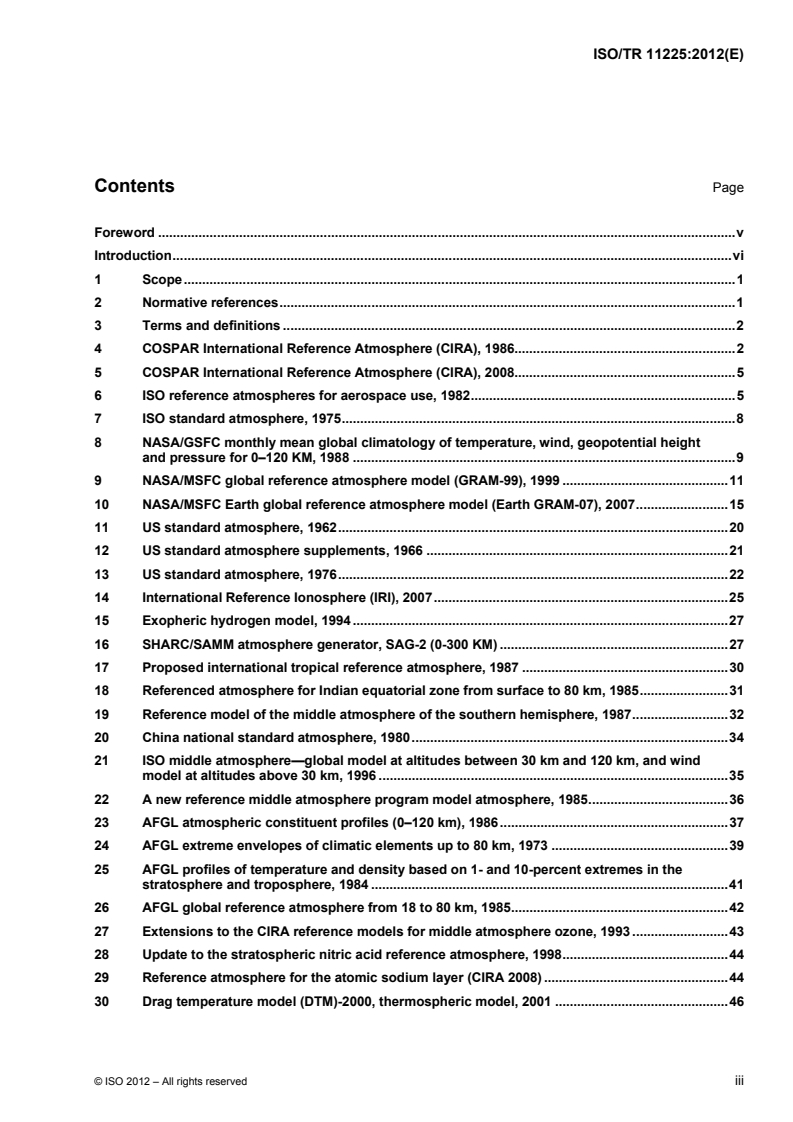
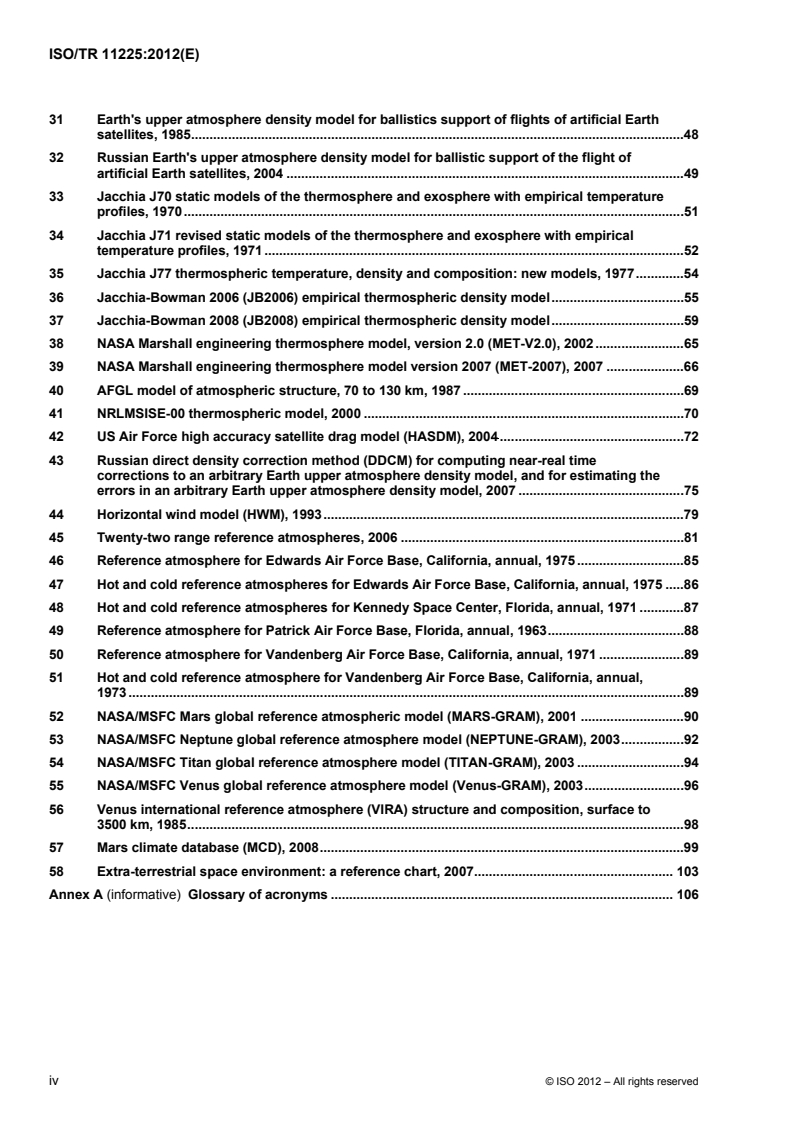
Contents Page
Foreword . v
Introduction . vi
1 Scope . 1
2 Normative references . 1
3 Terms and definitions . 2
4 COSPAR International Reference Atmosphere (CIRA), 1986. 2
5 COSPAR International Reference Atmosphere (CIRA), 2008. 5
6 ISO reference atmospheres for aerospace use, 1982 . 5
7 ISO standard atmosphere, 1975 . 8
8 NASA/GSFC monthly mean global climatology of temperature, wind, geopotential height
and pressure for 0–120 KM, 1988 . 9
9 NASA/MSFC global reference atmosphere model (GRAM-99), 1999 . 11
10 NASA/MSFC Earth global reference atmosphere model (Earth GRAM-07), 2007 . 15
11 US standard atmosphere, 1962 . 20
12 US standard atmosphere supplements, 1966 . 21
13 US standard atmosphere, 1976 . 22
14 International Reference Ionosphere (IRI), 2007 . 25
15 Exopheric hydrogen model, 1994 . 27
16 SHARC/SAMM atmosphere generator, SAG-2 (0-300 KM) . 27
17 Proposed international tropical reference atmosphere, 1987 . 30
18 Referenced atmosphere for Indian equatorial zone from surface to 80 km, 1985 . 31
19 Reference model of the middle atmosphere of the southern hemisphere, 1987 . 32
20 China national standard atmosphere, 1980 . 34
21 ISO middle atmosphere—global model at altitudes between 30 km and 120 km, and wind
model at altitudes above 30 km, 1996 . 35
22 A new reference middle atmosphere program model atmosphere, 1985 . 36
23 AFGL atmospheric constituent profiles (0–120 km), 1986 . 37
24 AFGL extreme envelopes of climatic elements up to 80 km, 1973 . 39
25 AFGL profiles of temperature and density based on 1- and 10-percent extremes in the
stratosphere and troposphere, 1984 . 41
26 AFGL global reference atmosphere from 18 to 80 km, 1985 . 42
27 Extensions to the CIRA reference models for middle atmosphere ozone, 1993 . 43
28 Update to the stratospheric nitric acid reference atmosphere, 1998 . 44
29 Reference atmosphere for the atomic sodium layer (CIRA 2008) . 44
30 Drag temperature model (DTM)-2000, thermospheric model, 2001 . 46
31 Earth's upper atmosphere density model for ballistics support of flights of artificial Earth
satellites, 1985 .48
32 Russian Earth's upper atmosphere density model for ballistic support of the flight of
artificial Earth satellites, 2004 .49
33 Jacchia J70 static models of the thermosphere and exosphere with empirical temperature
profiles, 1970 .51
34 Jacchia J71 revised static models of the thermosphere and exosphere with empirical
temperature profiles, 1971 .52
35 Jacchia J77 thermospheric temperature, density and composition: new models, 1977 .54
36 Jacchia-Bowman 2006 (JB2006) empirical thermospheric density model .55
37 Jacchia-Bowman 2008 (JB2008) empirical thermospheric density model .59
38 NASA Marshall engineering thermosphere model, version 2.0 (MET-V2.0), 2002 .65
39 NASA Marshall engineering thermosphere model version 2007 (MET-2007), 2007 .66
40 AFGL model of atmospheric structure, 70 to 130 km, 1987 .69
41 NRLMSISE-00 thermospheric model, 2000 .70
42 US Air Force high accuracy satellite drag model (HASDM), 2004 .72
43 Russian direct density correction method (DDCM) for computing near-real time
corrections to an arbitrary Earth upper atmosphere density model, and for estimating the
errors in an arbitrary Earth upper atmosphere density model, 2007 .75
44 Horizontal wind model (HWM), 1993 .79
45 Twenty-two range reference atmospheres, 2006 .81
46 Reference atmosphere for Edwards Air Force Base, California, annual, 1975 .85
47 Hot and cold reference atmospheres for Edwards Air Force Base, California, annual, 1975 .86
48 Hot and cold reference atmospheres for Kennedy Space Center, Florida, annual, 1971 .87
49 Reference atmosphere for Patrick Air Force Base, Florida, annual, 1963 .88
50 Reference atmosphere for Vandenberg Air Force Base, California, annual, 1971 .89
51 Hot and cold reference atmosphere for Vandenberg Air Force Base, California, annual,
1973 .89
52 NASA/MSFC Mars global reference atmospheric model (MARS-GRAM), 2001 .90
53 NASA/MSFC Neptune global reference atmosphere model (NEPTUNE-GRAM), 2003 .92
54 NASA/MSFC Titan global reference atmosphere model (TITAN-GRAM), 2003 .94
55 NASA/MSFC Venus global reference atmosphere model (Venus-GRAM), 2003 .96
56 Venus international reference atmosphere (VIRA) structure and composition, surface to
3500 km, 1985 .98
57 Mars climate database (MCD), 2008 .99
58 Extra-terrestrial space environment: a reference chart, 2007 . 103
Annex A (informative) Glossary of acronyms . 106
iv © ISO 2012 – All rights reserved
Foreword
ISO (the International Organization for Standardization) is a worldwide federation of national standards bodies
(ISO member bodies). The work of preparing International Standards is normally carried out through ISO
technical committees. Each member body interested in a subject for which a technical committee has been
established has the right to be represented on that committee. International organizations, governmental and
non-governmental, in liaison with ISO, also take part in the work. ISO collaborates closely with the
International Electrotechnical Commission (IEC) on all matters of electrotechnical standardization.
International Standards are drafted in accordance with the rules given in the ISO/IEC Directives, Part 2.
The main task of technical committees is to prepare International Standards. Draft International Standards
adopted by the technical committees are circulated to the member bodies for voting. Publication as an
International Standard requires approval by at least 75 % of the member bodies casting a vote.
Attention is drawn to the possibility that some of the elements of this document may be the subject of patent
rights. ISO shall not be held responsible for identifying any or all such patent rights.
ISO/TR 11225 was prepared by Technical Committee ISO/TC 20, Aircraft and space vehicles, Subcommittee
SC 14, Space systems and operations.
Introduction
th
Since the mid 19 century there has been considerable effort devoted to the development of standards and
reference atmosphere models. The first “Standard Atmospheres” were established by international agreement
in the 1920s. Later some countries, notably the United States, also developed and published Standard
Atmospheres. The term reference atmospheres is generally used to identify atmosphere models for specific
geographical locations or globally.
The proliferation of atmospheric models and the lack of documentation have hindered general knowledge of
their availability as well as information on their relative strengths, weaknesses, and limitations. The intent of
this guide is to compile in one reference practical information about some of the known historical and available
atmospheric models-those which describe the physical properties and chemical composition of the
atmosphere as a function of altitude. The inclusion in this Guide of information on the various reference and
standard atmosphere models is not meant to imply endorsement by ISO of the respective model. Also, inputs
provided on the models were based on the information available at the time the entry was originally prepared.
The included Earth and other planetary models are those intended for general purpose or aerospace
applications. The information provided, while deemed current at time of inclusion in the summary write-ups,
may or may not still be current at the time of this version of the Guide is published. Therefore, the reader
should further research the information before making decisions on usage of the model(s) of interest. The
models extend to heights ranging from as low as the surface to as high as 4000 km. Models describing
exclusively low altitude phenomena are not included. Possible examples of the latter are particulate aerosols
or pollutants in the boundary layer and cloud properties as a function of altitude in the troposphere. Dynamical
models such as the Earth Troposphere-Stratosphere General Circulation Models (GCM), the Thermosphere-
Ionosphere-Mesosphere-Electrodynamics General Circulation Model (TIME-GCM), and research reports on
measurements made by satellite, aircraft, and ground systems of the atmosphere are also not included in this
Technical Report.
vi © ISO 2012 – All rights reserved
TECHNICAL REPORT ISO/TR 11225:2012(E)
Space environment (natural and artificial) — Guide to reference
and standard atmosphere models
1 Scope
This Technical Report provides guidelines for selected reference and standard atmospheric models for use in
engineering design or scientific research. It describes the content of the models, uncertainties and limitations,
technical basis, databases from which the models are formed, publication references, and sources of
computer code where available for over seventy (70) Earth and planetary atmospheric models, for altitudes
from surface to 4000 kilometers, which are generally recognized in the aerospace sciences. This standard is
intended to assist aircraft and space vehicle designers and developers, geophysicists, meteorologists, and
climatologists in understanding available models, comparing sources of data, and interpreting engineering and
scientific results based on different atmospheric models.
This Technical Report summarizes the principal features of the models to the extent the information is
available:
• Model content
• Model uncertainties and limitations
• Basis of the model
• Publication references
• Dates of development, authors and sponsors
• Model codes and sources
The models are listed in the table of contents according to whether they are primarily global, middle
atmosphere, thermosphere, range, or regional (i.e., applying only to a specific geographic location). This
division is admittedly somewhat arbitrary because many of the models embody elements of several of the
categories listed.
With few exceptions, there is no information on standard deviations from the mean values or frequencies of
occurrence of the variables described by these models. This lack of information prohibits quantitative
assessments of uncertainties, and is a serious deficiency in nearly all reference and standard atmospheric
models.
Recommendations for models to include in subsequent revisions will be welcomed.
2 Normative references
The following referenced documents are indispensable for the application of this document. For dated
references, only the edition cited applies. For undated references, the latest edition of the referenced
document (including any amendments) applies.
ISO 5878:1982, Reference atmospheres for aerospace use
ISO 5878:1982/Add 1:1983, Reference atmospheres for aerospace use — Addendum 1: Wind supplement
ISO 5878:1982/Add 2:1983, Reference atmospheres for aerospace use — Addendum 2: Air humidity in the
Northern Hemisphere
ISO 5878:1982/Amd 1:1990, Reference atmospheres for aerospace use — Amendment 1
3 Terms and definitions
For the purposes of this document, the following terms and definitions apply.
3.1
reference atmospheres
vertical temperature profiles for each latitude and season; atmosphere models for specific geographical
locations or globally
3.2
mean sea level
reference point for both geopotential and geometric altitudes
3.3
geopotential altitude
point in atmosphere expressed in terms of its potential energy per unit mass (geopotential) at this altitude
relative to sea level
4 COSPAR International Reference Atmosphere (CIRA), 1986
4.1 Model content
The COSPAR International Reference Atmosphere (CIRA) provides empirical models of atmospheric
temperature and density from 0 km to 2000 km as recommended by the Committee on Space Research
(COSPAR). Since the early sixties, different editions of CIRA have been published: CIRA 1961, CIRA 1965,
CIRA 1972, and CIRA 1986.
The Committee on Space Research’s CIRA 1986 Model Atmosphere consists of three parts: Part I: Models of
the Thermosphere, Part II: Models of the Middle Atmosphere, and Part III: Models of Trace constituents. Part
II is similar in many respects to the NASA/GSFC Monthly Mean Climatology of Temperature, Wind,
Geopotential Height and Pressure for 0-120 km. This model is described later in this volume. Part III
(published in 1996) gives model information on ozone, water vapor, methane and nitrous oxide, nitric acid,
nitrogen dioxide, carbon dioxide and halogenated hydrocarbons, nitric oxide, stratospheric aerosols, atomic
oxygen, and atomic hydrogen.
Chapter 1 of Part I (ref 5.1) describes the empirical thermospheric model which is based on the Mass
Spectrometer-Incoherent Scatter (MSIS) 1986 model of Hedin (ref 5.6, 5.8). Like Hedin’s model, the altitude
range is 90-2000 km, however, the models presented in Part I should be used exclusively for applications
above 120 km; Part II should be exclusively used below 90 km while the “merging models” contained in Part II
should be used for applications between 90 and 120 km. The atmospheric parameters yielded by the model
are temperature, density, and composition, but not neutral winds. A large number of representative tables,
coefficients, and the FORTRAN program are listed in the appendices of this referenced volume. With the aid
of the program and the coefficients, representative thermospheric parameters can be generated for all
locations, Universal Time and seasons, and for a very wide range of solar and geomagnetic activity.
Chapter 2 presents theoretical thermospheric models attributed to Rees and Fuller-Rowell (ref 5.7). These
models reveal the detailed interrelationships between thermospheric structure (i.e., temperature and density),
chemistry, and dynamics for simplified models of solar and geomagnetic forcing. A set of initial case studies
using a coupled polar ionosphere/global thermosphere model is also presented, which demonstrates the
major interactions between the thermosphere and ionosphere.
2 © ISO 2012 – All rights reserved
Part I also contains five specialized chapters which review the major empirical contributions to our current
understanding of the thermosphere. These sections discuss in situ mass spectrometer measurements of
composition, temperature and winds; incoherent scatter radar measurements, satellite and ground-based
measurements of thermospheric temperatures and winds, the thermospheric storm-like response to high
levels of geomagnetic activities; and our understanding of the variance of solar EUV radiation.
Subsequent to publication of the CIRA 1986 model, several related developments have occurred. They
include: (1) the characterization of the mean behavior of the Earth’s atmosphere from 0 to 120 km altitude on
the basis of the CIRA 1986 model (ref 5.4) as an annual zonal mean for 30 deg N to derive single profiles for
the pressure, height, temperature, and zonal wind, and (2) a new zonal mean CIRA-1986 of temperature,
zonal wind, and geopotential / geometric height as a function of altitude or pressure extending from the ground
to approximately 120 km in the 80 deg S – 80 deg N latitudes (ref. 5.5).
The COSPAR committee responsible for updating the CIRA, 1986 Model met in July 2008 to address the
updating of the CIRA, 1986 Model. The CIRA 2008 Model was adopted by COSPAR.
4.2 Model uncertainties and limitations
4.2.1 The quality of the database describing some observables is variable. The experimental global scale
database for the lower thermosphere is still extremely limited.
4.2.2 The models are not reliable for large atmospheric disturbances. However, the causes of atmospheric
variability are discussed in great detail.
Standard deviations from mean values of atmospheric parameters are not provided.
4.3 Basis of the model
As stated previously, the empirical thermosphere model is based on the MSIS-86 model of Hedin (ref. 5.7).
The empirical model is complemented by theoretical models of Rees and Fuller-Rowell that show the
relationships between thermospheric structure, chemistry and dynamics for simplified models of solar and
geomagnetic forcing.
4.4 Databases
The principal publications which present the thermosphere database are listed in the MSIS-86 model
description (ref. 5.6). Hedin (1988) also wrote a specially-commissioned section within 5.1 relating to the
suitability and use of MSIS as the selected semi-empirical model for CIRA 1986-Part l.
4.5 Publication references
4.5.1 Rees, D., Editor, (1988): “COSPAR International Reference Atmosphere 1986 Part l. Thermospheric
Models, “Advances in Space Research, Vol. 8, No. 5/6, Pergamon Press, Oxford and NY.
4.5.2 Rees, D., J. J. Bernett, and K. Labitzke, editors (1990): “CIRA 1986, COSPAR International
Reference Atmosphere, Part II: Middle Atmosphere Models,” Advances in Space Research, Vol. 10, No. 12,
Pergamon Press, Oxford and NY.
4.5.3 Keating, G. M., editor (1996): COSPAR International Reference Atmosphere (CIRA), Part III: Trace
Constituent Reference Models,” Advances in Space Research, Vol. 18, No. 9/10, Pergamon Press, Oxford
and NY.
4.5.4 Barnett, J. J. and S. Chandra (1990): “COSPAR International Reference Atmosphere Grand Mean,”
Advances in Space Research, Vol. 10, No. 12, Pergamon Press, Oxford and NY.
4.5.5 Fleming, Eric L., Sushil Chandra, J. J. Barnett, and M. Corney (1990): “Zonal Mean Temperature,
Pressure, Zonal Wind, and Geopotential Height as Functions of Latitude,” Advances in Space Research,
Vol 10, No. 12, Pergamon Press, Oxford and NY.
4.5.6 Hedin, A. E. (1987): “MSIS-86 Thermospheric Model.” J. Geophys. Res., Vol 92, Pages 4649-4662.
4.5.7 Rees, D., and T. J. Fuller-Rowell (1988): The CIRA Theoretical Thermosphere Model, “ pages (5)
25-(5) 106, Advances in Space Research, Vol. 8, No. 5/6, Pergamon Press, Oxford and NY.
4.5.8 Hedin, A. E. (1087): The Atmospheric Model in the Region 90 to 2000 km,” Pages (5) 9-(5) 25,
Advances in Space Research, Vol. 8, No. 5/6, Pergamon Press, Oxford and NY.
4.5.9 Hedin, A. E., J. E. Salah, J. V. Evans, C. A. Reber, G. P. Newton, N. W. Spencer, D. C. Kayser, D.
Alcayde, Pl Bauer, L. Cogger, and J. Pl McClure, (1977) “A Global Thermospheric Model Based on Mass
Spectrometer and Incoherent Scatter Data”, MSIS 1, N2 Density and Temperature, J. Geophys. Res. 82,
2139-2147, 1977.
4.5.10 Hedin, A. E., G. A. Reber, G. P. Newton, N. W. Spencer, H. C. Brinton, H. G. Mayr, and W. E. Potter
(1977): A Global Thermospheric Model Based on Mass Spectrometer and Incoherent Scatter Data”, MSIS 2,
Composition, J. Geophys. Res., 82, 2148-2156, 1977.
4.6 Dates of development, authors, and sponsors
4.6.1 Dates:
Original model 1961
Revised model 1965
Revised model 1972
Revised model 1986
Trace constituent model 1996
Zonal mean model 1990
4.6.2 Many scientists made contributions to the three parts of the CIRA models. They are identified in
references 5.1, 5.2, and 5.3.
4.6.3 Co-Sponsors: Committee on Space Research (COSPAR) of the International Council of Scientific
Unions (ICSU) and the International Union of Radio Science (URSI).
4.7 Model codes and sources
The thermosphere model is published in the form of tables and figures with a FORTRAN computer code
included in an Appendix, describing the semi-empirical models of Part I, Chapter 1 (Ref 4.5.1). This program,
and the program from which the results of the theoretical and numerical model results can be generated
(Part I, Chapter 2) are available in computer-compatible form (tape or disk). They may also be obtained from
certain electronic databases. See Reference 4.5.1 for thermosphere model, Reference 4.5.2 for middle
atmosphere model, Reference 4.5.3 for trace constituent model, Reference 4.5.1 for grand mean model, and
Reference 4.5.5 for new zonal mean CIRA, 1986 model.
NOTE At the time of preparation of this document, plans were being made by the COSPAR to produce an updated and
revised version (CIRA08) of the COSPAR International Reference Atmosphere (CIRA), 1986. It is anticipated that the
CIRA08 will be published in 2009 as a Special Issue of Advances in Space Research. Therefore, when planning to use
CIRA, 1986 the availability of the new CIRA, 2008 should first be ascertained.
4 © ISO 2012 – All rights reserved
5 COSPAR International Reference Atmosphere (CIRA), 2008
5.1 CIRA-08
The COSPAR International Reference Atmosphere (CIRA) provides empirical models of atmospheric
temperature and density from 0 km to 4000 km as recommended and adopted by the Committee on Space
Research (COSPAR) and by the International Union of Radio Science (URSI). Since the early sixties, several
distinct editions of CIRA have been published: CIRA 1961, CIRA 1965, CIRA 1972 CIRA 1986 and most
recently, CIRA-08 (or CIRA-2008), which is currently in preparation by the CIRA Working Group.
5.2 Model content
The Committee on Space Research’s CIRA 2008 Model Atmosphere will contain the following major
contributions, in terms of recommended atmospheric models for use:
For Total Mass Density above 120 km:
Jacchia-Bowman 2008 and GRAM-07
For the Structure and Composition of the Atmosphere (ground-level upward):
NRLMSISE-00
For Neutral Winds in the Atmosphere (all levels):
Horizontal Wind Model-07 (HWM-07)
For Neutral Wind up to 120 km altitude:
Global Wind Empirical Model (GWEM)
There will also be chapters discussing the current state of knowledge and application of the Solar and
Geomagnetic Indices that are used to drive the new empirical models such as JB-2008; Metal Chemistry of
the Mesosphere and Lower Thermosphere, and expert advice regarding the limitations of the models and the
best use of the models for specific applications.
5.3 Model availability
CIRA-08 is currently in preparation, and is expected to be published in early 2009 as a Special Edition of
Advances in Space Research. The recommended Models within CIRA-08 are expected to be Web based,
along with guides to the best use of the Models.
5.4 Sponsors
Co-Sponsors: Committee on Space Research (COSPAR) of the International Council of Scientific Unions
(ICSU) and the International Union of Radio Science (URSI).
6 ISO reference atmospheres for aerospace use (ISO 5878:1982)
6.1 Model content
The International Organization for Standardization (ISO) Reference Atmospheres for Aerospace Use, 1982
consists of three documents containing tables and some figures. They present information on the seasonal,
latitudinal, longitudinal, and day-to-day variability of atmospheric properties at levels between the surface and
80 km.
ISO 5878:1982 contains values of temperature, pressure and density as a function of geometric and
geopotential altitude up to 80 km. Specific models include: (1) an annual model for 15 deg N latitude; (2)
seasonal models for 30 deg, 45 deg, 60 deg and 80 deg N latitude; (3) cold and warm stratospheric and
mesospheric regimes for 60 deg and 80 deg N latitude in December and January; and (4) seasonal and
latitudinal variations of temperatures and density for medium, high and low percentile values.
Addendum 2:1983 to ISO 5878:1982 contains parameters (means and standard deviations) of Northern
Hemisphere observed wind distributions in January and July up to 25 km for (1) four latitude zones plus
calculated values of the scalar mean wind speed and of high and low percentile values of wind speed; (2) four
stations (Dakar, Kagoshima, New York and Jan Mayen) with strong winds; (3) (Ajan, Clyde, Guam, and
Muharrag) with light winds; and (4) four meridians plus high and low values of wind speeds.
The Addendum contains values (mixing ratio, vapor pressure and dew point temperatures) of the Northern
Hemisphere air humidity in January and July to 10 km for (1) median values at 10 deg, 30 deg, 50 deg, and
70 deg N latitude; (2) median values along 0 deg, 80 deg E and 180 deg, 80 deg W meridians; (3) percentiles
(20 percent, 10 percent, 5 percent and 1 percent) in extremely dry and moist areas and seasons, and (4)
mean values for four stations representative of dry and moist regions (Tammaurrasset, North Africa;
Xhigawsk, East Siberia; Calcutta, India, and Turk, Pacific Islands).
6.2 Model uncertainties and limitations
6.2.1 The temperature, pressure and density models are subject to the uncertainties associated with errors
(about 1 deg C) in the standard radiosonde instruments used by the various countries to measure temperature
profiles to altitudes near 30 km. Meteorological Rocketsonde temperature errors are about 2 deg C in the
30 to 50 km altitude range and increase to about 8 deg C at 80 km. For the meteorological rocket
measurements, the thermistor measurements of temperature are subject to large corrections and
uncertainties with increasing altitude. Therefore, the measurements above 50 km were not used.
Measurements above 30 km, and especially above 50 km, were very limited. The warm and cold models for
60 deg and 80 deg N latitude are based on so few measurements that they are, at best, only rough estimates.
Confidence in their distribution decreases rapidly above 50 km where data are relatively sparse and
instrumentation errors relatively large.
6.2.2 The rawinsonde observations of wind velocity have uncertainties of about 5 percent of the vector
wind for 0.6 km mean layers. For tracking angles within 6 deg of the horizontal, which occurs under strong jet
stream conditions, the wind velocities are unreliable. According to the authors, their analysis of the scalar
mean speed derived from observations, and calculated from the circular normal distribution may be used to
calculate the values of wind speed with an accuracy sufficient for most practical purposes.
6.2.3 Reasonably reliable radiosonde measurements of humidity are available up to 10 km above sea
level. Relative error varies with temperature from about 5 percent at +40 deg C to 15 percent at -40 deg C and
are unreliable below -40 deg C. The tabulated humidity values above 8 km should be regarded as
approximate because the quantity of data is insufficient.
6.2.4 Other model limitations due to the analytical and statistical fractions used as well as sample sizes are
discussed in the text of the documents. The reference atmospheres are considered applicable to the Northern
hemisphere only.
6.3 Basis of the model
The numerical values of the various thermodynamic and physical parameters used in the comparisons of
atmospheric properties are the same as those used in the ISO 2533:1975, Standard Atmosphere, with the
exception of surface conditions and the acceleration of gravity. Mean sea level is taken as the reference for
both geopotential and geometric altitudes. The reference atmospheres are defined by the vertical temperature
profiles for each latitude and season. The vertical gradients of temperature are constant with respect to
geopotential altitude within each of a number of layers. Air is assumed to be a perfect gas, free from moisture
or dust. The reference atmosphere upper stratosphere and mesosphere temperature observations for the
southern hemisphere were phase adjusted by six months to conform to Northern hemisphere seasons.
The wind parameters are based on observations and use of the circular normal distribution functions, which
the authors consider acceptable for most practical purposes.
6 © ISO 2012 – All rights reserved
The humidity parameters are based on relative humidity and temperature measurements from radiosonde
observations. The humidity-mixing ratio is used as the main humidity characteristic.
6.4 Databases
The vertical pressure and density distributions were calculated from the temperature-altitude profiles using the
hydrostatic equation, the perfect gas law and appropriate mean sea-level values of pressure. The temperature
distributions for levels below 30 km were derived from routine radiosonde observations from the 1955-1966
time period as contained in Monthly Climatic Data of the World by the World Meteorological Organization. The
temperature field between 30 and 50 km is based on meteorological rocket measurements (bead thermistor or
resistance wires) made at 17 locations primarily during the 1964-1970 time period. The temperature
distributions between 50 and 80 km are based primarily on grenade, falling sphere, and pressure gauge
experiments made at 12 locations during the 1957-1971 time period.
The values of the quantities describing the wind fields were obtained for the altitude range 0 to 25 km from
actual observations made by balloon borne instruments and by estimation using the circular normal
distribution. The measurements were primarily in the 1950 to 1970 time period.
The values of humidity were derived from radiosonde measurements for the altitude range 0 to 25 km. These
measurements were also made primarily during the 1950 to 1970 time period.
6.5 Publication references
6.5.1 ISO 5878:1982, Reference Atmospheres for Aerospace Use, Technical Committee ISO/TC 20,
Aircraft and Space Vehicles.
6.5.2 ISO 5878:1982 / Addendum 1:1983, Reference Atmospheres, Addendum 1: Wind Supplement,
Technical Committee ISO TC 20, Aircraft and Space Vehicles.
6.5.3 ISO 5878:1982 / Addendum 2:1983, Reference Atmospheres for Aerospace Use, Addendum 2: Air
Humidity in the Northern Hemisphere, Technical Committee ISO/TC 20, Aircraft and Space Vehicles.
6.5.4 ISO 5878:1982/ Amendment 1:1990, Reference Atmospheres for Aerospace Use, Amendment 1,
Technical Committee ISO/TC, Aircraft and Space Vehicles.
6.6 Dates of development, authors and sponsors
6.6.1 Dates: ISO 5878-1982 circulated in November 1978, published in 1982
ISO 5878-1982/Addendum 1-1983 circulated in March 1979, published in 1983
ISO 5878/1982/Addendum 2-1983 circulated in April 1982, published in 1983
6.6.2 Authors: Members of Subcommittee 6 (Standard Atmospheres) of the International Organization
for Standardization, Technical Committee 20 (Aircraft and Space Vehicles).
6.6.3 Sponsors: International Organization for Standardization, Geneva, Switzerland, under the direction
of Technical Committee 20 - Secretariat, Aerospace Industries Association of America, Inc., 1250 Eye Street,
N.W., Washington, DC 20005.
6.7 Model codes and sources
The models are published in the form of tables and figures only. They are available from: American National
Standards Institute, 25 West 43 Street, New York, NY 10036. http://www.ansi.org
NOTE At the time this document was prepared, the SC 6 "Standard Atmosphere" of Technical Committee ISO/TC20,
Aircraft and Space Vehicles was in the process of updating and revising ISO 5878, ISO Reference Atmospheres for
Aerospace Use. This new version of ISO 5878 was published in draft form for review April 12, 2004 as ISO/WD 213-3
“Global Reference Atmosphere for Altitude 0-120 km for Aerospace Use” based on the work by ISO/TC 20/SC 6 “Standard
Atmosphere” during the period 1998–2003. It is the intent that it be published as an ISO International Standard "Global
Reference Atmosphere for Altitude 0-120 km for Aerospace Use".
This planned new ISO International Standard will present a set of models of vertical profiles of zonal (for 10 degree
latitudinal belts) and seasonal mean temperatures, pressures, densities, and meridian and zonal wind speeds, as well as
the space and temporal variability of these parameters in terms of standard deviations, for the altitude from 0 up to 120
km. The models of atmospheric parameters will be presented in graphic and tabular form in terms of geometric and
componential altitudes and nearly pole-to-pole coverage (80 degrees N–80 degrees S) of both hemispheres for four
central months of the seasons—January, April, July and October. The algorithms and recommendations for the
atmospheric parameters probability characteristics, which are the most useful for aviation and space practice, will also be
given. ISO 213 is being developed to serve as an informational basis for international air-space practice as well as to unify
the atmospheric models, which have to be used for design, production, exploitation and navigation of aircraft and space
vehicles and their equipment.
Accordingly, it is recommended that those consulting this document for information on ISO 5878 investigate to see if the
new ISO standard “Global Reference Atmosphere for Altitude 0-120 km for Aerospace Use” has been published by the
ISO/TC 20/SC 6 “Standard Atmospheres” and obtain a copy for use in lieu of ISO 5878. At the time of the preparation of
this document the Draft Standard “Global Reference Atmosphere for Altitude 0-120 km for Aerospace Use” was in a
process of approval as a National Russia and Commonwealth of Independent States (CIS) Countries Standard.
7 ISO Standard Atmosphere (ISO 2533:1975)
7.1 Model content
The International Organization for Standardization (ISO) Standard Atmosphere consists of a document
containing tables of atmospheric characteristics as functions of geometric and geopotential altitudes to 80 km.
They define the ISO Standard Atmosphere for the altitudes to 50 km. The data are identical to the ICAO and
WMO Standard Atmospheres to 32 km and are based on the standard atmospheres of ICAO 1964 and US
Standard 1962. The authors considered these models to be the most representative when comparing current
national and international standards and recommendations relative to the atmosphere based on the results of
recent research. Data from this recent research have been used for calculation of the atmospheric
characteristics for altitudes 50 km to 80 km that represent the ISO Interim Standard Atmosphere for this
altitude range. Data in the tables are given in SI units except that temperature is also given in degrees Celsius
and pressures are given in millibars and millimeters of mercury.
ISO 2544:1975 contains values of temperature, pressure, density, acceleration of gravity, speed of sound,
dynamic viscosity, kinematic viscosity, thermal conductivity, pressure scale height, specific weight, air number
density, mean air-particle collision frequency, and mean free path as a function of geometric and geopotential
altitude up to 80 km.
7.2 Model uncertainties and limitations
7.2.1 The tables have been calculated assuming the air to be a perfect gas free from moisture and dust
and based on conventional initial values of temperature, pressure and density.
7.2.2 The model approximates the annual nominal atmosphere for 45 degrees north latitude. As such,
large variations in monthly mean or even annual mean atmospheres for the other latitudes and longitudes
around the globe, relative to the values given in the ISO Standard Atmosphere, may be expected. Thus, while
providing a common frame of reference for comparing engineering designs, instrumentation calibrations and
processing of data, the model may exhibit significant deviations from the nominal annual, and especially
monthly, profiles of atmospheric parameters for given latitude and longitude locations. These are, however,
the same limitations found in the models used as a basis for the ISO Standard Atmosphere. The user should
be aware of these uncertainties and limitations of the model.
7.3 Basis of the model
The numerical values in the table for altitudes to 50 km are based on the ICAO Standard Atmosphere 1964,
the US Standard Atmosphere, 1962, and the COSPAR International Reference Atmosphere, 1965 (CIRA
1965); results of recent research as noted in the references were used for the 50 to 80 km altitude region. For
the altitudes to 32 km the tables are identical to the ICAO Standard Atmosphere, 1964.
8 © ISO 2012 – All rights reserved
7.4 Databases
Mean sea level is taken as the reference point for both the geopotential and geometric altitudes. The perfect
gas law is used for the calculations that assume a well-mixed atmosphere. The temperature of each
atmospheric layer is taken as a linear function of the geopotential altitude. The constants, coefficients,
equations and data were selected from these references:
7.4.1 COSPAR Working Group IV. COSPAR International Reference Atmosphere, 1965 (CIRA 1965),
North Holland Publishing Co., Amsterdam, 1965.
7.4.2 Comitet Standartov USSR: GOST 4401.64 "Tabblitsa Standartnoy Atmosfery," Izdatelstvo
Standartov, Moskva, 1964
7.4.3 Deutscher Normenausschuss: DIN 5450 "Norm Atmosphere," 1968.
7.4.4 Doc. 7486/2. Manual of the ICAO Standard Atmosphere extended to 32 kilometers, second edition,
1964, International Civil Aviation Organization, Montreal, 1964.
7.4.5 List, R. J., editor: Smithsonian Meteorological Tables, Sixth Revised Edition, Washington, DC, 1963.
7.4.6 US Committee on Extension to the Standard Atmosphere: US Standard Atmosphere, 1962, US
Government Printing Office, Washington, DC, 1962.
7.4.7 US Committee on Extension to the Standard Atmosphere: US Standard Atmosphere Supplements,
1966. US Government Printing Office, Washington, DC, 1966.
7.5 Publication references
ISO 2533:1975 “Standard Atmosphere First Edition, “Corrigendum 1, 1978, ISO, Geneva, Switzerland
7.6 Dates of development, authors and sponsors
7.6.1 Dates: Published 1975; corrected and updated 1978
7.6.2 Authors: Members of ISO TC20/SC6 (Aircraft and Space Vehicles / Standard Atmospheres)
7.6.3 Sponsors: International Organization for Standardization, Geneva, Switzerland
7.7 Model codes and sources
The model is published in the form of tables only. It is available from American National Standards Institute,
25 West 43 Street, New York, NY 10036. http://www.ansi.org
8 NASA/GSFC monthly mean global climatology of temperature, wind, geopotential height
and pressure for 0–120 KM, 1988
8.1 Model content
This climatological model, the National Aeronautics and Space Administration's NASA GSFC Monthly Mean
Global Climatology of Temperature, Wind, Geopotential Height and Pressure for 0-120 km, consists of a
NASA report and a floppy diskette to be used with a PC, and contains figures and tables which present
profiles of temperature, winds, and geopotential height as functions of altitude and pressure in the height
range 0-120 km. These atmospheric properties, which are presented in a climatological format, are monthly
mean values with nearly pole-to-pole coverage (80 deg S to 80 deg N). The model is intended for various
research and analysis activities such as the numerical simulation of atmospheric properties and t
...