


ISO/IEC 8649:1996
(Main)Information technology — Open Systems Interconnection — Service definition for the Association Control Service Element
Information technology — Open Systems Interconnection — Service definition for the Association Control Service Element
Technologies de l'information — Interconnexion de systèmes ouverts (OSI) — Définition de service applicable à l'élément de service de contrôle d'association
General Information
- Status
- Withdrawn
- Publication Date
- 09-Oct-1996
- Withdrawal Date
- 09-Oct-1996
- Technical Committee
- ISO/IEC JTC 1 - Information technology
- Drafting Committee
- ISO/IEC JTC 1 - Information technology
- Current Stage
- 9599 - Withdrawal of International Standard
- Start Date
- 13-Sep-2012
- Completion Date
- 12-Feb-2026
Relations
- Effective Date
- 10-Feb-2026
- Effective Date
- 09-Feb-2026
- Effective Date
- 06-Jun-2022
- Effective Date
- 06-Jun-2022
- Effective Date
- 15-Apr-2008
- Effective Date
- 15-Apr-2008
- Effective Date
- 15-Apr-2008
- Effective Date
- 15-Apr-2008
- Effective Date
- 15-Apr-2008
ISO/IEC 8649:1996 - Information technology -- Open Systems Interconnection -- Service definition for the Association Control Service Element
ISO/IEC 8649:1996 - Technologies de l'information -- Interconnexion de systemes ouverts (OSI) -- Définition de service applicable a l'élément de service de contrôle d'association
ISO/IEC 8649:1996 - Technologies de l'information -- Interconnexion de systemes ouverts (OSI) -- Définition de service applicable a l'élément de service de contrôle d'association
Get Certified
Connect with accredited certification bodies for this standard

BSI Group
BSI (British Standards Institution) is the business standards company that helps organizations make excellence a habit.

NYCE
Mexican standards and certification body.
Sponsored listings
Frequently Asked Questions
ISO/IEC 8649:1996 is a standard published by the International Organization for Standardization (ISO). Its full title is "Information technology — Open Systems Interconnection — Service definition for the Association Control Service Element". This standard covers: Information technology — Open Systems Interconnection — Service definition for the Association Control Service Element
Information technology — Open Systems Interconnection — Service definition for the Association Control Service Element
ISO/IEC 8649:1996 is classified under the following ICS (International Classification for Standards) categories: 35.100.70 - Application layer. The ICS classification helps identify the subject area and facilitates finding related standards.
ISO/IEC 8649:1996 has the following relationships with other standards: It is inter standard links to EN 61850-8-1:2011/A1:2020, EN ISO 16484-5:2014, ISO/IEC 8649:1996/Amd 2:1998, ISO/IEC 8649:1996/Amd 1:1997, ISO/IEC 15953:1999, ISO 8649:1988/Amd 1:1990, ISO 8649:1988; is excused to ISO/IEC 8649:1996/Amd 2:1998, ISO/IEC 8649:1996/Amd 1:1997. Understanding these relationships helps ensure you are using the most current and applicable version of the standard.
ISO/IEC 8649:1996 is available in PDF format for immediate download after purchase. The document can be added to your cart and obtained through the secure checkout process. Digital delivery ensures instant access to the complete standard document.
Standards Content (Sample)
INTERNATIONAL
lSO/IEC
STANDARD
Second edition
1996-l O-l 5
Information technology - Open Systems
Interconnection - Service definition for
the Association Control Service Element
Technologies de I’informa tion
- In terconnexion de syst&mes ouverts
(OS/) - Definition du service pour I%l6ment de service de con tr6le
d ‘association
Reference number
ISO/I EC 8649: 1996(E)
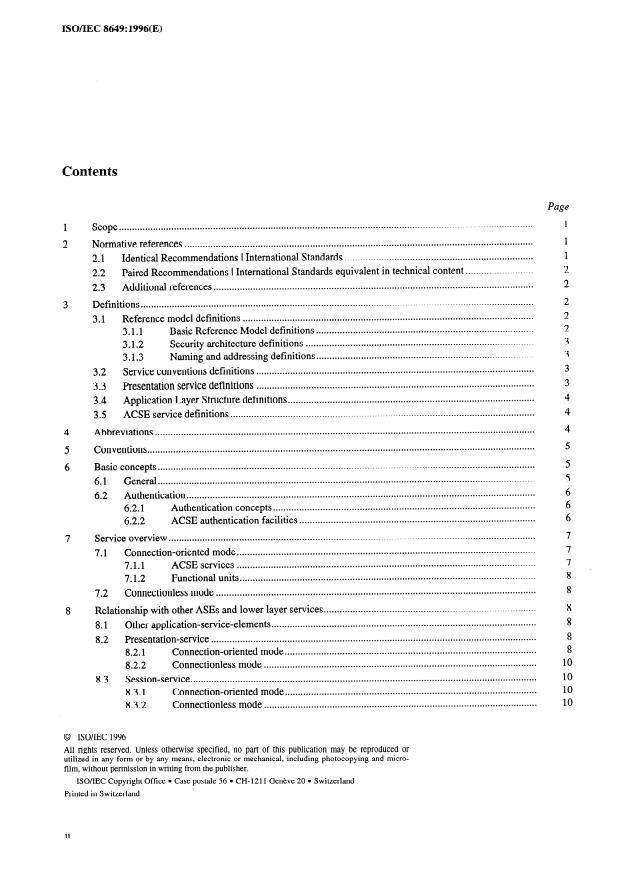
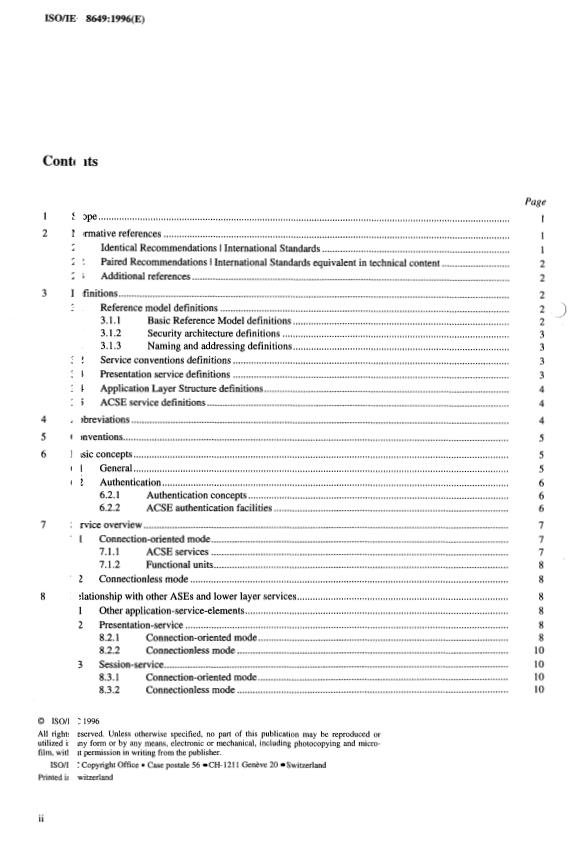
Contents
Page
. . . . . . . . . . . . . . . .*.~.
1 Scope
.....................................................................................................................................
2 Normative references
........................................................................
2.1 Identical Recommendations I International Standards
..........................
2.2 Paired Recommendations I International Standards equivalent in technical content
2.3 Additional references .
3 Definitions .
...............................................................................................................
31 . Reference model definitions
...................................................................................
3.1.1 Basic Reference Model definitions
.......................................................................................
3.1.2 Security architecture definitions
...................................................................................
Naming and addressing definitions
3.1.3
Service conventions definitions .
3.2
..........................................................................................................
Presentation service definitions
3.3
..............................................................................................
3.4 Application Layer Structure definitions
....................................................................................................................
35 . ACSE service definitions
. . . . . . . . . . . . . . . . . . . . .~.
4 Abbreviations
Conventions . . . . . . . . . . . . . . . . . . . . . . . . . . . . . . . . . . . . . . . . . . . . . . . . . . . . . . . . . . . . . . . . . . . . . . . . . . . . . . . . . . . . . . . . . . . . . . . . . . . .*.
6 Basic concepts .
General .
61 .
62 . Authentication .
....................................................................................................
Authentication concepts
6.2.1
ACSE authentication facilities .
6.2.2
............................................................................................................................................
7 Service overview
..................................................................................................................
Connection-oriented mode
7.1
ACSE services .
7.1.1
.................................................................................................................
7.1.2 Functional units
..........................................................................................................................
7.2 Connectionless mode
.................................................................................
8 Relationship with other ASEs and lower layer services
Other application-service-elements .
8.1
Presentation-service .
82 .
Connection-oriented mode .
8.2.1
........................................................................................................
8.2.2 Connectionless mode
83 . Session-service .
................................................................................................
8.3.1 Connection-oriented mode
Connectionless mode .
8.3.2
0 ISO/IEC 1996
All rights reserved. Unless otherwise specified, no part of this publication may be reproduced or
utilized in any form or by any means, electronic or mechanical, including photocopying and micro-
film, without permission in writing from the publisher. ,
ISO/IEC Copyright Office l Case postale 56 l CH-1211 Geneve 20 l Switzerland
Printed in Switzerland
ii
@ ISO/IEC
ISO/IEC 8649: 1996(E)
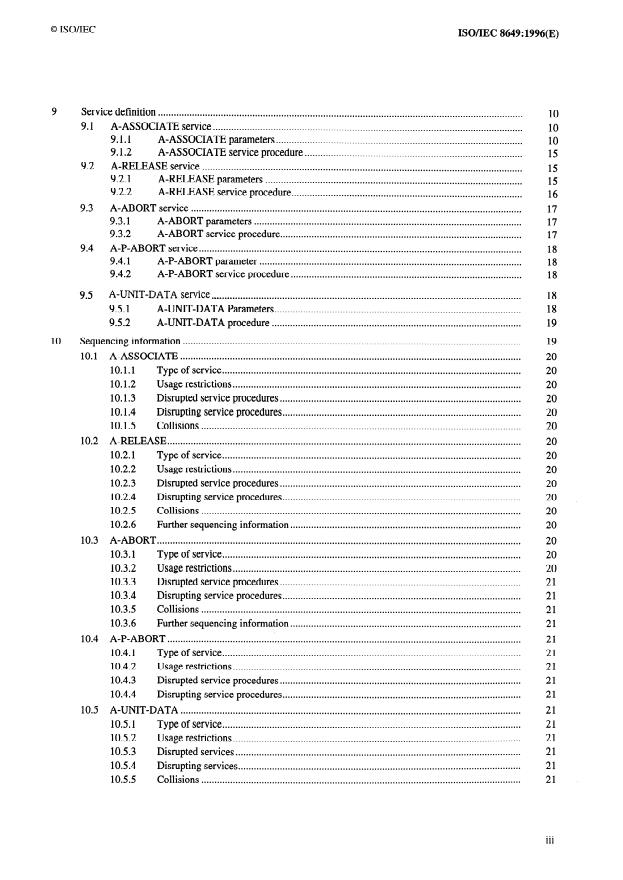
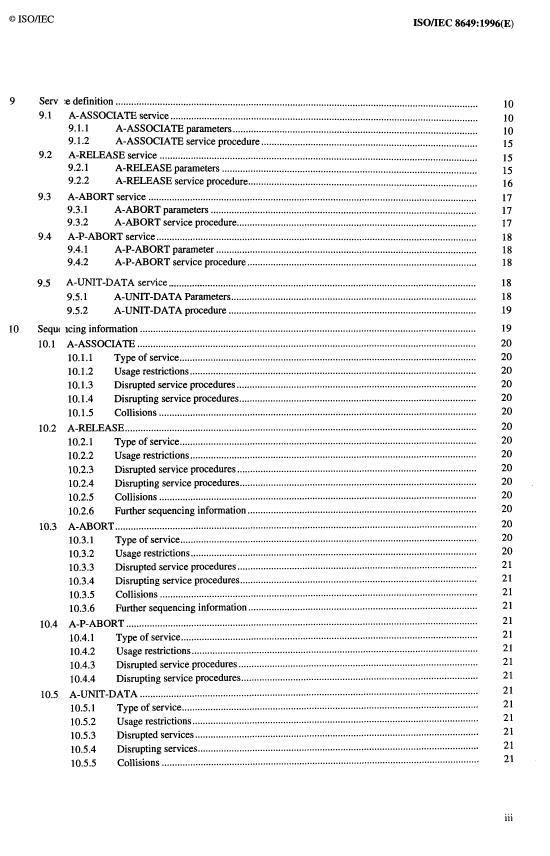
9 Service definition . . . . . . . . . . . . . . . . . . . . . . . . . . . . . . . . . . . . . . . . . . . . . . . . . . . . . . . . . . . . . . . . . . . . . . . . . . . . . . . . . . . . . . . . . . . . . . . . . . . . . . . . . . . . . . . . . . . . . . . . .
91 . A-ASSOCIATE service . . . . . . . . . . . . . . . . . . . . . . . . . . . . . . . . . . . . . . . . . . . . . . . . . . . . . . . . . . . . . . . . . . . . . . . . . . . . . . . . . . . . . . . . . . . . . . . . . . . . . . . . . . . . . . . . . . . . . . 10
A-ASSOCIATE parameters
9.1.1 . . . . . . . . . . .*. 10
9.1.2 A-ASSOCIATE service procedure . . . . . . . . . . . . . . . . . . . . . . . . . . . . . . . . . . . . . . . . . . . . . . . . . . . . . . . . . . . . . . . . . . . . . . . . . . . . . . . . . . . 15
9.2 A-RELEASE service . . . . . . . . . . . . . . . . . . . . . . . . . . . . . . . . . . . . . . . . . . . . . . . . . . . . . . . . . .*. 15
9.2.1 A-RELEASE parameters *.*.*~**~~.****~. 15
9.2.2 A-RELEASE service procedure
~*.e~.***. 16
. . . . . . . . . . . . . . . . . . . . . . . . . . . . . . . . . . . . . . . . . . . . . . . . . . . . . . . . . . . . . . . . . . . . . . . . . . . . . . . . . . . . . . . . . . . . . . . . . . . . . . . . . . . . . . . .*. 17
93 . A-ABORT service
. . . . . . . . . . . . . . . . . . . . . . . . . . . . . . . . . . . . . . . . . . . . . . . . . . . . . . . . . . . . . . . . . . . . . . . . . . . . . . . . . .~. 17
9.3.1 A-ABORT parameters
A-ABORT service procedure . . . . . . . . . . . . . . . . . . . . . . . . . . . . . . . . . . . . . . . . . . . . . . . . . . . . . . . . . . . . . . . . . . . . . . . . . . . . . . . . . . . . . . . . . . . .
9.3.2
A-P-ABORT service . . . . . . . . . . . . . . . . . . . . . . . . . . . . . . . . . . . . . . . . . . . . . . . . . . . . . . . . . . . . . . . . . . . . . . . . . . . . . . . . . . . . . . . . . . . . . . . . . . . . . . . . . . . . . . . . . . . . . . . . .
9.4
A-P-ABORT parameter . . . . . . . . . . . . . . . . . . . . . . . . . . . . . . . . . . . . . . . . . . . . . . . . . . . . . . . . . . . . . . . . . . . . . . . . . . . . . . . . . . . . . .*. 18
9.4.1
. . . . . . . . . . . . . . . . . . . . . . . . . . . . . . . . . . . . . . . . . . . . . . . . . . . . . . . . . . . . . . . . . . . . . . . . . . . . . . . . . . . . . . . . 18
9.4.2 A-P-ABORT service procedure
. A-UNIT-DATA setice .~.
A-UNIT-DATA Parameters . . . . . . . . . . . . . . . . . . . . . . . . . . . . . . . . . . . . . . . . . . . . . . . . . . . . . . . . . . . . . . . . . . . . . . . . . . . . . . . . . . . . . . . . . . . . . .
9.5.1
. . . . . . . . . . . . . . . . . . . . . . . . . . . . . . . . . . . . . . . . . . . . . . . . . . . . . . . . . . . . . . . . . . . . . . . . . . . . . . . . . . . . . . . . . . . . . . .
9.52 A-UNIT-DATA procedure
.................................................................................................................................
10 Sequencing information
10.1 A-ASSOCIATE .
Type of service .
10.1.1
..............................................................................................................
10.1.2 Usage restrictions
............................................................................................ 20
10.1.3 Disrupted service procedures
Disrupting service procedures .
10.1.4
Collisions .
10.1.5
.......................................................................................................................................
10.2 A-RELEASE
10.2.1 Type of service .
10.2.2 Usage restrictions .
Disrupted service procedures .
10.2.3
10.2.4 Disrupting service procedures .
Collisions .
10.25
........................................................................................
10.2.6 Further sequencing information
10.3 A-ABORT .
10.3.1 Type of service .
Usage restrictions .
10.3.2
Disrupted service procedures .
10.3.3
...........................................................................................
10.3.4 Disrupting service procedures
10.3.5 Collisions .
Further sequencing information .
10.3.6
10.4 A-P-ABORT .
Type of service .
10.4.1
10.4.2 Usage restrictions .
Disrupted service procedures .
10.4.3
Disrupting service procedures .
10.4.4
10.5 A-UNIT-DATA .
10.5.1 Type of service .
10.52 Usage restrictions .
10.5.3 Disrupted services .
10.5.4 Disrupting services .
Collisions .
10.5.5
. . .
ISO/IEC 8649: 1996(E)
0 ISO/IEC
Foreword
IS0 (the International Organization for Standardization) and IEC (the Inter-
national Electrotechnical Commission) form the specialized system for worldwide
standardization. National bodies that are members of IS0 or IEC participate in the
development of International Standards through technical committees established
by the respective organization to deal with particular fields of technical activity.
IS0 and IEC technical committees collaborate in fields of mutual interest. Other
international organizations, governmental and non-governmental, in liaison with
IS0 and IEC, also take part in the work.
In the field of information technology, IS0 and IEC have established a joint
technical committee, ISO/IEC JTC 1. Draft International Standards adopted by the
joint technical committee are circulated to national bodies for voting. Publication
as an International Standard requires approval by at least 75 % of the national
bodies casting a vote.
International Standard ISO/IEC 8649 was prepared by Joint Technical Committee
ISOIIEC JTC 1, Information technology, Subcommittee SC 21, Open Systems
Interconnection, data management and open distributed processing, in collabor-
ation with ITU-T. The identical text is published as ITU-T Recommendation
X.217.
This second edition cancels and replaces the first edition (IS0 8649: 1988), which
has been technically revised. It also incorporates Amendment 1: 1990,
Amendment 2: 199 1 and Technical Corrigendum
1: 199 1.
iv
0 ISO/IEC
ISO/IEC 8649: 1996(E)
Introduction
This Service Definition is one of a set of Recommendations and International Standards produced to facilitate the
interconnection of information processing systems. It is related to other Recommendations and International Standards in
the set as defined by the Reference Model for Open Systems Interconnection (see ITU-T Rec. X.200 I ISOLIEC 7498-l).
The Reference Model subdivides the area of standardization for interconnection into a series of layers of specification,
each of manageable size.
The goal of Open Systems Interconnection is to allow, with a minimum of technical agreement outside the
interconnection Recommendations I International Standards, the interconnection of information processing systems:
-
from different manufacturers;
-
under different managements;
-
of different levels of complexity; and
-
of different technologies.
This Service Definition recognizes that application-processes may wish to communicate with each other for a wide
variety of reasons. However, any communication will require the performance of certain services independent of the
reasons for communication. The application-service-element defined herein provides such services.
This Service Definition defines services provided by the application-service-element for application-association control:
the Association Control Service Element (ACSE). The ACSE provides basic facilities for the control of an application
association between two application-entities. The ACSE includes two optional functional units. One functional unit
supports the exchange of information in support of authentication during association establishment. The second
functional unit supports the negotiation of application context during association establishment. The ACSE services
apply to a wide range of application-process communications.
The ACSE services apply to a wide range of application-process communication requirements.
It is recognized that, with respect to ACSE Quality of Services (QOS) described in clause 9, work is still in progress to
provide an integrated treatment of QOS across all layers of the OS1 Reference Model, and to ensure that the individual
treatments in each layer service satisfy overall QOS objectives in a consistent manner. As a consequence, an addendum
may be added to this Service Definition at a later time which reflects further QOS developments and integration.
This page intentionally left blank
ISO/IEC 8649 : 1996 (E)
INTERNATIONAL STANDARD
IT&T RECOMMENDATION
INFORMATION TECHNOLOGY - OPEN SYSTEMS INTERCONNECTION -
SERVICE DEFINITION FOR THE ASSOCIATION
CONTROL SERVICE ELEMENT
Scope
Definition defines ACSE services for application-association control in an open systems intercon .nection
This Service
environment. ACSE supports two modes of commun ication service: connect ion-oriented and connection1 .ess.
The ACSE connection-oriented service is provided by the use of the connection-oriented ACSE protocol (see ITU-T
Rec. X.227 I ISO/IEC 8650-l) in conjunction with the connection-oriented presentation-service (see ITU-T Rec. X.216 I
ISO/IEC 8822). The ACSE connection-oriented service assumes as a minimum the use of the presentation-service
connection-oriented Kernel functional unit.
The ACSE connectionless service (A-UNIT-DATA) is provided by the use of the connectionless ACSE protocol (see
ITU-T Rec. X.237 I ISO/IEC 10035-l) in conjunction with the connectionless presentation-service (P-UNIT-DATA).
Three functional units are defined in the ACSE. The mandatory Kernel functional unit is used to establish and release
application-associations. The ACSE includes two optional functional units. The optional Authentication functional unit
supports the exchange of information in support of authentication during association establishment. It provides
additional facilities for exchanging information in support of authentication during association establishment without
adding services. The ACSE authentication facilities may be used to support a limited class of authentication methods.
The second optional functional unit supports the negotiation of application context during association establishment. The
ACSE services apply to a wide range of application-process communications.
This Service Definition does not specify individual implementations or products, nor does it constrain the
implementation of entities and interfaces within a computer system.
No requirement is made for conformance to this Service Definition.
2 Normative references
The following Recommendations and International Standards contain provisions which, through reference in this text,
constitute provisions of this Recommendation I International Standard. At the time of publication, the editions indicated
were valid. All Recommendations and International Standards are subject to revision, and the parties to agreements
based on this Recommendation I International Standard are encouraged to investigate the possibility of applying the most
recent edition of the Recommendations and Standards listed below. Members of IEC and IS0 maintain registers of
currently valid International Standards. The Telecommunication Standardization Bureau of the ITU maintains a list of
currently valid ITU-T Recommendations.
21 . Identical Recommendations I International Standards
-
ITU-T Recommendation X.200 (1994) I ISO/IEC 7498-l : 1994, Information technology - Open Systems
Interconnection - Basic Reference Model: The Basic Model.
-
ITU-T Recommendation X.207 (1993) I ISO/IEC 95451994, Information technozogy - Open Systems
Interconnection -Application Layer structure.
-
ITU-T Recommendation X.210 (1993) I ISO/IEC 1073 1: 1994, Information technology - Open Systems
Interconnection - Basic Reference Model: Conventions for the definition of OSI services.
-
ITU-T Recommendation X.215 (1995) I ISO/IEC 8326: 1996, Information technology - Open Systems
Interconnection - Session service definition.
-
ITU-T Recommendation X.216 (1994) I ISOLIEC 8822:1994, Information technology - Open Systems
Znterconnection - Presentation service definition.
ITU-T Rec. X.217 (1995 E) 1
ISO/IEC 8649 : 1996 (E)
- ITU-T Recommendation X.225 (1995) I ISO/IEC 8327-l : 1996, Information technology - Open Systems
Connection-oriented Session protocol: Protocol specification.
Interconnection -
-
ITU-T Recommendation X.227 (1995) I ISO/IEC 8650-l : 1996, Information technology - Open Systems
Connection-oriented protocol for the Association Control Service Element: Protocol
Interconnection -
specification.
-
ITU-T Recommendation X.237 (1995) I ISO/IEC 10035-l: 1995, Information technology - Open Systems
Connectionless protocol for the Association Control Service Element: Protocol
Interconnection -
specification.
- CCITT Recommendation X.660 (1992) I ISO/IEC 9834.1:1993, Information technology - Open Systems
Interconnection - Procedures for the operation of OSI Registration Authorities: General procedures.
22 0 Paired Recommendations I International Standards equivalent in technical content
-
CCITT Recommendation X.650 (1992), Open Systems Interconnection (OSI) - Reference Model for
naming and addressing.
Open Systems Interconnection - Basic Reference
IS0 7498-3: 1989, Information processing systems -
Model - Part 3: Naming and addressing.
- CCITT Recommendation X.800 (1991), Security architecture for Open Systems Interconnection for
CCITT applications.
IS0 7498-211989, Information processing systems - Open Systems Interconnection - Basic Reference
Model - Part 2: Security Architecture.
23 a Additional references
-
CCITT Recommendation X.410 (1984), Message Handling Systems: Remote operation and reliable
transfer server.
- IS0 6523:1984, Data interchange - Structures for the identification of organizations.
3 Definitions
For the purposes of this Recommendation I International Standard, the following definitions apply:
0 Reference model definitions
Basic Reference Model definitions
3.1.1
This Service Definition is based on the concepts developed in ITU-T Rec. X.200 I ISO/IEC 7498-l. It makes use of the
following terms defined in them:
application-entity;
a)
b) application-function;
application Layer;
C)
d) application-process;
application-protocol-control-information;
e)
f) application-protocol-data-unit;
g) application-service-element;
h) connectionless-mode presentation-service;
(N)-connectionless-mode transmission;
j) (N)-function;
k) presentation-connection;
1) presentation-service;
m) session-connection;
n) session-protocol; and
session-service.
0)
2 IT&T Rec. X.217 (1995 E)
ISO/IEC 8649 : 1996 (E)
3.1.2 Security architecture definitions
This Service Definition makes use of the following terms defined in CCITI’ Rec. X.800 I IS0 7498-2:
credentials;
a)
b) password; and
c) peer-entity authentication.
3.1.3 Naming and addressing definitions
This Service Definition makes use of the following terms defined in CCITT Rec. X.650 I IS0 7498-3:
application-process title;
a)
b) application-entity qualifier;
application-entity title; l)
C)
d) application-process invocation-identifier;
application-entity invocation-identifier; and
e)
f) presentation address.
32 . Service conventions definitions
This Service Definition makes use of the following terms defined in ITU-T Rec. X.2 10 I ISO/IEC/lO73 1:
service-provider;
a)
b) service-user;
confirmed service;
Cl
d) non-confirmed service;
e) provider-initiated service;
f) primitive;
g) request (primitive);
h) indication (primitive);
response (primitive); and
j) confirm (primitive).
33 . Presentation service definitions
This Service Definition makes use of the following terms defined in ITU-T Rec. X.216 I ISO/IEC 8822:
abstract syntax;
a)
b) abstract syntax name;
connectionless-mode (presentation);
C)
d) default context;
e) defined context set;
f) functional unit (presentation);
g) normal mode (presentation);
h) presentation context;
presentation data value; and
j) X.4 lo- 1984 mode (presentation).
I) As defined in CCI’TT Rec. X.650 I IS0 7498-3, an application-entity title is composed of an application-process title and an
application-entity qualifier. The ACSE service provides for the transfer of an application-entity title value by the transfer of its
component values.
ITU-T Rec. X.217 (1995 E)
ISO/IEC 8649 : 1996 (E)
34 . Application Layer Structure definitions
This Service Definition makes use of the following terms defined in ISO/IEC 9545:
application-context;
a>
b) application-entity invocation;
control function; and
C)
application-service object.
d)
35 . ACSE service definitions
For the purposes of this Service Definition, the following definitions apply:
3.5.1 application-association; association: A cooperative relationship among application-entity invocations which
enables the communication of information and the coordination of their joint operation for an instance of
communication. This relationship may be formed by the transfer of application-protocol-control-information using the
presentation service.
3.5.2 Association Control Service Element: The particular application-service-element defined in this Service
Definition.
3.5.3 ACSE service-user: The part of the application-entity that makes use of ACSE services.
ACSE service-provider: An abstraction of the totality of those entities which provide ACSE services to peer
3.5.4
ACSE service-users.
3.5.5 requestor: The ACSE service-user that issues the request primitive for a particular ACSE service. For a
confirmed service, it also receives the confirm primitive.
3.5.6 acceptor: The ACSE service-user that receives the indication primitive for a particular ACSE service. For a
confirmed service, it also issues the response primitive.
3.5.7 association-initiator: The ACSE service-user that initiates a particular association, i.e. the requestor of the
A-ASSOCIATE service that establishes the association.
3.5.8 association-responder: The ACSE service-user that is not the initiator of a particular association, i.e. the
acceptor of the A-ASSOCIATE service that establishes the association.
authentication: The corroboration of the identity of objects relevant to the establishment of an association.
3.5.9
For example, these can include the AEs, APs, and the human users of applications.
NOTE - This term has been defined to make it clear that a wider scope of authentication is being addressed than is covered
by peer-entity authentication in CCITI’ Rec. X.800 I IS0 7498-2.
application-enti invocation that processes and
3.5.10 authentication-function: An application-function within an
.tY
exchanges authentication-values with a peer authentication-function.
3.5.11 authentication-value: The output from an authentication-function to be transferred to a peer ACSE service-
user for input to the peer’s authentication-function.
of a specific set of authentication-function rules for defining,
3.5.12 authentication-mechanism: The specification
processing, and transferring authentication-values.
3.5.13 normal mode: The mode of ACSE operation that results in the transfer of ACSE semantics, using the
presentation-service.
3.5.14 X.410-1984 mode: The mode of ACSE operation that allows ACSE service-users to interwork using the
protocol specified in Recommendation X.410, 1984 version. The use of this mode results in no transfer of ACSE
semantics.
3.5.15 disrupt: A service procedure is disrupted by another service procedure if the second service results in service
primitives not being used as specified for the procedure of the first service.
4 Abbreviations
For the purposes of this Recommendation I International Standard, the following abbreviations apply:
ACSE Association Control Service Element
AE application-entity
4 IT&T Rec. X.217 (1995 E)
ISO/IEC 8649 : 1996 (E)
AEI application-entity invocation
Application process
AP
ASE application-service-element
CF Control function
confirm primitive
cnf
ind indication primitive
OS1 Open Systems Interconnection
Quality of Service
QOS
request primitive
r=l
5 Conventions
This Service Definition defines services for the ACSE following the descriptive conventions defined in ITU-T
Rec. X.2 10 I ISO/IEC 1073 1. In clause 9, the definition of each ACSE service includes a table that lists the parameters of
its primitives. For a given primitive, the presence of each parameter is described by one of the following values:
Blank Not applicable
Conditional
C
M Mandatory
Subject to conditions defined in ITU-T Rec. X.216 I ISO/IEC 8822
P
U User option
In addition, the notation (=) indicates that a parameter value is semantically equal to the value to its left in the table.
6 Basic concepts
61 b General
The reference model (see ITU-T Rec. X.200 I ISO/IEC 7498-l) represents communication between a pair of application-
processes (APs) in terms of communication between their application-entities (AEs) using the presentation-service. The
functionality of an AE is factored into a number of application-service-elements (ASEs). The interaction between AEs is
described in terms of the use of their ASEs’ services.
This Service Definition supports the modeling concepts of application-association and application context.
An application-association is a cooperative relationship between two AEIs. It provides the necessary frame of reference
between the AEIs in order that they may interwork effectively. This relationship is formed by the communication of
application-protocol-control-information between the AEIs through their use of the presentation-service.
An application context is an explicitly identified set of application-service-elements, related options and any other
necessary information for the interworking of application-entities on an application association (see ISO/IEC 9545).
The ACSE is modeled an ASE. The primary purpose of ACSE is to establish and release an application-association
between two AEIs and to determine the application context of that association. The ACSE supports two modes of
communication: connection-oriented and connectionless. For the connection-oriented mode, the application-association
is established and released by the reference of ACSE connection-oriented services (see 7.1). For the connectionless
mode, the application-association exists during the invocation of the single ACSE connectionless mode service,
A-UNIT-DATA (see 7.2).
The ACSE service-user is that part of an application-entity that makes use of ACSE services. It may be the Control
Function (CF) or an ASE or some combination of the two.
A referencing specification does not need to specify the use of ACSE service primitive parameters that are not relevant
to its operation. Such parameters may be passed by the CF between the ACSE service-provider and that part of the AEI
to which the parameters are relevant.
As an example, consider the authentication parameters of the Authentication functional unit discussed below in 6.2. The
CF may be used to model the passing of authentication-values between the authentication-function and the ACSE
service-provider. An ASE that references ACSE need not be concerned with these parameters.
ITU-T Rec. X.217 (1995 E) 5
ISO/IEC 8649 : 1996 (E)
The ACSE communicates with its service-user by means of service primitives defined in this Service Definition. The
ACSE references Presentation Layer service primitives to send and receive its semantics as defined in ISO/IEC 8650-l.
Although not referenced by ACSE to send and receive its semantics, several other Presentation Layer service primitives
may affect the sequencing of ACSE primitives (see 10.2.4).
62 0 Authentication
This Service Definition includes the Authentication functional unit. The functional unit allows APIs, AEIs and their
related objects to exchange authentication information during the establishment of an association.
6.2.1 Authentication concepts
This Service Definition includes the modeling concepts of authentication-function, authentication-mechanism,
authentication-mechanism name and authentication-value. Each is discussed below.
6.2.1.1 Authentication-function
For this Service Definition, authentication is supported by a pair of authentication-functions. An authentication-
function is modeled as an application-function [i.e. as an (N)-function as defined in ITU-T Rec. X.200 I
ISO/IEC 7498-l] that is available to the ACSE service-user. Each is contained within the associated AEIs.
.s way allows ACSE to deal with authenti .cation communication requirements
Modeling the authentication-function in thi
without havin ,g to understand the semantics of the security information exchanged or how it is used.
6.2.1.2 Authentication-mechanism
An authentication-mechanism is a particular specification of the processing to be performed by a pair of application-
functions for authentication. A specification contains the rules for creating, sending, receiving and processing
information needed for authentication.
Annex B of KU-T Rec. X.227 I ISO/IEC 8650-l is an example of an authentication-mechanism. It defines the
authentication of the sending AEI based on its AE title and its password. The password is contained in the
Authentication-value parameter.
6.2.1.3 Authentication-mechanism name
An authentication-mechanism name is used to specify a particular authentication-mechanism. For example, the name
of the authentication-mechanism specified in ITU-T Rec. X.227 I ISO/IEC 8650-1, Annex B, is assigned (i.e. registered)
in that annex. The value has the data type of an OBJECT IDENTIFIER.
An authentication-mechanism name may also be used to specify a more general security mechanism that includes an
authentication-mechanism. An example of a general security mechanism is an ASE that provides security facilities to its
service-user).
Authentication-mechanism names and general security mechanism names are subject to registration within OS1 (see
clause 12 of ITU-T Rec. X.227 I ISO/IEC 8650-l).
6.2.1.4 - Authentication-value
An authentication-value consists of information used by a pair of authentication-functions to perform authentication. It
can consist of information such as, credentials, a time-stamp, a digital signature, etc. It can also identify the type and/or
name of object to be authenticated, such as the AE, a human user, etc.
The semantic structure of an authentication-value is specified by the authentication-mechanism involved.
An authentication-function provides an authentication-value to its AEI to be sent to the peer AEI. The peer AEIs
authentication-function receives and processes this authentication-value. For example, it may use the value to
authenticate objects at the sending AEI.
An authentication-mechanism may be part of an ASE that provides security facilities to its service-user. In this situation,
the authentication-mechanism name identifies the ASE; the authentication-value is an APDU of the ASE.
6.2.2 ACSE authentication facilities
The ACSE Kernel functional unit does not support authentication. However, AP Title, AE Qualifier, AP invocation-
identifier and AE invocation-identifier values are optionally transferred during the establishment of an association. They
may be used to identify the calling, called and responding AEIs.
6 ITU-T Rec. X.217 (1995 E)
ISO/IEC8649:1996(E)
The ACSE Authentication functional unit supports the transfer of authentication-values as part of the A-ASSOCIATE
service. An authentication-value is treated as an atomic item by ACSE. Its semantics are transparent to the ACSE
service-provider.
The facilities of the Authentication functional unit may be used to convey other security-related information. This may
be done with the transfer of authentication information during association establishment.
7 Service overview
ACSE supports both a connection-oriented and connectionless mode of operation. Each mode is discussed below.
Table 1 lists all of the ACSE services. Table 1 indicates the communication mode and type of service.
Table 1 - ACSE services
Communication mode Service
Type
I
A-ASSOCIATE Confirmed
Connection-oriented
A-RELEASE Confirmed
A-ABORT Non-confirmed
A-P-ABORT Provider-initiated
A-UNIT-DATA Non-confirmed
Connectionless
71 0 Connection-oriented mode
The connection-oriented mode of ACSE is based on the use of the connection-oriented mode of the presentation service
(ITU-T Rec. X.216 I ISO/IEC 8822).
7.1.1 ACSE services
This Service Definition defines the following services for the control of a single association:
a) A-ASSOCIATE;
b) A-RELEASE;
c) A-ABORT; and
d) A-P-ABORT.
The A-ASSOCIATE service causes the start of use of an association by those ASE procedures identified by the value of
Application Context Name parameter.
NOTE - The use of an association by several ASEs is the subject of ongoing work.
The A-RELEASE service, if successful, causes the completion of the use of an association by those ASE procedures
identified by the application context that is in effect without loss of information in transit. However, the success of the
A-RELEASE service may be negotiated.
The A-ABORT service causes the abnormal release of the association with the possible loss of information in transit.
The A-P-ABORT service indicates the abnormal release of the association as a result of action by the underlying
presentation-service with the possible loss of information in transit.
For a particular association, the ACSE services operate in one of the following modes:
normal mode; or
a>
b) X.410-1984 mode.
The normal mode of operation allows the ACSE service-user to take full advantage of the functionality provided by
both ACSE and the presentation-service (ITU-T Rec. X.216 I ISO/IEC 8822). In this mode the ACSE service-provider
transfers its semantics using the normal mode of the presentation-service.
The X.410-1984 mode of operation allows the ACSE service-user to interwork with a peer using the protocol specified
by the Recommendation X.410-1984. In this mode, the ACSE service-provider does not transfer any semantics of its
own and uses the X.4 lo- 1984 mode of the presentation-service.
ITU-T Rec. X.217 (1995 E) 7
ISO/IEC 8649 : 1996 (E)
7.1.2 Functional units
Functional units are used by this Service Definition to identify ACSE user requirements during association
establishment. Three functional units are defined:
Kernel functional unit;
Authentication functional unit; and
b)
Application Context Negotiation functional unit.
Cl
The Kernel functional unit is always available, and includes the basic services identified in 7.1.
The Authentication functional unit supports authentication during association establishment. The availability of this
functional unit is negotiated during association establishment. This functional unit does not include additional services. It
adds parameters to the A-ASSOCIATE and A-ABORT services.
The Application Context Negotiation functional unit supports the negotiation of application context during association
establishment. The Application Context Negotiation functional unit allows the association-initiator to propose a list of
application context names to the association-acceptor during association establishment. The association-acceptor selects
one name. This functional unit does not include additional services. It adds a single parameter to the A-ASSOCIATE
and A-ABORT services.
Table 2 shows the services and parameters associated with the ACSE functi .onal units for the connection-oriented mode
of communication. The services and their parameters are discus sed in clause 9.
72 0 Connectionless mode
The connectionless mode of ACSE is based on the use of the connectionless mode of the presentation service. This
Service Definition defines a single service (A-UNIT-DATA) for the connectionless mode of ACSE. The A-UNIT-
DATA service simultaneously establishes and releases an association. That is, the application-association exists during
the invocation of the A-UNIT-DATA service.
The connectionless mode of ACSE does not have the notion of functional units. It does not support authentication as
does the connection-oriented mode of ACSE.
Relationship with other ASEs and lower layer services
81 . Other application-service-elements
The ACSE is intended to be used with other ASEs in order to support a specific information processing task. Therefore,
it is expected that the ACSE will be included in all application context specifications.
The collection of the ACSE and other ASE(s) included in an application context are required to use the facilities of the
presentation-service in a coordinated manner.
. Presentation-service
8.2.1 Connection-oriented mode
A one-to-one correspondence exists between an application-association and a presentation-connection.
The connection-oriented ACSE services require access to the P-CONNECT, P-RELEASE, P-U-ABORT and
P-P-ABORT services. The ACSE services shall be the sole user of these presentation services. The ACSE services
neither use nor constrain the use of any other presentation service. However, the A-RELEASE service is disrupted by a
request or indication primitive the P-RESYNCHRONIZE, P-U-EXCEPTION-REPORT, or P-P-EXCEPTION-REPORT
services.
The requestor and acceptor of the A-ASSOCIATE service determine the mode, the default presentation context, and the
initial defined context set of the underlying presentation-connection using the following A-ASSOCIATE parameters:
- Mode;
-
Presentation Requirements;
- Presentation Context Definition List;
ITU-T Rec. X.217 (1995 E)
ISOLIEC 8649 : 1996 (E)
-
Presentation Context Definition Result List;
-
Default Presentation Context Name; and
-
Default Presentation Context Result.
Table 2 - Functional unit services and their parameters (connection-oriented)
Service Parameter
Functional Unit
Kernel A-ASSOCIATE Mode
Application Context Name
Calling AP Title
Calling AE Qualifier
Calling AP Invocation-identifier
Calling AE Invocation-identifier
Called AP Title
Called AE Qualifier
Called AP Invocation-identifier
Called AE Invocation-identifier
Responding AP Title
Responding AE Qualifier
Responding AP Invocation-identifier
Responding AE Invocation-identifier
User Information
Result
Result Source
Diagnostic
Calling Presentation Address
Called Presentation Address
Responding Presentation Address
Presentation Context Definition List
Presentation Context Definition Result List
Default Presen
...
NORME
ISO/CEI
I NTER NAT1 ONALE
Deuxikme edition
1996-1 0-1 5
Technologies de l'information -
Interconnexion de systèmes
ouverts (OSI) - Définition de service
applicable à I'élément de service de
contrôle d'association
Information technology - Open Systems Interconnection - Service
definition for the Association Control Service Element
Numéro de réference
ISOKEI 8649:1996(F)
ISOKEI 8649 : 1996 (F)
Sommaire
Page
Domaine d'application .
Rtftrences normatives .
2.1 Recommandations I Normes internationales identiques . : . 1
2.2 Paires de Recommandations I Normes internationales tquivalentes par leur contenu technique . 2
2.3 Autres rtftrences . :. . 2
Dtfinitions . 2
3.1 Dtfinitions du modble de rtftrence .
3.1.1 Dtfinitions du modtle de rtftrence de base . 2
3.1.2 Dtfinitions de l'architecture de stcuritt . 3
3.1.3 3
DCfinitions relatives h la dtnomination et h l'adressage .
3.2 Definitions des conventions de service .
3.3 Dtfinitions du service de prtsentation . 3
3.4 Dtfinitions de la structure de la couche application .
3.5 Dtfinitions du service ACSE . 4
Abrtviations .
Conventions .
Concepts de base . 5
6.1 Considtrations gtntrales .
6.2 Authentification . 6
6.2.1 Concepts d'authentification . 6
6.2.2 Moyens d'authentification de I'ACSE .
Aperçu gtntral du service .
7.1 Mode connexion .
7.1.1 Services ACSE . 7
7.1.2 Unitts fonctionnelles . 8
7.2 Mode sans connexion . 8
Relation avec d'autres ASE et avec les services des couches de niveau inftrieur .
8.1 Autres tltments du service d'application .
8.2 Service de prksentation .
8.2.1 Mode connexion . 9
8.2.2 Mode sans connexion . 10
ISOlCEI 1996
Droits de reproduction rbservbs . Sauf prescription diffbrente. aucune partie de cette publication
ne peut &&e reproduite ni utilisbe sous quelque forme que ce soit et par aucun procbdé.
blectronique ou mbcanique. y compris la photocopie et les microfilms. sans l'accord hit de
I'bditeur .
ISOlCEI Copyright Office Case postale 56 CH-121 1 Genbve 20 Suisse
Version française tir& en 1997
Imprimt en Suisse
0 ISO/CEI
ISO/CEI 8649 : 1996 (F)
8.3 Service de session . 10
8.3.1 Mode connexion . 10
8.3.2 Mode sans connexion . 11
9 Définition des services . 11
Service A-ASSOCIATE . . 11
9.1
9.1.1 Paramkres A-ASSOCIATE . 11
9.1.2 ProCCdure du service A-ASSOCIATE . 15
Service A-RELEASE . 16
9.2
Parametres A-RELEASE . 16
9.2.1
9.2.2 Procédure du service A-RELEASE . 17
Service A-ABORT . . 18
9.3
9.3.1 Paramktres A-ABORT . 18
9.3.2 ProCCdure du service A-ABORT . 18
Service A-P-ABORT . 19
9.4
9.4.1 Paramktre A-P-ABORT . . 19
9.4.2 ProCCdure du service A-P-ABORT . .
9.5 Service A-UNIT-DATA .
9.5.1 Paramktres A-UNIT-DATA .
9.5.2 Procédure A-UNIT-DATA .
Enchaînement des informations .
1 O
10.1 A-ASSOCIATE . :: . 21
10.1.1 Type de service . 21
10.1.2 Restrictions il son utilisation .
10.1.3 Procédures de service susceptibles d'être interrompues .
10.1.4 ProcCdures de service susceptibles d'interrompre celui-ci . 21
10.1.5 Collisions .
10.2 A-RELEASE .
10.2.1 Type de service .
10.2.2 Restrictions il son utilisation . 21
10.2.3 Procédures de service susceptibles d'être interrompues . 21
10.2.4 Proctdures de service susceptibles d'interrompre celui-ci .
10.2.5 Collisions . 21
10.2.6 Autres informations relatives A l'enchaînement .
10.3 A-ABORT . 21
10.3.1 Type de service .
10.3.2 Restrictions B son utilisation . 22
10.3.3 Procédures de service susceptibles d'être interrompues . 22
10.3.4 Proctdures de service susceptibles d'interrompre celui-ci .
10.3.5 Collisions . 22
10.3.6 Autres informations relatives il l'enchaînement . 22
10.4 A-P-ABORT . 22
10.4.1 Type de service . 22
10.4.2 Restrictions B son utilisation .
10.4.3 ProcCdures de service susceptibles d'être interrompues . 22
10.4.4 ProcCdures de service susceptibles d'interrompre celui-ci . 22
10.5 A-UNIT-DATA . 22
10.5.1 Type de service . 22
10.5.2 Restrictions B son utilisation . 22
10.5.3 Services susceptibles d'être interrompus . 22
10.5.4 Services susceptibles de causer une interruption du service . 22
10.5.5 Collisions . 22
...
ISOKEI 8649 : 1996 (F)
0 ISO/CEI
Avant-propos
L'ISO (Organisation internationale de normalisation) et la CE1 (Commission
électrotechnique internationale) forment ensemble un système consacré à la
normalisation internationale considérée comme un tout. Les organismes nationaux
membres de IWO ou de la CE1 participent au développement des Normes
internationales par l'intermédiaire des comités techniques créés par l'organisation
'
concernée afin de s'occuper des différents domaines particuliers de l'activité
technique. Les comités techniques de I'ISO et de la CE1 collaborent dans des
domaines d'intérêt commun. D'autres organisations internationales, gouverne-
mentales et non gouvernementales, en liaison avec I'ISO et la CE1 participent
également aux travaux.
Dans le domaine des technologies de l'information, I'ISO et la CE1 ont crCé un
comité technique mixte, I'ISO/CEI JTC I. Les projets de Normes internationales
adopt& par le comité technique mixte sont soumis aux organismes nationaux pour
approbation, avant leur acceptation comme Normes internationales. Les Normes
internationales sont approuvées conformément aux procédures qui requièrent
75 YO au moins des organismes nationaux votants.
l'approbation de
La Norme internationale ISO/CEI 8649 a ttt tlaborte par le comité technique
mixte ISO/CEI JTC I, Technologies de l'information, sous-comité SC 2 1,
Interconnexion des systèmes ouverts, gestion des données et traitement distribué
ouvert, en collaboration avec I'UIT-T. Le texte identique est publié en tant que
Recommandation UIT-T X.2 17.
Cette deuxième édition annule et remplace la premibre tdition (IS0 8649: 1988),
qui a fait l'objet d'une révision technique. Elle incorpore aussi
l'Amendement 1 : 1990, l'Amendement 2: 199 1 et le Rectificatif technique 1 : 199 1.
iv
O ISO/CEI
ISOKEI 8649 : 1996 (F)
Introduction
La prCsente DCfinition du service fait partie d'un ensemble de Recommandations I Normes internationales ClaborCes pour
faciliter l'interconnexion des systkmes informatiques. Elle appartient h un ensemble de Recommandations I Nonnes
internationales dont les relations sont dCfinies par la Rec. UIT-T X.200 I ISOKEI 7498-1, modble de rCfCrence pour
l'interconnexion des systbmes ouverts. Ce modble de rCfCrence structure le domaine de la normalisation en vue de
l'interconnexion, en une sCrie de couches de spécifications, dont chacune est d'une taille maitrisable.
L'objectif de l'OS1 est de permettre, au prix d'un minimum d'accords techniques en dehors des Recommandations I
Normes internationales d'interconnexion, d'interconnecter des systbmes informatiques:
- de constructeurs différents;
- gCrCs de façon diffkrente;
-
de niveaux de complexit6 diffkrents; et
- de techniques diffkrentes.
La prtsente Dtfinition du service prend en compte le fait que les processus d'application peuvent être appelCs h
communiquer pour les raisons les plus diverses. Cependant, toute communication fait intervenir certains services quelles
que soient les raisons de cette communication: I'CICment de service application defini ccDCfinition du service>> assure ces
services.
La prCsente DCfinition du service dCfinit les services fournis par 1'ClCment de service application de contrôle
d'association d'application: I'Cltment de service de contrôle d'association (ACSE) (association control service element).
L'ACSE assure les Cléments de service essentiels nicessaires au contrôle d'une association d'application entre deux
entitts d'application. LACSE comprend deux unitCs fonctionnelles facultatives. L'une assure I'Cchange d'information h
l'appui de l'authentification pendant Ntablissement de l'association. L'autre assure la nkgociation du contexte
d'application pendant l'ttablissement de l'association.
Les services ACSE s'appliquent h un large eventail de besoins de communications du processus d'application,
En ce qui concerne la qualit6 de service (QS) de I'ACSE, dtcrite dans l'article 9 de la prdsente Definition du service, des
travaux sont toujours en cours pour intCgrer la QS dans toutes les couches du modble de rdfkrence OSI, et garantir que le
traitement du service par chaque couche rCpond de manibe cohCrente aux objectifs globaux de QS. En condquence, un
addendum pourrait Cue ajout6 par la suite h la prCsente Dtfinition du service, pour tenir compte des dCveloppements
ultCrieurs que pourront connaître la QS et I'inttgration.
V
ISOKEI 8649 : 1996 (F)
NORME INTERNATIONALE
RECOMMANDATION UIT-T
TECHNOLOGIES DE L'INFORMATION - INTERCONNEXION DE
SYSTÈMES OUVERTS (OSI) - DÉFNTION DE SERVICE APPLICABLE À L'ÉLÉMENT
DE SERVICE DE CONTRôLE D'ASSOCIATION
1 Domaine d'application
La prCsente DCfinition du service definit les services ACSE nkcessaires au contrôle d'association d'application dans un
environnement OSI. L'ACSE assure un service de communication organis6 en deux modes: connexion et sans
connexion.
Le service en mode connexion ACSE est fonde sur l'utilisation du protocole ACSE en mode connexion
(Rec. UIT-T X.227 I ISO/CEI 8650-1) conjointement avec le service de prksentation en mode connexion
(Rec. UIT-T X.216 I ISO/CEI 8822). I1 suppose, au minimum, l'utilisation de l'unit6 fonctionnelle noyau en mode
connexion du service de prksentation.
Le service en mode sans connexion ACSE (A-UNIT-DATA) est fond6 sur l'utilisation du protocole ACSE sans
connexion (Rec. UIT-T X.237 I ISOICEI 10035-1) conjointement avec le service de prksentation en mode sans
connexion (P-UNIT-DATA).
Trois unitCs fonctionnelles sont dtfinies dans I'ACSE. L'unit6 fonctionnelle noyau obligatoire sert h Ctablir des
mettre fin. L'unit6 fonctionnelle facultative authentification assure 1'Cchange
associations d'application et h y
d'information h l'appui de l'authentification pendant I'Ctablissement de l'association. Elle fournit des moyens
supplCmentaires permettant 1'Cchange d'informations destintes h l'authentification lors de 1'Ctablissement d'une
association saw ajouter de services. On peut recourir aux facilitCs d'authentification ACSE pour disposer d'une catkgorie
limitCe de mCthodes d'authentification. L'autre unit6 fonctionnelle facultative assure la nkgociation du contexte
d'application pendant I'ttablissement de l'association. Les services ACSE s'appliquent h un large Cventail de besoins de
communications du processus d'application.
La prCsente Dtfinition du service ne porte pas sur une rCalisation ou un produit prkcis et n'impose aucune contrainte
quant h la rdalisation des entitCs et interfaces d'un systbme informatique.
I1 n'est pas spCcifiC de prescriptions de conformit6 h la pr6sente DCfinition du service.
2 Références normatives
Les Recommandations et les Normes internationales suivantes contiennent des dispositions qui, par suite de la rCf6rence
qui y est faite, constituent des dispositions valables pour la pr6sente Recommandation I Norme internationale. Au
moment de la publication, les Cditions indiquCes Ctaient en vigueur. Toutes Recommandations et Normes internationales
sont sujettes h rCvision et les parties prenantes aux accords fondCs sur la prdsente Recommandation I Nonne
internationale sont invitees h rechercher la possibilitC d'appliquer les Cditions les plus &entes des Recommandations et
Les membres de la CE1 et de I'ISO possbdent le registre des Normes internationales en
Normes indiquCes ci-aprks.
vigueur. Le Bureau de la normalisation des tClCcommunications de I'UIT tient h jour une liste des Recommandations de
I'UIT-T en vigueur.
2.1 Recommandations I Normes internationales identiques
- Recommandation UIT-T X.200 (1994) I ISO/CEI 7498-1:1994, Technologies de l'information -
Interconnexion des systèmes ouverts - Modèle de référence de base: Le modèle de référence de base.
- Recommandation UIT-T X.207 (1993) I ISO/CEI 9545:1994, Technologies de l'information -
Interconnexion des systèmes ouverts - Structure de la couche application.
- Recommandation UIT-T X.210 (1993) I ISO/CEI 10731: 1994, Technologies de l'information -
Interconnexion des systèmes ouverts - Modèle de référence de base: Conventions pour la définition des
services de l'interconnexion des systèmes ouverts.
Rec. UIT-T X.217 (1995 F) 1
ISO/CEI 8649 : 1996 (F)
- Recommandation UIT-T X.215 (1995) I ISO/CEI 8326:1996, Technologies de l'information -
Interconnexion des systèmes ouverts - Définition du service de session.
- Recommandation UIT-T X.216 (1994) I ISO/CEI 8822:1994, Technologies de l'information -
Interconnexion des systèmes ouverts - Définition du service de présentation.
- Recommandation UIT-T X.225 (1995) I ISO/CEI 8327-1:1996, Technologies de l'information -
Interconnexion des systèmes ouverts - Spécification du protocole de session.
- Recommandation UIT-T X.227 (1995) I ISO/CEI 8650-1:1996, Technologies de l'infornlation -
Interconnexion des systèmes ouverts - Protocole en mode connexion applicable à l'élément de service de
contrôle d'association: Spécification du protocole.
- Recommandation UIT-T X.237 (1995) I ISOICEI 10035-1: 1995, Technologies de l'information -
Interconnexion des systèmes ouverts - Protocole en mode sans connexion pour l'élément de service de
contrôle d 'association: Spécification du protocole.
-
Recommandation X.660 du CCITT (1992) I ISO/CEI 9834-1: 1993, Technologies de l'information -
Interconnexion des systèmes ouverts - Procédures pour le fonctionnement des autorités d'enregistrement
0.91: Procédures générales.
2.2 Paires de Recommandations I Normes internationales équivalentes par leur contenu technique
-
Recommandation X.650 du CCITT (1992), Interconnexion des systèmes ouverts (OSI) - Modèle de
référence de base pour la dénomination et l'adressage.
IS0 7498-3: 1989, Systèmes de traitement de l'information - Interconnexion des systèmes ouverts -
Modèle de référence de base - Partie 3: Dénomination et adressage.
-
Recommandation X.800 du CCITT (1991), Architecture de sécurité pour l'interconnexion en systèmes
ouverts d'applications du CCITT.
IS0 7498-2: 1989, Systèmes de traitement de l'information - Interconnexion des systèmes ouverts -
Modèle de référence de base - Partie 2: Architecture de sécurité.
2.3 Autres références
-
Recommandation X.410 du CCITT (1984), Systèmes de messagerie: Opérations distantes et serveur de
transfert fiable.
-
IS0 6523: 1984, Echange de données - Structures pour l'identification des organisations.
3 Définitions
Pour les besoins de la prtsente Recommandation I Norme internationale, les dtfinitions suivantes s'appliquent.
3.1 Définitions du modèle de référence
3.1.1 Définitions du modèle de référence de base
La prCsente Definition du service est fondCe sur les concepts Cnoncts dans la Rec. UIT-T X.200 I ISO/CEI 7498-1. Elle
utilise les termes suivants qui y sont dtfinis:
a) entitd d'application;
b) fonction d'application;
c) couche application;
d) processus d'application;
informations de contrôle du protocole d'application;
e)
unit6 de donntes du protocole d'application;
f)
g) Cltment de service d'application;
service de prtsentation en mode sans connexion;
h)
transmission en mode sans connexion (N);
i)
j) fonction (N);
2 Ra UIT-T X.217 (1995 F)
ISO/CEI 8649 : 1996 (F)
k) connexion de prtsentation;
1) service de prtsentation;
m) connexion de session;
n) protocole de session;
O) service de session.
3.1.2 Définitions de l'architecture de sécurité
La présente Dtfinition du service utilise les termes suivants définis dans la Rec. X.800 du CCIT I IS0 7498-2:
a) pouvoirs;
b) mot de passe;
c) authentification de I'entitt homologue.
Définitions relatives a la dénomination et a l'adressage
3.1.3
La présente Définition du service utilise les termes suivants, définis dans la Rec. X.650 du CCITT I IS0 7498-3:
a) appellation de processus d'application;
b) qualificateur d'entitt d'application;
c) appellation d'entitt d'app1ication;l)
identificateur d'invocation de processus d'application;
d)
e) identificateur d'invocation d'entitt d'application;
f) adresse de prtsentation.
3.2 Définitions des conventions de service
La présente Dtfinition du service utilise les termes suivants, dtfinis dans la Rec. UIT-T X.210 I ISO/CEI 1073 1:
a) fournisseur du service;
b) utilisateur du service;
c) service de type confirmé;
service de type non confirme;
d)
service engendrt par le fournisseur;
e)
f) primitive;
g) demande (primitive de);
h) indication (primitive d');
i) réponse (primitive de);
j) confirmation (primitive de).
3.3 Définitions du service de présentation
La présente Definition du service utilise les termes suivants, dtfinis dans la Rec. UIT-T X.216 I ISO/CEI 8822:
a) syntaxe abstraite;
b) nom de syntaxe abstraite;
c) mode sans connexion (prtsentation);
d) contexte par défaut;
e) ensemble des contextes dtfinis;
f, unité fonctionnelle (présentation);
l) Comme défini dans la Rec. X.650 du CCITT I IS0 7498-3, une appellation d'entitb d'application est compos& d'une appellation de
processus d'application et d'un qualificateur d'entité d'application. LACSE assure le transfert d'une valeur d'appellation d'entité
d'application en transférant les valeurs de ses composantes.
Rec. UIT-T X.217 (1995 F)
ISO/CEI 8649 : 1996 (F)
g) mode normal (prtsentation);
h) contexte de prtsentation;
valeur de donntes de prtsentation;
i)
j) mode X.410-1984 (prtsentation).
Définitions de la structure de la couche application
3.4
La prtsente Dtfinition du service utilise les termes suivants dtfinis dans I'ISOKEI 9545:
a) contexte d'application;
b) invocation de l'entitt d'application;
c) fonction de contrôle;
d) objet du service d'application.
3.5 Définitions du service ACSE
Pour les besoins de la prtsente Dtfinition du service, les dtfinitions suivantes s'appliquent.
3.5.1 association d'application; association: relation de cooptration entre des invocations d'entitt d'application qui
permet de communiquer des informations et de coordonner leur exploitation commune pour une occurrence de
communication. Cette relation peut se traduire par le transfert d'informations de contrôle de protocole d'application 2
l'aide du service de prtsentation.
3.5.2 élément de service de contrôle d'association: I'tltment de service d'application dtfini dans la présente
Dtfinition du service.
3.5.3 utilisateur du service de contrôle d'association: partie de I'entitt d'application qui utilise des services de
contrôle d'association.
3.5.4 fournisseur du service de contrôle d'association: reprtsentation abstraite de l'ensemble des entités qui
fournissent des services de contrôle d'association aux utilisateurs du service de contrôle d'association homologues.
3.5.5 demandeur: utilisateur du service de contrôle d'association qui tmet la primitive de demande d'un service de
contrôle d'association dttermint; dans le cas d'un service de type ccconfirmtm, il reçoit aussi la primitive de confirmation.
3.5.6 accepteur: utilisateur du service de contrôle d'association qui reçoit la primitive d'indication d'un service de
contrôle d'association dttermint; dans le cas dun service de type confirmt, il tmet aussi la primitive de rtponse.
3.5.7 demandeur de l'association: utilisateur du service de contrôle d'association qui lance une association
dtterminte, c'est-&-dire le demandeur du service A-ASSOCIATE qui ttablit l'association.
3.5.8 répondeur de l'association: utilisateur du service de contrôle d'association qui n'est pas le demandeur d'une
association dtterminte, c'est-A-dire l'accepteur du service A-ASSOCIATE qui ttablit l'association.
3.5.9 authentification: corroboration de I'identitt des objets se rapportant & I'ttablissement d'une association. Par
exemple, il peut s'agir des entitts d'application, des processus d'application et des usagers des applications.
NOTE - Ce terme a CtC difini en vue d'indiquer clairement qu'il s'agit d'une authentification de portCe plus large que
l'authentification de I'entitC homologue dont traite la Rec. X.800 du CCIn I IS0 7498-2.
3.5.10 fonction d'authentification: fonction d'application dans une invocation d'entitt d'application qui consiste
traiter et h tchanger des valeurs d'authentification avec une fonction d'authentification homologue.
3.5.11 valeur d'authentification: résultat d'une fonction d'authentification A transfkrer 21 un utilisateur du service de
contrôle d'association homologue comme entree dans la fonction d'authentification homologue.
3.5.12 mécanisme d'authentification: spécification d'un ensemble prtcis de r2gles concernant la fonction
d'authentification en vue de dtfinir, traiter et transferer les valeurs d'authentification.
3.5.13 mode normal: mode de fonctionnement de I'tltment de service de contrôle d'association qui se traduit par le
transfert d'tltments stmantiques de contrôle d'association en utilisant le service de prtsentation.
3.5.14 mode X.410-1984: mode de fonctionnement de I'tltment de service de contrôle d'association qui permet
l'interfonctionnement des utilisateurs du service de contrôle d'association en utilisant le protocole sptcifit dans la
Recommandation X.410 du CCI'IT (version 1984). L'utilisation de ce mode n'implique aucun transfert d'tltments
stmantiques ACSE.
4 Rec UIT-T X.217 (1995 F)
ISOKEI 8649 : 1996 (F)
3.5.15 interruption: une procedure de service est interrompue par une autre procedure de service si le second service
a pour effet que des primitives de service ne sont pas utilistes comme specific pour la procedure du premier service.
4 Abréviations
Pour les besoins de la presente Recommandation I Norme internationale, les abrkviations suivantes sont utilisees.
ACSE Element de service de contrôle d'association (association control service element)
AE Entit6 d'application (application-entity)
Invocation d'entitk d'application (application-entity invocation)
AEI
AP Processus d'application (application process)
ASE Element de service d'application (application-service-element)
CF Fonction de contrôle (controlfunction)
conf Primitive de confirmation
i nd Primitive d'indication
OS1 Interconnexion des systbmes ouverts (open systems interconnection)
QS Qualitt de service
dern Primitive de demande
5 Conventions
La prtsente Definition du service definit les services de I'ACSE conformement aux conventions de description spkcifites
dans la Rec. UIT-T X.210 I ISO/CEI 10731. Dans l'article 9, la definition de chaque service ACSE comprend un tableau
qui indique les parambtres de ses primitives. Pour une primitive donnte, la presence de chaque parambtre est decrite par
une des valeurs suivantes:
blanc le parambtre ne figure pas
C conditionnel
M obligatoire (mandatory)
dans les conditions dtfinies dans la Rec. UIT-T X.216 I ISOICEI 8822
P
U au choix de l'utilisateur
En outre, la notation (=) indique que la valeur du parametre est semantiquement Bgale h celle qui figure h sa gauche dans
le tableau.
6 Concepts de base
6.1 Considérations générales
Le modble de refhence (Rec. UIT-T X.200 I ISO/CEI 7498-1) reprksente une communication entre deux processus
d'application (AP) en termes de communication entre leurs entites d'application (AE) utilisant le service de prtsentation.
L'ensemble des fonctions d'une AE se decompose en un certain nombre d'B1Cments de service d'application (ASE).
L'interaction entre les AE est decrite en termes d'utilisation des services de leurs ASE.
La prBsente Definition du service definit les concepts utilists pour la modelisation de l'association d'application et du
contexte d'application.
Une association d'application est une relation de cooptration entre deux identificateurs d'invocation de l'entite
d'application (AEI). Elle fournit le cadre de reference ntcessaire au bon interfonctionnement des AEI. Cette relation se
traduit par la communication d'informations de contrôle de protocole d'application entre les AEI, par l'intermddiaire des
services de prtsentation qu'elles utilisent.
Un contexte d'application est un ensemble explicitement identifie d'61Bments de service d'application, avec les options
assocites et toutes les autres informations necessaires h l'interfonctionnement des entites d'application sur une
association d'application (voir ISOICEI 9545).
Rec. UIT-T X.217 (1995 F) 5
ISO/CEI 8649 : 1996 (F)
LACSE est represent6 sous la forme d'un Cltment ASE. I1 a pour principal objectif d'Ctablir et de terminer une
association d'application entre deux identificateurs AEI et aussi de dtterminer le contexte d'application de cette
association. De plus, il assure deux types de communication: en mode connexion et sans connexion. Dans le premier cas,
l'association d'application est Ctablie et terminCe par rCfCrenciation des services en mode connexion ACSE (voir 7,l).
du service unique ACSE en mode sans
Dans le second cas, l'association d'application existe lors de l'invocation
connexion, A-UNIT-DATA (voir 7.2).
L'utilisateur du service ACSE est la partie d'une identit6 d'application qui utilise les services ACSE. I1 peut s'agir de la
fonction de contrôle (CF) ou d'un ClCrnent ASE ou encore d'une combinaison des deux.
Une spCcification de rtferenciation ne doit pas nkcessairement spCcifier l'utilisation des parametres des primitives de
service ACSE qui ne s'appliquent pas 51 son fonctionnement. Ces parambtres peuvent Ctre transmis par la fonction CF
entre le fournisseur du service ACSE et la partie de l'identificateur AEI h laquelle les parametres s'appliquent.
A titre d'exemple, il convient d'examiner les parametres d'authentification de l'unit6 fonctionnelle authentification dont il
est question au 6.2. On peut utiliser la fonction CF pour reprksenter le transfert des valeurs d'authentification entre la
fonction d'authentification et le fournisseur du service ACSE. Un ClCment ASE qui cite en rCfCrence un ACSE ne doit
pas tenir compte de ces paramktres.
L'ACSE communique avec son utilisateur de service au moyen de primitives de service définies dans la présente
DCfinition du service. L'ACSE reference les primitives de service de couche prdsentation pour envoyer et recevoir sa
stmantique, comme dCfini dans I'ISO/CEI 8650-1. Bien que non rCfCrencCes par I'ACSE pour envoyer et recevoir sa
semantique, plusieurs autres primitives de service de couche prksentation peuvent affecter l'ordre des primitives ACSE
(voir 10.2.4).
6.2 Authentification
La prksente DCfinition du service porte notamment sur l'unit6 fonctionnelle authentification qui permet aux
identificateurs API, AEI et h leurs objets apparentCs d'Cchanger des informations d'authentification lors de
I'ttablissement d'une association.
6.2.1 Concepts d'authentification
La prtsente Dtfinition du service porte notamment sur les concepts de modClisation de la fonction d'authentification, du
mtcanisme d'authentification, du nom du mCcanisme d'authentification et de la valeur d'authentification. Chacun de ces
concepts est analys6 ci-dessous.
6.2.1.1 Fonction d'authentification
Pour les besoins de la prCsente DCfinition du service, l'authentification est assurCe par deux fonctions d'authentification.
fonction d'authentification est representee sous la forme d'une fonction d'application [c'est-&-dire fonction (N)
Une
dtfinie dans la Rec. UIT-T X.200 I ISO/CEI 7498-11 disponible & l'utilisateur du service ACSE. Chacune d'elles fait
partie des identificateurs AEI associCs.
Du fait que I'ACSE reprdsente la fonction d'authentification sous cette forme, il peut faire face aux besoins de
communication d'authentification sans avoir & comprendre la stmantique de l'information de sCcuritC CchangCe ou son
mode d'utilisation.
6.2.1.2 Mécanisme d'authentification
Un mécanisme d'authentification est une specification particulikre du traitement que doivent executer deux fonctions
d'application pour l'authentification. Cette sptcification renferme les rkgles de creation, d'envoi, de rCception et de
traitement de l'information qui sont nkcessaires pour l'authentification.
L'Annexe B de la Rec. UIT-T X.227 I ISO/CEI 8650-1 fournit un exemple de mdcanisme d'authentification. On y trouve
la definition de l'authentification de l'identificateur d'invocation de I'entitC d'application d'dmission, fondCe sur son
appellation d'entitC d'application et son mot de passe. Ce mot de passe fait partie du parambtre valeur d'authentification.
6.2.1.3 Nom du mécanisme d'authentification
Un nom de mécanisme d'authentification sert a specifier un mCcanisme d'authentification particulier. Par exemple, le
nom du mCcanisme d'authentification spCcifiC dans la Rec. UIT-T X.227 I ISO/CEI 8650-1, Annexe B, est attribue
(c'est-8-dire consigne) dans l'annexe. La valeur a le type de donnees dun OBJECT IDENTIFIER.
Un nom de mdcanisme d'authentification peut aussi servir & sptcifier un mCcanisme de sCcuritC plus gCnCral qui englobe
un mkcanisme d'authentification. A titre d'exemple, on peut citer un ClCment ASE qui offre des moyens de sCcuritC & son
utilisateur de service.
6 Rec. UIT-T X.217 (1995 F)
ISOKEI 8649 : 1996 (F)
Les noms de mtcanismes d'authentification et les noms de m6canismes gCn6raux de stcurit6 sont sujets h enregistrement
dans le cadre de l'OS1 (voir l'article 12 dans la Rec. UIT-T X.227 I ISO/CEI 8650-1).
6.2.1.4 Valeur d'authentification
Une valeur d'authentification comprend l'information qu'utilisent deux fonctions d'authentification pour s'acquitter de
l'authentification. I1 peut s'agir d'un pouvoir, d'une indication de date et d'heure, d'une signature numerique, etc. Elle peut
aussi dkterminer le type et/ou le nom de l'objet B authentifier; par exemple, I'entit6 AE, un usager, etc.
La structure skmantique d'une valeur d'authentification est sp6cifiCe par le m6canisme d'authentification employt.
Une fonction d'authentification fournit une valeur d'authentification h son identificateur AEI pour qu'il l'envoie B son
AEI homologue. La fonction d'authentification de I'AEI homologue reçoit et traite cette valeur d'authentification. Par
exemple, elle peut utiliser la valeur pour authentifier des objets au niveau de l'identificateur AEI d'kmission.
Un m6canisme d'authentification peut faire partie d'un 6lément ASE qui offre des moyens de s6curiti B son utilisateur de
service. Dans ce cas, le nom du mtcanisme d'authentification identifie 1'6lCment ASE; la valeur d'authentification est une
unit6 de donn6es du protocole d'application (APDU) de I'ASE.
6.2.2 Moyens d'authentification de I'ACSE
L'unit6 fonctionnelle noyau de I'ACSE n'assure pas l'authentification. Toutefois, les valeurs du titre de processus
d'application (AP), du qualificateur d'AE, de l'identificateur d'invocation AP et de l'identificateur d'invocation AE sont
transfiries, B titre facultatif, lors de 1'6tablissement d'une association. On peut les utiliser pour recenser les identificateurs
appelants, appelCs et en rtponse.
L'unit6 fonctionnelle authentification de I'ACSE assure le transfert des valeurs d'authentification dans le cadre du service
A-ASSOCIATE. Une valeur d'authentification est traitCe comme item atomique par I'ACSE. Sa skmantique est
transparente pour le fournisseur du service ACSE.
On peut recourir aux moyens offerts par l'unit6 fonctionnelle authentification pour acheminer d'autres informations likes
h la sCcurit6. Cela peut être fait avec le transfert de l'information d'authentification lors de I'ktablissement d'une
association.
7 Aperçu général du service
LACSE assure h la fois un mode connexion et un mode sans connexion. Chacun deux est analys6 ci-dessous. Le
Tableau 1 contient la liste de tous les services ACSE. Le mode de communication et le type de service y sont indiqu6s.
service tY Pe
mode de communication
mode connexion A-ASSOCIATE confirm6
A-RELEASE confirm6
A-ABORT non confirm6
A-P-ABORT h l'initiative du fournisseur
sans connexion A-UNIT-D ATA non confirm6
7.1 Mode connexion
Le mode connexion de I'ACSE est fond6 sur l'utilisation du mode connexion du service de prdsentation
(Rec. UIT-T X.216 I ISOKEI 8822).
7.1.1 Services ACSE
La prtsente Difinition du service définit les services suivants pour le contrôle d'une association:
a) A-ASSOCIATE;
b) A-RELEASE;
C) A-ABORT;
d) A-P-ABORT.
Rec. UIT-T X.217 (1995 F) 7
ISO/CEI 8649 : 1996 (F)
Le service A-ASSOCIATE dCclenche l'utilisation d'une association par les procCdures ASE identifites par la valeur du
parametre nom du contexte d'application.
NOTE - L'utilisation d'une association par plusieurs ASE est actuellement h I'Ctude.
Le service A-RELEASE met normalement fin h l'utilisation d'une association par les proCCdures ASE identifiCes par le
contexte d'application en vigueur, sans perte des informations en transit. Toutefois, les conditions normales de
I'exCcution du service A-RELEASE peuvent être négociées.
Le service A-ABORT provoque la terminaison anormale de l'association, avec risque de perte des informations en
transit.
Le service A-P-ABORT indique la terminaison anormale de l'association, du fait d'une action du service de presentation
sous-jacent, avec risque de perte des informations en transit.
Pour une association determinCe, le service ACSE fonctionne dans l'un des modes suivants:
a) mode normal;
b) mode X.410-1984.
Le mode normal de fonctionnement permet h l'utilisateur du service ACSE de tirer pleinement profit des fonctions
assurtes par le service ACSE et le service de prksentation (Rec. UIT-T X.216 [ ISOKEI 8822). Dans ce mode, le
fournisseur du service ACSE transere sa semantique en utilisant le mode normal du service de présentation.
Le mode X.410-1984 permet I'interfonctionnement entre l'utilisateur du service ACSE et'un homologue, au moyen du
protocole spCcifiC par la Recommandation X.410-1984. Dans ce mode, le fournisseur du service ACSE ne transfère
aucun tltment de sa propre sCmantique et utilise le mode X.410-1984 du service de prtsentation.
7.1.2 Unités fonctionnelles
Dans la présente DCfinition du service, les unitCs fonctionnelles servent h recenser les besoins de l'utilisateur de I'ACSE
lors de I'ttablissement de l'association. Trois unitCs fonctionnelles sont dkfinies:
a) l'unit6 fonctionnelle noyau;
b) I'unitt fonctionnelle authentification;
I'unitt fonctionnelle ntgociation de contexte d'application.
c)
L'unit6 fonctionnelle noyau est toujours disponible et comprend les services de base indiquts au 7.1
L'unit6 fonctionnelle authentification permet l'authentification lors de l'ttablissement de l'association. La mise h
disposition de cette unit6 fonctionnelle est ntgociCe lors de I'établissement de l'association. Cette unit6 ne comporte pas
de services supplémentaires. Elle ajoute des parametres aux services A-ASSOCIATE et A-ABORT.
L'unit6 fonctionnelle nkgociation de contexte d'application permet la ntgociation du contexte d'application pendant
1'Ctablissement de l'association. Elle permet h l'initiateur de l'association de proposer une liste de noms de contextes
d'application au rtcepteur de l'association pendant I'ttablissement de l'association. L'accepteur de l'association choisit un
nom. L'unit6 fonctionnelle ne comprend pas de services supplhentaires. Elle ajoute un seul param2tre aux services
A-ASSOCIATE et A-ABORT.
Le Tableau 2 contient la liste des services et des parametres associts aux unitts fonctionnelles de I'ACSE pour les
communications en mode connexion. On trouvera une analyse des services et de leurs param2tres dans l'article 9.
7.2 Mode sans connexion
Le mode sans connexion de I'ACSE est fond6 sur l'utilisation du mode sans connexion du service de présentation. La
un seul service (A-UMT-DATA) pour le mode sans connexion de I'ACSE. Le
prdsente Dtfinition du service dtfinit
service A-UNIT-DATA ttablit et termine simultantment une association. Autrement dit, l'association d'application
existe lors de l'invocation du service A-UNIT-DATA.
Le mode sans connexion de I'ACSE ne recouvre pas la notion dunitts fonctionnelles. I1 ne permet pas l'authentification
comme le mode connexion de I'ACSE.
Rec. UIT-T X.217 (1995 F)
ISO/CEI 8649 : 1996 (F)
Tableau 2 - Services des unités fonctionnelles et leurs paramètre
...
-.L- . .
. - . . . . . .--I.I .I . -. . .-,. ” . . . . ” . . . . .‘.I_. .-. . -.I_. .I. ~ . .~
I NTE RNATI ONAL
ISO/IEC
STANDARD
Second edition
1996-1 0-1 5
Information technology - Open Systemls
Interconnection - Service definition for
the Association Control Service Element
Technologies de l’information - Interconnexion de s ystemes ouverts
(OS11 - DBfinition du service pour 1’818ment de service de contrôle
d’association
Reference nil m ber
ISO/I EC 8649: 1 ‘396(E)
I
ISO/IEi 8649:1996(E)
Contc Its
Page
1 5 3pe . 1
2 1 lrmative references . 1
2 Identical Recommendations I International Standards . 1
; ! Paired Recommendations I International Standards equivalent in technical content . 2
Z i Additional references . 2
3 I :finitions .
2 Reference model definitions .
3.1.1 Basic Reference Model definitions .
3.1.2 Security architecture definitions .
3.1.3 Naming and addressing definitions .
i ! Service conventions definitions .
I Presentation service definitions .
1 I Application Layer Structure definitions .
1 i ACSE service definitions .
................................................................................................................................................. 4
4 , lbreviations
5 mventions 5
....................................................................................................................................................
6 I sic concepts 5
................................................................................................................................................
( I General 5
................................................................................................................................................
( ? Authentication 6
.....................................................................................................................................
6.2.1 Authentication concepts 6
....................................................................................................
6.2.2 ACSE authentication facilities .
7 ; rvice overview .
.................................................................................................................. 7
. 1 Connection-oriented mode
.................................................................................................................. 7
7.1.1 ACSE services
7.1.2 Functional units 8
.................................................................................................................
. 2 Connectionless mode .
8 :lationship with other ASES and lower layer services . 8
1 Other application-service-elements .
2 Presentation-service . 8
8.2.1 Connection-oriented mode .
8.2.2 Connectionless mode .
3 Session-service . 10
8.3.1 Connection-oriented mode .
8.3.2 Connectionless mode .
O ISOA 1996
eserved. Unless otherwise specified, no part of this publication may be reproduced or
All right!
utilized i my form or by any means, electronic or mechanical, including photocopying and micro-
it permission in writing from the publisher.
film, wit1
: Copyright Office 0 Case postale 56 CH-121 1 Genève 20 Switzerland
1SO/1
Printed il witzerland
-- - -,
I
I -’
0 ISO/IEC
ISODEC 8649: 1996(E)i
9 Serv :e definition .
9.1
A-ASSOCIATE service .
9.1.1 A-ASSOCIATE parameters .
9-12 A-ASSOCIATE service procedure .
9.2
A-MLEASE service .
9.2.1 A-RELEASE parameters .
9.2.2 A-RELEASE service procedure .
9.3 A-ABORT service .
9.3.1 A-ABORT parameters .
9.3.2 A-ABORT service procedure .
9.4 A-P-ABORT service .
9.4.1 A-P-ABORT parameter .
9.4.2 A-P-ABORT service procedure .
A-UNIT-DATA service .
9.5
9.5.1 A-UNIT-DATA Parameters .
/,
9.5.2 A-UNIT-DATA procedure .
10 Sequc icing information . 19
10.1 A-ASSOCIATE .
10.1.1 Type of service .
10.1.2 Usage restrictions . 20
10.1.3 Disrupted service procedures .
10.1.4 Disrupting service procedures . 20
10.1.5 Collisions . 20
A-RELEASE .
10.2 20
10.2.1 Type of service . 20
10.2.2 Usage restrictions . 20
10.2.3 Disrupted service procedures . 20
10.2.4 Disrupting service procedures . 20
10.2.5 Collisions .
10.2.6 Further sequencing information . 20
A-ABORT . 20
10.3
10.3.1 Type of service .
10.3.2 Usage restrictions .
10.3.3 Disrupted service procedures .
10.3.4 Disrupting service procedures . 21
10.3.5 Collisions .
103.6 Further sequencing information .
A-P-ABORT .
10.4
10.4.1 Type of service .
10.4.2 Usage restrictions .
10.4.3 Disrupted service procedures .
10.4.4 Disrupting service procedures .
A-UMT-DATA . 21
10.5
10.5.1 Type of service .
10.5.2 Usage restrictions .
10.5.3 Disrupted services .
10.5.4 Disrupting services . 21
105.5 Collisions .
...
ISOAE ! 8649: 1996(E)
0 ISO/IEC
Fore ord
IS0 (tl International Organization for Standardization) and IEC (the Inter-
nationa Zlectrotechnical Commission) form the specialized system for worldwide
standarc cation. National bodies that are members of IS0 or IEC participate in the
develor lent of International Standards through technical committees established
by the 1 ipective organization to deal with particular fields of technical activity.
IS0 an( [EC technical committees collaborate in fields of mutual interest. Other
internat na1 organizations, governmental and non-governmental, in liaison with
IS0 an( EC, also take part in the work.
In the jld of information technology, IS0 and IEC have established a joint
technici committee, ISO/IEC JTC 1. Draft International Standards adopted by the
joint te( nical committee are circulated to national bodies for voting. Publication
as an II trnational Standard requires approval by at least 75 % of the national
bodies ( iting a vote.
na1 Standard ISO/IEC 8649 was prepared by Joint Technical Committee
Internat
ITC 1, Information technology, Subcommittee SC 21, Open Systems
ISO/IE(
Intercor ection, data management and open distributed processing, in collabor-
I ITU-T. The identical text is published as ITU-T Recommendation
ation w
X.217.
This sec nd edition cancels and replaces the first edition (IS0 8649: 1988), which
has be I technically revised. It also incorporates Amendment 1 : 1990,
Amendi :nt 2:1991 and Technical Corrigendum 1:1991.
iv
0 ISODEC ISODEC 8649:1996(E)
Introduc ion
This Servi1 : Definition is one of a set of Recommendations and International Standards produced to facilitate thle
interconnec ion of information processing systems. It is related to other Recommendations and International Standards iin
the set as d fined by the Reference Model for Open Systems Interconnection (see ITU-T Rec. X.200 I ISO/IEC 7498-1).
The Refert> Ice Model subdivides the area of standardization for interconnection into a series of layers of specification,
each of ma ageable size.
The goal If Open Systems Interconnection is to allow, with a minimum of technical agreement outside the
interconnec ion Recommendations I International Standards, the interconnection of information processing systems:
- from different manufacturers;
- under different managements;
-
of different levels of complexity; and
- of different technologies.
This Servi e Definition recognizes that application-processes may wish to communicate with each other for a wide
variety of easons. However, any communication will require the performance of certain services independent of the
reasons foi communication. The application-service-element defined herein provides such services.
This Servi : Definition defines services provided by the application-service-element for application-association control:
the AssocR tion Control Service Element (ACSE). The ACSE provides basic facilities for the control of an application
associatioi between two application-entities. The ACSE includes two optional functional units. One functional unit
supports 1 e exchange of information in support of authentication during association establishment. The second
functional mit supports the negotiation of application context during association establishment. The ACSE services
apply to a ride range of application-process communications.
The ACSE services apply to a wide range of application-process communication requirements.
It is recog ized that, with respect to ACSE Quality of Services (QOS) described in clause 9, work is still in progress lo
provide ar integrated treatment of QOS across all layers of the OS1 Reference Model, and to ensure that the individaal
treatments ln each layer service satisfy overall QOS objectives in a consistent manner. As a consequence, an addendum
may be ad ed to this Service Definition at a later time which reflects further QOS developments and integration.
V
I
ISO/IEC 8649 : 1996 (E,)
INTERN4 rIONAL STANDARD
ITU-T RE COMMENDATION
INE 13RMATION TECHNOLOGY - OPEN SYSTEMS INTERCONNECTION -
SERVICE DEFINITION FOR THE ASSOCIATION
CONTROL SERVICE ELEMENT
1 S !ope
This Servic : Definition defines ACSE services for application-association control in an open systems interconnection
environmei . ACSE supports two modes of communication service: connection-oriented and connectionless.
The ACSE :onnection-oriented service is provided by the use of the connection-oriented ACSE protocol (see ITU-T
Rec. X.227 ISOIIEC 8650-1) in conjunction with the connection-oriented presentation-service (see ITU-T Rec. X.216 I
ISOIIEC 8: 22). The ACSE connection-oriented service assumes as a minimum the use of the presentation-service
connection dented Kernel functional unit.
(
The ACSE :onnectionless service (A-UNIT-DATA) is provided by the use of the connectionless ACSE protocol (sec;
I ISOIIEC 10035- 1) in conjunction with the connectionless presentation-service (P-UNIT-DATA).
ITU-T Rec Y.237
Three funcr mal units are defined in the ACSE. The mandatory Kernel functional unit is used to establish and release
application. ssociations. The ACSE includes two optional functional units. The optional Authentication functional unit
supports th exchange of information in support of authentication during association establishment. It provides,
additional 1 cilities for exchanging information in support of authentication during association establishment without
adding serv :es. The ACSE authentication facilities may be used to support a limited class of authentication methods.
The second iptional functional unit supports the negotiation of application context during association establishment. The
ACSE servii es apply to a wide range of application-process communications.
This Servic ? Definition does not specify individual implementations or products, nor does it constrain the
implementa on of entities and interfaces within a computer system.
No requiren :nt is made for conformance to this Service Definition.
2 N rmative references
The followi g Recommendations and International Standards contain provisions which, through reference in this text,
(
constitute pi )visions of this Recommendation I International Standard. At the time of publication, the editions indicated
were valid. Ill Recommendations and International Standards are subject to revision, and the parties to agreements
based on thi Recommendation I International Standard are encouraged to investigate the possibility of applying the most
recent editia I of the Recommendations and Standards listed below. Members of IEC and IS0 maintain registers of
currently V;I id International Standards. The Telecommunication Standardization Bureau of the ITU maintains a list of
currently va d ITU-T Recommendations.
2.1 Id mtical Recommendations I International Standards
-
ITU-T Recommendation X.200 (1994) I ISOAEC 7498-1: 1994, Information technology - Open Systems
Interconnection - Basic Reference Model: The Basic Model.
-
ITU-T Recommendation X.207 (1993) I ISOAEC 9545: 1994, Information technology - Open Systems
Interconnection - Application Layer structure.
-
ITU-T Recommendation X.210 (1993) I ISOAEC 10731:1994, Information technology - Open Systems
Interconnection - Basic Reference Model: Conventions for the definition of OS1 services.
- 996, Information technology - Open Systems
ITU-T Recommendation X.215 (1995) I ISOIIEC 8326:
Interconnection - Session service definition.
- 994, Information technology - Open Systems
ITU-T Recommendation X.216 (1994) I ISOAEC 8822:
Interconnection - Presentation service definition.
ITU-T Rec. X.217 (1995 E)
I
ISOlIE 8649 : 1996 (E)
-
ITU-T Recommendation X.225 (1995) I ISOAEC 8327-1:1996, Information technology - Open Systems
Interconnection - Connection-oriented Session protocol: Protocol spec@cation.
-
ITU-T Recommendation X.227 (1995) I ISOAEC 8650-1:1996, Information technology - Open Systems
Interconnection - Connection-oriented protocol for the Association Control Service Element: Protocol
specification.
-
ITU-T Recommendation X.237 (1995) I ISODEC 10035- 1 : 1995, Information technology - Open Systems
Interconnection - Connectionless protocol for the Association Control Service Element: Protocol
specification.
-
CCITT Recommendation X.660 (1992) I ISOAEC 9834-1: 1993, Information technology - Open Systems
Interconnection - Procedures for the operation of OS1 Registration Authorities: General procedures.
2.2 Paired Recommendations I International Standards equivalent in technical content
-
CCITT Recommendation X.650 (1992), Open System Interconnection (OSI) - Reference Model for
naming and addressing.
IS0 7498-3: 1989, Information processing systems - Open Systems Interconnection - Basic Reference
Model - Part 3: Naming and addressing.
-
CCITT Recommendation X.800 (1991), Security architecture for Open Systems Interconnection for
CClm applications.
IS0 7498-2: 1989, Information processing systems - Open System Interconnection - Basic Reference
Model - Part 2: Security Architecture.
2.3 Additional references
-
CCITT Recommendation X.410 (1984), Message Handling System: Remote operation and reliable
transfer server.
-
IS0 6523: 1984, Data interchange - Structures for the ident@cation of organizations.
3 Definitions
For the irposes of this Recommendation I International Standard, the following definitions apply:
3.1 Reference model definitions
3.1.1 Basic Reference Model definitions
This Se ice Definition is based on the concepts developed in ITU-T Rec. X.200 I ISOAEC 7498-1. It makes use of the
followii terms defined in them:
a) application-entity;
b) application-function;
c) application Layer;
d) application-process;
e) application-protocol-control-information;
f) application-protocol-data-unit;
g) application-service-element;
h) connectionless-mode presentation-service;
i) (N)-connectionless-mode transmission;
j) (N)-function;
k) presentation-connection;
1) presentation-service;
m) session-connection;
n) session-protocol; and
O) session-service.
ITU-T RW. X.217 (1995 E)
ISOAEC 8649 : 1996 (E:)
3.1.2 ,E mrity architecture definitions
This Servii 9 Definition makes use of the following terms defined in CCITT Rec. X.800 I IS0 7498-2:
a credentials;
t password; and
e peer-entity authentication.
3.1.3
P uning and addressing definitions
This Servi( Definition makes use of the following terms defined in CCITT Rec. X.650 I IS0 7498-3:
a application-process title;
lu application-entity qualifier;
c application-entity title;')
d application-process invocation-identifier;
e application-entity invocation-identifier; and
fl presentation address.
3.2 !3 rvice conventions definitions
This Servic Definition makes use of the following terms defined in ITU-T Rec. X.210 I ISO/IEC/10731:
(
a: service-provider;
b: service-user;
c) confirmed service;
d: non-confirmed service;
e) provider-initiated service;
f) primitive;
g) request (primitive);
h) indication (primitive);
i) response (primitive); and
j) confirm (primitive).
3.3 PI esentation service definitions
This Servicc Definition makes use of the following terms defined in ITU-T Rec. X.216 I ISO/IEC 8822:
abstract syntax;
abstract syntax name;
connectionless-mode (presentation);
default context;
defined context set;
functional unit (presentation);
normal mode (presentation);
presentation context;
presentation data value; and
X.410- 1984 mode (presentation).
l) As define: in CCI'IT Rec. X.650 I IS0 7498-3, an application-entity title is composed of an application-process title and an
applicatio -entity qualifier. The ACSE service provides for the transfer of an application-entity title value by the transfer of its
componer values.
ITU-T Rec. X.217 (1995 E) 3
I
IS0A.E 8649 : 1996 (E)
3.4 Application Layer Structure definitions
This Se .ice Definition makes use of the following terms defined in ISO/IEC 9545:
a) application-context;
b) application-entity invocation;
c) control function; and
d) application-service object.
3.5 ACSE service definitions
For the irposes of this Service Definition, the following definitions apply:
3.5.1 application-association; association: A cooperative relationship among application-entity invocations which
enables he communication of information and the coordination of their joint operation for an instance of
commu cation. This relationship may be formed by the transfer of application-protocol-control-information using the
present; on service.
3.5.2 Association Control Service Element: The particular application-service-element defined in this Service
Definiti I.
3.5.3 ACSE service-user: The part of the application-entity that makes use of ACSE services.
3.5.4 ACSE service-provider: An abstraction of the totality of those entities which provide ACSE services to peer j
ACSE E vice-users.
3.5.5 requestor: The ACSE service-user that issues the request primitive for a particular ACSE service. For a
confirm I service, it also receives the confirm primitive.
3.5.6 acceptor: The ACSE service-user that receives the indication primitive for a particular ACSE service. For a
confirm I service, it also issues the response primitive.
3.5.7 association-initiator: The ACSE service-user that initiates a particular association, i.e. the requestor of the
A-ASS 3ATE service that establishes the association.
3.5.8 association-responder: The ACSE service-user that is not the initiator of a particular association, i.e. the
accept0 )f the A-ASSOCIATE service that establishes the association.
3.5.9 authentication: The corroboration of the identity of objects relevant to the establishment of an association.
For exa ple, these can include the AEs, APs, and the human users of applications.
NOTE - This term has been defined to make it clear that a wider scope of authentication is being addressed than is covered
by peer-c ity authentication in CCI'IT Rec. X.800 I IS0 7498-2.
3.5.10 authentication-function: An application-function within an application-entity invocation that processes and
exchang i authentication-values with a peer authentication-function.
i
3.5.11 authentication-value: The output from an authentication-function to be transferred to a peer ACSE service-
user for iput to the peer's authentication-function.
3.5.12 authentication-mechanism: The specification of a specific set of authentication-function rules for defining,
processi g, and transferring authentication-values.
3.5.13 normal mode: The mode of ACSE operation that results in the transfer of ACSE semantics, using the
presenti on-service.
3.5.14 X.410-1984 mode: The mode of ACSE operation that allows ACSE service-users to interwork using the
protoco ipecified in Recommendation X.410, 1984 version. The use of this mode results in no transfer of ACSE
semantil .
3.5.15 disrupt: A service procedure is disrupted by another service procedure if the second service results in service
primitiv , not being used as specified for the procedure of the first service.
4 Abbreviations
lrposes of this Recommendation I International Standard, the following abbreviations apply:
For the
ACSE Association Control Service Element
AE application-entity
ITU-T Rec. X.217 (1995 E)
ISO/IEC 8649 : 1996 (E)
I E1 application-entity invocation
le Application process
application-service-element
1’ SE
(F Control function
confirm primitive
( If
id indication primitive
( SI Open Systems Interconnection
OS Quality of Service
request primitive
‘9
5 onventions
This Servi e Definition defines services for the ACSE following the descriptive conventions defined in ITU-‘T
Rec. X.21( ISOAEC 10731. In clause 9, the definition of each ACSE service includes a table that lists the parameters of
its primitiv s. For a given primitive, the presence of each parameter is described by one of the following values:
E ank Not applicable
( Conditional
h Mandatory
P Subject to conditions defined in ITU-T Rec. X.216 I ISOAEC 8822
I User option
In addition. he notation (=) indicates that a parameter value is semantically equal to the value to its left in the table.
6 B wic concepts
6.1 Cl meral
The referen e model (see ITU-T Rec. X.200 I ISOAEC 7498-1) represents communication between a pair of application-.
processes (, Ps) in terms of communication between their application-entities (AEs) using the presentation-service. The:
functionalil of an AE is factored into a number of application-service-elements (ASEs). The interaction between AEs is
described ir terms of the use of their ASEs’ services.
This Servicl Definition supports the modeling concepts of application-association and application context.
An applica on-association is a cooperative relationship between two AEIs. It provides the necessary frame of reference
AEIs in order that they may interwork effectively. This relationship is formed by the communication of
between tht
application. Irotocol-control-information between the AEIs through their use of the presentation-service.
An applica lion context is an explicitly identified set of application-service-elements, related options and any other
necessary il ormation for the interworking of application-entities on an application association (see ISO/IEC 9545).
The ACSE s modeled an ASE. The primary purpose of ACSE is to establish and release an application-association
between tw AEIs and to determine the application context of that association. The ACSE supports two modes of
communica on: connection-oriented and connectionless. For the connection-oriented mode, the application-association
is establish# 1 and released by the reference of ACSE connection-oriented services (see 7.1). For the connectionless
mode, the pplication-association exists during the invocation of the single ACSE connectionless mode service,
A-UNIT-Dl TA (see 7.2).
The ACSE ervice-user is that part of an application-entity that makes use of ACSE services. It may be the Control
Function (C !) or an ASE or some combination of the two.
A referencia g specification does not need to specify the use of ACSE service primitive parameters that are not relevant
to its opera1 >n. Such parameters may be passed by the CF between the ACSE service-provider and that part of the AEI
to which thr parameters are relevant.
As an exam le, consider the authentication parameters of the Authentication functional unit discussed below in 6.2. The
CF may be used to model the passing of authentication-values between the authentication-function and the ACSE
service-pro! der. An ASE that references ACSE need not be concerned with these parameters.
ITU-T Rec. X.217 (1995 E) 5
I
ISOIKJ! 8649 : 1996 (E)
The A( E communicates with its service-user by means of service primitives defined in this Service Definition. The
ACSE I ierences Presentation Layer service primitives to send and receive its semantics as defined in ISO/IEC 8650-1.
Althoui not referenced by ACSE to send and receive its semantics, several other Presentation Layer service primitives
may aff :t the sequencing of ACSE primitives (see 10.2.4).
6.2 Authentication
This Se lice Definition includes the Authentication functional unit. The functional unit allows APIS, AEIs and their
related ljects to exchange authentication information during the establishment of an association.
6.2.1 Authentication concepts
This S vice Definition includes the modeling concepts of authentication-function, authentication-mechanism,
authent ition-mechanism name and authentication-value. Each is discussed below.
6.2.1.1 Authentication-function
For thi, Service Definition, authentication is supported by a pair of authentication-functions. An authentication-
functio is modeled as an application-function [i.e. as an (N)-function as defined in ITU-T Rec. X.200 I
ISO/IE( 7498-11 that is available to the ACSE service-user. Each is contained within the associated AEIs.
Modelii the authentication-function in this way allows ACSE to deal with authentication communication requirements
without aving to understand the semantics of the security information exchanged or how it is used.
6.2.1.2 Authentication-mechanism
An autl atication-mechanism is a particular specification of the processing to be performed by a pair of application-
functioi for authentication. A specification contains the rules for creating, sending, receiving and processing
informa 3n needed for authentication.
Annex of ITU-T Rec. X.227 I ISO/IEC 8650-1 is an example of an authentication-mechanism. It defines the
authent ition of the sending AEI based on its AE title and its password. The password is contained in the
Authen :ation-value parameter.
6.2.1.3 Authentication-mechanism name
An aut mtication-mechanism name is used to specify a particular authentication-mechanism. For example, the name
of the a hentication-mechanism specified in ITU-T Rec. X.227 I ISO/IEC 8650-1, Annex B, is assigned (i.e. registered)
in that i nex. The value has the data type of an OBJECT IDENTIFIER.
An autl ntication-mechanism name may also be used to specify a more general security mechanism that includes an
authent ition-mechanism. An example of a general security mechanism is an ASE that provides security facilities to its
service. ;er).
\
'
Authen :ation-mechanism names and general security mechanism names are subject to registration within OS1 (see
clause 1 of ITU-T Rec. X.227 I ISO/IEC 8650-1).
6.2.1.4 Authentication-value
An autl ntication-value consists of information used by a pair of authentication-functions to perform authentication. It
can con 6t of information such as, credentials, a time-stamp, a digital signature, etc. It can also identify the type and/or
O ,bject to be authenticated, such as the AE, a human user, etc.
name
The ser ntic structure of an authentication-value is specified by the authentication-mechanism involved.
An aut :ntication-function provides an authentication-value to its AEI to be sent to the peer AEI. The peer AEIs
authent ation-function receives and processes this authentication-value. For example, it may use the value to
authent ate objects at the sending AEI.
An autl ntication-mechanism may be part of an ASE that provides security facilities to its service-user. In this situation,
the aut1 ntication-mechanism name identifies the ASE; the authentication-value is an AF'DU of the ASE.
6.2.2 ACSE authentication facilities
The Ac iE Kernel functional unit does not support authentication. However, AP Title, AE Qualifier, AP invocation-
identifi and AE invocation-identifier values are optionally transferred during the establishment of an association. They
may be sed to identify the calling, called and responding AEIs.
ITU-T Rec. X.217 (1995 E)
ISOAEC 8649 : 1996 (E:)
The ACSE Authentication functional unit supports the transfer of authentication-values as part of the A-ASSOCIATE
service. A authentication-value is treated as an atomic item by ACSE. Its semantics are transparent to the ACSE
service-prc rider.
The facilit :s of the Authentication functional unit may be used to convey other security-related information. This may
h the transfer of authentication information during association establishment.
be done w
7 ! lervice overview
ACSE sur )arts both a connection-oriented and connectionless mode of operation. Each mode is discussed below.
Table 1 lis 8 all of the ACSE services. Table 1 indicates the communication mode and type of service.
Table 1 - ACSE services
Communication mode
I Service I 5Pe
~~~ ~
A-ASSOCIATE Confirmed
Connection-oriented
Confirmed
A-RELEASE
A-ABORT Non-confirmed
Provider-initiated
A-P-ABORT
Connectionless A-UNIT-DATA Non-confirmed
7.1 1 !onnection-oriented mode
The connc tion-oriented mode of ACSE is based on the use of the connection-oriented mode of the presentation service
(ITU-T RI :. X.216 I ISOAEC 8822).
7.1.1 .CSE services
This Servi e Definition defines the following services for the control of a single association:
I A-ASSOCIATE;
' ) A-RELEASE;
I A-Al3ORT;and
I ) A-P-ABORT.
The A-AS lOCIATE service causes the start of use of an association by those ASE procedures identified by the value of
Applicatic I Context Name parameter.
t
OTE - The use of an association by several ASES is the subject of ongoing work.
The A-RI BASE service, if successful, causes the completion of the use of an association by those ASE procedures
identified iy the application context that is in effect without loss of information in transit. However, the success of the
A-RELEP SE service may be negotiated.
The A-AI 3RT service causes the abnormal release of the association with the possible loss of information in transit.
The A-P- BORT service indicates the abnormal release of the association as a result of action by the underlying
presentatil n-service with the possible loss of information in transit.
For a part alar association, the ACSE services operate in one of the following modes:
) normal mode; or
) X.410-1984 mode.
The norm 11 mode of operation allows the ACSE service-user to take full advantage of the functionality provided by
both ACS i and the presentation-service (ITU-T Rec. X.216 I ISOAEC 8822). In this mode the ACSE service-provider
transfers i $ semantics using the normal mode of the presentation-service.
The X.41 =1984 mode of operation allows the ACSE service-user to interwork with a peer using the protocol specified
by the Rc :ommendation X.410-1984. In this mode, the ACSE service-provider does not transfer any semantics of its
own and 1 res the X.410-1984 mode of the presentation-service.
ITU-T Rec. X.217 (1995 E) 7
I
ISO/IE( 8649 : 1996 (E)
7.1.2 Functional units
Functior I units are used by this Service Definition to identify ACSE user requirements during association
establist lent. Three functional units are defined:
r) Kernel functional unit;
9) Authentication functional unit; and
Application Context Negotiation functional unit.
:)
The Ker !I functional unit is always available, and includes the basic services identified in 7.1,
The Au mication functional unit supports authentication during association establishment. The availability of this
function unit is negotiated during association establishment. This functional unit does not include additional services. It
adds par neters to the A-ASSOCIATE and A-ABORT services.
The Apl cation Context Negotiation functional unit supports the negotiation of application context during association
establist lent. The Application Context Negotiation functional unit allows the association-initiator to propose a list of
applicati 1 context names to the association-acceptor during association establishment. The association-acceptor selects
one nan This functional unit does not include additional services. It adds a single parameter to the A-ASSOCIATE
and A-A ORT services.
Table 2 hows the services and parameters associated with the ACSE functional units for the connection-oriented mode
of comn nication. The services and their parameters are discussed in clause 9.
7.2 Connectionless mode
The con :ctionless mode of ACSE is based on the use of the connectionless mode of the presentation service. This
Service efinition defines a single service (A-UNIT-DATA) for the connectionless mode of ACSE. The A-UNIT-
DATA ! :vice simultaneously establishes and releases an association. That is, the application-association exists during
.tien of the A-UNIT-DATA service.
the invo
The con tctionless mode of ACSE does not have the notion of functional units. It does not support authentication as
does the onnection-oriented mode of ACSE.
8 Relationship with other ASEs and lower layer services
8.1 Other application-service-elements
The AC 3 is intended to be used with other ASEs in order to support a specific information processing task. Therefore,
it is exp ted that the ACSE will be included in all application context specifications.
The col1 %ion of the ACSE and other ASE(s) included in an application context are required to use the facilities of the
presenta 3n-service in a coordinated manner.
8.2 Presentation-service
8.2.1 Connection-oriented mode
A one-tc me correspondence exists between an application-association and a presentation-connection.
The CO rection-oriented ACSE services require access to the P-CONNECT, P-RELEASE, P-U-ABORT and
P-P-AB RT services. The ACSE services shall be the sole user of these presentation services. The ACSE services
neither e nor constrain the use of any other presentation service. However, the A-RELEASE service is disrupted by a
request ' indication primitive the P-RESYNCHRONIZE, P-U-EXCEPTION-REPORT, or P-P-EXCEPTION-REPORT
services
The req tstor and acceptor of the A-ASSOCIATE service determine the mode, the default presentation context, and the
initial d ined context set of the underlying presentation-connection using the following A-ASSOCIATE parameters:
- Mode;
- Presentation Requirements;
- Presentation Context Definition List;
8 ITU-T Rec. X.217 (1995 E)
ISOAEC 8649 : 1996 (E)
.
Presentation Context Definition Result List;
.
Default Presentation Context Name; and
. Default Presentation Context Result.
Table 2 - Functional unit services and their parameters (connection-oriented)
Functional Unit Service
Parameter
Kernel
A-ASSOCIATE Mode
Application Context Name
Calling AP Title
Calling AE Qualifier
Calling AP Invocation-identifier
Calling AE Invocation-identifier
Called AP Title
Called AE Qualifier
Called AP Invocation-identifier
Called AE Invocation-identifier
Responding AP Title
Responding AE Qualifier
Responding AP Invocation-identifier
Responding AE Invocation-identifier
User Information
Result
Result Source
Diagnostic
Calling Presentation Address
Called Presentation Address
Responding Presentation Address
Presentation Context Definition List
Presentation Context Definition Result List
Default Presentation Context Name
Default Presentation Context Result
Quality of Service
Session Requirements
Initial Synchronization Point Serial Number
Initial Assignment of Tokens
Session-connection Identifier
A-RELEASE Reason
User Information
Result
A- ABORT Abort Source
User Information
A-P- ABORT Provider Reason
A-ASSOCIATE Authentication-mechanism Name
Authentication
Authentication-value
ACSE Requirements
Diagnostic
A-ABORT
~~
A-ASSOCIATE Application Context Name List
Application Context
Negotiation ACSE Requirements
If the reqt :stor specifies the value “normal” for the Mode parameter, the last five parameters above determine the
presentatic I context facility for the association according to the rules for the normal mode of the presentation-service
(ITU-T Re . X.216 I ISO/IEC 8822). At the conclusion of the A-ASSOCIATE procedure, the requestor and acceptor
must haw obtained a presentation context that supports the abstract syntax specified in ITU-T Rec. X.227 I
ISOAEC 8 50- 1 for the ACSE application-protocol-data-units.
F 3TE 1 - The ACSE service-provider is aware of the presentation context that contains its abstract syntax by a local
mechanism.
ITU-T Rec. X.217 (1995 E)
I
ISO/IEC 649 : 1996 (E)
If the reqi stor specifies the value “X.410-1984” for the Mode parameter, the ACSE service-provider does not transfer
ACS
...
Questions, Comments and Discussion
Ask us and Technical Secretary will try to provide an answer. You can facilitate discussion about the standard in here.
Loading comments...