

ISO/IEC 10164-15:2002
(Main)Information technology — Open Systems Interconnection — Systems management: Scheduling function — Part 15:
General Information
- Abstract
This Recommendation | International Standard defines the scheduling function. The scheduling function is a systems management function which may be used by an application process in a centralized or decentralized management environment to exchange information and commands for the purpose of systems management, as defined by CCITT Rec. X.700 | ISO/IEC 7498-4. This Recommendation | International Standard is positioned in the application layer of ITU-T Rec. X.200 | ISO/IEC 7498-1 and is defined according to the model provided by ISO/IEC 9545. The role of systems management functions is described by CCITT Rec. X.701 | ISO/IEC 10040. This Recommendation | International Standard: ? identifies a set of requirements satisfied by the function; ? provides a model for scheduling; ? specifies the management requirements of the function and how these are realized by specification of managed objects and their behaviour; ? defines the conformance requirements to be met by implementations of this Recommendation | International Standard; ? defines managed objects. This Recommendation | International Standard does not define: ? the manner in which management is to be accomplished by the user of the scheduling function; ? the nature of any implementation intended to provide the scheduling function; ? the nature of any interactions which result in the use of the scheduling function; ? the interactions which result by the simultaneous use of several management functions; ? the occasions where the use of the scheduling function is appropriate; ? the services necessary for the establishment, normal and abnormal release of a management association.
- Status
- Published
- Publication Date
- 10-Dec-2002
- Technical Committee
- ISO/IEC JTC 1 - Information technology
- Drafting Committee
- ISO/IEC JTC 1 - Information technology
- Current Stage
- 9093 - International Standard confirmed
- Start Date
- 25-Feb-2011
- Completion Date
- 29-Aug-2026
Buy Documents
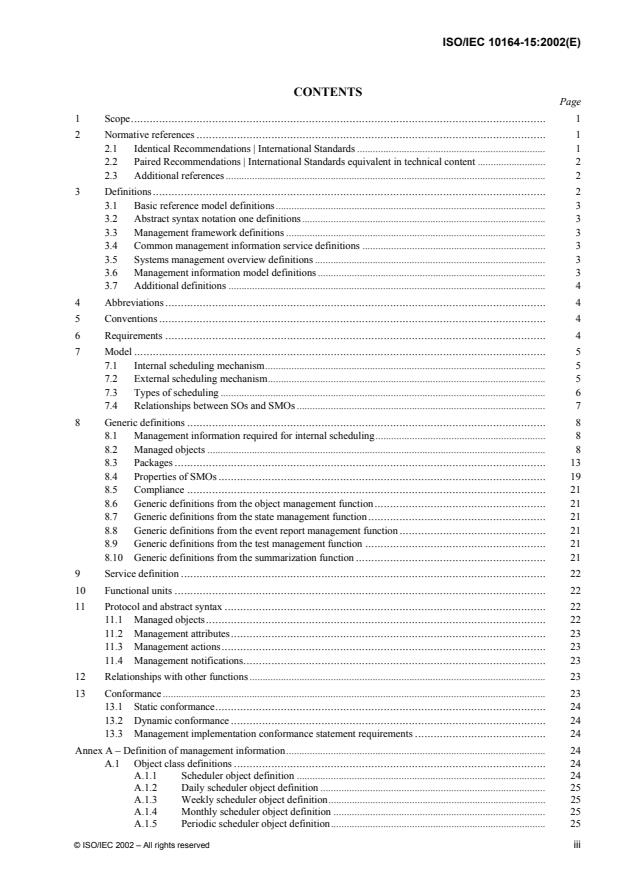
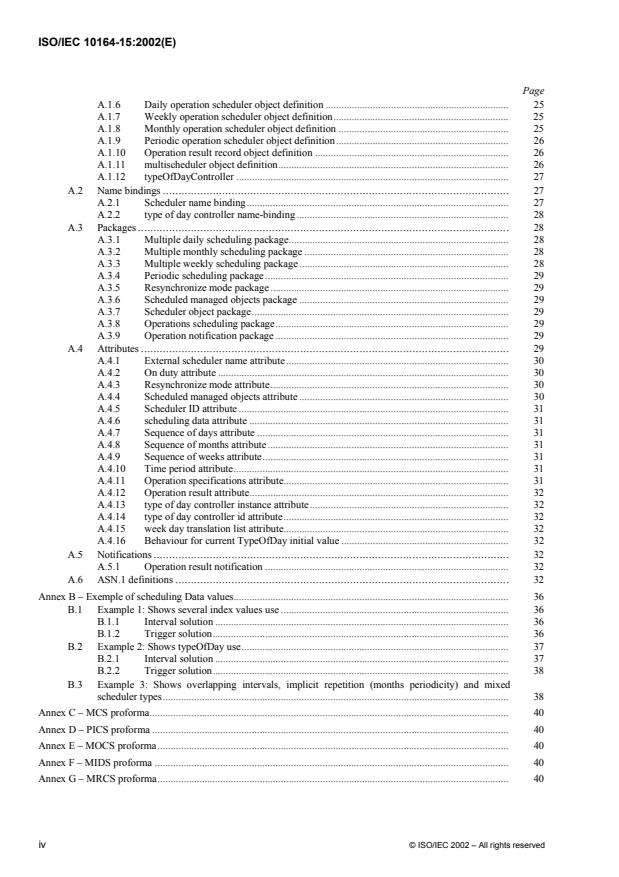
ISO/IEC 10164-15:2002 - Information technology — Open Systems Interconnection — Systems management: Scheduling function — Part 15: Released:12/11/2002


ISO/IEC 10164-15:2002 - Technologies de l'information — Interconnexion de systemes ouverts (OSI) — Gestion-systemes: Fonction de programmation — Partie 15: Released:5/26/2003
Overview
ISO/IEC 10164-15:2002 (ITU‑T X.746) specifies the Scheduling Function for systems management within the OSI application layer. It defines the scheduling function’s requirements and a formal model to exchange scheduling information and commands between management entities. The standard describes managed objects, their behaviour, service and protocol abstractions, and conformance rules-without prescribing specific implementation techniques or policy decisions.
Keywords: ISO/IEC 10164-15, scheduling function, systems management, OSI, managed objects, ASN.1
Key topics and requirements
- Scope and positioning: Positioned at the application layer per ISO/IEC 7498-1 and defined according to the management model in ISO/IEC 9545.
- Function requirements: Identifies functional requirements that a scheduling function must satisfy and how these map to management information.
- Scheduling model: Provides both internal and external scheduling mechanisms, plus types of scheduling (daily, weekly, monthly, periodic, etc.).
- Managed objects: Defines scheduler-related managed objects (e.g., scheduler, daily/weekly/monthly scheduler variants, operation result record, multischeduler, typeOfDay controller).
- Management information and ASN.1: Specifies object classes, attributes, notifications, packages and ASN.1 syntax for implementation and interoperability.
- Service & protocol abstractions: Describes functional units, service definitions, management actions, and notifications for scheduling operations.
- Conformance: Sets out static and dynamic conformance requirements and proforma (MCS, PICS, MOCS, MIDS, MRCS) for implementers.
- Annex material: Includes example scheduling data, package definitions, and proforma templates to aid implementation and testing.
Applications and practical value
ISO/IEC 10164-15 is used to standardize automated scheduling of management tasks across distributed systems. Practical uses include:
- Automating periodic maintenance tasks (backups, log rotation, data collection)
- Scheduling diagnostic, test and configuration operations in managed networks and IT systems
- Coordinating multi‑device or multi‑domain management actions through multischeduler objects
- Generating operation result notifications for audit and reporting
- Enabling interoperable management agents and consoles to exchange scheduling info using standardized managed objects and ASN.1 encodings
Typical implementers: systems and network management software vendors, enterprise IT architects, NMS developers, and standards integrators building interoperable management agents.
Who should use this standard
- Systems management product developers implementing scheduling capabilities
- Network operators standardizing automated operational workflows
- QA and interoperability test teams validating scheduling conformance
- Standards and policy architects aligning management functions across domains
Related standards
- ISO/IEC 10164 series (X.730–X.746 family) - other systems management functions
- ITU‑T X.746 (identical text)
- ISO/IEC 7498-1 (OSI Reference Model)
- ISO/IEC 7498-4 (Systems management)
- ISO/IEC 9545 (Management model)
- ITU‑T X.700 / X.701 (systems management framework)
For implementers, ISO/IEC 10164-15 provides the object definitions, service abstractions and conformance guidance needed to build interoperable scheduling in OSI-based systems management solutions.
Relations
- Effective Date
- 15-Apr-2008
- Effective Date
- 15-Apr-2008
Buy Documents
ISO/IEC 10164-15:2002 - Information technology — Open Systems Interconnection — Systems management: Scheduling function — Part 15: Released:12/11/2002
ISO/IEC 10164-15:2002 - Technologies de l'information — Interconnexion de systemes ouverts (OSI) — Gestion-systemes: Fonction de programmation — Partie 15: Released:5/26/2003
Get Certified
Connect with accredited certification bodies for this standard

BSI Group
BSI (British Standards Institution) is the business standards company that helps organizations make excellence a habit.

NYCE
Mexican standards and certification body.
Sponsored listings
Frequently Asked Questions
ISO/IEC 10164-15:2002 is a standard published by the International Organization for Standardization (ISO). Its full title is "Information technology — Open Systems Interconnection — Systems management: Scheduling function — Part 15:". This standard covers: This Recommendation | International Standard defines the scheduling function. The scheduling function is a systems management function which may be used by an application process in a centralized or decentralized management environment to exchange information and commands for the purpose of systems management, as defined by CCITT Rec. X.700 | ISO/IEC 7498-4. This Recommendation | International Standard is positioned in the application layer of ITU-T Rec. X.200 | ISO/IEC 7498-1 and is defined according to the model provided by ISO/IEC 9545. The role of systems management functions is described by CCITT Rec. X.701 | ISO/IEC 10040. This Recommendation | International Standard: ? identifies a set of requirements satisfied by the function; ? provides a model for scheduling; ? specifies the management requirements of the function and how these are realized by specification of managed objects and their behaviour; ? defines the conformance requirements to be met by implementations of this Recommendation | International Standard; ? defines managed objects. This Recommendation | International Standard does not define: ? the manner in which management is to be accomplished by the user of the scheduling function; ? the nature of any implementation intended to provide the scheduling function; ? the nature of any interactions which result in the use of the scheduling function; ? the interactions which result by the simultaneous use of several management functions; ? the occasions where the use of the scheduling function is appropriate; ? the services necessary for the establishment, normal and abnormal release of a management association.
This Recommendation | International Standard defines the scheduling function. The scheduling function is a systems management function which may be used by an application process in a centralized or decentralized management environment to exchange information and commands for the purpose of systems management, as defined by CCITT Rec. X.700 | ISO/IEC 7498-4. This Recommendation | International Standard is positioned in the application layer of ITU-T Rec. X.200 | ISO/IEC 7498-1 and is defined according to the model provided by ISO/IEC 9545. The role of systems management functions is described by CCITT Rec. X.701 | ISO/IEC 10040. This Recommendation | International Standard: ? identifies a set of requirements satisfied by the function; ? provides a model for scheduling; ? specifies the management requirements of the function and how these are realized by specification of managed objects and their behaviour; ? defines the conformance requirements to be met by implementations of this Recommendation | International Standard; ? defines managed objects. This Recommendation | International Standard does not define: ? the manner in which management is to be accomplished by the user of the scheduling function; ? the nature of any implementation intended to provide the scheduling function; ? the nature of any interactions which result in the use of the scheduling function; ? the interactions which result by the simultaneous use of several management functions; ? the occasions where the use of the scheduling function is appropriate; ? the services necessary for the establishment, normal and abnormal release of a management association.
ISO/IEC 10164-15:2002 is classified under the following ICS (International Classification for Standards) categories: 35.100.70 - Application layer. The ICS classification helps identify the subject area and facilitates finding related standards.
ISO/IEC 10164-15:2002 has the following relationships with other standards: It is inter standard links to ISO/IEC 10164-15:1995/Cor 1:1999, ISO/IEC 10164-15:1995. Understanding these relationships helps ensure you are using the most current and applicable version of the standard.
ISO/IEC 10164-15:2002 is available in PDF format for immediate download after purchase. The document can be added to your cart and obtained through the secure checkout process. Digital delivery ensures instant access to the complete standard document.
Standards Content (Sample)
INTERNATIONAL ISO/IEC
STANDARD 10164-15
Second edition
2002-12-15
Information technology — Open Systems
Interconnection — Systems management:
Scheduling function
Technologies de l'information — Interconnexion de systèmes ouverts
(OSI) — Gestion-systèmes: Fonction de programmation
Reference number
©
ISO/IEC 2002
PDF disclaimer
This PDF file may contain embedded typefaces. In accordance with Adobe's licensing policy, this file may be printed or viewed but
shall not be edited unless the typefaces which are embedded are licensed to and installed on the computer performing the editing. In
downloading this file, parties accept therein the responsibility of not infringing Adobe's licensing policy. The ISO Central Secretariat
accepts no liability in this area.
Adobe is a trademark of Adobe Systems Incorporated.
Details of the software products used to create this PDF file can be found in the General Info relative to the file; the PDF-creation
parameters were optimized for printing. Every care has been taken to ensure that the file is suitable for use by ISO member bodies. In
the unlikely event that a problem relating to it is found, please inform the Central Secretariat at the address given below.
© ISO/IEC 2002
All rights reserved. Unless otherwise specified, no part of this publication may be reproduced or utilized in any form or by any means,
electronic or mechanical, including photocopying and microfilm, without permission in writing from either ISO at the address below or
ISO's member body in the country of the requester.
ISO copyright office
Case postale 56 • CH-1211 Geneva 20
Tel. + 41 22 749 01 11
Fax + 41 22 749 09 47
E-mail copyright@iso.org
Web www.iso.org
Published in Switzerland
ii © ISO/IEC 2002 – All rights reserved
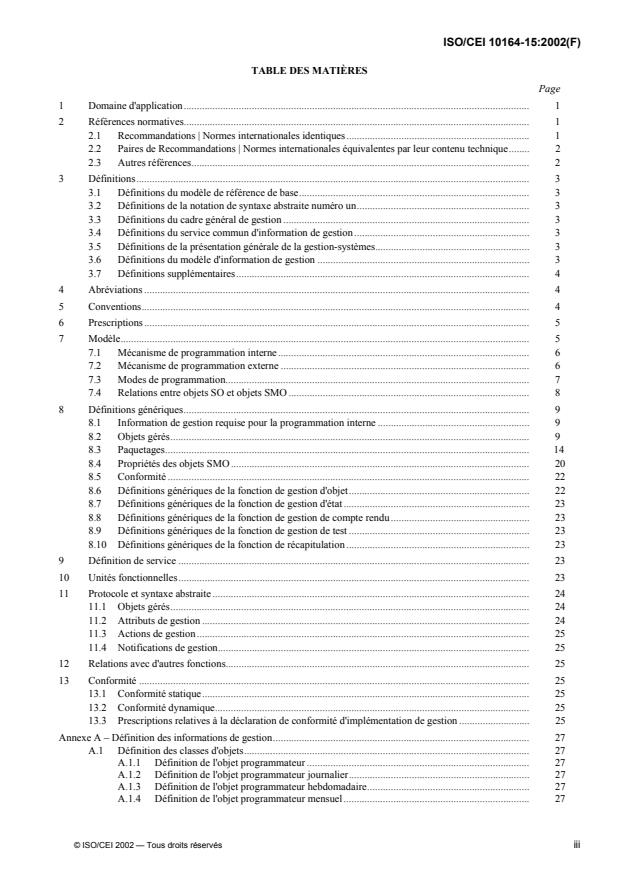
CONTENTS
Page
1 Scope. 1
2 Normative references . 1
2.1 Identical Recommendations | International Standards . 1
2.2 Paired Recommendations | International Standards equivalent in technical content . 2
2.3 Additional references. 2
3 Definitions. 2
3.1 Basic reference model definitions. 3
3.2 Abstract syntax notation one definitions. 3
3.3 Management framework definitions. 3
3.4 Common management information service definitions . 3
3.5 Systems management overview definitions. 3
3.6 Management information model definitions . 3
3.7 Additional definitions. 4
4 Abbreviations. 4
5 Conventions . 4
6 Requirements . 4
7 Model . 5
7.1 Internal scheduling mechanism. 5
7.2 External scheduling mechanism. 5
7.3 Types of scheduling. 6
7.4 Relationships between SOs and SMOs . 7
8 Generic definitions . 8
8.1 Management information required for internal scheduling. 8
8.2 Managed objects. 8
8.3 Packages . 13
8.4 Properties of SMOs. 19
8.5 Compliance . 21
8.6 Generic definitions from the object management function. 21
8.7 Generic definitions from the state management function. 21
8.8 Generic definitions from the event report management function. 21
8.9 Generic definitions from the test management function . 21
8.10 Generic definitions from the summarization function. 21
9 Service definition . 22
10 Functional units . 22
11 Protocol and abstract syntax . 22
11.1 Managed objects. 22
11.2 Management attributes. 23
11.3 Management actions. 23
11.4 Management notifications. 23
12 Relationships with other functions . 23
13 Conformance. 23
13.1 Static conformance. 24
13.2 Dynamic conformance. 24
13.3 Management implementation conformance statement requirements . 24
Annex A – Definition of management information. 24
A.1 Object class definitions . 24
A.1.1 Scheduler object definition. 24
A.1.2 Daily scheduler object definition . 25
A.1.3 Weekly scheduler object definition. 25
A.1.4 Monthly scheduler object definition . 25
A.1.5 Periodic scheduler object definition. 25
© ISO/IEC 2002 – All rights reserved iii
Page
A.1.6 Daily operation scheduler object definition . 25
A.1.7 Weekly operation scheduler object definition. 25
A.1.8 Monthly operation scheduler object definition . 25
A.1.9 Periodic operation scheduler object definition. 26
A.1.10 Operation result record object definition . 26
A.1.11 multischeduler object definition. 26
A.1.12 typeOfDayController. 27
A.2 Name bindings . 27
A.2.1 Scheduler name binding. 27
A.2.2 type of day controller name-binding . 28
A.3 Packages . 28
A.3.1 Multiple daily scheduling package. 28
A.3.2 Multiple monthly scheduling package . 28
A.3.3 Multiple weekly scheduling package . 28
A.3.4 Periodic scheduling package. 29
A.3.5 Resynchronize mode package . 29
A.3.6 Scheduled managed objects package . 29
A.3.7 Scheduler object package. 29
A.3.8 Operations scheduling package. 29
A.3.9 Operation notification package. 29
A.4 Attributes . 29
A.4.1 External scheduler name attribute. 30
A.4.2 On duty attribute . 30
A.4.3 Resynchronize mode attribute. 30
A.4.4 Scheduled managed objects attribute . 30
A.4.5 Scheduler ID attribute . 31
A.4.6 scheduling data attribute . 31
A.4.7 Sequence of days attribute . 31
A.4.8 Sequence of months attribute. 31
A.4.9 Sequence of weeks attribute. 31
A.4.10 Time period attribute. 31
A.4.11 Operation specifications attribute. 31
A.4.12 Operation result attribute. 32
A.4.13 type of day controller instance attribute. 32
A.4.14 type of day controller id attribute. 32
A.4.15 week day translation list attribute. 32
A.4.16 Behaviour for current TypeOfDay initial value . 32
A.5 Notifications . 32
A.5.1 Operation result notification . 32
A.6 ASN.1 definitions . 32
Annex B – Exemple of scheduling Data values. 36
B.1 Example 1: Shows several index values use . 36
B.1.1 Interval solution. 36
B.1.2 Trigger solution. 36
B.2 Example 2: Shows typeOfDay use. 37
B.2.1 Interval solution. 37
B.2.2 Trigger solution. 38
B.3 Example 3: Shows overlapping intervals, implicit repetition (months periodicity) and mixed
scheduler types. 38
Annex C – MCS proforma. 40
Annex D – PICS proforma . 40
Annex E – MOCS proforma. 40
Annex F – MIDS proforma . 40
Annex G – MRCS proforma. 40
iv © ISO/IEC 2002 – All rights reserved
Foreword
ISO (the International Organization for Standardization) and IEC (the International Electrotechnical
Commission) form the specialized system for worldwide standardization. National bodies that are members of
ISO or IEC participate in the development of International Standards through technical committees
established by the respective organization to deal with particular fields of technical activity. ISO and IEC
technical committees collaborate in fields of mutual interest. Other international organizations, governmental
and non-governmental, in liaison with ISO and IEC, also take part in the work. In the field of information
technology, ISO and IEC have established a joint technical committee, ISO/IEC JTC 1.
International Standards are drafted in accordance with the rules given in the ISO/IEC Directives, Part 2.
The main task of the joint technical committee is to prepare International Standards. Draft International
Standards adopted by the joint technical committee are circulated to national bodies for voting. Publication as
an International Standard requires approval by at least 75 % of the national bodies casting a vote.
Attention is drawn to the possibility that some of the elements of this document may be the subject of patent
rights. ISO and IEC shall not be held responsible for identifying any or all such patent rights.
ISO/IEC 10164-15 was prepared by ITU-T (as ITU-T Rec. X.746) and was adopted, under a special “fast-track
procedure” by Joint Technical Committee ISO/IEC JTC 1, in parallel with its approval by national bodies of
ISO and IEC. The identical text is published as ITU-T Rec. X.746.
This second edition cancels and replaces the first edition (ISO/IEC 10164-15:1995), which has been
technically revised.
ISO/IEC 10164 consists of the following parts, under the general title Information technology — Open
Systems Interconnection — Systems management:
— Part 1: Object management function
— Part 2: State management function
— Part 3: Attributes for representing relationships
— Part 4: Alarm reporting function
— Part 5: Event report management function
— Part 6: Log control function
— Part 7: Security alarm reporting function
— Part 8: Security audit trail function
— Part 9: Objects and attributes for access control
— Part 10: Usage metering function for accounting purposes
— Part 11: Metric objects and attributes
— Part 12: Test management function
— Part 13: Summarization function
© ISO/IEC 2002 – All rights reserved v
— Part 14: Confidence and diagnostic test categories
— Part 15: Scheduling function
— Part 16: Management knowledge management function
— Part 17: Change over function
— Part 18: Software management function
— Part 19: Management domain and management policy management function
— Part 20: Time management function
— Part 21: Command sequencer for systems management
— Part 22: Response time monitoring function
vi © ISO/IEC 2002 – All rights reserved
Introduction
ITU-T Rec. X.746 | ISO/IEC 10164-15 is a member of a family of Recommendations | International Standards dealing
with Systems Management:
– X.730 (1992) | ISO/IEC 10164-1:1993: Object management function.
– X.731 (1992) | ISO/IEC 10164-2:1993: State management function.
– X.732 (1992) | ISO/IEC 10164-3:1993: Attributes for representing relationships.
– X.733 (1992) | ISO/IEC 10164-4:1992: Alarm reporting function.
– X.734 (1992) | ISO/IEC 10164-5:1993: Event report management function.
– X.735 (1992) | ISO/IEC 10164-6:1993: Log control function.
– X.736 (1992) | ISO/IEC 10164-7:1992: Security alarm reporting function.
– X.737 (1995) | ISO/IEC 10164-14:1996: Confidence and diagnostic test categories.
– X.738 (1993) | ISO/IEC 10164-13:1995: Summarization function.
– X.739 (1993) | ISO/IEC 10164-11:1994: Metric objects and attributes.
– X.740 (1992) | ISO/IEC 10164-8:1993: Security audit trail function.
– X.741 (1995) | ISO/IEC 10164-9:1995: Objects and attributes for access control.
– X.742 (1995) | ISO/IEC 10164-10:1995: Usage metering function for accounting purposes.
– X.743 (1998) | ISO/IEC 10164-20:1999: Time management function.
– X.744 (1996) | ISO/IEC 10164-18:1997: Software management function.
– X.745 (1993) | ISO/IEC 10164-12:1994: Test management function.
– X.746 (2000) | ISO/IEC 10164-15:2001: Scheduling function.
– X.748 (1999) | ISO/IEC 10164-22:2000: Response time monitoring function.
– X.749 (1997) | ISO/IEC 10164-19:1998: Management domain and management policy management
function.
– X.750 (1996) | ISO/IEC 10164-16:1997: Management knowledge management function.
– X.751 (1995) | ISO/IEC 10164-17:1996: Changeover function.
– X.753 (1997) | ISO/IEC 10164-21:1998: Command sequencer for systems management.
© ISO/IEC 2002 – All rights reserved vii
INTERNATIONAL STANDARD
ITU-T RECOMMENDATION
INFORMATION TECHNOLOGY – OPEN SYSTEMS INTERCONNECTION –
SYSTEMS MANAGEMENT: SCHEDULING FUNCTION
1 Scope
This Recommendation | International Standard defines the scheduling function. The scheduling function is a systems
management function which may be used by an application process in a centralized or decentralized management
environment to exchange information and commands for the purpose of systems management, as defined by CCITT Rec.
X.700 | ISO/IEC 7498-4. This Recommendation | International Standard is positioned in the application layer of ITU-T
Rec. X.200 | ISO/IEC 7498-1 and is defined according to the model provided by ISO/IEC 9545. The role of systems
management functions is described by CCITT Rec. X.701 | ISO/IEC 10040.
This Recommendation | International Standard:
– identifies a set of requirements satisfied by the function;
– provides a model for scheduling;
– specifies the management requirements of the function and how these are realized by specification of
managed objects and their behaviour;
– defines the conformance requirements to be met by implementations of this Recommendation |
International Standard;
– defines managed objects.
This Recommendation | International Standard does not define:
– the manner in which management is to be accomplished by the user of the scheduling function;
– the nature of any implementation intended to provide the scheduling function;
– the nature of any interactions which result in the use of the scheduling function;
– the interactions which result by the simultaneous use of several management functions;
– the occasions where the use of the scheduling function is appropriate;
– the services necessary for the establishment, normal and abnormal release of a management association.
2 Normative references
The following Recommendations and International Standards contain provisions which, through reference in this text,
constitute provisions of this Recommendation | International Standard. At the time of publication, the editions indicated
were valid. All Recommendations and Standards are subject to revision, and parties to agreements based on this
Recommendation | International Standard are encouraged to investigate the possibility of applying the most recent
edition of the Recommendations and Standards listed below. Members of IEC and ISO maintain registers of currently
valid International Standards. The Telecommunication Standardization Bureau of the ITU maintains a list of currently
valid ITU-T Recommendations.
2.1 Identical Recommendations | International Standards
– ITU-T Recommendation X.200 (1994 | ISO/IEC 7498-1:1994, Information technology – Open Systems
Interconnection – Basic Reference Model: The Basic Model.
– ITU-T Recommendation X.210 (1993) | ISO/IEC 10731:1994, Information technology – Open Systems
Interconnection – Basic Reference Model – Conventions for the definition of OSI services.
– ITU-T Recommendation X.680 (1997) | ISO/IEC 8824-1:1998, Information technology – Abstract Syntax
Notation One (ASN.1): Specification of basic notation.
– ITU-T Recommendation X.681 (1997) | ISO/IEC 8824-2:1998, Information technology – Abstract Syntax
Notation One (ASN.1): Information object specification.
ITU-T X.746 (02/2000 E) 1
– ITU-T Recommendation X.682 (1997) | ISO/IEC 8824-3:1998, Information technology – Abstract Syntax
Notation One (ASN.1): Constraint specification.
– ITU-T Recommendation X.690 (1997) | ISO/IEC 8825-1:1998, Information technology – ASN.1 encoding
rules: Specification of Basic Encoding Rules (BER), Canonical Encoding Rules (CER) and Distinguished
Encoding Rules (DER).
– ITU-T Recommendation X.691 (1997) | ISO/IEC 8825-2:1998, Information technology – ASN.1 encoding
rules: Specification of Packed Encoding Rules (PER).
– CCITT Recommendation X.701 (1992) | ISO/IEC 10040:1992, Information technology – Open Systems
Interconnection – Systems management overview.
– ITU-T Recommendation X.710 (1997) | ISO/IEC 9595:1998, Information technology – Open Systems
Interconnection – Common management information service.
– CCITT Recommendation X.721 (1992) | ISO/IEC 10165-2:1992, Information technology – Open Systems
Interconnection – Structure of management information: Definition of management information.
– CCITT Recommendation X.722 (1992) | ISO/IEC 10165-4:1992, Information technology – Open Systems
Interconnection – Structure of management information: Guidelines for the definition of managed objects.
– ITU-T Recommendation X.724 (1993) | ISO/IEC 10165-6:1994, Information technology – Open Systems
Interconnection – Structure of management information: Requirements and guidelines for implementation
conformance statement proformas associated with OSI management.
– CCITT Recommendation X.730 (1992) | ISO/IEC 10164-1:1993, Information technology – Open Systems
Interconnection – Systems Management: Object management function.
– CCITT Recommendation X.731 (1992) | ISO/IEC 10164-2:1993, Information technology – Open Systems
Interconnection – Systems Management: State management function.
– CCITT Recommendation X.734 (1992) | ISO/IEC 10164-5:1993, Information technology – Open Systems
Interconnection – Systems Management: Event report management function.
– ITU-T Recommendation X.738 (1993) | ISO/IEC 10164-13:1995, Information technology – Open Systems
Interconnection – Systems Management: Summarization function.
– ITU-T Recommendation X.739 (1993) | ISO/IEC 10164-11:1994, Information technology – Open Systems
Interconnection – Systems Management: Metric objects and attributes.
– ITU-T Recommendation X.745 (1993) | ISO/IEC 10164-12:1994, Information technology – Open Systems
Interconnection – Systems Management: Test Management Function.
2.2 Paired Recommendations | International Standards equivalent in technical content
– CCITT Recommendation X.291 (1992), OSI conformance testing methodology and framework for
protocol Recommendations for CCITT applications – Abstract test suite specification.
ISO/IEC 9646-2:1994, Information technology – Open Systems Interconnection – Conformance testing
methodology and framework – Part 2: Abstract Test Suite specification.
– CCITT Recommendation X.700 (1992), Management framework for Open Systems Interconnection (OSI)
for CCITT applications.
ISO/IEC 7498-4:1989, Information processing systems – Open Systems Interconnection – Basic Reference
Model – Part 4: Management framework.
2.3 Additional references
– ITU-T Recommendation M.3100 (1995), Generic network information model.
– ISO/IEC 9545:1994, Information technology – Open Systems Interconnection – Application Layer
structure.
3 Definitions
For the purposes of this Recommendation | International Standard, the following definitions apply.
2 ITU-T X.746 (02/2000 E)
3.1 Basic reference model definitions
This Recommendation | International Standard makes use of the following terms defined in ITU-T Rec. X.200 |
ISO/IEC 7498-1.
a) open system;
b) systems management.
3.2 Abstract syntax notation one definitions
This Recommendation | International Standard makes use of the following term defined in ITU-T Rec. X.680 |
ISO/IEC 8824-1.
a) object identifier.
3.3 Management framework definitions
This Recommendation | International Standard makes use of the following term defined in CCITT Rec. X.700 |
ISO/IEC 7498-4.
a) managed object.
3.4 Common management information service definitions
This Recommendation | International Standard makes use of the following terms defined in ITU-T Rec. X.710 |
ISO/IEC 9595.
a) attribute;
b) common management information service.
3.5 Systems management overview definitions
This Recommendation | International Standard makes use of the following terms defined in CCITT Rec. X.701 |
ISO/IEC 10040.
a) agent;
b) managed object class;
c) manager;
d) notification;
e) systems management operations.
3.6 Management information model definitions
This Recommendation | International Standard makes use of the following terms defined in CCITT Rec. X.720 |
ISO/IEC 10165-1.
a) action;
b) actual class;
c) behaviour;
d) characteristic;
e) conditional package;
f) inheritance;
g) instantiation;
h) mandatory package;
i) name binding;
j) package;
k) subclass;
l) superclass.
ITU-T X.746 (02/2000 E) 3
3.7 Additional definitions
3.7.1 aperiodic scheduling: A type of scheduling that controls the triggering of activities at certain specified times
within specified managed object instances.
3.7.2 interval scheduling: A type of scheduling that controls a number of intervals of operation of activities within
specified managed object instances.
3.7.3 periodic scheduling: A type of scheduling that controls the repetitive triggering of activities within specified
managed object instances.
3.7.4 scheduling: The method of controlling the timing of the execution of a scheduled activity within or
represented by a managed object.
3.7.5 scheduled managed object (SMO): The managed object whose activities are to be scheduled.
3.7.6 scheduler object (SO): The managed object that defines the type and values of the schedule to be applied to
activities within SMOs.
3.7.7 trigger scheduling: A type of scheduling that controls the triggering of activities within specified managed
object instances.
4 Abbreviations
For the purposes of this Recommendation | International standard, the following abbreviations apply:
ASN.1 Abstract Syntax Notation One
CMIS Common Management Information Service
ICS Implementation Conformance Statement
MAPDU Management Application Protocol Data Unit
MCS Management Conformance Statement
MOCS Managed Object Conformance Statement
NE Network Element
OC Object Class
OS Operation System
SMO Scheduled Managed Object
SO Scheduler Object
5 Conventions
The ICS proformas specified in this Recommendation | International Standard (see Annexes C to G) use the common
notations, defined in CCITT Rec. X.291 | ISO/IEC 9646-2 and CCITT Rec. X.296 | ISO/IEC 9646-7.
6 Requirements
In terms of functionality, the requirements to be satisfied are:
– Provide a function that can schedule a number of activities within multiple managed objects according to
a single schedule.
– Be able to specify the time duration that the schedule is active.
– For schedules that control the interval of operation of an activity within a managed object, the start and
stop time should be defined as the actual time within a 24-hour clock.
– Provide a function that can schedule aperiodic and periodic triggering of an activity.
– Allow that the scheduling information communicated to the scheduled object be independent of the action
the scheduled object performs. The scheduler may have no knowledge about this action. As a
consequence, the relations between the scheduler, the scheduling information and the corresponding
actions to be performed are existing in the scheduled object.
– Several independent schedulers can coexist.
– Scheduling shall be possible on base of type of day (e.g. weekend, Christmas, bank holiday).
4 ITU-T X.746 (02/2000 E)
Interval scheduling
– Provide a function that controls the scheduled activities of one or more managed objects.
– Provide a configurable schedule that repeats over a specified time period. The specified time period may
be a day, a week or a month.
– Provide a user defined number of intervals together with the start and stop times of each of these intervals
within the specified period.
– Overlapping intervals shall be allowed. Precedence rules are therefore needed in order to decide which
interval is active.
Trigger scheduling
– Provide a function that controls the triggering of an activity of one or more managed objects.
– Provide a configurable period for the repetitions of the triggering.
– Provide a user defined list of trigger times.
7 Model
Scheduling can be modelled as a part of the managed object whose operation or activity is to be scheduled, or as a
separate managed object.
Characteristics for the control of a schedule can be imported into a managed object class or can be defined as a separate
managed object. These two ways of defining scheduling of a managed object are termed internal and external scheduling,
respectively. This Recommendation | International Standard describes models for both internal and external scheduling.
This Recommendation | International Standard also describes four types of scheduling in 7.3 below: interval, trigger
(periodic and aperiodic), operations and index ("multi-scheduler") scheduling. These scheduling types can be used with
internal and external scheduling mechanisms.
The activities which can be controlled by scheduling are defined as part of the scheduled managed object (SMO) class.
There need to be characteristics in the SMO related to these scheduled activities.
7.1 Internal scheduling mechanism
It is appropriate to define the scheduling mechanism within a managed object class if it will not need to be altered in the
future and the managed object is to be individually scheduled. The scheduling mechanism can be defined within a
managed object class by including the appropriate scheduling components (e.g. attributes and behaviour). If more than
one type of scheduling is defined within a managed object class, the conditions for instantiation of each type of
scheduling must be defined in the managed object class definition.
When the scheduling mechanism is defined within the managed object whose activity is scheduled, no additional objects
are required and the scheduling may be manipulated through the use of systems management operations. However, when
multiple activities within a managed object are to be scheduled using this mechanism, separate scheduling characteristics
are required for each activity.
Scheduling characteristics for each activity may include more than one type of scheduling (see 7.3) and the conditions
for instantiation of each type shall be defined in the managed object class definition.
7.2 External scheduling mechanism
It is beneficial to define an external scheduling mechanism so that schedules may be determined independently of SMOs.
Many managed objects may be controlled by a single schedule. If a single scheduler object (SO) provides the schedule,
there may be no need for scheduling components in the SMOs: in such a case, this eliminates the need to replicate and
coordinate schedules across SMOs.
The scheduling function is represented by SOs which are separate from the SMOs, as shown in Figure 1. One SO may
control activities in any number of SMOs. Multiple external schedules are allowed for the same activity. The approach
for defining more than one type of scheduling for the same activity is described in 7.3.
The scheduler object provides a schedule to a SMO. SMOs shall have attributes which identify the SOs providing
schedules. Each of these attributes shall have and be associated with behaviour which describes the effect of the schedule
upon the SMO. It may not be necessary to use several SOs to provide this, when using the index SO.
ITU-T X.746 (02/2000 E) 5
Managing system
Interface Managed system
Events
Scheduler
Object
(SO)
Operations
Events
Scheduled
Managed
Object (SMO)
Operations
Events
Scheduled
Managed
Object (SMO)
Operations
T0411540-99
Messages
Pointers
Figure 1 – Scheduler Object model
7.3 Types of scheduling
There are four specific types of scheduling: interval scheduling, trigger scheduling, operations scheduling and index
scheduling. This Recommendation | International Standard describes four types of interval scheduling – daily, weekly,
monthly and type-of-day interval scheduling (see 7.3.1); two types of trigger scheduling – periodic and aperiodic
scheduling (see 7.3.2), operations scheduling (see Operations scheduling) and index scheduling (see Index scheduling).
These types of scheduling are defined by packages which may be included in managed objects for the purpose of internal
scheduling (except for the operations scheduling) or in a scheduler object for external scheduling.
NOTE – Other scheduling packages are defined in CCITT Rec. X.734 | ISO/IEC 10164-5.
If a combination of interval and trigger scheduling is required for one activity, the triggering is effective only within the
intervals defined by the interval schedule.
7.3.1 Interval scheduling
Interval scheduling is used to define a schedule that controls a sequence of transitions of an activity of a SMO between
the active and inactive state. The schedule may repeat in one of the following ways: a given number of days with
specified intervals for each day, a given number of weeks with specified intervals for specified days of each week or a
given number of months with specified intervals for specified days of each month. Each of these types of interval
scheduling, daily, weekly and monthly is specified by selecting the intervals of day parameter for the day, week or month
mask attribute in the appropriate scheduler object class.
The duration over which interval scheduling affects the operation of the SMOs may be controlled by the specified
duration start time and duration stop time (date and time).
The intervals of operation are specified by a set of interval start and interval stop times.
The operation of the interval schedulers can be suspended by setting their administrative state attribute to locked and
resumed by setting their administrative state attribute to unlocked.
6 ITU-T X.746 (02/2000 E)
7.3.2 Trigger scheduling
7.3.2.1 Periodic scheduling
Periodic scheduling is used to define a schedule that repetitively triggers specified activities at regular time intervals
within specified managed object instances. The time duration over which the activities, specified in the SMOs, can be
triggered, may be controlled by the specified duration start time and duration stop time (date and time). When a periodic
scheduler is created, it either triggers at the specified duration start time (which may be the object creation time) or it
synchronizes the first triggering point to a specified synchronization time. It then synchronizes the period to this initial
triggering point.
The operation of a scheduler can be suspended and resumed by setting its administrative state attribute. Two methods of
synchronization of the triggering points can be used when the operation of the scheduler is resumed, either period
synchronization time or resynchronize mode. If a period synchronization time is specified, the triggering will always be
synchronized to that time. If a resynchronize mode has been specified in the SO, the triggering may be synchronized to
the specified duration start time, or it may be synchronized to the time of resumption of the SO, depending on the
resynchronize mode selected. If period synchronization time and resynchronize mode are absent, the period will always
be synchronized to the specified duration start time.
7.3.2.2 Aperiodic scheduling
An activity in a managed object can be triggered at scheduled times. This is achieved by specifying a set of trigger times
for the activity rather than specifying an interval for the operation of that activity. This mechanism allows activities in a
managed object to be triggered at absolute times as opposed to the triggering of activities at regular intervals relative to a
start time as defined for periodic scheduling (see 7.3.2.1).
An aperiodic trigger schedule may repeat in one of the following ways: a given number of days with specified trigger
times for each day, a given number of weeks with specified trigger times for specified days of each week or a given
number of months with specified trigger times for specified days of each month. Each of these types of aperiodic
scheduling, daily, weekly and monthly is specified by selecting the trigger times parameter for the day, week or month
mask attribute in the appropriate scheduler object class.
7.3.3 Operations scheduling
In accordance with its schedule, a scheduling object which uses the operation scheduling approach determines operations
performed upon SMOs.
In this case the SO may have notifications to report success and failure in the execution of the operations. A scheduling
object which uses the operation scheduling approach has attributes to identify a schedule, the SMOs which are being
scheduled and the operations and parameters which are to be requested in accord with the schedule. When the result
notification is issued, the managed object class and managed object instance parameters shall be present in the operation
result(s).
NOTE – The sending of messages between managed objects in the same system, either expressed on implied in this model, does
not imply any need for conformance testing of these inter-object interactions.
7.3.4 Index scheduling
This index scheduling functions is an enhancement to the previous schedulings.
The multiScheduler scheduling extends the functionality of the interval scheduling and aperiodic scheduling:
– for interval scheduling, the multiScheduler allows the transition of an activity between several (two or
more) states. Each such state is associated with an index value. The multiScheduler also allows
overlapping intervals;
– for aperiodic scheduling, the multiScheduler allows the triggering of (possibly different) activities
depending on an index value. Aperiodic scheduling in the multiScheduler can also be used for operation
scheduling.
For both types of scheduling, the index scheduling allows to schedule activities depending on the type of day, e.g.
holidays, weekdays. For this purpose, a type-Of-Day Controller is used to group days into categories according to their
type, e.g. 1st January can be classified as specialDay1.
7.4 Relationships between SOs and SMOs
A SMO may be scheduled by more than one SO. In order to be scheduled by an external interval or trigger scheduler, a
SMO shall have an attribute which points at the SO (the external scheduler name attribute). The SO may optionally have
an attribute which points at the SMO (the scheduled managed objects attribute). SMOs which have multiple activities to
ITU-T X.746 (02/2000 E) 7
be scheduled shall have an attribute associated with each activity that points to the appropriate SOs. A single SO may
provide a schedule for many SMOs. See Figure 1.
If a SMO is deleted, the entry for that object in the scheduled managed objects attribute in the related SO(s) will be
deleted. If there are no remaining entries in the scheduled managed objects attribute, the SO will continue to exist. If the
SO is deleted, the state of the activitie
...
NORME ISO/CEI
INTERNATIONALE 10164-15
Deuxième édition
2002-12-15
Technologies de l'information —
Interconnexion de systèmes ouverts
(OSI) — Gestion-systèmes: Fonction de
programmation
Information technology — Open Systems Interconnection — Systems
management: Scheduling function
Numéro de référence
ISO/CEI 10164-15:2002(F)
©
ISO/CEI 2002
ISO/CEI 10164-15:2002(F)
PDF – Exonération de responsabilité
Le présent fichier PDF peut contenir des polices de caractères intégrées. Conformément aux conditions de licence d'Adobe, ce fichier
peut être imprimé ou visualisé, mais ne doit pas être modifié à moins que l'ordinateur employé à cet effet ne bénéficie d'une licence
autorisant l'utilisation de ces polices et que celles-ci y soient installées. Lors du téléchargement de ce fichier, les parties concernées
acceptent de fait la responsabilité de ne pas enfreindre les conditions de licence d'Adobe. Le Secrétariat central de l'ISO décline toute
responsabilité en la matière.
Adobe est une marque déposée d'Adobe Systems Incorporated.
Les détails relatifs aux produits logiciels utilisés pour la création du présent fichier PDF sont disponibles dans la rubrique General Info
du fichier; les paramètres de création PDF ont été optimisés pour l'impression. Toutes les mesures ont été prises pour garantir
l'exploitation de ce fichier par les comités membres de l'ISO. Dans le cas peu probable où surviendrait un problème d'utilisation,
veuillez en informer le Secrétariat central à l'adresse donnée ci-dessous.
© ISO/CEI 2002
Droits de reproduction réservés. Sauf prescription différente, aucune partie de cette publication ne peut être reproduite ni utilisée sous
quelque forme que ce soit et par aucun procédé, électronique ou mécanique, y compris la photocopie et les microfilms, sans l'accord écrit
de l'ISO à l'adresse ci-après ou du comité membre de l'ISO dans le pays du demandeur.
ISO copyright office
Case postale 56 • CH-1211 Geneva 20
Tel. + 41 22 749 01 11
Fax. + 41 22 749 09 47
E-mail copyright@iso.org
Web www.iso.org
Version française parue en 2003
Publié en Suisse
ii © ISO/CEI 2002 — Tous droits réservés
ISO/CEI 10164-15:2002(F)
TABLE DES MATIÈRES
Page
1 Domaine d'application. 1
2 Références normatives. 1
2.1 Recommandations | Normes internationales identiques. 1
2.2 Paires de Recommandations | Normes internationales équivalentes par leur contenu technique. 2
2.3 Autres références. 2
3 Définitions. 3
3.1 Définitions du modèle de référence de base. 3
3.2 Définitions de la notation de syntaxe abstraite numéro un. 3
3.3 Définitions du cadre général de gestion . 3
3.4 Définitions du service commun d'information de gestion. 3
3.5 Définitions de la présentation générale de la gestion-systèmes. 3
3.6 Définitions du modèle d'information de gestion . 3
3.7 Définitions supplémentaires. 4
4 Abréviations . 4
5 Conventions. 4
6 Prescriptions . 5
7 Modèle. 5
7.1 Mécanisme de programmation interne. 6
7.2 Mécanisme de programmation externe . 6
7.3 Modes de programmation. 7
7.4 Relations entre objets SO et objets SMO . 8
8 Définitions génériques. 9
8.1 Information de gestion requise pour la programmation interne . 9
8.2 Objets gérés. 9
8.3 Paquetages. 14
8.4 Propriétés des objets SMO . 20
8.5 Conformité . 22
8.6 Définitions génériques de la fonction de gestion d'objet. 22
8.7 Définitions génériques de la fonction de gestion d'état . 23
8.8 Définitions génériques de la fonction de gestion de compte rendu . 23
8.9 Définitions génériques de la fonction de gestion de test . 23
8.10 Définitions génériques de la fonction de récapitulation . 23
9 Définition de service . 23
10 Unités fonctionnelles. 23
11 Protocole et syntaxe abstraite . 24
11.1 Objets gérés. 24
11.2 Attributs de gestion . 24
11.3 Actions de gestion. 25
11.4 Notifications de gestion. 25
12 Relations avec d'autres fonctions. 25
13 Conformité . 25
13.1 Conformité statique. 25
13.2 Conformité dynamique. 25
13.3 Prescriptions relatives à la déclaration de conformité d'implémentation de gestion . 25
Annexe A – Définition des informations de gestion. 27
A.1 Définition des classes d'objets. 27
A.1.1 Définition de l'objet programmateur . 27
A.1.2 Définition de l'objet programmateur journalier. 27
A.1.3 Définition de l'objet programmateur hebdomadaire. 27
A.1.4 Définition de l'objet programmateur mensuel . 27
© ISO/CEI 2002 — Tous droits réservés iii
ISO/CEI 10164-15:2002(F)
Page
A.1.5 Définition de l'objet programmateur périodique . 27
A.1.6 Définition de l'objet programmateur d'opérations journalier. 27
A.1.7 Définition de l'objet programmateur d'opérations hebdomadaire. 28
A.1.8 Définition de l'objet programmateur d'opérations mensuel. 28
A.1.9 Définition de l'objet programmateur d'opérations périodique . 28
A.1.10 Définition de l'objet enregistrement de résultat d'opération. 28
A.1.11 Définition de l'objet programmateur multiple. 28
A.1.12 Contrôleur de type de jour. 29
A.2 Liens de dénomination . 29
A.2.1 Liens de dénomination de programmateurs . 30
A.2.2 Liens de dénomination de contrôleur de type de jour . 30
A.3 Paquetages. 31
A.3.1 Paquetage programmation journalière multiple . 31
A.3.2 Paquetage programmation mensuelle multiple . 31
A.3.3 Paquetage programmation hebdomadaire multiple. 31
A.3.4 Paquetage programmation périodique. 31
A.3.5 Paquetage mode de resynchronisation . 31
A.3.6 Paquetage objets gérés programmés . 31
A.3.7 Paquetage objet programmateur. 31
A.3.8 Paquetage programmation d'opérations . 32
A.3.9 Paquetage notification d'opération . 32
A.4 Attributs . 32
A.4.1 Attribut nom de programmateur externe. 32
A.4.2 Attribut "en service". 33
A.4.3 Attribut mode de resynchronisation . 33
A.4.4 Attribut objets gérés programmés . 33
A.4.5 Attribut identificateur de programmateur. 33
A.4.6 Attribut données de programmation. 33
A.4.7 Attribut séquence journalière . 33
A.4.8 Attribut séquence mensuelle . 34
A.4.9 Attribut séquence hebdomadaire. 34
A.4.10 Attribut période de temps. 34
A.4.11 Attribut spécifications d'opération . 34
A.4.12 Attribut résultat d'opération. 34
A.4.13 Attribut instance de contrôleur de type de jour . 34
A.4.14 Attribut identificateur de contrôleur de type de jour . 35
A.4.15 Attribut liste de traduction du jour de la semaine. 35
A.4.16 Valeur initiale du comportement pour le type de jour actuel . 35
A.5 Notifications. 35
A.5.1 Notification de résultat d'opération . 35
A.6 Définitions ASN.1. 35
Annexe B – Exemples de valeurs de données de programmation . 39
B.1 Exemple 1: utilisation de plusieurs valeurs d'index . 39
B.1.1 Solution avec intervalles . 39
B.1.2 Solution avec déclenchement. 39
B.2 Exemple 2: utilisation du type de jour. 40
B.2.1 Solution avec intervalles . 40
B.2.2 Solution avec déclenchement. 41
B.3 Exemple 3: recouvrement d'intervalles, répétition implicite (mensuelle) et divers types de
programmateurs. 41
Annexe C – Formulaire MCS . 44
Annexe D – Formulaire PICS. 44
Annexe E – Formulaire MOCS . 44
Annexe F – Formulaire MIDS. 44
Annexe G – Formulaire MRCS . 44
iv © ISO/CEI 2002 — Tous droits réservés
ISO/CEI 10164-15:2002(F)
Avant-propos
L'ISO (Organisation internationale de normalisation) et la CEI (Commission électrotechnique internationale)
forment le système spécialisé de la normalisation mondiale. Les organismes nationaux membres de l'ISO ou
de la CEI participent au développement de Normes internationales par l'intermédiaire des comités techniques
créés par l'organisation concernée afin de s'occuper des domaines particuliers de l'activité technique. Les
comités techniques de l'ISO et de la CEI collaborent dans des domaines d'intérêt commun. D'autres
organisations internationales, gouvernementales et non gouvernementales, en liaison avec l'ISO et la CEI
participent également aux travaux. Dans le domaine des technologies de l'information, l'ISO et la CEI ont créé
un comité technique mixte, l'ISO/CEI JTC 1.
Les Normes internationales sont rédigées conformément aux règles données dans les Directives ISO/CEI,
Partie 2.
La tâche principale du comité technique mixte est d'élaborer les Normes internationales. Les projets de
Normes internationales adoptés par le comité technique mixte sont soumis aux organismes nationaux pour
vote. Leur publication comme Normes internationales requiert l'approbation de 75 % au moins des
organismes nationaux votants.
L'attention est appelée sur le fait que certains des éléments du présent document peuvent faire l'objet de
droits de propriété intellectuelle ou de droits analogues. L'ISO et la CEI ne sauraient être tenues pour
responsables de ne pas avoir identifié de tels droits de propriété et averti de leur existence.
L'ISO/CEI 10164-15 a été élaborée par l'UIT-T (en tant que Rec. UIT-T X.746) et adoptée, par une procédure
particulière dite «par voie expresse», par le comité technique mixte ISO/CEI JTC 1, parallèlement à son
approbation par les membres nationaux de l’ISO et de la CEI. Le texte identique est publié en tant que
Rec. UIT-T X.746.
Cette deuxième édition annule et remplace la première édition (ISO/CEI 10164-15:1995), qui a fait l'objet
d'une révision technique.
L'ISO/CEI 10164 comprend les parties suivantes, présentées sous le titre général Technologies de
l'information — Interconnexion de systèmes ouverts (OSI) — Gestion-systèmes:
— Partie 1: Fonction de gestion d'objets
— Partie 2: Fonction de gestion d'états
— Partie 3: Attributs pour la représentation des relations
— Partie 4: Fonction de signalisation des alarmes
— Partie 5: Fonction de gestion de rapport événementiel
— Partie 6: Fonction de contrôle de journal
— Partie 7: Fonction de compte rendu d'alarme de sécurité
— Partie 8: Fonction de sécurité de l'expertise de l'historique
— Partie 9: Objets et attributs de contrôle d'accès
— Partie 10: Fonction de comptage d'utilisation aux fins de comptabilité
— Partie 11: Objets et attributs métriques
© ISO/CEI 2002 — Tous droits réservés v
ISO/CEI 10164-15:2002(F)
— Partie 12: Fonction de gestion des tests
— Partie 13: Fonction de récapitulation
— Partie 14: Catégories de test de confiance et de diagnostic
— Partie 15: Fonction de programmation
— Partie 16: Fonction de gestion de la connaissance de gestion
— Partie 17: Fonction de basculement
— Partie 18: Fonction de gestion de logiciel
— Partie 19: Fonctions de gestion de domaine de gestion et de politique de gestion
— Partie 20: Fonction de gestion du temps
— Partie 21: Séquenceur de commandes pour la gestion-systèmes
— Partie 22: Fonction de supervision du temps de réponse
vi © ISO/CEI 2002 — Tous droits réservés
ISO/CEI 10164-15:2002(F)
Introduction
La Rec. UIT-T X.746 | ISO/CEI 10164-15 appartient à la famille des Recommandations | Normes internationales
traitant de la gestion-systèmes.
– X.730 (1992) | ISO/CEI 10164-1:1993: Fonction de gestion des objets.
– X.731 (1992) | ISO/CEI 10164-2:1993: Fonction de gestion d'états.
– X.732 (1992) | ISO/CEI 10164-3:1993: Attributs relationnels.
– X.733 (1992) | ISO/CEI 10164-4:1992: Fonction de signalisation des alarmes.
– X.734 (1992) | ISO/CEI 10164-5:1993: Fonction de gestion des rapports d'événement.
– X.735 (1992) | ISO/CEI 10164-6:1993: Fonction de commande des registres de consignation.
– X.736 (1992) | ISO/CEI 10164-7:1992: Fonction de signalisation des alarmes de sécurité.
– X.737 (1995) | ISO/CEI 10164-14:1996: Catégories de tests de confiance et de diagnostic.
– X.738 (1993) | ISO/CEI 10164-13:1995: Fonction de récapitulation.
– X.739 (1993) | ISO/CEI 10164-11:1994: Objets et attributs métriques.
– X.740 (1992) | ISO/CEI 10164-8:1993: Fonction de piste de vérification de sécurité.
– X.741 (1995) | ISO/CEI 10164-9:1995: Objets et attributs de contrôle d'accès.
– X.742 (1995) | ISO/CEI 10164-10:1995: Fonction de comptage d'utilisation aux fins de comptabilité.
– X.743 (1998) | ISO/CEI 10164-20:1999: Fonction de gestion du temps.
– X.744 (1996) | ISO/CEI 10164-18:1997: Fonction de gestion de logiciel.
– X.745 (1993) | ISO/CEI 10164-12:1994: Fonction de gestion des tests.
– X.746 (2000) | ISO/CEI 10164-15:2001: Fonction de programmation.
– X.748 (1999) | ISO/CEI 10164-22:2000: Fonction de supervision du temps de réponse.
– X.749 (1997) | ISO/CEI 10164-19:1998: Fonction de gestion de domaine de gestion et de politique de
gestion.
– X.750 (1996) | ISO/CEI 10164-16:1997: Fonction de gestion de la connaissance de gestion.
– X.751 (1995) | ISO/CEI 10164-17:1996: Fonction de basculement.
– X.753 (1997) | ISO/CEI 10164-21:1998: Séquenceur de commandes pour la gestion-systèmes.
© ISO/CEI 2002 — Tous droits réservés vii
ISO/CEI 10164-15:2002 (F)
NORME INTERNATIONALE
RECOMMANDATION UIT-T
TECHNOLOGIES DE L'INFORMATION – INTERCONNEXION DES SYSTÈMES
OUVERTS – GESTION-SYSTÈMES: FONCTION DE PROGRAMMATION
1 Domaine d'application
La présente Recommandation | Norme internationale définit la fonction de programmation, qui est une fonction de
gestion-systèmes pouvant être utilisée par un processus d'application dans un environnement de gestion centralisée ou
répartie pour échanger des informations et des commandes aux fins de la gestion-systèmes, selon la définition de la
Rec. CCITT X.700 | ISO/CEI 7498-4. La présente Recommandation | Norme internationale, qui se positionne dans la
couche Application de la Rec. UIT-T X.200 | ISO/CEI 7498-1, est définie selon le modèle fourni par l'ISO/CEI 9545.
Le rôle des fonctions de gestion-systèmes est décrit dans la Rec. CCITT X.701 | ISO/CEI 10040.
La présente Recommandation | Norme internationale:
– identifie un ensemble de prescriptions satisfaites par la fonction;
– fournit un modèle de programmation;
– spécifie les prescriptions de gestion de la fonction et la manière de les mettre en œuvre en spécifiant des
objets gérés et les comportements de ceux-ci;
– définit les prescriptions de conformité auxquelles doivent obéir les implémentations de la présente
Recommandation | Norme internationale;
– définit les objets gérés.
La présente Recommandation | Norme internationale ne définit pas:
– la manière selon laquelle l'utilisateur de la fonction de programmation doit accomplir la gestion;
– la nature de toute implémentation prévue pour assurer la fonction de programmation;
– la nature de toute interaction qui résulterait de l'utilisation de la fonction de programmation;
– les interactions qui résulteraient de l'utilisation simultanée de plusieurs fonctions de programmation;
– les situations où il convient d'utiliser la fonction de programmation;
– les services nécessaires à l'établissement d'une association de gestion et à sa libération normale ou
anormale.
2 Références normatives
Les Recommandations et Normes internationales suivantes contiennent des dispositions qui, par suite de la référence
qui y est faite, constituent des dispositions valables pour la présente Recommandation | Norme internationale. Au
moment de la publication, les éditions indiquées étaient en vigueur. Toutes Recommandations et Normes sont sujettes à
révision et les parties prenantes aux accords fondés sur la présente Recommandation | Norme internationale sont
invitées à rechercher la possibilité d'appliquer les éditions les plus récentes des Recommandations et Normes indiquées
ci-après. Les membres de la CEI et de l'ISO possèdent le registre des Normes internationales en vigueur. Le Bureau de
la normalisation des télécommunications de l'UIT tient à jour une liste des Recommandations UIT-T en vigueur.
2.1 Recommandations | Normes internationales identiques
– Recommandation UIT-T X.200 (1994) | ISO/CEI 7498-1:1994, Technologies de l'information –
Interconnexion des systèmes ouverts – Modèle de référence de base: le modèle de référence de base.
– Recommandation UIT-T X.210 (1993) | ISO/CEI 10731:1994, Technologies de l'information –
Interconnexion des systèmes ouverts – Modèle de référence de base: conventions pour la définition des
services de l'interconnexion de systèmes ouverts.
– Recommandation UIT-T X.680 (1997) | ISO/CEI 8824-1:1998, Technologies de l'information – Notation
de syntaxe abstraite numéro un: spécification de la notation de base.
– Recommandation UIT-T X.681 (1997) | ISO/CEI 8824-2:1998, Technologies de l'information – Notation
de syntaxe abstraite numéro un: spécification des objets informationnels.
Rec. UIT-T X.746 (02/2000 F) 1
ISO/CEI 10164-15:2002 (F)
– Recommandation UIT-T X.682 (1997) | ISO/CEI 8824-3:1998, Technologies de l'information – Notation
de syntaxe abstraite numéro un: spécification des contraintes.
– Recommandation UIT-T X.690 (1997) | ISO/CEI 8825-1:1998, Technologies de l'information – Règles
de codage ASN.1: spécification des règles de codage de base, des règles de codage canoniques et des
règles de codage distinctives.
– Recommandation UIT-T X.691 (1997) | ISO/CEI 8825-2:1998, Technologies de l'information – Règles
de codage ASN.1: spécification des règles de codage compact.
– Recommandation CCITT X.701 (1992) | ISO/CEI 10040:1992, Technologies de l'information –
Interconnexion des systèmes ouverts – Aperçu général de la gestion-systèmes.
– Recommandation UIT-T X.710 (1997) | ISO/CEI 9595:1998, Technologies de l'information –
Interconnexion des systèmes ouverts – Service commun d'information de gestion.
– Recommandation CCITT X.721 (1992) | ISO/CEI 10165-2:1992, Technologies de l'information –
Interconnexion des systèmes ouverts – Structure des informations de gestion: définition des informations
de gestion.
– Recommandation CCITT X.722 (1992) | ISO/CEI 10165-4:1992, Technologies de l'information –
Interconnexion des systèmes ouverts – Structure des informations de gestion: directives pour la
définition des objets gérés.
– Recommandation UIT-T X.724 (1993) | ISO/CEI 10165-6:1994, Technologies de l'information –
Interconnexion des systèmes ouverts – Structure de l'information de gestion: spécifications et directives
pour l'établissement des formulaires de déclaration de conformité d'instance associés à la gestion OSI.
– Recommandation CCITT X.730 (1992) | ISO/CEI 10164-1:1993, Technologies de l'information –
Interconnexion des systèmes ouverts – Gestion-systèmes: fonction de gestion des objets.
– Recommandation CCITT X.731 (1992) | ISO/CEI 10164-2:1993, Technologies de l'information –
Interconnexion des systèmes ouverts – Gestion-systèmes: fonction de gestion d'états.
– Recommandation CCITT X.734 (1992) | ISO/CEI 10164-5:1993, Technologies de l'information –
Interconnexion des systèmes ouverts – Gestion-systèmes: fonction de gestion des rapports d'événement.
– Recommandation UIT-T X.738 (1993) | ISO/CEI 10164-13:1995, Technologies de l'information –
Interconnexion des systèmes ouverts – Gestion-systèmes: fonction de récapitulation.
– Recommandation UIT-T X.739 (1993) | ISO/CEI 10164-11:1994, Technologies de l'information –
Interconnexion des systèmes ouverts – Gestion-systèmes: objets et attributs métriques.
– Recommandation UIT-T X.745 (1993) | ISO/CEI 10164-12:1994, Technologies de l'information –
Interconnexion des systèmes ouverts – Gestion-systèmes: fonction de gestion des tests.
2.2 Paires de Recommandations | Normes internationales équivalentes par leur contenu technique
– Recommandation CCITT X.291 (1992), Cadre général et méthodologie des tests de conformité OSI pour
les Recommandations sur les protocoles pour les applications de l'UIT-T – Spécification de suite de tests
abstraite.
ISO/CEI 9646-2:1994, Technologies de l'information – Interconnexion de systèmes ouverts (OSI) –
Cadre général et méthodologie des tests de conformité – Partie 2: Spécification des suites de tests
abstraites.
– Recommandation CCITT X.700 (1992), Cadre de gestion pour l'interconnexion de systèmes ouverts
pour les applications du CCITT.
ISO/CEI 7498-4:1989, Systèmes de traitement de l'information – Interconnexion de systèmes ouverts –
Modèle de référence de base – Partie 4: Cadre général de gestion.
2.3 Autres références
– Recommandation UIT-T M.3100 (1995), Modèle générique d'information de réseau.
– ISO/CEI 9545:1994, Technologies de l'information – Interconnexion de systèmes ouverts (OSI) –
Structure de la couche application.
2 Rec. UIT-T X.746 (02/2000 F)
ISO/CEI 10164-15:2002 (F)
3 Définitions
Pour les besoins de la présente Recommandation | Norme internationale, les définitions suivantes s'appliquent.
3.1 Définitions du modèle de référence de base
La présente Recommandation | Norme internationale utilise les termes suivants définis dans la Rec. UIT-T X.200 |
ISO/CEI 7498-1:
a) système ouvert;
b) gestion-systèmes.
3.2 Définitions de la notation de syntaxe abstraite numéro un
La présente Recommandation | Norme internationale utilise les termes suivants définis dans la Rec. UIT-T X.680 |
ISO/CEI 8824-1:
a) identificateur d'objet.
3.3 Définitions du cadre général de gestion
La présente Recommandation | Norme internationale utilise les termes suivants définis dans la Rec. CCITT X.700 |
ISO/CEI 7498-4:
a) objet géré.
3.4 Définitions du service commun d'information de gestion
La présente Recommandation | Norme internationale utilise les termes suivants définis dans la Rec. UIT-T X.710 |
ISO/CEI 9595:
a) attribut;
b) service commun d'information de gestion.
3.5 Définitions de la présentation générale de la gestion-systèmes
La présente Recommandation | Norme internationale utilise les termes suivants définis dans la Rec. CCITT X.701 |
ISO/CEI 10040:
a) agent;
b) classe d'objets gérés;
c) gestionnaire;
d) notification;
e) opérations de gestion-systèmes.
3.6 Définitions du modèle d'information de gestion
La présente Recommandation | Norme internationale utilise les termes suivants définis dans la Rec. CCITT X.720 |
ISO/CEI 10165-1:
a) action;
b) classe effective;
c) comportement;
d) caractéristique;
e) paquetage conditionnel;
f) héritage;
g) instanciation;
h) paquetage obligatoire;
i) corrélation de nom;
Rec. UIT-T X.746 (02/2000 F) 3
ISO/CEI 10164-15:2002 (F)
j) paquetage (de propriétés);
k) sous-classe;
l) hyperclasse.
3.7 Définitions supplémentaires
3.7.1 programmation apériodique: mode de programmation qui pilote le déclenchement d'activités à des instants
déterminés spécifiés au sein d'instances spécifiées d'objet géré.
3.7.2 programmation d'intervalle: mode de programmation qui pilote un nombre d'intervalles d'exécution
d'activités au sein d'instances spécifiées d'objet géré.
3.7.3 programmation périodique: mode de programmation qui pilote le déclenchement répétitif d'activités au sein
d'instances spécifiées d'objet géré.
3.7.4 programmation: méthode de pilotage des instants d'exécution d'une activité programmée au sein d'un objet
géré ou représentée par un tel objet.
3.7.5 objet géré programmé (SMO, scheduled managed object): objet géré dont les activités doivent être
programmées.
3.7.6 objet programmateur (SO, scheduler object): objet géré qui définit le mode et les valeurs de programmation
à appliquer aux activités de l'objet géré programmé.
3.7.7 programmation de déclenchement: mode de programmation qui pilote le déclenchement d'activités au sein
d'instances spécifiées d'objet géré.
4 Abréviations
Pour les besoins de la présente Recommandation | Norme internationale, les abréviations suivantes sont utilisées:
ASN.1 Notation de syntaxe abstraite numéro un (abstract syntax notation one)
CMIS Service commun d'informations de gestion (common management information service)
ICS Déclaration de conformité d'implémentation (implementation conformance statement)
MAPDU Unité de données protocolaire d'application de gestion (management application protocol data
unit)
MCS Récapitulatif de conformité de gestion (management conformance statement)
MOCS Déclaration de conformité d'objet géré (managed object conformance statement)
NE Elément de réseau (network element)
OC Classe d'objet (object class)
OS Système d'exploitation (operation system)
SMO Objet géré programmé (scheduled managed object)
SO Objet programmateur (scheduler object)
5 Conventions
Les formulaires ICS spécifiés dans la présente Recommandation | Norme internationale (voir les Annexes C à G)
utilisent les notations communes définies dans la Rec. CCITT X.291 | ISO/CEI 9646-2 et dans la Rec. CCITT X.296 |
ISO/CEI 9646-7.
4 Rec. UIT-T X.746 (02/2000 F)
ISO/CEI 10164-15:2002 (F)
6 Prescriptions
Les prescriptions à satisfaire en termes de fonctionnalité sont les suivantes:
– fournir une fonction capable de programmer conformément à un programme unique une multiplicité
d'activités au sein de multiples objets gérés;
– pouvoir spécifier la durée pendant laquelle un programme est actif;
– définir en termes d'heure effective d'horloge de 24 heures les instants de départ et de fin des programmes
pilotant l'intervalle d'opération d'une activité au sein d'un objet géré;
– fournir une fonction capable de programmer le déclenchement périodique ou apériodique d'une activité;
– assurer que les informations de programmation communiquées à l'objet programmé sont indépendantes
de l'action effectuée par l'objet en question. Le programmateur peut n'avoir aucune connaissance au sujet
de cette action. Il en résulte que les relations entre le programmateur, les informations de programmation
et les actions correspondantes existent au niveau de l'objet programmé;
– permettre la coexistence de plusieurs programmateurs indépendants;
– fournir une programmation basée sur le type de jour (par exemple week-end, Noël ou vacances).
La programmation d'intervalle doit:
– fournir une fonction qui pilote les activités programmées d'un ou de plusieurs objets gérés;
– fournir un programme configurable se répétant sur une période de temps spécifiée, la période de temps
spécifiée pouvant être un jour, une semaine ou un mois;
– fournir un nombre d'intervalles définis par l'utilisateur ainsi que les instants de départ et de fin de chaque
intervalle à l'intérieur de la période spécifiée;
– permettre le chevauchement des intervalles. Il en résulte que des règles de priorité sont nécessaires pour
déterminer l'intervalle actif.
La programmation de déclenchement doit:
– fournir une fonction qui pilote le déclenchement d'une activité d'un ou de plusieurs objets gérés;
– fournir une période configurable pour les répétitions du déclenchement;
– fournir une liste d'instants de déclenchement définie par l'utilisateur.
7 Modèle
La programmation peut être modélisée soit comme un objet géré distinct, soit comme une partie de l'objet géré dont
l'opération ou l'activité est à programmer.
Des caractéristiques du pilotage d'un programme peuvent être importées dans une classe d'objets gérés ou peuvent être
définies comme un objet géré distinct. Ces deux manières de définir la programmation d'un objet géré sont nommées
respectivement programmation interne et programmation externe. La présente Recommandation | Norme internationale
décrit des modèles pour les deux modes de programmation interne et externe.
La présente Recommandation | Norme internationale décrit également dans le paragraphe 7.3 ci-dessous quatre modes
de programmation: la programmation d'intervalle, la programmation de déclenchement (périodique et apériodique) et la
programmation par index (programmateur multiple). Chacun de ces modes de programmation peut être utilisé avec les
mécanismes de programmation interne ou externe.
Les activités pouvant être pilotées par la programmation sont définies comme parties de la classe d'objets gérés
programmés (SMO, scheduled managed object). Il est nécessaire que l'objet SMO contienne des caractéristiques
relatives à ces activités programmées.
Rec. UIT-T X.746 (02/2000 F) 5
ISO/CEI 10164-15:2002 (F)
7.1 Mécanisme de programmation interne
Il convient de définir un mécanisme de programmation au sein d'une classe d'objets gérés si ce mécanisme ne risque pas
d'être modifié ultérieurement et si l'objet géré doit être programmé d'une manière individuelle. Le mécanisme de
programmation peut être défini au sein d'une classe d'objets gérés par l'inclusion des composants de programmation
adéquats (attributs et comportements par exemple). Si plus d'un mode de programmation est défini au sein d'une classe
d'objets gérés, les conditions d'instanciation de chaque mode de programmation doivent être définies dans la définition
de la classe d'objets gérés.
Quand le mécanisme de programmation est défini au sein de l'objet dont l'activité est programmée, aucun objet
supplémentaire n'est nécessaire et la programmation peut être manipulée par l'utilisation des opérations de
gestion-systèmes. Toutefois, si de multiples activités doivent être programmées au sein d'un objet géré en utilisant ce
mécanisme, des caractéristiques de programmation distinctes sont requises pour chaque activité.
Les caractéristiques de programmation de chaque activité peuvent inclure plus d'un mode de programmation (voir § 7.3)
et les conditions d'instanciation de chaque mode doivent être définies dans la définition de la classe d'objets gérés.
7.2 Mécanisme de programmation externe
Il est avantageux de définir un mécanisme de programmation externe de manière à pouvoir déterminer les programmes
indépendamment des objets SMO. De nombreux objets gérés peuvent être ainsi pilotés par un programme unique. Si le
programme est fourni par un seul objet programmateur (SO, scheduler object), les composants de programmation dans
les objets SMO peuvent devenir superflus. Ceci élimine la nécessité de dupliquer et de coordonner des programmes
entre objets SMO.
La fonction de programmation est représentée par des objets SO distincts des objets SMO comme le montre la Figure 1.
Un objet SO peut piloter les activités d'un nombre quelconque d'objets SMO. Des programmes externes multiples sont
possibles pour la même activité. Le paragraphe 7.3 décrit la manière de définir plus d'un mode de programmation pour
la même activité.
L'objet programmateur fournit un programme à un objet SMO. Les objets SMO doivent posséder des attributs
identifiant l'objet SO qui fournit le programme. Chacun de ces attributs doit être associé avec un comportement qui
décrit l'effet du programme sur l'objet SMO. Lorsqu'on utilise l'index SO, il n'est pas nécessaire d'utiliser divers
objets SO pour obtenir cet effet.
Système gestionnaire
Interface Système géré
Evénements
Objet
programmateur
(SO)
Operations
Evénements
Objet géré
programmé
(SMO)
Operations
Evénements
Objet géré
programmé
(SMO)
Operations
T0411540-99
Messages
Pointers
Figure 1 – Modèle d'objet programmateur
6 Rec. UIT-T X.746 (02/2000 F)
ISO/CEI 10164-15:2002 (F)
7.3 Modes de programmation
Il existe quatre modes spécifiques de programmation: la programmation d'intervalle, la programmation de
déclenchement, la programmation d'opération et la programmation par index. La présente Recommandation | Norme
internationale décrit quatre modes de programmation d'intervalle: la programmation d'intervalle journalière,
hebdomadaire, mensuelle et par type de jour (voir § 7.3.1); deux modes de programmation de déclenchement: la
programmation périodique et la programmation apériodique (voir § 7.3.2); la programmation d'opération et la
programmation par index. Ces modes de programmation sont définis par des paquetages qui peuvent être inclus dans un
objet programmateur pour une programmation externe ou dans les objets gérés pour une programmation interne (sauf en
ce qui concerne la programmation d'opération).
NOTE – D'autres paquetages de programmation sont définis dans la Rec. CCITT X.734 | ISO/CEI 10164-5.
Si une activité nécessite une combinaison de programmations d'intervalle et de déclenchement, le déclenchement n'est
effectif qu'à l'intérieur des intervalles définis par le programme d'intervalle.
7.3.1 Programmation d'intervalle
La programmation d'intervalle est utilisée pour définir un programme pilotant une séquence de transitions de l'activité
d'un objet SMO entre états actif et inactif. Le programme peut se répéter de l'une des manières suivantes: à intervalles
quotidiens spécifiés pendant un nombre de jours donné, à intervalles quotidiens spécifiés à des jours spécifiés de la
semaine pendant un nombre donné de semaines, ou à intervalles quotidiens spécifiés aux jours de mois spécifiés
pendant un nombre donné de mois. Chacun de ces modes de programmation d'intervalle journalière, hebdomadaire ou
mensuelle est spécifié par la sélection, à l'intérieur de la classe d'objets "programmateur" appropriée, des intervalles du
paramètre jour pour les attributs de masque jour, semaine ou mois.
La durée pendant laquelle la programmation d'intervalle affecte l'opération de l'objet SMO peut être pilotée par la
spécification des instants de départ et de fin (date et heure).
Les intervalles d'opération sont spécifiés par un ensemble d'instants de début et de fin d'intervalle.
Le fonctionnement des programmateurs d'intervalle peut être suspendue en plaçant l'attribut d'état administratif en
position verrouillée et reprise en positionnant l'attribut d'état administratif en position déverrouillée.
7.3.2 Programmation de déclenchement
7.3.2.1 Programmation périodique
La programmation périodique est utilisée pour définir un programme qui déclenche d'une manière répétitive à des
intervalles de temps réguliers des activités spécifiées au sein d'instances spécifiées d'objet géré. La durée pendant
laquelle les activités spécifiées dans l'objet SMO sont susceptibles d'être déclenchées peut être pilotée par les instants
spécifiés de début de durée et de fin de durée (date et heure). Quand un programmateur périodique est créé, soit il se
déclenche à l'instant spécifié de début de durée (qui peut être l'instant de création de l'objet), ou il synchronise son
premier point de déclenchement sur un instant de déclenchement spécifié. La période est ensuite synchronisée sur le
premier point de déclenchement.
Le fonctionnement d'un programmateur peut être suspendu et repris en positionnant son attribut d'état administratif.
Deux méthodes de synchronisation des points de déclenchement peuvent être utilisées quand le fonctionnement d'un
programmateur est repri
...