

ISO/IEC 20922:2016
(Main)Information technology — Message Queuing Telemetry Transport (MQTT) v3.1.1
General Information
- Abstract
ISO/IEC 20922:2016 is a Client Server publish/subscribe messaging transport protocol. It is light weight, open, simple, and designed so as to be easy to implement. These characteristics make it ideal for use in many situations, including constrained environments such as for communication in Machine to Machine (M2M) and Internet of Things (IoT) contexts where a small code footprint is required and/or network bandwidth is at a premium. The protocol runs over TCP/IP, or over other network protocols that provide ordered, lossless, bi-directional connections. Its features include: Use of the publish/subscribe message pattern which provides one-to-many message distribution and decoupling of applications. A messaging transport that is agnostic to the content of the payload. Three qualities of service for message delivery: "At most once", where messages are delivered according to the best efforts of the operating environment. Message loss can occur. This level could be used, for example, with ambient sensor data where it does not matter if an individual reading is lost as the next one will be published soon after. "At least once", where messages are assured to arrive but duplicates can occur. "Exactly once", where message are assured to arrive exactly once. This level could be used, for example, with billing systems where duplicate or lost messages could lead to incorrect charges being applied.
- Status
- Published
- Publication Date
- 07-Jun-2016
- Technical Committee
- ISO/IEC JTC 1 - Information technology
- Drafting Committee
- ISO/IEC JTC 1 - Information technology
- Current Stage
- 9020 - International Standard under periodical review
- Start Date
- 15-Jul-2026
- Completion Date
- 15-Jul-2026


Overview - ISO/IEC 20922:2016 (MQTT v3.1.1)
ISO/IEC 20922:2016 standardizes the Message Queuing Telemetry Transport (MQTT v3.1.1), a lightweight, open, client‑server publish/subscribe messaging transport protocol. Designed for small code footprints and low network overhead, MQTT v3.1.1 is ideal for constrained environments common in Machine‑to‑Machine (M2M) and Internet of Things (IoT) deployments. The protocol runs over TCP/IP or other ordered, lossless, bi‑directional transports and is agnostic to payload content, enabling flexible telemetry and messaging use across devices, gateways, and cloud services.
Key topics and technical requirements
- Publish/subscribe messaging pattern - Supports one‑to‑many distribution and decoupling of publishers and subscribers for scalable message flows.
- Transport characteristics - Minimal protocol exchanges and small transport overhead to conserve bandwidth and reduce latency.
- Quality of Service (QoS) levels - Three delivery semantics:
- At most once (QoS 0) - Best‑effort delivery; messages may be lost (suitable for ambient sensor data).
- At least once (QoS 1) - Messages are assured to arrive but duplicates can occur.
- Exactly once (QoS 2) - Messages are guaranteed to arrive exactly once (suitable for billing/transactional data).
- Control packet model - Defined MQTT control packets (e.g., CONNECT, CONNACK, PUBLISH, PUBACK, PUBREC, PUBREL) and packet structure (fixed header, variable header, payload).
- Session and connection handling - Includes mechanisms for notifying interested parties about abnormal disconnections and managing client/server sessions.
- IPR and conformity - The standard is the ISO adoption of the OASIS MQTT v3.1.1 specification and references related intellectual‑property and maintenance procedures.
Practical applications and who uses this standard
- IoT device manufacturers and embedded firmware engineers looking for a lightweight messaging protocol with small code footprint.
- Cloud and platform providers implementing telemetry ingestion, message brokering, and event pipelines.
- System architects and integrators building M2M solutions, smart‑metering, telemetry, remote monitoring, and constrained network applications.
- Network engineers and operations teams deploying low‑bandwidth or intermittent connectivity solutions (mobile, satellite, LPWAN gateways).
- Solution designers needing selectable message delivery guarantees (QoS) for tradeoffs between reliability and bandwidth.
Related standards and resources
- OASIS MQTT Version 3.1.1 (authoritative specification) - the basis for ISO/IEC 20922:2016.
- “MQTT and the NIST Cybersecurity Framework” - guidance linking MQTT deployments with cybersecurity best practices (referenced by the standard).
- ISO/IEC JTC 1 adoption and maintenance procedures (for conformity and updates).
ISO/IEC 20922:2016 (MQTT v3.1.1) is a practical, widely adopted standard for lightweight, efficient messaging in IoT and M2M ecosystems-useful when minimizing bandwidth, code size, and complexity while retaining flexible delivery guarantees.
Get Certified
Connect with accredited certification bodies for this standard

BSI Group
BSI (British Standards Institution) is the business standards company that helps organizations make excellence a habit.

NYCE
Mexican standards and certification body.
Sponsored listings
Frequently Asked Questions
ISO/IEC 20922:2016 is a standard published by the International Organization for Standardization (ISO). Its full title is "Information technology — Message Queuing Telemetry Transport (MQTT) v3.1.1". This standard covers: ISO/IEC 20922:2016 is a Client Server publish/subscribe messaging transport protocol. It is light weight, open, simple, and designed so as to be easy to implement. These characteristics make it ideal for use in many situations, including constrained environments such as for communication in Machine to Machine (M2M) and Internet of Things (IoT) contexts where a small code footprint is required and/or network bandwidth is at a premium. The protocol runs over TCP/IP, or over other network protocols that provide ordered, lossless, bi-directional connections. Its features include: Use of the publish/subscribe message pattern which provides one-to-many message distribution and decoupling of applications. A messaging transport that is agnostic to the content of the payload. Three qualities of service for message delivery: "At most once", where messages are delivered according to the best efforts of the operating environment. Message loss can occur. This level could be used, for example, with ambient sensor data where it does not matter if an individual reading is lost as the next one will be published soon after. "At least once", where messages are assured to arrive but duplicates can occur. "Exactly once", where message are assured to arrive exactly once. This level could be used, for example, with billing systems where duplicate or lost messages could lead to incorrect charges being applied.
ISO/IEC 20922:2016 is a Client Server publish/subscribe messaging transport protocol. It is light weight, open, simple, and designed so as to be easy to implement. These characteristics make it ideal for use in many situations, including constrained environments such as for communication in Machine to Machine (M2M) and Internet of Things (IoT) contexts where a small code footprint is required and/or network bandwidth is at a premium. The protocol runs over TCP/IP, or over other network protocols that provide ordered, lossless, bi-directional connections. Its features include: Use of the publish/subscribe message pattern which provides one-to-many message distribution and decoupling of applications. A messaging transport that is agnostic to the content of the payload. Three qualities of service for message delivery: "At most once", where messages are delivered according to the best efforts of the operating environment. Message loss can occur. This level could be used, for example, with ambient sensor data where it does not matter if an individual reading is lost as the next one will be published soon after. "At least once", where messages are assured to arrive but duplicates can occur. "Exactly once", where message are assured to arrive exactly once. This level could be used, for example, with billing systems where duplicate or lost messages could lead to incorrect charges being applied.
ISO/IEC 20922:2016 is classified under the following ICS (International Classification for Standards) categories: 35.100.70 - Application layer. The ICS classification helps identify the subject area and facilitates finding related standards.
ISO/IEC 20922:2016 is available in PDF format for immediate download after purchase. The document can be added to your cart and obtained through the secure checkout process. Digital delivery ensures instant access to the complete standard document.
Standards Content (Sample)
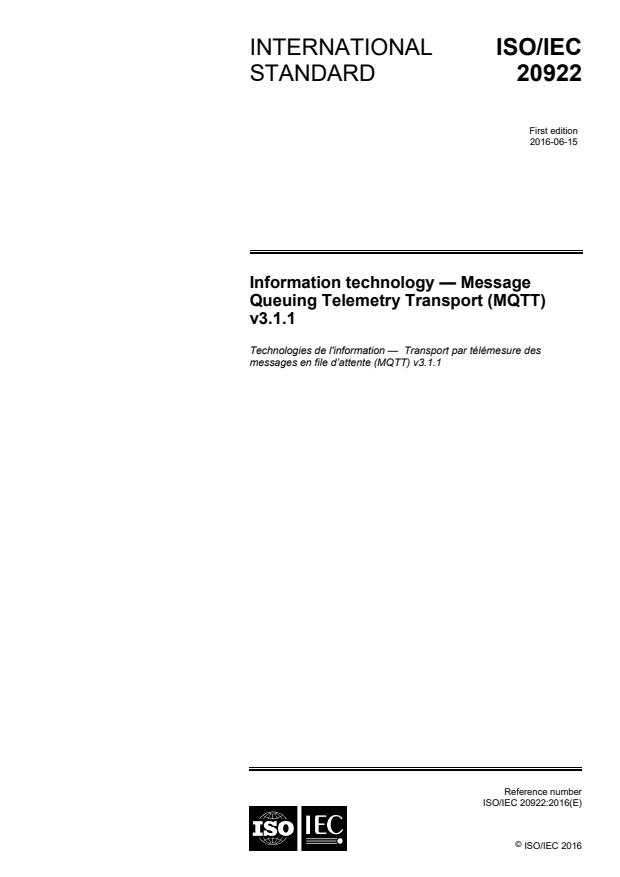
INTERNATIONAL ISO/IEC
STANDARD 20922
First edition
2016-06-15
Information technology — Message
Queuing Telemetry Transport (MQTT)
v3.1.1
Technologies de l'information — Transport par télémesure des
messages en file d’attente (MQTT) v3.1.1
Reference number
©
ISO/IEC 2016
© ISO/IEC 2016
All rights reserved. Unless otherwise specified, no part of this publication may be reproduced or utilized otherwise in any form or by any
means, electronic or mechanical, including photocopying, or posting on the internet or an intranet, without prior written permission.
Permission can be requested from either ISO at the address below or ISO’s member body in the country of the requester.
ISO copyright office
Case postale 56 CH-1211 Geneva 20
Tel. + 41 22 749 01 11
Fax + 41 22 749 09 47
E-mail copyright@iso.org
Web www.iso.org
Published in Switzerland
ii © ISO/IEC 2016 – All rights reserved
Foreword
ISO (the International Organization for Standardization) and IEC (the International Electrotechnical
Commission) form the specialized system for worldwide standardization. National bodies that are members of
ISO or IEC participate in the development of International Standards through technical committees
established by the respective organization to deal with particular fields of technical activity. ISO and IEC
technical committees collaborate in fields of mutual interest. Other international organizations, governmental
and non-governmental, in liaison with ISO and IEC, also take part in the work. In the field of information
technology, ISO and IEC have established a joint technical committee, ISO/IEC JTC 1.
The procedures used to develop this document and those intended for its further maintenance are described
in the ISO/IEC Directives, Part 1. In particular the different approval criteria needed for the different types of
document should be noted. This document was drafted in accordance with the editorial rules of the
ISO/IEC Directives, Part 2 (see www.iso.org/directives).
Attention is drawn to the possibility that some of the elements of this document may be the subject of patent
rights. ISO and IEC shall not be held responsible for identifying any or all such patent rights. Details of any
patent rights identified during the development of the document will be in the Introduction and/or on the ISO
list of patent declarations received (see www.iso.org/patents).
Any trade name used in this document is information given for the convenience of users and does not
constitute an endorsement.
For an explanation on the meaning of ISO specific terms and expressions related to conformity assessment,
as well as information about ISO's adherence to the WTO principles in the Technical Barriers to Trade (TBT),
see the following URL: Foreword — Supplementary information.
Technical Committee and was adopted, under the PAS procedure, by Joint Technical Committee ISO/IEC
JTC 1, Information technology, in parallel with its approval by the national bodies of ISO and IEC.
© ISO/IEC 2016 – All rights reserved iii
MQTT Version 3.1.1
OASIS Standard
29 October 2014
Specification URIs
This version:
http://docs.oasis-open.org/mqtt/mqtt/v3.1.1/os/mqtt-v3.1.1-os.doc (Authoritative)
http://docs.oasis-open.org/mqtt/mqtt/v3.1.1/os/mqtt-v3.1.1-os.html
http://docs.oasis-open.org/mqtt/mqtt/v3.1.1/os/mqtt-v3.1.1-os.pdf
Previous version:
http://docs.oasis-open.org/mqtt/mqtt/v3.1.1/cos01/mqtt-v3.1.1-cos01.doc (Authoritative)
http://docs.oasis-open.org/mqtt/mqtt/v3.1.1/cos01/mqtt-v3.1.1-cos01.html
http://docs.oasis-open.org/mqtt/mqtt/v3.1.1/cos01/mqtt-v3.1.1-cos01.pdf
Latest version:
http://docs.oasis-open.org/mqtt/mqtt/v3.1.1/mqtt-v3.1.1.doc (Authoritative)
http://docs.oasis-open.org/mqtt/mqtt/v3.1.1/mqtt-v3.1.1.html
http://docs.oasis-open.org/mqtt/mqtt/v3.1.1/mqtt-v3.1.1.pdf
Technical Committee:
OASIS Message Queuing Telemetry Transport (MQTT) TC
Chairs:
Raphael J Cohn (raphael.cohn@stormmq.com), Individual
Richard J Coppen (coppen@uk.ibm.com), IBM
Editors:
Andrew Banks (Andrew_Banks@uk.ibm.com), IBM
Rahul Gupta (rahul.gupta@us.ibm.com), IBM
Related work:
This specification is related to:
MQTT and the NIST Cybersecurity Framework Version 1.0. Edited by Geoff Brown and
Louis-Philippe Lamoureux. Latest version: http://docs.oasis-open.org/mqtt/mqtt-nist-
cybersecurity/v1.0/mqtt-nist-cybersecurity-v1.0.html.
Abstract:
MQTT is a Client Server publish/subscribe messaging transport protocol. It is light weight, open,
simple, and designed so as to be easy to implement. These characteristics make it ideal for use
in many situations, including constrained environments such as for communication in Machine to
Machine (M2M) and Internet of Things (IoT) contexts where a small code footprint is required
and/or network bandwidth is at a premium.
The protocol runs over TCP/IP, or over other network protocols that provide ordered, lossless, bi-
directional connections. Its features include:
Use of the publish/subscribe message pattern which provides one-to-many message
distribution and decoupling of applications.
A messaging transport that is agnostic to the content of the payload.
Three qualities of service for message delivery:
mqtt-v3.1.1-os 29 October 2014
Standards Track Work Product Copyright © OASIS Open 2014. All Rights Reserved. Page 1 of 81
© ISO/IEC 2016 – All rights reserved
"At most once", where messages are delivered according to the best efforts of the
operating environment. Message loss can occur. This level could be used, for
example, with ambient sensor data where it does not matter if an individual reading is
lost as the next one will be published soon after.
"At least once", where messages are assured to arrive but duplicates can occur.
"Exactly once", where message are assured to arrive exactly once. This level could
be used, for example, with billing systems where duplicate or lost messages could
lead to incorrect charges being applied.
A small transport overhead and protocol exchanges minimized to reduce network traffic.
A mechanism to notify interested parties when an abnormal disconnection occurs.
Status:
This document was last revised or approved by the membership of OASIS on the above date.
The level of approval is also listed above. Check the “Latest version” location noted above for
possible later revisions of this document. Any other numbered Versions and other technical work
produced by the Technical Committee (TC) are listed at https://www.oasis-
open.org/committees/tc_home.php?wg_abbrev=mqtt#technical.
TC members should send comments on this specification to the TC’s email list. Others should
send comments to the TC’s public comment list, after subscribing to it by following the
instructions at the “Send A Comment” button on the TC’s web page at https://www.oasis-
open.org/committees/mqtt/.
For information on whether any patents have been disclosed that may be essential to
implementing this specification, and any offers of patent licensing terms, please refer to the
Intellectual Property Rights section of the Technical Committee web page (https://www.oasis-
open.org/committees/mqtt/ipr.php).
Citation format:
When referencing this specification the following citation format should be used:
[mqtt-v3.1.1]
MQTT Version 3.1.1. Edited by Andrew Banks and Rahul Gupta. 29 October 2014. OASIS
Standard. http://docs.oasis-open.org/mqtt/mqtt/v3.1.1/os/mqtt-v3.1.1-os.html. Latest version:
http://docs.oasis-open.org/mqtt/mqtt/v3.1.1/mqtt-v3.1.1.html.
mqtt-v3.1.1-os 29 October 2014
Standards Track Work Product Copyright © OASIS Open 2014. All Rights Reserved. Page 2 of 81
© ISO/IEC 2016 – All rights reserved
Notices
Copyright © OASIS Open 2014. All Rights Reserved.
All capitalized terms in the following text have the meanings assigned to them in the OASIS Intellectual
Property Rights Policy (the "OASIS IPR Policy"). The full Policy may be found at the OASIS website.
This document and translations of it may be copied and furnished to others, and derivative works that
comment on or otherwise explain it or assist in its implementation may be prepared, copied, published,
and distributed, in whole or in part, without restriction of any kind, provided that the above copyright notice
and this section are included on all such copies and derivative works. However, this document itself may
not be modified in any way, including by removing the copyright notice or references to OASIS, except as
needed for the purpose of developing any document or deliverable produced by an OASIS Technical
Committee (in which case the rules applicable to copyrights, as set forth in the OASIS IPR Policy, must
be followed) or as required to translate it into languages other than English.
The limited permissions granted above are perpetual and will not be revoked by OASIS or its successors
or assigns.
This document and the information contained herein is provided on an "AS IS" basis and OASIS
DISCLAIMS ALL WARRANTIES, EXPRESS OR IMPLIED, INCLUDING BUT NOT LIMITED TO ANY
WARRANTY THAT THE USE OF THE INFORMATION HEREIN WILL NOT INFRINGE ANY
OWNERSHIP RIGHTS OR ANY IMPLIED WARRANTIES OF MERCHANTABILITY OR FITNESS FOR A
PARTICULAR PURPOSE.
OASIS requests that any OASIS Party or any other party that believes it has patent claims that would
necessarily be infringed by implementations of this OASIS Committee Specification or OASIS Standard,
to notify OASIS TC Administrator and provide an indication of its willingness to grant patent licenses to
such patent claims in a manner consistent with the IPR Mode of the OASIS Technical Committee that
produced this specification.
OASIS invites any party to contact the OASIS TC Administrator if it is aware of a claim of ownership of
any patent claims that would necessarily be infringed by implementations of this specification by a patent
holder that is not willing to provide a license to such patent claims in a manner consistent with the IPR
Mode of the OASIS Technical Committee that produced this specification. OASIS may include such
claims on its website, but disclaims any obligation to do so.
OASIS takes no position regarding the validity or scope of any intellectual property or other rights that
might be claimed to pertain to the implementation or use of the technology described in this document or
the extent to which any license under such rights might or might not be available; neither does it
represent that it has made any effort to identify any such rights. Information on OASIS' procedures with
respect to rights in any document or deliverable produced by an OASIS Technical Committee can be
found on the OASIS website. Copies of claims of rights made available for publication and any
assurances of licenses to be made available, or the result of an attempt made to obtain a general license
or permission for the use of such proprietary rights by implementers or users of this OASIS Committee
Specification or OASIS Standard, can be obtained from the OASIS TC Administrator. OASIS makes no
representation that any information or list of intellectual property rights will at any time be complete, or
that any claims in such list are, in fact, Essential Claims.
The name "OASIS" is a trademark of OASIS, the owner and developer of this specification, and should be
used only to refer to the organization and its official outputs. OASIS welcomes reference to, and
implementation and use of, specifications, while reserving the right to enforce its marks against
misleading uses. Please see https://www.oasis-open.org/policies-guidelines/trademark for above
guidance.
mqtt-v3.1.1-os 29 October 2014
Standards Track Work Product Copyright © OASIS Open 2014. All Rights Reserved. Page 3 of 81
© ISO/IEC 2016 – All rights reserved
Table of Contents
1 Introduction . 9
1.1 Organization of MQTT . 9
1.2 Terminology . 9
1.3 Normative references . 10
1.4 Non normative references . 11
1.5 Data representations . 13
1.5.1 Bits . 13
1.5.2 Integer data values . 13
1.5.3 UTF-8 encoded strings . 13
1.6 Editing conventions . 15
2 MQTT Control Packet format . 16
2.1 Structure of an MQTT Control Packet . 16
2.2 Fixed header . 16
2.2.1 MQTT Control Packet type . 16
2.2.2 Flags . 17
2.2.3 Remaining Length . 18
2.3 Variable header . 19
2.3.1 Packet Identifier . 20
2.4 Payload . 21
3 MQTT Control Packets . 23
3.1 CONNECT – Client requests a connection to a Server . 23
3.1.1 Fixed header. 23
3.1.2 Variable header . 23
3.1.3 Payload . 29
3.1.4 Response . 30
3.2 CONNACK – Acknowledge connection request . 31
3.2.1 Fixed header. 31
3.2.2 Variable header . 31
3.2.3 Payload . 33
3.3 PUBLISH – Publish message . 33
3.3.1 Fixed header. 33
3.3.2 Variable header . 35
3.3.3 Payload . 36
3.3.4 Response . 36
3.3.5 Actions . 36
3.4 PUBACK – Publish acknowledgement . 37
3.4.1 Fixed header. 37
3.4.2 Variable header . 37
3.4.3 Payload . 37
3.4.4 Actions . 37
3.5 PUBREC – Publish received (QoS 2 publish received, part 1) . 37
3.5.1 Fixed header. 38
3.5.2 Variable header . 38
mqtt-v3.1.1-os 29 October 2014
Standards Track Work Product Copyright © OASIS Open 2014. All Rights Reserved. Page 4 of 81
© ISO/IEC 2016 – All rights reserved
3.5.3 Payload . 38
3.5.4 Actions . 38
3.6 PUBREL – Publish release (QoS 2 publish received, part 2). 38
3.6.1 Fixed header. 38
3.6.2 Variable header . 39
3.6.3 Payload . 39
3.6.4 Actions . 39
3.7 PUBCOMP – Publish complete (QoS 2 publish received, part 3) . 39
3.7.1 Fixed header. 39
3.7.2 Variable header . 40
3.7.3 Payload . 40
3.7.4 Actions . 40
3.8 SUBSCRIBE - Subscribe to topics . 40
3.8.1 Fixed header. 40
3.8.2 Variable header . 40
3.8.3 Payload . 41
3.8.4 Response . 42
3.9 SUBACK – Subscribe acknowledgement . 43
3.9.1 Fixed header. 44
3.9.2 Variable header . 44
3.9.3 Payload . 44
3.10 UNSUBSCRIBE – Unsubscribe from topics . 45
3.10.1 Fixed header. 45
3.10.2 Variable header . 45
3.10.3 Payload . 46
3.10.4 Response . 46
3.11 UNSUBACK – Unsubscribe acknowledgement. 47
3.11.1 Fixed header. 47
3.11.2 Variable header . 47
3.11.3 Payload . 48
3.12 PINGREQ – PING request . 48
3.12.1 Fixed header. 48
3.12.2 Variable header . 48
3.12.3 Payload . 48
3.12.4 Response . 48
3.13 PINGRESP – PING response . 48
3.13.1 Fixed header. 48
3.13.2 Variable header . 49
3.13.3 Payload . 49
3.14 DISCONNECT – Disconnect notification . 49
3.14.1 Fixed header. 49
3.14.2 Variable header . 49
3.14.3 Payload . 49
3.14.4 Response . 49
4 Operational behavior . 51
mqtt-v3.1.1-os 29 October 2014
Standards Track Work Product Copyright © OASIS Open 2014. All Rights Reserved. Page 5 of 81
© ISO/IEC 2016 – All rights reserved
4.1 Storing state . 51
4.1.1 Non normative example . 51
4.2 Network Connections . 52
4.3 Quality of Service levels and protocol flows . 52
4.3.1 QoS 0: At most once delivery . 52
4.3.2 QoS 1: At least once delivery . 53
4.3.3 QoS 2: Exactly once delivery . 54
4.4 Message delivery retry . 55
4.5 Message receipt . 56
4.6 Message ordering . 56
4.7 Topic Names and Topic Filters . 57
4.7.1 Topic wildcards . 57
4.7.2 Topics beginning with $ . 58
4.7.3 Topic semantic and usage . 58
4.8 Handling errors . 59
5 Security . 60
5.1 Introduction . 60
5.2 MQTT solutions: security and certification . 60
5.3 Lightweight cryptography and constrained devices . 61
5.4 Implementation notes . 61
5.4.1 Authentication of Clients by the Server . 61
5.4.2 Authorization of Clients by the Server . 61
5.4.3 Authentication of the Server by the Client . 61
5.4.4 Integrity of Application Messages and Control Packets . 62
5.4.5 Privacy of Application Messages and Control Packets . 62
5.4.6 Non-repudiation of message transmission . 62
5.4.7 Detecting compromise of Clients and Servers . 62
5.4.8 Detecting abnormal behaviors. 63
5.4.9 Other security considerations . 63
5.4.10 Use of SOCKS . 64
5.4.11 Security profiles . 64
6 Using WebSocket as a network transport . 65
6.1 IANA Considerations . 65
7 Conformance . 66
7.1 Conformance Targets . 66
7.1.1 MQTT Server . 66
7.1.2 MQTT Client . 66
Appendix A. Acknowledgements (non normative) . 68
Appendix B. Mandatory normative statements (non normative) . 70
Appendix C. Revision history (non normative) . 80
mqtt-v3.1.1-os 29 October 2014
Standards Track Work Product Copyright © OASIS Open 2014. All Rights Reserved. Page 6 of 81
© ISO/IEC 2016 – All rights reserved
Table of Figures and Tables
Figure 1.1 Structure of UTF-8 encoded strings . 13
Figure 1.2 UTF-8 encoded string non normative example……………………………………………………………….…14
Figure 2.1 – Structure of an MQTT Control Packet . 16
Figure 2.2 - Fixed header format . 16
Table 2.1 - Control packet types . 16
Table 2.2 - Flag Bits . 17
Table 2.4 Size of Remaining Length field . 18
Figure 2.3 - Packet Identifier bytes. 20
Table 2.5 - Control Packets that contain a Packet Identifier . 20
Table 2.6 - Control Packets that contain a Payload . 21
Figure 3.1 – CONNECT Packet fixed header . 23
Figure 3.2 - Protocol Name bytes . 23
Figure 3.3 - Protocol Level byte . 24
Figure 3.4 - Connect Flag bits . 24
Figure 3.5 Keep Alive bytes . 27
Figure 3.6 - Variable header non normative example . 28
Figure 3.7 - Password bytes . 30
Figure 3.8 – CONNACK Packet fixed header . 31
Figure 3.9 – CONNACK Packet variable header. 31
Table 3.1 – Connect Return code values . 32
Figure 3.10 – PUBLISH Packet fixed header . 33
Table 3.2 - QoS definitions . 34
Table 3.3 - Publish Packet non normative example . 35
Figure 3.11 - Publish Packet variable header non normative example . 35
Table 3.4 - Expected Publish Packet response . 36
Figure 3.12 - PUBACK Packet fixed header . 37
Figure 3.13 – PUBACK Packet variable header . 37
Figure 3.14 – PUBREC Packet fixed header . 38
Figure 3.15 – PUBREC Packet variable header . 38
Figure 3.16 – PUBREL Packet fixed header . 38
Figure 3.17 – PUBREL Packet variable header . 39
Figure 3.18 – PUBCOMP Packet fixed header . 39
Figure 3.19 – PUBCOMP Packet variable header . 40
Figure 3.20 – SUBSCRIBE Packet fixed header . 40
Figure 3.21 - Variable header with a Packet Identifier of 10, Non normative example . 41
Figure 3.22 – SUBSCRIBE Packet payload format . 41
Table 3.5 - Payload non normative example . 42
Figure 3.23 - Payload byte format non normative example . 42
Figure 3.24 – SUBACK Packet fixed header . 44
Figure 3.25 – SUBACK Packet variable header . 44
Figure 3.26 – SUBACK Packet payload format . 44
Table 3.6 - Payload non normative example . 45
Figure 3.27 - Payload byte format non normative example . 45
Figure 3.28 – UNSUBSCRIBE Packet Fixed header . 45
Figure 3.29 – UNSUBSCRIBE Packet variable header . 45
Table3.7 - Payload non normative example . 46
Figure 3.30 - Payload byte format non normative example . 46
mqtt-v3.1.1-os 29 October 2014
Standards Track Work Product Copyright © OASIS Open 2014. All Rights Reserved. Page 7 of 81
© ISO/IEC 2016 – All rights reserved
Figure 3.31 – UNSUBACK Packet fixed header. 47
Figure 3.32 – UNSUBACK Packet variable header . 47
Figure 3.33 – PINGREQ Packet fixed header . 48
Figure 3.34 – PINGRESP Packet fixed header . 48
Figure 3.35 – DISCONNECT Packet fixed header . 49
Figure 4.1 – QoS 0 protocol flow diagram, non normative example . 52
Figure 4.2 – QoS 1 protocol flow diagram, non normative example . 53
Figure 4.3 – QoS 2 protocol flow diagram, non normative example . 54
Figure 6.1 - IANA WebSocket Identifier . 65
mqtt-v3.1.1-os 29 October 2014
Standards Track Work Product Copyright © OASIS Open 2014. All Rights Reserved. Page 8 of 81
© ISO/IEC 2016 – All rights reserved
1 1 Introduction
2 1.1 Organization of MQTT
3 This specification is split into seven chapters:
4 Chapter 1 - Introduction
5 Chapter 2 - MQTT Control Packet format
6 Chapter 3 - MQTT Control Packets
7 Chapter 4 - Operational behavior
8 Chapter 5 - Security
9 Chapter 6 - Using WebSocket as a network transport
10 Chapter 7 - Conformance Targets
11 1.2 Terminology
12 The key words "MUST", "MUST NOT", "REQUIRED", "SHALL", "SHALL NOT", "SHOULD", "SHOULD
13 NOT", "RECOMMENDED", "MAY", and "OPTIONAL" in this specification are to be interpreted as
14 described in IETF RFC 2119 [RFC2119].
15 Network Connection:
16 A construct provided by the underlying transport protocol that is being used by MQTT.
17 It connects the Client to the Server.
18 It provides the means to send an ordered, lossless, stream of bytes in both directions.
19 For examples see Section 4.2.
20 Application Message:
21 The data carried by the MQTT protocol across the network for the application. When Application
22 Messages are transported by MQTT they have an associated Quality of Service and a Topic Name.
23 Client:
24 A program or device that uses MQTT. A Client always establishes the Network Connection to the Server.
25 It can
26 Publish Application Messages that other Clients might be interested in.
27 Subscribe to request Application Messages that it is interested in receiving.
28 Unsubscribe to remove a request for Application Messages.
29 Disconnect from the Server.
30 Server:
31 A program or device that acts as an intermediary between Clients which publish Application Messages
32 and Clients which have made Subscriptions. A Server
33 Accepts Network Connections from Clients.
34 Accepts Application Messages published by Clients.
mqtt-v3.1.1-os 29 October 2014
Standards Track Work Product Copyright © OASIS Open 2014. All Rights Reserved. Page 9 of 81
© ISO/IEC 2016 – All rights reserved
35 Processes Subscribe and Unsubscribe requests from Clients.
36 Forwards Application Messages that match Client Subscriptions.
37 Subscription:
38 A Subscription comprises a Topic Filter and a maximum QoS. A Subscription is associated with a single
39 Session. A Session can contain more than one Subscription. Each Subscription within a session has a
40 different Topic Filter.
41 Topic Name:
42 The label attached to an Application Message which is matched against the Subscriptions known to the
43 Server. The Server sends a copy of the Application Message to each Client that has a matching
44 Subscription.
45 Topic Filter:
46 An expression contained in a Subscription, to indicate an interest in one or more topics. A Topic Filter can
47 include wildcard characters.
48 Session:
49 A stateful interaction between a Client and a Server. Some Sessions last only as long as the Network
50 Connection, others can span multiple consecutive Network Connections between a Client and a Server.
51 MQTT Control Packet:
52 A packet of information that is sent across the Network Connection. The MQTT specification defines
53 fourteen different types of Control Packet, one of which (the PUBLISH packet) is used to convey
54 Application Messages.
55 1.3 Normative references
56 [RFC2119]
57 Bradner, S., "Key words for use in RFCs to Indicate Requirement Levels", BCP 14, RFC 2119, March
58 1997.
59 http://www.ietf.org/rfc/rfc2119.txt
61 [RFC3629]
62 Yergeau, F., "UTF-8, a transformation format of ISO 10646", STD 63, RFC 3629, November 2003
63 http://www.ietf.org/rfc/rfc3629.txt
65 [RFC5246]
66 Dierks, T. and E. Rescorla, "The Transport Layer Security (TLS) Protocol Version 1.2", RFC 5246, August
67 2008.
68 http://www.ietf.org/rfc/rfc5246.txt
70 [RFC6455]
71 Fette, I. and A. Melnikov, "The WebSocket
...