

ISO/IEC 15953:1999
(Main)Information technology — Open Systems Interconnection — Service definition for the Application Service Object Association Control Service Element
General Information
- Abstract
This Recommendation | International Standard defines ACSE services for ASO-association control in an open systems interconnection environment. ACSE supports two modes of communication service: connection-mode and connectionless-mode. The ACSE connection-mode service is provided by the use of the connection-mode ACSE protocol (see ITU-T Rec. X.227 bis | ISO/IEC 15954). The ACSE connectionless-mode service (A-UNIT-DATA) is provided by the use of the connectionless-mode ACSE protocol (see ITU-T Rec. X.237 bis | ISO/IEC 15955). Five functional units are defined in the ACSE. The mandatory Kernel functional unit is used to establish and release ASO-associations. The optional Authentication functional unit provides additional facilities for exchanging information in support of authentication during association establishment without adding services. The ACSE authentication facilities may be used to support a limited class of authentication methods. The optional ASO-context negotiation functional unit allows multiple ASO-contexts to be offered during association establishment. The optional higher level association functional unit provides for the facility to identify ASO-associations and transparently pass data to child ASOs and allows the ASO-context or the presentation context on an ASO-association to be modified during the lifetime of the association. This Recommendation | International Standard does not specify individual implementations or products, nor does it constrain the implementation of entities and interfaces within a computer system. No requirement is made for conformance to this Service definition.
- Status
- Published
- Publication Date
- 15-Dec-1999
- Technical Committee
- ISO/IEC JTC 1 - Information technology
- Drafting Committee
- ISO/IEC JTC 1 - Information technology
- Current Stage
- 9093 - International Standard confirmed
- Start Date
- 06-Jan-2005
- Completion Date
- 29-Aug-2026
Buy Documents
ISO/IEC 15953:1999 - Information technology — Open Systems Interconnection — Service definition for the Application Service Object Association Control Service Element Released:12/16/1999
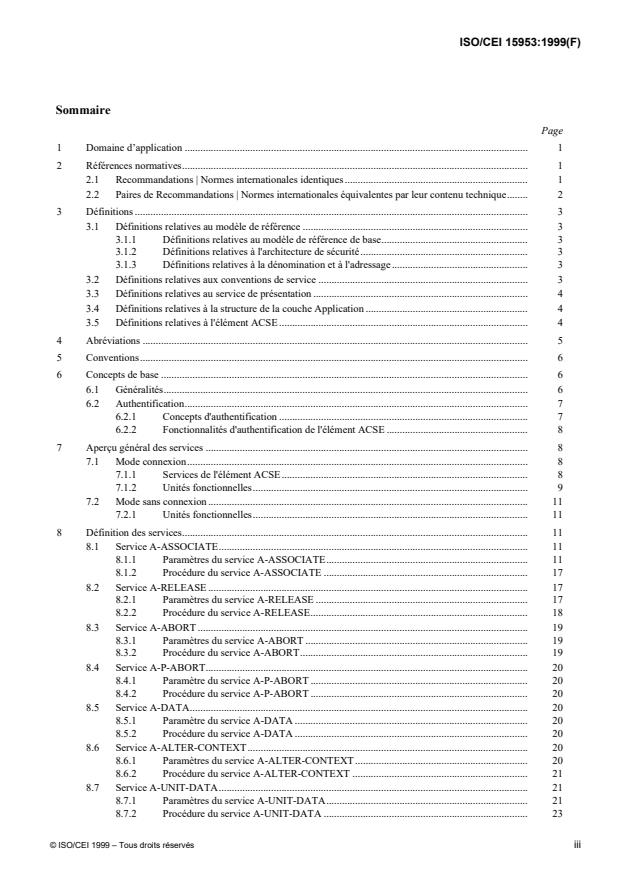
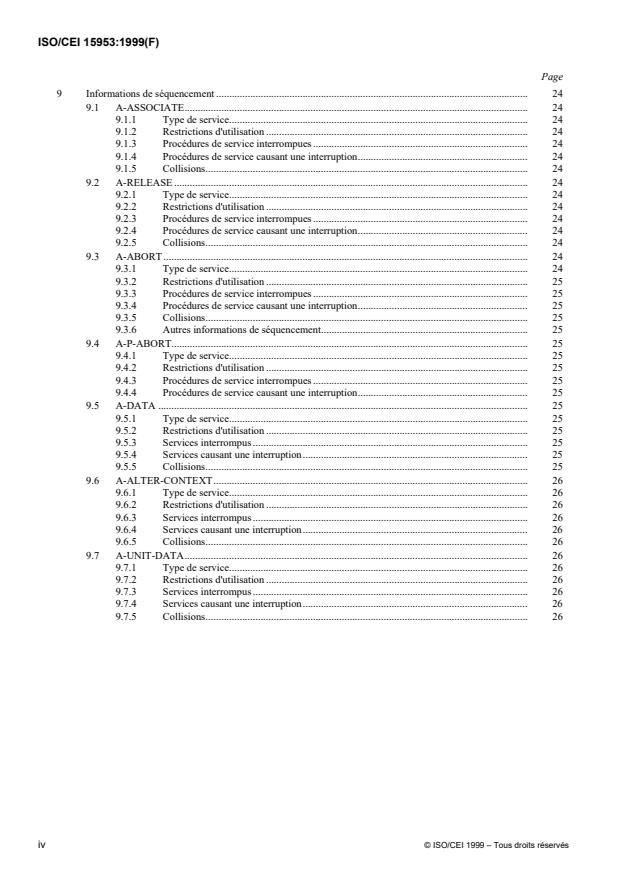
ISO/IEC 15953:1999 - Technologies de l'information — Interconnexion des systemes ouverts — Définition du service pour l'élément de service de contrôle d'association des objets de service d'application Released:3/30/2000
Overview
ISO/IEC 15953:1999 defines the Association Control Service Element (ACSE) - the application-layer service for controlling Application Service Object (ASO) associations in an Open Systems Interconnection (OSI) environment. This international standard describes ACSE services that support two communication modes: connection‑mode (see ISO/IEC 15954 / ITU‑T X.227 bis) and connectionless‑mode (see ISO/IEC 15955 / ITU‑T X.237 bis). ISO/IEC 15953 is a service definition (not an implementation specification) and does not mandate conformance to particular products or internal system interfaces.
Key topics
- ACSE service modes
- Connection‑mode: association-oriented control using the connection‑mode ACSE protocol.
- Connectionless‑mode: datagram-style A‑UNIT‑DATA service using the connectionless ACSE protocol.
- Functional units (five defined)
- Kernel (mandatory): establish and release ASO‑associations.
- Authentication (optional): exchange authentication information during association establishment.
- ASO‑context negotiation (optional): offer multiple ASO‑contexts during association setup.
- Higher‑level association (optional): identify ASO‑associations, transparently pass data to child ASOs, and allow context changes during an active association.
- Nested‑association (optional): support nested associations over upper layers.
- Service primitives and procedures
- Defines common ACSE primitives such as A‑ASSOCIATE, A‑RELEASE, A‑ABORT, A‑P‑ABORT, A‑DATA, A‑ALTER‑CONTEXT, and A‑UNIT‑DATA with parameters and sequencing rules.
- Authentication facilities
- Provides limited, standardized mechanisms to support a range of authentication methods during association establishment.
- Fast‑associate mechanism
- Supports compressed exchange (upper layer context identifier) to speed combined session/presentation/application association setup.
Applications
ISO/IEC 15953 is intended for:
- Protocol designers and implementers building OSI-compliant application-layer services and middleware.
- Vendors of networked applications and messaging systems needing standardized association control and optional authentication.
- Systems integrators and architects who require interoperable association negotiation and context management across heterogeneous systems.
- Standards bodies, academic researchers, and engineers referencing OSI application‑layer behavior and service primitives.
Practical benefits include predictable association lifecycles, interoperable context negotiation, and a defined basis for optional authentication support in multi‑vendor OSI environments.
Related standards
- ISO/IEC 15954 (connection‑mode ACSE protocol) - ITU‑T X.227 bis
- ISO/IEC 15955 (connectionless ACSE protocol) - ITU‑T X.237 bis
- ISO/IEC 7498‑1 (OSI Reference Model)
- ITU‑T X.217 bis (identical text to ISO/IEC 15953)
- Previous edition: ISO/IEC 8649 (superseded)
Keywords: ISO/IEC 15953:1999, ACSE services, ASO‑association control, Open Systems Interconnection, application service element, connection‑mode, connectionless, ASO‑context negotiation, authentication facilities.
Relations
- Effective Date
- 25-Aug-2026
- Effective Date
- 10-Feb-2026
- Effective Date
- 06-Sep-2025
- Effective Date
- 06-Sep-2025
- Effective Date
- 15-Apr-2008
Buy Documents
ISO/IEC 15953:1999 - Information technology — Open Systems Interconnection — Service definition for the Application Service Object Association Control Service Element Released:12/16/1999
ISO/IEC 15953:1999 - Technologies de l'information — Interconnexion des systemes ouverts — Définition du service pour l'élément de service de contrôle d'association des objets de service d'application Released:3/30/2000
Get Certified
Connect with accredited certification bodies for this standard

BSI Group
BSI (British Standards Institution) is the business standards company that helps organizations make excellence a habit.

NYCE
Mexican standards and certification body.
Sponsored listings
Frequently Asked Questions
ISO/IEC 15953:1999 is a standard published by the International Organization for Standardization (ISO). Its full title is "Information technology — Open Systems Interconnection — Service definition for the Application Service Object Association Control Service Element". This standard covers: This Recommendation | International Standard defines ACSE services for ASO-association control in an open systems interconnection environment. ACSE supports two modes of communication service: connection-mode and connectionless-mode. The ACSE connection-mode service is provided by the use of the connection-mode ACSE protocol (see ITU-T Rec. X.227 bis | ISO/IEC 15954). The ACSE connectionless-mode service (A-UNIT-DATA) is provided by the use of the connectionless-mode ACSE protocol (see ITU-T Rec. X.237 bis | ISO/IEC 15955). Five functional units are defined in the ACSE. The mandatory Kernel functional unit is used to establish and release ASO-associations. The optional Authentication functional unit provides additional facilities for exchanging information in support of authentication during association establishment without adding services. The ACSE authentication facilities may be used to support a limited class of authentication methods. The optional ASO-context negotiation functional unit allows multiple ASO-contexts to be offered during association establishment. The optional higher level association functional unit provides for the facility to identify ASO-associations and transparently pass data to child ASOs and allows the ASO-context or the presentation context on an ASO-association to be modified during the lifetime of the association. This Recommendation | International Standard does not specify individual implementations or products, nor does it constrain the implementation of entities and interfaces within a computer system. No requirement is made for conformance to this Service definition.
This Recommendation | International Standard defines ACSE services for ASO-association control in an open systems interconnection environment. ACSE supports two modes of communication service: connection-mode and connectionless-mode. The ACSE connection-mode service is provided by the use of the connection-mode ACSE protocol (see ITU-T Rec. X.227 bis | ISO/IEC 15954). The ACSE connectionless-mode service (A-UNIT-DATA) is provided by the use of the connectionless-mode ACSE protocol (see ITU-T Rec. X.237 bis | ISO/IEC 15955). Five functional units are defined in the ACSE. The mandatory Kernel functional unit is used to establish and release ASO-associations. The optional Authentication functional unit provides additional facilities for exchanging information in support of authentication during association establishment without adding services. The ACSE authentication facilities may be used to support a limited class of authentication methods. The optional ASO-context negotiation functional unit allows multiple ASO-contexts to be offered during association establishment. The optional higher level association functional unit provides for the facility to identify ASO-associations and transparently pass data to child ASOs and allows the ASO-context or the presentation context on an ASO-association to be modified during the lifetime of the association. This Recommendation | International Standard does not specify individual implementations or products, nor does it constrain the implementation of entities and interfaces within a computer system. No requirement is made for conformance to this Service definition.
ISO/IEC 15953:1999 is classified under the following ICS (International Classification for Standards) categories: 35.100.70 - Application layer. The ICS classification helps identify the subject area and facilitates finding related standards.
ISO/IEC 15953:1999 has the following relationships with other standards: It is inter standard links to EN 13757-1:2014, EN 62056-5-3:2017, ISO/IEC 8649:1996/Amd 1:1997, ISO/IEC 8649:1996/Amd 2:1998, ISO/IEC 8649:1996. Understanding these relationships helps ensure you are using the most current and applicable version of the standard.
ISO/IEC 15953:1999 is available in PDF format for immediate download after purchase. The document can be added to your cart and obtained through the secure checkout process. Digital delivery ensures instant access to the complete standard document.
Standards Content (Sample)
INTERNATIONAL ISO/IEC
STANDARD 15953
First edition
1999-12-15
Information technology — Open Systems
Interconnection — Service definition for
the Application Service Object
Association Control Service Element
Technologies de l'information — Interconnexion des systèmes
ouverts — Définition du service pour l'élément de service de contrôle
d'association des objets de service d'application
Reference number
©
ISO/IEC 1999
PDF disclaimer
This PDF file may contain embedded typefaces. In accordance with Adobe's licensing policy, this file may be printed or viewed but shall not
be edited unless the typefaces which are embedded are licensed to and installed on the computer performing the editing. In downloading this
file, parties accept therein the responsibility of not infringing Adobe's licensing policy. The ISO Central Secretariat accepts no liability in this
area.
Adobe is a trademark of Adobe Systems Incorporated.
Details of the software products used to create this PDF file can be found in the General Info relative to the file; the PDF-creation parameters
were optimized for printing. Every care has been taken to ensure that the file is suitable for use by ISO member bodies. In the unlikely event
that a problem relating to it is found, please inform the Central Secretariat at the address given below.
© ISO/IEC 1999
All rights reserved. Unless otherwise specified, no part of this publication may be reproduced or utilized in any form or by any means, electronic
or mechanical, including photocopying and microfilm, without permission in writing from either ISO at the address below or ISO's member body
in the country of the requester.
ISO copyright office
Case postale 56 � CH-1211 Geneva 20
Tel. + 41 22 749 01 11
Fax + 41 22 734 10 79
E-mail copyright@iso.ch
Web www.iso.ch
Printed in Switzerland
ii © ISO/IEC 1999 – All rights reserved
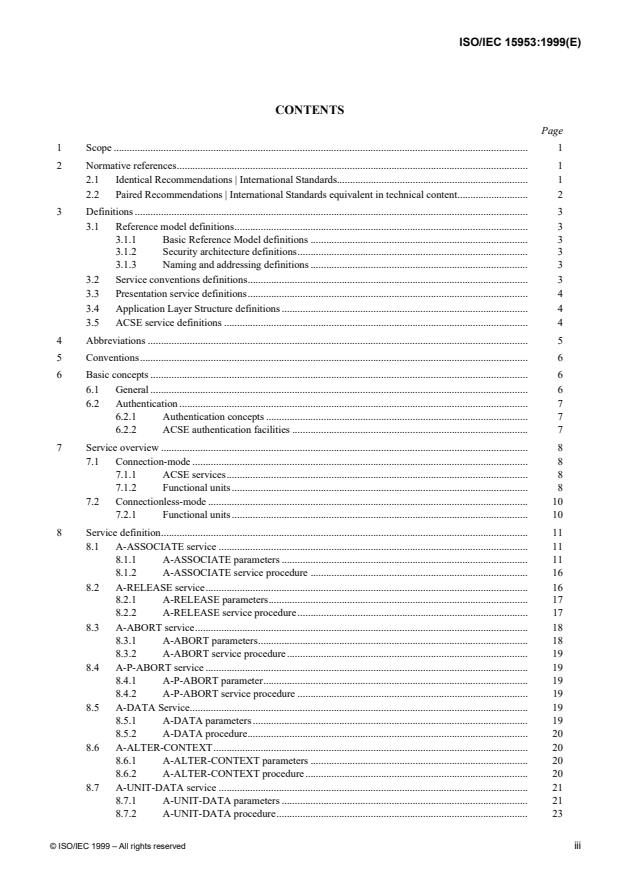
CONTENTS
Page
1 Scope . 1
2 Normative references. 1
2.1 Identical Recommendations | International Standards. 1
2.2 Paired Recommendations | International Standards equivalent in technical content. 2
3 Definitions . 3
3.1 Reference model definitions. 3
3.1.1 Basic Reference Model definitions . 3
3.1.2 Security architecture definitions. 3
3.1.3 Naming and addressing definitions . 3
3.2 Service conventions definitions. 3
3.3 Presentation service definitions. 4
3.4 Application Layer Structure definitions . 4
3.5 ACSE service definitions . 4
4 Abbreviations . 5
5 Conventions. 6
6 Basic concepts . 6
6.1 General . 6
6.2 Authentication . 7
6.2.1 Authentication concepts .7
6.2.2 ACSE authentication facilities . 7
7 Service overview . 8
7.1 Connection-mode . 8
7.1.1 ACSE services. 8
7.1.2 Functional units . 8
7.2 Connectionless-mode . 10
7.2.1 Functional units . 10
8 Service definition. 11
8.1 A-ASSOCIATE service . 11
8.1.1 A-ASSOCIATE parameters . 11
8.1.2 A-ASSOCIATE service procedure . 16
8.2 A-RELEASE service. 16
8.2.1 A-RELEASE parameters. 17
8.2.2 A-RELEASE service procedure. 17
8.3 A-ABORT service. 18
8.3.1 A-ABORT parameters. 18
8.3.2 A-ABORT service procedure. 19
8.4 A-P-ABORT service . 19
8.4.1 A-P-ABORT parameter. 19
8.4.2 A-P-ABORT service procedure . 19
8.5 A-DATA Service. 19
8.5.1 A-DATA parameters . 19
8.5.2 A-DATA procedure.20
8.6 A-ALTER-CONTEXT. 20
8.6.1 A-ALTER-CONTEXT parameters . 20
8.6.2 A-ALTER-CONTEXT procedure. 20
8.7 A-UNIT-DATA service . 21
8.7.1 A-UNIT-DATA parameters . 21
8.7.2 A-UNIT-DATA procedure. 23
© ISO/IEC 1999 – All rights reserved iii
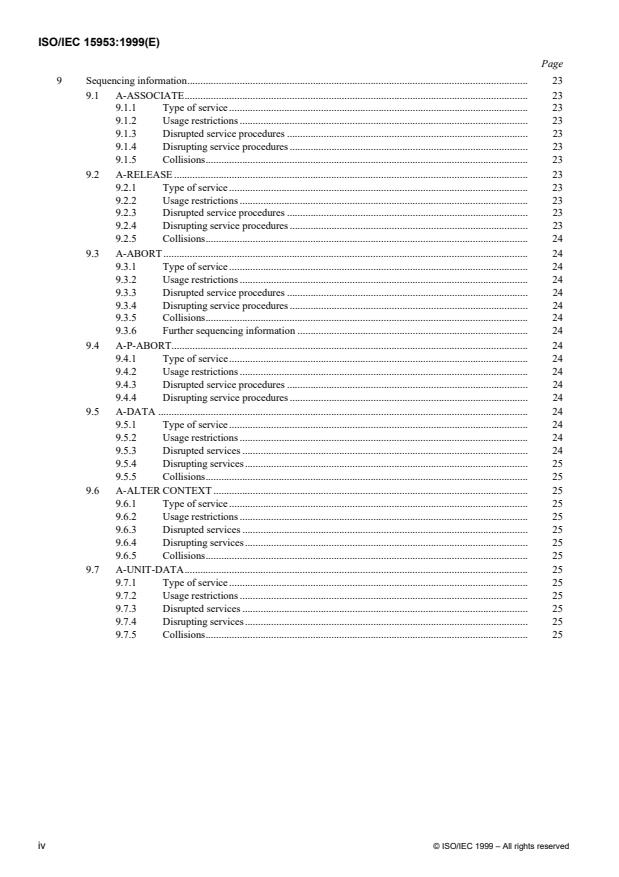
Page
9 Sequencing information. 23
9.1 A-ASSOCIATE. 23
9.1.1 Type of service . 23
9.1.2 Usage restrictions . 23
9.1.3 Disrupted service procedures . 23
9.1.4 Disrupting service procedures . 23
9.1.5 Collisions. 23
9.2 A-RELEASE . 23
9.2.1 Type of service . 23
9.2.2 Usage restrictions . 23
9.2.3 Disrupted service procedures . 23
9.2.4 Disrupting service procedures . 23
9.2.5 Collisions. 24
9.3 A-ABORT . 24
9.3.1 Type of service . 24
9.3.2 Usage restrictions . 24
9.3.3 Disrupted service procedures . 24
9.3.4 Disrupting service procedures . 24
9.3.5 Collisions. 24
9.3.6 Further sequencing information . 24
9.4 A-P-ABORT. 24
9.4.1 Type of service. 24
9.4.2 Usage restrictions . 24
9.4.3 Disrupted service procedures . 24
9.4.4 Disrupting service procedures . 24
9.5 A-DATA . 24
9.5.1 Type of service . 24
9.5.2 Usage restrictions . 24
9.5.3 Disrupted services . 24
9.5.4 Disrupting services. 25
9.5.5 Collisions. 25
9.6 A-ALTER CONTEXT . 25
9.6.1 Type of service . 25
9.6.2 Usage restrictions . 25
9.6.3 Disrupted services . 25
9.6.4 Disrupting services. 25
9.6.5 Collisions. 25
9.7 A-UNIT-DATA. 25
9.7.1 Type of service . 25
9.7.2 Usage restrictions . 25
9.7.3 Disrupted services . 25
9.7.4 Disrupting services. 25
9.7.5 Collisions. 25
iv © ISO/IEC 1999 – All rights reserved
Foreword
ISO (the International Organization for Standardization) and IEC (the International Electrotechnical Commission)
form the specialized system for worldwide standardization. National bodies that are members of ISO or IEC
participate in the development of International Standards through technical committees established by the
respective organization to deal with particular fields of technical activity. ISO and IEC technical committees
collaborate in fields of mutual interest. Other international organizations, governmental and non-governmental, in
liaison with ISO and IEC, also take part in the work.
International Standards are drafted in accordance with the rules given in the ISO/IEC Directives, Part 3.
In the field of information technology, ISO and IEC have established a joint technical committee, ISO/IEC JTC 1.
Draft International Standards adopted by the joint technical committee are circulated to national bodies for voting.
Publication as an International Standard requires approval by at least 75 % of the national bodies casting a vote.
Attention is drawn to the possibility that some of the elements of this International Standard may be the subject of
patent rights. ISO and IEC shall not be held responsible for identifying any or all such patent rights.
International Standard ISO/IEC 15953 was prepared by Joint Technical Committee ISO/IEC JTC 1, Information
technology, in collaboration with ITU-T. The identical text is published as ITU-T Recommendation X.217 bis.
This first edition of ISO/IEC 15953 cancels and replaces ISO/IEC 8649:1996 and its Amendment 1:1997 and
Amendment 2:1998, of which it constitutes a technical revision.
© ISO/IEC 1999 – All rights reserved v
Introduction
This Recommendation | International Standard is one of a set of Recommendations | International Standards produced to
facilitate the interconnection of information processing systems. It is related to other ITU-T Recommendations |
International Standards in the set as defined by the Reference Model for Open Systems Interconnection (see ITU-T
Rec. X.200 | ISO/IEC 7498-1). The reference model subdivides the areas of standardization for interconnection into a
series of layers of specification, each of manageable size.
The goal of Open Systems Interconnection is to allow, with a minimum of technical agreement outside the
Interconnection standards, the interconnection of information processing systems:
– from different manufacturers;
– under different managements;
– of different levels of complexity; and
– of different technologies.
This Recommendation | International Standard recognizes that application-processes may wish to communicate with
each other for a wide variety of reasons. However, any communication will require the performance of certain services
independent of the reasons for communication. The application-service-element defined herein provides such services.
This Service definition defines services provided by the application-service-element for ASO-association control: the
Association Control Service Element (ACSE). The ACSE provides basic facilities for the control of an ASO-association
among communicating application-service-objects (ASOs). The ACSE includes four optional functional units. One
functional unit provides additional facilities for exchanging information in support of authentication during association
establishment without adding services. The optional ASO-context negotiation functional unit allows multiple
ASO-contexts to be offered during association establishment. The optional higher level association functional unit
provides for the facility to identify ASO-associations and transparently pass data to child ASOs and allows the
ASO-context or the presentation context on an ASO-association to be modified during the lifetime of the association.
The optional nested-association functional unit provides for the facility to instantiate multiple associations nested over
supporting upper layers. The X.410 compatibility mode is not provided by this Service definition, since the optional
functional units defined in this Recommendation | International Standard are not used in this mode. The service
definition herein is backwards compatible with ITU-T Rec. X.217 | ISO/IEC 8649.
The fast-associate mechanism allows a session connection, including its embedded presentation connection and
application association, to be established using a compressed form of the information that would otherwise be sent on the
S-CONNECT exchange. The compressed form, called the upper layer context identifier, is a reference to an upper-layer
context specification, which is a definition of the fields of the application, ACSE, presentation and session protocols that
would be sent on the full-form connect messages. The upper layer context identifier may be parameterized to include
values for the variable fields allowed by the full form protocols for the upper layers.
Within the ACSE service, the only addition is the presence of a conceptual parameter which summarizes the contents of
the User-information of the A-ASSOCIATE primitives.
It is recognized that, with respect to ACSE Quality of services (QoS), described in clause 8, work is still in progress to
provide an integrated treatment of QoS across all layers of the OSI Reference Model, and to ensure that the individual
treatments in each layer service satisfy overall QoS objectives in a consistent manner. As a consequence, an addendum
may be added to this Service definition at a later time which reflects further QoS developments and integration.
vi © ISO/IEC 1999 – All rights reserved
ISO/IEC 15953 : 1999 (E)
INTERNATIONAL STANDARD
ISO/IEC 15953 : 1999 (E)
ITU-T Rec. X.217 bis (1998 E)
ITU-T RECOMMENDATION
INFORMATION TECHNOLOGY – OPEN SYSTEMS INTERCONNECTION –
SERVICE DEFINITION FOR THE APPLICATION SERVICE OBJECT
ASSOCIATION CONTROL SERVICE ELEMENT
1 Scope
This Recommendation | International Standard defines ACSE services for ASO-association control in an open systems
interconnection environment. ACSE supports two modes of communication service: connection-mode and
connectionless-mode.
The ACSE connection-mode service is provided by the use of the connection-mode ACSE protocol (see ITU-T
Rec. X.227 bis | ISO/IEC 15954).
The ACSE connectionless-mode service (A-UNIT-DATA) is provided by the use of the connectionless-mode ACSE
protocol (see ITU-T Rec. X.237 bis | ISO/IEC 15955).
Five functional units are defined in the ACSE. The mandatory Kernel functional unit is used to establish and release
ASO-associations. The optional Authentication functional unit provides additional facilities for exchanging information
in support of authentication during association establishment without adding services. The ACSE authentication
facilities may be used to support a limited class of authentication methods. The optional ASO-context negotiation
functional unit allows multiple ASO-contexts to be offered during association establishment. The optional higher level
association functional unit provides for the facility to identify ASO-associations and transparently pass data to child
ASOs and allows the ASO-context or the presentation context on an ASO-association to be modified during the lifetime
of the association.
This Recommendation | International Standard does not specify individual implementations or products, nor does it
constrain the implementation of entities and interfaces within a computer system.
No requirement is made for conformance to this Service definition.
2 Normative references
The following Recommendations and International Standards contain provisions which, through reference in this text,
constitute provisions of this Recommendation | International Standard. At this time of publication, the editions indicated
were valid. All Recommendations and Standards are subject to revision, and parties to agreements based on this
Recommendation | International Standard are encouraged to investigate the possibility of applying the most recent
edition of the Recommendations and Standards listed below. Members of IEC and ISO maintain registers of currently
valid International Standards. The Telecommunication Standardization Bureau of the ITU maintains a list of currently
valid ITU-T Recommendations.
2.1 Identical Recommendations | International Standards
– ITU-T Recommendation X.200 (1994) | ISO/IEC 7498-1:1994, Information technology – Open Systems
Interconnection – Basic Reference Model: The Basic Model.
– ITU-T Recommendation X.207 (1993) | ISO/IEC 9545:1994, Information technology – Open Systems
Interconnection – Application layer structure.
– ITU-T Recommendation X.210 (1993) | ISO/IEC 10731:1994, Information technology – Open Systems
Interconnection – Basic Reference Model: Conventions for the definition of OSI services.
ITU-T Rec. X.217 bis (1998 E) 1
ISO/IEC 15953 : 1999 (E)
– ITU-T Recommendation X.215 (1995) | ISO/IEC 8326:1996, Information technology – Open Systems
Interconnection – Session service definition.
– ITU-T Recommendation X.215 (1995)/Amd.1 (1997) | ISO/IEC 8326:1996/Amd.1:1998, Information
technology – Open Systems Interconnection – Session service definition – Amendment 1: Efficiency
enhancements.
– ITU-T Recommendation X.215 (1995)/Amd.2 (1997) | ISO/IEC 8326:1996/Amd.2:1998, Information
technology – Open Systems Interconnection – Session service definition – Amendment 2: Nested
connections functional unit.
– ITU-T Recommendation X.216 (1994) | ISO/IEC 8822:1994, Information technology – Open Systems
Interconnection – Presentation service definition.
– ITU-T Recommendation X.216 (1994)/Amd.1 (1997) | ISO/IEC 8822:1994/Amd.1:1998, Information
technology – Open Systems Interconnection – Presentation service definition – Amendment 1: Efficiency
enhancements.
– ITU-T Recommendation X.216 (1994)/Amd.2 (1997) | ISO/IEC 8822:1994/Amd.2:1998, Information
technology – Open Systems Interconnection – Presentation service definition – Amendment 2: Nested
connections functional unit.
– ITU-T Recommendation X.217 (1995) | ISO/IEC 8649:1996, Information technology – Open Systems
Interconnection –Service definition for the association control service element.
– ITU-T Recommendation X.225 (1995) | ISO/IEC 8327-1:1996, Information technology – Open Systems
Interconnection – Connection-oriented session protocol: Protocol specification.
– ITU-T Recommendation X.225 (1995)/Amd.1 (1997) | ISO/IEC 8327-1:1996/Amd.1:1998, Information
technology – Open Systems Interconnection – Connection-oriented session protocol: Protocol
specification – Amendment 1: Efficiency enhancements.
– ITU-T Recommendation X.225 (1995)/Amd.2 (1997) | ISO/IEC 8327-1:1996/Amd.2:1998, Information
technology – Open Systems Interconnection – Connection-oriented session protocol: Protocol
specification – Amendment 2: Nested connections functional unit.
– ITU-T Recommendation X.226 (1994) | ISO/IEC 8823-1:1994, Information technology – Open Systems
Interconnection – Connection-oriented presentation protocol: Protocol specification.
– ITU-T Recommendation X.226 (1994)/Amd.1 (1997) | ISO/IEC 8823-1:1994/Amd.1:1998, Information
technology – Open Systems Interconnection – Connection-oriented presentation protocol: Protocol
specification – Amendment 1: Efficiency enhancements.
– ITU-T Recommendation X.226 (1994)/Amd.2 (1997) | ISO/IEC 8823-1:1994/Amd.2:1998, Information
technology – Open Systems Interconnection – Connection-oriented presentation protocol: Protocol
specification – Amendment 2: Nested connections functional unit.
– ITU-T Recommendation X.227 bis (1998) | ISO/IEC 15954:1999, Information technology – Open
Systems Interconnection – Connection-mode protocol for the Application Service Object Association
Control Service Element.
– ITU-T Recommendation X.237 bis (1998) | ISO/IEC 15955:1999, Information technology – Open
Systems Interconnection – Connectionless protocol for the Application Service Object Association
Control Service Element.
– ITU-T Recommendation X.650 (1996) | ISO/IEC 7498-3:1997, Information technology – Open Systems
Interconnection – Basic Reference Model: Naming and addressing.
– CCITT Recommendation X.660 (1992) | ISO/IEC 9834-1:1993, Information technology – Open Systems
Interconnection – Procedures for the operation of OSI Registration Authorities: General procedures.
2.2 Paired Recommendations | International Standards equivalent in technical content
– CCITT Recommendation X.800 (1991), Security architecture for Open Systems Interconnection for
CCITT applications.
ISO 7498-2:1989, Information processing systems – Open Systems Interconnection – Basic Reference
Model – Part 2: Security Architecture.
2 ITU-T Rec. X.217 bis (1998 E)
ISO/IEC 15953 : 1999 (E)
3 Definitions
3.1 Reference model definitions
3.1.1 Basic Reference Model definitions
This Recommendation | International Standard is based on the concepts developed in ITU-T Rec. X.200 |
ISO/IEC 7498-1. It makes use of the following terms defined in them:
a) application-entity;
b) application-function;
c) Application Layer;
d) application-process;
e) application-protocol-control-information;
f) application-protocol-data-unit;
g) application-service-element;
h) connectionless-mode presentation-service;
i) (N)-connectionless-mode transmission;
j) (N)-function;
k) presentation-connection;
l) presentation-service;
m) concrete syntax;
n) session-connection;
o) session-protocol; and
p) session-service.
3.1.2 Security architecture definitions
This Recommendation | International Standard makes use of the following terms defined in CCITT Rec. X.800 |
ISO 7498-2:
a) credentials;
b) password; and
c) peer-entity authentication.
3.1.3 Naming and addressing definitions
This Recommendation | International Standard makes use of the following terms defined in ITU-T Rec. X.650 |
ISO/IEC 7498-3:
a) application-process title;
b) application-entity qualifier;
c) application-entity title;
d) application-process invocation-identifier;
e) application-entity invocation-identifier; and
f) presentation address.
3.2 Service conventions definitions
This Recommendation | International Standard makes use of the following terms defined in ITU-T Rec. X.210 |
ISO/IEC 10731:
a) service-provider;
b) service-user;
c) confirmed service;
ITU-T Rec. X.217 bis (1998 E) 3
ISO/IEC 15953 : 1999 (E)
d) non-confirmed service;
e) provider-initiated service;
f) primitive;
g) request (primitive);
h) indication (primitive);
i) response (primitive); and
j) confirm (primitive).
3.3 Presentation service definitions
This Recommendation | International Standard makes use of the following terms defined in ITU-T Rec. X.216 |
ISO/IEC 8822:
a) abstract syntax;
b) abstract syntax name;
c) connectionless-mode [presentation];
d) default context;
e) defined context set;
f) functional unit [presentation];
g) normal mode [presentation];
h) presentation context;
i) presentation data value.
3.4 Application Layer Structure definitions
This Recommendation | International Standard makes use of the following terms defined in ITU-T Rec. X.207 |
ISO/IEC 9545:
a) ASO-context;
b) ASO-invocation;
c) control function;
d) application-service-object (ASO);
e) ASO-association;
f) ASO-association-identifier;
g) ASOI-identifier;
h) ASOI-tag;
i) ASO-name;
j) ASO-qualifier;
k) child ASO;
l) parent ASO; and
m) ASO-title.
3.5 ACSE service definitions
For the purposes of this Recommendation | International Standard, the following definitions apply:
3.5.1 Association Control Service Element: The particular application-service-element defined in this Recommen-
dation | International Standard.
3.5.2 ACSE service-user: The part of the ASO that makes use of ACSE services.
3.5.3 ACSE service-provider: An abstraction of the totality of those entities which provide ACSE services to peer
ACSE service-users.
4 ITU-T Rec. X.217 bis (1998 E)
ISO/IEC 15953 : 1999 (E)
3.5.4 requestor: The ACSE service-user that issues the request primitive for a particular ACSE service. For a
confirmed service, it also receives the confirm primitive.
3.5.5 acceptor: The ACSE service-user that receives the indication primitive for a particular ACSE service. For a
confirmed service, it also issues the response primitive.
3.5.6 association-initiator: The ACSE service-user that initiates a particular association, i.e. the requestor of the
A-ASSOCIATE service that establishes the association.
3.5.7 association-responder: The ACSE service-user that is not the initiator of a particular association, i.e. the
acceptor of the A-ASSOCIATE service that establishes the association.
3.5.8 authentication: The corroboration of the identity of objects relevant to the establishment of an association.
For example, these can include the AEs, APs, and the human users of applications.
NOTE – This term has been defined to make it clear that a wider scope of authentication is being addressed than is covered by
peer-entity authentication in CCITT Rec. X.800 | ISO 7498-2.
3.5.9 authentication-function: An application-function within an application-entity invocation that processes and
exchanges authentication-values with a peer authentication-function.
3.5.10 authentication-value: The output from an authentication-function to be transferred to a peer ACSE
service-user for input to the peer’s authentication-function.
3.5.11 authentication-mechanism: The specification of a specific set of authentication-function rules for defining,
processing, and transferring authentication-values.
3.5.12 normal mode: The mode of ACSE operation that results in the transfer of ACSE semantics, using the
presentation-service.
3.5.13 disrupt: A service procedure is disrupted by another service procedure if the second service results in service
primitives not being used as specified for the procedure of the first service.
4 Abbreviations
For the purposes of this Recommendation | International Standard, the following abbreviations apply:
ACSE Association Control Service Element
AE application-entity
AEI application-entity invocation
Amd. Amendment to an ITU-T Recommendation or an ISO/IEC International Standard
AP application-process
ASE application-service-element
ASO application-service-object
ASOI ASO-invocation
CF control function
cnf confirm primitive
ind indication primitive
IEC International Electrotechnical Commission
ISO International Organization for Standardization
ITU-T International Telecommunication Union – Telecommunication Standardization Sector
OSI Open Systems Interconnection
QoS Quality of service
Rec. Recommendation [ITU-T]
req request primitive
resp response primitive
ITU-T Rec. X.217 bis (1998 E) 5
ISO/IEC 15953 : 1999 (E)
5 Conventions
This Recommendation | International Standard defines services for the ACSE following the descriptive conventions
defined in ITU-T Rec. X.210 (1993) | ISO/IEC 10731 (1994). In clause 8, the definition of each ACSE service includes
a table that lists the parameters of its primitives. For a given primitive, the presence of each parameter is described by
one of the following values:
blank Not applicable
C Conditional
M Mandatory
P Subject to conditions defined in ITU-T Rec. X.216 | ISO/IEC 8822
U User option
In addition, the notation (=) indicates that a parameter value is semantically equal to the value to its left in the table.
6 Basic concepts
6.1 General
The reference model (ITU-T Rec. X.200 | ISO/IEC 7498-1) as extended by the Application Layer Structure (see ITU-T
Rec. X.207 | ISO/IEC 9545) represents communication among application-processes (APs) in terms of communication
among their application-service-objects (ASOs). The functionality of an ASO is factored into a number of ASOs and
application-service-elements (ASEs). The interaction among ASOs in the same AE is described in terms of the use of the
ASO’s or the ASE’s services. Interactions among ASOs in peer AEs in the same or different systems is described in
terms of application-protocols.
This Service definition supports the modeling concepts of ASO-association, ASO-naming, and ASO-context.
An ASO-association is a cooperative relationship among ASOs. It provides the necessary frame of reference among
the ASOs in order that they may interwork effectively. ACSE forms this relationship by the communication of
application-protocol-control-information among the ASOIs. (Other means of establishing ASO-associations are outside
the scope of this Recommendation | International Standard.)
ASO-naming provides the ability for an ASO to establish an ASO-association directly with another ASO in the recursive
structure allowed by the Application Layer Structure. ASO-naming allows establishment to either the entity or to an
invocation of the entity. The structure of ASO-names and ASOI-names is consistent with the structure of AE-titles and
AEI-qualifiers, see ITU-T Rec. X.207 | ISO/IEC 9545.
An ASO-context is specified by identifying the role of the ASO-association and the control functions (CF) of the ASOs
communicating over the ASO-association.
The ACSE is modeled as an ASE. The primary purpose of ACSE is to establish and release an ASO-association among
ASOIs and to specify the ASO-context of that association, i.e. create explicit shared state among the communicating
ASOIs. The ACSE supports two modes of communication: connection-mode and connectionless-mode. For the
connection-mode, the ASO-association is established and released by the reference of ACSE connection-mode services
(see 7.1). For the connectionless-mode, the ASO-association exists during the invocation of the single ACSE
connectionless-mode service, A-UNIT-DATA (see 7.2).
The ACSE service-user is that part of an ASO that makes use of ACSE services. It may be the control function (CF), an
ASO, or an ASE or some combination of the three.
A referencing specification does not need to specify the use of ACSE service primitive parameters that are not relevant
to its operation. Such parameters may be passed by the CF between the ACSE service-provider and that part of the ASOI
to which the parameters are relevant.
As an example, consider the authentication parameters of the Authentication functional unit discussed below in 6.2. The
CF may be used to model the passing of authentication-values between the authentication function and the
ACSE-provider. An ASE that references ACSE need not be concerned with these parameters.
The ACSE communicates with its service user by means of service primitives defined in this Service definition.
Although not referenced by ACSE to send and receive its semantics, other supporting service primitives may affect the
sequencing of ACSE primitives (see 9.2.4) on application-associations or higher level associations.
6 ITU-T Rec. X.217 bis (1998 E)
ISO/IEC 15953 : 1999 (E)
6.2 Authentication
This Service definition includes the Authentication functional unit. The functional unit allows AP invocations, AEIs and
their related objects to exchange authentication information during the establishment of an association.
6.2.1 Authentication concepts
This Service definition includes the modeling concepts of authentication-function, authentication-mechanism,
authentication-mechanism Name and authentication-value. Each is discussed below.
6.2.1.1 Authentication-function
For this Service definition, authentication is supported by a pair of authentication-functions. An authentication-function
is modeled as an application-function [i.e. as an (N)-function as defined in ITU-T Rec. X.200 | ISO/IEC 7498-1] that is
available to the ACSE service-user. Each is contained within the associated ASOIs.
Modeling the authentication-function in this way allows ACSE to deal with authentication communication requirements
without having to understand the semantics of the security information exchanged or how it is used.
6.2.1.2 Authentication-mechanism
An authentication-mechanism is a particular specification of the processing to be performed by a pair of application-
functions for authentication. A specification contains the rules for creating, sending, receiving and processing
information needed for authentication.
Annex B in ITU-T Rec. X.227 bis | ISO/IEC 15954 is an example of an authentication-mechanism. It defines the authen-
tication of the sending ASOI based on its ASO-title and its password. The password is contained in the Authentication-
value parameter.
6.2.1.3 Authentication-mechanism Name
An authentication-mechanism Name is used to specify a particular authentication-mechanism. For example, the name of
the authentication-mechanism specified in ITU-T Rec. X.227 bis | ISO/IEC 15954, Annex B is assigned (i.e. registered)
in that annex. The value has the data type of an OBJECT IDENTIFIER.
An authentication-mechanism Name may also be used to specify a more general security mechanism that includes an
authentication-mechanism. An example of a general security mechanism is an ASE that provides security facilities to its
service-user.
Authentication-mechanism Names and general security mechanism names are subject to registration within OSI (see
clause 12 in ITU-T Rec. X.227 bis | ISO/IEC 15954).
6.2.1.4 Authentication-value
An authentication-value consists of information used by a pair of authentication-functions to perform authentication. It
can consist of information such as credentials, a time-stamp, a digital signature, etc. It can also identify the type and/or
name of the object to be authenticated, such as the ASO, a human user, etc.
The semantic structure of an authentication-value is specified by the authentication-mechanism involved.
An initiating ASOI’s authentication-function provides an authentication-value to its ASOI to be sent to the peer ASOI.
The peer ASOI’s authentication-function receives and processes this authentication-value. For example, it may use the
value to authenticate objects at the sending ASOI.
An authentication-mechanism may be part of an ASO that provides security facilities to its service-user. In this situation,
the authentication-mechanism Name identifies the ASO; the authentication-value is an APDU of the ASE.
6.2.2 ACSE authentication facilities
The ACSE Kernel functional unit does not support authentication.
The ACSE Authentication functional unit supports the transfer of authentication-values as part of the A-ASSOCIATE
service. An authentication-value is treated as an atomic item by ACSE. Its semantics are transparent to the ACSE
service-provider.
The facilities of the Authentication functional unit may be used to convey other security-related information. This may
be done with the transfer of authentication information during association establishment.
ITU-T Rec. X.217 bis (1998 E) 7
ISO/IEC 15953 : 1999 (E)
7 Service overview
ACSE supports both a connection-mode and connectionless-mode of operation. Each mode is discussed below. Table 1
lists all of the ACSE services. It indicates the communication mode and type of service.
7.1 Connection-mode
Table 1 – ACSE Services
Communication mode Service Type
Connection-mode A-ASSOCIATE Confirmed
A-RELEASE Confirmed
A-ABORT Non-Confirmed
A-P-ABORT Non-Confirmed
A-DATA Non-Confirmed
A-ALTER-CONTEXT Confirmed
Connectionless-mode A-UNIT-DATA Non-Confirmed
7.1.1 ACSE services
This Recommendation | International Standard defines the following services for the control of a single association:
a) A-ASSOCIATE;
b) A-RELEASE;
c) A-ABORT;
d) A-P-ABORT
e) A-DATA; and
f) A-ALTER-CONTEXT.
The A-ASSOCIATE service establishes an association among ASOs with the policies associated with the value of
ASO-context-name parameter.
The A-RELEASE service, if successful, terminates an association. However, the success of the A-RELEASE service
may be negotiated.
The A-ABORT service causes the abnormal release of the association with the possible loss of information in transit.
The A-P-ABORT service indicates the abnormal release of the ASO-association as a result of action by the supporting
service with the possible loss of information in transit.
The A-ALTER-CONTEXT service allows the service user to change the ASO-context or the presentation-context on the
ASO-association during the lifetime of the association.
The A-DATA service allows an ASO to distinguish multiple ASO-associations and to transparently pass data to child
ASOs.
For a particular association, the ACSE services operate in the following mode:
– normal mode.
The normal mode of operation allows the ACSE service-user to take full advantage of the functionality provided by
ACSE and the supporting service.
7.1.2 Functional units
Functional units are used by this Recommendation | International Standard to identify ACSE user requirements during
association establishment. Five functional units are defined:
a) Kernel functional unit;
b) Authentication functional unit;
8 ITU-T Rec. X.217 bis (1998 E)
ISO/IEC 15953 : 1999 (E)
c) ASO-context negotiation functional unit;
d) Higher Level Association functional unit; and
e) Nested Association functional unit.
The Kernel functional unit is always available, and includes the basic services identified in 7.1.1.
The Authentication functional unit supports authentication during association establishment. The availability of this
functional unit is negotiated during association establishment. This functional unit does not include additional services.
It adds parameters to the A-ASSOCIATE and A-ABORT s
...
NORME ISO/CEI
INTERNATIONALE 15953
Première édition
1999-12-15
Technologies de l'information —
Interconnexion des systèmes ouverts —
Définition du service pour l'élément de
service de contrôle d'association des
objets de service d'application
Information technology — Open Systems Interconnection — Service
definition for the Application Service Object Association Control Service
Numéro de référence
ISO/CEI 15953:1999(F)
©
ISO/CEI 1999
ISO/CEI 15953:1999(F)
PDF – Exonération de responsabilité
Le présent fichier PDF peut contenir des polices de caractères intégrées. Conformément aux conditions de licence d'Adobe, ce fichier peut
être imprimé ou visualisé, mais ne doit pas être modifié à moins que l'ordinateur employé à cet effet ne bénéficie d'une licence autorisant
l'utilisation de ces polices et que celles-ci y soient installées. Lors du téléchargement de ce fichier, les parties concernées acceptent de fait la
responsabilité de ne pas enfreindre les conditions de licence d'Adobe. Le Secrétariat central de l'ISO décline toute responsabilité en la
matière.
Adobe est une marque déposée d'Adobe Systems Incorporated.
Les détails relatifs aux produits logiciels utilisés pour la création du présent fichier PDF sont disponibles dans la rubrique General Info du
fichier; les paramètres de création PDF ont été optimisés pour l'impression. Toutes les mesures ont été prises pour garantir l'exploitation de
ce fichier par les comités membres de l'ISO. Dans le cas peu probable où surviendrait un problème d'utilisation, veuillez en informer le
Secrétariat central à l'adresse donnée ci-dessous.
© ISO/CEI 1999
Droits de reproduction réservés. Sauf prescription différente, aucune partie de cette publication ne peut être reproduite ni utilisée sous quelque
forme que ce soit et par aucun procédé, électronique ou mécanique, y compris la photocopie et les microfilms, sans l'accord écrit de l’ISO à
l’adresse ci-après ou du comité membre de l’ISO dans le pays du demandeur.
ISO copyright office
Case postale 56 � CH-1211 Geneva 20
Tel. + 41 22 749 01 11
Fax. + 41 22 734 10 79
E-mail copyright@iso.ch
Web www.iso.ch
Version française parue en 2000
ImpriméenSuisse
ii © ISO/CEI 1999 – Tous droits réservés
ISO/CEI 15953:1999(F)
Sommaire
Page
1 Domaine d’application . 1
2 Références normatives. 1
2.1 Recommandations | Normes internationales identiques . 1
2.2 Paires de Recommandations | Normes internationales équivalentes par leur contenu technique. 2
3 Définitions . 3
3.1 Définitions relatives au modèle de référence . 3
3.1.1 Définitions relatives au modèle de référence de base. 3
3.1.2 Définitions relatives à l'architecture de sécurité. 3
3.1.3 Définitions relatives à la dénomination et à l'adressage . 3
3.2 Définitions relatives aux conventions de service . 3
3.3 Définitions relatives au service de présentation . 4
3.4 Définitions relatives à la structure de la couche Application . 4
3.5 Définitions relatives à l'élément ACSE . 4
4 Abréviations . 5
5 Conventions. 6
6 Concepts de base . 6
6.1 Généralités. 6
6.2 Authentification. 7
6.2.1 Concepts d'authentification . 7
6.2.2 Fonctionnalités d'authentification de l'élément ACSE . 8
7 Aperçu général des services . 8
7.1 Mode connexion. 8
7.1.1 Services de l'élément ACSE. 8
7.1.2 Unités fonctionnelles. 9
7.2 Mode sans connexion . 11
7.2.1 Unités fonctionnelles. 11
8 Définition des services. 11
8.1 Service A-ASSOCIATE. 11
8.1.1 Paramètres du service A-ASSOCIATE. 11
8.1.2 Procédure du service A-ASSOCIATE . 17
8.2 Service A-RELEASE . 17
8.2.1 Paramètres du service A-RELEASE . 17
8.2.2 Procédure du service A-RELEASE. 18
8.3 Service A-ABORT . 19
8.3.1 Paramètres du service A-ABORT . 19
8.3.2 Procédure du service A-ABORT. 19
8.4 Service A-P-ABORT. 20
8.4.1 Paramètre du service A-P-ABORT . 20
8.4.2 Procédure du service A-P-ABORT . 20
8.5 Service A-DATA. 20
8.5.1 Paramètre du service A-DATA . 20
8.5.2 Procédure du service A-DATA . 20
8.6 Service A-ALTER-CONTEXT. 20
8.6.1 Paramètres du service A-ALTER-CONTEXT. 20
8.6.2 Procédure du service A-ALTER-CONTEXT . 21
8.7 Service A-UNIT-DATA. 21
8.7.1 Paramètres du service A-UNIT-DATA. 21
8.7.2 Procédure du service A-UNIT-DATA . 23
© ISO/CEI 1999 – Tous droits réservés iii
ISO/CEI 15953:1999(F)
Page
9 Informations de séquencement . 24
9.1 A-ASSOCIATE. 24
9.1.1 Type de service. 24
9.1.2 Restrictions d'utilisation . 24
9.1.3 Procédures de service interrompues . 24
9.1.4 Procédures de service causant une interruption. 24
9.1.5 Collisions. 24
9.2 A-RELEASE . 24
9.2.1 Type de service. 24
9.2.2 Restrictions d'utilisation . 24
9.2.3 Procédures de service interrompues . 24
9.2.4 Procédures de service causant une interruption. 24
9.2.5 Collisions. 24
9.3 A-ABORT . 24
9.3.1 Type de service. 24
9.3.2 Restrictions d'utilisation . 25
9.3.3 Procédures de service interrompues . 25
9.3.4 Procédures de service causant une interruption. 25
9.3.5 Collisions. 25
9.3.6 Autres informations de séquencement. 25
9.4 A-P-ABORT. 25
9.4.1 Type de service. 25
9.4.2 Restrictions d'utilisation . 25
9.4.3 Procédures de service interrompues . 25
9.4.4 Procédures de service causant une interruption. 25
9.5 A-DATA . 25
9.5.1 Type de service. 25
9.5.2 Restrictions d'utilisation . 25
9.5.3 Services interrompus . 25
9.5.4 Services causant une interruption. 25
9.5.5 Collisions. 25
9.6 A-ALTER-CONTEXT. 26
9.6.1 Type de service. 26
9.6.2 Restrictions d'utilisation . 26
9.6.3 Services interrompus . 26
9.6.4 Services causant une interruption. 26
9.6.5 Collisions. 26
9.7 A-UNIT-DATA. 26
9.7.1 Type de service. 26
9.7.2 Restrictions d'utilisation . 26
9.7.3 Services interrompus . 26
9.7.4 Services causant une interruption. 26
9.7.5 Collisions. 26
iv © ISO/CEI 1999 – Tous droits réservés
ISO/CEI 15953:1999(F)
Avant-propos
L'ISO (Organisation internationale de normalisation) et la CEI (Commission électrotechnique internationale)
forment le système spécialisé de la normalisation mondiale. Les organismes nationaux membres de l'ISO ou de la
CEI participent au développement de Normes internationales par l'intermédiaire des comités techniques créés par
l'organisation concernée afin de s'occuper des domaines particuliers de l'activité technique. Les comités
techniques de l'ISO et de la CEI collaborent dans des domaines d'intérêt commun. D'autres organisations
internationales, gouvernementales et non gouvernementales, en liaison avec l'ISO et la CEI participent également
aux travaux.
Les Normes internationales sont rédigées conformément aux règles données dans les Directives ISO/CEI, Partie 3.
Dans le domaine des technologies de l'information, l'ISO et la CEI ont créé un comité technique mixte,
l'ISO/CEI JTC 1. Les projets de Normes internationales adoptés par le comité technique mixte sont soumis aux
organismes nationaux pour vote. Leur publication comme Normes internationales requiert l'approbation de 75 % au
moins des organismes nationaux votants.
L’attention est appelée sur le fait que certains des éléments de la présente Norme internationale peuvent faire
l’objet de droits de propriété intellectuelle ou de droits analogues. L’ISO et la CEI ne sauraient être tenues pour
responsables de ne pas avoir identifié de tels droits de propriété et averti de leur existence.
La Norme internationale ISO/CEI 15953 a été élaborée par le comité technique mixte ISO/CEI JTC 1, Technologies
de l’information, en collaboration avec l’UIT-T. Le texte identique est publié en tant que Recommandation UIT-T
X.217 bis.
Cette première édition de l’ISO/CEI 15953 annule et remplace l’ISO/CEI 8649:1996, et ses Amendement 1:1997 et
Amendement 2:1998, qui ont fait l’objet d’une révision technique.
© ISO/CEI 1999 – Tous droits réservés v
ISO/CEI 15953:1999(F)
Introduction
La présente Recommandation | Norme internationale fait partie d'un ensemble de Recommandations | Normes
internationales de l'UIT-T élaborées pour faciliter l'interconnexion des systèmes informatiques. Ses relations avec les
autres Recommandations UIT-T | Normes internationales dans l'ensemble sont définies par le modèle de référence pour
l'interconnexion des systèmes ouverts, dit modèle OSI (voir la Rec. UIT-T X.200 | ISO/CEI 7498-1). Ce modèle de
référence structure le domaine de la normalisation, en vue de l'interconnexion, en une série de couches de spécification,
chaque couche étant de taille gérable.
L'objectif de l'interconnexion des systèmes ouverts (OSI) est de permettre – en recourant le moins possible à des accords
techniques sortant du cadre des normes d'interconnexion – d'interconnecter des systèmes informatiques:
– de constructeurs différents;
– gérés de façon différente;
– de niveaux de complexité différents;
– de techniques différentes.
La présente Recommandation | Norme internationale prend en considération le fait que les processus d'application
peuvent souhaiter communiquer pour les raisons les plus diverses. Cependant, pour toute communication et quelles que
soient les raisons de cette communication, il est nécessaire d'exécuter certains services. L'élément de service
d'application défini ici assure ces services.
La présente définition de service définit les services assurés par l'élément de service d'application pour le contrôle
d'associations d'objets de service d'application (ASO, application-service-object): l'élément de service de contrôle
d'association (ACSE, association control service element). L'élément ACSE assure des fonctionnalités de base pour le
contrôle d'une association d'objets ASO en communication. L'élément ACSE comprend quatre unités fonctionnelles
facultatives. L'une de ces unités assure des fonctionnalités additionnelles permettant d'échanger des informations
destinées à l'authentification au cours de l'établissement d'une association sans ajouter de service. L'unité fonctionnelle
facultative négociation de contexte d'objet ASO permet de proposer plusieurs contextes d'objet ASO pendant
l'établissement d'une association. L'unité fonctionnelle facultative association de niveau supérieur permet d'identifier les
associations d'objets ASO et de transmettre des données de manière transparente aux objets ASO descendants; elle
permet aussi de modifier le contexte d'objet ASO ou le contexte de présentation sur une association d'objets ASO tout au
long de la durée de vie de cette association. L'unité fonctionnelle facultative association emboîtée permet d'instancier
plusieurs associations emboîtées sur des couches supérieures support. Le mode de compatibilité X.410 n'est pas pris en
charge dans la présente définition de service, étant donné que les unités fonctionnelles facultatives définies dans la
présente Recommandation | Norme internationale ne sont pas utilisées dans ce mode. La compatibilité en amont de la
présente définition de service avec la Rec. UIT-T X.217 | ISO/CEI 8649 est assurée.
Le mécanisme d'association rapide permet d'établir une connexion de session, y compris ses connexion de présentation
et association d'application imbriquées, à partir d'informations sous forme compressée, qui seraient échangées dans les
primitives du service S-CONNECT si elles n'étaient pas compressées. Les informations sous forme compressée,
appelées identificateur de contexte de couche supérieure, font référence à la spécification d'un contexte de couche
supérieure, cette spécification définissant les champs des protocoles d'application, d'élément ACSE, de présentation et de
session qui serait envoyés dans les messages de connexion sous forme non compressée. Il est possible de paramétrer
l'identificateur de contexte de couche supérieure afin d'inclure des valeurs pour les champs variables autorisés par les
protocoles utilisant la forme non compressée pour les couches supérieures.
Dans l'élément ACSE, la seule adjonction est la présence d'un paramètre théorique qui comporte un résumé du contenu
des informations d'utilisateur figurant dans les primitives du service A-ASSOCIATE.
En ce qui concerne la qualité de service (QS) de l'élément ACSE, décrite à l'article 8, des travaux sont toujours en cours
pour intégrer le traitement de la qualité de service dans toutes les couches du modèle de référence OSI et garantir que,
dans chaque couche, le traitement répond de manière cohérente aux objectifs globaux de qualité de service. En
conséquence, un addendum pourrait être ajouté par la suite à la présente définition de service, pour tenir compte des
développements ultérieurs que pourront connaître la qualité de service et l'intégration.
vi © ISO/CEI 1999 – Tous droits réservés
ISO/CEI 15953 : 1999 (F)
NORME INTERNATIONALE
ISO/CEI 15953 : 1999 (F)
Rec. UIT-T X.217 bis (1998 F)
RECOMMANDATION UIT-T
TECHNOLOGIES DE L'INFORMATION – INTERCONNEXION DES SYSTÈMES
OUVERTS – DÉFINITION DE SERVICE DE L'ÉLÉMENT DE SERVICE DE
CONTRÔLE D'ASSOCIATION DES OBJETS DE SERVICE D'APPLICATION
1 Domaine d'application
La présente Recommandation | Norme internationale définit les services de l'élément ACSE permettant de contrôler une
association d'objets ASO dans un environnement d'interconnexion des systèmes ouverts. L'élément ACSE prend en
charge deux modes de communication: le mode connexion et le mode sans connexion.
La fourniture de service en mode connexion de l'élément ACSE est fondée sur l'utilisation du protocole d'élément ACSE
en mode connexion (voir la Rec. UIT-T X.227 bis | ISO/CEI 15954).
La fourniture de service en mode sans connexion de l'élément ACSE (A-UNIT-DATA) est fondée sur l'utilisation du
protocole d'élément ACSE en mode sans connexion (voir la Rec. UIT-T X.237 bis | ISO/CEI 15955).
Cinq unités fonctionnelles sont définies dans l'élément ACSE. L'unité fonctionnelle obligatoire noyau sert à établir et à
libérer des associations d'objets ASO. L'unité fonctionnelle facultative authentification assure des fonctionnalités
additionnelles permettant d'échanger des informations destinées à l'authentification au cours de l'établissement d'une
association sans ajouter de service. On peut recourir aux fonctionnalités d'authentification de l'élément ACSE pour
prendre en charge une catégorie limitée de méthodes d'authentification. L'unité fonctionnelle facultative négociation de
contexte d'objet ASO permet de proposer plusieurs contextes d'objet ASO pendant l'établissement d'une association.
L'unité fonctionnelle facultative association de niveau supérieur permet d'identifier les associations d'objets ASO et de
transmettre des données de manière transparente aux objets ASO descendants; elle permet aussi de modifier le contexte
d'objet ASO ou le contexte de présentation sur une association d'objets ASO tout au long de la durée de vie de cette
association.
La présente Recommandation | Norme internationale ne spécifie pas d'implémentation ou de produit précis et n'impose
aucune contrainte quant à l'implémentation des entités et des interfaces d'un système informatique.
Il n'est pas spécifié de prescriptions de conformité à la présente définition de service.
2 Références normatives
Les Recommandations et Normes internationales suivantes contiennent des dispositions qui, par suite de la référence qui
y est faite, constituent des dispositions de la présente Recommandation | Norme internationale. Au moment de la
publication, les éditions indiquées étaient en vigueur. Les Recommandations et Normes étant sujettes à révision, les
utilisateurs de la présente Recommandation | Norme internationale sont invités à rechercher la possibilité d'appliquer les
éditions les plus récentes des Recommandations et Normes énumérées ci-dessous. Les Membres de la CEI et de l'ISO
tiennent à jour le registre des Normes internationales en vigueur. Le Bureau de la normalisation des télécommunications
de l'UIT tient à jour la liste des Recommandations UIT-T en vigueur.
2.1 Recommandations | Normes internationales identiques
– Recommandation UIT-T X.200 (1994) | ISO/CEI 7498-1:1994, Technologies de l'information –
Interconnexion des systèmes ouverts – Modèle de référence de base: le modèle de référence de base.
– Recommandation UIT-T X.207 (1993) | ISO/CEI 9545:1994, Technologies de l'information –
Interconnexion des systèmes ouverts – Structure de la couche application.
– Recommandation UIT-T X.210 (1993) | ISO/CEI 10731:1994, Technologies de l'information –
Interconnexion des systèmes ouverts – Modèle de référence de base: conventions pour la définition des
services de l'interconnexion des systèmes ouverts.
Rec. UIT-T X.217 bis (1998 F) 1
ISO/CEI 15953 : 1999 (F)
– Recommandation UIT-T X.215 (1995) | ISO/CEI 8326:1996, Technologies de l'information –
Interconnexion des systèmes ouverts – Définition du service de session.
– Recommandation UIT-T X.215 (1995)/Amd.1 (1997) | ISO/CEI 8326:1996/Amd.1:1998, Technologies
de l'information – Interconnexion des systèmes ouverts – Définition du service de session –
Amendement 1: Amélioration de l'efficacité.
– Recommandation UIT-T X.215 (1995)/Amd.2 (1997) | ISO/CEI 8326:1996/Amd.2:1998, Technologies
de l'information – Interconnexion des systèmes ouverts – Définition du service de session –
Amendement 2: Unité fonctionnelle de connexions imbriquées.
– Recommandation UIT-T X.216 (1994) | ISO/CEI 8822:1994, Technologies de l'information –
Interconnexion des systèmes ouverts – Définition du service de présentation.
– Recommandation UIT-T X.216 (1994)/Amd.1 (1997) | ISO/CEI 8822:1994/Amd.1:1998, Technologies
de l'information – Interconnexion des systèmes ouverts – Définition du service de présentation –
Amendement 1: Amélioration de l'efficacité de la couche présentation.
– Recommandation UIT-T X.216 (1994)/Amd.2 (1997) | ISO/CEI 8822:1994/Amd.2:1998, Technologies
de l'information – Interconnexion des systèmes ouverts – Définition du service de présentation –
Amendement 2: Unité fonctionnelle de connexions imbriquées.
– Recommandation UIT-T X.217 (1995) | ISO/CEI 8649:1996, Technologies de l'information –
Interconnexion des systèmes ouverts – Définition du service applicable à l'élément de service de contrôle
d'association.
– Recommandation UIT-T X.225 (1995) | ISO/CEI 8327-1:1996, Technologies de l'information –
Interconnexion des systèmes ouverts – Protocole de session en mode connexion: spécification du
protocole.
– Recommandation UIT-T X.225 (1995)/Amd.1 (1997) | ISO/CEI 8327-1:1996/Amd.1:1998, Technologies
de l'information – Interconnexion des systèmes ouverts – Protocole de session en mode connexion:
spécification du protocole – Amendement 1: Amélioration de l'efficacité.
– Recommandation UIT-T X.225 (1995)/Amd.2 (1997) | ISO/CEI 8327-1:1996/Amd.2:1998, Technologies
de l'information – Interconnexion des systèmes ouverts – Protocole de session en mode connexion:
spécification du protocole – Amendement 2: Unité fonctionnelle de connexions imbriquées.
– Recommandation UIT-T X.226 (1994) | ISO/CEI 8823-1:1994, Technologies de l'information –
Interconnexion des systèmes ouverts – Protocole de présentation en mode connexion: spécification du
protocole.
– Recommandation UIT-T X.226 (1994)/Amd.1 (1997) | ISO/CEI 8823-1:1994/Amd.1:1998, Technologies
de l'information – Interconnexion des systèmes ouverts – Protocole de présentation en mode connexion:
spécification du protocole – Amendement 1: Amélioration de l'efficacité.
– Recommandation UIT-T X.226 (1994)/Amd.2 (1997) | ISO/CEI 8823-1:1994/Amd.2:1998, Technologies
de l'information – Interconnexion des systèmes ouverts – Protocole de présentation en mode connexion:
spécification du protocole – Amendement 2: Unité fonctionnelle de connexions imbriquées.
– Recommandation UIT-T X.227 bis (1998) | ISO/CEI 15954:1999, Technologies de l'information –
Interconnexion des systèmes ouverts – Protocole en mode connexion pour l'élément de service de
contrôle d'association des objets de service d'application.
– Recommandation UIT-T X.237 bis (1998) | ISO/CEI 15955:1999, Technologies de l'information –
Interconnexion des systèmes ouverts – Protocole en mode sans connexion pour l'élément de service de
contrôle d'association des objets de service d'application.
– Recommandation UIT-T X.650 (1996) | ISO/CEI 7498-3:1997, Technologies de l'information –
Interconnexion des systèmes ouverts (OSI) – Modèle de référence de base: dénomination et adressage.
– Recommandation CCITT X.660 (1992) | ISO/CEI 9834-1:1993, Technologies de l'information –
Interconnexion des systèmes ouverts – Procédures pour le fonctionnement des autorités d'enregistrement
OSI: Procédures générales.
2.2 Paires de Recommandations | Normes internationales équivalentes par leur contenu technique
– Recommandation CCITT X.800 (1991), Architecture de sécurité pour l'interconnexion en systèmes
ouverts d'applications du CCITT.
ISO 7498-2:1989, Systèmes de traitement de l'information – Interconnexion de systèmes ouverts – Modèle
de référence de base – Partie 2: Architecture de sécurité.
2 Rec. UIT-T X.217 bis (1998 F)
ISO/CEI 15953 : 1999 (F)
3 Définitions
3.1 Définitions relatives au modèle de référence
3.1.1 Définitions relatives au modèle de référence de base
La présente Recommandation | Norme internationale, fondée sur les concepts élaborés dans la Rec. UIT-T X.200 |
ISO/CEI 7498-1, utilise les termes suivants qui y sont définis:
a) entité d'application;
b) fonction d'application;
c) couche Application;
d) processus d'application;
e) information de contrôle de protocole d'application;
f) unité de données protocolaires d'application;
g) élément de service d'application;
h) service de présentation en mode sans connexion;
i) transmission en mode sans connexion de couche (N);
j) fonction (N);
k) connexion de présentation;
l) service de présentation;
m) syntaxe concrète;
n) connexion de session;
o) protocole de session;
p) service de session.
3.1.2 Définitions relatives à l'architecture de sécurité
La présente Recommandation | Norme internationale utilise les termes suivants définis dans la Rec. CCITT X.800 |
ISO 7498-2:
a) pouvoirs;
b) mot de passe;
c) authentification d'entité homologue.
3.1.3 Définitions relatives à la dénomination et à l'adressage
La présente Recommandation | Norme internationale utilise les termes suivants définis dans la Rec. UIT-T X.650 |
ISO/CEI 7498-3:
a) titre de processus d’application;
b) qualificateur d'entité d'application;
c) titre d'entité d'application;
d) identificateur d'invocation de processus d'application;
e) identificateur d'invocation d'entité d'application;
f) adresse de présentation.
3.2 Définitions relatives aux conventions de service
La présente Recommandation | Norme internationale utilise les termes suivants définis dans la Rec. UIT-T X.210 |
ISO/CEI 10731:
a) fournisseur de services;
b) utilisateur de services;
c) service de type confirmé;
d) service de type non confirmé;
Rec. UIT-T X.217 bis (1998 F) 3
ISO/CEI 15953 : 1999 (F)
e) service à l'initiative du fournisseur;
f) primitive;
g) (primitive de) demande;
h) (primitive d')indication;
i) (primitive de) réponse;
j) (primitive de) confirmation.
3.3 Définitions relatives au service de présentation
La présente Recommandation | Norme internationale utilise les termes suivants définis dans la Rec. UIT-T X.216 |
ISO/CEI 8822:
a) syntaxe abstraite;
b) nom de syntaxe abstraite;
c) mode sans connexion [présentation];
d) contexte par défaut;
e) ensemble de contextes définis;
f) unité fonctionnelle [présentation];
g) mode normal [présentation];
h) contexte de présentation;
i) valeur de données de présentation.
3.4 Définitions relatives à la structure de la couche Application
La présente Recommandation | Norme internationale utilise les termes suivants définis dans la Rec. UIT-T X.207 |
ISO/CEI 9545:
a) contexte d’objet ASO;
b) invocation d’objet ASO;
c) fonction de contrôle;
d) objet de service d'application (ASO);
e) association d'objets ASO;
f) identificateur d'association d'objets ASO;
g) identificateur d'invocation ASOI;
h) étiquette d'invocation ASOI;
i) nom d'objet ASO;
j) qualificateur d'objet ASO;
k) objet ASO descendant;
l) objet ASO ascendant;
m) titre d'objet ASO.
3.5 Définitions relatives à l'élément ACSE
Pour les besoins de la présente Recommandation | Norme internationale les définitions suivantes s'appliquent:
3.5.1 élément de service de contrôle d'association (ACSE, association control service element): l'élément de
service d'application défini dans la présente Recommandation | Norme internationale.
3.5.2 utilisateur de services de l'élément ACSE: partie de l'objet ASO qui utilise des services de l'élément ACSE.
3.5.3 fournisseur de services de l'élément ACSE: représentation abstraite de l'ensemble des entités qui fournissent
des services de l'élément ACSE aux utilisateurs homologues de services de cet élément.
4 Rec. UIT-T X.217 bis (1998 F)
ISO/CEI 15953 : 1999 (F)
3.5.4 demandeur: utilisateur de services de l'élément ACSE envoyant la primitive de demande d'un service
particulier de l'élément ACSE. Pour un service de type confirmé, le demandeur reçoit en outre la primitive de
confirmation.
3.5.5 accepteur: utilisateur de services de l'élément ACSE recevant la primitive d'indication d'un service particulier
de l'élément ACSE. Pour un service de type confirmé, l'accepteur envoie en outre la primitive de réponse.
3.5.6 initiateur de l’association: utilisateur de services de l'élément ACSE lançant une association donnée, c'est-à-
dire le demandeur du service A-ASSOCIATE établissant l'association.
3.5.7 répondeur de l'association: utilisateur de services de l'élément ACSE autre que l'initiateur d'une association
donnée, c'est-à-dire l'accepteur du service A-ASSOCIATE établissant l'association.
3.5.8 authentification: confirmation de l'identité des objets intervenant dans l'établissement d'une association. Par
exemple, il peut s'agir des entités d'application, des processus d'application et des usagers des applications.
NOTE – Ce terme a été défini en vue d'indiquer clairement que l'authentification dont il est question ici a une portée plus large
que l'authentification d'entité homologue dont il est question dans la Rec. CCITT X.800 | ISO 7498-2.
3.5.9 fonction d’authentification: fonction d'application dans une invocation d'entité d'application traitant et
échangeant des valeurs d'authentification avec une fonction d'authentification homologue.
3.5.10 valeur d’authentification: résultat d'une fonction d'authentification, à transférer à un utilisateur de services de
l'élément ACSE homologue en entrée de la fonction d'authentification de l'homologue.
3.5.11 mécanisme d'authentification: spécification d'un ensemble précis de règles relatives à la fonction
d'authentification et applicables à la définition, au traitement et au transfert de valeurs d'authentification.
3.5.12 mode normal: mode de fonctionnement de l'élément ACSE qui se traduit par le transfert de la sémantique
associée à cet élément, dans le cadre du service de présentation.
3.5.13 interruption: une procédure de service est interrompue par une autre procédure de service si le second service
a pour conséquence que des primitives de service ne sont pas utilisées comme spécifié pour la procédure du premier
service.
4 Abréviations
Pour les besoins de la présente Recommandation | Norme internationale les abréviations suivantes sont utilisées:
ACSE Elément de service de contrôle d'association (association control service element)
AE Entité d'application (application-entity)
AEI Invocation d'entité d'application (application-entity invocation)
Amd. Amendement d'une Recommandation UIT-T ou d'une Norme internationale ISO/CEI
AP Processus d'application (application process)
ASE Elément de service d'application (application-service-element)
ASO Objet de service d'application (application-service-object)
ASOI Invocation d'objet ASO (ASO-invocation)
CEI Commission électrotechnique internationale
CF Fonction de contrôle (control function)
conf Primitive de confirmation
dem Primitive de demande
ind Primitive d'indication
ISO Organisation internationale de normalisation (International Organization for Standardization)
OSI Interconnexion des systèmes ouverts (open systems interconnection)
QS Qualité de service
Rec. Recommandation [UIT-T]
rép Primitive de réponse
UIT-T Union internationale des télécommunications – Secteur de la normalisation des télécommunications
Rec. UIT-T X.217 bis (1998 F) 5
ISO/CEI 15953 : 1999 (F)
5 Conventions
La présente Recommandation | Norme internationale définit les services de l'élément ACSE conformément aux
conventions de description spécifiées dans la Rec. UIT-T X.210 (1993) | ISO/CEI 10731 (1994). Dans l'article 8, la
définition de chaque service de l'élément ACSE comporte un tableau qui énumère les paramètres des primitives du
service. Pour une primitive donnée, la présence de chaque paramètre est décrite par l'une des valeurs suivantes.
blanc non applicable
C conditionnel
M obligatoire
P dépendant des conditions définies dans la Rec. UIT-T X.216 | ISO/CEI 8822
U au choix de l'utilisateur
En outre, la notation (=) indique que la valeur du paramètre est sémantiquement égale à celle qui figure à sa gauche dans
le tableau.
6 Concepts de base
6.1 Généralités
Dans le cadre du modèle de référence (Rec. UIT-T X.200 | ISO/CEI 7498-1) étendu par la structure de couche
Application (voir la Rec. UIT-T X.207 | ISO/CEI 9545), une communication entre processus d'application (AP) est
représentée en termes de communication entre leurs objets de service d'application (ASO). L'ensemble des fonctions d'un
objet ASO est réparti sur un certain nombre d'objets ASO et d'éléments de service d'application (ASE). L'interaction
entre objets ASO d'une même entité d'application (AE) est décrite en termes d'utilisation des services des objets ASO et
des entités ASE. L'interaction entre objets ASO d'entités d'application homologues relevant d'un même système ou de
systèmes différents est décrite en termes de protocoles d'application.
La présente définition de service prend en charge les concepts de modélisation de l'association d'objets ASO, de la
dénomination d'objet ASO et du contexte d'objet ASO.
Une association d'objets ASO est une relation de coopération entre objets ASO. Elle constitue le cadre de référence
nécessaire au bon interfonctionnement des objets ASO. L'élément ACSE forme cette relation par la communication
d'informations de contrôle de protocole d'application entre les invocations ASOI. (Les autres moyens permettant d'établir
des associations d'objets ASO sortent du cadre de la présente Recommandation | Norme internationale.)
La dénomination d'objet ASO permet à un objet ASO d'établir une association d'objets ASO directement avec un autre
objet ASO, dans la structure récurrente autorisée par la structure de la couche Application. La dénomination d'objet ASO
permet d'établir une association soit avec l'entité soit avec une invocation de cette entité. La structure des noms d'objets
ASO et des noms d'invocations ASOI est cohérente avec la structure des titres d'entité d'application et des qualificateurs
d'invocations AEI (voir la Rec. UIT-T X.207 | ISO/CEI 9545).
Un contexte d'objet ASO est spécifié par la détermination du rôle de l'association d'objets ASO et des fonctions de
contrôle (CF, control function) des objets ASO qui communiquent sur l'association d'objets ASO.
L'élément ACSE est modélisé sous la forme d'un élément ASE. Il a pour principal objectif d'établir et de libérer une
association d'objets ASO entre invocations ASOI, ainsi que de spécifier le contexte d'objet ASO de cette association,
c'est-à-dire de créer un état partagé explicite entre les invocations ASOI en communication. L'élément ACSE prend en
charge deux modes de communication: le mode connexion et le mode sans connexion. Pour le mode connexion, on
établit et on libère une association d'objets ASO en faisant référence aux services en mode connexion de l'élément ACSE
(voir 7.1). Pour le mode sans connexion, l'association d'objets ASO existe pendant l'invocation du seul service en mode
sans connexion de l'élément ACSE, A-UNIT-DATA (voir 7.2).
L'utilisateur de services de l'élément ACSE est la partie d'un objet ASO qui utilise des services de l'élément ACSE. Il
peut s'agir de la fonction de contrôle (CF), d'un objet ASO, d'un élément ASE ou d'une combinaison des trois.
Il n'est pas nécessaire qu'une spécification faisant référence spécifie l'utilisation des paramètres de primitives de service
de l'élément ACSE qui ne s'appliquent pas à son fonctionnement. Ces paramètres peuvent être transmis par la fonction
de contrôle entre le fournisseur de services de l'élément ACSE et la partie de l'invocation ASOI à laquelle les paramètres
s'appliquent.
6 Rec. UIT-T X.217 bis (1998 F)
ISO/CEI 15953 : 1999 (F)
Prenons par exemple les paramètres d'authentification de l'unité fonctionnelle authentification dont il est question au 6.2.
On peut utiliser la fonction de contrôle pour modéliser la transmission de valeurs d'authentification entre la fonction
d'authentification et le fournisseur de services de l'élément ACSE. Il n'est pas nécessaire qu'un élément ASE qui fait
référence à l'élément ACSE tienne compte de ces paramètres.
L'élément ACSE communique avec l'utilisateur de ses services au moyen des primitives de service définies dans la
présente définition de Service. Bien que l'élément ACSE ne fasse pas référence aux primitives du service support pour
envoyer et recevoir sa sémantique, ces primitives peuvent affecter le séquencement des primitives de services de
l'élément ACSE (voir 9.2.4) sur des associations d'application ou sur des associations de niveau supérieur.
6.2 Authentification
La présente définition de service inclut l'unité fonctionnelle authentification, qui permet aux invocations AP et AEI ainsi
qu'à leurs objets connexes d'échanger des informations d'authentification pendant l'établissement d'une association.
6.2.1 Concepts d’authentification
La présente définition de service inclut les concepts de modélisation de la fonction d'authentification, du mécanisme
d'authentification, du nom de mécanisme d'authentification et de la valeur d'authentification. Chacun de ces concepts est
examiné ci-dessous.
6.2.1.1 Fonction d’authentification
Dans la présente définition de service, l'authentification est assurée par deux fonctions d'authentification. Une fonction
d'authentification est modélisée sous la forme d'une fonction d'application [c'est-à-dire une fonction (N) telle que définie
dans la Rec. UIT-T X.200 | ISO/CEI 7498-1] qui est à la disposition de l'utilisateur de services de l'élément ACSE.
Chacune de ces fonctions est contenue dans les invocations ASOI associées.
Avec cette modélisation, l'élément ACSE peut répondre aux besoins de communication d'authentification sans avoir à
comprendre la sémantique de l'information de sécurité échangée ni son mode d'utilisation.
6.2.1.2 Mécanisme d'authentification
Un mécanisme d'authentification est une spécification particulière du traitement que deux fonctions d'application doivent
effectuer pour l'authentification. Cette spécification contient les règles de création, d'envoi, de réception et de traitement
des informations nécessaires pour l'authentification.
L'Annexe B de la Rec. UIT-T X.227 bis | ISO/CEI 15954 donne un exemple de mécanisme d'authentification. Elle
définit l'authentification de l'invocation ASOI d'émission sur la base de son titre d'objet ASO et d
...