

ISO 11568:2023
(Main)Financial services — Key management (retail)
General Information
- Abstract
This document describes the management of symmetric and asymmetric cryptographic keys that can be used to protect sensitive information in financial services related to retail payments. The document covers all aspects of retail financial services, including connections between a card-accepting device and an Acquirer, between an Acquirer and a card Issuer, and between an ICC and a card-accepting device. It covers all phases of the key life cycle, including the generation, distribution, utilization, archiving, replacement and destruction of the keying material. This document covers manual and automated management of keying material, and any combination thereof, used for retail financial services. It includes guidance and requirements related to key separation, substitution prevention, identification, synchronization, integrity, confidentiality and compromise, as well as logging and auditing of key management events. Requirements associated with hardware used to manage keys have also been included in this document.
- Status
- Published
- Publication Date
- 16-Feb-2023
- Technical Committee
- ISO/TC 68/SC 2 - Financial Services, security
- Drafting Committee
- ISO/TC 68/SC 2/WG 13 - Security in retail banking
- Current Stage
- 6060 - International Standard published
- Start Date
- 17-Feb-2023
- Due Date
- 06-Mar-2022
- Completion Date
- 17-Feb-2023

Overview
ISO 11568:2023 - Financial services - Key management (retail) defines requirements and guidance for managing symmetric and asymmetric cryptographic keys used to protect sensitive information in retail payment environments. The standard covers the full key life cycle (generation, distribution, utilization, archiving, replacement and destruction), for connections such as card-accepting device ↔ Acquirer, Acquirer ↔ Issuer, and ICC ↔ terminal. It addresses both manual and automated key management, logging and auditing, and requirements for hardware used to manage keys.
Key topics and technical requirements
- Key life‑cycle management: policies and procedures for creation, storage, backup, archiving, replacement and secure destruction of keying material.
- Symmetric and asymmetric keys: requirements for secure generation, distribution and check values for both key types.
- Transaction key techniques: methods such as master keys, transaction keys and Derived Unique Key Per Transaction (DUKPT); the 2023 edition introduces AES DUKPT and removes fixed keys as a permissible method.
- Secure cryptographic devices (SCDs): device-level requirements, including additional controls when used with SKDAT (symmetric key distribution using asymmetric techniques).
- Dual control and split knowledge: mandatory controls to prevent single-person compromise of secret/private keys.
- Key attributes and key blocks: standardized packaging, integrity protection and attribute tagging for key transport and storage.
- Logging, auditing and compromise handling: explicit guidance for event logging, audit trails, synchronization and steps on key compromise.
- Cryptographic strength and separation: guidance for algorithm strength, single-purpose key usage, substitution prevention and clear key location controls.
- Hardware requirements: normative criteria for devices (e.g., HSMs/SCDs) used to create, store or distribute keys.
Practical applications and users
ISO 11568:2023 is applicable to organizations involved in retail payment security, including:
- Card issuers and acquirers
- Payment processors and payment service providers
- POS and terminal manufacturers, secure cryptographic device vendors and HSM integrators
- Security architects, key management teams, compliance and audit functions
- Payment gateway operators and host-to-host service providers
Use cases include secure key injection and distribution to terminals, derivation of per-transaction keys (DUKPT/AES DUKPT), HSM configuration and key rotation policies, and procedures for key compromise response and audit compliance.
Related standards
ISO 11568:2023 complements industry payment and cryptographic guidance such as EMV specifications, PCI PIN/PCI DSS requirements and other ISO/IEC and national cryptographic standards and algorithm guidance. Implementers should align ISO 11568 controls with applicable payment scheme rules and local regulations.
Keywords: ISO 11568:2023, key management (retail), retail payments, cryptographic key lifecycle, DUKPT, AES DUKPT, secure cryptographic device, HSM, key distribution, key rotation, key compromise, payment security.
Relations
- Effective Date
- 25-Aug-2026
- Effective Date
- 17-Jun-2017
- Effective Date
- 17-Jun-2017
- Effective Date
- 17-Jun-2017
Get Certified
Connect with accredited certification bodies for this standard

BSI Group
BSI (British Standards Institution) is the business standards company that helps organizations make excellence a habit.

NYCE
Mexican standards and certification body.
Sponsored listings
Frequently Asked Questions
ISO 11568:2023 is a standard published by the International Organization for Standardization (ISO). Its full title is "Financial services — Key management (retail)". This standard covers: This document describes the management of symmetric and asymmetric cryptographic keys that can be used to protect sensitive information in financial services related to retail payments. The document covers all aspects of retail financial services, including connections between a card-accepting device and an Acquirer, between an Acquirer and a card Issuer, and between an ICC and a card-accepting device. It covers all phases of the key life cycle, including the generation, distribution, utilization, archiving, replacement and destruction of the keying material. This document covers manual and automated management of keying material, and any combination thereof, used for retail financial services. It includes guidance and requirements related to key separation, substitution prevention, identification, synchronization, integrity, confidentiality and compromise, as well as logging and auditing of key management events. Requirements associated with hardware used to manage keys have also been included in this document.
This document describes the management of symmetric and asymmetric cryptographic keys that can be used to protect sensitive information in financial services related to retail payments. The document covers all aspects of retail financial services, including connections between a card-accepting device and an Acquirer, between an Acquirer and a card Issuer, and between an ICC and a card-accepting device. It covers all phases of the key life cycle, including the generation, distribution, utilization, archiving, replacement and destruction of the keying material. This document covers manual and automated management of keying material, and any combination thereof, used for retail financial services. It includes guidance and requirements related to key separation, substitution prevention, identification, synchronization, integrity, confidentiality and compromise, as well as logging and auditing of key management events. Requirements associated with hardware used to manage keys have also been included in this document.
ISO 11568:2023 is classified under the following ICS (International Classification for Standards) categories: 35.240.40 - IT applications in banking. The ICS classification helps identify the subject area and facilitates finding related standards.
ISO 11568:2023 has the following relationships with other standards: It is inter standard links to EN ISO 12855:2025, ISO 11568-4:2007, ISO 11568-1:2005, ISO 11568-2:2012. Understanding these relationships helps ensure you are using the most current and applicable version of the standard.
ISO 11568:2023 is available in PDF format for immediate download after purchase. The document can be added to your cart and obtained through the secure checkout process. Digital delivery ensures instant access to the complete standard document.
Standards Content (Sample)
INTERNATIONAL ISO
STANDARD 11568
First edition
2023-02
Financial services — Key management
(retail)
Services financiers — Gestion de clés (services aux particuliers)
Reference number
© ISO 2023
All rights reserved. Unless otherwise specified, or required in the context of its implementation, no part of this publication may
be reproduced or utilized otherwise in any form or by any means, electronic or mechanical, including photocopying, or posting on
the internet or an intranet, without prior written permission. Permission can be requested from either ISO at the address below
or ISO’s member body in the country of the requester.
ISO copyright office
CP 401 • Ch. de Blandonnet 8
CH-1214 Vernier, Geneva
Phone: +41 22 749 01 11
Email: copyright@iso.org
Website: www.iso.org
Published in Switzerland
ii
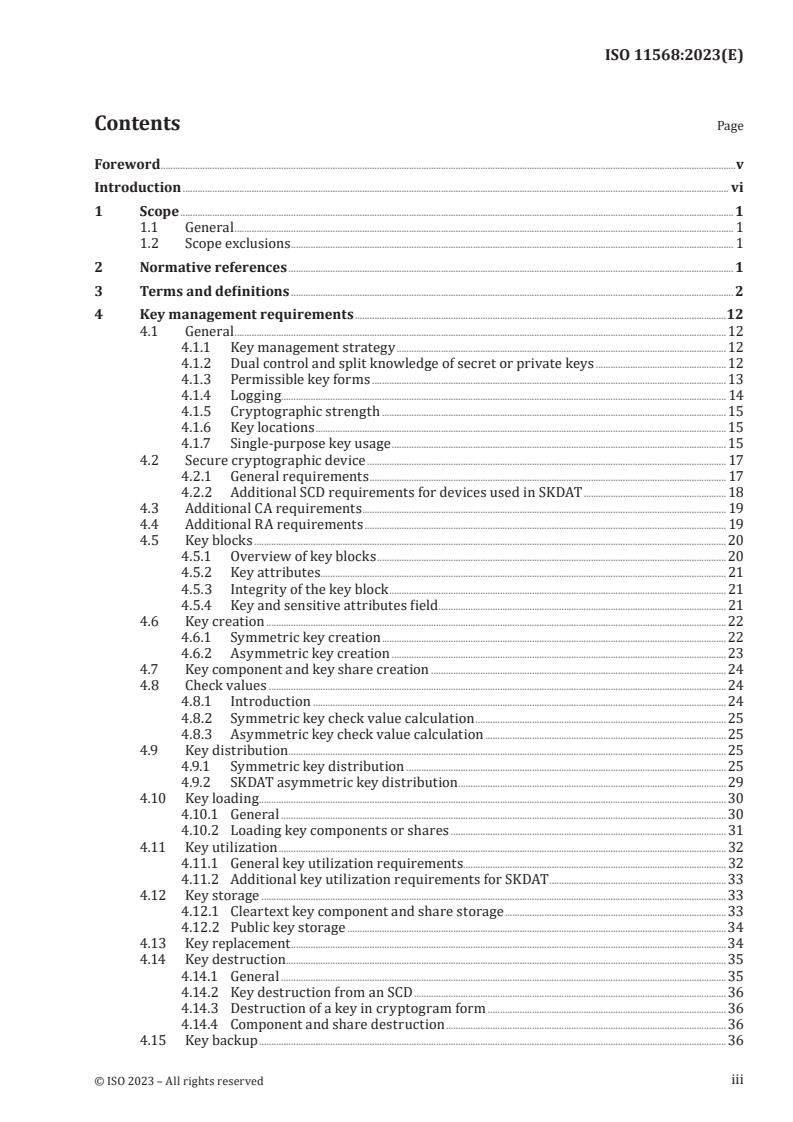
Contents Page
Foreword .v
Introduction . vi
1 Scope . 1
1.1 General . 1
1.2 Scope exclusions . 1
2 Normative references . 1
3 Terms and definitions . 2
4 Key management requirements .12
4.1 General .12
4.1.1 Key management strategy .12
4.1.2 Dual control and split knowledge of secret or private keys .12
4.1.3 Permissible key forms . 13
4.1.4 Logging. 14
4.1.5 Cryptographic strength .15
4.1.6 Key locations .15
4.1.7 Single-purpose key usage . 15
4.2 Secure cryptographic device . 17
4.2.1 General requirements . 17
4.2.2 Additional SCD requirements for devices used in SKDAT . 18
4.3 Additional CA requirements . 19
4.4 Additional RA requirements . 19
4.5 Key blocks . 20
4.5.1 Overview of key blocks .20
4.5.2 Key attributes. 21
4.5.3 Integrity of the key block . 21
4.5.4 Key and sensitive attributes field . 21
4.6 Key creation .22
4.6.1 Symmetric key creation . 22
4.6.2 Asymmetric key creation . 23
4.7 Key component and key share creation . 24
4.8 Check values . 24
4.8.1 Introduction . 24
4.8.2 Symmetric key check value calculation . 25
4.8.3 Asymmetric key check value calculation . 25
4.9 Key distribution . 25
4.9.1 Symmetric key distribution . 25
4.9.2 SKDAT asymmetric key distribution .29
4.10 Key loading . 30
4.10.1 General .30
4.10.2 Loading key components or shares . 31
4.11 Key utilization . 32
4.11.1 General key utilization requirements. 32
4.11.2 Additional key utilization requirements for SKDAT . 33
4.12 Key storage . 33
4.12.1 Cleartext key component and share storage . 33
4.12.2 Public key storage .34
4.13 Key replacement .34
4.14 Key destruction . 35
4.14.1 General . 35
4.14.2 Key destruction from an SCD .36
4.14.3 Destruction of a key in cryptogram form .36
4.14.4 Component and share destruction .36
4.15 Key backup .36
iii
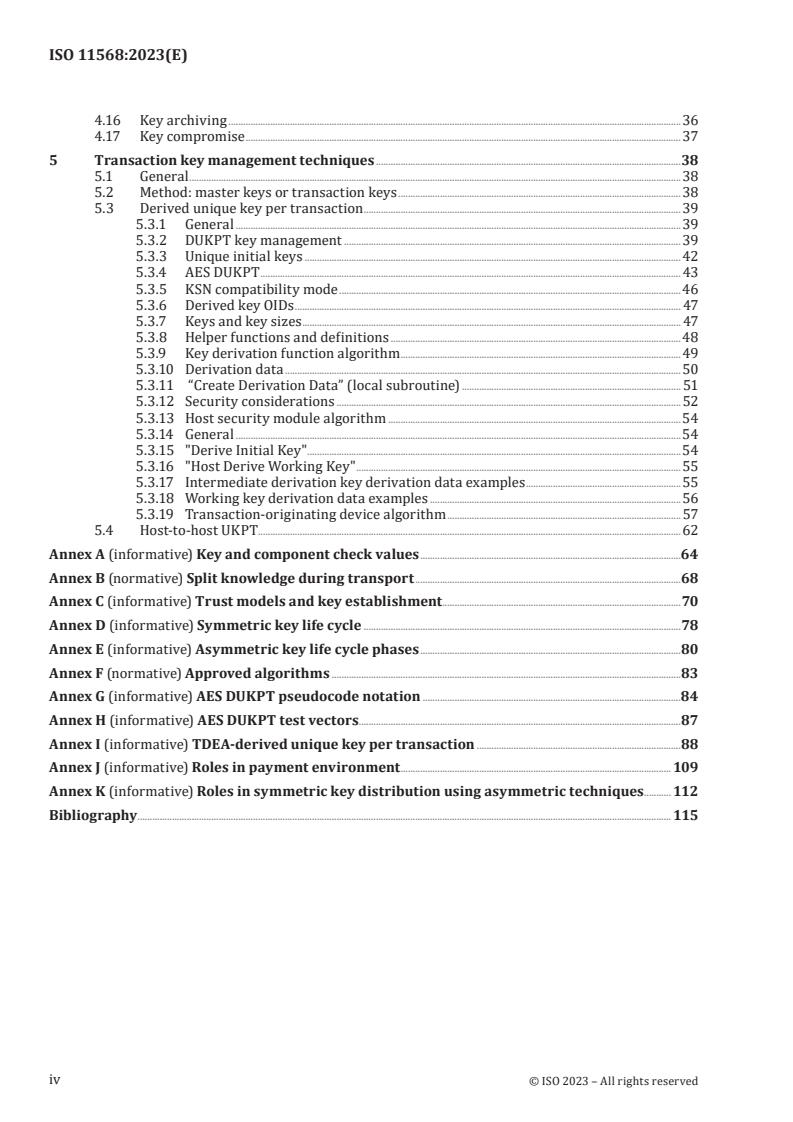
4.16 Key archiving .36
4.17 Key compromise . 37
5 Transaction key management techniques .38
5.1 General .38
5.2 Method: master keys or transaction keys .38
5.3 Derived unique key per transaction . 39
5.3.1 General .39
5.3.2 DUKPT key management .39
5.3.3 Unique initial keys . 42
5.3.4 AES DUKPT . 43
5.3.5 KSN compatibility mode .46
5.3.6 Derived key OIDs . 47
5.3.7 Keys and key sizes . 47
5.3.8 Helper functions and definitions .48
5.3.9 Key derivation function algorithm .49
5.3.10 Derivation data . 50
5.3.11 “Create Derivation Data” (local subroutine) . 51
5.3.12 Security considerations . 52
5.3.13 Host security module algorithm .54
5.3.14 General .54
5.3.15 "Derive Initial Key" . . .54
5.3.16 "Host Derive Working Key" . 55
5.3.17 Intermediate derivation key derivation data examples .55
5.3.18 Working key derivation data examples .56
5.3.19 Transaction-originating device algorithm . 57
5.4 Host-to-host UKPT . . 62
Annex A (informative) Key and component check values .64
Annex B (normative) Split knowledge during transport .68
Annex C (informative) Trust models and key establishment .70
Annex D (informative) Symmetric key life cycle .78
Annex E (informative) Asymmetric key life cycle phases .80
Annex F (normative) Approved algorithms .83
Annex G (informative) AES DUKPT pseudocode notation .84
Annex H (informative) AES DUKPT test vectors .87
Annex I (informative) TDEA-derived unique key per transaction .88
Annex J (informative) Roles in payment environment . 109
Annex K (informative) Roles in symmetric key distribution using asymmetric techniques . 112
Bibliography . 115
iv
Foreword
ISO (the International Organization for Standardization) is a worldwide federation of national standards
bodies (ISO member bodies). The work of preparing International Standards is normally carried out
through ISO technical committees. Each member body interested in a subject for which a technical
committee has been established has the right to be represented on that committee. International
organizations, governmental and non-governmental, in liaison with ISO, also take part in the work.
ISO collaborates closely with the International Electrotechnical Commission (IEC) on all matters of
electrotechnical standardization.
The procedures used to develop this document and those intended for its further maintenance are
described in the ISO/IEC Directives, Part 1. In particular, the different approval criteria needed for the
different types of ISO documents should be noted. This document was drafted in accordance with the
editorial rules of the ISO/IEC Directives, Part 2 (see www.iso.org/directives).
Attention is drawn to the possibility that some of the elements of this document may be the subject of
patent rights. ISO shall not be held responsible for identifying any or all such patent rights. Details of
any patent rights identified during the development of the document will be in the Introduction and/or
on the ISO list of patent declarations received (see www.iso.org/patents).
Any trade name used in this document is information given for the convenience of users and does not
constitute an endorsement.
For an explanation of the voluntary nature of standards, the meaning of ISO specific terms and
expressions related to conformity assessment, as well as information about ISO's adherence to
the World Trade Organization (WTO) principles in the Technical Barriers to Trade (TBT), see
www.iso.org/iso/foreword.html.
This document was prepared by Technical Committee ISO/TC 68, Financial services, Subcommittee SC 2,
Financial services, security.
This document cancels and replaces the former ISO 11568 series, which has been technically revised.
The main changes are as follows:
— all parts of the series combined into a single document;
— fixed key no longer included in the permissible methods of transaction key management;
— required key replacement policy (see 4.13) added;
— cleartext key injection removed;
— AES DUKPT introduced as a key management method.
Any feedback or questions on this document should be directed to the user’s national standards body. A
complete listing of these bodies can be found at www.iso.org/members.html.
v
Introduction
Retail financial transactions are often transmitted over potentially non-secure channels, which,
if exploited, can result in fraud. The vast range in value and volume of such transactions exposes
participants to severe risks, which can be uninsurable. To protect against these risks, many institutions
are employing encryption. The encryption algorithms used are in the public domain. The security and
reliability of any process based on these algorithms is directly dependent on the protection afforded to
secrets called cryptographic keys.
This document describes requirements and provides guidance for the secure management of
cryptographic keys used to protect sensitive information in a retail financial services environment, for
example in messages between a card acceptor and an Acquirer. Typical services in the retail financial
services domain include point-of-sale (POS) debit and credit authorizations and automated teller
machine (ATM) transactions. While it is designed with these environments in mind, it may also be used
in unrelated applications. For example, such keys could be used for:
— encrypting Personal Identification Numbers (PIN) (see ISO 9564-1);
— authenticating messages;
— encrypting other data;
— encrypting or deriving cryptographic keys;
— automated symmetric key distribution using asymmetric techniques.
vi
INTERNATIONAL STANDARD ISO 11568:2023(E)
Financial services — Key management (retail)
1 Scope
1.1 General
This document describes the management of symmetric and asymmetric cryptographic keys that can
be used to protect sensitive information in financial services related to retail payments. The document
covers all aspects of retail financial services, including connections between a card-accepting device
and an Acquirer, between an Acquirer and a card Issuer, and between an ICC and a card-accepting device.
It covers all phases of the key life cycle, including the generation, distribution, utilization, archiving,
replacement and destruction of the keying material. This document covers manual and automated
management of keying material, and any combination thereof, used for retail financial services. It
includes guidance and requirements related to key separation, substitution prevention, identification,
synchronization, integrity, confidentiality and compromise, as well as logging and auditing of key
management events.
Requirements associated with hardware used to manage keys have also been included in this document.
1.2 Scope exclusions
This document does not specifically address internet banking services offered by an Issuer to their own
customers through that financial institution's website or applications.
This document does not address using asymmetric keys to encrypt the Personal Identification Number
(PIN) or any other data and does not address asymmetric keys managed with asymmetric keys.
This document is not intended to apply to the management of the keys installed in an ICC during
manufacturing or the initial key established in an ICC during card personalization.
This document is not intended to address post-quantum encryption considerations. Key management
using quantum technologies is out of scope of this document.
2 Normative references
The following documents are referred to in the text in such a way that some or all of their content
constitutes requirements of this document. For dated references, only the edition cited applies. For
undated references, the latest edition of the referenced document (including any amendments) applies.
ISO/IEC 9797 (all parts), Information technology — Security techniques — Message Authentication Codes
(MACs)
ISO/IEC 11770 (all parts), Information security — Key management
ISO 13491 (all parts), Financial services — Secure cryptographic devices (retail)
ISO 16609, Financial services — Requirements for message authentication using symmetric techniques
ISO/IEC 18031, Information technology — Security techniques — Random bit generation
ISO/IEC 18032, Information security — Prime number generation
ISO/IEC 18033 (all parts), Information security — Encryption algorithms
ISO/IEC 19592-2, Information technology — Security techniques — Secret sharing — Part 2: Fundamental
mechanisms
ISO/IEC 19772, Information security — Authenticated encryption
ISO 20038, Banking and related financial services — Key wrap using AES
ISO 21188:2018, Public key infrastructure for financial services — Practices and policy framework
ANSI X9.63, Public Key Cryptography for the Financial Services Industry — Key Agreement and Key
Management Using Elliptic Curve-Based Cryptography
ANSI X9.143, Retail Financial Services — Interoperable Secure Key Block Specification
RFC 3647, Internet X.509 Public Key Infrastructure Certificate Policy and Certification Practices Framework,
Internet Request for Comments 3647, S. Chokhani, W. Ford, R. Sabett, C. Merrill, S. Wu, November 2003
3 Terms and definitions
For the purposes of this document, the following terms and definitions apply.
ISO and IEC maintain terminology databases for use in standardization at the following addresses:
— ISO Online browsing platform: available at https:// www .iso .org/ obp
— IEC Electropedia: available at https:// www .electropedia .org/
3.1
Acquirer
institution (or its agent) which acquires from the card acceptor the data relating to the transaction
(3.84) and initiates the data into an Interchange (3.47) system
[SOURCE: ISO/IEC 7812-1:2017, 3.1]
3.2
Advanced Encryption Standard
AES
16-byte block cipher (3.3)
Note 1 to entry: This is defined in ISO/IEC 18033-3.
3.3
algorithm
specified mathematical process for computation or set of rules which, if followed, will give a prescribed
result
[SOURCE: ISO 16609:2022, 3.1]
3.4
archived key
inactive cryptographic key (3.28) that is being stored in a secure manner for a non-operational purpose
3.5
asymmetric algorithm
cryptographic algorithm (3.27) that uses two related keys, a public key (3.71) and a private key (3.69),
where the two keys have the property that, given the public key, it is computationally infeasible (3.25) to
derive the private key
3.6
asymmetric cryptosystem
cryptosystem using asymmetric algorithms (3.5)
3.7
authentication
provision of assurance that a claimed characteristic of an entity is correct
[SOURCE: ISO/IEC 27000:2018, 3.5]
3.8
authentication element
message element that is to be protected by authentication (3.7)
[SOURCE: ISO 16609:2022, 3.12, modified — Term revised.]
3.9
Base Derivation Key
BDK
key used in derivation (3.32) to generate initial DUKPT keys (3.45) for installation into transaction
originating secure cryptographic devices (3.75) and for transaction processing
3.10
BDK ID
32-bit value that identifies the Base Derivation Key (3.9)
Note 1 to entry: This was formerly known as the Key Set Identifier (KSI) (3.57) in the TDEA DUKPT specification.
3.11
card acceptor
party accepting the card for the purpose of presenting transaction data to an Acquirer (3.1) or
intermediary facilitating the transaction flow
[SOURCE: ISO/IEC 7812-1:2017, 3.3]
3.12
certificate
digitally signed statement that binds the value of a public key to the identity of the person, device or
service that holds the corresponding private key
[SOURCE: ISO 20415:2019, 3.15, modified — Term revised.]
3.13
certificate authority
CA
entity that vouches for the binding between a device’s identity, its public key and associated keying
material
[SOURCE: ISO/IEC/IEEE 8802-11:2022, definition modified.]
3.14
certificate authority system
CA system
infrastructure required to manage, maintain and secure the key pairs and certificates of the certificate
authority (3.13)
Note 1 to entry: A CA system will typically include one or more Hardware Security Modules (3.42), firmware,
computer equipment, operating systems and software
3.15
certificate policy
CP
named set of rules that indicates the applicability of a certificate to a particular community and/or
class of application with common security requirements
[SOURCE: ISO 21188:2018, 3.13]
3.16
certificate practice statement
CPS
statement of the practices which a certificate authority (3.13) employs in issuing certificates (3.12)
and which defines the equipment, policies and procedures the certificate authority uses to satisfy the
requirements specified in the certificate policies (3.15) that are supported by it
3.17
certificate subject
entity identified in a certificate (3.12)
EXAMPLE Secure cryptographic device (3.75).
3.18
chain of custody
demonstrable possession, movement, handling and location of material from one point in time until
another
[SOURCE: ISO/IEC 27050-1:2019, 3.1]
3.19
check value
key check value
KCV
component check value
CCV
non-secret value that is cryptographically related to the key (or component) and is used to verify that
the underlying value is as expected
Note 1 to entry: It is possible for different keys or components to have the same check value.
3.20
cipher
method for the transformation of data in order to hide its information content, prevent its undetected
modification and/or prevent its unauthorized use
3.21
ciphertext
data which has been transformed to hide its information content
[SOURCE: ISO/IEC 18033-1:2021, 3.7]
3.22
cleartext
plaintext
unencrypted information
[SOURCE: ISO/IEC 18033-1:2021, 3.20]
3.23
communicating pair
two parties (usually institutions) sending and receiving transactions
Note 1 to entry: This includes alternate processing sites either owned or contracted by either communicating
party.
3.24
compromise
breach or failure of the security of a process or system used to protect the
confidentiality or integrity of sensitive information
Note 1 to entry: Compromise includes situations in which either unauthorized disclosure of sensitive information
could have occurred or appropriate control is not demonstrable.
3.25
computationally infeasible
property that a computation is theoretically achievable but is not feasible in terms of the time or
resources required to perform it
3.26
credentials
identification data for an entity, incorporating at a minimum the entity's distinguished name and public
key
3.27
cryptographic algorithm
algorithm (3.3) for the transforming of data using a cryptographic key (3.28)
Note 1 to entry: Data transformation includes operations such as encryption (3.40), decryption (3.31),
synchronized generation of keying material and computation or verification of a digital signature or Message
Authentication Code.
3.28
cryptographic key
key
sequence of bits that determine the outcome of a cryptographic operation
Note 1 to entry: See cryptographic algorithm for further details.
Note 2 to entry: Examples of cryptographic operations include encryption, decryption, check function
computation, derivation, signature generation or verification, and authentication.
3.29
cryptographic strength
strength
computational cost of the most effective known attack against a given cryptographic algorithm and key
size
Note 1 to entry: The cryptographic strength is usually a function of key size, but different algorithms can have
different cryptographic strengths even though their key sizes are the same.
Note 2 to entry: The strength of a given algorithm and key size can vary depending on the use of the algorithm.
For example, uses with few or no plaintext-ciphertext pairs could be more resistant to attack than uses with
many pairs under a given key.
3.30
cryptoperiod
defined period of time during which a specific cryptographic key (3.28) is authorized for use or during
which the cryptographic keys in a given system may remain in effect
[SOURCE: ISO 16609:2022, 3.9]
3.31
decryption
process of transforming ciphertext (3.21) data into cleartext (3.22) data
3.32
derivation
cryptographic transformation process that is used to derive one value from another value
Note 1 to entry: This is typically used to produce new cryptographic keys (3.28), which can potentially be used for
different purposes, from a single key.
3.33
Derivation Identifier
Derivation ID
DID
32-bit value that identifies the specific initial DUKPT key (3.45) derived using the Base Derivation Key
(3.9)
Note 1 to entry: This was formerly known as the 19-bit value Device ID (DID) or TRSM ID in the TDEA DUKPT
specification.
3.34
derivation key
cryptographic key (3.28) that is used to cryptographically compute another key using derivation (3.32)
3.35
derived unique key per transaction
DUKPT
key management method that uses a unique key for each transaction (3.84) and prevents the disclosure
of any past key used by the transaction originating SCD (3.86)
Note 1 to entry: The unique transaction keys (3.85) are derived from a Base Derivation Key (3.9) and non-secret
data transmitted as part of each transaction.
3.36
digital certificate
asymmetric cryptosystem that provides for the creation and subsequent verification of digital
signatures (3.37)
3.37
digital signature
cryptographic transformation of data which, when associated with a data unit and accompanied by the
corresponding public-key certificate, provides the services of origin authentication, data integrity and
signer non-repudiation
3.38
double-length TDEA key
TDEA key having a length of 128 bits, consisting of 112 key bits and 16 parity bits, which is typically
represented in 32 hexadecimal digits
3.39
dual control
process of utilizing two or more separate individuals operating in concert to protect sensitive functions
or information whereby no single individual is able to use the function or access all the information
alone
Note 1 to entry: A cryptographic key (3.28) is an example of the type of material protected using dual control.
Note 2 to entry: For protecting cryptographic keys and other sensitive data, this concept is closely related to split
knowledge (3.77).
[SOURCE: ISO 9564-1:2017, 3.10, modified — Definition revised and notes to entry added.]
3.40
encryption
encipherment
process of transforming cleartext (3.22) data into ciphertext (3.21) data for the purpose of security or
privacy
3.41
exclusive-or
XOR
mathematical operation defined as: 0 XOR 0 = 0 0 XOR 1 = 1 1 XOR 0 = 1 1 XOR 1 = 0
Note 1 to entry: Equivalent to binary addition without carry (modulo-2 addition).
3.42
Hardware Security Module
HSM
secure cryptographic device (3.75) that provides a set of secure cryptographic services including, but
not limited to, key generation, cryptogram creation, PIN translation and certificate signing
[SOURCE: ISO 13491-1:2016, 3.23]
3.43
hash function
one-way function that maps a set of strings of arbitrary length on to a set of fixed-length strings of bits
Note 1 to entry: The output is generally relatively small.
Note 2 to entry: A collision-resistant hash function has the property that it is computationally infeasible to
construct distinct inputs that map to the same output.
3.44
independent communication
process that allows an entity to counter-verify the correctness of a credential and identification
documents prior to producing a certificate
EXAMPLE Call-back, visual identification.
3.45
initial DUKPT key
IK
unique cryptographic key (3.28) loaded into a secure cryptographic device (3.75) that has been derived
from a Base Derivation Key (3.9)
3.46
Initial Key ID
64-bit value that identifies the specific initial DUKPT key (3.45) derived under the Base Derivation Key
(3.9)
Note 1 to entry: It is a concatenation of the BDK ID (3.10) and the Derivation ID (3.33)
3.47
Interchange
mutual acceptance and exchange of messages between institutions for card payment transactions
3.48
Issuer
institution holding the account identified by the Primary Account Number (PAN)
Note 1 to entry: See Annex J for additional information on the role an Issuer plays in the payment environment.
3.49
key agreement
process of establishing a shared secret key between entities in such a way that neither of them can
predetermine the value of that key
Note 1 to entry: By predetermine, it is meant that neither entity A nor entity B can, in a computationally efficient
way, choose a smaller key space and force the computed key in the protocol to fall into that key space.
[SOURCE: ISO/IEC 11770-4:2017, 3.13]
3.50
key component
component
one of at least two values that are combined using XOR to form a symmetric cryptographic key (3.28)
Note 1 to entry: Each component has the same format (including length) as the cryptographic key.
3.51
key distribution host
KDH
host distributing keys in the SKDAT (3.79) key distribution methodology
Note 1 to entry: See Annex K for more details on the role a KDH plays in SKDAT.
3.52
key encryption key
KEK
key used exclusively to encrypt and decrypt other keys
3.53
key receiving device
KRD
device receiving keys in the SKDAT (3.79) key distribution methodology
3.54
key separation
method for ensuring that a key is used for only its intended purpose
3.55
Key Serial Number
KSN
concatenation of the Initial Key ID (3.46) and the transaction counter used in DUKPT (3.35)
3.56
key set
group of keys that are all determined by a common cryptographic procedure and differentiated by non-
secret input such that knowledge of one key does not disclose any other key in the group
3.57
Key Set Identifier
KSI
non-secret value that uniquely identifies a key set (3.56)
3.58
key share
result of dividing a cryptographic key (3.28) into some number (n) of pieces (shares), such that a
designated minimum number (m) of pieces are required to reconstitute the key
Note 1 to entry: Each key share is constructed in such a manner that access to fewer than m shares does not
disclose any information about the key. In all cases, m is greater than 1 and less than or equal to n.
Note 2 to entry: A secret sharing scheme involving key shares is often referred to as an "m of n scheme".
3.59
keying material
data that comprise a complete cryptographic key (3.28) and its relevant metadata
EXAMPLE Keys, attributes, initialization vectors.
3.60
master key
highest level of key encrypting key in a hierarchy of key encryption keys (3.52) and transaction keys
(3.85)
3.61
message authentication
verification that a message was sent by the purported originator to the intended recipient and that the
message was not changed in transit
[SOURCE: ISO/IEC 20944-1:2013, 3.11.1.9]
3.62
Message Authentication Code
MAC
cryptographic value used to confirm that the message came from the stated sender and has not been
changed in transit
3.63
node
point in a network that does some form of processing of data
EXAMPLE Terminal, Acquirer, switch.
3.64
non-repudiation
service that provides verifiable evidence to substantiate integrity and origin of data, thereby eliminating
successful deniability
3.65
parity
result of a calculation of the number of ‘1’ bits in a string of ‘0’ and ‘1’ bits that indicates whether the
number of ‘1’ bits is odd or even
3.66
payment instrument
physical payment card, electronic equivalent or other electronic instrument or order used for the
transmission or payment of money, sold or issued to one or more persons, whether or not the instrument
is negotiable
Note 1 to entry: This does not include any credit card voucher, any letter of credit or any instrument that is
redeemable by the Issuer in goods or services.
3.67
Personal Identification Number
PIN
string of numeric digits established as a shared secret between the account owner and the Issuer (3.48),
for subsequent use to validate authorized card usage
[SOURCE: ISO 9564-1:2017, 3.19, modified]
3.68
Primary Account Number
PAN
assigned number, composed of an Issuer identification number, an individual account identification and
an accompanying check digit that identifies the card Issuer and account owner (who is the cardholder
for physical cards)
Note 1 to entry: The accompanying check digit is specified in ISO/IEC 7812-1.
[SOURCE: ISO 9564-1:2017, 3.22, modified]
3.69
private key
key in an asymmetric key pair which is known only by that entity
3.70
pseudo-random process
process that produces a value which is statistically random and essentially unpredictable even though
it was generated by a deterministic algorithm
3.71
public key
key of an entity’s asymmetric key pair which can usually be made public without compromising security
[SOURCE: ISO/IEC 11770-1:2010, 2.36]
3.72
random
value in a set that has an equal probability of being selected from the total population of possibilities,
hence is unpredictable
3.73
recipient
person, institution or other party that is responsible for and authorized to receive a message or package
3.74
replay
process of sending a message which contains all or part of a previously sent message, as a method of
perpetrating a fraud
3.75
secure cryptographic device
SCD
device that provides physically and logically protected cryptographic services and storage and which
can be integrated into a larger system such as an ATM or POS terminal
EXAMPLE entry device (PED), Hardware Security Module (HSM).
[SOURCE: ISO 13491-1:2016, 3.28]
3.76
sender
person, institution or other entity transmitting a message or package
3.77
split knowledge
condition under which two or more individuals separately and confidentially have information that,
individually, convey no knowledge of the resulting combined information
EXAMPLE Components (3.50) of a cryptographic key (3.28) managed under strict custody separation such
that no one person can gain access to the entire set.
[SOURCE: ISO 9564-1:2017, 3.28, modified — Definition revised and example added.]
3.78
symmetric key
secret cryptographic key (3.28) that is used in a symmetric algorithm (3.3)
3.79
symmetric key distribution using asymmetric techniques
SKDAT
key distribution method that uses asymmetric cryptography to protect the keys during transport
Note 1 to entry: See Annex K.
3.80
switch
node that can route data from a node to other nodes
3.81
tamper evident and authenticable bag
TEA bag
one-time use packaging that is designed in such a way as to make it infeasible to access the contents
without detection and has a pre-printed unique identifier that cannot be changed without detection to
allow for authentication
Note 1 to entry: The form of the packaging is not necessarily restricted to a bag.
3.82
tampering
unauthorized modification that compromises the security properties of a device or security container
EXAMPLE 1 Insertion of active or passive tapping mechanisms into a device to determine, record or modify
secret data.
EXAMPLE 2 An attempt to penetrate or open a security container, TEA bag or device.
3.83
terminal
device or system that initiates a transaction (3.84) and is, contains or interfaces with a transaction-
originating SCD (3.86) for cryptographic functions
3.84
transaction
series of messages to perform a predefined function
EXAMPLE Payment transaction.
3.85
transaction key
key used to cryptographically protect the transaction data elements between nodes
Note 1 to entry: If more than one key is used for different cryptographic functions, each key can be a variant or
derivative of the transaction key.
Note 2 to entry: A transaction key is sometimes referred to as a data key, communications key, session key or
working key.
3.86
transaction-originating SCD
secure cryptographic device (3.75) that is, is integrated in or is used by the terminal (3.83) that initiates
the financial transaction (3.84)
EXAMPLE PIN entry device.
...