

ISO/TS 9546:2024
(Main)Guidelines for security framework of information systems of third-party payment services
General Information
- Abstract
This document provides guidelines for a security framework to address the implementation of security mechanisms in technical infrastructures designed for the provision of third-party payment (TPP) services in order to achieve the security objectives defined in ISO 23195. The security framework is intended to protect critical systems and objects within the TPP system environment, either under the direct control of the third-party payment service provider (TPPSP) or by another entity (e.g. a bank). This document is applicable to the provision of any TPP service, including: — the TPP logical structural model; — the definition of the security framework; — the design principles, responsibilities and functional recommendations to support the security mechanism; — guidelines for applying the security framework defined in this document.
- Status
- Published
- Publication Date
- 18-Dec-2024
- Technical Committee
- ISO/TC 68/SC 2 - Financial Services, security
- Drafting Committee
- ISO/TC 68/SC 2 - Financial Services, security
- Current Stage
- 6060 - International Standard published
- Start Date
- 19-Dec-2024
- Due Date
- 22-Feb-2025
- Completion Date
- 19-Dec-2024
Overview
ISO/TS 9546:2024 - "Guidelines for security framework of information systems of third-party payment services" is a Technical Specification from ISO that provides guidance for designing and implementing security mechanisms in technical infrastructures used by third‑party payment (TPP) service providers (TPPSPs). Aligned with the security objectives defined in ISO 23195 and following the ISO/IEC 15408 methodology, this document defines a pragmatic security framework and security functional recommendations (SFCs) to protect critical systems and assets within TPP environments, whether operated by TPPSPs or by other entities (e.g., banks).
Key Topics
- TPP logical structural models: Two reference models (with and without TPP-AIS) describing typical component interactions and the Target of Evaluation (TOE).
- Component‑specific recommendations: Security functions for key components:
- TPPSP credentials carrier (C2) - encryption, user authentication, access control.
- TPP payment terminal (C3) - encryption, logical security, transaction security, protection of payment‑sensitive information.
- TPPSP gatekeeper (C5) - access control, transaction security, audit logging.
- TPP‑BIS (C6) - user authentication, transaction security, risk control.
- TPP‑AIS (C15) - encryption, identity verification, transaction security.
- Core security functions: Identification & authentication, authorization, audit logging, asset protection, encryption, transaction integrity.
- Three‑layer security framework:
- Process layer - policies, identity, authorization, logging.
- Application layer - component‑level security measures for C2, C3, C5, C6, C15.
- Infrastructure layer - deployment, network and platform controls.
- Implementation guidance: Practical steps - identify SPD elements, determine security objectives, select/adapt SFCs; plus real‑world practices and Annex A examples.
Applications
ISO/TS 9546:2024 is useful for:
- TPPSPs and fintechs designing secure payment platforms (mobile wallets, e‑commerce, open banking payments).
- System architects and developers building or integrating TPP components (credentials carriers, payment terminals, gatekeepers).
- Security engineers and risk managers implementing authentication, encryption, logging, transaction security and asset protection.
- Banks and service providers evaluating third‑party integrations and compliance with TPP security objectives.
- Auditors and regulators assessing the security posture of TPP ecosystems against ISO guidance.
Practical uses include designing secure TPP architectures, selecting appropriate SFCs per component, documenting TOE boundaries, and adopting the three‑layer model to align technical controls with business processes and risk controls.
Related standards
- ISO 23195 - defines security objectives for TPP services (ISO/TS 9546 maps SFCs to these objectives).
- ISO/IEC 15408 - Common Criteria methodology referenced for the TOE concept and SFR/SFC approach.
Keywords: ISO/TS 9546:2024, third‑party payment, TPP security framework, TPPSP, ISO 23195, payment terminal security, authentication, encryption, audit logging.
Get Certified
Connect with accredited certification bodies for this standard

BSI Group
BSI (British Standards Institution) is the business standards company that helps organizations make excellence a habit.

Great Wall Tianjin Quality Assurance Center
Established 1993, first batch to receive national accreditation with IAF recognition.
Hong Kong Quality Assurance Agency (HKQAA)
Hong Kong's leading certification body.
Sponsored listings
Frequently Asked Questions
ISO/TS 9546:2024 is a technical specification published by the International Organization for Standardization (ISO). Its full title is "Guidelines for security framework of information systems of third-party payment services". This standard covers: This document provides guidelines for a security framework to address the implementation of security mechanisms in technical infrastructures designed for the provision of third-party payment (TPP) services in order to achieve the security objectives defined in ISO 23195. The security framework is intended to protect critical systems and objects within the TPP system environment, either under the direct control of the third-party payment service provider (TPPSP) or by another entity (e.g. a bank). This document is applicable to the provision of any TPP service, including: — the TPP logical structural model; — the definition of the security framework; — the design principles, responsibilities and functional recommendations to support the security mechanism; — guidelines for applying the security framework defined in this document.
This document provides guidelines for a security framework to address the implementation of security mechanisms in technical infrastructures designed for the provision of third-party payment (TPP) services in order to achieve the security objectives defined in ISO 23195. The security framework is intended to protect critical systems and objects within the TPP system environment, either under the direct control of the third-party payment service provider (TPPSP) or by another entity (e.g. a bank). This document is applicable to the provision of any TPP service, including: — the TPP logical structural model; — the definition of the security framework; — the design principles, responsibilities and functional recommendations to support the security mechanism; — guidelines for applying the security framework defined in this document.
ISO/TS 9546:2024 is classified under the following ICS (International Classification for Standards) categories: 03.060 - Finances. Banking. Monetary systems. Insurance; 35.240.40 - IT applications in banking. The ICS classification helps identify the subject area and facilitates finding related standards.
ISO/TS 9546:2024 is available in PDF format for immediate download after purchase. The document can be added to your cart and obtained through the secure checkout process. Digital delivery ensures instant access to the complete standard document.
Standards Content (Sample)
Technical
Specification
ISO/TS 9546
First edition
Guidelines for security framework
2024-12
of information systems of third-
party payment services
Lignes directrices relatives au cadre de sécurité des systèmes
d'information des prestataires de services de paiement
Reference number
© ISO 2024
All rights reserved. Unless otherwise specified, or required in the context of its implementation, no part of this publication may
be reproduced or utilized otherwise in any form or by any means, electronic or mechanical, including photocopying, or posting on
the internet or an intranet, without prior written permission. Permission can be requested from either ISO at the address below
or ISO’s member body in the country of the requester.
ISO copyright office
CP 401 • Ch. de Blandonnet 8
CH-1214 Vernier, Geneva
Phone: +41 22 749 01 11
Email: copyright@iso.org
Website: www.iso.org
Published in Switzerland
ii
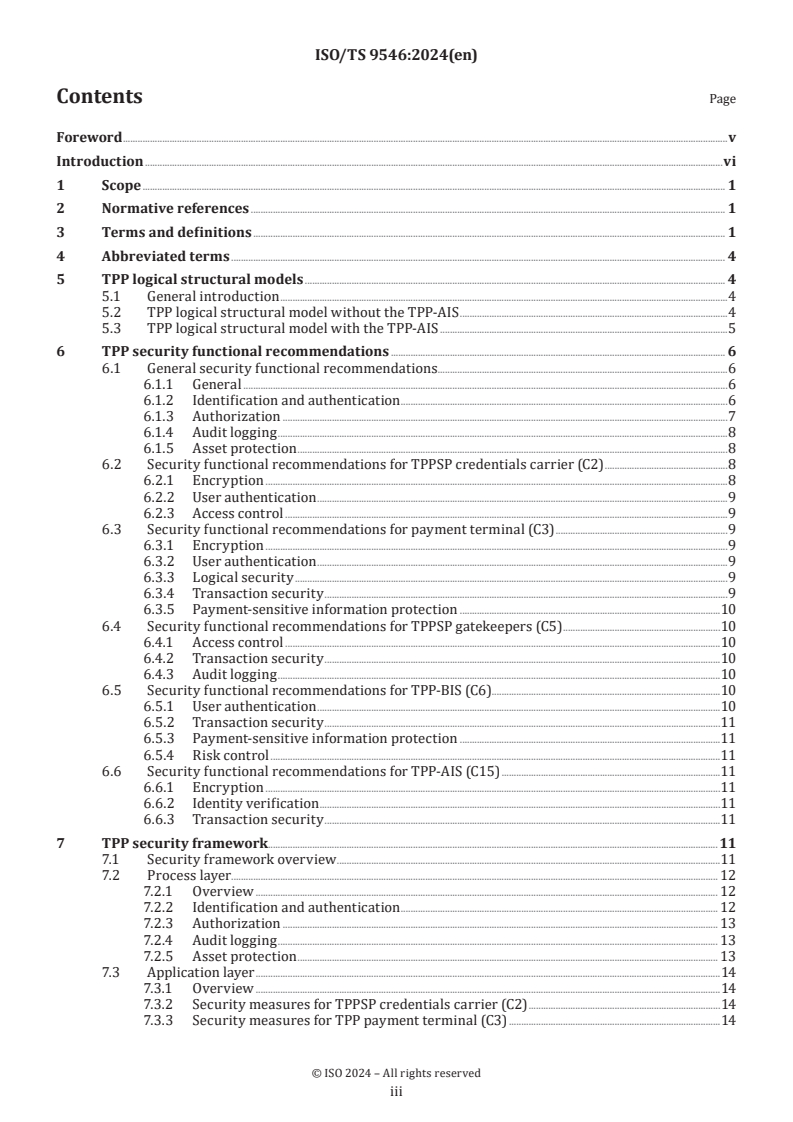
Contents Page
Foreword .v
Introduction .vi
1 Scope . 1
2 Normative references . 1
3 Terms and definitions . 1
4 Abbreviated terms . 4
5 TPP logical structural models . 4
5.1 General introduction .4
5.2 TPP logical structural model without the TPP-AIS .4
5.3 TPP logical structural model with the TPP-AIS .5
6 TPP security functional recommendations . 6
6.1 General security functional recommendations.6
6.1.1 General .6
6.1.2 Identification and authentication .6
6.1.3 Authorization .7
6.1.4 Audit logging .8
6.1.5 Asset protection .8
6.2 Security functional recommendations for TPPSP credentials carrier (C2) .8
6.2.1 Encryption .8
6.2.2 User authentication .9
6.2.3 Access control .9
6.3 Security functional recommendations for payment terminal (C3) .9
6.3.1 Encryption .9
6.3.2 User authentication .9
6.3.3 Logical security .9
6.3.4 Transaction security .9
6.3.5 Payment-sensitive information protection .10
6.4 Security functional recommendations for TPPSP gatekeepers (C5) .10
6.4.1 Access control .10
6.4.2 Transaction security .10
6.4.3 Audit logging .10
6.5 Security functional recommendations for TPP-BIS (C6).10
6.5.1 User authentication .10
6.5.2 Transaction security .11
6.5.3 Payment-sensitive information protection .11
6.5.4 Risk control .11
6.6 Security functional recommendations for TPP-AIS (C15) .11
6.6.1 Encryption .11
6.6.2 Identity verification .11
6.6.3 Transaction security .11
7 TPP security framework.11
7.1 Security framework overview .11
7.2 Process layer. 12
7.2.1 Overview . 12
7.2.2 Identification and authentication . 12
7.2.3 Authorization . 13
7.2.4 Audit logging . 13
7.2.5 Asset protection . 13
7.3 Application layer .14
7.3.1 Overview .14
7.3.2 Security measures for TPPSP credentials carrier (C2) .14
7.3.3 Security measures for TPP payment terminal (C3) .14
iii
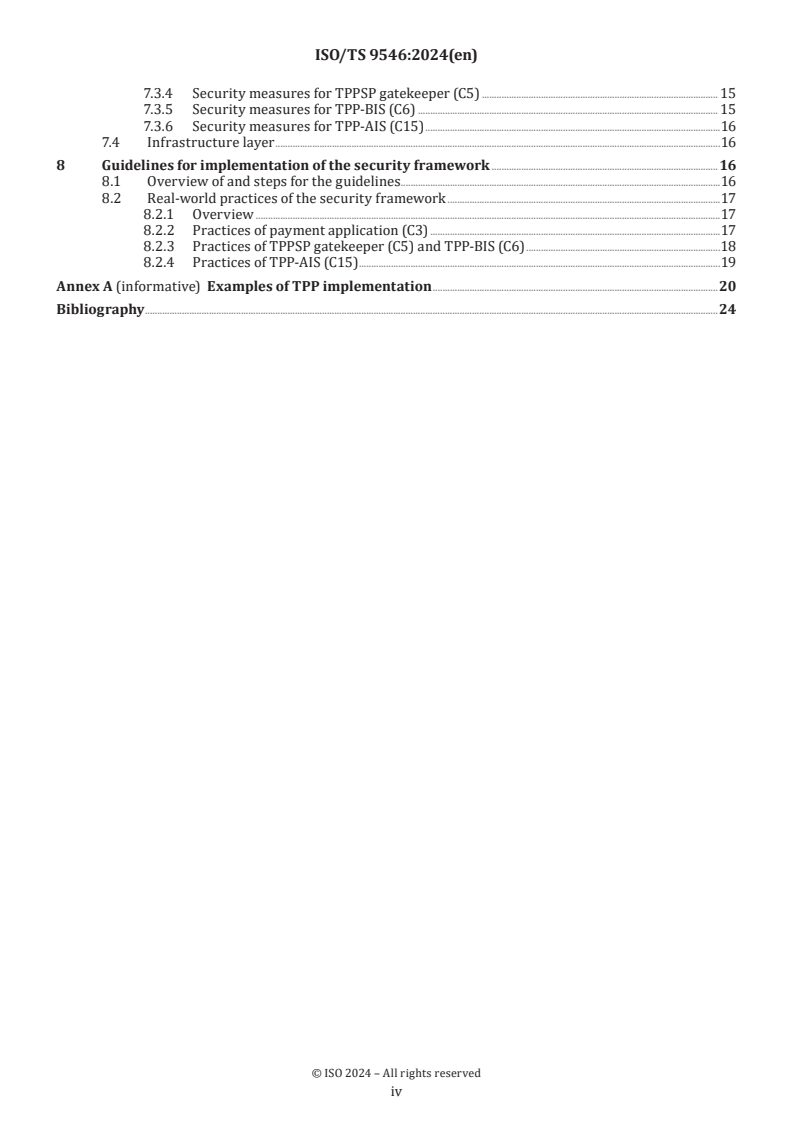
7.3.4 Security measures for TPPSP gatekeeper (C5) . 15
7.3.5 Security measures for TPP-BIS (C6) . 15
7.3.6 Security measures for TPP-AIS (C15) .16
7.4 Infrastructure layer .16
8 Guidelines for implementation of the security framework .16
8.1 Overview of and steps for the guidelines .16
8.2 Real-world practices of the security framework .17
8.2.1 Overview .17
8.2.2 Practices of payment application (C3) .17
8.2.3 Practices of TPPSP gatekeeper (C5) and TPP-BIS (C6) .18
8.2.4 Practices of TPP-AIS (C15) .19
Annex A (informative) Examples of TPP implementation .20
Bibliography .24
iv
Foreword
ISO (the International Organization for Standardization) is a worldwide federation of national standards
bodies (ISO member bodies). The work of preparing International Standards is normally carried out through
ISO technical committees. Each member body interested in a subject for which a technical committee
has been established has the right to be represented on that committee. International organizations,
governmental and non-governmental, in liaison with ISO, also take part in the work. ISO collaborates closely
with the International Electrotechnical Commission (IEC) on all matters of electrotechnical standardization.
The procedures used to develop this document and those intended for its further maintenance are described
in the ISO/IEC Directives, Part 1. In particular, the different approval criteria needed for the different types
of ISO document should be noted. This document was drafted in accordance with the editorial rules of the
ISO/IEC Directives, Part 2 (see www.iso.org/directives).
ISO draws attention to the possibility that the implementation of this document may involve the use of (a)
patent(s). ISO takes no position concerning the evidence, validity or applicability of any claimed patent
rights in respect thereof. As of the date of publication of this document, ISO had not received notice of (a)
patent(s) which may be required to implement this document. However, implementers are cautioned that
this may not represent the latest information, which may be obtained from the patent database available at
www.iso.org/patents. ISO shall not be held responsible for identifying any or all such patent rights.
Any trade name used in this document is information given for the convenience of users and does not
constitute an endorsement.
For an explanation of the voluntary nature of standards, the meaning of ISO specific terms and expressions
related to conformity assessment, as well as information about ISO's adherence to the World Trade
Organization (WTO) principles in the Technical Barriers to Trade (TBT), see www.iso.org/iso/foreword.html.
This document was prepared by Technical Committee ISO/TC 68, Financial services, Subcommittee SC 2,
Financial services, security.
Any feedback or questions on this document should be directed to the user’s national standards body. A
complete listing of these bodies can be found at www.iso.org/members.html.
v
Introduction
Third-party payment (TPP) is an evolving model for payment services provided by third-party payment
service providers (TPPSPs) to end users using payment accounts held in another entity, usually a bank.
Globally, mobile payment, online payment, e-wallet and open banking (payment services) can all be
supported by TPP. TPP plays an important role by complementing the offer of the traditional financial
market players and contributes to the efficiency of payment transactions and financial systems.
This document follows the methodology of the ISO/IEC 15408 series and continues the work of ISO 23195, in
which the security objectives of TPP are defined. It is supposed to define security functional requirements
(SFRs). However, due to the fast development of the TPP, this document is positioned to provide some security
guidelines for the TPP services and aims to provide some essential security functional recommendations
(SFCs) to achieve the security objectives defined in ISO 23195.
This document is intended to assist stakeholders, such as TPPSPs and developers of the TPP information
system, to mitigate the threats arising from the TPPSP intermediary role in the processing of payment
transactions. It specifies the security framework, design principles, responsibilities, and functional
recommendations to support the security mechanism defined and applied by TPPSPs. In the actual
construction of the technical architecture, the users of this document can select, add or delete relevant
components according to the framework of this document, to constitute the customized architecture
according to the actual business and development expectations of TPPSPs. After that, the implementer of
this document can select, add or delete the applicable functions from the corresponding security functions
assigned by this document for each component, to design a TPP system conforming to the security objectives
specified in ISO 23195.
Clause 5 introduces two types of TPP logical structural models from ISO 23195, which constitute the basic
models of this document. The components within the target of evaluation (TOE) (defined by ISO/IEC 15408-1
as a set of software, firmware and/or hardware possibly accompanied by guidance, which is the subject of
an evaluation) depicted in the models, such as TPPSP credentials carrier (C2), TPP payment terminal (C3),
TPPSP gatekeeper (C5), TPP-BIS (C6) and TPP-AIS (C15), are specified in this document.
Clause 6 introduces the SFCs based on the security objectives for the TPP services. 6.1 provides several
common SFCs for TPP services, which are the core elements of the security framework. 6.2 to 6.6 provide
component-specific SFCs, which are based on the business characteristics of TOE components (C2, C3, C5,
C6, C15).
Clause 7 introduces a three-layer security framework of TPP services which systematically presents the
logic of the security services and mechanisms used in TPP services and supports the SFCs in Clause 6. This
framework is based on the implementation of a set of security services and mechanisms on three different
functional layers required to provide TPP services, namely:
— process layer;
— application layer;
— infrastructure layer.
Clause 8 introduces guidelines for users that can help them adopt the TPP security framework set out in this
document. 8.1 provides three steps to implement the TPP security framework:
— identify the SPD elements;
— determine the security objectives;
— adopt appropriate SFCs to achieve the security objectives.
8.2 describes several real-world practices of the typical components of TPPSPs.
Annex A provides some typical implementation examples, which are widely used in real life all over the world.
vi
Technical Specification ISO/TS 9546:2024(en)
Guidelines for security framework of information systems of
third-party payment services
1 Scope
This document provides guidelines for a security framework to address the implementation of security
mechanisms in technical infrastructures designed for the provision of third-party payment (TPP) services
in order to achieve the security objectives defined in ISO 23195. The security framework is intended to
protect critical systems and objects within the TPP system environment, either under the direct control of
the third-party payment service provider (TPPSP) or by another entity (e.g. a bank).
This document is applicable to the provision of any TPP service, including:
— the TPP logical structural model;
— the definition of the security framework;
— the design principles, responsibilities and functional recommendations to support the security
mechanism;
— guidelines for applying the security framework defined in this document.
2 Normative references
There are no normative references in this document.
3 Terms and definitions
For the purposes of this document, the following terms and definitions apply.
ISO and IEC maintain terminology databases for use in standardization at the following addresses:
— ISO Online browsing platform: available at https:// www .iso .org/ obp
— IEC Electropedia: available at https:// www .electropedia .org/
3.1
TPP
third-party payment
payment transaction (3.2) involving at least one intermediary (3.3) third-party payment service provider
(TPPSP) (3.4)
[SOURCE: ISO 23195:2021, 3.1.3]
3.2
payment transaction
act of placing, transferring or withdrawing funds, irrespective of any underlying obligations between the
payer and the payee
[SOURCE: ISO 12812-1:2017, 3.40, modified — Additional preferred term "payment" removed.]
3.3
intermediary
commercial party that provides services to customers, suppliers or authorities within the supply chain
Note 1 to entry: The customer is the payment service user, who can be a payer or a payee, such as a merchant.
[SOURCE: ISO 23195:2021, 3.1.4]
3.4
TPPSP
third-party payment service provider
payment service provider offering third-party payment (TPP) (3.1) services where they are not the account
servicing payment service provider (ASPSP) (3.5) itself
Note 1 to entry: Comparison with the term “third-party payment service provider” defined in ISO/TR 21941:2017, 3.1.11:
a) the abbreviated form of “third-party payment service provider” has been clarified as “TPPSP” instead of “TPP”
because “TPP” is a business mode which has been defined in this document;
b) the abbreviated form ASPSP is utilized instead of “account servicing payment service provider”;
c) the term “payment initiation service” has been changed to “TPP” since the “TPP” contains “the payment initiation
services”;
d) “account information service on accounts” has been removed because it is not linked to TPP closely.
[SOURCE: ISO 23195:2021, 3.1.5]
3.5
ASPSP
account servicing payment service provider
payment service provider providing and maintaining a payment account for a payment service user
Note 1 to entry: In ISO/TR 21941, an ASPSP is defined as “providing and maintaining a payment account for a payer”
only. In the context of this document, an ASPSP can be a bank or other institution which opens and maintains a
payment account for the payment service user.
[SOURCE: ISO 23195:2021, 3.1.6]
3.6
information system
set of applications, services, information technology assets or other information-handling components
[SOURCE: ISO/IEC 27000:2018, 3.35]
3.7
TPP-BIS
third-party payment business information system
information system (3.6) that enables business functions of third-party payment service providers (TPPSPs)
(3.4) and deals with payment transactions (3.2) based on TPPSP credentials (3.17)
[SOURCE: ISO 23195:2021, 3.2.2]
3.8
TPPSP gatekeeper
third-party payment service provider gatekeeper
function implemented by a third-party payment service provider (TPPSP) (3.4) that performs access control
services to the third-party payment business information system (TPP-BIS) (3.7)
Note 1 to entry: The TPPSP gatekeeper can protect the TPP platform by preventing and mitigating the attack against
the TPP-BIS and set up the trusted channel while the message is transferred via the transaction channel.
[SOURCE: ISO 23195:2021, 3.2.4]
3.9
TPP-AIS
third-party payment agent information system
information system (3.6) that receives requests for a payment transaction (3.2) from a multilateral third-party
payment service provider (TPPSP) (3.4) and forwards them to a multilateral account servicing payment service
provider (ASPSP) (3.5), then receives responses from the ASPSP and forwards them to the relevant TPPSP
Note 1 to entry: When the TPP-AIS is constructed as the common financial infrastructure, the TPP-AIS may directly
connect with a clearing and settlement system (CASS) (3.10) and deliver the clearing information based on their
payment transaction log.
Note 2 to entry: Regarding third-party payment (TPP) (3.1) as a whole, TPP-AIS can be deemed an internal component.
However, TPP-AISs do not belong to any TPPSP or ASPSP generally. The operation of the TPP-AIS is independent of the
information systems owned by TPPSP and/or ASPSP.
[SOURCE: ISO 23195:2021, 3.2.5]
3.10
clearing and settlement system
CASS
system responsible for inter-bank funds clearing and funds transfer
Note 1 to entry: CASS may provide instant funds clearing; it may also provide batch clearing, in which the funds
clearing can be completed in a conventional period.
[SOURCE: ISO 23195:2021, 3.2.6]
3.11
TPP-API
third-party payment application program interface
logical interface within the account servicing payment service provider (ASPSP) (3.5) information system
(3.6) designed for access by third-party payment service providers (TPPSPs) (3.4) to the end users’ payment
accounts required for third-party payment (TPP) (3.1) services
3.12
security framework
set of processes, applications and infrastructures for security of third-party payment (TPP) (3.1) information
systems (3.6) and services
Note 1 to entry: Infrastructures include hardware, software, firmware and operational environments.
3.13
identity
set of attributes related to an entity
Note 1 to entry: In this document, an entity can be a payment service user or a system.
[SOURCE: ISO/IEC 24760-1:2019, 3.1.2, modified — Notes to entry replaced.]
3.14
identification
process of recognizing the attributes that identify an entity
Note 1 to entry: In this document, an entity can be a payment service user or a system.
[SOURCE: ISO 23195:2021, 3.1.16, modified — Note 1 to entry revised.]
3.15
authentication
process of corroborating an entity or attributes with a specified or understood level of assurance
[SOURCE: ISO 22300:2021, 3.2.8, modified — Notes to entry removed.]
3.16
authorization
right or permission that is granted to an entity to access a resource
[SOURCE: ISO/TR 22100-4:2018, 3.4, modified — Term "system" removed from "system entity" and "system
resource".]
3.17
credential
data provided to the payment service user for identification (3.14) and/or authentication (3.15) purposes
[SOURCE: ISO 23195:2021, 3.1.12, modified — Notes to entry removed.]
3.18
payment password
secret sequence of characters or a word that a user submits to a system for purposes of authentication,
validation, or verification of the payment transaction
[SOURCE: ISO/IEC 24775-2:2021, 3.1.44, modified — Clarification "of the payment transaction" added.]
4 Abbreviated terms
MFA multi-factor authentication
PIN personal identification number
SFA single-factor authentication
SFC security functional recommendation
SPD security problem definition
TEE trusted execution environment
TOE target of evaluation
TSF target of evaluation security functionality
2FA two-factor authentication
5 TPP logical structural models
5.1 General introduction
There are two types of logical structural models for TPP according to ISO 23195. Figure 1 shows the direct
connection between TPP-BIS and ASPSP. Figure 2 shows the indirect connection between TPP-BIS and
ASPSP via TPP-AIS. See ISO 23195:2021, 4.1 for more details.
The major difference between the two models is that Figure 2 has one more component, “TPP-AIS”, than
Figure 1, which brings about some additional security recommendations and measures to be considered,
such as the security considerations for authorization, authentication, data protection and interaction
through TPP-APIs of the TPP services.
5.2 TPP logical structural model without the TPP-AIS
In the direct connection mode, TPP-BIS connects to multiple ASPSPs who have business with it, and vice
versa. With the gradual increase of the number of both sides, this connection mode aggravates the connection
complexity and cost of both sides.
Key
1 communication channel through a network
2 communication channel involves man-machine interface
3 trusted channel
4 optional trusted channel
5 internal trusted channel
NOTE The graphical interpretation of the links connecting the different components is described in
ISO 23195:2021, Table 1.
Figure 1 — TPP logical structural model without the TPP-AIS
5.3 TPP logical structural model with the TPP-AIS
In the indirect connection mode, TPP-BIS connects to TPP-AIS, then transactions with multiple ASPSPs
can be made through and vice versa. TPP-AIS undertakes the responsibility for transferring transaction
information from both sides. Based on the transaction logs in which clearing and settlement information is
recorded, information is generated by the TPP-AIS and sent to the clearing and settlement system (CASS) to
perform the settlement between each ASPSP.
Key
1 communication channel through a network
2 communication channel involves man-machine interface
3 trusted channel
4 optional trusted channel
5 internal trusted channel
NOTE The graphical interpretation of the links connecting the different components is described in
ISO 23195:2021, Table 1.
Figure 2 — TPP logical structural model with the TPP-AIS
6 TPP security functional recommendations
6.1 General security functional recommendations
6.1.1 General
This clause describes the general security recommendations for TPP services. To fulfil the recommendations,
some or all of the components within the TOE should cooperate with each other, use appropriate security
services and implement security mechanisms which are introduced in this clause.
6.1.2 Identification and authentication
Identification is the process of recognizing the attributes or identity that identify an entity. In TPP business,
an entity is generally a payment service user or a system. Identity is the representation of an entity in the
form of one or more information elements (known as “attributes”) which allow the entity to be sufficiently
distinguished within a context. Identification of a payment service user, known as electronic know-your-
customer (eKYC) in the financial sector, includes identity proofing, enrolment and continuous maintenance
of the user’s identity attributes required to provide payment services according to ISO 5158.
Authentication is the process of corroborating an entity or attributes with a specified or understood level
of assurance. In TPP services, authentication technology supports access control for payment processes
by checking to see if the user’s credentials match with the credentials in an authorized user database or a
data authentication server. By doing so, authentication ensures secure operation, secure login and secure
transaction.
There are several authentication types: single-factor authentication (SFA), two-factor authentication (2FA)
and multi-factor authentication (MFA). The practice of requiring a user ID and password is typical SFA. The
practice of asking for additional authentication factors, such as a biometric signature or a one-time code
sent to the user’s mobile device before the transaction is attempted, is 2FA. When three or more identity
verification factors are used for authentication, for example a user ID and password, a biometric signature
and a personal question only the user knows, this is MFA.
For TPP services, authentication is the central security property. There are generally two types of
authentication: for users and between systems.
Security functional recommendations on identification and authentication are as follows:
a) The user's identity should be authenticated when he or she logs in to the payment application or initiates
a payment transaction.
b) The validity of payment terminal identity should be authenticated when it calls the TPPSP gatekeeper.
c) The validity of TPP-BIS should be authenticated when it interacts with TPP-AIS and vice versa.
d) Effective data authentication methods should be taken to protect the data from unauthorized changes,
counterfeiting and repudiation by all the components within the TPP TOE.
e) A suitable authentication technique should be chosen to substantiate the claimed identity of a user,
software, messages and other entities.
f) The strength of authentication should match with the risk level of the information being accessed.
Where strong authentication and identity verification are required, alternative methods other than
passwords should be used, such as digital certificates, smart cards, tokens and/or biometric means.
g) Cryptographic technology should be used to ensure the confidentiality, integrity and availability of
identifier, identity credential and identity information.
6.1.3 Authorization
6.1.3.1 Agreement aspect
From a TPP business aspect, users should authorize TPP-BIS to send payment instructions to ASPSP on
their behalf, such as checking the account balance and initiating and inquiring the payment transactions.
On the other hand, TPP-BIS and ASPSP can also make certain authorization decisions based on the details
of the payment transactions, such as the types of the user, the location of the payment, the frequency of the
payment and the amount of the payment, to mitigate potential risks.
Security functional recommendations on agreement authorization are as follows:
a) The TPPSP should obtain the payer’s authorization before using the payer’s data and conducting any
operations on the payer’s payment account managed by ASPSP.
b) The TPPSP should authorize users with different authorization processes in order to deter fraud.
6.1.3.2 Technical aspect
From a technical aspect, authorization is the process of granting an entity the access rights to a resource. It
generally comes after the entity has been successfully authenticated.
Security functional recommendations on technical authorization are as follows:
a) The payment application and TPP-BIS should grant appropriate access rights to users based on their
proven identities.
b) All components of TPP TOE should grant appropriate access rights to their TPP-APIs based on the proven
identities of other components.
c) When a payment instruction is sent from the TPPSP to the ASPSP of the payer (e.g. the payer’s bank), it
should contain a proof of consent generated by the payer.
d) In the logical structural model in Figure 2, the TPP-AIS should authorize the TPP-BIS to access its system
according to the attributes and transaction types of the TPP-BIS.
6.1.4 Audit logging
Audit logging is the process of documenting activities within the software systems used across the
information systems. An audit log contains the sequential records of data that are relevant and/or crucial to
maintaining the security of the system or business, such as the key operations of an event, the time at which
it occurred and the responsible user or service.
In TPP services, by reviewing the audit logs the organization can track the system activities or payment
transactions, investigate breaches, resolve disputes of transaction errors, ensure conformity to
organizational security policies and achieve the security objectives defined in ISO 23195.
Security functional recommendations on audit logging are as follows:
a) All components of TPP TOE should generate logs for business events and security events.
b) The audit logs should not contain payment-sensitive information.
6.1.5 Asset protection
In TPP, according to ISO 23195, protected assets are defined as user data and TPPSP’S TSF data. The user data
include TPP business configuration data, business cumulative data, transaction input data, transmitting data
and authentication data provided by ASPSP. The TPPSP’s TSF data include protected data and confidential data.
Asset protection recommendations include many aspects, such as the security of data in transmit, data
at rest, data sharing, key management, cyberattacks resistance and risk control. In order to achieve the
security objectives defined in ISO 23195, the following security recommendations should be met:
a) Security of network connectivity should be guaranteed between any two components within the TPP TOE.
b) Confidentiality, integrity, non-repudiation and authenticity of data transmitted, shared and stored in
the information system should be guaranteed by all components within the TPP TOE.
c) For payment-sensitive information, some higher level of security measures should be adopted.
d) Rules for key management should be established and implemented based on business and system
characteristics.
e) Effective measures should be taken to resist cyberattacks.
f) TPPSP should have the ability to prevent and control transaction risks according to ISO 31000.
6.2 Security functional recommendations for TPPSP credentials carrier (C2)
6.2.1 Encryption
a) The appropriate encryption method should be adopted to encrypt the credential and the reference PIN
according to ISO/TR 14742, to prevent payment credential from being stolen or forged.
b) The key management service should be provided according to ISO 11568, to safeguard the security of
key life cycle.
6.2.2 User authentication
a) The user should be identified and authenticated by the credential carrier before credential-based
financial operations are performed according to ISO 5158.
b) PIN verification mechanisms can prevent replay attacks.
6.2.3 Access control
a) A credential carrier should be issued to implement the appropriate access control policies of TPPSPs
before the user wants to initiate a TPP transaction.
b) TPPSP credential carriers should prohibit unauthorized access to the credential from the applications
and systems based on the identification, authentication and authorization information.
6.3 Security functional recommendations for payment terminal (C3)
6.3.1 Encryption
a) TPP payment terminals should protect the transaction and key processing operations by adopting
cryptographic algorithms according to ISO/TR 14742 and ISO 11568.
b) The cryptographic algorithms and key length should have adequate strength to ensure the security of
transactions according to ISO/TR 14742.
c) The key management service should be provided according to ISO 11568, to safeguard the security of
key life cycle.
d) The keys used for user or terminal authentication, TEE management, communication security and data
storage encryption should be different from each other.
6.3.2 User authentication
a) Appropriate authentication factors should be used for payment application software login.
b) TPP payment terminal should provide security measures to ensure the security of user authentication
information input by the user according to ISO 13491-1.
c) The payer should be authenticated before he or she uses the TPP service through the application.
6.3.3 Logical security
a) The TPP payment terminal should feature basic security counter measures according to ISO 13491-1
and ISO/TS 12812-2.
b) The rationale of process design about the security functions should be fully considered in order to avoid
logical vulnerability and to ensure that the security functions cannot be bypassed.
6.3.4 Transaction security
a) A security transmission channel should be established between the TPP payment terminal and TPPSP
gate keeper.
b) The payment application should protect the transaction information to prevent it from being changed
without authorization.
c) Non-repudiation of the transactions should be ensured by the TPP payment terminal.
d) Replay attacks of the transactions should be prevented by the TPP services.
e) The security of the working environment should be guaranteed when the TPP payment terminal
initiates payment transactions.
6.3.5 Payment-sensitive information protection
a) The TPP payment terminal should not store users' payment-sensitive information by any means, in
order to prevent the disclosure of payment-sensitive information.
b) Payment-sensitive information should not be displayed in plain text by the TPP payment terminal.
c) When a process of payment application software is terminated or unloaded, residual payment-
sensitive information that is not required should be deleted in order to ensure the security of sensitive
information.
d) Security measures should be taken to ensure confidentiality when payment-sensitive information is
transmitted between client application software and other local application software.
6.4 Security functional recommendations for TPPSP gatekeepers (C5)
6.4.1 Access control
a) The TPP gatekeeper should control access to the interface based on the identification, authentication
and authorization information to prevent unauthorized access.
b) A traffic-flow control mechanism should be put in place to protect the TPP gatekeeper from traffic
overload.
c) A security inspection should be performed on the interface of the TPP gatekeeper.
6.4.2 Transaction security
a) Effective measures should be taken to ensure communication security between the network (C4) and
the TPPSP gatekeeper (C5), as well as TPP-BIS (C6) and TPPSP gatekeeper (C5).
b) Effective measures should be taken to protect the integrity and non-repudiation of the transaction
information.
c) The TPPSP gatekeeper should not store payment-sensitive information, which should only be used for
completing transaction authorization.
6.4.3 Audit logging
a) The TPPSP gatekeeper should implement the audit logging function.
b) Effective measures should be taken to prevent system logs and transaction logs from being illegally
tampered with.
c) The logs should not contain payment-sensitive information.
6.5 Security functional recommendations for TPP-BIS (C6)
6.5.1 User authentication
a) TPP-BIS should adopt user authentication in order to prevent fraud.
b) When biometric recognition technology is adopted, the security of biometric recognition information
should be ensured.
6.5.2 Transaction security
a) Security measures should be taken to protect transactions from counterfeiting and repudiation.
b) Security measures should be taken to prevent transaction replay attacks.
6.5.3 Payment-sensitive information protection
a) Payment-sensitive information should only be accessed by authorized users and application components.
b) Payment-sensitive information should be stored and used according to the risk-control policies of
the TPPSPs.
c) Payment-sensitive information should not be displayed in plain text by the TPP-BIS.
6.5.4 Risk control
a) TPPSP should have the ability to prevent and control transaction risks in accordance with ISO 31000.
b) A transaction risk-control system should be constructed to identify and dispose of abnormal and high-
risk payment transactions in a timely manner.
c) TPPSP should adopt strong user authentication or set a reasonable payment amount limit for high-risk
transactions.
6.6 Security functional recommendations for TPP-AIS (C15)
...