

ISO 5201:2024
(Main)Financial services — Code-scanning payment security
General Information
- Abstract
This document provides an overview, risk assessment, minimum security requirements and extended security guidelines for code-scanning payment in which the payer uses a mobile device to operate the payment transaction. This document is applicable to cases where the payment code is used to initiate a mobile payment and presented by either the payer or the payee. The following is excluded from the scope of this document: — details of payer and payee onboarding; — details of the supporting payment infrastructure, as described in 5.1.
- Status
- Published
- Publication Date
- 18-Apr-2024
- Technical Committee
- ISO/TC 68/SC 2 - Financial Services, security
- Drafting Committee
- ISO/TC 68/SC 2 - Financial Services, security
- Current Stage
- 6060 - International Standard published
- Start Date
- 19-Apr-2024
- Due Date
- 04-May-2024
- Completion Date
- 19-Apr-2024

Overview
ISO 5201:2024 - "Financial services - Code-scanning payment security" is an international standard that defines a risk-based security framework for mobile code-scanning payments (e.g., QR codes, barcodes) where the payer uses a mobile device to initiate or complete a transaction. The standard covers an overview, structured risk assessment, minimum security requirements, and extended security guidelines for two main implementation modes: payer-presented and payee-presented code payments. It explicitly excludes details of payer/payee onboarding and the broader supporting payment infrastructure.
ISO 5201 follows a risk-based approach aligned with ISO 31000 and ISO/IEC 27005 and organizes requirements into baseline controls and mode-specific best practices. Annexes provide implementation examples, a case study, and cryptographic requirements.
Key topics and technical requirements
- Risk assessment framework: Identifies common risks (e.g., unauthorized users, illegitimate or tampered code content, insecure transmission, sensitive data leakage, routing conflicts) and mode-specific risks for payer-presented and payee-presented flows (e.g., stolen code value, code abuse, replay, forged payment notifications).
- Minimum security requirements (baseline): Measures that apply to all code-scanning payment providers, including:
- Payment application security and secure coding
- Payer authentication and verification mechanisms
- Secure communication and security protocols
- Anti-cyber attack controls and server-side protection of sensitive data
- Transaction integrity controls such as unique transaction IDs and payment result notification
- Rejecting illegitimate payment codes and protecting printed code images
- Mode-specific guidelines: Best practices for payer-presented flows (secure code generation, encoding/decoding controls, TTL for prefetched codes, anti-replay) and payee-presented flows (dynamic codes, encryption in the code payload, payer verification, payee code management).
- Cryptography requirements: Annex C defines approved algorithm and mechanism requirements for any cryptographic protections used (no specific algorithms are invented here; implementers must follow Annex C and referenced cryptographic standards).
Practical applications and who uses this standard
ISO 5201 is intended for:
- Payment service providers, fintechs, mobile wallet vendors
- Merchants and acquirers implementing QR/barcode-based checkout
- Security architects, developers, and QA teams designing code-scanning payment apps
- Risk managers, auditors, and regulators assessing security posture of mobile payments
Typical uses:
- Designing secure QR-code payment flows (payer-presented or payee-presented)
- Performing risk assessments and gap analysis against a recognized baseline
- Defining secure code-generation, storage, and presentation practices
- Choosing cryptographic and protocol controls to mitigate replay, tampering, and data leakage
Related standards
Relevant references cited in ISO 5201 include:
- ISO 11568 (Key management - retail)
- ISO 16609 (Message authentication using symmetric techniques)
- ISO 19092 (Biometrics - Security framework)
- ISO 20038 and other payment/crypto-related standards and ISO/IEC 27000-series guidance for information security management
Keywords: ISO 5201, code-scanning payment, mobile payment security, QR code security, payer-presented, payee-presented, risk assessment, payment application security, cryptography.
Get Certified
Connect with accredited certification bodies for this standard

BSI Group
BSI (British Standards Institution) is the business standards company that helps organizations make excellence a habit.

Great Wall Tianjin Quality Assurance Center
Established 1993, first batch to receive national accreditation with IAF recognition.
Hong Kong Quality Assurance Agency (HKQAA)
Hong Kong's leading certification body.
Sponsored listings
Frequently Asked Questions
ISO 5201:2024 is a standard published by the International Organization for Standardization (ISO). Its full title is "Financial services — Code-scanning payment security". This standard covers: This document provides an overview, risk assessment, minimum security requirements and extended security guidelines for code-scanning payment in which the payer uses a mobile device to operate the payment transaction. This document is applicable to cases where the payment code is used to initiate a mobile payment and presented by either the payer or the payee. The following is excluded from the scope of this document: — details of payer and payee onboarding; — details of the supporting payment infrastructure, as described in 5.1.
This document provides an overview, risk assessment, minimum security requirements and extended security guidelines for code-scanning payment in which the payer uses a mobile device to operate the payment transaction. This document is applicable to cases where the payment code is used to initiate a mobile payment and presented by either the payer or the payee. The following is excluded from the scope of this document: — details of payer and payee onboarding; — details of the supporting payment infrastructure, as described in 5.1.
ISO 5201:2024 is classified under the following ICS (International Classification for Standards) categories: 03.060 - Finances. Banking. Monetary systems. Insurance; 35.240.40 - IT applications in banking. The ICS classification helps identify the subject area and facilitates finding related standards.
ISO 5201:2024 is available in PDF format for immediate download after purchase. The document can be added to your cart and obtained through the secure checkout process. Digital delivery ensures instant access to the complete standard document.
Standards Content (Sample)
International
Standard
ISO 5201
First edition
Financial services — Code-scanning
2024-04
payment security
Reference number
© ISO 2024
All rights reserved. Unless otherwise specified, or required in the context of its implementation, no part of this publication may
be reproduced or utilized otherwise in any form or by any means, electronic or mechanical, including photocopying, or posting on
the internet or an intranet, without prior written permission. Permission can be requested from either ISO at the address below
or ISO’s member body in the country of the requester.
ISO copyright office
CP 401 • Ch. de Blandonnet 8
CH-1214 Vernier, Geneva
Phone: +41 22 749 01 11
Email: copyright@iso.org
Website: www.iso.org
Published in Switzerland
ii
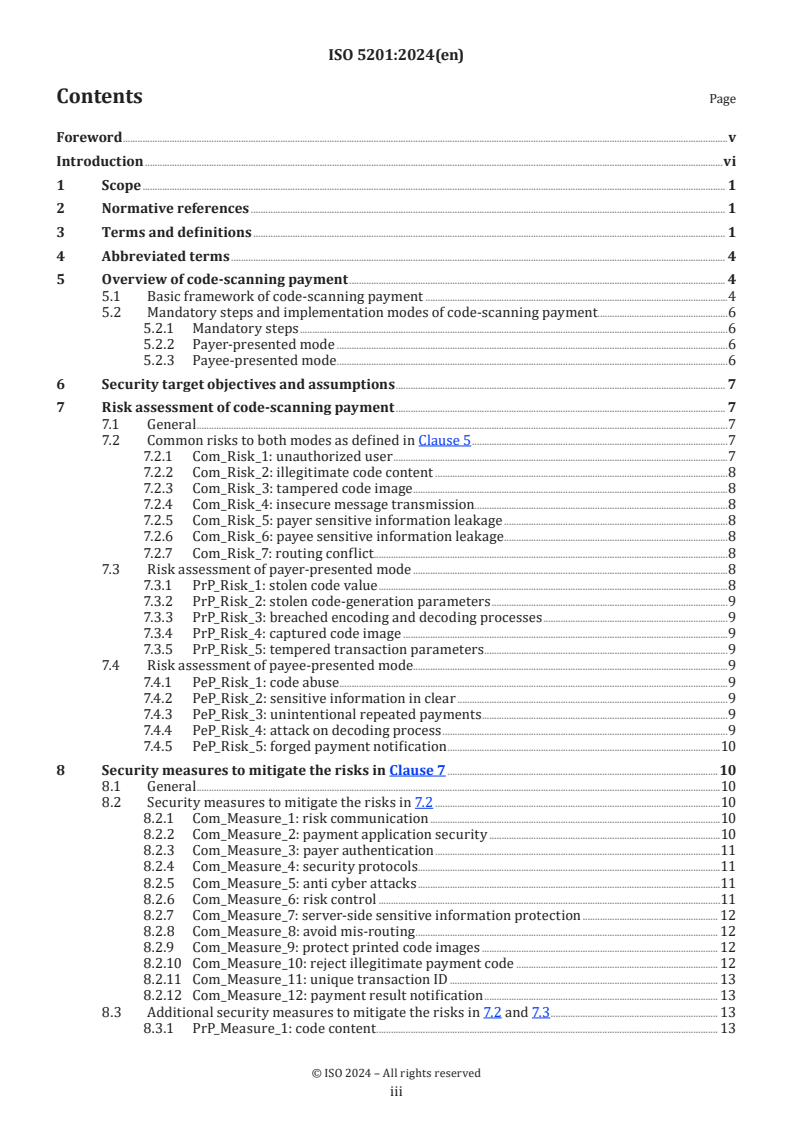
Contents Page
Foreword .v
Introduction .vi
1 Scope . 1
2 Normative references . 1
3 Terms and definitions . 1
4 Abbreviated terms . 4
5 Overview of code-scanning payment . 4
5.1 Basic framework of code-scanning payment .4
5.2 Mandatory steps and implementation modes of code-scanning payment.6
5.2.1 Mandatory steps .6
5.2.2 Payer-presented mode .6
5.2.3 Payee-presented mode .6
6 Security target objectives and assumptions . 7
7 Risk assessment of code-scanning payment . 7
7.1 General .7
7.2 Common risks to both modes as defined in Clause 5 .7
7.2.1 Com_Risk_1: unauthorized user .7
7.2.2 Com_Risk_2: illegitimate code content .8
7.2.3 Com_Risk_3: tampered code image .8
7.2.4 Com_Risk_4: insecure message transmission . .8
7.2.5 Com_Risk_5: payer sensitive information leakage .8
7.2.6 Com_Risk_6: payee sensitive information leakage .8
7.2.7 Com_Risk_7: routing conflict.8
7.3 Risk assessment of payer-presented mode .8
7.3.1 PrP_Risk_1: stolen code value .8
7.3.2 PrP_Risk_2: stolen code-generation parameters .9
7.3.3 PrP_Risk_3: breached encoding and decoding processes .9
7.3.4 PrP_Risk_4: captured code image .9
7.3.5 PrP_Risk_5: tempered transaction parameters .9
7.4 Risk assessment of payee-presented mode.9
7.4.1 PeP_Risk_1: code abuse.9
7.4.2 PeP_Risk_2: sensitive information in clear .9
7.4.3 PeP_Risk_3: unintentional repeated payments .9
7.4.4 PeP_Risk_4: attack on decoding process .9
7.4.5 PeP_Risk_5: forged payment notification .10
8 Security measures to mitigate the risks in Clause 7 .10
8.1 General .10
8.2 Security measures to mitigate the risks in 7.2 .10
8.2.1 Com_Measure_1: risk communication .10
8.2.2 Com_Measure_2: payment application security .10
8.2.3 Com_Measure_3: payer authentication .11
8.2.4 Com_Measure_4: security protocols .11
8.2.5 Com_Measure_5: anti cyber attacks .11
8.2.6 Com_Measure_6: risk control .11
8.2.7 Com_Measure_7: server-side sensitive information protection . 12
8.2.8 Com_Measure_8: avoid mis-routing . 12
8.2.9 Com_Measure_9: protect printed code images . 12
8.2.10 Com_Measure_10: reject illegitimate payment code . 12
8.2.11 Com_Measure_11: unique transaction ID . 13
8.2.12 Com_Measure_12: payment result notification . 13
8.3 Additional security measures to mitigate the risks in 7.2 and 7.3 . 13
8.3.1 PrP_Measure_1: code content . 13
iii
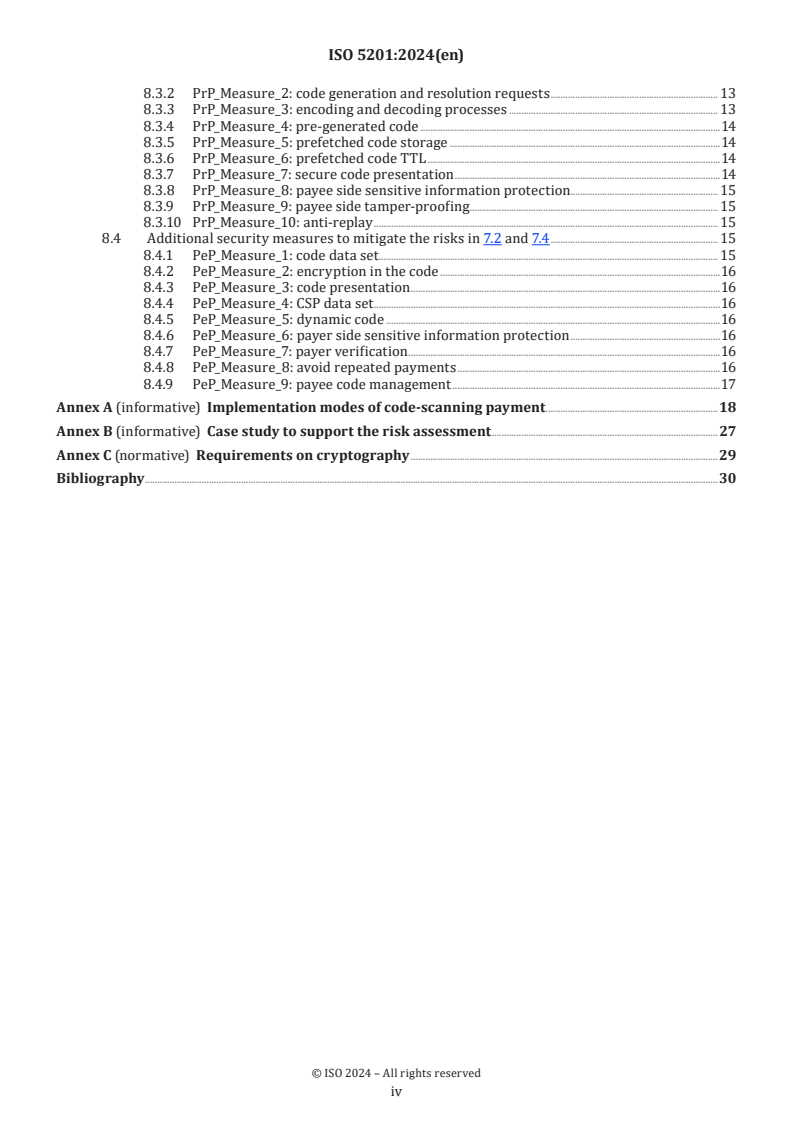
8.3.2 PrP_Measure_2: code generation and resolution requests . 13
8.3.3 PrP_Measure_3: encoding and decoding processes . 13
8.3.4 PrP_Measure_4: pre-generated code .14
8.3.5 PrP_Measure_5: prefetched code storage .14
8.3.6 PrP_Measure_6: prefetched code TTL .14
8.3.7 PrP_Measure_7: secure code presentation .14
8.3.8 PrP_Measure_8: payee side sensitive information protection. 15
8.3.9 PrP_Measure_9: payee side tamper-proofing. 15
8.3.10 PrP_Measure_10: anti-replay . 15
8.4 Additional security measures to mitigate the risks in 7.2 and 7.4 . 15
8.4.1 PeP_Measure_1: code data set. 15
8.4.2 PeP_Measure_2: encryption in the code .16
8.4.3 PeP_Measure_3: code presentation .16
8.4.4 PeP_Measure_4: CSP data set .16
8.4.5 PeP_Measure_5: dynamic code .16
8.4.6 PeP_Measure_6: payer side sensitive information protection .16
8.4.7 PeP_Measure_7: payer verification .16
8.4.8 PeP_Measure_8: avoid repeated payments .16
8.4.9 PeP_Measure_9: payee code management .17
Annex A (informative) Implementation modes of code-scanning payment .18
Annex B (informative) Case study to support the risk assessment .27
Annex C (normative) Requirements on cryptography .29
Bibliography .30
iv
Foreword
ISO (the International Organization for Standardization) is a worldwide federation of national standards
bodies (ISO member bodies). The work of preparing International Standards is normally carried out through
ISO technical committees. Each member body interested in a subject for which a technical committee
has been established has the right to be represented on that committee. International organizations,
governmental and non-governmental, in liaison with ISO, also take part in the work. ISO collaborates closely
with the International Electrotechnical Commission (IEC) on all matters of electrotechnical standardization.
The procedures used to develop this document and those intended for its further maintenance are described
in the ISO/IEC Directives, Part 1. In particular, the different approval criteria needed for the different types
of ISO document should be noted. This document was drafted in accordance with the editorial rules of the
ISO/IEC Directives, Part 2 (see www.iso.org/directives).
ISO draws attention to the possibility that the implementation of this document may involve the use of (a)
patent(s). ISO takes no position concerning the evidence, validity or applicability of any claimed patent
rights in respect thereof. As of the date of publication of this document, ISO had not received notice of (a)
patent(s) which may be required to implement this document. However, implementers are cautioned that
this may not represent the latest information, which may be obtained from the patent database available at
www.iso.org/patents. ISO shall not be held responsible for identifying any or all such patent rights.
Any trade name used in this document is information given for the convenience of users and does not
constitute an endorsement.
For an explanation of the voluntary nature of standards, the meaning of ISO specific terms and expressions
related to conformity assessment, as well as information about ISO’s adherence to the World Trade
Organization (WTO) principles in the Technical Barriers to Trade (TBT), see www.iso.org/iso/foreword.html.
This document was prepared by Technical Committee ISO/TC 68, Financial services, Subcommittee SC 2,
Financial Services, security.
Any feedback or questions on this document should be directed to the user’s national standards body. A
complete listing of these bodies can be found at www.iso.org/members.html.
v
Introduction
Code-scanning payment is a type of mobile payment service in which the payer uses a mobile device to
present a payment code image to a payee for scanning or scans a payment code image presented by the payee.
This document focuses on the security aspects of code-scanning payment. This document is structured
according to a risk-based analysis approach as specified in ISO 31000 and ISO/IEC 27005.
Clause 5 sets up the scope and context of the security analysis by giving an overview of code-scanning
payment. The basic framework is defined and the major roles are described. Some basic steps are mandatory
for these types of payment services, but there are many variations in practice because flexibility is one of
the major benefits of code-scanning payment. Various implementations can be roughly classified into two
categories: payer-presented mode and payee-presented mode. The risk assessment (see Clause 7) and
security requirements and guidelines (see Clause 8) are based on these two implementation modes.
Clause 6 clarifies the security target objectives and assumptions.
Clause 7 is the risk assessment of code-scanning payment. Security risks are identified and categorized
according to the implementation modes.
Clause 8 presents the security principles, requirements and guidelines on how to impose countermeasures
to control (mitigate or reduce) the risks identified in Clause 7. Minimum security requirements applicable
to both implementation modes are the security baseline for all code-scanning payment service providers.
Additional security guidelines are categorized by implementation modes, and presented as the best practices
recommended for the code-scanning payment service providers.
Annex A provides more details of the two implementation modes described in Clause 5, including the
payment transaction processes and payment code examples.
Annex B provides more details to support the risk assessment in Clause 7.
Annex C provides common requirements on the approved algorithms and mechanisms for any cryptographic
security measures used for code-scanning payment as defined in Clause 8.
vi
International Standard ISO 5201:2024(en)
Financial services — Code-scanning payment security
1 Scope
This document provides an overview, risk assessment, minimum security requirements and extended
security guidelines for code-scanning payment in which the payer uses a mobile device to operate the
payment transaction.
This document is applicable to cases where the payment code is used to initiate a mobile payment and
presented by either the payer or the payee.
The following is excluded from the scope of this document:
— details of payer and payee onboarding;
— details of the supporting payment infrastructure, as described in 5.1.
2 Normative references
The following documents are referred to in the text in such a way that some or all of their content constitutes
requirements of this document. For dated references, only the edition cited applies. For undated references,
the latest edition of the referenced document (including any amendments) applies.
ISO 11568, Financial services — Key management (retail)
ISO 16609, Financial services — Requirements for message authentication using symmetric techniques
ISO 19092, Financial services — Biometrics — Security framework
ISO 20038, Banking and related financial services — Key wrap using AES
ISO/IEC 9796 (all parts), Information technology — Security techniques — Digital signature schemes giving
message recovery
ISO/IEC 9797 (all parts), Information technology — Security techniques — Message Authentication Codes (MACs)
ISO/IEC 10118-1:2016/Amd 1:2021, Information technology — Security techniques — Hash-functions —
Part 1: General
ISO/IEC 10118-3, IT Security techniques — Hash-functions — Part 3: Dedicated hash-functions
ISO/IEC 14888 (all parts), Information technology — Security techniques — Digital signatures with appendix
ISO/IEC 18031, Information technology — Security techniques — Random bit generation
ISO/IEC 18033 (all parts), Information security — Security techniques — Encryption algorithms
ISO/IEC 19772, Information security — Authenticated encryption
NIST/FIPS PUB 202, SHA-3 Standard: Permutation-Based Hash and Extendable-Output Functions
3 Terms and definitions
For the purposes of this document, the following terms and definitions apply.
ISO and IEC maintain terminology databases for use in standardization at the following addresses:
— ISO Online browsing platform: available at https:// www .iso .org/ obp
— IEC Electropedia: available at https:// www .electropedia .org/
3.1
code image
symbolization of string constructed according to a defined format
EXAMPLE Code 128 as defined in ISO/IEC 15417 and QR code as defined in ISO/IEC 18004.
3.2
code-scanning
recognize and reveal the content of a code image (3.1)
Note 1 to entry: Not including interpretation of the code content.
3.3
code-scanning payment
payment transaction (3.10) initiated by code-scanning (3.2)
3.4
code service provider
CSP
logical role that manages the payment code (3.12) for the payer (3.9) or the payee (3.8), including generating,
distributing and (optionally) resolving
Note 1 to entry: The responsibility of this logical role can be split between several physical entities.
3.5
eavesdropping
unauthorized interception and interpretation of information-bearing emanations
[SOURCE: ISO/IEC 18013-3:2017, 3.5]
3.6
mobile device
device that utilizes communication networks while in motion
[SOURCE: ISO/IEC 24771:2014, 3.1.17]
3.7
mobile payment
payment (3.10) involving a mobile device (3.6) and using a payment instrument (3.13) and associated
infrastructures
[SOURCE: ISO 12812-1:2017, 3.29]
3.8
payee
person or legal entity who is the intended recipient of funds which have been the subject of a payment
transaction (3.10)
[SOURCE: ISO 12812-1:2017, 3.38]
3.9
payer
person or legal entity who authorizes a payment transaction (3.10)
Note 1 to entry: The payer can be a payment service provider (3.15).
[SOURCE: ISO 12812-1:2017, 3.39, modified —Note to entry added.]
3.10
payment
payment transaction
act of placing, transferring or withdrawing funds, irrespective of any underlying obligations between the
payer (3.9) and the payee (3.8)
[SOURCE: ISO 12812-1:2017, 3.40]
3.11
payment application
application resident in the payer’s (3.9) mobile device (3.6) which offers payment functionality
3.12
payment code
data string constructed according to a defined format or retrieved from a code image (3.1) used for the
purpose of making payments (3.10)
Note 1 to entry: The symbolized form of a payment code is called a “payment code image”.
EXAMPLE The payment code to represent an account or an order.
3.13
payment instrument
personalized device and/or set of procedures agreed between the payer (3.9) and the institution and used
by the payer in order to conduct a payment transaction (3.10)
EXAMPLE Credit transfer, card payment and electronic money.
[SOURCE: ISO 12812-1:2017, 3.43]
3.14
payment scheme
set of rules, practices, standards and/or implementation guidelines agreed between scheme participants for
the functioning of payment services and which is separated from any infrastructure or payment system that
supports its operation
[SOURCE: ISO 12812-1:2017, 3.44]
3.15
payment service provider
PSP
entity that provides payment services to a payment service user (3.16)
EXAMPLE Account servicing payment service provider (ASPSP), payment initiation service provider (PISP),
acquirer.
3.16
payment service user
PSU
natural person or legal entity making use of a payment service in the capacity of payer (3.9) or payee
(3.8), or both
3.17
point of interaction
POI
point at which payer (3.9) and payee (3.8) interact for the purpose of conducting a payment transaction (3.10)
EXAMPLE Point of sales (POS), vending machine, payment page on merchant website, quick response (QR) code
on a poster, mobile device (3.6) of the merchant.
3.18
risk
qualitative or quantitative measure, or both, of possible harm to a specified asset in a given threat
environment
Note 1 to entry: In the financial industry, assets include transaction financial value, payment systems integrity and
information security and privacy.
3.19
risk assessment
systematic process of evaluating the potential risks (3.18) involved in a projected activity or undertaking
3.20
secure element
SE
tamper-resistant platform in the mobile device (3.6) capable of securely hosting and executing applications
and associated confidential and cryptographic data (e.g. key management)
[SOURCE: ISO 12812-1:2017, 3.50, modified — Example deleted.]
3.21
trusted execution environment
TEE
aspect of the mobile device (3.6) comprising hardware and/or software which provides security services
to the mobile device computing environment, protects data against general software attacks and isolates
hardware and software security resources from the operating system
[SOURCE: ISO 12812-1:2017, 3.60]
4 Abbreviated terms
B2C business to customer
IBAN international bank account number
P2P person to person
POS point of sales
QR quick response
TTL time to live
URL uniform resource locator
5 Overview of code-scanning payment
5.1 Basic framework of code-scanning payment
Figure 1 is a basic framework of code-scanning payment that illustrates the relationship between the
different functional roles in the system.
Figure 1 — Basic framework of code-scanning payment
The participants of a typical code-scanning payment transaction include the payer, the payee and the
respective code service providers (CSPs) and payment service providers (PSPs). The payer CSP and the payer
PSP can be the same entity; likewise, the payee CSP and the payee PSP can also be the same entity. In some
cases, the payer CSP, the payer PSP, the payee CSP and the payee PSP can all be the same entity.
— Payer: The payer uses a mobile device to display and present their payment code image to the payee for
scanning or to scan a payment code image presented by the payee. The payment application provided by
the PSP or CSP and installed on the payer’s mobile device offers these functions. In some cases, the payer
can also use a static printout to present their payment code image. The payer can be either a person or a
legal entity.
— Payee: The payee uses an appropriate equipment to scan the code image presented by the payer or
any point of interaction (POI) equipment to display and present the payee code image to the payer for
scanning. The payee can be either a person or a legal entity.
— PSP: The PSP accepts the payment instructions from the payer, or the payment requests from the payee,
and processes the payments for them. This is a collective logical role which can contain several different
physical entities. The major component in the PSP domain is the supporting payment infrastructure.
NOTE 1 As stated in Clause 1, the details of the supporting payment infrastructure are out of scope, so it will be
treated as a secured black box and taken as a security assumption for the whole document. For a typical payment
transaction, it usually consists of three physical entities: an acquiring service provider (acquirer) who serves
the payee; an account service provider (ASPSP) who serves the payer; and a payment scheme which carries out
clearing and settlement. An acquiring service provider usually maintains a payment service user (PSU) account
management system, which contains necessary information for generating the payee’s payment code. Similarly,
an account service provider usually maintains a PSU account management system, which contains necessary
information for generating the payer’s payment code. For a person-to-person payment, there are two account
service providers and no acquiring service provider. In some cases, the acquiring service provider and account
service provider are the same physical entity, so there is no payment scheme involved.
— CSP: The basic function of the CSP is to generate and distribute the payment code for the payer or the
payee. Optionally the CSP can resolve the payment code for the PSU.
NOTE 2 The CSP needs to collect necessary information from the PSU account management system inside the
supporting payment infrastructure. The composition of the code management system is very flexible. It can be an
integrated part of the acquiring service provider’s platform and/or the account service provider’s platform or an
independent service provided by a technical vendor.
Figure 1 provides an outline of the basic framework. The participants involved can vary based on
implementation.
5.2 Mandatory steps and implementation modes of code-scanning payment
5.2.1 Mandatory steps
Figure 2 is an abstraction of the mandatory steps of code-scanning payment.
NOTE The white boxes are the target of evaluation (TOE) of this document. The grey boxes are out of scope.
Figure 2 — Mandatory steps of code-scanning payment
All the steps are mandatory, but the implementation of a code-scanning payment system is very flexible.
The mandatory steps in Figure 2 can be carried out by different entities involved in a payment transaction.
Variations of code-scanning payment systems can be roughly classified into two categories: payer-presented
mode and payee-presented mode.
5.2.2 Payer-presented mode
In this mode, the payment code image is generally presented by the payer, as a symbol that is dynamically
generated and displayed on the payer’s mobile device. The payer-presented code is usually generated by
the payer CSP and sent to the payer’s mobile device at the time of payment; however, in some cases it can be
prefetched and stored locally, or locally generated from a shared secret between the payer’s mobile device
and the payer CSP.
In some cases, a code image that is pre-generated by the payer CSP is sent to the payer in a static form, such
as printed on a card medium, and displayed to the payee at the time of payment.
At the time of payment, the code is presented to the payee, who then scans the presented code using the
payee’s POI.
A payer-presented payment code should contain the information or the secure link to appropriate
information to directly or indirectly identify a payer and can at the same time serve as an authorization
credential.
More details can be found in Clause A.2.
5.2.3 Payee-presented mode
In this mode, the payment code image is generally presented by the payee as a symbol that is:
— printed on a printable surface (e.g. paper card, adhesive sticker or a receipt); or
— displayed on the merchant’s POI.
At the time of payment, the code is presented to the payer, who then scans it using their mobile device. The
code can be static or dynamic.
A static payee-presented code contains information that is intended for repetitive use. At a minimum, it
should contain the information or the secure link to appropriate information to directly or indirectly identify
the payee.
A dynamic payee-presented code should contain the information or the secure link to appropriate
information to directly or indirectly identify a payee as well as to a specific payment transaction, such as the
amount to be paid. Information included in a dynamic code varies by transaction (e.g. the payment amount,
transaction ID).
More details can be found in Clause A.3.
6 Security target objectives and assumptions
This document specifies the following as the high-level security target objectives for the code-scanning
payment schemes:
a) Only the intended payer can initiate and/or authorize the transaction.
b) Only the intended payee can receive funds.
c) The payment amount is equal to the transferred value as intended by both payer and payee.
NOTE If, for example, a tip needs to be added in the payment amount, it still needs to be agreed by both payer
and payee. In this case, the payment amount is made up of the invoice amount and the tip amount.
d) Sensitive information and data, such as payment account and payment amount, are only accessible by
authorized entities.
e) Code-scanning payment services do not elevate the level of traditional risks in an electronic payment
system, such as cyberattacks, money laundering or fraud.
Further guidance on risk management is provided in ISO/IEC 27005.
The following security assumptions are made for the risk analysis in Clause 7 and security measures in
Clause 8:
— A properly developed and secured payment application shall be provided to each PSU before the code-
scanning payment service is activated.
— The code content shall be designed to disallow the initiation of payment transaction by insufficiently
secured applications.
7 Risk assessment of code-scanning payment
7.1 General
The risks listed in 7.2, 7.3 and 7.4 are sorted according to the steps in Figure 2.
7.2 Common risks to both modes as defined in Clause 5
7.2.1 Com_Risk_1: unauthorized user
The payment application is used by an unauthorised user to make payments through code-scanning.
NOTE This could be the result of, for example, loss or theft of the mobile device or loss or theft of user credentials.
7.2.2 Com_Risk_2: illegitimate code content
The presented code contains content which can be harmful to the PSU, the scanning device or the
payment scheme.
EXAMPLE 1 The data retrieved from the code directs the PSU to malicious resources, causing fraudulent payment
transactions, enabling identity theft, presenting offending information, etc.
EXAMPLE 2 The data retrieved from the code fails the demanded integrity verification due to various reasons such
as lack of digital signature.
EXAMPLE 3 The scanning device is interfered, corrupted or infected when decoding or processing the code content.
7.2.3 Com_Risk_3: tampered code image
The printed or displayed image of the presented code is replaced or modified.
7.2.4 Com_Risk_4: insecure message transmission
The payment transaction messages are eavesdropped, modified or replayed when they are transmitted over
the communication channel between the payer and the payer’s CSP or PSP and/or between the payee and
the payee’s CSP or PSP.
7.2.5 Com_Risk_5: payer sensitive information leakage
The payer’s sensitive information, except the code values and/or related parameters as in PrP_Risk_1 (see
7.3.1) and PrP_Risk_2 (see 7.3.2), is stolen by attackers and leveraged for malicious purposes, such as fraud.
EXAMPLE The payer’s authentication credential(s), user ID.
NOTE Such information could be stored in the payer’s device; obtained from the payer-presented code and stored
in the payee’s POI and/or the payee’s backend; stored at the CSP; or transmitted on the network.
7.2.6 Com_Risk_6: payee sensitive information leakage
The payee’s sensitive information, except the code image, is stolen by attackers and leveraged for malicious
purposes, such as fraud.
EXAMPLE The shared secrets between the payee and the payee CSP or PSP, the payee’s IBAN.
NOTE Such information could be obtained from the payee-presented code and stored in the payer’s device; stored
in the payee’s POI and/or the payee’s backend; stored at the CSP; or transmitted on the network.
7.2.7 Com_Risk_7: routing conflict
The format of code content of multiple code-scanning payment schemes allows interpretation of content in a
way that a different routing destination is identified than intended.
EXAMPLE See the case study in Clause B.3.
7.3 Risk assessment of payer-presented mode
7.3.1 PrP_Risk_1: stolen code value
The payer-presented code value is stolen and used without authorization when it is generated on the payer’s
CSP server, when it is transmitted over the communication channel between the payer and the payer’s CSP
server or when it is stored in the payer’s mobile device.
NOTE This risk is applicable when the payment application fetches the code value from the server in real time or
when it pre-fetches several code values to the device side in case there is a bad network connection when making a
payment. See the case study in Clause B.2.
7.3.2 PrP_Risk_2: stolen code-generation parameters
The parameters used to generate the payer-presented code are stolen and used without authorization when
they are generated at the payer’s CSP or PSP, when they are transmitted over the communication channel
between the payer and the payer’s CSP or PSP or when they are stored in the payer’s mobile device.
NOTE This risk is specific to those implementations which allow the payment application to generate the payer-
presented code locally using some parameters shared with the payer’s CSP. See the case study in Clause B.2.
7.3.3 PrP_Risk_3: breached encoding and decoding processes
The code generation and related payment information extracting processes are attacked and a legitimate
code value is exploited and used without authorization.
7.3.4 PrP_Risk_4: captured code image
The code image is captured and used without authorization by an attacker or malicious merchant when
being displayed.
7.3.5 PrP_Risk_5: tempered transaction parameters
The transaction parameters on the payee side are modified by an attacker or by the payee, intentionally or
unintentionally.
7.4 Risk assessment of payee-presented mode
7.4.1 PeP_Risk_1: code abuse
The payee-presented code is misused for payment acceptance in scenarios which are not allowed as per the
payee PSP’s requirements.
EXAMPLE The code issued for in-store payment is misused for online payment or the code issued for a payee is
misused for accepting payment by another illegitimate payee.
7.4.2 PeP_Risk_2: sensitive information in clear
The payee-presented code contains the payee’s sensitive information in clear text. This information is
obtained by attackers and leveraged for malicious purposes, such as fraud.
7.4.3 PeP_Risk_3: unintentional repeated payments
The payer(s) scans the same payee-presented code (static or dynamic) and makes repeated payments by
mistake due to temporary network failure or other reasons.
7.4.4 PeP_Risk_4: attack on decoding process
The attacker impersonates the payer(s), obtains payee-sensitive information from the payee’s CSP or PSP
and leverages it for malicious purposes, such as fraud.
NOTE 1 This risk is applicable when some or all of the data required for payment initiation need to be retrieved
from the payee’s CSP or PSP based on a token, index or proxy contained in the payee-presented code. Refer to A.3.2.2.2
for an example code format.
NOTE 2 Token refers to a surrogate value for PSU identification and/or transaction data. If the token is included in
the payee-presented data, it is referred to as a payee token; if the token is included in the payer-presented data, it is
referred to as a payer token.
NOTE 3 Index refers to a pointer which can be used to retrieve a record from a database.
NOTE 4 Proxy, sometimes referred to as an “alias”, is the data required in order to retrieve a payment account
identifier. For example, a mobile phone number or email address is used as a proxy to replace an international bank
account number (IBAN).
7.4.5 PeP_Risk_5: forged payment notification
The payer or attacker forges a payment completion notification to fraudulently obtain the product or service.
EXAMPLE The payee confirms payment completion visually by looking at the payment notification information
displayed on the payer’s mobile device; the payer cheats the payee by presenting a screenshot from a previous
transaction.
8 Security measures to mitigate the risks in Clause 7
8.1 General
The security measures given in Clause 8, including requirements and recommendations, are sorted based on
the steps in Figure 2. They do not reflect a priority order.
For less straightforward provisions, implementation guidance is provided.
These security measures are also roughly sorted against the risks identified in Clause 7. However, the
relationship between risks and countermeasures are not strictly 1:1. Most of the risks are tangled with each
other, correspondingly the security measures are also coordinated with each other to construct multi-layer
protection to secure the code-scanning payment system.
Clause 8.2 provides common security measures which shall be applied together with the additional security
measures in 8.3 or 8.4 which are specific to payer-presented mode or payee-presented mode, respectively.
8.2 Security measures to mitigate the risks in 7.2
8.2.1 Com_Measure_1: risk communication
The PSPs shall communicate the security risks associated with code-scanning payment to their PSUs and
recommend good behaviours, including at least the following:
— Promote code-scanning payment security knowledge to improve safety awareness.
— Provide clear information on potential security risks and countermeasures that are likely to occur
during the payment process, as in Figure 2.
— Enhance education on protection and management of sensitive data, such as transaction passwords and
biometrics data.
— If static payer- or payee-presented payment codes are supported, disclose the corresponding risks and
recommend countermeasures to the PSUs.
8.2.2 Com_Measure_2: payment application security
8.2.2.1 General
The payment application and the relevant data on the PSU’s device shall be protected from being
compromised.
8.2.2.2 Implementation guidance
Relevant data means the data managed by the payment application.
Security hardening technologies, such as secure element (SE), trusted execution environment (TEE) and
software code obfuscation, can be leveraged where appropriate.
Application-layer encryption and authentication shall be used to protect data flows, in addition to transport
layer security.
8.2.3 Com_Measure_3: payer authentication
8.2.3.1 General
The payer shall be authenticated to the payer’s PSP before they can use the code-scanning payment service.
8.2.3.2 Implementation guidance
The PSP can delegate the authentication to the payer’s device, the payment application or the payment scheme.
8.2.4 Com_Measure_4: security protocols
8.2.4.1 General
Security protocols shall be used on the external open communication channels and should be updated to the
latest stable versions.
8.2.4.2 Implementation guidance
Implement appropriate security controls such as transport layer security (TLS) and Internet Protocol
Security (IPsec). TLS 1.2 or later version should be applied where appropriate.
Security protocols with mutual authentication should be used on the external open communication channels
between the payee and the payee CSP or the payer and the payer CSP.
8.2.5 Com_Measure_5: anti cyber attacks
8.2.5.1 General
CSP and PSP shall implement security controls and practices to mitigate cyberattacks.
8.2.5.2 Implementation guidance
Obtaining an ISO/IEC 27001, ISO/IEC 27032 or similar certification can demonstrate such security
capabilities.
8.2.6 Com_Measure_6: risk control
8.2.6.1 General
Transaction risk control functions shall be added to reduce the potential damages caused by the security
risks associated with code-scanning payment.
8.2.6.2 Implementation guidance
The risk control system can identify abnormal payment transactions and take effective measures, such as
refusing the transaction, sending an additional
...