

ISO 2420:2017
(Main)Leather — Physical and mechanical tests — Determination of apparent density and mass per unit area
General Information
- Abstract
ISO 2420:2017 specifies a method for determining the apparent density and the mass per unit area of leather. It is applicable to all leathers.
- Status
- Published
- Publication Date
- 30-Jan-2017
- Technical Committee
- IULTCS - International Union of Leather Technologists and Chemists Societies
- Current Stage
- 9093 - International Standard confirmed
- Start Date
- 14-Jun-2022
- Completion Date
- 29-Aug-2026
Buy Documents
ISO 2420:2017 - Leather -- Physical and mechanical tests -- Determination of apparent density and mass per unit area
ISO 2420:2017 - Leather — Physical and mechanical tests — Determination of apparent density and mass per unit area/31/2017
ISO 2420:2017 - Cuir -- Essais physiques et mécaniques -- Détermination de la masse volumique apparente et de la masse surfacique
ISO 2420:2017 - Cuir — Essais physiques et mécaniques — Détermination de la masse volumique apparente et de la masse surfacique/31/2017
Overview
ISO 2420:2017 is an international standard published by ISO that specifies a precise method for determining the apparent density and mass per unit area (also called surface mass) of leather. It applies to all types of leather and provides a standardized procedure for physical and mechanical testing essential to quality control, manufacturing, and product development in the leather industry. By adhering to this standard, manufacturers and testing laboratories can ensure consistency and reliability in measuring leather’s basic physical properties.
Key Topics
Apparent Density Measurement
ISO 2420:2017 outlines the calculation of apparent density by measuring the mass and volume of a leather test sample. The volume is determined from the sample’s surface area and thickness. The standard accommodates both circular and square test specimens.Mass per Unit Area (Surface Mass)
The standard provides formulas to determine the leather’s mass per unit area, expressed in grams per square meter (g/m²), based on measured mass and surface dimensions.Sample Preparation and Testing Conditions
The standard references ISO norms for proper sampling (ISO 2418), sample conditioning (ISO 2419), and thickness measurement (ISO 2589) to ensure repeatability and accuracy under controlled environmental conditions.Testing Equipment Requirements
Detailed specifications cover the use of sharp emporte-pièces (cutting devices), precision thickness gauges, highly accurate balances (0.001 g readability), and vernier calipers for dimension measurement.Calculation Methods and Formulae
Includes explicit formulas to calculate apparent density and mass per unit area for both cylindrical (round) and cuboidal (square) test pieces, along with instructions on averaging multiple thickness and dimension readings.Reporting Guidelines
Defines essential information for test reports, including references to ISO 2420:2017, environmental conditioning conditions, measured values with specified significant figures, and any deviations from standard procedures.
Applications
ISO 2420:2017 is fundamental for:
Leather Manufacturers
To evaluate raw, semi-finished, or finished leather materials for consistent physical properties such as density and surface mass, which impact product durability, feel, and performance.Quality Control Laboratories
To perform standardized testing ensuring that leather batches meet specified quality standards and customer requirements.Product Development and R&D
To compare materials, develop new leather grades, or refine processing techniques based on accurate physical property data.Compliance and Certification
To provide certified measurement results for regulatory, commercial, or certification purposes, facilitating trade and quality assurance.Material Testing Professionals
As a recognized reference method, it promotes agreement and reproducibility across international laboratories and industries involved in leather technology.
Related Standards
The following ISO standards are closely linked to ISO 2420:2017 and provide complementary requirements for comprehensive leather testing:
ISO 2418: Leather - Chemical, Physical, Mechanical Tests - Sampling
Specifies procedures for leather sample selection ensuring representative and unbiased samples for testing.ISO 2419: Leather - Physical and Mechanical Tests - Preparation and Conditioning of Samples
Defines conditioning atmospheres and protocols to stabilize leather samples prior to measurement.ISO 2589: Leather - Physical and Mechanical Tests - Thickness Measurement
Provides methods to accurately measure leather thickness, a crucial parameter in density and surface mass calculations.EN 15987: Leather - Terminology for Leather Trade
Offers standardized definitions related to leather materials and trade, supporting clear communication across the supply chain.
By integrating ISO 2420:2017 with these related standards, industries achieve robust and internationally comparable leather test results that support quality assurance, material characterization, and commercial trade.
Adopting ISO 2420:2017 ensures that the apparent density and mass per unit area of leather materials are consistently measured using a globally recognized methodology, thereby enhancing product quality, facilitating international commerce, and supporting innovation in the leather sector.
Relations
- Effective Date
- 09-Feb-2026
- Effective Date
- 12-Feb-2026
- Effective Date
- 06-Jun-2022
- Effective Date
- 02-Aug-2014
Buy Documents
ISO 2420:2017 - Leather -- Physical and mechanical tests -- Determination of apparent density and mass per unit area
ISO 2420:2017 - Leather — Physical and mechanical tests — Determination of apparent density and mass per unit area/31/2017
ISO 2420:2017 - Cuir -- Essais physiques et mécaniques -- Détermination de la masse volumique apparente et de la masse surfacique
ISO 2420:2017 - Cuir — Essais physiques et mécaniques — Détermination de la masse volumique apparente et de la masse surfacique/31/2017
Get Certified
Connect with accredited certification bodies for this standard

Control Union Certifications
Global certification for agriculture and sustainability.

Hohenstein Institut
Textile testing and certification.

Bureau Veritas Bangladesh
Bureau Veritas certification services in Bangladesh.
Sponsored listings
Frequently Asked Questions
ISO 2420:2017 is a standard published by the International Organization for Standardization (ISO). Its full title is "Leather — Physical and mechanical tests — Determination of apparent density and mass per unit area". This standard covers: ISO 2420:2017 specifies a method for determining the apparent density and the mass per unit area of leather. It is applicable to all leathers.
ISO 2420:2017 specifies a method for determining the apparent density and the mass per unit area of leather. It is applicable to all leathers.
ISO 2420:2017 is classified under the following ICS (International Classification for Standards) categories: 59.140.30 - Leather and furs. The ICS classification helps identify the subject area and facilitates finding related standards.
ISO 2420:2017 has the following relationships with other standards: It is inter standard links to EN ISO 2417:2025, EN ISO 2420:2017, ISO 3186:2008, ISO 2420:2002. Understanding these relationships helps ensure you are using the most current and applicable version of the standard.
ISO 2420:2017 is available in PDF format for immediate download after purchase. The document can be added to your cart and obtained through the secure checkout process. Digital delivery ensures instant access to the complete standard document.
Standards Content (Sample)
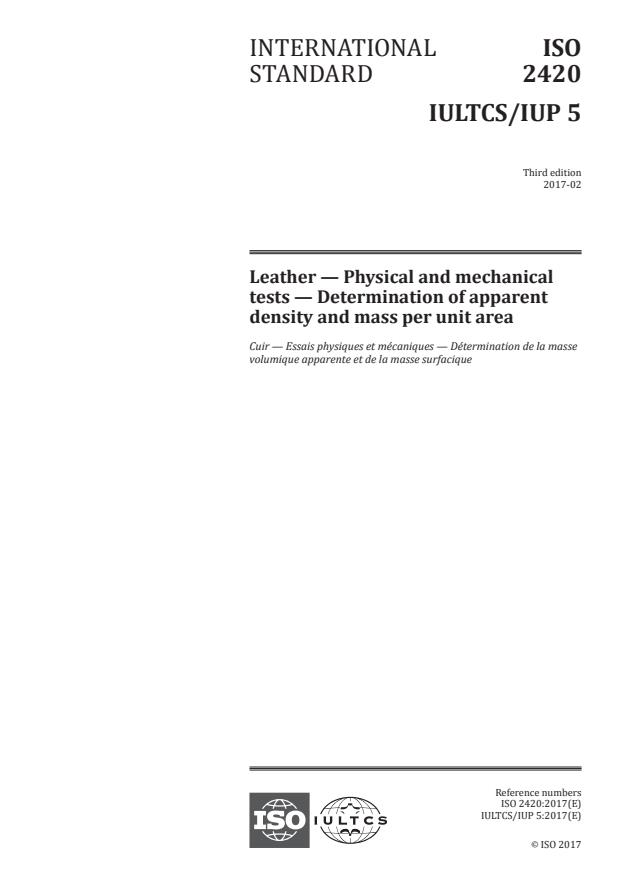
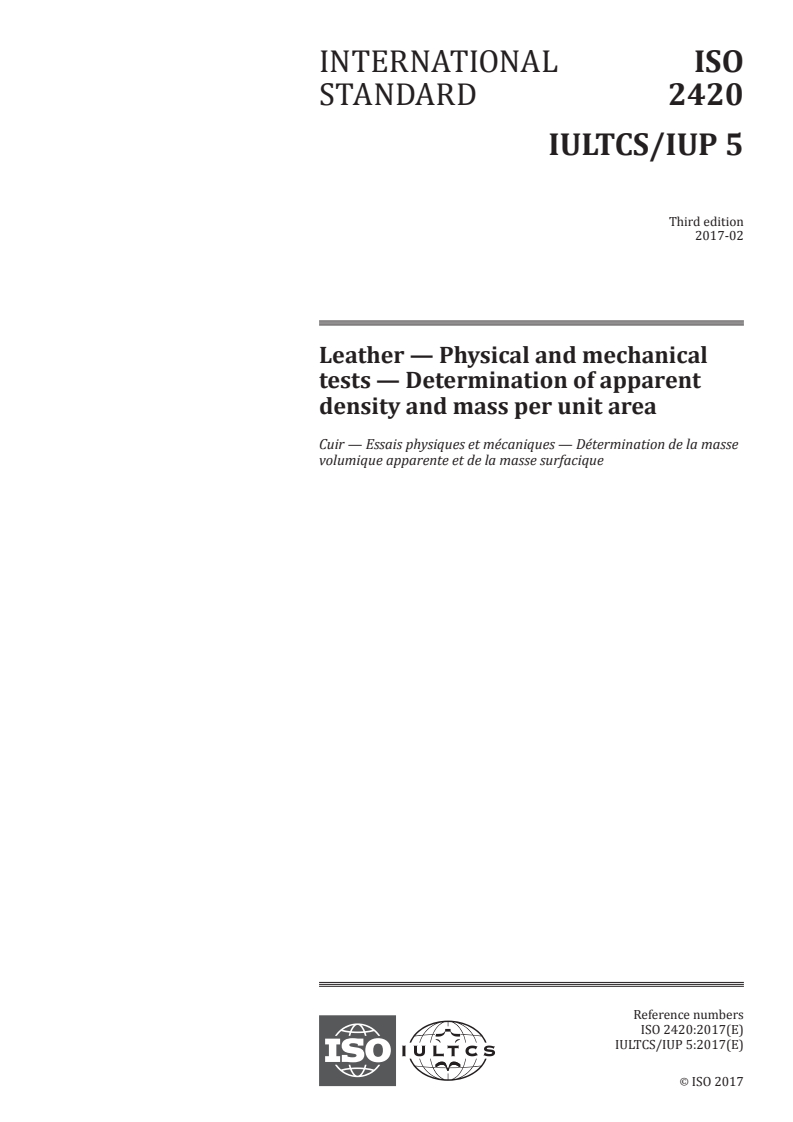
INTERNATIONAL ISO
STANDARD 2420
IULTCS/IUP 5
Third edition
2017-02
Leather — Physical and mechanical
tests — Determination of apparent
density and mass per unit area
Cuir — Essais physiques et mécaniques — Détermination de la masse
volumique apparente et de la masse surfacique
Reference numbers
IULTCS/IUP 5:2017(E)
©
ISO 2017
IULTCS/IUP 5:2017(E)
© ISO 2017, Published in Switzerland
All rights reserved. Unless otherwise specified, no part of this publication may be reproduced or utilized otherwise in any form
or by any means, electronic or mechanical, including photocopying, or posting on the internet or an intranet, without prior
written permission. Permission can be requested from either ISO at the address below or ISO’s member body in the country of
the requester.
ISO copyright office
Ch. de Blandonnet 8 • CP 401
CH-1214 Vernier, Geneva, Switzerland
Tel. +41 22 749 01 11
Fax +41 22 749 09 47
copyright@iso.org
www.iso.org
ii © ISO 2017 – All rights reserved
IULTCS/IUP 5:2017(E)
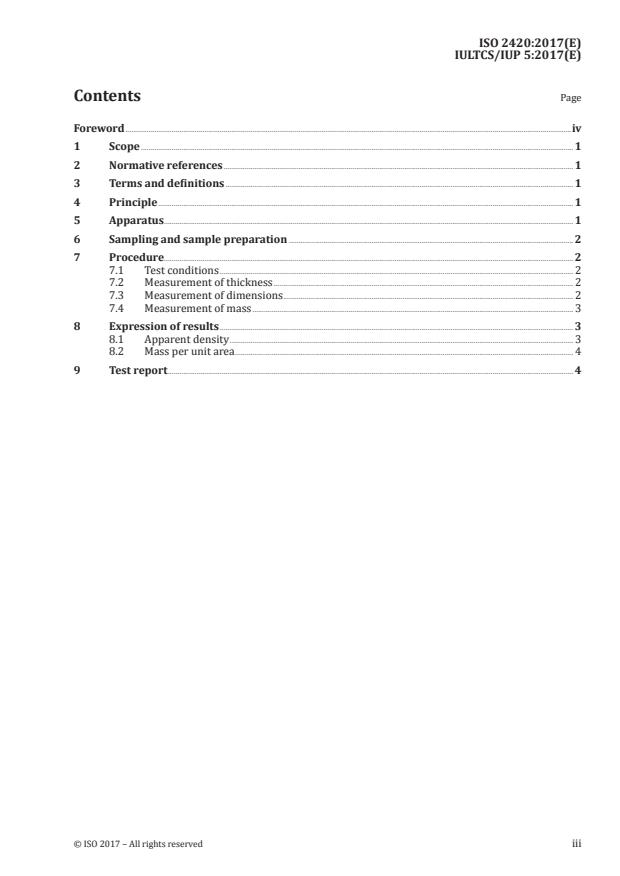
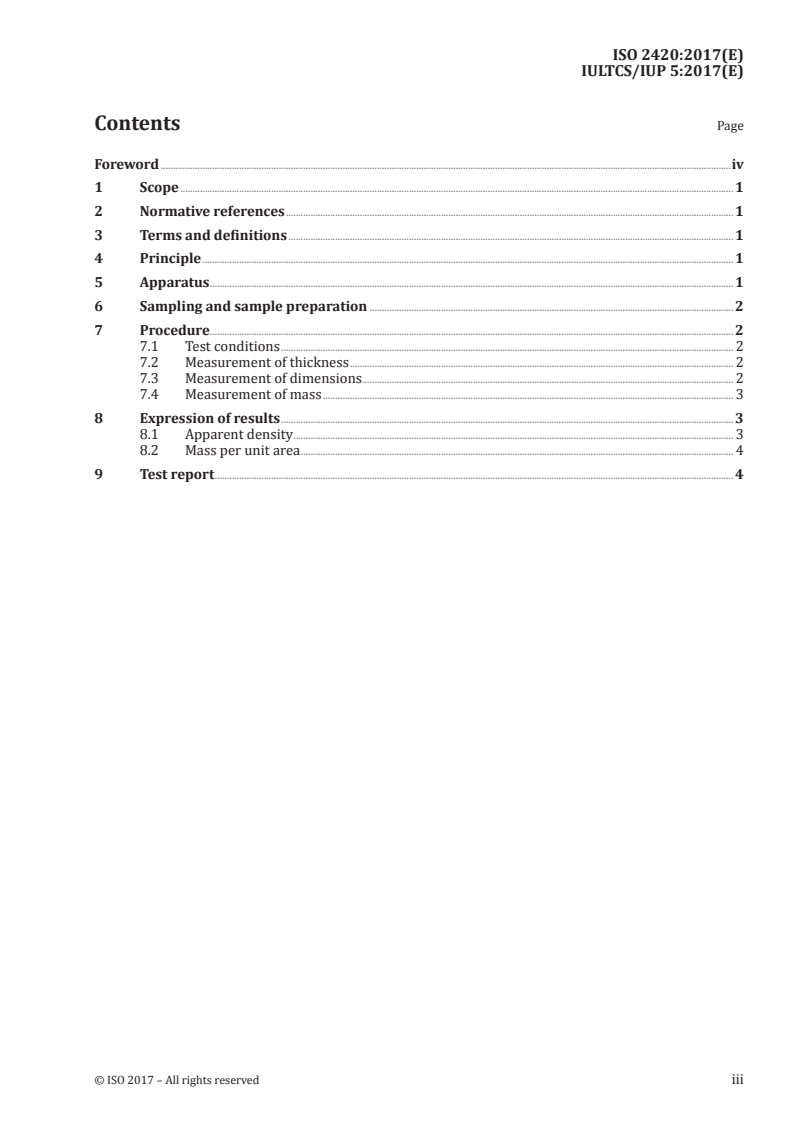
Contents Page
Foreword .iv
1 Scope . 1
2 Normative references . 1
3 Terms and definitions . 1
4 Principle . 1
5 Apparatus . 1
6 Sampling and sample preparation . 2
7 Procedure. 2
7.1 Test conditions . 2
7.2 Measurement of thickness . 2
7.3 Measurement of dimensions . 2
7.4 Measurement of mass . 3
8 Expression of results . 3
8.1 Apparent density . 3
8.2 Mass per unit area . 4
9 Test report . 4
IULTCS/IUP 5:2017(E)
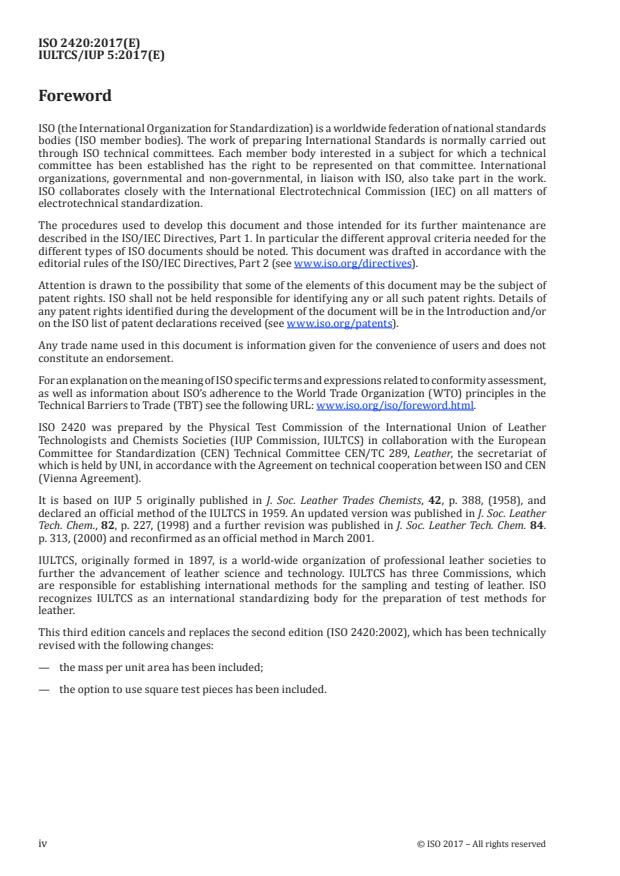
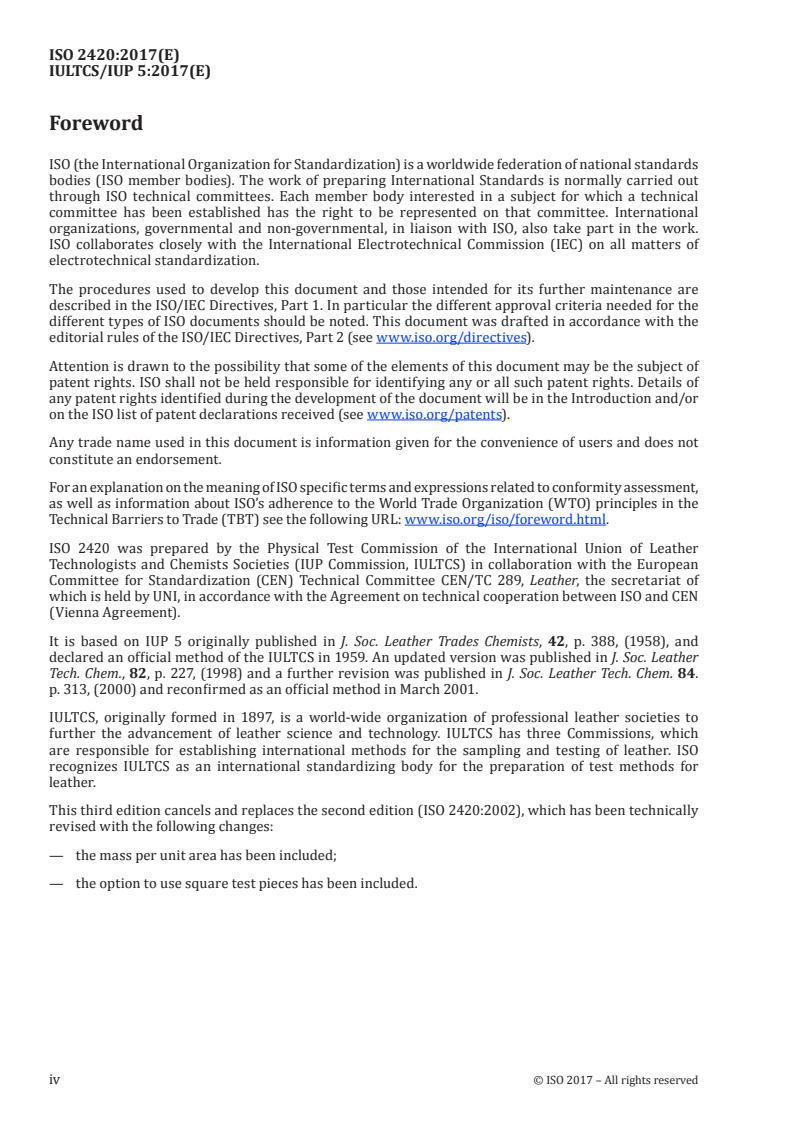
Foreword
ISO (the International Organization for Standardization) is a worldwide federation of national standards
bodies (ISO member bodies). The work of preparing International Standards is normally carried out
through ISO technical committees. Each member body interested in a subject for which a technical
committee has been established has the right to be represented on that committee. International
organizations, governmental and non-governmental, in liaison with ISO, also take part in the work.
ISO collaborates closely with the International Electrotechnical Commission (IEC) on all matters of
electrotechnical standardization.
The procedures used to develop this document and those intended for its further maintenance are
described in the ISO/IEC Directives, Part 1. In particular the different approval criteria needed for the
different types of ISO documents should be noted. This document was drafted in accordance with the
editorial rules of the ISO/IEC Directives, Part 2 (see www .iso .org/ directives).
Attention is drawn to the possibility that some of the elements of this document may be the subject of
patent rights. ISO shall not be held responsible for identifying any or all such patent rights. Details of
any patent rights identified during the development of the document will be in the Introduction and/or
on the ISO list of patent declarations received (see www .iso .org/ patents).
Any trade name used in this document is information given for the convenience of users and does not
constitute an endorsement.
For an explanation on the meaning of ISO specific terms and expressions related to conformity assessment,
as well as information about ISO’s adherence to the World Trade Organization (WTO) principles in the
Technical Barriers to Trade (TBT) see the following URL: www . i so .org/ iso/ foreword .html.
ISO 2420 was prepared by the Physical Test Commission of the International Union of Leather
Technologists and Chemists Societies (IUP Commission, IULTCS) in collaboration with the European
Committee for Standardization (CEN) Technical Committee CEN/TC 289, Leather, the secretariat of
which is held by UNI, in accordance with the Agreement on technical cooperation between ISO and CEN
(Vienna Agreement).
It is based on IUP 5 originally published in J. Soc. Leather Trades Chemists, 42, p. 388, (1958), and
declared an official method of the IULTCS in 1959. An updated version was published in J. Soc. Leather
Tech. Chem., 82, p. 227, (1998) and a further revision was published in J. Soc. Leather Tech. Chem. 84.
p. 313, (2000) and reconfirmed as an official method in March 2001.
IULTCS, originally formed in 1897, is a world-wide organization of professional leather societies to
further the advancement of leather science and technology. IULTCS has three Commissions, which
are responsible for establishing international methods for the sampling and testing of leather. ISO
recognizes IULTCS as an international standardizing body for the
...
INTERNATIONAL ISO
STANDARD 2420
IULTCS/IUP 5
Third edition
2017-02
Leather — Physical and mechanical
tests — Determination of apparent
density and mass per unit area
Cuir — Essais physiques et mécaniques — Détermination de la masse
volumique apparente et de la masse surfacique
Reference numbers
IULTCS/IUP 5:2017(E)
©
ISO 2017
IULTCS/IUP 5:2017(E)
© ISO 2017, Published in Switzerland
All rights reserved. Unless otherwise specified, no part of this publication may be reproduced or utilized otherwise in any form
or by any means, electronic or mechanical, including photocopying, or posting on the internet or an intranet, without prior
written permission. Permission can be requested from either ISO at the address below or ISO’s member body in the country of
the requester.
ISO copyright office
Ch. de Blandonnet 8 • CP 401
CH-1214 Vernier, Geneva, Switzerland
Tel. +41 22 749 01 11
Fax +41 22 749 09 47
copyright@iso.org
www.iso.org
ii © ISO 2017 – All rights reserved
IULTCS/IUP 5:2017(E)
Contents Page
Foreword .iv
1 Scope . 1
2 Normative references . 1
3 Terms and definitions . 1
4 Principle . 1
5 Apparatus . 1
6 Sampling and sample preparation . 2
7 Procedure. 2
7.1 Test conditions . 2
7.2 Measurement of thickness . 2
7.3 Measurement of dimensions . 2
7.4 Measurement of mass . 3
8 Expression of results . 3
8.1 Apparent density . 3
8.2 Mass per unit area . 4
9 Test report . 4
IULTCS/IUP 5:2017(E)
Foreword
ISO (the International Organization for Standardization) is a worldwide federation of national standards
bodies (ISO member bodies). The work of preparing International Standards is normally carried out
through ISO technical committees. Each member body interested in a subject for which a technical
committee has been established has the right to be represented on that committee. International
organizations, governmental and non-governmental, in liaison with ISO, also take part in the work.
ISO collaborates closely with the International Electrotechnical Commission (IEC) on all matters of
electrotechnical standardization.
The procedures used to develop this document and those intended for its further maintenance are
described in the ISO/IEC Directives, Part 1. In particular the different approval criteria needed for the
different types of ISO documents should be noted. This document was drafted in accordance with the
editorial rules of the ISO/IEC Directives, Part 2 (see www .iso .org/ directives).
Attention is drawn to the possibility that some of the elements of this document may be the subject of
patent rights. ISO shall not be held responsible for identifying any or all such patent rights. Details of
any patent rights identified during the development of the document will be in the Introduction and/or
on the ISO list of patent declarations received (see www .iso .org/ patents).
Any trade name used in this document is information given for the convenience of users and does not
constitute an endorsement.
For an explanation on the meaning of ISO specific terms and expressions related to conformity assessment,
as well as information about ISO’s adherence to the World Trade Organization (WTO) principles in the
Technical Barriers to Trade (TBT) see the following URL: www . i so .org/ iso/ foreword .html.
ISO 2420 was prepared by the Physical Test Commission of the International Union of Leather
Technologists and Chemists Societies (IUP Commission, IULTCS) in collaboration with the European
Committee for Standardization (CEN) Technical Committee CEN/TC 289, Leather, the secretariat of
which is held by UNI, in accordance with the Agreement on technical cooperation between ISO and CEN
(Vienna Agreement).
It is based on IUP 5 originally published in J. Soc. Leather Trades Chemists, 42, p. 388, (1958), and
declared an official method of the IULTCS in 1959. An updated version was published in J. Soc. Leather
Tech. Chem., 82, p. 227, (1998) and a further revision was published in J. Soc. Leather Tech. Chem. 84.
p. 313, (2000) and reconfirmed as an official method in March 2001.
IULTCS, originally formed in 1897, is a world-wide organization of professional leather societies to
further the advancement of leather science and technology. IULTCS has three Commissions, which
are responsible for establishing international methods for the sampling and testing of leather. ISO
recognizes IULTCS as an international standardizing body for the
...
NORME ISO
INTERNATIONALE 2420
IULTCS/IUP 5
Troisième édition
2017-02
Cuir — Essais physiques et
mécaniques — Détermination de la
masse volumique apparente et de la
masse surfacique
Leather — Physical and mechanical tests — Determination of
apparent density and mass per unit area
Numéros de référence
IULTCS/IUP 5:2017(F)
©
ISO 2017
IULTCS/IUP 5:2017(F)
DOCUMENT PROTÉGÉ PAR COPYRIGHT
© ISO 2017, Publié en Suisse
Droits de reproduction réservés. Sauf indication contraire, aucune partie de cette publication ne peut être reproduite ni utilisée
sous quelque forme que ce soit et par aucun procédé, électronique ou mécanique, y compris la photocopie, l’affichage sur
l’internet ou sur un Intranet, sans autorisation écrite préalable. Les demandes d’autorisation peuvent être adressées à l’ISO à
l’adresse ci-après ou au comité membre de l’ISO dans le pays du demandeur.
ISO copyright office
Ch. de Blandonnet 8 • CP 401
CH-1214 Vernier, Geneva, Switzerland
Tel. +41 22 749 01 11
Fax +41 22 749 09 47
copyright@iso.org
www.iso.org
ii © ISO 2017 – Tous droits réservés
IULTCS/IUP 5:2017(F)
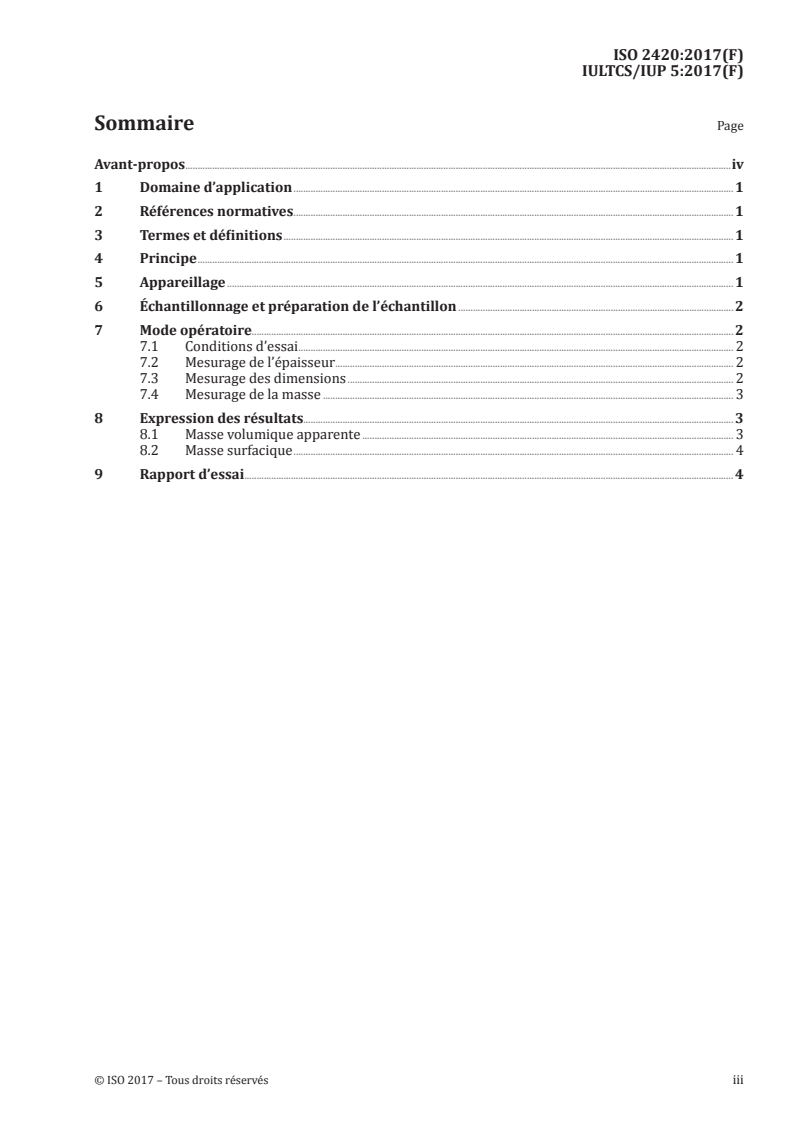
Sommaire Page
Avant-propos .iv
1 Domaine d’application . 1
2 Références normatives . 1
3 Termes et définitions . 1
4 Principe . 1
5 Appareillage . 1
6 Échantillonnage et préparation de l’échantillon . 2
7 Mode opératoire. 2
7.1 Conditions d’essai . 2
7.2 Mesurage de l’épaisseur . 2
7.3 Mesurage des dimensions . 2
7.4 Mesurage de la masse . 3
8 Expression des résultats. 3
8.1 Masse volumique apparente . 3
8.2 Masse surfacique . 4
9 Rapport d’essai . 4
IULTCS/IUP 5:2017(F)
Avant-propos
L’ISO (Organisation internationale de normalisation) est une fédération mondiale d’organismes
nationaux de normalisation (comités membres de l’ISO). L’élaboration des Normes internationales est
en général confiée aux comités techniques de l’ISO. Chaque comité membre intéressé par une étude
a le droit de faire partie du comité technique créé à cet effet. Les organisations internationales,
gouvernementales et non gouvernementales, en liaison avec l’ISO participent également aux travaux.
L’ISO collabore étroitement avec la Commission électrotechnique internationale (IEC) en ce qui
concerne la normalisation électrotechnique.
Les procédures utilisées pour élaborer le présent document et celles destinées à sa mise à jour sont
décrites dans les Directives ISO/IEC, Partie 1 Il convient, en particulier, de prendre note des différents
critères d’approbation requis pour les différents types de documents ISO. Le présent document a été
rédigé conformément aux règles de rédaction données dans les Directives ISO/IEC, Partie 2 (voir www
.iso .org/ directives).
L’attention est appelée sur le fait que certains des éléments du présent document peuvent faire l’objet de
droits de propriété intellectuelle ou de droits analogues. L’ISO ne saurait être tenue pour responsable
de ne pas avoir identifié de tels droits de propriété et averti de leur existence. Les détails concernant
les références aux droits de propriété intellectuelle ou autres droits analogues identifiés lors de
l’élaboration du document sont indiqués dans l’Introduction et/ou dans la liste des déclarations de
brevets reçues par l’ISO (voir www .iso .org/ brevets).
Les appellations commerciales éventuellement mentionnées dans le présent document sont données
pour information, par souci de commodité, à l’intention des utilisateurs et ne sauraient constituer un
engagement.
Pour une explication de la signification des termes et expressions spécifiques de l’ISO liés à l’évaluation
de la conformité, ou pour toute information au sujet de l’adhésion de l’ISO aux principes de l’Organisation
mondiale du commerce (OMC) concernant les obstacles techniques au commerce (OTC), voir le lien
suivant: w w w . i s o .org/ iso/ fr/ avant -propos .html.
L’ISO 2420 a été élaborée par la Commission Essais physiques de l’Union internationale des sociétés de
techniciens et chimistes du cuir (Commission IUP, IULTCS) en collaboration avec le Comité technique
du Comité européen de normalisation (CEN) CEN/TC 289, Cuir, dont le secrétariat est tenu par l’UNI,
conformément à l’Accord de coopération technique entre l’ISO et le CEN (l’Accord de Vienne).
Elle est basée sur le document IUP 5, qui a été publié dans le J. Soc. Leather Trades Chemists, 42, p. 388
(1958) et déclaré méthode officielle de l’IULTCS en 1959. Une version révisée a été publiée dans le J.
Soc. Leather Tech. Chem. 82, p. 227 (1998) puis une nouvelle version révisée a été publiée dans le J. Soc.
Leather Tech. Chem. 84. p. 313, (2000) et confirmée en tant que méthode officielle en mars 2001.
L’IULTCS est une organisation mondiale de sociétés professionnelles des industries du cuir fondée en
1897 ayant pour mission de favoriser l’avancement des sciences et technologies du cuir. L’IULTCS a trois
commissions, qui sont responsables de l’établissement de méthodes internationales d’échantillonnage
et d’essai des cuirs. L’ISO reconnaît l’IULTCS en tant qu’organisme international à activités normatives
pour l’élaboration de méthodes d’essai relatives au cuir.
Cette troisième édition annule et remplace la deuxième édition (ISO 2420:2002) qui a fait l’objet d’une
révision technique avec les modifications suivantes
...
NORME ISO
INTERNATIONALE 2420
IULTCS/IUP 5
Troisième édition
2017-02
Cuir — Essais physiques et
mécaniques — Détermination de la
masse volumique apparente et de la
masse surfacique
Leather — Physical and mechanical tests — Determination of
apparent density and mass per unit area
Numéros de référence
IULTCS/IUP 5:2017(F)
©
ISO 2017
IULTCS/IUP 5:2017(F)
DOCUMENT PROTÉGÉ PAR COPYRIGHT
© ISO 2017, Publié en Suisse
Droits de reproduction réservés. Sauf indication contraire, aucune partie de cette publication ne peut être reproduite ni utilisée
sous quelque forme que ce soit et par aucun procédé, électronique ou mécanique, y compris la photocopie, l’affichage sur
l’internet ou sur un Intranet, sans autorisation écrite préalable. Les demandes d’autorisation peuvent être adressées à l’ISO à
l’adresse ci-après ou au comité membre de l’ISO dans le pays du demandeur.
ISO copyright office
Ch. de Blandonnet 8 • CP 401
CH-1214 Vernier, Geneva, Switzerland
Tel. +41 22 749 01 11
Fax +41 22 749 09 47
copyright@iso.org
www.iso.org
ii © ISO 2017 – Tous droits réservés
IULTCS/IUP 5:2017(F)
Sommaire Page
Avant-propos .iv
1 Domaine d’application . 1
2 Références normatives . 1
3 Termes et définitions . 1
4 Principe . 1
5 Appareillage . 1
6 Échantillonnage et préparation de l’échantillon . 2
7 Mode opératoire. 2
7.1 Conditions d’essai . 2
7.2 Mesurage de l’épaisseur . 2
7.3 Mesurage des dimensions . 2
7.4 Mesurage de la masse . 3
8 Expression des résultats. 3
8.1 Masse volumique apparente . 3
8.2 Masse surfacique . 4
9 Rapport d’essai . 4
IULTCS/IUP 5:2017(F)
Avant-propos
L’ISO (Organisation internationale de normalisation) est une fédération mondiale d’organismes
nationaux de normalisation (comités membres de l’ISO). L’élaboration des Normes internationales est
en général confiée aux comités techniques de l’ISO. Chaque comité membre intéressé par une étude
a le droit de faire partie du comité technique créé à cet effet. Les organisations internationales,
gouvernementales et non gouvernementales, en liaison avec l’ISO participent également aux travaux.
L’ISO collabore étroitement avec la Commission électrotechnique internationale (IEC) en ce qui
concerne la normalisation électrotechnique.
Les procédures utilisées pour élaborer le présent document et celles destinées à sa mise à jour sont
décrites dans les Directives ISO/IEC, Partie 1 Il convient, en particulier, de prendre note des différents
critères d’approbation requis pour les différents types de documents ISO. Le présent document a été
rédigé conformément aux règles de rédaction données dans les Directives ISO/IEC, Partie 2 (voir www
.iso .org/ directives).
L’attention est appelée sur le fait que certains des éléments du présent document peuvent faire l’objet de
droits de propriété intellectuelle ou de droits analogues. L’ISO ne saurait être tenue pour responsable
de ne pas avoir identifié de tels droits de propriété et averti de leur existence. Les détails concernant
les références aux droits de propriété intellectuelle ou autres droits analogues identifiés lors de
l’élaboration du document sont indiqués dans l’Introduction et/ou dans la liste des déclarations de
brevets reçues par l’ISO (voir www .iso .org/ brevets).
Les appellations commerciales éventuellement mentionnées dans le présent document sont données
pour information, par souci de commodité, à l’intention des utilisateurs et ne sauraient constituer un
engagement.
Pour une explication de la signification des termes et expressions spécifiques de l’ISO liés à l’évaluation
de la conformité, ou pour toute information au sujet de l’adhésion de l’ISO aux principes de l’Organisation
mondiale du commerce (OMC) concernant les obstacles techniques au commerce (OTC), voir le lien
suivant: w w w . i s o .org/ iso/ fr/ avant -propos .html.
L’ISO 2420 a été élaborée par la Commission Essais physiques de l’Union internationale des sociétés de
techniciens et chimistes du cuir (Commission IUP, IULTCS) en collaboration avec le Comité technique
du Comité européen de normalisation (CEN) CEN/TC 289, Cuir, dont le secrétariat est tenu par l’UNI,
conformément à l’Accord de coopération technique entre l’ISO et le CEN (l’Accord de Vienne).
Elle est basée sur le document IUP 5, qui a été publié dans le J. Soc. Leather Trades Chemists, 42, p. 388
(1958) et déclaré méthode officielle de l’IULTCS en 1959. Une version révisée a été publiée dans le J.
Soc. Leather Tech. Chem. 82, p. 227 (1998) puis une nouvelle version révisée a été publiée dans le J. Soc.
Leather Tech. Chem. 84. p. 313, (2000) et confirmée en tant que méthode officielle en mars 2001.
L’IULTCS est une organisation mondiale de sociétés professionnelles des industries du cuir fondée en
1897 ayant pour mission de favoriser l’avancement des sciences et technologies du cuir. L’IULTCS a trois
commissions, qui sont responsables de l’établissement de méthodes internationales d’échantillonnage
et d’essai des cuirs. L’ISO reconnaît l’IULTCS en tant qu’organisme international à activités normatives
pour l’élaboration de méthodes d’essai relatives au cuir.
Cette troisième édition annule et remplace la deuxième édition (ISO 2420:2002) qui a fait l’objet d’une
révision technique avec les modifications suivantes
...