

ISO 1969:2004
(Main)Fibre ropes — Polyethylene — 3- and 4-strand ropes
General Information
- Abstract
ISO 1969:2004 specifies requirements for 3-strand hawser-laid and 4-strand shroud laid ropes for general service (excluding fittings) made of polyethylene and gives rules for their designation.
- Status
- Published
- Publication Date
- 25-Oct-2004
- Technical Committee
- ISO/TC 38 - Textiles
- Drafting Committee
- ISO/TC 38 - Textiles
- Current Stage
- 9093 - International Standard confirmed
- Start Date
- 31-Jul-2024
- Completion Date
- 29-Aug-2026
Buy Documents



ISO 1969:2004 - Fibre ropes — Polyethylene — 3- and 4-strand ropes Released:10/26/2004



ISO 1969:2004 - Cordages en fibres — Polyéthylene — Cordages a 3 et 4 torons Released:9/7/2005
ISO 1969:2004 - Fibre ropes — Polyethylene — 3- and 4-strand ropes
Overview
ISO 1969:2004 is an international standard specifying requirements for polyethylene fibre ropes, specifically focusing on 3-strand hawser-laid and 4-strand shroud-laid rope constructions. Developed by ISO in collaboration with CEN, this third edition supersedes the earlier 1990 release, offering updated technical specifications aimed at ensuring quality, performance, and uniformity in polyethylene ropes used for general service purposes. The standard excludes fittings and centers on the ropes themselves, establishing clear rules for designation, construction, physical properties, and marking.
Key benefits of ISO 1969:2004 include enhanced reliability in rope manufacturing, consistent quality assurance, and improved safety benchmarks for applications requiring polyethylene fibre ropes. This standard plays a critical role for manufacturers, suppliers, and end-users by defining performance criteria such as linear density, minimum breaking force, and rope designations according to internationally recognized conventions.
Key Topics
Rope Constructions
- Type A: 3-strand hawser-laid ropes
- Type B: 4-strand shroud-laid ropes
These two rope types provide distinct mechanical characteristics suitable for various general-purpose applications.
Designation Rules
The standard mandates a precise system to designate ropes by including the term "fibre rope," the standard number (ISO 1969), construction type, reference number corresponding to rope diameter, and material type (polyethylene).Physical Properties
Detailed specifications for linear density (expressed in kilotex) and minimum breaking force (in kilonewtons) are provided in tables for both 3-strand and 4-strand ropes. These parameters are critical for assessing rope performance under load, ensuring suitability for intended uses.Marking and Identification
Marking requirements follow ISO 9554 guidelines to guarantee traceability and easy identification of rope type, construction, and compliance.Manufacturing & Quality Control
Requirements for lay, construction, packaging, and delivery lengths are aligned with ISO 9554 to maintain consistent manufacturing standards.
Applications
ISO 1969:2004 polyethylene fibre ropes are widely used across various industries due to their durability, high strength-to-weight ratio, and resistance to environmental factors. Typical applications include:
- Marine and Shipping – Mooring lines, towing, and rigging ropes that require high breaking force and flexibility.
- Industrial Lifting and Cargo Securing – Safe handling of loads employing standardized ropes that meet rigorous strength requirements.
- Agricultural and Forestry Operations – Versatile ropes for hauling, securing, and general-purpose binding tasks.
- Outdoor and Recreational Activities – Durable ropes suitable for camping, climbing, and sport applications requiring reliable performance.
The standard’s clear specifications enable asset managers, engineers, and quality inspectors to select ropes with confidence, optimizing operational safety and performance.
Related Standards
ISO 1969:2004 is closely interlinked with other international standards regulating fibre ropes and cordage properties:
ISO 1968: Fibre ropes and cordage - Terms and definitions
Establishes consistent terminology essential for understanding fibre rope standards.ISO 2307: Ropes - Determination of certain physical and mechanical properties
Defines test methods underpinning breaking force and linear density measurements referenced in ISO 1969.ISO 9554: Fibre ropes - General specification
Covers broader guidelines on construction, lay, packaging, and delivery of fibre ropes, which ISO 1969 adheres to for polyethylene products.
Adherence to these complementary standards ensures comprehensive quality control, harmonized testing, and consistent product performance across the fibre rope industry.
Keywords: ISO 1969, polyethylene fibre ropes, 3-strand hawser-laid rope, 4-strand shroud-laid rope, fibre ropes standards, rope breaking force, rope linear density, ISO rope designation, general service ropes, rope marking ISO, industrial and marine ropes.
Relations
- Effective Date
- 12-Feb-2026
- Consolidates
ISO 5738:1980 - Milk and milk products — Determination of copper content — Photometric reference method - Effective Date
- 06-Jun-2022
- Effective Date
- 15-Apr-2008
Buy Documents
ISO 1969:2004 - Fibre ropes — Polyethylene — 3- and 4-strand ropes Released:10/26/2004
ISO 1969:2004 - Cordages en fibres — Polyéthylene — Cordages a 3 et 4 torons Released:9/7/2005
ISO 1969:2004 - Fibre ropes — Polyethylene — 3- and 4-strand ropes
Get Certified
Connect with accredited certification bodies for this standard

Control Union Certifications
Global certification for agriculture and sustainability.

Hohenstein Institut
Textile testing and certification.

Bureau Veritas Bangladesh
Bureau Veritas certification services in Bangladesh.
Sponsored listings
Frequently Asked Questions
ISO 1969:2004 is a standard published by the International Organization for Standardization (ISO). Its full title is "Fibre ropes — Polyethylene — 3- and 4-strand ropes". This standard covers: ISO 1969:2004 specifies requirements for 3-strand hawser-laid and 4-strand shroud laid ropes for general service (excluding fittings) made of polyethylene and gives rules for their designation.
ISO 1969:2004 specifies requirements for 3-strand hawser-laid and 4-strand shroud laid ropes for general service (excluding fittings) made of polyethylene and gives rules for their designation.
ISO 1969:2004 is classified under the following ICS (International Classification for Standards) categories: 59.080.50 - Ropes. The ICS classification helps identify the subject area and facilitates finding related standards.
ISO 1969:2004 has the following relationships with other standards: It is inter standard links to EN ISO 1969:2004, ISO 5738:1980, ISO 1969:1990. Understanding these relationships helps ensure you are using the most current and applicable version of the standard.
ISO 1969:2004 is available in PDF format for immediate download after purchase. The document can be added to your cart and obtained through the secure checkout process. Digital delivery ensures instant access to the complete standard document.
Standards Content (Sample)
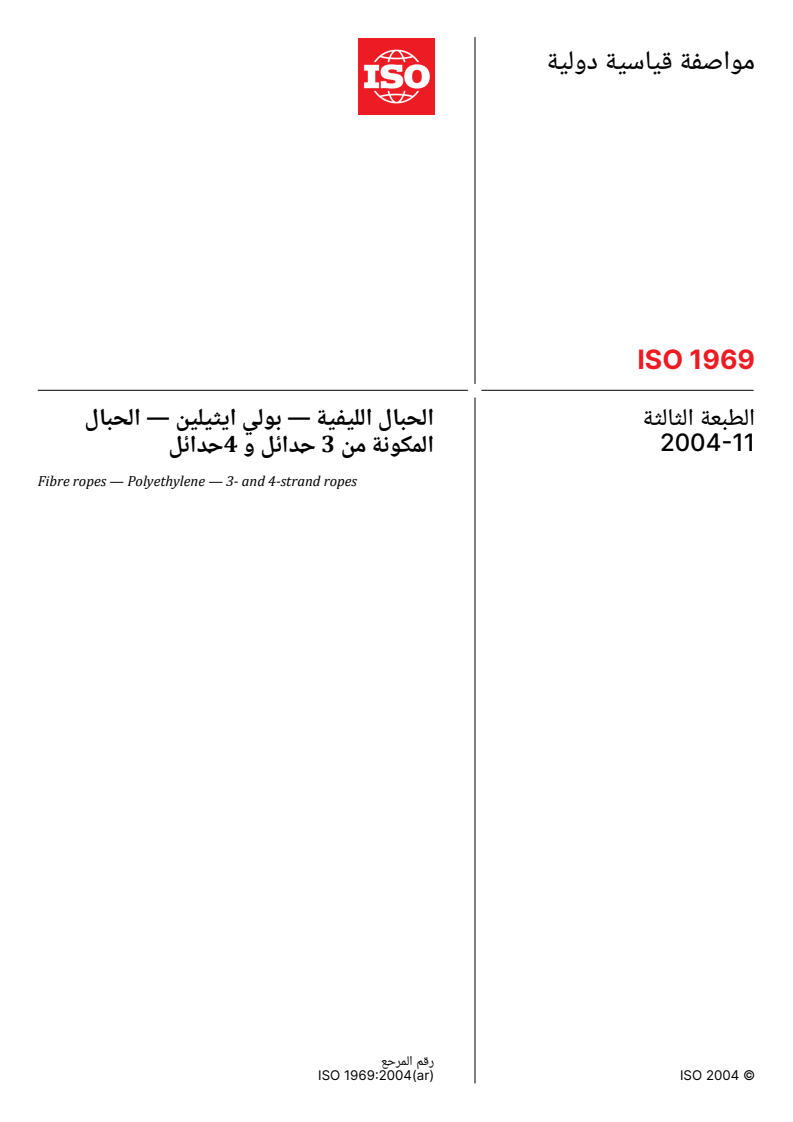
INTERNATIONAL ISO
STANDARD 1969
Third edition
2004-11-01
Fibre ropes — Polyethylene — 3- and
4-strand ropes
Cordages en fibres — Polyéthylène — Cordages à 3 et 4 torons
Reference number
©
ISO 2004
PDF disclaimer
This PDF file may contain embedded typefaces. In accordance with Adobe's licensing policy, this file may be printed or viewed but
shall not be edited unless the typefaces which are embedded are licensed to and installed on the computer performing the editing. In
downloading this file, parties accept therein the responsibility of not infringing Adobe's licensing policy. The ISO Central Secretariat
accepts no liability in this area.
Adobe is a trademark of Adobe Systems Incorporated.
Details of the software products used to create this PDF file can be found in the General Info relative to the file; the PDF-creation
parameters were optimized for printing. Every care has been taken to ensure that the file is suitable for use by ISO member bodies. In
the unlikely event that a problem relating to it is found, please inform the Central Secretariat at the address given below.
© ISO 2004
All rights reserved. Unless otherwise specified, no part of this publication may be reproduced or utilized in any form or by any means,
electronic or mechanical, including photocopying and microfilm, without permission in writing from either ISO at the address below or
ISO's member body in the country of the requester.
ISO copyright office
Case postale 56 • CH-1211 Geneva 20
Tel. + 41 22 749 01 11
Fax + 41 22 749 09 47
E-mail copyright@iso.org
Web www.iso.org
Published in Switzerland
ii © ISO 2004 – All rights reserved
Foreword
ISO (the International Organization for Standardization) is a worldwide federation of national standards bodies
(ISO member bodies). The work of preparing International Standards is normally carried out through ISO
technical committees. Each member body interested in a subject for which a technical committee has been
established has the right to be represented on that committee. International organizations, governmental and
non-governmental, in liaison with ISO, also take part in the work. ISO collaborates closely with the
International Electrotechnical Commission (IEC) on all matters of electrotechnical standardization.
International Standards are drafted in accordance with the rules given in the ISO/IEC Directives, Part 2.
The main task of technical committees is to prepare International Standards. Draft International Standards
adopted by the technical committees are circulated to the member bodies for voting. Publication as an
International Standard requires approval by at least 75 % of the member bodies casting a vote.
Attention is drawn to the possibility that some of the elements of this document may be the subject of patent
rights. ISO shall not be held responsible for identifying any or all such patent rights.
ISO 1969 was prepared by the European Committee for Standardization (CEN) Technical Committee
CEN/TC 248, Textiles and textile products, in collaboration with Technical Committee ISO/TC 38, Textiles, in
accordance with the Agreement on technical cooperation between ISO and CEN (Vienna Agreement).
This third edition cancels and replaces the second edition (ISO 1969:1990), which has been technically
revised.
INTERNATIONAL STANDARD ISO 1969:2004(E)
Fibre ropes — Polyethylene — 3- and 4-strand ropes
1 Scope
This International Standard specifies requirements for 3-strand hawser-laid and 4-strand shroud-laid ropes for
general service (excluding fittings) made of polyethylene and gives rules for their designation.
2 Normative references
The following referenced documents are indispensable for the application of this document. For dated
references, only the edition cited applies. For undated references, the latest edition of the referenced
document (including any amendments) applies.
ISO 1968, Fibre ropes and cordage — Terms and definitions
ISO 2307, Ropes — Determination of certain physical and mechanical properties
1)
ISO 9554:— , Fibre ropes — General specification
3 Terms and definitions
For the purposes of this document, the terms and definitions given in ISO 1968 apply.
4 Designation
Fibre ropes shall be designated by:
the words “fibre rope”;
the number of this International Standard;
the construction type of rope (see Clause 5);
the reference number of the rope;
the material from which the rope is made.
EXAMPLE Designation of a 4-strand shroud-laid rope (type B) with a linear mass of 8
...
NORME ISO
INTERNATIONALE 1969
Troisième édition
2004-11-01
Cordages en fibres — Polyéthylène —
Cordages à 3 et 4 torons
Fibre ropes — Polyethylene — 3- and 4-strand ropes
Numéro de référence
©
ISO 2004
PDF – Exonération de responsabilité
Le présent fichier PDF peut contenir des polices de caractères intégrées. Conformément aux conditions de licence d'Adobe, ce fichier
peut être imprimé ou visualisé, mais ne doit pas être modifié à moins que l'ordinateur employé à cet effet ne bénéficie d'une licence
autorisant l'utilisation de ces polices et que celles-ci y soient installées. Lors du téléchargement de ce fichier, les parties concernées
acceptent de fait la responsabilité de ne pas enfreindre les conditions de licence d'Adobe. Le Secrétariat central de l'ISO décline toute
responsabilité en la matière.
Adobe est une marque déposée d'Adobe Systems Incorporated.
Les détails relatifs aux produits logiciels utilisés pour la création du présent fichier PDF sont disponibles dans la rubrique General Info
du fichier; les paramètres de création PDF ont été optimisés pour l'impression. Toutes les mesures ont été prises pour garantir
l'exploitation de ce fichier par les comités membres de l'ISO. Dans le cas peu probable où surviendrait un problème d'utilisation,
veuillez en informer le Secrétariat central à l'adresse donnée ci-dessous.
© ISO 2004
Droits de reproduction réservés. Sauf prescription différente, aucune partie de cette publication ne peut être reproduite ni utilisée sous
quelque forme que ce soit et par aucun procédé, électronique ou mécanique, y compris la photocopie et les microfilms, sans l'accord écrit
de l'ISO à l'adresse ci-après ou du comité membre de l'ISO dans le pays du demandeur.
ISO copyright office
Case postale 56 • CH-1211 Geneva 20
Tel. + 41 22 749 01 11
Fax. + 41 22 749 09 47
E-mail copyright@iso.org
Web www.iso.org
Version française parue en 2005
Publié en Suisse
ii © ISO 2004 – Tous droits réservés
Avant-propos
L'ISO (Organisation internationale de normalisation) est une fédération mondiale d'organismes nationaux de
normalisation (comités membres de l'ISO). L'élaboration des Normes internationales est en général confiée
aux comités techniques de l'ISO. Chaque comité membre intéressé par une étude a le droit de faire partie du
comité technique créé à cet effet. Les organisations internationales, gouvernementales et non
gouvernementales, en liaison avec l'ISO participent également aux travaux. L'ISO collabore étroitement avec
la Commission électrotechnique internationale (CEI) en ce qui concerne la normalisation électrotechnique.
Les Normes internationales sont rédigées conformément aux règles données dans les Directives ISO/CEI,
Partie 2.
La tâche principale des comités techniques est d'élaborer les Normes internationales. Les projets de Normes
internationales adoptés par les comités techniques sont soumis aux comités membres pour vote. Leur
publication comme Normes internationales requiert l'approbation de 75 % au moins des comités membres
votants.
L'attention est appelée sur le fait que certains des éléments du présent document peuvent faire l'objet de
droits de propriété intellectuelle ou de droits analogues. L'ISO ne saurait être tenue pour responsable de ne
pas avoir identifié de tels droits de propriété et averti de leur existence.
L'ISO 1969 a été élaborée par le comité technique CEN/TC 248, Textiles et produits textiles, du Comité
européen de normalisation (CEN) en collaboration avec le comité technique ISO/TC 38, Textiles,
conformément à l'Accord de coopération technique entre l'ISO et le CEN (Accord de Vienne).
Cette troisième édition annule et remplace la deuxième édition (ISO 1969:1990), dont elle constitue une
révision technique.
NORME INTERNATIONALE ISO 1969:2004(F)
Cordages en fibres — Polyéthylène — Cordages à 3 et 4 torons
1 Domaine d'application
La présente Norme internationale spécifie les exigences relatives aux cordages en polyéthylène pour usages
divers (à l'exclusion des accessoires), cordages à trois torons et cordages câblés à quatre torons et précise
les règles de leur désignation.
2 Références normatives
Les documents de référence suivants sont indispensables pour l'application du présent document. Pour les
références datées, seule l'édition citée s'applique. Pour les références non datées, la dernière édition du
document de référence (y compris les éventuels amendements) s'applique.
ISO 1968, Cordages en fibres et articles de corderie — Vocabulaire
ISO 2307, Cordages en fibres — Détermination de certaines caractéristiques physiques et mécaniques
1)
ISO 9554:— , Cordages en fibres — Spécifications générales
3 Termes et définitions
Pour les besoins du présent document, les termes et définitions donnés dans l'ISO 1968 s'appliquent.
4 Désignation
Les cordages en fibres doivent être désignés par:
⎯ l'expression «cordage en fibres»;
⎯ la référence à la présente Norme internationale;
⎯ le type de cordage (voir Article 5);
⎯ le numéro de référence du cordage;
⎯ la matière première constitutive du cordage.
EXEMPLE Désignatio
...
ة�يلود ة�يسا�يق ةفصاوم
�����
ISO 1969
لا�بح لا — ن�يل�يي�يا يلو�ب — ة�يف�يللا لا�بحلا ةيلايلا ةع�بطلا
���������
2004-11
لبادجا4 و لبادجا 3 نم ةبوكملا
����
�
Fibre ropes — Polyethylene — 3- and 4-strand ropes
عجرملاا م�قر
ISO 1969:2004(ar) ISO 2004 ©
ISO 1969:2004(ar)
ة�يكلم قوفح�ب ة�يمحم ةف�ييو
�������
ISO 2004 ©
ال�ن ،ةــ�تك�تناك�تم و�ا ة�تنومتكاإا ةل�تسو �ي�ا�ن و�ا لاكس�الا نم لكس �ي�ا�ن ةماذحتسا و�ا روسنلاا اذه نم ءمجر �ي�ا خسن رو�ح�ي ال ،�كاذ �فالر ىلع صن�ي ما ام .ةظوقحم قوقحاا لك
���������������������������
وسإا وضع ةن�تهاا و�ا هانذ�ا ناونعاا ىلع وسإا نم �ي�ا نم نذإالا �تلظ نكل�ي .ق�نسم �ى�ناتك نذإا ىلع لوضحاا نوذ ،تنامتنإالا و�ا تنمتنإالا ىلع مسناا و�ا �ىنوضاا خسناا �كاذ �ى�ق
�������������������������������
.�تااطاا ذل�ن �ى�ق
ISO copyright office
CP 401 • Ch. de Blandonnet 8
CH-1214 Vernier, Geneva
Tel. + 41 22 749 01 11
E-mail copyright@iso.org
Website www.iso.org
امس�يوس �ى�ق تمسن
���
ISO 2004 — All rights reserved ©
�ب
ISO 1969:2004(ar)
ةحقضاا با�يويحم
��
��
د . م�يدفي
��
1 . لا�حملا 1
1 . ة�يل�يمكيلا عجاامملا 2
��
1 . ف�يراعي و باحلطصم 3
���
1 . ة�يمسيلا 4
��
1 . �ةماع با�بلطيم 5
��
2 . ة�يبا�يم�يفلا صاوحلا 6
�����
5 . �ة�يااص�يإلاا بابا�ي�بلا 7
���
ISO 2004 — All rights reserved ©
جج
ISO 1969:2004(ar)
م�يدفي
��
ة�ت اوذاا تاقصاولاا ذاذعإا مت�ي ام ا�نااعو ،(وم�ي�الا ى�ق ءاضع�الا) ة�تنظواا س�ت�تقتاا تاه�حا ىلااع ذاحيا ىه (س�ت�تقتلا ة�تاوذاا ةلطنلاا) وم�ي�الا
�����������������������
ة ا نوك�ي ن�ا ى�ق قحاا وضعاا اذها نإا�ق ، ة�تن�ق ةن�حا ةا تلكس ذ�ق عوصول�ن مالتهإا اها وضعاا ةه�حاا تناك اذإاو ، وم�ي�الا ة�تنقاا نا�حلاا لالر نم
���������������������������
نواعتي و .وم�ي�الا ةلطنم عم لصاوي اها ىتاا ة�تموكحاا م�تعو اهنم ة�تموكحاا ة�تاوذاا تالطنلااا �كاذك للعاا ى�ق �كراس�يو .ةن�حلاا �كلي ى�ق لتلم
��������������������������
.ىنقيومهكاا لا�حلاا ى�ق س�ت�تقتاا مهي ىتاا روم�الا ع�تلجر ى�ق (IEC) ة�تاوذاا ة�تنقيومهكاا ةن�حلاا عم ق�تيو لكس�ن وم�ي�الا ةلطنم
�������������������������
ىناتاا ءم�حاا – ISO/IEC تاه�تجروي ىق هذراواا تاه�تجروتلا ججامرإالا ذعاوقا اًققو ة�تاوذاا ة�تسا�تقاا ةقصاولاا هذه ةعا�تص مي
������������������������
ل�ن�ق نم اهذاذــــعإا مت�ي �ىتاا ة�تاوذاا ة�تسا�تقاا تاقصاولاا تاذوسم نإا ة�تاوذاا ة�تسا�تقاا تاقصاولاا ذاذعإا وه ة�تنقاا نا�حلا ة�تس�تنماا ةلهلاا
����������������������
هذ ه ذاــلتعا مت�ي ،وم�ي�الا ســل�حم ل�ن�ق نم ة�تاوذ ة�تسا�ت�ق ةقــصاولك اــهذالتعا ل�ن�ق ةق�قاوللا ءاضع�الا لوذاا ىلع اهع�يروي مت�ي ة�تنقاا نا�حلاا
��������������������
ن�تيوضلاا ءاضع�الا نم ل�ق�الا ىلع %75 ةق�قاوم �تلطتي �ىتاا وم�ي�الا تاءامجرإال ًاق�قو تاقصاولاا
��������������
ســ�ت�تقت لا ة�تاوذاا ةــلطنلاا للحتي ناو.ة�يمكقاا ة�تكللاا قوقحا ةعصار ةق�تيواا هذه مصانع صع�ن نوكي ن�ا ة�تاالترا ىاإا ها�نتنالا تقا ذونو
���������������������������������
. اهع�تلجر و�ا قوقحاا هذه نم ي�ا ذ�يذحي ة�تاووسم (وم�ي�الا)
��������ّ�
, جخ�تسناا تا�حتنمو جخ�تسناا ,CEN/TC 248 ةن�حلاا (CEN) س�ت�تقتلا ة�ت�نورو�الا ةن�حلاا ل�نق نم اهذاذعإا مي ISO 1969 ة�تاوذاا ةقصاولاا هذه
�������������������
(ان�ت�تق ة�تقاقيا) س�ت�تقتلا ة�ت�نورو�الا ةن�حلااو وم�ي�الا ن�ت�ن ىنقاا نواعتاا ة�تقاقيال ًاققو ,جخ�تسناا ,ISO/TC 38 ة�تاوذاا ةن�حلاا عم نواعتاا�ن
������������������������������
ًا�تن�ق ةتعجرامم مي �يذاا ,( ISO 1969:1990 )�ىناتاا راذصإالا لحم لح�يو �ىعل�ي تااتاا راذصإالا اذه
����������
ISO 2004 — All rights reserved ©
د
ISO 1969:2004(ar) ة�يلود ة�يسا�يق ةفصاوم
�����
لبادجا4 و لبادجا 3 نم ةبوكملا لا�بحلا — ن�يل�يي�يا يلو�ب — ة�يف�يللا لا�بحلا
�������
���
لا�حملا 1
ءانتتسا�ن ) ةماعاا ةمذحلا لناذ�حاا ة�تعا�نر لا�نحااو لناذجر ةيالي نم نوكم ةلحضاا لا�نحاا تا�نلطتل�ن ة�تاوذاا ة�تسا�تقاا ةقصاولاا هذه صتحي
����������������������������
.اهت�تلست�ن ةصار قناقر نلضتيو ن�تل�تيإا ىاو�ناا نم ةعونضلاا (تا�ن�تكمتاا
�������������������
ة�يل�يمكيلا عجاامملا 2
��
م�تع عجرامللا ة�نــسناا�ن .طقق ذوــجرولاا راذصإالا ق�نط�ي ,ةررولاا عجرامللا ة�نسناا�ن . ةق�تيواا هذه ق�ت�نطتا اهنع ىنع ال ة�تااتاا ة�تعجرملاا قنايواا
��������������������������
.(تال�يذعي ي�ا الماس) ة�تعجرملاا ةق�تيولا راذصإا مر�ا ق�نط�ي ,ةررولاا
�������������
.”ف�يراعي و تاحلطضم – رايو�الا و ة�تق�تلاا لا�نحاا “ ISO 1968
������
.”هذذحم ة�تك�تناك�تم و ة�تنا�يم�ت�ق صناضر ن�ت�تعي –لا�نحاا “ ISO 2307
����������
.”ةماع تاقصاوم – ة�تق�تلاا لا�نحاا “ ,ISO 9554
�����
ف�يراعي و باحلطصم 3
���
. ISO 1968 ىق هذراواا ف�يراعتاا و تاحلطضلاا ق�نطي ةق�تيواا هذه ضامع�ال
��������������
ة�يمسيلا 4
��
:ىل�ي ال�ن ة�تق�تلاا لا�نحاا ىلسي ن�ا �ت�ح�ي
�����
...