

ISO 1140:2021
(Main)Fibre ropes — Polyamide — 3-, 4-, 8- and 12-strand ropes
General Information
- Abstract
This document specifies requirements for 3-strand hawser-laid and 4-strand shroud-laid ropes, 8-strand braided ropes and 12-strand braided ropes for general service made of polyamide, and gives rules for their designation. This document does not cover all variations in strength or product performance. The rope manufacturer is consulted to ensure the intended design meets the requirements of the application
- Status
- Published
- Publication Date
- 18-Apr-2021
- Technical Committee
- ISO/TC 38 - Textiles
- Drafting Committee
- ISO/TC 38/WG 21 - Ropes, cordage, slings and netting
- Current Stage
- 9093 - International Standard confirmed
- Start Date
- 18-Sep-2026
- Completion Date
- 26-Sep-2026
Buy Documents


ISO 1140:2021 - Fibre ropes -- Polyamide -- 3-, 4-, 8- and 12-strand ropes
ISO 1140:2021 - Fibre ropes — Polyamide — 3-, 4-, 8- and 12-strand ropes/19/2021


ISO 1140:2021 - Cordages en fibres -- Polyamide -- Cordages à 3, 4, 8 et 12 torons
ISO 1140:2021 - Cordages en fibres — Polyamide — Cordages à 3, 4, 8 et 12 torons/19/2021
Overview
ISO 1140:2021 specifies requirements for polyamide fibre ropes in four constructions: 3‑strand hawser‑laid, 4‑strand shroud‑laid, 8‑strand braided, and 12‑strand braided ropes. It defines designation rules, construction types (A, B, L, T), physical property limits (linear density and minimum breaking strength), marking and basic delivery/packaging requirements for ropes intended for general service. The standard clarifies that it does not cover every possible strength or product‑performance variation and that the rope manufacturer should be consulted to ensure the rope design meets the intended application.
Key topics and technical requirements
- Constructions covered:
- Type A - 3‑strand hawser‑laid
- Type B - 4‑strand shroud‑laid
- Type L - 8‑strand braided
- Type T - 12‑strand braided
- Designation: ropes must be designated by “fibre rope”, document number (ISO 1140), construction/type, reference number, material (PA), and stabilization type (1 = heat set, 2 = not heat set). Example:
Fibre rope ISO 1140 – A – 20 – PA – 1 - Material rule: mixing of polyamide fibre types/grades in one rope is not permitted.
- Physical properties: linear density (ktex) and Minimum Breaking Strength (MBS) are specified in tables for each construction and reference number. Linear density is measured under reference tension per ISO 2307. MBS applies to new, dry ropes; wet breaking strength is typically 10–20% lower.
- Testing and definitions: MBS is set by each manufacturer using recognized statistical methods (see ISO 9554 Annex D). Breaking tests per ISO 2307; results depend on termination, knots, bends, conditioning and test method.
- Marking: Type 1 ropes with reference number < 14 require a green thread; other marking per ISO 9554.
- Delivery/production: Manufacture, lay, labelling, packaging and delivery lengths follow ISO 9554.
Applications and users
ISO 1140:2021 is applicable to general‑service polyamide ropes used in:
- marine and mooring lines (non‑specialized)
- general lifting, towing and handling where polyamide rope properties are suitable
- industrial and agricultural use where braided or laid polyamide cordage is specified
Primary users:
- rope manufacturers and designers
- procurement and quality managers specifying rope performance (MBS, linear density)
- rigging, maritime and offshore engineers evaluating rope selection and safety margins
- test laboratories performing ISO 2307 break tests
Note: Because the standard does not cover every performance variation, end‑users should consult manufacturers when specific strength, termination or environmental requirements are critical.
Related standards
- ISO 9554 - Fibre ropes - General specifications (construction, marking, stabilization)
- ISO 2307 - Fibre ropes - Determination of certain physical and mechanical properties (linear density, breaking tests)
- ISO 1968 - Fibre ropes and cordage - Vocabulary
Keywords: ISO 1140:2021, fibre ropes, polyamide ropes, 3‑strand, 4‑strand, 8‑strand, 12‑strand, minimum breaking strength, linear density, rope designation, rope marking.
Relations
- Consolidates
EN ISO 1140:2021 - Fibre ropes - Polyamide - 3-, 4-, 8- and 12-strand ropes (ISO 1140:2021) - Effective Date
- 12-Feb-2026
- Consolidates
ISO 20710-1:2022 - Fire safety engineering — Active fire protection systems — Part 1: General principles - Effective Date
- 06-Jun-2022
- Consolidated By
ISO 12183:2024 - Nuclear fuel technology — Controlled-potential coulometric measurement of plutonium - Effective Date
- 20-Aug-2022
- Effective Date
- 23-Apr-2020
Buy Documents
ISO 1140:2021 - Fibre ropes -- Polyamide -- 3-, 4-, 8- and 12-strand ropes
ISO 1140:2021 - Fibre ropes — Polyamide — 3-, 4-, 8- and 12-strand ropes/19/2021
ISO 1140:2021 - Cordages en fibres -- Polyamide -- Cordages à 3, 4, 8 et 12 torons
ISO 1140:2021 - Cordages en fibres — Polyamide — Cordages à 3, 4, 8 et 12 torons/19/2021
Get Certified
Connect with accredited certification bodies for this standard

Control Union Certifications
Global certification for agriculture and sustainability.

Hohenstein Institut
Textile testing and certification.

Bureau Veritas Bangladesh
Bureau Veritas certification services in Bangladesh.
Sponsored listings
Frequently Asked Questions
ISO 1140:2021 is a standard published by the International Organization for Standardization (ISO). Its full title is "Fibre ropes — Polyamide — 3-, 4-, 8- and 12-strand ropes". This standard covers: This document specifies requirements for 3-strand hawser-laid and 4-strand shroud-laid ropes, 8-strand braided ropes and 12-strand braided ropes for general service made of polyamide, and gives rules for their designation. This document does not cover all variations in strength or product performance. The rope manufacturer is consulted to ensure the intended design meets the requirements of the application
This document specifies requirements for 3-strand hawser-laid and 4-strand shroud-laid ropes, 8-strand braided ropes and 12-strand braided ropes for general service made of polyamide, and gives rules for their designation. This document does not cover all variations in strength or product performance. The rope manufacturer is consulted to ensure the intended design meets the requirements of the application
ISO 1140:2021 is classified under the following ICS (International Classification for Standards) categories: 59.080.50 - Ropes. The ICS classification helps identify the subject area and facilitates finding related standards.
ISO 1140:2021 has the following relationships with other standards: It is inter standard links to EN ISO 1140:2021, ISO 20710-1:2022, ISO 12183:2024, ISO 1140:2012. Understanding these relationships helps ensure you are using the most current and applicable version of the standard.
ISO 1140:2021 is available in PDF format for immediate download after purchase. The document can be added to your cart and obtained through the secure checkout process. Digital delivery ensures instant access to the complete standard document.
Standards Content (Sample)
INTERNATIONAL ISO
STANDARD 1140
Fifth edition
2021-04
Fibre ropes — Polyamide — 3-, 4-, 8-
and 12-strand ropes
Cordages en fibres — Polyamide — Cordages à 3, 4, 8 et 12 torons
Reference number
©
ISO 2021
© ISO 2021
All rights reserved. Unless otherwise specified, or required in the context of its implementation, no part of this publication may
be reproduced or utilized otherwise in any form or by any means, electronic or mechanical, including photocopying, or posting
on the internet or an intranet, without prior written permission. Permission can be requested from either ISO at the address
below or ISO’s member body in the country of the requester.
ISO copyright office
CP 401 • Ch. de Blandonnet 8
CH-1214 Vernier, Geneva
Phone: +41 22 749 01 11
Email: copyright@iso.org
Website: www.iso.org
Published in Switzerland
ii © ISO 2021 – All rights reserved
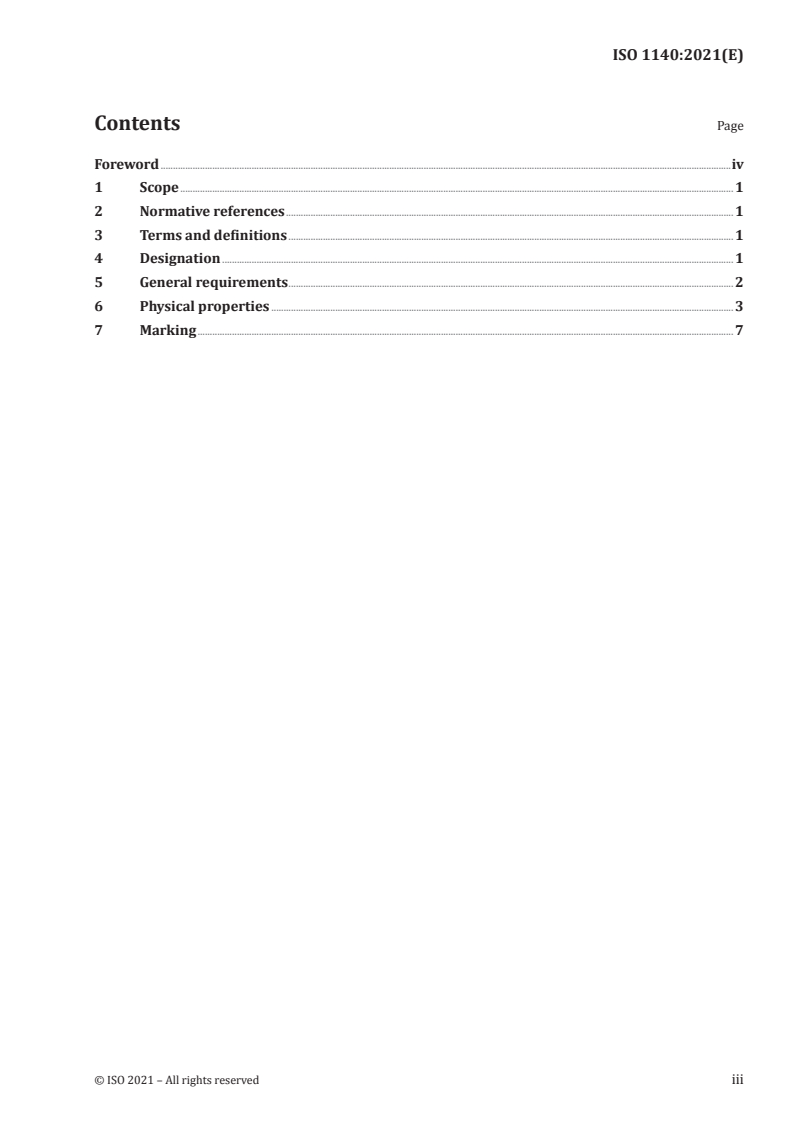
Contents Page
Foreword .iv
1 Scope . 1
2 Normative references . 1
3 Terms and definitions . 1
4 Designation . 1
5 General requirements . 2
6 Physical properties . 3
7 Marking . 7
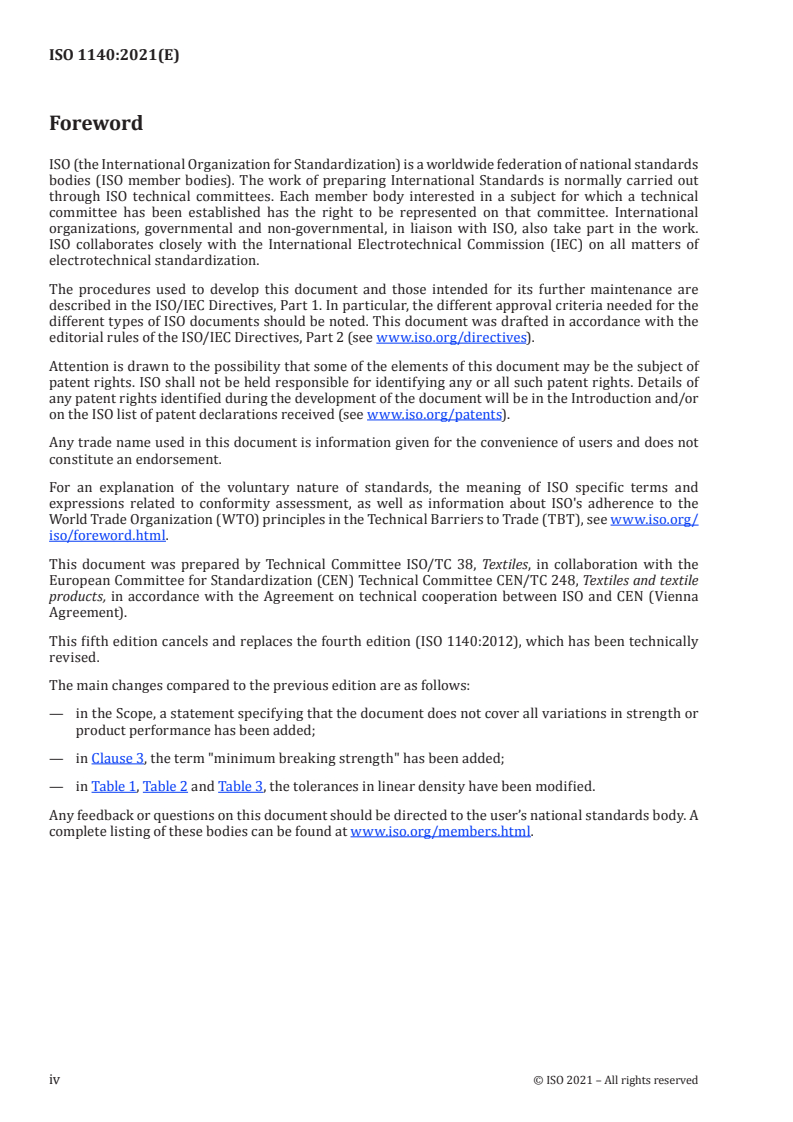
Foreword
ISO (the International Organization for Standardization) is a worldwide federation of national standards
bodies (ISO member bodies). The work of preparing International Standards is normally carried out
through ISO technical committees. Each member body interested in a subject for which a technical
committee has been established has the right to be represented on that committee. International
organizations, governmental and non-governmental, in liaison with ISO, also take part in the work.
ISO collaborates closely with the International Electrotechnical Commission (IEC) on all matters of
electrotechnical standardization.
The procedures used to develop this document and those intended for its further maintenance are
described in the ISO/IEC Directives, Part 1. In particular, the different approval criteria needed for the
different types of ISO documents should be noted. This document was drafted in accordance with the
editorial rules of the ISO/IEC Directives, Part 2 (see www .iso .org/ directives).
Attention is drawn to the possibility that some of the elements of this document may be the subject of
patent rights. ISO shall not be held responsible for identifying any or all such patent rights. Details of
any patent rights identified during the development of the document will be in the Introduction and/or
on the ISO list of patent declarations received (see www .iso .org/ patents).
Any trade name used in this document is information given for the convenience of users and does not
constitute an endorsement.
For an explanation of the voluntary nature of standards, the meaning of ISO specific terms and
expressions related to conformity assessment, as well as information about ISO's adherence to the
World Trade Organization (WTO) principles in the Technical Barriers to Trade (TBT), see www .iso .org/
iso/ foreword .html.
This document was prepared by Technical Committee ISO/TC 38, Textiles, in collaboration with the
European Committee for Standardization (CEN) Technical Committee CEN/TC 248, Textiles and textile
products, in accordance with the Agreement on technical cooperation between ISO and CEN (Vienna
Agreement).
This fifth edition cancels and replaces the fourth edition (ISO 1140:2012), which has been technically
revised.
The main changes compared to the previous edition are as follows:
— in the Scope, a statement specifying that the document does not cover all variations in strength or
product performance has been added;
— in Clause 3, the term "minimum breaking strength" has been added;
— in Table 1, Table 2 and Table 3, the tolerances in linear density have been modified.
Any feedback or questions on this document should be directed to the user’s national standards body. A
complete listing of these bodies can be found at www .iso .org/ members .html.
iv © ISO 2021 – All rights reserved
INTERNATIONAL STANDARD ISO 1140:2021(E)
Fibre ropes — Polyamide — 3-, 4-, 8- and 12-strand ropes
1 Scope
This document specifies requirements for 3-strand hawser-laid and 4-strand shroud-laid ropes,
8-strand braided ropes and 12-strand braided ropes for general service made of polyamide, and gives
rules for their designation.
This document does not cover all variations in strength or product performance. The rope manufacturer
is consulted to ensure the intended design meets the requirements of the application
2 Normative references
The following referenced documents are indispensable for the application of this document. For dated
references, only the edition cited applies. For undated references, the latest edition of the referenced
document (including any amendments) applies.
ISO 1968, Fibre ropes and cordage — Vocabulary
ISO 2307, Fibre ropes — Determination of certain physical and mechanical properties
ISO 9554, Fibre ropes — General specifications
3 Terms and definitions
For the purposes of this document, the terms and definitions given in ISO 1968 and the following apply.
ISO and IEC maintain terminological databases for use in standardization at the following addresses:
— ISO Online browsing platform: available at https:// www .iso .org/ obp
— IEC Electropedia: available at http:// www .electropedia .org/
3.1
minimum breaking strength
MBS
force a fibre rope shall at least achieve when tested following a recognized procedure/test method
Note 1 to entry: The MBS is set by each manufacturer, as per their own internal statistical methods based on
...
INTERNATIONAL ISO
STANDARD 1140
Fifth edition
2021-04
Fibre ropes — Polyamide — 3-, 4-, 8-
and 12-strand ropes
Cordages en fibres — Polyamide — Cordages à 3, 4, 8 et 12 torons
Reference number
©
ISO 2021
© ISO 2021
All rights reserved. Unless otherwise specified, or required in the context of its implementation, no part of this publication may
be reproduced or utilized otherwise in any form or by any means, electronic or mechanical, including photocopying, or posting
on the internet or an intranet, without prior written permission. Permission can be requested from either ISO at the address
below or ISO’s member body in the country of the requester.
ISO copyright office
CP 401 • Ch. de Blandonnet 8
CH-1214 Vernier, Geneva
Phone: +41 22 749 01 11
Email: copyright@iso.org
Website: www.iso.org
Published in Switzerland
ii © ISO 2021 – All rights reserved
Contents Page
Foreword .iv
1 Scope . 1
2 Normative references . 1
3 Terms and definitions . 1
4 Designation . 1
5 General requirements . 2
6 Physical properties . 3
7 Marking . 7
Foreword
ISO (the International Organization for Standardization) is a worldwide federation of national standards
bodies (ISO member bodies). The work of preparing International Standards is normally carried out
through ISO technical committees. Each member body interested in a subject for which a technical
committee has been established has the right to be represented on that committee. International
organizations, governmental and non-governmental, in liaison with ISO, also take part in the work.
ISO collaborates closely with the International Electrotechnical Commission (IEC) on all matters of
electrotechnical standardization.
The procedures used to develop this document and those intended for its further maintenance are
described in the ISO/IEC Directives, Part 1. In particular, the different approval criteria needed for the
different types of ISO documents should be noted. This document was drafted in accordance with the
editorial rules of the ISO/IEC Directives, Part 2 (see www .iso .org/ directives).
Attention is drawn to the possibility that some of the elements of this document may be the subject of
patent rights. ISO shall not be held responsible for identifying any or all such patent rights. Details of
any patent rights identified during the development of the document will be in the Introduction and/or
on the ISO list of patent declarations received (see www .iso .org/ patents).
Any trade name used in this document is information given for the convenience of users and does not
constitute an endorsement.
For an explanation of the voluntary nature of standards, the meaning of ISO specific terms and
expressions related to conformity assessment, as well as information about ISO's adherence to the
World Trade Organization (WTO) principles in the Technical Barriers to Trade (TBT), see www .iso .org/
iso/ foreword .html.
This document was prepared by Technical Committee ISO/TC 38, Textiles, in collaboration with the
European Committee for Standardization (CEN) Technical Committee CEN/TC 248, Textiles and textile
products, in accordance with the Agreement on technical cooperation between ISO and CEN (Vienna
Agreement).
This fifth edition cancels and replaces the fourth edition (ISO 1140:2012), which has been technically
revised.
The main changes compared to the previous edition are as follows:
— in the Scope, a statement specifying that the document does not cover all variations in strength or
product performance has been added;
— in Clause 3, the term "minimum breaking strength" has been added;
— in Table 1, Table 2 and Table 3, the tolerances in linear density have been modified.
Any feedback or questions on this document should be directed to the user’s national standards body. A
complete listing of these bodies can be found at www .iso .org/ members .html.
iv © ISO 2021 – All rights reserved
INTERNATIONAL STANDARD ISO 1140:2021(E)
Fibre ropes — Polyamide — 3-, 4-, 8- and 12-strand ropes
1 Scope
This document specifies requirements for 3-strand hawser-laid and 4-strand shroud-laid ropes,
8-strand braided ropes and 12-strand braided ropes for general service made of polyamide, and gives
rules for their designation.
This document does not cover all variations in strength or product performance. The rope manufacturer
is consulted to ensure the intended design meets the requirements of the application
2 Normative references
The following referenced documents are indispensable for the application of this document. For dated
references, only the edition cited applies. For undated references, the latest edition of the referenced
document (including any amendments) applies.
ISO 1968, Fibre ropes and cordage — Vocabulary
ISO 2307, Fibre ropes — Determination of certain physical and mechanical properties
ISO 9554, Fibre ropes — General specifications
3 Terms and definitions
For the purposes of this document, the terms and definitions given in ISO 1968 and the following apply.
ISO and IEC maintain terminological databases for use in standardization at the following addresses:
— ISO Online browsing platform: available at https:// www .iso .org/ obp
— IEC Electropedia: available at http:// www .electropedia .org/
3.1
minimum breaking strength
MBS
force a fibre rope shall at least achieve when tested following a recognized procedure/test method
Note 1 to entry: The MBS is set by each manufacturer, as per their own internal statistical methods based on
...
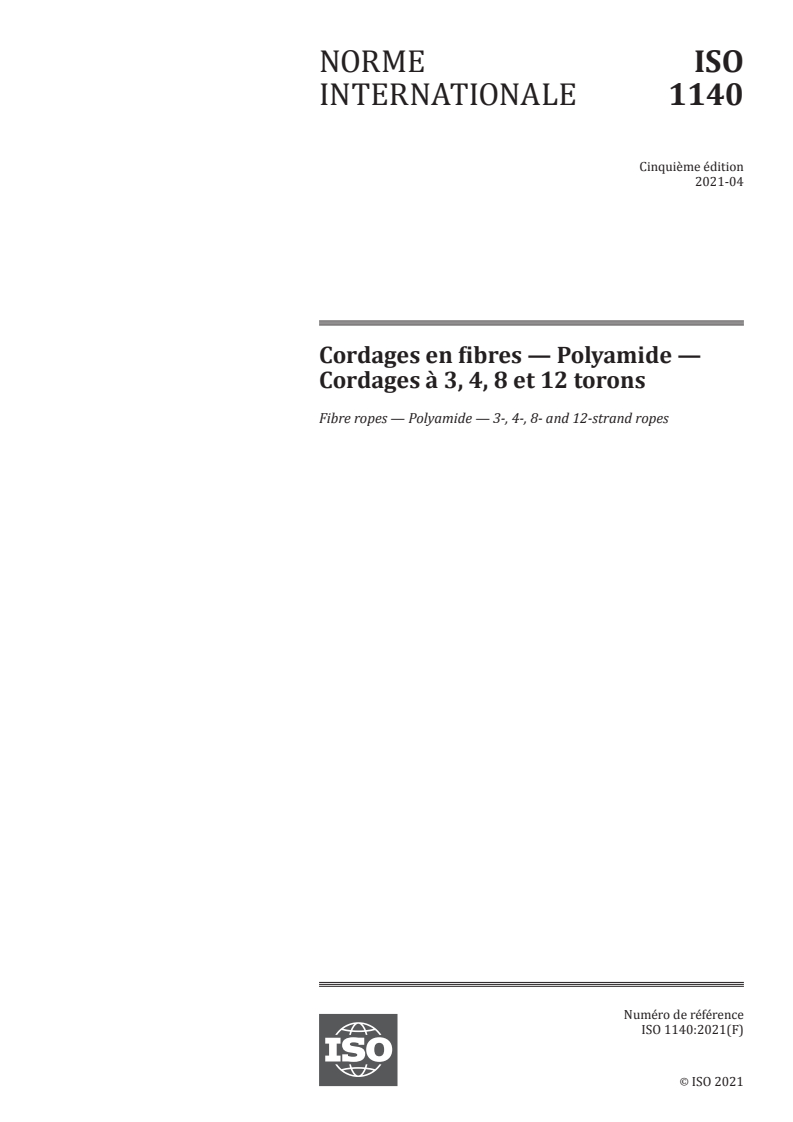
NORME ISO
INTERNATIONALE 1140
Cinquième édition
2021-04
Cordages en fibres — Polyamide —
Cordages à 3, 4, 8 et 12 torons
Fibre ropes — Polyamide — 3-, 4-, 8- and 12-strand ropes
Numéro de référence
©
ISO 2021
DOCUMENT PROTÉGÉ PAR COPYRIGHT
© ISO 2021
Tous droits réservés. Sauf prescription différente ou nécessité dans le contexte de sa mise en œuvre, aucune partie de cette
publication ne peut être reproduite ni utilisée sous quelque forme que ce soit et par aucun procédé, électronique ou mécanique,
y compris la photocopie, ou la diffusion sur l’internet ou sur un intranet, sans autorisation écrite préalable. Une autorisation peut
être demandée à l’ISO à l’adresse ci-après ou au comité membre de l’ISO dans le pays du demandeur.
ISO copyright office
Case postale 401 • Ch. de Blandonnet 8
CH-1214 Vernier, Genève
Tél.: +41 22 749 01 11
E-mail: copyright@iso.org
Web: www.iso.org
Publié en Suisse
ii © ISO 2021 – Tous droits réservés
Sommaire Page
Avant-propos .iv
1 Domaine d’application . 1
2 Références normatives . 1
3 Termes et définitions . 1
4 Désignation . 2
5 Exigences générales . 2
6 Propriétés physiques . 4
7 Marquage . 7
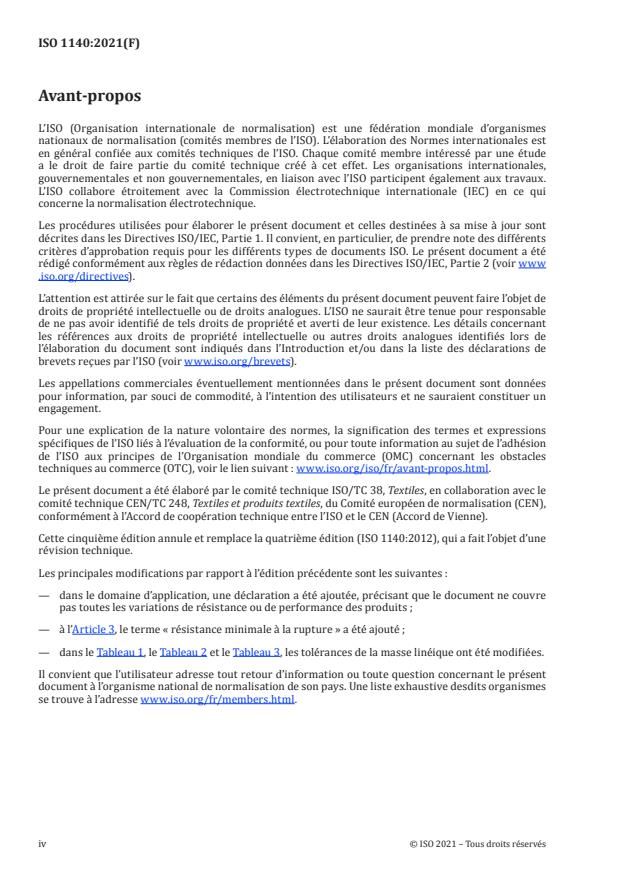
Avant-propos
L’ISO (Organisation internationale de normalisation) est une fédération mondiale d’organismes
nationaux de normalisation (comités membres de l’ISO). L’élaboration des Normes internationales est
en général confiée aux comités techniques de l’ISO. Chaque comité membre intéressé par une étude
a le droit de faire partie du comité technique créé à cet effet. Les organisations internationales,
gouvernementales et non gouvernementales, en liaison avec l’ISO participent également aux travaux.
L’ISO collabore étroitement avec la Commission électrotechnique internationale (IEC) en ce qui
concerne la normalisation électrotechnique.
Les procédures utilisées pour élaborer le présent document et celles destinées à sa mise à jour sont
décrites dans les Directives ISO/IEC, Partie 1. Il convient, en particulier, de prendre note des différents
critères d’approbation requis pour les différents types de documents ISO. Le présent document a été
rédigé conformément aux règles de rédaction données dans les Directives ISO/IEC, Partie 2 (voir www
.iso .org/ directives).
L’attention est attirée sur le fait que certains des éléments du présent document peuvent faire l’objet de
droits de propriété intellectuelle ou de droits analogues. L’ISO ne saurait être tenue pour responsable
de ne pas avoir identifié de tels droits de propriété et averti de leur existence. Les détails concernant
les références aux droits de propriété intellectuelle ou autres droits analogues identifiés lors de
l’élaboration du document sont indiqués dans l’Introduction et/ou dans la liste des déclarations de
brevets reçues par l’ISO (voir www .iso .org/ brevets).
Les appellations commerciales éventuellement mentionnées dans le présent document sont données
pour information, par souci de commodité, à l’intention des utilisateurs et ne sauraient constituer un
engagement.
Pour une explication de la nature volontaire des normes, la signification des termes et expressions
spécifiques de l’ISO liés à l’évaluation de la conformité, ou pour toute information au sujet de l’adhésion
de l’ISO aux principes de l’Organisation mondiale du commerce (OMC) concernant les obstacles
techniques au commerce (OTC), voir le lien suivant : www .iso .org/ iso/ fr/ avant -propos .html.
Le présent document a été élaboré par le comité technique ISO/TC 38, Textiles, en collaboration avec le
comité technique CEN/TC 248, Textiles et produits textiles, du Comité européen de normalisation (CEN),
conformément à l’Accord de coopération technique entre l’ISO et le CEN (Accord de Vienne).
Cette cinquième édition annule et remplace la quatrième édition (ISO 1140:2012), qui a fait l’objet d’une
révision technique.
Les principales modifications par rapport à l’édition précédente sont les suivantes :
— dans le domaine d’application, une déclaration a été ajoutée, précisant que le document ne couvre
pas toutes les variations de résistance ou de performance des produits ;
— à l’Article 3, le terme « résistance minimale à la rupture » a été ajouté ;
— dans le Tableau 1, le Tableau 2 et le Tableau 3, les tolérances de la masse linéique ont été modifiées.
Il convient que l’utilisateur adresse tout retour d’information ou toute question concernant le présent
document à l’organisme national de normalisation de son pays. Une liste exhaustive desdits organismes
se trouve à l’adresse www .iso .org/ fr/ members .html.
iv © ISO 2021 – Tous droits réservés
NORME INTERNATIONALE ISO 1140:2021(F)
Cordages en fibres — Polyamide — Cordages à 3, 4, 8 et
12 torons
1 Domaine d’application
Le présent document spécifie les exigences relatives aux cordages câblés à 3 torons et à 4 torons, ainsi
qu’aux cordages tressés à 8 torons et à 12 torons, en polyamide, pour usages divers, et précise les règles
de leur désignation.
Le présent document ne couvre pas toutes les variations de résistance ou de performance des produits.
Consulter le fabricant du cordage pour s’assurer que la conception prévue satisfait aux exigences de
l’application.
2 Références normatives
Les documents suivants sont cités dans le texte de sorte qu’ils constituent, pour tout ou partie de leur
contenu, des exigences du présent document. Pour les références datées, seule l’édition citée s’applique.
Pour les références non datées, la dernière édition du document de référence s'applique (y compris les
éventuels amendements).
ISO 1968, Cordages en fibres et articles de corderie — Vocabulaire
ISO 2307, Cordages en fibres — Détermination de certaines caractéristiques physiques et mécaniques
ISO 9554, Cordages en fibres — Spécifications générales
3 Termes et définitions
Pour les besoins du présent document, les termes et les définitions de l’ISO 1968 ainsi que les suivants
s’appliquent.
L’ISO et l’IEC tiennent à jour des bases de données terminologiques destinées à être utilisées en
normalisation, consultables aux adresses suivantes:
— ISO Online browsing platform: disponible à l’adresse https:// www .iso .org/ obp
— IEC Electropedia: disponible à l’adresse http:// www .electropedia .org/
3.1
résistance minimale à la rupture
MBS
force qu’un cordage en fibres doit au moins atteindre lorsqu’il est soumis à essai conformément à un
mode opératoire
...
NORME ISO
INTERNATIONALE 1140
Cinquième édition
2021-04
Cordages en fibres — Polyamide —
Cordages à 3, 4, 8 et 12 torons
Fibre ropes — Polyamide — 3-, 4-, 8- and 12-strand ropes
Numéro de référence
©
ISO 2021
DOCUMENT PROTÉGÉ PAR COPYRIGHT
© ISO 2021
Tous droits réservés. Sauf prescription différente ou nécessité dans le contexte de sa mise en œuvre, aucune partie de cette
publication ne peut être reproduite ni utilisée sous quelque forme que ce soit et par aucun procédé, électronique ou mécanique,
y compris la photocopie, ou la diffusion sur l’internet ou sur un intranet, sans autorisation écrite préalable. Une autorisation peut
être demandée à l’ISO à l’adresse ci-après ou au comité membre de l’ISO dans le pays du demandeur.
ISO copyright office
Case postale 401 • Ch. de Blandonnet 8
CH-1214 Vernier, Genève
Tél.: +41 22 749 01 11
E-mail: copyright@iso.org
Web: www.iso.org
Publié en Suisse
ii © ISO 2021 – Tous droits réservés
Sommaire Page
Avant-propos .iv
1 Domaine d’application . 1
2 Références normatives . 1
3 Termes et définitions . 1
4 Désignation . 2
5 Exigences générales . 2
6 Propriétés physiques . 4
7 Marquage . 7
Avant-propos
L’ISO (Organisation internationale de normalisation) est une fédération mondiale d’organismes
nationaux de normalisation (comités membres de l’ISO). L’élaboration des Normes internationales est
en général confiée aux comités techniques de l’ISO. Chaque comité membre intéressé par une étude
a le droit de faire partie du comité technique créé à cet effet. Les organisations internationales,
gouvernementales et non gouvernementales, en liaison avec l’ISO participent également aux travaux.
L’ISO collabore étroitement avec la Commission électrotechnique internationale (IEC) en ce qui
concerne la normalisation électrotechnique.
Les procédures utilisées pour élaborer le présent document et celles destinées à sa mise à jour sont
décrites dans les Directives ISO/IEC, Partie 1. Il convient, en particulier, de prendre note des différents
critères d’approbation requis pour les différents types de documents ISO. Le présent document a été
rédigé conformément aux règles de rédaction données dans les Directives ISO/IEC, Partie 2 (voir www
.iso .org/ directives).
L’attention est attirée sur le fait que certains des éléments du présent document peuvent faire l’objet de
droits de propriété intellectuelle ou de droits analogues. L’ISO ne saurait être tenue pour responsable
de ne pas avoir identifié de tels droits de propriété et averti de leur existence. Les détails concernant
les références aux droits de propriété intellectuelle ou autres droits analogues identifiés lors de
l’élaboration du document sont indiqués dans l’Introduction et/ou dans la liste des déclarations de
brevets reçues par l’ISO (voir www .iso .org/ brevets).
Les appellations commerciales éventuellement mentionnées dans le présent document sont données
pour information, par souci de commodité, à l’intention des utilisateurs et ne sauraient constituer un
engagement.
Pour une explication de la nature volontaire des normes, la signification des termes et expressions
spécifiques de l’ISO liés à l’évaluation de la conformité, ou pour toute information au sujet de l’adhésion
de l’ISO aux principes de l’Organisation mondiale du commerce (OMC) concernant les obstacles
techniques au commerce (OTC), voir le lien suivant : www .iso .org/ iso/ fr/ avant -propos .html.
Le présent document a été élaboré par le comité technique ISO/TC 38, Textiles, en collaboration avec le
comité technique CEN/TC 248, Textiles et produits textiles, du Comité européen de normalisation (CEN),
conformément à l’Accord de coopération technique entre l’ISO et le CEN (Accord de Vienne).
Cette cinquième édition annule et remplace la quatrième édition (ISO 1140:2012), qui a fait l’objet d’une
révision technique.
Les principales modifications par rapport à l’édition précédente sont les suivantes :
— dans le domaine d’application, une déclaration a été ajoutée, précisant que le document ne couvre
pas toutes les variations de résistance ou de performance des produits ;
— à l’Article 3, le terme « résistance minimale à la rupture » a été ajouté ;
— dans le Tableau 1, le Tableau 2 et le Tableau 3, les tolérances de la masse linéique ont été modifiées.
Il convient que l’utilisateur adresse tout retour d’information ou toute question concernant le présent
document à l’organisme national de normalisation de son pays. Une liste exhaustive desdits organismes
se trouve à l’adresse www .iso .org/ fr/ members .html.
iv © ISO 2021 – Tous droits réservés
NORME INTERNATIONALE ISO 1140:2021(F)
Cordages en fibres — Polyamide — Cordages à 3, 4, 8 et
12 torons
1 Domaine d’application
Le présent document spécifie les exigences relatives aux cordages câblés à 3 torons et à 4 torons, ainsi
qu’aux cordages tressés à 8 torons et à 12 torons, en polyamide, pour usages divers, et précise les règles
de leur désignation.
Le présent document ne couvre pas toutes les variations de résistance ou de performance des produits.
Consulter le fabricant du cordage pour s’assurer que la conception prévue satisfait aux exigences de
l’application.
2 Références normatives
Les documents suivants sont cités dans le texte de sorte qu’ils constituent, pour tout ou partie de leur
contenu, des exigences du présent document. Pour les références datées, seule l’édition citée s’applique.
Pour les références non datées, la dernière édition du document de référence s'applique (y compris les
éventuels amendements).
ISO 1968, Cordages en fibres et articles de corderie — Vocabulaire
ISO 2307, Cordages en fibres — Détermination de certaines caractéristiques physiques et mécaniques
ISO 9554, Cordages en fibres — Spécifications générales
3 Termes et définitions
Pour les besoins du présent document, les termes et les définitions de l’ISO 1968 ainsi que les suivants
s’appliquent.
L’ISO et l’IEC tiennent à jour des bases de données terminologiques destinées à être utilisées en
normalisation, consultables aux adresses suivantes:
— ISO Online browsing platform: disponible à l’adresse https:// www .iso .org/ obp
— IEC Electropedia: disponible à l’adresse http:// www .electropedia .org/
3.1
résistance minimale à la rupture
MBS
force qu’un cordage en fibres doit au moins atteindre lorsqu’il est soumis à essai conformément à un
mode opératoire
...