

ISO 19232-4:2013
(Main)Non-destructive testing — Image quality of radiographs — Part 4: Experimental evaluation of image quality values and image quality tables
General Information
- Abstract
ISO 19232-4:2013 gives instructions for the determination of image quality values and image quality tables. If the IQI requirements specified in ISO 19232‑3 cannot be used because, for example, the absorption coefficients of the IQI material and the inspected material differ by more than 30 %, test exposures are necessary to determine acceptance of image quality values. The image quality values achieved by the test exposures are required for all exposures made under the same radiographic conditions.
- Status
- Published
- Publication Date
- 12-Jun-2013
- Technical Committee
- ISO/TC 135/SC 5 - Radiographic testing
- Drafting Committee
- ISO/TC 135/SC 5 - Radiographic testing
- Current Stage
- 9093 - International Standard confirmed
- Start Date
- 02-Jan-2024
- Completion Date
- 29-Aug-2026
Buy Documents
ISO 19232-4:2013 - Non-destructive testing — Image quality of radiographs — Part 4: Experimental evaluation of image quality values and image quality tables Released:6/13/2013
ISO 19232-4:2013 - Essais non destructifs — Qualité d'image des radiogrammes — Partie 4: Évaluation expérimentale des indices de qualité d'image et des tables de qualité d'image Released:6/13/2013
Overview
ISO 19232-4:2013 is part of the ISO 19232 series, addressing non-destructive testing (NDT) and the image quality of radiographs. Specifically, this standard focuses on the experimental evaluation of image quality values and the creation of image quality tables for radiographic testing. ISO 19232-4:2013 provides a practical framework for situations where conventional requirements for image quality indicators (IQIs), as defined in ISO 19232-3, cannot be applied due to significant differences in absorption coefficients between IQI materials and the tested object.
This standard gives guidance for conducting test exposures and establishing image quality tables under varying radiographic conditions, ensuring reliable and consistent assessment of radiographic image quality in industrial applications.
Key Topics
- Image Quality Indicator (IQI) Use: Defines the use and significance of IQIs-devices with graded elements (such as wires or steps)-to measure radiographic image quality.
- Image Quality Value (IQV) Determination: Instructions for experimental procedures to establish the minimum detectable detail in a radiograph.
- Image Quality Table Creation: Directions for developing tables correlating minimum image quality values to different penetrated thickness ranges.
- Test Exposure Methodology: Outlines how to perform experimental test exposures when standard IQI criteria do not apply, including the repetition of tests for consistent results.
- Acceptance Criteria: Details the process for accepting image quality values based on repeated, reproducible measurements.
- Application Scope: Applicability when the absorption coefficient of the IQI deviates significantly (by more than 30%) from the inspected material.
Applications
ISO 19232-4:2013 is essential for various industries relying on radiographic testing to ensure material integrity and safety. Its primary applications include:
- Industrial Radiography: Used across sectors such as aerospace, automotive, construction, and energy to validate the quality of welds, castings, and structural components.
- Customized Testing Conditions: Enables radiographic testing under non-standard conditions where material properties require experimental evaluation rather than routine application of generalized indicators.
- Development of Inspection Protocols: Supports the creation of customized acceptance criteria and image quality tables for specific materials and geometries, enhancing reliability in critical assessments.
- Quality Assurance in Manufacturing: Ensures traceability and repeatability in radiographic image evaluation, which is vital for organizations needing to meet regulatory, safety, and quality standards.
Related Standards
For a comprehensive approach to image quality in radiographic testing, consider the following ISO standards alongside ISO 19232-4:2013:
- ISO 19232-1: Determines image quality value using wire-type IQIs.
- ISO 19232-2: Determines image quality value using step/hole-type image quality indicators.
- ISO 19232-3: Defines radiographic image quality classes and essential acceptance criteria.
- ISO 19232-5: Specifies the determination of image unsharpness using duplex wire-type IQIs.
- ISO 5579: Lays out the basic rules for radiographic testing of metallic materials using film and X- or gamma rays.
By implementing ISO 19232-4:2013, organizations utilize a standardized, systematic method for evaluating and documenting image quality in radiographic NDT, especially in cases that fall outside standard IQI application, ensuring both compliance and operational excellence.
Relations
- Effective Date
- 09-Feb-2026
- Effective Date
- 09-Feb-2026
- Effective Date
- 09-Feb-2026
- Effective Date
- 12-Feb-2026
- Effective Date
- 06-Jun-2022
- Effective Date
- 13-Nov-2010
Buy Documents
ISO 19232-4:2013 - Non-destructive testing — Image quality of radiographs — Part 4: Experimental evaluation of image quality values and image quality tables Released:6/13/2013
ISO 19232-4:2013 - Essais non destructifs — Qualité d'image des radiogrammes — Partie 4: Évaluation expérimentale des indices de qualité d'image et des tables de qualité d'image Released:6/13/2013
Get Certified
Connect with accredited certification bodies for this standard

IMP NDT d.o.o.
Non-destructive testing services. Radiography, ultrasonic, magnetic particle, penetrant, visual inspection.
Inštitut za kovinske materiale in tehnologije
Institute of Metals and Technology. Materials testing, metallurgical analysis, NDT.
Q Techna d.o.o.
NDT and quality assurance specialist. 30+ years experience. NDT personnel certification per ISO 9712, nuclear and thermal power plant inspections, QA/
Sponsored listings
Frequently Asked Questions
ISO 19232-4:2013 is a standard published by the International Organization for Standardization (ISO). Its full title is "Non-destructive testing — Image quality of radiographs — Part 4: Experimental evaluation of image quality values and image quality tables". This standard covers: ISO 19232-4:2013 gives instructions for the determination of image quality values and image quality tables. If the IQI requirements specified in ISO 19232‑3 cannot be used because, for example, the absorption coefficients of the IQI material and the inspected material differ by more than 30 %, test exposures are necessary to determine acceptance of image quality values. The image quality values achieved by the test exposures are required for all exposures made under the same radiographic conditions.
ISO 19232-4:2013 gives instructions for the determination of image quality values and image quality tables. If the IQI requirements specified in ISO 19232‑3 cannot be used because, for example, the absorption coefficients of the IQI material and the inspected material differ by more than 30 %, test exposures are necessary to determine acceptance of image quality values. The image quality values achieved by the test exposures are required for all exposures made under the same radiographic conditions.
ISO 19232-4:2013 is classified under the following ICS (International Classification for Standards) categories: 19.100 - Non-destructive testing. The ICS classification helps identify the subject area and facilitates finding related standards.
ISO 19232-4:2013 has the following relationships with other standards: It is inter standard links to EN ISO 17636-1:2022, EN ISO 5579:2013, EN ISO 17636-2:2022, EN ISO 19232-4:2013, ISO/IEC 9995-3:2002, ISO 19232-4:2004. Understanding these relationships helps ensure you are using the most current and applicable version of the standard.
ISO 19232-4:2013 is available in PDF format for immediate download after purchase. The document can be added to your cart and obtained through the secure checkout process. Digital delivery ensures instant access to the complete standard document.
Standards Content (Sample)
INTERNATIONAL ISO
STANDARD 19232-4
Second edition
2013-06-15
Non-destructive testing — Image
quality of radiographs —
Part 4:
Experimental evaluation of image
quality values and image quality tables
Essais non destructifs — Qualité d’image des radiogrammes —
Partie 4: Évaluation expérimentale des indices de qualité d’image et
des tables de qualité d’image
Reference number
©
ISO 2013
© ISO 2013
All rights reserved. Unless otherwise specified, no part of this publication may be reproduced or utilized otherwise in any form
or by any means, electronic or mechanical, including photocopying, or posting on the internet or an intranet, without prior
written permission. Permission can be requested from either ISO at the address below or ISO’s member body in the country of
the requester.
ISO copyright office
Case postale 56 • CH-1211 Geneva 20
Tel. + 41 22 749 01 11
Fax + 41 22 749 09 47
E-mail copyright@iso.org
Web www.iso.org
Published in Switzerland
ii © ISO 2013 – All rights reserved
Contents Page
Foreword .iv
1 Scope . 1
2 Terms and definitions . 1
3 Experimental evaluation of image quality values . 1
4 Determination of image quality tables . 2
Bibliography . 3
Foreword
ISO (the International Organization for Standardization) is a worldwide federation of national standards
bodies (ISO member bodies). The work of preparing International Standards is normally carried out
through ISO technical committees. Each member body interested in a subject for which a technical
committee has been established has the right to be represented on that committee. International
organizations, governmental and non-governmental, in liaison with ISO, also take part in the work.
ISO collaborates closely with the International Electrotechnical Commission (IEC) on all matters of
electrotechnical standardization.
International Standards are drafted in accordance with the rules given in the ISO/IEC Directives, Part 2.
The main task of technical committees is to prepare International Standards. Draft International
Standards adopted by the technical committees are circulated to the member bodies for voting.
Publication as an International Standard requires approval by at least 75 % of the member bodies
casting a vote.
Attention is drawn to the possibility that some of the elements of this document may be the subject of
patent rights. ISO shall not be held responsible for identifying any or all such patent rights.
ISO 19232-4 was prepared by the European Committee for Standardization (CEN) in collaboration with
ISO Technical Committee TC 135, Non-destructive testing, Subcommittee SC 5, Radiation methods, in
accordance with the Agreement on technical cooperation between ISO and CEN (Vienna Agreement).
This second edition cance
...
NORME ISO
INTERNATIONALE 19232-4
Deuxième édition
2013-06-15
Essais non destructifs — Qualité
d’image des radiogrammes —
Partie 4:
Évaluation expérimentale des indices
de qualité d’image et des tables de
qualité d’image
Non-destructive testing — Image quality of radiographs —
Part 4: Experimental evaluation of image quality values and image
quality tables
Numéro de référence
©
ISO 2013
DOCUMENT PROTÉGÉ PAR COPYRIGHT
© ISO 2013
Droits de reproduction réservés. Sauf indication contraire, aucune partie de cette publication ne peut être reproduite ni utilisée
sous quelque forme que ce soit et par aucun procédé, électronique ou mécanique, y compris la photocopie, l’affichage sur
l’internet ou sur un Intranet, sans autorisation écrite préalable. Les demandes d’autorisation peuvent être adressées à l’ISO à
l’adresse ci-après ou au comité membre de l’ISO dans le pays du demandeur.
ISO copyright office
Case postale 56 • CH-1211 Geneva 20
Tel. + 41 22 749 01 11
Fax + 41 22 749 09 47
E-mail copyright@iso.org
Web www.iso.org
Publié en Suisse
ii © ISO 2013 – Tous droits réservés
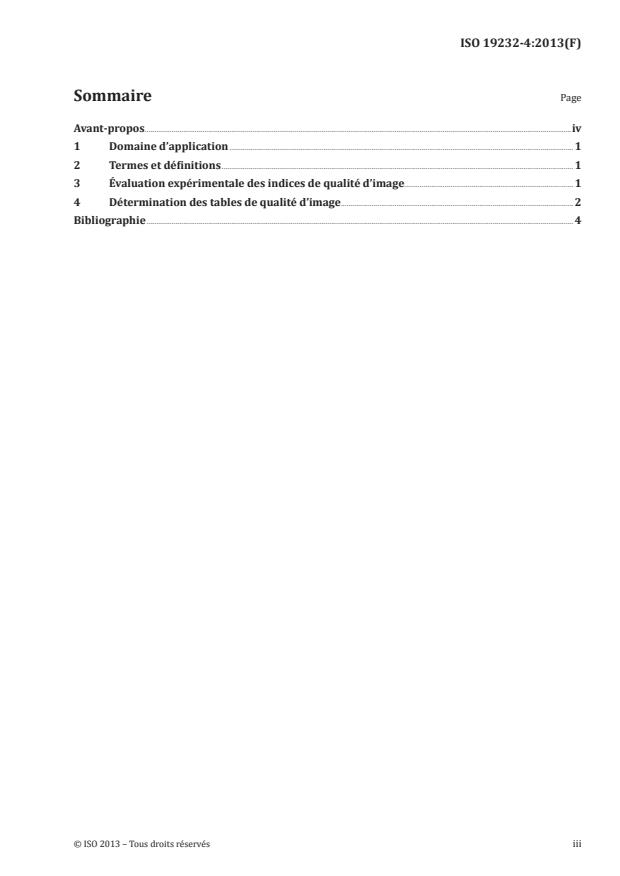
Sommaire Page
Avant-propos .iv
1 Domaine d’application . 1
2 Termes et définitions . 1
3 Évaluation expérimentale des indices de qualité d’image. 1
4 Détermination des tables de qualité d’image. 2
Bibliographie . 4
Avant-propos
L’ISO (Organisation internationale de normalisation) est une fédération mondiale d’organismes
nationaux de normalisation (comités membres de l’ISO). L’élaboration des Normes internationales est
en général confiée aux comités techniques de l’ISO. Chaque comité membre intéressé par une étude
a le droit de faire partie du comité technique créé à cet effet. Les organisations internationales,
gouvernementales et non gouvernementales, en liaison avec l’ISO participent également aux travaux.
L’ISO collabore étroitement avec la Commission électrotechnique internationale (CEI) en ce qui concerne
la normalisation électrotechnique.
Les Normes internationales sont rédigées conformément aux règles données dans les Directives
ISO/CEI, Partie 2.
La tâche principale des comités techniques est d’élaborer les Normes internationales. Les projets de
Normes internationales adoptés par les comités techniques sont soumis aux comités membres pour vote.
Leur publication comme Normes internationales requiert l’approbation de 75 % au moins des comités
membres votants.
L’attention est appelée sur le fait que certains des éléments du présent document peuvent faire l’objet de
droits de propriété intellectuelle ou de droits analogues. L’ISO ne saurait être tenue pour responsable de
ne pas avoir identifié de tels droits de propriété et averti de leur existence.
L’ISO 19232-4 a été élaborée par le comité technique CEN/TC 138, Essais non destructifs, du Comité
européen de normalisation (CEN) en collaboration avec le comité technique ISO/TC 135, Essais non
destructifs, sous-comité SC 5, Moyens utilisant les rayonnements, conformément à l’Accord de coopération
technique entre l’ISO et le CEN (Accord de Vienne).
Cette deuxième édition annule et remplace la première édition (ISO 19232-4:2004), dont elle constitue
une révision mineure avec les changements suivants:
— mise à jour des références;
— correction de la Figure 1 et de sa légende.
L’
...