


ISO/PRF 6319
(Main)Ships and marine technology — Marine environment protection — Conducting and documenting in-water cleaning of biofouling on ships
Ships and marine technology — Marine environment protection — Conducting and documenting in-water cleaning of biofouling on ships
This document provides best practices for planning and conducting in-water cleaning (IWC) operations safely, efficiently and in an environmentally sound manner. Additionally, this document provides best practices for reporting on the effectiveness of IWC operations. This document addresses all forms of IWC of external submerged surfaces, which are hull and niche areas, all types and levels of biofouling, which means biofilms, microfouling and macrofouling, conducted both with and without capture. It does not address internal piping. The document has been established to inform ports, regulatory agencies, ship biofouling IWC service providers, inspection service providers, IWC equipment manufacturers, coating manufacturers, ship owners, ship managers, ship operators and other relevant stakeholders.
Titre manque
General Information
- Status
- Not Published
- Technical Committee
- ISO/TC 8/SC 2 - Marine environment protection
- Drafting Committee
- ISO/TC 8/SC 2 - Marine environment protection
- Current Stage
- 5020 - FDIS ballot initiated: 2 months. Proof sent to secretariat
- Start Date
- 15-Jan-2026
- Completion Date
- 17-Jan-2026
Overview
ISO/PRF 6319:2026, titled Ships and Marine Technology - Marine Environment Protection - Conducting and Documenting In-Water Cleaning of Biofouling on Ships, is an international standard developed by ISO to establish best practices for managing in-water cleaning (IWC) operations. This standard focuses on enabling safe, efficient, and environmentally sound removal of biofouling from the external submerged surfaces of ships, including hulls and niche areas. It addresses all types and levels of biofouling-biofilms, microfouling, and macrofouling-and covers cleaning methods performed both with and without capture of removed material. The standard excludes internal piping systems.
Designed for a broad audience-including ports, regulatory agencies, IWC service providers, inspection bodies, equipment and coating manufacturers, ship owners, managers, and operators-ISO/PRF 6319 provides a comprehensive framework for the planning, execution, and documentation of in-water cleaning events to minimize environmental impact and improve operational outcomes.
Key Topics
- General Preparations: Guidelines on compatibility between antifouling coatings (AFC) and IWC systems, environmental, health and safety planning, operator training, contingency planning, and quality management.
- Hull Condition Assessment: Procedures to evaluate hull and coating condition prior to cleaning, including workflows for data review and assessment of biofouling extent.
- Pre-Cleaning Preparations: Processes for documentation, approvals, and coordination before initiating cleaning, ensuring compliance with environmental and regulatory requirements.
- In-Water Cleaning Operations: Best practices for safe and effective cleaning, focusing on operations coordination, biofouling ratings, area identification, monitoring, and contingency measures.
- Post-Cleaning Reporting: Detailed instructions for cleaning reports, including pictorial documentation, description of cleaned zones, assessment of remaining biofouling, and record keeping.
- Special Considerations: Handling of niche areas prone to biofouling accumulation and strategies to mitigate water quality impacts during cleaning.
- Documentation and Record Keeping: Emphasis on thorough reporting to meet port and regulatory documentation requirements for multiple cleaning events.
Applications
ISO/PRF 6319 serves as an essential guideline for maritime stakeholders aiming to implement or enhance in-water cleaning programs that:
- Prevent the spread of invasive aquatic species by managing biofouling effectively.
- Reduce fuel consumption and greenhouse gas emissions by maintaining optimal hull performance.
- Ensure compliance with international and local marine environmental protection regulations.
- Support operational efficiency by providing verified procedures for biofouling removal.
- Facilitate transparent, consistent reporting of cleaning activities to regulators and port authorities.
- Enhance safety through training protocols and contingency planning for unexpected operational issues.
- Integrate with existing biofouling management plans and antifouling coatings for synergistic environmental protection.
This standard is particularly valuable for shipowners and operators who perform regular IWC maintenance, port authorities regulating marine biosecurity, biofouling control service providers, and manufacturers of cleaning equipment and marine coatings.
Related Standards
To complement ISO/PRF 6319, maritime professionals often reference related ISO standards and international marine regulations, including:
- ISO 19030 Series - Measurement of hull and propeller performance to monitor fouling effects.
- IMO Biofouling Guidelines - Provided by the International Maritime Organization for biofouling management plans.
- ISO 8501 - Surface preparation standards for coatings, relevant when inspecting hull condition.
- ISO 14001 - Environmental management systems supporting sustainable marine operations.
- Regional port and environmental authority standards for in-water cleaning and discharge controls.
By aligning with ISO/PRF 6319 and these associated standards, maritime stakeholders can establish uniform, effective biofouling control protocols that safeguard marine ecosystems and ensure vessel operational excellence.
Keywords: ISO 6319, in-water cleaning, biofouling removal, marine environment protection, ship hull cleaning, antifouling compatibility, marine biosecurity, environmental compliance, ship maintenance documentation, marine technology standards
ISO/PRF 6319 - Ships and marine technology — Marine environment protection — Conducting and documenting in-water cleaning of biofouling on ships Released:15. 01. 2026
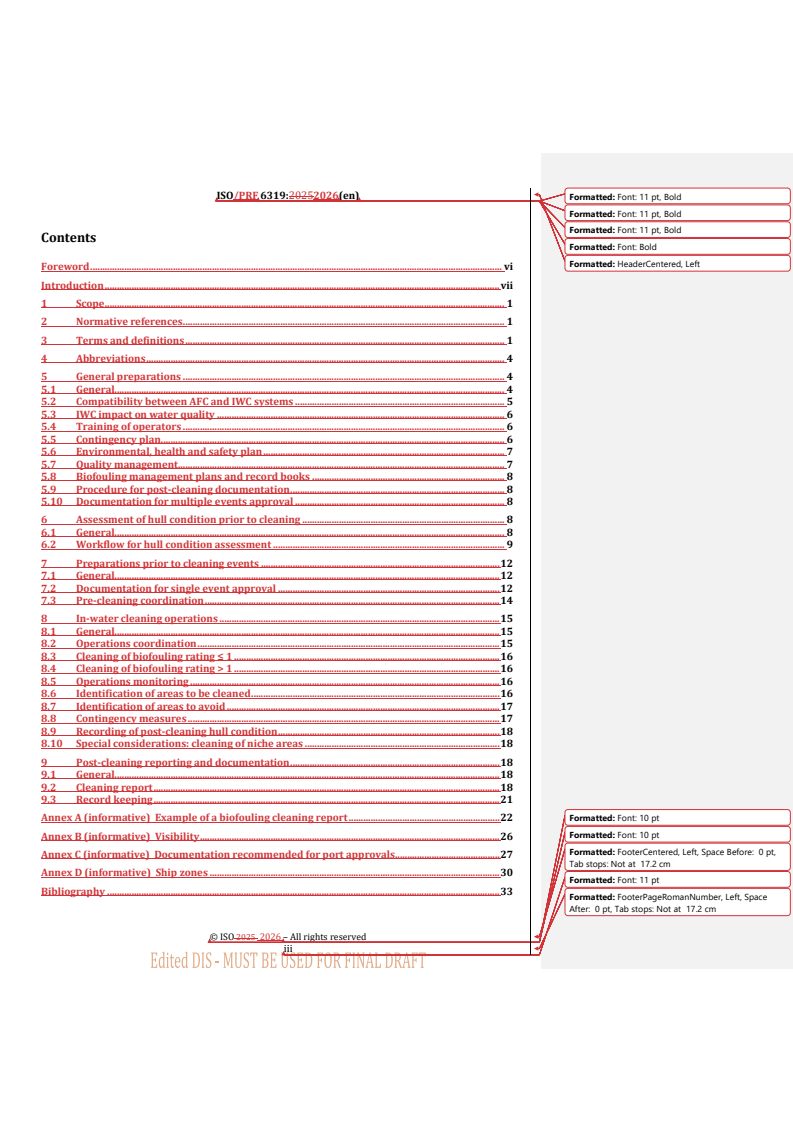
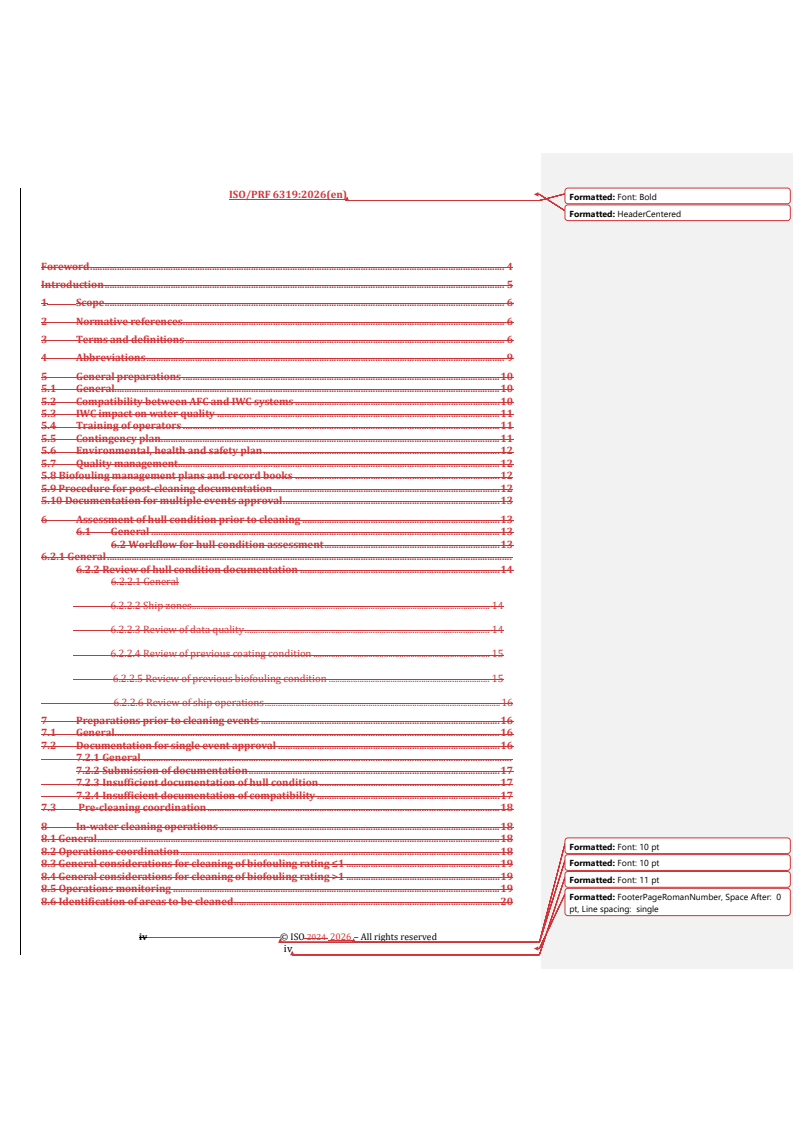
REDLINE ISO/PRF 6319 - Ships and marine technology — Marine environment protection — Conducting and documenting in-water cleaning of biofouling on ships Released:15. 01. 2026
Frequently Asked Questions
ISO/PRF 6319 is a draft published by the International Organization for Standardization (ISO). Its full title is "Ships and marine technology — Marine environment protection — Conducting and documenting in-water cleaning of biofouling on ships". This standard covers: This document provides best practices for planning and conducting in-water cleaning (IWC) operations safely, efficiently and in an environmentally sound manner. Additionally, this document provides best practices for reporting on the effectiveness of IWC operations. This document addresses all forms of IWC of external submerged surfaces, which are hull and niche areas, all types and levels of biofouling, which means biofilms, microfouling and macrofouling, conducted both with and without capture. It does not address internal piping. The document has been established to inform ports, regulatory agencies, ship biofouling IWC service providers, inspection service providers, IWC equipment manufacturers, coating manufacturers, ship owners, ship managers, ship operators and other relevant stakeholders.
This document provides best practices for planning and conducting in-water cleaning (IWC) operations safely, efficiently and in an environmentally sound manner. Additionally, this document provides best practices for reporting on the effectiveness of IWC operations. This document addresses all forms of IWC of external submerged surfaces, which are hull and niche areas, all types and levels of biofouling, which means biofilms, microfouling and macrofouling, conducted both with and without capture. It does not address internal piping. The document has been established to inform ports, regulatory agencies, ship biofouling IWC service providers, inspection service providers, IWC equipment manufacturers, coating manufacturers, ship owners, ship managers, ship operators and other relevant stakeholders.
ISO/PRF 6319 is classified under the following ICS (International Classification for Standards) categories: 13.020.99 - Other standards related to environmental protection; 47.020.99 - Other standards related to shipbuilding and marine structures. The ICS classification helps identify the subject area and facilitates finding related standards.
ISO/PRF 6319 is available in PDF format for immediate download after purchase. The document can be added to your cart and obtained through the secure checkout process. Digital delivery ensures instant access to the complete standard document.
Standards Content (Sample)
International
Standard
ISO 6319
First edition
Ships and marine technology —
Marine environment protection
— Conducting and documenting
in-water cleaning of biofouling on
ships
PROOF/ÉPREUVE
Reference number
ISO 6319:2026(en) © ISO 2026
ISO 6319:2026(en)
© ISO 2026
All rights reserved. Unless otherwise specified, or required in the context of its implementation, no part of this publication may
be reproduced or utilized otherwise in any form or by any means, electronic or mechanical, including photocopying, or posting on
the internet or an intranet, without prior written permission. Permission can be requested from either ISO at the address below
or ISO’s member body in the country of the requester.
ISO copyright office
CP 401 • Ch. de Blandonnet 8
CH-1214 Vernier, Geneva
Phone: +41 22 749 01 11
Email: copyright@iso.org
Website: www.iso.org
Published in Switzerland
PROOF/ÉPREUVE
ii
ISO 6319:2026(en)
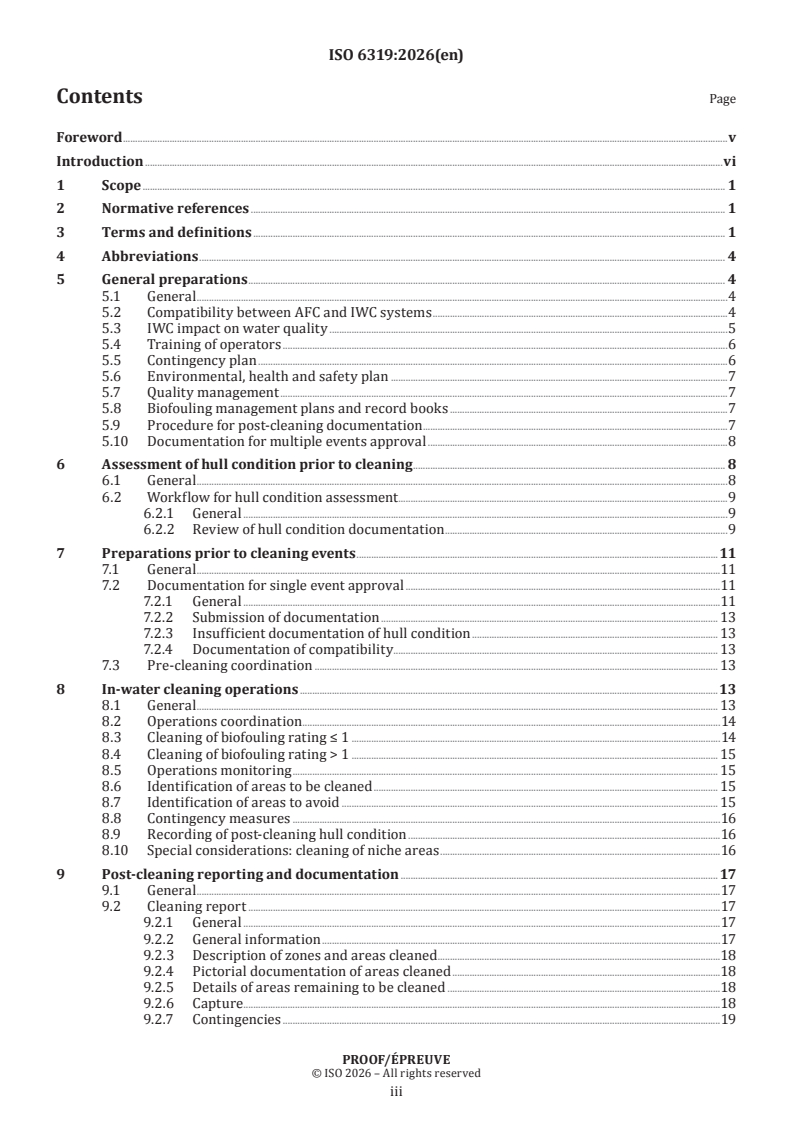
Contents Page
Foreword .v
Introduction .vi
1 Scope . 1
2 Normative references . 1
3 Terms and definitions . 1
4 Abbreviations . 4
5 General preparations . 4
5.1 General .4
5.2 Compatibility between AFC and IWC systems .4
5.3 IWC impact on water quality .5
5.4 Training of operators .6
5.5 Contingency plan .6
5.6 Environmental, health and safety plan .7
5.7 Quality management .7
5.8 Biofouling management plans and record books .7
5.9 Procedure for post-cleaning documentation .7
5.10 Documentation for multiple events approval .8
6 Assessment of hull condition prior to cleaning . 8
6.1 General .8
6.2 Workflow for hull condition assessment .9
6.2.1 General .9
6.2.2 Review of hull condition documentation .9
7 Preparations prior to cleaning events .11
7.1 General .11
7.2 Documentation for single event approval .11
7.2.1 General .11
7.2.2 Submission of documentation . 13
7.2.3 Insufficient documentation of hull condition . 13
7.2.4 Documentation of compatibility . 13
7.3 Pre-cleaning coordination . 13
8 In-water cleaning operations .13
8.1 General . 13
8.2 Operations coordination .14
8.3 Cleaning of biofouling rating ≤ 1 .14
8.4 Cleaning of biofouling rating > 1 . 15
8.5 Operations monitoring . 15
8.6 Identification of areas to be cleaned . 15
8.7 Identification of areas to avoid . 15
8.8 Contingency measures .16
8.9 Recording of post-cleaning hull condition .16
8.10 Special considerations: cleaning of niche areas .16
9 Post-cleaning reporting and documentation . 17
9.1 General .17
9.2 Cleaning report .17
9.2.1 General .17
9.2.2 General information .17
9.2.3 Description of zones and areas cleaned . .18
9.2.4 Pictorial documentation of areas cleaned .18
9.2.5 Details of areas remaining to be cleaned .18
9.2.6 Capture . . .18
9.2.7 Contingencies .19
PROOF/ÉPREUVE
iii
ISO 6319:2026(en)
9.3 Record keeping .19
Annex A (informative) Example of a biofouling cleaning report .20
Annex B (informative) Visibility .23
Annex C (informative) Documentation recommended for port approvals .24
Annex D (informative) Ship zones .26
Bibliography .28
PROOF/ÉPREUVE
iv
ISO 6319:2026(en)
Foreword
ISO (the International Organization for Standardization) is a worldwide federation of national standards
bodies (ISO member bodies). The work of preparing International Standards is normally carried out through
ISO technical committees. Each member body interested in a subject for which a technical committee
has been established has the right to be represented on that committee. International organizations,
governmental and non-governmental, in liaison with ISO, also take part in the work. ISO collaborates closely
with the International Electrotechnical Commission (IEC) on all matters of electrotechnical standardization.
The procedures used to develop this document and those intended for its further maintenance are described
in the ISO/IEC Directives, Part 1. In particular, the different approval criteria needed for the different types
of ISO document should be noted. This document was drafted in accordance with the editorial rules of the
ISO/IEC Directives, Part 2 (see www.iso.org/directives).
ISO draws attention to the possibility that the implementation of this document may involve the use of (a)
patent(s). ISO takes no position concerning the evidence, validity or applicability of any claimed patent
rights in respect thereof. As of the date of publication of this document, ISO had not received notice of (a)
patent(s) which may be required to implement this document. However, implementers are cautioned that
this may not represent the latest information, which may be obtained from the patent database available at
www.iso.org/patents. ISO shall not be held responsible for identifying any or all such patent rights.
Any trade name used in this document is information given for the convenience of users and does not
constitute an endorsement.
For an explanation of the voluntary nature of standards, the meaning of ISO specific terms and expressions
related to conformity assessment, as well as information about ISO's adherence to the World Trade
Organization (WTO) principles in the Technical Barriers to Trade (TBT), see www.iso.org/iso/foreword.html.
This document was prepared by Technical Committee ISO/TC 8, Ships and marine technology, Subcommittee
SC 2, Marine environment protection.
Any feedback or questions on this document should be directed to the user’s national standards body. A
complete listing of these bodies can be found at www.iso.org/members.html.
PROOF/ÉPREUVE
v
ISO 6319:2026(en)
Introduction
Preventing and removing biofouling on hulls of ships limits the introduction and spread of invasive aquatic
species (IAS). Indeed, biofouling on ships is recognized as an important potential sub-vector to translocate
[1]-[4]
IAS. Such translocation threatens coastal environments by disrupting ecological systems, which can
also negatively affect fisheries, aquaculture and tourism. Additionally, biofouling increases frictional drag
on hulls and decreases the propeller efficiency, in turn increasing fuel consumption, greenhouse gas (GHG)
emissions and air pollution from ships. Not only is biofouling estimated to increase a ship’s fuel consumption
[5] [6]
by on average 9 %, this added fuel consumption costs the shipping industry billions of USD. Therefore,
improving biofouling management across the global shipping fleet will have considerable benefits, both
from an environmental and economic standpoint.
The most common way of controlling hull biofouling is applying coatings containing biocides, however, if the
anti-fouling system (AFS) fails or if the ship’s operational profile or environmental conditions deviate from
the coating specification, removing biofouling by cleaning the hull can become necessary. Traditionally,
service providers have offered in-water cleaning (IWC) services using brush-based IWC systems operated by
human divers, with considerable variation among systems. More recently, IWC remotely operated vehicles
(ROVs) using brush or water-jetting technology and autonomous systems as well as crew-operated systems
have become available for in-port and in-transit cleaning. IWC may be conducted with or without capturing
the materials liberated from the ship surface.
IWC can help to protect the environment from both IAS and harmful emissions by reducing the number of
heavily fouled ships in international trade that may spread IAS during operations and idle periods. However,
an inherent risk of IWC is that the cleaning operation itself may result in the release of IAS and contaminants
into the local environment. The aim of this document is to provide best practices and requirements to
ensure that IWC operations not only effectively achieve a clean hull, but simultaneously ensure that these
measures are conducted safely, meaning that they protect human life and the environment. Environmentally
sound IWC operations strive for little to no impact to marine ecosystems and avoid damage to ships’ AFCs to
facilitate their optimal performance.
This document aligns with and supplements the International Maritime Organization’s (IMO) 2023
Guidelines for the control and management of ships’ biofouling to minimize the transfer of invasive aquatic
[7]
species, henceforth referred to as the IMO 2023 Biofouling Guidelines. This document specifies that
cleaning of microfouling (biofouling rating 1 or less) does not require the use of a capture system, while the
cleaning of macrofouling (biofouling rating 2 or higher) requires the use of a capture system. At the time of
publication of this document, comprehensive biofouling management policies are not widespread, and the
[8]
few jurisdictions that have such policies use varying procedures. This document aims to provide a level
playing field by contributing to globally harmonized practices. By specifying a methodology for safe and
sustainable IWC processes, procedures are provided to ports and other relevant authorities facing requests
for IWC when a ship is in port or at anchorage. Furthermore, this information aims to assure shipowners
that cleaning services are performed according to a set of standard practices regardless of the location.
This document also informs a range of other stakeholders including ship biofouling IWC service providers,
inspection service providers, IWC equipment manufacturers and coating manufacturers.
Through a stepwise approach, this document describes the IWC process chronologically. First, all relevant,
preparatory aspects — such as general preparations, the assessment of the hull prior to the IWC operation,
and preparations associated with any single cleaning event — are considered, then the cleaning operation
itself is discussed, which is followed by considerations of post-cleaning processes and reporting. Questions
of why and when cleaning is necessary, including the establishment of proactive or reactive cleaning
regimes, are beyond the scope of this document. Rather, this document focuses on the questions of how the
IWC preparations and operations should take place, and how they should be documented.
PROOF/ÉPREUVE
vi
International Standard ISO 6319:2026(en)
Ships and marine technology — Marine environment
protection — Conducting and documenting in-water cleaning
of biofouling on ships
1 Scope
This document provides requirements and best practices for planning, conducting and documenting in-water
cleaning (IWC) operations safely, efficiently and in an environmentally sound manner. Additionally, this
document provides requirements and best practices for reporting on the effectiveness of IWC operations.
This document addresses all forms of IWC of external submerged surfaces, which are hull and niche areas,
all types and levels of biofouling, which means biofilms, microfouling and macrofouling, conducted both
with or without capture. It does not address internal piping.
The document has been established to inform ports, regulatory agencies, ship biofouling IWC service
providers, inspection service providers, IWC equipment manufacturers, coating manufacturers, shipowners,
ship managers, ship operators and other relevant stakeholders.
2 Normative references
The following documents are referred to in the text in such a way that some or all of their content constitutes
requirements of this document. For dated references, only the edition cited applies. For undated references,
the latest edition of the referenced document (including any amendments) applies.
ISO 20679, Ships and marine technology — Marine environment protection — Testing of ship biofouling in-water
cleaning systems
3 Terms and definitions
For the purposes of this document, the following terms and definitions apply.
ISO and IEC maintain terminology databases for use in standardization at the following addresses:
— ISO Online browsing platform: available at https:// www .iso .org/ obp
— IEC Electropedia: available at https:// www .electropedia .org/
3.1
antifouling coating
AFC
surface coating designed to prevent, repel or facilitate the detachment of biofouling (3.3) from hull (3.7) and
niche areas (3.13) that are typically or occasionally submerged
Note 1 to entry: AFC includes both biocidal and non-biocidal coatings.
3.2
antifouling system
AFS
coating, paint, surface treatment, surface or device that is used on a ship (3.18) to control or prevent
attachment of unwanted organisms
PROOF/ÉPREUVE
ISO 6319:2026(en)
3.3
biofouling
accumulation of aquatic organisms such as microorganisms, plants and animals on surfaces and structures
immersed in or exposed to the aquatic environment
Note 1 to entry: Biofouling can include pathogens.
[7]
[SOURCE: IMO 2023 Biofouling Guidelines, 2.1 ]
3.4
capture
process of containment, collection and removal of biofouling (3.3) material and waste substances (3.21)
detached from submerged surfaces during in-water cleaning (3.9) or in dry dock
[7]
[SOURCE: IMO 2023 Biofouling Guidelines, 2.1 modified— "in-water cleaning" replaced "cleaning in
water".]
3.5
compatibility
state in which an in-water cleaning (3.9) system can operate on an antifouling coating (3.1) without causing
damage that can either reduce its performance, reduce its lifetime, or both, which can contribute to a higher
risk of biofouling (3.3)
3.6
biofouling rating
allocation of a number for a defined inspection area of the ship surface based on a visual assessment,
including description of biofouling (3.3) present and percentage of macrofouling (3.10) coverage
3.7
hull
underwater area of a ship (3.18), including niche areas (3.13)
3.8
invasive aquatic species
non-native species to a particular ecosystem which can pose threats to human, animal and plant life,
economic and cultural activities and the aquatic environment
[7]
[SOURCE: IMO 2023 Biofouling Guidelines, 2.1 ]
3.9
in-water cleaning
IWC
removal of biofouling (3.3) from a ship’s hull (3.7) including niche areas (3.13) while in the water
3.10
macrofouling
biofouling (3.3) caused by the attachment and subsequent growth of visible plants and animals on structures
and ships exposed to water
Note 1 to entry: Macrofouling comprises large, distinct multicellular individual or colonial organisms visible to the
human eye such as barnacles, tubeworms, mussels, fronds/filaments of algae, bryozoans, sea squirts and other large
attached, encrusting or mobile organisms.
[7]
[SOURCE: IMO 2023 Biofouling Guidelines, 2.1 ]
3.11
microfouling
biofouling (3.3) caused by bacteria, fungi, microalgae, protozoans and other microscopic organisms, that
creates a biofilm also called a slime layer
[7]
[SOURCE: IMO 2023 Biofouling Guidelines, 2.1 ]
PROOF/ÉPREUVE
ISO 6319:2026(en)
3.12
multiple events approval
fundamental approvals from ports and other relevant authorities allowing service providers to conduct
multiple in-water cleaning (3.9) operations over a time period
Note 1 to entry: Commonly called licence or permit.
3.13
niche areas
subset of the submerged surface areas on a ship (3.18) that may be more susceptible to biofouling (3.3) than
the main hull (3.7) due to structural complexity, different or variable hydrodynamic forces, susceptibility to
antifouling coating (3.1) wear or damage, inadequate or no protection by an antifouling system (3.2)
[7]
[SOURCE: IMO 2023 Biofouling Guidelines, 2.1 ]
3.14
operator
actor who operates the cleaning or inspection unit
3.15
proactive cleaning
periodic removal of microfouling (3.11) on ships’ hulls to prevent or minimize attachment of macrofouling
(3.10)
[7]
[SOURCE: IMO 2023 Biofouling Guidelines, 2.1 ]
3.16
reactive cleaning
corrective action during which biofouling (3.3) is removed from a ship’s hull (3.7)
3.17
service provider
person or organization that supplies the cleaning service
Note 1 to entry: In some cases, this can be the same organization as the technology provider (3.20).
3.18
ship
vessel of any type whatsoever operating in the aquatic environment and includes hydrofoil boats, air-cushion
vehicles, submersibles, floating craft, fixed or floating platforms, floating storage units (FSUs) and floating
production storage and off-loading units (FPSOs)
[7]
[SOURCE: IMO 2023 Biofouling Guidelines, 2.1 ]
3.19
single event approval
approvals from ports and other relevant authorities to service providers (3.17) for conducting a single in-
water cleaning (3.9) event
3.20
technology provider
person or organization that supplies the in-water cleaning (3.9) technology to a service provider (3.17)
Note 1 to entry: In some cases, this can be the same organization as the service provider (3.17).
3.21
waste substances
dissolved and particulate materials that may be released or produced during cleaning or maintenance, and
can include biocides, metals, organic substances, removed biofouling (3.3), pigments, microplastics or other
contaminants that could have a negative impact on the environment
[7]
[SOURCE: IMO 2023 Biofouling Guidelines, 2.1 ]
PROOF/ÉPREUVE
ISO 6319:2026(en)
4 Abbreviations
AFC Antifouling coating
AFS Antifouling system
AUV Autonomous underwater vehicles
BFMP Biofouling management plan
BFRB Biofouling record book
FPSOs Floating production storage and off-loading units
FRC Foul-release coating
FSUs Floating storage units
GHG Greenhouse gas emissions
IAS Invasive aquatic species
IMO International Maritime Organization
IWC In-water cleaning
LOTO Lock out and tag out
QMS Quality management system
ROV Remotely operated vehicles
SPC Self-polishing coating
5 General preparations
5.1 General
This clause describes the preparations that are fundamental to IWC operations, including the qualifications
and approvals of the IWC equipment, process and operators required prior to the start of IWC. Topics
include, among others, documentation of compatibility between the AFC and IWC system, operator training,
documentation of testing to assess the impact to the water column when cleaning occurs, IWC service work
instructions, and quality management for the service provider.
5.2 Compatibility between AFC and IWC systems
Compatibility between an AFC and an IWC system is defined as follows: the state in which an IWC system
can operate on an AFC without causing damage that can either reduce its performance, reduce its lifetime,
or both, which can contribute to a higher risk of biofouling.
IWC service providers, IWC technology developers or coating manufacturers are expected to provide
a compatibility assessment considering compatibility parameters to determine the suitability of their
technology for IWC operations for different AFCs and different biofouling ratings. The results of the
compatibility assessment shall be considered by the ship when determining a cleaning regime to be
documented in the biofouling management plan (BFMP). When seeking to qualify an IWC technology for use
with a certain AFC at a given location, the results from the compatibility assessment should be presented to
ports and other relevant authorities.
PROOF/ÉPREUVE
ISO 6319:2026(en)
For reference, indicators that demonstrate a lack of compatibility may relate to the impact on the AFC
refouling rate (meaning the rate in which biofouling accumulates post cleaning), the impact on water quality,
the impact on ship hull performance, or visible damages to the AFC as a result of IWC operations.
The exact processes for measuring and evaluating AFC and IWC system compatibility fall beyond the scope
of this document. On a general note, the following key parameters for compatibility between IWC and AFC
shall be considered to qualify IWC systems and to issue permits for IWC operations:
a) The type, properties and the age of the AFC on the different hull sections where IWC will take place. Even
on the same hull, there can be different coating system technologies. Coating systems that are closer
to the end of their service lifetime tend to have some damaged sections and this shall be considered.
Data regarding the properties of the AFC is specified in the BFMP and shall be obtained from the ship
operator or the coating manufacturer.
NOTE 1 Past in-water inspection or cleaning reports and the ship’s biofouling documentation can also serve as
input.
The compatibility of self-polishing and foul-release coatings (SPC and FRC) with various IWC systems
varies considerably. For example, IWC operations involving SPC shall consider the propensity of such
AFC to polish-off by design (passive release) and thus adjust their settings accordingly to ensure
compatibility and avoid any excessive release of waste material to the water.
b) The type and settings of the IWC system. As a minimum, compatibility considerations shall assess the
hull sections that can be cleaned with a specific tool or system, the type of waste capture mechanism
if used by the IWC system, the degree of brush hardness, the pressure level for systems using air or
water pressure and the degree of contact and adhesion the IWC system has with the hull during the
IWC process. Data regarding the IWC system shall be obtained from the IWC service supplier or the ship
operator.
NOTE 2 IWC systems can have wheels for navigation that can disturb the AFC.
c) The type, degree, and density of biofouling growth on the hull during the specific IWC operation (see
[7]
Table 1 in the IMO 2023 Biofouling Guidelines for biofouling ratings). Data regarding the current
biofouling accumulation on the ship shall be obtained from the ship operator or any third party actively
involved in monitoring and maintenance of the AFC for a particular ship.
NOTE 3 The parameters to consider when evaluating the combability of an AFC with a particular cleaning
system can be numerous, and new methods will likely emerge in the future. Such testing procedures can vary in
scope and duration.
5.3 IWC impact on water quality
It is imperative that all IWC operations strive to have little to no impact on the water column or sediments.
The service provider shall document that the specific equipment does not create a statistically significant
increase in waste substances of concern released into water relative to background concentrations and
passive release. Each service provider shall document that the cleaning equipment in use has been tested
in conditions similar to the upcoming IWC operation (e.g. coating, test conditions including hull area,
temperature and tides, equipment including hardware selection process parameters and operational
parameters). Tests procedures shall follow ISO 20679. Equivalent standards acceptable to the port or other
relevant authorities may also be used.
Ports and other relevant authorities should be provided with documentation of tests results related to an
upcoming IWC operation to properly evaluate the operation’s potential impact on local water quality. The
potential concentrations or discharge of any specified contaminants shall be evaluated and approved as
acceptable by the ports and other relevant authorities where the cleaning is intended to take place.
NOTE Ports and other relevant authorities can request service providers to repeat parts of the test procedure
during the multiple event approval period, or before the approval is renewed.
PROOF/ÉPREUVE
ISO 6319:2026(en)
5.4 Training of operators
IWC technology providers shall provide health and safety training for the operators of their respective IWC
systems. Operators shall be trained in the technical details of the cleaning equipment to meet required
performance as expected by the IWC technology supplier. Suitable training of operators shall address the
performance criteria for the specific IWC equipment, covering the roles and responsibilities of IWC system
operators, including any relevant work processes. Operators shall be trained in the visual assessment of
biofouling ratings. Operators are responsible for preventing biological and chemical contamination.
Such prevention training as well as contingency response training are essential elements that shall be
incorporated into the training programme for operators. Personnel involved in IWC operations shall be
aware of the regulations and requirements for conducting IWC, including the regulations regarding the
discharge of biofouling, particles and chemicals into a marine environment of the cleaning location. Records
shall be kept (electronic format suffices) to document that training has been successfully completed.
NOTE IWC systems can also be operated by the ship’s crew, and they can also be operated autonomously.
5.5 Contingency plan
At a minimum, the events that shall be considered in the contingency plan are as follows:
— Ship contingencies:
— port operations such as simultaneous operations (e.g. bunkering and cargo operations), ship
movements, changes in cargo operations, etc.,
— ship schedule changes,
— changes in plans for bunkering operations,
— emergencies during cargo operations,
— ship safety or stability,
— observed damage to the ship or ship’s AFS,
— changes in observed fouling since last available report.
— IWC service provider contingencies:
— diver incident or accident contingency plan (if applicable),
— loss of equipment contingency,
— equipment malfunction contingency,
— environmental impact contingency,
— weather-related safety risks,
— unintended release of waste substances,
— diver safety,
— rise and fall of tide influencing clearance under the ship,
— cargo activities influencing clearance under the ship,
— elements that could delay the completion of the IWC or delay the ship’s departure.
PROOF/ÉPREUVE
ISO 6319:2026(en)
5.6 Environmental, health and safety plan
The organization using the IWC equipment shall document that the procedures do not pose any unusual
risks for human health, property, or the environment including the launching, operation, retrieval and
stowage of equipment.
Health and safety aspects may be addressed in various forms, usually using a combination of design of
equipment, training and instructions. The details of the environmental, health and safety plan will depend
on the procedure chosen, and whether proper safeguards are in place.
5.7 Quality management
The organization conducting IWC can have a quality management system (QMS) for documenting all parts of
the planning and execution of IWC operations. A QMS can monitor and verify that operations are performed
according to the IWC system specifications and any applicable local policies.
The organization conducting IWC operations can maintain a QMS based on an existing international
standard (e.g. ISO 9001). Such quality standard procedures can outline who is responsible for gathering,
managing and documenting the pre-, during and post-service elements of this document. This shall include
sufficient photographs, videos, documented records, or other forms of verification that will allow the
ship operator, port authorities and other relevant parties to confirm that the organization can record and
effectively manage all elements of the IWC operations.
The following is a non-exhaustive list of documentation that can be maintained as part of quality management
by the organization conducting IWC:
— all parts of the planning and execution of IWC operations,
— process records to monitor and verify that operations are performing and designed,
— training records for service personnel,
— maintenance, inspection, and performance validation records for the IWC equipment.
5.8 Biofouling management plans and record books
The ship is expected to follow the reporting recommendations for their ship-specific biofouling management
plan (BFMP) and biofouling record book (BFRB) as described in the IMO 2023 Biofouling Guidelines, 10-11.
[7]
The BFMP shall outline the installed AFS including recommendations from the manufacturers for monitoring
and maintenance activities. In the case of AFCs, BFMPs shall include guidance for in-water inspections and
IWC activities.
BFRBs shall be used to log all biofouling-related events of the ship, including among others, idle periods,
results from in-water inspections and post-cleaning reports.
5.9 Procedure for post-cleaning documentation
The service provider or operator shall have a procedure for post-cleaning documentation. Such
documentation shall be provided after each IWC operation, and it shall be consistent with the requirements
set forth in Clause 9. This includes documentation of the hull condition with still pictures and video, and an
assessment of the biofouling rating and coating condition consistent with the areas of the ship established in
the BFMP.
PROOF/ÉPREUVE
ISO 6319:2026(en)
5.10 Documentation for multiple events approval
When seeking a multiple events and long-term approval for IWC, the documentation provided to the port
and relevant authorities should include, at minimum:
— general description of the IWC equipment,
— operations plan,
— working principles, operational requirements and limitations,
— compatibility documentation,
— documentation of impact on water quality,
— documentation of training of operators,
— environmental, health and safety plan,
— procedures for avoiding ship zones and areas with biofouling where equipment is not appropriate,
— procedure for providing post-cleaning documentation.
See Table C.1 for a full overview of documentation recommended for applications for multiple events and
single event approvals.
6 Assessment of hull condition prior to cleaning
6.1 General
This clause outlines how to assess the condition of the hull, including niche areas, prior to the commencement
of IWC operations. This clause is not intended to describe the procedures for conducting a hull inspection,
but it instead describes the administrative process that takes place to assess the condition of the hull based
on all available information.
After the general need for IWC has been established, the specific details of which portions of the hull require
cleaning and the cleaning method to be employed shall be determined. An assessment of hull condition prior
to cleaning can help with selecting the equipment to be used to clean each area prior to mobilizing the IWC
supplier. Additionally, it can still be necessary to grant permission for the specific cleaning operation. To
support the approval processes specified in Clause 7, an assessment of the biofouling rating and coating
condition of the hull is required.
The hull condition assessment shall be performed by the operator, in coordination with the parties pertinent
to the cleaning event and the location in which cleaning is to be conducted, including the ship’s crew, ship
operations staff, the port or other relevant authority, and any other interested stakeholder organizations
and individuals.
For proper planning, the port or other relevant authorities, ship owner and service provider all require
a thorough understanding of the anticipated hull condition at the proposed time of cleaning. Previous
inspection and cleaning reports, performance data and recent vessel operations shall all be considered in
conducting the hull condition assessment. The assessment will enable the ship representative and service
provider to agree on a proposed cleaning plan during the pre-cleaning coordination outlined in Clause 7. The
documents detailing the hull condition shall be provided to the ports or local authorities to verify that the
equipment is appropriate for the planned IWC operation.
PROOF/ÉPREUVE
ISO 6319:2026(en)
6.2 Workflow for hull condition assessment
6.2.1 General
Recent inspection and cleaning reports shall be reviewed for recency and thoroughness, and compared
with recent operational data for the ship, and older reports if available, to determine the anticipated hull
condition at the time of cleaning.
The review of the most recent inspection or cleaning report shall determine that the biofouling rating of the
areas that have been proposed to be cleaned is appropriate for the planned cleaning.
This assessment shall not only consider the summary of the report but shall also consider the validity and
applicability of the report for the upcoming cleaning. If available, performance data and documentation of
recent ship operations shall be reviewed (see 6.2.2.6).
Review of multiple historical inspection and cleaning reports is recommended, as trends can be identified
that can aid receipt of approvals and the decisions to be made during the pre-cleaning coordination.
Additional supporting information, such as video documentation of previous inspections or cleanings
or more comprehensive electronic inspection reports shall be reviewed when available. Together with
traditional inspection and cleaning reports, this information constitutes the hull condition documentation.
If the initial assessment indicates uncertainty in the anticipated hull condition, if no prior documentation of
hull condition exists, or if the port or other relevant authority does not view the provided documentation as
sufficient, an inspection shall be undertaken with sufficient detail to assess the current condition of the hull
biofouling and coating condition of the areas targeted for cleaning.
NOTE See 8.6 on quick in-water assessment, which is carried out immediately prior to, or simultaneously with,
the cleaning operation.
6.2.2 Review of hull condition documentation
6.2.2.1 General
There are a number of tools available to allow the IWC service provider and ship owner to determine the
current biofouling rating and coating condition of the hull prior to commencing a cleaning operation.
NOTE 1 While trained diver inspections have been demonstrated to provide robust and repeatable hull condition
data, new methods and innovations in technologies can be used to conduct hull condition reporting. Examples of these
technologies include ROVs, autonomous underwater vehicles (AUVs), and next-generation cameras, lighting, and image
processing systems.
[9] [10] [7]
NOTE 2 See AMPP SP21487–2021, AMPP SP21421–2017, and IMO 2023 Biofouling Guidelines for guidance
on how to report on biofouling rating and coating condition. In this document, Annex A provides an example of a
cleaning report.
See 6.2.2.2 to 6.2.2.6 for descriptions and requirements of the documentation that informs the hull condition
review, and aspects to consider when reviewing the hull condition documentation.
6.2.2.2 Ship zones
As the assessment of hull condition is intended to support de
...
Formatted
...
Style Definition
...
Style Definition
...
Style Definition
...
Style Definition
...
Style Definition
...
ISO/TC 8/SC 2
Style Definition
...
Style Definition
...
Secretariat: ANSI
Style Definition
...
Date: 2025-07-072026-01-14
Style Definition
...
Style Definition
...
Style Definition
...
Style Definition
...
Style Definition
...
Style Definition
...
Ships and marine technology — Marine environment protection —
Style Definition
...
Conducting and documenting in-water cleaning of biofouling on ships
Style Definition
...
Style Definition
...
Style Definition
...
Style Definition
...
Style Definition
...
Style Definition
...
Style Definition
...
Style Definition
...
PROOF
Style Definition
...
Style Definition
...
Style Definition
...
Style Definition
...
Style Definition
...
Style Definition
...
Style Definition
...
Style Definition
...
Style Definition
...
Style Definition
...
Style Definition
...
Style Definition
...
Style Definition
...
Style Definition
...
Style Definition
...
Style Definition
...
Style Definition
...
Style Definition
...
Style Definition
...
Style Definition
...
Style Definition
...
Style Definition
...
Style Definition
...
Style Definition
...
Style Definition
...
Style Definition
...
Style Definition
...
Style Definition
...
Style Definition
...
Style Definition
...
Style Definition
...
Style Definition
...
Style Definition
...
St l D fi iti
Formatted: Font: Bold
Formatted: HeaderCentered
All rights reserved. Unless otherwise specified, or required in the context of its implementation, no part of this publication
may be reproduced or utilized otherwise in any form or by any means, electronic or mechanical, including photocopying,
or posting on the internet or an intranet, without prior written permission. Permission can be requested from either ISO
at the address below or ISO'sISO’s member body in the country of the requester.
ISO Copyright Office copyright office
Formatted: zzCopyright address
CP 401 • Ch. de Blandonnet 8
CH-1214 Vernier, Geneva
Formatted: zzCopyright address
Phone: + 41 22 749 01 11
Email: copyright@iso.org
E-mail: copyright@iso.org
Website: www.iso.orgwww.iso.org
Formatted: German (Germany)
Formatted: German (Germany)
Published in Switzerland.
Formatted: zzCopyright address
Formatted: Font: 10 pt
Formatted: Font: 10 pt
Formatted: Font: 11 pt
Formatted: FooterPageRomanNumber, Space After: 0
pt, Line spacing: single
ii © ISO 2024 2026 – All rights reserved
ii
Formatted: Font: 11 pt, Bold
Formatted: Font: 11 pt, Bold
Contents
Formatted: Font: Bold
Formatted: HeaderCentered, Left
Foreword . vi
Introduction . vii
1 Scope . 1
2 Normative references . 1
3 Terms and definitions . 1
4 Abbreviations . 4
5 General preparations . 4
5.1 General. 4
5.2 Compatibility between AFC and IWC systems . 5
5.3 IWC impact on water quality . 6
5.4 Training of operators . 6
5.5 Contingency plan . 6
5.6 Environmental, health and safety plan . 7
5.7 Quality management . 7
5.8 Biofouling management plans and record books . 8
5.9 Procedure for post-cleaning documentation . 8
5.10 Documentation for multiple events approval . 8
6 Assessment of hull condition prior to cleaning . 8
6.1 General. 8
6.2 Workflow for hull condition assessment . 9
7 Preparations prior to cleaning events . 12
7.1 General. 12
7.2 Documentation for single event approval . 12
7.3 Pre-cleaning coordination . 14
8 In-water cleaning operations . 15
8.1 General. 15
8.2 Operations coordination . 15
8.3 Cleaning of biofouling rating ≤ 1 . 16
8.4 Cleaning of biofouling rating > 1 . 16
8.5 Operations monitoring . 16
8.6 Identification of areas to be cleaned . 16
8.7 Identification of areas to avoid . 17
8.8 Contingency measures . 17
8.9 Recording of post-cleaning hull condition . 18
8.10 Special considerations: cleaning of niche areas . 18
9 Post-cleaning reporting and documentation . 18
9.1 General. 18
9.2 Cleaning report . 18
9.3 Record keeping . 21
Annex A (informative) Example of a biofouling cleaning report . 22 Formatted: Font: 10 pt
Formatted: Font: 10 pt
Annex B (informative) Visibility . 26
Formatted: FooterCentered, Left, Space Before: 0 pt,
Annex C (informative) Documentation recommended for port approvals. 27
Tab stops: Not at 17.2 cm
Annex D (informative) Ship zones . 30
Formatted: Font: 11 pt
Bibliography . 33
Formatted: FooterPageRomanNumber, Left, Space
After: 0 pt, Tab stops: Not at 17.2 cm
iii
Formatted: Font: Bold
Formatted: HeaderCentered
Foreword . 4
Introduction . 5
1 Scope . 6
2 Normative references . 6
3 Terms and definitions . 6
4 Abbreviations . 9
5 General preparations . 10
5.1 General. 10
5.2 Compatibility between AFC and IWC systems . 10
5.3 IWC impact on water quality . 11
5.4 Training of operators . 11
5.5 Contingency plan . 11
5.6 Environmental, health and safety plan . 12
5.7 Quality management . 12
5.8 Biofouling management plans and record books . 12
5.9 Procedure for post-cleaning documentation . 12
5.10 Documentation for multiple events approval . 13
6 Assessment of hull condition prior to cleaning . 13
6.1 General . 13
6.2 Workflow for hull condition assessment . 13
6.2.1 General .
6.2.2 Review of hull condition documentation . 14
6.2.2.1 General
6.2.2.2 Ship zones . 14
6.2.2.3 Review of data quality . 14
6.2.2.4 Review of previous coating condition . 15
6.2.2.5 Review of previous biofouling condition . 15
6.2.2.6 Review of ship operations . 16
7 Preparations prior to cleaning events . 16
7.1 General. 16
7.2 Documentation for single event approval . 16
7.2.1 General .
7.2.2 Submission of documentation . 17
7.2.3 Insufficient documentation of hull condition . 17
7.2.4 Insufficient documentation of compatibility . 17
7.3 Pre-cleaning coordination . 18
8 In-water cleaning operations . 18
8.1 General . 18
Formatted: Font: 10 pt
8.2 Operations coordination . 18
8.3 General considerations for cleaning of biofouling rating ≤1 . 19 Formatted: Font: 10 pt
8.4 General considerations for cleaning of biofouling rating >1 . 19
Formatted: Font: 11 pt
8.5 Operations monitoring . 19
Formatted: FooterPageRomanNumber, Space After: 0
8.6 Identification of areas to be cleaned . 20
pt, Line spacing: single
iv © ISO 2024 2026 – All rights reserved
iv
Formatted: Font: 11 pt, Bold
Formatted: Font: 11 pt, Bold
8.7 Identification of areas to be avoided . 20
Formatted: Font: Bold
8.8 Contingency measures . 20
8.9 Recording of post-cleaning hull condition . 21
Formatted: HeaderCentered, Left
8.10 Special considerations: Cleaning of niche areas . 21
9 Post-cleaning reporting and documentation . 21
9.1 General
9.2 Cleaning report . 21
9.2.1 General .
9.2.2 General information . 22
9.2.3 Description of zones and areas cleaned . 22
9.2.4 Pictorial documentation of areas cleaned . 22
9.2.5 Details of areas remaining to be cleaned . 23
9.2.6 Capture .
9.2.7 Contingencies . 23
9.3 Record keeping . 23
ANNEX A . 24
ANNEX B . 27
ANNEX C . 28
ANNEX D (informative) Ship zones . 30
ANNEX E (informative) Rating scale to assess the extent of biofouling. 31
Bibliography . 32
Formatted: Font: 10 pt
Formatted: Font: 10 pt
Formatted: FooterCentered, Left, Space Before: 0 pt,
Tab stops: Not at 17.2 cm
Formatted: Font: 11 pt
Formatted: FooterPageRomanNumber, Left, Space
After: 0 pt, Tab stops: Not at 17.2 cm
v
Formatted: Font: Bold
Formatted: HeaderCentered
Foreword Formatted: Adjust space between Latin and Asian text,
Adjust space between Asian text and numbers
ISO (the International Organization for Standardization) is a worldwide federation of national standards
bodies (ISO member bodies). The work of preparing International Standards is normally carried out through
ISO technical committees. Each member body interested in a subject for which a technical committee has been
established has the right to be represented on that committee. International organizations, governmental and
non-governmental, in liaison with ISO, also take part in the work. ISO collaborates closely with the
International Electrotechnical Commission (IEC) on all matters of electrotechnical standardization.
The procedures used to develop this document and those intended for its further maintenance are described
in the ISO/IEC Directives, Part 1. In particular, the different approval criteria needed for the different types of
ISO document should be noted. This document was drafted in accordance with the editorial rules of the
ISO/IEC Directives, Part 2 (see www.iso.org/directives).
Formatted: English (United Kingdom)
ISO draws attention to the possibility that the implementation of this document may involve the use of (a)
patent(s). ISO takes no position concerning the evidence, validity or applicability of any claimed patent rights
in respect thereof. As of the date of publication of this document, ISO had not received notice of (a) patent(s)
Formatted: Font color: Auto
which may be required to implement this document. However, implementers are cautioned that this may not
represent the latest information, which may be obtained from the patent database available at
www.iso.org/patents.www.iso.org/patents. ISO shall not be held responsible for identifying any or all such
patent rights.
Any trade name used in this document is information given for the convenience of users and does not
constitute an endorsement.
For an explanation of the voluntary nature of standards, the meaning of ISO specific terms and expressions
related to conformity assessment, as well as information about ISO's adherence to the World Trade
Organization (WTO) principles in the Technical Barriers to Trade (TBT), see
www.iso.org/iso/foreword.htmlwww.iso.org/iso/foreword.html.
Formatted: English (United Kingdom)
This document was prepared by Technical Committee ISO/TC 8, Ships and marine technology, Subcommittee
Formatted: Font: Not Italic
SC 2, Marine environment protection.
Formatted: Adjust space between Latin and Asian text,
Adjust space between Asian text and numbers
Any feedback or questions on this document should be directed to the user’s national standards body. A
Formatted: English (United Kingdom)
complete listing of these bodies can be found at www.iso.org/members.htmlwww.iso.org/members.html.
Formatted: English (United Kingdom)
.
Formatted: Adjust space between Latin and Asian text,
Adjust space between Asian text and numbers
Formatted: Font: 10 pt
Formatted: Font: 10 pt
Formatted: Font: 11 pt
Formatted: FooterPageRomanNumber, Space After: 0
pt, Line spacing: single
vi © ISO 2024 2026 – All rights reserved
vi
Formatted: Font: 11 pt, Bold
Formatted: Font: 11 pt, Bold
Introduction
Formatted: Font: Bold
Formatted: HeaderCentered, Left
Preventing and removing biofouling on hulls of ships limits the introduction and spread of invasive aquatic
species (IAS). Indeed, biofouling on ships is recognized as an important potential sub-vector to translocate
[1]-[4] [1]-[4]
IAS. . Such translocation threatens coastal environments by disrupting ecological systems, which can
also negatively affect fisheries, aquaculture, and tourism. Additionally, biofouling increases frictional drag on
hulls and decreases the propeller efficiency, in turn increasing fuel consumption, greenhouse gas (GHG)
emissions and air pollution from ships. Not only is biofouling estimated to increase a ship’s fuel consumption
[5] [5] [6] [6]
by on average 9 %, %, this added fuel consumption costs the shipping industry billions of USD. .
Therefore, improving biofouling management across the global shipping fleet will have considerable benefits,
both from an environmental and economic standpoint.
The most common way of controlling hull biofouling is applying coatings containing biocides, however, if the
anti-fouling system (AFS) fails or if the ship’s operational profile or environmental conditions deviate from
the coating specification, removing biofouling by cleaning the hull can become necessary. Traditionally,
service providers have offered in-water cleaning (IWC) services using brush-based IWC systems operated by
human divers, with considerable variation among systems. More recently, IWC remotely operated vehicles
(ROVs) using brush or water-jetting technology and autonomous systems as well as crew-operated systems
have become available for in-port and in-transit cleaning. IWC may be conducted with or without capturing
the materials liberated from the ship surface.
IWC can help to protect the environment from both IAS and harmful emissions by reducing the number of
heavily fouled ships in international trade that may spread IAS during operations and idle periods. However,
an inherent risk of IWC is that the cleaning operation itself may result in the release of IAS and contaminants
into the local environment. The aim of this document is to provide best practices and requirements to ensure
that IWC operations not only effectively achieve a clean hull, but simultaneously ensure that these measures
are conducted safely, meaning that they protect human life and the environment. Environmentally sound IWC
operations strive for little to no impact to marine ecosystems and avoid damage to ships’ AFCs to facilitate
their optimal performance.
This document aligns with, and supplements, the International Maritime Organization’s (IMO) 2023
Guidelines for the control and management of ships’ biofouling to minimize the transfer of invasive aquatic
[7] [7]
species, henceforth referred to as the IMO 2023 Biofouling Guidelines. . This document specifies that
cleaning of microfouling (biofouling rating 1 or less) does not require the use of a capture system, while the
cleaning of macrofouling (biofouling rating 2 or higher) requires the use of a capture system. At presentAt the
time of publication of this document, comprehensive biofouling management policies are not widespread, and
[8] [8]
the few jurisdictions that have such policies use varying procedures. . This document aims to provide a
level playing field by contributing to globally harmonized practices. By specifying a methodology for safe and
sustainable IWC processes, procedures are provided to ports and other relevant authorities facing requests
for IWC when a ship is in port or at anchorage. Furthermore, this information aims to assure shipowners that
cleaning services are performed according to a set of standard practices regardless of the location. This
document also informs a range of other stakeholders including ship biofouling IWC service providers,
inspection service providers, IWC equipment manufacturers and coating manufacturers.
Through a stepwise approach, this document describes the IWC process chronologically. First, all relevant,
preparatory aspects— — such as general preparations, the assessment of the hull prior to the IWC operation,
and preparations associated with any single cleaning event— — are considered, then the cleaning operation
Formatted: Font: 10 pt
itself is discussed, which is followed by considerations of post-cleaning processes and reporting. Questions of
Formatted: Font: 10 pt
why and when cleaning is necessary, including the establishment of proactive or reactive cleaning regimes,
are beyond the scope of this document. Rather, this document focuses on the questions of how the IWC Formatted: FooterCentered, Left, Space Before: 0 pt,
preparations and operations should take place, and how they should be documented. Tab stops: Not at 17.2 cm
Formatted: Font: 11 pt
Formatted: FooterPageRomanNumber, Left, Space
After: 0 pt, Tab stops: Not at 17.2 cm
vii
ISO 6319:2025(en)
Formatted: Left
Ships and marine technology — Marine environment protection —
Conducting and documenting in-water cleaning of biofouling on ships
1 Scope
This document provides requirements and best practices for planning and, conducting and documenting in-
water cleaning (IWC) operations safely, efficiently and in an environmentally sound manner. Additionally, this
document provides requirements and best practices for reporting on the effectiveness of IWC operations.
This document addresses all forms of IWC of external submerged surfaces, which are hull and niche areas, all
types and levels of biofouling, which means biofilms, microfouling and macrofouling, conducted both with or
without capture. It does not address internal piping.
The document has been established to inform ports, regulatory agencies, ship biofouling IWC service
providers, inspection service providers, IWC equipment manufacturers, coating manufacturers, shipowners,
ship managers, ship operators and other relevant stakeholders.
2 Normative references
Formatted: Default Paragraph Font
The following documents are referred to in the text in such a way that some or all of their content constitutes
Formatted: Default Paragraph Font
requirements of this document. For dated references, only the edition cited applies. For undated references,
the latest edition of the referenced document (including any amendments) applies.
Formatted: Default Paragraph Font
Formatted: Default Paragraph Font
ISO 20679, Ships and marine technology –— Marine environment protection –— Testing of ship biofouling in-
water cleaning systems Formatted: Default Paragraph Font
Formatted: Adjust space between Latin and Asian text,
3 Terms and definitions
Adjust space between Asian text and numbers, Tab
stops: Not at 0.7 cm + 1.4 cm + 2.1 cm + 2.8 cm +
For the purposes of this document, the following terms and definitions apply.
3.5 cm + 4.2 cm + 4.9 cm + 5.6 cm + 6.3 cm + 7 cm
Formatted: Adjust space between Latin and Asian text,
ISO and IEC maintain terminology databases for use in standardization at the following addresses:
Adjust space between Asian text and numbers
Formatted: English (United Kingdom)
— — ISO Online browsing platform: available at https://www.iso.org/obphttps://www.iso.org/obp
Formatted: Font: 11 pt, English (United Kingdom)
— — IEC Electropedia: available at https://www.electropedia.org/https://www.electropedia.org/
Formatted: English (United Kingdom)
3.1 3.1 Formatted: English (United Kingdom)
antifouling coating
Formatted: TermNum2, Adjust space between Latin
AFC
and Asian text, Adjust space between Asian text and
surface coating designed to prevent, repel or facilitate the detachment of biofouling (3.3) from hull (3.7) and
numbers
niche areas (3.13)(3.3) from hull (3.7) and niche areas (3.13) that are typically or occasionally submerged
Formatted: Adjust space between Latin and Asian text,
Adjust space between Asian text and numbers, Tab
Note 1 to entry: AFC includes both biocidal and non-biocidal coatings.
stops: Not at 0.7 cm + 1.4 cm + 2.1 cm + 2.8 cm +
3.5 cm + 4.2 cm + 4.9 cm + 5.6 cm + 6.3 cm + 7 cm
3.2 3.2
Formatted: TermNum2, Adjust space between Latin
antifouling system
and Asian text, Adjust space between Asian text and
AFS
numbers
coating, paint, surface treatment, surface or device that is used on a ship (3.18)(3.18) to control or prevent
attachment of unwanted organisms
Formatted: Footer, Left, Space After: 0 pt, Tab stops:
Not at 17.2 cm
Formatted: Font: Bold
Formatted: HeaderCentered
3.3 3.3
biofouling
accumulation of aquatic organisms such as microorganisms, plants and animals on surfaces and structures
immersed in or exposed to the aquatic environment
Note 1 to entry: Biofouling can include pathogens.
Formatted: Adjust space between Latin and Asian text,
Adjust space between Asian text and numbers, Tab
[7] [7]
[SOURCE: IMO 2023 Biofouling Guidelines, 2.1 ] ]
stops: Not at 0.7 cm + 1.4 cm + 2.1 cm + 2.8 cm +
3.5 cm + 4.2 cm + 4.9 cm + 5.6 cm + 6.3 cm + 7 cm
3.4 3.4
Formatted: Adjust space between Latin and Asian text,
capture
Adjust space between Asian text and numbers
process of containment, collection and removal of biofouling (3.3)(3.3) material and waste substances
Formatted: Font: Not Italic
(3.21)(3.21) detached from submerged surfaces during in-water cleaning in water (3.9) or in dry dock
Formatted: Font: Not Italic
[7] [7]
[SOURCE: IMO 2023 Biofouling Guidelines, 2.1 ] modified— "in-water cleaning" replaced "cleaning in
Formatted: Font: Italic
water".]
3.5 3.5
compatibility
the state in which an in-water cleaning (3.9)(3.9) system can operate on an antifouling coating (3.1)(3.1)
without causing damage that can either reduce its performance, reduce its lifetime, or both, which can
contribute to a higher risk of biofouling (3.3)(3.3)
3.6
3.6 fouling
biofouling rating
Formatted: Adjust space between Latin and Asian text,
allocation of a number for a defined inspection area of the ship surface based on a visual assessment, including
Adjust space between Asian text and numbers
description of biofouling (3.3)(3.3) present and percentage of macrofouling (3.10)(3.10) coverage
[7]
[SOURCE: IMO 2023 Biofouling Guidelines, 2.1 ]
3.7 3.7
Formatted: TermNum2, Adjust space between Latin
hull
and Asian text, Adjust space between Asian text and
underwater area of a ship (3.18),(3.18), including niche areas (3.13)(3.13)
numbers
3.8 3.8
invasive aquatic species
non-native species to a particular ecosystem which can pose threats to human, animal and plant life, economic
and cultural activities and the aquatic environment
[7] [7]
[SOURCE: IMO 2023 Biofouling Guidelines, 2.1 ] ]
3.9 3.9
in-water cleaning
IWC
Formatted: Font: Not Italic
removal of biofouling (3.3)(3.3) from a ship’s hull (3.7)(3.7) including niche areas (3.13)(3.13) while in the
Formatted: Adjust space between Latin and Asian text,
water
Adjust space between Asian text and numbers, Tab
stops: Not at 0.7 cm + 1.4 cm + 2.1 cm + 2.8 cm +
3.10 3.10
3.5 cm + 4.2 cm + 4.9 cm + 5.6 cm + 6.3 cm + 7 cm
macrofouling
Formatted: Font: 10 pt
biofoulingbiofouling (3.3) caused by the attachment and subsequent growth of visible plants and animals on
structures and ships exposed to water
Formatted: Font: 10 pt
Formatted: Font: 11 pt
Note 1 to entry: Macrofouling iscomprises large, distinct multicellular individual or colonial organisms visible to the
human eye such as barnacles, tubeworms, mussels, fronds/filaments of algae, bryozoans, sea squirts and other large
Formatted: FooterPageNumber, Space After: 0 pt, Line
attached, encrusting or mobile organisms.
spacing: single
2 © ISO 2024 2026 – All rights reserved
Formatted: Font: 11 pt, Bold
Formatted: Font: 11 pt, Bold
[7] [7]
[SOURCE: IMO 2023 Biofouling Guidelines, 2.1 ] ]
Formatted: Font: Bold
3.11 3.11
Formatted: HeaderCentered, Left
microfouling
Formatted: Adjust space between Latin and Asian text,
biofoulingbiofouling (3.3) caused by bacteria, fungi, microalgae, protozoans and other microscopic organisms,
Adjust space between Asian text and numbers
that creates a biofilm also called a slime layer
[7] [7]
[SOURCE: IMO 2023 Biofouling Guidelines, 2.1 ] ]
3.12 3.12
multiple events approval
fundamental approvals from ports and other relevant authorities allowing service providers to conduct
multiple in-water cleaning (3.9)(3.9) operations over a time period
Note 1 to entry: Commonly called licence or permit.
Formatted: Adjust space between Latin and Asian text,
Adjust space between Asian text and numbers, Tab
3.13 3.13
stops: Not at 0.7 cm + 1.4 cm + 2.1 cm + 2.8 cm +
niche areas
3.5 cm + 4.2 cm + 4.9 cm + 5.6 cm + 6.3 cm + 7 cm
subset of the submerged surface areas on a ship (3.18)(3.18) that may be more susceptible to biofouling
Formatted: TermNum2, Adjust space between Latin
(3.3)(3.3) than the main hull (3.7)(3.7) due to structural complexity, different or variable hydrodynamic
and Asian text, Adjust space between Asian text and
forces, susceptibility to antifouling coating (3.1)(3.1) wear or damage, inadequate or no protection by an
numbers
antifouling system (3.2) (3.2)
Formatted: Font: Not Italic
[7] [7]
[SOURCE: IMO 2023 Biofouling Guidelines, 2.1 ] ] Formatted: Font: Not Italic
Formatted: Font: Not Italic
3.14 3.14
operator
actor who operates the cleaning or inspection unit
3.15 3.15
proactive cleaning
periodic removal of microfouling (3.11)(3.11) on ships’ hulls to prevent or minimize attachment of
macrofouling (3.10)(3.10)
[7] [7]
[SOURCE: IMO 2023 Biofouling Guidelines, 2.1 ] ]
3.16 3.16
reactive cleaning
corrective action during which biofouling (3.3)(3.3) is removed from a ship’s hull (3.7)(3.7)
3.17 3.17
Formatted: Adjust space between Latin and Asian text,
service provider
Adjust space between Asian text and numbers, Tab
person or organization that supplies the cleaning service
stops: Not at 0.7 cm + 1.4 cm + 2.1 cm + 2.8 cm +
3.5 cm + 4.2 cm + 4.9 cm + 5.6 cm + 6.3 cm + 7 cm
Note 1 to entry: In some cases, this can be the same organization as the technology provider (3.20).(3.20).
Formatted: TermNum2, Adjust space between Latin
and Asian text, Adjust space between Asian text and
3.18 3.18
numbers
ship
Formatted: Font: 10 pt
vessel of any type whatsoever operating in the aquatic environment and includes hydrofoil boats, air-cushion
vehicles, submersibles, floating craft, fixed or floating platforms, floating storage units (FSUs) and floating
Formatted: Font: 10 pt
production storage and off-loading units (FPSOs)
Formatted: FooterCentered, Left, Space Before: 0 pt,
Tab stops: Not at 17.2 cm
[7] [7]
[SOURCE: IMO 2023 Biofouling Guidelines, 2.1 ] ]
Formatted: Font: 11 pt
Formatted: FooterPageNumber, Left, Space After: 0 pt,
Tab stops: Not at 17.2 cm
Formatted: Font: Bold
Formatted: HeaderCentered
3.19 3.19
single event approval
approvals from ports and other relevant authorities to service providers (3.17)(3.17) for conducting a single
in-water cleaning (3.9)(3.9) event
Formatted: Adjust space between Latin and Asian text,
3.20 3.20 Adjust space between Asian text and numbers, Tab
technology provider stops: Not at 0.7 cm + 1.4 cm + 2.1 cm + 2.8 cm +
3.5 cm + 4.2 cm + 4.9 cm + 5.6 cm + 6.3 cm + 7 cm
person or organization that supplies the in-water cleaning (3.9)(3.9) technology to a service provider
(3.17)(3.17)
Formatted: TermNum2, Adjust space between Latin
and Asian text, Adjust space between Asian text and
Note 1 to entry: In some cases, this can be the same organization as the service provider (3.17).(3.17).
numbers
Formatted Table
3.21 3.21
Formatted: Table body (+), Adjust space between Latin
waste substances
and Asian text, Adjust space between Asian text and
dissolved and particulate materials that may be released or produced during cleaning or maintenance, and
numbers
can include biocides, metals, organic substances, removed biofouling (3.3),(3.3), pigments, microplastics or
other contaminants that could have a negative impact on the environment
Formatted: Table body (+), Adjust space between Latin
and Asian text, Adjust space between Asian text and
[7] [7]
[SOURCE: IMO 2023 Biofouling Guidelines, 2.1 ] ]
numbers
Formatted: Table body (+), Adjust space between Latin
4 Abbreviations
and Asian text, Adjust space between Asian text and
numbers
AFC Antifouling coating
Formatted: Table body (+), Adjust space between Latin
and Asian text, Adjust space between Asian text and
AFS Antifouling system
numbers
AUV Autonomous underwater vehicles
Formatted: Table body (+), Adjust space between Latin
BFMP Biofouling management plan
and Asian text, Adjust space between Asian text and
numbers
BFRB Biofouling record book
Formatted: Table body (+), Adjust space between Latin
FPSOs Floating production storage and off-loading units
and Asian text, Adjust space between Asian text and
numbers
FRC Foul-release coating
Formatted: Table body (+), Adjust space between Latin
FSUs Floating storage units
and Asian text, Adjust space between Asian text and
GHG Greenhouse gas emissions
numbers
IAS Invasive aquatic species Formatted
...
Formatted
IMO International Maritime Organization .
Formatted
...
IWC In-water cleaning
Formatted
...
LOTO Lock out and tag out
Formatted
...
QMS Quality management system
Formatted
...
ROV Remotely operated vehicles
Formatted
...
SPC Self-polishing coating
Formatted
...
Formatted
...
5 General preparations
Formatted
...
5.1 General
Formatted
...
This clause describes the preparations that are fundamental to IWC operations, including the qualifications Formatted: Font: 10 pt
and approvals of the IWC equipment, process and operators required prior to the start of IWC. Topics include,
Formatted: Font: 10 pt
among others, documentation of compatibility between the AFC and IWC system, operator training,
Formatted: Font: 11 pt
Formatted
...
4 © ISO 2024 2026 – All rights reserved
Formatted: Font: 11 pt, Bold
Formatted: Font: 11 pt, Bold
documentation of testing to assess the impact to the water column when cleaning occurs, IWC service work
Formatted: Font: Bold
instructions, and quality management for the service provider.
Formatted: HeaderCentered, Left
5.2 Compatibility between AFC and IWC systems
Formatted: Adjust space between Latin and Asian text,
Adjust space between Asian text and numbers, Tab
Compatibility between an AFC and an IWC system is defined as follows: the state in which an IWC system can
stops: Not at 0.71 cm
operate on an AFC without causing damage that can either reduce its performance, reduce its lifetime, or both,
Formatted: Adjust space between Latin and Asian text,
which can contribute to a higher risk of biofouling.
Adjust space between Asian text and numbers
IWC service providers, IWC technology developers or coating manufacturers are expected to provide a
compatibility assessment considering compatibility parameters to determine the suitability of their
technology for IWC operations for different AFCs and different biofouling ratings. The results of the
compatibility assessment shall be considered by the ship when determining a cleaning regime to be
documented in the biofouling management plan (BFMP). When seeking to qualify an IWC technology for use
with a certain AFC at a given location, the results from the compatibility assessment should be presented to
ports and other relevant authorities.
For reference, indicators that demonstrate a lack of compatibility may relate to the impact on the AFC refouling
rate (meaning the rate in which biofouling accumulates post cleaning), the impact on water quality, the impact
on ship hull performance, or visible damages to the AFC as a result of IWC operations.
The exact processes for measuring and evaluating AFC and IWC system compatibility fall beyond the scope of
this document. On a general note, the following key parameters for compatibility between IWC and AFC shall
be considered to qualify IWC systems and to issue permits for IWC operations:
a) a) The type, properties, and the age of the AFC on the different hull sections where IWC will take
Formatted: Numbered + Level: 1 + Numbering Style: a,
place. Even on the same hull, there can be different coating system technologies. Coating systems that are
b, c, … + Start at: 1 + Alignment: Left + Aligned at: 0
closer to t
...
Questions, Comments and Discussion
Ask us and Technical Secretary will try to provide an answer. You can facilitate discussion about the standard in here.
Loading comments...