


ISO 22754:2008
(Main)Pulp and paper — Determination of the effective residual ink concentration (ERIC number) by infrared reflectance measurement
Pulp and paper — Determination of the effective residual ink concentration (ERIC number) by infrared reflectance measurement
ISO 22754:2008 specifies a method for the determination of the effective residual ink concentration (ERIC number) by infrared reflectance measurement. ISO 22754:2008 is applicable to all types of deinked, recycled pulp and to sheets of machine-made paper made from recycled pulp, where the residual ink is black. The method is applicable to materials available in sheet form only if the opacity at 950 nm is less than 97 %. The ERIC number obtained is dependent on the distribution of ink particle sizes, and the method is most effective for submicron particles. The value obtained is reliable only if the test material is uniform in ink distribution, formation, and grammage such that presenting different parts of the sheet to the measuring aperture of the reflectometer produces very similar readings.
Pâte et papier — Détermination de la concentration d'encre résiduelle relative (nombre ERIC) par mesurage de la réflectance infrarouge
L'ISO 22754:2008 spécifie une méthode de détermination de la concentration d'encre résiduelle relative (nombre ERIC) par mesurage de la réflectance infrarouge. Cette méthode s'applique à tous les types de pâte désencrée et recyclée ainsi qu'aux feuilles de papier fabriquées sur machine à partir de pâte recyclée lorsque l'encre résiduelle est noire. Cette méthode est applicable aux matériaux disponibles sous forme de feuille uniquement si l'opacité à une longueur d'onde de 950 nm est inférieure à 97 %. Le nombre ERIC obtenu dépend de la répartition des tailles de particules d'encre; et la méthode est plus efficace pour les particules submicroniques. La valeur obtenue n'est fiable que si le matériau est uniforme en ce qui concerne la distribution de l'encre, la formation et le grammage de telle sorte que la présentation de diverses parties de la feuille à l'ouverture de mesurage du réflectomètre donne des résultats très similaires.
General Information
- Status
- Published
- Publication Date
- 04-Nov-2008
- Technical Committee
- ISO/TC 6 - Paper, board and pulps
- Drafting Committee
- ISO/TC 6/WG 3 - Optical properties
- Current Stage
- 9093 - International Standard confirmed
- Start Date
- 07-Sep-2022
- Completion Date
- 12-Feb-2026
Overview
ISO 22754:2008 specifies a laboratory method to determine the effective residual ink concentration (ERIC number) in deinked and recycled pulp and papers by infrared reflectance measurement at 950 nm. The ERIC number quantifies the light absorption attributable to residual black ink in recycled fibres and helps monitor deinking efficiency and optical quality of recycled paper products. The method is most effective for submicron ink particles and is intended for sheet-form materials with opacity < 97% at 950 nm.
Key topics and technical requirements
- Measurement principle: Uses reflectance factor measurements of a multi-sheet pad (intrinsic reflectance R∞) and a single sheet over a black cavity (single-sheet reflectance R0) at 950 nm and applies the Kubelka–Munk equations to calculate light scattering (s950) and absorption (k950) coefficients.
- ERIC calculation: ERIC = 10^(6 × (ksheet/kink)), where kink is the ink absorption coefficient at 950 nm. If kink is unknown, a default kink = 10 000 (units as specified in the standard) is used - report actual k if measured.
- Instrumentation: Requires a calibrated reflectometer matched to ISO 2469 with an effective wavelength of (950.0 ± 5.0) nm and specified bandpass limits.
- Sample prep & uniformity: Applicable to machine-made sheets or laboratory sheets prepared per ISO 3688 (60 g/m²). Test material must be uniform in ink distribution, formation, and grammage so repeated aperture readings are consistent.
- Limits & conditions: Only for black residual ink and materials with opacity at 950 nm less than 97%. Results depend on ink particle-size distribution and are most sensitive to submicron particles.
- Calibration & controls: Use reference and working standards (ISO 2469) and a black cavity with <1% reflectance at 950 nm. Grammage measured per ISO 536.
Applications and users
ISO 22754:2008 is practical for:
- Quality control in recycled paper and deinking plants to monitor deinking performance
- R&D on deinking processes, inks, and flotation/ washing efficiency
- Analytical laboratories performing routine ERIC testing of incoming recycled pulp
- Equipment manufacturers (reflectometers/filters) and certification bodies validating measurement methods
- Purchasing/specification teams who need objective ink contamination metrics for recycled pulp and paper
Keywords: ISO 22754:2008, ERIC number, effective residual ink concentration, infrared reflectance, deinked pulp, recycled paper, 950 nm reflectometer, Kubelka–Munk.
Related standards
- ISO 2469 - Measurement of diffuse radiance factor (reflectometer calibration)
- ISO 3688 - Preparation of laboratory sheets (ISO brightness)
- ISO 536 - Determination of grammage
- ISO 186 - Sampling to determine average quality
- ISO 14487 - Standard water for physical testing
This standard provides a reproducible, instrument-based metric (ERIC) to assess residual black ink in recycled fibre streams and guide process control and product specifications.


ISO 22754:2008 - Pulp and paper -- Determination of the effective residual ink concentration (ERIC number) by infrared reflectance measurement
ISO 22754:2008 - Pâte et papier -- Détermination de la concentration d'encre résiduelle relative (nombre ERIC) par mesurage de la réflectance infrarouge
Get Certified
Connect with accredited certification bodies for this standard

Control Union Certifications
Global certification for agriculture and sustainability.

Gozdarski inštitut Slovenije
Slovenian Forestry Institute. Forest management certification support, timber testing.
Sponsored listings
Frequently Asked Questions
ISO 22754:2008 is a standard published by the International Organization for Standardization (ISO). Its full title is "Pulp and paper — Determination of the effective residual ink concentration (ERIC number) by infrared reflectance measurement". This standard covers: ISO 22754:2008 specifies a method for the determination of the effective residual ink concentration (ERIC number) by infrared reflectance measurement. ISO 22754:2008 is applicable to all types of deinked, recycled pulp and to sheets of machine-made paper made from recycled pulp, where the residual ink is black. The method is applicable to materials available in sheet form only if the opacity at 950 nm is less than 97 %. The ERIC number obtained is dependent on the distribution of ink particle sizes, and the method is most effective for submicron particles. The value obtained is reliable only if the test material is uniform in ink distribution, formation, and grammage such that presenting different parts of the sheet to the measuring aperture of the reflectometer produces very similar readings.
ISO 22754:2008 specifies a method for the determination of the effective residual ink concentration (ERIC number) by infrared reflectance measurement. ISO 22754:2008 is applicable to all types of deinked, recycled pulp and to sheets of machine-made paper made from recycled pulp, where the residual ink is black. The method is applicable to materials available in sheet form only if the opacity at 950 nm is less than 97 %. The ERIC number obtained is dependent on the distribution of ink particle sizes, and the method is most effective for submicron particles. The value obtained is reliable only if the test material is uniform in ink distribution, formation, and grammage such that presenting different parts of the sheet to the measuring aperture of the reflectometer produces very similar readings.
ISO 22754:2008 is classified under the following ICS (International Classification for Standards) categories: 85.040 - Pulps; 85.060 - Paper and board. The ICS classification helps identify the subject area and facilitates finding related standards.
ISO 22754:2008 is available in PDF format for immediate download after purchase. The document can be added to your cart and obtained through the secure checkout process. Digital delivery ensures instant access to the complete standard document.
Standards Content (Sample)
INTERNATIONAL ISO
STANDARD 22754
First edition
2008-11-15
Pulp and paper — Determination of the
effective residual ink concentration (ERIC
number) by infrared reflectance
measurement
Pâte et papier — Détermination de la concentration d'encre résiduelle
relative (nombre ERIC) par mesurage de la réflectance infrarouge
Reference number
©
ISO 2008
PDF disclaimer
This PDF file may contain embedded typefaces. In accordance with Adobe's licensing policy, this file may be printed or viewed but
shall not be edited unless the typefaces which are embedded are licensed to and installed on the computer performing the editing. In
downloading this file, parties accept therein the responsibility of not infringing Adobe's licensing policy. The ISO Central Secretariat
accepts no liability in this area.
Adobe is a trademark of Adobe Systems Incorporated.
Details of the software products used to create this PDF file can be found in the General Info relative to the file; the PDF-creation
parameters were optimized for printing. Every care has been taken to ensure that the file is suitable for use by ISO member bodies. In
the unlikely event that a problem relating to it is found, please inform the Central Secretariat at the address given below.
© ISO 2008
All rights reserved. Unless otherwise specified, no part of this publication may be reproduced or utilized in any form or by any means,
electronic or mechanical, including photocopying and microfilm, without permission in writing from either ISO at the address below or
ISO's member body in the country of the requester.
ISO copyright office
Case postale 56 • CH-1211 Geneva 20
Tel. + 41 22 749 01 11
Fax + 41 22 749 09 47
E-mail copyright@iso.org
Web www.iso.org
Published in Switzerland
ii © ISO 2008 – All rights reserved
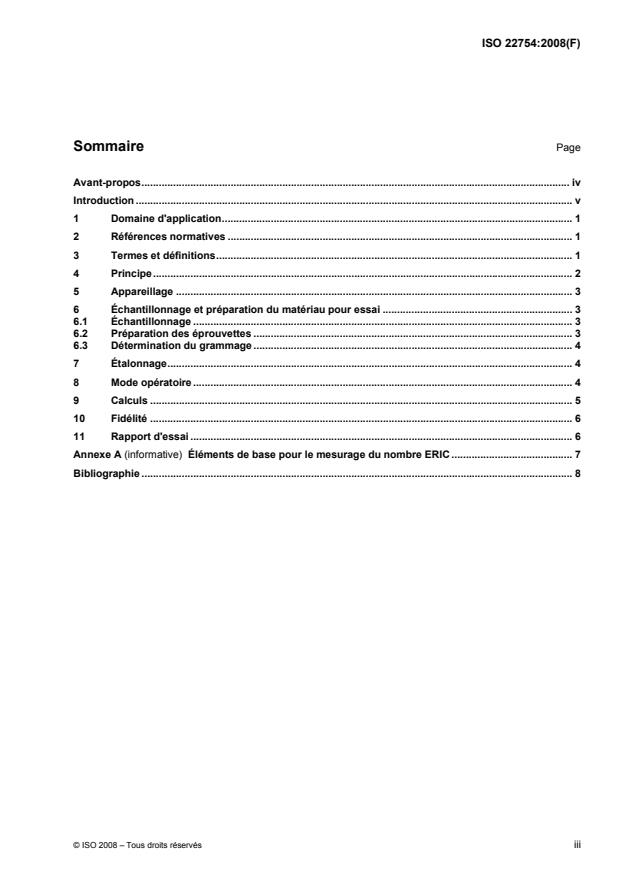
Contents Page
Foreword. iv
Introduction . v
1 Scope . 1
2 Normative references . 1
3 Terms and definitions. 1
4 Principle. 2
5 Apparatus . 2
6 Sampling and preparation of test material. 3
6.1 Sampling. 3
6.2 Preparation of the test pieces . 3
6.3 Grammage determination . 4
7 Calibration . 4
8 Procedure . 4
9 Calculations. 5
10 Precision. 6
11 Test report . 6
Annex A (informative) Background to the ERIC measurement . 7
Bibliography . 8
Foreword
ISO (the International Organization for Standardization) is a worldwide federation of national standards bodies
(ISO member bodies). The work of preparing International Standards is normally carried out through ISO
technical committees. Each member body interested in a subject for which a technical committee has been
established has the right to be represented on that committee. International organizations, governmental and
non-governmental, in liaison with ISO, also take part in the work. ISO collaborates closely with the
International Electrotechnical Commission (IEC) on all matters of electrotechnical standardization.
International Standards are drafted in accordance with the rules given in the ISO/IEC Directives, Part 2.
The main task of technical committees is to prepare International Standards. Draft International Standards
adopted by the technical committees are circulated to the member bodies for voting. Publication as an
International Standard requires approval by at least 75 % of the member bodies casting a vote.
Attention is drawn to the possibility that some of the elements of this document may be the subject of patent
rights. ISO shall not be held responsible for identifying any or all such patent rights.
ISO 22754 was prepared by Technical Committee ISO/TC 6, Paper, board and pulps.
iv © ISO 2008 – All rights reserved
Introduction
This International Standard provides a means of assessing the effective residual ink concentration (ERIC) in
paper made from recycled fibres. The presence of residual ink influences the brightness and colour of pulp
and of paper made from recycled fibre. The effect of the residual ink can be counteracted more easily if the
effective concentration of the ink can be monitored. Brightness is not, however, an effective parameter for
monitoring the deinking process, since brightness is affected by the presence not only of ink but also of other
light-absorbing materials in the blue region of the spectrum such as lignin and dyestuffs. The ERIC method
employs reflectance measurements in the infrared region of the spectrum where the light absorption
coefficient of the ink is several orders of magnitude greater than the absorption coefficients of the fibre and
[1]
other components, and this provides a sensitive means of estimating the concentration of ink . This
International Standard is based on the TAPPI method T 567 pm-97.
INTERNATIONAL STANDARD ISO 22754:2008(E)
Pulp and paper — Determination of the effective residual ink
concentration (ERIC number) by infrared reflectance
measurement
1 Scope
This International Standard specifies a method for the determination of the effective residual ink concentration
(ERIC number) by infrared reflectance measurement.
This International Standard is applicable to all types of deinked, recycled pulp and to sheets of machine-made
paper made from recycled pulp, where the residual ink is black. The method is applicable to materials
available in sheet form only if the opacity at 950 nm is less than 97 %. The ERIC number obtained is
[2]
dependent on the distribution of ink particle sizes, and the method is most effective for submicron particles .
The value obtained is reliable only if the test material is uniform in ink distribution, formation, and grammage
such that presenting different parts of the sheet to the measuring aperture of the reflectometer produces very
similar readings.
2 Normative references
The following referenced documents are indispensable for the application of this document. For dated
references, only the edition cited applies. For undated references, the latest edition of the referenced
document (including any amendments) applies.
ISO 186, Paper and board — Sampling to determine average quality
ISO 536, Paper and board — Determination of grammage
ISO 2469, Paper, board and pulps — Measurement of diffuse radiance factor
ISO 3688, Pulps — Preparation of laboratory sheets for the measurement of diffuse blue reflectance factor
(ISO brightness)
ISO 14487, Pulps — Standard water for physical testing
3 Terms and definitions
For the purposes of this document, the following terms and definitions apply.
3.1
diffuse reflectance factor
R
ratio of the radiation reflected by a body to that reflected by the perfect reflecting diffuser under the same
conditions of diffuse illumination and normal detection
NOTE 1 The ratio is often expressed as a percentage.
NOTE 2 This International Standard prescribes diffuse irradiation and normal detection in an instrument calibrated in
accordance with the provisions of this International Standard.
3.2
intrinsic reflectance factor
R
∞
diffuse reflectance factor of a layer or pad of material thick enough to be opaque, i.e. such that increasing the
thickness of the pad by doubling the number of sheets results in no change in the measured reflectance factor
NOTE The reflectance factor of a non-opaque sheet is dependent on the background and is not a material property.
3.3
single-sheet reflectance factor
R
reflectance factor of a single sheet of paper with a black cavity as backing
3.4
light scattering coefficient at 950 nm by reflectance factor measurements
s
〈Kubelka-Munk method〉 coefficient calculated by application of the Kubelka-Munk equations to reflectance
factor data obtained at a wavelength of 950 nm in an instrument having a geometry and having been
calibrated as specified in 5.1, and taking into consideration the grammage
NOTE 1 Units: m /kg.
NOTE 2 The relevant equations are given in Clause 9.
3.5
light absorption coefficient at 950 nm by reflectance factor measurements
k
〈Kubelka-Munk method〉 coefficient calculated by application of the Kubelka-Munk equations to reflectance
factor data obtained at a wavelength of 950 nm in an instrument having a geometry and having been
calibrated as specified in 5.1, and taking into consideration the grammage
NOTE 1 Units: m /kg.
NOTE 2 The relevant equations are given in Clause 9.
3.6
effective residual ink concentration
ERIC number
ratio of the light absorption coefficient of pulp or paper containing ink to the light absorption coefficient of the
ink itself, both being determined at a wavelength of 950 nm
NOTE The ERIC number is dimensionless.
4 Principle
The intrinsic reflectance factor and the single-sheet reflectance factor of the test material are determined at a
wavelength of 950 nm. The light absorption coefficient of the test material is calculated from these data by
application of the Kubelka-Munk equations. The ERIC number may then be calculated as the ratio of this
value to the light absorption coefficient of the ink.
5 Apparatus
5.1 Reflectometer, having the geometric, spectral and photometric characteristics described in ISO 2469,
equipped with a filter or other device enabling the reflectance factor to be measured at a wavelength of
950 nm, and calibrated in accordance with the provisions of ISO 2469.
2 © ISO 2008 – All rights reserved
For such measurements, the effective wavelength of the reflectometer shall be (950,0 ± 5,0) nm. The spectral
characteristics shall be such that the bandpass width at half peak height shall not exceed 150 nm, and the
bandpass width at 10 % peak height shall not exceed 250 nm.
5.2 Reference standard, issued by an ISO/TC 6 authorized laboratory in accordance with the provisions of
ISO 2469 for calibration of the instrument and the working standards, and having an assigned reflectance
value corresponding to a wavelength of 950 nm.
Use new reference standards sufficiently frequently to ensure that the reflectometer is maintained in
agreement with the reference instrument.
5.3 Working standards, two plates of flat opal glass, ceramic or other suitable material, cleaned and
calibrated as described in ISO 2469.
Calibrate the working standards sufficiently frequently to ensure that satisfactory calibration is maintained.
NOTE In some instruments, the function of the primary working standard may be taken over by a built-in internal
standard.
5.4 Black cavity, having a known reflectance factor of less than 1 % at 950 nm. The black cavity should be
stored upside down in a dust-free environment or with a protectiv
...
NORME ISO
INTERNATIONALE 22754
Première édition
2008-11-15
Pâte et papier — Détermination de la
concentration d'encre résiduelle relative
(nombre ERIC) par mesurage de la
réflectance infrarouge
Pulp and paper — Determination of the effective residual ink
concentration (ERIC number) by infrared reflectance measurement
Numéro de référence
©
ISO 2008
PDF – Exonération de responsabilité
Le présent fichier PDF peut contenir des polices de caractères intégrées. Conformément aux conditions de licence d'Adobe, ce fichier
peut être imprimé ou visualisé, mais ne doit pas être modifié à moins que l'ordinateur employé à cet effet ne bénéficie d'une licence
autorisant l'utilisation de ces polices et que celles-ci y soient installées. Lors du téléchargement de ce fichier, les parties concernées
acceptent de fait la responsabilité de ne pas enfreindre les conditions de licence d'Adobe. Le Secrétariat central de l'ISO décline toute
responsabilité en la matière.
Adobe est une marque déposée d'Adobe Systems Incorporated.
Les détails relatifs aux produits logiciels utilisés pour la création du présent fichier PDF sont disponibles dans la rubrique General Info
du fichier; les paramètres de création PDF ont été optimisés pour l'impression. Toutes les mesures ont été prises pour garantir
l'exploitation de ce fichier par les comités membres de l'ISO. Dans le cas peu probable où surviendrait un problème d'utilisation,
veuillez en informer le Secrétariat central à l'adresse donnée ci-dessous.
DOCUMENT PROTÉGÉ PAR COPYRIGHT
© ISO 2008
Droits de reproduction réservés. Sauf prescription différente, aucune partie de cette publication ne peut être reproduite ni utilisée sous
quelque forme que ce soit et par aucun procédé, électronique ou mécanique, y compris la photocopie et les microfilms, sans l'accord écrit
de l'ISO à l'adresse ci-après ou du comité membre de l'ISO dans le pays du demandeur.
ISO copyright office
Case postale 56 • CH-1211 Geneva 20
Tel. + 41 22 749 01 11
Fax + 41 22 749 09 47
E-mail copyright@iso.org
Web www.iso.org
Publié en Suisse
ii © ISO 2008 – Tous droits réservés
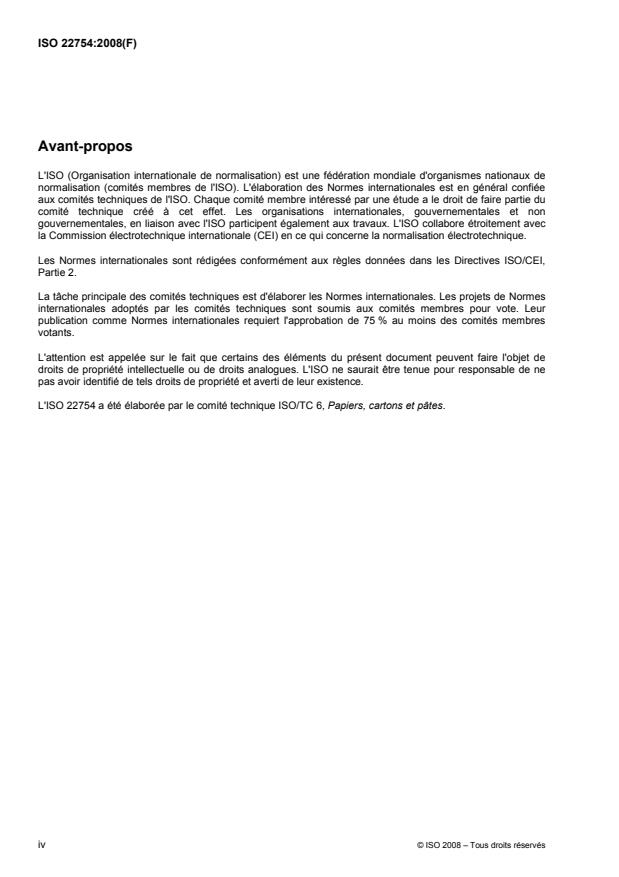
Sommaire Page
Avant-propos. iv
Introduction . v
1 Domaine d'application. 1
2 Références normatives . 1
3 Termes et définitions. 1
4 Principe. 2
5 Appareillage . 3
6 Échantillonnage et préparation du matériau pour essai . 3
6.1 Échantillonnage . 3
6.2 Préparation des éprouvettes . 3
6.3 Détermination du grammage . 4
7 Étalonnage. 4
8 Mode opératoire . 4
9 Calculs . 5
10 Fidélité . 6
11 Rapport d'essai . 6
Annexe A (informative) Éléments de base pour le mesurage du nombre ERIC . 7
Bibliographie . 8
Avant-propos
L'ISO (Organisation internationale de normalisation) est une fédération mondiale d'organismes nationaux de
normalisation (comités membres de l'ISO). L'élaboration des Normes internationales est en général confiée
aux comités techniques de l'ISO. Chaque comité membre intéressé par une étude a le droit de faire partie du
comité technique créé à cet effet. Les organisations internationales, gouvernementales et non
gouvernementales, en liaison avec l'ISO participent également aux travaux. L'ISO collabore étroitement avec
la Commission électrotechnique internationale (CEI) en ce qui concerne la normalisation électrotechnique.
Les Normes internationales sont rédigées conformément aux règles données dans les Directives ISO/CEI,
Partie 2.
La tâche principale des comités techniques est d'élaborer les Normes internationales. Les projets de Normes
internationales adoptés par les comités techniques sont soumis aux comités membres pour vote. Leur
publication comme Normes internationales requiert l'approbation de 75 % au moins des comités membres
votants.
L'attention est appelée sur le fait que certains des éléments du présent document peuvent faire l'objet de
droits de propriété intellectuelle ou de droits analogues. L'ISO ne saurait être tenue pour responsable de ne
pas avoir identifié de tels droits de propriété et averti de leur existence.
L'ISO 22754 a été élaborée par le comité technique ISO/TC 6, Papiers, cartons et pâtes.
iv © ISO 2008 – Tous droits réservés
Introduction
La présente Norme internationale fournit un moyen d'évaluer la concentration d'encre résiduelle relative
(ERIC) dans le papier fabriqué à partir de fibres recyclées. La présence d'encre résiduelle influe sur la
blancheur et la couleur de la pâte et du papier fabriqués à partir de fibres recyclées. L'effet de l'encre
résiduelle peut être neutralisé plus facilement si la concentration relative de l'encre peut être contrôlée.
Toutefois, le degré de blancheur n'est pas un paramètre effectif de surveillance du processus de désencrage
car il est affecté non seulement par la présence d'encre mais également par celle d'autres matériaux
absorbant la lumière dans la région bleue du spectre, tels que la lignine et les colorants. La méthode ERIC
utilise les mesurages de la réflectance dans la région infrarouge du spectre où le coefficient d'absorption de
lumière de l'encre est supérieur de plusieurs ordres de grandeur aux coefficients d'absorption des fibres et
autres composants; en outre, cette méthode fournit un moyen sensible permettant d'estimer la concentration
[1]
d'encre . La présente Norme internationale est basée sur la méthode d'essai TAPPI T 567 pm-97.
NORME INTERNATIONALE ISO 22754:2008(F)
Pâte et papier — Détermination de la concentration d'encre
résiduelle relative (nombre ERIC) par mesurage de la
réflectance infrarouge
1 Domaine d'application
La présente Norme internationale spécifie une méthode de détermination de la concentration d'encre
résiduelle relative (nombre ERIC) par mesurage de la réflectance infrarouge.
Cette méthode s'applique à tous les types de pâte désencrée et recyclée ainsi qu'aux feuilles de papier
fabriquées sur machine à partir de pâte recyclée lorsque l'encre résiduelle est noire. Cette méthode est
applicable aux matériaux disponibles sous forme de feuille uniquement si l'opacité à une longueur d'onde de
950 nm est inférieure à 97 %. Le nombre ERIC obtenu dépend de la répartition des tailles de particules
[2]
d'encre; et la méthode est plus efficace pour les particules submicroniques . La valeur obtenue n'est fiable
que si le matériau est uniforme en ce qui concerne la distribution de l'encre, la formation et le grammage de
telle sorte que la présentation de diverses parties de la feuille à l'ouverture de mesurage du réflectomètre
donne des résultats très similaires.
2 Références normatives
Les documents de référence suivants sont indispensables pour l'application du présent document. Pour les
références datées, seule l'édition citée s'applique. Pour les références non datées, la dernière édition du
document de référence s'applique (y compris les éventuels amendements).
ISO 186, Papier et carton — Échantillonnage pour déterminer la qualité moyenne
ISO 536, Papier et carton — Détermination du grammage
ISO 2469, Papier, carton et pâtes — Mesurage du facteur de luminance énergétique diffuse
ISO 3688, Pâtes — Préparation des feuilles de laboratoire pour le mesurage du facteur de réflectance diffuse
dans le bleu (degré de blancheur ISO)
ISO 14487, Pâtes — Eau normalisée pour essais physiques
3 Termes et définitions
Pour les besoins du présent document, les termes et définitions suivants s'appliquent.
3.1
facteur de réflectance diffuse
R
rapport du rayonnement réfléchi par un corps au rayonnement réfléchi par le diffuseur parfait par réflexion,
dans les mêmes conditions d'éclairage diffus et de détection normale
NOTE 1 Ce facteur est souvent exprimé sous forme de pourcentage.
NOTE 2 La présente Norme internationale spécifie l'utilisation d'un rayonnement diffus et d'une détection normale dans
un appareil étalonné conformément aux dispositions de la présente Norme internationale.
3.2
facteur de réflectance intrinsèque
R
∞
facteur de réflectance diffuse d'une couche ou d'une liasse de matériau suffisamment épaisse pour être
opaque, c'est-à-dire que l'augmentation de l'épaisseur de la liasse par doublement du nombre de feuilles la
constituant n'engendre aucune modification du facteur de réflectance mesuré
NOTE Le facteur de réflectance d'une feuille non opaque dépend du fond et n'est pas une propriété du matériau.
3.3
facteur de réflectance d'une feuille unique
R
facteur de réflectance d'une feuille unique de papier posée sur un fond noir
3.4
coefficient de diffusion de la lumière à 950 nm par mesurages du facteur de réflectance
s
〈méthode Kubelka-Munk〉 coefficient calculé en tenant compte du grammage et en appliquant les équations
de Kubelka-Munk aux données obtenues pour le facteur de réflectance à une longueur d'onde de 950 nm sur
un appareil ayant une géométrie et ayant été étalonné comme spécifié en 5.1
NOTE 1 L'unité utilisée pour exprimer le coefficient est: m /kg.
NOTE 2 Les équations appropriées sont données dans l'Article 9.
3.5
coefficient d'absorption de la lumière à 950 nm par mesurages du facteur de réflectance
k
〈méthode Kubelka-Munk〉 coefficient calculé en tenant compte du grammage et en appliquant les équations
de Kubelka-Munk aux données obtenues pour le facteur de réflectance à une longueur d'onde de 950 nm, sur
un appareil ayant une géométrie et ayant été étalonné comme spécifié en 5.1
NOTE 1 L'unité utilisée pour exprimer le coefficient est: m /kg.
NOTE 2 Les équations appropriées sont données dans l'Article 9.
3.6
concentration d'encre résiduelle relative
nombre ERIC
rapport du coefficient d'absorption de la lumière de pâtes ou de papiers contenant de l'encre au coefficient
d'absorption de la lumière de l'encre proprement dite, chacun étant déterminé à une longueur d'onde de
950 nm
NOTE Le nombre ERIC est sans dimension.
4 Principe
Le facteur de réflectance intrinsèque et le facteur de réflectance d'une feuille unique du matériau pour essai
sont déterminés à une longueur d'onde de 950 nm. Le coefficient d'absorption de la lumière du matériau pour
essai est calculé à partir de ces données à l'aide des équations de Kubelka-Munk. Le nombre ERIC peut
ensuite être calculé comme étant le rapport de cette valeur au coefficient d'absorption de la lumière de l'encre.
2 © ISO 2008 – Tous droits réservés
5 Appareillage
5.1 Réflectomètre, ayant les caractéristiques géométriques, spectrales et photométriques décrites dans
l'ISO 2469, équipé d'un filtre ou d'un autre dispositif permettant de mesurer le facteur de réflectance à une
longueur d'onde de 950 nm, et étalonné conformément aux dispositions de l'ISO 2469.
Pour de tels mesurages, la longueur d'onde effective du réflectomètre doit être de (950,0 ± 5,0) nm. Les
caractéristiques spectrales doivent être telles que la largeur de la bande passante à mi-hauteur ne dépasse
pas 150 nm et qu'à 10 % de la hauteur de crête elle ne dépasse pas 250 nm.
5.2 Étalon de référence, fourni par un laboratoire agréé par l'ISO/TC 6 conformément aux dispositions de
l'ISO 2469 pour l'étalonnage de l'appareil de mesure et des étalons de travail, et ayant une valeur de
réflectance assignée correspondant à une longueur d'onde de 950 nm.
Utiliser de nouveaux étalons de référence assez fréquemment pour s'assurer que le réflectomètre concorde
avec l'appareil de référence.
5.3 Étalons de travail, constitués de deux plaques de verre opale, de céramique ou d'un autre matériau
adapté, nettoyées et étalonnées conformément à l'ISO 2469.
Étalonner les étalons de travail de manière assez fréquente pour maintenir un étalonnage satisfaisant.
NOTE Dans certains appareils, la fonction de l'étalon de travail primaire peut être assurée par un étalon interne
intégré.
5.4 Corps noir, dont le facteur de réflectance connu est inférieur à 1 % à 950 nm. Il convient d'entrepose
...
Questions, Comments and Discussion
Ask us and Technical Secretary will try to provide an answer. You can facilitate discussion about the standard in here.
Loading comments...