

ISO 11231:2019
(Main)Space systems — Probabilistic risk assessment (PRA)
General Information
- Abstract
This document supports and complements the implementation of the risk management process defined in ISO 17666 in situations when the application of a quantitative risk assessment is deemed necessary. This document defines the principles, process, implementation and requirements for conducting a quantitative risk assessment and explains the details of probabilistic risk assessment (PRA) as applied to safety. While PRA can be applied to project risk management involving cost and schedule, this application is outside the scope of this document. This document provides the basic requirements and procedures for the use of PRA techniques to assess safety or mission risk and success in space programmes and projects. This document is applicable to all international space projects involving: — the design of space vehicles for the transportation of personnel in space; — the design of space and non-terrestrial planetary stations inhabited by human beings; — the design of space and launch vehicles powered by, or carrying, nuclear materials; — other projects as directed by the authorities or clients. These types of projects generally involve scenarios, chains of events or activities that could result in the death of, or serious injury to, members of the public, astronauts or pilots, or the workforce, or the loss of critical or high-value equipment and property. For other types of projects, it is intended that PRA be performed at the discretion of the project management.
- Status
- Published
- Publication Date
- 28-Apr-2019
- Technical Committee
- ISO/TC 20/SC 14 - Space systems and operations
- Drafting Committee
- ISO/TC 20/SC 14/WG 5 - Space System Program Management and Quality
- Current Stage
- 9092 - International Standard to be revised
- Start Date
- 25-Feb-2025
- Completion Date
- 29-Aug-2026
Buy Documents


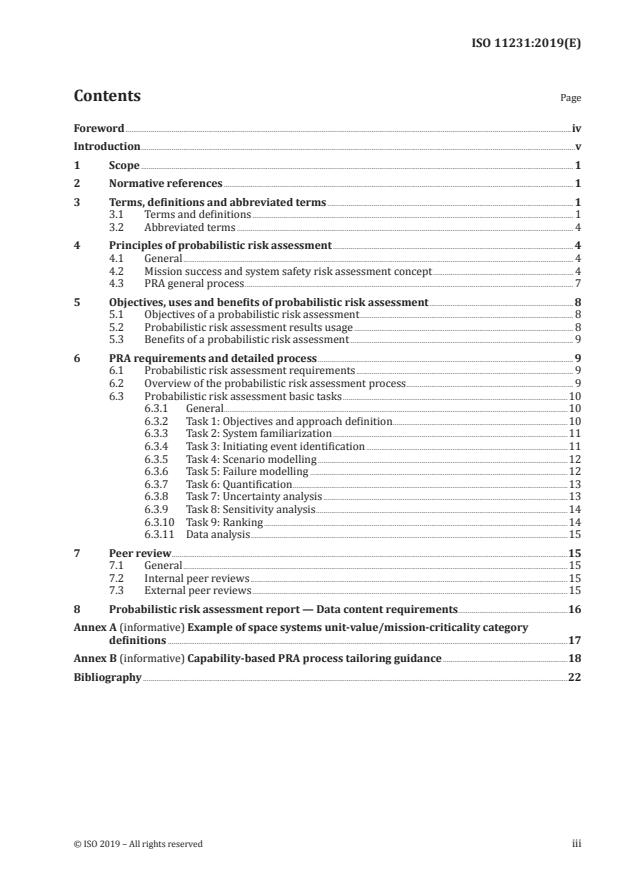

ISO 11231:2019 - Space systems -- Probabilistic risk assessment (PRA)
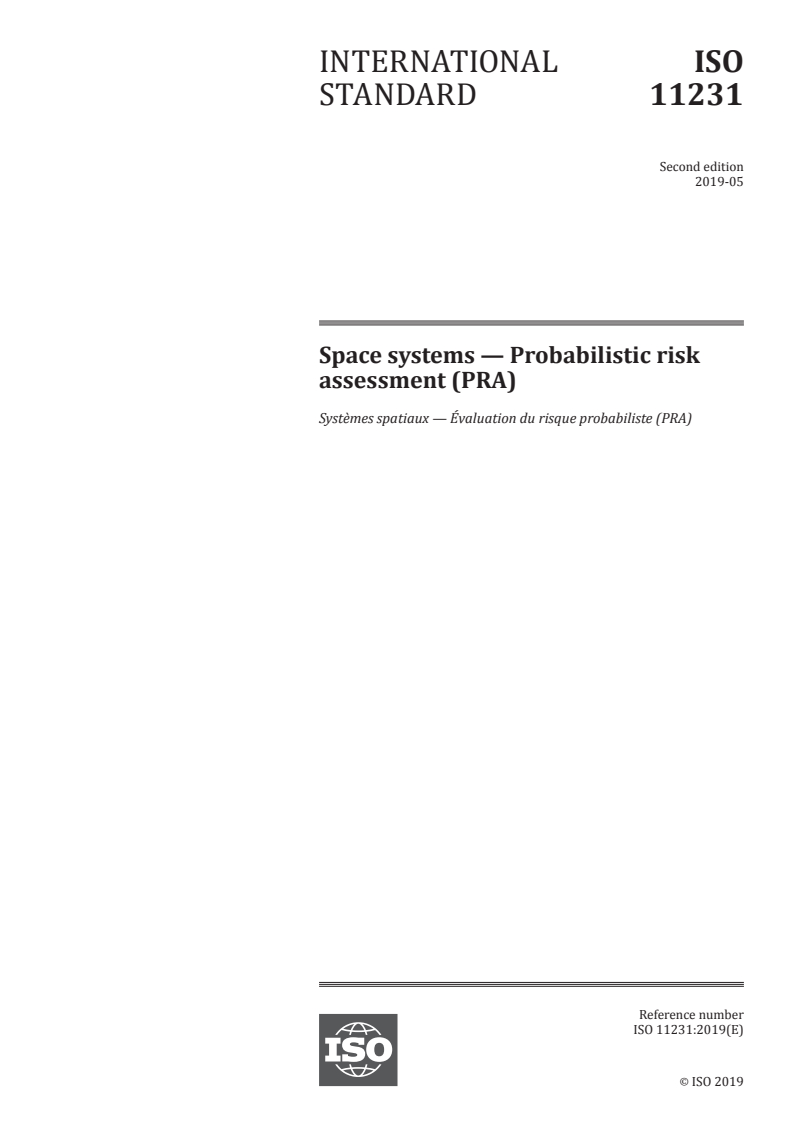

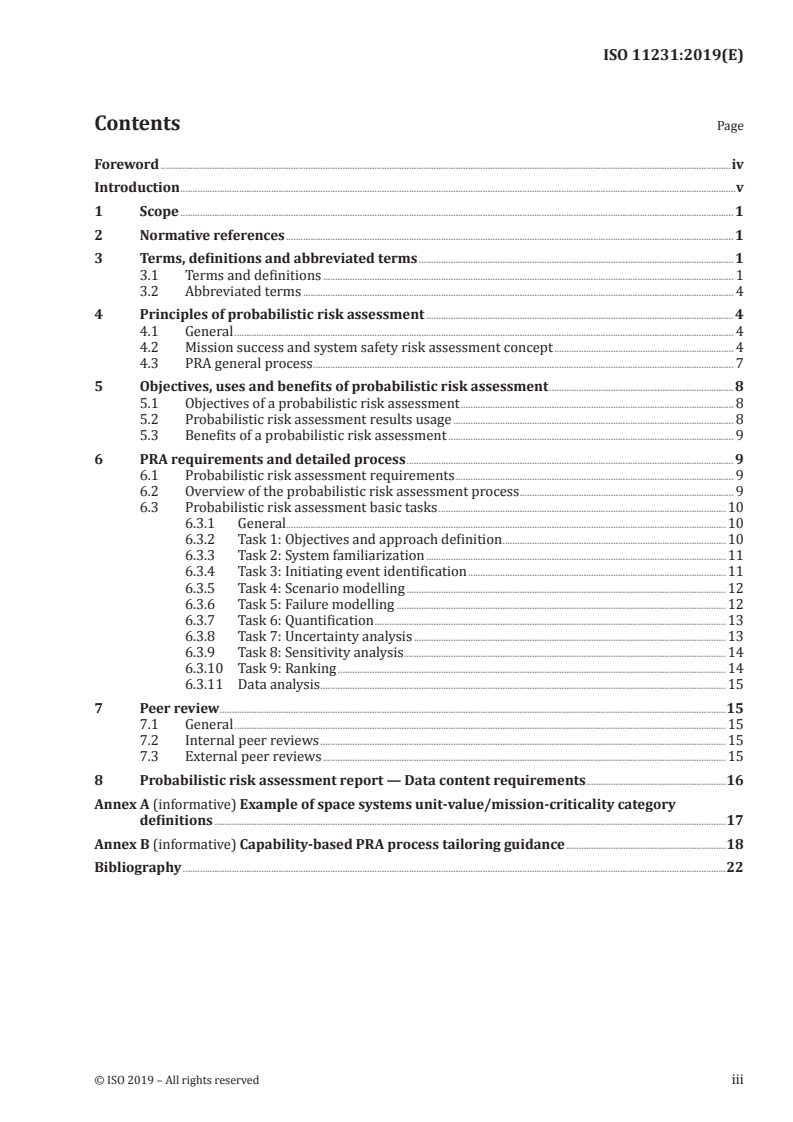

ISO 11231:2019 - Space systems — Probabilistic risk assessment (PRA)/29/2019
Overview
ISO 11231:2019 - "Space systems - Probabilistic risk assessment (PRA)" specifies principles, process, implementation and requirements for conducting quantitative probabilistic risk assessments in space programmes. It complements the risk management framework of ISO 17666 and is focused on safety and mission risk (not cost/schedule). The standard is intended for high-consequence space projects such as crewed space vehicles, inhabited planetary stations, launch or space vehicles carrying nuclear materials, and other projects as directed by authorities or clients.
Key technical topics and requirements
- Scope and applicability: PRA for safety and mission success in international space projects; quantitative approach where required by project management or regulators.
- PRA principles and process: Defines the PRA lifecycle and how PRA integrates with ISO 17666 risk management.
- Structured PRA tasks: A nine‑task process is described, including objectives & approach, system familiarization, initiating event identification, scenario modelling, failure modelling, quantification, uncertainty analysis, sensitivity analysis and ranking.
- Data, quantification and expert judgment: Guidance on data usage, expert elicitation and probability reference frames (e.g., per mission).
- Uncertainty and sensitivity analysis: Requirement to quantify uncertainties and use sensitivity studies to identify dominant risk contributors.
- Risk contribution and ranking: Methods to measure risk contributors to prioritize mitigation (risk reduction potential).
- Peer review and reporting: Internal and external peer review expectations and required PRA report data content.
- Definitions and normative references: Includes harmonized terminology (references ISO 17666; related definitions reference ISO 14620-2).
Practical applications - who uses ISO 11231
- Safety engineers and PRA analysts performing quantitative assessments of spacecraft, launch systems and inhabited facilities.
- Systems and mission assurance teams using PRA to inform design decisions, safety cases and allocation of resources.
- Program managers and regulators requiring documented, auditable PRA results to justify risk acceptance or mitigation.
- Project stakeholders and clients evaluating mission risk, crew safety and high-value asset protection.
Practical benefits include focused resource allocation, identification of dominant risk drivers, quantified uncertainty for decision making, and improved design/operational risk mitigation strategies.
Related standards
- ISO 17666 - Space systems - Risk management (normative reference; defines the broader RM process PRA complements)
- ISO 14620-2 (referenced for terms/definitions in the standard)
- ISO/IEC Directives (editorial and development context)
Keywords: ISO 11231, Probabilistic Risk Assessment, PRA, space systems, quantitative risk assessment, mission risk, safety risk, ISO 17666, uncertainty analysis, risk contribution.
Relations
- Effective Date
- 18-Jun-2016
Buy Documents
ISO 11231:2019 - Space systems -- Probabilistic risk assessment (PRA)
ISO 11231:2019 - Space systems — Probabilistic risk assessment (PRA)/29/2019
Get Certified
Connect with accredited certification bodies for this standard

BUREAU VERITAS Certification Germany
Bureau Veritas certification in Germany.

Element Materials Technology
Materials testing and product certification.

AQMS Ltd.
AQMS provides ISO certification to SMEs across the UK.
Sponsored listings
Frequently Asked Questions
ISO 11231:2019 is a standard published by the International Organization for Standardization (ISO). Its full title is "Space systems — Probabilistic risk assessment (PRA)". This standard covers: This document supports and complements the implementation of the risk management process defined in ISO 17666 in situations when the application of a quantitative risk assessment is deemed necessary. This document defines the principles, process, implementation and requirements for conducting a quantitative risk assessment and explains the details of probabilistic risk assessment (PRA) as applied to safety. While PRA can be applied to project risk management involving cost and schedule, this application is outside the scope of this document. This document provides the basic requirements and procedures for the use of PRA techniques to assess safety or mission risk and success in space programmes and projects. This document is applicable to all international space projects involving: — the design of space vehicles for the transportation of personnel in space; — the design of space and non-terrestrial planetary stations inhabited by human beings; — the design of space and launch vehicles powered by, or carrying, nuclear materials; — other projects as directed by the authorities or clients. These types of projects generally involve scenarios, chains of events or activities that could result in the death of, or serious injury to, members of the public, astronauts or pilots, or the workforce, or the loss of critical or high-value equipment and property. For other types of projects, it is intended that PRA be performed at the discretion of the project management.
This document supports and complements the implementation of the risk management process defined in ISO 17666 in situations when the application of a quantitative risk assessment is deemed necessary. This document defines the principles, process, implementation and requirements for conducting a quantitative risk assessment and explains the details of probabilistic risk assessment (PRA) as applied to safety. While PRA can be applied to project risk management involving cost and schedule, this application is outside the scope of this document. This document provides the basic requirements and procedures for the use of PRA techniques to assess safety or mission risk and success in space programmes and projects. This document is applicable to all international space projects involving: — the design of space vehicles for the transportation of personnel in space; — the design of space and non-terrestrial planetary stations inhabited by human beings; — the design of space and launch vehicles powered by, or carrying, nuclear materials; — other projects as directed by the authorities or clients. These types of projects generally involve scenarios, chains of events or activities that could result in the death of, or serious injury to, members of the public, astronauts or pilots, or the workforce, or the loss of critical or high-value equipment and property. For other types of projects, it is intended that PRA be performed at the discretion of the project management.
ISO 11231:2019 is classified under the following ICS (International Classification for Standards) categories: 49.140 - Space systems and operations. The ICS classification helps identify the subject area and facilitates finding related standards.
ISO 11231:2019 has the following relationships with other standards: It is inter standard links to ISO 11231:2010. Understanding these relationships helps ensure you are using the most current and applicable version of the standard.
ISO 11231:2019 is available in PDF format for immediate download after purchase. The document can be added to your cart and obtained through the secure checkout process. Digital delivery ensures instant access to the complete standard document.
Standards Content (Sample)
INTERNATIONAL ISO
STANDARD 11231
Second edition
2019-05
Space systems — Probabilistic risk
assessment (PRA)
Systèmes spatiaux — Évaluation du risque probabiliste (PRA)
Reference number
©
ISO 2019
© ISO 2019
All rights reserved. Unless otherwise specified, or required in the context of its implementation, no part of this publication may
be reproduced or utilized otherwise in any form or by any means, electronic or mechanical, including photocopying, or posting
on the internet or an intranet, without prior written permission. Permission can be requested from either ISO at the address
below or ISO’s member body in the country of the requester.
ISO copyright office
CP 401 • Ch. de Blandonnet 8
CH-1214 Vernier, Geneva
Phone: +41 22 749 01 11
Fax: +41 22 749 09 47
Email: copyright@iso.org
Website: www.iso.org
Published in Switzerland
ii © ISO 2019 – All rights reserved
Contents Page
Foreword .iv
Introduction .v
1 Scope . 1
2 Normative references . 1
3 Terms, definitions and abbreviated terms . 1
3.1 Terms and definitions . 1
3.2 Abbreviated terms . 4
4 Principles of probabilistic risk assessment . 4
4.1 General . 4
4.2 Mission success and system safety risk assessment concept . 4
4.3 PRA general process . 7
5 Objectives, uses and benefits of probabilistic risk assessment . 8
5.1 Objectives of a probabilistic risk assessment . 8
5.2 Probabilistic risk assessment results usage . 8
5.3 Benefits of a probabilistic risk assessment . 9
6 PRA requirements and detailed process . 9
6.1 Probabilistic risk assessment requirements . 9
6.2 Overview of the probabilistic risk assessment process . 9
6.3 Probabilistic risk assessment basic tasks .10
6.3.1 General.10
6.3.2 Task 1: Objectives and approach definition .10
6.3.3 Task 2: System familiarization .11
6.3.4 Task 3: Initiating event identification .11
6.3.5 Task 4: Scenario modelling .12
6.3.6 Task 5: Failure modelling .12
6.3.7 Task 6: Quantification .13
6.3.8 Task 7: Uncertainty analysis .13
6.3.9 Task 8: Sensitivity analysis .14
6.3.10 Task 9: Ranking .14
6.3.11 Data analysis .15
7 Peer review .15
7.1 General .15
7.2 Internal peer reviews .15
7.3 External peer reviews .15
8 Probabilistic risk assessment report — Data content requirements .16
Annex A (informative) Example of space systems unit-value/mission-criticality category
definitions .17
Annex B (informative) Capability-based PRA process tailoring guidance .18
Bibliography .22
Foreword
ISO (the International Organization for Standardization) is a worldwide federation of national standards
bodies (ISO member bodies). The work of preparing International Standards is normally carried out
through ISO technical committees. Each member body interested in a subject for which a technical
committee has been established has the right to be represented on that committee. International
organizations, governmental and non-governmental, in liaison with ISO, also take part in the work.
ISO collaborates closely with the International Electrotechnical Commission (IEC) on all matters of
electrotechnical standardization.
The procedures used to develop this document and those intended for its further maintenance are
described in the ISO/IEC Directives, Part 1. In particular, the different approval criteria needed for the
different types of ISO documents should be noted. This document was drafted in accordance with the
editorial rules of the ISO/IEC Directives, Part 2 (see www .iso .org/directives).
Attention is drawn to the possibility that some of the elements of this document may be the subject of
patent rights. ISO shall not be held responsible for identifying any or all such patent rights. Details of
any patent rights identified during the development of the document will be in the Introduction and/or
on the ISO list of patent declarations received (see www .iso .org/patents).
Any trade name used in this document is information given for the convenience of users and does not
constitute an endorsement.
For an explanation of the voluntary nature of standards, the meaning of ISO specific terms and
expressions related to conformity assessment, as well as information about ISO's adherence to the
World Trade Organization (WTO) principles in the Technical Barriers to Trade (TBT) see www .iso
.org/iso/foreword .html.
This document was prepared by Technical Committee ISO/TC 20, Aircraft and space vehicles,
Subcommittee SC 14, Space systems and operations.
This second edition cancels and replaces the first edition (ISO 11231:2010), which has been technically
revised.
The main changes compared to the previous edition are as follows:
— updated definitions of terms;
— simplification of Clause 4;
— updated figures and tables;
— addition of capability-based safety, reliability and quality assurance.
Any feedback or questions on this document should be directed to the user’s national standards body. A
complete listing of these bodies can be found at www .iso .org/members .html.
iv © ISO 2019 – All rights reserved
Introduction
Structured risk management processes use qualitative and quantitative risk assessment techniques
to support optimal decisions regarding safety and the probability of mission success, as provided in
ISO 17666. The most systematic and comprehensive methodology for conducting these evaluations is
probabilistic risk assessment (PRA).
PRA has, over the past three decades, become the principal analytic method for identifying and
analysing risk from projects and complex systems. Its utility for risk management (RM) has been
proven in many industries, including aerospace, electricity generation, petrochemical and defence. PRA
is a methodology used to identify and evaluate risk, in order to facilitate RM activities by identifying
dominant contributors to risk, so that resources can be effectively allocated to address significant
risk drivers and are not wasted on items that contribute insignificantly to the risk. In addition to
analysing risk, PRA provides a framework to quantify uncertainties in events and event sequences that
are important to system safety. By enabling the quantification of uncertainty, PRA informs decision
makers on the sources of uncertainty and provides information on the worth of investment resources
in reducing uncertainty. In this way, PRA supplements traditional safety analyses that support
safety-related decisions. Through the use of PRA, safety analyses are capable of focusing on both the
probability and severity of events and consequences that adversely impact safety.
PRA differs from reliability analysis in two important respects:
a) PRA allows a more precise quantification of uncertainty both for individual events and for the
overall system;
b) PRA applies more informative evaluations that quantify metrics related to the occurrence of highly
adverse consequences (e.g. fatalities, loss of mission), as opposed to narrowly defined system
performance metrics (e.g. mean-time-to-failure).
PRA also differs from hazard analyses, which identifies and evaluates metrics related to the effects of
high-consequence and low-probability events, treating them as if they had happened, i.e. without regard
to their probability of occurrence. In addition, the completeness of the set of accident scenarios cannot
be assured in the conduct of a hazard analysis. PRA results are more diverse and directly applicable
to resource allocation and other RM decision-making based on a broader spectrum of consequence
metrics.
Through the PRA process, weaknesses and vulnerabilities of the system that can adversely impact
safety, performance and mission success are identified. These results in turn provide insights into viable
RM strategies to reduce risk and direct the decision maker to areas where expenditure of resources to
improve design and operation might be more effective.
The most useful applications of PRA have been in the risk evaluation of complex systems that can result
in low-probability and high-consequence scenarios, or the evaluation of complex scenarios consisting of
chains of events that collectively may adversely impact system safety more than individually.
INTERNATIONAL STANDARD ISO 11231:2019(E)
Space systems — Probabilistic risk assessment (PRA)
1 Scope
This document supports and complements the implementation of the risk management process defined
in ISO 17666 in situations when the application of a quantitative risk assessment is deemed necessary.
This document defines the principles, process, implementation and requirements for conducting a
quantitative risk assessment and explains the details of probabilistic risk assessment (PRA) as applied
to safety. While PRA can be applied to project risk management involving cost and schedule, this
application is outside the scope of this document.
This document provides the basic requirements and procedures for the use of PRA techniques to assess
safety or mission risk and success in space programmes and projects. This document is applicable to all
international space projects involving:
— the design of space vehicles for the transportation of personnel in space;
— the design of space and non-terrestrial planetary stations inhabited by human beings;
— the design of space and launch vehicles powered by, or carrying, nuclear materials;
— other projects as directed by the authorities or clients.
These types of projects generally involve scenarios, chains of events or activities that could result in the
death of, or serious injury to, members of the public, astronauts or pilots, or the workforce, or the loss
of critical or high-value equipment and property. For other types of projects, it is intended that PRA be
performed at the discretion of the project management.
2 Normative references
The following documents are referred to in the text in such a way that some or all of their content
constitutes requirements of this document. For dated references, only the edition cited applies. For
undated references, the latest edition of the referenced document (including any amendments) applies.
ISO 17666, Space systems — Risk management
3 Terms, definitions and abbreviated terms
3.1 Terms and definitions
For the purpose of this document, the terms and definitions given in ISO 17666 and the following apply.
ISO and IEC maintain terminological databases for use in standardization at the following addresses:
— ISO Online browsing platform: available at https: //www .iso .org/obp
— IEC Electropedia: available at https: //www .electropedia .org/
3.1.1
acceptable risk
safety risk, the severity, and the probability (3.1.3) of which, may be reasonably accepted by humanity,
without durable or irreversible foreseeable consequences on health, Earth, and the environment, at the
present time and in the future
[SOURCE: ISO 14620-2:2011, 3.1, modified — The EXAMPLE has been removed]
3.1.2
expert judgment
systematic and structured elicitation of probability data through the estimation and assessment by
specialists
Note 1 to entry: “Structured” implies the use of a method; “systematic” means regularly.
Note 2 to entry: Mathematical aggregation of individual judgments is generally preferred over behavioural or
consensus aggregation.
3.1.3
probability
probability of occurrence or measure for the occurrence rate or frequency of an event, a hazard scenario
or consequence
3.1.4
probability reference frame
relative indicator against which the probability (3.1.3) is expressed
Note 1 to entry: The probability reference frame is linked to the structure of the analysis. A typical reference
frame in use in space projects is “per mission”.
3.1.5
risk
undesirable situation or circumstance that has both a likelihood of occurring and a potentially negative
consequence on a project
Note 1 to entry: Risks arise from uncertainty due to a lack of predictability or control of events. Risks are inherent
to any project and can arise at any time during the project life cycle; reducing these uncertainties reduces the risk.
[SOURCE: ISO 17666:2016, 3.1.12]
3.1.6
risk contribution
measure of the decrease of the probability (3.1.3) of a top consequence, when the events associated with
the corresponding risk contributor are assumed not to occur
Note 1 to entry: Risk contribution indicates (and is directly proportional to) the “risk reduction potential” of the
risk contributor. Important risk contributors are events, which have a high-risk contribution and risk reduction
potential.
Note 2 to entry: Risk contribution provides a systematic measure that makes it possible to rank design and
operation constituents of a system from a safety risk point of view. It allows the identification of high risk or
vulnerable areas in the system, which can then serve as drivers for safety improvements.
3.1.7
risk contributor
single event or particular set of events upon which the risk depends
Note 1 to entry: Risk contributors can be ranked relative to each other by their risk contribution (3.1.7).
2 © ISO 2019 – All rights reserved
3.1.8
risk management
systematic and iterative optimisation of the project resources, performed according to the established
project risk management policy
[SOURCE: ISO 17666:2016, 3.1.5]
3.1.9
risk scenario
sequence or combination of events leading from the initial cause to the unwanted consequence
Note 1 to entry: The cause can be a single event or something activating a dormant problem.
[SOURCE: ISO 17666:2016, 3.1.13]
3.1.10
safety risk
measure of the potential consequences of a hazard considering the probability (3.1.3) of the associated
mishap, the harm caused to people, and the damage caused to public and private property and the
environment
EXAMPLE Expected number of casualties.
Note 1 to entry: Safety risk is always associated with a specific hazard scenario or a particular set of scenarios.
The risk posed by a single scenario is called “individual scenario risk”. The risk posed by the combination of
individual risks and their impact on each other is called “overall risk”.
Note 2 to entry: The magnitude of safety risk is represented by the severity and the probability (3.1.3) of the
consequence.
[SOURCE: ISO 14620-2:2011, 3.30, modified — NOTE 1 and 2 have been removed; new Note 1 and 2 to
entry have been added; EXAMPLE has been added]
3.1.11
interested party
stakeholder
person or organization that can affect, be affected by, or perceive itself to be affected by a decision or
activity
EXAMPLE Customers, owners, people in an organization, providers, bankers, regulators, unions, partners or
society that can include competitors or opposing pressure groups.
[SOURCE: ISO 9000:2015, 3.2.3, modified — Note 1 to entry has been removed]
3.1.12
uncertainty
lack of certitude resulting from inaccuracies of input parameters, analysis process or both
Note 1 to entry: Uncertainty can be represented as an interval with an upper and lower value or as an uncertainty
distribution.
3.1.13
uncertainty contributor
single event or particular set of events upon which the uncertainty of the top consequence depends
Note 1 to entry: Uncertainty contributors can be ranked relative to each other by their uncertainty contribution
(3.1.13).
3.1.14
uncertainty contribution
measure of the decrease of the uncertainty of a top consequence, when the probabilities of the events
associated with the corresponding uncertainty contributor are assumed to be without uncertainty
Note 1 to entry: Uncertainty contribution indicates (and is directly proportional to) the “uncertainty reduction
potential” of the uncertainty contributor. Important uncertainty contributors are events, which have a high
uncertainty contribution and uncertainty reduction potential.
Note 2 to entry: Uncertainty contribution provides a systematic measure that makes it possible to rank data and
information sources.
3.2 Abbreviated terms
FMECA Failure Mode, Effects, and Criticality Analysis
IE Initiating Event
MLD Master Logic Diagrams
PRA Probabilistic Risk Assessment
P(A) probability of event A
P(A/B) conditional probability of event A given event B has occurred
RM Risk Management
4 Principles of probabilistic risk assessment
4.1 General
PRA assists engineers and managers in including risk results in management and engineering
practices and in the decision-making process throughout a project life cycle, for such aspects as design,
construction, testing, operation, maintenance and disposal, together with their interfaces, management,
cost and schedule (see ISO 17666).
In this document, the PRA methodology is intended for technical risk assessments involving mission
success and system safety.
4.2 Mission success and system safety risk assessment concept
The application of PRA to mission success and system safety risks is discussed here. Mission success and
system safety risk assessments complement deterministic failure modes and effects analysis (FMEA) and
hazard analysis (HA) by adding a probabilistic dimension to the deterministic evaluation in the form of
failure mode, effects, and criticality analysis (FMECA) in the case of the former and hazard risk assessment
in the case of the latter. These probabilistic evaluations support risk informed decision-making.
The relationship between the deterministic and probabilistic failure modes/hazards evaluation
methods is shown in Figure 1.
Mission-success and system safety risk assessments can be used to either assess the risks posed by
individual risk scenarios separately, or assess sets of risk scenarios collectively, in the form of the
overall risk posed by those scenarios.
The assessment of individual risk scenarios can be performed using consequence severity and scenario
probability categorization schemes by applying risk grids or risk matrices and risk indexes, as described
in ISO 23460 and ISO 14620-1. However, these risk matrixes and index methods cannot be used to
4 © ISO 2019 – All rights reserved
combine individual components of risk within a scenario or to combine scenarios to evaluate overall
risk. These methods do not constitute combinatorial computational tools.
Assessment of the overall risk posed by a particular set of scenarios requires the rigor of the PRA
approach. This assessment provides the basis for identifying and ranking risk contributors. Important
contributors can then be used for driving and optimizing the system design or operation from a safety
performance point of view. The calculated overall risk can also be compared to probabilistic safety
targets or acceptance criteria. Acceptable risks are defined by the authorities or clients in step 1 of the
risk management process. Risk can also be used as a metric for quantifying safety in decision models.
Key
S scenario i S (x ;p ) risk of scenario 1
i 1 1 1
S scenario 1 S (x ) severity of scenario N
1 N N
S scenario N: with severity = x and probability = p S (x ;p ) risk of scenario N
N i i N N N
S (x ) severity of scenario 1
1 1
Figure 1 — Relationship between the deterministic and probabilistic failure modes/hazard
evaluation methods
A representation of the assessment of the overall mission-success or system safety risk is shown in
Figure 2. As indicated in the figure, the risk assessment uses the failure mode or hazard scenarios
to model individual sequences of events that are necessary and sufficient for an undesired system
level consequence to occur. A scenario can be represented as a “logical intersection” of the initial
cause or initiating event and the necessary conditional intermediate events leading to the associated
consequence. The overall risk is then the logical union of the risk of the individual scenarios that lead to
the same consequence.
Probabilistic risk assessments of complex systems identify scenarios typically using event trees, or
event sequence diagrams and fault trees, to derive the logical models that lead to particular undesired
safety consequences of interest. As described above, in order to quantify scenarios, the probability of
the initiating events (i.e. causes) and the probability of each subsequent intermediate event, conditional
on the occurrence of the previous events in the sequence, are combined to determine the probability
that the end state (i.e. consequences) will occur. For each scenario, the severity (i.e. magnitude) of the
consequences is usually determined based on the physical characteristics and nature of the scenario
being evaluated. The overall consequences are determined by summing overall scenarios in a process
that is analogous to that used to determine the overall probability.
An estimation of event probabilities is usually based on different sources of data. Typical data sources
include previous experience with the particular system [i.e. measured or directly observed relevant
test or experience data and lessons learned (see ISO 16192)], data from other systems or projects
(i.e. extrapolation from generic data, similarity data or physical models) and expert judgment (i.e.
direct estimation of probabilities by domain specialists). Events are quantified in the context of the
corresponding hazard scenario, i.e. the probability of an event is assessed conditionally on the previous
events in the sequence.
Systematic identification and treatment of uncertainties is characteristic of the assessment of the
overall risk and conducted in two ways. The probability estimates of scenario events are produced with
their associated uncertainties and presented in the form of probability distributions or intervals. These
uncertainties are then propagated in the calculations of the probabilities of the consequence(s).
Quantification of the overall risk is obtained by calculating the probabilities and magnitudes of
the consequences. This calculation can be achieved through the use of point values or probability
(uncertainty) distributions. An uncertainty distribution is characterized by representative point values,
e.g. the mean or a specific quintile value in the upper part of the distribution. A representative point
value in the upper part of the uncertainty distribution associated with the overall risk, at a confidence
level accepted by the decision maker, tends to be used to implement the precautionary principle for risk
acceptance decisions and for risk comparisons. The precautionary principle implies that conservative
assumptions with respect to the risk value are preferred to optimistic ones, in order to ensure that a
system is not considered to satisfy an agreed risk target or an acceptance criterion falsely, or that one
option is not falsely preferred to another in the comparisons. A higher uncertainty regarding the overall
risk value transfers a higher representative point value to be used for risk acceptance or comparisons.
The relative importance of an event or a scenario to the overall risk is measured by its risk contribution.
The risk contribution provides information on the potential for safety improvement, i.e. potential for
reducing the overall risk associated with the event or scenario. Similar to individual events, design and
operation constituents can also be ranked from a risk reduction point of view by accumulating the risk
contributions of the events associated with the particular constituents.
The relative importance of the uncertainty of an event or a scenario to the uncertainty of the overall
risk is measured by its uncertainty contribution. Uncertainty contribution values indicate and rank
those events, which are the main sources of uncertainty for the consequence probability and have the
highest potential for reducing this uncertainty. The reduction of consequence uncertainties directly
transfers to the use of lower representative point values of the consequence probabilities.
Risk and uncertainty contributors are identified based on their ranking. Important risk and uncertainty
contributors are those events, or their corresponding system constituents, that have high-risk reduction
and uncertainty reduction potential.
6 © ISO 2019 – All rights reserved
Key
SC scenario 1 P(A ) probability of A , the initiating event
1 1 1
SC scenario 2 P(B │A ) conditional probability of B given A
2 1 1 1 1
SC scenario 3 P(C │B , A ) conditional probability of C given B and A
3 1 1 1 1 1 1
SC scenario N P(D │C , B , A ) conditional probability of D given C , B and
N 1 1 1 1 1 1 1
A
a
P(X) total probability, the logical sum of the Representative
probability of all scenarios 1 to N point value
Figure 2 — Example of the assessment of the overall risk
4.3 PRA general process
As illustrated in Figure 3, the PRA general process begins by identifying a set of “initiating events” (IEs)
that perturb the system, i.e. adverse triggers that cause it to change its operating state or configuration.
For each IE, the analysis proceeds by determining the subsequent events (failures) that can lead to
undesirable consequences. The magnitudes of the consequences of these scenarios are then determined,
as well as their occurrence frequencies (probabilities). Frequencies and consequences are integrated
into a representation of the risk profile of the system. This risk profile is evaluated for uncertainties
and then used to support risk management decisions.
Figure 3 — PRA general process flow steps
5 Objectives, uses and benefits of probabilistic risk assessment
5.1 Objectives of a probabilistic risk assessment
The objectives of a probabilistic risk assessment are the following:
— to identify and assess the (safety or mission) risks posed by individual identified scenarios, or to
identify and assess the overall risk posed by sets of scenarios collectively;
— to identify risk and uncertainty contributors, as well as corresponding risk areas in system design
and operation;
— to rank risk and uncertainty contributors in a decreasing order of importance;
— to identify and prioritize options for risk reduction.
5.2 Probabilistic risk assessment results usage
Probabilistic risk assessment results are used for the following:
— to assess the level of safety or mission risk and success in a quantitative (probabilistic) manner;
— to decrease the level mission risk and increase the level of safety or mission success of a system
through risk reduction;
— to drive the definition and implementation of design and operational requirements, specifications,
concepts, procedures, etc.;
— to provide a quantitative basis for defining safety and mission requirements by:
— determining the applicability of safety and mission requirements;
8 © ISO 2019 – All rights reserved
— implementing safety and mission requirements;
— to verify PRA results implementation and to demonstrate compliance or non-compliance;
— to support safety and mission-related project decisions;
— to support safety submissions and reviews through documented evidences;
— to support safety certification of a system through documented evidences;
— to support risk communication and tracking;
— to provide input to overall project risk management.
5.3 Benefits of a probabilistic risk assessment
The benefits of a probabilistic risk assessment are the following:
— to provide a quantitative framework for assessing risks and determining which are acceptable and
which are not;
— to apportion safety responsibilities among teams more realistically;
— to allocate safety improvement expenditures in proportion with the impact of these improvements
on risk reduction;
— to build safety into the system in an efficient and consistent way;
— to display quantitatively the significance of accident scenarios;
— to identify quantitatively system and component weaknesses;
— to assess phase related system or subsystem safety levels;
— to compare quantitatively the efficiency of risk reduction actions.
6 PRA requirements and detailed process
6.1 Probabilistic risk assessment requirements
The probabilistic risk assessment requirements in this document are defined as follows:
a) the probabilistic risk assessment shall follow the process as defined in 6.3;
b) the probabilistic risk assessment shall be documented in accordance with the requirements of
Clause 8.
6.2 Overview of the probabilistic risk assessment process
The basic tasks of a probabilistic risk assessment are described in 6.3. These basic tasks are used
to implement steps 1 through 4 of the PRA general process flow, as outlined in 4.3 and illustrated
in Figure 3. The PRA planning should result in a set of activities that are commensurate with the
system’s unit-value/mission-criticality and life cycle technical data content/maturity. This planning is
sometimes referred to as a capability-based process tailoring (see ISO/TS 18667). An example of space
systems unit-value/mission-criticality category definitions is provided in Annex A (sourced from ISO/
TS 18667). Guidance for capability-based PRA process tailoring is provided in Annex B (sourced from
ISO/TS 18667).
6.3 Probabilistic risk assessment basic tasks
6.3.1 General
The detailed PRA process flow diagram is illustrated in Figure 4. A brief description of each of the nine
basic tasks in this process is provided in 6.3.2 to 6.3.10.
Figure 4 — Detailed PRA process flow basic tasks
6.3.2 Task 1: Objectives and approach definition
The initial task of a PRA is to define the objectives, scope and approach of the analysis, i.e. plan the
PRA. The objectives of the risk assessment provide clear statements of the purpose and expected end
uses for the results. The scope defines the mission profile and system(s) or portion thereof that will
be included in the analysis. These two elements provide the basis for identifying and selecting the
consequence(s) metrics of interest. These consequence metrics can include harm to humans (e.g. injury,
illness or death), degradation of mission capabilities, loss of mission, property damage and losses or
other undesired outcomes.
Depending on the objectives and scope of the PRA, applicable system configurations and time frame,
guidelines for considering initiating events should be defined, i.e. whether to include external events
such as micrometeoroids. The results of task 1 should be completely reviewed by the appropriate
project management and responsible safety and mission assurance organizations prior to commencing
with the assessment.
The activities below are included in task 1.
a) Identify the objectives of the probabilistic risk assessment, by defining the intended purpose and
use(s) of the analytical results.
b) Identify the scope and depth of the analysis, by defining the mission envelope, applicable systems
boundaries (which part of systems design and operations will be analysed) and the level of detail
for accident scenarios and the associated analyses.
c) Identify the consequence metric(s) for the analysis, including the consequence types and
whether risks are required for individual hazard scenarios, or overall risks of specific undesired
consequence types, or both (i.e. loss of mission, loss of vehicle, loss of crew):
1) identify the risk grid, index scheme or risk matrix to be used (based on consequence severity
and scenario probability categories), and
10 © ISO 2019 – All rights reserved
2) identify specified overall risk targets or acceptance criteria (based on probabilistic targets and
criterion for a specific consequence).
d) Identify associated information and data sources.
e) Document the approved PRA plan.
6.3.3 Task 2: System familiarization
Familiarization with the system under analysis is the next step. Familiarization covers all relevant
design and operational information, including engineering and process drawings, as well as operating
and emergency procedures. If the PRA is being performed on an existing system that has been operated
for some time, the engineering information shall be on an as-built or as-operated basis. If the PRA is
being conducted during design, the engineering information needed for the assessment is based on
the as-designed configuration with considerations for system operations. Examination and, if possible,
visual inspection of the system(s) being analysed, are recommended. The purpose of this effort is to
become thoroughly familiar with the mission and systems involved and to gain an understanding
of the success states and success criteria needed for a proper overall mission completion. System
familiarization identifies how the systems operate, their interdependencies, the role of the human in
operations (command and control, maintenance) and any system configuration changes that may occur
during applicable mission stages, phases or regimes. Mission and system success criteria provide the
basis for developing functional and systemic models.
The activities below are included in task 2.
a) Identify and describe the analytical scope, systems configuration and operation (functional and
physical architecture and layout vis-à-vis the mission timeline), including mission phases and
operating configurations, system constituents and functions, and physical zones, etc.
b) Define the mission success criteria along with contributions from and the success criteria of each
system required for the completion of the mission.
6.3.4 Task 3: Initiating event identification
Next, a complete set of initiating events that triggers subsequent accident scenarios shall be identified
and analysed. These events initiate accident sequences leading to defined end states (consequence
metrics). There are several ways to identify initiating events. If the PRA is being performed on an
existing system that has been operated for some time, a review of past experiences, incidences and
operating history can help identify initiating events. If the analysis is being conducted on new designs,
past experience of similar systems in similar environments or with similar mission envelopes can be
used. Along with experience data, systematic methods, e.g. Master Logic Diagrams (MLD) and Failure
Mode, Effects, and Criticality Analysis (FMECA), are recommended for identifying initiating events.
An MLD is a hierarchical, top-down tree display, showing general types of undesired events at the
top, proceeding to increasingly detailed event descriptions at lower tiers and displaying postulated
initiating events at the bottom. An FMECA systematically assumes component failures and evaluates
their effects on the system performance.
When multiple initiating events leading to scenarios with the same end state are identified, those
events having very low probabilities can be screened out. Independent initiating events can be grouped
according to the similarity of challenges they pose to the system, i.e. initiated events that result in the
same system response. When initiating events are treated as a group, their frequencies can be summed
to derive the group initiator frequency.
The activities below are included in task 3.
a) Identify and evaluate initiating events that can trigger subsequence accident scenarios using
experience data and systematic methods (use relevant input from existing hazard analysis
produced in accordance with MLDs and FMECAs).
b) Evaluate the occurrence probabilities of the identified initiating events and screen out those events
with very low relative probabilities (or frequencies).
c) Combine initiating events with similar effects on the system into groups and determine the group
occurrence probabilities (frequencies).
6.3.5 Task 4: Scenario modelling
Modelling of accident scenario is an inductive process that usually involves tools called event trees. An
event tree starts with the initiating event and progresses through the scenario, a series of successes or
failures of intermediate events (also called pivotal events or top events), until end states are reached.
Event trees generally take into account the time sequence of pivotal or top events that represent the
functional or systemic behaviour of the overall system. Sometimes a graphical tool called an event
sequence diagram (ESD) is used to describe an accident scenario, because this type of diagram lends
itself better to engineering thinking than does an event tree. An ESD is logically equivalent to an event
tree and shall then be converted to an event tree for quantification. Another type of inductive modelling
tool that can also be employed is a reliability block diagram.
The activities below are included in task 4.
a) For each initiating event (or combined group of events), model the approximate time sequence
and conditional response (success or failure) of the pivotal events (i.e. human actions, structure,
systems, components) needed to prevent the initiating event from causing potential consequences.
b) For those accident sequences that are postulated to lead to potential consequences, evaluate the
conditional physical (mechanistic) response of the system to the physical impacts of the initiating
events as modified by identified preventative controls (i.e. human actions, structures, systems,
components) and determine the magnitude and characteristics of the ensuing physical response
(i.e. detonation, deflagration, loss of control, loss of oxygen, etc.).
c) For those physical system responses that can lead to potential consequences, model the conditional
response (success or failure) of the controls (i.e. human actions, structures, systems, components)
available or designed to mitigate the potential consequences that can be caused by the physical
system responses.
6.3.6 Task 5: Failure modelling
The modelling of failure causes and faults (or their complements, successes) of each pivotal or event
tree top event is a deductive process. There are several deductive modelling tools that can be employed
to evaluate the failure of top events such as Markov chains, reliability block diagrams and fault trees,
among others. Fault t
...
INTERNATIONAL ISO
STANDARD 11231
Second edition
2019-05
Space systems — Probabilistic risk
assessment (PRA)
Systèmes spatiaux — Évaluation du risque probabiliste (PRA)
Reference number
©
ISO 2019
© ISO 2019
All rights reserved. Unless otherwise specified, or required in the context of its implementation, no part of this publication may
be reproduced or utilized otherwise in any form or by any means, electronic or mechanical, including photocopying, or posting
on the internet or an intranet, without prior written permission. Permission can be requested from either ISO at the address
below or ISO’s member body in the country of the requester.
ISO copyright office
CP 401 • Ch. de Blandonnet 8
CH-1214 Vernier, Geneva
Phone: +41 22 749 01 11
Fax: +41 22 749 09 47
Email: copyright@iso.org
Website: www.iso.org
Published in Switzerland
ii © ISO 2019 – All rights reserved
Contents Page
Foreword .iv
Introduction .v
1 Scope . 1
2 Normative references . 1
3 Terms, definitions and abbreviated terms . 1
3.1 Terms and definitions . 1
3.2 Abbreviated terms . 4
4 Principles of probabilistic risk assessment . 4
4.1 General . 4
4.2 Mission success and system safety risk assessment concept . 4
4.3 PRA general process . 7
5 Objectives, uses and benefits of probabilistic risk assessment . 8
5.1 Objectives of a probabilistic risk assessment . 8
5.2 Probabilistic risk assessment results usage . 8
5.3 Benefits of a probabilistic risk assessment . 9
6 PRA requirements and detailed process . 9
6.1 Probabilistic risk assessment requirements . 9
6.2 Overview of the probabilistic risk assessment process . 9
6.3 Probabilistic risk assessment basic tasks .10
6.3.1 General.10
6.3.2 Task 1: Objectives and approach definition .10
6.3.3 Task 2: System familiarization .11
6.3.4 Task 3: Initiating event identification .11
6.3.5 Task 4: Scenario modelling .12
6.3.6 Task 5: Failure modelling .12
6.3.7 Task 6: Quantification .13
6.3.8 Task 7: Uncertainty analysis .13
6.3.9 Task 8: Sensitivity analysis .14
6.3.10 Task 9: Ranking .14
6.3.11 Data analysis .15
7 Peer review .15
7.1 General .15
7.2 Internal peer reviews .15
7.3 External peer reviews .15
8 Probabilistic risk assessment report — Data content requirements .16
Annex A (informative) Example of space systems unit-value/mission-criticality category
definitions .17
Annex B (informative) Capability-based PRA process tailoring guidance .18
Bibliography .22
Foreword
ISO (the International Organization for Standardization) is a worldwide federation of national standards
bodies (ISO member bodies). The work of preparing International Standards is normally carried out
through ISO technical committees. Each member body interested in a subject for which a technical
committee has been established has the right to be represented on that committee. International
organizations, governmental and non-governmental, in liaison with ISO, also take part in the work.
ISO collaborates closely with the International Electrotechnical Commission (IEC) on all matters of
electrotechnical standardization.
The procedures used to develop this document and those intended for its further maintenance are
described in the ISO/IEC Directives, Part 1. In particular, the different approval criteria needed for the
different types of ISO documents should be noted. This document was drafted in accordance with the
editorial rules of the ISO/IEC Directives, Part 2 (see www .iso .org/directives).
Attention is drawn to the possibility that some of the elements of this document may be the subject of
patent rights. ISO shall not be held responsible for identifying any or all such patent rights. Details of
any patent rights identified during the development of the document will be in the Introduction and/or
on the ISO list of patent declarations received (see www .iso .org/patents).
Any trade name used in this document is information given for the convenience of users and does not
constitute an endorsement.
For an explanation of the voluntary nature of standards, the meaning of ISO specific terms and
expressions related to conformity assessment, as well as information about ISO's adherence to the
World Trade Organization (WTO) principles in the Technical Barriers to Trade (TBT) see www .iso
.org/iso/foreword .html.
This document was prepared by Technical Committee ISO/TC 20, Aircraft and space vehicles,
Subcommittee SC 14, Space systems and operations.
This second edition cancels and replaces the first edition (ISO 11231:2010), which has been technically
revised.
The main changes compared to the previous edition are as follows:
— updated definitions of terms;
— simplification of Clause 4;
— updated figures and tables;
— addition of capability-based safety, reliability and quality assurance.
Any feedback or questions on this document should be directed to the user’s national standards body. A
complete listing of these bodies can be found at www .iso .org/members .html.
iv © ISO 2019 – All rights reserved
Introduction
Structured risk management processes use qualitative and quantitative risk assessment techniques
to support optimal decisions regarding safety and the probability of mission success, as provided in
ISO 17666. The most systematic and comprehensive methodology for conducting these evaluations is
probabilistic risk assessment (PRA).
PRA has, over the past three decades, become the principal analytic method for identifying and
analysing risk from projects and complex systems. Its utility for risk management (RM) has been
proven in many industries, including aerospace, electricity generation, petrochemical and defence. PRA
is a methodology used to identify and evaluate risk, in order to facilitate RM activities by identifying
dominant contributors to risk, so that resources can be effectively allocated to address significant
risk drivers and are not wasted on items that contribute insignificantly to the risk. In addition to
analysing risk, PRA provides a framework to quantify uncertainties in events and event sequences that
are important to system safety. By enabling the quantification of uncertainty, PRA informs decision
makers on the sources of uncertainty and provides information on the worth of investment resources
in reducing uncertainty. In this way, PRA supplements traditional safety analyses that support
safety-related decisions. Through the use of PRA, safety analyses are capable of focusing on both the
probability and severity of events and consequences that adversely impact safety.
PRA differs from reliability analysis in two important respects:
a) PRA allows a more precise quantification of uncertainty both for individual events and for the
overall system;
b) PRA applies more informative evaluations that quantify metrics related to the occurrence of highly
adverse consequences (e.g. fatalities, loss of mission), as opposed to narrowly defined system
performance metrics (e.g. mean-time-to-failure).
PRA also differs from hazard analyses, which identifies and evaluates metrics related to the effects of
high-consequence and low-probability events, treating them as if they had happened, i.e. without regard
to their probability of occurrence. In addition, the completeness of the set of accident scenarios cannot
be assured in the conduct of a hazard analysis. PRA results are more diverse and directly applicable
to resource allocation and other RM decision-making based on a broader spectrum of consequence
metrics.
Through the PRA process, weaknesses and vulnerabilities of the system that can adversely impact
safety, performance and mission success are identified. These results in turn provide insights into viable
RM strategies to reduce risk and direct the decision maker to areas where expenditure of resources to
improve design and operation might be more effective.
The most useful applications of PRA have been in the risk evaluation of complex systems that can result
in low-probability and high-consequence scenarios, or the evaluation of complex scenarios consisting of
chains of events that collectively may adversely impact system safety more than individually.
INTERNATIONAL STANDARD ISO 11231:2019(E)
Space systems — Probabilistic risk assessment (PRA)
1 Scope
This document supports and complements the implementation of the risk management process defined
in ISO 17666 in situations when the application of a quantitative risk assessment is deemed necessary.
This document defines the principles, process, implementation and requirements for conducting a
quantitative risk assessment and explains the details of probabilistic risk assessment (PRA) as applied
to safety. While PRA can be applied to project risk management involving cost and schedule, this
application is outside the scope of this document.
This document provides the basic requirements and procedures for the use of PRA techniques to assess
safety or mission risk and success in space programmes and projects. This document is applicable to all
international space projects involving:
— the design of space vehicles for the transportation of personnel in space;
— the design of space and non-terrestrial planetary stations inhabited by human beings;
— the design of space and launch vehicles powered by, or carrying, nuclear materials;
— other projects as directed by the authorities or clients.
These types of projects generally involve scenarios, chains of events or activities that could result in the
death of, or serious injury to, members of the public, astronauts or pilots, or the workforce, or the loss
of critical or high-value equipment and property. For other types of projects, it is intended that PRA be
performed at the discretion of the project management.
2 Normative references
The following documents are referred to in the text in such a way that some or all of their content
constitutes requirements of this document. For dated references, only the edition cited applies. For
undated references, the latest edition of the referenced document (including any amendments) applies.
ISO 17666, Space systems — Risk management
3 Terms, definitions and abbreviated terms
3.1 Terms and definitions
For the purpose of this document, the terms and definitions given in ISO 17666 and the following apply.
ISO and IEC maintain terminological databases for use in standardization at the following addresses:
— ISO Online browsing platform: available at https: //www .iso .org/obp
— IEC Electropedia: available at https: //www .electropedia .org/
3.1.1
acceptable risk
safety risk, the severity, and the probability (3.1.3) of which, may be reasonably accepted by humanity,
without durable or irreversible foreseeable consequences on health, Earth, and the environment, at the
present time and in the future
[SOURCE: ISO 14620-2:2011, 3.1, modified — The EXAMPLE has been removed]
3.1.2
expert judgment
systematic and structured elicitation of probability data through the estimation and assessment by
specialists
Note 1 to entry: “Structured” implies the use of a method; “systematic” means regularly.
Note 2 to entry: Mathematical aggregation of individual judgments is generally preferred over behavioural or
consensus aggregation.
3.1.3
probability
probability of occurrence or measure for the occurrence rate or frequency of an event, a hazard scenario
or consequence
3.1.4
probability reference frame
relative indicator against which the probability (3.1.3) is expressed
Note 1 to entry: The probability reference frame is linked to the structure of the analysis. A typical reference
frame in use in space projects is “per mission”.
3.1.5
risk
undesirable situation or circumstance that has both a likelihood of occurring and a potentially negative
consequence on a project
Note 1 to entry: Risks arise from uncertainty due to a lack of predictability or control of events. Risks are inherent
to any project and can arise at any time during the project life cycle; reducing these uncertainties reduces the risk.
[SOURCE: ISO 17666:2016, 3.1.12]
3.1.6
risk contribution
measure of the decrease of the probability (3.1.3) of a top consequence, when the events associated with
the corresponding risk contributor are assumed not to occur
Note 1 to entry: Risk contribution indicates (and is directly proportional to) the “risk reduction potential” of the
risk contributor. Important risk contributors are events, which have a high-risk contribution and risk reduction
potential.
Note 2 to entry: Risk contribution provides a systematic measure that makes it possible to rank design and
operation constituents of a system from a safety risk point of view. It allows the identification of high risk or
vulnerable areas in the system, which can then serve as drivers for safety improvements.
3.1.7
risk contributor
single event or particular set of events upon which the risk depends
Note 1 to entry: Risk contributors can be ranked relative to each other by their risk contribution (3.1.7).
2 © ISO 2019 – All rights reserved
3.1.8
risk management
systematic and iterative optimisation of the project resources, performed according to the established
project risk management policy
[SOURCE: ISO 17666:2016, 3.1.5]
3.1.9
risk scenario
sequence or combination of events leading from the initial cause to the unwanted consequence
Note 1 to entry: The cause can be a single event or something activating a dormant problem.
[SOURCE: ISO 17666:2016, 3.1.13]
3.1.10
safety risk
measure of the potential consequences of a hazard considering the probability (3.1.3) of the associated
mishap, the harm caused to people, and the damage caused to public and private property and the
environment
EXAMPLE Expected number of casualties.
Note 1 to entry: Safety risk is always associated with a specific hazard scenario or a particular set of scenarios.
The risk posed by a single scenario is called “individual scenario risk”. The risk posed by the combination of
individual risks and their impact on each other is called “overall risk”.
Note 2 to entry: The magnitude of safety risk is represented by the severity and the probability (3.1.3) of the
consequence.
[SOURCE: ISO 14620-2:2011, 3.30, modified — NOTE 1 and 2 have been removed; new Note 1 and 2 to
entry have been added; EXAMPLE has been added]
3.1.11
interested party
stakeholder
person or organization that can affect, be affected by, or perceive itself to be affected by a decision or
activity
EXAMPLE Customers, owners, people in an organization, providers, bankers, regulators, unions, partners or
society that can include competitors or opposing pressure groups.
[SOURCE: ISO 9000:2015, 3.2.3, modified — Note 1 to entry has been removed]
3.1.12
uncertainty
lack of certitude resulting from inaccuracies of input parameters, analysis process or both
Note 1 to entry: Uncertainty can be represented as an interval with an upper and lower value or as an uncertainty
distribution.
3.1.13
uncertainty contributor
single event or particular set of events upon which the uncertainty of the top consequence depends
Note 1 to entry: Uncertainty contributors can be ranked relative to each other by their uncertainty contribution
(3.1.13).
3.1.14
uncertainty contribution
measure of the decrease of the uncertainty of a top consequence, when the probabilities of the events
associated with the corresponding uncertainty contributor are assumed to be without uncertainty
Note 1 to entry: Uncertainty contribution indicates (and is directly proportional to) the “uncertainty reduction
potential” of the uncertainty contributor. Important uncertainty contributors are events, which have a high
uncertainty contribution and uncertainty reduction potential.
Note 2 to entry: Uncertainty contribution provides a systematic measure that makes it possible to rank data and
information sources.
3.2 Abbreviated terms
FMECA Failure Mode, Effects, and Criticality Analysis
IE Initiating Event
MLD Master Logic Diagrams
PRA Probabilistic Risk Assessment
P(A) probability of event A
P(A/B) conditional probability of event A given event B has occurred
RM Risk Management
4 Principles of probabilistic risk assessment
4.1 General
PRA assists engineers and managers in including risk results in management and engineering
practices and in the decision-making process throughout a project life cycle, for such aspects as design,
construction, testing, operation, maintenance and disposal, together with their interfaces, management,
cost and schedule (see ISO 17666).
In this document, the PRA methodology is intended for technical risk assessments involving mission
success and system safety.
4.2 Mission success and system safety risk assessment concept
The application of PRA to mission success and system safety risks is discussed here. Mission success and
system safety risk assessments complement deterministic failure modes and effects analysis (FMEA) and
hazard analysis (HA) by adding a probabilistic dimension to the deterministic evaluation in the form of
failure mode, effects, and criticality analysis (FMECA) in the case of the former and hazard risk assessment
in the case of the latter. These probabilistic evaluations support risk informed decision-making.
The relationship between the deterministic and probabilistic failure modes/hazards evaluation
methods is shown in Figure 1.
Mission-success and system safety risk assessments can be used to either assess the risks posed by
individual risk scenarios separately, or assess sets of risk scenarios collectively, in the form of the
overall risk posed by those scenarios.
The assessment of individual risk scenarios can be performed using consequence severity and scenario
probability categorization schemes by applying risk grids or risk matrices and risk indexes, as described
in ISO 23460 and ISO 14620-1. However, these risk matrixes and index methods cannot be used to
4 © ISO 2019 – All rights reserved
combine individual components of risk within a scenario or to combine scenarios to evaluate overall
risk. These methods do not constitute combinatorial computational tools.
Assessment of the overall risk posed by a particular set of scenarios requires the rigor of the PRA
approach. This assessment provides the basis for identifying and ranking risk contributors. Important
contributors can then be used for driving and optimizing the system design or operation from a safety
performance point of view. The calculated overall risk can also be compared to probabilistic safety
targets or acceptance criteria. Acceptable risks are defined by the authorities or clients in step 1 of the
risk management process. Risk can also be used as a metric for quantifying safety in decision models.
Key
S scenario i S (x ;p ) risk of scenario 1
i 1 1 1
S scenario 1 S (x ) severity of scenario N
1 N N
S scenario N: with severity = x and probability = p S (x ;p ) risk of scenario N
N i i N N N
S (x ) severity of scenario 1
1 1
Figure 1 — Relationship between the deterministic and probabilistic failure modes/hazard
evaluation methods
A representation of the assessment of the overall mission-success or system safety risk is shown in
Figure 2. As indicated in the figure, the risk assessment uses the failure mode or hazard scenarios
to model individual sequences of events that are necessary and sufficient for an undesired system
level consequence to occur. A scenario can be represented as a “logical intersection” of the initial
cause or initiating event and the necessary conditional intermediate events leading to the associated
consequence. The overall risk is then the logical union of the risk of the individual scenarios that lead to
the same consequence.
Probabilistic risk assessments of complex systems identify scenarios typically using event trees, or
event sequence diagrams and fault trees, to derive the logical models that lead to particular undesired
safety consequences of interest. As described above, in order to quantify scenarios, the probability of
the initiating events (i.e. causes) and the probability of each subsequent intermediate event, conditional
on the occurrence of the previous events in the sequence, are combined to determine the probability
that the end state (i.e. consequences) will occur. For each scenario, the severity (i.e. magnitude) of the
consequences is usually determined based on the physical characteristics and nature of the scenario
being evaluated. The overall consequences are determined by summing overall scenarios in a process
that is analogous to that used to determine the overall probability.
An estimation of event probabilities is usually based on different sources of data. Typical data sources
include previous experience with the particular system [i.e. measured or directly observed relevant
test or experience data and lessons learned (see ISO 16192)], data from other systems or projects
(i.e. extrapolation from generic data, similarity data or physical models) and expert judgment (i.e.
direct estimation of probabilities by domain specialists). Events are quantified in the context of the
corresponding hazard scenario, i.e. the probability of an event is assessed conditionally on the previous
events in the sequence.
Systematic identification and treatment of uncertainties is characteristic of the assessment of the
overall risk and conducted in two ways. The probability estimates of scenario events are produced with
their associated uncertainties and presented in the form of probability distributions or intervals. These
uncertainties are then propagated in the calculations of the probabilities of the consequence(s).
Quantification of the overall risk is obtained by calculating the probabilities and magnitudes of
the consequences. This calculation can be achieved through the use of point values or probability
(uncertainty) distributions. An uncertainty distribution is characterized by representative point values,
e.g. the mean or a specific quintile value in the upper part of the distribution. A representative point
value in the upper part of the uncertainty distribution associated with the overall risk, at a confidence
level accepted by the decision maker, tends to be used to implement the precautionary principle for risk
acceptance decisions and for risk comparisons. The precautionary principle implies that conservative
assumptions with respect to the risk value are preferred to optimistic ones, in order to ensure that a
system is not considered to satisfy an agreed risk target or an acceptance criterion falsely, or that one
option is not falsely preferred to another in the comparisons. A higher uncertainty regarding the overall
risk value transfers a higher representative point value to be used for risk acceptance or comparisons.
The relative importance of an event or a scenario to the overall risk is measured by its risk contribution.
The risk contribution provides information on the potential for safety improvement, i.e. potential for
reducing the overall risk associated with the event or scenario. Similar to individual events, design and
operation constituents can also be ranked from a risk reduction point of view by accumulating the risk
contributions of the events associated with the particular constituents.
The relative importance of the uncertainty of an event or a scenario to the uncertainty of the overall
risk is measured by its uncertainty contribution. Uncertainty contribution values indicate and rank
those events, which are the main sources of uncertainty for the consequence probability and have the
highest potential for reducing this uncertainty. The reduction of consequence uncertainties directly
transfers to the use of lower representative point values of the consequence probabilities.
Risk and uncertainty contributors are identified based on their ranking. Important risk and uncertainty
contributors are those events, or their corresponding system constituents, that have high-risk reduction
and uncertainty reduction potential.
6 © ISO 2019 – All rights reserved
Key
SC scenario 1 P(A ) probability of A , the initiating event
1 1 1
SC scenario 2 P(B │A ) conditional probability of B given A
2 1 1 1 1
SC scenario 3 P(C │B , A ) conditional probability of C given B and A
3 1 1 1 1 1 1
SC scenario N P(D │C , B , A ) conditional probability of D given C , B and
N 1 1 1 1 1 1 1
A
a
P(X) total probability, the logical sum of the Representative
probability of all scenarios 1 to N point value
Figure 2 — Example of the assessment of the overall risk
4.3 PRA general process
As illustrated in Figure 3, the PRA general process begins by identifying a set of “initiating events” (IEs)
that perturb the system, i.e. adverse triggers that cause it to change its operating state or configuration.
For each IE, the analysis proceeds by determining the subsequent events (failures) that can lead to
undesirable consequences. The magnitudes of the consequences of these scenarios are then determined,
as well as their occurrence frequencies (probabilities). Frequencies and consequences are integrated
into a representation of the risk profile of the system. This risk profile is evaluated for uncertainties
and then used to support risk management decisions.
Figure 3 — PRA general process flow steps
5 Objectives, uses and benefits of probabilistic risk assessment
5.1 Objectives of a probabilistic risk assessment
The objectives of a probabilistic risk assessment are the following:
— to identify and assess the (safety or mission) risks posed by individual identified scenarios, or to
identify and assess the overall risk posed by sets of scenarios collectively;
— to identify risk and uncertainty contributors, as well as corresponding risk areas in system design
and operation;
— to rank risk and uncertainty contributors in a decreasing order of importance;
— to identify and prioritize options for risk reduction.
5.2 Probabilistic risk assessment results usage
Probabilistic risk assessment results are used for the following:
— to assess the level of safety or mission risk and success in a quantitative (probabilistic) manner;
— to decrease the level mission risk and increase the level of safety or mission success of a system
through risk reduction;
— to drive the definition and implementation of design and operational requirements, specifications,
concepts, procedures, etc.;
— to provide a quantitative basis for defining safety and mission requirements by:
— determining the applicability of safety and mission requirements;
8 © ISO 2019 – All rights reserved
— implementing safety and mission requirements;
— to verify PRA results implementation and to demonstrate compliance or non-compliance;
— to support safety and mission-related project decisions;
— to support safety submissions and reviews through documented evidences;
— to support safety certification of a system through documented evidences;
— to support risk communication and tracking;
— to provide input to overall project risk management.
5.3 Benefits of a probabilistic risk assessment
The benefits of a probabilistic risk assessment are the following:
— to provide a quantitative framework for assessing risks and determining which are acceptable and
which are not;
— to apportion safety responsibilities among teams more realistically;
— to allocate safety improvement expenditures in proportion with the impact of these improvements
on risk reduction;
— to build safety into the system in an efficient and consistent way;
— to display quantitatively the significance of accident scenarios;
— to identify quantitatively system and component weaknesses;
— to assess phase related system or subsystem safety levels;
— to compare quantitatively the efficiency of risk reduction actions.
6 PRA requirements and detailed process
6.1 Probabilistic risk assessment requirements
The probabilistic risk assessment requirements in this document are defined as follows:
a) the probabilistic risk assessment shall follow the process as defined in 6.3;
b) the probabilistic risk assessment shall be documented in accordance with the requirements of
Clause 8.
6.2 Overview of the probabilistic risk assessment process
The basic tasks of a probabilistic risk assessment are described in 6.3. These basic tasks are used
to implement steps 1 through 4 of the PRA general process flow, as outlined in 4.3 and illustrated
in Figure 3. The PRA planning should result in a set of activities that are commensurate with the
system’s unit-value/mission-criticality and life cycle technical data content/maturity. This planning is
sometimes referred to as a capability-based process tailoring (see ISO/TS 18667). An example of space
systems unit-value/mission-criticality category definitions is provided in Annex A (sourced from ISO/
TS 18667). Guidance for capability-based PRA process tailoring is provided in Annex B (sourced from
ISO/TS 18667).
6.3 Probabilistic risk assessment basic tasks
6.3.1 General
The detailed PRA process flow diagram is illustrated in Figure 4. A brief description of each of the nine
basic tasks in this process is provided in 6.3.2 to 6.3.10.
Figure 4 — Detailed PRA process flow basic tasks
6.3.2 Task 1: Objectives and approach definition
The initial task of a PRA is to define the objectives, scope and approach of the analysis, i.e. plan the
PRA. The objectives of the risk assessment provide clear statements of the purpose and expected end
uses for the results. The scope defines the mission profile and system(s) or portion thereof that will
be included in the analysis. These two elements provide the basis for identifying and selecting the
consequence(s) metrics of interest. These consequence metrics can include harm to humans (e.g. injury,
illness or death), degradation of mission capabilities, loss of mission, property damage and losses or
other undesired outcomes.
Depending on the objectives and scope of the PRA, applicable system configurations and time frame,
guidelines for considering initiating events should be defined, i.e. whether to include external events
such as micrometeoroids. The results of task 1 should be completely reviewed by the appropriate
project management and responsible safety and mission assurance organizations prior to commencing
with the assessment.
The activities below are included in task 1.
a) Identify the objectives of the probabilistic risk assessment, by defining the intended purpose and
use(s) of the analytical results.
b) Identify the scope and depth of the analysis, by defining the mission envelope, applicable systems
boundaries (which part of systems design and operations will be analysed) and the level of detail
for accident scenarios and the associated analyses.
c) Identify the consequence metric(s) for the analysis, including the consequence types and
whether risks are required for individual hazard scenarios, or overall risks of specific undesired
consequence types, or both (i.e. loss of mission, loss of vehicle, loss of crew):
1) identify the risk grid, index scheme or risk matrix to be used (based on consequence severity
and scenario probability categories), and
10 © ISO 2019 – All rights reserved
2) identify specified overall risk targets or acceptance criteria (based on probabilistic targets and
criterion for a specific consequence).
d) Identify associated information and data sources.
e) Document the approved PRA plan.
6.3.3 Task 2: System familiarization
Familiarization with the system under analysis is the next step. Familiarization covers all relevant
design and operational information, including engineering and process drawings, as well as operating
and emergency procedures. If the PRA is being performed on an existing system that has been operated
for some time, the engineering information shall be on an as-built or as-operated basis. If the PRA is
being conducted during design, the engineering information needed for the assessment is based on
the as-designed configuration with considerations for system operations. Examination and, if possible,
visual inspection of the system(s) being analysed, are recommended. The purpose of this effort is to
become thoroughly familiar with the mission and systems involved and to gain an understanding
of the success states and success criteria needed for a proper overall mission completion. System
familiarization identifies how the systems operate, their interdependencies, the role of the human in
operations (command and control, maintenance) and any system configuration changes that may occur
during applicable mission stages, phases or regimes. Mission and system success criteria provide the
basis for developing functional and systemic models.
The activities below are included in task 2.
a) Identify and describe the analytical scope, systems configuration and operation (functional and
physical architecture and layout vis-à-vis the mission timeline), including mission phases and
operating configurations, system constituents and functions, and physical zones, etc.
b) Define the mission success criteria along with contributions from and the success criteria of each
system required for the completion of the mission.
6.3.4 Task 3: Initiating event identification
Next, a complete set of initiating events that triggers subsequent accident scenarios shall be identified
and analysed. These events initiate accident sequences leading to defined end states (consequence
metrics). There are several ways to identify initiating events. If the PRA is being performed on an
existing system that has been operated for some time, a review of past experiences, incidences and
operating history can help identify initiating events. If the analysis is being conducted on new designs,
past experience of similar systems in similar environments or with similar mission envelopes can be
used. Along with experience data, systematic methods, e.g. Master Logic Diagrams (MLD) and Failure
Mode, Effects, and Criticality Analysis (FMECA), are recommended for identifying initiating events.
An MLD is a hierarchical, top-down tree display, showing general types of undesired events at the
top, proceeding to increasingly detailed event descriptions at lower tiers and displaying postulated
initiating events at the bottom. An FMECA systematically assumes component failures and evaluates
their effects on the system performance.
When multiple initiating events leading to scenarios with the same end state are identified, those
events having very low probabilities can be screened out. Independent initiating events can be grouped
according to the similarity of challenges they pose to the system, i.e. initiated events that result in the
same system response. When initiating events are treated as a group, their frequencies can be summed
to derive the group initiator frequency.
The activities below are included in task 3.
a) Identify and evaluate initiating events that can trigger subsequence accident scenarios using
experience data and systematic methods (use relevant input from existing hazard analysis
produced in accordance with MLDs and FMECAs).
b) Evaluate the occurrence probabilities of the identified initiating events and screen out those events
with very low relative probabilities (or frequencies).
c) Combine initiating events with similar effects on the system into groups and determine the group
occurrence probabilities (frequencies).
6.3.5 Task 4: Scenario modelling
Modelling of accident scenario is an inductive process that usually involves tools called event trees. An
event tree starts with the initiating event and progresses through the scenario, a series of successes or
failures of intermediate events (also called pivotal events or top events), until end states are reached.
Event trees generally take into account the time sequence of pivotal or top events that represent the
functional or systemic behaviour of the overall system. Sometimes a graphical tool called an event
sequence diagram (ESD) is used to describe an accident scenario, because this type of diagram lends
itself better to engineering thinking than does an event tree. An ESD is logically equivalent to an event
tree and shall then be converted to an event tree for quantification. Another type of inductive modelling
tool that can also be employed is a reliability block diagram.
The activities below are included in task 4.
a) For each initiating event (or combined group of events), model the approximate time sequence
and conditional response (success or failure) of the pivotal events (i.e. human actions, structure,
systems, components) needed to prevent the initiating event from causing potential consequences.
b) For those accident sequences that are postulated to lead to potential consequences, evaluate the
conditional physical (mechanistic) response of the system to the physical impacts of the initiating
events as modified by identified preventative controls (i.e. human actions, structures, systems,
components) and determine the magnitude and characteristics of the ensuing physical response
(i.e. detonation, deflagration, loss of control, loss of oxygen, etc.).
c) For those physical system responses that can lead to potential consequences, model the conditional
response (success or failure) of the controls (i.e. human actions, structures, systems, components)
available or designed to mitigate the potential consequences that can be caused by the physical
system responses.
6.3.6 Task 5: Failure modelling
The modelling of failure causes and faults (or their complements, successes) of each pivotal or event
tree top event is a deductive process. There are several deductive modelling tools that can be employed
to evaluate the failure of top events such as Markov chains, reliability block diagrams and fault trees,
among others. Fault t
...