


ISO 21339:2023
(Main)6Al-4V titanium alloys — Determination of aluminium and vanadium contents — Inductively coupled plasma atomic emission spectrometric method
6Al-4V titanium alloys — Determination of aluminium and vanadium contents — Inductively coupled plasma atomic emission spectrometric method
This document specifies an inductively coupled plasma atomic emission spectrometric method for the determination of the contents (mass fraction) of aluminium and vanadium in 6Al-4V titanium alloys. This method is applicable to all kinds of 6Al-4V titanium alloys specified in ISO 23515 (designation of titanium alloys) for aluminium in the range from 4,70 % to 7,00 % and vanadium in the range from 3,00 % to 5,00 %.
6Al-4V alliages de titane — Détermination de la teneur en aluminium et en vanadium — Méthode par spectrométrie d'émission atomique avec plasma à couplage inductif
General Information
- Status
- Published
- Publication Date
- 28-Sep-2023
- Technical Committee
- ISO/TC 79/SC 11 - Titanium
- Drafting Committee
- ISO/TC 79/SC 11/WG 2 - Chemical analysis
- Current Stage
- 6060 - International Standard published
- Start Date
- 29-Sep-2023
- Due Date
- 30-Mar-2025
- Completion Date
- 29-Sep-2023
Overview
ISO 21339:2023 specifies an inductively coupled plasma atomic emission spectrometric (ICP‑AES) method for the quantitative determination of aluminium (Al) and vanadium (V) in 6Al‑4V titanium alloys. The standard applies to 6Al‑4V grades described in ISO 23515 and covers aluminium in the range 4.70 % to 7.00 % and vanadium 3.00 % to 5.00 % (mass fraction). The procedure uses acid dissolution (nitric + hydrofluoric acids), matrix-matched calibration and optional internal standards for accurate ICP‑AES analysis.
Key topics and requirements
- Scope and applicable range: Targets composition control of 6Al‑4V alloys (Al 4.70–7.00 %, V 3.00–5.00 %).
- Principle: Sample dissolution in HNO3 and HF, dilution, nebulization into ICP and measurement of emission intensities for Al and V (and internal standard if used).
- Reagents and standards: Use analytical-grade reagents and Grade 2 water (ISO 3696). Standard solutions (1 g/L) for Al and V are described; internal standards allowed (indium, cobalt or strontium).
- Apparatus: Class A volumetric glassware (ISO 648/1042); plastic beakers/flasks; ICP‑AES with a hydrofluoric‑acid‑resistant nebulizer. Instrument must be capable of measuring analyte lines and the internal standard (simultaneous or adapted sequential spectrometers).
- Sampling and sample prep: Typical test sample is millings/drillings (≤ 5 mm), dry and clean. Test portion commonly 0.10 g (user may vary if validated). Dissolve with nitric and hydrofluoric acid and dilute to volume.
- Calibration and measurement: Use matrix-matched calibration solutions (includes titanium carrier), perform duplicate determinations under repeatability conditions (single run allowed by agreement), and follow instrument optimization/background correction.
- Quality and reporting: The standard defines expression of results, precision data (inter‑laboratory information included), and test report requirements.
Practical applications and users
ISO 21339:2023 is designed for laboratories and organizations requiring reliable compositional analysis of 6Al‑4V titanium alloy, including:
- Metallurgical and chemical testing laboratories (ICP‑AES labs)
- Aerospace and defense manufacturers (material certification and incoming inspection)
- Medical device and implant producers (alloy verification)
- Metal suppliers and material quality‑control teams
- Certification bodies and conformity assessment labs
Keywords: ISO 21339:2023, 6Al‑4V, titanium alloy analysis, ICP‑AES, aluminium determination, vanadium determination, alloy composition testing, metal quality control.
Related standards
- ISO 23515 - designation of titanium alloys (applies to 6Al‑4V grades)
- ISO 3696 - water for analytical laboratory use
- ISO 648, ISO 1042 - laboratory volumetric glassware requirements
This standard supports accurate, reproducible Al and V measurement in 6Al‑4V using ICP‑AES, enabling consistent material verification across industry laboratories.
Get Certified
Connect with accredited certification bodies for this standard

Element Materials Technology
Materials testing and product certification.

Inštitut za kovinske materiale in tehnologije
Institute of Metals and Technology. Materials testing, metallurgical analysis, NDT.
Sponsored listings
Frequently Asked Questions
ISO 21339:2023 is a standard published by the International Organization for Standardization (ISO). Its full title is "6Al-4V titanium alloys — Determination of aluminium and vanadium contents — Inductively coupled plasma atomic emission spectrometric method". This standard covers: This document specifies an inductively coupled plasma atomic emission spectrometric method for the determination of the contents (mass fraction) of aluminium and vanadium in 6Al-4V titanium alloys. This method is applicable to all kinds of 6Al-4V titanium alloys specified in ISO 23515 (designation of titanium alloys) for aluminium in the range from 4,70 % to 7,00 % and vanadium in the range from 3,00 % to 5,00 %.
This document specifies an inductively coupled plasma atomic emission spectrometric method for the determination of the contents (mass fraction) of aluminium and vanadium in 6Al-4V titanium alloys. This method is applicable to all kinds of 6Al-4V titanium alloys specified in ISO 23515 (designation of titanium alloys) for aluminium in the range from 4,70 % to 7,00 % and vanadium in the range from 3,00 % to 5,00 %.
ISO 21339:2023 is classified under the following ICS (International Classification for Standards) categories: 77.120.50 - Titanium and titanium alloys. The ICS classification helps identify the subject area and facilitates finding related standards.
ISO 21339:2023 is available in PDF format for immediate download after purchase. The document can be added to your cart and obtained through the secure checkout process. Digital delivery ensures instant access to the complete standard document.
Standards Content (Sample)
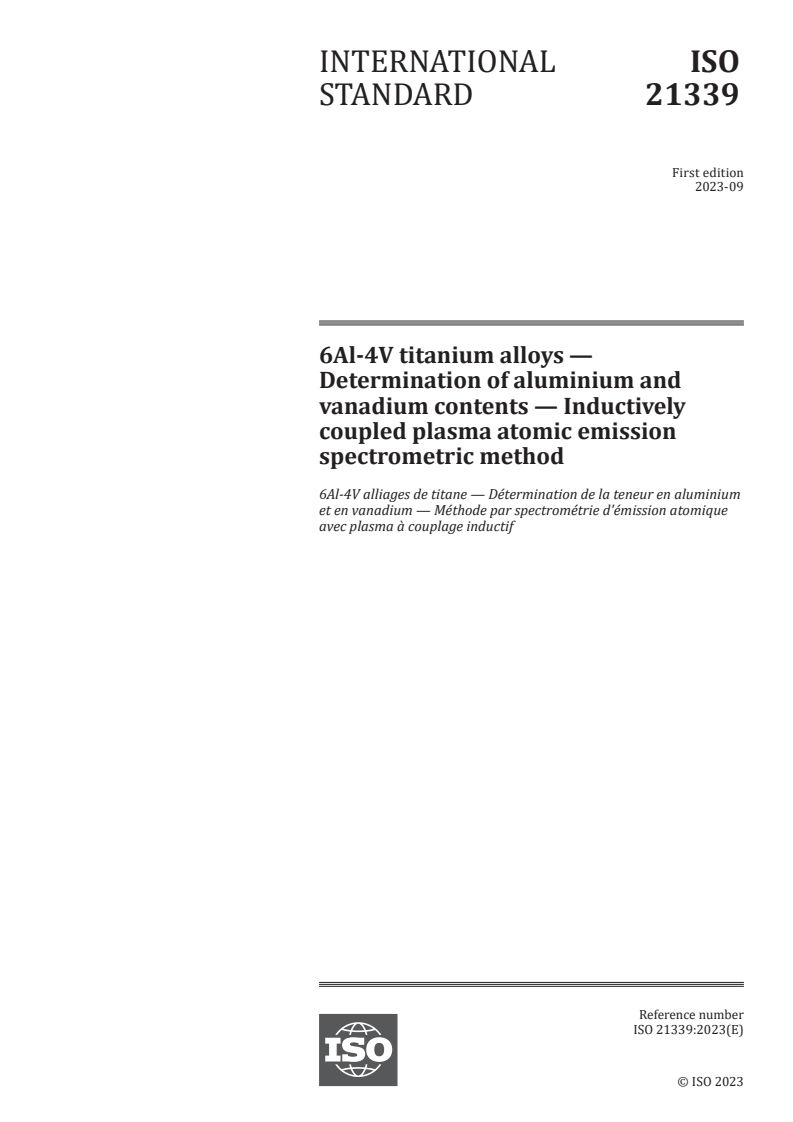
INTERNATIONAL ISO
STANDARD 21339
First edition
2023-09
6Al-4V titanium alloys —
Determination of aluminium and
vanadium contents — Inductively
coupled plasma atomic emission
spectrometric method
6Al-4V alliages de titane — Détermination de la teneur en aluminium
et en vanadium — Méthode par spectrométrie d'émission atomique
avec plasma à couplage inductif
Reference number
© ISO 2023
All rights reserved. Unless otherwise specified, or required in the context of its implementation, no part of this publication may
be reproduced or utilized otherwise in any form or by any means, electronic or mechanical, including photocopying, or posting on
the internet or an intranet, without prior written permission. Permission can be requested from either ISO at the address below
or ISO’s member body in the country of the requester.
ISO copyright office
CP 401 • Ch. de Blandonnet 8
CH-1214 Vernier, Geneva
Phone: +41 22 749 01 11
Email: copyright@iso.org
Website: www.iso.org
Published in Switzerland
ii
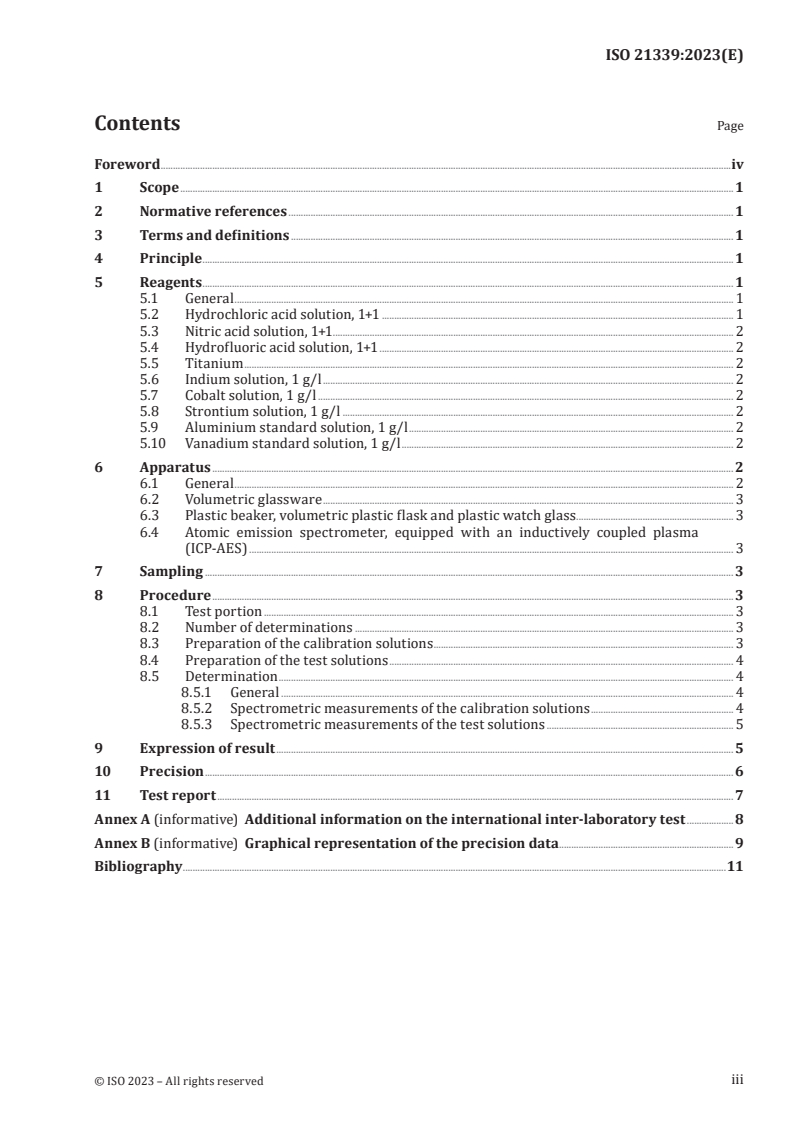
Contents Page
Foreword .iv
1 Scope . 1
2 Normative references . 1
3 Terms and definitions . 1
4 Principle . 1
5 Reagents . 1
5.1 General . 1
5.2 Hydrochloric acid solution, 1+1 . 1
5.3 Nitric acid solution, 1+1. 2
5.4 Hydrofluoric acid solution, 1+1 . 2
5.5 Titanium . 2
5.6 Indium solution, 1 g/l . 2
5.7 Cobalt solution, 1 g/l . 2
5.8 Strontium solution, 1 g/l . 2
5.9 Aluminium standard solution, 1 g/l . 2
5.10 Vanadium standard solution, 1 g/l . 2
6 Apparatus . 2
6.1 General . 2
6.2 Volumetric glassware . 3
6.3 Plastic beaker, volumetric plastic flask and plastic watch glass . 3
6.4 Atomic emission spectrometer, equipped with an inductively coupled plasma
(ICP-AES) . 3
7 Sampling . 3
8 Procedure .3
8.1 Test portion . 3
8.2 Number of determinations . 3
8.3 Preparation of the calibration solutions . 3
8.4 Preparation of the test solutions . 4
8.5 Determination . 4
8.5.1 General . 4
8.5.2 Spectrometric measurements of the calibration solutions . 4
8.5.3 Spectrometric measurements of the test solutions . 5
9 Expression of result . 5
10 Precision . 6
11 Test report . 7
Annex A (informative) Additional information on the international inter-laboratory test .8
Annex B (informative) Graphical representation of the precision data. 9
Bibliography .11
iii
Foreword
ISO (the International Organization for Standardization) is a worldwide federation of national standards
bodies (ISO member bodies). The work of preparing International Standards is normally carried out
through ISO technical committees. Each member body interested in a subject for which a technical
committee has been established has the right to be represented on that committee. International
organizations, governmental and non-governmental, in liaison with ISO, also take part in the work.
ISO collaborates closely with the International Electrotechnical Commission (IEC) on all matters of
electrotechnical standardization.
The procedures used to develop this document and those intended for its further maintenance are
described in the ISO/IEC Directives, Part 1. In particular, the different approval criteria needed for the
different types of ISO document should be noted. This document was drafted in accordance with the
editorial rules of the ISO/IEC Directives, Part 2 (see www.iso.org/directives).
ISO draws attention to the possibility that the implementation of this document may involve the use
of (a) patent(s). ISO takes no position concerning the evidence, validity or applicability of any claimed
patent rights in respect thereof. As of the date of publication of this document, ISO had not received
notice of (a) patent(s) which may be required to implement this document. However, implementers are
cautioned that this may not represent the latest information, which may be obtained from the patent
database available at www.iso.org/patents. ISO shall not be held responsible for identifying any or all
such patent rights.
Any trade name used in this document is information given for the convenience of users and does not
constitute an endorsement.
For an explanation of the voluntary nature of standards, the meaning of ISO specific terms and
expressions related to conformity assessment, as well as information about ISO's adherence to
the World Trade Organization (WTO) principles in the Technical Barriers to Trade (TBT), see
www.iso.org/iso/foreword.html.
This document was prepared by Technical Committee ISO/TC 79, Light metals and their alloys,
Subcommittee SC 11, Titanium.
Any feedback or questions on this document should be directed to the user’s national standards body. A
complete listing of these bodies can be found at www.iso.org/members.html.
iv
INTERNATIONAL STANDARD ISO 21339:2023(E)
6Al-4V titanium alloys — Determination of aluminium and
vanadium contents — Inductively coupled plasma atomic
emission spectrometric method
1 Scope
This document specifies an inductively coupled plasma atomic emission spectrometric method for the
determination of the contents (mass fraction) of aluminium and vanadium in 6Al-4V titanium alloys.
This method is applicable to all kinds of 6Al-4V titanium alloys specified in ISO 23515 (designation of
titanium alloys) for aluminium in the range from 4,70 % to 7,00 % and vanadium in the range from
3,00 % to 5,00 %.
2 Normative references
The following documents are referred to in the text in such a way that some or all of their content
constitutes requirements of this document. For dated references, only the edition cited applies. For
undated references, the latest edition of the referenced document (including any amendments) applies.
ISO 648, Laboratory glassware — Single-volume pipettes
ISO 1042, Laboratory glassware — One-mark volumetric flasks
ISO 3696, Water for analytical laboratory use — Specification and test methods
3 Terms and definitions
No terms and definitions are listed in this document.
ISO and IEC maintain terminology databases for use in standardization at the following addresses:
— ISO Online browsing platform: available at https:// www .iso .org/ obp
— IEC Electropedia: available at https:// www .electropedia .org/
4 Principle
A test portion is dissolved with nitric and hydrofluoric acids. After suitable dilution and, if necessary,
addition of an internal standard element, the solution is nebulized into an inductively coupled plasma
atomic emission spectrometer and the intensity of the emitted light from each element is measured
(including, where relevant, the intensity of the internal standard element).
5 Reagents
5.1 General
During the analysis, unless otherwise stated, use only reagents of recognized analytical grade and only
grade 2 water as specified in ISO 3696.
5.2 Hydrochloric acid solution, 1+1
Add slowly 500 ml of hydrochloric acid (ρ 1,16 g/ml to 1,19 g/ml) to 500 ml of water and mix.
5.3 Nitric acid solution, 1+1
Add slowly 500 ml of nitric acid (ρ 1,42 g/ml) to 500 ml of water and mix.
5.4 Hydrofluoric acid solution, 1+1
Add, carefully and slowly, 100 ml of hydrofluoric acid (ρ 1,14 g/ml) to 100 ml of water and mix.
5.5 Titanium
High purity titanium [min 99,9 % (mass fraction)], containing less than or equal to 0,005 % (mass
fraction) of aluminium and vanadium.
5.6 Indium solution, 1 g/l
Weigh 1,000 g of high purity indium [min 99,9 % (mass fraction)]. Transfer it into a 300 ml beaker and
add 100 ml of hydrochloric acid (5.2) and 20 ml of nitric acid (5.3). Heat gently to complete dissolution.
Cool, transfer the solution quantitatively into a 1 000 ml one-mark volumetric flask, dilute to the
...
Questions, Comments and Discussion
Ask us and Technical Secretary will try to provide an answer. You can facilitate discussion about the standard in here.
Loading comments...