

ISO/TR 12036:2000
(Main)Micrographics — Expungement, deletion, correction or amendment of records on microforms
General Information
- Abstract
This Technical Report applies to the removal and destruction of images from microforms when document expungement is ordered. It also applies to the revision of image content when an order requires the deletion, correction or amendment of specific information. It establishes proper procedures for image removal or revision and for documenting these actions to ensure file integrity. These guidelines cover techniques for removing information from microforms. If followed, they should enable the user to adequately meet an expungement request.
- Status
- Published
- Publication Date
- 16-Aug-2000
- Technical Committee
- ISO/TC 171 - Document management applications
- Drafting Committee
- ISO/TC 171 - Document management applications
- Current Stage
- 9093 - International Standard confirmed
- Start Date
- 02-Apr-2013
- Completion Date
- 29-Aug-2026
Overview
ISO/TR 12036:2000 - "Micrographics - Expungement, deletion, correction or amendment of records on microforms" - is a Technical Report that provides guidelines for removing, destroying or revising images on microforms when a legal or administrative order (for example an expungement) requires deletion, correction or amendment. The report focuses on preserving file integrity, documenting actions, and using reliable micrographic techniques so altered microforms remain accurate and legally defensible.
Key topics and technical requirements
- Scope and intent: Procedures apply to image removal, destruction, deletion, correction and amendment across microfilm, microfiche and related microforms.
- File integrity and documentation: Always retain the authorizing order (when appropriate) and insert a completed expungement notice (Annex A) into the microform near the altered images. If the order would reveal the deleted information, do not microfilm the order - reference it in the notice instead.
- Master-microform changes: Alterations should be made to the master microform; replacement copies must be generated from the altered master and original images destroyed.
- Unacceptable methods: Avoid unreliable removal techniques such as punching holes, opaque blocking inks, or chemical bleaching (e.g., potassium dichromate) because these can damage film, leave traces, or create health/environmental risks.
- Film-specific procedures:
- Silver-gelatin 16 mm and 35 mm roll film: Remove and destroy affected sections; splice in notice and (where appropriate) the order. For blipped/coded film, replacement must preserve blip/code counts and coding method.
- Splicing: Use thermal butt weld or sonic splice for polyester bases; thermal butt weld for acetate. Tape splices are not recommended for long-term storage.
- Microfiche: For silver negative microfiche, image emulsion may be removed by careful abrasion using a rounded, polished tool under at least 6:1 magnification; moisten area with distilled water and avoid damaging the film base.
- Other film types covered include microfilm jackets, computer-output film, photoplastic film, transparent electrophotography (TEP), diazo/vesicular and other records - with tailored procedures described in the report.
- Indexes and duplicates: Procedures address updating indexes and replacing duplicates to reflect expungements and preserve retrieval integrity.
Applications and who uses it
- Records managers, court administrators, archivists, municipal clerks, legal librarians, and micrographics service providers
- Use cases: complying with court-ordered expungements, updating archival microform holdings, correcting or amending legally sensitive records, and preparing defensible audit trails for altered microforms
Related standards
- ISO 6196-1:1993 (Micrographics - Vocabulary) is referenced for terminology. Other micrographics preservation standards and local legal requirements should be consulted when implementing expungement procedures.
Relations
- Consolidated By
ISO 105-E02:2013 - Textiles — Tests for colour fastness — Part E02: Colour fastness to sea water - Effective Date
- 06-Jun-2022
Frequently Asked Questions
ISO/TR 12036:2000 is a technical report published by the International Organization for Standardization (ISO). Its full title is "Micrographics — Expungement, deletion, correction or amendment of records on microforms". This standard covers: This Technical Report applies to the removal and destruction of images from microforms when document expungement is ordered. It also applies to the revision of image content when an order requires the deletion, correction or amendment of specific information. It establishes proper procedures for image removal or revision and for documenting these actions to ensure file integrity. These guidelines cover techniques for removing information from microforms. If followed, they should enable the user to adequately meet an expungement request.
This Technical Report applies to the removal and destruction of images from microforms when document expungement is ordered. It also applies to the revision of image content when an order requires the deletion, correction or amendment of specific information. It establishes proper procedures for image removal or revision and for documenting these actions to ensure file integrity. These guidelines cover techniques for removing information from microforms. If followed, they should enable the user to adequately meet an expungement request.
ISO/TR 12036:2000 is classified under the following ICS (International Classification for Standards) categories: 37.080 - Document imaging applications. The ICS classification helps identify the subject area and facilitates finding related standards.
ISO/TR 12036:2000 has the following relationships with other standards: It is inter standard links to ISO 105-E02:2013. Understanding these relationships helps ensure you are using the most current and applicable version of the standard.
ISO/TR 12036:2000 is available in PDF format for immediate download after purchase. The document can be added to your cart and obtained through the secure checkout process. Digital delivery ensures instant access to the complete standard document.
Standards Content (Sample)
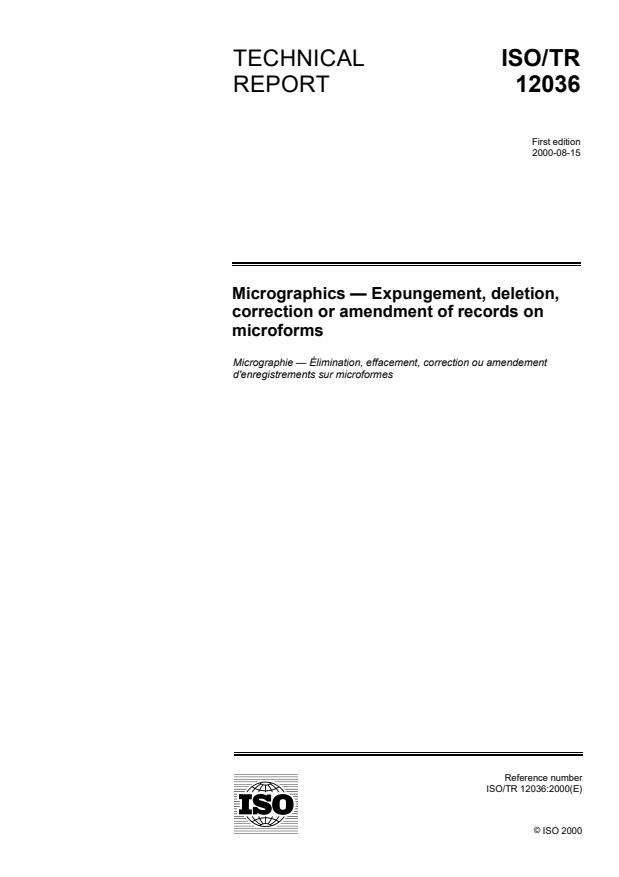
TECHNICAL ISO/TR
REPORT 12036
First edition
2000-08-15
Micrographics — Expungement, deletion,
correction or amendment of records on
microforms
Micrographie — Élimination, effacement, correction ou amendement
d'enregistrements sur microformes
Reference number
©
ISO 2000
PDF disclaimer
This PDF file may contain embedded typefaces. In accordance with Adobe's licensing policy, this file may be printed or viewed but shall not
be edited unless the typefaces which are embedded are licensed to and installed on the computer performing the editing. In downloading this
file, parties accept therein the responsibility of not infringing Adobe's licensing policy. The ISO Central Secretariat accepts no liability in this
area.
Adobe is a trademark of Adobe Systems Incorporated.
Details of the software products used to create this PDF file can be found in the General Info relative to the file; the PDF-creation parameters
were optimized for printing. Every care has been taken to ensure that the file is suitable for use by ISO member bodies. In the unlikely event
that a problem relating to it is found, please inform the Central Secretariat at the address given below.
All rights reserved. Unless otherwise specified, no part of this publication may be reproduced or utilized in any form or by any means, electronic
or mechanical, including photocopying and microfilm, without permission in writing from either ISO at the address below or ISO's member body
in the country of the requester.
ISO copyright office
Case postale 56 � CH-1211 Geneva 20
Tel. + 41 22 749 01 11
Fax + 41 22 749 09 47
E-mail copyright@iso.ch
Web www.iso.ch
Printed in Switzerland
ii © ISO 2000 – All rights reserved
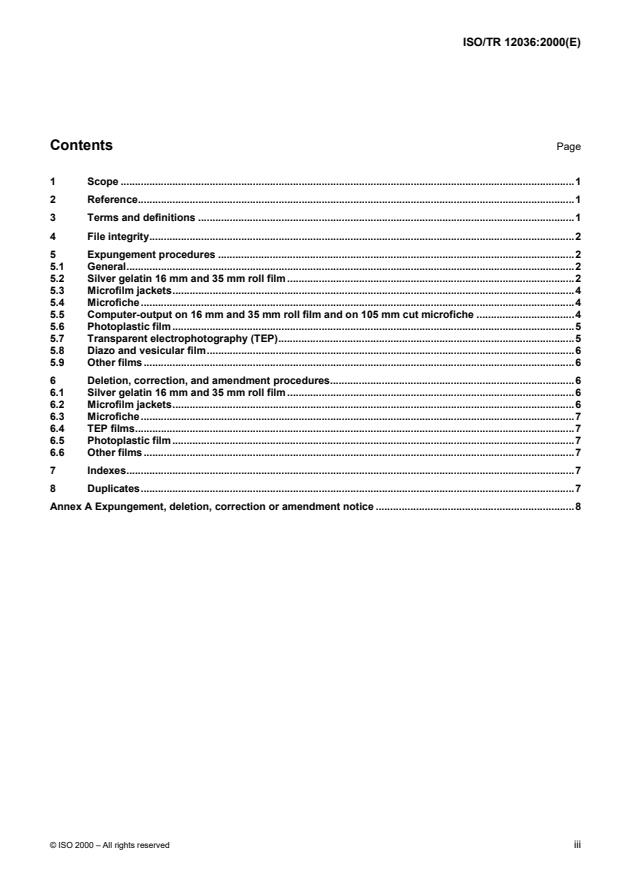
Contents Page
1 Scope .1
2 Reference.1
3 Terms and definitions .1
4 File integrity.2
5 Expungement procedures .2
5.1 General.2
5.2 Silver gelatin 16 mm and 35 mm roll film .2
5.3 Microfilm jackets.4
5.4 Microfiche.4
5.5 Computer-output on 16 mm and 35 mm roll film and on 105 mm cut microfiche .4
5.6 Photoplastic film.5
5.7 Transparent electrophotography (TEP).5
5.8 Diazo and vesicular film.6
5.9 Other films.6
6 Deletion, correction, and amendment procedures.6
6.1 Silver gelatin 16 mm and 35 mm roll film .6
6.2 Microfilm jackets.6
6.3 Microfiche.7
6.4 TEP films.7
6.5 Photoplastic film.7
6.6 Other films.7
7 Indexes.7
8 Duplicates.7
Annex A Expungement, deletion, correction or amendment notice .8
Foreword
ISO (the International Organization for Standardization) is a worldwide federation of national standards bodies (ISO
member bodies). The work of preparing International Standards is normally carried out through ISO technical
committees. Each member body interested in a subject for which a technical committee has been established has
the right to be represented on that committee. International organizations, governmental and non-governmental, in
liaison with ISO, also take part in the work. ISO collaborates closely with the International Electrotechnical
Commission (IEC) on all matters of electrotechnical standardization.
International Standards are drafted in accordance with the rules given in the ISO/IEC Directives, Part 3.
The main task of technical committees is to prepare International Standards. Draft International Standards adopted
by the technical committees are circulated to the member bodies for voting. Publication as an International
Standard requires approval by at least 75 % of the member bodies casting a vote.
In exceptional circumstances, when a technical committee has collected data of a different kind from that which is
normally published as an International Standard ("state of the art", for example), it may decide by a simple majority
vote of its participating members to publish a Technical Report. A Technical Report is entirely informative in nature
and does not have to be reviewed until the data it provides are considered to be no longer valid or useful.
Attention is drawn to the possibility that some of the elements of this Technical Report may be the subject of patent
rights. ISO shall not be held responsible for identifying any or all such patent rights.
ISO/TR 12036 was prepared by Technical Committee ISO/TC 171, Document imaging applications, Subcommittee
SC 3, General issues.
iv © ISO 2000 – All rights reserved
Introduction
Expungement legally ordered on selective records by courts of law may jeopardize the admissibility of “expunged”
microfilm as evidence in these courts of law. Microfilm is inherently a medium not easily subject to correction.
Therefore, it is necessary to provide guidelines for expunging microfilmed records to ensure that uniform
procedures can be followed which minimize the possibility of having microfilm rejected in the courts. This document
is intended to provide guidelines for the best method, to date, of removing information from microforms.
A court-ordered expungement may be rescinded by a higher legal court or reconsidered by the originating court. If
the microfilmed record has been destroyed or defaced in compliance with the first order before the rescinding order
is received by the records custodian, the complete original record is lost forever. This is particularly true if the
normal course of daily business allows destruction of the original document. This loss may be catastrophic to courts
of law if further litigation becomes mandatory and the original document can no longer be produced in any form. In
view of this possible pitfall, court administrators should be prepared to organize their files to provide for such
contingencies. The prerogatives of legal courts in establishing or organizing operating procedures are unaffected
by this Technical Report. Therefore, this document covers only a recommended means of removing a record or
portion of a record in specific compliance with an ad hoc expungement order.
TECHNICAL REPORT ISO/TR 12036:2000(E)
Micrographics — Expungement, deletion, correction or
amendment of records on microforms
1 Scope
This Technical Report applies to the removal and destruction of images from microforms when document
expungement is ordered. It also applies to the revision of image content when an order requires the deletion,
correction or amendment of specific information. It establishes proper procedures for image removal or revision and
for documenting these actions to ensure file integrity.
These guidelines cover techniques for removing information from microforms. If followed, they should enable the
user to adequately meet an expungement request.
2 Reference
ISO 6196-1:1993, Micrographics — Vocabulary — Part 1: General terms.
3 Terms and definitions
For the purposes of this Technical Report, the terms and definitions given in ISO 6196-1 and the following apply.
3.1
deletion
obliteration of specific information contained in a microfilmed document
NOTE This procedure does not permit the removal and destruction of an image or images without replacement, unless it
contains only the information to be deleted; nor does it permit the obliteration of information other than that specified in the
deletion order. All expungement work should be done in a way that avoids damage to the rest of the film.
3.2
destruction
complete elimination of a microform or section of a microfilm
NOTE This requires an action such as incineration or shredding.
3.3
expungement
process of removing a document from a system and leaving no evidence of the document ever having appeared on
the system
3.4
removal
actual elimination of an image or images from a microform
4 File integrity
It is essential that file integrity be maintained to ensure the accuracy, completeness, and legal acceptance of a
microform which has been altered. It is also essential that the documentation authorizing any alteration should be
kept for the life of the relevant microform.
The procedures for expungement require that images in a microform be removed and destroyed or be obliterated,
leaving no evidence of the original document Procedures for deletion, correction, or amendment require the
substitution of revised images for original images in the microform. Care should be taken, in the replacement of
images, to match the density of the overall film. The original images should be destroyed or obliterated.
Documentation for an altered microform should consist of the order mandating the change (e.g. expungement) and
the completed notice (see annex A). The documentation is inserted in place of the expunged document or
precedes the replacement image or images containing deletions, corrections, or amendments.
In those instances when the order contains information that could identify the expunged document or could reveal
the original information which is to be deleted, corrected, or amended, the order is not microfilmed or placed in the
altered microform. Only the notice is inserted. The notice will include appropriate reference to the missing order. In
some instances, either the microform or space limitations will not permit the insertion of the microfilmed order and
notice. Appropriate instructions for resolving this problem are described according to the specific type of microform.
5 Expungement procedures
5.1 General
The procedures described in 5.2 to 5.8 should be followed when expungement of a document image or images is
ordered.
The changes ordered to be made should be made to the master microform. Any images which are to be inserted
should be produced to at least the same standards as used for the original microform.
When the following procedures are being carried out, normal precautions for handling master microforms, such as
the provision of a clean, clear work area and the wearing of clean white cotton gloves, should be followed.
NOTE Where copies exist, these should be replaced by new copies from the altered master and the replaced copies should
be destroyed. Any replacement of images should include additional images before and after the replaced defective image(s) for
splicing purposes. Replacement images should be spliced in the original film according to the approved procedures (i.e. at the
beginning of the roll, at the end of the roll or in place of the defective image).
5.2 Silver gelatin 16 mm and 35 mm roll film
Some expungement methods are not considered acceptable (see Table 1).
5.2.1 Manually indexed roll film
Remove and destroy the section of film containing the image or images covered by the expungement order. In
place of the removed section, splice in a microfilm image of a completed notice and the expungement order if it
does not contain information that could identify the expunged document or reveal its content. All images spliced
into the original camera negative should be filmed at the same reduction or as close to the original camera negative
reduction ratio as possible.
2 © ISO 2000 – All rights reserved
Table 1 — Unreliable methods of expungement
Method Reason for rejection
Punching a hole or holes through Weakens film, prevents accurate
document images to eliminate information duplication where tension on film may
cause distortion or breakage during the
duplication process. May not completely
eliminate all aspects of the file.
Using opaque or blocking out the image Opaque can be removed, an ink pen
with ink-type pen cannot completely block out the
information, and both may cause long-
term damage to the film.
Chemical means such as potassium Difficult and complicated process that
dichromate (bleach) used on emulsion requires proper equipment and facilities.
No chemicals of any kind should be used
on long-term film to delete images from
the film. Chemical treatments may cause
deterioration during long-term storage.
Problems of toxicity or environmental
pollution preclude the use of many
chemicals.
5.2.2 Blipped or coded roll film
Remove and destroy the section of film containing the document image or images covered by the expungement
order. In place of the removed section, splice in a microfilm image of a completed notice and the expungement
order if it does not contain information that could identify the expunged document or reveal its content.
If the blips or codes are used in the retrieval system, it is important that the replacement section contain the same
number of blips or other appropriate codes as the
...