

ISO/IEC 20619:2023
(Main)Information technology — C# specification suite
General Information
- Abstract
This specification defines the C# programming language and its required library. It defines all the necessary components that are needed to implement this Suite. This Suite does not change if one or more components are updated by a new standard edition. The Suite changes only when new components are added to it and/or existing components are removed from it.
- Status
- Published
- Publication Date
- 04-Sep-2023
- Technical Committee
- ISO/IEC JTC 1 - Information technology
- Drafting Committee
- ISO/IEC JTC 1 - Information technology
- Current Stage
- 6060 - International Standard published
- Start Date
- 05-Sep-2023
- Due Date
- 12-Jan-2025
- Completion Date
- 01-Sep-2023
Overview
ISO/IEC 20619:2023 is the international standard defining the C# specification suite, published by ISO and IEC. This first edition consolidates key components that specify the syntax, semantics, and library requirements for the widely used C# programming language. Developed in collaboration with Ecma International, this suite provides a structured framework for consistent implementation of C#. By referencing the latest Ecma standards, ISO/IEC 20619:2023 ensures alignment with evolving technology while maintaining stability for developers and organizations adopting the language.
This standard is essential for software developers, tool vendors, and platform implementers aiming to develop or support C# applications with conformance to internationally recognized language specifications.
Key Topics
C# Language Specification
Defines the syntax, semantics, and pre-processing directives of the C# language, including compulsory and optional features. This component ensures consistent interpretation of C# code and seamless interoperability across implementations.C# Library Specification
Establishes the required class libraries usable in C# programs, drawn from ECMA-335 Partition IV, while focusing on the subset mandated for C# by ECMA-334. This foundation enables robust application development with standardized APIs and data types.Normative References
The specification suite incorporates:- ECMA-334 - C# Language Specification
- ECMA-335 Partition IV - Common Language Infrastructure (CLI): Profiles and Libraries
Modular Structure
The suite aggregates components via normative and informative references, meaning the suite itself changes only when components are added or removed, not merely through updates to individual specifications.
Applications
Software Development
Provides a definitive reference for designing C# compilers, interpreters, and development tools standardized on international guidelines.Cross-Platform Frameworks
Helps ensure that C# implementations maintain consistent behavior across diverse operating systems and runtime environments.Education and Certification
Standards-based curricula and certification programs can rely on ISO/IEC 20619:2023 to teach and evaluate proficiency in C# programming aligned with current best practices.Enterprise and Government Use
Organizations requiring standardized IT development practices can mandate compliance with this suite to guarantee consistent quality and maintainability of C# applications.
Related Standards
ECMA-334: C# Language Specification
Detailed technical document specifying C# language syntax and semantics.ECMA-335: Common Language Infrastructure (CLI)
Provides the comprehensive framework for language integration, including profiles and libraries relevant to C#.ECMA TR/84: CLI Information Derived from Partition IV XML File
Technical report offering supplemental information about the CLI profiles and libraries used within the .NET ecosystem.
Practical Value
ISO/IEC 20619:2023 plays a critical role in unifying the C# language’s implementation globally. It fosters interoperability, reduces ambiguity in compiler development, and facilitates the evolution of the language within a consistent international framework. Developers and organizations leveraging this standard benefit from:
- Stable language foundation compatible with modern IT infrastructure
- Reduced risk of incompatibility between software components
- Streamlined development processes guided by clear normative references
- Confidence in adopting C# for large-scale and cross-industry solutions
By aligning practices with ISO/IEC 20619:2023, stakeholders contribute to a cohesive C# ecosystem benefiting the wider programming community.
Get Certified
Connect with accredited certification bodies for this standard

BSI Group
BSI (British Standards Institution) is the business standards company that helps organizations make excellence a habit.

NYCE
Mexican standards and certification body.
Sponsored listings
Frequently Asked Questions
ISO/IEC 20619:2023 is a standard published by the International Organization for Standardization (ISO). Its full title is "Information technology — C# specification suite". This standard covers: This specification defines the C# programming language and its required library. It defines all the necessary components that are needed to implement this Suite. This Suite does not change if one or more components are updated by a new standard edition. The Suite changes only when new components are added to it and/or existing components are removed from it.
This specification defines the C# programming language and its required library. It defines all the necessary components that are needed to implement this Suite. This Suite does not change if one or more components are updated by a new standard edition. The Suite changes only when new components are added to it and/or existing components are removed from it.
ISO/IEC 20619:2023 is classified under the following ICS (International Classification for Standards) categories: 35.060 - Languages used in information technology. The ICS classification helps identify the subject area and facilitates finding related standards.
ISO/IEC 20619:2023 is available in PDF format for immediate download after purchase. The document can be added to your cart and obtained through the secure checkout process. Digital delivery ensures instant access to the complete standard document.
Standards Content (Sample)
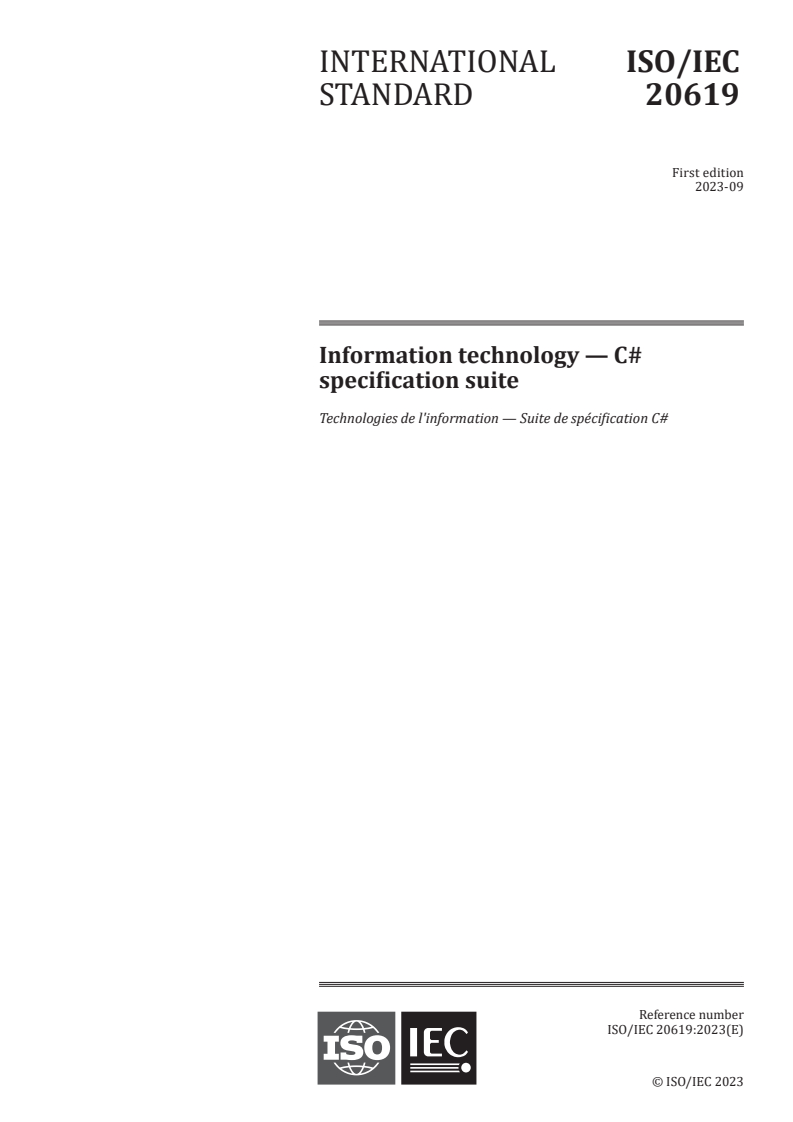
INTERNATIONAL ISO/IEC
STANDARD 20619
First edition
2023-09
Information technology — C#
specification suite
Technologies de l'information — Suite de spécification C#
Reference number
© ISO/IEC 2023
© ISO/IEC 2023
All rights reserved. Unless otherwise specified, or required in the context of its implementation, no part of this publication may
be reproduced or utilized otherwise in any form or by any means, electronic or mechanical, including photocopying, or posting on
the internet or an intranet, without prior written permission. Permission can be requested from either ISO at the address below
or ISO’s member body in the country of the requester.
ISO copyright office
CP 401 • Ch. de Blandonnet 8
CH-1214 Vernier, Geneva
Phone: +41 22 749 01 11
Email: copyright@iso.org
Website: www.iso.org
Published in Switzerland
ii
© ISO/IEC 2023 – All rights reserved
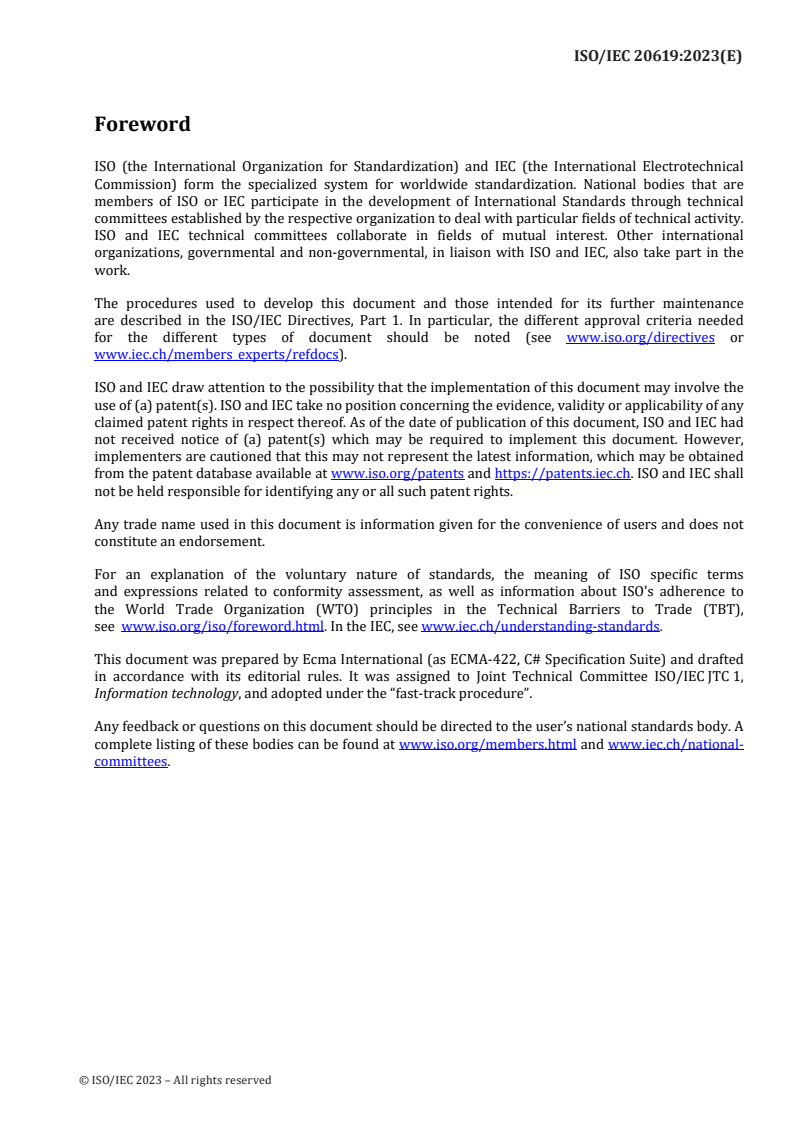
Foreword
ISO (the International Organization for Standardization) and IEC (the International Electrotechnical
Commission) form the specialized system for worldwide standardization. National bodies that are
members of ISO or IEC participate in the development of International Standards through technical
committees established by the respective organization to deal with particular fields of technical activity.
ISO and IEC technical committees collaborate in fields of mutual interest. Other international
organizations, governmental and non-governmental, in liaison with ISO and IEC, also take part in the
work.
The procedures used to develop this document and those intended for its further maintenance
are described in the ISO/IEC Directives, Part 1. In particular, the different approval criteria needed
for the different types of document should be noted (see www.iso.org/directives or
www.iec.ch/members_experts/refdocs).
ISO and IEC draw attention to the possibility that the implementation of this document may involve the
use of (a) patent(s). ISO and IEC take no position concerning the evidence, validity or applicability of any
claimed patent rights in respect thereof. As of the date of publication of this document, ISO and IEC had
not received notice of (a) patent(s) which may be required to implement this document. However,
implementers are cautioned that this may not represent the latest information, which may be obtained
from the patent database available at www.iso.org/patents and https://patents.iec.ch. ISO and IEC shall
not be held responsible for identifying any or all such patent rights.
Any trade name used in this document is information given for the convenience of users and does not
constitute an endorsement.
For an explanation of the voluntary nature of standards, the meaning of ISO specific terms
and expressions related to conformity assessment, as well as information about ISO's adherence to
the World Trade Organization (WTO) principles in the Technical Barriers to Trade (TBT),
see www.iso.org/iso/foreword.html. In the IEC, see www.iec.ch/understanding-standards.
This document was prepared by Ecma International (as ECMA-422, C# Specification Suite) and drafted
in accordance with its editorial rules. It was assigned to Joint Technical Committee ISO/IEC JTC 1,
Information technology, and adopted under the “fast-track procedure”.
Any feedback or questions on this document should be directed to the user’s national standards body. A
complete listing of these bodies can be found at www.iso.org/members.html and www.iec.ch/national-
committees.
© ISO/IEC 2023 – All rights reserved
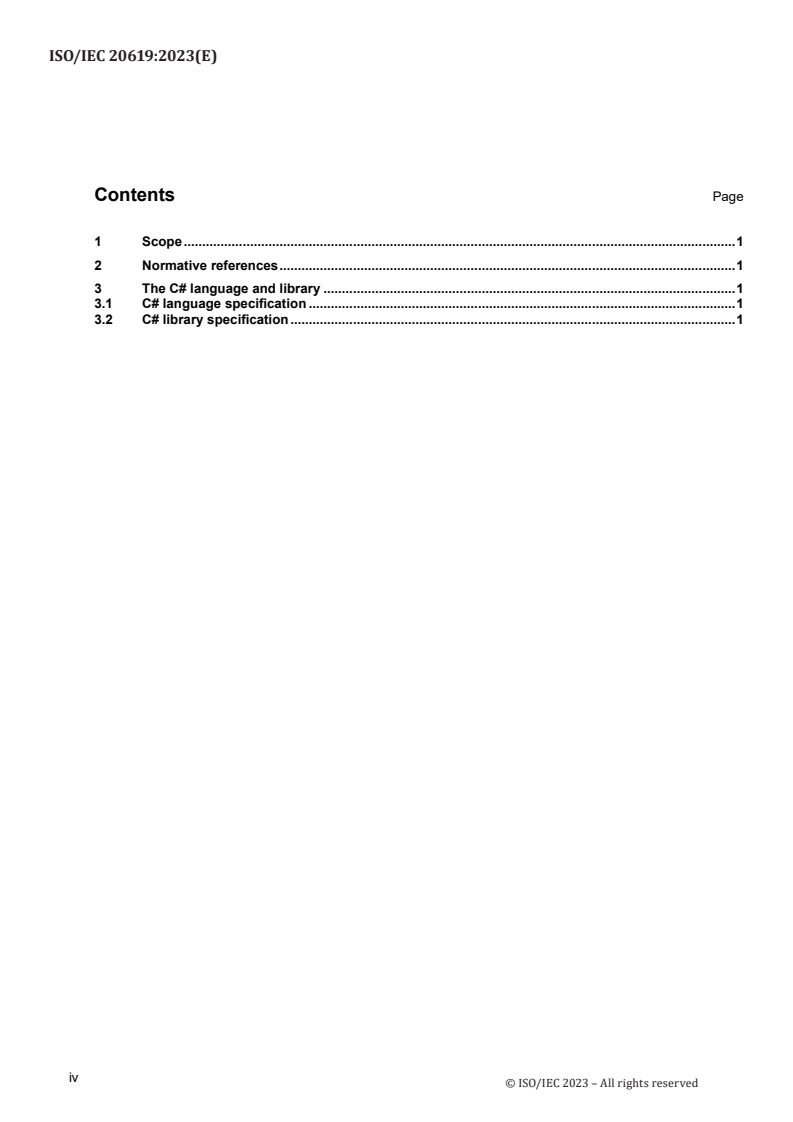
Contents Page
1 Scope . 1
2 Normative references . 1
...