

ISO/IEC 19505-1:2012
(Main)Information technology — Object Management Group Unified Modeling Language (OMG UML) — Part 1: Infrastructure
General Information
- Abstract
ISO/IEC 19505-1:2012 defines the Unified Modeling Language (UML), revision 2. The objective of UML is to provide system architects, software engineers, and software developers with tools for analysis, design, and implementation of software-based systems as well as for modeling business and similar processes.
- Status
- Published
- Publication Date
- 19-Apr-2012
- Technical Committee
- ISO/IEC JTC 1 - Information technology
- Drafting Committee
- ISO/IEC JTC 1 - Information technology
- Current Stage
- 9093 - International Standard confirmed
- Start Date
- 10-May-2025
- Completion Date
- 29-Aug-2026

Overview
ISO/IEC 19505-1:2012 specifies the Object Management Group (OMG) Unified Modeling Language (UML) - Part 1: Infrastructure. This ISO/IEC standard defines UML revision 2 as a modeling language for analysis, design and implementation of software-based systems and for modeling business and related processes. The document provides the foundational infrastructure: metamodeling constructs, language architecture, semantics and rules needed for consistent UML use and tool interoperability.
Key topics and technical requirements
- Language architecture and design principles - defines the UML infrastructure, core elements and how the language is organized for consistent interpretation.
- Four-layer metamodel hierarchy - describes metamodel layering and metamodeling practices that underpin UML models.
- Core packages and elements - formal specifications for Core::Abstractions, Core::Basic, Core::Constructs and many foundational packages (classifiers, instances, structural features, expressions, constraints, etc.).
- Language formalism and semantics - levels of formalism, class/package specification structure, semantics and semantic variation points.
- Conformance and compliance - definitions of conformance levels, language units, types of compliance and how tools or models claim compliance with the standard.
- Constraints and instance modeling - guidance on using constraint languages and natural language for model constraints, plus instance model representations.
- Architectural alignment and MDA support - alignment between UML infrastructure and meta-object facilities (MOF) to support Model-Driven Architecture (MDA) and tool integration.
- Notation and presentation - conventions for diagrams, typography, presentation options and examples for consistent model visualization.
Applications and practical value
- Ensures consistent modeling semantics across teams and tools, reducing ambiguity in system design and documentation.
- Enables tool interoperability (model exchange, repository integration) by defining conformance levels and metamodel alignment.
- Supports model-driven development (MDD/MDA) workflows where precise metamodeling and semantics are required for automated transformations and code generation.
- Provides a stable foundation for software architecture, systems engineering and business process modeling, aiding traceability from analysis to implementation.
Who should use this standard
- System architects, software engineers and developers who create UML models for system design and implementation.
- Tool vendors and integrators building UML modeling tools, repositories or transformation engines.
- Standards, QA and compliance teams that verify UML conformance and interoperability.
- Consultants and model-driven development practitioners implementing MDA or model transformation pipelines.
Related standards
- References architectural alignment with MOF (Meta-Object Facility) and addresses Model-Driven Architecture concepts. For complete UML usage, consult complementary UML specifications and tooling guidance provided by OMG and ISO/IEC.
Relations
- Effective Date
- 25-Aug-2026
- Effective Date
- 25-Aug-2026
- Effective Date
- 25-Aug-2026
- Effective Date
- 25-Aug-2026
- Effective Date
- 25-Aug-2026
- Effective Date
- 25-Aug-2026
- Effective Date
- 25-Aug-2026
- Effective Date
- 15-Jul-2026
- Effective Date
- 01-Jul-2026
- Effective Date
- 31-Mar-2026
- Effective Date
- 10-Feb-2026
Get Certified
Connect with accredited certification bodies for this standard

BSI Group
BSI (British Standards Institution) is the business standards company that helps organizations make excellence a habit.

NYCE
Mexican standards and certification body.
Sponsored listings
Frequently Asked Questions
ISO/IEC 19505-1:2012 is a standard published by the International Organization for Standardization (ISO). Its full title is "Information technology — Object Management Group Unified Modeling Language (OMG UML) — Part 1: Infrastructure". This standard covers: ISO/IEC 19505-1:2012 defines the Unified Modeling Language (UML), revision 2. The objective of UML is to provide system architects, software engineers, and software developers with tools for analysis, design, and implementation of software-based systems as well as for modeling business and similar processes.
ISO/IEC 19505-1:2012 defines the Unified Modeling Language (UML), revision 2. The objective of UML is to provide system architects, software engineers, and software developers with tools for analysis, design, and implementation of software-based systems as well as for modeling business and similar processes.
ISO/IEC 19505-1:2012 is classified under the following ICS (International Classification for Standards) categories: 35.060 - Languages used in information technology. The ICS classification helps identify the subject area and facilitates finding related standards.
ISO/IEC 19505-1:2012 has the following relationships with other standards: It is inter standard links to CEN/TS 16157-10:2022, CEN/TS 16157-11:2025, CEN/TS 16157-12:2022, EN 16157-2:2019, EN 16157-3:2018, CEN ISO/TS 22726-2:2025, EN 16157-1:2018, CEN/TS 16157-8:2020, EN ISO 14823-1:2024, EN IEC 62264-2:2026, EN IEC 62769-6:2021. Understanding these relationships helps ensure you are using the most current and applicable version of the standard.
ISO/IEC 19505-1:2012 is available in PDF format for immediate download after purchase. The document can be added to your cart and obtained through the secure checkout process. Digital delivery ensures instant access to the complete standard document.
Standards Content (Sample)
INTERNATIONAL ISO/IEC
STANDARD 19505-1
First edition
2012-04-15
Information technology — Object
Management Group Unified Modeling
Language (OMG UML) —
Part 1:
Infrastructure
Technologies de l'information — Langage de modélisation unifié OMG
(OMG UML) —
Partie 1: Infrastructure
Reference number
©
ISO/IEC 2012
© ISO/IEC 2012
All rights reserved. Unless otherwise specified, no part of this publication may be reproduced or utilized in any form or by any means,
electronic or mechanical, including photocopying and microfilm, without permission in writing from either ISO at the address below or
ISO's member body in the country of the requester.
ISO copyright office
Case postale 56 CH-1211 Geneva 20
Tel. + 41 22 749 01 11
Fax + 41 22 749 09 47
E-mail copyright@iso.org
Web www.iso.org
Published in Switzerland
ii © ISO/IEC 2012 – All rights reserved
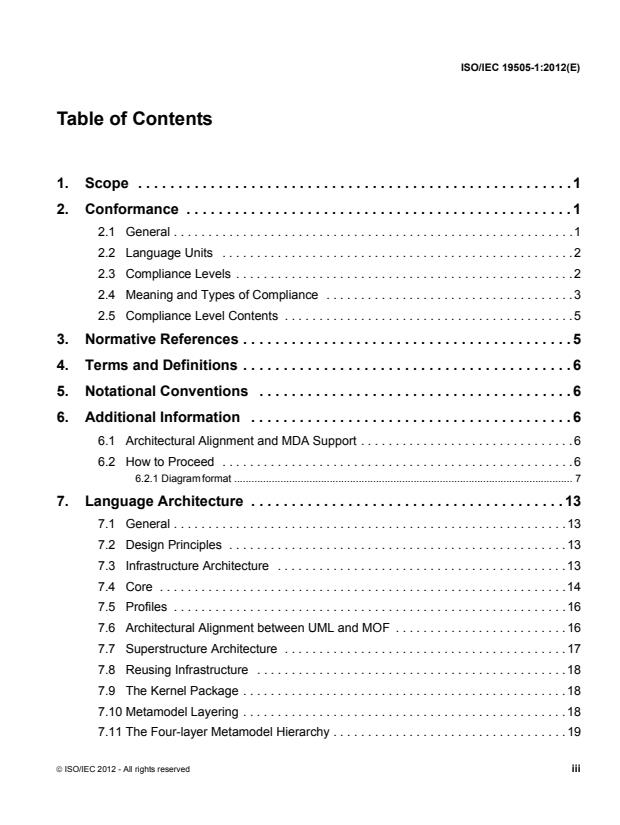
Table of Contents
1. Scope . . . . . . . . . . . . . . . . . . . . . . . . . . . . . . . . . . . . . . . . . . . . . . . . . . . . . . 1
2. Conformance . . . . . . . . . . . . . . . . . . . . . . . . . . . . . . . . . . . . . . . . . . . . . . . . 1
2.1 General . . . . . . . . . . . . . . . . . . . . . . . . . . . . . . . . . . . . . . . . . . . . . . . . . . . . . . . . . .1
2.2 Language Units . . . . . . . . . . . . . . . . . . . . . . . . . . . . . . . . . . . . . . . . . . . . . . . . . . .2
2.3 Compliance Levels . . . . . . . . . . . . . . . . . . . . . . . . . . . . . . . . . . . . . . . . . . . . . . . . .2
2.4 Meaning and Types of Compliance . . . . . . . . . . . . . . . . . . . . . . . . . . . . . . . . . . . .3
2.5 Compliance Level Contents . . . . . . . . . . . . . . . . . . . . . . . . . . . . . . . . . . . . . . . . . .5
3. Normative References . . . . . . . . . . . . . . . . . . . . . . . . . . . . . . . . . . . . . . . . . 5
4. Terms and Definitions . . . . . . . . . . . . . . . . . . . . . . . . . . . . . . . . . . . . . . . . . 6
5. Notational Conventions . . . . . . . . . . . . . . . . . . . . . . . . . . . . . . . . . . . . . . . 6
6. Additional Information . . . . . . . . . . . . . . . . . . . . . . . . . . . . . . . . . . . . . . . . 6
6.1 Architectural Alignment and MDA Support . . . . . . . . . . . . . . . . . . . . . . . . . . . . . . .6
6.2 How to Proceed . . . . . . . . . . . . . . . . . . . . . . . . . . . . . . . . . . . . . . . . . . . . . . . . . . .6
6.2.1 Diagram format . 7
7. Language Architecture . . . . . . . . . . . . . . . . . . . . . . . . . . . . . . . . . . . . . . . 13
7.1 General . . . . . . . . . . . . . . . . . . . . . . . . . . . . . . . . . . . . . . . . . . . . . . . . . . . . . . . . .13
7.2 Design Principles . . . . . . . . . . . . . . . . . . . . . . . . . . . . . . . . . . . . . . . . . . . . . . . . .13
7.3 Infrastructure Architecture . . . . . . . . . . . . . . . . . . . . . . . . . . . . . . . . . . . . . . . . . .13
7.4 Core . . . . . . . . . . . . . . . . . . . . . . . . . . . . . . . . . . . . . . . . . . . . . . . . . . . . . . . . . . .14
7.5 Profiles . . . . . . . . . . . . . . . . . . . . . . . . . . . . . . . . . . . . . . . . . . . . . . . . . . . . . . . . .16
7.6 Architectural Alignment between UML and MOF . . . . . . . . . . . . . . . . . . . . . . . . .16
7.7 Superstructure Architecture . . . . . . . . . . . . . . . . . . . . . . . . . . . . . . . . . . . . . . . . .17
7.8 Reusing Infrastructure . . . . . . . . . . . . . . . . . . . . . . . . . . . . . . . . . . . . . . . . . . . . .18
7.9 The Kernel Package . . . . . . . . . . . . . . . . . . . . . . . . . . . . . . . . . . . . . . . . . . . . . . .18
7.10 Metamodel Layering . . . . . . . . . . . . . . . . . . . . . . . . . . . . . . . . . . . . . . . . . . . . . . .18
7.11 The Four-layer Metamodel Hierarchy . . . . . . . . . . . . . . . . . . . . . . . . . . . . . . . . . .19
© ISO/IEC 2012 - All rights reserved iii
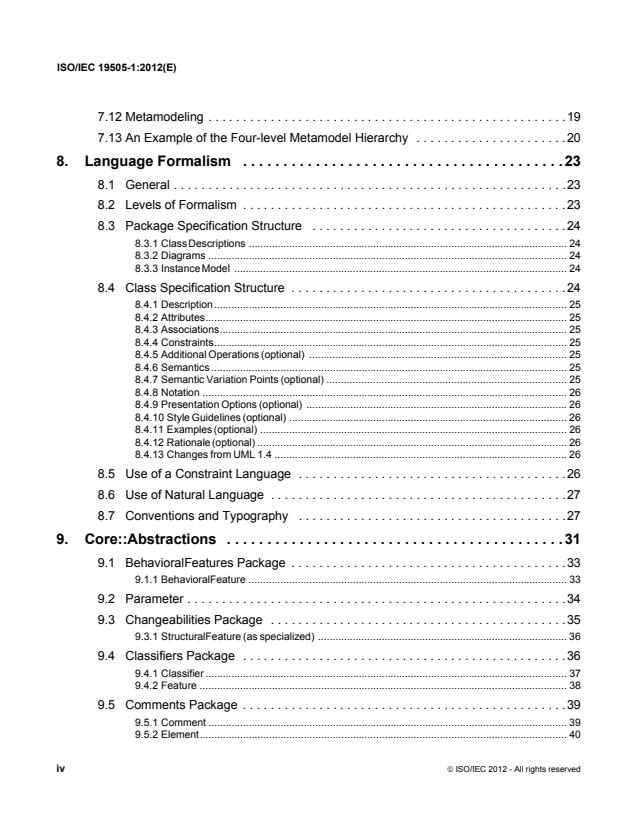
7.12 Metamodeling . . . . . . . . . . . . . . . . . . . . . . . . . . . . . . . . . . . . . . . . . . . . . . . . . . . .19
7.13 An Example of the Four-level Metamodel Hierarchy . . . . . . . . . . . . . . . . . . . . . .20
8. Language Formalism . . . . . . . . . . . . . . . . . . . . . . . . . . . . . . . . . . . . . . . .23
8.1 General . . . . . . . . . . . . . . . . . . . . . . . . . . . . . . . . . . . . . . . . . . . . . . . . . . . . . . . . .23
8.2 Levels of Formalism . . . . . . . . . . . . . . . . . . . . . . . . . . . . . . . . . . . . . . . . . . . . . . .23
8.3 Package Specification Structure . . . . . . . . . . . . . . . . . . . . . . . . . . . . . . . . . . . . .24
8.3.1 Class Descriptions . 24
8.3.2 Diagrams . 24
8.3.3 Instance Model . 24
8.4 Class Specification Structure . . . . . . . . . . . . . . . . . . . . . . . . . . . . . . . . . . . . . . . .24
8.4.1 Description . 25
8.4.2 Attributes . 25
8.4.3 Associations . 25
8.4.4 Constraints . 25
8.4.5 Additional Operations (optional) .25
8.4.6 Semantics . 25
8.4.7 Semantic Variation Points (optional) . 25
8.4.8 Notation . 26
8.4.9 Presentation Options (optional) .26
8.4.10 Style Guidelines (optional) . 26
8.4.11 Examples (optional) . 26
8.4.12 Rationale (optional) . 26
8.4.13 Changes from UML 1.4 . 26
8.5 Use of a Constraint Language . . . . . . . . . . . . . . . . . . . . . . . . . . . . . . . . . . . . . . .26
8.6 Use of Natural Language . . . . . . . . . . . . . . . . . . . . . . . . . . . . . . . . . . . . . . . . . . .27
8.7 Conventions and Typography . . . . . . . . . . . . . . . . . . . . . . . . . . . . . . . . . . . . . . .27
9. Core::Abstractions . . . . . . . . . . . . . . . . . . . . . . . . . . . . . . . . . . . . . . . . . .31
9.1 BehavioralFeatures Package . . . . . . . . . . . . . . . . . . . . . . . . . . . . . . . . . . . . . . . .33
9.1.1 BehavioralFeature . 33
9.2 Parameter . . . . . . . . . . . . . . . . . . . . . . . . . . . . . . . . . . . . . . . . . . . . . . . . . . . . . . .34
9.3 Changeabilities Package . . . . . . . . . . . . . . . . . . . . . . . . . . . . . . . . . . . . . . . . . . .35
9.3.1 StructuralFeature (as specialized) . 36
9.4 Classifiers Package . . . . . . . . . . . . . . . . . . . . . . . . . . . . . . . . . . . . . . . . . . . . . . .36
9.4.1 Classifier . 37
9.4.2 Feature . 38
9.5 Comments Package . . . . . . . . . . . . . . . . . . . . . . . . . . . . . . . . . . . . . . . . . . . . . . .39
9.5.1 Comment . 39
9.5.2 Element . 40
iv © ISO/IEC 2012 - All rights reserved
9.6 Constraints Package . . . . . . . . . . . . . . . . . . . . . . . . . . . . . . . . . . . . . . . . . . . . . .41
9.6.1 Constraint . 42
9.6.2 Namespace (as specialized) .45
9.7 Elements Package . . . . . . . . . . . . . . . . . . . . . . . . . . . . . . . . . . . . . . . . . . . . . . . .46
9.7.1 Element . 46
9.8 Expressions Package . . . . . . . . . . . . . . . . . . . . . . . . . . . . . . . . . . . . . . . . . . . . . .47
9.8.1 Expression . 47
9.8.2 OpaqueExpression . 48
9.8.3 ValueSpecification . 49
9.9 Generalizations Package . . . . . . . . . . . . . . . . . . . . . . . . . . . . . . . . . . . . . . . . . . .51
9.9.1 Classifier (as specialized) . 52
9.9.2 Generalization . 53
9.10 Instances Package . . . . . . . . . . . . . . . . . . . . . . . . . . . . . . . . . . . . . . . . . . . . . . . .54
9.10.1 InstanceSpecification . 55
9.10.2 InstanceValue . 58
9.10.3 Slot . 59
9.11 Literals Package . . . . . . . . . . . . . . . . . . . . . . . . . . . . . . . . . . . . . . . . . . . . . . . . . .60
9.11.1 LiteralBoolean . 60
9.11.2 LiteralInteger . 61
9.11.3 LiteralNull . 62
9.11.4 LiteralReal . 63
9.11.5 LiteralSpecification . 64
9.11.6 LiteralString . 64
9.11.7 LiteralUnlimitedNatural . 65
9.12 Multiplicities Package . . . . . . . . . . . . . . . . . . . . . . . . . . . . . . . . . . . . . . . . . . . . . .66
9.12.1 MultiplicityElement . 67
9.13 MultiplicityExpressions Package . . . . . . . . . . . . . . . . . . . . . . . . . . . . . . . . . . . . .70
9.13.1 MultiplicityElement (specialized) .71
9.14 Namespaces Package . . . . . . . . . . . . . . . . . . . . . . . . . . . . . . . . . . . . . . . . . . . . .73
9.14.1 NamedElement . 73
9.14.2 Namespace . 75
9.15 Ownerships Package . . . . . . . . . . . . . . . . . . . . . . . . . . . . . . . . . . . . . . . . . . . . . .76
9.15.1 Element (as specialized) . 77
9.16 Redefinitions Package . . . . . . . . . . . . . . . . . . . . . . . . . . . . . . . . . . . . . . . . . . . . .78
9.16.1 RedefinableElement . 79
9.17 Relationships Package . . . . . . . . . . . . . . . . . . . . . . . . . . . . . . . . . . . . . . . . . . . . .81
9.17.1 DirectedRelationship . 81
9.17.2 Relationship . 82
9.18 StructuralFeatures Package . . . . . . . . . . . . . . . . . . . . . . . . . . . . . . . . . . . . . . . . .83
© ISO/IEC 2012 - All rights reserved v
9.18.1 StructuralFeature . 83
9.19 Super Package . . . . . . . . . . . . . . . . . . . . . . . . . . . . . . . . . . . . . . . . . . . . . . . . . . .84
9.19.1 Classifier (as specialized) . 85
9.20 TypedElements Package . . . . . . . . . . . . . . . . . . . . . . . . . . . . . . . . . . . . . . . . . . .87
9.20.1 Type . 88
9.20.2 TypedElement . 89
9.21 Visibilities Package . . . . . . . . . . . . . . . . . . . . . . . . . . . . . . . . . . . . . . . . . . . . . . . .89
9.21.1 NamedElement (as specialized) . 90
9.21.2 VisibilityKind . 91
10. Core::Basic . . . . . . . . . . . . . . . . . . . . . . . . . . . . . . . . . . . . . . . . . . . . . . . .93
10.1 General . . . . . . . . . . . . . . . . . . . . . . . . . . . . . . . . . . . . . . . . . . . . . . . . . . . . . . . . .93
10.2 Types Diagram . . . . . . . . . . . . . . . . . . . . . . . . . . . . . . . . . . . . . . . . . . . . . . . . . . .94
10.2.1 Comment . 94
10.2.2 Element . 95
10.2.3 NamedElement . 95
10.2.4 Type . 96
10.2.5 TypedElement . 96
10.3 Classes Diagram . . . . . . . . . . . . . . . . . . . . . . . . . . . . . . . . . . . . . . . . . . . . . . . . .97
10.3.1 Class . 97
10.3.2 MultiplicityElement . 98
10.3.3 Operation . 99
10.3.4 Parameter . 99
10.3.5 Property . 100
10.4 DataTypes Diagram . . . . . . . . . . . . . . . . . . . . . . . . . . . . . . . . . . . . . . . . . . . . . .101
10.4.1 DataType . 101
10.4.2 Enumeration . 102
10.4.3 EnumerationLiteral . 102
10.4.4 PrimitiveType . 103
10.5 Packages Diagram . . . . . . . . . . . . . . . . . . . . . . . . . . . . . . . . . . . . . . . . . . . . . . .103
10.5.1 Package . 103
10.5.2 Type . 104
11. Core::Constructs . . . . . . . . . . . . . . . . . . . . . . . . . . . . . . . . . . . . . . . . . . .105
11.1 General . . . . . . . . . . . . . . . . . . . . . . . . . . . . . . . . . . . . . . . . . . . . . . . . . . . . . . . .105
11.2 Root Diagram . . . . . . . . . . . . . . . . . . . . . . . . . . . . . . . . . . . . . . . . . . . . . . . . . . .106
11.2.1 Comment . 107
11.2.2 DirectedRelationship . 108
11.2.3 Element . 108
11.2.4 Relationship . 109
11.3 Expressions Diagram . . . . . . . . . . . . . . . . . . . . . . . . . . . . . . . . . . . . . . . . . . . . .110
vi © ISO/IEC 2012 - All rights reserved
11.3.1 Expression . 110
11.3.2 OpaqueExpression . 111
11.3.3 ValueSpecification . 111
11.4 Classes Diagram . . . . . . . . . . . . . . . . . . . . . . . . . . . . . . . . . . . . . . . . . . . . . . . .112
11.4.1 Association . 113
11.4.2 Class . 120
11.4.3 Classifier . 123
11.4.4 Operation . 126
11.4.5 Property . 126
11.5 Classifiers Diagram . . . . . . . . . . . . . . . . . . . . . . . . . . . . . . . . . . . . . . . . . . . . . .131
11.5.1 Classifier . 132
11.5.2 Feature . 133
11.5.3 MultiplicityElement . 134
11.5.4 RedefinableElement . 134
11.5.5 StructuralFeature . 135
11.5.6 Type . 136
11.5.7 TypedElement . 137
11.6 Constraints Diagram . . . . . . . . . . . . . . . . . . . . . . . . . . . . . . . . . . . . . . . . . . . . . .137
11.6.1 Constraint . 138
11.6.2 Namespace . 139
11.7 DataTypes Diagram . . . . . . . . . . . . . . . . . . . . . . . . . . . . . . . . . . . . . . . . . . . . . .139
11.7.1 DataType . 140
11.7.2 Enumeration . 141
11.7.3 EnumerationLiteral . 143
11.7.4 Operation . 144
11.7.5 PrimitiveType . 144
11.7.6 Property . 145
11.8 Namespaces Diagram . . . . . . . . . . . . . . . . . . . . . . . . . . . . . . . . . . . . . . . . . . . .146
11.8.1 ElementImport . 146
11.8.2 NamedElement . 149
11.8.3 Namespace . 150
11.8.4 PackageableElement .151
11.8.5 PackageImport . 152
11.9 Operations Diagram . . . . . . . . . . . . . . . . . . . . . . . . . . . . . . . . . . . . . . . . . . . . . .153
11.9.1 BehavioralFeature . 154
11.9.2 Operation . 156
11.9.3 Parameter . 159
11.9.4 ParameterDirectionKind . 160
11.10 Packages Diagram . . . . . . . . . . . . . . . . . . . . . . . . . . . . . . . . . . . . . . . . . . . . . .161
11.10.1 Type . 161
11.10.2 Package . 162
11.10.3 PackageMerge . 165
12. Core::Profiles . . . . . . . . . . . . . . . . . . . . . . . . . . . . . . . . . . . . . . . . . . . . . . 175
© ISO/IEC 2012 - All rights reserved vii
12.1 General . . . . . . . . . . . . . . . . . . . . . . . . . . . . . . . . . . . . . . . . . . . . . . . . . . . . . . . .175
12.2 Profiles package . . . . . . . . . . . . . . . . . . . . . . . . . . . . . . . . . . . . . . . . . . . . . . . . .177
12.2.1 Class (from Profiles) . 178
12.2.2 Extension (from Profiles) . 179
12.2.3 ExtensionEnd (from Profiles) . 182
12.2.4 Image (from Profiles) . 183
12.2.5 Package (from Profiles) . 184
12.2.6 PackageableElement (from Profiles) . 186
12.2.7 Profile (from Profiles) . 186
12.2.8 ProfileApplication (from Profiles) . 193
12.2.9 Stereotype (from Profiles) . 194
13. PrimitiveTypes . . . . . . . . . . . . . . . . . . . . . . . . . . . . . . . . . . . . . . . . . . . . .203
13.1 General . . . . . . . . . . . . . . . . . . . . . . . . . . . . . . . . . . . . . . . . . . . . . . . . . . . . . . . .203
13.2 PrimitiveTypes Package . . . . . . . . . . . . . . . . . . . . . . . . . . . . . . . . . . . . . . . . . . .203
13.2.1 Boolean . 203
13.2.2 Integer . 204
13.2.3 Real . 205
13.2.4 String . 206
13.2.5 UnlimitedNatural . 207
Subpart III - Annexes . . . . . . . . . . . . . . . . . . . . . . . . . . . . . . . . . . . 209
Annex A: XMI Serialization and Schema . . . . . . . . . . . . . . . . . . . . . . . . . . . .211
Annex B: Support for Model Driven Architecture . . . . . . . . . . . . . . . . . . . .213
Annex C: UML XMI Documents . . . . . . . . . . . . . . . . . . . . . . . . . . . . . . . . . . .215
INDEX . . . . . . . . . . . . . . . . . . . . . . . . . . . . . . . . . . . . . . . . . . . . . . . . . . . . . . . .217
viii © ISO/IEC 2012 - All rights reserved
Foreword
ISO (the International Organization for Standardization) is a worldwide federation of national standards bodies (ISO
member bodies). The work of preparing International Standards is normally carried out through ISO technical
committees. Each member body interested in a subject for which a technical committee has been established has the right
to be represented on that committee. International organizations, governmental and non-governmental, in liaison with
ISO, also take part in the work. ISO collaborates closely with the International Electrotechnical Commission (IEC) on all
matters of electrotechnical standardization.
International Standards are drafted in accordance with the rules given in the ISO/IEC Directives, Part 2.
The main task of technical committees is to prepare International Standards. Draft International Standards adopted by the
technical committees are circulated to the member bodies for voting. Publication as an International Standard requires
approval by at least 75 % of the member bodies casting a vote.
Attention is drawn to the possibility that some of the elements of this part of ISO/IEC 19505 may be the subject of patent
rights. ISO shall not be held responsible for identifying any or all such patent rights.
This International Standard was prepared by Technical Committee ISO/IEC/TC JTC1, Information technology, in
collaboration with the Object Management Group (OMG), following the submission and processing as a Publicly
Available Specification (PAS) of the OMG Unified Modeling Language (UML) specification.
This International Standard is related to:
• ITU-T Recommendations X.901-904 | ISO/IEC 10746, the Reference Model of Open Distributed Processing (RM-
ODP).
This International Standard consists of the following parts, under the general title Information technology - Open
distributed processing - UML specification:
• Part 1: Infrastructure
• Part 2: Superstructure
Apart from this Foreword, the text of this International Standard is identical with that for the OMG specification for
UML, v2.4.1, Part 1.
© ISO/IEC 2012 - All rights reserved ix
Introduction
The rapid growth of distributed processing has led to a need for a coordinating framework for this standardization and
ITU-T Recommendations X.901-904 | ISO/IEC 10746, the Reference Model of Open Distributed Processing (RM-ODP)
provides such a framework. It defines an architecture within which support of distribution, interoperability, and portability
can be integrated.
RM-ODP Part 2 (ISO/IEC 10746-2) defines the foundational concepts and modeling framework for describing distributed
systems. The scopes and objectives of the RM-ODP Part 2 and the UML, while related, are not the same and, in a number
of cases, the RM-ODP Part 2 and the UML specification use the same term for concepts that are related but not identical
(e.g., interface). Nevertheless, a specification using the Part 2 modeling concepts can be expressed using UML with
appropriate extensions (using stereotypes, tags, and constraints).
RM-ODP Part 3 (ISO/IEC 10746-3) specifies a generic architecture of open distributed systems, expressed using the
foundational concepts and framework defined in Part 2. Given the relation between UML as a modeling language and Part
2 of the RM ODP standard, it is easy to show that UML is suitable as a notation for the individual viewpoint
specifications defined by the RM-ODP.
The Unified Modeling Language (UML) is a general-purpose modeling language with a semantic specification, a
graphical notation, an interchange format, and a repository query interface. It is designed for use in object-oriented
software applications, including those based on technologies recommended by the Object Management Group (OMG). As
such, it serves a variety of purposes including, but not limited to, the following:
• a means for communicating requirements and design intent,
• a basis for implementation (including automated code generation),
• a reverse engineering and documentation facility.
As an international standard, the various components of UML provide a common foundation for model and metadata
interchange:
• between software development tools,
• between software developers, and
• between repositories and other object management facilities.
The existence of such a standard facilitates the communication between standardized UML environments and other
environments.
While not limited to this context, the UML standard is closely related to work on the standardization of Open Distributed
Processing (ODP).
x © ISO/IEC 2012 - All rights reserved
INTERNATIONAL STANDARD ISO/IEC 19505-1:2012 (E)
Information technology - Object Management Group
Unified Modeling Language (OMG UML), Infrastructure
1Scope
This International Standard defines the Unified Modeling Language (UML), revision 2. The objective of UML is to
provide system architects, software engineers, and software developers with tools for analysis, design, and
implementation of software-based systems as well as for modeling business and similar processes.
The initial versions of UML (UML 1) originated with three leading object-oriented methods (Booch, OMT, and OOSE),
and incorporated a number of best practices from modeling language design, object-oriented programming, and
architectural description languages. Relative to UML 1, this revision of UML has been enhanced with significantly more
precise definitions of its abstract syntax rules and semantics, a more modular language structure, and a greatly improved
capability for modeling large-scale systems.
One of the primary goals of UML is to advance the state of the industry by enabling object visual modeling tool
interoperability. However, to enable meaningful exchange of model information between tools, agreement on semantics
and notation is required. UML meets the following requirements:
• A formal definition of a common MOF-based metamodel that specifies the abstract syntax of the UML. The abstract
syntax defines the set of UML modeling concepts, their attributes and their relationships, as well as the rules for
combining these concepts to construct partial or complete UML models.
• A detailed explanation of the semantics of each UML modeling concept. The semantics define, in a technology-
independent manner, how the UML concepts are to be realized by computers.
• A specification of the human-readable notation elements for representing the individual UML modeling concepts as
well as rules for combining them into a variety of different diagram types corresponding to different aspects of modeled
systems.
• A detailed definition of ways in which UML tools can be made compliant with this International Standard. This is
supported (in a separate specification) with an XML-based specification of corresponding model interchange formats
(XMI) that must be realized by compliant tools.
2 Conformance
2.1 General
UML is a language with a very broad scope that covers a large and diverse set of application domains. Not all of its
modeling capabilities are necessarily useful in all domains or applications. This suggests that the language should be
structured modularly, with the ability to select only those parts of the language that are of direct interest. On the other
hand, an excess of this type of flexibility increases the likelihood that two different UML tools will be supporting
different subsets of the language, leading to interchange problems between them. Consequently, the definition of
compliance for UML requires a balance to be drawn between modularity and ease of interchange.
© ISO/IEC 2012 - All rights reserved 1
Experience with previous versions of UML has indicated that the ability to exchange models between tools is of
paramount interest to a large community of users. For that reason, this International Standard defines a small number of
compliance levels thereby increasing the likelihood that two or more compliant tools will support the same or compatible
language subsets. However, in recognition of the need for flexibility in learning and using the language, UML also
provides the concept of language units.
2.2 Language Units
The modeling concepts of UML are grouped into language units. A language unit consists of a collection of tightly-
coupled modeling concepts that provide users with the power to represent aspects of the system under study according to
a particular paradigm or formalism. For example, the State Machines language unit enables modelers to specify discrete
event-driven behavior using a variant of the well-known statecharts formalism, while the Activities language unit
provides for modeling behavior based on a workflow-like paradigm. From the user’s perspective, this partitioning of
UML means that they need only be concerned with those parts of the language that they consider necessary for their
models. If those needs change over time, further language units can be added to the user’s repertoire as required. Hence,
a UML user does not have to know the full language to use it effectively.
In addition, most language units are partitioned into multiple increments, each adding more modeling capabilities to the
previous ones. This fine-grained decomposition of UML serves to make the language easier to learn and use, but the
individual segments within this structure do not represent separate compliance points. The latter strategy would lead to an
excess of compliance points and result to the interoperability problems described above. Nevertheless, the groupings
provided by language units and their increments do serve to simplify the definition of UML compliance as explained
below.
2.3 Compliance Levels
The stratification of language units is used as the foundation for defining compliance in UML. Namely, the set of
modeling concepts of UML is partitioned into horizontal layers of increasing capability called compliance levels.
Compliance levels cut across the various language units, although some language units are only present in the upper
levels. As their name suggests, each compliance level is a distinct compliance point.
For ease of model interchange, there are just two compliance levels defined for UML Infrastructure:
• Level 0 (L0) - This contains a single language unit that provides for modeling the kinds of class-based structures
encountered in most popular object-oriented programming languages. As such, it provides an entry-level modeling
capability. More importantly, it represents a low-cost common denominator that can serve as a basis for interoperability
between different categories of modeling tools.
• Metamodel Constructs (LM) - This adds an extra language unit for more advanced class-based structures used for
building metamodels (using CMOF) such as UML itself.
As noted, compliance levels build on supporting compliance levels. The principal mechanism used in this International
Standard for achieving this is package merge (see Section 11.10.3, “PackageMerge,” on page -164). Package merge
allows modeling concepts defined at one level to be extended with new features. Most importantly, this is achieved in the
context of the same namespace, which enables interchange of models at different levels of compliance as described in
“Meaning and Types of Compliance.”
For this reason, all compliance levels are defined as extensions to a single core “UML” package that defines the common
namespace shared by all the compliance levels. Level 0 is defined by the top-level metamodel shown below.
2 © ISO/IEC 2012 - All rights reserved
Figure 2.1 - Level 0 package diagram
In this model, ”UML” is originally an empty package that simply merges in the contents of the Basic package from the
UML Infrastructure. This package, contains elementary concepts such as Class, Package, DataType, Operation, etc.
At the next level (Level LM), the contents of the “UML” package, now including the packages merged into Level 0 and
their contents, are extended with the Constructs package.
Figure 2.2 - Level M package diagram
Note that LM does not explicitly merge Basic, since the elements in Basic are already incorporated into the corresponding
elements in Constructs.
2.4 Meaning and Types of Compliance
Compliance to a given level entails full realization of all language units that are defined for that compliance level. This
also implies full realization of all language units in all the levels below that level. “Full realization” for a language unit at
a given level means supporting the complete set of modeling concepts defined for that language unit at that level.
Thus, it is not meaningful to claim compliance to, say, Level 2 without also being compliant with the Level 0 and Level
1. A tool that is compliant at a given level must be able to import models from tools that are compliant to lower levels
without loss of information.
© ISO/IEC 2012 - All rights reserved 3
There are two distinct types of compliance. They are:
• Abstract syntax compliance. For a given compliance level, this entails:
• compliance with the metaclasses, their structural relationships, and any constraints defined as part of the merged
UML metamodel for that compliance level, and
• the ability to output models and to read in models based on the XMI schema corresponding to that compliance
level.
• Concrete syntax compliance. For a given compliance level, this entails:
• compliance to the notation defined in the “Notation” sub clauses in this part of ISO/IEC 19505 for those
metamodel elements that are defined as part of the merged metamodel for that compliance level and, by
implication, the diagram types in which those elements may appear; and optionally
• the ability to output diagrams and to read in diagrams based on the XMI schema defined by the Diagram
Interchange specification for notation at that level. This option requires abstract syntax and concrete syntax
compliance.
Concrete syntax compliance does not require compliance to any presentation options that are defined as part of the
notation.
Compliance for a given level can be expressed as:
• abstract syntax compliance
• concrete syntax compliance
• abstract syntax with concrete syntax compliance
• abstract syntax with concrete syntax and diagram interchange compliance
Table 2.1 - Example compliance statement
Compliance Summary
Compliance level Abstract Syntax Concrete Syntax Diagram Interchange Op-
tion
L0 YES YES NO
LM NO YES NO
In case of tools that generate program code from models or those that are capable of executing models, it is also useful to
understand the level of support for the run-time semantics described in the various “Semantics” sub clauses of the
specification. However, the presence of numerous variation points in these semantics (and the fact that they are defined
informally using natural language), make it impractical to define this as a formal
...