

ISO/IEC 19514:2017
(Main)Information technology — Object management group systems modeling language (OMG SysML)
General Information
- Abstract
The purpose of ISO/IEC 19514:2017 is to specify the Systems Modeling Language (SysML), a general-purpose modeling language for systems engineering. Its intent is to specify the language so that systems engineering modelers may learn to apply and use SysML; modeling tool vendors may implement and support SysML; and both can provide feedback to improve future versions. Note that a definition of "system" and "systems engineering" can be found in ISO/IEC/IEEE 15288. SysML reuses a subset of UML 2 and provides additional extensions to satisfy the requirements of the language. This International Standard documents the language architecture in terms of the parts of UML 2 that are reused and the extensions to UML 2. The International Standard includes the concrete syntax (notation) for the complete language and specifies the extensions to UML 2. The reusable portion of the UML 2 standard is not included directly in the International Standard but is included by reference. The International Standard also provides examples of how the language can be used to solve common systems engineering problems. SysML is designed to provide simple but powerful constructs for modeling a wide range of systems engineering problems. It is particularly effective in specifying requirements, structure, behavior, allocations, and constraints on system properties to support engineering analysis. The language is intended to support multiple processes and methods such as structured, object-oriented, and others, but each methodology may impose additional constraints on how a construct or diagram kind may be used. This version of the language supports most, but not all, of the requirements of the UML for Systems Engineering RFP, as shown in the Requirements Traceability referenced by Annex F. These gaps are intended to be addressed in future versions of SysML as indicated in the matrix. The following sub clauses provide background information about this International Standard. Instructions for both systems engineers and tool vendors who read this International Standard are provided in "How to Read this International Standard." The main body of this International Standard describes the normative technical content. The annexes include additional information to aid in understanding and implementation of this International Standard.
- Status
- Published
- Publication Date
- 03-Apr-2017
- Technical Committee
- ISO/IEC JTC 1 - Information technology
- Drafting Committee
- ISO/IEC JTC 1 - Information technology
- Current Stage
- 9093 - International Standard confirmed
- Start Date
- 10-May-2025
- Completion Date
- 29-Aug-2026
Overview
ISO/IEC 19514:2017 specifies the Systems Modeling Language (SysML), a general-purpose modeling language for systems engineering. SysML is an International Standard that documents the language architecture, the concrete syntax (notation), and the extensions to UML 2 that are necessary for systems engineering. The standard is intended to help systems engineers learn and apply SysML, enable modeling tool vendors to implement and support the language, and provide a basis for feedback and future improvement.
Key topics and technical requirements
- Language architecture and design principles: defines which parts of UML 2 are reused and how SysML extends UML to meet systems engineering needs.
- Concrete syntax and notation: normative definitions of diagrams and model elements so models are unambiguous and tool-interoperable.
- Diagram types and modeling constructs: includes Block Definition Diagrams, Internal Block Diagrams, Ports and Flows, Constraint Blocks and Parametric Diagrams, Activity/Behavior constructs, and more.
- Extensions and conformance: specifies stereotypes, diagram extensions and extension mechanisms; defines conformance types for tools and models.
- Modeling support for analysis: constructs for specifying requirements, structure, behavior, allocations, and constraints to support engineering analysis and verification.
- Usage guidance: examples, annexes, and a “How to Read this International Standard” section to assist both users and tool vendors.
- Relationship to other standards: references UML 2 (reused by reference) and points to ISO/IEC/IEEE 15288 for definitions of “system” and “systems engineering.”
Practical applications and users
- Systems engineers and MBSE practitioners use SysML for model-based systems engineering (MBSE) to capture requirements, system architecture, behavior, interfaces, and parametric constraints for simulation and analysis.
- Modeling tool vendors implement the concrete syntax, extension mechanisms, and conformance rules to provide interoperable modeling environments.
- Systems architects, requirements engineers, and analysts rely on SysML diagrams (e.g., parametric diagrams for performance/constraint modeling; block diagrams for structure and interfaces) to support design tradeoffs, verification, and communication across engineering teams.
- Industries: aerospace, automotive, defense, industrial systems, and any domain requiring rigorous system specification and analysis.
Related standards
- ISO/IEC/IEEE 15288 - system and systems engineering lifecycle processes (definitions referenced by ISO/IEC 19514:2017).
- UML 2 (Object Management Group) - base language reused by SysML; UML content is included by reference in the standard.
Keywords: ISO/IEC 19514:2017, SysML, systems modeling language, systems engineering, UML 2, MBSE, block definition diagram, parametric diagram, ports and flows, constraint blocks, modeling tools, conformance.
Get Certified
Connect with accredited certification bodies for this standard

BSI Group
BSI (British Standards Institution) is the business standards company that helps organizations make excellence a habit.

NYCE
Mexican standards and certification body.
Sponsored listings
Frequently Asked Questions
ISO/IEC 19514:2017 is a standard published by the International Organization for Standardization (ISO). Its full title is "Information technology — Object management group systems modeling language (OMG SysML)". This standard covers: The purpose of ISO/IEC 19514:2017 is to specify the Systems Modeling Language (SysML), a general-purpose modeling language for systems engineering. Its intent is to specify the language so that systems engineering modelers may learn to apply and use SysML; modeling tool vendors may implement and support SysML; and both can provide feedback to improve future versions. Note that a definition of "system" and "systems engineering" can be found in ISO/IEC/IEEE 15288. SysML reuses a subset of UML 2 and provides additional extensions to satisfy the requirements of the language. This International Standard documents the language architecture in terms of the parts of UML 2 that are reused and the extensions to UML 2. The International Standard includes the concrete syntax (notation) for the complete language and specifies the extensions to UML 2. The reusable portion of the UML 2 standard is not included directly in the International Standard but is included by reference. The International Standard also provides examples of how the language can be used to solve common systems engineering problems. SysML is designed to provide simple but powerful constructs for modeling a wide range of systems engineering problems. It is particularly effective in specifying requirements, structure, behavior, allocations, and constraints on system properties to support engineering analysis. The language is intended to support multiple processes and methods such as structured, object-oriented, and others, but each methodology may impose additional constraints on how a construct or diagram kind may be used. This version of the language supports most, but not all, of the requirements of the UML for Systems Engineering RFP, as shown in the Requirements Traceability referenced by Annex F. These gaps are intended to be addressed in future versions of SysML as indicated in the matrix. The following sub clauses provide background information about this International Standard. Instructions for both systems engineers and tool vendors who read this International Standard are provided in "How to Read this International Standard." The main body of this International Standard describes the normative technical content. The annexes include additional information to aid in understanding and implementation of this International Standard.
The purpose of ISO/IEC 19514:2017 is to specify the Systems Modeling Language (SysML), a general-purpose modeling language for systems engineering. Its intent is to specify the language so that systems engineering modelers may learn to apply and use SysML; modeling tool vendors may implement and support SysML; and both can provide feedback to improve future versions. Note that a definition of "system" and "systems engineering" can be found in ISO/IEC/IEEE 15288. SysML reuses a subset of UML 2 and provides additional extensions to satisfy the requirements of the language. This International Standard documents the language architecture in terms of the parts of UML 2 that are reused and the extensions to UML 2. The International Standard includes the concrete syntax (notation) for the complete language and specifies the extensions to UML 2. The reusable portion of the UML 2 standard is not included directly in the International Standard but is included by reference. The International Standard also provides examples of how the language can be used to solve common systems engineering problems. SysML is designed to provide simple but powerful constructs for modeling a wide range of systems engineering problems. It is particularly effective in specifying requirements, structure, behavior, allocations, and constraints on system properties to support engineering analysis. The language is intended to support multiple processes and methods such as structured, object-oriented, and others, but each methodology may impose additional constraints on how a construct or diagram kind may be used. This version of the language supports most, but not all, of the requirements of the UML for Systems Engineering RFP, as shown in the Requirements Traceability referenced by Annex F. These gaps are intended to be addressed in future versions of SysML as indicated in the matrix. The following sub clauses provide background information about this International Standard. Instructions for both systems engineers and tool vendors who read this International Standard are provided in "How to Read this International Standard." The main body of this International Standard describes the normative technical content. The annexes include additional information to aid in understanding and implementation of this International Standard.
ISO/IEC 19514:2017 is classified under the following ICS (International Classification for Standards) categories: 35.060 - Languages used in information technology. The ICS classification helps identify the subject area and facilitates finding related standards.
ISO/IEC 19514:2017 is available in PDF format for immediate download after purchase. The document can be added to your cart and obtained through the secure checkout process. Digital delivery ensures instant access to the complete standard document.
Standards Content (Sample)
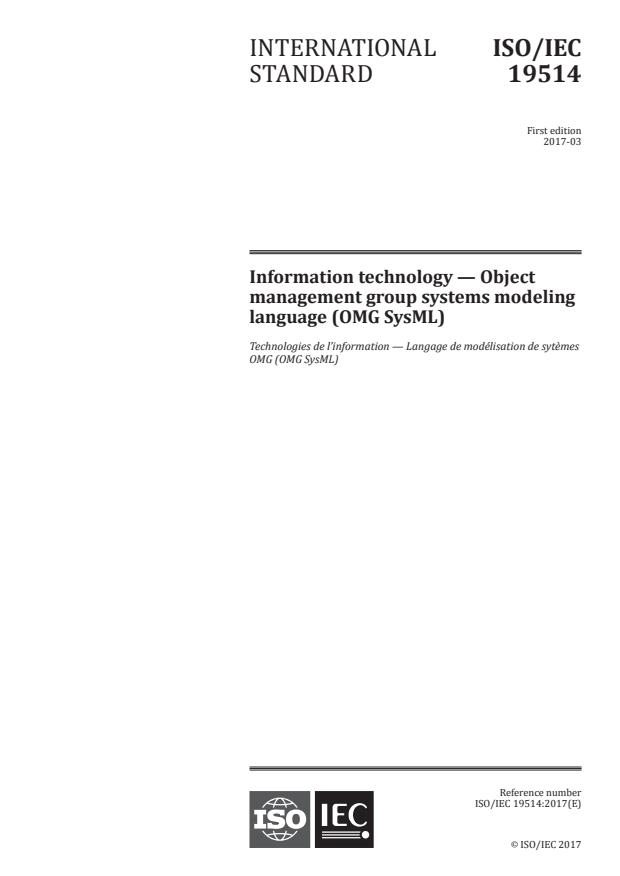
INTERNATIONAL ISO/IEC
STANDARD 19514
First edition
2017-03
Information technology — Object
management group systems modeling
language (OMG SysML)
Technologies de l’information — Langage de modélisation de sytèmes
OMG (OMG SysML)
Reference number
©
ISO/IEC 2017
© ISO/IEC 2017, Published in Switzerland
All rights reserved. Unless otherwise specified, no part of this publication may be reproduced or utilized otherwise in any form
or by any means, electronic or mechanical, including photocopying, or posting on the internet or an intranet, without prior
written permission. Permission can be requested from either ISO at the address below or ISO’s member body in the country of
the requester.
ISO copyright office
Ch. de Blandonnet 8 • CP 401
CH-1214 Vernier, Geneva, Switzerland
Tel. +41 22 749 01 11
Fax +41 22 749 09 47
copyright@iso.org
www.iso.org
ii © ISO/IEC 2017 – All rights reserved
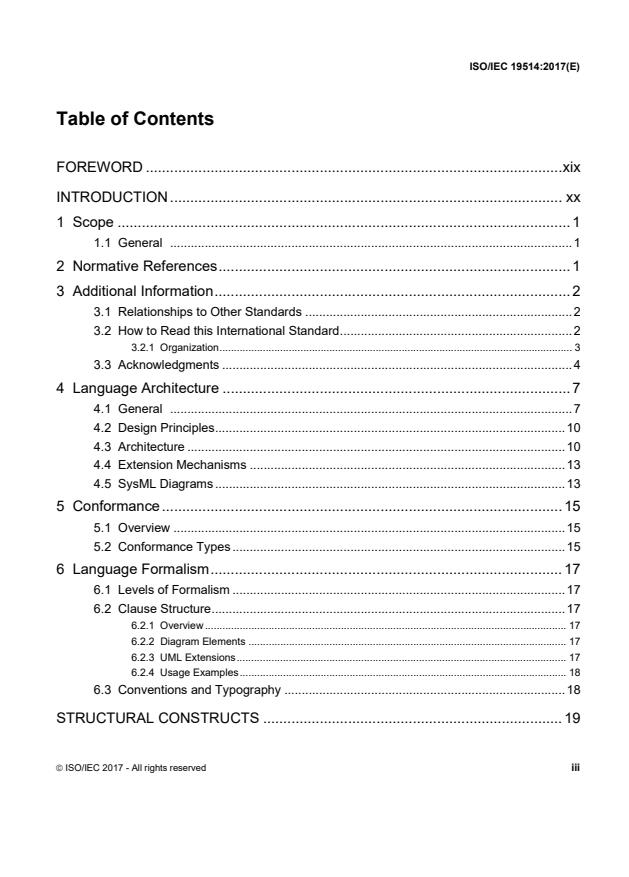
Table of Contents
FOREWORD .xix
INTRODUCTION. xx
1 Scope . 1
1.1 General .1
2 Normative References. 1
3 Additional Information. 2
3.1 Relationships to Other Standards .2
3.2 How to Read this International Standard.2
3.2.1 Organization. 3
3.3 Acknowledgments .4
4 Language Architecture . 7
4.1 General .7
4.2 Design Principles.10
4.3 Architecture .10
4.4 Extension Mechanisms .13
4.5 SysML Diagrams .13
5 Conformance. 15
5.1 Overview .15
5.2 Conformance Types .15
6 Language Formalism. 17
6.1 Levels of Formalism .17
6.2 Clause Structure.17
6.2.1 Overview . 17
6.2.2 Diagram Elements . 17
6.2.3 UML Extensions. 17
6.2.4 Usage Examples. 18
6.3 Conventions and Typography .18
STRUCTURAL CONSTRUCTS . 19
ISO/IEC 2017 - All rights reserved iii
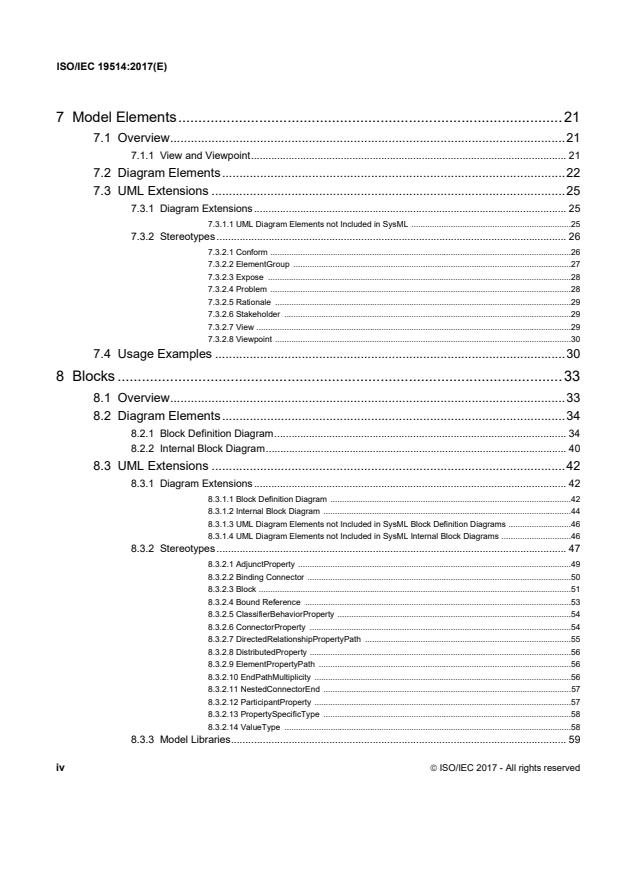
7 Model Elements.21
7.1 Overview.21
7.1.1 View and Viewpoint. 21
7.2 Diagram Elements.22
7.3 UML Extensions .25
7.3.1 Diagram Extensions. 25
7.3.1.1 UML Diagram Elements not Included in SysML .25
7.3.2 Stereotypes. 26
7.3.2.1 Conform .26
7.3.2.2 ElementGroup .27
7.3.2.3 Expose .28
7.3.2.4 Problem .28
7.3.2.5 Rationale .29
7.3.2.6 Stakeholder .29
7.3.2.7 View .29
7.3.2.8 Viewpoint .30
7.4 Usage Examples .30
8 Blocks .33
8.1 Overview.33
8.2 Diagram Elements.34
8.2.1 Block Definition Diagram. 34
8.2.2 Internal Block Diagram. 40
8.3 UML Extensions .42
8.3.1 Diagram Extensions. 42
8.3.1.1 Block Definition Diagram .42
8.3.1.2 Internal Block Diagram .44
8.3.1.3 UML Diagram Elements not Included in SysML Block Definition Diagrams .46
8.3.1.4 UML Diagram Elements not Included in SysML Internal Block Diagrams .46
8.3.2 Stereotypes. 47
8.3.2.1 AdjunctProperty .49
8.3.2.2 Binding Connector .50
8.3.2.3 Block .51
8.3.2.4 Bound Reference .53
8.3.2.5 ClassifierBehaviorProperty .54
8.3.2.6 ConnectorProperty .54
8.3.2.7 DirectedRelationshipPropertyPath .55
8.3.2.8 DistributedProperty .56
8.3.2.9 ElementPropertyPath .56
8.3.2.10 EndPathMultiplicity .56
8.3.2.11 NestedConnectorEnd .57
8.3.2.12 ParticipantProperty .57
8.3.2.13 PropertySpecificType .58
8.3.2.14 ValueType .58
8.3.3 Model Libraries. 59
iv ISO/IEC 2017 - All rights reserved
8.3.3.1 Package PrimitiveValueTypes .59
8.3.3.2 Package UnitAndQuantityKind .60
8.4 Usage Examples .62
8.4.1 Wheel Hub Assembly. 62
8.4.2 Example Value Type Definitions . 64
8.4.3 Design Configuration for SUV EPA Fuel Economy Test. 65
8.4.4 Water Delivery . 65
8.4.5 Constraining Decomposition .65
8.4.6 Units and Quantity Kinds . 67
9 Ports and Flows. 71
9.1 Overview .71
9.1.1 Ports. 71
9.1.2 Flow Properties, Provided and Required Features, and Nested Ports . 71
9.1.3 Proxy Ports and Full Ports . 71
9.1.4 Item Flows. 72
9.1.5 Deprecation of Flow Ports and Flow Specifications. 72
9.2 Diagram Elements.73
9.2.1 Block Definition Diagram. 73
9.2.2 Internal Block Diagram. 76
9.3 UML Extensions .78
9.3.1 Diagram Extensions. 78
9.3.1.1 DirectedFeature .78
9.3.1.2 FlowProperty .78
9.3.1.3 FullPort .78
9.3.1.4 InvocationOnNestedPortAction .78
9.3.1.5 ItemFlow .78
9.3.1.6 Port. 78
9.3.1.7 ProxyPort .79
9.3.1.8 TriggerOnNestedPort .79
9.3.2 Stereotypes. 79
9.3.2.1 AcceptChangeStructuralFeatureEventAction .81
9.3.2.2 Block . 82
9.3.2.3 ChangeStructuralFeatureEvent .82
9.3.2.4 DirectedFeature .82
9.3.2.5 FeatureDirection .83
9.3.2.6 FlowDirection. 84
9.3.2.7 FlowProperty .84
9.3.2.8 FullPort .85
9.3.2.9 InterfaceBlock .86
9.3.2.10 InvocationOnNestedPortAction .86
9.3.2.11 ItemFlow .86
9.3.2.12 ProxyPort .87
9.3.2.13 TriggerOnNestedPort .88
ISO/IEC 2017 - All rights reserved v
9.4 Usage Examples .89
9.4.1 Ports with Required and Provided Features . 89
9.4.2 Flow Ports and Item Flows. 89
9.4.3 Ports with Flow Properties . 90
9.4.4 Proxy and Full Ports. 90
9.4.5 Association and Port Decomposition . 91
9.4.6 Item Flow Decomposition. 95
10 Constraint Blocks.97
10.1 Overview.97
10.2 Diagram Elements.98
10.2.1 Block Definition Diagram. 98
10.2.2 Parametric Diagram . 98
10.3 UML Extensions .99
10.3.1 Diagram Extensions. 99
10.3.1.1 Block Definition Diagram .99
10.3.1.2 Parametric Diagram .101
10.3.2 Stereotypes. 100
10.3.2.1 ConstraintBlock .101
10.4 Usage Examples .101
10.4.1 Definition of Constraint Blocks on a Block Definition Diagram. 101
10.4.2 Usage of Constraint Blocks on a Parametric Diagram. 101
BEHAVIORAL CONSTRUCTS.103
11 Activities .105
11.1 Overview.105
11.1.1 Control as Data . 105
11.1.2 Continuous Systems . 105
11.1.3 Probability . 105
11.1.4 Activities as Blocks. 106
11.1.5 Timelines. 106
11.2 Diagram Elements.107
11.2.1 Activity Diagram . 105
11.3 UML Extensions .114
11.3.1 Diagram Extensions. 114
11.3.1.1 Activity .114
11.3.1.2 CallBehaviorAction .115
11.3.1.3 ControlFlow .116
11.3.1.4 ObjectNode, Variables, and Parameters .116
11.3.2 Stereotypes. 117
11.3.2.1 Continuous .118
vi ISO/IEC 2017 - All rights reserved
11.3.2.2 ControlOperator .119
11.3.2.3 Discrete .119
11.3.2.4 NoBuffer .119
11.3.2.5 Overwrite .120
11.3.2.6 Optional .120
11.3.2.7 Probability .120
11.3.2.8 Rate .121
11.3.3 Model Libraries . 121
11.3.3.1 Package ControlValues .121
11.4 Usage Examples .122
12 Interactions. 127
12.1 Overview .127
12.2 Diagram Elements.128
12.2.1 Sequence Diagram . 128
12.3 UML Extensions .133
12.3.1 Diagram Extensions. 133
12.3.1.1 Exclusion of Communication Diagram, Interaction Overview Diagram, and
Timing Diagram .133
12.3.1.2 Interactions and Parameters .133
12.4 Usage Examples .134
12.4.1 Sequence Diagrams .134
13 State Machines. 135
13.1 Overview .135
13.2 Diagram Elements.135
13.2.1 State Machine Diagram . 135
13.3 UML Extensions .140
13.3.1 Diagram Extensions. 140
13.3.1.1 State Machines and Parameters .140
13.4 Usage Examples .140
13.4.1 State Machine Diagram . 140
14 Use Cases. 141
14.1 Overview .141
14.2 Diagram Elements.142
14.2.1 Use Case Diagram. 142
14.3 UML Extensions .143
14.4 Usage Examples .143
CROSSCUTTING CONSTRUCTS. 145
ISO/IEC 2017 - All rights reserved vii
15 Allocations .147
15.1 Overview.147
15.2 Diagram Elements.147
15.2.1 Representing Allocation on Diagrams. 148
15.3 UML Extensions .149
15.3.1 Diagram Extensions. 149
15.3.1.1 Tables .149
15.3.1.2 Allocate Relationship Rendering . 149
15.3.1.3 Allocation Compartment Format .149
15.3.1.4 Allocation Callout Format .149
15.3.1.5 AllocatedActivityPartition Label .149
15.3.2 Stereotypes. 150
15.3.2.1 Allocate(from Allocations) .150
15.3.2.2 AllocateActivityPartition(from Allocations) .151
15.4 Usage Examples .152
15.4.1 Behavior Allocation of Actions to Parts and Activities to Blocks . 152
15.4.2 Allocate Flow. 153
15.4.2.1 Allocating Structure .154
15.4.2.2 Automotive Example .154
15.4.3 Tabular Representation. 155
16 Requirements .157
16.1 Overview.157
16.2 Diagram Elements.159
16.2.1 Requirement Diagram. 159
16.3 UML Extensions .162
16.3.1 Diagram Extensions. 162
16.3.1.1 Requirement Diagram .162
16.3.1.2 Requirement Notation .162
16.3.1.3 Requirement Property Callout Format .162
16.3.1.4 Requirements on Other Diagrams .162
16.3.1.5 Requirements Table .163
16.3.2 Stereotypes. 164
16.3.2.1 Copy .164
16.3.2.2 DeriveReqt .165
16.3.2.3 Refine .165
16.3.2.4 Requirement .165
16.3.2.5 TestCase .167
16.3.2.6 Satisfy .167
16.3.2.7 Trace .167
16.3.2.8 Verify .168
16.4 Usage Examples .168
16.4.1 Requirement Decomposition and Traceability . 168
16.4.2 Requirements and Design Elements. 169
viii ISO/IEC 2017 - All rights reserved
16.4.3 Requirements Reuse .171
16.4.4 Verification Procedure (Test Case). 172
17 Profiles & Model Libraries. 175
17.1 Overview .175
17.2 Diagram Elements.176
17.2.1 Profile Definition in Package Diagram . 176
17.2.1.1 Extension .178
17.2.2 Stereotypes Used On Diagrams . 178
17.2.2.1 StereotypeInNode .179
17.2.2.2 StereotypeInComment .180
17.2.2.3 StereotypeInCompartment .180
17.3 UML Extensions .180
17.4 Usage Examples .180
17.4.1 Defining a Profile. 180
17.4.2 Adding Stereotypes to a Profile . 181
17.4.3 Defining a Model Library that Uses a Profile. 182
17.4.4 Guidance on Whether to Use a Stereotype or Class . 183
17.4.5 Using a Profile. 183
17.4.6 Using a Stereotype . 184
17.4.7 Using a Model Library Element. 184
ANNEXES . 187
Annex A: Diagrams. 189
Annex B: SysML Diagram Interchange . 195
Annex C: Deprecated Elements . 205
Annex D: Sample Problem . 213
Annex E: Non-normative Extensions. 251
Annex F: Requirements Traceability . 319
Annex G: Model Interchange. 321
Annex H: Legal Information. 325
ISO/IEC 2017 - All rights reserved ix
x ISO/IEC 2017 - All rights reserved
List of Figures
Figure 4.1 - Overview of SysML/UML Interrelationship.7
Figure 4.2 - SysML Extension of UML.11
Figure 4.3 - SysML Package Structure .12
Figure 4.4 - Non-normative Package Structure.13
Figure 7.1 - Stereotypes defined in package ModelElements.26
Figure 7.2 - Rationale and Problem examples .31
Figure 8.1 - Nested property reference .45
Figure 8.2 - Abstract syntax extensions for SysML blocks .47
Figure 8.3 - Abstract syntax extensions for SysML properties.47
Figure 8.4 - Abstract syntax extensions for SysML value types.47
Figure 8.5 - Abstract syntax extensions for SysML property paths.48
Figure 8.6 - Abstract syntax extensions for SysML connector ends.48
Figure 8.7 - Abstract syntax extensions for SysML property-specific types.48
Figure 8.8 - Abstract syntax extensions for SysML bound references .49
Figure 8.9 - Abstract syntax extensions for SysML adjunct properties and classifier behavior properties.49
Figure 8.10 - Model library for primitive value types .59
Figure 8.11 - Model library for Unit and QuantityKind .60
Figure 8.12 - Block diagram for the Wheel Package.63
Figure 8.13 - Internal Block Diagram for WheelHubAssembly.64
Figure 8.14 - Defining Value Types with units of measure from the International System of Units (SI) .64
Figure 8.15 - Vehicle decomposition .65
Figure 8.16 - Vehicle internal structure.66
Figure 8.17 - Vehicle specialization.66
Figure 8.18 - Example of Unit, QuantityKind and ValueType definitions .67
Figure 8.19 - Instance-level view of the Unit, QuantityKind and ValueType definitions .68
Figure 8.20 - Example of equivalent Unit representations .68
Figure 8.21 - Instance-level representation of equivalent Unit definitions.69
Figure 9.1 - Port Stereotypes.79
Figure 9.2 - Stereotypes for Actions on Nested Ports.80
Figure 9.3 - Stereotypes for Property Value Change Events.80
Figure 9.4 - Provided and Required Features.80
Figure 9.5 - ItemFlow Stereotype .81
Figure 9.6 - Usage example of ports with provided and required features.89
Figure 9.7 Usage example of proxy and full ports.91
Figure 9.8 - Water Delivery association block.92
Figure 9.9 - Internal structure of Water Delivery association block .92
Figure 9.10 - Two views of Water Delivery connector within House block.93
Figure 9.11 - Specializations of Water Client in house example .93
Figure 9.12 - Plumbing association block.94
Figure 9.13 - Internal structure of Plumbing association block.94
Figure 9.14 - Water Delivery association block with internal Plumbing connector .94
ISO/IEC 2017 - All rights reserved xi
Figure 9.15 - Usage example of item flows in internal block diagrams .95
Figure 9.16 - Usage example of item flow decomposition .96
Figure 9.17 - Usage example of item flow decomposition .96
Figure 10.1 - Stereotypes defined in SysML ConstraintBlocks package.100
Figure 11.1 - Block definition diagram with activities as blocks.115
Figure 11.2 - CallBehaviorAction notation.with behavior stereotype .115
Figure 11.3 - CallBehaviorAction notation.with action name .115
Figure 11.4 - Control flow notation.116
Figure 11.5 - Block definition diagram with activities as blocks associated with types of object nodes,
variables, and parameters.116
Figure 11.6 - ObjectNode notation in activity diagrams.117
Figure 11.7 - ObjectNode notation in activity diagrams.117
Figure 11.8 - Abstract Syntax for SysML Activity Extensions .118
Figure 11.9 - Control values.
...