

ISO/IEC 19507:2012
(Main)Information technology — Object Management Group Object Constraint Language (OCL)
General Information
- Abstract
ISO/IEC 19507:2012 defines the Object Constraint Language (OCL), version 2.3.1. OCL version 2.3.1 is the version of OCL that is aligned with UML 2.3 and MOF 2.0.
- Status
- Published
- Publication Date
- 19-Apr-2012
- Technical Committee
- ISO/IEC JTC 1 - Information technology
- Drafting Committee
- ISO/IEC JTC 1 - Information technology
- Current Stage
- 9093 - International Standard confirmed
- Start Date
- 25-Jan-2022
- Completion Date
- 29-Aug-2026
Overview
ISO/IEC 19507:2012 specifies the Object Management Group Object Constraint Language (OCL), version 2.3.1. This ISO standard formalizes OCL as the textual language for expressing constraints and queries on UML models and MOF-based metamodels. ISO/IEC 19507:2012 ensures OCL 2.3.1 is aligned with UML 2.3 and MOF 2.0, providing normative rules for syntax, semantics and tool conformance.
Keywords: ISO/IEC 19507, OCL 2.3.1, Object Constraint Language, UML 2.3, MOF 2.0, model validation, model-driven engineering.
Key Topics and Requirements
The standard covers the complete OCL specification and includes the following technical areas:
- Language Description and Rationale: purpose, where to use OCL and basic notational conventions.
- Expressions and Types: definitions for primitive types, UML-derived types, enumerations, tuples and collections.
- Objects, Properties and Navigation: attributes, operations, association ends, qualified associations and navigation rules.
- Constraints and Contexts: how to write invariants, preconditions, postconditions, package and operation contexts, and initial/derived values.
- Collection Operations: standard collection operators (select, collect, forAll, exists, closure, iterate).
- Messages and Calls: calling operations, sending signals and accessing results.
- Concrete and Abstract Syntax: formal mappings between concrete syntax (textual notation) and the OCL abstract syntax metamodel.
- Semantics and Well-formedness: UML-based semantic description, values and evaluation packages, and conformance rules.
- Tooling Guidance and Conformance: environment definition, parsing notes and rules for tool builders.
The document contains normative well-formedness rules, type conformance rules, and mappings between concrete and abstract syntaxes that tools must implement to claim compliance.
Practical Applications and Users
ISO/IEC 19507:2012 is used to add precise, executable constraints and queries to models in these contexts:
- Model validation and verification in Model-Driven Engineering (MDE) and Model-Based Systems Engineering (MBSE)
- Formalizing UML model semantics for code generation, model transformations and automated tests
- Defining domain-specific constraints in metamodels built on MOF
- Tool implementers creating OCL parsers, validators and evaluators (UML/OCL tool vendors, IDE plugin authors)
- System architects, software modelers, QA engineers and analysts who need unambiguous model constraints
Keywords: model validation, OCL constraints, UML modeling, tool conformance, MDE.
Related Standards
- UML 2.3 (Object Management Group) - modeling language aligned with OCL contexts
- MOF 2.0 (Meta-Object Facility) - metamodeling foundation used by OCL
ISO/IEC 19507:2012 provides the authoritative, ISO-approved definition of OCL 2.3.1 for standards-compliant modeling and tooling.
Get Certified
Connect with accredited certification bodies for this standard

BSI Group
BSI (British Standards Institution) is the business standards company that helps organizations make excellence a habit.

NYCE
Mexican standards and certification body.
Sponsored listings
Frequently Asked Questions
ISO/IEC 19507:2012 is a standard published by the International Organization for Standardization (ISO). Its full title is "Information technology — Object Management Group Object Constraint Language (OCL)". This standard covers: ISO/IEC 19507:2012 defines the Object Constraint Language (OCL), version 2.3.1. OCL version 2.3.1 is the version of OCL that is aligned with UML 2.3 and MOF 2.0.
ISO/IEC 19507:2012 defines the Object Constraint Language (OCL), version 2.3.1. OCL version 2.3.1 is the version of OCL that is aligned with UML 2.3 and MOF 2.0.
ISO/IEC 19507:2012 is classified under the following ICS (International Classification for Standards) categories: 35.060 - Languages used in information technology. The ICS classification helps identify the subject area and facilitates finding related standards.
ISO/IEC 19507:2012 is available in PDF format for immediate download after purchase. The document can be added to your cart and obtained through the secure checkout process. Digital delivery ensures instant access to the complete standard document.
Standards Content (Sample)
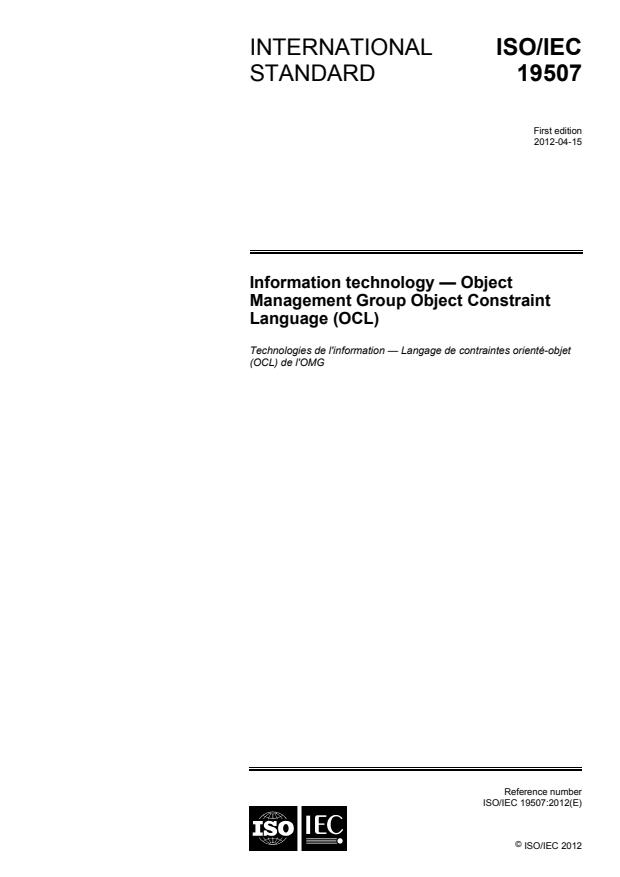
INTERNATIONAL ISO/IEC
STANDARD 19507
First edition
2012-04-15
Information technology — Object
Management Group Object Constraint
Language (OCL)
Technologies de l'information — Langage de contraintes orienté-objet
(OCL) de l'OMG
Reference number
©
ISO/IEC 2012
© ISO/IEC 2012
All rights reserved. Unless otherwise specified, no part of this publication may be reproduced or utilized in any form or by any means,
electronic or mechanical, including photocopying and microfilm, without permission in writing from either ISO at the address below or
ISO's member body in the country of the requester.
ISO copyright office
Case postale 56 CH-1211 Geneva 20
Tel. + 41 22 749 01 11
Fax + 41 22 749 09 47
E-mail copyright@iso.org
Web www.iso.org
Published in Switzerland
ii © ISO/IEC 2012 – All rights reserved
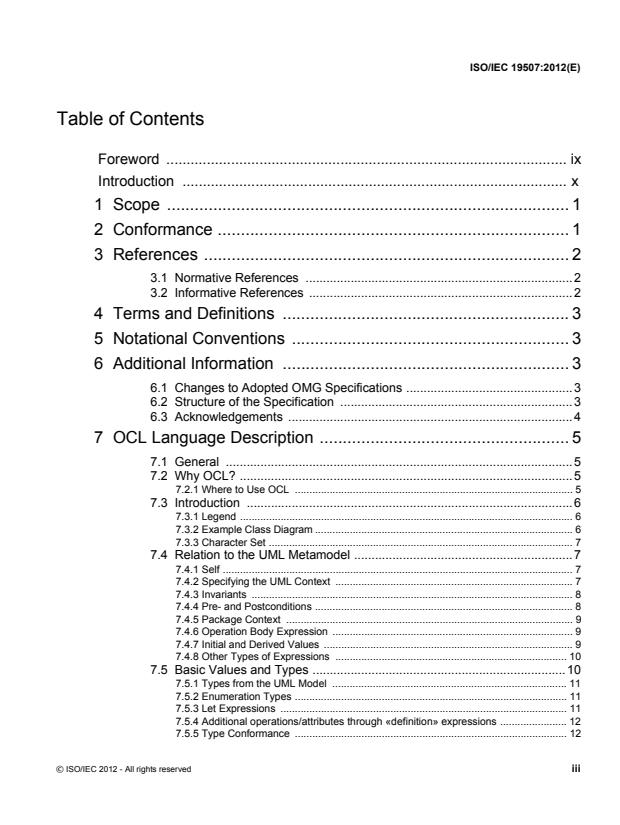
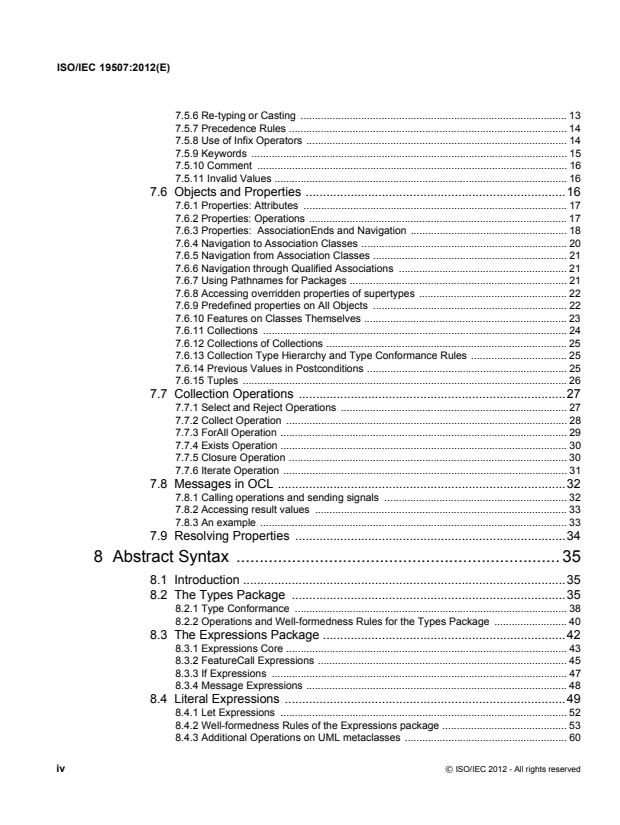
Table of Contents
Foreword . ix
Introduction . x
1 Scope . 1
2 Conformance . 1
3 References . 2
3.1 Normative References .2
3.2 Informative References .2
4 Terms and Definitions . 3
5 Notational Conventions .3
6 Additional Information .3
6.1 Changes to Adopted OMG Specifications .3
6.2 Structure of the Specification .3
6.3 Acknowledgements .4
7 OCL Language Description .5
7.1 General .5
7.2 Why OCL? .5
7.2.1 Where to Use OCL . 5
7.3 Introduction .6
7.3.1 Legend . 6
7.3.2 Example Class Diagram . 6
7.3.3 Character Set . 7
7.4 Relation to the UML Metamodel .7
7.4.1 Self . 7
7.4.2 Specifying the UML Context . 7
7.4.3 Invariants . 8
7.4.4 Pre- and Postconditions . 8
7.4.5 Package Context . 9
7.4.6 Operation Body Expression . 9
7.4.7 Initial and Derived Values . 9
7.4.8 Other Types of Expressions . 10
7.5 Basic Values and Types .10
7.5.1 Types from the UML Model . 11
7.5.2 Enumeration Types . 11
7.5.3 Let Expressions . 11
7.5.4 Additional operations/attributes through «definition» expressions . 12
7.5.5 Type Conformance . 12
© ISO/IEC 2012 - All rights reserved iii
7.5.6 Re-typing or Casting . 13
7.5.7 Precedence Rules . 14
7.5.8 Use of Infix Operators . 14
7.5.9 Keywords . 15
7.5.10 Comment . 16
7.5.11 Invalid Values . 16
7.6 Objects and Properties .16
7.6.1 Properties: Attributes . 17
7.6.2 Properties: Operations . 17
7.6.3 Properties: AssociationEnds and Navigation . 18
7.6.4 Navigation to Association Classes . 20
7.6.5 Navigation from Association Classes . 21
7.6.6 Navigation through Qualified Associations . 21
7.6.7 Using Pathnames for Packages . 21
7.6.8 Accessing overridden properties of supertypes . 22
7.6.9 Predefined properties on All Objects . 22
7.6.10 Features on Classes Themselves . 23
7.6.11 Collections . 24
7.6.12 Collections of Collections . 25
7.6.13 Collection Type Hierarchy and Type Conformance Rules . 25
7.6.14 Previous Values in Postconditions . 25
7.6.15 Tuples . 26
7.7 Collection Operations .27
7.7.1 Select and Reject Operations . 27
7.7.2 Collect Operation . 28
7.7.3 ForAll Operation . 29
7.7.4 Exists Operation . 30
7.7.5 Closure Operation . 30
7.7.6 Iterate Operation . 31
7.8 Messages in OCL .32
7.8.1 Calling operations and sending signals . 32
7.8.2 Accessing result values . 33
7.8.3 An example . 33
7.9 Resolving Properties .34
8 Abstract Syntax . 35
8.1 Introduction .35
8.2 The Types Package .35
8.2.1 Type Conformance . 38
8.2.2 Operations and Well-formedness Rules for the Types Package . 40
8.3 The Expressions Package .42
8.3.1 Expressions Core . 43
8.3.2 FeatureCall Expressions . 45
8.3.3 If Expressions . 47
8.3.4 Message Expressions . 48
8.4 Literal Expressions .49
8.4.1 Let Expressions . 52
8.4.2 Well-formedness Rules of the Expressions package . 53
8.4.3 Additional Operations on UML metaclasses . 60
iv © ISO/IEC 2012 - All rights reserved
8.4.4 Additional Operations on OCL Metaclasses . 62
8.4.5 Overview of class hierarchy of OCL Abstract Syntax metamodel . 64
9 Concrete Syntax . 65
9.1 General .65
9.2 Structure of the Concrete Syntax .65
9.3 A Note to Tool Builders .67
9.3.1 Parsing .67
9.3.2 Visibility . 67
9.4 Concrete Syntax .67
9.4.1 ExpressionInOclCS . 68
9.4.2 OclExpressionCS . 68
9.4.3 VariableExpCS . 69
9.4.4 simpleNameCS . 69
9.4.5 restrictedKeywordCS . 70
9.4.6 unreservedSimpleNameCS . 71
9.4.7 pathNameCS . 71
9.4.8 LiteralExpCS . 72
9.4.9 EnumLiteralExpCS . 72
9.4.10 CollectionLiteralExpCS . 73
9.4.11 CollectionTypeIdentifierCS . 73
9.4.12 CollectionLiteralPartsCS . 74
9.4.13 CollectionLiteralPartCS . 74
9.4.14 CollectionRangeCS . 74
9.4.15 PrimitiveLiteralExpCS . 75
9.4.16 TupleLiteralExpCS . 76
9.4.17 UnlimitedNaturalLiteralExpCS . 76
9.4.18 IntegerLiteralExpCS . 76
9.4.19 RealLiteralExpCS . 77
9.4.20 StringLiteralExpCS . 77
9.4.21 BooleanLiteralExpCS . 78
9.4.22 TypeLiteralExpCS . 78
9.4.23 CallExpCS . 79
9.4.24 LoopExpCS . 79
9.4.25 IteratorExpCS . 80
9.4.26 IterateExpCS . 83
9.4.27 VariableDeclarationCS . 84
9.4.28 TypeCS . 85
9.4.29 primitiveTypeCS . 85
9.4.30 oclTypeCS . 86
9.4.31 collectionTypeCS . 86
9.4.32 tupleTypeCS . 87
9.4.33 variableDeclarationListCS . 87
9.4.34 FeatureCallExpCS . 88
9.4.35 OperationCallExpCS . 88
9.4.36 PropertyCallExpCS . 91
9.4.37 NavigationCallExpCS . 93
9.4.38 AssociationClassCallExpCS . 93
9.4.39 isMarkedPreCS . 94
9.4.40 argumentsCS . 94
© ISO/IEC 2012 - All rights reserved v
9.4.41 LetExpCS . 95
9.4.42 LetExpSubCS . 95
9.4.43 OclMessageExpCS . 96
9.4.44 OclMessageArgumentsCS . 97
9.4.45 OclMessageArgCS . 97
9.4.46 IfExpCS . 98
9.4.47 NullLiteralExpCS . 98
9.4.48 InvalidLiteralExpCS . 99
9.4.49 Comments . 99
9.5 Environment Definition .99
9.5.1 Environment . 99
9.5.2 NamedElement . 102
9.5.3 Namespace . 102
9.6 Concrete to Abstract Syntax Mapping .102
9.7 Abstract Syntax to Concrete Syntax Mapping .103
10 Semantics Described Using UML . 105
10.1 Introduction .105
10.2 The Values Package .106
10.2.1 Definitions of Concepts for the Values Package . 107
10.2.2 Well-formedness Rules for the Values Package . 111
10.2.3 Additional Operations for the Values Package . 113
10.2.4 Overview of the Values Package . 114
10.3 The Evaluations Package .115
10.3.1 Definitions of Concepts for the Evaluations Package . 116
10.3.2 Well-formedness Rules of the Evaluations Package . 125
10.3.3 Additional Operations of the Evaluations Package . 132
10.3.4 Overview of the Values Package . 133
10.4 The AS-Domain-Mapping Package .134
10.4.1 Well-formedness rules for the AS-Domain-Mapping.type-value Package . 135
10.4.2 Additional Operations for the AS-Domain-Mapping.type-value Package . 137
10.4.3 Well-formedness rules for the AS-Domain-Mapping.exp-eval Package . 137
11 OCL Standard Library .145
11.1 Introduction .145
11.2 The OclAny, OclVoid, OclInvalid, and OclMessage Types .146
11.2.1 OclAny . 146
11.2.2 OclMessage . 146
11.2.3 OclVoid . 146
11.2.4 OclInvalid . 146
11.3 Operations and Well-formedness Rules .146
11.3.1 OclAny . 146
11.3.2 OclVoid . 148
11.3.3 OclMessage . 148
11.4 Primitive Types .148
11.4.1 Real . 148
11.4.2 Integer . 148
11.4.3 String . 149
vi © ISO/IEC 2012 - All rights reserved
11.4.4 Boolean . 149
11.4.5 UnlimitedNatural . 149
11.5 Operations and Well-formedness Rules .149
11.5.1 Real . 149
11.5.2 Integer . 150
11.5.3 String . 151
11.5.4 Boolean . 153
11.5.5 UnlimitedNatural . 154
11.6 Collection-Related Types .155
11.6.1 Collection . 156
11.6.2 Set . 156
11.6.3 OrderedSet . 156
11.6.4 Bag . 156
11.6.5 Sequence . 156
11.7 Operations and Well-formedness Rules .156
11.7.1 Collection . 156
11.7.2 Set . 159
11.7.3 OrderedSet . 161
11.7.4 Bag . 163
11.7.5 Sequence . 165
11.8 Predefined Iterator Expressions .168
11.8.1 Extending the Standard Library with Iterator Expressions . 168
11.9 Mapping Rules for Predefined Iterator Expressions .168
11.9.1 Collection . 168
11.9.2 Set . 170
11.9.3 Bag . 171
11.9.4 Sequence . 172
11.9.5 OrderedSet . 173
12 The Use of OCL Expressions in UML Models . 175
12.1 Introduction .175
12.2 The ExpressionInOcl Type .175
12.2.1 ExpressionInOcl . 176
12.3 Well-formedness Rules .176
12.3.1 ExpressionInOcl . 176
12.4 Standard Placements of OCL Expressions .177
12.4.1 How to Extend the Use of OCL at Other Places . 177
12.5 Definition .177
12.5.1 Well-formedness Rules . 177
12.6 Invariant .178
12.6.1 Well-formedness rules . 178
12.7 Precondition .179
12.7.1 Well-formedness rules. 179
12.7.2 Postcondition . 180
12.7.3 Well-formedness rules . 180
12.8 Initial Value Expression .180
12.8.1 Well-formedness rules . 181
12.9 Derived Value Expression .182
© ISO/IEC 2012 - All rights reserved vii
12.10 Operation Body Expression .182
12.11 Guard .182
12.11.1 Well-formedness rules . 183
12.12 Concrete Syntax of Context Declarations .183
12.12.1 packageDeclarationCS . 184
12.12.2 contextDeclarationCS . 184
12.12.3 propertyContextDeclCS . 184
12.12.4 initOrDerValueCS . 184
12.12.5 classifierContextDeclCS . 184
12.12.6 invOrDefCS . 184
12.12.7 defExpressionCS . 185
12.12.8 operationContextDeclCS . 185
12.12.9 prePostOrBodyDeclCS . 185
12.12.10 operationCS . 185
12.12.11 parametersCS . 185
13 The Basic OCL and Essential OCL . 187
13.1 Introduction .187
13.2 OCL Adaptation for Metamodeling .187
13.3 Diagrams .188
Annex A - Semantics.193
Annex B - Bibliography.229
Annex C - Legal Information.231
viii © ISO/IEC 2012 - All rights reserved
Foreword
ISO (the International Organization for Standardization) is a worldwide federation of national standards bodies (ISO
member bodies). The work of preparing International Standards is normally carried out through ISO technical
committees. Each member body interested in a subject for which a technical committee has been established has the right
to be represented on that committee. International organizations, governmental and non-governmental, in liaison with
ISO, also take part in the work. ISO collaborates closely with the International Electrotechnical Commission (IEC) on all
matters of electrotechnical standardization.
International Standards are drafted in accordance with the rules given in the ISO/IEC Directives, Part 2.
The main task of technical committees is to prepare International Standards. Draft International Standards adopted by the
technical committees are circulated to the member bodies for voting. Publication as an International Standard requires
approval by at least 75 % of the member bodies casting a vote.
Attention is drawn to the possibility that some of the elements of this document may be the subject of patent rights. ISO
shall not be held responsible for identifying any or all such patent rights.
ISO/IEC 19507 was prepared by Technical Committee ISO/IEC JTC1, Information technology, in collaboration with the
Object Management Group (OMG), following the submission and processing as a Publicly Available Specification (PAS)
of the OMG Object Constraint Language specification Version 2.3.1.
ISO/IEC 19507, under the general title Information technology - Open distributed processing - Object Constraint
Language specification (OCL), apart from this introductory material is identical with that for the OMG specification for
Object Constraint Language, v2.3.1.
© ISO/IEC 2012 - All rights reserved ix
Introduction
The rapid growth of distributed processing has led to a need for a coordinating framework for this standardization and
ITU-T Recommendations X.901-904 | ISO/IEC 10746, the Reference Model of Open Distributed Processing (RM-ODP)
provides such a framework. It defines an architecture within which support of distribution, interoperability, and portability
can be integrated.
RM-ODP Part 2 (ISO/IEC 10746-2) defines the foundational concepts and modeling framework for describing distributed
systems. The scopes and objectives of the RM-ODP Part 2 and the UML, while related, are not the same and, in a number
of cases, the RM-ODP Part 2 and the UML specification use the same term for concepts that are related but not identical
(e.g., interface). Nevertheless, a specification using the Part 2 modeling concepts can be expressed using UML with
appropriate extensions (using stereotypes, tags, and constraints).
RM-ODP Part 3 (ISO/IEC 10746-3) specifies a generic architecture of open distributed systems, expressed using the
foundational concepts and framework defined in Part 2. Given the relation between UML as a modeling language and Part
2 of the RM ODP standard, it is easy to show that UML is suitable as a notation for the individual viewpoint
specifications defined by the RM-ODP.
OCL Language
OCL is a pure specification language; therefore, an OCL expression is guaranteed to be without side effects. When an
OCL expression is evaluated, it simply returns a value. It cannot change anything in the model. This means that the state
of the system will never change because of the evaluation of an OCL expression, even though an OCL expression can be
used to specify a state change (e.g., in a post-condition).
OCL is not a programming language; therefore, it is not possible to write program logic or flow control in OCL. You
cannot invoke processes or activate non-query operations within OCL. Because OCL is a modeling language in the first
place, OCL expressions are not by definition directly executable.
OCL is a typed language so that each OCL expression has a type. To be well formed, an OCL expression must conform
to the type conformance rules of the language. For example, you cannot compare an Integer with a String. Each Classifier
defined within a UML model represents a distinct OCL type. In addition, OCL includes a set of supplementary predefined
types. These are described in Clause 11 (“The OCL Standard Library”).
x © ISO/IEC 2012 - All rights reserved
INTERNATIONAL STANDARD ISO/IEC 19507:2012(E)
Information technology - Object Management Group
Object Constraint Language (OCL)
1Scope
This International Standard defines the Object Constraint Language (OCL), version 2.3.1. OCL version 2.3.1 is the
version of OCL that is aligned with UML 2.3 and MOF 2.0.
2 Conformance
The UML 2.0 Infrastructure and the MOF 2.0 Core specifications that were developed in parallel with this OCL 2.3.1
specification share a common core. The OCL specification contains a well-defined and named subset of OCL that is
defined purely based on the common core of UML and MOF. This allows this subset of OCL to be used with both the
MOF and the UML, while the full specification can be used with the UML only.
The following compliance points are distinguished for both parts.
1. Syntax compliance: The tool can read and write OCL expressions in accordance with the grammar, including
validating its type conformance and conformance of well-formedness rules against a model.
2. XMI compliance: The tool can exchange OCL expressions using XMI.
3. Evaluation compliance: The tool evaluates OCL expressions in accordance with the semantics clause. The following
additional compliance points are optional for OCL evaluators, as they are dependent on the technical platform on
which they are evaluated:
• allInstances()
• pre-values and oclIsNew() in postconditions
• OclMessage
• navigating across non-navigable associations
• accessing private and protected features of an object
The following table shows the possible compliance points. Each tool is expected to fill in this table to specify which
compliance points are supported.
© ISO/IEC 2012 - All rights reserved 1
Table 2.1 - Overview of OCL Compliance Points
OCL-MOF subset Full OCL
Syntax
XMI
Evaluation
- allInstances
- @pre in postcondtions
- OclMessage
- navigating non-navigable associations
- accessing private and protected features
3 References
3.1 Normative References
The following referenced documents are indispensable for the application of this document. For dated references, only the
edition cited applies. For undated references, the latest edition of the referenced document (including any amendments)
applies.
• ISO 639 Codes for the representation of names of languages
• ISO 3166 Codes for the representation of names of countries and their subdivisions
• ISO/IEC 10646:2003 Information technology -- Universal Multiple-Octet Coded Character Set (UCS)
• UML 2.3 Superstructure Specification: http://www.omg.org/spec/UML/2.3/Superstructure/PDF/
• UML 2.3 Infrastructure Specification: http://www.omg.org/soec/UML/2.3/Infrastructure/PDF/
• MOF 2.0 Core Specification: http://www.omg.org/spec/MOF/2.0/PDF/
• UNICODE 5.1 Standard: http://www.unicode.org/versions/Unicode5.1.0/
• Unicode Technical Standard#10: http://www.unicode.org/reports/tr10/
3.2 Informative References
The following specifications are referenced in informative text:
• ISO/IEC 19501:2005 Information technology - Open Distributed Processing -- Unified Modeling Language (UML)
Version 1.4.2
2 © ISO/IEC 2012 - All rights reserved
4 Terms and Definitions
There are no formal definitions that are taken from other documents.
5 Notational Conventions
There are no symbols defined.
6 Additional Information
6.1 Changes to Adopted OMG Specifications
This International Standard replaces the specification of OCL given in OCL 2.2.
The version of OCL specified in ISO/IEC 19501:2005 in intended for use in models based on UML 1.4.1 and UML 1.5.
However, use of the OCL specified by ISO/IEC 19501:2005 is not prescribed by this specification.
The version of OCL specified in this International Standard is not directly applicable to models based on ISO/IEC
19501:2005.
6.2 Structure of the Specification
This International Standard is divided into several clauses.
• The OCL Language Description clause gives an informal description of OCL. This clause is not normative, but meant
to be explanatory.
• Clause 8 (“Abstract Syntax”) describes the abstract syntax of OCL using a MOF 2.0 compliant metamodel. This is the
same approach as used in the UML specifications. The metamodel is MOF compliant in the sense that it only uses
constructs that are defined in the MOF.
• Clause 9 (“Concrete Syntax”) describes the canonical concrete syntax using an attributed EBNF grammar. This syntax
is mapped onto the abstract syntax, achieving a complete separation between concrete and abstract syntax.
• Clause 10 (“Semantics Described using UML”) describes the semantics for OCL using UML.
• In Clause 11 (“The OCL Standard Library”) the OCL Standard Library is described. This defines type like Integer,
Boolean, etc. and all the collection types. OCL is not a stand-alone language, but an integral part of the UML. An OCL
expression needs to be placed within the context of a UML model.
• Clause 12 (“The Use of Ocl Expressions in UML Models”) describes a number of places within the UML where OCL
expressions can be used.
• Clause 13 (“Basic OCL and Essential OCL”) defines the adaptation of the OCL metamodel when used in particular
context of Core::Basic infrastructure library package and in the context of EMOF.
• Annex A (Semantics), Annex B (Bibliography), and Annex C (Legal Information)
© ISO/IEC 2012 - All rights reserved 3
6.3 Acknowledgements
The following companies submitted and/or supported parts of this specification:
• Adaptive Ltd.
• BoldSoft
• Borland Software Corporation
• Compuware Corporation
• Dresden University of Technology
• France Telecom
• International Business Machines
• IONA
• Kabira Technologies Inc.
• Kings College
• Classe Objecten
• Open Canarias, SL
• Oracle
• Project Technology Inc.
• Rational Software Corporation
• SAP AG
• Softeam
• Syntropy Ltd.
• Telelogic
• Thales
• University of Bremen
• University of Kent
• University of York
• Zeligsoft, Inc.
4 © ISO/IEC 2012 - All rights reserved
7 OCL Language Description
7.1 General
This clause introduces the Object Constraint Language (OCL), a formal language used to describe expressions on UML
models. These expressions typically specify invariant conditions that must hold for the system being modeled or queries
over objects described in a model. Note that when the OCL expressions are evaluated, they do not have side effects (i.e.,
their evaluation cannot alter the state of the corresponding executing system).
OCL expressions can be used to specify operations / actions that, when executed, do alter the state of the system. UML
modelers can use OCL to specify application-specific constraints in their models. UML modelers can also use OCL to
specify queries on the UML model, which are completely programming language independent.
Note - This clause is informative only and not normative.
7.2 Why OCL?
A UML diagram, such as a class diagram, is typically not refined enough to provide all the relevant aspects of a
specification. There is, among other things, a need to describe additional constraints about the objects in the model. Such
constraints are often described in natural language. Practice has shown that this will always result in ambiguities. In order
to write unambiguous constraints, so-called formal languages have been developed. The disadvantage of traditional
formal languages is that they are usable to persons with a strong mathematical background, but difficult for the average
business or system modeler to use.
OCL has been developed to fill this gap. It is a formal language that remains easy to read and write. It has been developed
as a business modeling language within the IBM Insurance division, and has its roots in the Syntropy method.
OCL is a pure specification language; therefore, an OCL expression is guaranteed to be without side effects. When an
OCL expression is evaluated, it simply returns a value. It cannot change anything in the model. This means that the state
of the system will never change because of the evaluation of an OCL expression, even though an OCL expression can be
used to specify a state change (e.g., in a post-condition).
OCL is not a programming language; therefore, it is not possible to write program logic or flow control in OCL. You
cannot invoke processes or activate non-query operations within OCL. Because OCL is a modeling language in the first
place, OCL expressions are not by definition directly executable.
OCL is a typed language so that each OCL expression has a type. To be well formed, an OCL expression must conform
to the type conformance rules of the language. For example, you cannot compare an Integer with a String. Each Classifier
defined within a UML model represents a distinct OCL type. In addition, OCL includes a set of supplementary predefined
types. These are described in Clause 11 (“The OCL Standard Library”).
As a specification language, all implementation issues are out of scope and cannot be expressed in OCL.
The evaluation of an OCL expression is instantaneous. This means that the states of objects in a model cannot change
during evaluation.
7.2.1 Where to Use OCL
OCL can be used for a number of different purposes:
• as a query language,
© ISO/IEC 2012 - All rights reserved 5
• to specify invariants on classes and types in the class model,
• to specify type invariant for Stereotypes,
• to describe pre- and post conditions on Operations and Methods,
• to describe Guards,
• to specify target (sets) for messages and actions,
• to specify constraints on operations, and
• to specify derivation rules for
...