

ISO 7206-13:2016/Amd 1:2022
(Amendment)Implants for surgery — Partial and total hip joint prostheses — Part 13: Determination of resistance to torque of head fixation of stemmed femoral components — Amendment 1
General Information
- Abstract
- Status
- Published
- Publication Date
- 04-May-2022
- Technical Committee
- ISO/TC 150/SC 4 - Bone and joint replacements
- Drafting Committee
- ISO/TC 150/SC 4/WG 1 - Mechanical testing
- Current Stage
- 6060 - International Standard published
- Start Date
- 05-May-2022
- Due Date
- 16-Mar-2023
- Completion Date
- 05-May-2022
Buy Documents

ISO 7206-13:2016/Amd 1:2022 - Implants for surgery — Partial and total hip joint prostheses — Part 13: Determination of resistance to torque of head fixation of stemmed femoral components — Amendment 1 Released:5/5/2022
Overview
ISO 7206-13:2016/Amd 1:2022 is an important amendment to the international standard that governs partial and total hip joint prostheses. Specifically, it focuses on the determination of resistance to torque of head fixation in stemmed femoral components used in surgical implants. Developed by ISO Technical Committee ISO/TC 150, Subcommittee SC 4, this standard ensures rigorous testing protocols to assess the mechanical stability and durability of hip prosthesis components under torsional stress.
This amendment updates testing guidelines to improve reliability during surgical implant evaluation, particularly addressing the fixation strength of the prosthetic femoral head to the stem. It provides vital enhancements in test preparation methods, especially for gluing and casting techniques, thereby supporting better patient outcomes through improved implant safety.
Key Topics
Resistance to Torque Measurement
Details precise methods for assessing how much rotational force the fixation between the femoral head and stem can withstand without failure.Test Surface Preparation
Highlights updated requirements for roughening articulating surfaces when using certain resin glues or cast resins to improve adhesion strength and prevent premature test failures.Mechanical Stability of Hip Prostheses
Focuses on evaluating the mechanical locking mechanisms that secure the femoral head to the stem, vital for the long-term function of partial and total hip joint replacements.Updated Testing Notes
The amendment adds specific notes for test operators to ensure consistency, reliability, and accuracy during the torque resistance evaluation.International Collaboration
Prepared under ISO’s structured development process, this amendment reflects global consensus, including inputs from medical device manufacturers, testing laboratories, and regulatory agencies.
Applications
This ISO amendment serves as a critical reference for:
Orthopedic Device Manufacturers
To validate and certify the torque resistance of hip prosthesis components during design and production, ensuring compliance with global market requirements.Testing Laboratories
To implement standardized methods for measuring fixation strength, improving reproducibility and comparability of test results across facilities.Regulatory Authorities
To evaluate product conformity based on internationally accepted mechanical testing procedures for hip implants.Surgeons and Healthcare Providers
To select prostheses that meet rigorous resistance standards which directly impact implant longevity, patient mobility, and overall surgical success.Research and Development
To innovate improved implant fixation technologies and materials that meet or exceed ISO requirements for torque resistance.
Related Standards
ISO 7206 Series – Covers various aspects of testing and design for hip joint prostheses, including fatigue testing and material properties.
ISO 21535 – Implants for Surgery - Wear of Total Hip-Joint Prostheses
Addresses methods for evaluating wear characteristics contributing to implant longevity.ISO 5832 Series – Implants for Surgery - Metallic Materials
Specifies properties of metals used in orthopedic implants, relevant to stemmed femoral components.ISO 14242 – Implants for Surgery - Wear of Total Hip-Joint Prostheses under Loading
Complements torque resistance testing by focusing on wear under cyclic loading conditions.
By adhering to the amendments outlined in ISO 7206-13:2016/Amd 1:2022, stakeholders across the orthopedic implant industry can ensure enhanced testing accuracy and improved prosthesis durability, ultimately benefiting patient safety and implant performance worldwide.
Relations
- Effective Date
- 18-Dec-2021
Buy Documents
ISO 7206-13:2016/Amd 1:2022 - Implants for surgery — Partial and total hip joint prostheses — Part 13: Determination of resistance to torque of head fixation of stemmed femoral components — Amendment 1 Released:5/5/2022
Get Certified
Connect with accredited certification bodies for this standard

BSI Group
BSI (British Standards Institution) is the business standards company that helps organizations make excellence a habit.

TÜV Rheinland
TÜV Rheinland is a leading international provider of technical services.

TÜV SÜD
TÜV SÜD is a trusted partner of choice for safety, security and sustainability solutions.
Sponsored listings
Frequently Asked Questions
ISO 7206-13:2016/Amd 1:2022 is a standard published by the International Organization for Standardization (ISO). Its full title is "Implants for surgery — Partial and total hip joint prostheses — Part 13: Determination of resistance to torque of head fixation of stemmed femoral components — Amendment 1". This standard covers: Implants for surgery — Partial and total hip joint prostheses — Part 13: Determination of resistance to torque of head fixation of stemmed femoral components — Amendment 1
Implants for surgery — Partial and total hip joint prostheses — Part 13: Determination of resistance to torque of head fixation of stemmed femoral components — Amendment 1
ISO 7206-13:2016/Amd 1:2022 is classified under the following ICS (International Classification for Standards) categories: 11.040.40 - Implants for surgery, prosthetics and orthotics. The ICS classification helps identify the subject area and facilitates finding related standards.
ISO 7206-13:2016/Amd 1:2022 has the following relationships with other standards: It is inter standard links to ISO 7206-13:2016. Understanding these relationships helps ensure you are using the most current and applicable version of the standard.
ISO 7206-13:2016/Amd 1:2022 is available in PDF format for immediate download after purchase. The document can be added to your cart and obtained through the secure checkout process. Digital delivery ensures instant access to the complete standard document.
Standards Content (Sample)
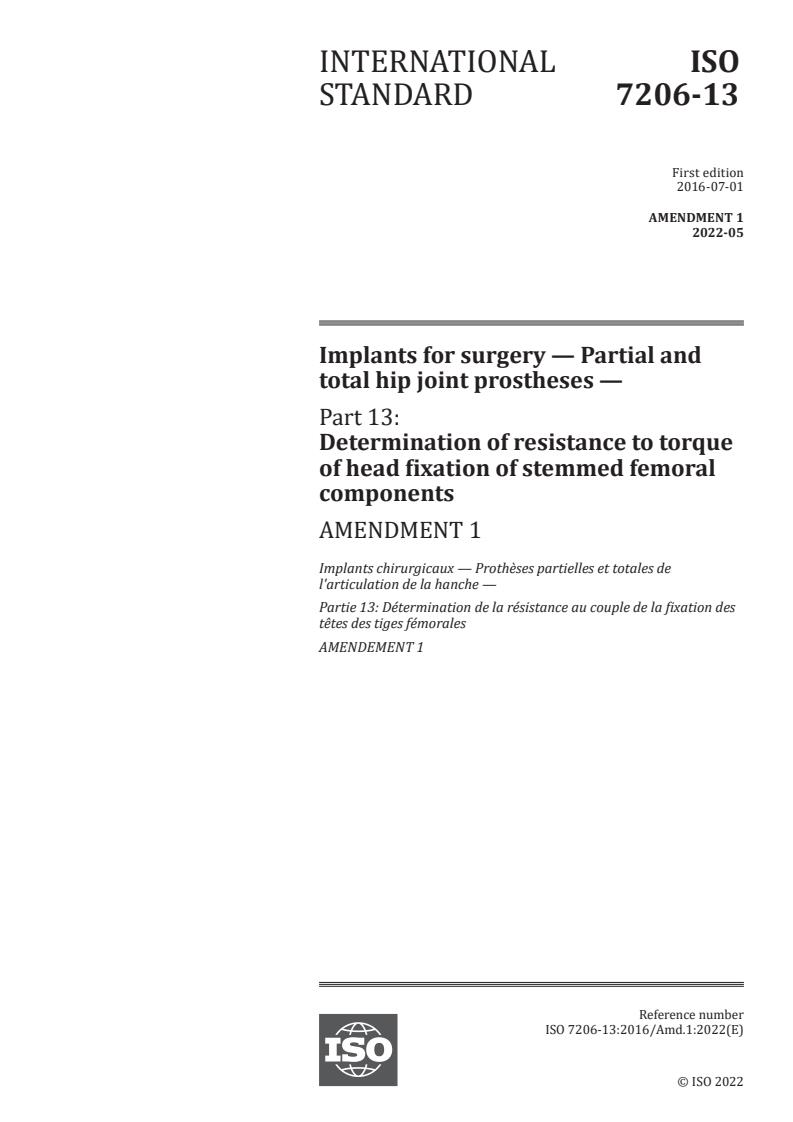
INTERNATIONAL ISO
STANDARD 7206-13
First edition
2016-07-01
AMENDMENT 1
2022-05
Implants for surgery — Partial and
total hip joint prostheses —
Part 13:
Determination of resistance to torque
of head fixation of stemmed femoral
components
AMENDMENT 1
Implants chirurgicaux — Prothèses partielles et totales de
l'articulation de la hanche —
Partie 13: Détermination de la résistance au couple de la fixation des
têtes des tiges fémorales
AMENDEMENT 1
Reference number
ISO 7206-13:2016/Amd.1:2022(E)
ISO 7206-13:2016/Amd.1:2022(E)
© ISO 2022
All rights reserved. Unless otherwise specified, or required in the context of its implementation, no part of this publication may
be reproduced or utilized otherwise in any form or by any means, electronic or mechanical, including photocopying, or posting on
the internet or an intranet, without prior written permission. Permission can be requested from either ISO at the address below
or ISO’s member body in the country of the requester.
ISO copyright office
CP 401 • Ch. de Blandonnet 8
CH-1214 Vernier, Geneva
Phone: +41 22 749 01 11
Email: copyright@iso.org
Website: www.iso.org
Published in Switzerland
ii
ISO 7206-13:2016/Amd.1:2022(E)
Foreword
ISO (the International Organization for Standardization) is a worldwide federation of national standards
bodies (ISO member bodies). The work of preparing International Standards is normally carried out
through ISO technical committees. Each member body interested in a subject for which a technical
committee has been established has the right to be represented on that committee. International
organizations, governmental and non-governmental, in liaison with ISO, also take part in the work.
ISO collaborates closely with the International Electrotechnical Commission (IEC) on all matters of
electrotechnical standardization.
The procedures used to develop this document and those intended for its further maintenance are
described in the ISO/IEC Directives, Part 1. In particular, the different approval criteria needed for the
different types of ISO documents should be noted. This document was drafted in accordance with the
editorial rules of the ISO/IEC Directives, Part 2 (see www.iso.org/directives).
A
...