

ISO/TR 8100-24:2016
(Main)Safety requirements for lifts (elevators) — Part 24: Convergence of lift requirements
General Information
- Abstract
ISO/TR 8100-24:2016 provides a comparison of the requirements for door locks, buffers, governors, safeties and brakes covered by the major prescriptive safety standards: a) CEN EN 81‑1:1998+A3:2009; b) ASME A17.1-2010/CSA B44-10; c) JIS TS A 0028-1:2011; d) The Building Standard Law of Japan. It also includes prescriptive recommendations to harmonize the requirements within those standards.
- Status
- Published
- Publication Date
- 13-Dec-2016
- Technical Committee
- ISO/TC 178 - Lifts, escalators and moving walks
- Drafting Committee
- ISO/TC 178/WG 4 - Safety requirements and risk assessment
- Current Stage
- 6060 - International Standard published
- Start Date
- 14-Dec-2016
- Due Date
- 22-Nov-2019
- Completion Date
- 22-Nov-2019
Buy Documents
ISO/TR 8100-24:2016 - Safety requirements for lifts (elevators) — Part 24: Convergence of lift requirements Released:12/14/2016
ISO/TR 8100-24:2016 - Safety requirements for lifts (elevators) — Part 24: Convergence of lift requirements/14/2016
Overview - ISO/TR 8100-24:2016 (Lift safety convergence)
ISO/TR 8100-24:2016 is a technical report (first edition, 2016) that compares and recommends harmonization of prescriptive safety requirements for lifts (elevators). Its primary focus is the convergence of component-level safety requirements - door locks, buffers, governors, safeties and brakes - across the major regional codes: CEN EN 81‑1, ASME A17.1/CSA B44, JIS TS A 0028-1 and the Building Standard Law of Japan. The report provides side-by-side comparisons, prioritized prescriptive recommendations and guidance aimed at facilitating global alignment of elevator safety requirements.
Key topics and technical requirements
- Comparative analysis of component requirements for:
- Door locks (interlocks, unlocking zones, emergency unlocking)
- Buffers (energy absorption requirements and operational zones)
- Governors (overspeed protection and activation criteria)
- Safeties (safety gear design and engagement thresholds)
- Brakes (design and performance expectations)
- Prioritization scheme for recommendations:
- Priority 1 - items that directly affect component design (to be harmonized first).
- Priority 2 - items that primarily affect system behavior or normative language.
- Practical examples from the report (excerpted): differing definitions and dimensional limits for unlocking/leveling zones (e.g., 0.20 m vs. 0.35 m), and alignment proposals for hoistway door interlocks and closed-position criteria.
- Emphasis on good engineering practice and cross-reference to ISO/TS 22559-2 for implementation guidance.
Practical applications - who uses this standard
- Standards writers and national committees - use the report to inform revisions and promote convergence of regional lift codes.
- Elevator manufacturers and component suppliers - align product design and documentation to meet multiple regional prescriptive requirements and facilitate international trade.
- Test labs and certification bodies - reference harmonized criteria for component testing, approval and cross-recognition.
- Design engineers and consultants - apply reconciled recommendations when specifying safety components for global projects.
- Regulators and building authorities - assess equivalence between regional codes and adopt consistent safety baselines.
Related standards
- CEN EN 81‑1:1998 + A3:2009 (European)
- ASME A17.1‑2010 / CSA B44‑10 (North America)
- JIS TS A 0028‑1:2011 and Building Standard Law of Japan (Japan)
- ISO/TS 22559‑2 (good engineering practice guidance)
ISO/TR 8100-24:2016 is a practical resource for anyone involved in elevator safety standardization, helping to reduce regional divergence and support the safe, global circulation of lift components.
Relations
- Effective Date
- 10-Dec-2016
Buy Documents
ISO/TR 8100-24:2016 - Safety requirements for lifts (elevators) — Part 24: Convergence of lift requirements Released:12/14/2016
ISO/TR 8100-24:2016 - Safety requirements for lifts (elevators) — Part 24: Convergence of lift requirements/14/2016
Get Certified
Connect with accredited certification bodies for this standard

DIBt (Deutsches Institut für Bautechnik)
German Institute for Building Technology.
DIN CERTCO
DIN Group product certification.

Aboma Certification B.V.
Specialized in construction, metal, and transport sectors.
Sponsored listings
Frequently Asked Questions
ISO/TR 8100-24:2016 is a technical report published by the International Organization for Standardization (ISO). Its full title is "Safety requirements for lifts (elevators) — Part 24: Convergence of lift requirements". This standard covers: ISO/TR 8100-24:2016 provides a comparison of the requirements for door locks, buffers, governors, safeties and brakes covered by the major prescriptive safety standards: a) CEN EN 81‑1:1998+A3:2009; b) ASME A17.1-2010/CSA B44-10; c) JIS TS A 0028-1:2011; d) The Building Standard Law of Japan. It also includes prescriptive recommendations to harmonize the requirements within those standards.
ISO/TR 8100-24:2016 provides a comparison of the requirements for door locks, buffers, governors, safeties and brakes covered by the major prescriptive safety standards: a) CEN EN 81‑1:1998+A3:2009; b) ASME A17.1-2010/CSA B44-10; c) JIS TS A 0028-1:2011; d) The Building Standard Law of Japan. It also includes prescriptive recommendations to harmonize the requirements within those standards.
ISO/TR 8100-24:2016 is classified under the following ICS (International Classification for Standards) categories: 91.140.90 - Lifts. Escalators. The ICS classification helps identify the subject area and facilitates finding related standards.
ISO/TR 8100-24:2016 has the following relationships with other standards: It is inter standard links to ISO/PRF TR 22559-5. Understanding these relationships helps ensure you are using the most current and applicable version of the standard.
ISO/TR 8100-24:2016 is available in PDF format for immediate download after purchase. The document can be added to your cart and obtained through the secure checkout process. Digital delivery ensures instant access to the complete standard document.
Standards Content (Sample)
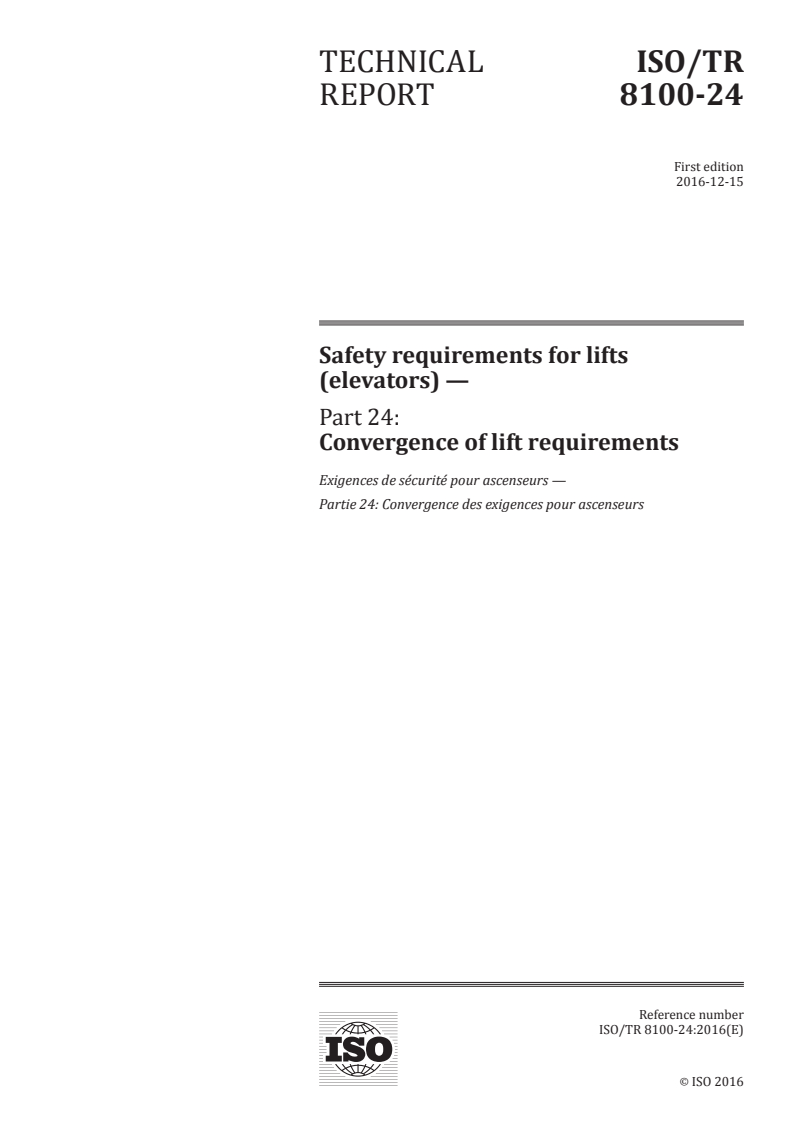
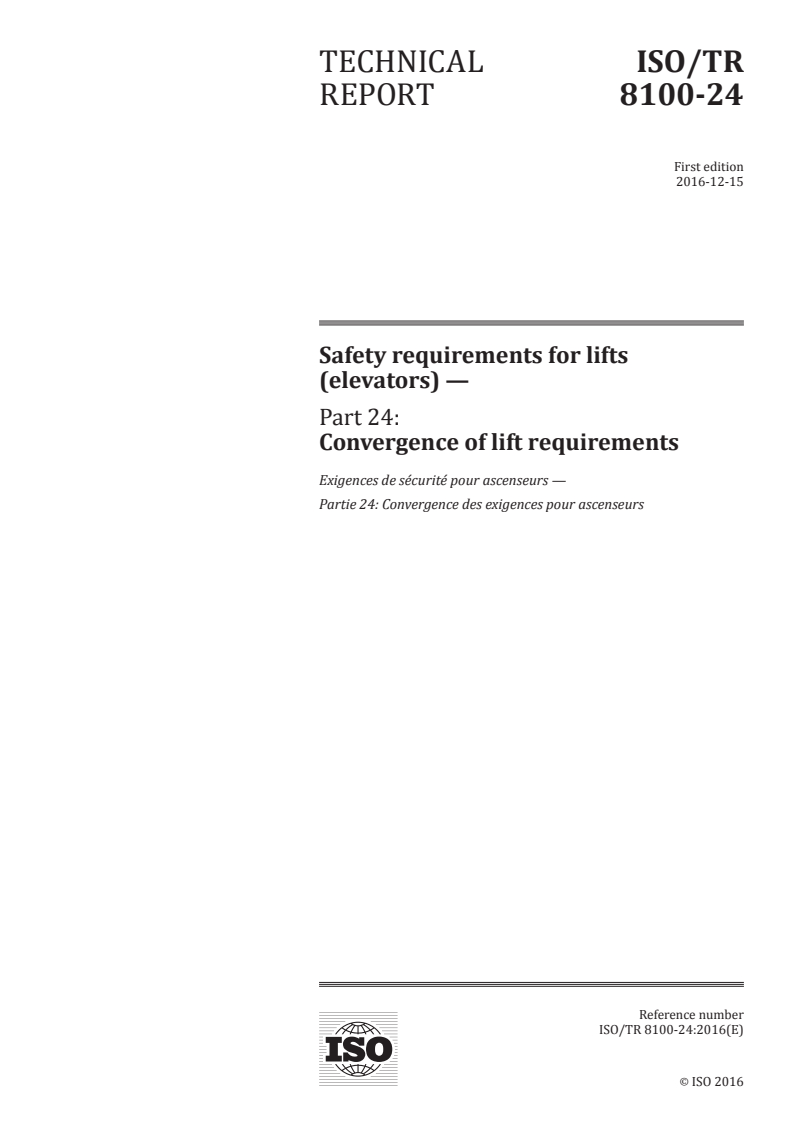
TECHNICAL ISO/TR
REPORT 8100-24
First edition
2016-12-15
Safety requirements for lifts
(elevators) —
Part 24:
Convergence of lift requirements
Exigences de sécurité pour ascenseurs —
Partie 24: Convergence des exigences pour ascenseurs
Reference number
©
ISO 2016
© ISO 2016, Published in Switzerland
All rights reserved. Unless otherwise specified, no part of this publication may be reproduced or utilized otherwise in any form
or by any means, electronic or mechanical, including photocopying, or posting on the internet or an intranet, without prior
written permission. Permission can be requested from either ISO at the address below or ISO’s member body in the country of
the requester.
ISO copyright office
Ch. de Blandonnet 8 • CP 401
CH-1214 Vernier, Geneva, Switzerland
Tel. +41 22 749 01 11
Fax +41 22 749 09 47
copyright@iso.org
www.iso.org
ii © ISO 2016 – All rights reserved
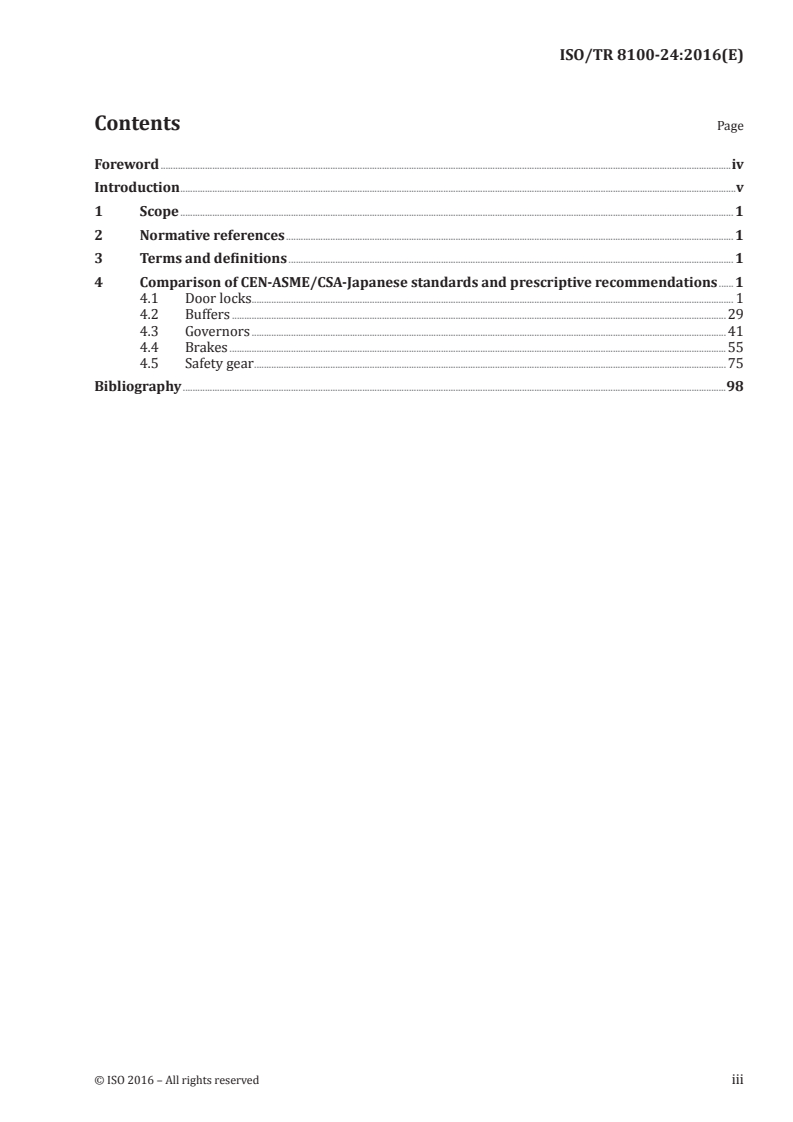
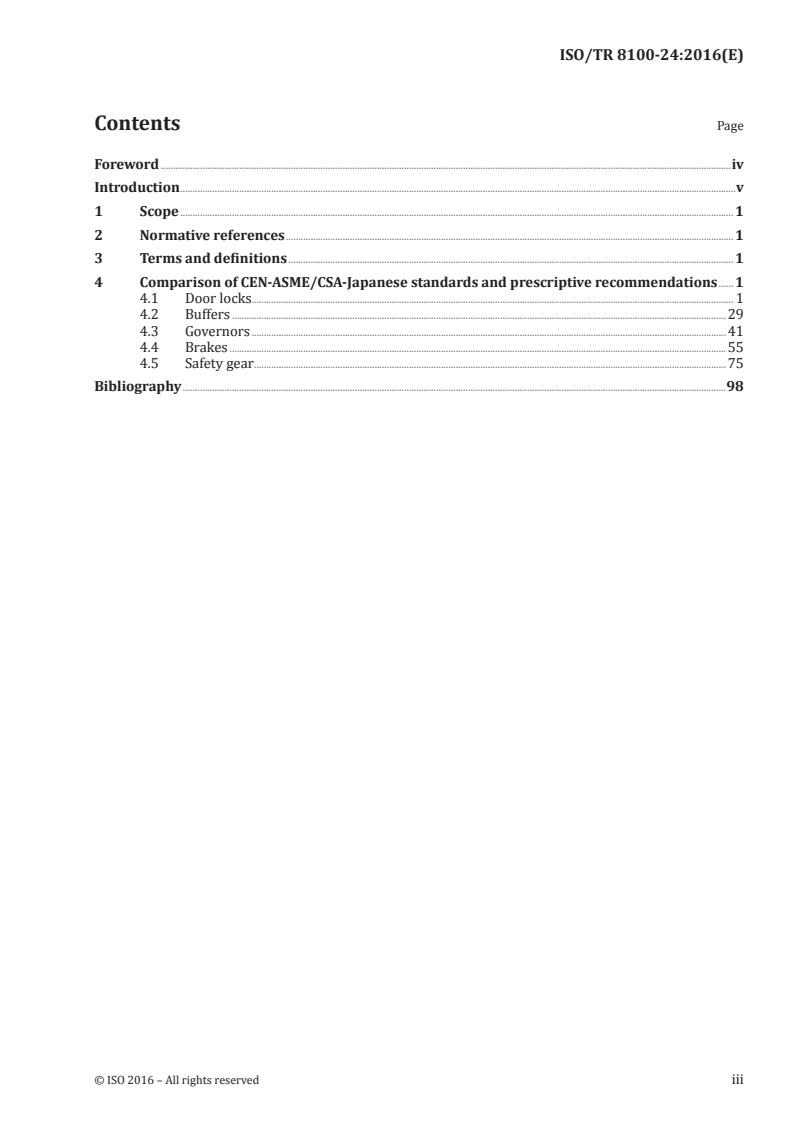
Contents Page
Foreword .iv
Introduction .v
1 Scope . 1
2 Normative references . 1
3 Terms and definitions . 1
4 Comparison of CEN-ASME/CSA-Japanese standards and prescriptive recommendations .1
4.1 Door locks . 1
4.2 Buffers .29
4.3 Governors .41
4.4 Brakes .55
4.5 Safety gear .75
Bibliography .98
Foreword
ISO (the International Organization for Standardization) is a worldwide federation of national standards
bodies (ISO member bodies). The work of preparing International Standards is normally carried out
through ISO technical committees. Each member body interested in a subject for which a technical
committee has been established has the right to be represented on that committee. International
organizations, governmental and non-governmental, in liaison with ISO, also take part in the work.
ISO collaborates closely with the International Electrotechnical Commission (IEC) on all matters of
electrotechnical standardization.
The procedures used to develop this document and those intended for its further maintenance are
described in the ISO/IEC Directives, Part 1. In particular the different approval criteria needed for the
different types of ISO documents should be noted. This document was drafted in accordance with the
editorial rules of the ISO/IEC Directives, Part 2 (see www.iso.org/directives).
Attention is drawn to the possibility that some of the elements of this document may be the subject of
patent rights. ISO shall not be held responsible for identifying any or all such patent rights. Details of
any patent rights identified during the development of the document will be in the Introduction and/or
on the ISO list of patent declarations received (see www.iso.org/patents).
Any trade name used in this document is information given for the convenience of users and does not
constitute an endorsement.
For an explanation on the meaning of ISO specific terms and expressions related to conformity assessment,
as well as information about ISO’s adherence to the World Trade Organization (WTO) principles in the
Technical Barriers to Trade (TBT) see the following URL: www.iso.org/iso/foreword.html.
The committee responsible for this document is ISO/TC 178, Lifts, escalators and moving walks.
A list of all parts in the ISO 22559 series can be found on the ISO website.
iv © ISO 2016 – All rights reserved
Introduction
This document has been developed as a step towards the convergence of key requirements in the major
world-wide lift codes and also the updating of ISO/TR 11071 (all parts).
ISO/TR 11071 (all parts) represents a comprehensive comparison of the major lift prescriptive safety
standards in use at the time of publication. Since that time, there has been considerable harmonization
and rationalization of various standards with the result that there are currently three major sets of
prescriptive safety requirements in extensive use. These are the CEN EN 81 series of standards, the
ASME A17 series/CSA B44 of standards, and the JIS TS A 0028-1 and the Building Standard Law of
Japan (BSLJ).
The goal of this document is to provide recommendations to assist national committees, when
reviewing and revising individual standards, to initiate convergence towards harmonization of the
technical requirements.
This document expands the list of “agreed-upon points”, with a view to facilitate convergence of key
requirements of the documents identified above.
In order to divide the work into manageable increments and set the priorities, it was deemed
constructive to start with requirements for door locks, buffers, governors, safeties and brakes as the
first step towards the complete lift.
In order to expedite the convergence process, the recommendations have been prioritized to implement
the harmonization of requirements for safety components. The priorities are ranked as follows:
a) Priority 1, where the design of safety components are directly affected;
b) Priority 2, where the design of systems or requirement language only are affected.
NOTE Priority 1 includes items that should be harmonized first as it affects the design of the components
directly. Priority 2 includes items that should be harmonized at a later stage as it affects the system or
language only.
The comparison of requirements in different parts of the world indicated the importance of good
engineering practice in the implementation of standards with regard to safety. It was concluded that
guidance on good engineering practice was necessary and it would be best to provide this guidance
in ISO/TS 22559-2, the scope of which covers this issue. It is important that this document be read in
conjunction with ISO/TS 22559-2.
This document was prepared by the Task Force on Convergence (TFC) and is based on information
and input provided by the code study groups from Europe (EUCSG), North America (NACSG) and Japan
(JPCSG). After in-depth analysis of differences and rationale, the code study groups have agreed and
formulated actions to be implemented in the course of development or revisions of standards in their
respective regions. Completion of those actions will result in harmonization of code requirements for
door locks, buffers, governors, safeties and brakes and will facilitate free circulation of those safety
components around the world.
This document is intended for use by standard writers in order to implement the prescriptive
recommendations when developing or revising standards.
TECHNICAL REPORT ISO/TR 8100-24:2016(E)
Safety requirements for lifts (elevators) —
Part 24:
Convergence of lift requirements
1 Scope
This document provides a comparison of the requirements for door locks, buffers, governors, safeties
and brakes covered by the major prescriptive safety standards:
a) CEN EN 81-1:1998+A3:2009;
b) ASME A17.1-2010/CSA B44-10;
c) JIS TS A 0028-1:2011;
d) The Building Standard Law of Japan.
It also includes prescriptive recommendations to harmonize the requirements within those standards.
2 Normative references
There are no normative references in this document.
3 Terms and definitions
For the purposes of this document, the terms and definitions given in ISO/TS 22559-2:2010,
CEN EN 81-1:1998 and its amendment CEN EN 81-1:1998/Amd. A3:2009, ASME A17.1-2010/CSA B44-10
and JIS TS A 0028-1:2011 apply.
ISO and IEC maintain terminological databases for use in standardization at the following addresses:
— IEC Electropedia: available at http://www.electropedia.org/
— ISO Online browsing platform: available at http://www.iso.org/obp
4 Comparison of CEN-ASME/CSA-Japanese standards and prescriptive
recommendations
4.1 Door locks
Table 1 contains a comparison of door locks in the CEN-ASME/CSA-Japanese standards and prescriptive
recommendations prepared by the TFC.
2 © ISO 2016 – All rights reserved
Table 1 — Convergence of CEN-ASME-Japan elevator standards —Door locks
Sq ISO/
EN 81–1:1998+Amd. A3:2009 ASME A17.1–2010/CSA B44–10 Japan Comments and proposals for convergence
# TS 22559-2
7.7.1 Locking and closed landing door check SECTION 2.12 Basically, the Proposal: Standards writing bodies to consider
Protection against the risk of falling HOISTWAY DOOR LOCKING DEVICES AND unlocking zone is adopting the following proposed requirements:
It shall not be possible in normal operation to open ELECTRIC CONTACTS, AND HOISTWAY same as EN 81-1. Priority 2 — Consider adopting language and
a landing door (or any of the panels in the case of a ACCESS SWITCHES Added the defini- parameters from EN 81-1.
multi-panel door) unless the car has stopped, or is tion of Leveling,
2.12.1 General
on the point of stopping, in the unlocking zone of Re-leveling and
2.12.1.1 When the car is stopped within the
that door. door zone.
unlocking zone, the hoistway doors shall be
unlocked, or locked but openable from the
landing side either manually or by power.
NOTE For Emergency unlocking, see 7.7.3.2 l. 2.12.1.2 When the car is outside the unlock-
ing zone, the hoistway doors shall be openable
from the landing side only by a hoistway door
unlocking device (see 2.12.6, 2.12.7, and Non-
mandatory Appendix B).
Not in EN 81–1 2.12.1.3 For security purposes, hoistway Proposal: Standards writing bodies to consider
doors shall be permitted to be locked out of adopting the following proposed requirements:
service, subject to the requirements of 2.11.6. Priority 2 — Consider adopting language and
parameters from ASME A17.1/CSA B44.
NOTE For 2.12.1.4 and 2.12.1.5, see 7.7.3.
7.7.1 (second and third paragraphs) 1.3 DEFINITIONS (BSLJ-EO 129–10 Proposal: Standards writing bodies to consider
The unlocking zone shall not extend more than Unlocking zone: a zone extending from the item 3 para- adopting the following proposed requirements:
0,20 m above and below the landing level. landing floor level to a point not less than graphs 1 and 2) Priority 2 — Consider adopting requirements
In the case, however, of mechanically operated car 75 mm (3 in.) nor more than 450 mm (18 in.) ±200 mm similar to EN 81-1:1998, 7.7.1.
and landing doors operating simultaneously, the above and below the landing. New JIS is consid-
unlocking zone may extend to a maximum of 0,35 m Leveling zone: ±250 mm if manual levelling. ered to be 350 mm.
above and below the landing level.
7.7.2 Protection against shearing 1.3 Definitions Basically, the Proposal: Standards writing bodies to consider
7.7.2.1 With the exception of 7.7.2.2, it shall not Hoistway door interlock: a device having two unlocking zone is adopting the following proposed requirements:
be possible in normal operation to start the lift nor related and interdependent functions, that are: same as EN 81–1. Priority 2 — Consider adopting requirements
keep it in motion if a landing door, or any of the (a) to prevent the operation of the driving Added the defini- similar to EN 81-1:1998, 7.7.2.
panels in the case of a multi-panel door is open. machine by the normal operating device un- tion of prelimi-
However, preliminary operations for the movement less the hoistway door is locked in the closed nary operations
of the car may take place. position; for the movement
of the car.
NOT in ASME A17.1/CSA B44.
Not in EN 81–1 (b) to prevent the opening of the hoistway Proposal: Standards writing bodies to consider
door from the landing side unless the car is adopting the following proposed requirements:
within the landing zone and is either stopped Priority 2 — Consider adopting requirements
or being stopped. similar to paragraph (b) of hoistway door interlock
definition of ASME A17.1/CSA B44.
Table 1 (continued)
Sq ISO/
EN 81–1:1998+Amd. A3:2009 ASME A17.1–2010/CSA B44–10 Japan Comments and proposals for convergence
# TS 22559-2
7.7.2.2 Operation with doors open is permitted in 2.12.2.3 Operation of the Driving Machine Same as Proposal: Standards writing bodies to consider
the following zones: With a Hoistway Door Unlocked or Not in EN 81–1 adopting the following proposed requirements:
a) in the unlocking zone to permit levelling or the Closed Position. Priority 2 — Consider adopting language of of
relevelling at the corresponding floor level, Operation of the driving machine when a EN 81–1:1998, 7.7.2.2 and EN 81-1:1998, 14.2.1.2.
provided the requirements of 14.2.1.2 are met; hoistway door is unlocked or not in the closed
position (see 2.12.2.2) shall be permitted
under one of the following conditions:
(a) by a car leveling or truck zoning device
(see 2.26.1.6);
Not in EN 81–1 (b) when a hoistway access switch is operated b) Excluded dock-
(see 2.12.7); ing operation
Not in EN 81–1 (c) when a bypass switch is activated (see
2.26.1.5).
b) in a zone extending to a maximum height of 2.26.1.6.4 The truck zone at any landing shall This is a priority 2 item as it does not affect the
1,65 m above the landing level to permit the loading not extend more than 1 700 mm (67 in.) above door lock as a component.
or unloading of the car, provided the requirements the landing.
of 8.4.3, 8.14 and 14.2.1.5 are met, and:
1) the clear height between the landing door head- NOT in ASME A17.1/CSA B44
er and the floor of the car, in any position, shall not
be less than 2 m;
2) whatever the position of the car inside this zone, NOT in ASME A17.1/CSA B44
it must be possible, without special operation, to
effect the complete closure of the landing door.
7.7.3 Locking and emergency unlocking 2.12.2 Interlocks Same as Proposals: Standards writing bodies to consider
Each landing door shall be provided with a locking 2.12.2.1 General. Each entrance at a landing EN 81-1 adopting the following proposed requirements:
device satisfying the conditions of 7.7.1. to an elevator used for passengers or freight Priority 2 — Consider using the term landing en-
and not conforming to 2.12.3.1 shall be trance in EN 81–1:1998, 7.7.3.
equipped with one or more interlocks meeting
the design requirements of 2.12.2.4.
2.12.1.4 Passenger elevator hoistway doors
shall be equipped with interlocks conforming
to 2.12.2.
Not in EN 81–1 2.12.1.5 Freight elevator hoistway doors Do not consider freight elevators at this stage.
shall be equipped with interlocks conforming
to 2.12.2 or combination mechanical locks and
electric contacts conforming to, and where
permitted by, 2.12.3.
This device shall be protected against deliberate 2.12.2.6 Location. Interlocks shall be so Proposal: Standards writing bodies to consider
misuse. located that they are not accessible from the adopting the following proposed requirements:
landing side when the hoistway doors are Priority 2 — Consider adopting language from
closed. ASME A17.1-2010/CSA B44-10, 2.12.2.6.
4 © ISO 2016 – All rights reserved
Table 1 (continued)
Sq ISO/
EN 81–1:1998+Amd. A3:2009 ASME A17.1–2010/CSA B44–10 Japan Comments and proposals for convergence
# TS 22559-2
7 Landing Doors 2.12.2.2 Closed Position of Hoistway The following sen- Proposal: Standards writing bodies to consider
7.1 General Provisions Doors. Hoistway doors shall be considered to tence is deleted. adopting the following proposed requirements:
The openings in the well giving access to the lift car be in the closed position under the following “This value due to Priority 2 — Consider expanding of EN 81–1:1998,
shall be provided with imperforate landing doors. conditions. These dimensions apply to the wear, may reach 7.1 to harmonize with ASME A17.1-2010/CSA B44-
When closed, the clearance between panels, or doors in their normal operating condition (see 10 mm.” 10, 2.12.2.2.
between panels and uprights, lintels or sills, shall be 2.14.4.11): (10 mm is too big)
as small as possible. (a) for horizontally sliding or swinging doors,
This condition is considered to be fulfilled when when the leading edge of the door is within
the operational clearances do not exceed 6 mm. 10 mm (0.375 in.) of the nearest face of the
This value due to wear, may reach 10 mm. These jamb or when the panels of centre-opening
clearances are measured at the back of recesses, if doors are within 10 mm (0.375 in.) of contact
present. with each other;
(b) for vertically sliding counterweighted Proposal: Standards writing bodies to consider
doors, when the leading edge of the door is adopting the following proposed requirements:
within 10 mm (0.375 in.) of the sill for doors Priority 1 — Consider adding requirements from
that slide up to open, or 10 mm (0.375 in.) of ASME A17.1-2010/CSA B44-10, 2.12.2.2 (b) and (c).
the lintel for doors that slide down to open;
(c) for vertically sliding biparting counterbal-
anced doors, when the astragal on the upper
panel is within 19 mm (0.75 in.) of the lower
panel.
7.7.3.1 Locking 2.12.2.4.3 The interlock shall lock the door Japan is consid- Proposal: Standards writing bodies to consider
The effective locking of the landing door in the in the closed position with a minimum engage- ering adopting a adopting the following proposed requirements:
closed position shall precede the movement of the ment of 7 mm (0.28 in.) of the locking members 7 mm parameter. Priority 2 — Consider adopting the text and
car. However, preliminary operations for the move- before the interlock contacts are closed and Same as diagram of EN 81–1:1998, 7.7.3.1.
ment of the car may take place. The locking must be before the driving machine can be operated, EN 81–1
proved by an electric safety device in conformity except as permitted in 2.12.2.3. The swing door is
with 14.1.2. out of scope.
7.7.3.1.1 The car shall not be able to start until the
locking elements are engaged by at least 7 mm. See
Figure 3.
Figure 1 — Examples of locking elements
Table 1 (continued)
Sq ISO/
EN 81–1:1998+Amd. A3:2009 ASME A17.1–2010/CSA B44–10 Japan Comments and proposals for convergence
# TS 22559-2
Not in EN 81–1 2.12.2.4.3 (second paragraph) Proposal: Standards writing bodies to consider
Devices that permit operation of the driving adopting the following proposed requirements:
machine by the normal operating device when Priority 1 — Consider adopting ASME A17.1-2010/
the door is closed but before it is locked are CSA B44-10, 2.12.2.4.3.
not interlocks and are not permitted where Consider adopting EN 81–1:1998, 14.1.2.
interlocks are required by this Code.
7.7.3.1.2 The element of the electric safety device 2.12.2.4 General Design Requirements. No specification Proposals: Standards writing bodies to consider
proving the locked condition of the door panel(s) Interlocks shall conform to 2.12.2.4.1 to (generally, positive adopting the following proposed requirements:
shall be positively operated without any interme- 2.12.2.4.7. opening contacts Priority 1 — Accept EN 81–1:1998, 7.7.3.1.2 as
diate mechanism by the locking element. It shall be are used) modified:
2.12.2.4.1 Interlock contacts shall be posi-
foolproof but adjustable if necessary. Same as “The element of the electric safety device proving
tively opened by the locking member or by a
Specific case: In the case of locking devices used in EN 81–1 the locked condition of the door panel(s) shall be
member connected to and mechanically oper-
installations requiring special protection against positively operated without any intermediate
ated by the locking member, and the contacts
risks of humidity or explosion, the connection may mechanism by the locking element.”
shall be maintained in the open position by
be only positive, provided the link between the me-
the action of gravity, or by a restrained com-
chanical lock and the element of the electric safety
pression spring, or by both, or by means of the
device proving the locked condition can only be
opening member (see 2.26.2.14). Contacts shall
interrupted by destroying deliberately the locking
be open when the hoistway door interlock is
device.
unlocked.
Not in EN 81–1 2.12.2.4.1 (continuation)
If the contacts are maintained in the open
position by other than the locking member,
the interlock shall be located such that the
contacts cannot be closed by hand from the car
or landing when the doors are open.
Not in EN 81–1 2.12.2.4.1 (second paragraph) Proposal: Standards writing bodies to consider
The electrical contact bridging means shall adopting the following proposed requirements:
withstand a separating force of 200 N (45 lbf) Priority 1 — Consider adding similar requirement
in any direction from the locking member. as ASME A17.1-2010/CSA B44-10, 2.12.2.4.1 second
paragraph, i.e. 200 N separating force.
7.7.3.1.3 For hinged doors, locking shall be effect- NOT in ASME A17.1/CSA B44 Not in JIS Proposal: Standards writing bodies to consider
ed as near as possible to the vertical closing edge(s) (swing door) adopting the following proposed requirements:
of the doors, and maintained even in the case of Priority 2 — Consider adopting EN 81–1:1998,
panels sagging. 7.7.3.1.3.
7.7.3.1.4 The locking elements and their fixings NOT in ASME A17.1/CSA B44 Same as Proposal: Standards writing bodies to consider
shall be resistant to shock, and be made or EN 81-1 adopting the following proposed requirements:
reinforced with metal. Priority 1 — Consider performance based language
and appropriate parameters rather than
requirements for metal.
Priority 1 Consider adding the shock requirement.
See also F. 1.2.2.3.
7.7.3.1.5 The engagement of the locking elements NOT in ASME A17.1/CSA B44 Same as Proposal: Standards writing bodies to consider
shall be achieved in such a way that a force of 300 N EN 81–1 adopting the following proposed requirements:
in the opening direction of the door does not dimin- Priority 1 — Consider adding requirements similar
ish the effectiveness of locking. to EN 81–1:1998, 7.7.3.1.5, i.e. 300 N locking force.
6 © ISO 2016 – All rights reserved
Table 1 (continued)
Sq ISO/
EN 81–1:1998+Amd. A3:2009 ASME A17.1–2010/CSA B44–10 Japan Comments and proposals for convergence
# TS 22559-2
7.7.3.1.6 The lock shall resist, without permanent NOT in ASME A17.1/CSA B44 Same as Proposal: Standards writing bodies to consider
deformation during the test laid down in F.1, a EN 81–1 adopting the following proposed requirements:
minimum force at the level of the lock and in the Priority 2 — Consider adding requirements similar
direction of opening of the door of: to EN 81–1:1998, 7.7.3.1.6.
a) 1 000 N in the case of sliding doors; 8.3.3.4.8 (see also F.1.2.2.2): b) is out of scope. 6.1.6 [p2]
b) 3 000 N on the locking pin, in the case of hinged …The force shall be 1 000 N (225 lb) in the case When locked,
doors. of a locking device intended for use with slid- locking device
ing doors, and 3 000 N (675 lb)…in the case of to resist an
locking device intended for use with swinging opening force
doors. ≥1 000 N.
7.7.3.1.7 The locking action shall be effected 2.12.2.4.2 The locking member of the inter- Same as Proposal: Standards writing bodies to consider
and maintained by the action of gravity, perma- lock shall hold the door in the locked position EN 81–1 adopting the following proposed requirements:
nent magnets, or springs. The springs shall act by by means of gravity, or by a restrained com- Priority 2 — Consider adopting EN 81–1:1998,
compression, be guided and of such dimensions pression spring, or by both, or by means of a 7.7.3.1.7.
that, at the moment of unlocking, the coils are not positive linkage. Priority 1 — Consider deleting requirements for
compressed solid. permanent magnets.
Priority 1 — Consider adding requirements for
positive linkage.
7.7.3.1.7 (second paragraph) NOT in ASME A17.1/CSA B44 Same as Proposal: Standards writing bodies to consider
In the event of the permanent magnet (or spring) no EN 81–1 adopting the following proposed requirements:
longer fulfilling its function, gravity shall not cause Priority 2 — Consider adopting EN 81–1:1998,
unlocking. 7.7.3.1.7.
7.7.3.1.7 (third paragraph) NOT in ASME A17.1/CSA B44 Same as Proposal: Standards writing bodies to consider
If the locking element is maintained in position by EN 81–1 adopting the following proposed requirements:
the action of a permanent magnet, it shall not be Priority 1 — Consider adding requirement from
possible to neutralize its effect by simple means third paragraph of EN 81–1:1998, 7.7.3.1.7 if
(e.g. heat or shock). permanent magnets are retained.
7.7.3.1.8 The locking device shall be protected NOT in ASME A17.1/CSA B44 Same as Proposal: Standards writing bodies to consider
against the risk of an accumulation of dust, which EN 81–1 adopting the following proposed requirements:
could hinder its proper functioning. Priority 1 — Consider adding the requirement in
EN 81–1:1998, 7.7.3.1.8.
7.7.3.1.9 Inspection of the working parts shall be NOT in ASME A17.1/CSA B44 Same as Proposal: Standards writing bodies to consider
easy, as, for example, by use of a vision panel. EN 81–1 adopting the following proposed requirements:
Priority 1 — Consider revising EN 81–1:1998,
7.7.3.1.9 to a performance requirement.
7.7.3.1.10 In the case where the lock contacts are NOT in ASME A17.1/CSA B44 Same as Proposal: Standards writing bodies to consider
in a box, the fixing screws for the cover shall be of EN 81–1. adopting the following proposed requirements:
the captive type, so that they remain in the holes in Priority 1 — Consider adoption of assumption
the cover or box when opening the cover. EN 81–1:1998, 0.3.19.
Consider replacing EN 81–1:1998, 7.7.3.1.10 with
0.3.19 (Assumption)
EN 81–1:1998, 0.3.19.
The fixing systems of guards or covers, which have
to be removed during maintenance and inspection,
remains attached to the guard or cover, or
equipment when the guard or cover is removed.
Table 1 (continued)
Sq ISO/
EN 81–1:1998+Amd. A3:2009 ASME A17.1–2010/CSA B44–10 Japan Comments and proposals for convergence
# TS 22559-2
Not in EN 81–1 2.12.2.4.5 Interlock systems employing a NOT in JIS Proposal: Standards writing bodies to consider
single master switch for more than one door adopting the following proposed requirements:
are prohibited. Priority 2 — Consider deletion of ASME A17.1-2010/
CSA B44-10, 2.12.2.4.5.
Not in EN 81–1 2.12.2.4.6 Mercury tube switches shall not NOT in JIS
be used.
Not in EN 81–1 2.12.2.5 Interlock Retiring Cam Device. Proposal: Standards writing bodies to consider
Retiring cams used to actuate an interlock adopting the following proposed requirements:
shall exert a force at least double the average Priority 1 — Consider adopting ASME A17.1-2010/
force required to operate the interlock and CSA B44-10, 2.12.2.5.
shall have a movement at least 13 mm (0.5 in.)
more than the average movement required to
operate the interlock.
An interlock retiring cam device shall be per-
manently marked by the manufacturer with
its rated horizontal force and rated horizontal
movement.
The rated horizontal force shall be the static
force exerted by a retiring cam device in
the horizontal direction when extended a
distance equal to 75 % of its rated horizontal
movement. The rated horizontal movement
shall be the horizontal distance travelled by
the retiring cam device from the fully retired
position to the fully extended position.
Not in EN 81–1 2.12.3 Hoistway Door Combination NOT in JIS
Mechanical Locks and Electric Contacts
2.12.3.1 Where Permitted. Hoistway door
combination mechanical locks and electric
contacts shall be permitted only on freight
elevators equipped with manually operated
vertically sliding doors and only at the follow-
ing landings:
(a) the top terminal landing and the landing
whose sill is located not more than 1 225 mm
(48 in.) below the top terminal landing sill,
provided that the elevator rise does not exceed
4 570 mm (15 ft);
(b) any landing whose sill is within 1 525 mm
(60 in.) of the pit floor, regardless of the
elevator rise.
NOTE 2.12.3.2 to 2.12.3.5 are not copied since
there are no corresponding requirements in
EN 81–1.
8 © ISO 2016 – All rights reserved
Table 1 (continued)
Sq ISO/
EN 81–1:1998+Amd. A3:2009 ASME A17.1–2010/CSA B44–10 Japan Comments and proposals for convergence
# TS 22559-2
Not in EN 81–1 2.12.5 Restricted Opening of Hoistway or NOT in JIS Proposal: Standards writing bodies to consider
Car Doors adopting the following proposed requirements:
Hoistway and car doors of passenger elevators Priority 2 — Consider adoption of ASME A17.1-
shall conform to 2.12.5.1 to 2.12.5.3. 2010/CSA B44-10, 2.12.5.
2.12.5.1 When a car is outside the unlocking
zone, the hoistway doors or car doors shall
be so arranged that the hoistway doors or car
doors cannot be opened more than 100 mm
(4 in.) from inside the car.
2.12.5.2 When the car doors are so arranged
that they cannot be opened when the car is
outside the unlocking zone, the car doors shall
be openable from outside the car without the
use of a special tool(s).
2.12.5.3 The doors shall be openable from
within the car (see 2.14.5.7) when the car is
within the unlocking zone.
NOTE (2.12.5) See also 2.12.1 and Nonmanda-
tory Appendix B, Unlocking Zone.
7.7.3.2 Emergency unlocking 2.12.6 Hoistway Door Unlocking Devices Same as Proposal: Standards writing bodies to consider
Each of the landing doors shall be capable of being 2.12.6.1 General. Except in jurisdictions that EN 81–1 adopting the following proposed requirements:
unlocked from the outside with the aid of a key, limit the use of hoistway door unlocking devic- (Japan is going to Priority 2 — Consider adoption of ASME A17.1-
which will fit the unlocking triangle as defined in es, they shall be provided for use by elevator use the triangle 2010/CSA B44-10, 2.12.6.2.1.
Annex B. and emergency personnel for each elevator at key.)
every landing where there is an entrance. Same as
EN 81–1
2.12.6.2 Location and Design. Hoistway
door unlocking devices shall conform to
2.12.6.2.1 to 2.12.6.2.5.
2.12.6.2.1 The device shall unlock and permit
the opening of a hoistway door from a landing
irrespective of the position of the car.
2.12.6.2.4 The hoistway door unlocking
device shall be Group 1 Security* (see 8.1). The
operating means shall also be made available
to emergency personnel during an emergency.
Keys of this type shall be given only to a responsible *8.1.2 Group 1: Restricted NOT in JIS
person. 8.1.2 (k) Requirement 2.12.6.2.4, hoistway
door unlocking device. (Shall also be made
available to emergency personnel during an
emergency.)
Table 1 (continued)
Sq ISO/
EN 81–1:1998+Amd. A3:2009 ASME A17.1–2010/CSA B44–10 Japan Comments and proposals for convergence
# TS 22559-2
They shall be accompanied by a written instruction NOT in ASME A17.1/CSA B44 Same as
detailing the essential precautions to be taken in EN 81–1
order to avoid accidents which could result from
an unlocking which was not followed by effective
relocking.
Not in EN 81–1 2.12.6.2.2 The device shall be designed to NOT in JIS Proposal: Standards writing bodies to consider
prevent unlocking the door with common adopting the following proposed requirements:
tools. Priority 2 — Consider adopting ASME A17.1-2010/
CSA B44-10, 2.12.6.2.2.
After an emergency unlocking, the locking device NOT in ASME A17.1/CSA B44 NOT in JIS
shall not be able to remain in the unlocked position
with the landing door closed.
Not in EN 81–1 2.12.6.2.3 Where a hoistway unlocking de- Same as
vice consists of an arrangement whereby a re- EN 81–1
NOTE 2.12.6.2.3 intended for “lock and contact”
leasing chain, permanently attached to a door
not for Interlocks.
locking mechanism, is kept under a locked
panel adjacent to the landing door, such a panel
shall be self-closing and self-locking and shall
not have identifying markings on its face.
Not in EN 81–1 2.12.6.2.5 The unlocking device keyway Proposal: Standards writing bodies to consider
and locked panel (see 2.12.6.2.3), if provided, adopting the following proposed requirements:
shall be located at a height not greater than Priority 2 — Consider amending ASME A17.1-2010/
2 100 mm (83 in.) above the landing. CSA B44-10, 2.12.6.2.5 to include the alternative
use of special lock release tools where the height is
greater than 2.1 m.
In the case of landing doors driven by the car door, 2.11.3 Closing of Hoistway Doors
a device (either weight or springs) shall ensure the 2.11.3.1 Horizontally sliding or single-sec-
automatic closing of the landing door if this door tion swinging doors of automatic-operation
becomes open, for whatever reason, when the car is elevators shall be provided with door closers
outside the unlocking zone. arranged to close an open door automatically if
the car, for any reason, leaves the landing zone.
10 © ISO 2016 – All rights reserved
Table 1 (continued)
Sq ISO/
EN 81–1:1998+Amd. A3:2009 ASME A17.1–2010/CSA B44–10 Japan Comments and proposals for convergence
# TS 22559-2
7.7.3.3 The locking device is regarded as a safety 2.12.4 Listing/Certification Door Locking Same as See section in table below pertaining to EN 81–1
component and shall be verified according to the Devices and Door or Gate Electric Contacts EN 81–1. and ASME A17.1-2010/CSA B44-10 test require-
requirements in F.1. 2.12.4.1 Type Tests. Each type and make of But the locking ments
hoistway door interlock, hoistway door com- device is not in the
NOTE EU administrative requirements are con-
bination mechanical lock and electric contact, category of safety
tained in the Lifts Directive.
and door or gate electric contact shall conform device in new
to the type tests specified in 8.3.3, unless notice.)
tested prior to:
(a) August 1, 1996, and shall have been sub-
jected to the tests specified in A17.1a–1994,
Section 1101;
(b) March 23, 2002 in jurisdictions enforcing
CSA B44 and shall have been subjected to the
tests specified in CSA B44S1–97, 11.5.
The tests shall be done by or under the super-
vision of a certifying organization.
2.12.4.2 Listing/Certification. Each type
and make of hoistway door interlock, hoistway
door combination mechanical lock and electric
contact, and door or gate electric contact shall
conform to the general requirements for tests
and certification specified in 8.3.1.
7.7.4 Electrical device for proving the landing 2.26.2.14 Hoistway Door Interlocks and Same as Proposals: Standards writing bodies to consider
door closed Hoistway Door Electric Contacts. EN 81–1 adopting the following proposed requirements:
7.7.4.1 Each landing door shall be provided with an Hoistway door interlocks or hoistway door Priority 2 — Consider adopting EN 81–1:1998,
electric safety device in conformity with 14.1.2 for electric contacts conforming to 2.12 shall be 7.7.4.1 and EN 81–1:1998, 7.7.4.2.
proving the closed position, so that the conditions provided for all elevators.
imposed by 7.7.2 are satisfied.
2.26.4.3 The devices covered by 2.26.2 shall
meet the requirements of either 2.26.4.3.1 or
2.26.4.3.2.
2.26.4.3.1 They shall have contacts that are
positively opened mechanically; their opening
shall not be solely dependent on springs.
Exceptions are devices…
2.12.2.4.4 Interlocks, used with multisection
doors, shall conform to the following require-
ments:
7.7.4.2 In the case of horizontally sliding landing Same as
doors, coupled with car doors, this device may be EN 81–1
in common with the device for proving the locked
condition, provided that it is dependent upon the
effective closing of the landing door.
Table 1 (continued)
Sq ISO/
EN 81–1:1998+Amd. A3:2009 ASME A17.1–2010/CSA B44–10 Japan Comments and proposals for convergence
# TS 22559-2
Not in EN 81–1 (b) Where used with vertically sliding NOT in JIS
biparting counter balanced doors, they shall (out of scope)
be so arranged that the interlock contacts are
mechanically held in the open position by the
door or devices attached thereto, unless the
door is in the closed position.
(c) Where used with centre-opening horizon-
tally swinging doors, either
(1) both door panels shall be equipped with
interlocks,
or
7.7.4.3 In the case of hinged landing doors, this (2) where the door panels are so arranged The swing door is
device shall be placed adjacent to the closing edge that one panel can be opened only after the out of scope.
of the door or on the mechanical device proving the other panel has been opened, the interlock is
closed condition of the door. not required on the section that opens last, if
that door panel is provided with a door electric
contact conforming to 2.14.4.2.3, 2.14.4.2.5,
and 2.26.2.15, except that terms “door or gate”
and “car door or gate” shall be replaced with
the term “hoistway door” or “hoistway door
section” and the term “accessible from inside
the car panel” with the term “accessible from
the landing side when the hoistway doors are
closed.”
Not in EN 81-1 (d) Where used with combination horizontal- NOT in JIS
ly sliding and swinging doors, either (out of scope)
(1) the sliding and swinging panels shall
both be equipped with interlocks, or
(2) where the sliding and swinging panels
are interconnected in conformity with the
requirements of 2.11.13.5, the interlock is
not required on the swinging panel, provided
that the interlock on the sliding panel is so
designed and installed that the car cannot
be operated unless the sliding and swinging
panels are both locked in the closed position,
as defined in 2.12.2.2.
Not in EN 81–1 (e) Where a door closer, used with a combi- NOT in JIS
nation sliding and swinging door, is arranged (out of scope)
to be disconnected to allow the sliding panel
to swing, it shall be so designed and installed
that it shall not make the interlock contact
when disconnected and released.
12 © ISO 2016 – All rights reserved
Table 1 (continued)
Sq ISO/
EN 81–1:1998+Amd. A3:2009 ASME A17.1–2010/CSA B44–10 Japan Comments and proposals for convergence
# TS 22559-2
7.7.5 Requirements common to devices for proving 2.26.1.5 Inspection Operation With Open The swing door is Proposal: Standards writing bodies to consider
the locked condition and the closed condition of the Door Circuits. out of scope adopting the following proposed requirements:
door A single set of switches marked “CAR DOOR Priority 2 — Consider adopting EN 81–1:1998, 7.7.5
7.7.5.1 It shall not be possible, from positions nor- BYPASS” and “HOISTWAY DOOR BYPASS” shall and add ASME A17.1-2010/CSA B44-10, 2.12.2.4.1 to
mally accessible to persons, to operate the lift with be provided in the elevator controller enclo- EN 81–1:1998, 7.7.5.2 text for clarity.
a landing door open or unlocked, after one single sure containing the car door and gate electric Priority 2 — Consider the addition of “inspection
action not forming part of the normal operating contact circuits and hoistway door interlock operation with open door circuits” (i.e. bypass
sequence. and hoistway door electric contact circuits operation) to EN 81–1:1998, 7.7.5.1.
(see 2.26.2.14 and 2.26.2.15); except where the
switches are not accessible from outside the
hoistway, they shall be located in the inspec-
tion and test panel (see 2.7.6.5). The switches
shall prepare the control system so that, only
when top-of-car or in-car inspection operation
is activated, the car shall be permitted to be
moved with open door contacts. The switches
shall conform to 2.26.1.5.1 to 2.26.1.5.8.
7.7.5.2 The means used to prove the position of a 2.12.2.4.1 Interlock contacts shall be posi- Same as
locking element shall have positive operation. tively opened by the locking member or by a EN 81–1.
member connected to and mechanically oper-
ated by the locking member, and the contacts
shall be maintained in the open position by
the action of gravity, or by a restrained com-
pression spring, or by both, or by means of the
opening member (see 2.26.2.14). Contacts shall
be open when the hoistway door interlock is
unlocked
7.7.6 Sliding doors with multiple, mechanically 2.12.2.4.4 Interlocks, used with multisection Same as Proposal: Standards writing bodies to consider
linked panels doors, shall conform to the following require- EN 81–1. adopting the following proposed requirements:
7.7.6.1 If a sliding door comprises several directly ments: Priority 2 — Consider harmonizing ASME A17.1-
mechanically linked panels, it is permitted: (a) They shall lock all sections of the door, but 2010/CSA B44-10, 2.12.2.4.4 with EN 81–1:1997,
a) to place the device required in 7.7.4.1 or 7.7.4.2 shall be permitted to be applied to only one 7.7.6 requirements.
on a single panel, and section of the door, provided the device used to
b) to lock only one panel, provided that this single interconnect the door sections is so arranged
locking prevents the opening of the other panel(s) that locking one section will prevent the open-
by hooking the panels in the closed position in case ing of all sections.
of tel
...
TECHNICAL ISO/TR
REPORT 8100-24
First edition
2016-12-15
Safety requirements for lifts
(elevators) —
Part 24:
Convergence of lift requirements
Exigences de sécurité pour ascenseurs —
Partie 24: Convergence des exigences pour ascenseurs
Reference number
©
ISO 2016
© ISO 2016, Published in Switzerland
All rights reserved. Unless otherwise specified, no part of this publication may be reproduced or utilized otherwise in any form
or by any means, electronic or mechanical, including photocopying, or posting on the internet or an intranet, without prior
written permission. Permission can be requested from either ISO at the address below or ISO’s member body in the country of
the requester.
ISO copyright office
Ch. de Blandonnet 8 • CP 401
CH-1214 Vernier, Geneva, Switzerland
Tel. +41 22 749 01 11
Fax +41 22 749 09 47
copyright@iso.org
www.iso.org
ii © ISO 2016 – All rights reserved
Contents Page
Foreword .iv
Introduction .v
1 Scope . 1
2 Normative references . 1
3 Terms and definitions . 1
4 Comparison of CEN-ASME/CSA-Japanese standards and prescriptive recommendations .1
4.1 Door locks . 1
4.2 Buffers .29
4.3 Governors .41
4.4 Brakes .55
4.5 Safety gear .75
Bibliography .98
Foreword
ISO (the International Organization for Standardization) is a worldwide federation of national standards
bodies (ISO member bodies). The work of preparing International Standards is normally carried out
through ISO technical committees. Each member body interested in a subject for which a technical
committee has been established has the right to be represented on that committee. International
organizations, governmental and non-governmental, in liaison with ISO, also take part in the work.
ISO collaborates closely with the International Electrotechnical Commission (IEC) on all matters of
electrotechnical standardization.
The procedures used to develop this document and those intended for its further maintenance are
described in the ISO/IEC Directives, Part 1. In particular the different approval criteria needed for the
different types of ISO documents should be noted. This document was drafted in accordance with the
editorial rules of the ISO/IEC Directives, Part 2 (see www.iso.org/directives).
Attention is drawn to the possibility that some of the elements of this document may be the subject of
patent rights. ISO shall not be held responsible for identifying any or all such patent rights. Details of
any patent rights identified during the development of the document will be in the Introduction and/or
on the ISO list of patent declarations received (see www.iso.org/patents).
Any trade name used in this document is information given for the convenience of users and does not
constitute an endorsement.
For an explanation on the meaning of ISO specific terms and expressions related to conformity assessment,
as well as information about ISO’s adherence to the World Trade Organization (WTO) principles in the
Technical Barriers to Trade (TBT) see the following URL: www.iso.org/iso/foreword.html.
The committee responsible for this document is ISO/TC 178, Lifts, escalators and moving walks.
A list of all parts in the ISO 22559 series can be found on the ISO website.
iv © ISO 2016 – All rights reserved
Introduction
This document has been developed as a step towards the convergence of key requirements in the major
world-wide lift codes and also the updating of ISO/TR 11071 (all parts).
ISO/TR 11071 (all parts) represents a comprehensive comparison of the major lift prescriptive safety
standards in use at the time of publication. Since that time, there has been considerable harmonization
and rationalization of various standards with the result that there are currently three major sets of
prescriptive safety requirements in extensive use. These are the CEN EN 81 series of standards, the
ASME A17 series/CSA B44 of standards, and the JIS TS A 0028-1 and the Building Standard Law of
Japan (BSLJ).
The goal of this document is to provide recommendations to assist national committees, when
reviewing and revising individual standards, to initiate convergence towards harmonization of the
technical requirements.
This document expands the list of “agreed-upon points”, with a view to facilitate convergence of key
requirements of the documents identified above.
In order to divide the work into manageable increments and set the priorities, it was deemed
constructive to start with requirements for door locks, buffers, governors, safeties and brakes as the
first step towards the complete lift.
In order to expedite the convergence process, the recommendations have been prioritized to implement
the harmonization of requirements for safety components. The priorities are ranked as follows:
a) Priority 1, where the design of safety components are directly affected;
b) Priority 2, where the design of systems or requirement language only are affected.
NOTE Priority 1 includes items that should be harmonized first as it affects the design of the components
directly. Priority 2 includes items that should be harmonized at a later stage as it affects the system or
language only.
The comparison of requirements in different parts of the world indicated the importance of good
engineering practice in the implementation of standards with regard to safety. It was concluded that
guidance on good engineering practice was necessary and it would be best to provide this guidance
in ISO/TS 22559-2, the scope of which covers this issue. It is important that this document be read in
conjunction with ISO/TS 22559-2.
This document was prepared by the Task Force on Convergence (TFC) and is based on information
and input provided by the code study groups from Europe (EUCSG), North America (NACSG) and Japan
(JPCSG). After in-depth analysis of differences and rationale, the code study groups have agreed and
formulated actions to be implemented in the course of development or revisions of standards in their
respective regions. Completion of those actions will result in harmonization of code requirements for
door locks, buffers, governors, safeties and brakes and will facilitate free circulation of those safety
components around the world.
This document is intended for use by standard writers in order to implement the prescriptive
recommendations when developing or revising standards.
TECHNICAL REPORT ISO/TR 8100-24:2016(E)
Safety requirements for lifts (elevators) —
Part 24:
Convergence of lift requirements
1 Scope
This document provides a comparison of the requirements for door locks, buffers, governors, safeties
and brakes covered by the major prescriptive safety standards:
a) CEN EN 81-1:1998+A3:2009;
b) ASME A17.1-2010/CSA B44-10;
c) JIS TS A 0028-1:2011;
d) The Building Standard Law of Japan.
It also includes prescriptive recommendations to harmonize the requirements within those standards.
2 Normative references
There are no normative references in this document.
3 Terms and definitions
For the purposes of this document, the terms and definitions given in ISO/TS 22559-2:2010,
CEN EN 81-1:1998 and its amendment CEN EN 81-1:1998/Amd. A3:2009, ASME A17.1-2010/CSA B44-10
and JIS TS A 0028-1:2011 apply.
ISO and IEC maintain terminological databases for use in standardization at the following addresses:
— IEC Electropedia: available at http://www.electropedia.org/
— ISO Online browsing platform: available at http://www.iso.org/obp
4 Comparison of CEN-ASME/CSA-Japanese standards and prescriptive
recommendations
4.1 Door locks
Table 1 contains a comparison of door locks in the CEN-ASME/CSA-Japanese standards and prescriptive
recommendations prepared by the TFC.
2 © ISO 2016 – All rights reserved
Table 1 — Convergence of CEN-ASME-Japan elevator standards —Door locks
Sq ISO/
EN 81–1:1998+Amd. A3:2009 ASME A17.1–2010/CSA B44–10 Japan Comments and proposals for convergence
# TS 22559-2
7.7.1 Locking and closed landing door check SECTION 2.12 Basically, the Proposal: Standards writing bodies to consider
Protection against the risk of falling HOISTWAY DOOR LOCKING DEVICES AND unlocking zone is adopting the following proposed requirements:
It shall not be possible in normal operation to open ELECTRIC CONTACTS, AND HOISTWAY same as EN 81-1. Priority 2 — Consider adopting language and
a landing door (or any of the panels in the case of a ACCESS SWITCHES Added the defini- parameters from EN 81-1.
multi-panel door) unless the car has stopped, or is tion of Leveling,
2.12.1 General
on the point of stopping, in the unlocking zone of Re-leveling and
2.12.1.1 When the car is stopped within the
that door. door zone.
unlocking zone, the hoistway doors shall be
unlocked, or locked but openable from the
landing side either manually or by power.
NOTE For Emergency unlocking, see 7.7.3.2 l. 2.12.1.2 When the car is outside the unlock-
ing zone, the hoistway doors shall be openable
from the landing side only by a hoistway door
unlocking device (see 2.12.6, 2.12.7, and Non-
mandatory Appendix B).
Not in EN 81–1 2.12.1.3 For security purposes, hoistway Proposal: Standards writing bodies to consider
doors shall be permitted to be locked out of adopting the following proposed requirements:
service, subject to the requirements of 2.11.6. Priority 2 — Consider adopting language and
parameters from ASME A17.1/CSA B44.
NOTE For 2.12.1.4 and 2.12.1.5, see 7.7.3.
7.7.1 (second and third paragraphs) 1.3 DEFINITIONS (BSLJ-EO 129–10 Proposal: Standards writing bodies to consider
The unlocking zone shall not extend more than Unlocking zone: a zone extending from the item 3 para- adopting the following proposed requirements:
0,20 m above and below the landing level. landing floor level to a point not less than graphs 1 and 2) Priority 2 — Consider adopting requirements
In the case, however, of mechanically operated car 75 mm (3 in.) nor more than 450 mm (18 in.) ±200 mm similar to EN 81-1:1998, 7.7.1.
and landing doors operating simultaneously, the above and below the landing. New JIS is consid-
unlocking zone may extend to a maximum of 0,35 m Leveling zone: ±250 mm if manual levelling. ered to be 350 mm.
above and below the landing level.
7.7.2 Protection against shearing 1.3 Definitions Basically, the Proposal: Standards writing bodies to consider
7.7.2.1 With the exception of 7.7.2.2, it shall not Hoistway door interlock: a device having two unlocking zone is adopting the following proposed requirements:
be possible in normal operation to start the lift nor related and interdependent functions, that are: same as EN 81–1. Priority 2 — Consider adopting requirements
keep it in motion if a landing door, or any of the (a) to prevent the operation of the driving Added the defini- similar to EN 81-1:1998, 7.7.2.
panels in the case of a multi-panel door is open. machine by the normal operating device un- tion of prelimi-
However, preliminary operations for the movement less the hoistway door is locked in the closed nary operations
of the car may take place. position; for the movement
of the car.
NOT in ASME A17.1/CSA B44.
Not in EN 81–1 (b) to prevent the opening of the hoistway Proposal: Standards writing bodies to consider
door from the landing side unless the car is adopting the following proposed requirements:
within the landing zone and is either stopped Priority 2 — Consider adopting requirements
or being stopped. similar to paragraph (b) of hoistway door interlock
definition of ASME A17.1/CSA B44.
Table 1 (continued)
Sq ISO/
EN 81–1:1998+Amd. A3:2009 ASME A17.1–2010/CSA B44–10 Japan Comments and proposals for convergence
# TS 22559-2
7.7.2.2 Operation with doors open is permitted in 2.12.2.3 Operation of the Driving Machine Same as Proposal: Standards writing bodies to consider
the following zones: With a Hoistway Door Unlocked or Not in EN 81–1 adopting the following proposed requirements:
a) in the unlocking zone to permit levelling or the Closed Position. Priority 2 — Consider adopting language of of
relevelling at the corresponding floor level, Operation of the driving machine when a EN 81–1:1998, 7.7.2.2 and EN 81-1:1998, 14.2.1.2.
provided the requirements of 14.2.1.2 are met; hoistway door is unlocked or not in the closed
position (see 2.12.2.2) shall be permitted
under one of the following conditions:
(a) by a car leveling or truck zoning device
(see 2.26.1.6);
Not in EN 81–1 (b) when a hoistway access switch is operated b) Excluded dock-
(see 2.12.7); ing operation
Not in EN 81–1 (c) when a bypass switch is activated (see
2.26.1.5).
b) in a zone extending to a maximum height of 2.26.1.6.4 The truck zone at any landing shall This is a priority 2 item as it does not affect the
1,65 m above the landing level to permit the loading not extend more than 1 700 mm (67 in.) above door lock as a component.
or unloading of the car, provided the requirements the landing.
of 8.4.3, 8.14 and 14.2.1.5 are met, and:
1) the clear height between the landing door head- NOT in ASME A17.1/CSA B44
er and the floor of the car, in any position, shall not
be less than 2 m;
2) whatever the position of the car inside this zone, NOT in ASME A17.1/CSA B44
it must be possible, without special operation, to
effect the complete closure of the landing door.
7.7.3 Locking and emergency unlocking 2.12.2 Interlocks Same as Proposals: Standards writing bodies to consider
Each landing door shall be provided with a locking 2.12.2.1 General. Each entrance at a landing EN 81-1 adopting the following proposed requirements:
device satisfying the conditions of 7.7.1. to an elevator used for passengers or freight Priority 2 — Consider using the term landing en-
and not conforming to 2.12.3.1 shall be trance in EN 81–1:1998, 7.7.3.
equipped with one or more interlocks meeting
the design requirements of 2.12.2.4.
2.12.1.4 Passenger elevator hoistway doors
shall be equipped with interlocks conforming
to 2.12.2.
Not in EN 81–1 2.12.1.5 Freight elevator hoistway doors Do not consider freight elevators at this stage.
shall be equipped with interlocks conforming
to 2.12.2 or combination mechanical locks and
electric contacts conforming to, and where
permitted by, 2.12.3.
This device shall be protected against deliberate 2.12.2.6 Location. Interlocks shall be so Proposal: Standards writing bodies to consider
misuse. located that they are not accessible from the adopting the following proposed requirements:
landing side when the hoistway doors are Priority 2 — Consider adopting language from
closed. ASME A17.1-2010/CSA B44-10, 2.12.2.6.
4 © ISO 2016 – All rights reserved
Table 1 (continued)
Sq ISO/
EN 81–1:1998+Amd. A3:2009 ASME A17.1–2010/CSA B44–10 Japan Comments and proposals for convergence
# TS 22559-2
7 Landing Doors 2.12.2.2 Closed Position of Hoistway The following sen- Proposal: Standards writing bodies to consider
7.1 General Provisions Doors. Hoistway doors shall be considered to tence is deleted. adopting the following proposed requirements:
The openings in the well giving access to the lift car be in the closed position under the following “This value due to Priority 2 — Consider expanding of EN 81–1:1998,
shall be provided with imperforate landing doors. conditions. These dimensions apply to the wear, may reach 7.1 to harmonize with ASME A17.1-2010/CSA B44-
When closed, the clearance between panels, or doors in their normal operating condition (see 10 mm.” 10, 2.12.2.2.
between panels and uprights, lintels or sills, shall be 2.14.4.11): (10 mm is too big)
as small as possible. (a) for horizontally sliding or swinging doors,
This condition is considered to be fulfilled when when the leading edge of the door is within
the operational clearances do not exceed 6 mm. 10 mm (0.375 in.) of the nearest face of the
This value due to wear, may reach 10 mm. These jamb or when the panels of centre-opening
clearances are measured at the back of recesses, if doors are within 10 mm (0.375 in.) of contact
present. with each other;
(b) for vertically sliding counterweighted Proposal: Standards writing bodies to consider
doors, when the leading edge of the door is adopting the following proposed requirements:
within 10 mm (0.375 in.) of the sill for doors Priority 1 — Consider adding requirements from
that slide up to open, or 10 mm (0.375 in.) of ASME A17.1-2010/CSA B44-10, 2.12.2.2 (b) and (c).
the lintel for doors that slide down to open;
(c) for vertically sliding biparting counterbal-
anced doors, when the astragal on the upper
panel is within 19 mm (0.75 in.) of the lower
panel.
7.7.3.1 Locking 2.12.2.4.3 The interlock shall lock the door Japan is consid- Proposal: Standards writing bodies to consider
The effective locking of the landing door in the in the closed position with a minimum engage- ering adopting a adopting the following proposed requirements:
closed position shall precede the movement of the ment of 7 mm (0.28 in.) of the locking members 7 mm parameter. Priority 2 — Consider adopting the text and
car. However, preliminary operations for the move- before the interlock contacts are closed and Same as diagram of EN 81–1:1998, 7.7.3.1.
ment of the car may take place. The locking must be before the driving machine can be operated, EN 81–1
proved by an electric safety device in conformity except as permitted in 2.12.2.3. The swing door is
with 14.1.2. out of scope.
7.7.3.1.1 The car shall not be able to start until the
locking elements are engaged by at least 7 mm. See
Figure 3.
Figure 1 — Examples of locking elements
Table 1 (continued)
Sq ISO/
EN 81–1:1998+Amd. A3:2009 ASME A17.1–2010/CSA B44–10 Japan Comments and proposals for convergence
# TS 22559-2
Not in EN 81–1 2.12.2.4.3 (second paragraph) Proposal: Standards writing bodies to consider
Devices that permit operation of the driving adopting the following proposed requirements:
machine by the normal operating device when Priority 1 — Consider adopting ASME A17.1-2010/
the door is closed but before it is locked are CSA B44-10, 2.12.2.4.3.
not interlocks and are not permitted where Consider adopting EN 81–1:1998, 14.1.2.
interlocks are required by this Code.
7.7.3.1.2 The element of the electric safety device 2.12.2.4 General Design Requirements. No specification Proposals: Standards writing bodies to consider
proving the locked condition of the door panel(s) Interlocks shall conform to 2.12.2.4.1 to (generally, positive adopting the following proposed requirements:
shall be positively operated without any interme- 2.12.2.4.7. opening contacts Priority 1 — Accept EN 81–1:1998, 7.7.3.1.2 as
diate mechanism by the locking element. It shall be are used) modified:
2.12.2.4.1 Interlock contacts shall be posi-
foolproof but adjustable if necessary. Same as “The element of the electric safety device proving
tively opened by the locking member or by a
Specific case: In the case of locking devices used in EN 81–1 the locked condition of the door panel(s) shall be
member connected to and mechanically oper-
installations requiring special protection against positively operated without any intermediate
ated by the locking member, and the contacts
risks of humidity or explosion, the connection may mechanism by the locking element.”
shall be maintained in the open position by
be only positive, provided the link between the me-
the action of gravity, or by a restrained com-
chanical lock and the element of the electric safety
pression spring, or by both, or by means of the
device proving the locked condition can only be
opening member (see 2.26.2.14). Contacts shall
interrupted by destroying deliberately the locking
be open when the hoistway door interlock is
device.
unlocked.
Not in EN 81–1 2.12.2.4.1 (continuation)
If the contacts are maintained in the open
position by other than the locking member,
the interlock shall be located such that the
contacts cannot be closed by hand from the car
or landing when the doors are open.
Not in EN 81–1 2.12.2.4.1 (second paragraph) Proposal: Standards writing bodies to consider
The electrical contact bridging means shall adopting the following proposed requirements:
withstand a separating force of 200 N (45 lbf) Priority 1 — Consider adding similar requirement
in any direction from the locking member. as ASME A17.1-2010/CSA B44-10, 2.12.2.4.1 second
paragraph, i.e. 200 N separating force.
7.7.3.1.3 For hinged doors, locking shall be effect- NOT in ASME A17.1/CSA B44 Not in JIS Proposal: Standards writing bodies to consider
ed as near as possible to the vertical closing edge(s) (swing door) adopting the following proposed requirements:
of the doors, and maintained even in the case of Priority 2 — Consider adopting EN 81–1:1998,
panels sagging. 7.7.3.1.3.
7.7.3.1.4 The locking elements and their fixings NOT in ASME A17.1/CSA B44 Same as Proposal: Standards writing bodies to consider
shall be resistant to shock, and be made or EN 81-1 adopting the following proposed requirements:
reinforced with metal. Priority 1 — Consider performance based language
and appropriate parameters rather than
requirements for metal.
Priority 1 Consider adding the shock requirement.
See also F. 1.2.2.3.
7.7.3.1.5 The engagement of the locking elements NOT in ASME A17.1/CSA B44 Same as Proposal: Standards writing bodies to consider
shall be achieved in such a way that a force of 300 N EN 81–1 adopting the following proposed requirements:
in the opening direction of the door does not dimin- Priority 1 — Consider adding requirements similar
ish the effectiveness of locking. to EN 81–1:1998, 7.7.3.1.5, i.e. 300 N locking force.
6 © ISO 2016 – All rights reserved
Table 1 (continued)
Sq ISO/
EN 81–1:1998+Amd. A3:2009 ASME A17.1–2010/CSA B44–10 Japan Comments and proposals for convergence
# TS 22559-2
7.7.3.1.6 The lock shall resist, without permanent NOT in ASME A17.1/CSA B44 Same as Proposal: Standards writing bodies to consider
deformation during the test laid down in F.1, a EN 81–1 adopting the following proposed requirements:
minimum force at the level of the lock and in the Priority 2 — Consider adding requirements similar
direction of opening of the door of: to EN 81–1:1998, 7.7.3.1.6.
a) 1 000 N in the case of sliding doors; 8.3.3.4.8 (see also F.1.2.2.2): b) is out of scope. 6.1.6 [p2]
b) 3 000 N on the locking pin, in the case of hinged …The force shall be 1 000 N (225 lb) in the case When locked,
doors. of a locking device intended for use with slid- locking device
ing doors, and 3 000 N (675 lb)…in the case of to resist an
locking device intended for use with swinging opening force
doors. ≥1 000 N.
7.7.3.1.7 The locking action shall be effected 2.12.2.4.2 The locking member of the inter- Same as Proposal: Standards writing bodies to consider
and maintained by the action of gravity, perma- lock shall hold the door in the locked position EN 81–1 adopting the following proposed requirements:
nent magnets, or springs. The springs shall act by by means of gravity, or by a restrained com- Priority 2 — Consider adopting EN 81–1:1998,
compression, be guided and of such dimensions pression spring, or by both, or by means of a 7.7.3.1.7.
that, at the moment of unlocking, the coils are not positive linkage. Priority 1 — Consider deleting requirements for
compressed solid. permanent magnets.
Priority 1 — Consider adding requirements for
positive linkage.
7.7.3.1.7 (second paragraph) NOT in ASME A17.1/CSA B44 Same as Proposal: Standards writing bodies to consider
In the event of the permanent magnet (or spring) no EN 81–1 adopting the following proposed requirements:
longer fulfilling its function, gravity shall not cause Priority 2 — Consider adopting EN 81–1:1998,
unlocking. 7.7.3.1.7.
7.7.3.1.7 (third paragraph) NOT in ASME A17.1/CSA B44 Same as Proposal: Standards writing bodies to consider
If the locking element is maintained in position by EN 81–1 adopting the following proposed requirements:
the action of a permanent magnet, it shall not be Priority 1 — Consider adding requirement from
possible to neutralize its effect by simple means third paragraph of EN 81–1:1998, 7.7.3.1.7 if
(e.g. heat or shock). permanent magnets are retained.
7.7.3.1.8 The locking device shall be protected NOT in ASME A17.1/CSA B44 Same as Proposal: Standards writing bodies to consider
against the risk of an accumulation of dust, which EN 81–1 adopting the following proposed requirements:
could hinder its proper functioning. Priority 1 — Consider adding the requirement in
EN 81–1:1998, 7.7.3.1.8.
7.7.3.1.9 Inspection of the working parts shall be NOT in ASME A17.1/CSA B44 Same as Proposal: Standards writing bodies to consider
easy, as, for example, by use of a vision panel. EN 81–1 adopting the following proposed requirements:
Priority 1 — Consider revising EN 81–1:1998,
7.7.3.1.9 to a performance requirement.
7.7.3.1.10 In the case where the lock contacts are NOT in ASME A17.1/CSA B44 Same as Proposal: Standards writing bodies to consider
in a box, the fixing screws for the cover shall be of EN 81–1. adopting the following proposed requirements:
the captive type, so that they remain in the holes in Priority 1 — Consider adoption of assumption
the cover or box when opening the cover. EN 81–1:1998, 0.3.19.
Consider replacing EN 81–1:1998, 7.7.3.1.10 with
0.3.19 (Assumption)
EN 81–1:1998, 0.3.19.
The fixing systems of guards or covers, which have
to be removed during maintenance and inspection,
remains attached to the guard or cover, or
equipment when the guard or cover is removed.
Table 1 (continued)
Sq ISO/
EN 81–1:1998+Amd. A3:2009 ASME A17.1–2010/CSA B44–10 Japan Comments and proposals for convergence
# TS 22559-2
Not in EN 81–1 2.12.2.4.5 Interlock systems employing a NOT in JIS Proposal: Standards writing bodies to consider
single master switch for more than one door adopting the following proposed requirements:
are prohibited. Priority 2 — Consider deletion of ASME A17.1-2010/
CSA B44-10, 2.12.2.4.5.
Not in EN 81–1 2.12.2.4.6 Mercury tube switches shall not NOT in JIS
be used.
Not in EN 81–1 2.12.2.5 Interlock Retiring Cam Device. Proposal: Standards writing bodies to consider
Retiring cams used to actuate an interlock adopting the following proposed requirements:
shall exert a force at least double the average Priority 1 — Consider adopting ASME A17.1-2010/
force required to operate the interlock and CSA B44-10, 2.12.2.5.
shall have a movement at least 13 mm (0.5 in.)
more than the average movement required to
operate the interlock.
An interlock retiring cam device shall be per-
manently marked by the manufacturer with
its rated horizontal force and rated horizontal
movement.
The rated horizontal force shall be the static
force exerted by a retiring cam device in
the horizontal direction when extended a
distance equal to 75 % of its rated horizontal
movement. The rated horizontal movement
shall be the horizontal distance travelled by
the retiring cam device from the fully retired
position to the fully extended position.
Not in EN 81–1 2.12.3 Hoistway Door Combination NOT in JIS
Mechanical Locks and Electric Contacts
2.12.3.1 Where Permitted. Hoistway door
combination mechanical locks and electric
contacts shall be permitted only on freight
elevators equipped with manually operated
vertically sliding doors and only at the follow-
ing landings:
(a) the top terminal landing and the landing
whose sill is located not more than 1 225 mm
(48 in.) below the top terminal landing sill,
provided that the elevator rise does not exceed
4 570 mm (15 ft);
(b) any landing whose sill is within 1 525 mm
(60 in.) of the pit floor, regardless of the
elevator rise.
NOTE 2.12.3.2 to 2.12.3.5 are not copied since
there are no corresponding requirements in
EN 81–1.
8 © ISO 2016 – All rights reserved
Table 1 (continued)
Sq ISO/
EN 81–1:1998+Amd. A3:2009 ASME A17.1–2010/CSA B44–10 Japan Comments and proposals for convergence
# TS 22559-2
Not in EN 81–1 2.12.5 Restricted Opening of Hoistway or NOT in JIS Proposal: Standards writing bodies to consider
Car Doors adopting the following proposed requirements:
Hoistway and car doors of passenger elevators Priority 2 — Consider adoption of ASME A17.1-
shall conform to 2.12.5.1 to 2.12.5.3. 2010/CSA B44-10, 2.12.5.
2.12.5.1 When a car is outside the unlocking
zone, the hoistway doors or car doors shall
be so arranged that the hoistway doors or car
doors cannot be opened more than 100 mm
(4 in.) from inside the car.
2.12.5.2 When the car doors are so arranged
that they cannot be opened when the car is
outside the unlocking zone, the car doors shall
be openable from outside the car without the
use of a special tool(s).
2.12.5.3 The doors shall be openable from
within the car (see 2.14.5.7) when the car is
within the unlocking zone.
NOTE (2.12.5) See also 2.12.1 and Nonmanda-
tory Appendix B, Unlocking Zone.
7.7.3.2 Emergency unlocking 2.12.6 Hoistway Door Unlocking Devices Same as Proposal: Standards writing bodies to consider
Each of the landing doors shall be capable of being 2.12.6.1 General. Except in jurisdictions that EN 81–1 adopting the following proposed requirements:
unlocked from the outside with the aid of a key, limit the use of hoistway door unlocking devic- (Japan is going to Priority 2 — Consider adoption of ASME A17.1-
which will fit the unlocking triangle as defined in es, they shall be provided for use by elevator use the triangle 2010/CSA B44-10, 2.12.6.2.1.
Annex B. and emergency personnel for each elevator at key.)
every landing where there is an entrance. Same as
EN 81–1
2.12.6.2 Location and Design. Hoistway
door unlocking devices shall conform to
2.12.6.2.1 to 2.12.6.2.5.
2.12.6.2.1 The device shall unlock and permit
the opening of a hoistway door from a landing
irrespective of the position of the car.
2.12.6.2.4 The hoistway door unlocking
device shall be Group 1 Security* (see 8.1). The
operating means shall also be made available
to emergency personnel during an emergency.
Keys of this type shall be given only to a responsible *8.1.2 Group 1: Restricted NOT in JIS
person. 8.1.2 (k) Requirement 2.12.6.2.4, hoistway
door unlocking device. (Shall also be made
available to emergency personnel during an
emergency.)
Table 1 (continued)
Sq ISO/
EN 81–1:1998+Amd. A3:2009 ASME A17.1–2010/CSA B44–10 Japan Comments and proposals for convergence
# TS 22559-2
They shall be accompanied by a written instruction NOT in ASME A17.1/CSA B44 Same as
detailing the essential precautions to be taken in EN 81–1
order to avoid accidents which could result from
an unlocking which was not followed by effective
relocking.
Not in EN 81–1 2.12.6.2.2 The device shall be designed to NOT in JIS Proposal: Standards writing bodies to consider
prevent unlocking the door with common adopting the following proposed requirements:
tools. Priority 2 — Consider adopting ASME A17.1-2010/
CSA B44-10, 2.12.6.2.2.
After an emergency unlocking, the locking device NOT in ASME A17.1/CSA B44 NOT in JIS
shall not be able to remain in the unlocked position
with the landing door closed.
Not in EN 81–1 2.12.6.2.3 Where a hoistway unlocking de- Same as
vice consists of an arrangement whereby a re- EN 81–1
NOTE 2.12.6.2.3 intended for “lock and contact”
leasing chain, permanently attached to a door
not for Interlocks.
locking mechanism, is kept under a locked
panel adjacent to the landing door, such a panel
shall be self-closing and self-locking and shall
not have identifying markings on its face.
Not in EN 81–1 2.12.6.2.5 The unlocking device keyway Proposal: Standards writing bodies to consider
and locked panel (see 2.12.6.2.3), if provided, adopting the following proposed requirements:
shall be located at a height not greater than Priority 2 — Consider amending ASME A17.1-2010/
2 100 mm (83 in.) above the landing. CSA B44-10, 2.12.6.2.5 to include the alternative
use of special lock release tools where the height is
greater than 2.1 m.
In the case of landing doors driven by the car door, 2.11.3 Closing of Hoistway Doors
a device (either weight or springs) shall ensure the 2.11.3.1 Horizontally sliding or single-sec-
automatic closing of the landing door if this door tion swinging doors of automatic-operation
becomes open, for whatever reason, when the car is elevators shall be provided with door closers
outside the unlocking zone. arranged to close an open door automatically if
the car, for any reason, leaves the landing zone.
10 © ISO 2016 – All rights reserved
Table 1 (continued)
Sq ISO/
EN 81–1:1998+Amd. A3:2009 ASME A17.1–2010/CSA B44–10 Japan Comments and proposals for convergence
# TS 22559-2
7.7.3.3 The locking device is regarded as a safety 2.12.4 Listing/Certification Door Locking Same as See section in table below pertaining to EN 81–1
component and shall be verified according to the Devices and Door or Gate Electric Contacts EN 81–1. and ASME A17.1-2010/CSA B44-10 test require-
requirements in F.1. 2.12.4.1 Type Tests. Each type and make of But the locking ments
hoistway door interlock, hoistway door com- device is not in the
NOTE EU administrative requirements are con-
bination mechanical lock and electric contact, category of safety
tained in the Lifts Directive.
and door or gate electric contact shall conform device in new
to the type tests specified in 8.3.3, unless notice.)
tested prior to:
(a) August 1, 1996, and shall have been sub-
jected to the tests specified in A17.1a–1994,
Section 1101;
(b) March 23, 2002 in jurisdictions enforcing
CSA B44 and shall have been subjected to the
tests specified in CSA B44S1–97, 11.5.
The tests shall be done by or under the super-
vision of a certifying organization.
2.12.4.2 Listing/Certification. Each type
and make of hoistway door interlock, hoistway
door combination mechanical lock and electric
contact, and door or gate electric contact shall
conform to the general requirements for tests
and certification specified in 8.3.1.
7.7.4 Electrical device for proving the landing 2.26.2.14 Hoistway Door Interlocks and Same as Proposals: Standards writing bodies to consider
door closed Hoistway Door Electric Contacts. EN 81–1 adopting the following proposed requirements:
7.7.4.1 Each landing door shall be provided with an Hoistway door interlocks or hoistway door Priority 2 — Consider adopting EN 81–1:1998,
electric safety device in conformity with 14.1.2 for electric contacts conforming to 2.12 shall be 7.7.4.1 and EN 81–1:1998, 7.7.4.2.
proving the closed position, so that the conditions provided for all elevators.
imposed by 7.7.2 are satisfied.
2.26.4.3 The devices covered by 2.26.2 shall
meet the requirements of either 2.26.4.3.1 or
2.26.4.3.2.
2.26.4.3.1 They shall have contacts that are
positively opened mechanically; their opening
shall not be solely dependent on springs.
Exceptions are devices…
2.12.2.4.4 Interlocks, used with multisection
doors, shall conform to the following require-
ments:
7.7.4.2 In the case of horizontally sliding landing Same as
doors, coupled with car doors, this device may be EN 81–1
in common with the device for proving the locked
condition, provided that it is dependent upon the
effective closing of the landing door.
Table 1 (continued)
Sq ISO/
EN 81–1:1998+Amd. A3:2009 ASME A17.1–2010/CSA B44–10 Japan Comments and proposals for convergence
# TS 22559-2
Not in EN 81–1 (b) Where used with vertically sliding NOT in JIS
biparting counter balanced doors, they shall (out of scope)
be so arranged that the interlock contacts are
mechanically held in the open position by the
door or devices attached thereto, unless the
door is in the closed position.
(c) Where used with centre-opening horizon-
tally swinging doors, either
(1) both door panels shall be equipped with
interlocks,
or
7.7.4.3 In the case of hinged landing doors, this (2) where the door panels are so arranged The swing door is
device shall be placed adjacent to the closing edge that one panel can be opened only after the out of scope.
of the door or on the mechanical device proving the other panel has been opened, the interlock is
closed condition of the door. not required on the section that opens last, if
that door panel is provided with a door electric
contact conforming to 2.14.4.2.3, 2.14.4.2.5,
and 2.26.2.15, except that terms “door or gate”
and “car door or gate” shall be replaced with
the term “hoistway door” or “hoistway door
section” and the term “accessible from inside
the car panel” with the term “accessible from
the landing side when the hoistway doors are
closed.”
Not in EN 81-1 (d) Where used with combination horizontal- NOT in JIS
ly sliding and swinging doors, either (out of scope)
(1) the sliding and swinging panels shall
both be equipped with interlocks, or
(2) where the sliding and swinging panels
are interconnected in conformity with the
requirements of 2.11.13.5, the interlock is
not required on the swinging panel, provided
that the interlock on the sliding panel is so
designed and installed that the car cannot
be operated unless the sliding and swinging
panels are both locked in the closed position,
as defined in 2.12.2.2.
Not in EN 81–1 (e) Where a door closer, used with a combi- NOT in JIS
nation sliding and swinging door, is arranged (out of scope)
to be disconnected to allow the sliding panel
to swing, it shall be so designed and installed
that it shall not make the interlock contact
when disconnected and released.
12 © ISO 2016 – All rights reserved
Table 1 (continued)
Sq ISO/
EN 81–1:1998+Amd. A3:2009 ASME A17.1–2010/CSA B44–10 Japan Comments and proposals for convergence
# TS 22559-2
7.7.5 Requirements common to devices for proving 2.26.1.5 Inspection Operation With Open The swing door is Proposal: Standards writing bodies to consider
the locked condition and the closed condition of the Door Circuits. out of scope adopting the following proposed requirements:
door A single set of switches marked “CAR DOOR Priority 2 — Consider adopting EN 81–1:1998, 7.7.5
7.7.5.1 It shall not be possible, from positions nor- BYPASS” and “HOISTWAY DOOR BYPASS” shall and add ASME A17.1-2010/CSA B44-10, 2.12.2.4.1 to
mally accessible to persons, to operate the lift with be provided in the elevator controller enclo- EN 81–1:1998, 7.7.5.2 text for clarity.
a landing door open or unlocked, after one single sure containing the car door and gate electric Priority 2 — Consider the addition of “inspection
action not forming part of the normal operating contact circuits and hoistway door interlock operation with open door circuits” (i.e. bypass
sequence. and hoistway door electric contact circuits operation) to EN 81–1:1998, 7.7.5.1.
(see 2.26.2.14 and 2.26.2.15); except where the
switches are not accessible from outside the
hoistway, they shall be located in the inspec-
tion and test panel (see 2.7.6.5). The switches
shall prepare the control system so that, only
when top-of-car or in-car inspection operation
is activated, the car shall be permitted to be
moved with open door contacts. The switches
shall conform to 2.26.1.5.1 to 2.26.1.5.8.
7.7.5.2 The means used to prove the position of a 2.12.2.4.1 Interlock contacts shall be posi- Same as
locking element shall have positive operation. tively opened by the locking member or by a EN 81–1.
member connected to and mechanically oper-
ated by the locking member, and the contacts
shall be maintained in the open position by
the action of gravity, or by a restrained com-
pression spring, or by both, or by means of the
opening member (see 2.26.2.14). Contacts shall
be open when the hoistway door interlock is
unlocked
7.7.6 Sliding doors with multiple, mechanically 2.12.2.4.4 Interlocks, used with multisection Same as Proposal: Standards writing bodies to consider
linked panels doors, shall conform to the following require- EN 81–1. adopting the following proposed requirements:
7.7.6.1 If a sliding door comprises several directly ments: Priority 2 — Consider harmonizing ASME A17.1-
mechanically linked panels, it is permitted: (a) They shall lock all sections of the door, but 2010/CSA B44-10, 2.12.2.4.4 with EN 81–1:1997,
a) to place the device required in 7.7.4.1 or 7.7.4.2 shall be permitted to be applied to only one 7.7.6 requirements.
on a single panel, and section of the door, provided the device used to
b) to lock only one panel, provided that this single interconnect the door sections is so arranged
locking prevents the opening of the other panel(s) that locking one section will prevent the open-
by hooking the panels in the closed position in case ing of all sections.
of tel
...