

ISO/FDIS 19085-1
(Main)Woodworking machines — Safety — Part 1: Common requirements
- Abstract
This document gives the safety requirements and measures to reduce risks arising during operation, adjustment, maintenance, transport, assembly, dismantling, disabling and scrapping, related to woodworking machines capable of continuous production use, hereinafter referred as "machines". These safety requirements and measures are those common to most of the machines, when they are used as intended and under the conditions foreseen by the manufacturer; reasonably foreseeable misuse has been considered too. The machines are designed to process solid wood and material with similar physical characteristics to wood, with hand feed or integrated feed. This document is intended to be used in conjunction with the other parts of the ISO 19085 series, applicable to specific machine types. The extent to which all significant hazards of a specific machine type are covered is indicated in the specific part of the ISO 19085 series relevant to that machine type. The hazards covered, at least partly, by the requirements of this document, are listed in Annex A. It is not applicable to machines intended for use in potential explosive atmospheres or to machines manufactured prior to the date of its publication.
- Status
- Not Published
- Technical Committee
- ISO/TC 39/SC 4 - Woodworking machines
- Current Stage
- 5020 - Proof sent to secretariat or FDIS ballot initiated: 8 weeks - 50 Approval
- Start Date
- 09-Nov-2026
- Due Date
- 09-Nov-2026
- Completion Date
- 09-Nov-2026
Buy Documents
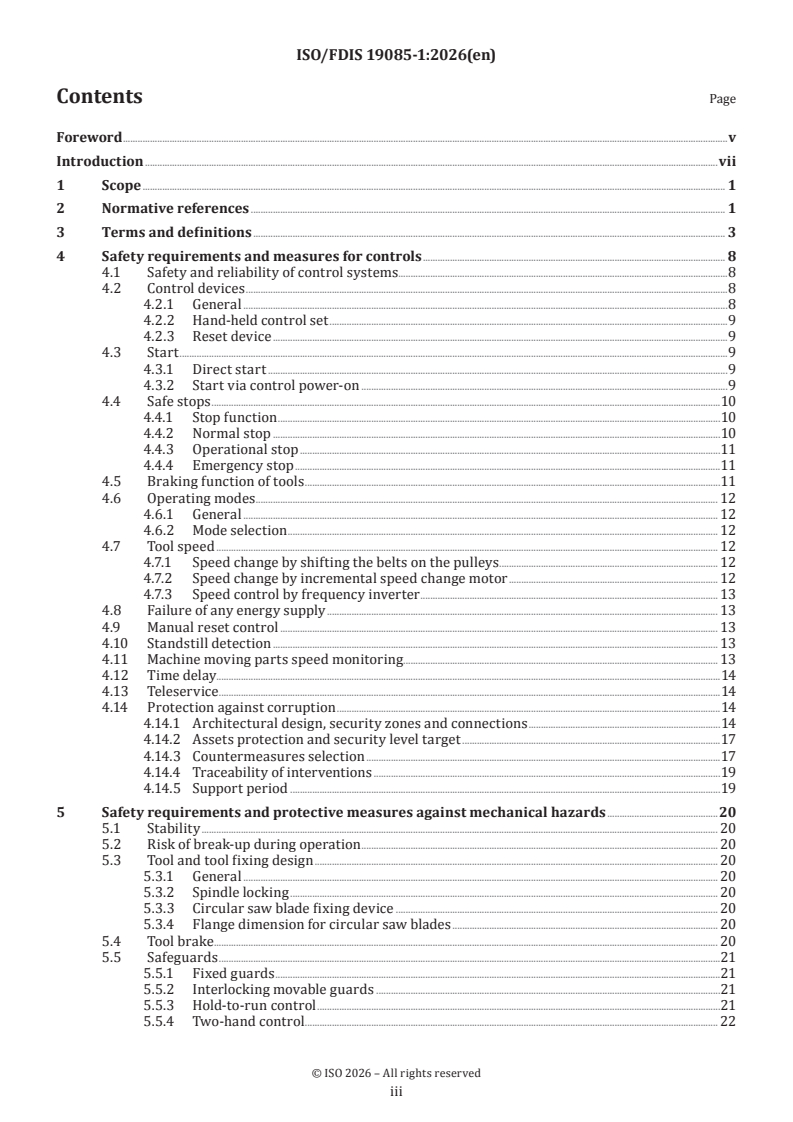
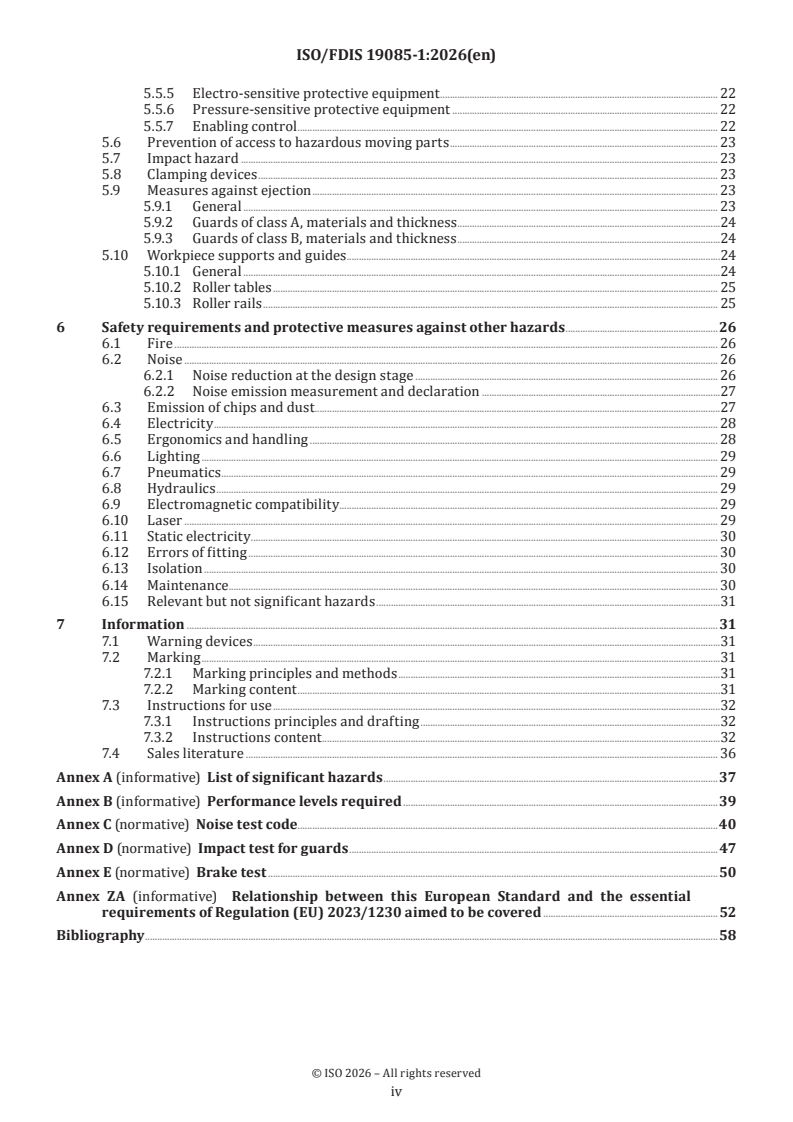
ISO/FDIS 19085-1 - Woodworking machines — Safety — Part 1: Common requirements
REDLINE ISO/FDIS 19085-1 - Woodworking machines — Safety — Part 1: Common requirements
ISO/FDIS 19085-1 is ISO's type-C safety standard for woodworking machines. It sets common safety and cyber security requirements for woodworking machines capable of continuous production use that process solid wood and materials with similar physical characteristics to wood. The standard is intended for designers, manufacturers, suppliers and importers, and it is used together with the other parts of the ISO 19085 series for specific machine types.
What does ISO/FDIS 19085-1 specify?
ISO/FDIS 19085-1 specifies the common safety requirements and measures that apply to most woodworking machines, including operation, adjustment, maintenance, transport, assembly, dismantling, disabling and scrapping. It also covers cyber security hazards linked to loss of availability, confidentiality and integrity.
The scope is limited to machines used as intended and under reasonably foreseeable misuse. It excludes machines for potential explosive atmospheres and machines manufactured before the publication date.
The document is organized into seven clauses, followed by informative and normative annexes.
| Annex | What it covers |
|---|---|
| Annex A | List of significant hazards, hazardous situations and events |
| Annex B | Performance levels required for the safety functions |
| Annex C | Noise test code |
| Annex D | Impact test for guards |
| Annex E | Brake test |
| Annex ZA | Relationship with Regulation (EU) 2023/1230 |
ISO/FDIS 19085-1 is meant to be read with the relevant machine-specific part of the ISO 19085 series. The specific part states which of these common requirements apply to that machine type and how they are implemented in practice.
What are the key requirements of ISO/FDIS 19085-1?
ISO/FDIS 19085-1 focuses on control functions, guarding, braking, and protection against mechanical, electrical and cyber security hazards. For most readers, the most important point is that the document does not treat safety as one single machine rating - it assigns performance levels to individual safety functions.
Control systems and safety functions
ISO/FDIS 19085-1 requires safety functions to be designed and implemented according to ISO 13849-1. The document uses safety-related parts of control systems (SRP/CS) and performance level (PL), and Annex B summarizes the required PL for 26 safety functions.
In practice, this means you need to size and validate each safety function separately. For example, prevention of unexpected start, emergency stop, normal stop, manual reset, mode selection, interlocking of movable guards, ESPE and PSPE are generally required at PL c, while speed monitoring of moving parts except tools is PL b. Hold-to-run is shown as b/c, and electric braking systems are PL b.
The document also covers start, stop, run-up, run-down, standstill detection, time delay and teleservice. That matters because the control system must not create a hazardous restart, and remote functions must never override local safety functions.
Braking and speed control
ISO/FDIS 19085-1 sets specific requirements for tool braking and for moving-part speed monitoring. If tool drives have brakes, a normal stop or emergency stop must trigger braking immediately, and the tool brake requirements are tied to the run-down time.
For practical use, this means the machine must stop quickly enough for the hazard it creates, and the brake function must be tested. Annex E gives the brake test, including measurement of run-up and run-down times and the reporting items for the test.
If a moving part other than a tool is speed limited, the control system must stop the drive automatically if the actual speed exceeds the limit by more than 5 percent. This is a clear design rule for feed mechanisms and other moving parts where overspeed can create a hazard.
Mechanical hazards and guards
ISO/FDIS 19085-1 addresses stability, break-up during operation, tool and tool fixing design, tool brakes, safeguards, access to hazardous moving parts, impact hazard, clamping devices, ejection, and workpiece supports and guides.
A practical outcome is that access to power-driven moving parts that can shear or crush must be prevented by guards or protective devices. Access to tools is controlled by a combination of fixed guards and interlocking movable guards, and guard locking is required in certain cases, including machines with mechanical feed and machines with manual feed when the run-down time is greater than 10 s.
Where impact hazard remains, the speed of the moving parts is limited to 25 m/min unless the hazard is avoided by design or by other measures. Where powered clamping is used, the document requires measures that prevent crushing, such as two-hand control or limiting the clamp gap and stroke.
Other hazards, including electrical and environmental hazards
ISO/FDIS 19085-1 also covers fire, noise, dust, electricity, ergonomics, lighting, pneumatics, hydraulics, EMC, laser, static electricity, errors of fitting, isolation and maintenance.
The practical meaning is that the machine must be designed as a whole, not only as a cutting system. For example, the document requires chips and dust capture with an extraction outlet, electrical enclosures with at least IP 52, local lighting for process checking or setting, and compliance with the relevant pneumatic and hydraulic standards where those systems are fitted.
For noise, Annex C gives the test code for determining, declaring and verifying emission values. For electrical safety, the machine manufacturer must provide protective bonding up to the PE terminal and supply the user with information needed to complete indirect-contact protection and feeder-circuit short-circuit protection. For laser use, only category 2, 2M or lower-risk lasers are allowed for cutting-line indication.
Cyber security and teleservice
ISO/FDIS 19085-1 adds dedicated cyber security requirements in Clause 4.14. It introduces architectural design, security zones, asset protection, countermeasure selection, traceability of interventions and support period requirements.
This matters because the standard treats cyber security as part of machine safety. The machine must be designed so that corruption of data or unauthorized intervention cannot create a hazardous situation. The document also gives teleservice rules: remote connections must be secured, supervision of the connection is required during telecontrol, and the local emergency stop and other safety functions always take precedence over remote commands.
Information for use
ISO/FDIS 19085-1 requires warning devices, marking, instructions for use and sales literature to be aligned with the safety design. The sales literature must not contradict the instructions for use, and it must contain the same noise information.
That means the user information is not just documentation. It is part of the safety case for the machine, especially for setup, use, maintenance and noise communication.
What terms does ISO/FDIS 19085-1 define?
ISO/FDIS 19085-1 defines the main machine, control and cyber security terms used throughout the document. These are the terms that most affect how you read the clauses.
- woodworking machine - a machine designed to process wood and materials with similar physical characteristics to wood.
- material with similar physical characteristics to wood - engineered wood, solid wood with certain laminates or edges, cork, bone, rigid rubber and plastics.
- control power-on - a control that enables energy to machine actuators without directly starting a dangerous movement.
- operational stop - standstill of machine actuators without cutting off energy and with standstill monitored.
- feed - controlled relative movement between the workpiece and the tool, by hand or by powered feed.
- electro-sensitive protective equipment (ESPE) - protective sensing equipment that uses a sensing device, monitoring device and output switching devices.
- intervention - a legitimate or illegitimate action or event that changes hardware, software or data and can alter machine behaviour or cause loss of availability, confidentiality or integrity.
- corruption - accidental or illegitimate modification of machine data that can create a hazardous situation or compromise availability, confidentiality or integrity.
Who uses ISO/FDIS 19085-1?
ISO/FDIS 19085-1 is used by machine manufacturers, designers, suppliers and importers who need a common safety baseline for woodworking machinery. It is also used by health and safety bodies, regulators and market surveillance organizations when they assess machine safety.
In day-to-day work, engineers use it to design control systems, guards, brakes, extraction, electrical equipment and user information. Quality managers and buyers use it to define requirements for procurement, conformity assessment and acceptance testing. Service providers and maintenance teams use it for safe intervention, teleservice and cleaning procedures.
What changed in ISO/FDIS 19085-1 from the previous edition?
ISO/FDIS 19085-1 cancels and replaces the second edition, ISO 19085-1:2021, and it is technically revised. The main changes stated in the document are:
- verification methods at the end of each subclause were deleted
- several definitions were improved and refined
- subclauses 4.2, 4.6 and 5.10 were subdivided for clearer and more specific requirements
- requirements for hand-held control sets were added in 4.2.2
- new text on push buttons with normally open contact was added in 4.3.1, 4.3.2, 4.9 and 5.5.3
- some tool-speed requirements that applied only to certain machines were removed from 4.7.3
- the text on monitoring in 4.10 was deleted because it duplicated other requirements
- a new subclause on protection against corruption was added in 4.14, together with related definitions and user information
- 5.1 was revised to refer only to ISO 12100
- 5.4 and 5.9 were simplified in structure
- several electrical and lighting requirements were clarified
- 7.2 and 7.3 were rearranged
- 7.4 on sales literature was added
- an annex containing the stability test was deleted and later annexes were renumbered accordingly
Which standards are used with ISO/FDIS 19085-1?
ISO/FDIS 19085-1 relies on a set of companion standards for control systems, guarding, electrical equipment, noise, hydraulics, pneumatics and cyber security.
| Standard | What it contributes |
|---|---|
| ISO 12100 | General principles of design, risk assessment and risk reduction |
| ISO 13849-1 | Design, verification and validation of safety-related control systems |
| ISO 13850 | Emergency stop function |
| ISO 13851 | Two-hand control devices |
| ISO 14118 | Prevention of unexpected start-up |
| ISO 14119 | Interlocking devices associated with guards |
| ISO 14120 | General requirements for guards |
| ISO 20607 | Instruction handbook drafting |
| IEC 60204-1 | Electrical equipment of machines |
| IEC 61496-1, IEC 61496-2, IEC 61496-3 | ESPE requirements and tests |
| IEC 61800-5-2 | Safety functions for drive systems, including Safe Stop 1 |
| IEC 62443-3-2, IEC 62443-3-3 | Cyber security risk assessment and system security levels |
| ISO 4413, ISO 4414 | Hydraulic and pneumatic system safety requirements |
| IEC 60825-1 | Laser classification and requirements |
| ISO 3744, ISO 3746, ISO 11201, ISO 11202, ISO 11204, ISO 11688-1, ISO 4871 | Noise measurement, design guidance and declaration |
| EN 847-1, EN 847-2, EN 847-3 | Woodworking tool safety requirements and clamping devices |
| EN 1837, EN 50370-1, EN 50370-2, EN 50525-2-21 | Lighting, EMC and cable requirements used in the document |
What does the ISO/FDIS 19085-1 document contain?
ISO/FDIS 19085-1 contains a clause structure covering scope, normative references, definitions, control-system requirements, mechanical hazards, other hazards and user information. It also contains annexes that support design and verification work.
The document includes Table A.1 on significant hazards and Table B.1 on required performance levels. It also includes the noise test code in Annex C, the impact test for guards in Annex D and the brake test in Annex E.
Figure 1 shows climb cutting and cutting against the feed, and Figure 2 shows an example of the machine security context for cyber security. The annexes give test methods, sampling, projectiles, mounting conditions, operating conditions, acceptance criteria and reporting items, so they are directly useful for design verification, type testing and conformity assessment.
Relations
- Consolidates
FprEN ISO 19085-1 - Woodworking machines - Safety - Part 1: Common requirements (ISO/FDIS 19085-1:2026) - Effective Date
- 12-Feb-2026
- Effective Date
- 17-Feb-2024
Buy Documents
ISO/FDIS 19085-1 - Woodworking machines — Safety — Part 1: Common requirements
REDLINE ISO/FDIS 19085-1 - Woodworking machines — Safety — Part 1: Common requirements
Get Certified
Connect with accredited certification bodies for this standard

CIS Institut d.o.o.
Personal Protective Equipment (PPE) certification body. Notified Body NB-2890 for EU Regulation 2016/425 PPE.
Gozdarski inštitut Slovenije
Slovenian Forestry Institute. Forest management certification support, timber testing.

Kiwa BDA Testing
Building and construction product certification.
Sponsored listings
Frequently Asked Questions
ISO/FDIS 19085-1 is a draft published by the International Organization for Standardization (ISO). Its full title is "Woodworking machines — Safety — Part 1: Common requirements". This standard covers: This document gives the safety requirements and measures to reduce risks arising during operation, adjustment, maintenance, transport, assembly, dismantling, disabling and scrapping, related to woodworking machines capable of continuous production use, hereinafter referred as "machines". These safety requirements and measures are those common to most of the machines, when they are used as intended and under the conditions foreseen by the manufacturer; reasonably foreseeable misuse has been considered too. The machines are designed to process solid wood and material with similar physical characteristics to wood, with hand feed or integrated feed. This document is intended to be used in conjunction with the other parts of the ISO 19085 series, applicable to specific machine types. The extent to which all significant hazards of a specific machine type are covered is indicated in the specific part of the ISO 19085 series relevant to that machine type. The hazards covered, at least partly, by the requirements of this document, are listed in Annex A. It is not applicable to machines intended for use in potential explosive atmospheres or to machines manufactured prior to the date of its publication.
This document gives the safety requirements and measures to reduce risks arising during operation, adjustment, maintenance, transport, assembly, dismantling, disabling and scrapping, related to woodworking machines capable of continuous production use, hereinafter referred as "machines". These safety requirements and measures are those common to most of the machines, when they are used as intended and under the conditions foreseen by the manufacturer; reasonably foreseeable misuse has been considered too. The machines are designed to process solid wood and material with similar physical characteristics to wood, with hand feed or integrated feed. This document is intended to be used in conjunction with the other parts of the ISO 19085 series, applicable to specific machine types. The extent to which all significant hazards of a specific machine type are covered is indicated in the specific part of the ISO 19085 series relevant to that machine type. The hazards covered, at least partly, by the requirements of this document, are listed in Annex A. It is not applicable to machines intended for use in potential explosive atmospheres or to machines manufactured prior to the date of its publication.
ISO/FDIS 19085-1 is classified under the following ICS (International Classification for Standards) categories: 13.110 - Safety of machinery; 79.120.10 - Woodworking machines. The ICS classification helps identify the subject area and facilitates finding related standards.
ISO/FDIS 19085-1 has the following relationships with other standards: It is inter standard links to FprEN ISO 19085-1, ISO 19085-1:2021. Understanding these relationships helps ensure you are using the most current and applicable version of the standard.
ISO/FDIS 19085-1 is available in PDF format for immediate download after purchase. The document can be added to your cart and obtained through the secure checkout process. Digital delivery ensures instant access to the complete standard document.
Standards Content (Sample)
Contents
- Introduction
- 1 Scope
- 2 Normative references
- 3 Terms and definitions
- 3.1 woodworking machine
- 3.2 material with similar physical characteristics to wood
- 3.3 easily machinable material
- 3.4 control power-on
- 3.5 machine actuator
- 3.6 operational stop
- 3.7 run-up time
- 3.8 run-down time
- 3.9 normal processing mode
- 3.10 feed
- 3.11 climb cutting
- 3.12 cutting against the feed
- 3.13 boring tool
- 3.14 ejection
- 3.15 kickback
- 3.16 anti-kickback device
- 3.17 electro-sensitive protective equipment
- 3.18 pressure-sensitive protective equipment
- 3.19 teleservice
- 3.20 telecontrol
- 3.21 intervention
- 3.22 modification
- 3.23 security context
- 3.24 countermeasure
- 3.25 tracing log
- 3.26 corruption
- 3.27 availability
- 3.28 integrity
- 3.29 confidentiality
- 3.30 security zone
- 3.31 asset
- 3.32 defence in depth approach
- 3.33 security level
- 4 Safety requirements and measures for controls
- 4.1 Safety and reliability of control systems
- 4.2 Control devices
- 4.3 Start
- 4.4 Safe stops
- 4.5 Braking function of tools
- 4.6 Operating modes
- 4.7 Tool speed
- 4.8 Failure of any energy supply
- 4.9 Manual reset control
- 4.10 Standstill detection
- 4.11 Machine moving parts speed monitoring
- 4.12 Time delay
- 4.13 Teleservice
- 4.14 Protection against corruption
- 5 Safety requirements and protective measures against mechanical hazards
- 5.1 Stability
- 5.2 Risk of break-up during operation
- 5.3 Tool and tool fixing design
- 5.4 Tool brake
- 5.5 Safeguards
- 5.6 Prevention of access to hazardous moving parts
- 5.7 Impact hazard
- 5.8 Clamping devices
- 5.9 Measures against ejection
- 5.10 Workpiece supports and guides
- 6 Safety requirements and protective measures against other hazards
- 6.1 Fire
- 6.2 Noise
- 6.3 Emission of chips and dust
- 6.4 Electricity
- 6.5 Ergonomics and handling
- 6.6 Lighting
- 6.7 Pneumatics
- 6.8 Hydraulics
- 6.9 Electromagnetic compatibility
- 6.10 Laser
- 6.11 Static electricity
- 6.12 Errors of fitting
- 6.13 Isolation
- 6.14 Maintenance
- 6.15 Relevant but not significant hazards
- 7 Information
Introduction
The ISO 19085 series provides technical safety requirements for the design and construction of woodworking machinery, as well as for the content of the relevant instruction handbook. The ISO 19085 series is intended for designers, manufacturers, suppliers and importers of the machines specified in the Scope of its parts. This document is a type-C standard as stated in ISO 12100.
This document is of relevance, in particular, for the following stakeholder groups representing the market players with regard to machinery safety:
- machine manufacturers (small, medium and large enterprises);
- health and safety bodies (regulators, accident prevention organizations, market surveillance, etc.). Others can be affected by the level of machinery safety achieved with the means of the document by the above-mentioned stakeholder groups:
- machine users/employers (small, medium and large enterprises);
- machine users/employees (e.g. trade unions, organizations for people with special needs);
- service providers, for example, for maintenance (small, medium and large enterprises);
- consumers (in case of machinery intended for use by consumers). The above-mentioned stakeholder groups have been given the possibility to participate in the drafting process of this document.
The machinery concerned and the extent to which hazards, hazardous situations or hazardous events are covered are indicated in the Scope of this document.
When requirements of this type-C standard are different from those which are stated in type-A or type-B standards, the requirements of this type-C standard take precedence over the requirements of the other standards for machines that have been designed and built according to the requirements of this type-C standard.
The full set of requirements for a particular type of woodworking machine are the requirements given in the part of the ISO 19085 series applicable to that type of woodworking machine, together with the requirements from this document that are cited in the applicable part of the ISO 19085 series. This document was developed, at its first edition, taking the requirements that are common to most woodworking machines from pre-existing specific standards on safety of different types of woodworking machines, which were “stand-alone” standards, i.e. not parts of a multi-parts series like the ISO 19085 series. This document can be used as a guide when the designer has to do a full risk assessment according to ISO 12100 and design the means for reducing the risks arising from relevant hazards for any woodworking machine not covered by a specific part of the ISO 19085 series. As the ISO 19085 series reflects the state-ofthe-art of woodworking machinery safety, referring to any subclause of its parts can also be helpful when searching for solutions to similar risks.
In the other parts of the ISO 19085 series, a subclause can either refer to the same subclause of this document, or give specific requirements, or both. The specific text can be subdivided into further subclauses. The ISO 19085 series is structured as follows:
- this document (i.e. ISO 19085-1) specifies the basic safety elements (like control devices, safeguards, guards’ materials, most common workpiece supports and guides, etc.) and their design requirements that are suitable to woodworking machines;
- all other parts of the ISO 19085 series specify whether the basic safety elements are required for the relevant machine type and the requirements for their implementation on the machine.
ISO/FDIS 19085-1:2026(en) For the clearest possible reference among parts, all parts of the ISO 19085 series have exactly the same structure of subclauses numbering and headings; each part shows all subclauses headings, even those that are not relevant to it (stating so), in all cases where this avoids shifting the following subclauses down and losing their numbering correspondence with this document, which can be confusing.
FINAL DRAFT International Standard ISO/FDIS 19085-1:2026(en) Woodworking machines — Safety — Part 1:
Common requirements
1 Scope
This document specifies safety and cyber security requirements and measures common to most woodworking machines, capable of continuous production use and designed to process solid wood and materials with similar physical characteristics to wood, hereinafter referred to also as “machines”. This document deals with significant hazards, hazardous situations or hazardous events (listed in Annex A), relevant to woodworking machinery, when it is used as intended and under conditions of misuse which are reasonably foreseeable by the manufacturer.
This document is also applicable to the other life cycle phases of woodworking machines: transport, assembly, adjustment, maintenance, disabling, dismantling and scrapping. This document also deals with cyber security hazards significant to woodworking machines in relation to the potential loss of availability, confidentiality and integrity, not only related with machines safety. This document is not applicable to machines intended for use in potential explosive atmospheres or to machines manufactured before the date of its publication.
2 Normative references
The following documents are referred to in the text in such a way that some or all of their content constitutes requirements of this document. For dated references, only the edition cited applies. For undated references, the latest edition of the referenced document (including any amendments) applies. ISO 3744:2025, Acoustics — Determination of sound power levels of noise sources using sound pressure — Engineering methods for an essentially free field over a reflecting plane ISO 3746:2010, Acoustics — Determination of sound power levels and sound energy levels of noise sources using sound pressure — Survey method using an enveloping measurement surface over a reflecting plane ISO 4413:2010, Hydraulic fluid power — General rules and safety requirements for systems and their components ISO 4414:2010, Pneumatic fluid power — General rules and safety requirements for systems and their components ISO 4871:1996, Acoustics — Declaration and verification of noise emission values of machinery and equipment ISO 11201:2010, Acoustics — Noise emitted by machinery and equipment — Determination of emission sound pressure levels at a work station and at other specified positions in an essentially free field over a reflecting plane with negligible environmental corrections ISO 11202:2010, Acoustics — Noise emitted by machinery and equipment — Determination of emission sound pressure levels at a work station and at other specified positions applying approximate environmental corrections ISO 11202:2010/Amd 1:2020, Acoustics — Noise emitted by machinery and equipment — Determination of emission sound pressure levels at a work station and at other specified positions applying approximate environmental corrections — Amendment 1
ISO/FDIS 19085-1:2026(en) ISO 11204:2010, Acoustics — Noise emitted by machinery and equipment — Determination of emission sound pressure levels at a work station and at other specified positions applying accurate environmental corrections ISO 12100:2010, Safety of machinery — General principles for design — Risk assessment and risk reduction ISO 13849-1:2023, Safety of machinery — Safety-related parts of control systems — Part 1: General principles for design ISO 13850:2015, Safety of machinery — Emergency stop function — Principles for design ISO 13851:2019, Safety of machinery — Two-hand control devices — Principles for design and selection ISO 13856-1:2013, Safety of machinery — Pressure-sensitive protective devices — Part 1: General principles for design and testing of pressure-sensitive mats and pressure-sensitive floors ISO 13856-2:2013, Safety of machinery — Pressure-sensitive protective devices — Part 2: General principles for design and testing of pressure-sensitive edges and pressure-sensitive bars ISO 13856-3:2013, Safety of machinery — Pressure-sensitive protective devices — Part 3: General principles for design and testing of pressure-sensitive bumpers, plates, wires and similar devices ISO 14118:2017, Safety of machinery — Prevention of unexpected start-up ISO 14119:2024, Safety of machinery — Interlocking devices associated with guards — Principles for design and selection ISO 14120:2015, Safety of machinery — Guards — General requirements for the design and construction of fixed and movable guards ISO 20607:2019, Safety of machinery — Instruction handbook — General drafting principles I EC 6 020 4 -1:2016 +A 1: 2021, Safety of machinery — Electrical equipment of machines — Part 1: General requirements I EC 6 0529:198 9+A M D1: 19 9 9+ A M D2: 2013, Degrees of protection provided by enclosures (IP Code) IEC 60825-1:2014, Safety of laser products — Part 1: Equipment classification and requirements IEC 60947-5-1:2024, Low-voltage switchgear and controlgear – Part 5-1: Control circuit devices and switching elements - Electromechanical control circuit devices IEC 61310-1:2007, Safety of machinery — Indication, marking and actuation — Part 1: Requirements for visual, acoustic and tactile signals IEC 61439-1:2020, Low-voltage switchgear and controlgear assemblies — Part 1: General rules IEC 61496-1:2020, Safety of machinery — Electro-sensitive protective equipment — Part 1: General requirements and tests IEC 61496-2:2020, Safety of machinery — Electro-sensitive protective equipment — Part 2: Particular requirements for equipment using active opto-electronic protective devices (AOPDs) IEC 61496-3:2025, Safety of machinery — Electro-sensitive protective equipment — Part 3: Particular requirements for active opto-electronic protective devices responsive to diffuse reflection (AOPDDR) IEC 61800-5-2:2016, Adjustable speed electrical power drive systems — Part 5-2: Safety requirements — Functional IEC 62443-3-2:2020, Security for industrial automation and control systems - Part 3-2: Security risk assessment for system design IEC 62443-3-3:2013, Industrial communication networks - Network and system security - Part 3-3: System security requirements and security levels
ISO/FDIS 19085-1:2026(en) EN 847-1:2017, Tools for woodworking — Safety requirements — Part 1: Milling tools, circular saw blades EN 847-2:2017, Tools for woodworking — Safety requirements — Part 2: Requirements for the shank of shank mounted milling tools/circular saw blades EN 847-3:2013, Tools for woodworking — Safety requirements — Part 3: Clamping devices EN 1837:2020, Safety of machinery — Integral lighting of machines EN 50370-1:2005, Electromagnetic compatibility (EMC) — Product family standard for machine tools — Part 1:
Emission EN 50370-2:2003, Electromagnetic compatibility (EMC) — Product family standard for machine tools — Part 2:
Immunity EN 50525-2-21:2011, Electric cables — Low voltage energy cables of rated voltages up to and including 450/750 V (U0/U) — Part 2-21: Cables for general applications — Flexible cables with crosslinked elastomeric insulation
3 Terms and definitions
For the purposes of this document, the terms and definitions given in ISO 12100:2010, ISO 13849-1:2023 and the following apply.
ISO and IEC maintain terminology databases for use in standardization at the following addresses:
- ISO Online browsing platform: available at https:// www .iso .org/ obp
- IEC Electropedia: available at https:// www .electropedia .org/
3.1 woodworking machine
machine designed to process wood and material with similar physical characteristics to wood (3.2)
3.2 material with similar physical characteristics to wood
engineered wood, engineered wood and solid wood composed with plastic or light alloy laminates or edges or profiles, as well as cork, bone, rigid rubber and plastics Note 1 to entry: Examples of engineered wood are particleboard, fibreboard, plywood, cross laminated timber (CLT). Engineered wood is also commonly called wood-based material.
Note 2 to entry: Examples for plastics are thermoplastic materials and thermoplastic resins, thermosetting resins, expanded plastic materials, polyurethane (PU), phenol and polyvinylchloride (PVC).
3.3 easily machinable material
material of which the unexpected contact with a spinning tool does not mechanically generate sparks and does not result in damage of the tool EXAMPLE Material with similar physical characteristics to wood (3.2) or light alloy.
3.4 control power-on
control that does not directly start any dangerous movement, but, after activation, enables the supply of energy to machine actuators (3.5)
3.5 machine actuator
powered mechanism used to move a machine part or axis EXAMPLE Drive, pneumatic cylinder, hydraulic cylinder.
ISO/FDIS 19085-1:2026(en)
3.6 operational stop
standstill of machine actuators (3.5) without cutting off the energy supply to them and with monitoring of the standstill condition
3.7 run-up time
time elapsed from the actuation of the start control device until the tool reaches the intended speed
3.8 run-down time
time elapsed from the actuation of the stop control device until tool standstill
3.9 normal processing mode
MODE 1 condition with all safeguards in place and functional, typically used for normal processing but not limited to it
3.10 feed
controlled relative movement between workpiece and tool Note 1 to entry: The feed can be controlled by hand or by a powered mechanism. The first case is called hand feed or manual feed; the second case is called powered feed or mechanical feed. The powered feed mechanism can be integrated with the machine or demountable.
3.11 climb cutting
cutting where the projection of the movement of the cutting knife in the direction of the feed (3.10) has the same sense as the relative movement of the workpiece against the tool Note 1 to entry: For an example of climb cutting, see Figure 1 a).
3.12 cutting against the feed
cutting where the projection of the movement of the cutting knife in the direction of the feed (3.10) has the opposite sense to the relative movement of the workpiece against the tool Note 1 to entry: For an example of cutting against the feed, see Figure 1 b). a) Climb cutting
ISO/FDIS 19085-1:2026(en) b) Cutting against the feed Key 1 fixed axis tool 2 moving axis tool 3 feed (workpiece) 4 workpiece (moving) 5 feed (tool) 6 workpiece (fixed) Figure 1 — Climb cutting and cutting against the feed
3.13 boring tool
tool whose feed (3.10) is only in the direction of its axis of rotation
3.14 ejection
uncontrolled movement of the workpiece or part of it or of the tool or part of it from the machine
3.15 kickback
unexpected movement of the workpiece or part of it opposite to the sense of the movement of the workpiece during processing
3.16 anti-kickback device
device that either reduces the possibility of a kickback (3.15) or stops the kickback
3.17 electro-sensitive protective equipment
ESPE assembly of devices or components, or both, working together for protective tripping or presence-sensing purposes, and comprising at a minimum:
- a sensing device, - controlling or monitoring devices, - output signal switching devices Note 1 to entry: Safety-related control systems associated with the ESPE or the ESPE itself can include a secondary switching device, muting functions, stopping performance monitor, start interlock, etc. EXAMPLE Light beam [active opto-electronic protective devices (AOPD)], laser scanner [active opto-electronic protective devices responsive to diffuse reflection (AOPDDR)], capacitive, active infrared, ultra-sonic and image monitoring equipment.
[SOURCE: ISO 13855:2024, 3.1.5, modified — "and/or a safety-related data interface" has been deleted from the definition, Note 1 to entry has been replaced and an EXAMPLE has been added.]
ISO/FDIS 19085-1:2026(en)
3.18 pressure-sensitive protective equipment
PSPE assembly of devices and components triggered using the “mechanical activated trip” method to provide protection under hazardous situations EXAMPLE Pressure-sensitive mats, bumpers, pressure-sensitive edges. Note 1 to entry: PSPE generate a stopping signal by the use of different techniques, e.g. mechanical contacts, fibreoptic sensors, pneumatic sensors. [SOURCE: ISO 13482:2014, 3.30, modified — "and bars" and "and floors" have been removed from the EXAMPLE.]
3.19 teleservice
machine diagnosis (including trouble-shooting), software update from a remote service site and telecontrol (3.20)
3.20 telecontrol
control of the machine movements from a remote service site
3.21 intervention
<cybersecurity> legitimate or illegitimate action or event that changes the hardware components and the software or data which modifies or interrupts the behaviour, state or operation of the machine temporarily or permanently leading to a hazardous situation or that causes loss of availability (3.27), confidentiality (3.29) and integrity (3.28) Note 1 to entry: Action taken on safety routines, safety variables, calibration data, firmware updates of safety-related parts of software are considered interventions in the sense of this document. Note 2 to entry: Normal operational changes to variables, such as opening a safety gate or triggering an ESPE, do not constitute an intervention in the sense of a change to data.
3.22 modification
<cybersecurity> change caused by an intervention (3.21) EXAMPLE Software version, parametrization of devices and software.
3.23 security context
<cybersecurity> security provided to the machine by the environment in which the machine is intended to be used Note 1 to entry: The security provided to the machine by its intended environment can effectively restrict the threats that are applicable to the machine.
[SOURCE: IEC 62443-4-1:2018, 3.1.23, modified — the word “product” has been replaced by the word “machine”.]
3.24 countermeasure
<cybersecurity> action, device, procedure or technique that reduces a threat, a vulnerability or the consequences of an attack by minimizing the harm the attack can cause or by discovering and reporting it so that corrective action can be taken [SOURCE: IEC 62443-4-2:2019, 3.1.15]
ISO/FDIS 19085-1:2026(en)
3.25 tracing log
<cybersecurity> collection of data recording interventions (3.21) that affect the safety-related control system
3.26 corruption
<cybersecurity> accidental or illegitimate modification (3.22) of machine data potentially resulting in hazardous situations or loss of availability (3.27), confidentiality (3.29) and integrity (3.28)
3.27 availability
<cybersecurity> the state of access to data that is guaranteed within an agreed time frame
3.28 integrity
<cybersecurity> the quality of - logical correctness and reliability of the control system, - logical completeness of hardware and software to implement the protection mechanisms and the consistency of the data structures, and - correctness of the stored data
3.29 confidentiality
<cybersecurity> the quality of information that is not disclosed to unauthorised persons, processes or devices
3.30 security zone
<cybersecurity> grouping of logical or physical assets (3.32) based upon risk or other criteria, such as criticality of assets, operational function, physical or logical location, required access (e.g. least privilege principles) or responsible organization [SOURCE: IEC 62443-3-2:2020, 3.1.25]
3.31 asset
<cybersecurity> physical or logical object having either a perceived or actual value to the industrial automation and control system of a machine (IACS) [SOURCE: IEC 62443-3-3:2013, 3.1.1] Note 1 to entry: An asset can be tangible or intangible.
EXAMPLE Hardware components, connections, software, know-how, sensitive personal data, production plan data.
...
Contents
- Introduction
- 1 Scope
- 2 Normative references
- 3 Terms and definitions
- 3.11 3.11
- 3.21 Intervention
- 3.21 intervention
- 3.22 Modification
- 3.22 modification
- 3.23 3.23 Security
- 3.24 Countermeasure
- 3.25 3.25 Compensating
- 3.26 Tracing log
- 3.27 Corruption
- 3.26 corruption
- 3.28 Availability
- 3.27 availability
- 3.29 Integrity
- 3.28 integrity
- 3.30 Confidentiality
- 3.29 confidentiality
- 3.31 3.30 Security
- 3.32 Asset
- 3.31 asset
- 3.33 IACS
- 3.34 3.32 Defence
- 3.35 3.33 Security
- 4 Safety requirements and measures for controls
- 4.1 Safety and reliability of control systems
- 4.2 Control devices
- 4.3 Start
- 4.4 Safe stops
- 4.5 Braking function of tools
- 4.6 Operating modes
- 4.7 Tool speed
- 4.8 Failure of any energy supply
- 4.9 Manual reset control
- 4.10 Standstill detection
- 4.11 Machine moving parts speed monitoring
- 4.12 Time delay
- 4.13 Teleservice
- 4.14 Protection against corruption
- 5 Safety requirements and protective measures against mechanical hazards
- 5.1 Stability
- 5.2 Risk of break-up during operation
- 5.3 Tool and tool fixing design
- 5.4 Tool brake
- 5.5 Safeguards
- 5.6 Prevention of access to hazardous moving parts
- 5.7 Impact hazard
- 5.8 Clamping devices
- 5.9 Measures against ejection
- 5.10 Workpiece supports and guides
- 6 Safety requirements and protective measures against other hazards
- 6.1 Fire
- 6.2 Noise
- 6.3 Emission of chips and dust
- 6.4 Electricity
- 6.5 Ergonomics and handling
- 6.6 Lighting
- 6.7 Pneumatics
- 6.8 Hydraulics
- 6.9 Electromagnetic compatibility
- 6.10 Laser
- 6.11 Static electricity
- 6.12 Errors of fitting
- 6.13 Isolation
- 6.14 Maintenance
- 6.15 Relevant but not significant hazards
- 7 Information
- 7.1 Warning devices
- 7.2 Marking
- 7.3 Instructions for use
- 7.4 Sales literature
- Annex A
- 1 Mechanical hazards related to
- 2 Electrical hazards due to
- 4 Hazards generated by noise, resulting in
- 4.2 Accidents due Interferenceto interference with speech
- 6 Hazards generated by radiation
Introduction
The ISO 19085 series provides technical safety requirements for the design and construction of woodworking machinery, as well as for the content of the relevant instruction handbook. The ISO 19085 series applies tois intended for designers, manufacturers, suppliers and importers of the machines specified in the Scope of its parts.
This document is a type-C standard as stated in ISO 12100.
This document is of relevance, in particular, for the following stakeholder groups representing the market players with regard to machinery safety:
- — machine manufacturers (small, medium and large enterprises);
- — health and safety bodies (regulators, accident prevention organizations, market surveillance, etc.). Others can be affected by the level of machinery safety achieved with the means of the document by the abovementioned stakeholder groups:
- — machine users/employers (small, medium and large enterprises);
- — machine users/employees (e.g. trade unions, organizations for people with special needs);
- — service providers, for example, for maintenance (small, medium and large enterprises);
- — consumers (in case of machinery intended for use by consumers). The above-mentioned stakeholder groups have been given the possibility to participate in the drafting process of this document.
The machinery concerned and the extent to which hazards, hazardous situations or hazardous events are covered are indicated in the Scope of this document.
When requirements of this type-C standard are different from those which are stated in type-A or type-B standards, the requirements of this type-C standard take precedence over the requirements of the other standards for machines that have been designed and built according to the requirements of this type-C standard.
The full set of requirements for a particular type of woodworking machine are the requirements given in the part of the ISO 19085 series applicable to that type of woodworking machine, together with the requirements from this document that are cited in the applicable part of the ISO 19085 series. This document was developed, at its first edition, taking the requirements that are common to most woodworking machines from pre-existing specific standards on safety of different types of woodworking machines, which were “stand-alone” standards, i.e. not parts of a multi-parts series like the ISO 19085 isseries. This document can be used as a guide when the designer has to do a full risk assessment according to ISO 12100 and design the means for reducing the risks arising from relevant hazards for any woodworking machine not covered by a specific part of the ISO 19085 series. As the ISO 19085 series reflects the state-ofthe-art of woodworking machinery safety, referring to any subclause of its parts can also be helpful when searching for solutions to similar risks.
In the other parts of the ISO 19085 series, a subclause can either refer to the same subclause of this document, or give specific requirements, or both. The specific text can be subdivided into further subclauses.
ISO/FDIS 19085-1:2026(en) The ISO 19085 series is structured as follows:
- this document (i.e. ISO 19085-1) specifies the basic safety elements (like control devices, safeguards, guards’ materials, most common workpiece supports and guides, etc.) and their design requirements that are suitable to woodworking machines;
- all other parts of the ISO 19085 series specify whether the basic safety elements are required for the relevant machine type and the requirements for their implementation on the machine. For the clearest possible reference among parts, all parts of the ISO 19085 series have exactly the same frame asstructure of subclauses numbering and headings, and; each part shows all subclauses headings, even those that are not relevant to it (stating so), in all cases where this avoids shifting the following subclauses down and losing their numbering correspondence with this document, which couldcan be confusing.
DRAFT International Standard ISO/FDIS 19085-1:2026(en)
Woodworking machines — Safety — — Part 1:
Common requirements
1 Scope
This document specifies safety and cyber security requirements and measures common to most woodworking machines, capable of continuous production use and designed to process solid wood and materials with similar physical characteristics to wood, hereinafter referred to also as “machines”. This document deals with significant hazards, hazardous situations or hazardous events (listed in Annex AAnnex A),), relevant to woodworking machinery, when it is used as intended and under conditions of misuse which are reasonably foreseeable. by the manufacturer.
This document is also applicable to the other life cycle phases of woodworking machines: transport, assembly, adjustment, maintenance, disabling, dismantling and scrapping. This document also deals with cyber security hazards significant to woodworking machines in relation withto the potential loss of availability, confidentiality and integrity, not only related with machines safety. This document is not applicable to machines intended for use in potential explosive atmospheres or to machines manufactured prior tobefore the date of its publication.
2 Normative references
The following documents are referred to in the text in such a way that some or all of their content constitutes requirements of this document. For dated references, only the edition cited applies. For undated references, the latest edition of the referenced document (including any amendments) applies. ISO 3744:20102025, Acoustics — Determination of sound power levels and sound energy levels of noise sources using sound pressure — Engineering methods for an essentially free field over a reflecting plane ISO 3746:2010, Acoustics — Determination of sound power levels and sound energy levels of noise sources using sound pressure — Survey method using an enveloping measurement surface over a reflecting plane ISO 4413:2010, Hydraulic fluid power — General rules and safety requirements for systems and their components ISO 4414:2010, Pneumatic fluid power — General rules and safety requirements for systems and their components ISO 4871:1996, Acoustics — Declaration and verification of noise emission values of machinery and equipment ISO 11201:2010, Acoustics — Noise emitted by machinery and equipment — Determination of emission sound pressure levels at a work station and at other specified positions in an essentially free field over a reflecting plane with negligible environmental corrections
ISO/FDIS 19085-1:2026(en) ISO 11202:2010, Acoustics — Noise emitted by machinery and equipment — Determination of emission sound pressure levels at a work station and at other specified positions applying approximate environmental corrections ISO 11202:2010/Amd 1:2020, Acoustics — Noise emitted by machinery and equipment — Determination of emission sound pressure levels at a work station and at other specified positions applying approximate environmental corrections — Amendment 1 ISO 11204:2010, Acoustics — Noise emitted by machinery and equipment — Determination of emission sound pressure levels at a work station and at other specified positions applying accurate environmental corrections ISO 11688-1:2009, Acoustics — Recommended practice for the design of low-noise machinery and equipment — Part 1: Planning ISO 12100:2010, Safety of machinery — General principles for design — Risk assessment and risk reduction ISO 13849--1:2023, Safety of machinery — Safety-related parts of control systems — Part 1: General principles for design ISO 13850:2015, Safety of machinery — Emergency stop function — Principles for design ISO 13851:2019, Safety of machinery — Two-hand control devices — Principles for design and selection ISO 13856--1:2013, Safety of machinery — Pressure-sensitive protective devices — Part 1: General principles for design and testing of pressure-sensitive mats and pressure-sensitive floors ISO 13856--2:2013, Safety of machinery — Pressure-sensitive protective devices — Part 2: General principles for design and testing of pressure-sensitive edges and pressure-sensitive bars ISO 13856--3:2013, Safety of machinery — Pressure-sensitive protective devices — Part 3: General principles for design and testing of pressure-sensitive bumpers, plates, wires and similar devices ISO 14118:2017, Safety of machinery — Prevention of unexpected start-up ISO 14119:2024, Safety of machinery — Interlocking devices associated with guards — Principles for design and selection ISO 14120:2015, Safety of machinery — Guards — General requirements for the design and construction of fixed and movable guards ISO 20607:2019, Safety of machinery — Instruction handbook — General drafting principles IEC 60204--1:2016+A1:2021, Safety of machinery — Electrical equipment of machines — Part 1: General requirements IEC 60529:1989+AMD1:1999+AMD2:2013, Degrees of protection provided by enclosures (IP Code) IEC 60825--1:2014, Safety of laser products — Part 1: Equipment classification and requirements IEC 60947-5-1:2024, Low-voltage switchgear and controlgear – Part 5-1: Control circuit devices and switching elements - Electromechanical control circuit devices IEC 61310--1:2007, Safety of machinery — Indication, marking and actuation — Part 1: Requirements for visual, acoustic and tactile signals IEC 61439--1:2020, Low-voltage switchgear and controlgear assemblies — Part 1: General rules
ISO/FDIS 19085-1:2026(en) IEC 61496--1:2020, Safety of machinery — Electro-sensitive protective equipment — Part 1: General requirements and tests IEC 61496--2:2020, Safety of machinery — Electro-sensitive protective equipment — Part 2: Particular requirements for equipment using active opto-electronic protective devices (AOPDs) IEC 61496--3:2025, Safety of machinery — Electro-sensitive protective equipment — Part 3: Particular requirements for active opto-electronic protective devices responsive to diffuse reflection (AOPDDR) IEC 61800--5--2:2016, Adjustable speed electrical power drive systems — Part 5-2: Safety requirements — Functional IEC 62443-3-2:2020, Security for industrial automation and control systems - Part 3-2: Security risk assessment for system design IEC 62443-3-3:2013, Industrial communication networks - Network and system security - Part 3-3: System security requirements and security levels EN 847--1:2017, Tools for woodworking — Safety requirements — Part 1: Milling tools, circular saw blades EN 847--2:2017, Tools for woodworking — Safety requirements — Part 2: Requirements for the shank of shank mounted milling tools/circular saw blades EN 847--3:2013, Tools for woodworking — Safety requirements — Part 3: Clamping devices EN 894-2:1997+A1:2008, Safety of machinery — Ergonomics requirements for the design of displays and control actuators — Part 2: Displays EN 1837:2020, Safety of machinery — Integral lighting of machines EN 50370--1:2005, Electromagnetic compatibility (EMC) — Product family standard for machine tools — Part 1: Emission EN 50370--2:2003, Electromagnetic compatibility (EMC) — Product family standard for machine tools — Part 2: Immunity EN 50525--2--21:2011, Electric cables — Low voltage energy cables of rated voltages up to and including 450/750 V (U0/U) — Part 2-21: Cables for general applications — Flexible cables with crosslinked elastomeric insulation
3 Terms and definitions
For the purposes of this document, the terms and definitions given in ISO 12100:2010, ISO 13849--1:2023 and the following apply.
ISO and IEC maintain terminology databases for use in standardization at the following addresses:
- — ISO Online browsing platform: available at https://www.iso.org/obp
- — IEC Electropedia: available at https://www.electropedia.org/ 3.1 3.1 woodworking machine machine designed to process wood and material with similar physical characteristics to wood (3.2(3.2))
ISO/FDIS 19085-1:2026(en) 3.2 3.2 material with similar physical characteristics to wood engineered wood, engineered wood and solid wood composed with plastic or light alloy laminates or edges or profiles, as well as cork, bone, rigid rubber and plastics Note 1 to entry: Examples of engineered wood are particleboard, fibreboard, plywood, cross laminated timber (CLT). Engineered wood is also commonly called wood-based material.
Note 2 to entry: Examples for plastics are thermoplastic materials and thermoplastic resins, thermosetting resins, expanded plastic materials, polyurethane (PU), phenol and polyvinylchloride (PVC). 3.3 3.3 easily machinable material material of which the unexpected contact with a spinning tool does not mechanically generate sparks and does not result in a damage of the tool EXAMPLE Material with similar physical characteristics to wood (3.2) or light alloy. 3.4 3.4 control power-on control that does not directly start any dangerous movement, but, after activation, enables the supply of energy to machine actuators (3.5(3.5)) 3.5 3.5 machine actuator powered mechanism used to move a machine part or axis EXAMPLE driveDrive, pneumatic cylinder, hydraulic cylinder.
3.6 3.6 operational stop standstill of machine actuators (3.5(3.5)) without cutting off the energy supply to them and with monitoring of the standstill condition 3.7 3.7 run-up time time elapsed from the actuation of the start control device until the tool reaches the intended speed 3.8 3.8 run-down time time elapsed from the actuation of the stop control device until tool standstill 3.9 3.9 normal processing mode MODE 1 condition with all safeguards in place and functional, typically used for normal processing but not limited to it 3.10 3.10 feed controlled relative movement between workpiece and tool Note 1 to entry: The feed can be controlled by hand or by a powered mechanism. The first case is called hand feed or manual feed; the second case is called powered feed or mechanical feed. The powered feed mechanism can be integrated with the machine or demountable.
ISO/FDIS 19085-1:2026(en)
3.11 3.11
climb cutting cutting where the projection of the movement of the cutting knife in the direction of the feed (3.10(3.10)) has the same sense as the relative movement of the workpiece against the tool Note 1 to entry: See Figure 1 For an example of climb cutting, see Figure 1 a). 3.12 3.12 cutting against the feed cutting where the projection of the movement of the cutting knife in the direction of the feed (3.10(3.10)) has the opposite sense to the relative movement of the workpiece against the tool Note 1 to entry: See Figure 1 For an example of cutting against the feed, see Figure 1 b).
a) Climb cutting
b) Cutting against the feed Key 1 fixed axis tool 2 moving axis tool
ISO/FDIS 19085-1:2026(en) 3 feed (workpiece) 4 workpiece (moving) 5 feed (tool) 6 workpiece (fixed) Figure 1 — Climb cutting and cutting against the feed 3.13 3.13 boring tool tool whose feed (3.10(3.10)) is only in the direction of its axis of rotation 3.14 3.14 ejection uncontrolled movement of the workpiece or part of it or of the tool or part of it from the machine 3.15 3.15 kickback unexpected movement of the workpiece or part of it opposite to the sense of the movement of the workpiece during processing 3.16 3.16 anti-kickback device device that either reduces the possibility of a kickback (3.15(3.15)) or stops the kickback 3.17 3.17 electro-sensitive protective equipment ESPE assembly of devices or components, or both, working together for protective tripping or presence-sensing purposes, and comprising at a minimum:
- — a sensing device, - — controlling or monitoring devices, - — output signal switching devices Note 1 to entry: Safety-related control systems associated with the ESPE or the ESPE itself can include a secondary switching device, muting functions, stopping performance monitor, start interlock, etc. EXAMPLE Light beam [active opto-electronic protective devices (AOPD),)], laser scanner [active opto-electronic protective devices responsive to diffuse reflection (AOPDDR),)], capacitive, active infrared, ultra-sonic and image monitoring equipment.
[SOURCE: ISO 13855:2024, 3.1.45, modified — "and/or a safety-related data interface" has been deleted from the abbreviated term, the EXAMPLE anddefinition, Note 1 to entry havehas been replaced and an EXAMPLE has been added.] 3.18 3.18 pressure-sensitive protective equipment PSPE assembly of devices and components triggered using the “mechanical activated trip” method to provide protection under hazardous situations EXAMPLE Pressure-sensitive mats, bumpers, pressure-sensitive edges.
ISO/FDIS 19085-1:2026(en) Note 1 to entry: PSPE generate a stopping signal by the use of different techniques, e.g. mechanical contacts, fibre-optic sensors, pneumatic sensors.
[SOURCE: ISO 13482:2014, 3.30, modified — "and bars" and "and floors" have been removed from the EXAMPLE.] 3.19 3.19 teleservice machine diagnosis (including trouble-shooting), software update from a remote service site and telecontrol (3.20(3.20)) 3.20 3.20 telecontrol control of the machine movements from a remote service site
3.21 Intervention
3.21 intervention
<cybersecurity> legitimate or illegitimate action or event that changes ofthe hardware components and the software or data which modifies or interrupts the behaviour, state or operation of the machine temporarily or permanently leading to a hazardous situation or that causes loss of availability (3.27,), confidentiality (3.29,) and integrity (3.28) Note 1 to entry: Action taken on safety routines, safety variables, calibration data, firmware updates of safety-related parts of software are considered interventions in the sense of this document. Note 2 to entry: Normal operational changes to variables, such as opening a safety gate, or triggering an ESPE, do not constitute an intervention in the sense of a change to data.
3.22 Modification
3.22 modification
<cybersecurity> Changechange caused by an intervention (3.21(3.21)) EXAMPLES: softwareEXAMPLE Software version, parametrization of devices and software.
3.23 3.23 Security
security context <cybersecurity> security provided to the machine by the environment in which the machine is intended to be used Note 1 to entry: The security provided to the machine by its intended environment can effectively restrict the threats that are applicable to the machine.
[SOURCE: IEC 62443-4-1:2018, 3.1.23, modified — the word “product” ishas been replaced by the word “machine”]”.] 3.213.24 countermeasure
3.24 Countermeasure
ISO/FDIS 19085-1:2026(en) <cybersecurity> action, device, procedure or technique that reduces a threat, a vulnerability or the consequences of an attack by minimizing the harm the attack can cause or by discovering and reporting it so that corrective action can be taken [SOURCE: IEC 62443-4-2:2019, 3.1.15]
3.25 3.25 Compensating
tracing log countermeasure <cybersecurity> Countermeasure employed in lieu of or in addition to inherent security capabilities to comply with one or more security requirements [SOURCE: IEC 62443-4-2 :2019, 3.1.9]
3.26 Tracing log
<cybersecurity> Collectioncollection of data recording interventions (3.21) that affect the safety-related control system
3.27 Corruption
3.26 corruption
<cybersecurity> accidental or illegitimate modification (3.22) of machine data potentially resulting in hazardous situations or loss of availability (3.27,), confidentiality (3.29,) and integrity (3.28)
3.28 Availability
3.27 availability
<cybersecurity> Ensuring thatthe state of access to data that is guaranteed within an agreed time frame
...