

ISO 10784-2:2011
(Main)Space systems — Early operations — Part 2: Initialization plan
General Information
- Abstract
A general definition of initialization is that it begins at separation of the spacecraft (SC) from the launcher. In some cases, a more exact definition will be that initialization begins in flight, upon planned change in mode or state of the SC from the launch configuration. Commissioning is completed when the SC, including its payload, is certified for initial mission operations. Prior to certification for mission operations, the SC is described as a test article in the three parts of ISO 10784. ISO 10784 does not include a requirement for contingency plans, but does include a statement of the need for contingency planning. ISO 10784-2:2011 provides SC manufacturers and operators with a specific form and format to write spacecraft initialization plans required to configure and verify the SC to perform normal mission operations. Since the SC is considered a test article at this phase of its operational life, ISO 17566 is used as a normative reference in constructing the initialization plan. It provides SC manufacturers, operators and other stakeholders with a common language and form to verify and document spacecraft initialization prior to normal SC mission operations.
- Status
- Published
- Publication Date
- 28-Nov-2011
- Technical Committee
- ISO/TC 20/SC 14 - Space systems and operations
- Current Stage
- 9093 - International Standard confirmed
- Start Date
- 14-Jun-2022
- Completion Date
- 29-Aug-2026

Overview
ISO 10784-2:2011, "Space systems - Early operations - Part 2: Initialization plan," defines a standardized form and format for spacecraft initialization plans. It is intended for the phase that begins at separation from the launcher (or upon a planned in‑flight mode change) and continues until commissioning - when the spacecraft (SC) and payload are certified for initial mission operations. Prior to certification the spacecraft is treated as a test article. ISO 10784-2:2011 helps manufacturers, operators and stakeholders verify and document initialization activities consistently.
Key topics and requirements
ISO 10784-2:2011 specifies the content and organization of an initialization plan rather than prescriptive technical procedures. Major elements include:
- Introduction and objectives: clear statement of initialization goals and scope (what systems, what tests).
- Referenced documentation: normative and informative references (ISO 17566 is a normative reference for test documentation).
- Nomenclature: glossary, symbols and acronyms to establish a common language.
- Purpose and verification strategy: use of an initialization strategy matrix (event, time, operational requirement, procedure, prerequisites, notes) to define minimum verification requirements and pass/fail criteria.
- Plan description and flow: methodology, sequence of initialization events, flowcharts or schedules.
- Initialization configuration requirements: spacecraft configuration matrix, measured parameters, operational modes, electrical/mechanical/propulsion/pyrotechnic states.
- Ground-system requirements: control facility identification, equipment, instrumentation, interfaces, software, data acquisition and infrastructure constraints and safety limitations.
- Procedural requirements and checklists: detailed procedural checklists, team roles and responsibilities, activation input/output data and supporting analyses.
- Statement of the need for contingency planning (the standard does not mandate contingency plans but recognizes their importance).
Practical applications and users
ISO 10784-2:2011 is practical for:
- Spacecraft manufacturers preparing initialization documentation for handover and verification.
- Satellite operators designing post‑launch early operations and acceptance tests.
- Mission systems and test engineers creating procedural checklists, verification matrices and ground‑system interfaces.
- Programme managers and safety officers ensuring consistent documentation, configuration control and traceability prior to commissioning. Typical uses: drafting initialization plans for LEO/GEO missions, defining ground equipment and software needs, establishing pass/fail criteria and formalizing team roles for early operations.
Related standards
- ISO 10784-1: Spacecraft initialization and commissioning (strategy matrix reference)
- ISO 10784-3: Commissioning report
- ISO 17566: Space systems - General test documentation (normative reference)
Keywords: ISO 10784-2:2011, spacecraft initialization, initialization plan, early operations, space systems, commissioning, spacecraft manufacturers, ground-system requirements, initialization checklist.
Get Certified
Connect with accredited certification bodies for this standard

BUREAU VERITAS Certification Germany
Bureau Veritas certification in Germany.

Element Materials Technology
Materials testing and product certification.

AQMS Ltd.
AQMS provides ISO certification to SMEs across the UK.
Sponsored listings
Frequently Asked Questions
ISO 10784-2:2011 is a standard published by the International Organization for Standardization (ISO). Its full title is "Space systems — Early operations — Part 2: Initialization plan". This standard covers: A general definition of initialization is that it begins at separation of the spacecraft (SC) from the launcher. In some cases, a more exact definition will be that initialization begins in flight, upon planned change in mode or state of the SC from the launch configuration. Commissioning is completed when the SC, including its payload, is certified for initial mission operations. Prior to certification for mission operations, the SC is described as a test article in the three parts of ISO 10784. ISO 10784 does not include a requirement for contingency plans, but does include a statement of the need for contingency planning. ISO 10784-2:2011 provides SC manufacturers and operators with a specific form and format to write spacecraft initialization plans required to configure and verify the SC to perform normal mission operations. Since the SC is considered a test article at this phase of its operational life, ISO 17566 is used as a normative reference in constructing the initialization plan. It provides SC manufacturers, operators and other stakeholders with a common language and form to verify and document spacecraft initialization prior to normal SC mission operations.
A general definition of initialization is that it begins at separation of the spacecraft (SC) from the launcher. In some cases, a more exact definition will be that initialization begins in flight, upon planned change in mode or state of the SC from the launch configuration. Commissioning is completed when the SC, including its payload, is certified for initial mission operations. Prior to certification for mission operations, the SC is described as a test article in the three parts of ISO 10784. ISO 10784 does not include a requirement for contingency plans, but does include a statement of the need for contingency planning. ISO 10784-2:2011 provides SC manufacturers and operators with a specific form and format to write spacecraft initialization plans required to configure and verify the SC to perform normal mission operations. Since the SC is considered a test article at this phase of its operational life, ISO 17566 is used as a normative reference in constructing the initialization plan. It provides SC manufacturers, operators and other stakeholders with a common language and form to verify and document spacecraft initialization prior to normal SC mission operations.
ISO 10784-2:2011 is classified under the following ICS (International Classification for Standards) categories: 49.140 - Space systems and operations. The ICS classification helps identify the subject area and facilitates finding related standards.
ISO 10784-2:2011 is available in PDF format for immediate download after purchase. The document can be added to your cart and obtained through the secure checkout process. Digital delivery ensures instant access to the complete standard document.
Standards Content (Sample)
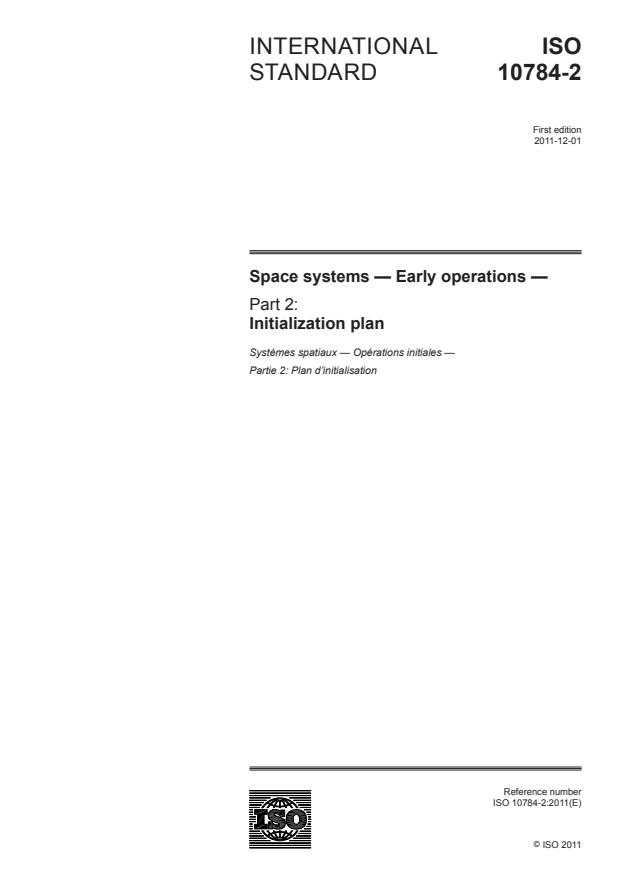
INTERNATIONAL ISO
STANDARD 10784-2
First edition
2011-12-01
Space systems — Early operations —
Part 2:
Initialization plan
Systèmes spatiaux — Opérations initiales —
Partie 2: Plan d’initialisation
Reference number
ISO 10784-2:2011(E)
©
ISO 2011
© ISO 2011
All rights reserved. Unless otherwise specified, no part of this publication may be reproduced or utilized in any form or by any means,
electronic or mechanical, including photocopying and microfilm, without permission in writing from either ISO at the address below or ISO’s
member body in the country of the requester.
ISO copyright office
Case postale 56 • CH-1211 Geneva 20
Tel. + 41 22 749 01 11
Fax + 41 22 749 09 47
E-mail copyright@iso.org
Web www.iso.org
Published in Switzerland
ii © ISO 2011 – All rights reserved
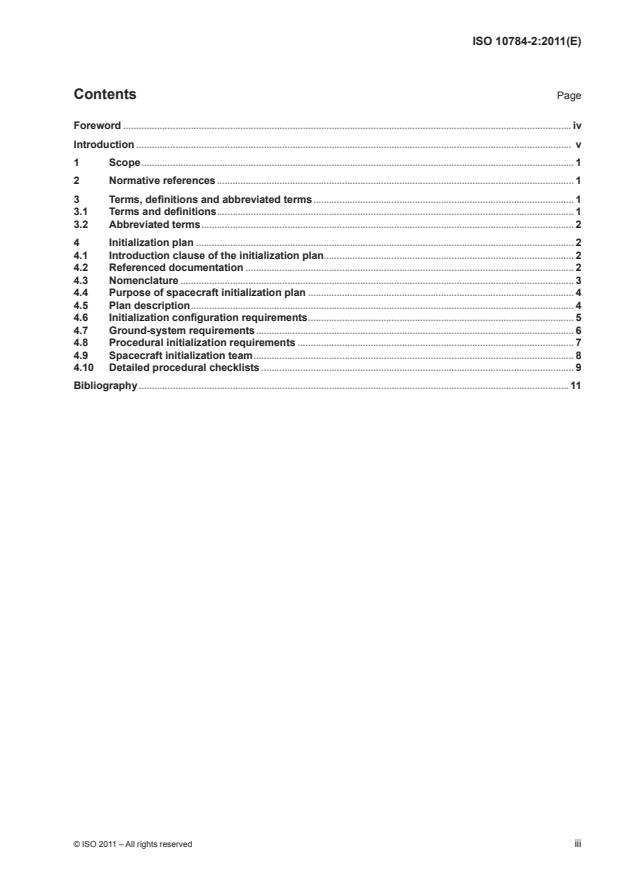
Contents Page
Foreword . iv
Introduction . v
1 Scope . 1
2 Normative references . 1
3 Terms, definitions and abbreviated terms . 1
3.1 Terms and definitions . 1
3.2 Abbreviated terms . 2
4 Initialization plan . 2
4.1 Introduction clause of the initialization plan. 2
4.2 Referenced documentation . 2
4.3 Nomenclature . 3
4.4 Purpose of spacecraft initialization plan . 4
4.5 Plan description . 4
4.6 Initialization configuration requirements . 5
4.7 Ground-system requirements . 6
4.8 Procedural initialization requirements . 7
4.9 Spacecraft initialization team . 8
4.10 Detailed procedural checklists . 9
Bibliography . 11
© ISO 2011 – All rights reserved iii
Foreword
ISO (the International Organization for Standardization) is a worldwide federation of national standards bodies
(ISO member bodies). The work of preparing International Standards is normally carried out through ISO
technical committees. Each member body interested in a subject for which a technical committee has been
established has the right to be represented on that committee. International organizations, governmental and
non-governmental, in liaison with ISO, also take part in the work. ISO collaborates closely with the International
Electrotechnical Commission (IEC) on all matters of electrotechnical standardization.
International Standards are drafted in accordance with the rules given in the ISO/IEC Directives, Part 2.
The main task of technical committees is to prepare International Standards. Draft International Standards
adopted by the technical committees are circulated to the member bodies for voting. Publication as an
International Standard requires approval by at least 75 % of the member bodies casting a vote.
Attention is drawn to the possibility that some of the elements of this document may be the subject of patent
rights. ISO shall not be held responsible for identifying any or all such patent rights.
ISO 10784-2 was prepared by Technical Committee ISO/TC 20, Aircraft and space vehicles, Subcommittee
SC 14, Space systems and operations.
ISO 10784 consists of the following parts, under the general title Space systems — Early operations:
— Part 1: Spacecraft initialization and commissioning
— Part 2: Initialization plan
— Part 3: Commissioning report
iv © ISO 2011 – All rights reserved
Introduction
The three parts of ISO 10784 provide spacecraft (SC) manufacturers and operators with a specific form and
format for writing SC initialization plans and commissioning reports required to configure and verify the SC
to perform normal mission operations. Often, SC manufacturers and operators have defined these plans
and reports uniquely for each programme, or regional, national and corporate organizations have unique
initialization plans and commissioning reports. The three parts of ISO 10784 aim at establishing a common
language and form for SC stakeholders. The use of one form and format will simplify stakeholder understanding
of initialization and commissioning activities.
© ISO 2011 – All rights reserved v
INTERNATIONAL STANDARD ISO 10784-2:2011(E)
Space systems — Early operations —
Part 2:
Initialization plan
1 Scope
A general definition of initialization is that it begins at separation of the spacecraft (SC) from the launcher. In
some cases, a more exact definition will be that initialization begins in flight, upon planned change in mode or
state of the SC from the launch configuration. Commissioning is completed when the SC, including its payload,
is certified for initial mission operations. Prior to certification for mission operations, the SC is described as a
test article in the three parts of ISO 10784. ISO 10784 does not include a requirement for contingency plans,
but does include a statement of the need for contingency planning.
This part of ISO 10784 provides SC manufacturers and operators with a specific form and format to write
spacecraft initialization plans required to configure and verify the SC to perform normal mission operations.
Since the SC is considered a test article at this phase of its operational life, ISO 17566 is used as a normative
reference in constructing the initialization plan. It provides SC manufacturers, operators and other stakeholders
with a common language and form to verify and document spacecraft initialization prior to normal SC mission
operations.
2 Normative references
The following referenced documents are indispensable for the application of this document. For dated
references, only the edition cited applies. For undated references, the latest edition of the referenced document
(including any amendments) applies.
ISO 10784-1, Space systems — Early operations — Part 1: Spacecraft initialization and commissioning
ISO 17566, Space systems — General test documentation
3 Terms, definitions and abbreviated terms
3.1 Terms and definitions
For the purposes of this document, the following terms and definitions apply.
3.1.1
commissioning
certification of a spacecraft as ready for mission operations
3.1.2
early operations
period from initialization to commissioning for mission operations
3.1.3
initialization
initial functional and operational checkout of a spacecraft following separation from the launch vehicle
© ISO 2011 – All rights reserved 1
3.2 Abbreviated terms
LV launch vehicle
PL payload
SC spacecraft
4 Initialization plan
4.1 Introduction clause of the initialization plan
4.1.1 General
The introduction clause is a preliminary element which shall be used to give general information or commentary
about the technical content of the initialization plan and about the reasons prompting its preparation. Because
the spacecraft is not yet certified for operations, it is described as a test article. The introduction shall include
a brief description of initialization and its objectives. It shall not contain requirements.
4.1.2 Objective
The objective subclause shall specify the desired initialization outcome in terms of SC certification, acceptance
or other development. The objective may reference other clauses or subclauses which appear later in the
document.
4.1.3 Scope
The scope subclause shall define, without ambiguity, the SC, the range of testing covered by the plan and the
applicability of the plan in relation to fulfilling SC initialization objectives.
The initialization plan document shall provide input information for the generation of overall commissioning
objectives. The initialization plan document may be a part of the overall spacecraft programme test plan.
4.1.4 Background
The background subclause is optional. If included, it may discuss the background of the spacecraft programme
if that information benefits the overall understanding of the initialization plan.
4.2 Referenced documentation
4.2.1 General
This clause shall provide a list of the documents to which reference is made in the initialization plan.
Nothing in this document, however, supersedes applicable laws and regulations unless a specific exemption
has been obtained.
4.2.2 Normative references
Normative references are published standards and specifications that provide requirements or constraints for
initialization. The required format for the list of normative references is shown below.
2 © ISO 2011 – All rights reserved
Document number Document description Revision level/Release date
4.2.3 Applicable references
Applicable references are programme-related documents that provide requirements or constraints for
initialization. The required format for the list of applicable references is shown below.
Document number Document description Revision level/Release date
4.2.4 Informative references
Informative references are documents included for information only. Such references amplify or clarify the
document content but do not contain requirements applicable to the initialization plan. They can be standards,
other publications or drawings, for instance. The required format for the list of informative references is shown
below.
Document number Document description Revision level/Release date
4.3 Nomenclature
4.3.1 Terms and definitions
The terms and definitions subclause shall provide the definitions necessary for the understanding of certain
terms used in the initialization plan. The terms and definitions subclause shall include only those items specific
to the initialization plan concerned. In some cases, a project dictionary or glossary may be referenced.
4.3.2 Symbols
The symbols subclause shall provide a list of the symbols necessary for the understanding of the initialization
plan.
Unless there is a need to list symbols in a specific order to reflect technical criteria, all symbols should be listed
in alphabetical order.
The symbols subclause shall include only those items specific to the initialization plan concerned.
4.3.3 Acronyms
The acronyms subclause shall provide a list of the acronyms necessary for the understanding of the initialization
plan.
The acronyms subclause shall include only those items specific to the initialization plan concerned.
4.3.4 Abbreviated terms
The abbreviated terms subclause shall define the abbreviated terms used in the initialization report.
© ISO 2011 – All rights reserved 3
4.4 Purpose of spacecraft initialization plan
4.4.1 Overall description
This clause shall describe the overall process as it applies to the scope of the document concerned and how it
relates to the initialization strategy matrix.
4.4.2 Initialization strategy matrix
The initialization strategy matrix (see ISO 10784-1) shall specify the minimum set of operational requirements
to be verified within the plan and the verification strategies that will be employed to satisfy these requirements.
This matrix
...