

ISO/IEC TS 22237-7:2018
(Main)Information technology — Data centre facilities and infrastructures — Part 7: Management and operational information
General Information
- Abstract
ISO/IEC TS 22237-7:2018 specifies processes for the management and operation of data centres. The primary focus of this document is the operational processes necessary to deliver the expected level of resilience, availability, risk management, risk mitigation, capacity planning, security and energy efficiency. The secondary focus is on management processes to align the actual and future demands of users.
- Status
- Published
- Publication Date
- 26-Apr-2018
- Technical Committee
- ISO/IEC JTC 1/SC 39 - Sustainability, IT and data centres
- Drafting Committee
- ISO/IEC JTC 1/SC 39/WG 3 - Sustainable facilities and infrastructures
- Current Stage
- 9092 - International Standard to be revised
- Start Date
- 03-Dec-2024
- Completion Date
- 29-Aug-2026
Buy Documents

ISO/IEC TS 22237-7:2018 - Information technology — Data centre facilities and infrastructures — Part 7: Management and operational information Released:4/27/2018

ISO/IEC TS 22237-7:2018 - Information technology — Data centre facilities and infrastructures — Part 7: Management and operational information/27/2018
Overview
ISO/IEC TS 22237-7:2018 - part of the ISO/IEC TS 22237 series - specifies processes for the management and operation of data centres. Its primary emphasis is on operational processes required to deliver expected levels of resilience, availability, risk management, capacity planning, security and energy efficiency. A secondary focus covers management processes that align current and future user demand with data centre capability.
Key Topics
Highlights from the standard include:
- Operational information & parameters tied to building, power, environmental control, cabling and security (cross-referenced to Parts 2–6).
- Acceptance testing and verification procedures for construction, power, HVAC, cabling, security and energy-efficiency enablement.
- A comprehensive list of operational processes such as:
- Operations management
- Incident management (including MTTR focus)
- Change management
- Asset & configuration management
- Capacity management
- Management processes including:
- Availability management
- Security management
- Resource and energy management
- Product lifecycle, cost and strategy management
- Service level and customer management
- KPIs and measurements: the standard defines base and advanced KPIs (e.g., availability metrics, SLA compliance, energy KPIs) and monitoring tests to support operational decisions.
- Annexes provide guidance on process implementation and security systems.
Practical Applications
ISO/IEC TS 22237-7:2018 is practical for organizations that need to operationalize or audit data centre facilities and infrastructures:
- Data centre operators & facility managers use it to define day-to-day operational procedures, acceptance testing and monitoring regimes.
- IT service managers & SRE teams use the KPIs and incident/change management guidance to align SLAs and improve uptime.
- Designers, integrators & consultants reference the operational parameters to ensure designs are maintainable and testable.
- Energy managers & sustainability teams apply the energy-management and energy-efficiency tests to reduce PUE and operational costs.
- Auditors & compliance officers use the standard to assess resilience, availability and security process maturity.
Related Standards
- ISO/IEC TS 22237-2: Building construction
- ISO/IEC TS 22237-3: Power distribution
- ISO/IEC TS 22237-4: Environmental control
- ISO/IEC TS 22237-5: Telecommunications cabling
- ISO/IEC TS 22237-6: Security systems
Adopting ISO/IEC TS 22237-7:2018 helps organizations standardize data center management, improve operational resilience, and demonstrate consistent approaches to capacity planning, security and energy efficiency.
Buy Documents
ISO/IEC TS 22237-7:2018 - Information technology — Data centre facilities and infrastructures — Part 7: Management and operational information Released:4/27/2018
ISO/IEC TS 22237-7:2018 - Information technology — Data centre facilities and infrastructures — Part 7: Management and operational information/27/2018
Get Certified
Connect with accredited certification bodies for this standard

BSI Group
BSI (British Standards Institution) is the business standards company that helps organizations make excellence a habit.

NYCE
Mexican standards and certification body.
Sponsored listings
Frequently Asked Questions
ISO/IEC TS 22237-7:2018 is a technical specification published by the International Organization for Standardization (ISO). Its full title is "Information technology — Data centre facilities and infrastructures — Part 7: Management and operational information". This standard covers: ISO/IEC TS 22237-7:2018 specifies processes for the management and operation of data centres. The primary focus of this document is the operational processes necessary to deliver the expected level of resilience, availability, risk management, risk mitigation, capacity planning, security and energy efficiency. The secondary focus is on management processes to align the actual and future demands of users.
ISO/IEC TS 22237-7:2018 specifies processes for the management and operation of data centres. The primary focus of this document is the operational processes necessary to deliver the expected level of resilience, availability, risk management, risk mitigation, capacity planning, security and energy efficiency. The secondary focus is on management processes to align the actual and future demands of users.
ISO/IEC TS 22237-7:2018 is classified under the following ICS (International Classification for Standards) categories: 35.020 - Information technology (IT) in general. The ICS classification helps identify the subject area and facilitates finding related standards.
ISO/IEC TS 22237-7:2018 is available in PDF format for immediate download after purchase. The document can be added to your cart and obtained through the secure checkout process. Digital delivery ensures instant access to the complete standard document.
Standards Content (Sample)
TECHNICAL ISO/IEC TS
SPECIFICATION 22237-7
First edition
2018-05
Information technology — Data centre
facilities and infrastructures —
Part 7:
Management and operational
information
Technologie de l’information — Installation et infrastructures de
centres de traitement de données —
Partie 7: Informations de gestion et de fonctionnement
Reference number
©
ISO/IEC 2018
© ISO/IEC 2018
All rights reserved. Unless otherwise specified, or required in the context of its implementation, no part of this publication may
be reproduced or utilized otherwise in any form or by any means, electronic or mechanical, including photocopying, or posting
on the internet or an intranet, without prior written permission. Permission can be requested from either ISO at the address
below or ISO’s member body in the country of the requester.
ISO copyright office
CP 401 • Ch. de Blandonnet 8
CH-1214 Vernier, Geneva
Phone: +41 22 749 01 11
Fax: +41 22 749 09 47
Email: copyright@iso.org
Website: www.iso.org
Published in Switzerland
ii © ISO/IEC 2018 – All rights reserved
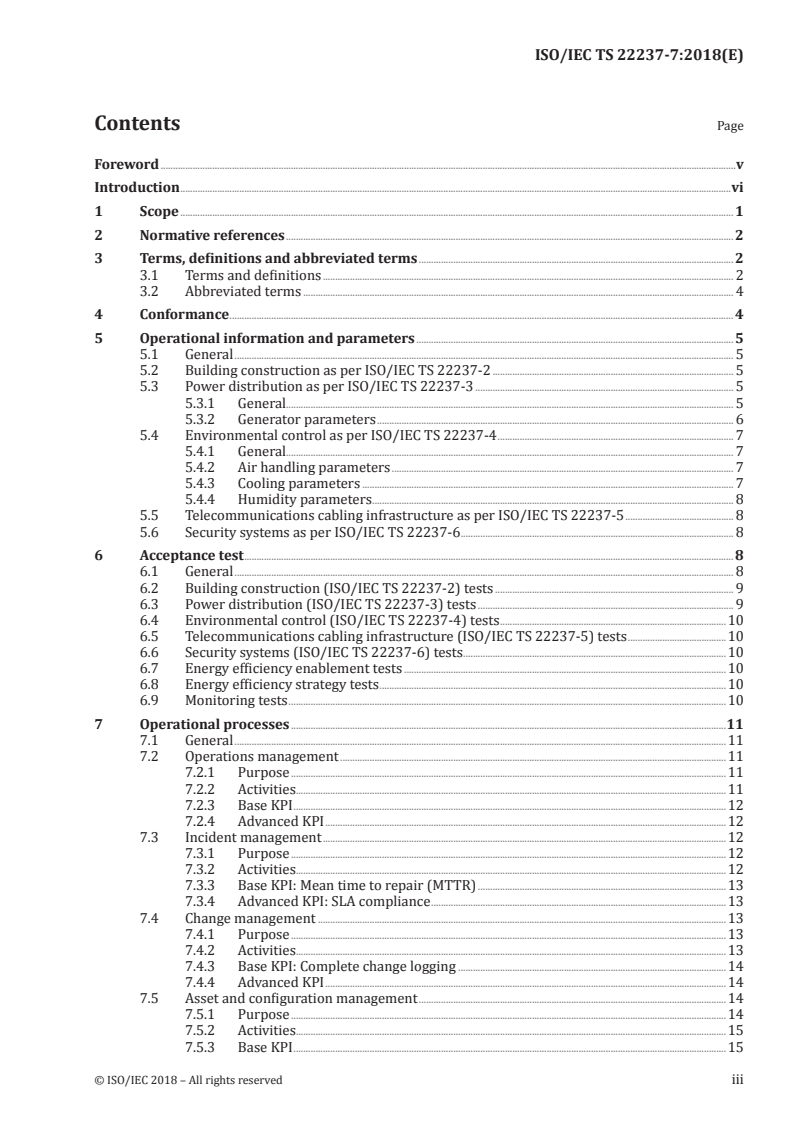
Contents Page
Foreword .v
Introduction .vi
1 Scope . 1
2 Normative references . 2
3 Terms, definitions and abbreviated terms . 2
3.1 Terms and definitions . 2
3.2 Abbreviated terms . 4
4 Conformance . 4
5 Operational information and parameters . 5
5.1 General . 5
5.2 Building construction as per ISO/IEC TS 22237-2 . 5
5.3 Power distribution as per ISO/IEC TS 22237-3 . 5
5.3.1 General. 5
5.3.2 Generator parameters . 6
5.4 Environmental control as per ISO/IEC TS 22237-4 . 7
5.4.1 General. 7
5.4.2 Air handling parameters . 7
5.4.3 Cooling parameters . 7
5.4.4 Humidity parameters . . 8
5.5 Telecommunications cabling infrastructure as per ISO/IEC TS 22237-5 . 8
5.6 Security systems as per ISO/IEC TS 22237-6 . 8
6 Acceptance test . 8
6.1 General . 8
6.2 Building construction (ISO/IEC TS 22237-2) tests . 9
6.3 Power distribution (ISO/IEC TS 22237-3) tests . 9
6.4 Environmental control (ISO/IEC TS 22237-4) tests .10
6.5 Telecommunications cabling infrastructure (ISO/IEC TS 22237-5) tests .10
6.6 Security systems (ISO/IEC TS 22237-6) tests . .10
6.7 Energy efficiency enablement tests .10
6.8 Energy efficiency strategy tests .10
6.9 Monitoring tests .10
7 Operational processes .11
7.1 General .11
7.2 Operations management .11
7.2.1 Purpose .11
7.2.2 Activities.11
7.2.3 Base KPI .12
7.2.4 Advanced KPI .12
7.3 Incident management .12
7.3.1 Purpose .12
7.3.2 Activities.12
7.3.3 Base KPI: Mean time to repair (MTTR) .13
7.3.4 Advanced KPI: SLA compliance .13
7.4 Change management .13
7.4.1 Purpose .13
7.4.2 Activities.13
7.4.3 Base KPI: Complete change logging .14
7.4.4 Advanced KPI .14
7.5 Asset and configuration management .14
7.5.1 Purpose .14
7.5.2 Activities.15
7.5.3 Base KPI .15
© ISO/IEC 2018 – All rights reserved iii
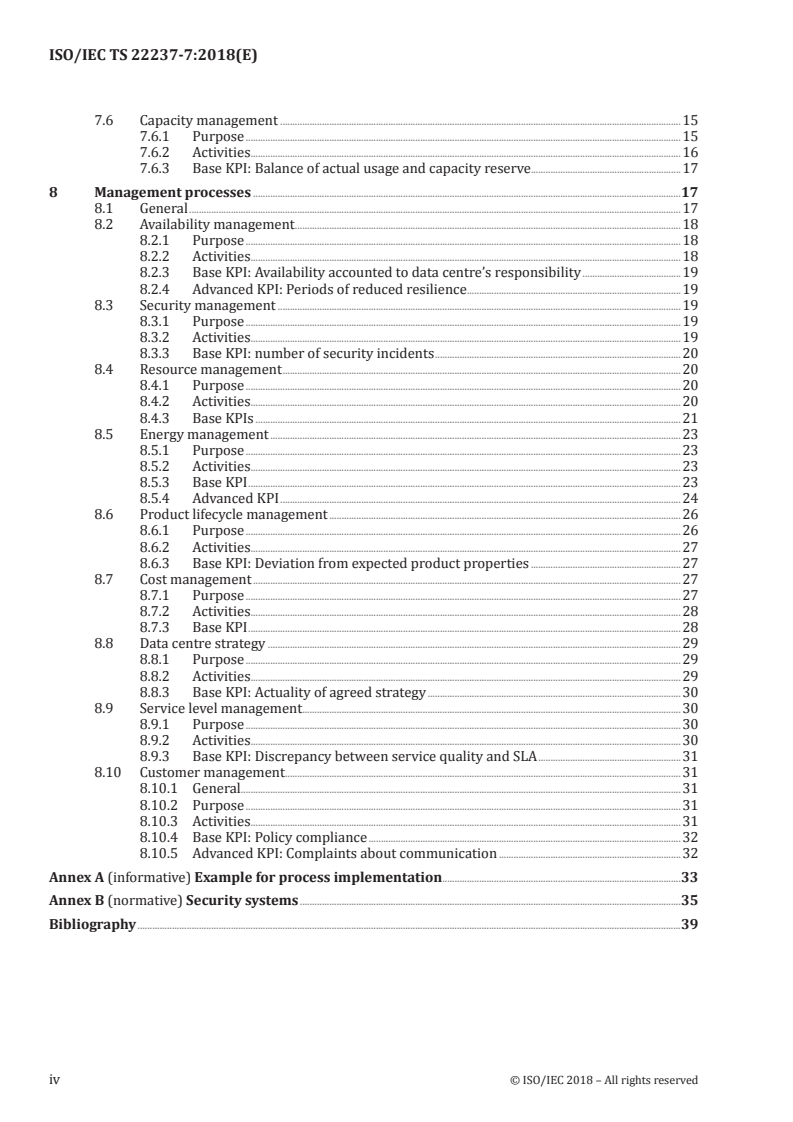
7.6 Capacity management .15
7.6.1 Purpose .15
7.6.2 Activities.16
7.6.3 Base KPI: Balance of actual usage and capacity reserve.17
8 Management processes .17
8.1 General .17
8.2 Availability management .18
8.2.1 Purpose .18
8.2.2 Activities.18
8.2.3 Base KPI: Availability accounted to data centre’s responsibility .19
8.2.4 Advanced KPI: Periods of reduced resilience .19
8.3 Security management .19
8.3.1 Purpose .19
8.3.2 Activities.19
8.3.3 Base KPI: number of security incidents .20
8.4 Resource management .20
8.4.1 Purpose .20
8.4.2 Activities.20
8.4.3 Base KPIs .21
8.5 Energy management .23
8.5.1 Purpose .23
8.5.2 Activities.23
8.5.3 Base KPI .23
8.5.4 Advanced KPI .24
8.6 Product lifecycle management .26
8.6.1 Purpose .26
8.6.2 Activities.27
8.6.3 Base KPI: Deviation from expected product properties .27
8.7 Cost management .27
8.7.1 Purpose .27
8.7.2 Activities.28
8.7.3 Base KPI .28
8.8 Data centre strategy .29
8.8.1 Purpose .29
8.8.2 Activities.29
8.8.3 Base KPI: Actuality of agreed strategy .30
8.9 Service level management.30
8.9.1 Purpose .30
8.9.2 Activities.30
8.9.3 Base KPI: Discrepancy between service quality and SLA .31
8.10 Customer management .31
8.10.1 General.31
8.10.2 Purpose .31
8.10.3 Activities.31
8.10.4 Base KPI: Policy compliance .32
8.10.5 Advanced KPI: Complaints about communication .32
Annex A (informative) Example for process implementation .33
Annex B (normative) Security systems .35
Bibliography .39
iv © ISO/IEC 2018 – All rights reserved
Foreword
ISO (the International Organization for Standardization) and IEC (the International Electrotechnical
Commission) form the specialized system for worldwide standardization. National bodies that are
members of ISO or IEC participate in the development of International Standards through technical
committees established by the respective organization to deal with particular fields of technical
activity. ISO and IEC technical committees collaborate in fields of mutual interest. Other international
organizations, governmental and non-governmental, in liaison with ISO and IEC, also take part in the
work. In the field of information technology, ISO and IEC have established a joint technical committee,
ISO/IEC JTC 1.
The procedures used to develop this document and those intended for its further maintenance are
described in the ISO/IEC Directives, Part 1. In particular the different approval criteria needed for
the different types of document should be noted. This document was drafted in accordance with the
editorial rules of the ISO/IEC Directives, Part 2 (see www .iso .org/directives).
Attention is drawn to the possibility that some of the elements of this document may be the subject
of patent rights. ISO and IEC shall not be held responsible for identifying any or all such patent
rights. Details of any patent rights identified during the development of the document will be in the
Introduction and/or on the ISO list of patent declarations received (see www .iso .org/patents).
Any trade name used in this document is information given for the convenience of users and does not
constitute an endorsement.
For an explanation on the voluntary nature of standards, the meaning of ISO specific terms and
expressions related to conformity assessment, as well as information about ISO's adherence to the
World Trade Organization (WTO) principles in the Technical Barriers to Trade (TBT) see the following
URL: www .iso .org/iso/foreword .html.
This document was prepared by Technical Committee ISO/IEC JTC 1, Information technology,
Subcommittee SC 39, Sustainability for and by Information Technology.
A list of all parts in the ISO/IEC TS 22237 series can be found on the ISO website.
© ISO/IEC 2018 – All rights reserved v
Introduction
The unrestricted access to internet-based information demanded by the information society has led to
an exponential growth of both internet traffic and the volume of stored/retrieved data. Data centres
are housing and supporting the information technology and network telecommunications equipment
for data processing, data storage and data transport. They are required both by network operators
(delivering those services to customer premises) and by enterprises within those customer premises.
Data centres need to provide modular, scalable and flexible facilities and infrastructures to easily
accommodate the rapidly changing requirements of the market. In addition, energy consumption of data
centres has become critical both from an environmental point of view (reduction of carbon footprint)
and with respect to economical considerations (cost of energy) for the data centre operator.
The implementation of data centres varies in terms of:
a) purpose (enterprise, co-location, co-hosting, or network operator facilities);
b) security level;
c) physical size;
d) accommodation (mobile, temporary and permanent constructions).
The needs of data centres also vary in terms of availability of service, the provision of security and
the objectives for energy efficiency. These needs and objectives influence the design of data centres
in terms of building construction, power distribution, environmental control and physical security.
Effective management and operational information is required to monitor achievement of the defined
needs and objectives.
The ISO/IEC TS 22237 series specifies requirements and recommendations to support the various
parties involved in the design, planning, procurement, integration, installation, operation and
maintenance of facilities and infrastructures within data centres. These parties include:
1) owners, facility managers, ICT managers, project managers, main contractors;
2) architects, consultants, building designers and builders, system and installation designers;
3) facility and infrastructure integrators, suppliers of equipment;
4) installers, maintainers.
At the time of publication of this document, the ISO/IEC TS 22237 series will comprise the following
documents:
ISO/IEC TS 22237-1, Information technology — Data centre facilities and infrastructures — Part 1: General
concepts;
ISO/IEC TS 22237-2, Information technology — Data centre facilities and infrastructures — Part 2:
Building construction;
ISO/IEC TS 22237-3, Information technology — Data centre facilities and infrastructures — Part 3: Power
distribution;
ISO/IEC TS 22237-4, Information technology — Data centre facilities and infrastructures — Part 4:
Environmental control;
ISO/IEC TS 22237-5, Information technology — Data centre facilities and infrastructures — Part 5:
Telecommunications cabling infrastructure;
ISO/IEC TS 22237-6, Information technology — Data centre facilities and infrastructures — Part 6:
Security systems;
vi © ISO/IEC 2018 – All rights reserved
ISO/IEC TS 22237-7, Information technology — Data centre facilities and infrastructures — Part 7:
Management and operational information;
The inter-relationship of the specifications within the ISO/IEC TS 22237 series is shown in Figure 1.
Figure 1 — Schematic relationship between the ISO/IEC TS 22237 series of documents
ISO/IEC TS 22237-2 to ISO/IEC TS 22237-6 specify requirements and recommendations for particular
facilities and infrastructures to support the relevant classification for “availability”, “physical security”
and “energy efficiency enablement” selected from ISO/IEC TS 22237-1.
This document addresses the operational and management information (in accordance with the
requirements of ISO/IEC TS 22237-1). A data centre’s primary function typically is to house large
quantities of computer and telecommunications hardware which affects the construction, operation,
and physical security. Most of the data centres may impose special security requirements. Therefore,
the planning of a data centre by the designer and the various engineering disciplines that will assist in
the planning and implementation of the design of the data centre, i.e. electrical, mechanical, security,
etc. shall be carried out in cooperation with the IT and telecommunications personnel, network
professionals, the facilities manager, the IT end users, and any other personnel involved.
This document is intended for use by and collaboration between facility managers, ICT managers, and
main contractors.
The ISO/IEC TS 22237 series does not address the selection of information technology and network
telecommunications equipment, software and associated configuration issues.
© ISO/IEC 2018 – All rights reserved vii
TECHNICAL SPECIFICATION ISO/IEC TS 22237-7:2018(E)
Information technology — Data centre facilities and
infrastructures —
Part 7:
Management and operational information
1 Scope
This document specifies processes for the management and operation of data centres. The primary
focus of this document is the operational processes necessary to deliver the expected level of resilience,
availability, risk management, risk mitigation, capacity planning, security and energy efficiency.
The secondary focus is on management processes to align the actual and future demands of users.
Figure 2 shows an overview of related processes.
The transition from planning and building to operation of a data centre is considered as part of the
acceptance test process in Clause 6.
Figure 2 — Data centre management processes overview
NOTE 1 Only processes specific for data centres are in the scope of this document. Business processes like
people management, financial management, etc. are out of scope.
NOTE 2 Specific skill sets are required of those working in and operating a data centre.
© ISO/IEC 2018 – All rights reserved 1
2 Normative references
The following documents are referred to in the text in such a way that some or all of their content
constitutes requirements of this document. For dated references, only the edition cited applies. For
undated references, the latest edition of the referenced document (including any amendments) applies.
ISO/IEC TS 22237-1:2018, Information technology — Data centre facilities and infrastructures — Part 1:
General concepts
ISO/IEC TS 22237-2, Information technology — Data centre facilities and infrastructures — Part 2:
Building construction
ISO/IEC TS 22237-3, Information technology — Data centre facilities and infrastructures — Part 3: Power
distribution
ISO/IEC TS 22237-4, Information technology — Data centre facilities and infrastructures — Part 4:
Environmental control
ISO/IEC TS 22237-5, Information technology — Data centre facilities and infrastructures — Part 5:
Telecommunications cabling infrastructure
ISO/IEC TS 22237-6, Information technology — Data centre facilities and infrastructures — Part 6:
Security systems
3 Terms, definitions and abbreviated terms
3.1 Terms and definitions
For the purposes of this document, the terms and definitions given in ISO/IEC TS 22237-1 to ISO/
IEC TS 22237-6 and the following apply.
ISO and IEC maintain terminological databases for use in standardization at the following addresses:
— IEC Electropedia: available at http: //www .electropedia .org/
— ISO Online browsing platform: available at https: //www .iso .org/obp
3.1.1
availability management
process for monitoring, analysis, reporting and improvement of availability
3.1.2
capacity management
process for monitoring, analysis, reporting and improvement of capacity
3.1.3
change management
process for recording, coordination, approval and monitoring of all changes
3.1.4
configuration item
entity managed by configuration management
3.1.5
configuration management
process for logging and monitoring of configuration items
3.1.6
cost distribution model
model to distribute costs that cannot be directly related to an infrastructure item
2 © ISO/IEC 2018 – All rights reserved
3.1.7
cost management
process for monitoring, analysis and reporting of all infrastructure related costs
3.1.8
customer management
process for management of customer’s responsibilities
3.1.9
data centre strategy
process for alignment of actual data centre’s capabilities and future demands of data centre’s users
and owners
3.1.10
energy management
process for monitoring, analysis, reporting and improvement of energy efficiency
3.1.11
incident management
process for responding to unplanned events and recovery of normal operation state
3.1.12
incident severity
incident category according to the four impact categories described in ISO/IEC TS 22237-1:2018, 5.3
3.1.13
key performance indicator
parameter used to evaluate performance
3.1.14
operations management
process for infrastructure maintenance, monitoring and event management
3.1.15
product lifecycle management
process for managing the timely renewal of infrastructure components and review of product
lifecycle costs
3.1.16
provisioned capacity
capacity of the data centre’s actual installed infrastructure
3.1.17
security incident
unplanned event resulting in an actual or potential breach of security
3.1.18
security management
process for design and monitoring of security policies, analysis, reporting and improvement of security
3.1.19
service level management
process for monitoring, analysis and reporting of service level compliance
3.1.20
service level agreement
agreement defining the content and quality of the service to be delivered and the timescale in which it
is to be delivered
© ISO/IEC 2018 – All rights reserved 3
3.1.21
total capacity
maximum capacity the data centre was designed for at full use in terms of e.g. space, power and cooling
3.1.22
used capacity
data centre’s actual capacity used by the IT and facility in terms of e.g. space, power and cooling
3.2 Abbreviated terms
For the purposes of this document, the abbreviated terms given in ISO/IEC TS 22237-1 and the
following apply:
CRAC Computer Room Air Conditioning
CUE Carbon Usage Effectiveness
EER Energy Efficiency Ratio
ERE Energy Re-use Efficiency
HVAC Heating, Ventilation and Air Conditioning
IST Integrated Systems Test
KPI Key Performance Indicator
a
PUE Power Usage Effectiveness
a
pPUE Partial Power Usage Effectiveness
REF Renewable Energy Factor
SLA Service Level Agreement
TCO Total Cost of Ownership
WRE Water Re-use Effectiveness
WUE Water Usage Effectiveness
a
It is recognized that the term “efficiency” should be employed for PUE but “effectiveness” provides
continuity with earlier market recognition of the term.
4 Conformance
For a data centre to conform to this document it shall have:
a) an implemented data centre strategy defined by stated business requirements;
b) an implemented set of service management policies and procedures covering the following:
1) operations management;
2) incident management;
3) security management;
4) customer management;
c) a monitored PUE KPI;
4 © ISO/IEC 2018 – All rights reserved
d) an asset management policy;
e) an environmental control policy;
f) a lifecycle management policy;
g) an energy management policy.
5 Operational information and parameters
5.1 General
In general, operators should understand the designed capacity and optimum operating parameters of
the data centre. This is extremely important to maintain efficient operations and reliable service.
It is particularly important for the operators to understand the “N” design capacity to ensure that this
is not exceeded. If the “N” design capacity is exceeded then some of the design redundancy will be lost
which may effectively reduce the reliability class of the data centre.
At handover to operations instructions shall be delivered by designers and constructors on how to
handle operational parameters of the infrastructure at different loads.
At the beginning of data centre lifecycle IT loads will be low; therefore instructions for efficient part
load operation are very important.
The following subclauses describe the information that operation retrieves from the various data
centre subsystems of ISO/IEC TS 22237-2 to ISO/IEC TS 22237-6 together with operational parameters
that shall be configured during the lifecycle of the data centre to achieve the goal to run at the optimal
point for the given IT load.
5.2 Building construction as per ISO/IEC TS 22237-2
All information delivered by the building management systems relating to any of the other subsystems
in the building will be described in 5.3 to 5.6.
The following information shall be handed over to operations:
a) maximum bearable load by construction;
b) escape routes;
c) technical: transmission heat/cooling;
d) documentation about installation for flood control;
e) regulatory requirements;
f) acoustic protection;
g) use of water-polluting substances (effluent water);
h) environmental regulations.
5.3 Power distribution as per ISO/IEC TS 22237‑3
5.3.1 General
To operate a data centre in a safe and efficient mode the following information is required at all metering
points defined by the level of granularity:
a) active power load;
© ISO/IEC 2018 – All rights reserved 5
b) apparent power load;
c) power factor;
d) voltage;
e) current on each phase;
f) energy usage (consumption in kWh).
The following information shall be handed over to operations:
1) main power capacity;
2) back-up power source (e.g. generator);
3) power distribution capacities;
4) UPS capacity, battery capacity, modularity and efficiency at various IT loads;
5) resilience plan;
6) plan for protection from electrostatic discharge;
7) granularity level of energy efficiency enablement.
5.3.2 Generator parameters
The generator takes over after failure of the mains power supply. When the mains power supply returns
a smooth power transition from the generator should be made. The procedure provides two parameters
that need to be defined:
a) T1 — the time between the failure of the main supply and the start of the generator;
b) T2 — the time the generator shall run before switch off.
T1 should be large enough to prevent the generator from starting when it is not really needed. The
UPS will keep the IT up and running for at least some minutes, but a safety period is needed in case the
generator will fail to start and IT needs to be shut down. Also environmental conditions shall be kept
under control to prevent overheating.
T2 should be large enough to ensure that the loading of the UPS batteries is on a level that enables a
second failure of the mains power supply to be tolerated. In the worst case the second failure of mains
power supply will happen immediately after the generator has switched off.
The ideal values of T1 and T2 will vary dependent on the capacity of the data centre and its current
load. T1 and T2 shall be determined from the following:
1) IT load;
2) UPS capacity;
3) UPS battery re-charge/discharge times;
4) expected rise of temperature after failure of the cooling;
5) generator type and capacity.
Optimization of T1 and T2 aims to protect the generator from bad working conditions, i.e. starting too
early when not needed, not running long enough to securely handle consecutive failings of the mains
power supply or running too long thus increasing fuel costs.
6 © ISO/IEC 2018 – All rights reserved
5.4 Environmental control as per ISO/IEC TS 22237-4
5.4.1 General
For environmental control the basic measured parameters are temperature and humidity which need
to be reported based on the level of granularity available. Some of the spaces can have additional
environmental requirements such as control of the level of contaminants.
The following information shall be handed over to operations:
a) the cooling efficiency at various load conditions;
b) a document in which moisture control is detailed under various external environmental conditions
(i.e. dry cold winters and hot humid summers);
c) example scenarios detailing the observable parameters which determine overall cooling efficiency
and the interplay between those parameters, e.g. ventilator speeds, chilled water temperature,
free cooling capabilities, IT heat load and IT airflow requirements. Metering should be in place to
facilitate this process;
d) cooling capacity of each cooling component;
e) maximum cooling capacity of the computer room space;
f) maximum cooling capacity per cabinet.
5.4.2 Air handling parameters
With increasing IT load, computer rooms with access floor cooling require management of tiles with
openings, pressure and cold water temperature at CRACs.
At low part load, openings are required at racks loaded with IT only. Low pressure will be sufficient
to provide the necessary air flow and the cold water temperature can be higher as there is only little
cooling capacity needed.
Operations shall be provided with an instruction set on how to adjust the cooling systems to match the
heat load.
Where access floors are used for cooling this may include changing the open space in vented tiles,
adding vented tiles to new equipment locations and removing them where equipment is removed.
Where CRAC units with variable speed fans are implemented this may include adjusting the fan speed
to increase or reduce the volume of air provided for cooling.
Where chilled water cooling systems are implemented this may include varying the temperature of the
cold water supply to match the cooling requirement.
The instructions should indicate whether redundant equipment such as CRAC units should be in service
continuously or left in standby. The decision will normally depend on the relative efficiency of each
operating mode.
5.4.3 Cooling parameters
In the situation where the cooling system utilizes a chilled water circuit, the chilled water feed
temperature should be just low enough to provide sufficient cooling capacity, but otherwise as high as
possible to minimize condensation on the heat exchanger resulting in a need for humidification. The
higher feed temperature also expands the time in which the chilled water can be generated using a
form of “free cooling”.
© ISO/IEC 2018 – All rights reserved 7
Operations will need an instruction set on how to handle cold water temperature at different conditions
of heat load and outside air temperature. In addition, instructions may be needed to adjust power of
pumps to the cooling demand.
5.4.4 Humidity parameters
Moisture control in the data centre should preferably be based on either dew point or absolute moisture
content (g/m ) measurements. Care should be taken that condensation will not occur anywhere near
the IT equipment.
Operations will need an instruction set on how to set upper and lower limit of moisture to avoid
unnecessary humidification and de-humidification.
5.5 Telecommunications cabling infrastructure as per ISO/IEC TS 22237‑5
There is no information expected from cabling infrastructure itself.
Automated infrastructure management systems offering real time documentation and efficient
management of the physical layer should be considered for availability and operational purposes.
It is recommended to integrate the functionality of these systems into data centre management tools
offering an overall infrastructure management.
5.6 Security systems as per ISO/IEC TS 22237-6
For access control the necessary information should be delivery, visitor and employee records, access
control systems, video records, and unauthorized entry and exit alarms. For additional information on
access procedures see B.1.
For fire, the necessary information should be fire compartment penetration data (i.e. location and status
of fire barriers) and all types of warning information being generated by the various detection systems,
inspection records. A cause and effect algorithm shall be available which describes what happens at
each stage of a fire or security event. For additional information on fire suppression procedures and
maintenance of fire barriers see B.1.4 and B.2.
For other internal environmental events, the necessary information should be inspection records for
leaks etc. For additional information on EMC directive procedures see B.3.
6 Acceptance test
6.1 General
Handover to operations are described as phase 11 of the design process in ISO/IEC TS 22237-1. A
critical aspect of this handover is acceptance testing to ensure that the constructed facility matches the
original design intent.
There is a unique opportunity for extensive acceptance testing of the infrastructure prior to the first
implementation of IT and the connected starting point of productive operation of a data centre. Cross
domain tests can be carried out only during pre-production phase. All test results shall be documented.
It is strongly recommended to involve operational personnel in acceptance tests.
Documentation shall be provided by vendors and suppliers of infrastructure prior to start of tests.
8 © ISO/IEC 2018 – All rights reserved
No responsibility for “completed” construction areas should be undertaken by the site Operations
Management without the formal acceptance of the area according to defined criteria. These should
include the following:
a) a full commissioning programme has been successfully completed up to and including Integrated
Systems Testing (IST) with all commissioning records fully updated;
b) all required training has been completed;
c) Operations Management should not undertake any management responsibility until they have
satisfied themselves that the systems are working through acceptance testing and are able to be
properly maintained;
d) Operations Management should have the opportunity to recruit and tr
...
TECHNICAL ISO/IEC TS
SPECIFICATION 22237-7
First edition
2018-05
Information technology — Data centre
facilities and infrastructures —
Part 7:
Management and operational
information
Technologie de l’information — Installation et infrastructures de
centres de traitement de données —
Partie 7: Informations de gestion et de fonctionnement
Reference number
©
ISO/IEC 2018
© ISO/IEC 2018
All rights reserved. Unless otherwise specified, or required in the context of its implementation, no part of this publication may
be reproduced or utilized otherwise in any form or by any means, electronic or mechanical, including photocopying, or posting
on the internet or an intranet, without prior written permission. Permission can be requested from either ISO at the address
below or ISO’s member body in the country of the requester.
ISO copyright office
CP 401 • Ch. de Blandonnet 8
CH-1214 Vernier, Geneva
Phone: +41 22 749 01 11
Fax: +41 22 749 09 47
Email: copyright@iso.org
Website: www.iso.org
Published in Switzerland
ii © ISO/IEC 2018 – All rights reserved
Contents Page
Foreword .v
Introduction .vi
1 Scope . 1
2 Normative references . 2
3 Terms, definitions and abbreviated terms . 2
3.1 Terms and definitions . 2
3.2 Abbreviated terms . 4
4 Conformance . 4
5 Operational information and parameters . 5
5.1 General . 5
5.2 Building construction as per ISO/IEC TS 22237-2 . 5
5.3 Power distribution as per ISO/IEC TS 22237-3 . 5
5.3.1 General. 5
5.3.2 Generator parameters . 6
5.4 Environmental control as per ISO/IEC TS 22237-4 . 7
5.4.1 General. 7
5.4.2 Air handling parameters . 7
5.4.3 Cooling parameters . 7
5.4.4 Humidity parameters . . 8
5.5 Telecommunications cabling infrastructure as per ISO/IEC TS 22237-5 . 8
5.6 Security systems as per ISO/IEC TS 22237-6 . 8
6 Acceptance test . 8
6.1 General . 8
6.2 Building construction (ISO/IEC TS 22237-2) tests . 9
6.3 Power distribution (ISO/IEC TS 22237-3) tests . 9
6.4 Environmental control (ISO/IEC TS 22237-4) tests .10
6.5 Telecommunications cabling infrastructure (ISO/IEC TS 22237-5) tests .10
6.6 Security systems (ISO/IEC TS 22237-6) tests . .10
6.7 Energy efficiency enablement tests .10
6.8 Energy efficiency strategy tests .10
6.9 Monitoring tests .10
7 Operational processes .11
7.1 General .11
7.2 Operations management .11
7.2.1 Purpose .11
7.2.2 Activities.11
7.2.3 Base KPI .12
7.2.4 Advanced KPI .12
7.3 Incident management .12
7.3.1 Purpose .12
7.3.2 Activities.12
7.3.3 Base KPI: Mean time to repair (MTTR) .13
7.3.4 Advanced KPI: SLA compliance .13
7.4 Change management .13
7.4.1 Purpose .13
7.4.2 Activities.13
7.4.3 Base KPI: Complete change logging .14
7.4.4 Advanced KPI .14
7.5 Asset and configuration management .14
7.5.1 Purpose .14
7.5.2 Activities.15
7.5.3 Base KPI .15
© ISO/IEC 2018 – All rights reserved iii
7.6 Capacity management .15
7.6.1 Purpose .15
7.6.2 Activities.16
7.6.3 Base KPI: Balance of actual usage and capacity reserve.17
8 Management processes .17
8.1 General .17
8.2 Availability management .18
8.2.1 Purpose .18
8.2.2 Activities.18
8.2.3 Base KPI: Availability accounted to data centre’s responsibility .19
8.2.4 Advanced KPI: Periods of reduced resilience .19
8.3 Security management .19
8.3.1 Purpose .19
8.3.2 Activities.19
8.3.3 Base KPI: number of security incidents .20
8.4 Resource management .20
8.4.1 Purpose .20
8.4.2 Activities.20
8.4.3 Base KPIs .21
8.5 Energy management .23
8.5.1 Purpose .23
8.5.2 Activities.23
8.5.3 Base KPI .23
8.5.4 Advanced KPI .24
8.6 Product lifecycle management .26
8.6.1 Purpose .26
8.6.2 Activities.27
8.6.3 Base KPI: Deviation from expected product properties .27
8.7 Cost management .27
8.7.1 Purpose .27
8.7.2 Activities.28
8.7.3 Base KPI .28
8.8 Data centre strategy .29
8.8.1 Purpose .29
8.8.2 Activities.29
8.8.3 Base KPI: Actuality of agreed strategy .30
8.9 Service level management.30
8.9.1 Purpose .30
8.9.2 Activities.30
8.9.3 Base KPI: Discrepancy between service quality and SLA .31
8.10 Customer management .31
8.10.1 General.31
8.10.2 Purpose .31
8.10.3 Activities.31
8.10.4 Base KPI: Policy compliance .32
8.10.5 Advanced KPI: Complaints about communication .32
Annex A (informative) Example for process implementation .33
Annex B (normative) Security systems .35
Bibliography .39
iv © ISO/IEC 2018 – All rights reserved
Foreword
ISO (the International Organization for Standardization) and IEC (the International Electrotechnical
Commission) form the specialized system for worldwide standardization. National bodies that are
members of ISO or IEC participate in the development of International Standards through technical
committees established by the respective organization to deal with particular fields of technical
activity. ISO and IEC technical committees collaborate in fields of mutual interest. Other international
organizations, governmental and non-governmental, in liaison with ISO and IEC, also take part in the
work. In the field of information technology, ISO and IEC have established a joint technical committee,
ISO/IEC JTC 1.
The procedures used to develop this document and those intended for its further maintenance are
described in the ISO/IEC Directives, Part 1. In particular the different approval criteria needed for
the different types of document should be noted. This document was drafted in accordance with the
editorial rules of the ISO/IEC Directives, Part 2 (see www .iso .org/directives).
Attention is drawn to the possibility that some of the elements of this document may be the subject
of patent rights. ISO and IEC shall not be held responsible for identifying any or all such patent
rights. Details of any patent rights identified during the development of the document will be in the
Introduction and/or on the ISO list of patent declarations received (see www .iso .org/patents).
Any trade name used in this document is information given for the convenience of users and does not
constitute an endorsement.
For an explanation on the voluntary nature of standards, the meaning of ISO specific terms and
expressions related to conformity assessment, as well as information about ISO's adherence to the
World Trade Organization (WTO) principles in the Technical Barriers to Trade (TBT) see the following
URL: www .iso .org/iso/foreword .html.
This document was prepared by Technical Committee ISO/IEC JTC 1, Information technology,
Subcommittee SC 39, Sustainability for and by Information Technology.
A list of all parts in the ISO/IEC TS 22237 series can be found on the ISO website.
© ISO/IEC 2018 – All rights reserved v
Introduction
The unrestricted access to internet-based information demanded by the information society has led to
an exponential growth of both internet traffic and the volume of stored/retrieved data. Data centres
are housing and supporting the information technology and network telecommunications equipment
for data processing, data storage and data transport. They are required both by network operators
(delivering those services to customer premises) and by enterprises within those customer premises.
Data centres need to provide modular, scalable and flexible facilities and infrastructures to easily
accommodate the rapidly changing requirements of the market. In addition, energy consumption of data
centres has become critical both from an environmental point of view (reduction of carbon footprint)
and with respect to economical considerations (cost of energy) for the data centre operator.
The implementation of data centres varies in terms of:
a) purpose (enterprise, co-location, co-hosting, or network operator facilities);
b) security level;
c) physical size;
d) accommodation (mobile, temporary and permanent constructions).
The needs of data centres also vary in terms of availability of service, the provision of security and
the objectives for energy efficiency. These needs and objectives influence the design of data centres
in terms of building construction, power distribution, environmental control and physical security.
Effective management and operational information is required to monitor achievement of the defined
needs and objectives.
The ISO/IEC TS 22237 series specifies requirements and recommendations to support the various
parties involved in the design, planning, procurement, integration, installation, operation and
maintenance of facilities and infrastructures within data centres. These parties include:
1) owners, facility managers, ICT managers, project managers, main contractors;
2) architects, consultants, building designers and builders, system and installation designers;
3) facility and infrastructure integrators, suppliers of equipment;
4) installers, maintainers.
At the time of publication of this document, the ISO/IEC TS 22237 series will comprise the following
documents:
ISO/IEC TS 22237-1, Information technology — Data centre facilities and infrastructures — Part 1: General
concepts;
ISO/IEC TS 22237-2, Information technology — Data centre facilities and infrastructures — Part 2:
Building construction;
ISO/IEC TS 22237-3, Information technology — Data centre facilities and infrastructures — Part 3: Power
distribution;
ISO/IEC TS 22237-4, Information technology — Data centre facilities and infrastructures — Part 4:
Environmental control;
ISO/IEC TS 22237-5, Information technology — Data centre facilities and infrastructures — Part 5:
Telecommunications cabling infrastructure;
ISO/IEC TS 22237-6, Information technology — Data centre facilities and infrastructures — Part 6:
Security systems;
vi © ISO/IEC 2018 – All rights reserved
ISO/IEC TS 22237-7, Information technology — Data centre facilities and infrastructures — Part 7:
Management and operational information;
The inter-relationship of the specifications within the ISO/IEC TS 22237 series is shown in Figure 1.
Figure 1 — Schematic relationship between the ISO/IEC TS 22237 series of documents
ISO/IEC TS 22237-2 to ISO/IEC TS 22237-6 specify requirements and recommendations for particular
facilities and infrastructures to support the relevant classification for “availability”, “physical security”
and “energy efficiency enablement” selected from ISO/IEC TS 22237-1.
This document addresses the operational and management information (in accordance with the
requirements of ISO/IEC TS 22237-1). A data centre’s primary function typically is to house large
quantities of computer and telecommunications hardware which affects the construction, operation,
and physical security. Most of the data centres may impose special security requirements. Therefore,
the planning of a data centre by the designer and the various engineering disciplines that will assist in
the planning and implementation of the design of the data centre, i.e. electrical, mechanical, security,
etc. shall be carried out in cooperation with the IT and telecommunications personnel, network
professionals, the facilities manager, the IT end users, and any other personnel involved.
This document is intended for use by and collaboration between facility managers, ICT managers, and
main contractors.
The ISO/IEC TS 22237 series does not address the selection of information technology and network
telecommunications equipment, software and associated configuration issues.
© ISO/IEC 2018 – All rights reserved vii
TECHNICAL SPECIFICATION ISO/IEC TS 22237-7:2018(E)
Information technology — Data centre facilities and
infrastructures —
Part 7:
Management and operational information
1 Scope
This document specifies processes for the management and operation of data centres. The primary
focus of this document is the operational processes necessary to deliver the expected level of resilience,
availability, risk management, risk mitigation, capacity planning, security and energy efficiency.
The secondary focus is on management processes to align the actual and future demands of users.
Figure 2 shows an overview of related processes.
The transition from planning and building to operation of a data centre is considered as part of the
acceptance test process in Clause 6.
Figure 2 — Data centre management processes overview
NOTE 1 Only processes specific for data centres are in the scope of this document. Business processes like
people management, financial management, etc. are out of scope.
NOTE 2 Specific skill sets are required of those working in and operating a data centre.
© ISO/IEC 2018 – All rights reserved 1
2 Normative references
The following documents are referred to in the text in such a way that some or all of their content
constitutes requirements of this document. For dated references, only the edition cited applies. For
undated references, the latest edition of the referenced document (including any amendments) applies.
ISO/IEC TS 22237-1:2018, Information technology — Data centre facilities and infrastructures — Part 1:
General concepts
ISO/IEC TS 22237-2, Information technology — Data centre facilities and infrastructures — Part 2:
Building construction
ISO/IEC TS 22237-3, Information technology — Data centre facilities and infrastructures — Part 3: Power
distribution
ISO/IEC TS 22237-4, Information technology — Data centre facilities and infrastructures — Part 4:
Environmental control
ISO/IEC TS 22237-5, Information technology — Data centre facilities and infrastructures — Part 5:
Telecommunications cabling infrastructure
ISO/IEC TS 22237-6, Information technology — Data centre facilities and infrastructures — Part 6:
Security systems
3 Terms, definitions and abbreviated terms
3.1 Terms and definitions
For the purposes of this document, the terms and definitions given in ISO/IEC TS 22237-1 to ISO/
IEC TS 22237-6 and the following apply.
ISO and IEC maintain terminological databases for use in standardization at the following addresses:
— IEC Electropedia: available at http: //www .electropedia .org/
— ISO Online browsing platform: available at https: //www .iso .org/obp
3.1.1
availability management
process for monitoring, analysis, reporting and improvement of availability
3.1.2
capacity management
process for monitoring, analysis, reporting and improvement of capacity
3.1.3
change management
process for recording, coordination, approval and monitoring of all changes
3.1.4
configuration item
entity managed by configuration management
3.1.5
configuration management
process for logging and monitoring of configuration items
3.1.6
cost distribution model
model to distribute costs that cannot be directly related to an infrastructure item
2 © ISO/IEC 2018 – All rights reserved
3.1.7
cost management
process for monitoring, analysis and reporting of all infrastructure related costs
3.1.8
customer management
process for management of customer’s responsibilities
3.1.9
data centre strategy
process for alignment of actual data centre’s capabilities and future demands of data centre’s users
and owners
3.1.10
energy management
process for monitoring, analysis, reporting and improvement of energy efficiency
3.1.11
incident management
process for responding to unplanned events and recovery of normal operation state
3.1.12
incident severity
incident category according to the four impact categories described in ISO/IEC TS 22237-1:2018, 5.3
3.1.13
key performance indicator
parameter used to evaluate performance
3.1.14
operations management
process for infrastructure maintenance, monitoring and event management
3.1.15
product lifecycle management
process for managing the timely renewal of infrastructure components and review of product
lifecycle costs
3.1.16
provisioned capacity
capacity of the data centre’s actual installed infrastructure
3.1.17
security incident
unplanned event resulting in an actual or potential breach of security
3.1.18
security management
process for design and monitoring of security policies, analysis, reporting and improvement of security
3.1.19
service level management
process for monitoring, analysis and reporting of service level compliance
3.1.20
service level agreement
agreement defining the content and quality of the service to be delivered and the timescale in which it
is to be delivered
© ISO/IEC 2018 – All rights reserved 3
3.1.21
total capacity
maximum capacity the data centre was designed for at full use in terms of e.g. space, power and cooling
3.1.22
used capacity
data centre’s actual capacity used by the IT and facility in terms of e.g. space, power and cooling
3.2 Abbreviated terms
For the purposes of this document, the abbreviated terms given in ISO/IEC TS 22237-1 and the
following apply:
CRAC Computer Room Air Conditioning
CUE Carbon Usage Effectiveness
EER Energy Efficiency Ratio
ERE Energy Re-use Efficiency
HVAC Heating, Ventilation and Air Conditioning
IST Integrated Systems Test
KPI Key Performance Indicator
a
PUE Power Usage Effectiveness
a
pPUE Partial Power Usage Effectiveness
REF Renewable Energy Factor
SLA Service Level Agreement
TCO Total Cost of Ownership
WRE Water Re-use Effectiveness
WUE Water Usage Effectiveness
a
It is recognized that the term “efficiency” should be employed for PUE but “effectiveness” provides
continuity with earlier market recognition of the term.
4 Conformance
For a data centre to conform to this document it shall have:
a) an implemented data centre strategy defined by stated business requirements;
b) an implemented set of service management policies and procedures covering the following:
1) operations management;
2) incident management;
3) security management;
4) customer management;
c) a monitored PUE KPI;
4 © ISO/IEC 2018 – All rights reserved
d) an asset management policy;
e) an environmental control policy;
f) a lifecycle management policy;
g) an energy management policy.
5 Operational information and parameters
5.1 General
In general, operators should understand the designed capacity and optimum operating parameters of
the data centre. This is extremely important to maintain efficient operations and reliable service.
It is particularly important for the operators to understand the “N” design capacity to ensure that this
is not exceeded. If the “N” design capacity is exceeded then some of the design redundancy will be lost
which may effectively reduce the reliability class of the data centre.
At handover to operations instructions shall be delivered by designers and constructors on how to
handle operational parameters of the infrastructure at different loads.
At the beginning of data centre lifecycle IT loads will be low; therefore instructions for efficient part
load operation are very important.
The following subclauses describe the information that operation retrieves from the various data
centre subsystems of ISO/IEC TS 22237-2 to ISO/IEC TS 22237-6 together with operational parameters
that shall be configured during the lifecycle of the data centre to achieve the goal to run at the optimal
point for the given IT load.
5.2 Building construction as per ISO/IEC TS 22237-2
All information delivered by the building management systems relating to any of the other subsystems
in the building will be described in 5.3 to 5.6.
The following information shall be handed over to operations:
a) maximum bearable load by construction;
b) escape routes;
c) technical: transmission heat/cooling;
d) documentation about installation for flood control;
e) regulatory requirements;
f) acoustic protection;
g) use of water-polluting substances (effluent water);
h) environmental regulations.
5.3 Power distribution as per ISO/IEC TS 22237‑3
5.3.1 General
To operate a data centre in a safe and efficient mode the following information is required at all metering
points defined by the level of granularity:
a) active power load;
© ISO/IEC 2018 – All rights reserved 5
b) apparent power load;
c) power factor;
d) voltage;
e) current on each phase;
f) energy usage (consumption in kWh).
The following information shall be handed over to operations:
1) main power capacity;
2) back-up power source (e.g. generator);
3) power distribution capacities;
4) UPS capacity, battery capacity, modularity and efficiency at various IT loads;
5) resilience plan;
6) plan for protection from electrostatic discharge;
7) granularity level of energy efficiency enablement.
5.3.2 Generator parameters
The generator takes over after failure of the mains power supply. When the mains power supply returns
a smooth power transition from the generator should be made. The procedure provides two parameters
that need to be defined:
a) T1 — the time between the failure of the main supply and the start of the generator;
b) T2 — the time the generator shall run before switch off.
T1 should be large enough to prevent the generator from starting when it is not really needed. The
UPS will keep the IT up and running for at least some minutes, but a safety period is needed in case the
generator will fail to start and IT needs to be shut down. Also environmental conditions shall be kept
under control to prevent overheating.
T2 should be large enough to ensure that the loading of the UPS batteries is on a level that enables a
second failure of the mains power supply to be tolerated. In the worst case the second failure of mains
power supply will happen immediately after the generator has switched off.
The ideal values of T1 and T2 will vary dependent on the capacity of the data centre and its current
load. T1 and T2 shall be determined from the following:
1) IT load;
2) UPS capacity;
3) UPS battery re-charge/discharge times;
4) expected rise of temperature after failure of the cooling;
5) generator type and capacity.
Optimization of T1 and T2 aims to protect the generator from bad working conditions, i.e. starting too
early when not needed, not running long enough to securely handle consecutive failings of the mains
power supply or running too long thus increasing fuel costs.
6 © ISO/IEC 2018 – All rights reserved
5.4 Environmental control as per ISO/IEC TS 22237-4
5.4.1 General
For environmental control the basic measured parameters are temperature and humidity which need
to be reported based on the level of granularity available. Some of the spaces can have additional
environmental requirements such as control of the level of contaminants.
The following information shall be handed over to operations:
a) the cooling efficiency at various load conditions;
b) a document in which moisture control is detailed under various external environmental conditions
(i.e. dry cold winters and hot humid summers);
c) example scenarios detailing the observable parameters which determine overall cooling efficiency
and the interplay between those parameters, e.g. ventilator speeds, chilled water temperature,
free cooling capabilities, IT heat load and IT airflow requirements. Metering should be in place to
facilitate this process;
d) cooling capacity of each cooling component;
e) maximum cooling capacity of the computer room space;
f) maximum cooling capacity per cabinet.
5.4.2 Air handling parameters
With increasing IT load, computer rooms with access floor cooling require management of tiles with
openings, pressure and cold water temperature at CRACs.
At low part load, openings are required at racks loaded with IT only. Low pressure will be sufficient
to provide the necessary air flow and the cold water temperature can be higher as there is only little
cooling capacity needed.
Operations shall be provided with an instruction set on how to adjust the cooling systems to match the
heat load.
Where access floors are used for cooling this may include changing the open space in vented tiles,
adding vented tiles to new equipment locations and removing them where equipment is removed.
Where CRAC units with variable speed fans are implemented this may include adjusting the fan speed
to increase or reduce the volume of air provided for cooling.
Where chilled water cooling systems are implemented this may include varying the temperature of the
cold water supply to match the cooling requirement.
The instructions should indicate whether redundant equipment such as CRAC units should be in service
continuously or left in standby. The decision will normally depend on the relative efficiency of each
operating mode.
5.4.3 Cooling parameters
In the situation where the cooling system utilizes a chilled water circuit, the chilled water feed
temperature should be just low enough to provide sufficient cooling capacity, but otherwise as high as
possible to minimize condensation on the heat exchanger resulting in a need for humidification. The
higher feed temperature also expands the time in which the chilled water can be generated using a
form of “free cooling”.
© ISO/IEC 2018 – All rights reserved 7
Operations will need an instruction set on how to handle cold water temperature at different conditions
of heat load and outside air temperature. In addition, instructions may be needed to adjust power of
pumps to the cooling demand.
5.4.4 Humidity parameters
Moisture control in the data centre should preferably be based on either dew point or absolute moisture
content (g/m ) measurements. Care should be taken that condensation will not occur anywhere near
the IT equipment.
Operations will need an instruction set on how to set upper and lower limit of moisture to avoid
unnecessary humidification and de-humidification.
5.5 Telecommunications cabling infrastructure as per ISO/IEC TS 22237‑5
There is no information expected from cabling infrastructure itself.
Automated infrastructure management systems offering real time documentation and efficient
management of the physical layer should be considered for availability and operational purposes.
It is recommended to integrate the functionality of these systems into data centre management tools
offering an overall infrastructure management.
5.6 Security systems as per ISO/IEC TS 22237-6
For access control the necessary information should be delivery, visitor and employee records, access
control systems, video records, and unauthorized entry and exit alarms. For additional information on
access procedures see B.1.
For fire, the necessary information should be fire compartment penetration data (i.e. location and status
of fire barriers) and all types of warning information being generated by the various detection systems,
inspection records. A cause and effect algorithm shall be available which describes what happens at
each stage of a fire or security event. For additional information on fire suppression procedures and
maintenance of fire barriers see B.1.4 and B.2.
For other internal environmental events, the necessary information should be inspection records for
leaks etc. For additional information on EMC directive procedures see B.3.
6 Acceptance test
6.1 General
Handover to operations are described as phase 11 of the design process in ISO/IEC TS 22237-1. A
critical aspect of this handover is acceptance testing to ensure that the constructed facility matches the
original design intent.
There is a unique opportunity for extensive acceptance testing of the infrastructure prior to the first
implementation of IT and the connected starting point of productive operation of a data centre. Cross
domain tests can be carried out only during pre-production phase. All test results shall be documented.
It is strongly recommended to involve operational personnel in acceptance tests.
Documentation shall be provided by vendors and suppliers of infrastructure prior to start of tests.
8 © ISO/IEC 2018 – All rights reserved
No responsibility for “completed” construction areas should be undertaken by the site Operations
Management without the formal acceptance of the area according to defined criteria. These should
include the following:
a) a full commissioning programme has been successfully completed up to and including Integrated
Systems Testing (IST) with all commissioning records fully updated;
b) all required training has been completed;
c) Operations Management should not undertake any management responsibility until they have
satisfied themselves that the systems are working through acceptance testing and are able to be
properly maintained;
d) Operations Management should have the opportunity to recruit and tr
...