

ISO/IEC 22237-2:2024
(Main)Information technology — Data centre facilities and infrastructures — Part 2: Building construction
General Information
- Abstract
This document specifies requirements and recommendations for the construction of buildings and other structures which provide accommodation for data centres based on the criteria and classification for “physical security” within ISO/IEC 22237-1 in support of availability. This document specifies requirements and recommendations for the following: a) location and site selection (taking in to account natural environment and adjacencies); b) protection from environmental risks; c) site configuration; d) building construction; e) building configuration; f) provision of access; g) physical intrusion protection; h) physical fire protection; i) protection against damage from water; j) quality construction measures. Safety and electromagnetic compatibility (EMC) requirements are outside the scope of this document and are covered by other standards and regulations. However, information given in this document can be of assistance in meeting these standards and regulations. Conformance of data centres to the present document is covered in Clause 4.
- Status
- Published
- Publication Date
- 18-Feb-2024
- Technical Committee
- ISO/IEC JTC 1/SC 39 - Sustainability, IT and data centres
- Drafting Committee
- ISO/IEC JTC 1/SC 39 - Sustainability, IT and data centres
- Current Stage
- 6060 - International Standard published
- Start Date
- 19-Feb-2024
- Due Date
- 30-Nov-2023
- Completion Date
- 19-Feb-2024
Overview
ISO/IEC 22237-2:2024 - Information technology - Data centre facilities and infrastructures - Part 2: Building construction - specifies requirements and recommendations for the construction of buildings and structures that house data centres. Aligned with the physical security classification in ISO/IEC 22237-1, this standard focuses on measures that support data centre availability by addressing site selection, protection from environmental risks, site and building configuration, access provision, intrusion and fire protection, water damage prevention, and quality construction practices. Conformance is defined in Clause 4. Note: safety and electromagnetic compatibility (EMC) requirements are outside the scope and are covered by other standards and regulations.
Key Topics
The standard organizes practical requirements across the data centre lifecycle. Major technical topics include:
- Location and site selection (Clause 5): assessments of geography, natural environment and adjacencies to reduce risk.
- Environmental risk analysis: identification and mitigation of natural and human-made hazards.
- Utility provision and site configuration (Clause 6): arrangements for power, communications and resilience.
- Outside spaces (Clause 7): access routes, parking, temporary facilities, fuel storage and perimeter design including Protection Class boundaries.
- Building construction (Clause 8): load-bearing structure, foundations, exterior/interior walls, roofs, floors and raised access floors.
- Physical intrusion protection: perimeter barriers and protection classes to meet required security levels.
- Physical fire protection and water damage prevention: requirements and recommendations for structural and passive measures.
- Quality construction measures: materials, finishes and construction quality to maintain availability and durability.
Applications
ISO/IEC 22237-2 is intended for professionals involved in planning, designing, building and certifying data centre facilities:
- Data centre owners and operators seeking to align building construction with availability and physical security objectives.
- Architects and civil/structural engineers designing data centre buildings and foundations.
- Facilities and site planners responsible for site selection, utilities and perimeter protection.
- Project managers, consultants and auditors performing compliance assessments or preparing tender/specification documents.
Practical uses include developing construction specifications, performing environmental and adjacency risk assessments, defining Protection Classes for perimeter and building boundaries, and integrating building-level measures with data centre infrastructure plans.
Related standards
- ISO/IEC 22237-1 - physical security criteria and classification (reference used by Part 2)
- Other parts of the ISO/IEC 22237 series and applicable local building, fire safety and EMC regulations (for safety and EMC compliance)
Keywords: ISO/IEC 22237-2:2024, data centre building construction, data centre facilities, site selection, environmental risk, physical security, protection class, data centre infrastructure.
Relations
- Effective Date
- 06-Jun-2022
Get Certified
Connect with accredited certification bodies for this standard

BSI Group
BSI (British Standards Institution) is the business standards company that helps organizations make excellence a habit.

NYCE
Mexican standards and certification body.
Sponsored listings
Frequently Asked Questions
ISO/IEC 22237-2:2024 is a standard published by the International Organization for Standardization (ISO). Its full title is "Information technology — Data centre facilities and infrastructures — Part 2: Building construction". This standard covers: This document specifies requirements and recommendations for the construction of buildings and other structures which provide accommodation for data centres based on the criteria and classification for “physical security” within ISO/IEC 22237-1 in support of availability. This document specifies requirements and recommendations for the following: a) location and site selection (taking in to account natural environment and adjacencies); b) protection from environmental risks; c) site configuration; d) building construction; e) building configuration; f) provision of access; g) physical intrusion protection; h) physical fire protection; i) protection against damage from water; j) quality construction measures. Safety and electromagnetic compatibility (EMC) requirements are outside the scope of this document and are covered by other standards and regulations. However, information given in this document can be of assistance in meeting these standards and regulations. Conformance of data centres to the present document is covered in Clause 4.
This document specifies requirements and recommendations for the construction of buildings and other structures which provide accommodation for data centres based on the criteria and classification for “physical security” within ISO/IEC 22237-1 in support of availability. This document specifies requirements and recommendations for the following: a) location and site selection (taking in to account natural environment and adjacencies); b) protection from environmental risks; c) site configuration; d) building construction; e) building configuration; f) provision of access; g) physical intrusion protection; h) physical fire protection; i) protection against damage from water; j) quality construction measures. Safety and electromagnetic compatibility (EMC) requirements are outside the scope of this document and are covered by other standards and regulations. However, information given in this document can be of assistance in meeting these standards and regulations. Conformance of data centres to the present document is covered in Clause 4.
ISO/IEC 22237-2:2024 is classified under the following ICS (International Classification for Standards) categories: 35.020 - Information technology (IT) in general. The ICS classification helps identify the subject area and facilitates finding related standards.
ISO/IEC 22237-2:2024 has the following relationships with other standards: It is inter standard links to ISO/IEC TS 22237-2:2018. Understanding these relationships helps ensure you are using the most current and applicable version of the standard.
ISO/IEC 22237-2:2024 is available in PDF format for immediate download after purchase. The document can be added to your cart and obtained through the secure checkout process. Digital delivery ensures instant access to the complete standard document.
Standards Content (Sample)
International
Standard
ISO/IEC 22237-2
First edition
Information technology —
2024-02
Data centre facilities and
infrastructures —
Part 2:
Building construction
Technologie de l’information — Installation et infrastructures de
centres de traitement de données —
Partie 2: Construction des bâtiments
Reference number
© ISO/IEC 2024
All rights reserved. Unless otherwise specified, or required in the context of its implementation, no part of this publication may
be reproduced or utilized otherwise in any form or by any means, electronic or mechanical, including photocopying, or posting on
the internet or an intranet, without prior written permission. Permission can be requested from either ISO at the address below
or ISO’s member body in the country of the requester.
ISO copyright office
CP 401 • Ch. de Blandonnet 8
CH-1214 Vernier, Geneva
Phone: +41 22 749 01 11
Email: copyright@iso.org
Website: www.iso.org
Published in Switzerland
© ISO/IEC 2024 – All rights reserved
ii
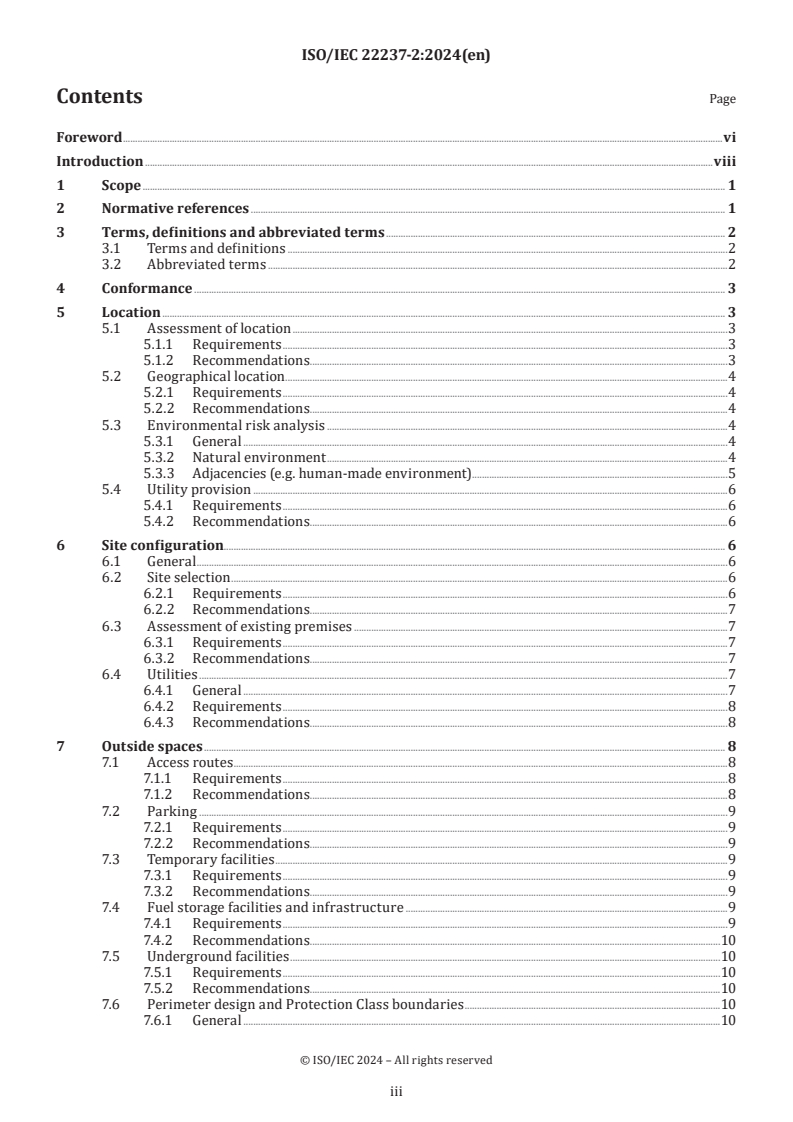
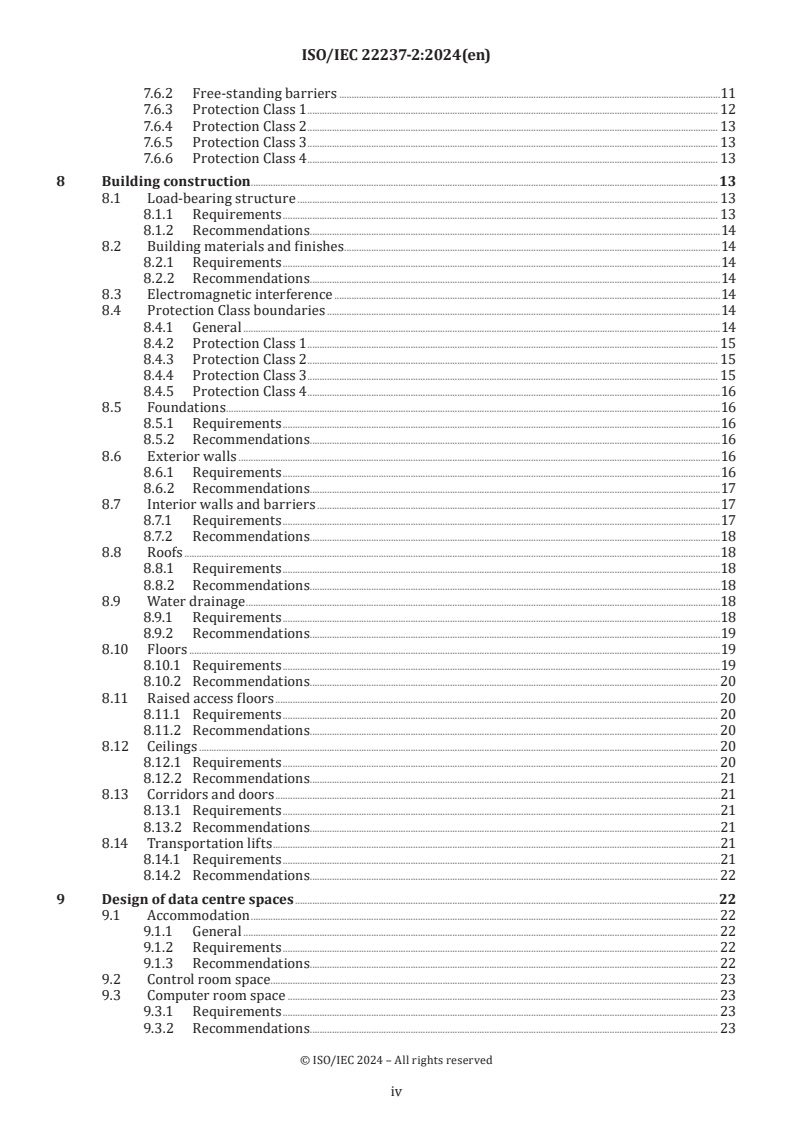
Contents Page
Foreword .vi
Introduction .viii
1 Scope . 1
2 Normative references . 1
3 Terms, definitions and abbreviated terms . 2
3.1 Terms and definitions .2
3.2 Abbreviated terms .2
4 Conformance . 3
5 Location . 3
5.1 Assessment of location .3
5.1.1 Requirements .3
5.1.2 Recommendations.3
5.2 Geographical location .4
5.2.1 Requirements .4
5.2.2 Recommendations.4
5.3 Environmental risk analysis .4
5.3.1 General .4
5.3.2 Natural environment .4
5.3.3 Adjacencies (e.g. human-made environment) .5
5.4 Utility provision .6
5.4.1 Requirements .6
5.4.2 Recommendations.6
6 Site configuration. 6
6.1 General .6
6.2 Site selection .6
6.2.1 Requirements .6
6.2.2 Recommendations.7
6.3 Assessment of existing premises .7
6.3.1 Requirements .7
6.3.2 Recommendations.7
6.4 Utilities .7
6.4.1 General .7
6.4.2 Requirements .8
6.4.3 Recommendations.8
7 Outside spaces . 8
7.1 Access routes .8
7.1.1 Requirements .8
7.1.2 Recommendations.8
7.2 Parking .9
7.2.1 Requirements .9
7.2.2 Recommendations.9
7.3 Temporary facilities .9
7.3.1 Requirements .9
7.3.2 Recommendations.9
7.4 Fuel storage facilities and infrastructure .9
7.4.1 Requirements .9
7.4.2 Recommendations.10
7.5 Underground facilities .10
7.5.1 Requirements .10
7.5.2 Recommendations.10
7.6 Perimeter design and Protection Class boundaries .10
7.6.1 General .10
© ISO/IEC 2024 – All rights reserved
iii
7.6.2 Free-standing barriers .11
7.6.3 Protection Class 1 . 12
7.6.4 Protection Class 2 . 13
7.6.5 Protection Class 3 . 13
7.6.6 Protection Class 4 . 13
8 Building construction . .13
8.1 Load-bearing structure . 13
8.1.1 Requirements . 13
8.1.2 Recommendations.14
8.2 Building materials and finishes . .14
8.2.1 Requirements .14
8.2.2 Recommendations.14
8.3 Electromagnetic interference .14
8.4 Protection Class boundaries .14
8.4.1 General .14
8.4.2 Protection Class 1 . 15
8.4.3 Protection Class 2 . 15
8.4.4 Protection Class 3 . 15
8.4.5 Protection Class 4 .16
8.5 Foundations .16
8.5.1 Requirements .16
8.5.2 Recommendations.16
8.6 Exterior walls .16
8.6.1 Requirements .16
8.6.2 Recommendations.17
8.7 Interior walls and barriers .17
8.7.1 Requirements .17
8.7.2 Recommendations.18
8.8 Roofs .18
8.8.1 Requirements .18
8.8.2 Recommendations.18
8.9 Water drainage .18
8.9.1 Requirements .18
8.9.2 Recommendations.19
8.10 Floors .19
8.10.1 Requirements .19
8.10.2 Recommendations. 20
8.11 Raised access floors . 20
8.11.1 Requirements . 20
8.11.2 Recommendations. 20
8.12 Ceilings . 20
8.12.1 Requirements . 20
8.12.2 Recommendations.21
8.13 Corridors and doors .21
8.13.1 Requirements .21
8.13.2 Recommendations.21
8.14 Transportation lifts .21
8.14.1 Requirements .21
8.14.2 Recommendations. 22
9 Design of data centre spaces .22
9.1 Accommodation . 22
9.1.1 General . 22
9.1.2 Requirements . 22
9.1.3 Recommendations. 22
9.2 Control room space . . 23
9.3 Computer room space . 23
9.3.1 Requirements . 23
9.3.2 Recommendations. 23
© ISO/IEC 2024 – All rights reserved
iv
9.4 Electrical space . 23
9.4.1 Requirements . 23
9.4.2 Recommendations. 23
9.5 Mechanical space .24
9.5.1 Requirements .24
9.5.2 Recommendations.24
9.6 Telecommunications space .24
9.7 Spaces for firefighting systems.24
9.7.1 General .24
9.7.2 Requirements .24
9.7.3 Recommendations.24
9.8 Storage space .24
9.8.1 Requirements .24
9.8.2 Recommendations.24
9.9 Testing and holding spaces . 25
9.10 Docking bay . 25
9.10.1 Requirements . 25
9.10.2 Recommendations. 25
9.11 General office space . 25
10 Construction of data centre spaces .25
10.1 Protection against flooding . 25
10.1.1 Requirements . 25
10.1.2 Recommendations. 25
10.2 Access to data centre spaces . 25
10.2.1 Requirements . 25
10.2.2 Recommendations. 26
10.3 Vapour density . 26
10.3.1 Requirements . 26
10.3.2 Recommendations. 26
11 Fire compartments and fire barriers .26
11.1 Fire compartments . 26
11.1.1 Requirements . 26
11.1.2 Recommendations.27
11.2 Fire barriers .27
11.2.1 Requirements .27
11.2.2 Recommendations. 28
11.3 Protection Class boundaries . 28
11.3.1 General . 28
11.3.2 Protection Class 1 . 28
11.3.3 Protection Class 2 . 28
11.3.4 Protection Class 3 . 28
11.3.5 Protection Class 4 . 29
Annex A (informative) Building materials .30
Annex B (informative) Summary of data centre location requirements and recommendations
of Clause 5 . . . .32
Bibliography .35
© ISO/IEC 2024 – All rights reserved
v
Foreword
ISO (the International Organization for Standardization) and IEC (the International Electrotechnical
Commission) form the specialized system for worldwide standardization. National bodies that are
members of ISO or IEC participate in the development of International Standards through technical
committees established by the respective organization to deal with particular fields of technical activity.
ISO and IEC technical committees collaborate in fields of mutual interest. Other international organizations,
governmental and non-governmental, in liaison with ISO and IEC, also take part in the work.
The procedures used to develop this document and those intended for its further maintenance are described
in the ISO/IEC Directives, Part 1. In particular, the different approval criteria needed for the different types
of document should be noted. This document was drafted in accordance with the editorial rules of the ISO/
IEC Directives, Part 2 (see www.iso.org/directives or www.iec.ch/members_experts/refdocs).
ISO and IEC draw attention to the possibility that the implementation of this document may involve the
use of (a) patent(s). ISO and IEC take no position concerning the evidence, validity or applicability of any
claimed patent rights in respect thereof. As of the date of publication of this document, ISO and IEC had not
received notice of (a) patent(s) which may be required to implement this document. However, implementers
are cautioned that this may not represent the latest information, which may be obtained from the patent
database available at www.iso.org/patents and https://patents.iec.ch. ISO and IEC shall not be held
responsible for identifying any or all such patent rights.
Any trade name used in this document is information given for the convenience of users and does not
constitute an endorsement.
For an explanation of the voluntary nature of standards, the meaning of ISO specific terms and expressions
related to conformity assessment, as well as information about ISO's adherence to the World Trade
Organization (WTO) principles in the Technical Barriers to Trade (TBT) see www.iso.org/iso/foreword.html.
In the IEC, see www.iec.ch/understanding-standards.
This document was prepared by Joint Technical Committee ISO/IEC JTC 1, Information technology,
Subcommittee SC 39, Sustainability, IT and data centres.
This first edition cancels and replaces ISO/IEC TS 22237-2:2018, which has been technically revised.
The main changes are as follows:
— the interrelationship between this document and ISO/IEC 22237-6 concerning constructional
prerequisites for the implementation of security concepts and desired security systems has been more
clearly presented;
— the document has been restructured;
— Clause 6, “Site configuration”, has been split and relevant subclauses have been moved into a new
Clause 7, “Outside spaces”;
— Clause 7, “Building construction”, has been completely revised to present all requirements and
recommendations in a single Clause 8;
— Clause 8, “Data centre spaces and access routes”, has been revised to focus on the design of data
centre spaces (now Clause 9);
— a new Clause 10, “Construction of data centre spaces”, has been added;
— the content of Clause 9, “Fire compartments, fire barriers and fire suppression systems”, has been
revised (now Clause 11);
— Annex A on additional requirements and recommendations has been removed;
— Annex B on physical protection against external hazards has been revised as Annex A “Building
materials”;
© ISO/IEC 2024 – All rights reserved
vi
— a new Annex B summarizing the requirements and recommendations of Clause 5 has been added.
A list of all parts in the ISO/IEC 22237 series can be found on the ISO and IEC websites.
Any feedback or questions on this document should be directed to the user’s national standards
body. A complete listing of these bodies can be found at www.iso.org/members.html and
www.iec.ch/national-committees.
© ISO/IEC 2024 – All rights reserved
vii
Introduction
The unrestricted access to internet-based information demanded by the information society has led to an
exponential growth of both internet traffic and the volume of stored/retrieved data. Data centres house
and support the information technology and network telecommunications equipment for data processing,
data storage and data transport. They are required both by network operators (delivering those services to
customer premises) and by enterprises within those customer premises.
Data centres need to provide modular, scalable and flexible facilities and infrastructures to easily
accommodate the rapidly changing requirements of the market. In addition, the energy consumption of data
centres has become critical, both from an environmental point of view (reduction of carbon footprint), and
with respect to economic considerations (cost of energy) for the data centre operator.
The implementation of data centres varies in terms of:
a) purpose (enterprise, co-location, co-hosting or network operator facilities);
b) security level;
c) physical size; and
d) accommodation (mobile, temporary and permanent constructions).
NOTE Cloud services can be provided by all data centre types mentioned.
The needs of data centres also vary in terms of availability of service, the provision of security, and the
objectives for energy efficiency. These needs and objectives influence the design of data centres in terms of
building construction, power distribution, environmental control, telecommunications cabling and physical
security. Effective management and operational information are required to monitor achievement of the
defined needs and objectives.
The ISO/IEC 22237 series specifies requirements and recommendations to support the various parties
involved in the design, planning, procurement, integration, installation, operation and maintenance of
facilities and infrastructures within data centres. These parties include:
1) owners, operators, facility managers, ICT managers, project managers and main contractors;
2) consultants, architects, building designers and builders, system/installation designers, auditors, test
and commissioning agents;
3) suppliers of equipment; and
4) installers and maintainers.
The inter-relationship of the various documents within the ISO/IEC 22237 series at the time of publication is
shown in Figure 1.
© ISO/IEC 2024 – All rights reserved
viii
Figure 1 — Schematic relationship between the documents of the ISO/IEC 22237 series
ISO/IEC 22237-2 to ISO/IEC 22237-6 specify requirements and recommendations for particular facilities
and infrastructures to support the relevant classification for “availability”, “physical security” and “energy
efficiency enablement”, according to ISO/IEC 22237−1.
This document, ISO/IEC 22237-2, addresses the building design of data centres. It addresses physical security
issues from a construction point of view, as opposed to ISO/IEC 22237-6, which specifies the pertinent
security system requirements of those facilities and infrastructures (in accordance with the requirements
of ISO/IEC 22237-1).
ISO/IEC TS 22237-7 addresses the operational and management information (in accordance with the
requirements of ISO/IEC 22237-1).
This document is intended for use by and collaboration between architects, building designers and builders,
system and installation designers.
The ISO/IEC 22237 series does not address the selection of information technology and network
telecommunications equipment, software and associated configuration issues.
© ISO/IEC 2024 – All rights reserved
ix
International Standard ISO/IEC 22237-2:2024(en)
Information technology — Data centre facilities and
infrastructures —
Part 2:
Building construction
1 Scope
This document specifies requirements and recommendations for the construction of buildings and other
structures which provide accommodation for data centres based on the criteria and classification for
“physical security” within ISO/IEC 22237-1 in support of availability.
This document specifies requirements and recommendations for the following:
a) location and site selection (taking in to account natural environment and adjacencies);
b) protection from environmental risks;
c) site configuration;
d) building construction;
e) building configuration;
f) provision of access;
g) physical intrusion protection;
h) physical fire protection;
i) protection against damage from water;
j) quality construction measures.
Safety and electromagnetic compatibility (EMC) requirements are outside the scope of this document and
are covered by other standards and regulations. However, information given in this document can be of
assistance in meeting these standards and regulations.
Conformance of data centres to the present document is covered in Clause 4.
2 Normative references
The following documents are referred to in the text in such a way that some or all of their content constitutes
requirements of this document. For dated references, only the edition cited applies. For undated references,
the latest edition of the referenced document (including any amendments) applies.
ISO/IEC 22237-1, Information technology — Data centre facilities and infrastructures — Part 1: General
concepts
ISO/IEC 22237-3, Information technology — Data centre facilities and infrastructures — Part 3: Power
distribution
ISO/IEC 22237-4, Information technology — Data centre facilities and infrastructures — Part 4: Environmental
control
© ISO/IEC 2024 – All rights reserved
ISO/IEC 22237-6, Information technology — Data centre facilities and infrastructures — Part 6: Security
systems
ISO/IEC 30129, Information technology — Telecommunications bonding networks for buildings and other
structures
IEC 62305-3, Protection against lightning – Part 3: Physical damage to structures and life hazard
ISO/IEC TS 22237-5, Information technology — Data centre facilities and infrastructures — Part 5:
Telecommunications cabling infrastructure
ISO/IEC TS 22237-7, Information technology — Data centre facilities and infrastructures — Part 7: Management
and operational information
ISO/IEC TS 22237-30, Information technology — Data centre facilities and infrastructures — Part 30:
Earthquake risk and impact analysis
3 Terms, definitions and abbreviated terms
3.1 Terms and definitions
For the purposes of this document, the terms and definitions given in ISO/IEC 22237-1 and the following
apply.
ISO and IEC maintain terminology databases for use in standardization at the following addresses:
— ISO Online browsing platform: available at https:// www .iso .org/ obp
— IEC Electropedia: available at https:// www .electropedia .org/
3.1.1
effective height of free-standing barrier
h
e
shortest distance between any point on the top of the permanent part of the free-standing barrier (excluding
any toppings) and the surface of the supporting ground when measured in the plane of the barrier
3.1.2
free-standing barrier
wall, fence, gate, turnstile or other similar self-supporting barrier, and their associated foundations, designed
to prevent entry to a space of a given Protection Class
3.1.3
topping
construction, added to the top of a free-standing barrier, and designed to be an effective intruder-deterrent
or for a decorative display of security
3.1.4
pathway
defined route of
...