

ISO/IEC TR 30133:2023
(Main)Information technology — Data centres — Practices for resource-efficient data centres
General Information
- Abstract
This document describes generally applicable practices for improving the resource efficiency of data centres, independent of their application(s). This document focuses on continuous improvement processes, designs and guidelines that prioritize resource efficiency. In general, the processes and practices are technology-neutral and are independent of location. The practices for data centre resource efficiency improvement deal with various establishment and operation aspects such as data centre planning, management, cooling, power feeding, information and communications technology (ICT) and cost aspects that are not restricted by the scope of this document. The following items are not included in the scope of this document: — development of key performance indicators (KPIs); — comparability between data centre performance results; — definition of maturity model for data centres; — social sustainability issues.
- Status
- Published
- Publication Date
- 04-May-2023
- Technical Committee
- ISO/IEC JTC 1/SC 39 - Sustainability, IT and data centres
- Drafting Committee
- ISO/IEC JTC 1/SC 39 - Sustainability, IT and data centres
- Current Stage
- 6060 - International Standard published
- Start Date
- 05-May-2023
- Due Date
- 14-Dec-2015
- Completion Date
- 05-May-2023
Overview
ISO/IEC TR 30133:2023 - Information technology - Data centres - Practices for resource-efficient data centres provides technology‑neutral, location‑independent guidance and best practices to improve the resource efficiency of data centres. The technical report emphasizes continuous improvement, design choices and operational practices across planning, management, cooling, power feeding, ICT equipment and cost considerations. It is focused on practical measures rather than on developing KPIs, performance comparability or maturity models (these items are explicitly excluded).
Key topics and technical focus
ISO/IEC TR 30133:2023 covers a broad set of resource‑efficiency topics, including:
- Data centre planning & building
- Site and building design considerations that use external environment and modular expansion to minimize resource use.
- Operational principles and continuous improvement
- Processes for collecting operational data, monitoring performance and replacing or upgrading equipment to improve efficiency.
- ICT equipment and services
- Server and storage management: virtualization, system integration, storage energy efficiency, power control, maintenance and management of idle equipment.
- Network equipment: virtualization, cabling and layout to reduce waste and optimize airflow.
- Cooling and thermal management
- Computer room air conditioning (CRAC/CRAH), hot‑aisle/cold‑aisle containment and alternative cooling approaches (including direct liquid cooling).
- Power systems and resilience
- Power feeding, UPS/PDU considerations and design practices that balance resilience and efficiency.
- Data centre infrastructure management (DCIM)
- Monitoring energy use, temperature/humidity, facilities and IT equipment; events/alarms; capacity management; automatic control and control loops to improve energy performance.
- Other infrastructure and systems
- Integration of fire protection, security and other facility systems into efficiency strategies.
Practical applications - who should use this standard
ISO/IEC TR 30133:2023 is practical for professionals working to reduce data centre resource use and operating costs, including:
- Data centre operators and facility managers implementing energy‑ and resource‑saving measures
- IT managers and architects planning virtualization, server consolidation and storage optimization
- HVAC and electrical engineers designing efficient cooling and power systems
- Sustainability officers and energy auditors assessing operational improvement opportunities
- Consultants and system integrators advising on DCIM and monitoring strategies
The guidance supports decision making in both new builds and retrofit/operations by identifying where to measure, monitor and improve resource efficiency.
Related standards (if applicable)
- ISO/IEC 30134‑1 (used as a terminology source in this report) and other data centre efficiency guidance.
- Industry guidance such as ASHRAE thermal and data centre design recommendations are commonly used alongside this TR.
Keywords: ISO/IEC TR 30133:2023, data centres, resource‑efficient data centres, data centre resource efficiency, DCIM, cooling, virtualization, power feeding, ICT equipment, monitoring.
Get Certified
Connect with accredited certification bodies for this standard

BSI Group
BSI (British Standards Institution) is the business standards company that helps organizations make excellence a habit.

NYCE
Mexican standards and certification body.
Sponsored listings
Frequently Asked Questions
ISO/IEC TR 30133:2023 is a technical report published by the International Organization for Standardization (ISO). Its full title is "Information technology — Data centres — Practices for resource-efficient data centres". This standard covers: This document describes generally applicable practices for improving the resource efficiency of data centres, independent of their application(s). This document focuses on continuous improvement processes, designs and guidelines that prioritize resource efficiency. In general, the processes and practices are technology-neutral and are independent of location. The practices for data centre resource efficiency improvement deal with various establishment and operation aspects such as data centre planning, management, cooling, power feeding, information and communications technology (ICT) and cost aspects that are not restricted by the scope of this document. The following items are not included in the scope of this document: — development of key performance indicators (KPIs); — comparability between data centre performance results; — definition of maturity model for data centres; — social sustainability issues.
This document describes generally applicable practices for improving the resource efficiency of data centres, independent of their application(s). This document focuses on continuous improvement processes, designs and guidelines that prioritize resource efficiency. In general, the processes and practices are technology-neutral and are independent of location. The practices for data centre resource efficiency improvement deal with various establishment and operation aspects such as data centre planning, management, cooling, power feeding, information and communications technology (ICT) and cost aspects that are not restricted by the scope of this document. The following items are not included in the scope of this document: — development of key performance indicators (KPIs); — comparability between data centre performance results; — definition of maturity model for data centres; — social sustainability issues.
ISO/IEC TR 30133:2023 is classified under the following ICS (International Classification for Standards) categories: 35.020 - Information technology (IT) in general. The ICS classification helps identify the subject area and facilitates finding related standards.
ISO/IEC TR 30133:2023 is available in PDF format for immediate download after purchase. The document can be added to your cart and obtained through the secure checkout process. Digital delivery ensures instant access to the complete standard document.
Standards Content (Sample)
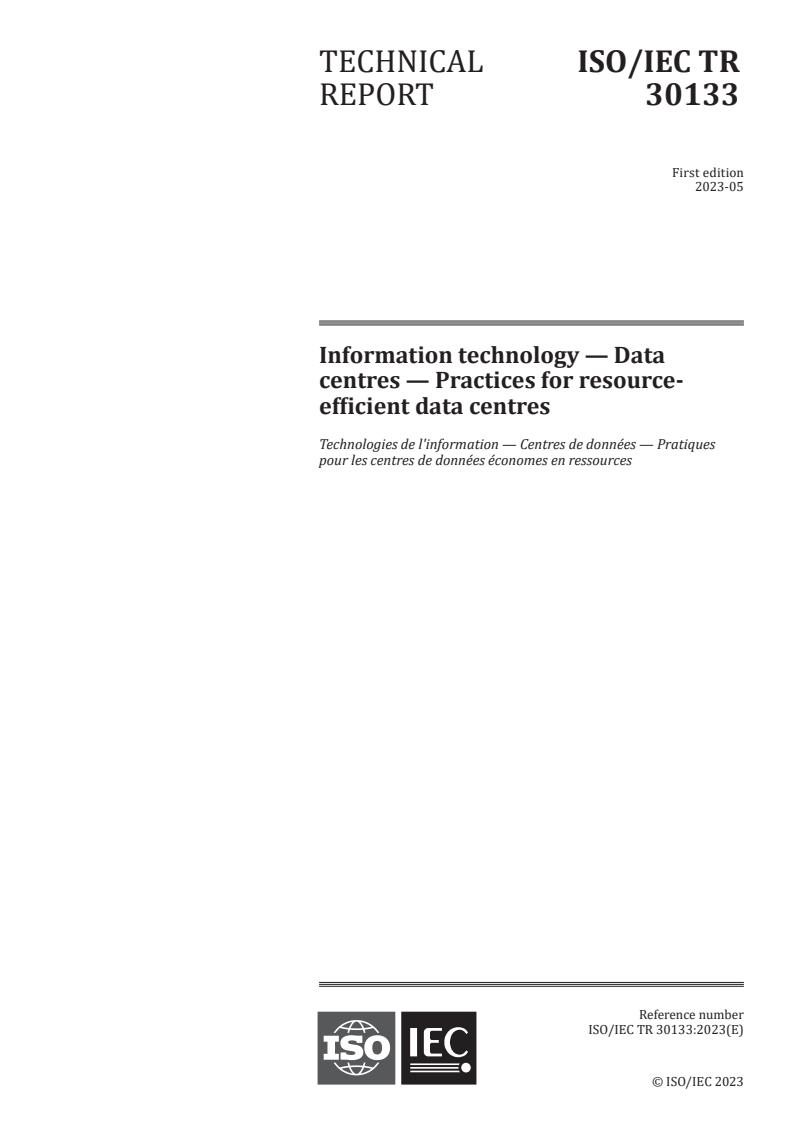
TECHNICAL ISO/IEC TR
REPORT 30133
First edition
2023-05
Information technology — Data
centres — Practices for resource-
efficient data centres
Technologies de l'information — Centres de données — Pratiques
pour les centres de données économes en ressources
Reference number
© ISO/IEC 2023
© ISO/IEC 2023
All rights reserved. Unless otherwise specified, or required in the context of its implementation, no part of this publication may
be reproduced or utilized otherwise in any form or by any means, electronic or mechanical, including photocopying, or posting on
the internet or an intranet, without prior written permission. Permission can be requested from either ISO at the address below
or ISO’s member body in the country of the requester.
ISO copyright office
CP 401 • Ch. de Blandonnet 8
CH-1214 Vernier, Geneva
Phone: +41 22 749 01 11
Email: copyright@iso.org
Website: www.iso.org
Published in Switzerland
ii
© ISO/IEC 2023 – All rights reserved
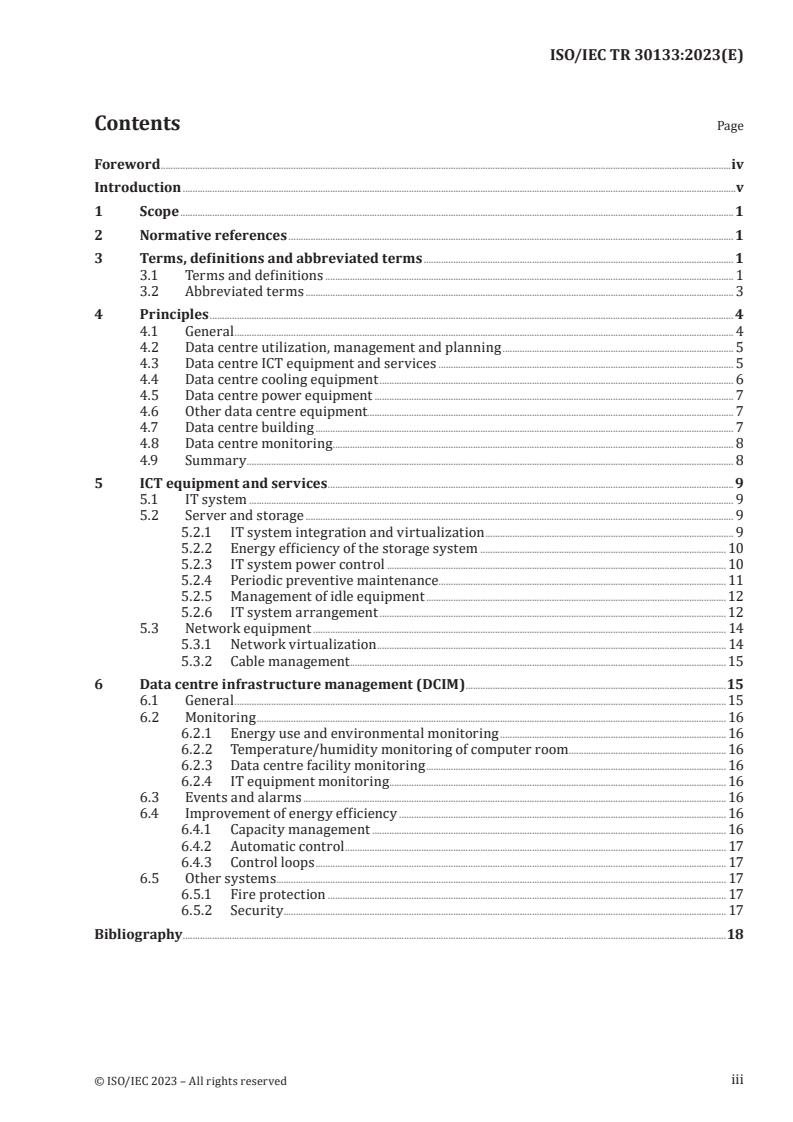
Contents Page
Foreword .iv
Introduction .v
1 Scope . 1
2 Normative references . 1
3 Terms, definitions and abbreviated terms . 1
3.1 Terms and definitions . 1
3.2 Abbreviated terms . 3
4 Principles . 4
4.1 General . 4
4.2 Data centre utilization, management and planning . 5
4.3 Data centre ICT equipment and services . 5
4.4 Data centre cooling equipment . 6
4.5 Data centre power equipment . 7
4.6 Other data centre equipment. 7
4.7 Data centre building . 7
4.8 Data centre monitoring . 8
4.9 Summary . 8
5 ICT equipment and services .9
5.1 IT system . 9
5.2 Server and storage . 9
5.2.1 IT system integration and virtualization . 9
5.2.2 Energy efficiency of the storage system . 10
5.2.3 IT system power control . 10
5.2.4 Periodic preventive maintenance. 11
5.2.5 Management of idle equipment .12
5.2.6 IT system arrangement .12
5.3 Network equipment . 14
5.3.1 Network virtualization . 14
5.3.2 Cable management . 15
6 Data centre infrastructure management (DCIM) .15
6.1 General . 15
6.2 Monitoring . 16
6.2.1 Energy use and environmental monitoring . 16
6.2.2 Temperature/humidity monitoring of computer room . 16
6.2.3 Data centre facility monitoring . 16
6.2.4 IT equipment monitoring . 16
6.3 Events and alarms . 16
6.4 Improvement of energy efficiency . 16
6.4.1 Capacity management . 16
6.4.2 Automatic control . 17
6.4.3 Control loops . 17
6.5 Other systems . . 17
6.5.1 Fire protection . 17
6.5.2 Security . . . 17
Bibliography .18
iii
© ISO/IEC 2023 – All rights reserved
Foreword
ISO (the International Organization for Standardization) and IEC (the International Electrotechnical
Commission) form the specialized system for worldwide standardization. National bodies that are
members of ISO or IEC participate in the development of International Standards through technical
committees established by the respective organization to deal with particular fields of technical
activity. ISO and IEC technical committees collaborate in fields of mutual interest. Other international
organizations, governmental and non-governmental, in liaison with ISO and IEC, also take part in the
work.
The procedures used to develop this document and those intended for its further maintenance
are described in the ISO/IEC Directives, Part 1. In particular, the different approval criteria
needed for the different types of document should be noted. This document was drafted in
accordance with the editorial rules of the ISO/IEC Directives, Part 2 (see www.iso.org/directives or
www.iec.ch/members_experts/refdocs).
Attention is drawn to the possibility that some of the elements of this document may be the subject
of patent rights. ISO and IEC shall not be held responsible for identifying any or all such patent
rights. Details of any patent rights identified during the development of the document will be in the
Introduction and/or on the ISO list of patent declarations received (see www.iso.org/patents) or the IEC
list of patent declarations received (see https://patents.iec.ch).
Any trade name used in this document is information given for the convenience of users and does not
constitute an endorsement.
For an explanation of the voluntary nature of standards, the meaning of ISO specific terms and
expressions related to conformity assessment, as well as information about ISO's adherence to
the World Trade Organization (WTO) principles in the Technical Barriers to Trade (TBT) see
www.iso.org/iso/foreword.html. In the IEC, see www.iec.ch/understanding-standards.
This document was prepared by Joint Technical Committee ISO/IEC JTC 1, Information technology,
Subcommittee SC 39, Sustainability, IT and data centres.
Any feedback or questions on this document should be directed to the user’s national standards
body. A complete listing of these bodies can be found at www.iso.org/members.html and
www.iec.ch/national-committees.
iv
© ISO/IEC 2023 – All rights reserved
Introduction
Data centres are essential to the provision of information technology (IT) services and can play an
important role in the conservation of resources. However, they can also consume a considerable amount
of resources if mis-managed and thus, it is critical to utilize these resources efficiently.
Resource efficiency in a data centre begins with the location (taking advantage of the external
environment) and the building design to minimize energy consumption. The facilities can then
implement modular extension or easily extensible space, cooling, and power according to the IT services
provided and co-location situation.
Once data centres are constructed and equipped with all the necessary facilities, it is important to
collect and monitor operational data. Based on the information obtained, it is possible to determine
which elements utilize resources least efficiently and assess how to improve the performance.
The performance of existing facilities can be periodically measured to determine if the original design
objectives for resource efficiency are being achieved and allowing performance to be improved by
replacement of equipment with better resource-efficiency characteristics.
This document provides information on available options for improving resource efficiency in data
centres, with particular emphasis on operational procedures.
v
© ISO/IEC 2023 – All rights reserved
TECHNICAL REPORT ISO/IEC TR 30133:2023(E)
Information technology — Data centres — Practices for
resource-efficient data centres
1 Scope
This document describes generally applicable practices for improving the resource efficiency of data
centres, independent of their application(s).
This document focuses on continuous improvement processes, designs and guidelines that prioritize
resource efficiency. In general, the processes and practices are technology-neutral and are independent
of location.
The practices for data centre resource efficiency improvement deal with various establishment and
operation aspects such as data centre planning, management, cooling, power feeding, information
and communications technology (ICT) and cost aspects that are not restricted by the scope of this
document.
The following items are not included in the scope of this document:
— development of key performance indicators (KPIs);
— comparability between data centre performance results;
— definition of maturity model for data centres;
— social sustainability issues.
2 Normative references
There are no normative references in this document.
3 Terms, definitions and abbreviated terms
For the purposes of this document, the following terms and definitions apply.
ISO and IEC maintain terminology databases for use in standardization at the following addresses:
— ISO Online browsing platform: available at https:// www .iso .org/ obp
— IEC Electropedia: available at https:// www .electropedia .org/
3.1 Terms and definitions
3.1.1
availability
ability of an item to be in a state to perform a required function under given conditions at a given instant
of time or over a given time interval, assuming that the required external resources are provided
[SOURCE: ISO/IEC 22237-1:2021, 3.1.1]
© ISO/IEC 2023 – All rights reserved
3.1.2
computer room space
area within the data centre that accommodates the data processing, data storage and telecommunication
equipment that provides the primary function of the data centre
[SOURCE: ISO/IEC 22237-1:2021, 3.1.6]
3.1.3
computer room air conditioning/computer room air handling
CRAC/CRAH
equipment that provides cooling airflow volumes into a computer room as a means of environmental
control
Note 1 to entry: Other abbreviations such as CCU, DFU, RACU, UFU are sometimes used.
3.1.4
data centre
structure, or group of structures, dedicated to the centralized accommodation, interconnection and
operation of information technology and network telecommunications equipment providing data
storage, processing and transport services together with all the facilities and infrastructures for power
distribution and environmental control together with the necessary levels of resilience and security
required to provide the desired service availability
Note 1 to entry: A structure can consist of multiple buildings and/or spaces with specific functions to support the
primary function.
Note 2 to entry: The boundaries of the structure or space considered the data centre which includes the
information and communications technology equipment and supporting environmental controls can be defined
within a larger structure or building.
[SOURCE: ISO/IEC 30134-1:2016, 3.1.4]
3.1.5
direct liquid-cooled ICT equipment
ICT equipment that is cooled by direct flow of liquid into an equipment cabinet or directly to the ICT
equipment chassis to provide cooling, rather than the use of moving air
3.1.6
energy efficiency
measure of the work done (as a result of design and/or operational procedures) for a given amount of
energy consumed
3.1.7
hot-aisle/cold-aisle
construction of cabinets and containment intended to prevent the mixing of ICT equipment
intake and exhaust air within computer room space(s)
3.1.8
information and communications technology equipment
ICT equipment
information technology (IT) and network telecommunications (NT) equipment providing data storage,
processing and transport services
Note 1 to entry: This represents the “critical load” of the data centre.
3.1.9
rack
open construction, typically self-supporting and floor-mounted, for housing closures and other
information technology equipment
© ISO/IEC 2023 – All rights reserved
3.1.10
resilience
capacity to withstand failure in one or more of the ICT equipment or data centre infrastructures
3.1.11
set-point
desired or target value (maximum or minimum) for a physical quantity used for control
3.1.12
virtualization
creation of a virtual version of physical ICT equipment or resource to offer a more efficient use of ICT
hardware
3.2 Abbreviated terms
For the purposes of this document the following abbreviated terms apply.
ASHRAE (formerly) American Society of Heating, Refrigeration and Air conditioning Engineers
BREEAM Building Research Establishment Environmental Assessment Method
CMDB configuration management database
CPU central processing unit
CRAC computer room air conditioning
CRAH computer room air handling
DCIM data centre infrastructure management
F-R-F-R front-rear-front-rear
ICT information and communications technology
I/O input/output
IT information technology
LAN local area network
LEED leadership in energy and environmental design
MAID massive array of inactive disks
MLPS multiprotocol label switching
OVP open virtual platform
PDU power distribution unit
PUE power usage effectiveness
RAID redundant array of independent disks
SLA service level agreement
UPS uninterruptible power supply
VLAN virtual local area network
© ISO/IEC 2023 – All rights reserved
VPN virtual private network
VXLAN virtual extensible local area network
WUE water usage effectiveness
4 Principles
4.1 General
To operate and manage a data centre with effective usage of resources, there are many things to be
considered in each phase, from design to operation. Resource efficiency in the data centre can be
achieved mostly in the design and building phase. In the design and building phase of a data centre,
the location selection can take advantage of the external environment, by taking into consideration
building that minimizes consumption, modular extension or easily extensible space, cooling, and power,
according to the IT services provided and co-location situation. As there can be a variety of forms and
structures depending on the purpose of the data centre, resource efficiency technology can be suitably
applied in accordance with the relevant application. In addition, it is advantageous to utilize state-of-
the-art IT equipment which achieves the best practice in energy efficiency as well as performance.
Once the data centre is introduced, it is quite difficult to rebuild or reengineer it. One of the effective
ways to improve the resource efficiency of existing data centres is to collect and monitor operational
data in facilities in order to find inefficient equipment. In addition to infrastructure facilities such as
cooling and power generation and distribution, IT equipment can also be monitored. Measured data
can be analysed and processed to provide statistics and insights such as predictions of the energy
consumed, and key performance indicators as introduced in the ISO/IEC 30134 series (PUE, WUE,
etc). The data centre operators can find out how much the efficiency of equipment is degraded. If aging
facilities are failing to achieve the initially-designed efficiency and performance, they can be properly
replaced.
For a data centre to achieve resource efficiency, the aspects described in 4.2 to 4.8 need to be considered.
In the design stage, it is necessary to prevent over-investments or budget shortages due to miscalculation
of IT equipment capacity growth. In addition, the design can take optimal usage of resources into account
during operation after the construction of a data centre. This sub-clause describes considerations for
data centre design and construction in terms of building, power, cooling, and data centre infrastructure
management (DCIM) for improving resource efficiency.
For data centres that are designed and constructed with resource-efficient components, continuous
maintenance activities are necessary for maintaining their efficiency. During its operations, a data
centre's efficiency can be degraded due to various reasons, such as equipment aging or IT trend changes.
It is thus necessary to perform maintenance and enhancement activities. The following subclauses
provide best practices in effective operation for the infrastructure and IT equipment of a standalone
medium/large data centre in order to maintain and enhance resource efficiency through data centre
operation and management. Though other data centre types can utilize different elements of the
following subclauses, some data centres will not have access or control of the infrastructure described
therein. Therefore, some aspects of the following subclauses will not be applicable to other types of
data centres, especially those with shared facility resources.
© ISO/IEC 2023 – All rights reserved
4.2 Data centre utilization, management and planning
It is important to develop a holistic strategy and management approach to the data centre to ensure
the required availability and effective delivery of economic and environmental benefits. The following
aspects can be considered.
a) General policies.
Policies can be established that apply to all aspects of the data centre and its operation. See
ISO/IEC TS 22237-7.
b) Resilience level and provisioning.
Two of the most significant sources of inefficiency in data centres are the over provisioning of
space, power or cooling, or the facilities being run at less than full capacity. Monolithic, as opposed
to modular design of facilities also represents a significant and frequently unnecessary capital
expenditure. Furthermore, as the level of resilience of the data centre increases, inefficiencies due
to fixed overheads increase and this is compounded by poor utilization.
c) Involvement of organizational groups.
Ineffective communication between the disciplines working in a data centre is a major driver of
inefficiency and can create issues of capacity management and reliability.
4.3 Data centre ICT equipment and services
The ICT equipment creates most of the demand for power and cooling in a data centre. Any reductions
in power and cooling used by, or provisioned for, the ICT equipment will have magnified effects at the
utility energy supply.
The purpose of the equipment environmental specifications in this subclause is to ensure that new
equipment can operate under the wider ranges of temperature and humidity, thus allowing greater
flexibility in operating temperature and humidity to the operator.
The following aspects can be considered.
a) Selection and deployment of new ICT equipment.
Once ICT equipment is purchased and installed in the data centre it typically spends several years
in a data centre consuming power and creating heat. The appropriate selection of hardware and
deployment methods can provide significant long-term savings.
b) Deployment of new ICT services.
The service architecture, software and deployment of ICT services have an impact at least as great
as that of the ICT equipment.
c) Management of existing ICT equipment and services.
It is common to focus on new services and equipment being installed into the data centre but
there are also substantial opportunities to achieve energy and cost reductions from within the
existing service and physical estate, for example, by decommissioning hardware no longer in use or
implementing energy saving policies.
d) Data management and storage.
Storage is a major growth area in both cost and energy consumption within a data centre. It is
generally recognized that a significant proportion of the data stored is unnecessary, duplicated or
does not require high performance access.
© ISO/IEC 2023 – All rights reserved
Some sectors have a particular issue due to very broad and non-specific data retention directives
from governments or regulating bodies which can cause large volumes of data to be unnecessarily
heavily protected and archived.
See Clause 5 for further information.
4.4 Data centre cooling equipment
A major part of the facility infrastructure is the cooling system.
Cooling of the data centre is frequently the largest energy loss in the facility and as such represents a
significant opportunity to reduce energy consumption.
The following aspects can be considered.
a) Airflow management and design.
The objective of airflow management is to circulate only the amount of air through the data
centre that is necessary to remove the heat created by the ICT equipment (i.e. no air circulates
unnecessarily).
Poor airflow management often results in attempts to compensate by reducing air supply
temperatures or supplying excessive air volumes, which have an energy penalty.
Improving airflow management will deliver more uniform ICT equipment inlet temperatures. This
is a prerequisite to increasing temperature set-points and reducing airflow volumes which enable
reductions in energy consumption without the risk of equipment overheating.
b) Cooling management.
Data centre is not a static system and cooling systems can be automatically and dynamically tuned
in response to fluctuations in thermal load.
c) Temperature and humidity settings.
Operating overly restricted environmental controls (in particular, excessively cooled computer
rooms) results in an energy penalty.
Widening the set-point range for temperature and humidity can reduce energy consumption
...