


ISO/PRF 17387
(Main)Intelligent transport systems - Lane change decision aid systems (LCDAS) - Performance requirements and test procedures
Intelligent transport systems - Lane change decision aid systems (LCDAS) - Performance requirements and test procedures
ISO 17387:2008 specifies system requirements and test methods for Lane Change Decision Aid Systems (LCDAS). LCDAS are fundamentally intended to warn the driver of the subject vehicle against potential collisions with vehicles to the side and/or to the rear of the subject vehicle, and moving in the same direction as the subject vehicle during lane change manoeuvres. This standardization addresses LCDAS for use on forward moving cars, vans and straight trucks in highway situations.
Systèmes de transport intelligents — Systèmes d'aide à la décision de changement de voie (LCDAS) — Exigences de performances et méthodes d'essai
General Information
- Status
- Not Published
- Technical Committee
- ISO/TC 204 - Intelligent transport systems
- Drafting Committee
- ISO/TC 204/WG 14 - Vehicle/roadway warning and control systems
- Current Stage
- 5020 - FDIS ballot initiated: 2 months. Proof sent to secretariat
- Start Date
- 17-Dec-2025
- Completion Date
- 27-Dec-2025
Relations
- Effective Date
- 04-Nov-2023
Overview
ISO/PRF 17387, titled Intelligent transport systems - Lane change decision aid systems (LCDAS) - Performance requirements and test procedures, is an international standard developed by ISO Technical Committee ISO/TC 204 focusing on intelligent transport systems. This latest edition, published in 2025, specifies comprehensive system requirements and standardized test procedures for Lane Change Decision Aid Systems (LCDAS). LCDAS are advanced vehicle safety systems designed to alert drivers of potential collisions with vehicles in adjacent lanes to the side or rear when performing lane change maneuvers.
Targeted primarily at forward-moving passenger cars, vans, and straight trucks on highways, this standard enhances the safety and effectiveness of lane change assistance technology. It explicitly excludes motorcycles and articulated vehicles such as tractor/trailer combinations and articulated buses.
Key Topics
System Scope and Functionality:
LCDAS are intended to warn drivers about vehicles in adjacent lanes moving in the same direction, providing vital decision support without taking automatic control. The systems supplement traditional interior and exterior mirrors but do not replace the driver's responsibility for safe maneuvering.Coverage Zone Classification:
The standard defines system coverage zones to specify areas monitored by the LCDAS, ensuring reliable awareness of vehicles in blind spots or rearward regions.Target Vehicle Closing Speed Classification:
ISO 17387 introduces classifications for target vehicle speeds relative to the subject vehicle, including optional adjustments for road curvature, improving accuracy of warnings based on vehicle dynamics and environmental conditions.Functional Requirements:
Detailed functional performance criteria ensure LCDAS provide timely and appropriate warnings. Requirements cover system state behavior, alert thresholds, user interface design, and operation with trailers. Self-test capabilities are mandated for system reliability.Test Procedures:
Rigorous testing methodologies validate LCDAS performance under various environmental conditions and traffic scenarios. These include blind spot warning tests, closing vehicle warning tests, and lane change warning tests, ensuring compliance with established safety margins.User Responsibility Clarification:
The standard emphasizes that absence of warnings does not guarantee safety, underlining the driver's ultimate responsibility. LCDAS augment but do not replace driver vigilance.
Applications
Passenger Cars and Light Commercial Vehicles:
Integration of LCDAS in new car models improves driver awareness during lane changes on highways, reducing collision risks.Straight Trucks:
The system's adaptability to larger vehicles supports improved safety for road transport operations, especially in multi-lane environments.Vehicle Safety System Development:
Manufacturers and suppliers use this standard to design and validate LCDAS that meet international performance and testing benchmarks.Regulatory Compliance:
Authorities may reference ISO 17387 for setting safety requirements and certification processes related to intelligent lane change assistance technologies.
Related Standards
ISO 26262 - Road Vehicles Functional Safety:
Provides complementary guidance on the functional safety lifecycle for automotive systems, applicable for design and evaluation of LCDAS hardware and software.ISO/TC 204 Intelligent Transport Systems Family:
Other standards under this technical committee address vehicle communication protocols, cooperative systems, and traffic management, enhancing LCDAS integration within broader intelligent transport frameworks.SAE J2945/1 - On-Board System Requirements for V2V Safety Communications:
Relevant for connected vehicle applications, which may augment LCDAS capabilities by sharing traffic information.
Conclusion
ISO/PRF 17387:2025 establishes essential performance benchmarks and objective test procedures for Lane Change Decision Aid Systems, promoting safer lane change maneuvers via standardized driver warning mechanisms. This internationally recognized standard supports automotive manufacturers, system developers, and regulatory bodies in deploying effective, reliable LCDAS technology to enhance road safety on highways for cars, vans, and straight trucks. Incorporating this standard ensures LCDAS products are rigorously evaluated and conform to best practices for driver assistance systems.

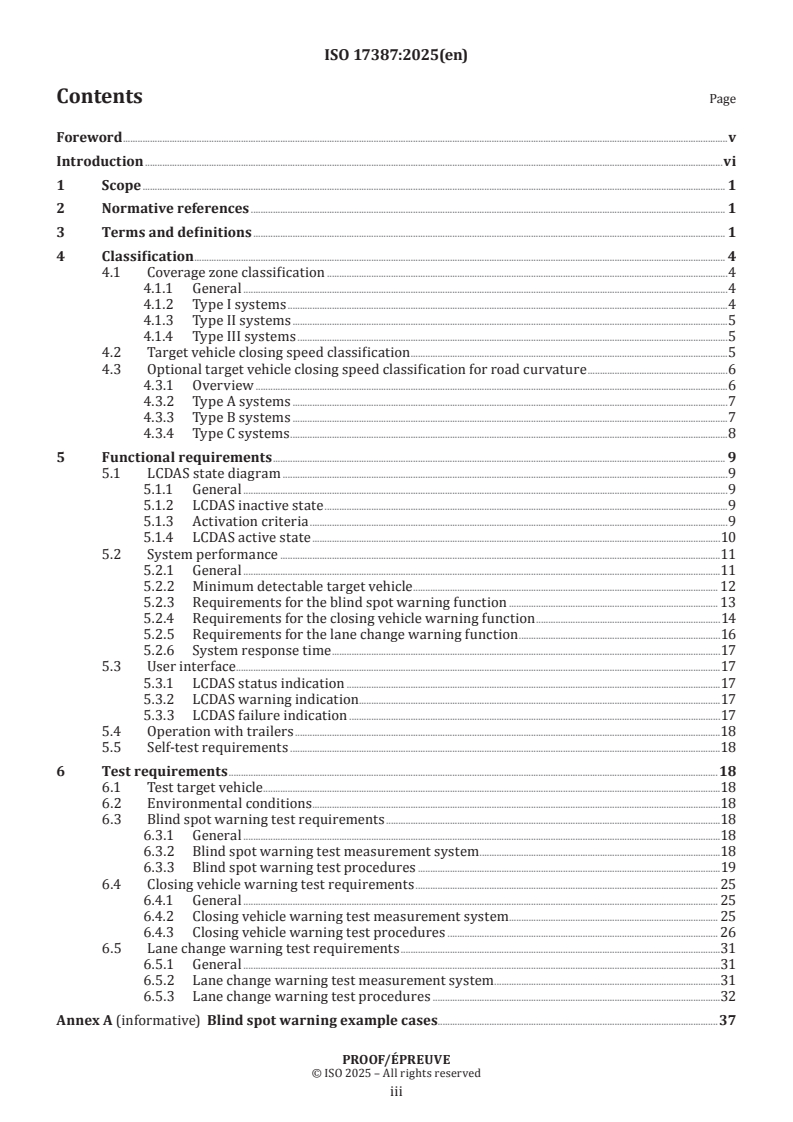

ISO/PRF 17387 - Intelligent transport systems — Lane change decision aid systems (LCDAS) — Performance requirements and test procedures Released:17. 12. 2025
REDLINE ISO/PRF 17387 - Intelligent transport systems — Lane change decision aid systems (LCDAS) — Performance requirements and test procedures Released:17. 12. 2025
Frequently Asked Questions
ISO/PRF 17387 is a draft published by the International Organization for Standardization (ISO). Its full title is "Intelligent transport systems - Lane change decision aid systems (LCDAS) - Performance requirements and test procedures". This standard covers: ISO 17387:2008 specifies system requirements and test methods for Lane Change Decision Aid Systems (LCDAS). LCDAS are fundamentally intended to warn the driver of the subject vehicle against potential collisions with vehicles to the side and/or to the rear of the subject vehicle, and moving in the same direction as the subject vehicle during lane change manoeuvres. This standardization addresses LCDAS for use on forward moving cars, vans and straight trucks in highway situations.
ISO 17387:2008 specifies system requirements and test methods for Lane Change Decision Aid Systems (LCDAS). LCDAS are fundamentally intended to warn the driver of the subject vehicle against potential collisions with vehicles to the side and/or to the rear of the subject vehicle, and moving in the same direction as the subject vehicle during lane change manoeuvres. This standardization addresses LCDAS for use on forward moving cars, vans and straight trucks in highway situations.
ISO/PRF 17387 is classified under the following ICS (International Classification for Standards) categories: 03.220.20 - Road transport; 35.240.60 - IT applications in transport. The ICS classification helps identify the subject area and facilitates finding related standards.
ISO/PRF 17387 has the following relationships with other standards: It is inter standard links to ISO 17387:2008. Understanding these relationships helps ensure you are using the most current and applicable version of the standard.
ISO/PRF 17387 is available in PDF format for immediate download after purchase. The document can be added to your cart and obtained through the secure checkout process. Digital delivery ensures instant access to the complete standard document.
Standards Content (Sample)
International
Standard
ISO 17387
Second edition
Intelligent transport systems —
Lane change decision aid
systems (LCDAS) — Performance
requirements and test procedures
Systèmes de transport intelligents — Systèmes d'aide à la
décision de changement de voie (LCDAS) — Exigences de
performances et méthodes d'essai
PROOF/ÉPREUVE
Reference number
ISO 17387:2025(en) © ISO 2025
ISO 17387:2025(en)
© ISO 2025
All rights reserved. Unless otherwise specified, or required in the context of its implementation, no part of this publication may
be reproduced or utilized otherwise in any form or by any means, electronic or mechanical, including photocopying, or posting on
the internet or an intranet, without prior written permission. Permission can be requested from either ISO at the address below
or ISO’s member body in the country of the requester.
ISO copyright office
CP 401 • Ch. de Blandonnet 8
CH-1214 Vernier, Geneva
Phone: +41 22 749 01 11
Email: copyright@iso.org
Website: www.iso.org
Published in Switzerland
PROOF/ÉPREUVE
ii
ISO 17387:2025(en)
Contents Page
Foreword .v
Introduction .vi
1 Scope . 1
2 Normative references . 1
3 Terms and definitions . 1
4 Classification . 4
4.1 Coverage zone classification .4
4.1.1 General .4
4.1.2 Type I systems .4
4.1.3 Type II systems .5
4.1.4 Type III systems .5
4.2 Target vehicle closing speed classification .5
4.3 Optional target vehicle closing speed classification for road curvature .6
4.3.1 Overview .6
4.3.2 Type A systems .7
4.3.3 Type B systems .7
4.3.4 Type C systems .8
5 Functional requirements . 9
5.1 LCDAS state diagram .9
5.1.1 General .9
5.1.2 LCDAS inactive state .9
5.1.3 Activation criteria .9
5.1.4 LCDAS active state .10
5.2 System performance .11
5.2.1 General .11
5.2.2 Minimum detectable target vehicle . 12
5.2.3 Requirements for the blind spot warning function . 13
5.2.4 Requirements for the closing vehicle warning function .14
5.2.5 Requirements for the lane change warning function .16
5.2.6 System response time .17
5.3 User interface .17
5.3.1 LCDAS status indication .17
5.3.2 LCDAS warning indication .17
5.3.3 LCDAS failure indication .17
5.4 Operation with trailers .18
5.5 Self-test requirements .18
6 Test requirements .18
6.1 Test target vehicle .18
6.2 Environmental conditions . .18
6.3 Blind spot warning test requirements .18
6.3.1 General .18
6.3.2 Blind spot warning test measurement system .18
6.3.3 Blind spot warning test procedures .19
6.4 Closing vehicle warning test requirements . 25
6.4.1 General . 25
6.4.2 Closing vehicle warning test measurement system . 25
6.4.3 Closing vehicle warning test procedures . 26
6.5 Lane change warning test requirements .31
6.5.1 General .31
6.5.2 Lane change warning test measurement system .31
6.5.3 Lane change warning test procedures .32
Annex A (informative) Blind spot warning example cases.37
PROOF/ÉPREUVE
iii
ISO 17387:2025(en)
Annex B (informative) Closing vehicle warning test speeds for systems with optional curvature
types .45
Bibliography .46
PROOF/ÉPREUVE
iv
ISO 17387:2025(en)
Foreword
ISO (the International Organization for Standardization) is a worldwide federation of national standards
bodies (ISO member bodies). The work of preparing International Standards is normally carried out through
ISO technical committees. Each member body interested in a subject for which a technical committee
has been established has the right to be represented on that committee. International organizations,
governmental and non-governmental, in liaison with ISO, also take part in the work. ISO collaborates closely
with the International Electrotechnical Commission (IEC) on all matters of electrotechnical standardization.
The procedures used to develop this document and those intended for its further maintenance are described
in the ISO/IEC Directives, Part 1. In particular, the different approval criteria needed for the different types
of ISO document should be noted. This document was drafted in accordance with the editorial rules of the
ISO/IEC Directives, Part 2 (see www.iso.org/directives).
ISO draws attention to the possibility that the implementation of this document may involve the use of (a)
patent(s). ISO takes no position concerning the evidence, validity or applicability of any claimed patent
rights in respect thereof. As of the date of publication of this document, ISO had received notice of (a)
patent(s) which may be required to implement this document. However, implementers are cautioned that
this may not represent the latest information, which may be obtained from the patent database available at
www.iso.org/patents. ISO shall not be held responsible for identifying any or all such patent rights.
Any trade name used in this document is information given for the convenience of users and does not
constitute an endorsement.
For an explanation of the voluntary nature of standards, the meaning of ISO specific terms and expressions
related to conformity assessment, as well as information about ISO's adherence to the World Trade
Organization (WTO) principles in the Technical Barriers to Trade (TBT), see www.iso.org/iso/foreword.html.
This document was prepared by Technical CommitteeISO/TC 204, Intelligent transport systems.
This second edition cancels and replaces the first edition (ISO 17387:2008), which has been technically
revised.
The main changes are as follows:
— the target vehicle closing speed classification and target vehicle closing speed classification for road
curvature have been modified;
— the test procedure for closing vehicle warning function has been modified;
— the blind spot warning test for target vehicle moving laterally has been modified;
— the definition of the reference point for driver’s eye position has been simplified.
Any feedback or questions on this document should be directed to the user’s national standards body. A
complete listing of these bodies can be found at www.iso.org/members.html.
PROOF/ÉPREUVE
v
ISO 17387:2025(en)
Introduction
Lane change decision aid systems (LCDAS) warn the driver against collisions that can occur due to a lane
change manoeuvre. LCDAS are intended to supplement the vehicle’s interior and exterior rear-view mirrors;
they are not intended to eliminate the need for such mirrors. LCDAS are intended to detect vehicles in the
adjacent lanes to the rear and sides of the subject vehicle (see Figure 1). When the subject vehicle driver
indicates the desire to make a lane change, the system evaluates the situation and warns the driver if a
lane change is not recommended. The absence of a warning does not guarantee that the driver can safely
make a lane change manoeuvre. The system will not take any automatic action to prevent possible collisions.
Responsibility for the safe operation of the vehicle remains with the driver.
NOTE Many figures in this document show vehicles on roadways with lane markings. This is not intended to imply
that lane marking recognition or lane detection is required for an LCDAS. The lane markings are drawn for reference
only.
Key
1 subject vehicle
2 target vehicles
a
The shaded area illustrates the concept of one possible system. The actual requirements are given in Clause 5.
Figure 1 — LCDAS concept
PROOF/ÉPREUVE
vi
International Standard ISO 17387:2025(en)
Intelligent transport systems — Lane change decision aid
systems (LCDAS) — Performance requirements and test
procedures
1 Scope
This document specifies system requirements and test methods for lane change decision aid systems
(LCDAS). LCDAS are intended to warn the driver of the subject vehicle against potential collisions with
vehicles either to the side or to the rear in the adjacent lanes of the subject vehicle and moving in the same
direction as the subject vehicle for lane change manoeuvres. This document addresses LCDAS for use on
forward-moving cars, vans and straight trucks.
This document does not address LCDAS for use on motorcycles or articulated vehicles such as tractor/trailer
combinations and articulated buses.
2 Normative references
There are no normative references in this document.
3 Terms and definitions
For the purposes of this document, the following terms and definitions apply.
ISO and IEC maintain terminology databases for use in standardization at the following addresses:
— ISO Online browsing platform: available at https:// www .iso .org/ obp
— IEC Electropedia: available at https:// www .electropedia .org/
3.1
subject vehicle
vehicle equipped with the system in question and related to the topic of discussion
3.2
target vehicle
any vehicle that is closing in on the subject vehicle from behind, or any
vehicle that is located in one of the adjacent zones
3.3
coverage zone
entire area to be monitored by the lane change decision aid system (LCDAS), consisting of a specific subset
of the following zones: left adjacent zone, right adjacent zone, left rear zone and right rear zone
Note 1 to entry: A target vehicle located within the coverage zone will thus be detected by the system.
3.4
adjacent zone
zone to the left and right of the subject vehicle
Note 1 to entry: See Figure 2. This figure shows the zone concept only. Actual requirements are given in 5.2.
PROOF/ÉPREUVE
ISO 17387:2025(en)
Note 2 to entry: The adjacent zones are intended to cover the lanes adjacent to the subject vehicle. However, the
position and size of the adjacent zones are defined with respect to the subject vehicle and are independent of any lane
markings.
Key
1 subject vehicle
2 left adjacent zone
3 right adjacent zone
Figure 2 — Adjacent zones
3.5
rear zone
zone that is behind and to the sides of the subject vehicle
Note 1 to entry: See Figure 3. This figure shows the zone concept only. Actual requirements are given in 5.2.
Note 2 to entry: The rear zones are intended to cover the lanes adjacent to the subject vehicle. However, the position
and size of the rear zones are defined with respect to the subject vehicle and are independent of any lane markings.
Key
1 subject vehicle
2 left rear zone
3 right rear zone
Figure 3 — Rear zones
3.6
lateral clearance
lateral distance between the side of the subject vehicle and the near side of a target
vehicle
Note 1 to entry: See Figure 4.
PROOF/ÉPREUVE
ISO 17387:2025(en)
Key
1 subject vehicle
2 target vehicle
3 lateral clearance
Figure 4 — Lateral clearance
3.7
rear clearance
distance between the rear of the subject vehicle and the front of the target vehicle as
measured along a straight line, or optionally, as estimated along the target vehicle’s estimated path
Note 1 to entry: See Figure 5.
Note 2 to entry: This definition applies to target vehicles in the rear zones only.
a) On a straight road measured along b) On a straight road estimated along
a straight line target vehicle path
Key
1 subject vehicle
2 target vehicle
3 rear clearance
Figure 5 — Examples of rear clearance
3.8
closing speed
difference between the target vehicle’s speed and the subject vehicle’s speed
Note 1 to entry: This definition applies to target vehicles in the rear zones only. A positive closing speed indicates that
the target vehicle is closing in on the subject vehicle from the rear.
3.9
time to collision
estimated time that it would take a target vehicle to collide with the subject vehicle if the subject vehicle
were in the target vehicle’s path and the target vehicle’s current closing speed were to remain constant
Note 1 to entry: Time to collision can be estimated by dividing a target vehicle’s rear clearance by its closing speed.
This definition applies to target vehicles in the rear zones only.
PROOF/ÉPREUVE
ISO 17387:2025(en)
3.10
overtaking speed
difference between the subject vehicle’s speed and the target vehicle’s speed when
the subject vehicle is overtaking the target vehicle
Note 1 to entry: A positive overtaking speed indicates that the subject vehicle is moving faster than the target vehicle.
3.11
blind spot warning function
function that detects the presence of target vehicles in one or more of the adjacent zones and provides a
warning to the subject vehicle driver
3.12
closing vehicle warning function
function that detects closing vehicles in one or more of the rear zones and provides a warning to the driver
3.13
lane change warning function
function that combines the blind spot warning function and the closing vehicle warning function
3.14
roadway radius of curvature
horizontal radius of curvature of the road on which the subject vehicle is travelling
3.15
straight road
segment of road for which the curve radius is larger than 5 000 m
3.16
reference point for driver’s eye position
reference for the position of driver’s eyes in longitudinal direction of the subject vehicle
Note 1 to entry: The reference point is located at the centre of the 95th percentile eyellipse on the x-axis of the subject
vehicle.
4 Classification
4.1 Coverage zone classification
4.1.1 General
LCDAS are classified by the minimum required coverage as shown in Table 1. For example, a type I system
shall provide coverage of at least the left and right adjacent zones.
Table 1 — Coverage zone classification
Left adjacent Right adjacent Left rear Right rear
Type Function
zone coverage zone coverage zone coverage zone coverage
Blind spot
I X X
warning
Closing vehicle
II X X
warning
Lane change
III X X X X
warning
4.1.2 Type I systems
Type I systems provide the blind spot warning function only. Type I systems are intended to warn the subject
vehicle driver of target vehicles in the adjacent zones. Type I systems are not required to provide warnings
PROOF/ÉPREUVE
ISO 17387:2025(en)
of target vehicles that are approaching the subject vehicle from the rear. The subject vehicle driver shall
be made aware of the limitations of this type of system, at least in the owner’s manual. In particular, the
owner’s manual shall include the following statement: “This system provides support only within a limited
area beside the vehicle. The system will not necessarily provide adequate warning for vehicles approaching
from the rear.”
4.1.3 Type II systems
Type II systems provide the closing vehicle warning function only. These systems are intended to warn the
subject vehicle driver of target vehicles that are approaching the subject vehicle from the rear. Since type II
systems are not required to provide warnings of target vehicles located adjacent to the subject vehicle,
type II systems are recommended for use on vehicles that have side mirrors with a horizontal field of view
of at least 45° on both sides of the vehicle. If type II systems are used on other vehicles, the owner’s manual
should include the following statement: “The driver is required to turn and look into the adjacent area
before attempting a lane change.” The subject vehicle driver shall be made aware of the limitations of this
type of system, at least in the owner’s manual. In particular, the owner’s manual shall include the following
statement: “This system provides no support for the areas adjacent to the subject vehicle. This system will
not necessarily provide adequate warning for very fast moving vehicles approaching from the rear and will
not necessarily not cover the detection of approaching vehicles in all road curvatures.”
4.1.4 Type III systems
Type III systems provide the blind spot warning function and the closing vehicle warning function. Type III
systems are intended to warn the subject vehicle driver of target vehicles in the adjacent zones and target
vehicles which are approaching the subject vehicle from the rear. The subject vehicle driver shall be made
aware of the limitations of this type of system, at least in the owner’s manual. In particular, the owner’s
manual shall include the following statement: “This system will not necessarily provide adequate warning
for very fast moving vehicles approaching from the rear and will not necessarily cover the detection of
approaching vehicles in all road curvatures.”
4.2 Target vehicle closing speed classification
LCDAS of types II and III are classified based on the maximum approaching target vehicle closing speed
shown in Table 2. A system may belong to more than one of the types listed in Table 2. For example, a highly
capable system may meet or exceed the minimum requirements defined individually for types SAV, MAV and
FAV.
Table 2 — Target vehicle closing speed classification
Maximum target vehicle
closing speed
Type
m/s
SAV 10
MAV 15
FAV 20
NOTE The maximum target vehicle closing speed has a direct effect on the required sensor range and/or
acquisition time. A higher closing speed will require a longer sensor range and/or a shorter acquisition time in order
to detect the target vehicle in sufficient time to give the subject vehicle driver adequate warning.
Figure 6 shows the minimum performance of type SAV, MAV and FAV regarding the relative speed between
the subject vehicle and the target vehicle. LCDAS of types II and III can be capable of operating on curved
roads. There is a relationship between the maximum target vehicle closing speed and the roadway radius of
curvature. For a given curve radius and a typical subject vehicle speed, the closing speed of a target vehicle
is limited by driving dynamics parameters. In addition, the visibility of the target vehicle can be limited due
to the curve radii.
PROOF/ÉPREUVE
ISO 17387:2025(en)
The subject vehicle driver shall be made aware of the limitations of the system, at least in the owner’s manual.
In particular, the owner’s manual shall include the following statement: “This system will not necessarily
provide adequate warning on curves."
Key
X target vehicle closing speed, m/s
1 type SAV - slow
2 type MAV - medium
3 type FAV - fast
Figure 6 — Type SAV, MAV, FAV system minimum performance regarding to target vehicle closing
speed
4.3 Optional target vehicle closing speed classification for road curvature
4.3.1 Overview
In addition to the target vehicle closing speed classification (SAV, MAV or FAV) as shown in Figure 6,
curvature capability provided by LCDAS can also be provided.
An advanced form of LCDAS may use additional sensor input or may integrate additional environmental
information from a map. Such systems can provide the closing vehicle warning function in curvature
situations.
For conformity to this optional classification, roadway curvature shall be related to the expectable maximum
target vehicle closing speed, shown in Table 3.
Types A, B and C represent the relationship between LCDAS types SAV, MAV and FAV in addition to a
minimum roadway curvature:
— type A contains type SAV;
— type B contains type SAV and MAV;
— type C contains type SAV, MAV and FAV.
Table 3 — Target vehicle closing speed classification for road curvature
Maximum target vehicle Minimum roadway radius
closing speed of curvature
Type
m/s m
A 10 125
B 15 250
C 20 500
PROOF/ÉPREUVE
ISO 17387:2025(en)
4.3.2 Type A systems
Figure 7 shows the minimum required region of performance with regard to roadway radius of curvature
and target vehicle closing speed for a type A system. Type A systems can be capable of operating on curved
roads with smaller radii. The subject vehicle driver shall be made aware of the limitations of the system, at
least in the owner’s manual. In particular, the owner’s manual shall include the following statement: “This
system will not necessarily provide adequate warning on curves tighter than [X] metres radius,” where X is
replaced by the tightest curve radius for which the system is designed but not more than 125 m.
Key
X target vehicle closing speed, m/s
Y roadway radius of curvature, m
Figure 7 — Type A system minimum region of performance
4.3.3 Type B systems
Figure 8 shows the minimum required region of performance with regard to roadway radius of curvature
and target vehicle closing speed for a type B system. Type B systems can be capable of operating on curved
roads with smaller radii. The subject vehicle driver shall be made aware of the limitations of the system, at
least in the owner’s manual. In particular, the owner’s manual shall include the following statement: “This
system will not necessarily provide adequate warning on curves tighter than [X] metres radius” where X is
replaced by the tightest curve radius for which the system is designed but not more than 250 m.
PROOF/ÉPREUVE
ISO 17387:2025(en)
Key
X target vehicle closing speed, m/s
Y roadway radius of curvature, m
Figure 8 — Type B system minimum region of performance
4.3.4 Type C systems
Figure 9 shows the minimum required region of performance with regard to roadway radius of curvature
and target vehicle closing speed for a type C system. Type C systems can be capable of operating on curved
roads with smaller radii. The subject vehicle driver shall be made aware of the limitations of the system, at
least in the owner’s manual. In particular, the owner’s manual shall include the following statement: “This
system will not necessarily provide adequate warning on curves tighter than [X] metres radius” where X is
replaced by the tightest curve radius for which the system is designed but not more than 500 m.
Key
X target vehicle closing speed, m/s
Y roadway radius of curvature, m
Figure 9 — Type C system minimum region of performance
PROOF/ÉPREUVE
ISO 17387:2025(en)
5 Functional requirements
5.1 LCDAS state diagram
5.1.1 General
At a minimum, the LCDAS shall operate according to the state diagram in Figure 10.
Figure 10 — LCDAS state diagram
5.1.2 LCDAS inactive state
In the LCDAS inactive state the system shall give no warnings to the driver. This state may be a power off
state or a ready state. In a ready state the system can detect target vehicles, but shall not issue warnings
because the activation criteria are not met.
5.1.3 Activation criteria
5.1.3.1 General
When activated, the LCDAS shall transition from the LCDAS inactive state to the LCDAS active state. Several
activation criteria may be used at the same time. Potential activation criteria include but are not limited to
those described in the following subclauses.
5.1.3.2 Continuous activation
The system may be active continuously (whenever the subject vehicle’s ignition is on).
5.1.3.3 Manual switch activation
The system may be activated manually, e.g. by a toggle switch, a tip switch or a menu-based user interface.
5.1.3.4 Turn signal activation
The system may be activated based on the subject vehicle turn signal status. For instance, if the left turn
signal is on, the system may be activated on the left side of the subject vehicle, while remaining inactive on
the right side of the subject vehicle.
PROOF/ÉPREUVE
ISO 17387:2025(en)
5.1.3.5 Subject vehicle speed activation
The system may be activated based on the subject vehicle speed. If this is the case, then when the subject
vehicle speed is greater than or equal to a certain threshold speed the system will transition to the LCDAS
active state. The threshold speed shall be not more than 16,7 m/s (60 km/h).
For blind spot warning function, the threshold speed should be no more than 8,3 m/s (30 km/h) to cover
urban traffic situations.
5.1.4 LCDAS active state
5.1.4.1 General
In the LCDAS active state the system shall detect target vehicles.
5.1.4.2 Non-warning state
In the non-warning state, the system is active, but the warning requirements are not fulfilled.
5.1.4.3 Warning state
5.1.4.3.1 General
In the warning state the system is active, and the warning requirements are fulfilled.
5.1.4.3.2 Warning level 1 state
In the warning level 1 state the warning requirements are fulfilled but no evaluation criteria are met.
The warning given to the driver in this state shall be a cautionary warning, which is less urgent than the
warnings given in warning level 2 and any subsequent warning levels.
5.1.4.3.3 Evaluation criteria
5.1.4.3.3.1 General
Evaluation criteria are certain parameters that an LCDAS may monitor. Evaluation criteria should be useful
in determining the driver’s intention for changing the lane of travel. If one or more of these evaluation
criteria are met, then the system may transition from the warning level 1 state to warning level 2 and above.
Several evaluation criteria may be used at the same time. Potential evaluation criteria include but are not
limited to those described in the following subclauses.
5.1.4.3.3.2 Turn signal evaluation
The system may evaluate the subject vehicle turn signal status. For instance, if the left turn signal is on, the
system may transition to warning level 2 or higher on the left side of the subject vehicle, while not affecting
the right side of the subject vehicle.
5.1.4.3.3.3 Subject vehicle steering input evaluation
The system may evaluate the steering input by the subject vehicle driver. If, for instance, the system
determines that the driver is initiating a lane change to the left, the system may transition to warning level 2
or higher on the left side of the subject vehicle, while not affecting the right side of the subject vehicle.
5.1.4.3.3.4 Subject vehicle lane position evaluation
The system may evaluate the subject vehicle’s position and/or lateral motion within its lane. If, for instance,
the system determines that the subject vehicle is moving toward or into the lane to the left, the system may
PROOF/ÉPREUVE
ISO 17387:2025(en)
transition to warning level 2 or higher on the left side of the subject vehicle, while not affecting the right side
of the subject vehicle.
5.1.4.3.3.5 Lateral clearance evaluation
The system may evaluate the lateral clearance to a target vehicle. If the system has the ability to measure
lateral clearance, then when the lateral clearance is less than a preset threshold value, the system may
transition to warning level 2 or higher.
5.1.4.3.4 Warning level 2 and above
Warning level 2 and above are optional states. In these states the warning requirements are fulfilled, and
one or more evaluation criteria are met. The warnings given to the driver in these states shall be imminent
warnings that are more urgent than the warning given in the warning level 1 state.
5.2 System performance
5.2.1 General
Lines A – O, illustrated in Figure 11 and defined in the following list, are necessary for the description of the
blind spot warning requirements and the closing vehicle warning requirements. The designations "right",
"left" and "behind" refer to the driving direction of the subject vehicle. The lane markings in Figure 11 are
shown for reference only. All dimensions are given with respect to the subject vehicle.
— Line A shall be parallel to the trailing edge of the subject vehicle, with a distance of 30,0 m behind it.
— Line B shall be parallel to the trailing edge of the subject vehicle, with a distance of 3,0 m behind it.
— Line C shall be parallel to the leading edge of the subject vehicle and 85 cm behind the centre of the
braking pedal on x-axis of the vehicle (longitudinal) representing a reference point for driver’s eye
position.
— Line D shall be the extension in both directions of the leading edge of the subject vehicle.
— Line E shall be parallel to the centreline of the subject vehicle and shall be located at the left outermost
edge of the subject vehicle’s body, excluding the exterior mirror.
— Line F shall be parallel to the centreline of the subject vehicle, at a distance of 0,5 m to the left of the left
outermost edge of the subject vehicle’s body.
— Line G shall be parallel to the centreline of the subject vehicle, at a distance of 3,0 m to the left of the left
outermost edge of the subject vehicle’s body.
— Line H shall be parallel to the centreline of the subject vehicle, at a distance of 6,0 m to the left of the left
outermost edge of the subject vehicle’s body.
— Line J shall be parallel to the centreline of the subject vehicle and shall be located at the right outermost
edge of the subject vehicle’s body, excluding the exterior mirror.
— Line K shall be parallel to the centreline of the subject vehicle, at a distance of 0,5 m to the right of the
right outermost edge of the subject vehicle’s body.
— Line L shall be parallel to the centreline of the subject vehicle, at a distance of 3,0 m to the right of the
right outermost edge of the subject vehicle’s body.
— Line M shall be parallel to the centreline of the subject vehicle, at a distance of 6,0 m to the right of the
right outermost edge of the subject vehicle’s body.
— Line N shall be the extension in both directions of the trailing edge of the subject vehicle.
— Line O shall be parallel to the trailing edge of the subject vehicle, at a distance of 10,0 m behind it.
PROOF/ÉPREUVE
ISO 17387:2025(en)
Key
1 subject vehicle
2 reference point for driver’s eye position
3 left adjacent zone
4 right adjacent zone
Figure 11 — Warning requirements diagram
5.2.2 Minimum detectable target vehicle
The LCDAS shall be capable of detecting target vehicles that are at least the size of a highway-legal motorcycle
with a rider.
PROOF/ÉPREUVE
ISO 17387:2025(en)
5.2.3 Requirements for the blind spot warning function
5.2.3.1 Warning requirements for the blind spot warning function
5.2.3.1.1 General
The blind spot warning function shall provide coverage of the left and right adjacent zones. The minimum
requirement is to warn on a straight road. Means should be considered to avoid false warnings on
curved roads. The lines illustrated in Figure 11 are needed for the description of the blind spot warning
requirements.
NOTE The adjacent zone coverage is intended to supplement the mirror coverage of the subject vehicle.
5.2.3.1.2 Left side blind spot warning requirements
Referring to Figure 11, a left side blind spot warning shall be issued to the subject vehicle driver if a target
vehicle satisfies all of the following conditions:
— any part of the target vehicle is in front of line B;
— the target vehicle is entirely behind line C;
— the target vehicle is entirely to the left of line F;
— any part of the target vehicle is to the right of line G.
If the zone defined by lines A, D, E and H contains neither target vehicles nor any parts thereof, then a left
side blind spot warning shall not be issued.
See Annex A for blind spot warning example cases.
5.2.3.1.3 Right side blind spot warning requirements
Referring to Figure 11, a right side blind spot warning shall be issued to the subject vehicle driver if a target
vehicle satisfies all of the following conditions:
— any part of the target vehicle is in front of line B;
— the target vehicle is entirely behind line C;
— the target vehicle is entirely to the right of line K;
— any part of the target vehicle is to the left of line L.
If the zone defined by lines A, D, J and M contains neither target vehicles nor any parts thereof, then a right
side blind spot warning shall not be issued.
See Annex A for blind spot warning example cases.
5.2.3.2 Optional blind spot warning suppression
If the subject vehicle is overtaking the target vehicle and the target vehicle has entered the adjacent zone
from the front, the blind spot warning may be suppressed for a period of no more than 2 s after the blind
spot warning is first required.
PROOF/ÉPREUVE
ISO 17387:2025(en)
5.2.4 Requirements for the closing vehicle warning function
5.2.4.1 Warning requirements for the closing vehicle warning function
5.2.4.1.1 General
The closing vehicle warning function shall provide coverage of the left and right rear zones. The minimum
requirement is to warn on a straight road. Means should be considered to avoid false warnings on curved
roads. The lines illustrated in Figure 11 are needed for the description of the warning requirements. For
systems having the ability to estimate the geometry of the roadway, these lines may be defined to follow the
curvature of the roadway.
5.2.4.1.2 Left side closing vehicle warning requirements
5.2.4.1.2.1 General
Referring to Figure 11, a left side closing vehicle warning shall be issued to the subject vehicle driver if a
target vehicle satisfies all of the following conditions:
— the target vehicle is entirely behind line B;
— the target vehicle is entirely to the left of line F;
— any part of the target vehicle is to the right of line G;
— the target vehicle’s estimated time to collision is less than or equal to the value given in Table 4.
Table 4 — Closing vehicle warning time to collision by target vehicle closing speed classification
Maximum target vehicle clos-
Time to collision
ing speed for full performance
Type
m/s s
SAV 10 2,5
MAV 15 3,0
FAV 20 3,5
For target vehicles in the left rear zone behind line A, a left side closing vehicle warning shall not be issued if
all target vehicles have estimated times to collision of 7,5 s or more.
For target vehicles located on or beyond line A, a left side closing vehicle warning shall not be issued if either
of the following conditions is true:
— the target vehicle is entirely in front of line N;
— no part of the target vehicle is located in the area between lines E and H.
5.2.4.1.2.2 Optional left side closing vehicle warnings requirements for road curvature
If LCDAS is designed to cover road curvature situations, the following requirements shall be fulfilled.
Referring to Figure 11, a left side closing vehicle warning should be issued to the subject vehicle driver if a
target vehicle satisfies all of the following conditions:
— the target vehicle is entirely behind line B;
— the target vehicle is entirely to the left of line F;
— any part of the target vehicle is to the right of line G;
— the target vehicle’s estimated time to collision is less than or equal to the value given in Table 5.
PROOF/ÉPREUVE
ISO 17387:2025(en)
Table 5 — Closing vehicle warning time to collision by target vehicle closing speed classification for
road curvature
Maximum target vehicle clos-
Time to collision
ing speed for full performance
Type
m/s s
A 10 2,5
B 15 3,0
C 20 3,5
For target vehicles in the left rear zone behind line A, a left side closing vehicle warning should not be issued
if all target vehicles have estimated times to collision of 7,5 s or more.
For target vehicles located on or beyond line A, a left side closing vehicle warning should not be issued if
...
Style Definition
...
Style Definition
...
Style Definition
...
Style Definition
...
Style Definition
...
Style Definition
...
INTERNATIONAL STANDARD
Style Definition
...
Style Definition
...
ISO/DISPRF 17387:2025(en)
Style Definition
...
ISO/TC 204
Style Definition
...
Style Definition
...
Secretariat: ANSI
Style Definition
...
second edition
Style Definition
...
Style Definition
Date: 2025-08-0612-16 .
Style Definition
...
Style Definition
...
Style Definition
...
Style Definition
...
Style Definition
...
Intelligent transport systems — Lane change decision aid systems
Style Definition
...
(LCDAS) — Performance requirements and test procedures
Style Definition
...
Style Definition
...
Systèmes de transport intelligents de transport — Systèmes d'aide à la décision de changement de
voie (LCDAS) — Exigences de performances et méthodes d'essai
Style Definition
...
Style Definition
...
Style Definition
...
Style Definition
...
Style Definition
...
Style Definition
...
Style Definition
...
Style Definition
...
Style Definition
PROOF .
Style Definition
...
Style Definition
...
Style Definition
...
Style Definition
...
Style Definition
...
Style Definition
...
Style Definition
...
Style Definition
...
Style Definition
...
Style Definition
...
Style Definition
...
Style Definition
...
Style Definition
...
Style Definition
...
Style Definition
...
Style Definition
...
Style Definition
...
Style Definition
...
Style Definition
...
Style Definition
...
Style Definition
...
Style Definition
...
Style Definition
...
Style Definition
...
Style Definition
...
Style Definition
...
St l D fi iti
Error! Reference source not found.
PDF disclaimer
This PDF file may contain embedded typefaces. In accordance with Adobe's licensing policy, this file may be printed or viewed but shall not
be edited unless the typefaces which are embedded are licensed to and installed on the computer performing the editing. In downloading this
file, parties accept therein the responsibility of not infringing Adobe's licensing policy. The ISO Central Secretariat accepts no liability in this
area.
Adobe is a trademark of Adobe Systems Incorporated.
Details of the software products used to create this PDF file can be found in the General Info relative to the file; the PDF-creation parameters
were optimized for printing. Every care has been taken to ensure that the file is suitable for use by ISO member bodies. In the unlikely event
that a problem relating to it is found, please inform the Central Secretariat at the address given below.
Formatted: Font: Bold
Formatted: HeaderCentered
Formatted: Default Paragraph Font
Formatted: Default Paragraph Font
All rights reserved. Unless otherwise specified, or required in the context of its implementation, no part of this publication
may be reproduced or utilized otherwise in any form or by any means, electronic or mechanical, including photocopying,
or posting on the internet or an intranet, without prior written permission. Permission can be requested from either ISO
at the address below or ISO’s member body in the country of the requester.
ISO copyright office
CP 401 • Ch. de Blandonnet 8
CH-1214 Vernier, Geneva
Phone: + 41 22 749 01 11
Formatted: French (France)
EmailE-mail: copyright@iso.org
Formatted: French (France)
Website: www.iso.orgwww.iso.org
Formatted: French (France)
Published in Switzerland
Formatted: English (United Kingdom)
Formatted: English (United Kingdom)
Formatted: FooterPageRomanNumber
ii
ISO/DISPRF 17387:2025(en)
Formatted: Font: Bold
Formatted: Font: Bold
Formatted: HeaderCentered, Left, Line spacing: single
Contents Page
Formatted: Adjust space between Latin and Asian text,
Adjust space between Asian text and numbers, Tab
Foreword . iv
stops: Not at 0.71 cm + 17.2 cm
Introduction . vi
1 Scope . 1
2 Normative references . 1
3 Terms and definitions . 1
4 Classification. 6
4.1 Coverage zone classification . 6
4.2 Target vehicle closing speed classification . 7
4.3 Optional target vehicle closing speed classification for road curvature . 9
5 Functional requirements . 14
5.1 LCDAS state diagram . 14
5.2 System performance . 17
5.3 User interface . 26
5.4 Operation with trailers . 27
5.5 Self-test requirements . 27
6 Test requirements . 28
6.1 Test target vehicle . 28
6.2 Environmental conditions . 28
6.3 Blind spot warning test requirements . 28
6.4 Closing vehicle warning test requirements . 39
6.5 Lane change warning test requirements . 48
Annex A (informative) Blind spot warning example cases . 56
Annex B (informative) Closing vehicle warning test speeds for systems with optional curvature
types . 86
Bibliography . 87
1 Scope . 2
2 Terms and definitions . 2
3 Classification. 6
4 Functional requirements . 10
5 Test requirements . 19
Annex A (informative) Blind spot warning example cases . 36
Annex B (informative) Closing vehicle warning test speeds for systems with optional curvature
types . 52
Formatted: Font: 10 pt
Formatted: Font: 10 pt
Formatted: Font: 10 pt
Formatted: FooterCentered, Left, Space Before: 0 pt,
Tab stops: Not at 17.2 cm
Formatted: Font: 11 pt
Formatted: FooterPageRomanNumber, Left, Space
After: 0 pt, Tab stops: Not at 17.2 cm
© ISO 2025 – All rights reserved
iii
Error! Reference source not found.
PDF disclaimer
This PDF file may contain embedded typefaces. In accordance with Adobe's licensing policy, this file may be printed or viewed but shall not
be edited unless the typefaces which are embedded are licensed to and installed on the computer performing the editing. In downloading this
file, parties accept therein the responsibility of not infringing Adobe's licensing policy. The ISO Central Secretariat accepts no liability in this
area.
Adobe is a trademark of Adobe Systems Incorporated.
Details of the software products used to create this PDF file can be found in the General Info relative to the file; the PDF-creation parameters
were optimized for printing. Every care has been taken to ensure that the file is suitable for use by ISO member bodies. In the unlikely event
that a problem relating to it is found, please inform the Central Secretariat at the address given below.
Formatted: Font: Bold
Formatted: HeaderCentered
Formatted: Adjust space between Latin and Asian text,
Foreword
Adjust space between Asian text and numbers
ISO (the International Organization for Standardization) is a worldwide federation of national standards
bodies (ISO member bodies). The work of preparing International Standards is normally carried out through
ISO technical committees. Each member body interested in a subject for which a technical committee has been
established has the right to be represented on that committee. International organizations, governmental and
non-governmental, in liaison with ISO, also take part in the work. ISO collaborates closely with the
International Electrotechnical Commission (IEC) on all matters of electrotechnical standardization.
The procedures used to develop this document and those intended for its further maintenance are described
in the ISO/IEC Directives, Part 1. In particular, the different approval criteria needed for the different types of
ISO document should be noted. This document was drafted in accordance with the editorial rules of the
ISO/IEC Directives, Part 2 (see www.iso.org/directives).
Formatted: English (United Kingdom)
ISO draws attention to the possibility that the implementation of this document may involve the use of (a)
patent(s). ISO takes no position concerning the evidence, validity or applicability of any claimed patent rights
in respect thereof. As of the date of publication of this document, ISO had received notice of (a) patent(s) which
may be required to implement this document. However, implementers are cautioned that this may not
represent the latest information, which may be obtained from the patent database available at
www.iso.org/patents.www.iso.org/patents. ISO shall not be held responsible for identifying any or all such
patent rights.
Any trade name used in this document is information given for the convenience of users and does not
constitute an endorsement.
For an explanation of the voluntary nature of standards, the meaning of ISO specific terms and expressions
related to conformity assessment, as well as information about ISO's adherence to the World Trade
Organization (WTO) principles in the Technical Barriers to Trade (TBT), see
www.iso.org/iso/foreword.htmlwww.iso.org/iso/foreword.html.
Formatted: English (United Kingdom)
This document was prepared by Technical Committee ISOCommitteeISO/TC 204, Intelligent transport systems.
Formatted: Adjust space between Latin and Asian text,
Adjust space between Asian text and numbers
This second edition cancels and replaces the first edition (ISO 17387:2008), which has been technically
Formatted: Default Paragraph Font
revised.
Formatted: Default Paragraph Font
The main changes are as follows:
Formatted: Default Paragraph Font
Formatted: FooterPageRomanNumber
iv
ISO/DISPRF 17387:2025(en)
Formatted: Font: Bold
Formatted: Font: Bold
Formatted: HeaderCentered, Left, Line spacing: single
— — adaptation of the target vehicle closing speed classification and target vehicle closing speed
Formatted: Adjust space between Latin and Asian text,
classification for road curvature have been modified;
Adjust space between Asian text and numbers, Tab
stops: Not at 0.7 cm + 1.4 cm + 2.1 cm + 2.8 cm +
— — adaptation of the test procedure offor closing vehicle warning function has been modified;
3.5 cm + 4.2 cm + 4.9 cm + 5.6 cm + 6.3 cm + 7 cm
— — adaptation of the blind spot warning test for target vehicle moving laterally has been modified;
— — simplification of defining the definition of the reference point for driver’s eye position has been
simplified.
Any feedback or questions on this document should be directed to the user’s national standards body. A
Formatted: English (United Kingdom)
complete listing of these bodies can be found at www.iso.org/members.htmlwww.iso.org/members.html.
Formatted: English (United Kingdom)
Formatted: Font: 10 pt
Formatted: Font: 10 pt
Formatted: Font: 10 pt
Formatted: FooterCentered, Left, Space Before: 0 pt,
Tab stops: Not at 17.2 cm
Formatted: Font: 11 pt
Formatted: FooterPageRomanNumber, Left, Space
After: 0 pt, Tab stops: Not at 17.2 cm
© ISO 2025 – All rights reserved
v
Error! Reference source not found.
PDF disclaimer
This PDF file may contain embedded typefaces. In accordance with Adobe's licensing policy, this file may be printed or viewed but shall not
be edited unless the typefaces which are embedded are licensed to and installed on the computer performing the editing. In downloading this
file, parties accept therein the responsibility of not infringing Adobe's licensing policy. The ISO Central Secretariat accepts no liability in this
area.
Adobe is a trademark of Adobe Systems Incorporated.
Details of the software products used to create this PDF file can be found in the General Info relative to the file; the PDF-creation parameters
were optimized for printing. Every care has been taken to ensure that the file is suitable for use by ISO member bodies. In the unlikely event
that a problem relating to it is found, please inform the Central Secretariat at the address given below.
Formatted: Font: Bold
Formatted: HeaderCentered
Formatted: Adjust space between Latin and Asian text,
Introduction
Adjust space between Asian text and numbers
Lane change decision aid systems (LCDAS) warn the driver against collisions that maycan occur due to a lane
change manoeuvre. LCDAS are intended to supplement the vehicle’s interior and exterior rear-view mirrors,;
they are not intended to eliminate the need for such mirrors. LCDAS are intended to detect vehicles in the
adjacent lanes to the rear and sides of the subject vehicle (see Figure 1).Figure 1). When the subject vehicle
driver indicates the desire to make a lane change, the system evaluates the situation and warns the driver if a
lane change is not recommended. The absence of a warning does not guarantee that the driver can safely make
a lane change manoeuvre. The system will not take any automatic action to prevent possible collisions.
Responsibility for the safe operation of the vehicle remains with the driver.
NOTE Many figures in this document show vehicles on roadways with lane markings. This is not meantintended to
Formatted: Adjust space between Latin and Asian text,
imply that lane marking recognition or lane detection is required for an LCDAS. The lane markings are drawn for
Adjust space between Asian text and numbers, Tab
reference only.
stops: Not at 0.7 cm + 1.4 cm + 2.1 cm + 2.8 cm +
3.5 cm + 4.2 cm + 4.9 cm + 5.6 cm + 6.3 cm + 7 cm
Formatted: FooterPageRomanNumber
vi
ISO/DISPRF 17387:2025(en)
Formatted: Font: Bold
Formatted: Font: Bold
Formatted: HeaderCentered, Left, Line spacing: single
Key
Formatted: Key Title, Adjust space between Latin and
1 subject vehicle
Asian text, Adjust space between Asian text and
2 target vehicles numbers
a
The shaded area illustrates the concept of one possible system. The actual requirements are given in Clause 5.Clause 5.
Formatted: Adjust space between Latin and Asian text,
Adjust space between Asian text and numbers, Tab
Figure 1 — LCDAS concept
stops: Not at 0.7 cm + 1.4 cm + 2.8 cm + 3.5 cm +
4.2 cm + 4.9 cm + 5.6 cm + 6.3 cm + 7 cm
Formatted: None, Adjust space between Latin and
Asian text, Adjust space between Asian text and
numbers
Formatted: Font: 10 pt
Formatted: Font: 10 pt
Formatted: Font: 10 pt
Formatted: FooterCentered, Left, Space Before: 0 pt,
Tab stops: Not at 17.2 cm
Formatted: Font: 11 pt
Formatted: FooterPageRomanNumber, Left, Space
After: 0 pt, Tab stops: Not at 17.2 cm
© ISO 2025 – All rights reserved
vii
DRAFT International Standard ISO/DIS 17387:2025(en)
Intelligent transport systems — Lane change decision aid systems
(LCDAS) — Performance requirements and test procedures
1 Scope
This document specifies system requirements and test methods for lane change decision aid systems (LCDAS).
LCDAS are intended to warn the driver of the subject vehicle against potential collisions with vehicles either
to the side or to the rear in the adjacent lanes of the subject vehicle and moving in the same direction as the
subject vehicle for lane change manoeuvres. This standardizationdocument addresses LCDAS for use on
forward -moving cars, vans and straight trucks.
This document does not address LCDAS for use on motorcycles or articulated vehicles such as tractor/trailer
combinations and articulated buses.
2 Normative references
There are no normative references in this document.
3 Terms and definitions
Formatted: Adjust space between Latin and Asian text,
Adjust space between Asian text and numbers
For the purposes of this document, the following terms and definitions apply.
ISO and IEC maintain terminology databases for use in standardization at the following addresses:
Formatted: English (United Kingdom)
Formatted: Font: 11 pt, English (United Kingdom)
— — ISO Online browsing platform: available at https://www.iso.org/obphttps://www.iso.org/obp
Formatted: English (United Kingdom)
— — IEC Electropedia: available at https://www.electropedia.org/https://www.electropedia.org/
Formatted: English (United Kingdom)
NOTE The figures illustrating the coverage zone definitions show the zone concept only. The actual requirements are
given in 5.2.
3.1 3.1
Formatted: TermNum2, Adjust space between Latin
subject vehicle
and Asian text, Adjust space between Asian text and
vehicle equipped with the system in question and related to the topic of discussion numbers
3.2
3.2
target vehicle
> any vehicle that is closing in on the subject vehicle from behind, or any vehicle that is located in one of the
Formatted: Adjust space between Latin and Asian text,
adjacent zones Adjust space between Asian text and numbers
Note 1 to entry: An LCDAS target vehicle is referred to as “target vehicle” in this document.
3.3 3.3
Formatted: TermNum2, Adjust space between Latin
coverage zone
and Asian text, Adjust space between Asian text and
entire area to be monitored by the lane change decision aid system (LCDAS, System’s coverage zone),
numbers
consisting of a specific subset of the following zones: left adjacent zone, right adjacent zone, left rear zone and
right rear zone
Formatted: Footer, Left, Space After: 0 pt, Line
spacing: single, Tab stops: Not at 17.2 cm
Error! Reference source not found.
PDF disclaimer
This PDF file may contain embedded typefaces. In accordance with Adobe's licensing policy, this file may be printed or viewed but shall not
be edited unless the typefaces which are embedded are licensed to and installed on the computer performing the editing. In downloading this
file, parties accept therein the responsibility of not infringing Adobe's licensing policy. The ISO Central Secretariat accepts no liability in this
area.
Adobe is a trademark of Adobe Systems Incorporated.
Details of the software products used to create this PDF file can be found in the General Info relative to the file; the PDF-creation parameters
were optimized for printing. Every care has been taken to ensure that the file is suitable for use by ISO member bodies. In the unlikely event
that a problem relating to it is found, please inform the Central Secretariat at the address given below.
Formatted: Font: Bold
Formatted: HeaderCentered
Note 1 to entry: A target vehicle located within the coverage zone will thus be detected by the system.
Formatted: Adjust space between Latin and Asian text,
Adjust space between Asian text and numbers, Tab
3.4 3.4
stops: Not at 0.7 cm + 1.4 cm + 2.1 cm + 2.8 cm +
adjacent zone
3.5 cm + 4.2 cm + 4.9 cm + 5.6 cm + 6.3 cm + 7 cm
zone to the left and right of the subject vehicle
Formatted: TermNum2, Adjust space between Latin
and Asian text, Adjust space between Asian text and
Note 1 to entry: See Figure 2.
numbers
Note 1 to entry: See Figure 2. This figure shows the zone concept only. Actual requirements are given in 5.2.
Note 2 to entry: The adjacent zones are intended to cover the lanes adjacent to the subject vehicle.
Formatted: Adjust space between Latin and Asian text,
However, the position and size of the adjacent zones are defined with respect to the subject vehicle and are independent
Adjust space between Asian text and numbers, Tab
of any lane markings.
stops: Not at 0.7 cm + 1.4 cm + 2.1 cm + 2.8 cm +
3.5 cm + 4.2 cm + 4.9 cm + 5.6 cm + 6.3 cm + 7 cm
Formatted: Key Title, Adjust space between Latin and
Asian text, Adjust space between Asian text and
numbers
Formatted: Adjust space between Latin and Asian text,
Adjust space between Asian text and numbers, Tab
stops: Not at 0.7 cm + 1.4 cm + 2.8 cm + 3.5 cm +
Key
4.2 cm + 4.9 cm + 5.6 cm + 6.3 cm + 7 cm
1 subject vehicle
Formatted: French (France)
2 left adjacent zone
3 right adjacent zone
Formatted: FooterPageNumber
ISO/DISPRF 17387:2025(en)
Formatted: Font: Bold
Formatted: Font: Bold
Formatted: HeaderCentered, Left, Line spacing: single
Figure 2 — Adjacent zones
Formatted: None, Adjust space between Latin and
Asian text, Adjust space between Asian text and
3.5 3.5
numbers
rear zone
Formatted: TermNum2, Adjust space between Latin
zone that is behind and to the sides of the subject vehicle
and Asian text, Adjust space between Asian text and
numbers
Note 1 to entry: See Figure 3.
Note 1 to entry: See Figure 3. This figure shows the zone concept only. Actual requirements are given in 5.2.
Note 2 to entry: The rear zones are intended to cover the lanes adjacent to the subject vehicle. However,
Formatted: Adjust space between Latin and Asian text,
the position and size of the rear zones are defined with respect to the subject vehicle and are independent of any lane
Adjust space between Asian text and numbers, Tab
markings.
stops: Not at 0.7 cm + 1.4 cm + 2.1 cm + 2.8 cm +
3.5 cm + 4.2 cm + 4.9 cm + 5.6 cm + 6.3 cm + 7 cm
Formatted: Key Title, Adjust space between Latin and
Asian text, Adjust space between Asian text and
numbers
Formatted: Adjust space between Latin and Asian text,
Adjust space between Asian text and numbers, Tab
stops: Not at 0.7 cm + 1.4 cm + 2.8 cm + 3.5 cm +
4.2 cm + 4.9 cm + 5.6 cm + 6.3 cm + 7 cm
Formatted: None, Adjust space between Latin and
Asian text, Adjust space between Asian text and
numbers
Key
Formatted: TermNum2, Adjust space between Latin
1 subject vehicle
and Asian text, Adjust space between Asian text and
numbers
2 left rear zone
3 right rear zone
Formatted: Line spacing: At least 11.5 pt, Adjust space
between Latin and Asian text, Adjust space between
Figure 3 — ZonesRear zones
Asian text and numbers
Formatted: Adjust space between Latin and Asian text,
Adjust space between Asian text and numbers, Tab
3.6 3.6
stops: Not at 0.7 cm + 1.4 cm + 2.1 cm + 2.8 cm +
lateral clearance
3.5 cm + 4.2 cm + 4.9 cm + 5.6 cm + 6.3 cm + 7 cm
lateral distance between the side of the subject vehicle and the near side of a target vehicle
Formatted: Font: 10 pt
Note 1 to entry: See Figure 4.Figure 4.
Formatted: Font: 10 pt
Formatted: Font: 10 pt
Formatted: FooterCentered, Left, Space Before: 0 pt,
Tab stops: Not at 17.2 cm
Formatted: Font: 11 pt
Formatted: FooterPageNumber, Left, Space After: 0 pt,
Tab stops: Not at 17.2 cm
© ISO 2025 – All rights reserved
Error! Reference source not found.
PDF disclaimer
This PDF file may contain embedded typefaces. In accordance with Adobe's licensing policy, this file may be printed or viewed but shall not
be edited unless the typefaces which are embedded are licensed to and installed on the computer performing the editing. In downloading this
file, parties accept therein the responsibility of not infringing Adobe's licensing policy. The ISO Central Secretariat accepts no liability in this
area.
Adobe is a trademark of Adobe Systems Incorporated.
Details of the software products used to create this PDF file can be found in the General Info relative to the file; the PDF-creation parameters
were optimized for printing. Every care has been taken to ensure that the file is suitable for use by ISO member bodies. In the unlikely event
that a problem relating to it is found, please inform the Central Secretariat at the address given below.
Formatted: Font: Bold
Formatted: HeaderCentered
Formatted: Key Title, Adjust space between Latin and
Asian text, Adjust space between Asian text and
numbers
Formatted: Adjust space between Latin and Asian text,
Adjust space between Asian text and numbers, Tab
Key
stops: Not at 0.7 cm + 1.4 cm + 2.8 cm + 3.5 cm +
1 subject vehicle
4.2 cm + 4.9 cm + 5.6 cm + 6.3 cm + 7 cm
2 target vehicle
Formatted: None, Adjust space between Latin and
3 lateral clearance
Asian text, Adjust space between Asian text and
numbers
Figure 4 — Lateral clearance
Formatted: TermNum2, Adjust space between Latin
and Asian text, Adjust space between Asian text and
3.7 3.7
numbers
rear clearance
Formatted: Line spacing: At least 11.5 pt, Adjust space
distance between the rear of the subject vehicle and the front of the target vehicle as
between Latin and Asian text, Adjust space between
measured along a straight line, or optionally, as estimated along the target vehicle’s estimated path
Asian text and numbers
Formatted: Adjust space between Latin and Asian text,
Note 1 to entry: See Figures 5 a) to 5 b).Figure 5.
Adjust space between Asian text and numbers, Tab
Note 2 to entry: This definition applies to target vehicles in the rear zones only. stops: Not at 0.7 cm + 1.4 cm + 2.1 cm + 2.8 cm +
3.5 cm + 4.2 cm + 4.9 cm + 5.6 cm + 6.3 cm + 7 cm
Formatted: FooterPageNumber
ISO/DISPRF 17387:2025(en)
Formatted: Font: Bold
Formatted: Font: Bold
Formatted: HeaderCentered, Left, Line spacing: single
Formatted Table
Formatted: Font: Not Bold
Formatted: Font: Not Bold
Formatted: Key Text, Adjust space between Latin and
Asian text, Adjust space between Asian text and
numbers
Formatted: Font: 9 pt, Not Bold
Formatted: Font: 9 pt, Not Bold
a) On a straight road measured along b) On a straight road estimated along
a straight line target vehicle path
Formatted: Key Title, Space Before: 12 pt, Adjust space
between Latin and Asian text, Adjust space between
Key Asian text and numbers
1 subject vehicle
Formatted: Adjust space between Latin and Asian text,
2 target vehicle
Adjust space between Asian text and numbers, Tab
stops: Not at 0.7 cm + 1.4 cm + 2.8 cm + 3.5 cm +
3 rear clearance
4.2 cm + 4.9 cm + 5.6 cm + 6.3 cm + 7 cm
Figure 5 — Examples of rear clearance
Formatted: None, Adjust space between Latin and
Asian text, Adjust space between Asian text and
numbers
3.8 3.8
closing speed
Formatted: TermNum2, Adjust space between Latin
difference between the target vehicle’s speed and the subject vehicle’s speed
and Asian text, Adjust space between Asian text and
numbers
Note 1 to entry: This definition applies to target vehicles in the rear zones only. A positive closing speed
Formatted: Space After: 12 pt, Line spacing: At least
indicates that the target vehicle is closing in on the subject vehicle from the rear.
11.5 pt, Adjust space between Latin and Asian text,
Adjust space between Asian text and numbers
3.9 3.9
Formatted: Adjust space between Latin and Asian text,
time to collision
Adjust space between Asian text and numbers, Tab
estimated time that it would take a target vehicle to collide with the subject vehicle if the subject vehicle would
stops: Not at 0.7 cm + 1.4 cm + 2.1 cm + 2.8 cm +
bewere in the target vehicle’s path and the target vehicle’s current closing speed remainedwere to remain
3.5 cm + 4.2 cm + 4.9 cm + 5.6 cm + 6.3 cm + 7 cm
constant
Formatted: TermNum2, Adjust space between Latin
Note 1 to entry: Time to collision can be estimated by dividing a target vehicle’s rear clearance by its and Asian text, Adjust space between Asian text and
closing speed. This definition applies to target vehicles in the rear zones only.
numbers
Formatted: Adjust space between Latin and Asian text,
3.10 3.10
Adjust space between Asian text and numbers, Tab
overtaking speed
stops: Not at 0.7 cm + 1.4 cm + 2.1 cm + 2.8 cm +
difference between the subject vehicle’s speed and the target vehicle’s speed when
3.5 cm + 4.2 cm + 4.9 cm + 5.6 cm + 6.3 cm + 7 cm
the subject vehicle is overtaking the target vehicle
Formatted
...
Note 1 to entry: A positive overtaking speed indicates that the subject vehicle is moving faster than the
Formatted
...
target vehicle.
Formatted
...
3.11 3.11 Formatted: Font: 10 pt
blind spot warning function
Formatted: Font: 10 pt
function that detects the presence of target vehicles in one or more of the adjacent zones and warnsprovides
Formatted: Font: 10 pt
a warning to the subject vehicle driver
Formatted
...
Formatted: Font: 11 pt
Formatted
...
© ISO 2025 – All rights reserved
Error! Reference source not found.
PDF disclaimer
This PDF file may contain embedded typefaces. In accordance with Adobe's licensing policy, this file may be printed or viewed but shall not
be edited unless the typefaces which are embedded are licensed to and installed on the computer performing the editing. In downloading this
file, parties accept therein the responsibility of not infringing Adobe's licensing policy. The ISO Central Secretariat accepts no liability in this
area.
Adobe is a trademark of Adobe Systems Incorporated.
Details of the software products used to create this PDF file can be found in the General Info relative to the file; the PDF-creation parameters
were optimized for printing. Every care has been taken to ensure that the file is suitable for use by ISO member bodies. In the unlikely event
that a problem relating to it is found, please inform the Central Secretariat at the address given below.
Formatted: Font: Bold
Formatted: HeaderCentered
3.12 3.12
closing vehicle warning function
function that detects closing vehicles in one or more of the rear zones and warnsprovides a warning to the
driver
3.13 3.13
lane change warning function
function that combines the blind spot warning function and the closing vehicle warning function
3.14 3.14
roadway radius of curvature
horizontal radius of curvature of the road on which the subject vehicle is travelling
3.15 3.15
straight road
segment of road for which the curve radius is larger than 5 000 m
3.16 3.16
reference point offor driver’s eye position
Referencereference for the position of driver’s eyes in longitudinal direction of the subject vehicle
Note 1 to entry: The reference point is located at the centre of the 95th percentile eyellipse on the x-axis of the subject
Formatted: Adjust space between Latin and Asian text,
vehicle.
Adjust space between Asian text and numbers, Tab
stops: Not at 0.7 cm + 1.4 cm + 2.1 cm + 2.8 cm +
4 Classification 3.5 cm + 4.2 cm + 4.9 cm + 5.6 cm + 6.3 cm + 7 cm
Formatted: Adjust space between Latin and Asian text,
4.1 Coverage zone classification
Adjust space between Asian text and numbers
Formatted: Adjust space between Latin and Asian text,
4.1.1 General
Adjust space between Asian text and numbers, Tab
stops: Not at 0.71 cm
LCDAS are classified by the minimum required coverage as shown in Table 1; forTable 1. For example, a type I
system shall provide coverage of at least the left and right adjacent zones.
Formatted: Adjust space between Latin and Asian text,
Adjust space between Asian text and numbers, Tab
stops: Not at 0.71 cm + 0.99 cm + 1.27 cm
Formatted: Adjust space between Latin and Asian text,
Adjust space between Asian text and numbers
Formatted: FooterPageNumber
ISO/DISPRF 17387:2025(en)
Formatted: Font: Bold
Formatted: Font: Bold
Formatted: HeaderCentered, Left, Line spacing: single
Table 1 — Coverage zone classification
Formatted: None, Adjust space between Latin and
Left adjacent Right Left rear Right rear Asian text, Adjust space between Asian text and
Type zone adjacent zone zone coverag zone Function
numbers
coverage coverage e coverage
Formatted: Font: Not Bold
Blind spot
Formatted: Font: Not Bold
I X X
warning
Formatted: Adjust space between Latin and Asian text,
Closing vehicle
Adjust space between Asian text and numbers
II X X
warning
Formatted Table
Lane change
III X X X X
Formatted: Font: Not Bold
warning
Formatted: Font: Not Bold
4.1.2 Type I systems
Formatted: Font: Not Bold
Formatted: Font: Not Bold
Type I systems provide the blind spot warning function only. TheseType I systems are intended to warn the
subject vehicle driver of target vehicles in the adjacent zones. TheseType I systems are not required to provide
Formatted: Adjust space between Latin and Asian text,
warnings of target vehicles that are approaching the subject vehicle from the rear. The subject vehicle driver Adjust space between Asian text and numbers
shall be made aware of the limitations of this type of system, at least in the owner’s manual. In particular, the
Formatted: Adjust space between Latin and Asian text,
owner’s manual shouldshall include the following statement: “This system provides support only within a
Adjust space between Asian text and numbers
limited area beside the vehicle. The system canwill not necessarily provide adequate warning for vehicles
Formatted: Adjust space between Latin and Asian text,
approaching from the rear.”
Adjust space between Asian text and numbers
4.1.3 Type II systems
Formatted: Space Before: 12 pt, Adjust space between
Latin and Asian text, Adjust space between Asian text
Type II systems provide the closing vehicle warning function only. These systems are intended to warn the and numbers, Tab stops: Not at 0.71 cm + 0.99 cm +
subject vehicle driver of target vehicles that are approaching the subject vehicle from the rear. Since 1.27 cm
thesetype II systems are not required to provide warnings of target vehicles located adjacent to the subject
Formatted: Adjust space between Latin and Asian text,
vehicle, type II systems are recommended for use on vehicles that have side mirrors with a horizontal field of
Adjust space between Asian text and numbers
view of at least 45° on both sides of the vehicle. If thesetype II systems are used on other vehicles, the owner’s
Formatted: Adjust space between Latin and Asian text,
manual should include the following statement: “The driver mustis required to turn and look into the adjacent
Adjust space between Asian text and numbers, Tab
area before attempting a lane change.” The subject vehicle driver shall be made aware of the limitations of this
stops: Not at 0.71 cm + 0.99 cm + 1.27 cm
type of system, at least in the owner’s manual. In particular, the owner’s manual shall include the following
Formatted: Adjust space between Latin and Asian text,
statement: “This system provides no support for the areas adjacent to the subject vehicle. This system maywill
Adjust space between Asian text and numbers
not necessarily provide adequate warning for very fast moving vehicles approaching from the rear and
maywill not necessarily not cover the detection of approaching vehicles in all road curvatures.”
4.1.4 Type III systems
Formatted: Adjust space between Latin and Asian text,
Adjust space between Asian text and numbers, Tab
Type III systems provide the blind spot warning function and the closing vehicle warning function.
stops: Not at 0.71 cm + 0.99 cm + 1.27 cm
TheseType III systems are intended to warn the subject vehicle driver of target vehicles in the adjacent zones
Formatted: Adjust space between Latin and Asian text,
and target vehicles which are approaching the subject vehicle from the rear. The subject vehicle driver shall
Adjust space between Asian text and numbers
be made aware of the limitations of this type of system, at least in the owner’s manual. In particular, the
owner’s manual shouldshall include the following statement: “This system maywill not necessarily provide
adequate warning for very fast moving vehicles approaching from the rear and maywill not necessarily cover
the detection of approaching vehicles in all road curvatures.”
Formatted
...
Formatted
...
4.2 Target vehicle closing speed classification
Formatted: Font: 10 pt
LCDAS of types II and III are classified based on the maximum approaching target vehicle closing speed shown
Formatted: Font: 10 pt
in Table 2.Table 2. A system may belong to more than one of the types listed in table 2.Table 2. For example, a
Formatted: Font: 10 pt
highly capable system may meet or exceed the minimum requirements defined individually for types Slow
Approaching Vehicle (SAV), Medium Fast Approaching Vehicle (MAV) and Fast Approaching Vehicle (FAV)
Formatted
...
SAV, MAV and FAV.
Formatted: Font: 11 pt
Formatted
...
© ISO 2025 – All rights reserved
Error! Reference source not found.
PDF disclaimer
This PDF file may contain embedded typefaces. In accordance with Adobe's licensing policy, this file may be printed or viewed but shall not
be edited unless the typefaces which are embedded are licensed to and installed on the computer performing the editing. In downloading this
file, parties accept therein the responsibility of not infringing Adobe's licensing policy. The ISO Central Secretariat accepts no liability in this
area.
Adobe is a trademark of Adobe Systems Incorporated.
Details of the software products used to create this PDF file can be found in the General Info relative to the file; the PDF-creation parameters
were optimized for printing. Every care has been taken to ensure that the file is suitable for use by ISO member bodies. In the unlikely event
that a problem relating to it is found, please inform the Central Secretariat at the address given below.
Formatted: Font: Bold
Formatted: HeaderCentered
Table 2 — Target vehicle closing speed classification
Formatted: None, Adjust space between Latin and
Asian text, Adjust space between Asian text and
Maximum target vehicle
numbers
closing speed
Type
Formatted: Font: Not Bold
m/s
Formatted: Font: Not Bold
SAV 10
Formatted: Font: Not Bold
MAV 15
Formatted: Adjust space between Latin and Asian text,
FAV 20 Adjust space between Asian text and numbers
Formatted Table
NOTE The maximum target vehicle closing speed has a direct effect on the required sensor range and/or acquisition
time. A higher closing speed will require a longer sensor range and/or a shorter acquisition time in order to detect the Formatted: Adjust space between Latin and Asian text,
target vehicle quickly enoughin sufficient time to give the subject vehicle driver adequate warning. Adjust space between Asian text and numbers
Formatted: Adjust space between Latin and Asian text,
Figure 6Figure 6 shows the minimum performance of type SAV, MAV and FAV with regard toregarding the
Adjust space between Asian text and numbers
relative speed between the subject vehicle and the target vehicle. LCDAS of types II and III maycan be capable
Formatted: Adjust space between Latin and Asian text,
of operating on curved roads. There is a relationship between the maximum target vehicle closing speed and
Adjust space between Asian text and numbers
the roadway radius of curvature. For a given curve radius and a typical subject vehicle speed, the closing speed
of a target vehicle is limited by driving dynamics parameters. In addition, the visibility of the target vehicle is Formatted: Adjust space between Latin and Asian text,
maycan be limited due to the curve radii. Adjust space between Asian text and numbers
Formatted: Space Before: 6 pt, Adjust space between
The subject vehicle driver shouldshall be made aware of the limitations of the system, at least in the owner’s
Latin and Asian text, Adjust space between Asian text
manual. In particular, the owner’s manual shall include the following statement: “This system maywill not
and numbers, Tab stops: Not at 0.7 cm + 1.4 cm + 2.1
necessarily provide adequate warning on curves."
cm + 2.8 cm + 3.5 cm + 4.2 cm + 4.9 cm + 5.6 cm +
6.3 cm + 7 cm
Formatted: Adjust space between Latin and Asian text,
Adjust space between Asian text and numbers
Formatted: FooterPageNumber
ISO/DISPRF 17387:2025(en)
Formatted: Font: Bold
Formatted: Font: Bold
Formatted: HeaderCentered, Left, Line spacing: single
Key
Formatted: Key Title, Adjust space between Latin and
xX target vehicle closing speed, m/s
Asian text, Adjust space between Asian text and
1 type SAV - slow numbers
2 type MAV - medium
Formatted: Adjust space between Latin and Asian text,
3 type FAV - fast
Adjust space between Asian text and numbers, Tab
stops: Not at 0.7 cm + 1.4 cm + 2.8 cm + 3.5 cm +
Figure 6 — Type SAV, MAV, FAV system minimum performance regarding to target vehicle closing 4.2 cm + 4.9 cm + 5.6 cm + 6.3 cm + 7 cm
speed
Formatted: None, Adjust space between Latin and
Asian text, Adjust space between Asian text and
numbers
4.3 Optional Targettarget vehicle closing speed classification for road curvature
Formatted: Adjust space between Latin and Asian text,
4.3.1 Overview
Adjust space between Asian text and numbers, Tab
stops: Not at 0.71 cm
In addition to the target vehicle closing speed c
...
Questions, Comments and Discussion
Ask us and Technical Secretary will try to provide an answer. You can facilitate discussion about the standard in here.
Loading comments...