

ISO 11680-1:2021
(Main)Machinery for forestry — Safety requirements and testing for pole-mounted powered pruners — Part 1: Machines fitted with an integral combustion engine
General Information
- Abstract
This document specifies safety requirements and measures for their verification for the design and construction of portable, hand-held, pole-mounted powered pruners (hereafter named “machine”), including extendable and telescopic machines, having an integral combustion engine as their power source. These machines use a power transmission shaft to transmit power to a cutting attachment consisting of a saw-chain and guide bar, a reciprocating saw blade or a single-piece circular saw blade with a 205 mm maximum outside diameter. Methods for the elimination or reduction of hazards arising from the use of these machines and the type of information on safe working practices to be provided by the manufacturer are specified. This document deals with all significant hazards, hazardous situations or hazardous events with the exception of electric shock from contact with overhead electric lines (apart from warnings and advice for inclusion in the instructions), relevant to these machines when they are used as intended and under conditions of misuse which are reasonably foreseeable by the manufacturer (see Annex A). This document is applicable to portable, hand-held, pole-mounted powered pruners manufactured after its date of publication. Brush cutters with a circular saw blade are not included in the scope of this document. NOTE Brush cutter requirements are outlined in ISO 11806-1:2021.
- Status
- Withdrawn
- Publication Date
- 21-Oct-2021
- Technical Committee
- ISO/TC 23/SC 17 - Manually portable (hand-held) powered lawn and garden equipment and forest machinery
- Drafting Committee
- ISO/TC 23/SC 17/WG 4 - Safety
- Current Stage
- 9599 - Withdrawal of International Standard
- Start Date
- 18-Jun-2025
- Completion Date
- 29-Aug-2026
Buy Documents


ISO 11680-1:2021 - Machinery for forestry — Safety requirements and testing for pole-mounted powered pruners — Part 1: Machines fitted with an integral combustion engine/22/2021


ISO 11680-1:2021 - Machinery for forestry -- Safety requirements and testing for pole-mounted powered pruners

ISO 11680-1:2021 - Matériel forestier — Exigences de sécurité et essais pour les perches élagueuses à moteur — Partie 1: Machines équipées d'un moteur à combustion interne intégré/22/2021

ISO 11680-1:2021 - Matériel forestier -- Exigences de sécurité et essais pour les perches élagueuses à moteur
Overview
ISO 11680-1:2021 - Machinery for forestry - Safety requirements and testing for pole-mounted powered pruners - Part 1: Machines fitted with an integral combustion engine - specifies safety requirements and verification methods for portable, hand‑held, pole‑mounted powered pruners driven by an integral combustion engine. The standard applies to extendable and telescopic machines that transmit power via a shaft to cutting attachments (saw‑chain and guide bar, reciprocating saw blade or a single‑piece circular saw blade up to 205 mm outside diameter). Brush cutters with circular saw blades are excluded (see ISO 11806-1:2021 for brush cutter requirements). Electric shock from overhead lines is also excluded except for required warnings in the instructions.
Key topics and technical requirements
ISO 11680-1:2021 covers comprehensive safety, testing and information-for-use requirements, including:
- General safety design principles and verification methods for design and construction.
- Protection against contact with power‑driven components and cutting attachments.
- Handles and harness design, ergonomic placement and strength verification.
- Cutting attachment requirements for saw‑chains, circular blades and reciprocating blades; strength and transport covers.
- Minimum clearances and distances to the cutting attachment to reduce injury risk.
- Engine controls: starting, stopping, throttle control, throttle latch and clutch requirements and tests.
- Fuel system integrity: fuel feed line strength, accessibility and tank structural requirements (with normative procedures in Annex B).
- Protection against hot parts, exhaust emissions and verification procedures (Annex C).
- Vibration and noise: design‑level reduction and measurement methods for operator exposure.
- Electromagnetic immunity, labeling, markings, warnings and instructions for safe working practices.
- Information and documentation: required technical data, instructions, warning labels and label durability tests.
Important normative content is supported by informative and normative annexes: Annex A lists significant hazards; Annex B and C provide verification procedures.
Practical applications
- Guides manufacturers in safe design, construction and verification of pole‑mounted powered pruners with combustion engines.
- Provides conformity and test criteria for product development, type testing and CE/market compliance.
- Helps safety engineers and test labs measure vibration, noise, fuel system integrity and protective guards.
- Informs the creation of user manuals, mandatory markings and warning labels to reduce foreseeable misuse risks.
Who should use this standard
- Forestry machinery manufacturers and OEMs designing pole‑mounted pruners
- Product safety and compliance engineers
- Test laboratories and certification bodies
- Technical regulators, procurement teams and safety officers in forestry operations
- Aftermarket accessory and harness designers
Related standards
- ISO 11806-1:2021 (brush cutter requirements) - referenced for machines outside this standard’s scope.
Keywords: ISO 11680-1:2021, pole-mounted powered pruners, forestry machinery safety, combustion engine pruners, saw‑chain safety, testing and verification, extendable pruners, telescopic pruners.
Relations
- Effective Date
- 09-Feb-2026
- Effective Date
- 12-Feb-2026
- Effective Date
- 05-Nov-2022
- Effective Date
- 21-Oct-2017
Buy Documents
ISO 11680-1:2021 - Machinery for forestry — Safety requirements and testing for pole-mounted powered pruners — Part 1: Machines fitted with an integral combustion engine/22/2021
ISO 11680-1:2021 - Machinery for forestry -- Safety requirements and testing for pole-mounted powered pruners
ISO 11680-1:2021 - Matériel forestier — Exigences de sécurité et essais pour les perches élagueuses à moteur — Partie 1: Machines équipées d'un moteur à combustion interne intégré/22/2021
ISO 11680-1:2021 - Matériel forestier -- Exigences de sécurité et essais pour les perches élagueuses à moteur
Get Certified
Connect with accredited certification bodies for this standard

Control Union Certifications
Global certification for agriculture and sustainability.

ECOCERT
Organic and sustainability certification.

FSC International
Forest Stewardship Council certification.
Sponsored listings
Frequently Asked Questions
ISO 11680-1:2021 is a standard published by the International Organization for Standardization (ISO). Its full title is "Machinery for forestry — Safety requirements and testing for pole-mounted powered pruners — Part 1: Machines fitted with an integral combustion engine". This standard covers: This document specifies safety requirements and measures for their verification for the design and construction of portable, hand-held, pole-mounted powered pruners (hereafter named “machine”), including extendable and telescopic machines, having an integral combustion engine as their power source. These machines use a power transmission shaft to transmit power to a cutting attachment consisting of a saw-chain and guide bar, a reciprocating saw blade or a single-piece circular saw blade with a 205 mm maximum outside diameter. Methods for the elimination or reduction of hazards arising from the use of these machines and the type of information on safe working practices to be provided by the manufacturer are specified. This document deals with all significant hazards, hazardous situations or hazardous events with the exception of electric shock from contact with overhead electric lines (apart from warnings and advice for inclusion in the instructions), relevant to these machines when they are used as intended and under conditions of misuse which are reasonably foreseeable by the manufacturer (see Annex A). This document is applicable to portable, hand-held, pole-mounted powered pruners manufactured after its date of publication. Brush cutters with a circular saw blade are not included in the scope of this document. NOTE Brush cutter requirements are outlined in ISO 11806-1:2021.
This document specifies safety requirements and measures for their verification for the design and construction of portable, hand-held, pole-mounted powered pruners (hereafter named “machine”), including extendable and telescopic machines, having an integral combustion engine as their power source. These machines use a power transmission shaft to transmit power to a cutting attachment consisting of a saw-chain and guide bar, a reciprocating saw blade or a single-piece circular saw blade with a 205 mm maximum outside diameter. Methods for the elimination or reduction of hazards arising from the use of these machines and the type of information on safe working practices to be provided by the manufacturer are specified. This document deals with all significant hazards, hazardous situations or hazardous events with the exception of electric shock from contact with overhead electric lines (apart from warnings and advice for inclusion in the instructions), relevant to these machines when they are used as intended and under conditions of misuse which are reasonably foreseeable by the manufacturer (see Annex A). This document is applicable to portable, hand-held, pole-mounted powered pruners manufactured after its date of publication. Brush cutters with a circular saw blade are not included in the scope of this document. NOTE Brush cutter requirements are outlined in ISO 11806-1:2021.
ISO 11680-1:2021 is classified under the following ICS (International Classification for Standards) categories: 65.060.80 - Forestry equipment. The ICS classification helps identify the subject area and facilitates finding related standards.
ISO 11680-1:2021 has the following relationships with other standards: It is inter standard links to EN ISO 11680-2:2021, EN ISO 11680-1:2021, ISO 11680:2025, ISO 11680-1:2011. Understanding these relationships helps ensure you are using the most current and applicable version of the standard.
ISO 11680-1:2021 is available in PDF format for immediate download after purchase. The document can be added to your cart and obtained through the secure checkout process. Digital delivery ensures instant access to the complete standard document.
Standards Content (Sample)
INTERNATIONAL ISO
STANDARD 11680-1
Third edition
2021-10
Machinery for forestry — Safety
requirements and testing for pole-
mounted powered pruners —
Part 1:
Machines fitted with an integral
combustion engine
Matériel forestier — Exigences de sécurité et essais pour les perches
élagueuses à moteur —
Partie 1: Machines équipées d'un moteur à combustion interne
intégré
Reference number
© ISO 2021
All rights reserved. Unless otherwise specified, or required in the context of its implementation, no part of this publication may
be reproduced or utilized otherwise in any form or by any means, electronic or mechanical, including photocopying, or posting on
the internet or an intranet, without prior written permission. Permission can be requested from either ISO at the address below
or ISO’s member body in the country of the requester.
ISO copyright office
CP 401 • Ch. de Blandonnet 8
CH-1214 Vernier, Geneva
Phone: +41 22 749 01 11
Email: copyright@iso.org
Website: www.iso.org
Published in Switzerland
ii
Contents Page
Foreword .v
Introduction .vii
1 Scope . 1
2 Normative references . 1
3 Terms and definitions . 2
4 Safety requirements and/or protective measures . 4
4.1 General . 4
4.2 Protection against contact with power driven components . 4
4.2.1 Requirements . 4
4.2.2 Verification . 4
4.3 Handles . 6
4.3.1 Requirements . 6
4.3.2 Verification . 6
4.4 Harness . . 6
4.4.1 Requirements . 6
4.4.2 Verification . 6
4.5 Cutting attachment . 7
4.5.1 Saw-chain cutting attachment . 7
4.5.2 Circular saw blade cutting attachment . 7
4.5.3 Cutting attachment strength . 8
4.6 Transport cover for cutting attachment . 9
4.6.1 Requirements . 9
4.6.2 Verification . 9
4.7 Distance to cutting attachment . 9
4.7.1 Requirements . 9
4.7.2 Verification . 10
4.8 Engine starting device . 10
4.8.1 Requirements . 10
4.8.2 Verification . 10
4.9 Engine stopping device . 10
4.9.1 Requirements . 10
4.9.2 Verification . 11
4.10 Throttle control . 11
4.10.1 Throttle trigger . 11
4.10.2 Operation . 11
4.10.3 Throttle control latch .12
4.11 Clutch . 12
4.11.1 Requirements .12
4.11.2 Verification . 13
4.12 Tanks . 13
4.12.1 Requirements . 13
4.12.2 Verification . 13
4.13 Protection against contact with parts of the machine under high voltage .13
4.13.1 Requirements . 13
4.13.2 Verification . 13
4.14 Protection against contact with hot parts . 14
4.14.1 Requirements . 14
4.14.2 Verification . 14
4.15 Exhaust gases . 15
4.15.1 Requirements . 15
4.15.2 Verification . 15
4.16 Vibration . 15
4.16.1 Reduction by design at source and by protective measures .15
iii
4.16.2 Vibration measurement . 15
4.17 Noise . 15
4.17.1 Reduction by design at source and protective measures .15
4.17.2 Noise measurement .15
4.18 Electromagnetic immunity . 16
4.18.1 Requirements . 16
4.18.2 Verification . 16
4.19 Fuel feed line strength and accessibility . 16
4.19.1 Requirements . 16
4.19.2 Verification . 16
4.20 Fuel tank structural integrity . 16
4.20.1 Requirements . 16
4.20.2 Verification . 16
5 Information for use .17
5.1 Instructions . 17
5.1.1 General . 17
5.1.2 Technical data . 17
5.1.3 Other information . 17
5.2 Markings and warnings . 19
5.2.1 General requirements . 19
5.2.2 Marking requirements . 20
5.2.3 Warning requirements . 21
5.3 Test of labels . 21
5.3.1 Preparation of test specimens and control specimens . 21
5.3.2 Wipe resistance test . 21
5.3.3 Adhesion test . 22
Annex A (informative) List of significant hazards .23
Annex B (normative) Procedures for the evaluation of the strength and accessibility of fuel
feed lines.25
Annex C (normative) Verification of protection against contact with hot parts .26
Bibliography .28
iv
Foreword
ISO (the International Organization for Standardization) is a worldwide federation of national standards
bodies (ISO member bodies). The work of preparing International Standards is normally carried out
through ISO technical committees. Each member body interested in a subject for which a technical
committee has been established has the right to be represented on that committee. International
organizations, governmental and non-governmental, in liaison with ISO, also take part in the work.
ISO collaborates closely with the International Electrotechnical Commission (IEC) on all matters of
electrotechnical standardization.
The procedures used to develop this document and those intended for its further maintenance are
described in the ISO/IEC Directives, Part 1. In particular, the different approval criteria needed for the
different types of ISO documents should be noted. This document was drafted in accordance with the
editorial rules of the ISO/IEC Directives, Part 2 (see www.iso.org/directives).
Attention is drawn to the possibility that some of the elements of this document may be the subject of
patent rights. ISO shall not be held responsible for identifying any or all such patent rights. Details of
any patent rights identified during the development of the document will be in the Introduction and/or
on the ISO list of patent declarations received (see www.iso.org/patents).
Any trade name used in this document is information given for the convenience of users and does not
constitute an endorsement.
For an explanation of the voluntary nature of standards, the meaning of ISO specific terms and
expressions related to conformity assessment, as well as information about ISO's adherence to
the World Trade Organization (WTO) principles in the Technical Barriers to Trade (TBT), see
www.iso.org/iso/foreword.html.
This document was prepared by Technical Committee ISO/TC 23, Tractors and machinery for agriculture
and forestry, Subcommittee SC 17, Manually portable (hand-held) powered lawn and garden equipment and
forest machinery, in collaboration with the European Committee for Standardization (CEN) Technical
Committee CEN/TC 144, Tractors and machinery for agriculture and forestry, in accordance with the
Agreement on technical cooperation between ISO and CEN (Vienna Agreement).
This third edition cancels and replaces the second edition (ISO 11680-1:2011), which has been
technically revised.
The main changes compared to the previous edition are as follows:
— Clause 1, the scope has been broadened to include extended and telescopic machines;
— Clause 3, definitions for “cutting attachment”, “dry weight”, “extendable”, “hand-held” and
“telescopic” have been added;
— Figure 1 has been amended to show different types of pole mounted powered pruners;
— Clause 4:
— a new subclause, 4.2 “Protection against contact with power driven components”, has been
added;
— in 4.4, harness requirements have been reworded and amended;
— in 4.5.2, the requirements for circular saw blade securing have been clarified;
— in 4.7, the distance to the cutting attachment have been clarified;
— in 4.10.2, the requirement to test the throttle trigger lockout function has been added;
— in 4.12, the verification method for fuel tank ventilation system has been added;
— in 4.14, the requirements for protection against hot surfaces have been reworded and amended;
v
— in 4.19, fuel feed line strength and accessibility requirements have been added;
— in 4.20, fuel tank structural integrity requirements have been added;
— Clause 5:
— in 5.1, the requirements for instructions have been revised;
— in 5.2, the marking and warning requirements have been rearranged.
A list of all parts in the ISO 11680 series can be found on the ISO website.
Any feedback or questions on this document should be directed to the user’s national standards body. A
complete listing of these bodies can be found at www.iso.org/members.html.
vi
Introduction
This document is a type-C standard as stated in ISO 12100:2010.
This document is of relevance, in particular, for the following stakeholder groups representing the
market players with regard to machinery safety:
— machine manufacturers (small, medium and large enterprises);
— health and safety bodies (regulators, accident prevention organisations, market surveillance, etc.).
Others can be affected by the level of machinery safety achieved with the means of the document by the
above-mentioned stakeholder groups:
— machine users/employers (small, medium and large enterprises);
— machine users/employees (e.g. trade unions, organizations for people with special needs);
— service providers, e. g. for maintenance (small, medium and large enterprises);
— consumers (in case of machinery intended for use by consumers).
The above-mentioned stakeholder groups have been given the possibility to participate at the drafting
process of this document.
The machinery concerned and the extent to which hazards, hazardous situations or hazardous events
are covered are indicated in the scope of this document.
When requirements of this type-C standard are different from those which are stated in type A or
type B standards, the requirements of this type-C standard take precedence over the requirements of
the other standards for machines that have been designed and built according to the requirements of
this type C standard.
vii
INTERNATIONAL STANDARD ISO 11680-1:2021(E)
Machinery for forestry — Safety requirements and testing
for pole-mounted powered pruners —
Part 1:
Machines fitted with an integral combustion engine
1 Scope
This document specifies safety requirements and measures for their verification for the design and
construction of portable, hand-held, pole-mounted powered pruners (hereafter named “machine”),
including extendable and telescopic machines, having an integral combustion engine as their power
source. These machines use a power transmission shaft to transmit power to a cutting attachment
consisting of a saw-chain and guide bar, a reciprocating saw blade or a single-piece circular saw blade
with a 205 mm maximum outside diameter. Methods for the elimination or reduction of hazards arising
from the use of these machines and the type of information on safe working practices to be provided by
the manufacturer are specified.
This document deals with all significant hazards, hazardous situations or hazardous events with the
exception of electric shock from contact with overhead electric lines (apart from warnings and advice
for inclusion in the instructions), relevant to these machines when they are used as intended and under
conditions of misuse which are reasonably foreseeable by the manufacturer (see Annex A).
This document is applicable to portable, hand-held, pole-mounted powered pruners manufactured after
its date of publication.
Brush cutters with a circular saw blade are not included in the scope of this document.
NOTE Brush cutter requirements are outlined in ISO 11806-1:2021.
2 Normative references
The following documents are referred to in the text in such a way that some or all of their content
constitutes requirements of this document. For dated references, only the edition cited applies. For
undated references, the latest edition of the referenced document (including any amendments) applies.
ISO 6531:2017, Machinery for forestry — Portable chain-saws — Vocabulary
ISO 7112:2018, Machinery for forestry — Portable brush-cutters and grass-trimmers — Vocabulary
ISO 7113:1999, Portable hand-held forestry machines — Cutting attachments for brush cutters — Single-
piece metal blades
ISO 12100:2010, Safety of machinery — General principles for design — Risk assessment and risk reduction
ISO 13857:2019, Safety of machinery — Safety distances to prevent hazard zones being reached by upper
and lower limbs
ISO 14982:1998, Agricultural and forestry machinery — Electromagnetic compatibility — Test methods
and acceptance criteria
ISO 22867:2021, Forestry and gardening machinery — Vibration test code for portable hand-held machines
with internal combustion engine — Vibration at the handles
ISO 22868:2021, Forestry and gardening machinery — Noise test code for portable hand-held machines
with internal combustion engine — Engineering method (Grade 2 accuracy)
IEC 61032:1997, Protection of persons and equipment by enclosures — Probes for verification
3 Terms and definitions
For the purposes of this document, the terms and definitions given in ISO 6531:2017, ISO 7112:2018,
ISO 12100:2010 and the following apply.
ISO and IEC maintain terminological databases for use in standardization at the following addresses:
— ISO Online browsing platform: available at https:// www .iso .org/ obp
— IEC Electropedia: available at http:// www .electropedia .org/
3.1
pole-mounted powered pruner
machine whose power source is attached via a long shaft tube (pole) to a cutting attachment, designed
to enable an operator to cut branches from a distance
Note 1 to entry: See Figure 1 for examples of pole-mounted powered pruners with integral combustion engine
within the scope of this document.
a) Machine with saw-chain cut- b) Machine with circular saw c) Machine with reciprocating
ting attachment blade cutting attachment saw blade cutting attachment
d) Extendable machine e) Telescopic machine
Key
1 power unit
2 rear handle
3 front handle
4 shaft tube
5 cutting attachment
6 extension
7 telescopic shaft tube
Figure 1 — Examples of pole-mounted powered pruners with integral combustion engine
3.2
cutting attachment
combination of a saw-chain and guide bar, a reciprocating saw blade or a single-piece circular saw
blade, used to cut branches from a standing tree
3.3
dry weight
weight of the machine with empty fuel/oil tank(s) and without cutting attachment (3.2)
3.4
extendable
able to extend operational length of the machine by adding shaft extensions
3.5
hand-held
supported and controlled by the operator
Note 1 to entry: A harness can aid in providing support.
3.6
telescopic
able to extend operational length of the machine by means of a sliding inner shaft and outer shaft
4 Safety requirements and/or protective measures
4.1 General
Machines shall comply with the safety requirements and/or protective measures of this clause. In
addition, the machine shall be designed according to the principles of ISO 12100:2010 for relevant but
not significant hazards which are not dealt with by this document.
The safe operation of a pole-mounted powered pruner also depends on the safe environment associated
with the use of personal protective equipment (PPE), such as gloves, slip-resistant footwear, and eye,
hearing and head protective equipment, as well as safe working procedures (see 5.1).
4.2 Protection against contact with power driven components
4.2.1 Requirements
All power driven components with the exception of the cutting attachment, shall be located or guarded
so that the operator will not inadvertently contact them when starting or during normal operation of
the machine as described in the instructions.
4.2.2 Verification
The location and accessibility of power driven components shall be verified by inspection. For straight
line access, the safety distances specified in ISO 13857:2019, 4.2.4.1 and 4.2.4.3 shall be met. For other
access points, use probe B of IEC 61032:1997, shown in Figure 2. The probe shall be applied to any
opening protecting a power-driven part using a force of (10 ± 2) N. Contact with any power driven
component is not allowed.
Dimensions in millimetres
Key
A handle
B guard
C insulating material
D joints
E stop face
F chamfer all edges
G spherical
H cylindrical
Figure 2 — Probe for accessibility of power-driven components
4.3 Handles
4.3.1 Requirements
The machine shall have a handle for each hand. The shape and surface of the handle shall be designed
so as to provide the necessary sureness of grip, regardless of whether or not the operator wears gloves.
If the handle nearest the cutting attachment is an integral part of the drive-shaft tube, the perimeter of
the handle cross-section along the gripping length shall be between 65 mm and 170 mm. The gripping
length shall be at least 100 mm.
The gripping length of a bail or closed handle shall comprise any length that is straight or curved at a
radius greater than 100 mm together with any blend radius, but not more than 10 mm, at one or both
ends of the gripping surface.
4.3.2 Verification
The design and dimensions shall be verified by inspection and measurement.
4.4 Harness
4.4.1 Requirements
All machines with a dry weight of more than 6 kg shall be equipped with a harness to be worn by the
operator. The harness is primarily for supporting the machine during movement between cutting tasks
and for reducing the risk of unintentional contact with the cutting attachment. The harness shall be
adjustable to the size of the operator.
Shoulder harnesses shall be:
— designed in a way for easy removal; or
— equipped with a quick release mechanism that ensures that the machine can be removed or released
quickly from the operator.
A single shoulder harness is considered to be designed in a way for easy removal.
A double shoulder harness is considered to be designed in a way for easy removal, if the left and right
shoulder straps are not connected to each other in front of the operator’s body.
If straps to connect the left and right shoulder straps are provided, it is also considered to be designed
in a way for easy removal when the straps connecting the left and right shoulder straps can be released
under the load of the machine by using one hand and have no more than two release points.
NOTE An example of a release point is a buckle that requires squeezing between the thumb and finger before
releasing, for example a side release buckle.
A quick-release mechanism, if provided, shall be positioned either at the connection between the
machine and the harness or between the harness and the operator. The quick-release mechanism shall
only function by deliberate action of the operator.
It shall be possible to open the quick-release mechanism while under load using only one hand and it
shall have no more than two release points.
4.4.2 Verification
The harness, its functionality and its adjustment shall be verified by inspection. The quick-release
mechanism shall be verified by a functional test carried out by a person wearing the harness and with a
vertical load of three times the dry weight of the machine acting on the suspension point.
4.5 Cutting attachment
4.5.1 Saw-chain cutting attachment
4.5.1.1 Requirements
Saw-chain cutting attachments shall be provided with a means of adjustment to achieve saw-chain
tension in accordance with the instructions. The method of ensuring saw-chain tension shall be
described in the instructions.
Means shall also be provided to lubricate the saw-chain, either automatically or manually. If a manual
oiler is provided, it shall be located so that it can be operated while the machine is held by both handles
4.5.1.2 Verification
Means for adjustment and lubrication of the saw-chain shall be verified by inspection and functional
testing.
4.5.2 Circular saw blade cutting attachment
4.5.2.1 Requirements
These requirements are applicable to circular saw blade cutting attachments equipped with all circular
saw blades recommended for use by the manufacturer.
The circular saw blade shall be a single-piece blade in accordance with the specifications for blade
surface quality and blade material given in ISO 7113:1999.
Circular saw blades shall be secured by an attachment method preventing relative motion between
the circular saw blade and the retainer, or between the circular saw blade and the shaft on which it is
mounted, when the rotational torque defined in 4.5.2.2 is applied to the circular saw blade.
The method for securing the circular saw blade shall also prevent loosening of the circular saw blade
during use by:
— having a fastening system that is tightened by the driving torque of the machine, or
— having a fastening system secured by a method not acted upon by rotational forces.
4.5.2.2 Verification
Surface quality and material of the circular saw blade shall be verified in accordance with ISO 7113:1999,
Clause 4 and 5.2.
The function of the attachment method shall be verified by the following test procedure.
a) Install the cutting attachment in accordance with the instructions.
b) Lock the power transmission shaft.
c) Apply to the circular saw blade a rotational torque, M, in newton metres (N⋅m). See Formula (1):
M = 0,4 × V × k (1)
where
V is the engine displacement, in cubic centimetres (cm );
k is the gear ratio (engine/blade rotational frequency).
The torque M shall be applied over (5 ± 2) s and held for (2 ± 1) s.
d) Conduct the test five times in the direction opposite to normal rotation, then five times in the
direction of normal operation.
The method for securing the circular saw blade shall be verified by inspection.
4.5.3 Cutting attachment strength
4.5.3.1 Requirements
Recommended cutting attachments and their fixing systems and guards shall not break or crack after
impact with a hard surface when subjected to the functional test specified in 4.5.3.2.
4.5.3.2 Verification
The ambient temperature shall be (20 ± 5) °C.
The test shall be performed with the engine stopped. The machine shall be at the fully extended position
(if extendable), as this represents the worst-case scenario. The fuel tank and saw-chain lubrication
tank, if applicable, shall be filled to 50 % of maximum fill level. The engine oil tank, if applicable, shall be
filled according to the manufacturer’s instructions.
Suspend the machine freely from a position (150 ± 2) mm in front of the middle of the rear handle and
at a height of (775 ± 2) mm above the test surface (see Figure 3).
Allow the machine to swing freely once around the point of suspension from a start position in which
the machine is at an angle of (45 ± 2) ° to the horizontal. The test surface with which the machine
impacts shall be flat and of concrete or similar hard material.
If, after impact, no breakage or cracks can be detected in the cutting attachment or its fixing system or
guard by means of visual inspection, verify the structural integrity of the fixing system and guard by
operating the machine as follows. If the saw blade or guide bar is so bent as to be unusable, replace it
before the test. Start the engine and run at racing speed for (60 ± 2) s. Control the engine speed using
the throttle trigger.
Structural integrity of the fixing system and guard is considered to have been successfully verified
if no parts of the cutting attachment have been ejected and no cracks can be detected during visual
inspection. Failure in the drive mechanism is not considered as being failure of the test.
Dimensions in millimetres
a) Non-extendable machine b) Telescopic or extendable machine
Figure 3 — Test set-up cutting attachment strength
4.6 Transport cover for cutting attachment
4.6.1 Requirements
The machine shall be provided with a transport cover for the cutting attachment.
The transport cover for the cutting attachment shall cover the saw-chain on the part of guide bar
intended for cutting, or the cutting edges of circular or reciprocating saw blades, as appropriate, during
transportation or when the machine is stored. The transport cover shall stay in its protective position
when the machine is held in any direction.
4.6.2 Verification
The attachment of the transport cover to the cutting attachment shall be verified by inspection when
holding the machine in any direction.
4.7 Distance to cutting attachment
4.7.1 Requirements
The distance, L, from the rear of the throttle trigger to the nearest unguarded point of the cutting
attachment shall be at least 1 250 mm, if applicable measured as a chain measurement (L1 + L2), with
the cutting attachment adjusted to its position nearest to the operator (see Figure 4).
If the location of the throttle trigger is adjustable, any adjustment below the distance of 1 250 mm shall
be prevented by design.
This minimum distance from the rear of the throttle trigger to the nearest unguarded point of the
cutting attachment shall apply to all cutting attachments recommended by the manufacturer.
A fixed obstacle (e.g. the gear case or a collar on the shaft tube) shall be provided close to the cutting
attachment to indicate to the operator that his hand is getting close to the cutting attachment. The
distance from the rear of the fixed obstacle to the nearest unguarded point of the cutting attachment
(L3) shall be at least 120 mm, measured as a chain measurement.
Dimensions in millimetres
Figure 4 — Distance to the cutting attachment
4.7.2 Verification
Means for adjustment, the presence of the fixed obstacle and the distances from the throttle trigger and
fixed obstacle to the cutting attachment shall be verified by inspection and measurement.
4.8 Engine starting device
4.8.1 Requirements
An engine starting device shall be provided. If a manual starter is provided, it shall be permanently
attached to the machine, and if using a rope, shall have a recoil device. If an electric starter is provided,
it shall require two or more separate and dissimilar actions to activate. A combination manual/electric
starter shall fulfil all requirements.
4.8.2 Verification
The means of starting the engine shall be verified by inspection and functional testing.
4.9 Engine stopping device
4.9.1 Requirements
The machine shall be fitted with an engine stopping device by which the engine can be brought to a
final stop and which does not depend on sustained manual effort for its operation. The control for this
device shall be so positioned that it can be operated while the machine is held with both hands by an
operator wearing gloves. The colour of the control shall clearly contrast with the background.
4.9.2 Verification
The correct functioning of the engine stopping device shall be verified by inspection while the machine
is being operated. The location of the control shall also be verified by inspection.
4.10 Throttle control
4.10.1 Throttle trigger
4.10.1.1 Requirements
The throttle trigger shall be positioned so that it can be pressed and released with a gloved hand while
both handles are being held.
4.10.1.2 Verification
The position shall be verified by inspection and functional testing.
4.10.2 Operation
4.10.2.1 Requirements
The machine shall be provided with a throttle trigger that, when released, automatically reverts to the
idling position unless a throttle control latch to aid starting is engaged (see 4.10.3). The throttle trigger
shall be retained in the idling position by the automatic engagement of a throttle trigger lockout.
After the starting procedure has been completed, activation of the throttle trigger to increase the
engine speed to a point at which the cutting attachment will start to move shall only be possible with
the throttle trigger lockout disengaged.
The starting procedure is considered to have been completed when the operator disengages the throttle
control latch and the engine returns to idling speed.
Unintentional movement of the cutting attachment shall be minimized by a throttle control so designed
that, when a force is applied to the throttle control handle while the throttle trigger lockout is engaged,
engine speed will not increase to a point where the clutch engages and cutting attachment movement
begins.
When a force is applied to the throttle trigger, while the throttle trigger lockout is engaged, engine
speed shall not increase to a point where the clutch engages and cutting attachment movement begins.
4.10.2.2 Verification
The functionality shall be verified by inspection while operating the machine. The throttle control
linkage design shall be verified by applying a force equal to three times the dry weight of the machine in
the most unfavourable direction on the middle of the handle with the throttle control, with the machine
rigidly fixed on the shaft tube in front of the handle with the throttle control. The force shall be applied
with a tolerance of ±5 N.
The throttle trigger lockout function shall be verified by applying a force equal to (50 ± 2) N on the
throttle trigger with the throttle trigger lockout engaged. During the test, the hand grip shall be fixed,
without contacting the throttle trigger lockout.
The specified force shall be applied gradually to the throttle trigger in the direction of travel and held
for (5 ± 1) s. For pivoting throttle triggers the force shall be applied at the point furthest from the
pivot and for linear operating throttle triggers the force shall be applied at the midpoint of the throttle
trigger. See Figure 5.
a) Pivoting throttle trigger b) Linear operating throttle trigger
Key
1 throttle trigger lockout
2 throttle trigger
F force application direction
Figure 5 — Throttle trigger lockout performance test
4.10.3 Throttle control latch
4.10.3.1 Requirements
If a throttle control latch is provided to aid starting and its engagement results in movement of the
cutting attachment during starting, the throttle control latch shall have to be engaged manually and
shall be automatically released when the throttle trigger is operated. In such cases, the activation
device used to set the throttle control latch shall be located outside the gripping area of the handle and
it shall require at least two independent motions to engage the throttle control latch.
The gripping area is defined as extending from 25 mm in front of, to 75 mm behind, the rear part of the
throttle trigger.
The operational force on the throttle trigger for releasing the throttle control latch shall not exceed
25 N.
4.10.3.2 Verification
The functionality of the throttle control latch shall be verified by inspection and measurement while
operating the machine. The specified force for releasing the throttle control latch shall be applie
...
INTERNATIONAL ISO
STANDARD 11680-1
Third edition
2021-10
Machinery for forestry — Safety
requirements and testing for pole-
mounted powered pruners —
Part 1:
Machines fitted with an integral
combustion engine
Matériel forestier — Exigences de sécurité et essais pour les perches
élagueuses à moteur —
Partie 1: Machines équipées d'un moteur à combustion interne
intégré
Reference number
© ISO 2021
All rights reserved. Unless otherwise specified, or required in the context of its implementation, no part of this publication may
be reproduced or utilized otherwise in any form or by any means, electronic or mechanical, including photocopying, or posting on
the internet or an intranet, without prior written permission. Permission can be requested from either ISO at the address below
or ISO’s member body in the country of the requester.
ISO copyright office
CP 401 • Ch. de Blandonnet 8
CH-1214 Vernier, Geneva
Phone: +41 22 749 01 11
Email: copyright@iso.org
Website: www.iso.org
Published in Switzerland
ii
Contents Page
Foreword .v
Introduction .vii
1 Scope . 1
2 Normative references . 1
3 Terms and definitions . 2
4 Safety requirements and/or protective measures . 4
4.1 General . 4
4.2 Protection against contact with power driven components . 4
4.2.1 Requirements . 4
4.2.2 Verification . 4
4.3 Handles . 6
4.3.1 Requirements . 6
4.3.2 Verification . 6
4.4 Harness . . 6
4.4.1 Requirements . 6
4.4.2 Verification . 6
4.5 Cutting attachment . 7
4.5.1 Saw-chain cutting attachment . 7
4.5.2 Circular saw blade cutting attachment . 7
4.5.3 Cutting attachment strength . 8
4.6 Transport cover for cutting attachment . 9
4.6.1 Requirements . 9
4.6.2 Verification . 9
4.7 Distance to cutting attachment . 9
4.7.1 Requirements . 9
4.7.2 Verification . 10
4.8 Engine starting device . 10
4.8.1 Requirements . 10
4.8.2 Verification . 10
4.9 Engine stopping device . 10
4.9.1 Requirements . 10
4.9.2 Verification . 11
4.10 Throttle control . 11
4.10.1 Throttle trigger . 11
4.10.2 Operation . 11
4.10.3 Throttle control latch .12
4.11 Clutch . 12
4.11.1 Requirements .12
4.11.2 Verification . 13
4.12 Tanks . 13
4.12.1 Requirements . 13
4.12.2 Verification . 13
4.13 Protection against contact with parts of the machine under high voltage .13
4.13.1 Requirements . 13
4.13.2 Verification . 13
4.14 Protection against contact with hot parts . 14
4.14.1 Requirements . 14
4.14.2 Verification . 14
4.15 Exhaust gases . 15
4.15.1 Requirements . 15
4.15.2 Verification . 15
4.16 Vibration . 15
4.16.1 Reduction by design at source and by protective measures .15
iii
4.16.2 Vibration measurement . 15
4.17 Noise . 15
4.17.1 Reduction by design at source and protective measures .15
4.17.2 Noise measurement .15
4.18 Electromagnetic immunity . 16
4.18.1 Requirements . 16
4.18.2 Verification . 16
4.19 Fuel feed line strength and accessibility . 16
4.19.1 Requirements . 16
4.19.2 Verification . 16
4.20 Fuel tank structural integrity . 16
4.20.1 Requirements . 16
4.20.2 Verification . 16
5 Information for use .17
5.1 Instructions . 17
5.1.1 General . 17
5.1.2 Technical data . 17
5.1.3 Other information . 17
5.2 Markings and warnings . 19
5.2.1 General requirements . 19
5.2.2 Marking requirements . 20
5.2.3 Warning requirements . 21
5.3 Test of labels . 21
5.3.1 Preparation of test specimens and control specimens . 21
5.3.2 Wipe resistance test . 21
5.3.3 Adhesion test . 22
Annex A (informative) List of significant hazards .23
Annex B (normative) Procedures for the evaluation of the strength and accessibility of fuel
feed lines.25
Annex C (normative) Verification of protection against contact with hot parts .26
Bibliography .28
iv
Foreword
ISO (the International Organization for Standardization) is a worldwide federation of national standards
bodies (ISO member bodies). The work of preparing International Standards is normally carried out
through ISO technical committees. Each member body interested in a subject for which a technical
committee has been established has the right to be represented on that committee. International
organizations, governmental and non-governmental, in liaison with ISO, also take part in the work.
ISO collaborates closely with the International Electrotechnical Commission (IEC) on all matters of
electrotechnical standardization.
The procedures used to develop this document and those intended for its further maintenance are
described in the ISO/IEC Directives, Part 1. In particular, the different approval criteria needed for the
different types of ISO documents should be noted. This document was drafted in accordance with the
editorial rules of the ISO/IEC Directives, Part 2 (see www.iso.org/directives).
Attention is drawn to the possibility that some of the elements of this document may be the subject of
patent rights. ISO shall not be held responsible for identifying any or all such patent rights. Details of
any patent rights identified during the development of the document will be in the Introduction and/or
on the ISO list of patent declarations received (see www.iso.org/patents).
Any trade name used in this document is information given for the convenience of users and does not
constitute an endorsement.
For an explanation of the voluntary nature of standards, the meaning of ISO specific terms and
expressions related to conformity assessment, as well as information about ISO's adherence to
the World Trade Organization (WTO) principles in the Technical Barriers to Trade (TBT), see
www.iso.org/iso/foreword.html.
This document was prepared by Technical Committee ISO/TC 23, Tractors and machinery for agriculture
and forestry, Subcommittee SC 17, Manually portable (hand-held) powered lawn and garden equipment and
forest machinery, in collaboration with the European Committee for Standardization (CEN) Technical
Committee CEN/TC 144, Tractors and machinery for agriculture and forestry, in accordance with the
Agreement on technical cooperation between ISO and CEN (Vienna Agreement).
This third edition cancels and replaces the second edition (ISO 11680-1:2011), which has been
technically revised.
The main changes compared to the previous edition are as follows:
— Clause 1, the scope has been broadened to include extended and telescopic machines;
— Clause 3, definitions for “cutting attachment”, “dry weight”, “extendable”, “hand-held” and
“telescopic” have been added;
— Figure 1 has been amended to show different types of pole mounted powered pruners;
— Clause 4:
— a new subclause, 4.2 “Protection against contact with power driven components”, has been
added;
— in 4.4, harness requirements have been reworded and amended;
— in 4.5.2, the requirements for circular saw blade securing have been clarified;
— in 4.7, the distance to the cutting attachment have been clarified;
— in 4.10.2, the requirement to test the throttle trigger lockout function has been added;
— in 4.12, the verification method for fuel tank ventilation system has been added;
— in 4.14, the requirements for protection against hot surfaces have been reworded and amended;
v
— in 4.19, fuel feed line strength and accessibility requirements have been added;
— in 4.20, fuel tank structural integrity requirements have been added;
— Clause 5:
— in 5.1, the requirements for instructions have been revised;
— in 5.2, the marking and warning requirements have been rearranged.
A list of all parts in the ISO 11680 series can be found on the ISO website.
Any feedback or questions on this document should be directed to the user’s national standards body. A
complete listing of these bodies can be found at www.iso.org/members.html.
vi
Introduction
This document is a type-C standard as stated in ISO 12100:2010.
This document is of relevance, in particular, for the following stakeholder groups representing the
market players with regard to machinery safety:
— machine manufacturers (small, medium and large enterprises);
— health and safety bodies (regulators, accident prevention organisations, market surveillance, etc.).
Others can be affected by the level of machinery safety achieved with the means of the document by the
above-mentioned stakeholder groups:
— machine users/employers (small, medium and large enterprises);
— machine users/employees (e.g. trade unions, organizations for people with special needs);
— service providers, e. g. for maintenance (small, medium and large enterprises);
— consumers (in case of machinery intended for use by consumers).
The above-mentioned stakeholder groups have been given the possibility to participate at the drafting
process of this document.
The machinery concerned and the extent to which hazards, hazardous situations or hazardous events
are covered are indicated in the scope of this document.
When requirements of this type-C standard are different from those which are stated in type A or
type B standards, the requirements of this type-C standard take precedence over the requirements of
the other standards for machines that have been designed and built according to the requirements of
this type C standard.
vii
INTERNATIONAL STANDARD ISO 11680-1:2021(E)
Machinery for forestry — Safety requirements and testing
for pole-mounted powered pruners —
Part 1:
Machines fitted with an integral combustion engine
1 Scope
This document specifies safety requirements and measures for their verification for the design and
construction of portable, hand-held, pole-mounted powered pruners (hereafter named “machine”),
including extendable and telescopic machines, having an integral combustion engine as their power
source. These machines use a power transmission shaft to transmit power to a cutting attachment
consisting of a saw-chain and guide bar, a reciprocating saw blade or a single-piece circular saw blade
with a 205 mm maximum outside diameter. Methods for the elimination or reduction of hazards arising
from the use of these machines and the type of information on safe working practices to be provided by
the manufacturer are specified.
This document deals with all significant hazards, hazardous situations or hazardous events with the
exception of electric shock from contact with overhead electric lines (apart from warnings and advice
for inclusion in the instructions), relevant to these machines when they are used as intended and under
conditions of misuse which are reasonably foreseeable by the manufacturer (see Annex A).
This document is applicable to portable, hand-held, pole-mounted powered pruners manufactured after
its date of publication.
Brush cutters with a circular saw blade are not included in the scope of this document.
NOTE Brush cutter requirements are outlined in ISO 11806-1:2021.
2 Normative references
The following documents are referred to in the text in such a way that some or all of their content
constitutes requirements of this document. For dated references, only the edition cited applies. For
undated references, the latest edition of the referenced document (including any amendments) applies.
ISO 6531:2017, Machinery for forestry — Portable chain-saws — Vocabulary
ISO 7112:2018, Machinery for forestry — Portable brush-cutters and grass-trimmers — Vocabulary
ISO 7113:1999, Portable hand-held forestry machines — Cutting attachments for brush cutters — Single-
piece metal blades
ISO 12100:2010, Safety of machinery — General principles for design — Risk assessment and risk reduction
ISO 13857:2019, Safety of machinery — Safety distances to prevent hazard zones being reached by upper
and lower limbs
ISO 14982:1998, Agricultural and forestry machinery — Electromagnetic compatibility — Test methods
and acceptance criteria
ISO 22867:2021, Forestry and gardening machinery — Vibration test code for portable hand-held machines
with internal combustion engine — Vibration at the handles
ISO 22868:2021, Forestry and gardening machinery — Noise test code for portable hand-held machines
with internal combustion engine — Engineering method (Grade 2 accuracy)
IEC 61032:1997, Protection of persons and equipment by enclosures — Probes for verification
3 Terms and definitions
For the purposes of this document, the terms and definitions given in ISO 6531:2017, ISO 7112:2018,
ISO 12100:2010 and the following apply.
ISO and IEC maintain terminological databases for use in standardization at the following addresses:
— ISO Online browsing platform: available at https:// www .iso .org/ obp
— IEC Electropedia: available at http:// www .electropedia .org/
3.1
pole-mounted powered pruner
machine whose power source is attached via a long shaft tube (pole) to a cutting attachment, designed
to enable an operator to cut branches from a distance
Note 1 to entry: See Figure 1 for examples of pole-mounted powered pruners with integral combustion engine
within the scope of this document.
a) Machine with saw-chain cut- b) Machine with circular saw c) Machine with reciprocating
ting attachment blade cutting attachment saw blade cutting attachment
d) Extendable machine e) Telescopic machine
Key
1 power unit
2 rear handle
3 front handle
4 shaft tube
5 cutting attachment
6 extension
7 telescopic shaft tube
Figure 1 — Examples of pole-mounted powered pruners with integral combustion engine
3.2
cutting attachment
combination of a saw-chain and guide bar, a reciprocating saw blade or a single-piece circular saw
blade, used to cut branches from a standing tree
3.3
dry weight
weight of the machine with empty fuel/oil tank(s) and without cutting attachment (3.2)
3.4
extendable
able to extend operational length of the machine by adding shaft extensions
3.5
hand-held
supported and controlled by the operator
Note 1 to entry: A harness can aid in providing support.
3.6
telescopic
able to extend operational length of the machine by means of a sliding inner shaft and outer shaft
4 Safety requirements and/or protective measures
4.1 General
Machines shall comply with the safety requirements and/or protective measures of this clause. In
addition, the machine shall be designed according to the principles of ISO 12100:2010 for relevant but
not significant hazards which are not dealt with by this document.
The safe operation of a pole-mounted powered pruner also depends on the safe environment associated
with the use of personal protective equipment (PPE), such as gloves, slip-resistant footwear, and eye,
hearing and head protective equipment, as well as safe working procedures (see 5.1).
4.2 Protection against contact with power driven components
4.2.1 Requirements
All power driven components with the exception of the cutting attachment, shall be located or guarded
so that the operator will not inadvertently contact them when starting or during normal operation of
the machine as described in the instructions.
4.2.2 Verification
The location and accessibility of power driven components shall be verified by inspection. For straight
line access, the safety distances specified in ISO 13857:2019, 4.2.4.1 and 4.2.4.3 shall be met. For other
access points, use probe B of IEC 61032:1997, shown in Figure 2. The probe shall be applied to any
opening protecting a power-driven part using a force of (10 ± 2) N. Contact with any power driven
component is not allowed.
Dimensions in millimetres
Key
A handle
B guard
C insulating material
D joints
E stop face
F chamfer all edges
G spherical
H cylindrical
Figure 2 — Probe for accessibility of power-driven components
4.3 Handles
4.3.1 Requirements
The machine shall have a handle for each hand. The shape and surface of the handle shall be designed
so as to provide the necessary sureness of grip, regardless of whether or not the operator wears gloves.
If the handle nearest the cutting attachment is an integral part of the drive-shaft tube, the perimeter of
the handle cross-section along the gripping length shall be between 65 mm and 170 mm. The gripping
length shall be at least 100 mm.
The gripping length of a bail or closed handle shall comprise any length that is straight or curved at a
radius greater than 100 mm together with any blend radius, but not more than 10 mm, at one or both
ends of the gripping surface.
4.3.2 Verification
The design and dimensions shall be verified by inspection and measurement.
4.4 Harness
4.4.1 Requirements
All machines with a dry weight of more than 6 kg shall be equipped with a harness to be worn by the
operator. The harness is primarily for supporting the machine during movement between cutting tasks
and for reducing the risk of unintentional contact with the cutting attachment. The harness shall be
adjustable to the size of the operator.
Shoulder harnesses shall be:
— designed in a way for easy removal; or
— equipped with a quick release mechanism that ensures that the machine can be removed or released
quickly from the operator.
A single shoulder harness is considered to be designed in a way for easy removal.
A double shoulder harness is considered to be designed in a way for easy removal, if the left and right
shoulder straps are not connected to each other in front of the operator’s body.
If straps to connect the left and right shoulder straps are provided, it is also considered to be designed
in a way for easy removal when the straps connecting the left and right shoulder straps can be released
under the load of the machine by using one hand and have no more than two release points.
NOTE An example of a release point is a buckle that requires squeezing between the thumb and finger before
releasing, for example a side release buckle.
A quick-release mechanism, if provided, shall be positioned either at the connection between the
machine and the harness or between the harness and the operator. The quick-release mechanism shall
only function by deliberate action of the operator.
It shall be possible to open the quick-release mechanism while under load using only one hand and it
shall have no more than two release points.
4.4.2 Verification
The harness, its functionality and its adjustment shall be verified by inspection. The quick-release
mechanism shall be verified by a functional test carried out by a person wearing the harness and with a
vertical load of three times the dry weight of the machine acting on the suspension point.
4.5 Cutting attachment
4.5.1 Saw-chain cutting attachment
4.5.1.1 Requirements
Saw-chain cutting attachments shall be provided with a means of adjustment to achieve saw-chain
tension in accordance with the instructions. The method of ensuring saw-chain tension shall be
described in the instructions.
Means shall also be provided to lubricate the saw-chain, either automatically or manually. If a manual
oiler is provided, it shall be located so that it can be operated while the machine is held by both handles
4.5.1.2 Verification
Means for adjustment and lubrication of the saw-chain shall be verified by inspection and functional
testing.
4.5.2 Circular saw blade cutting attachment
4.5.2.1 Requirements
These requirements are applicable to circular saw blade cutting attachments equipped with all circular
saw blades recommended for use by the manufacturer.
The circular saw blade shall be a single-piece blade in accordance with the specifications for blade
surface quality and blade material given in ISO 7113:1999.
Circular saw blades shall be secured by an attachment method preventing relative motion between
the circular saw blade and the retainer, or between the circular saw blade and the shaft on which it is
mounted, when the rotational torque defined in 4.5.2.2 is applied to the circular saw blade.
The method for securing the circular saw blade shall also prevent loosening of the circular saw blade
during use by:
— having a fastening system that is tightened by the driving torque of the machine, or
— having a fastening system secured by a method not acted upon by rotational forces.
4.5.2.2 Verification
Surface quality and material of the circular saw blade shall be verified in accordance with ISO 7113:1999,
Clause 4 and 5.2.
The function of the attachment method shall be verified by the following test procedure.
a) Install the cutting attachment in accordance with the instructions.
b) Lock the power transmission shaft.
c) Apply to the circular saw blade a rotational torque, M, in newton metres (N⋅m). See Formula (1):
M = 0,4 × V × k (1)
where
V is the engine displacement, in cubic centimetres (cm );
k is the gear ratio (engine/blade rotational frequency).
The torque M shall be applied over (5 ± 2) s and held for (2 ± 1) s.
d) Conduct the test five times in the direction opposite to normal rotation, then five times in the
direction of normal operation.
The method for securing the circular saw blade shall be verified by inspection.
4.5.3 Cutting attachment strength
4.5.3.1 Requirements
Recommended cutting attachments and their fixing systems and guards shall not break or crack after
impact with a hard surface when subjected to the functional test specified in 4.5.3.2.
4.5.3.2 Verification
The ambient temperature shall be (20 ± 5) °C.
The test shall be performed with the engine stopped. The machine shall be at the fully extended position
(if extendable), as this represents the worst-case scenario. The fuel tank and saw-chain lubrication
tank, if applicable, shall be filled to 50 % of maximum fill level. The engine oil tank, if applicable, shall be
filled according to the manufacturer’s instructions.
Suspend the machine freely from a position (150 ± 2) mm in front of the middle of the rear handle and
at a height of (775 ± 2) mm above the test surface (see Figure 3).
Allow the machine to swing freely once around the point of suspension from a start position in which
the machine is at an angle of (45 ± 2) ° to the horizontal. The test surface with which the machine
impacts shall be flat and of concrete or similar hard material.
If, after impact, no breakage or cracks can be detected in the cutting attachment or its fixing system or
guard by means of visual inspection, verify the structural integrity of the fixing system and guard by
operating the machine as follows. If the saw blade or guide bar is so bent as to be unusable, replace it
before the test. Start the engine and run at racing speed for (60 ± 2) s. Control the engine speed using
the throttle trigger.
Structural integrity of the fixing system and guard is considered to have been successfully verified
if no parts of the cutting attachment have been ejected and no cracks can be detected during visual
inspection. Failure in the drive mechanism is not considered as being failure of the test.
Dimensions in millimetres
a) Non-extendable machine b) Telescopic or extendable machine
Figure 3 — Test set-up cutting attachment strength
4.6 Transport cover for cutting attachment
4.6.1 Requirements
The machine shall be provided with a transport cover for the cutting attachment.
The transport cover for the cutting attachment shall cover the saw-chain on the part of guide bar
intended for cutting, or the cutting edges of circular or reciprocating saw blades, as appropriate, during
transportation or when the machine is stored. The transport cover shall stay in its protective position
when the machine is held in any direction.
4.6.2 Verification
The attachment of the transport cover to the cutting attachment shall be verified by inspection when
holding the machine in any direction.
4.7 Distance to cutting attachment
4.7.1 Requirements
The distance, L, from the rear of the throttle trigger to the nearest unguarded point of the cutting
attachment shall be at least 1 250 mm, if applicable measured as a chain measurement (L1 + L2), with
the cutting attachment adjusted to its position nearest to the operator (see Figure 4).
If the location of the throttle trigger is adjustable, any adjustment below the distance of 1 250 mm shall
be prevented by design.
This minimum distance from the rear of the throttle trigger to the nearest unguarded point of the
cutting attachment shall apply to all cutting attachments recommended by the manufacturer.
A fixed obstacle (e.g. the gear case or a collar on the shaft tube) shall be provided close to the cutting
attachment to indicate to the operator that his hand is getting close to the cutting attachment. The
distance from the rear of the fixed obstacle to the nearest unguarded point of the cutting attachment
(L3) shall be at least 120 mm, measured as a chain measurement.
Dimensions in millimetres
Figure 4 — Distance to the cutting attachment
4.7.2 Verification
Means for adjustment, the presence of the fixed obstacle and the distances from the throttle trigger and
fixed obstacle to the cutting attachment shall be verified by inspection and measurement.
4.8 Engine starting device
4.8.1 Requirements
An engine starting device shall be provided. If a manual starter is provided, it shall be permanently
attached to the machine, and if using a rope, shall have a recoil device. If an electric starter is provided,
it shall require two or more separate and dissimilar actions to activate. A combination manual/electric
starter shall fulfil all requirements.
4.8.2 Verification
The means of starting the engine shall be verified by inspection and functional testing.
4.9 Engine stopping device
4.9.1 Requirements
The machine shall be fitted with an engine stopping device by which the engine can be brought to a
final stop and which does not depend on sustained manual effort for its operation. The control for this
device shall be so positioned that it can be operated while the machine is held with both hands by an
operator wearing gloves. The colour of the control shall clearly contrast with the background.
4.9.2 Verification
The correct functioning of the engine stopping device shall be verified by inspection while the machine
is being operated. The location of the control shall also be verified by inspection.
4.10 Throttle control
4.10.1 Throttle trigger
4.10.1.1 Requirements
The throttle trigger shall be positioned so that it can be pressed and released with a gloved hand while
both handles are being held.
4.10.1.2 Verification
The position shall be verified by inspection and functional testing.
4.10.2 Operation
4.10.2.1 Requirements
The machine shall be provided with a throttle trigger that, when released, automatically reverts to the
idling position unless a throttle control latch to aid starting is engaged (see 4.10.3). The throttle trigger
shall be retained in the idling position by the automatic engagement of a throttle trigger lockout.
After the starting procedure has been completed, activation of the throttle trigger to increase the
engine speed to a point at which the cutting attachment will start to move shall only be possible with
the throttle trigger lockout disengaged.
The starting procedure is considered to have been completed when the operator disengages the throttle
control latch and the engine returns to idling speed.
Unintentional movement of the cutting attachment shall be minimized by a throttle control so designed
that, when a force is applied to the throttle control handle while the throttle trigger lockout is engaged,
engine speed will not increase to a point where the clutch engages and cutting attachment movement
begins.
When a force is applied to the throttle trigger, while the throttle trigger lockout is engaged, engine
speed shall not increase to a point where the clutch engages and cutting attachment movement begins.
4.10.2.2 Verification
The functionality shall be verified by inspection while operating the machine. The throttle control
linkage design shall be verified by applying a force equal to three times the dry weight of the machine in
the most unfavourable direction on the middle of the handle with the throttle control, with the machine
rigidly fixed on the shaft tube in front of the handle with the throttle control. The force shall be applied
with a tolerance of ±5 N.
The throttle trigger lockout function shall be verified by applying a force equal to (50 ± 2) N on the
throttle trigger with the throttle trigger lockout engaged. During the test, the hand grip shall be fixed,
without contacting the throttle trigger lockout.
The specified force shall be applied gradually to the throttle trigger in the direction of travel and held
for (5 ± 1) s. For pivoting throttle triggers the force shall be applied at the point furthest from the
pivot and for linear operating throttle triggers the force shall be applied at the midpoint of the throttle
trigger. See Figure 5.
a) Pivoting throttle trigger b) Linear operating throttle trigger
Key
1 throttle trigger lockout
2 throttle trigger
F force application direction
Figure 5 — Throttle trigger lockout performance test
4.10.3 Throttle control latch
4.10.3.1 Requirements
If a throttle control latch is provided to aid starting and its engagement results in movement of the
cutting attachment during starting, the throttle control latch shall have to be engaged manually and
shall be automatically released when the throttle trigger is operated. In such cases, the activation
device used to set the throttle control latch shall be located outside the gripping area of the handle and
it shall require at least two independent motions to engage the throttle control latch.
The gripping area is defined as extending from 25 mm in front of, to 75 mm behind, the rear part of the
throttle trigger.
The operational force on the throttle trigger for releasing the throttle control latch shall not exceed
25 N.
4.10.3.2 Verification
The functionality of the throttle control latch shall be verified by inspection and measurement while
operating the machine. The specified force for releasing the throttle control latch shall be applie
...
NORME ISO
INTERNATIONALE 11680-1
Troisième édition
2021-10
Matériel forestier — Exigences de
sécurité et essais pour les perches
élagueuses à moteur —
Partie 1:
Machines équipées d'un moteur à
combustion interne intégré
Machinery for forestry — Safety requirements and testing for pole-
mounted powered pruners —
Part 1: Machines fitted with an integral combustion engine
Numéro de référence
DOCUMENT PROTÉGÉ PAR COPYRIGHT
© ISO 2021
Tous droits réservés. Sauf prescription différente ou nécessité dans le contexte de sa mise en œuvre, aucune partie de cette
publication ne peut être reproduite ni utilisée sous quelque forme que ce soit et par aucun procédé, électronique ou mécanique,
y compris la photocopie, ou la diffusion sur l’internet ou sur un intranet, sans autorisation écrite préalable. Une autorisation peut
être demandée à l’ISO à l’adresse ci-après ou au comité membre de l’ISO dans le pays du demandeur.
ISO copyright office
Case postale 401 • Ch. de Blandonnet 8
CH-1214 Vernier, Genève
Tél.: +41 22 749 01 11
E-mail: copyright@iso.org
Web: www.iso.org
Publié en Suisse
ii
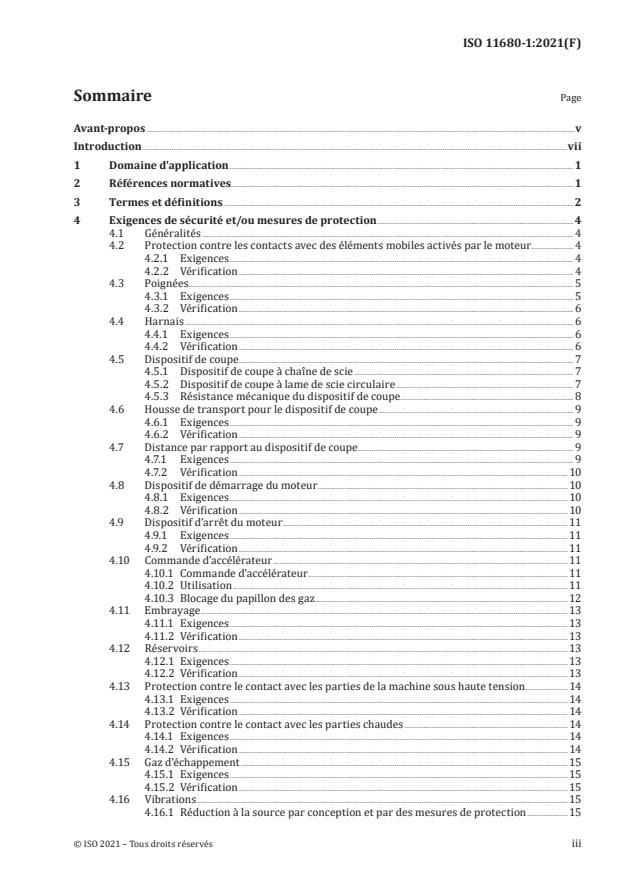
Sommaire Page
Avant-propos .v
Introduction .vii
1 Domaine d'application .1
2 Références normatives .1
3 Termes et définitions . 2
4 Exigences de sécurité et/ou mesures de protection . 4
4.1 Généralités . 4
4.2 Protection contre les contacts avec des éléments mobiles activés par le moteur. 4
4.2.1 Exigences . 4
4.2.2 Vérification . 4
4.3 Poignées . 5
4.3.1 Exigences . 5
4.3.2 Vérification . 6
4.4 Harnais . 6
4.4.1 Exigences . 6
4.4.2 Vérification . 6
4.5 Dispositif de coupe . 7
4.5.1 Dispositif de coupe à chaîne de scie . 7
4.5.2 Dispositif de coupe à lame de scie circulaire . 7
4.5.3 Résistance mécanique du dispositif de coupe . 8
4.6 Housse de transport pour le dispositif de coupe . 9
4.6.1 Exigences . 9
4.6.2 Vérification . 9
4.7 Distance par rapport au dispositif de coupe . 9
4.7.1 Exigences . 9
4.7.2 Vérification . 10
4.8 Dispositif de démarrage du moteur . 10
4.8.1 Exigences . 10
4.8.2 Vérification . 10
4.9 Dispositif d’arrêt du moteur . 11
4.9.1 Exigences . 11
4.9.2 Vérification . 11
4.10 Commande d’accélérateur . 11
4.10.1 Commande d'accélérateur . 11
4.10.2 Utilisation . 11
4.10.3 Blocage du papillon des gaz .12
4.11 Embrayage . 13
4.11.1 Exigences . 13
4.11.2 Vérification . 13
4.12 Réservoirs .13
4.12.1 Exigences . 13
4.12.2 Vérification . 13
4.13 Protection contre le contact avec les parties de la machine sous haute tension . 14
4.13.1 Exigences . 14
4.13.2 Vérification . 14
4.14 Protection contre le contact avec les parties chaudes . 14
4.14.1 Exigences . 14
4.14.2 Vérification . 14
4.15 Gaz d'échappement . 15
4.15.1 Exigences . 15
4.15.2 Vérification . 15
4.16 Vibrations . 15
4.16.1 Réduction à la source par conception et par des mesures de protection .15
iii
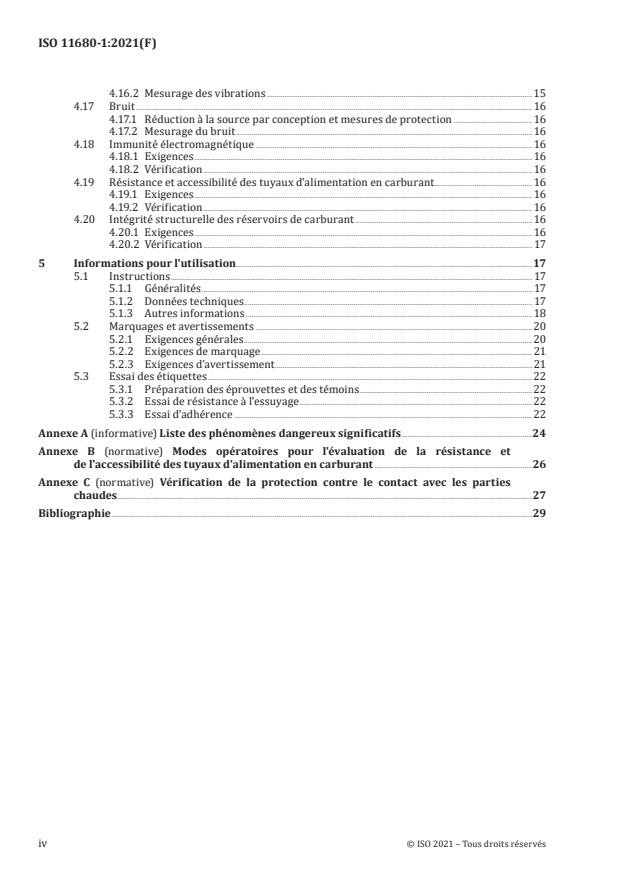
4.16.2 Mesurage des vibrations . 15
4.17 Bruit . 16
4.17.1 Réduction à la source par conception et mesures de protection . 16
4.17.2 Mesurage du bruit . 16
4.18 Immunité électromagnétique . 16
4.18.1 Exigences . 16
4.18.2 Vérification . 16
4.19 Résistance et accessibilité des tuyaux d'alimentation en carburant. 16
4.19.1 Exigences . 16
4.19.2 Vérification . 16
4.20 Intégrité structurelle des réservoirs de carburant . 16
4.20.1 Exigences . 16
4.20.2 Vérification . 17
5 Informations pour l'utilisation .17
5.1 Instructions . 17
5.1.1 Généralités . 17
5.1.2 Données techniques . 17
5.1.3 Autres informations . 18
5.2 Marquages et avertissements . 20
5.2.1 Exigences générales .20
5.2.2 Exigences de marquage . 21
5.2.3 Exigences d’avertissement . 21
5.3 Essai des étiquettes . 22
5.3.1 Préparation des éprouvettes et des témoins . . 22
5.3.2 Essai de résistance à l'essuyage . 22
5.3.3 Essai d'adhérence . 22
Annexe A (informative) Liste des phénomènes dangereux significatifs .24
Annexe B (normative) Modes opératoires pour l'évaluation de la résistance et
de l'accessibilité des tuyaux d'alimentation en carburant .26
Annexe C (normative) Vérification de la protection contre le contact avec les parties
chaudes.27
Bibliographie .29
iv
Avant-propos
L'ISO (Organisation internationale de normalisation) est une fédération mondiale d'organismes
nationaux de normalisation (comités membres de l'ISO). L'élaboration des Normes internationales est
en général confiée aux comités techniques de l'ISO. Chaque comité membre intéressé par une étude
a le droit de faire partie du comité technique créé à cet effet. Les organisations internationales,
gouvernementales et non gouvernementales, en liaison avec l'ISO participent également aux travaux.
L'ISO collabore étroitement avec la Commission électrotechnique internationale (IEC) en ce qui
concerne la normalisation électrotechnique.
Les procédures utilisées pour élaborer le présent document et celles destinées à sa mise à jour sont
décrites dans les Directives ISO/IEC, Partie 1. Il convient, en particulier, de prendre note des différents
critères d'approbation requis pour les différents types de documents ISO. Le présent document a
été rédigé conformément aux règles de rédaction données dans les Directives ISO/IEC, Partie 2 (voir
www.iso.org/directives).
L'attention est attirée sur le fait que certains des éléments du présent document peuvent faire l'objet de
droits de propriété intellectuelle ou de droits analogues. L'ISO ne saurait être tenue pour responsable
de ne pas avoir identifié de tels droits de propriété et averti de leur existence. Les détails concernant
les références aux droits de propriété intellectuelle ou autres droits analogues identifiés lors de
l'élaboration du document sont indiqués dans l'Introduction et/ou dans la liste des déclarations de
brevets reçues par l'ISO (voir www.iso.org/brevets).
Les appellations commerciales éventuellement mentionnées dans le présent document sont données
pour information, par souci de commodité, à l’intention des utilisateurs et ne sauraient constituer un
engagement.
Pour une explication de la nature volontaire des normes, la signification des termes et expressions
spécifiques de l'ISO liés à l'évaluation de la conformité, ou pour toute information au sujet de l'adhésion
de l'ISO aux principes de l’Organisation mondiale du commerce (OMC) concernant les obstacles
techniques au commerce (OTC), voir www.iso.org/avant-propos.
Le présent document a été élaboré par le comité technique ISO/TC 23, Tracteurs et matériels agricoles
et forestiers, sous-comité SC 17, Matériel pour jardins et pelouses et matériel forestier portatifs à main
à moteur, en collaboration avec le comité technique CEN/TC 144, Tracteurs et matériels agricoles
et forestiers, du Comité européen de normalisation (CEN) conformément à l’Accord de coopération
technique entre l’ISO et le CEN (Accord de Vienne).
Cette troisième édition annule et remplace la deuxième édition (ISO 11680-1:2011), qui a fait l’objet
d’une révision technique.
Les principales modifications par rapport à l’édition précédente sont les suivantes:
— Article 1, le domaine d'application a été élargi pour inclure les machines en extension et les machines
télescopiques;
— Article 3, les définitions de "dispositif de coupe", "poids à vide", "extensible", "portative" et
"télescopique" ont été ajoutées;
— la Figure 1 a été modifiée pour illsutrer les différents types de perches élagueuses;
— Article 4:
— 4.2, un nouveau paragraphe “Protection contre le contact avec les éléments mobiles activés par
le moteur” a été ajouté;
— 4.,4 les exigences relatives aux harnais ont été reformulées et modifiées;
— 4.5.2, les exigences spécifiées matière de fixation des lames de scie circulaire ont été clarifiées;
— 4.7, la définition de la distance par rapport au dispositif de coupe a été clarifiée;
v
— 4.10.2, l’exigence selon laquelle la fonction de verrouillage de la commande d'accélérateur doit
être soumise à essai a été ajoutée;
— 4.12, la méthode de vérification pour le système de ventilation du réservoir de carburant a été
ajoutée;
— 4.14, les exigences en matière de protection contre les surfaces chaudes ont été reformulées et
modifiées;
— 4.19, les exigences relatives à la résistance et l’accessibilité des tuyaux d'alimentation en
carburant ont été ajoutées;
— 4.20, les exigences relatives à l’intégrité structurelle du réservoir de carburant ont été ajoutées;
— Article 5:
— 5.1, les exigences relatives aux instructions ont été révisées;
— 5.2, les exigences en matière de marquage et d’avertissement ont été réorganisées.
Il convient que l’utilisateur adresse tout retour d’information ou toute question concernant le présent
document à l’organisme national de normalisation de son pays. Une liste exhaustive desdits organismes
se trouve à l’adresse www.iso.org/fr/members.html.
vi
Introduction
Le présent document est une norme de type C tel que mentionné dans l’ISO 12100:2010.
Le présent document concerne, en particulier, les groupes de parties prenantes suivants, représentant
les acteurs du marché dans le domaine de la sécurité des machines:
— fabricants de machine (petites, moyennes et grandes entreprises);
— organismes de santé et de sécurité (autorités réglementaires, organismes de prévention des risques
professionnels, surveillance du marché, etc.)
D'autres partenaires peuvent être concernés par le niveau de sécurité des machines atteint à l'aide du
document par les groupes de parties prenantes mentionnés ci-dessus:
— utilisateurs de machines/employeurs (petites, moyennes et grandes entreprises);
— utilisateurs de machines/salariés (par exemple syndicats de salariés, organisations représentant
des personnes ayant des besoins particuliers);
— prestataires de services, par exemple sociétés de maintenance (petites, moyennes et grandes
entreprises);
— consommateurs (dans le cas de machines destinées à être utilisées par des consommateurs).
Les groupes de parties prenantes mentionnés ci-dessus ont eu la possibilité de participer à l'élaboration
du présent document.
Les machines concernées et l’étendue des phénomènes dangereux, situations dangereuses ou
événements dangereux couverts sont indiquées dans le domaine d’application du présent document.
Lorsque des exigences de la présente norme de type C sont différentes de celles énoncées dans les
normes de type A ou les normes de type B, les exigences de la présente norme de type C ont priorité
sur celles des autres normes pour les machines ayant été conçues et fabriquées conformément aux
exigences de la présente norme de type C.
vii
NORME INTERNATIONALE ISO 11680-1:2021(F)
Matériel forestier — Exigences de sécurité et essais pour
les perches élagueuses à moteur —
Partie 1:
Machines équipées d'un moteur à combustion interne
intégré
1 Domaine d'application
Le présent document spécifie les exigences de sécurité, et les mesures pour leur vérification, pour
la conception et la construction des perches élagueuses portatives à moteur (ci-après appelées
«machines») y compris des machines en extension et les machines télescopiques équipées d'un moteur
à combustion interne intégré comme source motrice. Ces machines utilisent un arbre de transmission
de puissance pour transmettre la puissance à un dispositif de coupe constitué d'une chaîne de scie
et d'une barre de guidage, d'une lame de scie alternative ou d'une lame de scie circulaire monobloc
d'un diamètre extérieur maximal de 205 mm. Elle spécifie des méthodes pour éliminer ou réduire les
phénomènes dangereux inhérents à l’utilisation de ces machines et le type d'informations devant être
fournies par le fabricant sur les pratiques d'utilisation sûre.
Le présent document traite de tous les phénomènes dangereux significatifs, situations dangereuses
ou événements dangereux, à l'exception du choc électrique engendré par un contact avec des lignes
électriques aériennes (en dehors des avertissements et conseils à inclure dans la notice d'instructions)
pertinents pour ces machines lorsqu’elles sont utilisées normalement et dans des conditions de mauvais
usage raisonnablement prévisibles par le fabricant (voir Annexe A).
Le présent document est applicable aux perches élagueuses à moteur portatives, tenues à la main,
fabriquées après sa date de publication.
Les débroussailleuses à lame de scie circulaire ne sont pas incluses dans le domaine d'application de la
présente norme.
NOTE Les exigences relatives aux débroussailleuses sont spécifiées dans l’ISO 11806-1.
2 Références normatives
Les documents suivants sont cités dans le texte de sorte qu’ils constituent, pour tout ou partie de leur
contenu, des exigences du présent document. Pour les références datées, seule l’édition citée s’applique.
Pour les références non datées, la dernière édition du document de référence s'applique (y compris les
éventuels amendements).
ISO 6531:2017, Matériel forestier — Scies à chaîne portatives — Vocabulaire
ISO 7112:2018, Matériel forestier — Débroussailleuses et coupe-herbe portatifs — Vocabulaire
ISO 7113:1999, Machines forestières portatives — Accessoires de coupe des débroussailleuses — Lames
métalliques monobloc
ISO 12100:2010, Sécurité des machines — Principes généraux de conception — Appréciation du risque et
réduction du risque
ISO 13857:2019, Sécurité des machines — Distances de sécurité empêchant les membres supérieurs et
inférieurs d'atteindre les zones dangereuses
ISO 14982:1998, Machines agricoles et forestières — Compatibilité électromagnétique — Méthodes d'essai
et critères d'acceptation
ISO 22867:2021, Machines forestières et machines de jardin — Code d'essai des vibrations pour machines
portatives tenues à la main à moteur à combustion interne — Vibrations au niveau des poignées
ISO 22868:2020, Machines forestières et machines de jardin — Code d’essai acoustique pour machines
portatives tenues à la main à moteur à combustion interne — Méthode d’expertise (classe de précision 2)
IEC 61032:1997, Protection des personnes et des matériels par les enveloppes — Calibres d’essai pour la
vérification
3 Termes et définitions
Pour les besoins du présent document, les termes et les définitions de l'ISO 6531:2017, l'ISO 7112:2018,
l'ISO 12100:2010, ainsi que les suivants s'appliquent.
L’ISO et l’IEC tiennent à jour des bases de données terminologiques destinées à être utilisées en
normalisation, consultables aux adresses suivantes:
— ISO Online browsing platform: disponible à l’adresse https:// www .iso .org/ obp
— IEC Electropedia: disponible à l’adresse http:// www .electropedia .org/
3.1
perche élagueuse à moteur
machine dans laquelle la source motrice est reliée, par l'intermédiaire d'un long tube de protection de
l'arbre de transmission, à un dispositif de coupe permettant à un opérateur de couper des branches à
une certaine distance
Note 1 à l'article: Voir la Figure 1 pour des exemples de perches élagueuses à moteur équipées d'un moteur à
combustion interne intégré entrant dans le Domaine d'application du présent document.
a) Perche élagueuse avec b) Perche élagueuse avec c) Perche élagueuse avec
dispositif de coupe à chaîne dispositif de coupe à lame dispositif de coupe à lame
de scie de scie circulaire de scie alternative
d) Perche élagueuse extensible e) Perche élagueuse télescopique
Légende
1 source motrice
2 poignée arrière
3 poignée avant
4 tube de protection de l'arbre de transmission
5 dispositif de coupe
6 extension
7 tube télescopique de protection de l'arbre de transmission
Figure 1 — Exemples de perches élagueuses à moteur équipées d'un moteur à combustion
interne intégré
3.2
dispositif de coupe
combinaison de chaîne de scie et barre de guidage, lame de scie alternative ou lame de scie circulaire
monobloc, utilisés pour couper les branches d'un arbre sur pied
3.3
poids à vide
poids de la machine avec réservoir(s) de carburant/d'huile vide(s) et sans dispositif de coupe (3.2)
3.4
extensible
possibilité d'étendre la longueur opérationnelle de la machine en ajoutant des extensions d'arbre
3.5
tenu à la main
soutenu et contrôlé par l'opérateur
Note 1 à l'article: Un harnais peut aider à fournir un soutien.
3.6
télescopique
possibilité d'étendre la longueur opérationnelle de la machine au moyen d'un arbre intérieur et d'un
arbre extérieur coulissants
4 Exigences de sécurité et/ou mesures de protection
4.1 Généralités
Les machines doivent être conformes aux exigences de sécurité et/ou mesures de protection du
présent article. De plus, les machines doivent être conçues selon les principes de l'ISO 12100:2010 pour
les phénomènes dangereux pertinents mais non significatifs qui ne sont pas traités dans le présent
document.
Le fonctionnement en toute sécurité de la perche élagueuse à moteur dépend également du niveau de
sécurité de l’environnement associées à l'utilisation d'équipements de protection individuelle (EPI) tels
que gants, chaussures antidérapantes et équipements de protection pour les yeux, les oreilles, et la tête,
et les procédures de travail sécuritaire (voir en 5.1).
4.2 Protection contre les contacts avec des éléments mobiles activés par le moteur
4.2.1 Exigences
Tous les éléments mobiles activés par le moteur, à l'exception du dispositif de coupe, doivent être situés
ou protégés de manière à ce que l'opérateur ne puisse pas les toucher par inadvertance au démarrage
ou pendant le fonctionnement normal de la machine, comme indiqué dans la notice d’instruction.
4.2.2 Vérification
L'emplacement et l'orientation des éléments mobiles activés par le moteur doivent être vérifiés par
inspection. Pour un accès en ligne droite, les distances de sécurité spécifiées dans l’ISO 13857:2019,
4.2.4.1 et 4.2.4.3, doivent être respectées. Pour les autres points d'accès, utiliser le calibre d’essai B
de l’IEC 61032:1997, présenté à la Figure 2. Le calibre d’essai doit être appliqué sur toute ouverture
protégeant un élément mobile activé par le moteur en utilisant une force de (10 ± 2) N. Le contact avec
tout élément mobile activé par le moteur n'est pas autorisé.
Dimensions en millimetres
Légende
A poignée E surface de butée
B protecteur F tous les bords sont chanfreinées
C matériau isolant G sphérique
D assemblages H cylindrique
Figure 2 — Calibre d’essai pour l'accessibilité des éléments mobiles activés par le moteur
4.3 Poignées
4.3.1 Exigences
La machine doit avoir une poignée pour chaque main. La forme et la surface de la poignée doivent
être conçues pour offrir la sûreté de prise nécessaire, que l'opérateur porte des gants ou non. Si la
poignée la plus proche du dispositif de coupe fait partie intégrante du tube de protection de l'arbre de
transmission, le périmètre de la section transversale de la poignée sur la longueur de préhension doit
être entre 65 mm et 170 mm. La longueur de préhension doit être d'au moins 100 mm.
La longueur de préhension de la poignée en arceau ou fermés doit comprendre toute partie droite
ou courbe de rayon supérieur à 100 mm, y compris tout rayon de raccordement à l'une ou aux deux
extrémités de la surface de préhension, dans la limite de 10 mm.
4.3.2 Vérification
La conception et les dimensions doivent être vérifiées par inspection et mesurage.
4.4 Harnais
4.4.1 Exigences
Toutes les machines de plus de 6kg à vide doivent être équipées d'un harnais que l'opérateur doit porter.
Le harnais sert principalement à supporter la machine lors des mouvements entre les opérations de
coupe et à réduire le risque de contact accidentel avec le dispositif de coupe. L’opérateur doit également
pouvoir régler le harnais en fonction de sa taille.
Les harnais d'épaule doivent être:
— conçus de manière à pouvoir être retirés facilement; ou
— équipés d'un dispositif de décrochage rapide qui permet à l'opérateur de se dégager rapidement de
la machine.
Il est considéré qu’un simple harnais d'épaule est conçu de manière à pouvoir être enlevé facilement.
Un double harnais d'épaule est considéré comme conçu de manière à pouvoir être retiré facilement, si
les sangles gauche et droite ne sont pas reliées entre elles devant le corps de l'opérateur.
Si des sangles permettant de relier les sangles gauche et droite sont prévues, elles sont également
considérées comme conçues de manière à pouvoir être retirées facilement lorsque les sangles reliant
les sangles gauche et droite peuvent être libérées sous la charge de la machine à l'aide d'une seule main
et ne comportent pas plus de deux points de relâchement.
NOTE Un exemple de point de relâchement est une boucle qui nécessite d'être serrée entre le pouce et le
doigt avant d'être libérée, par exemple les boucles à déclenchement latéral.
Un dispositif de décrochage rapide, s'il existe, doit être placé soit au niveau de la connexion entre
la machine et le harnais, soit entre le harnais et l'opérateur. Le dispositif de décrochage rapide doit
uniquement fonctionner par une action délibérée de l’opérateur.
Le dispositif de décrochage rapide doit pouvoir être ouvert sous charge d'une seule main et ne doit pas
comporter plus de deux points de déclenchement.
4.4.2 Vérification
Le harnais, son fonctionnement et son réglage doivent être vérifiés par inspection. Le dispositif de
décrochage rapide doit être vérifié par un essai de fonctionnement par une personne portant le harnais
et avec une charge verticale égale à trois fois le poids à vide de la machine fixée au point d'accrochage.
4.5 Dispositif de coupe
4.5.1 Dispositif de coupe à chaîne de scie
4.5.1.1 Exigences
Un dispositif de coupe à chaîne de scie doit être fourni avec des moyens de réglage permettant de tendre
la chaîne conformément aux instructions. La méthode de mise en tension de la chaîne doit être décrite
dans les instructions.
Des moyens doivent être prévus pour graisser la chaîne de scie soit manuellement soit de façon
automatique. Lorsqu'un dispositif de graissage manuel est prévu, il doit être placé de manière à pouvoir
être actionné alors que la perche élagueuse est tenue à deux poignées.
4.5.1.2 Vérification
Les moyens permettant de régler et de graisser la chaîne de scie doivent être vérifiés par inspection et
essai de fonctionnement.
4.5.2 Dispositif de coupe à lame de scie circulaire
4.5.2.1 Exigences
Ces exigences s'appliquent aux dispositifs de coupe de lames de scie circulaire équipés de toutes les
lames de scie circulaire recommandées par le fabricant pour l’utilisation.
Les lames de scie circulaire doivent être des lames monobloc conforme aux spécifications de qualités de
surface et de matériau des lames figurant dans l'ISO 7113:1999.
La lame de scie circulaire doit être fixées par une méthode empêchant tout mouvement relatif entre
la lame de scie circulaire et le dispositif de retenue , ou entre la lame de scie circulaire et l'arbre sur
lequel elle est montée, lorsque le couple de rotation défini au point 4.5.2.2 est appliqué à la lame de scie
circulaire.
La méthode de fixation de la lame de scie circulaire doit également empêcher le desserrage de la lame
de scie circulaire pendant l'utilisation en:
— un système de fixation qui est serré par le couple moteur de la machine, ou
— un système de fixation sécurisé par une méthode qui n'est pas soumise à des forces de rotation"
4.5.2.2 Vérification
La qualité de surface et le matériau de la lame doivent être vérifiés conformément à l'ISO 7113:1999,
Article 4 et Paragraphe 5.2.
La fonction de la méthode de fixation doit être vérifiée par le mode opératoire d'essai suivant.
a) Monter le dispositif de coupe comme décrit dans les instructions.
b) Bloquer l'arbre de transmission de puissance.
c) Appliquer à la lame un couple de rotation, M, en newtons mètre (N ⋅ m):
M = 0,4 × V × k (1)
où
V est la cylindrée, en centimètres cubes (cm );
k est le rapport de transmission (fréquence de rotation du moteur/fréquence de rotation de la lame).
Le couple M doit être appliqué pendant (5 ± 2) s et maintenu pendant (2 ± 1) s.
d) Réaliser l’essai cinq fois dans le sens inverse du sens normal de rotation, puis cinq fois dans le sens
normal de fonctionnement.
La méthode de fixation de la lame de scie circulaire doit être vérifiée par inspection.
4.5.3 Résistance mécanique du dispositif de coupe
4.5.3.1 Exigences
Les dispositifs de coupe recommandés, leurs systèmes de fixation et leurs protecteurs ne doivent
présenter aucune fissure visible après avoir heurté une surface dure, lorsqu'ils sont soumis à l'essai de
fonctionnement spécifié en 4.5.3.2.
4.5.3.2 Vérification
La température ambiante doit être de (20 ± 5) °C.
L'essai doit être effectué avec le moteur arrêté. La machine doit être en position de complète extension,
(si elle est extensible) car cela représente le scénario le plus défavorable. Le réservoir de carburant
et le réservoir de lubrification des chaînes, le cas échéant, doivent être remplis à 50 % du niveau de
remplissage maximal. Le réservoir d'huile moteur, le cas échéant, doit être rempli conformément aux
instructions du fabricant.
Suspendre la machine librement à (150 ± 2) mm en face du milieu de la poignée arrière et à une hauteur
de (775 ± 2) mm au-dessus de la surface d'essai (voir Figure 3).
Laisser la machine balancer librement autour du point d'accrochage, une fois, à partir d'une position
de départ où la machine est à (45 ± 2) ° par rapport à l'horizontale. La surface d’essai impactée par la
machine doit être plane et en béton ou matériau dur similaire.
Si, après l'impact, aucune rupture ou fissure ne peut être détectée dans le dispositif de coupe, son
système de fixation ou son protecteur par un examen visuel, vérifier l'intégrité structurelle du système
de fixation et du protecteur en faisant fonctionner la machine comme suit. Si la lame de scie ou la
barre de guidage est tordue au point d'être devenue inutilisable, remplacer l'un ou l'autre avant l’essai.
Démarrer le moteur et le faire tourner à à la vitesse de course pendant (60 ± 2) s. Contrôler le régime
moteur à l'aide de la commande d'accélérateur.
L'intégrité structurelle du système de fixation et du protecteur est jugée satisfaisante si aucune pièce
du dispositif de coupe n'a été éjectée et si aucune fissure n'est détectée pendant l’inspection visuelle. Un
défaut dans le mécanisme d'entraînement n'est pas considéré comme un échec de l'essai.
Dimensions en millimetres
a) Machine non extensible b) Machine télescopique ou extensible
Figure 3 — Montage d'essai résistance du dispositif de coupe
4.6 Housse de transport pour le dispositif de coupe
4.6.1 Exigences
La machine doit être munie d'un couvercle pour l'accessoire de coupe.
La housse de transport du dispositif de coupe doit recouvrir la chaîne de scie sur la partie du guide-
chaîne destinée à la coupe, ou les arêtes de coupe des lames de scie circulaire ou alternative, selon le cas,
pendant le transport ou le stockage de la machine. La housse de transport doit rester dans sa position
de protection lorsque la machine est maintenue dans n'importe quelle direction.
4.6.2 Vérification
La fixation du protecteur de transport sur le dispositif de coupe doit être vérifiée par inspection lorsque
la machine est maintenue dans n'importe quelle direction.
4.7 Distance par rapport au dispositif de coupe
4.7.1 Exigences
La distance L depuis l’arrière de la commande d'accélérateur jusqu’au point non protégé le plus proche
du dispositif de coupe doit être d'au moins 1 250 mm, mesurée en longueur de chaîne le cas échéant
(L1 + L2), le dispositif de coupe étant positionné au plus près de l'opérateur (voir Figure 4).
Lorsqu'il est possible de régler la position de la commande d'accélérateur, un réglage en-deçà de la
distance minimale de 1 250 mm doit être rendu impossible par conception.
Cette distance minimale depuis l'arrière de la commande d'accélérateur jusqu’au point le plus proche
accessible du dispositif de coupe doit s'appliquer à tous les dispositifs de coupe recommandés par le
fabricant.
Pour avertir l'opérateur que sa main est placée trop près de l'organe de coupe, un obstacle fixe (par
exemple, la boîte d’engrenage ou un anneau fixé sur le tube de protection de l'arbre de transmission)
doit être prévu à proximité du dispositif de coupe. La distance depuis l'arrière de l'obstacle fixe jusqu’au
point le plus proche accessible du dispositif de coupe (L3) doit être d'au moins 120 mm, mesuré en
longueur de chaîne.
Dimensions en millimetres
Figure 4 — Distance par rapport au dispositif de coupe
4.7.2 Vérification
Les moyens de réglage, la présence d'un obstacle fixe et les distances entre la commande d'accélérateur
et le dispositif de coupe doivent être vérifiés par inspection et mesurage.
4.8 Dispositif de démarrage du moteur
4.8.1 Exigences
Un dispositif de démarrage du moteur doit être prévu. Si un démarreur manuel est prévu, il doit être
fixé de manière permanente à la machine et, s'il utilise une corde, il doit être équipé d'un dispositif
d'enroulement automatique de la corde. Si un démarreur électrique est fourni, il doit nécessiter deux ou
plusieurs actions distinctes et dissemblables pour s'activer. Un démarreur combiné manuel/électrique
doit répondre à toutes les exigences.
4.8.2 Vérification
Les moyens permettant de démarrer la machine doivent être vérifiés par inspection et essai de
fonctionnement.
4.9 Dispositif d’arrêt du moteur
4.9.1 Exigences
La machine doit être munie d'un dispositif d'arrêt du moteur permettant d'obtenir l'arrêt complet du
moteur et dont l'actionnement ne nécessite pas un effort manuel soutenu. La commande de ce dispositif
doit être placée de telle sorte que le dispositif puisse être actionné alors que la machine est tenue à deux
mains par un opérateur portant des gants. La couleur de la commande doit se détacher nettement de la
couleur du fond.
4.9.2 Vérification
Le fonctionnement correct du dispositif d'arrêt du moteur doit être vérifié par inspection pendant que
la machine fonctionne. L'emplacement de la commande doit être vérifié par inspection.
4.10 Commande d’accélérateur
4.10.1 Commande d'accélérateur
4.10.1.1 Exigences
La commande d'accélérateur doit être placée de telle façon que l'on puisse la presser et la relâcher avec
une main gantée, tout en tenant les deux poignées.
4.10.1.2 Vérification
La position doit être vérifiée par inspection et essais de fonctionnement.
4.10.2 Utilisation
4.10.2.1 Exigences
La machine doit être munie d'une commande d'accélérateur qui, lorsqu'elle est relâchée, revient
automatiquement en position de ralenti à moins qu'un blocage du papillon des gaz ne soit activé pour
faciliter le démarrage (voir 4.10.3). La commande de l'accélérateur d
...
NORME ISO
INTERNATIONALE 11680-1
Troisième édition
2021-10
Matériel forestier — Exigences de
sécurité et essais pour les perches
élagueuses à moteur —
Partie 1:
Machines équipées d'un moteur à
combustion interne intégré
Machinery for forestry — Safety requirements and testing for pole-
mounted powered pruners —
Part 1: Machines fitted with an integral combustion engine
Numéro de référence
DOCUMENT PROTÉGÉ PAR COPYRIGHT
© ISO 2021
Tous droits réservés. Sauf prescription différente ou nécessité dans le contexte de sa mise en œuvre, aucune partie de cette
publication ne peut être reproduite ni utilisée sous quelque forme que ce soit et par aucun procédé, électronique ou mécanique,
y compris la photocopie, ou la diffusion sur l’internet ou sur un intranet, sans autorisation écrite préalable. Une autorisation peut
être demandée à l’ISO à l’adresse ci-après ou au comité membre de l’ISO dans le pays du demandeur.
ISO copyright office
Case postale 401 • Ch. de Blandonnet 8
CH-1214 Vernier, Genève
Tél.: +41 22 749 01 11
E-mail: copyright@iso.org
Web: www.iso.org
Publié en Suisse
ii
Sommaire Page
Avant-propos .v
Introduction .vii
1 Domaine d'application .1
2 Références normatives .1
3 Termes et définitions . 2
4 Exigences de sécurité et/ou mesures de protection . 4
4.1 Généralités . 4
4.2 Protection contre les contacts avec des éléments mobiles activés par le moteur. 4
4.2.1 Exigences . 4
4.2.2 Vérification . 4
4.3 Poignées . 5
4.3.1 Exigences . 5
4.3.2 Vérification . 6
4.4 Harnais . 6
4.4.1 Exigences . 6
4.4.2 Vérification . 6
4.5 Dispositif de coupe . 7
4.5.1 Dispositif de coupe à chaîne de scie . 7
4.5.2 Dispositif de coupe à lame de scie circulaire . 7
4.5.3 Résistance mécanique du dispositif de coupe . 8
4.6 Housse de transport pour le dispositif de coupe . 9
4.6.1 Exigences . 9
4.6.2 Vérification . 9
4.7 Distance par rapport au dispositif de coupe . 9
4.7.1 Exigences . 9
4.7.2 Vérification . 10
4.8 Dispositif de démarrage du moteur . 10
4.8.1 Exigences . 10
4.8.2 Vérification . 10
4.9 Dispositif d’arrêt du moteur . 11
4.9.1 Exigences . 11
4.9.2 Vérification . 11
4.10 Commande d’accélérateur . 11
4.10.1 Commande d'accélérateur . 11
4.10.2 Utilisation . 11
4.10.3 Blocage du papillon des gaz .12
4.11 Embrayage . 13
4.11.1 Exigences . 13
4.11.2 Vérification . 13
4.12 Réservoirs .13
4.12.1 Exigences . 13
4.12.2 Vérification . 13
4.13 Protection contre le contact avec les parties de la machine sous haute tension . 14
4.13.1 Exigences . 14
4.13.2 Vérification . 14
4.14 Protection contre le contact avec les parties chaudes . 14
4.14.1 Exigences . 14
4.14.2 Vérification . 14
4.15 Gaz d'échappement . 15
4.15.1 Exigences . 15
4.15.2 Vérification . 15
4.16 Vibrations . 15
4.16.1 Réduction à la source par conception et par des mesures de protection .15
iii
4.16.2 Mesurage des vibrations . 15
4.17 Bruit . 16
4.17.1 Réduction à la source par conception et mesures de protection . 16
4.17.2 Mesurage du bruit . 16
4.18 Immunité électromagnétique . 16
4.18.1 Exigences . 16
4.18.2 Vérification . 16
4.19 Résistance et accessibilité des tuyaux d'alimentation en carburant. 16
4.19.1 Exigences . 16
4.19.2 Vérification . 16
4.20 Intégrité structurelle des réservoirs de carburant . 16
4.20.1 Exigences . 16
4.20.2 Vérification . 17
5 Informations pour l'utilisation .17
5.1 Instructions . 17
5.1.1 Généralités . 17
5.1.2 Données techniques . 17
5.1.3 Autres informations . 18
5.2 Marquages et avertissements . 20
5.2.1 Exigences générales .20
5.2.2 Exigences de marquage . 21
5.2.3 Exigences d’avertissement . 21
5.3 Essai des étiquettes . 22
5.3.1 Préparation des éprouvettes et des témoins . . 22
5.3.2 Essai de résistance à l'essuyage . 22
5.3.3 Essai d'adhérence . 22
Annexe A (informative) Liste des phénomènes dangereux significatifs .24
Annexe B (normative) Modes opératoires pour l'évaluation de la résistance et
de l'accessibilité des tuyaux d'alimentation en carburant .26
Annexe C (normative) Vérification de la protection contre le contact avec les parties
chaudes.27
Bibliographie .29
iv
Avant-propos
L'ISO (Organisation internationale de normalisation) est une fédération mondiale d'organismes
nationaux de normalisation (comités membres de l'ISO). L'élaboration des Normes internationales est
en général confiée aux comités techniques de l'ISO. Chaque comité membre intéressé par une étude
a le droit de faire partie du comité technique créé à cet effet. Les organisations internationales,
gouvernementales et non gouvernementales, en liaison avec l'ISO participent également aux travaux.
L'ISO collabore étroitement avec la Commission électrotechnique internationale (IEC) en ce qui
concerne la normalisation électrotechnique.
Les procédures utilisées pour élaborer le présent document et celles destinées à sa mise à jour sont
décrites dans les Directives ISO/IEC, Partie 1. Il convient, en particulier, de prendre note des différents
critères d'approbation requis pour les différents types de documents ISO. Le présent document a
été rédigé conformément aux règles de rédaction données dans les Directives ISO/IEC, Partie 2 (voir
www.iso.org/directives).
L'attention est attirée sur le fait que certains des éléments du présent document peuvent faire l'objet de
droits de propriété intellectuelle ou de droits analogues. L'ISO ne saurait être tenue pour responsable
de ne pas avoir identifié de tels droits de propriété et averti de leur existence. Les détails concernant
les références aux droits de propriété intellectuelle ou autres droits analogues identifiés lors de
l'élaboration du document sont indiqués dans l'Introduction et/ou dans la liste des déclarations de
brevets reçues par l'ISO (voir www.iso.org/brevets).
Les appellations commerciales éventuellement mentionnées dans le présent document sont données
pour information, par souci de commodité, à l’intention des utilisateurs et ne sauraient constituer un
engagement.
Pour une explication de la nature volontaire des normes, la signification des termes et expressions
spécifiques de l'ISO liés à l'évaluation de la conformité, ou pour toute information au sujet de l'adhésion
de l'ISO aux principes de l’Organisation mondiale du commerce (OMC) concernant les obstacles
techniques au commerce (OTC), voir www.iso.org/avant-propos.
Le présent document a été élaboré par le comité technique ISO/TC 23, Tracteurs et matériels agricoles
et forestiers, sous-comité SC 17, Matériel pour jardins et pelouses et matériel forestier portatifs à main
à moteur, en collaboration avec le comité technique CEN/TC 144, Tracteurs et matériels agricoles
et forestiers, du Comité européen de normalisation (CEN) conformément à l’Accord de coopération
technique entre l’ISO et le CEN (Accord de Vienne).
Cette troisième édition annule et remplace la deuxième édition (ISO 11680-1:2011), qui a fait l’objet
d’une révision technique.
Les principales modifications par rapport à l’édition précédente sont les suivantes:
— Article 1, le domaine d'application a été élargi pour inclure les machines en extension et les machines
télescopiques;
— Article 3, les définitions de "dispositif de coupe", "poids à vide", "extensible", "portative" et
"télescopique" ont été ajoutées;
— la Figure 1 a été modifiée pour illsutrer les différents types de perches élagueuses;
— Article 4:
— 4.2, un nouveau paragraphe “Protection contre le contact avec les éléments mobiles activés par
le moteur” a été ajouté;
— 4.,4 les exigences relatives aux harnais ont été reformulées et modifiées;
— 4.5.2, les exigences spécifiées matière de fixation des lames de scie circulaire ont été clarifiées;
— 4.7, la définition de la distance par rapport au dispositif de coupe a été clarifiée;
v
— 4.10.2, l’exigence selon laquelle la fonction de verrouillage de la commande d'accélérateur doit
être soumise à essai a été ajoutée;
— 4.12, la méthode de vérification pour le système de ventilation du réservoir de carburant a été
ajoutée;
— 4.14, les exigences en matière de protection contre les surfaces chaudes ont été reformulées et
modifiées;
— 4.19, les exigences relatives à la résistance et l’accessibilité des tuyaux d'alimentation en
carburant ont été ajoutées;
— 4.20, les exigences relatives à l’intégrité structurelle du réservoir de carburant ont été ajoutées;
— Article 5:
— 5.1, les exigences relatives aux instructions ont été révisées;
— 5.2, les exigences en matière de marquage et d’avertissement ont été réorganisées.
Il convient que l’utilisateur adresse tout retour d’information ou toute question concernant le présent
document à l’organisme national de normalisation de son pays. Une liste exhaustive desdits organismes
se trouve à l’adresse www.iso.org/fr/members.html.
vi
Introduction
Le présent document est une norme de type C tel que mentionné dans l’ISO 12100:2010.
Le présent document concerne, en particulier, les groupes de parties prenantes suivants, représentant
les acteurs du marché dans le domaine de la sécurité des machines:
— fabricants de machine (petites, moyennes et grandes entreprises);
— organismes de santé et de sécurité (autorités réglementaires, organismes de prévention des risques
professionnels, surveillance du marché, etc.)
D'autres partenaires peuvent être concernés par le niveau de sécurité des machines atteint à l'aide du
document par les groupes de parties prenantes mentionnés ci-dessus:
— utilisateurs de machines/employeurs (petites, moyennes et grandes entreprises);
— utilisateurs de machines/salariés (par exemple syndicats de salariés, organisations représentant
des personnes ayant des besoins particuliers);
— prestataires de services, par exemple sociétés de maintenance (petites, moyennes et grandes
entreprises);
— consommateurs (dans le cas de machines destinées à être utilisées par des consommateurs).
Les groupes de parties prenantes mentionnés ci-dessus ont eu la possibilité de participer à l'élaboration
du présent document.
Les machines concernées et l’étendue des phénomènes dangereux, situations dangereuses ou
événements dangereux couverts sont indiquées dans le domaine d’application du présent document.
Lorsque des exigences de la présente norme de type C sont différentes de celles énoncées dans les
normes de type A ou les normes de type B, les exigences de la présente norme de type C ont priorité
sur celles des autres normes pour les machines ayant été conçues et fabriquées conformément aux
exigences de la présente norme de type C.
vii
NORME INTERNATIONALE ISO 11680-1:2021(F)
Matériel forestier — Exigences de sécurité et essais pour
les perches élagueuses à moteur —
Partie 1:
Machines équipées d'un moteur à combustion interne
intégré
1 Domaine d'application
Le présent document spécifie les exigences de sécurité, et les mesures pour leur vérification, pour
la conception et la construction des perches élagueuses portatives à moteur (ci-après appelées
«machines») y compris des machines en extension et les machines télescopiques équipées d'un moteur
à combustion interne intégré comme source motrice. Ces machines utilisent un arbre de transmission
de puissance pour transmettre la puissance à un dispositif de coupe constitué d'une chaîne de scie
et d'une barre de guidage, d'une lame de scie alternative ou d'une lame de scie circulaire monobloc
d'un diamètre extérieur maximal de 205 mm. Elle spécifie des méthodes pour éliminer ou réduire les
phénomènes dangereux inhérents à l’utilisation de ces machines et le type d'informations devant être
fournies par le fabricant sur les pratiques d'utilisation sûre.
Le présent document traite de tous les phénomènes dangereux significatifs, situations dangereuses
ou événements dangereux, à l'exception du choc électrique engendré par un contact avec des lignes
électriques aériennes (en dehors des avertissements et conseils à inclure dans la notice d'instructions)
pertinents pour ces machines lorsqu’elles sont utilisées normalement et dans des conditions de mauvais
usage raisonnablement prévisibles par le fabricant (voir Annexe A).
Le présent document est applicable aux perches élagueuses à moteur portatives, tenues à la main,
fabriquées après sa date de publication.
Les débroussailleuses à lame de scie circulaire ne sont pas incluses dans le domaine d'application de la
présente norme.
NOTE Les exigences relatives aux débroussailleuses sont spécifiées dans l’ISO 11806-1.
2 Références normatives
Les documents suivants sont cités dans le texte de sorte qu’ils constituent, pour tout ou partie de leur
contenu, des exigences du présent document. Pour les références datées, seule l’édition citée s’applique.
Pour les références non datées, la dernière édition du document de référence s'applique (y compris les
éventuels amendements).
ISO 6531:2017, Matériel forestier — Scies à chaîne portatives — Vocabulaire
ISO 7112:2018, Matériel forestier — Débroussailleuses et coupe-herbe portatifs — Vocabulaire
ISO 7113:1999, Machines forestières portatives — Accessoires de coupe des débroussailleuses — Lames
métalliques monobloc
ISO 12100:2010, Sécurité des machines — Principes généraux de conception — Appréciation du risque et
réduction du risque
ISO 13857:2019, Sécurité des machines — Distances de sécurité empêchant les membres supérieurs et
inférieurs d'atteindre les zones dangereuses
ISO 14982:1998, Machines agricoles et forestières — Compatibilité électromagnétique — Méthodes d'essai
et critères d'acceptation
ISO 22867:2021, Machines forestières et machines de jardin — Code d'essai des vibrations pour machines
portatives tenues à la main à moteur à combustion interne — Vibrations au niveau des poignées
ISO 22868:2020, Machines forestières et machines de jardin — Code d’essai acoustique pour machines
portatives tenues à la main à moteur à combustion interne — Méthode d’expertise (classe de précision 2)
IEC 61032:1997, Protection des personnes et des matériels par les enveloppes — Calibres d’essai pour la
vérification
3 Termes et définitions
Pour les besoins du présent document, les termes et les définitions de l'ISO 6531:2017, l'ISO 7112:2018,
l'ISO 12100:2010, ainsi que les suivants s'appliquent.
L’ISO et l’IEC tiennent à jour des bases de données terminologiques destinées à être utilisées en
normalisation, consultables aux adresses suivantes:
— ISO Online browsing platform: disponible à l’adresse https:// www .iso .org/ obp
— IEC Electropedia: disponible à l’adresse http:// www .electropedia .org/
3.1
perche élagueuse à moteur
machine dans laquelle la source motrice est reliée, par l'intermédiaire d'un long tube de protection de
l'arbre de transmission, à un dispositif de coupe permettant à un opérateur de couper des branches à
une certaine distance
Note 1 à l'article: Voir la Figure 1 pour des exemples de perches élagueuses à moteur équipées d'un moteur à
combustion interne intégré entrant dans le Domaine d'application du présent document.
a) Perche élagueuse avec b) Perche élagueuse avec c) Perche élagueuse avec
dispositif de coupe à chaîne dispositif de coupe à lame dispositif de coupe à lame
de scie de scie circulaire de scie alternative
d) Perche élagueuse extensible e) Perche élagueuse télescopique
Légende
1 source motrice
2 poignée arrière
3 poignée avant
4 tube de protection de l'arbre de transmission
5 dispositif de coupe
6 extension
7 tube télescopique de protection de l'arbre de transmission
Figure 1 — Exemples de perches élagueuses à moteur équipées d'un moteur à combustion
interne intégré
3.2
dispositif de coupe
combinaison de chaîne de scie et barre de guidage, lame de scie alternative ou lame de scie circulaire
monobloc, utilisés pour couper les branches d'un arbre sur pied
3.3
poids à vide
poids de la machine avec réservoir(s) de carburant/d'huile vide(s) et sans dispositif de coupe (3.2)
3.4
extensible
possibilité d'étendre la longueur opérationnelle de la machine en ajoutant des extensions d'arbre
3.5
tenu à la main
soutenu et contrôlé par l'opérateur
Note 1 à l'article: Un harnais peut aider à fournir un soutien.
3.6
télescopique
possibilité d'étendre la longueur opérationnelle de la machine au moyen d'un arbre intérieur et d'un
arbre extérieur coulissants
4 Exigences de sécurité et/ou mesures de protection
4.1 Généralités
Les machines doivent être conformes aux exigences de sécurité et/ou mesures de protection du
présent article. De plus, les machines doivent être conçues selon les principes de l'ISO 12100:2010 pour
les phénomènes dangereux pertinents mais non significatifs qui ne sont pas traités dans le présent
document.
Le fonctionnement en toute sécurité de la perche élagueuse à moteur dépend également du niveau de
sécurité de l’environnement associées à l'utilisation d'équipements de protection individuelle (EPI) tels
que gants, chaussures antidérapantes et équipements de protection pour les yeux, les oreilles, et la tête,
et les procédures de travail sécuritaire (voir en 5.1).
4.2 Protection contre les contacts avec des éléments mobiles activés par le moteur
4.2.1 Exigences
Tous les éléments mobiles activés par le moteur, à l'exception du dispositif de coupe, doivent être situés
ou protégés de manière à ce que l'opérateur ne puisse pas les toucher par inadvertance au démarrage
ou pendant le fonctionnement normal de la machine, comme indiqué dans la notice d’instruction.
4.2.2 Vérification
L'emplacement et l'orientation des éléments mobiles activés par le moteur doivent être vérifiés par
inspection. Pour un accès en ligne droite, les distances de sécurité spécifiées dans l’ISO 13857:2019,
4.2.4.1 et 4.2.4.3, doivent être respectées. Pour les autres points d'accès, utiliser le calibre d’essai B
de l’IEC 61032:1997, présenté à la Figure 2. Le calibre d’essai doit être appliqué sur toute ouverture
protégeant un élément mobile activé par le moteur en utilisant une force de (10 ± 2) N. Le contact avec
tout élément mobile activé par le moteur n'est pas autorisé.
Dimensions en millimetres
Légende
A poignée E surface de butée
B protecteur F tous les bords sont chanfreinées
C matériau isolant G sphérique
D assemblages H cylindrique
Figure 2 — Calibre d’essai pour l'accessibilité des éléments mobiles activés par le moteur
4.3 Poignées
4.3.1 Exigences
La machine doit avoir une poignée pour chaque main. La forme et la surface de la poignée doivent
être conçues pour offrir la sûreté de prise nécessaire, que l'opérateur porte des gants ou non. Si la
poignée la plus proche du dispositif de coupe fait partie intégrante du tube de protection de l'arbre de
transmission, le périmètre de la section transversale de la poignée sur la longueur de préhension doit
être entre 65 mm et 170 mm. La longueur de préhension doit être d'au moins 100 mm.
La longueur de préhension de la poignée en arceau ou fermés doit comprendre toute partie droite
ou courbe de rayon supérieur à 100 mm, y compris tout rayon de raccordement à l'une ou aux deux
extrémités de la surface de préhension, dans la limite de 10 mm.
4.3.2 Vérification
La conception et les dimensions doivent être vérifiées par inspection et mesurage.
4.4 Harnais
4.4.1 Exigences
Toutes les machines de plus de 6kg à vide doivent être équipées d'un harnais que l'opérateur doit porter.
Le harnais sert principalement à supporter la machine lors des mouvements entre les opérations de
coupe et à réduire le risque de contact accidentel avec le dispositif de coupe. L’opérateur doit également
pouvoir régler le harnais en fonction de sa taille.
Les harnais d'épaule doivent être:
— conçus de manière à pouvoir être retirés facilement; ou
— équipés d'un dispositif de décrochage rapide qui permet à l'opérateur de se dégager rapidement de
la machine.
Il est considéré qu’un simple harnais d'épaule est conçu de manière à pouvoir être enlevé facilement.
Un double harnais d'épaule est considéré comme conçu de manière à pouvoir être retiré facilement, si
les sangles gauche et droite ne sont pas reliées entre elles devant le corps de l'opérateur.
Si des sangles permettant de relier les sangles gauche et droite sont prévues, elles sont également
considérées comme conçues de manière à pouvoir être retirées facilement lorsque les sangles reliant
les sangles gauche et droite peuvent être libérées sous la charge de la machine à l'aide d'une seule main
et ne comportent pas plus de deux points de relâchement.
NOTE Un exemple de point de relâchement est une boucle qui nécessite d'être serrée entre le pouce et le
doigt avant d'être libérée, par exemple les boucles à déclenchement latéral.
Un dispositif de décrochage rapide, s'il existe, doit être placé soit au niveau de la connexion entre
la machine et le harnais, soit entre le harnais et l'opérateur. Le dispositif de décrochage rapide doit
uniquement fonctionner par une action délibérée de l’opérateur.
Le dispositif de décrochage rapide doit pouvoir être ouvert sous charge d'une seule main et ne doit pas
comporter plus de deux points de déclenchement.
4.4.2 Vérification
Le harnais, son fonctionnement et son réglage doivent être vérifiés par inspection. Le dispositif de
décrochage rapide doit être vérifié par un essai de fonctionnement par une personne portant le harnais
et avec une charge verticale égale à trois fois le poids à vide de la machine fixée au point d'accrochage.
4.5 Dispositif de coupe
4.5.1 Dispositif de coupe à chaîne de scie
4.5.1.1 Exigences
Un dispositif de coupe à chaîne de scie doit être fourni avec des moyens de réglage permettant de tendre
la chaîne conformément aux instructions. La méthode de mise en tension de la chaîne doit être décrite
dans les instructions.
Des moyens doivent être prévus pour graisser la chaîne de scie soit manuellement soit de façon
automatique. Lorsqu'un dispositif de graissage manuel est prévu, il doit être placé de manière à pouvoir
être actionné alors que la perche élagueuse est tenue à deux poignées.
4.5.1.2 Vérification
Les moyens permettant de régler et de graisser la chaîne de scie doivent être vérifiés par inspection et
essai de fonctionnement.
4.5.2 Dispositif de coupe à lame de scie circulaire
4.5.2.1 Exigences
Ces exigences s'appliquent aux dispositifs de coupe de lames de scie circulaire équipés de toutes les
lames de scie circulaire recommandées par le fabricant pour l’utilisation.
Les lames de scie circulaire doivent être des lames monobloc conforme aux spécifications de qualités de
surface et de matériau des lames figurant dans l'ISO 7113:1999.
La lame de scie circulaire doit être fixées par une méthode empêchant tout mouvement relatif entre
la lame de scie circulaire et le dispositif de retenue , ou entre la lame de scie circulaire et l'arbre sur
lequel elle est montée, lorsque le couple de rotation défini au point 4.5.2.2 est appliqué à la lame de scie
circulaire.
La méthode de fixation de la lame de scie circulaire doit également empêcher le desserrage de la lame
de scie circulaire pendant l'utilisation en:
— un système de fixation qui est serré par le couple moteur de la machine, ou
— un système de fixation sécurisé par une méthode qui n'est pas soumise à des forces de rotation"
4.5.2.2 Vérification
La qualité de surface et le matériau de la lame doivent être vérifiés conformément à l'ISO 7113:1999,
Article 4 et Paragraphe 5.2.
La fonction de la méthode de fixation doit être vérifiée par le mode opératoire d'essai suivant.
a) Monter le dispositif de coupe comme décrit dans les instructions.
b) Bloquer l'arbre de transmission de puissance.
c) Appliquer à la lame un couple de rotation, M, en newtons mètre (N ⋅ m):
M = 0,4 × V × k (1)
où
V est la cylindrée, en centimètres cubes (cm );
k est le rapport de transmission (fréquence de rotation du moteur/fréquence de rotation de la lame).
Le couple M doit être appliqué pendant (5 ± 2) s et maintenu pendant (2 ± 1) s.
d) Réaliser l’essai cinq fois dans le sens inverse du sens normal de rotation, puis cinq fois dans le sens
normal de fonctionnement.
La méthode de fixation de la lame de scie circulaire doit être vérifiée par inspection.
4.5.3 Résistance mécanique du dispositif de coupe
4.5.3.1 Exigences
Les dispositifs de coupe recommandés, leurs systèmes de fixation et leurs protecteurs ne doivent
présenter aucune fissure visible après avoir heurté une surface dure, lorsqu'ils sont soumis à l'essai de
fonctionnement spécifié en 4.5.3.2.
4.5.3.2 Vérification
La température ambiante doit être de (20 ± 5) °C.
L'essai doit être effectué avec le moteur arrêté. La machine doit être en position de complète extension,
(si elle est extensible) car cela représente le scénario le plus défavorable. Le réservoir de carburant
et le réservoir de lubrification des chaînes, le cas échéant, doivent être remplis à 50 % du niveau de
remplissage maximal. Le réservoir d'huile moteur, le cas échéant, doit être rempli conformément aux
instructions du fabricant.
Suspendre la machine librement à (150 ± 2) mm en face du milieu de la poignée arrière et à une hauteur
de (775 ± 2) mm au-dessus de la surface d'essai (voir Figure 3).
Laisser la machine balancer librement autour du point d'accrochage, une fois, à partir d'une position
de départ où la machine est à (45 ± 2) ° par rapport à l'horizontale. La surface d’essai impactée par la
machine doit être plane et en béton ou matériau dur similaire.
Si, après l'impact, aucune rupture ou fissure ne peut être détectée dans le dispositif de coupe, son
système de fixation ou son protecteur par un examen visuel, vérifier l'intégrité structurelle du système
de fixation et du protecteur en faisant fonctionner la machine comme suit. Si la lame de scie ou la
barre de guidage est tordue au point d'être devenue inutilisable, remplacer l'un ou l'autre avant l’essai.
Démarrer le moteur et le faire tourner à à la vitesse de course pendant (60 ± 2) s. Contrôler le régime
moteur à l'aide de la commande d'accélérateur.
L'intégrité structurelle du système de fixation et du protecteur est jugée satisfaisante si aucune pièce
du dispositif de coupe n'a été éjectée et si aucune fissure n'est détectée pendant l’inspection visuelle. Un
défaut dans le mécanisme d'entraînement n'est pas considéré comme un échec de l'essai.
Dimensions en millimetres
a) Machine non extensible b) Machine télescopique ou extensible
Figure 3 — Montage d'essai résistance du dispositif de coupe
4.6 Housse de transport pour le dispositif de coupe
4.6.1 Exigences
La machine doit être munie d'un couvercle pour l'accessoire de coupe.
La housse de transport du dispositif de coupe doit recouvrir la chaîne de scie sur la partie du guide-
chaîne destinée à la coupe, ou les arêtes de coupe des lames de scie circulaire ou alternative, selon le cas,
pendant le transport ou le stockage de la machine. La housse de transport doit rester dans sa position
de protection lorsque la machine est maintenue dans n'importe quelle direction.
4.6.2 Vérification
La fixation du protecteur de transport sur le dispositif de coupe doit être vérifiée par inspection lorsque
la machine est maintenue dans n'importe quelle direction.
4.7 Distance par rapport au dispositif de coupe
4.7.1 Exigences
La distance L depuis l’arrière de la commande d'accélérateur jusqu’au point non protégé le plus proche
du dispositif de coupe doit être d'au moins 1 250 mm, mesurée en longueur de chaîne le cas échéant
(L1 + L2), le dispositif de coupe étant positionné au plus près de l'opérateur (voir Figure 4).
Lorsqu'il est possible de régler la position de la commande d'accélérateur, un réglage en-deçà de la
distance minimale de 1 250 mm doit être rendu impossible par conception.
Cette distance minimale depuis l'arrière de la commande d'accélérateur jusqu’au point le plus proche
accessible du dispositif de coupe doit s'appliquer à tous les dispositifs de coupe recommandés par le
fabricant.
Pour avertir l'opérateur que sa main est placée trop près de l'organe de coupe, un obstacle fixe (par
exemple, la boîte d’engrenage ou un anneau fixé sur le tube de protection de l'arbre de transmission)
doit être prévu à proximité du dispositif de coupe. La distance depuis l'arrière de l'obstacle fixe jusqu’au
point le plus proche accessible du dispositif de coupe (L3) doit être d'au moins 120 mm, mesuré en
longueur de chaîne.
Dimensions en millimetres
Figure 4 — Distance par rapport au dispositif de coupe
4.7.2 Vérification
Les moyens de réglage, la présence d'un obstacle fixe et les distances entre la commande d'accélérateur
et le dispositif de coupe doivent être vérifiés par inspection et mesurage.
4.8 Dispositif de démarrage du moteur
4.8.1 Exigences
Un dispositif de démarrage du moteur doit être prévu. Si un démarreur manuel est prévu, il doit être
fixé de manière permanente à la machine et, s'il utilise une corde, il doit être équipé d'un dispositif
d'enroulement automatique de la corde. Si un démarreur électrique est fourni, il doit nécessiter deux ou
plusieurs actions distinctes et dissemblables pour s'activer. Un démarreur combiné manuel/électrique
doit répondre à toutes les exigences.
4.8.2 Vérification
Les moyens permettant de démarrer la machine doivent être vérifiés par inspection et essai de
fonctionnement.
4.9 Dispositif d’arrêt du moteur
4.9.1 Exigences
La machine doit être munie d'un dispositif d'arrêt du moteur permettant d'obtenir l'arrêt complet du
moteur et dont l'actionnement ne nécessite pas un effort manuel soutenu. La commande de ce dispositif
doit être placée de telle sorte que le dispositif puisse être actionné alors que la machine est tenue à deux
mains par un opérateur portant des gants. La couleur de la commande doit se détacher nettement de la
couleur du fond.
4.9.2 Vérification
Le fonctionnement correct du dispositif d'arrêt du moteur doit être vérifié par inspection pendant que
la machine fonctionne. L'emplacement de la commande doit être vérifié par inspection.
4.10 Commande d’accélérateur
4.10.1 Commande d'accélérateur
4.10.1.1 Exigences
La commande d'accélérateur doit être placée de telle façon que l'on puisse la presser et la relâcher avec
une main gantée, tout en tenant les deux poignées.
4.10.1.2 Vérification
La position doit être vérifiée par inspection et essais de fonctionnement.
4.10.2 Utilisation
4.10.2.1 Exigences
La machine doit être munie d'une commande d'accélérateur qui, lorsqu'elle est relâchée, revient
automatiquement en position de ralenti à moins qu'un blocage du papillon des gaz ne soit activé pour
faciliter le démarrage (voir 4.10.3). La commande de l'accélérateur d
...