

ISO/IEC 14496-2:2004/Amd 4:2008
(Amendment)Information technology — Coding of audio-visual objects — Part 2: Visual — Amendment 4: Simple profile level 6
General Information
- Abstract
- Status
- Published
- Publication Date
- 13-May-2008
- Current Stage
- 6060 - International Standard published
- Start Date
- 14-May-2008
- Due Date
- 10-Jan-2010
- Completion Date
- 10-Jan-2008


Overview
ISO/IEC 14496-2:2004/Amd 4:2008 is an amendment to the international standard for coding of audio-visual objects, specifically addressing visual elements in digital media. Published by ISO (International Organization for Standardization) and IEC (International Electrotechnical Commission), this amendment adds Simple Profile Level 6 to Part 2 of the standard, which is a key part of the MPEG-4 suite widely used for video compression and multimedia content distribution.
This update defines increased capabilities for Simple Profile within ISO/IEC 14496-2:2004, enabling support for higher-resolution video and improved performance. The amendment is crucial for professionals and organizations engaged in the development, standardization, and implementation of digital video systems and applications.
Key Topics
- Simple Profile Level 6 Addition
- Introduces Level 6 for the Simple Profile, expanding the capabilities of MPEG-4 visual encoding.
- Supports typical visual session sizes of 1280 × 720 pixels (commonly referred to as "720p" resolution) with rectangular VOP luminance samples.
- Enhanced Performance Parameters
- Level 6 defines larger video memory size (VMV), video coding buffer size (VCV), VCV decoder rate, and video buffer verifier (VBV) buffer size.
- Enables higher bit rates and improved compatibility for modern visual applications.
- Standard Compliance
- Provides clear identifiers for Simple Profile Level 6 in accordance with Table G.1 and Table N.1 of the standard, ensuring consistent implementation.
- Global Standardization
- Developed and maintained by ISO/IEC JTC 1/SC 29, facilitating international harmonization for digital video technologies.
Applications
ISO/IEC 14496-2:2004/Amd 4:2008 is essential in a broad range of digital video applications, ensuring interoperability and quality across platforms. Practical applications include:
- Broadcast and Streaming
Supports HD (720p) video content for television broadcasts, online streaming platforms, and multimedia services. - Consumer Electronics
Used in devices such as digital cameras, smartphones, set-top boxes, and smart TVs to encode and decode video in compliance with international standards. - Video Conferencing
Facilitates efficient video compression, enabling clear, real-time communication with optimal bandwidth usage. - Content Creation and Distribution
Ensures that media content produced by studios or distributed over various channels is encoded for broad compatibility and scalability. - Archiving and Retrieval
Standardizes the format and quality of stored visual media, supporting long-term digital archives.
Related Standards
Professionals working with this amendment may also encounter these related standards in the MPEG-4 family and multimedia processing:
- ISO/IEC 14496-1: Systems - Describes the framework and system-level functionalities of MPEG-4.
- ISO/IEC 14496-3: Audio Coding - Covers the audio component of MPEG-4, complementing visual coding.
- ISO/IEC 14496-10 (H.264/AVC): Advanced video coding offering higher compression efficiency for HD and UHD content.
- ISO/IEC 13818-2 (MPEG-2 Video): Earlier standard for digital video compression used in DVD and broadcast TV.
- ITU-T H.263/H.264: Relevant for video conferencing and IP-based video communications.
For up-to-date information and access to the official standard, visit www.iso.org.
Keywords: ISO/IEC 14496-2, MPEG-4 visual, video coding standard, Simple Profile Level 6, HD video compression, 720p video, international standardization, digital video applications, multimedia coding, video encoding compliance.
Relations
- Amends
ISO/IEC 14496-2:2004 - Information technology — Coding of audio-visual objects — Part 2: Visual - Effective Date
- 06-Jun-2022
- Child
ISO/IEC 14496-2:2004 - Information technology — Coding of audio-visual objects — Part 2: Visual - Effective Date
- 15-Apr-2008
Get Certified
Connect with accredited certification bodies for this standard

BSI Group
BSI (British Standards Institution) is the business standards company that helps organizations make excellence a habit.

NYCE
Mexican standards and certification body.
Sponsored listings
Frequently Asked Questions
ISO/IEC 14496-2:2004/Amd 4:2008 is a standard published by the International Organization for Standardization (ISO). Its full title is "Information technology — Coding of audio-visual objects — Part 2: Visual — Amendment 4: Simple profile level 6". This standard covers: Information technology — Coding of audio-visual objects — Part 2: Visual — Amendment 4: Simple profile level 6
Information technology — Coding of audio-visual objects — Part 2: Visual — Amendment 4: Simple profile level 6
ISO/IEC 14496-2:2004/Amd 4:2008 is classified under the following ICS (International Classification for Standards) categories: 35.040 - Information coding; 35.040.40 - Coding of audio, video, multimedia and hypermedia information. The ICS classification helps identify the subject area and facilitates finding related standards.
ISO/IEC 14496-2:2004/Amd 4:2008 has the following relationships with other standards: It is inter standard links to ISO/IEC 14496-2:2004; is excused to ISO/IEC 14496-2:2004. Understanding these relationships helps ensure you are using the most current and applicable version of the standard.
ISO/IEC 14496-2:2004/Amd 4:2008 is available in PDF format for immediate download after purchase. The document can be added to your cart and obtained through the secure checkout process. Digital delivery ensures instant access to the complete standard document.
Standards Content (Sample)
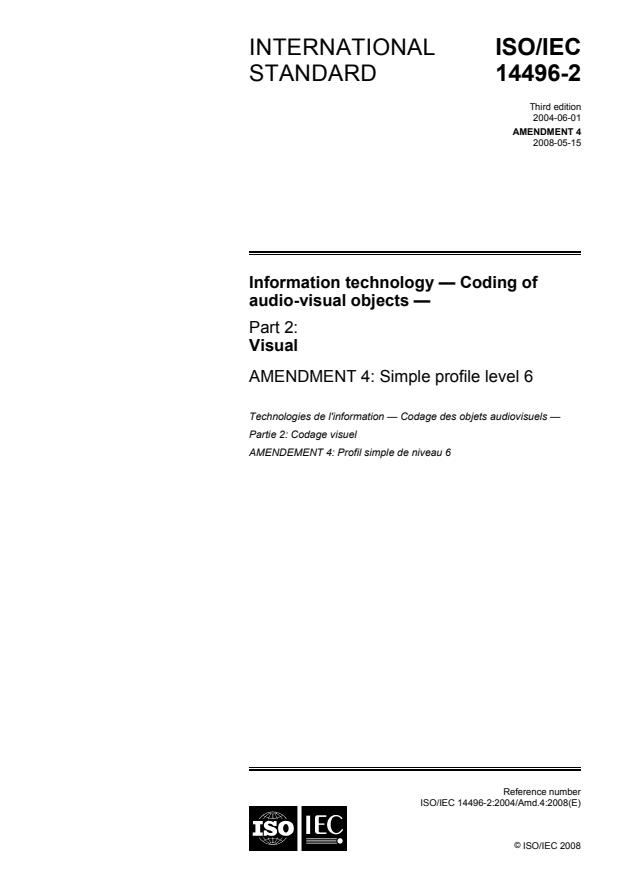
INTERNATIONAL ISO/IEC
STANDARD 14496-2
Third edition
2004-06-01
AMENDMENT 4
2008-05-15
Information technology — Coding of
audio-visual objects —
Part 2:
Visual
AMENDMENT 4: Simple profile level 6
Technologies de l'information — Codage des objets audiovisuels —
Partie 2: Codage visuel
AMENDEMENT 4: Profil simple de niveau 6
Reference number
ISO/IEC 14496-2:2004/Amd.4:2008(E)
©
ISO/IEC 2008
ISO/IEC 14496-2:2004/Amd.4:2008(E)
PDF disclaimer
This PDF file may contain embedded typefaces. In accordance with Adobe's licensing policy, this file may be printed or viewed but
shall not be edited unless the typefaces which are embedded are licensed to and installed on the computer performing the editing. In
downloading this file, parties accept therein the responsibility of not infringing Adobe's licensing policy. The ISO Central Secretariat
accepts no liability in this area.
Adobe is a trademark of Adobe Systems Incorporated.
Details of the software products used to create this PDF file can be found in the General Info relative to the file; the PDF-creation
parameters were optimized for printing. Every care has been taken to ensure that the file is suitable for use by ISO member bodies. In
the unlikely event that a problem relating to it is found, please inform the Central Secretariat at the address given below.
© ISO/IEC 2008
All rights reserved. Unless otherwise specified, no part of this publication may be reproduced or utilized in any form or by any means,
electronic or mechanical, including photocopying and microfilm, without permission in writing from either ISO at the address below or
ISO's member body in the country of the requester.
ISO copyright office
Case postale 56 • CH-1211 Geneva 20
Tel. + 41 22 749 01 11
Fax + 41 22 749 09 47
E-mail copyright@iso.org
Web www.iso.org
Published in Switzerland
ii © ISO/IEC 2008 – All rights reserved
ISO/IEC 14496-2:2004/Amd.4:2008(E)
Foreword
ISO (the International Organization for Standardization) and IEC (the International Electrotechnical
Commission) form the specialized system for worldwide standardization. National bodies that are members of
ISO or IEC participate in the development of International Standards through technical committees
established by the respective organization to deal with particular
...