


ISO/FDIS 877-3
(Main)Plastics — Methods of exposure to solar radiation — Part 3: Intensified weathering using concentrated solar radiation
Plastics — Methods of exposure to solar radiation — Part 3: Intensified weathering using concentrated solar radiation
ISO 877-3:2018 specifies a method for exposing plastics to concentrated solar radiation using reflecting concentrators to accelerate the weathering processes. The purpose is to assess property changes produced after specified stages of such exposures. The reflecting concentrators used in these exposures are sometimes referred to as "Fresnel reflectors" because in cross-section the array of mirrors used to concentrate the solar radiation resembles the cross-section of a Fresnel lens. General guidance concerning the scope of the ISO 877 series is given in ISO 877‑1. NOTE Additional information about solar concentrating exposures, including a partial list of standards in which they are specified, is given in the Bibliography.
Plastiques — Méthodes d'exposition au rayonnement solaire — Partie 3: Exposition intensifiée par rayonnement solaire concentré
ISO 877-3:2018 spécifie une méthode d'exposition des plastiques à un rayonnement solaire concentré à l'aide de concentrateurs réfléchissants pour accélérer le processus d'exposition aux intempéries. L'objectif consiste à évaluer les changements produits après des phases d'exposition spécifiées. Les concentrateurs réfléchissants utilisés dans ces essais d'exposition sont parfois désignés sous le nom de «miroirs de Fresnel» car, vu en coupe transversale, le jeu de miroirs utilisé pour concentrer le rayonnement solaire ressemble à la coupe transversale d'une lentille de Fresnel. Des lignes directrices générales relatives au domaine d'application de la série ISO 877 sont données dans l'ISO 877‑1. NOTE Des informations supplémentaires concernant les essais d'exposition à un rayonnement solaire concentré, y compris une liste partielle des normes dans lesquelles ils sont spécifiés, sont données dans la Bibliographie.
General Information
- Status
- Not Published
- Technical Committee
- ISO/TC 61/SC 6 - Ageing, chemical and environmental resistance
- Drafting Committee
- ISO/TC 61/SC 6/WG 2 - Exposure to light
- Current Stage
- 5020 - FDIS ballot initiated: 2 months. Proof sent to secretariat
- Start Date
- 20-Feb-2026
- Completion Date
- 20-Feb-2026
Relations
- Effective Date
- 12-Feb-2026
- Effective Date
- 28-Oct-2023
- Effective Date
- 21-Oct-2023
Overview
ISO/FDIS 877-3:2026, published by the International Organization for Standardization (ISO), specifies methods for exposing plastics to concentrated solar radiation using reflecting concentrators. These devices, often called "Fresnel reflectors," concentrate natural sunlight onto test specimens, accelerating weathering processes to evaluate changes in material properties. This accelerated testing approach allows for a faster assessment of plastics’ resistance to environmental factors, simulating years of natural weathering in a much shorter timeframe. The standard is part of the broader ISO 877 series, which addresses various methods of exposing plastics to solar radiation.
Key Topics
- Accelerated Weathering of Plastics: Using concentrated solar radiation to speed up the environmental aging process of plastics.
- Use of Reflecting Concentrators: Arrays of mirrors (Fresnel reflectors) focus sunlight onto test specimens, intensifying exposure.
- Test Conditions: The standard details requirements for apparatus, specimen preparation, exposure site selection, mirror orientation, temperature control, and irradiance level.
- Climatic Control: Factors such as air flow, relative humidity, and temperature monitoring are included to replicate realistic outdoor conditions while focusing solar exposure for maximum effect.
- Exposure Stages: Test durations and exposures are defined in terms of total solar radiant exposure or solar UV radiant exposure, using established measurement techniques.
- Water Spray Cycles: The standard includes several water spray cycles to simulate the effects of moisture, further enhancing the realism of the accelerated aging process.
Applications
ISO/FDIS 877-3 is essential for industries where plastics are exposed to outdoor environments and need proven durability, such as:
- Automotive: Testing exterior plastics, coatings, and optical parts for weather resistance.
- Construction: Evaluating the long-term performance of building materials like window profiles, claddings, and sealants.
- Packaging: Accelerated assessment of plastic packaging under UV and climatic stresses.
- Consumer Products: Ensuring durability of outdoor equipment, garden tools, and furniture.
- Material Development: Comparative evaluation of new plastic formulations, additives, or UV stabilizers for extended service life.
Using this standard, laboratories can rapidly predict how a plastic product or component will perform after prolonged exposure to intense sunlight and weathering, helping manufacturers improve product design, meet regulatory requirements, and accelerate time-to-market for new materials.
Related Standards
- ISO 877-1: Plastics - Methods of exposure to solar radiation - Part 1: General guidance. Offers foundational concepts and requirements for the series.
- ISO 877-2: Plastics - Methods of exposure to solar radiation - Part 2: Direct weathering and exposure behind window glass. Describes less intensive, more typical outdoor exposures.
- ISO 4892-1: Plastics - Methods of exposure to laboratory light sources - Part 1: General guidance and requirements. Covers laboratory-based weathering.
- ASTM G90: Standard Practice for Performing Accelerated Outdoor Weathering of Nonmetallic Materials Using Concentrated Natural Sunlight. Referenced for apparatus and procedures in ISO/FDIS 877-3.
- ASTM G179: Specification for Black/White Panel Temperature Devices in Weathering Tests, for temperature measurement.
- ISO 4582 and ISO 9370: For determination of color changes, property variations, and instrumental measurement of radiant exposure.
ISO/FDIS 877-3:2026 provides a robust, internationally harmonized method for the accelerated outdoor weathering of plastics, enabling reliable material performance evaluation under intensified solar radiation conditions.
Buy Documents
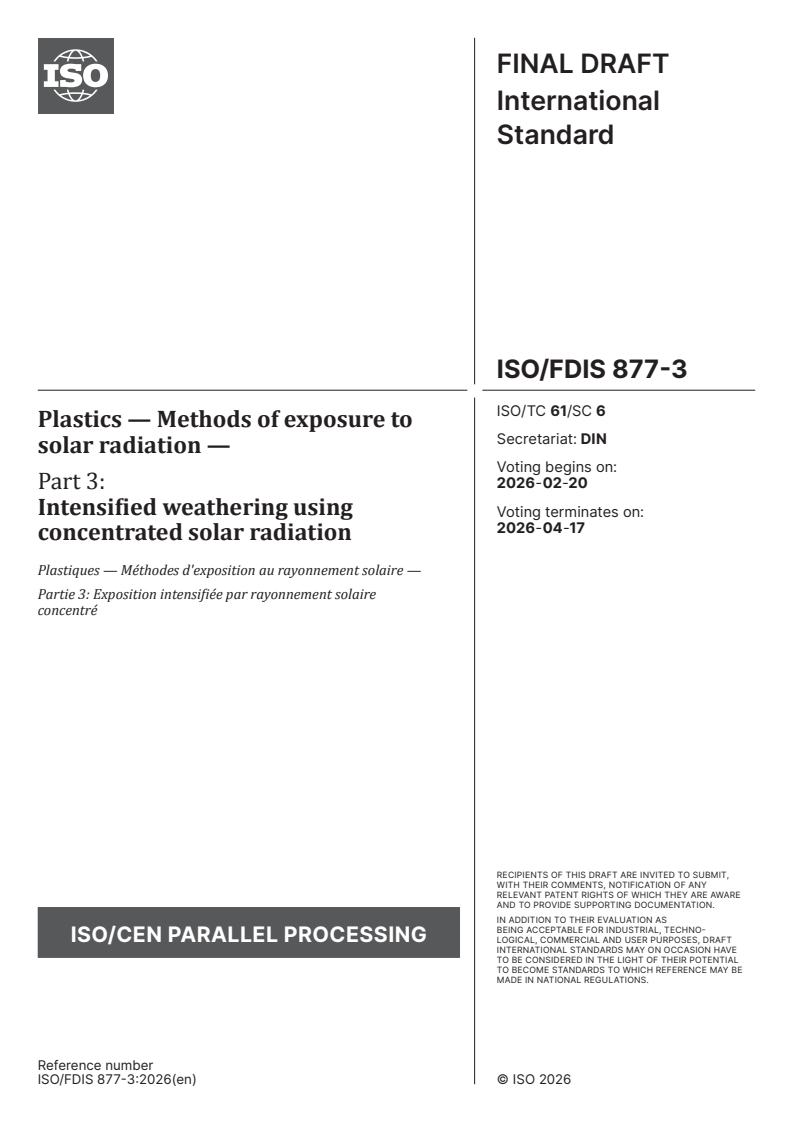

ISO/FDIS 877-3 - Plastics — Methods of exposure to solar radiation — Part 3: Intensified weathering using concentrated solar radiation Released:6. 02. 2026
REDLINE ISO/FDIS 877-3 - Plastics — Methods of exposure to solar radiation — Part 3: Intensified weathering using concentrated solar radiation Released:6. 02. 2026

ISO/FDIS 877-3 - Plastiques — Méthodes d'exposition au rayonnement solaire — Partie 3: Exposition intensifiée par rayonnement solaire concentré
Get Certified
Connect with accredited certification bodies for this standard

Smithers Quality Assessments
US management systems and product certification.

DIN CERTCO
DIN Group product certification.
Sponsored listings
Frequently Asked Questions
ISO/FDIS 877-3 is a draft published by the International Organization for Standardization (ISO). Its full title is "Plastics — Methods of exposure to solar radiation — Part 3: Intensified weathering using concentrated solar radiation". This standard covers: ISO 877-3:2018 specifies a method for exposing plastics to concentrated solar radiation using reflecting concentrators to accelerate the weathering processes. The purpose is to assess property changes produced after specified stages of such exposures. The reflecting concentrators used in these exposures are sometimes referred to as "Fresnel reflectors" because in cross-section the array of mirrors used to concentrate the solar radiation resembles the cross-section of a Fresnel lens. General guidance concerning the scope of the ISO 877 series is given in ISO 877‑1. NOTE Additional information about solar concentrating exposures, including a partial list of standards in which they are specified, is given in the Bibliography.
ISO 877-3:2018 specifies a method for exposing plastics to concentrated solar radiation using reflecting concentrators to accelerate the weathering processes. The purpose is to assess property changes produced after specified stages of such exposures. The reflecting concentrators used in these exposures are sometimes referred to as "Fresnel reflectors" because in cross-section the array of mirrors used to concentrate the solar radiation resembles the cross-section of a Fresnel lens. General guidance concerning the scope of the ISO 877 series is given in ISO 877‑1. NOTE Additional information about solar concentrating exposures, including a partial list of standards in which they are specified, is given in the Bibliography.
ISO/FDIS 877-3 is classified under the following ICS (International Classification for Standards) categories: 83.080.01 - Plastics in general. The ICS classification helps identify the subject area and facilitates finding related standards.
ISO/FDIS 877-3 has the following relationships with other standards: It is inter standard links to FprEN ISO 877-3, ISO 7870-2:2023, ISO 877-3:2018. Understanding these relationships helps ensure you are using the most current and applicable version of the standard.
ISO/FDIS 877-3 is available in PDF format for immediate download after purchase. The document can be added to your cart and obtained through the secure checkout process. Digital delivery ensures instant access to the complete standard document.
Standards Content (Sample)
FINAL DRAFT
International
Standard
ISO/TC 61/SC 6
Plastics — Methods of exposure to
Secretariat: DIN
solar radiation —
Voting begins on:
2026-02-20
Part 3:
Intensified weathering using
Voting terminates on:
2026-04-17
concentrated solar radiation
Plastiques — Méthodes d'exposition au rayonnement solaire —
Partie 3: Exposition intensifiée par rayonnement solaire
concentré
RECIPIENTS OF THIS DRAFT ARE INVITED TO SUBMIT,
WITH THEIR COMMENTS, NOTIFICATION OF ANY
RELEVANT PATENT RIGHTS OF WHICH THEY ARE AWARE
AND TO PROVIDE SUPPOR TING DOCUMENTATION.
IN ADDITION TO THEIR EVALUATION AS
BEING ACCEPTABLE FOR INDUSTRIAL, TECHNO-
ISO/CEN PARALLEL PROCESSING LOGICAL, COMMERCIAL AND USER PURPOSES, DRAFT
INTERNATIONAL STANDARDS MAY ON OCCASION HAVE
TO BE CONSIDERED IN THE LIGHT OF THEIR POTENTIAL
TO BECOME STAN DARDS TO WHICH REFERENCE MAY BE
MADE IN NATIONAL REGULATIONS.
Reference number
FINAL DRAFT
International
Standard
ISO/TC 61/SC 6
Plastics — Methods of exposure to
Secretariat: DIN
solar radiation —
Voting begins on:
Part 3:
Intensified weathering using
Voting terminates on:
concentrated solar radiation
Plastiques — Méthodes d'exposition au rayonnement solaire —
Partie 3: Exposition intensifiée par rayonnement solaire
concentré
RECIPIENTS OF THIS DRAFT ARE INVITED TO SUBMIT,
WITH THEIR COMMENTS, NOTIFICATION OF ANY
RELEVANT PATENT RIGHTS OF WHICH THEY ARE AWARE
AND TO PROVIDE SUPPOR TING DOCUMENTATION.
© ISO 2026
IN ADDITION TO THEIR EVALUATION AS
All rights reserved. Unless otherwise specified, or required in the context of its implementation, no part of this publication may
BEING ACCEPTABLE FOR INDUSTRIAL, TECHNO-
ISO/CEN PARALLEL PROCESSING
LOGICAL, COMMERCIAL AND USER PURPOSES, DRAFT
be reproduced or utilized otherwise in any form or by any means, electronic or mechanical, including photocopying, or posting on
INTERNATIONAL STANDARDS MAY ON OCCASION HAVE
the internet or an intranet, without prior written permission. Permission can be requested from either ISO at the address below
TO BE CONSIDERED IN THE LIGHT OF THEIR POTENTIAL
or ISO’s member body in the country of the requester.
TO BECOME STAN DARDS TO WHICH REFERENCE MAY BE
MADE IN NATIONAL REGULATIONS.
ISO copyright office
CP 401 • Ch. de Blandonnet 8
CH-1214 Vernier, Geneva
Phone: +41 22 749 01 11
Email: copyright@iso.org
Website: www.iso.org
Published in Switzerland Reference number
ii
Contents Page
Foreword .iv
1 Scope . 1
2 Normative references . 1
3 Terms and definitions . 1
4 Principle . 1
5 Apparatus . 2
5.1 General requirements .2
5.2 Apparatus for measurement of climatic factors .3
6 Test specimens . 3
7 Exposure conditions . 4
7.1 Orientation of mirrors .4
7.2 Exposure site.4
7.3 Temperature control .4
7.4 Irradiance level .5
8 Exposure stages . 6
8.1 General .6
8.2 Solar radiant exposure .6
8.2.1 Guidance for selection of the exposure stage .6
8.2.2 Instrumental measurement of solar radiant exposure .6
9 Procedure . 7
9.1 Mounting of test specimens .7
9.2 Mounting of reference materials (if used) .7
9.3 Climatic observations .7
9.4 Exposure of test specimens .7
9.4.1 General .7
9.4.2 Exposure cycles .7
9.4.3 Testing under glass.7
10 Expression of results . 8
10.1 Determination of changes in properties .8
10.2 Climatic conditions and observations .8
10.2.1 General .8
10.2.2 Temperature .8
10.2.3 Relative humidity .8
10.2.4 Levels (values) of exposure stages .8
10.2.5 Radiation measurement.9
10.2.6 Precipitation .9
10.2.7 Time of wetness .9
10.2.8 Other observations .9
11 Test report . 9
Bibliography .10
iii
Foreword
ISO (the International Organization for Standardization) is a worldwide federation of national standards
bodies (ISO member bodies). The work of preparing International Standards is normally carried out through
ISO technical committees. Each member body interested in a subject for which a technical committee
has been established has the right to be represented on that committee. International organizations,
governmental and non-governmental, in liaison with ISO, also take part in the work. ISO collaborates closely
with the International Electrotechnical Commission (IEC) on all matters of electrotechnical standardization.
The procedures used to develop this document and those intended for its further maintenance are described
in the ISO/IEC Directives, Part 1. In particular, the different approval criteria needed for the different types
of ISO documents should be noted. This document was drafted in accordance with the editorial rules of the
ISO/IEC Directives, Part 2 (see www.iso.org/directives).
ISO draws attention to the possibility that the implementation of this document may involve the use of (a)
patent(s). ISO takes no position concerning the evidence, validity or applicability of any claimed patent
rights in respect thereof. As of the date of publication of this document, ISO had received notice of (a)
patent(s) which may be required to implement this document. However, implementers are cautioned that
this may not represent the latest information, which may be obtained from the patent database available at
www.iso.org/patents. ISO shall not be held responsible for identifying any or all such patent rights.
Any trade name used in this document is information given for the convenience of users and does not
constitute an endorsement.
For an explanation of the voluntary nature of standards, the meaning of ISO specific terms and expressions
related to conformity assessment, as well as information about ISO's adherence to the World Trade
Organization (WTO) principles in the Technical Barriers to Trade (TBT), see www.iso.org/iso/foreword.html.
This document was prepared by Technical Committee ISO/TC 61, Plastics, Subcommittee SC 6, Ageing,
chemical and environmental resistance, in collaboration with the European Committee for Standardization
(CEN) Technical Committee CEN/TC 249, Plastics, in accordance with the Agreement on technical cooperation
between ISO and CEN (Vienna Agreement).
This third edition cancels and replaces the second edition (ISO 877-3:2018), which has been technically
revised.
The main changes are as follows:
— size requirements in 7.3 have been added;
— in 10.2.4, a second formula has been added;
— a new 10.2.5 “Radiation measurement” has been added and subsequent clauses have been renumbered.
A list of all parts in the ISO 877 series can be found on the ISO website.
Any feedback or questions on this document should be directed to the user’s national standards body. A
complete listing of these bodies can be found at www.iso.org/members.html.
iv
FINAL DRAFT International Standard ISO/FDIS 877-3:2026(en)
Plastics — Methods of exposure to solar radiation —
Part 3:
Intensified weathering using concentrated solar radiation
1 Scope
This document specifies a method for exposing plastics to concentrated solar radiation using reflecting
concentrators to accelerate the weathering processes. The purpose is to assess property changes produced
after specified stages of such exposures. The reflecting concentrators used in these exposures are sometimes
referred to as “Fresnel reflectors” because, in cross-section, the array of mirrors used to concentrate the
solar radiation resembles the cross-section of a Fresnel lens.
General guidance concerning the scope of the ISO 877 series is given in ISO 877-1.
NOTE Additional information about solar concentrating exposures, including a partial list of standards in which
they are specified, is given in the Bibliography.
2 Normative references
The following documents are referred to in the text in such a way that some or all of their content constitutes
requirements of this document. For dated references, only the edition cited applies. For undated references,
the latest edition of the referenced document (including any amendments) applies.
ISO 877-1, Plastics — Methods of exposure to solar radiation — Part 1: General guidance
ISO 877-2:2025, Plastics — Methods of exposure to solar radiation — Part 2: Direct weathering and exposure
behind window glass
ISO 4892-1, Plastics — Methods of exposure to laboratory light sources — Part 1: General guidance and
requirements
ASTM G90, Standard Practice for Performing Accelerated Outdoor Weathering of Nonmetallic Materials Using
Concentrated Natural Sunlight
ASTM G179, Standard Specification for Metal Black Panel and White Panel Temperature Devices for Natural
Weathering Tests
3 Terms and definitions
No terms and definitions are listed in this document.
ISO and IEC maintain terminology databases for use in standardization at the following addresses:
— ISO Online browsing platform: available at https:// www .iso .org/ obp
— IEC Electropedia: available at https:// www .electropedia .org/
4 Principle
This document describes a method for performing accelerated weathering on plastics using intensified solar
radiation. General guidance is given in ISO 877-1.
5 Apparatus
5.1 General requirements
General requirements shall be in accordance with ISO 877-1.
All requirements for the solar concentrating device, operation of the device and measurement of the solar
radiation within the specimen exposure area shall be in accordance with ASTM G90. See Figures 1 and 2 for
schematic diagrams of the two types of test apparatus.
Key
1 air plenum
2 air blower
3 rotor assembly
4 air deflector
5 A-frame assembly
6 mirror
7 gear box
8 mast for manual elevation adjustment
9 air flow switch
10 water spray nozzles
11 clutch disc for elevation drive
12 solar cells with shadow hat
13 specimen protection door
14 door release mechanism
Figure 1 — Schematic diagram of test apparatus with single-axis tracking
and manual elevation adjustment
Key
1 air plenum
2 air blower
3 rotor assembly
4 turntable assembly
5 A-frame assembly
6 mirror
7 gear box for elevation drive
8 control box
9 gear box for azimuth drive
10 air flow switch
11 water spray nozzles
12 clutch disc for elevation drive
13 solar cells with shadow hat
14 specimen protection door
15 door release mechanism
16 air deflector
Figure 2 — Schematic diagram of test apparatus with dual-axis tracking
5.2 Apparatus for measurement of climatic factors
The apparatus for measurement of climatic factors shall be in accordance with ISO 877-1.
6 Test specimens
Test specimens shall be in accordance with ISO 877-1.
NOTE When irregularly shaped specimens are used, air flow and specimen cooling can be adversely affected. In
addition, irradiance will not be uniform on all surfaces of a shaped specimen.
7 Exposure conditions
7.1 Orientation of mirrors
The orientation of th
...
ISO/TC 61/SC 6
Secretariat: DIN
Date: 2026-01-0802-05
Plastics — Methods of exposure to solar radiation — —
Part 3:
Intensified weathering using concentrated solar radiation
Plastiques — Méthodes d'exposition au rayonnement solaire — —
Partie 3: Exposition intensifiée par rayonnement solaire concentré
FDIS stage
ThiThiThiThiThiThis drs drs drs drs drs drafafafafafaft is t is t is t is t is t is submitted tsubmitted tsubmitted tsubmitted tsubmitted tsubmitted toooooo a a a a a a p p p p p parallel arallel arallel arallel arallel arallel vovovovovovote in ISOte in ISOte in ISOte in ISOte in ISOte in ISO, CE, CE, CE, CE, CE, CEN.N.N.N.N.N.
All rights reserved. Unless otherwise specified, or required in the context of its implementation, no part of this publication
may be reproduced or utilized otherwise in any form or by any means, electronic or mechanical, including photocopying,
or posting on the internet or an intranet, without prior written permission. Permission can be requested from either ISO
at the address below or ISO’s member body in the country of the requester.
ISO copyright office
CP 401 • Ch. de Blandonnet 8
CH-1214 Vernier, Geneva
Phone: + 41 22 749 01 11
EmailE-mail: copyright@iso.org
Website: www.iso.org
Published in Switzerland
© ISO #### 2026 – All rights reserved
ii
Contents
Foreword . iv
1 Scope . 1
2 Normative references . 1
3 Terms and definitions . 1
4 Principle . 2
5 Apparatus . 2
5.1 General requirements . 2
5.2 Apparatus for measurement of climatic factors . 6
6 Test specimens . 6
7 Exposure conditions . 6
7.1 Orientation of mirrors . 6
7.2 Exposure site . 6
7.3 Temperature control . 6
7.4 Irradiance level . 9
8 Exposure stages . 10
8.1 General . 10
8.2 Solar radiant exposure . 10
9 Procedure . 11
9.1 Mounting of test specimens . 11
9.2 Mounting of reference materials (if used) . 11
9.3 Climatic observations . 11
9.4 Exposure of test specimens . 11
10 Expression of results . 12
10.1 Determination of changes in properties . 12
10.2 Climatic conditions and observations . 12
11 Test report . 13
Bibliography . 14
iii
Foreword
ISO (the International Organization for Standardization) is a worldwide federation of national standards
bodies (ISO member bodies). The work of preparing International Standards is normally carried out through
ISO technical committees. Each member body interested in a subject for which a technical committee has been
established has the right to be represented on that committee. International organizations, governmental and
non-governmental, in liaison with ISO, also take part in the work. ISO collaborates closely with the
International Electrotechnical Commission (IEC) on all matters of electrotechnical standardization.
The procedures used to develop this document and those intended for its further maintenance are described
in the ISO/IEC Directives, Part 1. In particular, the different approval criteria needed for the different types of
ISO documents should be noted. This document was drafted in accordance with the editorial rules of the
ISO/IEC Directives, Part 2 (see www.iso.org/directives).
ISO draws attention to the possibility that the implementation of this document may involve the use of (a)
patent(s). ISO takes no position concerning the evidence, validity or applicability of any claimed patent rights
in respect thereof. As of the date of publication of this document, ISO had received notice of (a) patent(s) which
may be required to implement this document. However, implementers are cautioned that this may not
represent the latest information, which may be obtained from the patent database available at
www.iso.org/patents. ISO shall not be held responsible for identifying any or all such patent rights.
Any trade name used in this document is information given for the convenience of users and does not
constitute an endorsement.
For an explanation of the voluntary nature of standards, the meaning of ISO specific terms and expressions
related to conformity assessment, as well as information about ISO's adherence to the World Trade
Organization (WTO) principles in the Technical Barriers to Trade (TBT), see www.iso.org/iso/foreword.html.
This document was prepared by Technical Committee ISO/TC 61, Plastics, Subcommittee SC 6, Ageing,
chemical and environmental resistance, in collaboration with the European Committee for Standardization
(CEN) Technical Committee CEN/TC 249, Plastics, in accordance with the Agreement on technical cooperation
between ISO and CEN (Vienna Agreement).
This third edition cancels and replaces the second edition (ISO 877--3:2018), which has been technically
revised.
The main changes are as follows:
— — size requirements in 7.37.3 have been added;
— — in 10.2.410.2.4,, a second formula has been added;
— — a new 10.2.510.2.5 “Radiation measurement” has been added and subsequent clauses have been
renumbered.
A list of all parts in the ISO 877 series can be found on the ISO website.
Any feedback or questions on this document should be directed to the user’s national standards body. A
complete listing of these bodies can be found at www.iso.org/members.html.
© ISO #### 2026 – All rights reserved
iv
FINAL DRAFT International Standard ISO/FDIS 877-3:2026(en)
Plastics — Methods of exposure to solar radiation — —
Part 3:
Intensified weathering using concentrated solar radiation
1 Scope
This document specifies a method for exposing plastics to concentrated solar radiation using reflecting
concentrators to accelerate the weathering processes. The purpose is to assess property changes produced
after specified stages of such exposures. The reflecting concentrators used in these exposures are sometimes
referred to as “Fresnel reflectors” because, in cross-section, the array of mirrors used to concentrate the solar
radiation resembles the cross-section of a Fresnel lens.
General guidance concerning the scope of the ISO 877 series is given in ISO 877--1.
NOTE Additional information about solar concentrating exposures, including a partial list of standards in which they
are specified, is given in the Bibliography.
2 Normative references
The following documents are referred to in the text in such a way that some or all of their content constitutes
requirements of this document. For dated references, only the edition cited applies. For undated references,
the latest edition of the referenced document (including any amendments) applies.
ISO 877--1, Plastics — Methods of exposure to solar radiation — Part 1: General guidance
ISO 877--2:2025, Plastics — Methods of exposure to solar radiation — Part 2: Direct weathering and exposure
behind window glass
ISO 4892--1, Plastics — Methods of exposure to laboratory light sources — Part 1: General guidance and
requirements
ASTM G90, Standard Practice for Performing Accelerated Outdoor Weathering of Nonmetallic Materials Using
Concentrated Natural Sunlight
ASTM G179, Standard Specification for Metal Black Panel and White Panel Temperature Devices for Natural
Weathering Tests
3 Terms and definitions
No terms and definitions are listed in this document.
ISO and IEC maintain terminology databases for use in standardization at the following addresses:
— — ISO Online browsing platform: available at https://www.iso.org/obp
— — IEC Electropedia: available at https://www.electropedia.org/
4 Principle
This document describes a method for performing accelerated weathering on plastics using intensified solar
radiation. General guidance is given in ISO 877--1.
5 Apparatus
5.1 General requirements
General requirements shall be in accordance with ISO 877--1.
All requirements for the solar concentrating device, operation of the device and measurement of the solar
radiation within the specimen exposure area shall be in accordance with ASTM G90. See Figures 1Figures 1
and 22 for schematic diagrams of the two types of test apparatus.
© ISO #### 2026 – All rights reserved
Key
1 air plenum
2 air blower
3 rotor assembly
4 air deflector
5 A-frame assembly
6 mirror
7 gear box
8 mast for manual elevation adjustment
9 air flow switch
10 water spray nozzles
11 clutch disc for elevation drive
12 solar cells with shadow hat
13 specimen protection door
14 door release mechanism
Figure 1 — Schematic diagram of test apparatus with single-axis tracking
and manual elevation adjustment
© ISO #### 2026 – All rights reserved
Key
1 air plenum
2 air blower
3 rotor assembly
4 turntable assembly
5 A-frame assembly
6 mirror
7 gear box for elevation drive
8 control box
9 gear box for azimuth drive
10 air flow switch
11 water spray nozzles
12 clutch disc for elevation drive
13 solar cells with shadow hat
14 specimen protection door
15 door release mechanism
16 air deflector
Figure 2 — Schematic diagram of test apparatus with dual-axis tracking
5.2 Apparatus for measurement of climatic factors
The apparatus for measurement of climatic factors shall be in accordance with ISO 877--1.
6 Test specimens
Test specimens shall be in accordance with ISO 877--1.
NOTE When irregularly shaped specimens are used, air flow and specimen cooling can be adversely affected. In
addition, irradiance will not be uniform on all surfaces of a shaped specimen.
7 Exposure conditions
7.1 Orientation of mirrors
The orientation of the mirrors shall be in accordance with ASTM G90.
7.2 Exposure site
Fresnel-reflecting solar concentrating devices operate most effectively at locations that receive at least 3 500 h
of sunshine per year and where the average daytime relative humidity is less than 30 %. ASTM G90 provides
requirements for the exposure site’s average ratio of direct solar radiation to global normal solar radiation.
NOTE In regions that receive 3 500 h of solar radiation and where the average daytime relative humidity is less than
30 %, the average ratio of direct solar radiation to global normal solar radiation is at least 0,75. Areas that meet these
criteria have a minimum diffuse component of solar radiation (sky radiation). The use of reflecting solar concentrator
devices in regions of moderate to high diffuse solar irradiance will substantially reduce the amount of UV radiation at the
specimen target board. Moderate to high levels of humidity and urban aerosols result in scattering of the direct
component of solar radiation so that ultraviolet radiation is scattered into the hemispherical sky dome and is not
available to be focused by the mirrors on to the specimen target board. This is shown in Figure 3Figure 3. In addition,
the use of reflecting solar concentrator devices in regions of moderate to high diffuse solar irradiance can give different
stability rankings for materials compared to exposures conducted in accordance with ISO 877--2 because of the
differences in UV radiation.
7.3 Temperature control
Solar concentrating devices are equipped with a blower to cool the specimens. Specimen temperatures for
most materials are typically 10 °C higher than the maximum temperature which would be reached if an
identical specimen was exposed directly to solar radiation (without concentration) at normal incidence at the
same time.
© ISO #### 2026 – All rights reserved
If more precise control of specimen temperature is required, the temperature of a black or white panel, the
temperature of a black or white standard thermometer, the temperature of a particular specimen, the air
temperature or the temperature indicated by a remote sensor may be monitored and used as an input to
control the specimen temperature. If used, report the controlled temperature and any observed deviations in
the test report.
Use of this method of temperature control can produce results that are not equivalent to typical solar
concentrating exposures and can require longer radiant exposures to produce the same amou
...
PROJET FINAL
Norme
internationale
ISO/TC 61/SC 6
Plastiques — Méthodes d'exposition
Secrétariat: DIN
au rayonnement solaire —
Début de vote:
2026-02-20
Partie 3:
Exposition intensifiée par
Vote clos le:
2026-04-17
rayonnement solaire concentré
Plastics — Methods of exposure to solar radiation —
Part 3: Intensified weathering using concentrated solar radiation
LES DESTINATAIRES DU PRÉSENT PROJET SONT
INVITÉS À PRÉSENTER, AVEC LEURS OBSERVATIONS,
NOTIFICATION DES DROITS DE PROPRIÉTÉ DONT ILS
AURAIENT ÉVENTUELLEMENT CONNAISSANCE ET À
FOURNIR UNE DOCUMENTATION EXPLICATIVE.
OUTRE LE FAIT D’ÊTRE EXAMINÉS POUR
ÉTABLIR S’ILS SONT ACCEPTABLES À DES FINS
INDUSTRIELLES, TECHNOLOGIQUES ET COM-MERCIALES,
AINSI QUE DU POINT DE VUE DES UTILISATEURS, LES
PROJETS DE NORMES
TRAITEMENT PARALLÈLE ISO/CEN
INTERNATIONALES DOIVENT PARFOIS ÊTRE CONSIDÉRÉS
DU POINT DE VUE DE LEUR POSSI BILITÉ DE DEVENIR DES
NORMES POUVANT
SERVIR DE RÉFÉRENCE DANS LA RÉGLEMENTATION
NATIONALE.
Numéro de référence
PROJET FINAL
Norme
internationale
ISO/TC 61/SC 6
Plastiques — Méthodes d'exposition
Secrétariat: DIN
au rayonnement solaire —
Début de vote:
Partie 3: 2026-02-20
Exposition intensifiée par
Vote clos le:
2026-04-17
rayonnement solaire concentré
Plastics — Methods of exposure to solar radiation —
Part 3: Intensified weathering using concentrated solar radiation
LES DESTINATAIRES DU PRÉSENT PROJET SONT
INVITÉS À PRÉSENTER, AVEC LEURS OBSERVATIONS,
NOTIFICATION DES DROITS DE PROPRIÉTÉ DONT ILS
AURAIENT ÉVENTUELLEMENT CONNAISSANCE ET À
FOURNIR UNE DOCUMENTATION EXPLICATIVE.
DOCUMENT PROTÉGÉ PAR COPYRIGHT
OUTRE LE FAIT D’ÊTRE EXAMINÉS POUR
ÉTABLIR S’ILS SONT ACCEPTABLES À DES FINS
© ISO 2026 INDUSTRIELLES, TECHNOLOGIQUES ET COM-MERCIALES,
AINSI QUE DU POINT DE VUE DES UTILISATEURS, LES
Tous droits réservés. Sauf prescription différente ou nécessité dans le contexte de sa mise en œuvre, aucune partie de cette
PROJETS DE NORMES
TRAITEMENT PARALLÈLE ISO/CEN
INTERNATIONALES DOIVENT PARFOIS ÊTRE CONSIDÉRÉS
publication ne peut être reproduite ni utilisée sous quelque forme que ce soit et par aucun procédé, électronique ou mécanique,
DU POINT DE VUE DE LEUR POSSI BILITÉ DE DEVENIR DES
y compris la photocopie, ou la diffusion sur l’internet ou sur un intranet, sans autorisation écrite préalable. Une autorisation peut
NORMES POUVANT
être demandée à l’ISO à l’adresse ci-après ou au comité membre de l’ISO dans le pays du demandeur.
SERVIR DE RÉFÉRENCE DANS LA RÉGLEMENTATION
NATIONALE.
ISO copyright office
Case postale 401 • Ch. de Blandonnet 8
CH-1214 Vernier, Genève
Tél.: +41 22 749 01 11
E-mail: copyright@iso.org
Web: www.iso.org
Publié en Suisse Numéro de référence
ii
Sommaire Page
Avant-propos .iv
1 Domaine d’application . 1
2 Références normatives . 1
3 Termes et définitions . 1
4 Principe. 2
5 Appareillage . 2
5.1 Exigences générales .2
5.2 Appareillage pour le mesurage des facteurs climatiques .3
6 Éprouvettes. 4
7 Conditions d’exposition . 4
7.1 Orientation des miroirs .4
7.2 Site d’exposition.4
7.3 Contrôle de la température .4
7.4 Niveau d’irradiance .5
8 Phases d’exposition . 6
8.1 Généralités .6
8.2 Exposition énergétique solaire .6
8.2.1 Lignes directrices pour la sélection de la phase d’exposition .6
8.2.2 Mesurage de l’exposition énergétique solaire au moyen d’instruments .6
9 Mode opératoire . 7
9.1 Montage des éprouvettes .7
9.2 Montage des matériaux de référence (s’ils sont utilisés) .7
9.3 Observations climatiques .7
9.4 Exposition des éprouvettes .7
9.4.1 Généralités .7
9.4.2 Cycles d’exposition . .7
9.4.3 Essai d’exposition sous verre .7
10 Expression des résultats . 8
10.1 Détermination des modifications de propriétés .8
10.2 Conditions climatiques et observations .8
10.2.1 Généralités .8
10.2.2 Température .8
10.2.3 Humidité relative .8
10.2.4 Niveaux (valeurs) des phases d’exposition .8
10.2.5 Mesurage du rayonnement .9
10.2.6 Précipitations .9
10.2.7 Durée du temps humide .9
10.2.8 Autres observations .9
11 Rapport d’essai . 9
Bibliographie .11
iii
Avant-propos
L’ISO (Organisation internationale de normalisation) est une fédération mondiale d’organismes nationaux
de normalisation (comités membres de l’ISO). L’élaboration des Normes internationales est en général
confiée aux comités techniques de l’ISO. Chaque comité membre intéressé par une étude a le droit de faire
partie du comité technique créé à cet effet. Les organisations internationales, gouvernementales et non
gouvernementales, en liaison avec l’ISO participent également aux travaux. L’ISO collabore étroitement avec
la Commission électrotechnique internationale (IEC) en ce qui concerne la normalisation électrotechnique.
Les procédures utilisées pour élaborer le présent document et celles destinées à sa mise à jour sont
décrites dans les Directives ISO/IEC, Partie 1. Il convient, en particulier, de prendre note des différents
critères d’approbation requis pour les différents types de documents ISO. Le présent document a
été rédigé conformément aux règles de rédaction données dans les Directives ISO/IEC, Partie 2 (voir
www.iso.org/directives).
L’ISO attire l’attention sur le fait que la mise en application du présent document peut entraîner l’utilisation
d’un ou de plusieurs brevets. L’ISO ne prend pas position quant à la preuve, à la validité et à l’applicabilité de
tout droit de brevet revendiqué à cet égard. À la date de publication du présent document, l’ISO n’avait pas
reçu notification qu’un ou plusieurs brevets pouvaient être nécessaires à sa mise en application. Toutefois,
il y a lieu d’avertir les responsables de la mise en application du présent document que des informations
plus récentes sont susceptibles de figurer dans la base de données de brevets, disponible à l’adresse
www.iso.org/brevets. L’ISO ne saurait être tenue pour responsable de ne pas avoir identifié tout ou partie de
tels droits de brevet.
Les appellations commerciales éventuellement mentionnées dans le présent document sont données pour
information, par souci de commodité, à l’intention des utilisateurs et ne sauraient constituer un engagement.
Pour une explication de la nature volontaire des normes, la signification des termes et expressions
spécifiques de l’ISO liés à l’évaluation de la conformité, ou pour toute information au sujet de l’adhésion de
l’ISO aux principes de l’Organisation mondiale du commerce (OMC) concernant les obstacles techniques au
commerce (OTC), voir www.iso.org/avant-propos.
Le présent document a été élaboré par le comité technique ISO/TC 61, Plastiques, sous-comité SC 6,
Vieillissement et résistance aux agents chimiques et environnants, en collaboration avec le comité technique
CEN/TC 249, Plastiques, du Comité européen de normalisation (CEN), conformément à l’Accord de
coopération technique entre l’ISO et le CEN (Accord de Vienne).
Cette troisième édition annule et remplace la deuxième édition (ISO 877-3:2018), qui a fait l’objet d’une
révision technique.
Les principales modifications sont les suivantes:
— des exigences relatives à la taille en 7.3 ont été ajoutées;
— en 10.2.4, une deuxième formule a été ajoutée;
— un nouveau paragraphe 10.2.5 «Mesurage du rayonnement» a été ajouté et les paragraphes qui suivent
ont été renumérotés.
Une liste de toutes les parties de la série ISO 877 se trouve sur le site web de l’ISO.
Il convient que l’utilisateur adresse tout retour d’information ou toute question concernant le présent
document à l’organisme national de normalisation de son pays. Une liste exhaustive desdits organismes se
trouve à l’adresse www.iso.org/fr/members.html.
iv
PROJET FINAL Norme internationale ISO/FDIS 877-3:2026(fr)
Plastiques — Méthodes d'exposition au rayonnement
solaire —
Partie 3:
Exposition intensifiée par rayonnement solaire concentré
1 Domaine d’application
Le présent document spécifie une méthode d’exposition des plastiques à un rayonnement solaire concentré
à l’aide de concentrateurs réfléchissants pour accélérer le processus d’exposition aux intempéries. L’objectif
consiste à évaluer les changements produits après des phases d’exposition spécifiées. Les concentrateurs
réfléchissants utilisés dans ces essais d’exposition sont parfois désignés sous le nom de «miroirs de Fresnel»
car, vu en coupe transversale, le jeu de miroirs utilisé pour concentrer le rayonnement solaire ressemble à la
coupe transversale d’une lentille de Fresnel.
Des lignes directrices générales relatives au domaine d’application de la série ISO 877 sont données dans
l’ISO 877-1.
NOTE Des informations supplémentaires concernant les essais d’exposition à un rayonnement solaire concentré,
y compris une liste partielle des normes dans lesquelles ils sont spécifiés, sont données dans la Bibliographie.
2 Références normatives
Les documents suivants cités dans le texte constituent, pour tout ou partie de leur contenu, des exigences du
présent document. Pour les références datées, seule l’édition citée s’applique. Pour les références non datées,
la dernière édition du document de référence s’applique (y compris les éventuels amendements).
ISO 877-1, Plastiques — Méthodes d'exposition au rayonnement solaire — Partie 1: Lignes directrices générales
ISO 877-2:2025, Plastiques — Méthodes d'exposition au rayonnement solaire — Partie 2: Exposition directe et
exposition derrière une vitre en verre
ISO 4892-1, Plastiques — Méthodes d'exposition à des sources lumineuses de laboratoire — Partie 1: Lignes
directrices générales et exigences
ASTM G90, Standard Practice for Performing Accelerated Outdoor Weathering of Nonmetallic Materials Using
Concentrated Natural Sunlight
ASTM G179, Standard Specification for Metal Black Panel and White Panel Temperature Devices for Natural
Weathering Tests
3 Termes et définitions
Aucun terme n’est défini dans le présent document.
L’ISO et l’IEC tiennent à jour des bases de données terminologiques destinées à être utilisées en normalisation,
consultables aux adresses suivantes:
— ISO Online browsing platform: disponible à l’adresse https:// www .iso .org/ obp
— IEC Electropedia: disponible à l’adresse https:// www .electropedia .org/
4 Principe
Le présent document décrit une méthode d’exposition accélérée des plastiques aux intempéries par
rayonnement solaire concentré. Des lignes directrices générales sont données dans l’ISO 877-1.
5 Appareillage
5.1 Exigences générales
Les exigences générales doivent être conformes à l’ISO 877-1.
Toutes les exigences relatives au concentrateur solaire, à son utilisation et au mesurage du rayonnement
solaire dans la zone d’exposition de l’éprouvette doivent être conformes à l’ASTM G90. Voir les Figures 1 et 2
pour les représentations schématiques des deux types d’appareillage d’essai.
Légende
1 conduite d’air
2 soufflerie
3 ensemble rotor
4 déflecteur d’air
5 cadre en A
6 miroir
7 motoréducteur
8 élévateur à réglage manuel
9 interrupteur de distribution de l’air
10 buses de pulvérisation d’eau
11 disque d’embrayage pour réglage de la hauteur
12 cellule solaire et chapeau d’ombrage
13 porte de protection de l’éprouvette
14 mécanisme de déclenchement de la porte
Figure 1 — Schéma de l’appareillage d’essai avec système de poursuite à axe unique et réglage
manuel de la hauteur
Légende
1 conduite d’air
2 soufflerie
3 ensemble rotor
4 pivot
5 cadre en A
6 miroir
7 motoréducteur pour réglage de hauteur
8 boîtier de commande
9 motoréducteur pour réglage de l’azimut
10 interrupteur de distribution de l’air
11 buses de pulvérisation d’eau
12 disque d’embrayage pour réglage de la hauteur
13 cellule solaire et chapeau d’ombrage
14 porte de protection de l’éprouvette
15 mécanisme de déclenchement de la porte
16 déflecteur d’air
Figure 2 — Schéma de l’appareillage d’essai avec système de poursuite à axes doubles
5.2 Appareillage pour le mesurage des facteurs climatiques
L’appareillage pour le mesurage des facteurs climatiques doit être conforme à l’ISO 877-1.
6 Éprouvettes
Les éprouvettes doivent être conformes à l’ISO 877-1.
NOTE Lorsque des éprouvettes de forme irrégulière sont utilisées, la circulation d’air et le refroidissement de
l’éprouvette peuvent être compromis. De plus, l’irradiance ne sera pas répartie uniformément sur toutes les surfaces
d’une éprouvette profilée.
7 Conditions d’exposition
7.1 Orientation des miroirs
L’orientation des miroirs doit être conformes à l’ASTM G90.
7.2 Site d’exposition
Les dispositifs par rayonnement solaire concentré à réflexion de Fresnel fonctionnent de manière plus
efficace dans des lieux qui reçoivent au minimum 3 500 h d’ensoleillement par an et où l’humidité relative
moyenne journalière est inférieure à 30 %. L’ASTM G90 mentionne des exigences relatives au rapport moyen
de rayonnement solaire direct du site d’exposition au rayonnement solaire global normal.
NOTE Dans les régions qui reçoivent 3 500 h de rayonnement solaire et où le taux moyen d’humidité relative
journalière est inférieur à 30 %, le rapport moyen de rayonnement solaire direct au rayonnement solaire global
normal est supérieur ou égal à 0,75. Les régions qui répondent à ces critères sont caractérisées par une composante
diffuse minimale du rayonnement solaire (rayonnement du ciel). L’utilisation de concentrateurs réfléchissants dans
des régions où l’irradiance solaire diffuse revêt des valeurs modérées à élevées réduit considérablement la quantité
d
...
Questions, Comments and Discussion
Ask us and Technical Secretary will try to provide an answer. You can facilitate discussion about the standard in here.
Loading comments...