

ISO 4892-4:2024
(Main)Plastics — Methods of exposure to laboratory light sources — Part 4: Open-flame carbon-arc lamps
General Information
- Abstract
This document specifies methods for exposing specimens to open-flame carbon-arc lamps in the presence of moisture to reproduce the weathering effects that occur when materials are exposed in actual end-use environments to global solar radiation, or to window-glass filtered solar radiation. The specimens are exposed to filtered open-flame carbon-arc light under controlled environmental conditions (temperature, moisture). Various filters are described. General guidance is given in ISO 4892-1.
- Status
- Published
- Publication Date
- 03-Dec-2024
- Technical Committee
- ISO/TC 61/SC 6 - Ageing, chemical and environmental resistance
- Drafting Committee
- ISO/TC 61/SC 6/WG 2 - Exposure to light
- Current Stage
- 6060 - International Standard published
- Start Date
- 04-Dec-2024
- Due Date
- 28-Mar-2025
- Completion Date
- 04-Dec-2024
Overview
ISO 4892-4:2024 - Plastics - Methods of exposure to laboratory light sources - Part 4: Open‑flame carbon‑arc lamps specifies laboratory methods to reproduce outdoor weathering of plastics using filtered open‑flame carbon‑arc light in the presence of moisture. The standard defines how to expose specimens under controlled temperature, moisture/humidity, and spectral irradiance conditions to simulate global solar radiation or window‑glass filtered solar radiation for accelerated weathering and comparative testing.
Key topics and requirements
- Purpose: Reproduce weathering effects (UV, visible, heat, moisture) that occur in end‑use environments using open‑flame carbon‑arc lamps.
- Laboratory light source: Requirements for open‑flame carbon‑arc apparatus, including carbon rods (rare‑earth salts/coatings) and the use of glass filters.
- Filter types: Descriptions of daylight filters (type 1), window‑glass filters (type 2) and extended‑UV filters (type 3) to tailor spectral irradiance to target solar conditions.
- Spectral irradiance measurement: Spectral output is measured (typically 250–400 nm in 2 nm increments) and reported as passband percentages (e.g., 290–320 nm, 320–360 nm, 360–400 nm) relative to total UV irradiance.
- Environmental control: Controlled black‑panel/black‑standard temperature, chamber air temperature, relative humidity, and programmed spray or condensation cycles to simulate moisture exposure.
- Apparatus and instrumentation: Test chamber, radiometer, thermometer, spray system, specimen holders and equipment to assess property changes.
- Procedure and reporting: Specimen mounting, exposure cycles (light/dark), radiant exposure measurement, and post‑exposure evaluation (changes in color, mechanical or physical properties). A reference control material is recommended; intercomparisons between devices require established statistical relationships.
Applications and users
ISO 4892-4:2024 is used for:
- Accelerated weathering testing of plastics, coatings and polymeric components.
- Predicting durability and service life where UV and moisture are key degradation factors.
- Comparative product development, quality control, failure analysis and regulatory compliance.
Primary users:
- Materials scientists, polymer formulators and R&D laboratories
- Test houses and quality assurance teams
- Manufacturers of plastics, outdoor equipment, automotive glazing and architectural materials
- Certification bodies and standards organizations
Related standards
- ISO 4892-1 - General guidance and requirements for laboratory light‑source exposure methods.
- ISO 4582 - Determination of changes in colour and property variation after exposure to solar or laboratory sources.
Keywords: ISO 4892-4:2024, plastics weathering, open‑flame carbon‑arc, laboratory light sources, accelerated weathering, spectral irradiance, daylight filters, window‑glass filters, moisture exposure, black‑panel temperature.
Relations
- Effective Date
- 21-Oct-2023
Get Certified
Connect with accredited certification bodies for this standard

DIN CERTCO
DIN Group product certification.

Smithers Quality Assessments
US management systems and product certification.
Sponsored listings
Frequently Asked Questions
ISO 4892-4:2024 is a standard published by the International Organization for Standardization (ISO). Its full title is "Plastics — Methods of exposure to laboratory light sources — Part 4: Open-flame carbon-arc lamps". This standard covers: This document specifies methods for exposing specimens to open-flame carbon-arc lamps in the presence of moisture to reproduce the weathering effects that occur when materials are exposed in actual end-use environments to global solar radiation, or to window-glass filtered solar radiation. The specimens are exposed to filtered open-flame carbon-arc light under controlled environmental conditions (temperature, moisture). Various filters are described. General guidance is given in ISO 4892-1.
This document specifies methods for exposing specimens to open-flame carbon-arc lamps in the presence of moisture to reproduce the weathering effects that occur when materials are exposed in actual end-use environments to global solar radiation, or to window-glass filtered solar radiation. The specimens are exposed to filtered open-flame carbon-arc light under controlled environmental conditions (temperature, moisture). Various filters are described. General guidance is given in ISO 4892-1.
ISO 4892-4:2024 is classified under the following ICS (International Classification for Standards) categories: 83.080.01 - Plastics in general. The ICS classification helps identify the subject area and facilitates finding related standards.
ISO 4892-4:2024 has the following relationships with other standards: It is inter standard links to ISO 4892-4:2013. Understanding these relationships helps ensure you are using the most current and applicable version of the standard.
ISO 4892-4:2024 is available in PDF format for immediate download after purchase. The document can be added to your cart and obtained through the secure checkout process. Digital delivery ensures instant access to the complete standard document.
Standards Content (Sample)
International
Standard
ISO 4892-4
Fourth edition
Plastics — Methods of exposure to
2024-12
laboratory light sources —
Part 4:
Open-flame carbon-arc lamps
Plastiques — Méthodes d'exposition à des sources lumineuses de
laboratoire —
Partie 4: Lampes à arc au carbone
Reference number
© ISO 2024
All rights reserved. Unless otherwise specified, or required in the context of its implementation, no part of this publication may
be reproduced or utilized otherwise in any form or by any means, electronic or mechanical, including photocopying, or posting on
the internet or an intranet, without prior written permission. Permission can be requested from either ISO at the address below
or ISO’s member body in the country of the requester.
ISO copyright office
CP 401 • Ch. de Blandonnet 8
CH-1214 Vernier, Geneva
Phone: +41 22 749 01 11
Email: copyright@iso.org
Website: www.iso.org
Published in Switzerland
ii
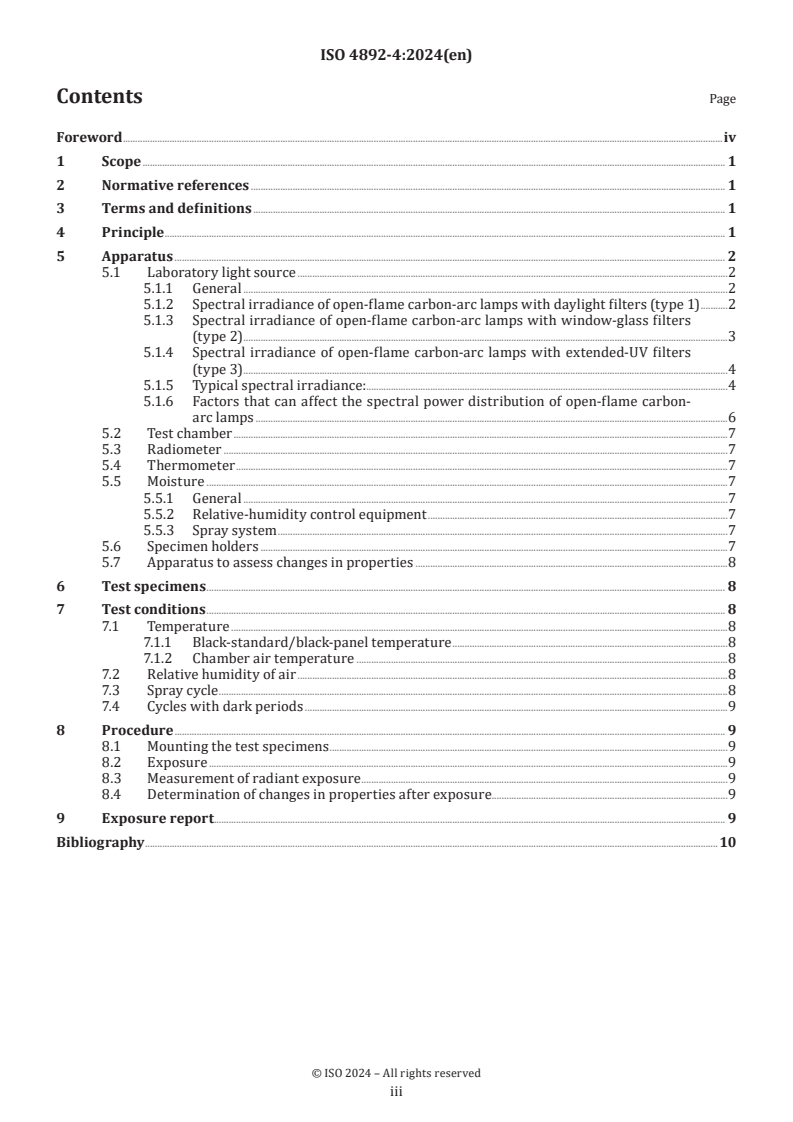
Contents Page
Foreword .iv
1 Scope . 1
2 Normative references . 1
3 Terms and definitions . 1
4 Principle . 1
5 Apparatus . 2
5.1 Laboratory light source .2
5.1.1 General .2
5.1.2 Spectral irradiance of open-flame carbon-arc lamps with daylight filters (type 1) .2
5.1.3 Spectral irradiance of open-flame carbon-arc lamps with window-glass filters
(type 2) .3
5.1.4 Spectral irradiance of open-flame carbon-arc lamps with extended-UV filters
(type 3) .4
5.1.5 Typical spectral irradiance:.4
5.1.6 Factors that can affect the spectral power distribution of open-flame carbon-
arc lamps .6
5.2 Test chamber .7
5.3 Radiometer .7
5.4 Thermometer .7
5.5 Moisture .7
5.5.1 General .7
5.5.2 Relative-humidity control equipment .7
5.5.3 Spray system .7
5.6 Specimen holders .7
5.7 Apparatus to assess changes in properties .8
6 Test specimens . 8
7 Test conditions . 8
7.1 Temperature .8
7.1.1 Black-standard/black-panel temperature .8
7.1.2 Chamber air temperature .8
7.2 Relative humidity of air .8
7.3 Spray cycle .8
7.4 Cycles with dark periods .9
8 Procedure . 9
8.1 Mounting the test specimens .9
8.2 Exposure .9
8.3 Measurement of radiant exposure .9
8.4 Determination of changes in properties after exposure.9
9 Exposure report. 9
Bibliography .10
iii
Foreword
ISO (the International Organization for Standardization) is a worldwide federation of national standards
bodies (ISO member bodies). The work of preparing International Standards is normally carried out through
ISO technical committees. Each member body interested in a subject for which a technical committee
has been established has the right to be represented on that committee. International organizations,
governmental and non-governmental, in liaison with ISO, also take part in the work. ISO collaborates closely
with the International Electrotechnical Commission (IEC) on all matters of electrotechnical standardization.
The procedures used to develop this document and those intended for its further maintenance are described
in the ISO/IEC Directives, Part 1. In particular, the different approval criteria needed for the different types
of ISO documents should be noted. This document was drafted in accordance with the editorial rules of the
ISO/IEC Directives, Part 2 (see www.iso.org/directives).
ISO draws attention to the possibility that the implementation of this document may involve the use of (a)
patent(s). ISO takes no position concerning the evidence, validity or applicability of any claimed patent
rights in respect thereof. As of the date of publication of this document, ISO had not received notice of (a)
patent(s) which may be required to implement this document. However, implementers are cautioned that
this may not represent the latest information, which may be obtained from the patent database available at
www.iso.org/patents. ISO shall not be held responsible for identifying any or all such patent rights.
Any trade name used in this document is information given for the convenience of users and does not
constitute an endorsement.
For an explanation of the voluntary nature of standards, the meaning of ISO specific terms and expressions
related to conformity assessment, as well as information about ISO's adherence to the World Trade
Organization (WTO) principles in the Technical Barriers to Trade (TBT), see www.iso.org/iso/foreword.html.
This document was prepared by Technical Committee ISO/TC 61, Plastics, Subcommittee SC 6, Ageing,
chemical and environmental resistance.
This fourth edition cancels and replaces the third edition (ISO 4892-4:2013), of which it constitutes a minor
revision.
The change is as follows:
— reference to CIE 85 updated to CIE 241.
A list of all parts in the ISO 4892 series can be found on the ISO website.
Any feedback or questions on this document should be directed to the user’s national standards body. A
complete listing of these bodies can be found at www.iso.org/members.html.
iv
International Standard ISO 4892-4:2024(en)
Plastics — Methods of exposure to laboratory light sources —
Part 4:
Open-flame carbon-arc lamps
1 Scope
This document specifies methods for exposing specimens to open-flame carbon-arc lamps in the presence
of moisture to reproduce the weathering effects that occur when materials are exposed in actual end-use
environments to global solar radiation, or to window-glass filtered solar radiation.
The specimens are exposed to filtered open-flame carbon-arc light under controlled environmental
conditions (temperature, moisture). Various filters are described.
General guidance is given in ISO 4892-1.
2 Normative references
The following documents are referred to in the text in such a way that some or all of their content constitutes
requirements of this document. For dated references, only the edition cited applies. For undated references,
the latest edition of the referenced document (including any amendments) applies.
ISO 4582, Plastics — Determination of changes in colour and variations in properties after exposure to glass-
filtered solar radiation, natural weathering or laboratory radiation sources
ISO 4892-1, Plastics — Methods of exposure to laboratory light sources — Part 1: General guidance and
requirements
3 Terms and definitions
No terms and definitions are listed in this document.
ISO and IEC maintain terminology databases for use in standardization at the following addresses:
— ISO Online browsing platform: available at https:// www .iso .org/ obp
— IEC Electropedia: available at https:// www .electropedia .org/
4 Principle
4.1 Specimens of the materials to be tested are exposed to glass-filtered open-flame carbon-arc light, to
heat and to moisture continuously or in repetitive cycles.
4.2 The exposure conditions may be varied by selection of:
a) the light filter;
b) the type of exposure to moisture/humidity;
c) the length of exposure to light and moisture/humidity;
d) the exposure temperature;
e) the relative lengths of the light and dark periods.
The effect of moisture is usually produced by controlling the humidity of the air or by spraying the test
specimens with demineralized/deionized water or by condensation of water vapour on to the surfaces of the
specimens.
4.3 The procedure may include measurements of the irradiance and radiant exposure at the surface of the
specimens.
4.4 It is recommended that a similar material of known behaviour (a control) be exposed simultaneously
with the test specimens to provide a reference standard for comparative purposes.
4.5 Intercomparison of results obtained from specimens exposed in different apparatus should not
be made unless an appropriate statistical relationship has been established between the devices for the
particular material tested.
5 Apparatus
5.1 Laboratory light source
5.1.1 General
Open-flame carbon-arc light sources typically use three or four pairs of carbon rods, which contain a
mixture of rare-earth metal salts and have a surface coating of a metal, such as copper. An electric current
is passed between the carbon rods, which burn, giving off ultraviolet, visible and infrared radiation. The
pairs of carbon rods are burned in sequence, with one pair burning at any one time. Use the carbon rods
recommended by the manufacturer of the apparatus. The radiation reaching the specimens passes through
glass filters. Three types of glass filter are used in practice. Tables 1 and 2 show the typical relative spectral
irradiance for open-flame carbon-arc lamps with daylight and window-glass filters, respectively. When
extended-UV filters are used, the relative spectral irradiance shall meet the requirements of Table 3.
5.1.2 Spectral irradiance of open-flame carbon-arc lamps with daylight filters (type 1)
Table 1 shows typical relative spectral irradiance in the UV wavelength range of an open-flame carbon-arc
lamp with daylight filters in order to simulate daylight (see CIE Publication No. 241, CIE-H1).
Table 1 — Typical relative spectral irradiance for open-flame carbon-arc lamps with daylight filters
ab
(type 1)
Typical distribution for open-
Spectral passband
de
flame carbon-arc lamp with CIE 241, CIE-H1
[λ = wavelength
c
daylight filters
%
in nanometres (nm)]
%
λ < 290 0,05 0
290 ≤ λ ≤ 320 2,9 5,9
320 < λ ≤ 360 20,5 40,4
360 < λ ≤ 400 76,6 53,8
a
This table gives the irradiance in the given passband, expressed as a percentage of the total irradiance between 290 nm and
400 nm. To determine the relative spectral irradiance for a specific daylight filter or set of filters for an open-flame carbon-arc
lamp, the relative spectral irradiance shall be measured from 250 nm to 400 nm. Typically, this is done in 2 nm increments. The
total irradiance in each passband is then summed and divided by the total irradiance between 290 nm and 400 nm.
b
This table gives typical data for an open-flame carbon-arc lamp with borosilicate-glass daylight filters. At the time of
publication of this document, not enough data are available to develop a specification for the open-flame carbon-arc lamp with a
daylight filter.
c
For any individual relative spectral irradiance, the calculated percentages for the passbands in this table will sum to 100 %.
d
The data from CIE 241, CIE-H1 are the global solar irradiance on a horizontal surface for an air mass of 1,0, an
...