

ISO 2828:1973
(Main)Aluminium oxide primarily used for the production of aluminium — Determination of fluorine content — Alizarin complexone and lanthanum chloride spectrophotometric method
General Information
- Abstract
Applicable to products having F contents of more than 0.003 % (m/m). Dissolution of a test portion by attack by sulphuric acid under pressure. Separation of the fluorine by distillation at a temperature of (150 1) °C by sulphuric acid. The distillation is carried out by the method described in ISO 1693. Formation of a blue coloured complex between fluorine and alizarin complexone/lanthanum chloride reagent at a pH between 4.5 and 4.6. Addition of acetone to increase the stability and sensitivity of the fluorine complex. Spectrophotometric measurement of the complex at a wavelength of about 620 nm. Has also been approved by the IUPAC.
- Status
- Published
- Publication Date
- 30-Nov-1973
- Technical Committee
- ISO/TC 226 - Materials for the production of primary aluminium
- Drafting Committee
- ISO/TC 226 - Materials for the production of primary aluminium
- Current Stage
- 9093 - International Standard confirmed
- Start Date
- 04-Jan-2022
- Completion Date
- 29-Aug-2026
Buy Documents
ISO 2828:1973 - Aluminium oxide primarily used for the production of aluminium -- Determination of fluorine content -- Alizarin complexone and lanthanum chloride spectrophotometric method
ISO 2828:1973 - Aluminium oxide primarily used for the production of aluminium — Determination of fluorine content — Alizarin complexone and lanthanum chloride spectrophotometric method/1/1973
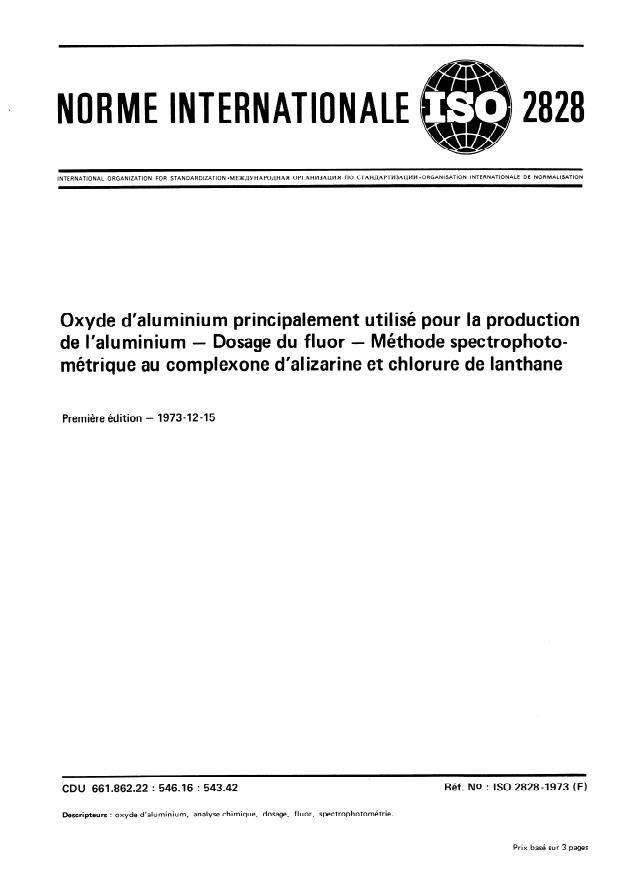
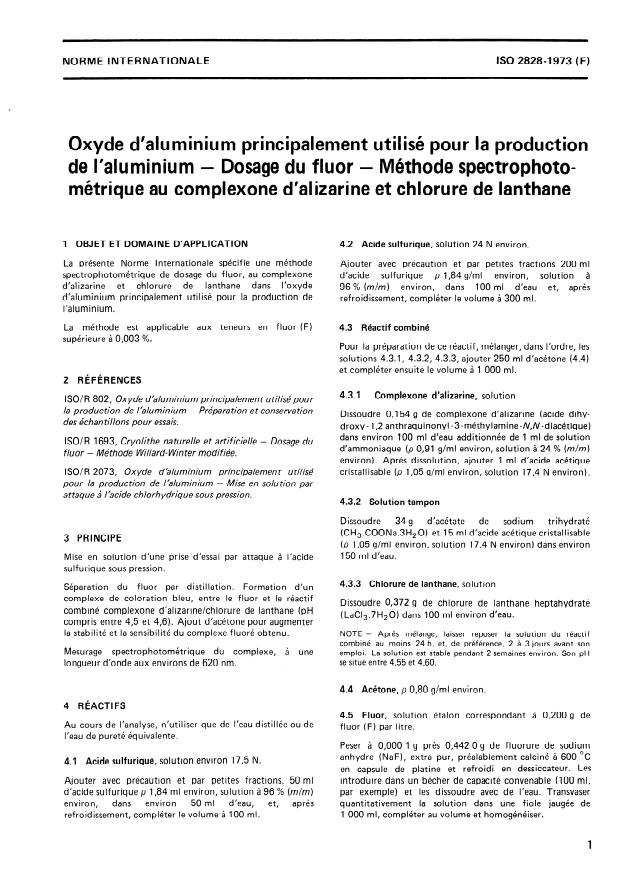
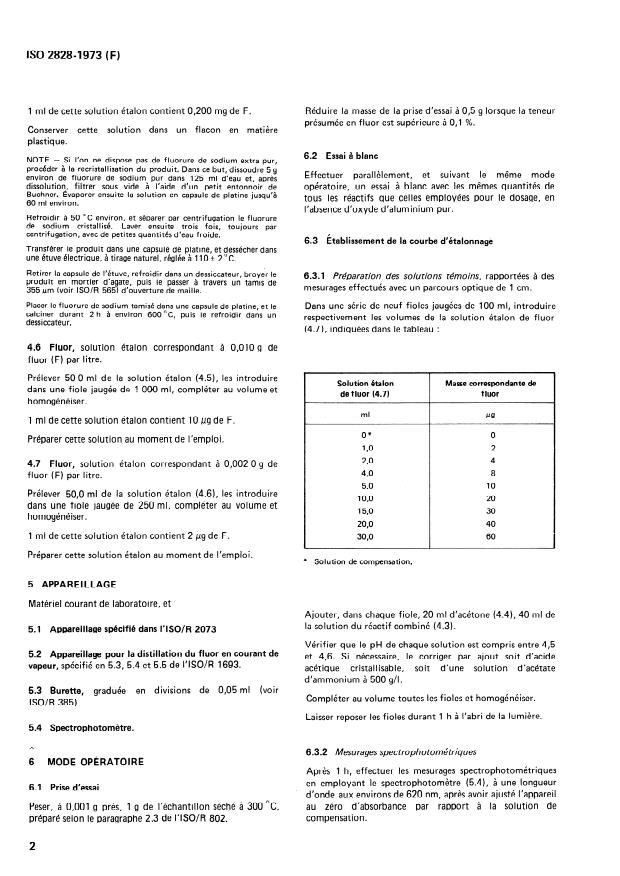
ISO 2828:1973 - Oxyde d'aluminium principalement utilisé pour la production de l'aluminium -- Dosage du fluor -- Méthode spectrophotométrique au complexone d'alizarine et chlorure de lanthane
ISO 2828:1973 - Oxyde d'aluminium principalement utilisé pour la production de l'aluminium -- Dosage du fluor -- Méthode spectrophotométrique au complexone d'alizarine et chlorure de lanthane
ISO 2828:1973 - Oxyde d'aluminium principalement utilisé pour la production de l'aluminium — Dosage du fluor — Méthode spectrophotométrique au complexone d'alizarine et chlorure de lanthane/1/1973
ISO 2828:1973 - Oxyde d'aluminium principalement utilisé pour la production de l'aluminium — Dosage du fluor — Méthode spectrophotométrique au complexone d'alizarine et chlorure de lanthane/1/1973
Overview
ISO 2828:1973 specifies a spectrophotometric method for the determination of fluorine content in aluminium oxide primarily used for aluminium production. This standard is essential for quality control in the aluminium manufacturing industry, ensuring that fluorine levels are accurately measured when they exceed 0.003% (m/m). The method involves dissolving a sample with sulfuric acid under pressure, followed by distillation and complexation of fluorine for spectrophotometric analysis using alizarin complexone and lanthanum chloride reagents.
This internationally recognized test method, approved by ISO and the IUPAC, provides reliable, sensitive, and precise measurement of fluorine, critical for maintaining product purity and process control.
Key Topics
- Sample Preparation: Dissolution of aluminium oxide samples in sulfuric acid under controlled pressure conditions.
- Fluorine Separation: Distillation of fluorine from the solution at 150 ±1 °C using sulfuric acid, following the method described in ISO 1693.
- Complex Formation: Formation of a blue-colored complex between fluorine and a combined reagent of alizarin complexone and lanthanum chloride at a pH of 4.5 to 4.6.
- Acetone Addition: Use of acetone to enhance the stability and sensitivity of the fluorine complex for accurate analysis.
- Spectrophotometric Measurement: Quantification of the fluorine complex at a wavelength near 620 nm using a spectrophotometer.
- Calibration and Standards: Preparation of fluorine standard solutions and calibration curves for precise quantification.
- pH Control: Adjustment and maintenance of the solution pH for optimal complex stability and measurement accuracy.
Applications
- Quality Control in Aluminium Production: Ensures that aluminium oxide meets fluorine content specifications critical for downstream metallurgical processes.
- Chemical Analysis Laboratories: Provides a standardized method for laboratories to accurately determine fluorine in aluminium oxide samples.
- Industrial Process Monitoring: Supports monitoring and control of fluorine contamination, which can affect aluminium refining efficiency and product quality.
- Research and Development: Facilitates investigation into materials and chemical characteristics of aluminium oxide by providing reliable fluorine content measurement.
- Regulatory Compliance: Assists manufacturers in adhering to international regulations and quality standards for aluminium oxide purity.
Related Standards
- ISO 1693: Specifies the distillation method for fluorine separation used within ISO 2828.
- ISO 802: Details preparation and storage of aluminium oxide test samples.
- ISO 2073: Covers dissolution of aluminium oxide by hydrochloric acid under pressure, referenced for comparative methods.
- ISO 2828 aligns with best practices in chemical analysis standards for aluminium compounds and fluorine determination.
By adopting ISO 2828:1973, industries involved in aluminium oxide production gain access to a precise, internationally validated test method for fluorine content. This promotes consistency in quality assurance checks, boosts analytical confidence, and helps maintain compliance with global standards. The use of alizarin complexone and lanthanum chloride spectrophotometric analysis represents a sensitive and reliable approach for fluorine quantification in challenging materials like aluminium oxide.
Keywords: ISO 2828, aluminium oxide, fluorine determination, spectrophotometric method, alizarin complexone, lanthanum chloride, fluorine content, chemical analysis, aluminium production, ISO standards, fluorine measurement.
Relations
- Effective Date
- 09-Feb-2026
- Effective Date
- 09-Feb-2026
Buy Documents
ISO 2828:1973 - Aluminium oxide primarily used for the production of aluminium -- Determination of fluorine content -- Alizarin complexone and lanthanum chloride spectrophotometric method
ISO 2828:1973 - Aluminium oxide primarily used for the production of aluminium — Determination of fluorine content — Alizarin complexone and lanthanum chloride spectrophotometric method/1/1973
ISO 2828:1973 - Oxyde d'aluminium principalement utilisé pour la production de l'aluminium -- Dosage du fluor -- Méthode spectrophotométrique au complexone d'alizarine et chlorure de lanthane
ISO 2828:1973 - Oxyde d'aluminium principalement utilisé pour la production de l'aluminium -- Dosage du fluor -- Méthode spectrophotométrique au complexone d'alizarine et chlorure de lanthane
ISO 2828:1973 - Oxyde d'aluminium principalement utilisé pour la production de l'aluminium — Dosage du fluor — Méthode spectrophotométrique au complexone d'alizarine et chlorure de lanthane/1/1973
ISO 2828:1973 - Oxyde d'aluminium principalement utilisé pour la production de l'aluminium — Dosage du fluor — Méthode spectrophotométrique au complexone d'alizarine et chlorure de lanthane/1/1973
Get Certified
Connect with accredited certification bodies for this standard

ECOCERT
Organic and sustainability certification.

Eurofins Food Testing Global
Global leader in food, environment, and pharmaceutical product testing.

Intertek Bangladesh
Intertek certification and testing services in Bangladesh.
Sponsored listings
Frequently Asked Questions
ISO 2828:1973 is a standard published by the International Organization for Standardization (ISO). Its full title is "Aluminium oxide primarily used for the production of aluminium — Determination of fluorine content — Alizarin complexone and lanthanum chloride spectrophotometric method". This standard covers: Applicable to products having F contents of more than 0.003 % (m/m). Dissolution of a test portion by attack by sulphuric acid under pressure. Separation of the fluorine by distillation at a temperature of (150 1) °C by sulphuric acid. The distillation is carried out by the method described in ISO 1693. Formation of a blue coloured complex between fluorine and alizarin complexone/lanthanum chloride reagent at a pH between 4.5 and 4.6. Addition of acetone to increase the stability and sensitivity of the fluorine complex. Spectrophotometric measurement of the complex at a wavelength of about 620 nm. Has also been approved by the IUPAC.
Applicable to products having F contents of more than 0.003 % (m/m). Dissolution of a test portion by attack by sulphuric acid under pressure. Separation of the fluorine by distillation at a temperature of (150 1) °C by sulphuric acid. The distillation is carried out by the method described in ISO 1693. Formation of a blue coloured complex between fluorine and alizarin complexone/lanthanum chloride reagent at a pH between 4.5 and 4.6. Addition of acetone to increase the stability and sensitivity of the fluorine complex. Spectrophotometric measurement of the complex at a wavelength of about 620 nm. Has also been approved by the IUPAC.
ISO 2828:1973 is classified under the following ICS (International Classification for Standards) categories: 71.100.10 - Materials for aluminium production. The ICS classification helps identify the subject area and facilitates finding related standards.
ISO 2828:1973 has the following relationships with other standards: It is inter standard links to EN ISO 21814:2022, EN ISO 17947:2023. Understanding these relationships helps ensure you are using the most current and applicable version of the standard.
ISO 2828:1973 is available in PDF format for immediate download after purchase. The document can be added to your cart and obtained through the secure checkout process. Digital delivery ensures instant access to the complete standard document.
Standards Content (Sample)
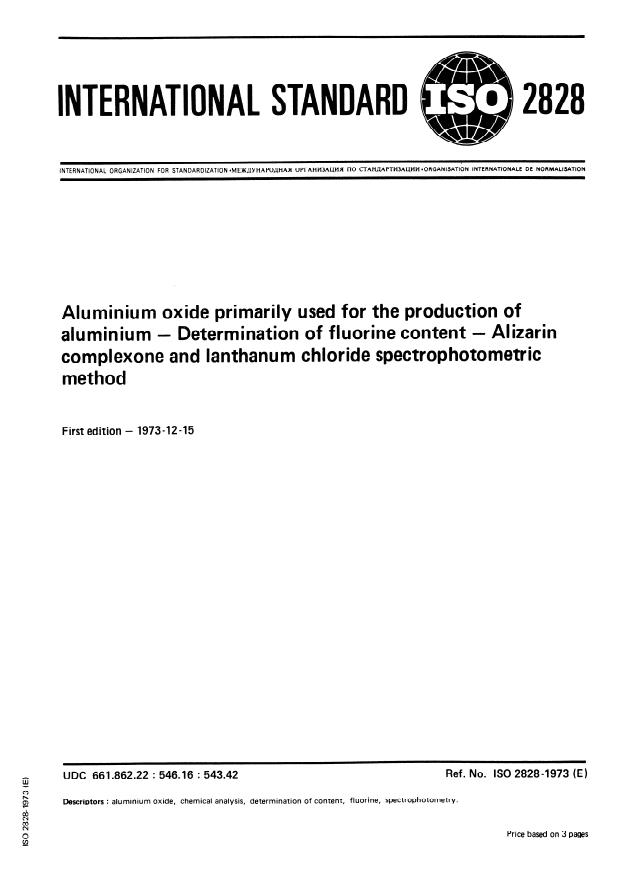
INTERNATIO AL STANDARD 2828
INTERNATIONAL ORGANIZATION FOR STANDARDIZATION l MEXflYHAPOAHAJl OPTAHM3AUMII I-lo CTAHAAPTM3AW4.ORGANlSATl6N INTERNATIONALE DE NORMALISATION
Aluminium oxide primarily used for the production of
aluminium - Determination of fluorine content - Alizarin
complexone and lanthanum chloride spectrophotometric
method
First edition - 1973-12-15
UDC 661.862.22 : 546.16 : 543.42 Ref. No. IS0 2828-1973 (E)
Descriptors : aluminium oxide, chemical analysis, determination of content, fluorine, spectrophotometry.
Price based on 3 pages
IS0 (the International Organization for Standardization) is a worldwide federation
of national standards institutes (IS0 Member Bodies). The work of developing
International Standards is carried out through IS0 Technical Committees. Every
Member Body interested in a subject for which a Technical Committee has been set
up has the right to be represented on that Committee. International organizations,
governmental and non-governmental, in liaison with ISO, also take part in the work.
Draft International Standards adopted by the Technical Committees are circulated
to the Member Bodies for approval before their acceptance as International
Standards by the IS0 Council.
International Standard IS0 2828 was drawn up by Technical Committee
ISO/TC 47, Chemistry, and circulated to the Member Bodies in July 1972.
It has been approved by the Member Bodies of the following countries :
Ireland South Africa, Rep. of
Australia
Israel Sweden
Austria
Belgium Italy Switzerland
Mexico Thailand
Czechoslovakia
Egypt, Arab Rep. of Netherlands Turkey
United Kingdom
France New Zealand
Germany Poland U.S.S.R.
Hungary Portugal
India Romania
This International Standard has also been approved by the International Union of
Pure and Applied Chemistry (IUPAC).
No Member Body expressed disapproval of the document.
0 International Organization for Standardization, 1973 e
Printed in Switzerland
INTERNATIONAL STANDARD IS0 28284973 (E)
Aluminium oxide primarily used for the production of
aluminium - Determination of fluorine content - Alizarin
complexone and lanthanum chloride spectrophotometric
method
1 SCOPE AND FIELD OF APPLICATION
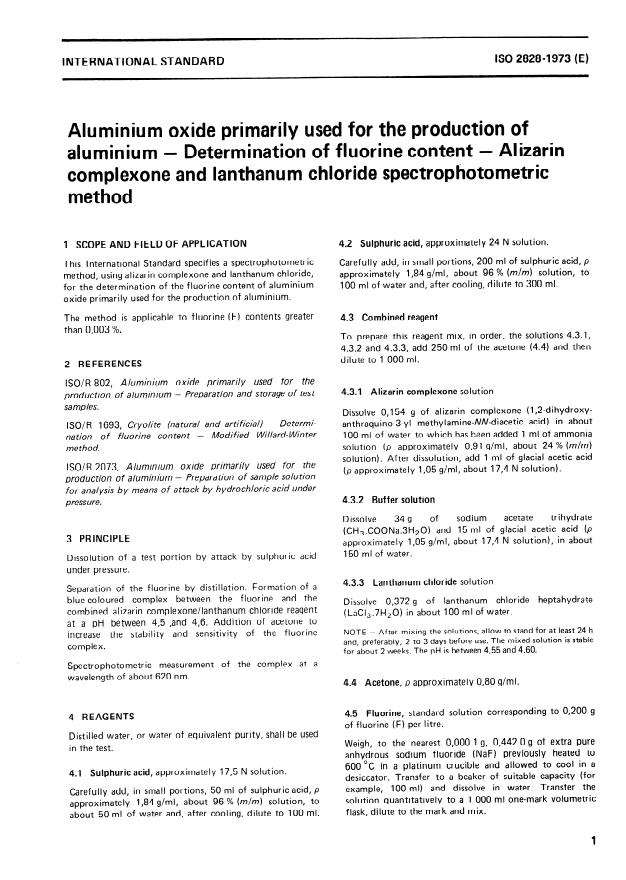
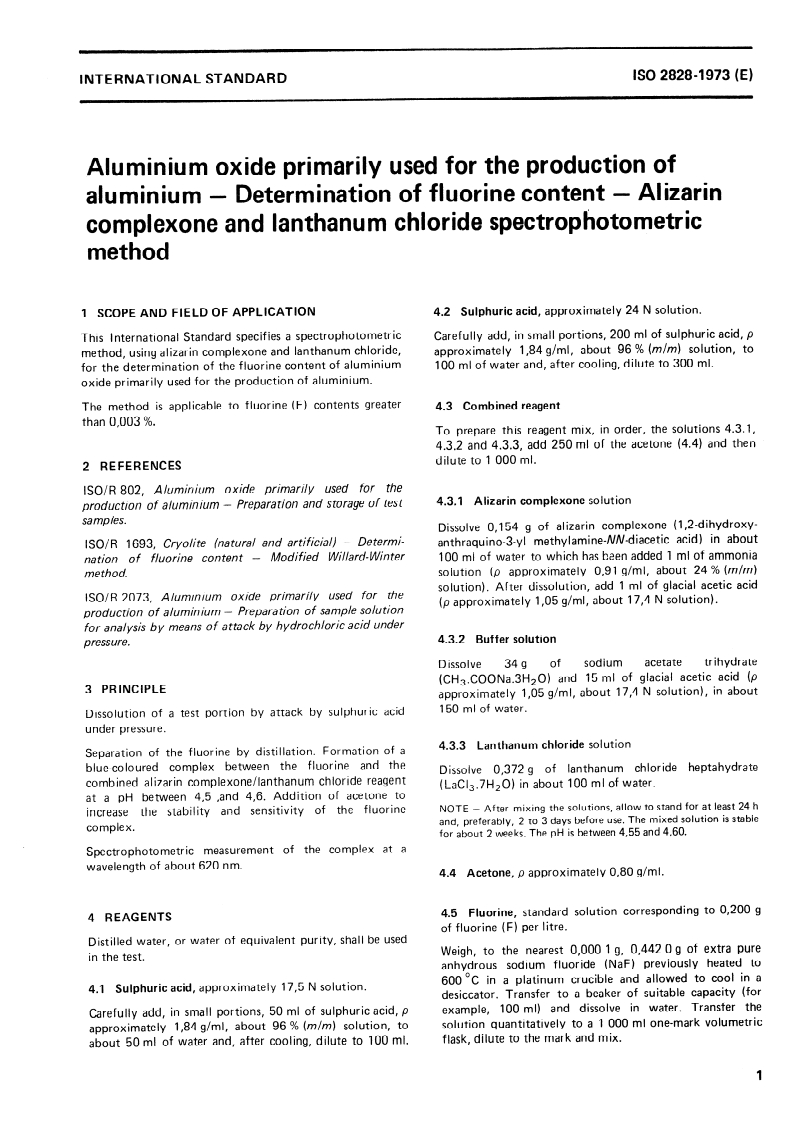
4.2 Sulphuric acid, approximately 24 N solution.
This International Standard specifies a spectrophotometr ic
Carefully add, in small portions, 200 ml of sulphuric acid, p
method, using alizarin complexone and lanthanum chloride,
approximately 1,84 g/ml, about 96 % (m/m) solution, to
for the determination of the fluorine content of aluminium
100 ml of water and, after cooling, dilute to 300 ml.
oxide primarily used for the production of atuminium.
The method is applicable to fluorine (F) contents greater
4.3 Combined reagent
than 0,003 %.
To prepare this reagent mix, in order, the solutions 4.3.1 o
4.3.2 and 4.3.3, add 250 ml of the acetone (4.4) and then
dilute to 1 000 ml.
2 REFERENCES
ISO/R 802, Numinium oxide primarily used for the
4.3.1 Alizarin complexone solution
production of aiuminiwm - Preparation and storage of test
samples.
Dissolve 0,154 g of alizarin complexone (1,2-dihydroxy-
ISO/R 1693, Cryolite (natural and artificial) - Determi- anthraquino3yl methylamine-NN-diacetic acid) in about
nation of fluorine con tent - Modified Willard- Winter
100 ml of water to which has been added 1 ml of ammonia
method.
solution (p approximately 0,91 g/ml, about 24 % (m/m)
solution). After dissolution, add 1 ml of glacial acetic acid
ISO/R 2073, Aluminium oxide primarily used for the
(p approximately I,05 g/ml, about 17,4 N solution).
production of aluminium - Preparation of sample solution
for analysis by means of attack by hydrochloric acid under
pressure. 4.3.2 Buffer solution
sodium acetate tr ihydrate
Dissolve 34 g of
(CH3.COONa.3H20) and 15 ml of glacial acetic acid (p
3 PRINCIPLE
approximately 1,05 g/ml, about 17,4 N solution), in about
150 ml of water.
Dissolution of a test portion by attack by sulphuric acid
under pressure.
4.3.3 Lanthanum chloride solution
Separation of the fluorine by distillation. Formation of a
blue-coloured complex between the fluorine and the
Dissolve 0,372 g of lanthanum chloride heptahydrate
combined alizarin complexone/lanthanum chloride reagent
(haC13.7H20) in about 100 ml of water.
at a pH between 4,5 ,and 4,6. Addition of acetone to
NBTE - After mixing the solutions, allow to stand for at least 24 h
increase the stability and sensitivity of the fluorine
and, preferably, 2 to 3 days before use. The mixed solution is stable
complex.
for about 2 weeks. The pH is between 4,55 and 4,60.
Spectrophotometric measurement of the complex at a
wavelength of about 620 nm.
4.4 Acetone, p approximately 0,80 g/ml.
4.5 Fluorine, standard solution corresponding to 0,200 g
4 REAGENTS
of fluorine (F) per litre.
Distilled water, or water of equivalent purity, shall be used
Weigh, to the nearest 0,000 1 g, 0,442 0 g of extra pure
in the test.
anhydrous sodium fluoride (NaF) previously heated to
600 “C in a platinum crucible and allowed to cool in a
4.1 Sulphuric acid, approximately 17,5 N solution.
desiccator. Transfer to a beaker of suitable capacity (for
Carefully add, in small portions, 50 ml of sulphuric acid, p example, 100 ml) and dissolve in water. Transfer the
solution quantitatively to a 1 000 ml one-mark volumetric
approximately 1,84 g/ml, about 96 % (m/m) solution, to
flask, dilute to the mark and mix.
about 50 ml of water and, after cooling, dilute to 100 ml.
IS0 28284973 (E)
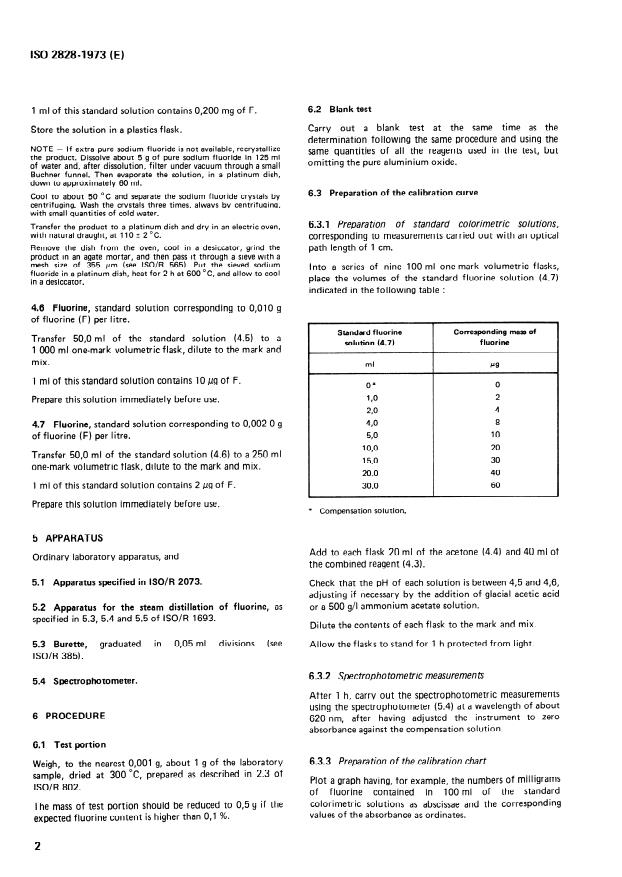
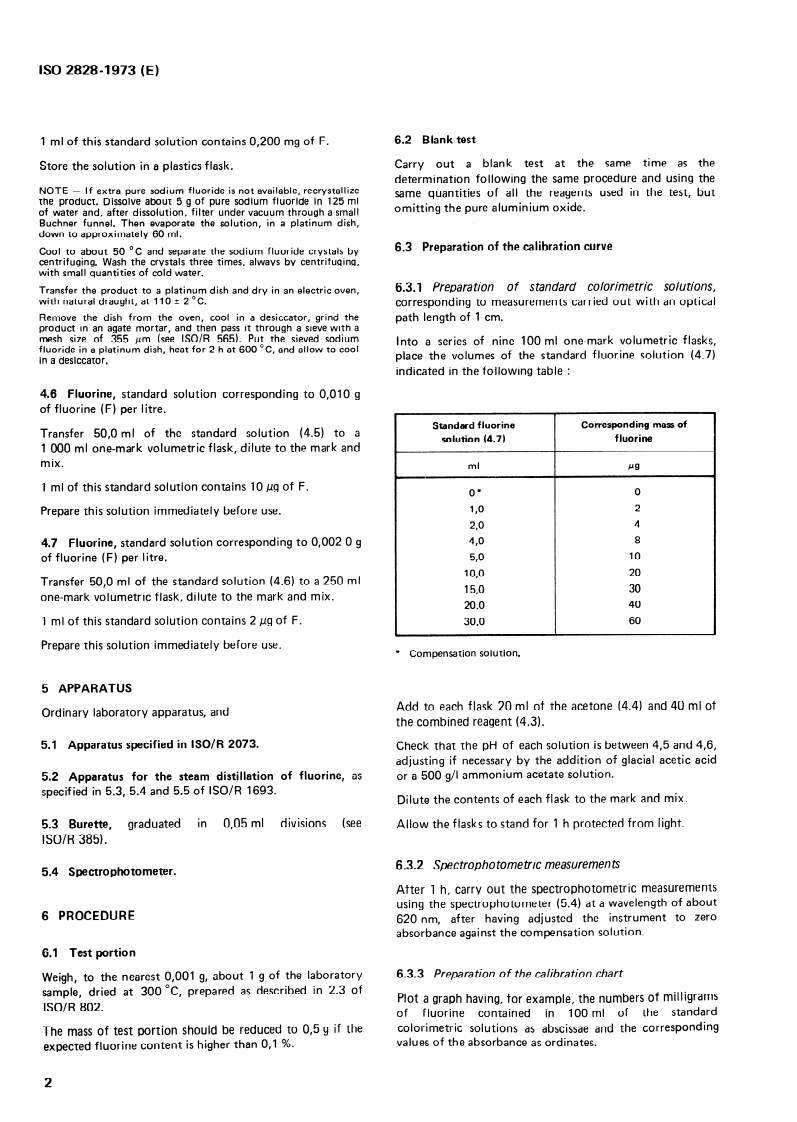
6.2 Blank test
1 ml of this standard solution contains 0,200 mg of F.
Carry out a blank test at the same time as the
Store the solution in a plastics flask.
determination following the same procedure and using the
NOTE - If extra pure sodium fluoride is not available, recrystallize
same quantities of all the reagents
...
INTERNATIO AL STANDARD 2828
INTERNATIONAL ORGANIZATION FOR STANDARDIZATION l MEXflYHAPOAHAJl OPTAHM3AUMII I-lo CTAHAAPTM3AW4.ORGANlSATl6N INTERNATIONALE DE NORMALISATION
Aluminium oxide primarily used for the production of
aluminium - Determination of fluorine content - Alizarin
complexone and lanthanum chloride spectrophotometric
method
First edition - 1973-12-15
UDC 661.862.22 : 546.16 : 543.42 Ref. No. IS0 2828-1973 (E)
Descriptors : aluminium oxide, chemical analysis, determination of content, fluorine, spectrophotometry.
Price based on 3 pages
IS0 (the International Organization for Standardization) is a worldwide federation
of national standards institutes (IS0 Member Bodies). The work of developing
International Standards is carried out through IS0 Technical Committees. Every
Member Body interested in a subject for which a Technical Committee has been set
up has the right to be represented on that Committee. International organizations,
governmental and non-governmental, in liaison with ISO, also take part in the work.
Draft International Standards adopted by the Technical Committees are circulated
to the Member Bodies for approval before their acceptance as International
Standards by the IS0 Council.
International Standard IS0 2828 was drawn up by Technical Committee
ISO/TC 47, Chemistry, and circulated to the Member Bodies in July 1972.
It has been approved by the Member Bodies of the following countries :
Ireland South Africa, Rep. of
Australia
Israel Sweden
Austria
Belgium Italy Switzerland
Mexico Thailand
Czechoslovakia
Egypt, Arab Rep. of Netherlands Turkey
United Kingdom
France New Zealand
Germany Poland U.S.S.R.
Hungary Portugal
India Romania
This International Standard has also been approved by the International Union of
Pure and Applied Chemistry (IUPAC).
No Member Body expressed disapproval of the document.
0 International Organization for Standardization, 1973 e
Printed in Switzerland
INTERNATIONAL STANDARD IS0 28284973 (E)
Aluminium oxide primarily used for the production of
aluminium - Determination of fluorine content - Alizarin
complexone and lanthanum chloride spectrophotometric
method
1 SCOPE AND FIELD OF APPLICATION
4.2 Sulphuric acid, approximately 24 N solution.
This International Standard specifies a spectrophotometr ic
Carefully add, in small portions, 200 ml of sulphuric acid, p
method, using alizarin complexone and lanthanum chloride,
approximately 1,84 g/ml, about 96 % (m/m) solution, to
for the determination of the fluorine content of aluminium
100 ml of water and, after cooling, dilute to 300 ml.
oxide primarily used for the production of atuminium.
The method is applicable to fluorine (F) contents greater
4.3 Combined reagent
than 0,003 %.
To prepare this reagent mix, in order, the solutions 4.3.1 o
4.3.2 and 4.3.3, add 250 ml of the acetone (4.4) and then
dilute to 1 000 ml.
2 REFERENCES
ISO/R 802, Numinium oxide primarily used for the
4.3.1 Alizarin complexone solution
production of aiuminiwm - Preparation and storage of test
samples.
Dissolve 0,154 g of alizarin complexone (1,2-dihydroxy-
ISO/R 1693, Cryolite (natural and artificial) - Determi- anthraquino3yl methylamine-NN-diacetic acid) in about
nation of fluorine con tent - Modified Willard- Winter
100 ml of water to which has been added 1 ml of ammonia
method.
solution (p approximately 0,91 g/ml, about 24 % (m/m)
solution). After dissolution, add 1 ml of glacial acetic acid
ISO/R 2073, Aluminium oxide primarily used for the
(p approximately I,05 g/ml, about 17,4 N solution).
production of aluminium - Preparation of sample solution
for analysis by means of attack by hydrochloric acid under
pressure. 4.3.2 Buffer solution
sodium acetate tr ihydrate
Dissolve 34 g of
(CH3.COONa.3H20) and 15 ml of glacial acetic acid (p
3 PRINCIPLE
approximately 1,05 g/ml, about 17,4 N solution), in about
150 ml of water.
Dissolution of a test portion by attack by sulphuric acid
under pressure.
4.3.3 Lanthanum chloride solution
Separation of the fluorine by distillation. Formation of a
blue-coloured complex between the fluorine and the
Dissolve 0,372 g of lanthanum chloride heptahydrate
combined alizarin complexone/lanthanum chloride reagent
(haC13.7H20) in about 100 ml of water.
at a pH between 4,5 ,and 4,6. Addition of acetone to
NBTE - After mixing the solutions, allow to stand for at least 24 h
increase the stability and sensitivity of the fluorine
and, preferably, 2 to 3 days before use. The mixed solution is stable
complex.
for about 2 weeks. The pH is between 4,55 and 4,60.
Spectrophotometric measurement of the complex at a
wavelength of about 620 nm.
4.4 Acetone, p approximately 0,80 g/ml.
4.5 Fluorine, standard solution corresponding to 0,200 g
4 REAGENTS
of fluorine (F) per litre.
Distilled water, or water of equivalent purity, shall be used
Weigh, to the nearest 0,000 1 g, 0,442 0 g of extra pure
in the test.
anhydrous sodium fluoride (NaF) previously heated to
600 “C in a platinum crucible and allowed to cool in a
4.1 Sulphuric acid, approximately 17,5 N solution.
desiccator. Transfer to a beaker of suitable capacity (for
Carefully add, in small portions, 50 ml of sulphuric acid, p example, 100 ml) and dissolve in water. Transfer the
solution quantitatively to a 1 000 ml one-mark volumetric
approximately 1,84 g/ml, about 96 % (m/m) solution, to
flask, dilute to the mark and mix.
about 50 ml of water and, after cooling, dilute to 100 ml.
IS0 28284973 (E)
6.2 Blank test
1 ml of this standard solution contains 0,200 mg of F.
Carry out a blank test at the same time as the
Store the solution in a plastics flask.
determination following the same procedure and using the
NOTE - If extra pure sodium fluoride is not available, recrystallize
same quantities of all the reagents
...
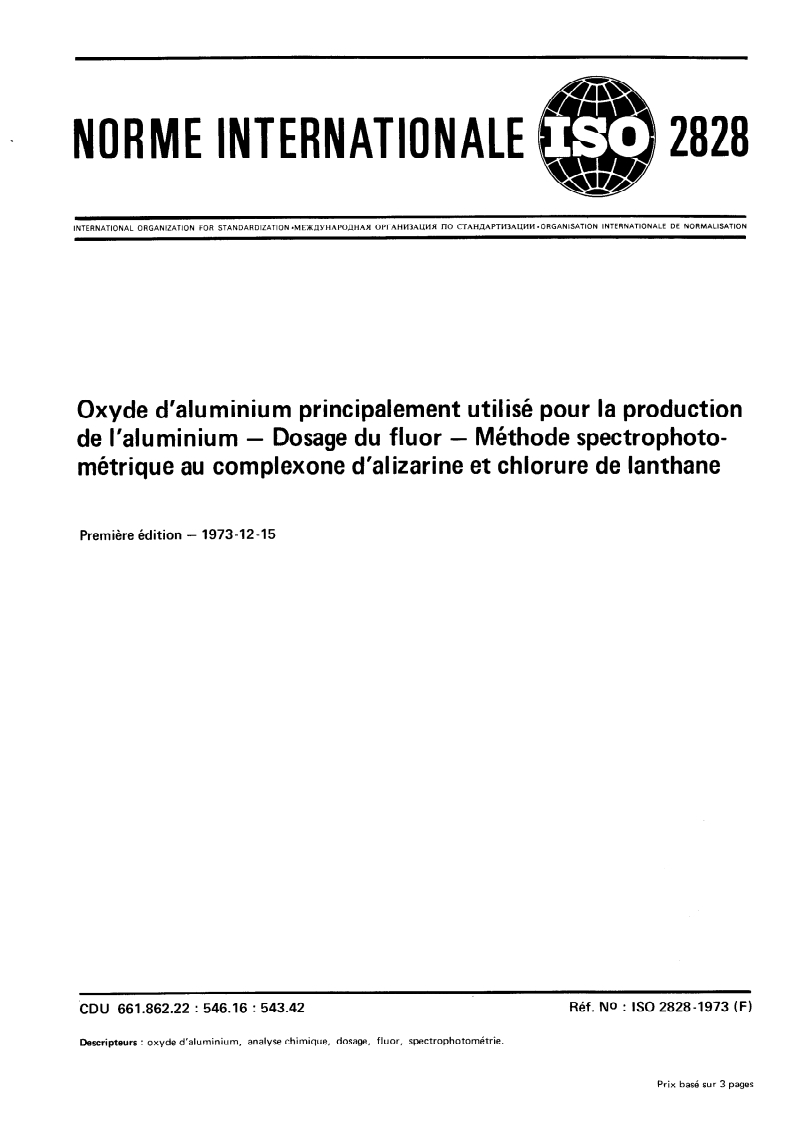
NORME INTERNATIONALE
INTERNATIONAL ORGANIZATION FOR STANDARDIZATION l MEX)JYHAPOAHAR OPTAHM3ALVW r’I0 CTAHAAPTM3ALWZI -ORGANISATION INTERNATIONALE DE NORMALISATION
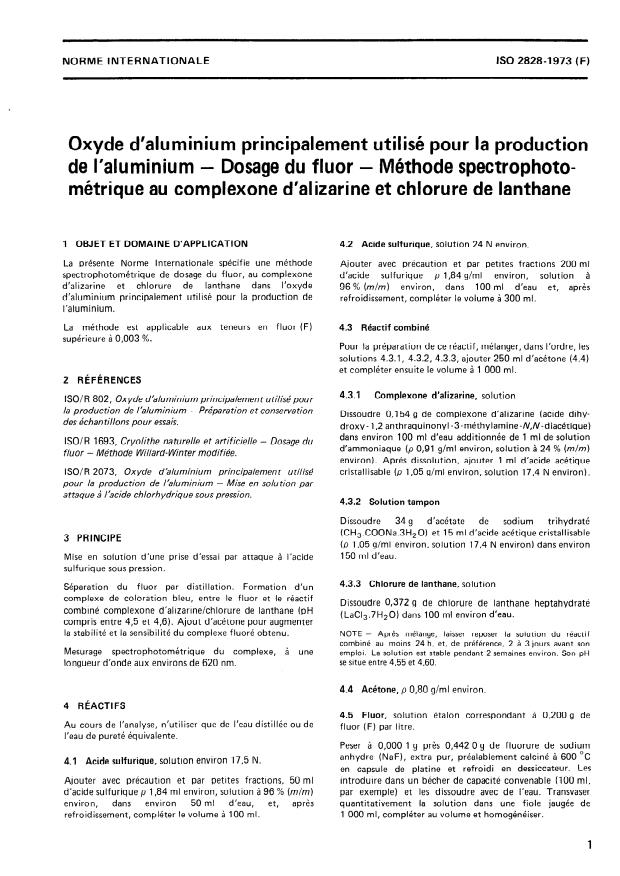
Oxyde d’aluminium principalement utilisé pour la production
- Dosage du fluor -
de l’aluminium Méthode spectrophoto-
métrique au complexone d’alizarine et chlorure de lanthane
Première édition - 1973-12-15
Réf. No : ISO 2828-1973 (F)
CDU 661.862.22 : 546.16 : 543.42
analyse chimique, dosage, fluor, spectrophotométrie.
Descripteurs : oxyde d’aluminium,
Prix basé sur 3 pages
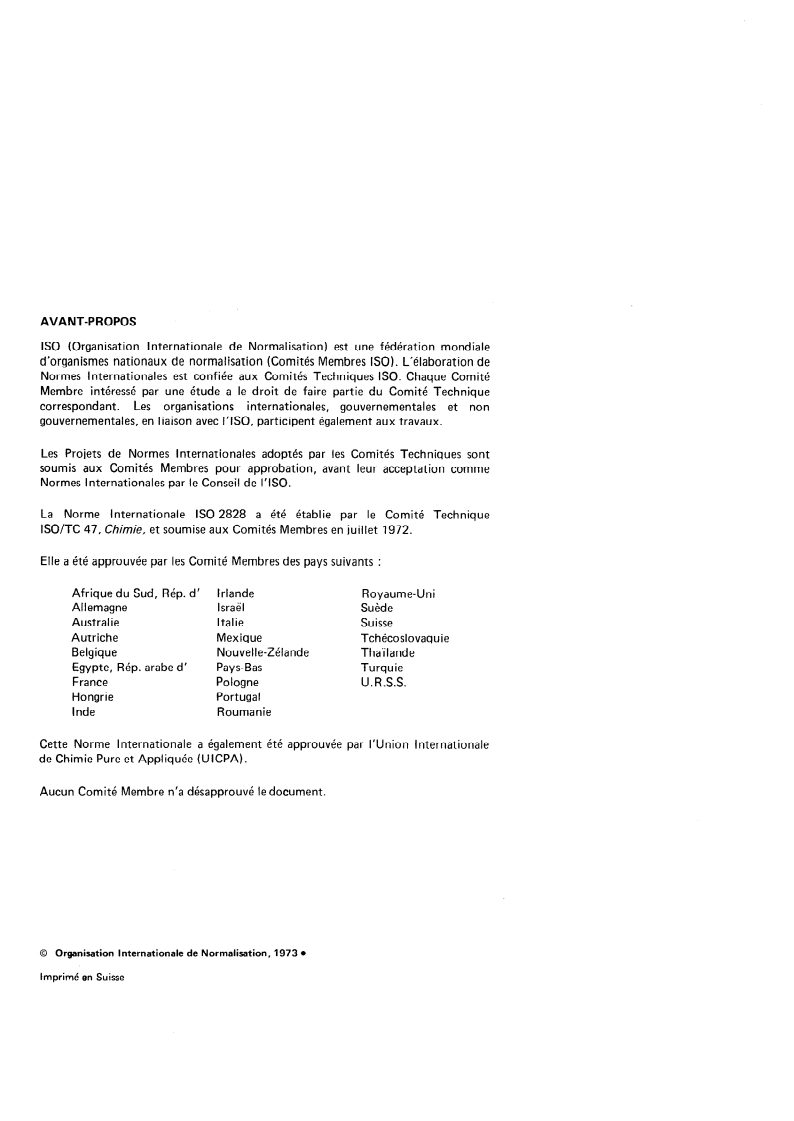
AVANT-PROPOS
ISO (Organisation Internationale de Normalisation) est une fédération mondiale
d’organismes nationaux de normalisation (Comités Membres 60). L’élaboration de
Normes Internationales est confiée aux Comités Techniques 60. Chaque Comité
Membre intéressé par une étude a le droit de faire partie du Comité Technique
correspondant. Les organisations internationales, gouvernementales et non
gouvernementales, en liaison avec I’ISO, participent également aux travaux.
Les Projets de Normes Internationales adoptés par les Comités Techniques sont
soumis aux Comités Membres pour approbation, avant leur acceptation comme
Normes Internationales par le Conseil de I’ISO.
La Norme Internationale ISO 2828 a été établie par le Comité Technique
ISO/TC 47, Chimie, et soumise aux Comités Membres en juillet 1972.
Elle a été approuvée par les Comité Membres des pays suivants :
Afrique du Sud, Rép. d’ Irlande
Royaume-Uni
Israël
Allemagne Suède
Australie Italie
Suisse
Mexique
Autriche Tchécoslovaquie
Belgique Nouvelle-Zélande Thaïlande
Egypte, Rép. arabe d’ Pays-Bas Turquie
France Pologne U.R.S.S.
Hongrie Portugal
Inde Roumanie
Cette Norme Internationale a également été approuvée par l’Union Internationale
de Chimie Pure et Appliquée (UICPA).
Aucun Comité Membre n’a désapprouvé le document.
0 Organisation Internationale de Normalisation, 1973 l
Imprimé en Suisse
ISO 28284973 (F)
NORME INTERNATIONALE
Oxyde d’aluminium principalement utilisé pour la production
de l’aluminium - Dosage du fluor - Méthode spectrophoto-
métrique au complexone d’alizarine et chlorure de lanthane
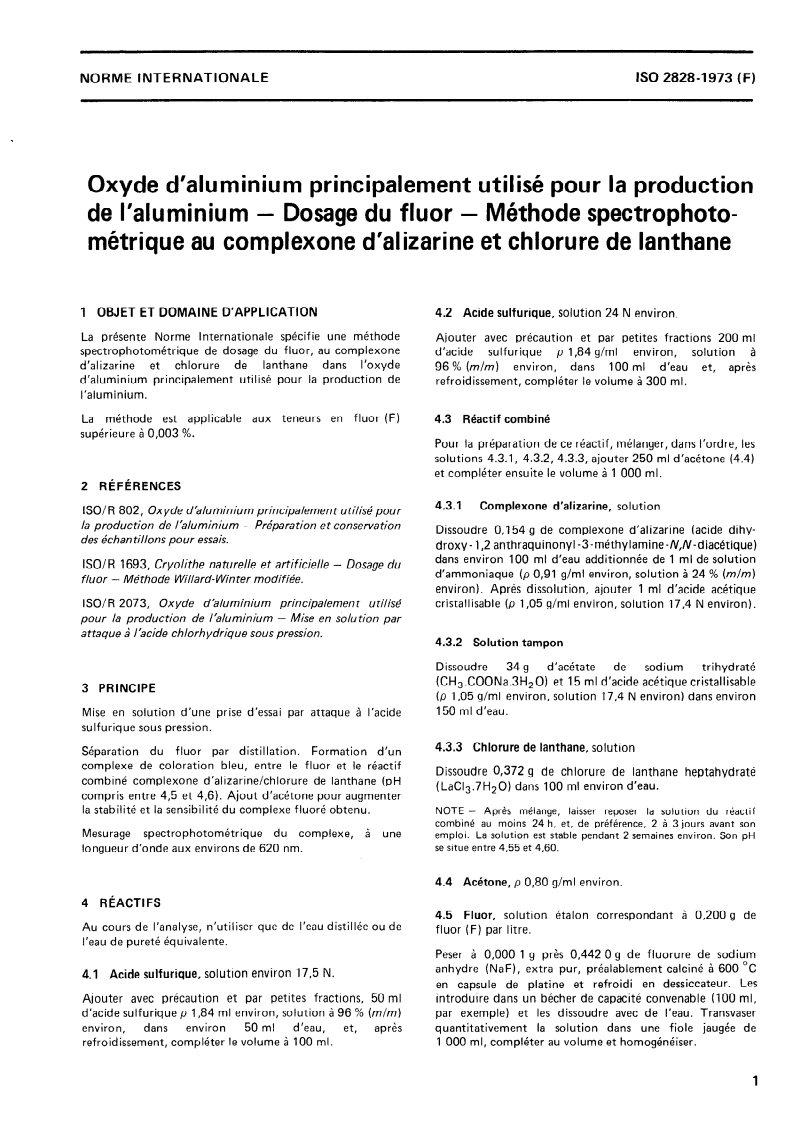
1 OBJET ET DOMAINE D’APPLICATION 4.2 Acide sulfurique, solution 24 N environ.
La présente Norme Internationale spécifie une méthode Ajouter avec précaution et par petites fractions 200 ml
spectrophotométrique de dosage du fluor, au complexone d’acide sulfurique p 1,84 g/ml environ, solution à
d’alizarine et chlorure de lanthane dans l’oxyde 96 % (mlm) environ, dans 100 ml d’eau et, après
d’aluminium principalement utilisé pour la production de
refroidissement, compléter le volume à 300 ml.
l’aluminium.
4.3 Réactif combiné
La méthode est applicable aux teneurs en fluor (F)
supérieure à 0,003 %.
Pour la préparation de ce réactif, mélanger, dans l’ordre, les
solutions 4.3.1, 4.3.2, 4.3.3, ajouter 250 ml d’acétone (4.4)
et compléter ensuite le volume à 1 000 ml.
2 RÉFÉRENCES
4.3.1 Complexone d’alizarine, solution
ISOI R 802, Oxyde d%luminium principalement utilisé pour
la production de l’aluminium - Préparation et conservation
Dissoudre 0,154 g de complexone d’alizarine (acide dihy-
des échantillons pour essais.
droxy- 1,2 anthraquinonyl-3-méthylamine-N,N-diacétique)
dans environ 100 ml d’eau additionnée de 1 ml de solution
lSO/R 1693, Cryolithe naturelle et artificielle - Dosage du
d’ammoniaque (p 0,91 g/ml environ, solution à 24 % (mlm)
fluor - Méthode Wilard- Win ter modifiée.
environ). Après dissolution, ajouter 1 ml d’acide acétique
ISO/R 2073, Oxyde d’aluminium principalement utilisé cristallisable (p 1,05 g/ml environ, solution 17,4 N environ).
pour la production de l’aluminium - Mise en solution par
attaque à l’acide chlorhydrique sous pression.
4.3.2 Solution tampon
Dissoudre d’acétate de sodium trihydraté
34 9
(CH3.C00Na.3H20) et 15 ml d’acide acétique cristallisable
3 PRINCIPE
(p 1,05 g/ml environ, solution 17,4 N environ) dans environ
150 ml d’eau.
Mise en solution d’une prise d’essai par attaque à l’acide
sulfurique sous pression.
4.3.3 Chlorure de lanthane, solution
du fluor par distillation. Formation d’un
Séparation
complexe de coloration bleu, entre le fluor et le réactif
Dissoudre 0,372 g de chlorure de lanthane heptahydraté
combiné complexone d’alizarinekhlorure de lanthane (pH
(LaC13.7H20) dans 100 ml environ d’eau.
compris entre 4,5 et 4,6). Ajout d’acétone pour augmenter
la stabilité et la sensibilité du complexe fluoré obtenu. NOTE - Après mélange, laisser reposer la solution du réactif
combiné au moins 24 h, et, de préférence, 2 à 3 jours avant son
Mesurage spectrophotométrique du complexe, à une emploi. La solution est stable pendant 2 semaines environ. Son pH
se situe entre 4,55 et 4,60.
longueur d’onde aux environs de 620 nm.
4.4 Acétone, p 0,80 g/ml environ.
4 RÉACTIFS
4.5 Fluor, solution étalon correspondant à 0,200 g de
Au cours de l’analyse, n’utiliser que de l’eau distillée ou de
fluor (F) par litre.
l’eau de pureté équivalente.
Peser à 0,000 1 g près 0,442 0 g de fluorure de sodium
anhydre (NaF), extra pur, préalablement calciné à 600 “C
4.1 Acide sulfurique, solution environ l7,5 N.
en capsule de platine et refroidi en dessiccateur. Les
introduire dans un bécher de capacité convenable (100 ml,
Ajouter avec précaution et par petites fractions, 50 ml
par exemple) et les dissoudre avec de l’eau. Transvaser
d’acide sulfurique p 1,84 ml environ, solution à 96 % (m/m)
environ 50 ml après quantitativement la solution dans une fiole jaugée de
environ, dans d’eau, et,
1 000 ml, compléter au volume et homogénéiser.
refroidissement, compléter le volume à 100 ml.
ISO 28284973 (F)
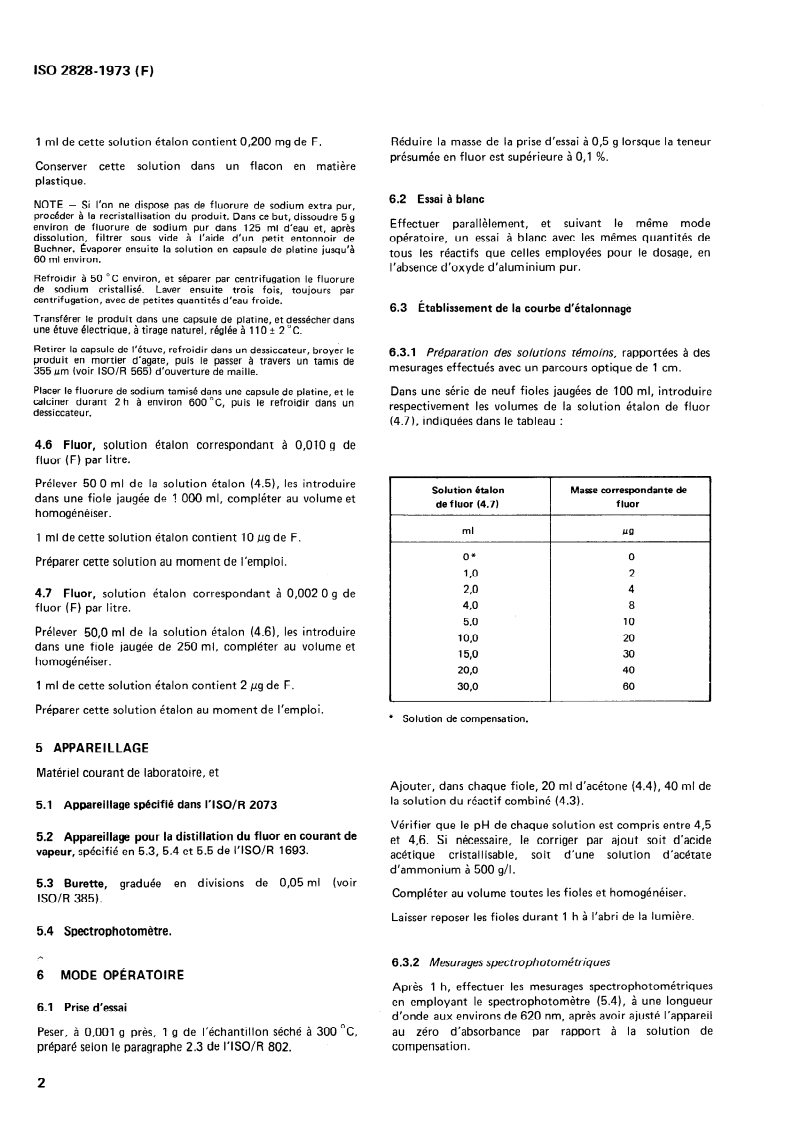
Réduire la masse de la prise d’essai à 0,5 g lorsque la teneur
1 ml de cette solution étalon contient 0,200 mg de F.
présumée en fluor est supérieure à 0,l %.
Conserver cette solution dans un flacon en matière
plastique.
6.2 Essai à blanc
NOTE - Si l’on ne dispose pas de fluorure de sodium extra pur,
procéder à la recristallisation du produit. Dans ce but, dissoudre 5 g
Effectuer parallèlement, et suivant le même mode
environ de fluorure de sodium pur dans 125 ml d’eau et, après
dissolution, filtrer sous vide à l’aide d’un petit entonnoir de opératoire, un essai à blanc avec les mêmes quantités de
Buchner. Évaporer ensuite l
...
NORME INTERNATIONALE
INTERNATIONAL ORGANIZATION FOR STANDARDIZATION l MEX)JYHAPOAHAR OPTAHM3ALVW r’I0 CTAHAAPTM3ALWZI -ORGANISATION INTERNATIONALE DE NORMALISATION
Oxyde d’aluminium principalement utilisé pour la production
- Dosage du fluor -
de l’aluminium Méthode spectrophoto-
métrique au complexone d’alizarine et chlorure de lanthane
Première édition - 1973-12-15
Réf. No : ISO 2828-1973 (F)
CDU 661.862.22 : 546.16 : 543.42
analyse chimique, dosage, fluor, spectrophotométrie.
Descripteurs : oxyde d’aluminium,
Prix basé sur 3 pages
AVANT-PROPOS
ISO (Organisation Internationale de Normalisation) est une fédération mondiale
d’organismes nationaux de normalisation (Comités Membres 60). L’élaboration de
Normes Internationales est confiée aux Comités Techniques 60. Chaque Comité
Membre intéressé par une étude a le droit de faire partie du Comité Technique
correspondant. Les organisations internationales, gouvernementales et non
gouvernementales, en liaison avec I’ISO, participent également aux travaux.
Les Projets de Normes Internationales adoptés par les Comités Techniques sont
soumis aux Comités Membres pour approbation, avant leur acceptation comme
Normes Internationales par le Conseil de I’ISO.
La Norme Internationale ISO 2828 a été établie par le Comité Technique
ISO/TC 47, Chimie, et soumise aux Comités Membres en juillet 1972.
Elle a été approuvée par les Comité Membres des pays suivants :
Afrique du Sud, Rép. d’ Irlande
Royaume-Uni
Allemagne Israël Suède
Australie Italie
Suisse
Mexique
Autriche Tchécoslovaquie
Belgique Nouvelle-Zélande Thaïlande
Egypte, Rép. arabe d’ Pays-Bas Turquie
France Pologne U.R.S.S.
Hongrie Portugal
Inde Roumanie
Cette Norme Internationale a également été approuvée par l’Union Internationale
de Chimie Pure et Appliquée (UICPA).
Aucun Comité Membre n’a désapprouvé le document.
0 Organisation Internationale de Normalisation, 1973 l
Imprimé en Suisse
ISO 28284973 (F)
NORME INTERNATIONALE
Oxyde d’aluminium principalement utilisé pour la production
de l’aluminium - Dosage du fluor - Méthode spectrophoto-
métrique au complexone d’alizarine et chlorure de lanthane
1 OBJET ET DOMAINE D’APPLICATION 4.2 Acide sulfurique, solution 24 N environ.
La présente Norme Internationale spécifie une méthode Ajouter avec précaution et par petites fractions 200 ml
spectrophotométrique de dosage du fluor, au complexone d’acide sulfurique p 1,84 g/ml environ, solution à
d’alizarine et chlorure de lanthane dans l’oxyde 96 % (mlm) environ, dans 100 ml d’eau et, après
d’aluminium principalement utilisé pour la production de
refroidissement, compléter le volume à 300 ml.
l’aluminium.
4.3 Réactif combiné
La méthode est applicable aux teneurs en fluor (F)
supérieure à 0,003 %.
Pour la préparation de ce réactif, mélanger, dans l’ordre, les
solutions 4.3.1, 4.3.2, 4.3.3, ajouter 250 ml d’acétone (4.4)
et compléter ensuite le volume à 1 000 ml.
2 RÉFÉRENCES
4.3.1 Complexone d’alizarine, solution
ISOI R 802, Oxyde daluminium principalement utilisé pour
la production de l’aluminium - Préparation et conservation
Dissoudre 0,154 g de complexone d’alizarine (acide dihy-
des échantillons pour essais.
droxy- 1,2 anthraquinonyl-3-méthylamine-N,N-diacétique)
dans environ 100 ml d’eau additionnée de 1 ml de solution
lSO/R 1693, Cryolithe naturelle et artificielle - Dosage du
d’ammoniaque (p 0,91 g/ml environ, solution à 24 % (mlm)
fluor - Méthode Wilard- Win ter modifiée.
environ). Après dissolution, ajouter 1 ml d’acide acétique
ISO/R 2073, Oxyde d’aluminium principalement utilisé cristallisable (p 1,05 g/ml environ, solution 17,4 N environ).
pour la production de l’aluminium - Mise en solution par
attaque à l’acide chlorhydrique sous pression.
4.3.2 Solution tampon
Dissoudre d’acétate de sodium trihydraté
34 9
(CH3.C00Na.3H20) et 15 ml d’acide acétique cristallisable
3 PRINCIPE
(p 1,05 g/ml environ, solution 17,4 N environ) dans environ
150 ml d’eau.
Mise en solution d’une prise d’essai par attaque à l’acide
sulfurique sous pression.
4.3.3 Chlorure de lanthane, solution
du fluor par distillation. Formation d’un
Séparation
complexe de coloration bleu, entre le fluor et le réactif
Dissoudre 0,372 g de chlorure de lanthane heptahydraté
combiné complexone d’alizarinekhlorure de lanthane (pH
(LaC13.7H20) dans 100 ml environ d’eau.
compris entre 4,5 et 4,6). Ajout d’acétone pour augmenter
la stabilité et la sensibilité du complexe fluoré obtenu. NOTE - Après mélange, laisser reposer la solution du réactif
combiné au moins 24 h, et, de préférence, 2 à 3 jours avant son
Mesurage spectrophotométrique du complexe, à une emploi. La solution est stable pendant 2 semaines environ. Son pH
se situe entre 4,55 et 4,60.
longueur d’onde aux environs de 620 nm.
4.4 Acétone, p 0,80 g/ml environ.
4 RÉACTIFS
4.5 Fluor, solution étalon correspondant à 0,200 g de
Au cours de l’analyse, n’utiliser que de l’eau distillée ou de
fluor (F) par litre.
l’eau de pureté équivalente.
Peser à 0,000 1 g près 0,442 0 g de fluorure de sodium
anhydre (NaF), extra pur, préalablement calciné à 600 “C
4.1 Acide sulfurique, solution environ l7,5 N.
en capsule de platine et refroidi en dessiccateur. Les
introduire dans un bécher de capacité convenable (100 ml,
Ajouter avec précaution et par petites fractions, 50 ml
par exemple) et les dissoudre avec de l’eau. Transvaser
d’acide sulfurique p 1,84 ml environ, solution à 96 % (m/m)
environ 50 ml après quantitativement la solution dans une fiole jaugée de
environ, dans d’eau, et,
1 000 ml, compléter au volume et homogénéiser.
refroidissement, compléter le volume à 100 ml.
ISO 28284973 (F)
Réduire la masse de la prise d’essai à 0,5 g lorsque la teneur
1 ml de cette solution étalon contient 0,200 mg de F.
présumée en fluor est supérieure à 0,l %.
Conserver cette solution dans un flacon en matière
plastique.
6.2 Essai à blanc
NOTE - Si l’on ne dispose pas de fluorure de sodium extra pur,
procéder à la recristallisation du produit. Dans ce but, dissoudre 5 g
et suivant le même mode
Effectuer parallèlement,
environ de fluorure de sodium pur dans 125 ml d’eau et, après
dissolution, filtrer sous vide à l’aide d’un petit entonnoir de
opératoire, un essai à bl
...
NORME INTERNATIONALE
INTERNATIONAL ORGANIZATION FOR STANDARDIZATION l MEX)JYHAPOAHAR OPTAHM3ALVW r’I0 CTAHAAPTM3ALWZI -ORGANISATION INTERNATIONALE DE NORMALISATION
Oxyde d’aluminium principalement utilisé pour la production
- Dosage du fluor -
de l’aluminium Méthode spectrophoto-
métrique au complexone d’alizarine et chlorure de lanthane
Première édition - 1973-12-15
Réf. No : ISO 2828-1973 (F)
CDU 661.862.22 : 546.16 : 543.42
analyse chimique, dosage, fluor, spectrophotométrie.
Descripteurs : oxyde d’aluminium,
Prix basé sur 3 pages
AVANT-PROPOS
ISO (Organisation Internationale de Normalisation) est une fédération mondiale
d’organismes nationaux de normalisation (Comités Membres 60). L’élaboration de
Normes Internationales est confiée aux Comités Techniques 60. Chaque Comité
Membre intéressé par une étude a le droit de faire partie du Comité Technique
correspondant. Les organisations internationales, gouvernementales et non
gouvernementales, en liaison avec I’ISO, participent également aux travaux.
Les Projets de Normes Internationales adoptés par les Comités Techniques sont
soumis aux Comités Membres pour approbation, avant leur acceptation comme
Normes Internationales par le Conseil de I’ISO.
La Norme Internationale ISO 2828 a été établie par le Comité Technique
ISO/TC 47, Chimie, et soumise aux Comités Membres en juillet 1972.
Elle a été approuvée par les Comité Membres des pays suivants :
Afrique du Sud, Rép. d’ Irlande
Royaume-Uni
Allemagne Israël Suède
Australie Italie
Suisse
Mexique
Autriche Tchécoslovaquie
Belgique Nouvelle-Zélande Thaïlande
Egypte, Rép. arabe d’ Pays-Bas Turquie
France Pologne U.R.S.S.
Hongrie Portugal
Inde Roumanie
Cette Norme Internationale a également été approuvée par l’Union Internationale
de Chimie Pure et Appliquée (UICPA).
Aucun Comité Membre n’a désapprouvé le document.
0 Organisation Internationale de Normalisation, 1973 l
Imprimé en Suisse
ISO 28284973 (F)
NORME INTERNATIONALE
Oxyde d’aluminium principalement utilisé pour la production
de l’aluminium - Dosage du fluor - Méthode spectrophoto-
métrique au complexone d’alizarine et chlorure de lanthane
1 OBJET ET DOMAINE D’APPLICATION 4.2 Acide sulfurique, solution 24 N environ.
La présente Norme Internationale spécifie une méthode Ajouter avec précaution et par petites fractions 200 ml
spectrophotométrique de dosage du fluor, au complexone d’acide sulfurique p 1,84 g/ml environ, solution à
d’alizarine et chlorure de lanthane dans l’oxyde 96 % (mlm) environ, dans 100 ml d’eau et, après
d’aluminium principalement utilisé pour la production de
refroidissement, compléter le volume à 300 ml.
l’aluminium.
4.3 Réactif combiné
La méthode est applicable aux teneurs en fluor (F)
supérieure à 0,003 %.
Pour la préparation de ce réactif, mélanger, dans l’ordre, les
solutions 4.3.1, 4.3.2, 4.3.3, ajouter 250 ml d’acétone (4.4)
et compléter ensuite le volume à 1 000 ml.
2 RÉFÉRENCES
4.3.1 Complexone d’alizarine, solution
ISOI R 802, Oxyde daluminium principalement utilisé pour
la production de l’aluminium - Préparation et conservation
Dissoudre 0,154 g de complexone d’alizarine (acide dihy-
des échantillons pour essais.
droxy- 1,2 anthraquinonyl-3-méthylamine-N,N-diacétique)
dans environ 100 ml d’eau additionnée de 1 ml de solution
lSO/R 1693, Cryolithe naturelle et artificielle - Dosage du
d’ammoniaque (p 0,91 g/ml environ, solution à 24 % (mlm)
fluor - Méthode Wilard- Win ter modifiée.
environ). Après dissolution, ajouter 1 ml d’acide acétique
ISO/R 2073, Oxyde d’aluminium principalement utilisé cristallisable (p 1,05 g/ml environ, solution 17,4 N environ).
pour la production de l’aluminium - Mise en solution par
attaque à l’acide chlorhydrique sous pression.
4.3.2 Solution tampon
Dissoudre d’acétate de sodium trihydraté
34 9
(CH3.C00Na.3H20) et 15 ml d’acide acétique cristallisable
3 PRINCIPE
(p 1,05 g/ml environ, solution 17,4 N environ) dans environ
150 ml d’eau.
Mise en solution d’une prise d’essai par attaque à l’acide
sulfurique sous pression.
4.3.3 Chlorure de lanthane, solution
du fluor par distillation. Formation d’un
Séparation
complexe de coloration bleu, entre le fluor et le réactif
Dissoudre 0,372 g de chlorure de lanthane heptahydraté
combiné complexone d’alizarinekhlorure de lanthane (pH
(LaC13.7H20) dans 100 ml environ d’eau.
compris entre 4,5 et 4,6). Ajout d’acétone pour augmenter
la stabilité et la sensibilité du complexe fluoré obtenu. NOTE - Après mélange, laisser reposer la solution du réactif
combiné au moins 24 h, et, de préférence, 2 à 3 jours avant son
Mesurage spectrophotométrique du complexe, à une emploi. La solution est stable pendant 2 semaines environ. Son pH
se situe entre 4,55 et 4,60.
longueur d’onde aux environs de 620 nm.
4.4 Acétone, p 0,80 g/ml environ.
4 RÉACTIFS
4.5 Fluor, solution étalon correspondant à 0,200 g de
Au cours de l’analyse, n’utiliser que de l’eau distillée ou de
fluor (F) par litre.
l’eau de pureté équivalente.
Peser à 0,000 1 g près 0,442 0 g de fluorure de sodium
anhydre (NaF), extra pur, préalablement calciné à 600 “C
4.1 Acide sulfurique, solution environ l7,5 N.
en capsule de platine et refroidi en dessiccateur. Les
introduire dans un bécher de capacité convenable (100 ml,
Ajouter avec précaution et par petites fractions, 50 ml
par exemple) et les dissoudre avec de l’eau. Transvaser
d’acide sulfurique p 1,84 ml environ, solution à 96 % (m/m)
environ 50 ml après quantitativement la solution dans une fiole jaugée de
environ, dans d’eau, et,
1 000 ml, compléter au volume et homogénéiser.
refroidissement, compléter le volume à 100 ml.
ISO 28284973 (F)
Réduire la masse de la prise d’essai à 0,5 g lorsque la teneur
1 ml de cette solution étalon contient 0,200 mg de F.
présumée en fluor est supérieure à 0,l %.
Conserver cette solution dans un flacon en matière
plastique.
6.2 Essai à blanc
NOTE - Si l’on ne dispose pas de fluorure de sodium extra pur,
procéder à la recristallisation du produit. Dans ce but, dissoudre 5 g
et suivant le même mode
Effectuer parallèlement,
environ de fluorure de sodium pur dans 125 ml d’eau et, après
dissolution, filtrer sous vide à l’aide d’un petit entonnoir de
opératoire, un essai à bl
...
NORME INTERNATIONALE
INTERNATIONAL ORGANIZATION FOR STANDARDIZATION l MEX)JYHAPOAHAR OPTAHM3ALVW r’I0 CTAHAAPTM3ALWZI -ORGANISATION INTERNATIONALE DE NORMALISATION
Oxyde d’aluminium principalement utilisé pour la production
- Dosage du fluor -
de l’aluminium Méthode spectrophoto-
métrique au complexone d’alizarine et chlorure de lanthane
Première édition - 1973-12-15
Réf. No : ISO 2828-1973 (F)
CDU 661.862.22 : 546.16 : 543.42
analyse chimique, dosage, fluor, spectrophotométrie.
Descripteurs : oxyde d’aluminium,
Prix basé sur 3 pages
AVANT-PROPOS
ISO (Organisation Internationale de Normalisation) est une fédération mondiale
d’organismes nationaux de normalisation (Comités Membres 60). L’élaboration de
Normes Internationales est confiée aux Comités Techniques 60. Chaque Comité
Membre intéressé par une étude a le droit de faire partie du Comité Technique
correspondant. Les organisations internationales, gouvernementales et non
gouvernementales, en liaison avec I’ISO, participent également aux travaux.
Les Projets de Normes Internationales adoptés par les Comités Techniques sont
soumis aux Comités Membres pour approbation, avant leur acceptation comme
Normes Internationales par le Conseil de I’ISO.
La Norme Internationale ISO 2828 a été établie par le Comité Technique
ISO/TC 47, Chimie, et soumise aux Comités Membres en juillet 1972.
Elle a été approuvée par les Comité Membres des pays suivants :
Afrique du Sud, Rép. d’ Irlande
Royaume-Uni
Israël
Allemagne Suède
Australie Italie
Suisse
Mexique
Autriche Tchécoslovaquie
Belgique Nouvelle-Zélande Thaïlande
Egypte, Rép. arabe d’ Pays-Bas Turquie
France Pologne U.R.S.S.
Hongrie Portugal
Inde Roumanie
Cette Norme Internationale a également été approuvée par l’Union Internationale
de Chimie Pure et Appliquée (UICPA).
Aucun Comité Membre n’a désapprouvé le document.
0 Organisation Internationale de Normalisation, 1973 l
Imprimé en Suisse
ISO 28284973 (F)
NORME INTERNATIONALE
Oxyde d’aluminium principalement utilisé pour la production
de l’aluminium - Dosage du fluor - Méthode spectrophoto-
métrique au complexone d’alizarine et chlorure de lanthane
1 OBJET ET DOMAINE D’APPLICATION 4.2 Acide sulfurique, solution 24 N environ.
La présente Norme Internationale spécifie une méthode Ajouter avec précaution et par petites fractions 200 ml
spectrophotométrique de dosage du fluor, au complexone d’acide sulfurique p 1,84 g/ml environ, solution à
d’alizarine et chlorure de lanthane dans l’oxyde 96 % (mlm) environ, dans 100 ml d’eau et, après
d’aluminium principalement utilisé pour la production de
refroidissement, compléter le volume à 300 ml.
l’aluminium.
4.3 Réactif combiné
La méthode est applicable aux teneurs en fluor (F)
supérieure à 0,003 %.
Pour la préparation de ce réactif, mélanger, dans l’ordre, les
solutions 4.3.1, 4.3.2, 4.3.3, ajouter 250 ml d’acétone (4.4)
et compléter ensuite le volume à 1 000 ml.
2 RÉFÉRENCES
4.3.1 Complexone d’alizarine, solution
ISOI R 802, Oxyde d%luminium principalement utilisé pour
la production de l’aluminium - Préparation et conservation
Dissoudre 0,154 g de complexone d’alizarine (acide dihy-
des échantillons pour essais.
droxy- 1,2 anthraquinonyl-3-méthylamine-N,N-diacétique)
dans environ 100 ml d’eau additionnée de 1 ml de solution
lSO/R 1693, Cryolithe naturelle et artificielle - Dosage du
d’ammoniaque (p 0,91 g/ml environ, solution à 24 % (mlm)
fluor - Méthode Wilard- Win ter modifiée.
environ). Après dissolution, ajouter 1 ml d’acide acétique
ISO/R 2073, Oxyde d’aluminium principalement utilisé cristallisable (p 1,05 g/ml environ, solution 17,4 N environ).
pour la production de l’aluminium - Mise en solution par
attaque à l’acide chlorhydrique sous pression.
4.3.2 Solution tampon
Dissoudre d’acétate de sodium trihydraté
34 9
(CH3.C00Na.3H20) et 15 ml d’acide acétique cristallisable
3 PRINCIPE
(p 1,05 g/ml environ, solution 17,4 N environ) dans environ
150 ml d’eau.
Mise en solution d’une prise d’essai par attaque à l’acide
sulfurique sous pression.
4.3.3 Chlorure de lanthane, solution
du fluor par distillation. Formation d’un
Séparation
complexe de coloration bleu, entre le fluor et le réactif
Dissoudre 0,372 g de chlorure de lanthane heptahydraté
combiné complexone d’alizarinekhlorure de lanthane (pH
(LaC13.7H20) dans 100 ml environ d’eau.
compris entre 4,5 et 4,6). Ajout d’acétone pour augmenter
la stabilité et la sensibilité du complexe fluoré obtenu. NOTE - Après mélange, laisser reposer la solution du réactif
combiné au moins 24 h, et, de préférence, 2 à 3 jours avant son
Mesurage spectrophotométrique du complexe, à une emploi. La solution est stable pendant 2 semaines environ. Son pH
se situe entre 4,55 et 4,60.
longueur d’onde aux environs de 620 nm.
4.4 Acétone, p 0,80 g/ml environ.
4 RÉACTIFS
4.5 Fluor, solution étalon correspondant à 0,200 g de
Au cours de l’analyse, n’utiliser que de l’eau distillée ou de
fluor (F) par litre.
l’eau de pureté équivalente.
Peser à 0,000 1 g près 0,442 0 g de fluorure de sodium
anhydre (NaF), extra pur, préalablement calciné à 600 “C
4.1 Acide sulfurique, solution environ l7,5 N.
en capsule de platine et refroidi en dessiccateur. Les
introduire dans un bécher de capacité convenable (100 ml,
Ajouter avec précaution et par petites fractions, 50 ml
par exemple) et les dissoudre avec de l’eau. Transvaser
d’acide sulfurique p 1,84 ml environ, solution à 96 % (m/m)
environ 50 ml après quantitativement la solution dans une fiole jaugée de
environ, dans d’eau, et,
1 000 ml, compléter au volume et homogénéiser.
refroidissement, compléter le volume à 100 ml.
ISO 28284973 (F)
Réduire la masse de la prise d’essai à 0,5 g lorsque la teneur
1 ml de cette solution étalon contient 0,200 mg de F.
présumée en fluor est supérieure à 0,l %.
Conserver cette solution dans un flacon en matière
plastique.
6.2 Essai à blanc
NOTE - Si l’on ne dispose pas de fluorure de sodium extra pur,
procéder à la recristallisation du produit. Dans ce but, dissoudre 5 g
Effectuer parallèlement, et suivant le même mode
environ de fluorure de sodium pur dans 125 ml d’eau et, après
dissolution, filtrer sous vide à l’aide d’un petit entonnoir de opératoire, un essai à blanc avec les mêmes quantités de
Buchner. Évaporer ensuite l
...