


ISO/DTS 24943
(Main)Traditional Chinese medicine — Requirements for decoction pieces prescription
Traditional Chinese medicine — Requirements for decoction pieces prescription
This document specifies the general requirements, content, and writing requirement for decoction pieces prescription. It regulates qualification of prescription writing, prescription of precious medicines, prescription of toxic and anesthetic medicines, and institution-based prescription, etc.
Médecine traditionnelle chinoise — Exigences relatives à la prescription de pièces de décoction
General Information
- Status
- Not Published
- Technical Committee
- ISO/TC 249 - Traditional Chinese medicine
- Drafting Committee
- ISO/TC 249/WG 2 - Quality and safety of manufactured TCM products
- Current Stage
- 5020 - FDIS ballot initiated: 2 months. Proof sent to secretariat
- Start Date
- 31-Dec-2025
- Completion Date
- 31-Dec-2025
Overview
ISO/DTS 24943 sets forth standardized requirements for the prescription of decoction pieces in Traditional Chinese Medicine (TCM). This international standard outlines the essential general requirements, content structure, and writing protocols for prescriptions involving decoction pieces. It addresses critical aspects such as qualification criteria for prescribers, management of prescriptions involving precious, toxic, and anesthetic medicines, as well as institution-based prescription regulations. Designed to improve safety, communication, and consistency within TCM practices, this standard supports the quality of medical care and enhances patient safety.
Key Topics
Prescription Qualification: Only licensed physicians with appropriate medical qualifications and educational background may issue prescriptions. Medical institutions grant prescription rights, including freelance and self-employed practitioners.
Prescription Composition: Prescriptions must be formulated based on TCM diagnostic principles, such as syndrome differentiation and treatment theory. They detail the names, quantities, preparation methods, dosage, contraindications, and precautions for the decoction pieces.
Prescription Writing: Clarity and legibility are mandatory. Amendments require prescriber signature and date. Narcotic and toxic prescriptions must include warning labels to emphasize safe handling.
Timeliness and Validity: Prescriptions should comply with timeliness guidelines per local regulations to ensure medical relevance and patient safety.
Preservation and Destruction: Medical institutions are responsible for the proper maintenance and archiving of prescriptions in compliance with applicable health authority guidelines.
Prescription Management: This includes ensuring that personnel involved in dispensing are qualified and that prescriptions adhere to regulatory requirements for narcotic and toxic drugs.
Integration with Related Standards: This standard aligns with ISO 18668 (coding for decoction pieces and granule forms), ISO 20333 (coding rules in supply chain management), and ISO 20334 (coding system for formulae).
Applications
Healthcare Institutions: Hospitals and TCM clinics can adopt ISO/DTS 24943 to standardize decoction piece prescription processes, ensuring consistent clinical documentation and safer patient outcomes.
Pharmacies and Herbal Dispensaries: Ensures proper handling, reviewing, and dispensing of prescriptions by qualified personnel, minimizing medication errors.
Regulatory Compliance: Helps governmental health agencies and accreditation bodies enforce uniform standards in prescription writing for TCM medicines, enhancing public safety.
Education and Training: Serves as an authoritative resource for training TCM practitioners, focusing on legal, clinical, and technical aspects of prescribing decoction pieces.
Healthcare IT Systems: Facilitates the development of electronic prescription systems adopting standardized writing formats and content requirements.
Related Standards
- ISO 18668-2 - Traditional Chinese Medicine: Coding System for Chinese Medicines-Part 2 (Decoction Pieces).
- ISO 18668-4 - Coding System for Chinese Medicines-Part 4 (Granule Forms).
- ISO 20333 - Coding Rules for Chinese Medicines in Supply Chain Management.
- ISO 20334 - Coding System of Formulae in Traditional Chinese Medicine.
These standards collectively enhance traceability, safety, and interoperability across TCM healthcare services and supply chain operations.
Keywords: Traditional Chinese Medicine prescription, decoction pieces prescription, TCM prescription standards, Chinese medicine prescription writing, narcotic drug prescription in TCM, toxic medicine prescription, prescription management in TCM, ISO/DTS 24943, TCM healthcare quality, herbal medicine dispensing standards.
ISO/DTS 24943 - Traditional Chinese medicine — Requirements for decoction pieces prescription Released:17. 12. 2025
REDLINE ISO/DTS 24943 - Traditional Chinese medicine — Requirements for decoction pieces prescription Released:17. 12. 2025
Get Certified
Connect with accredited certification bodies for this standard

BSI Group
BSI (British Standards Institution) is the business standards company that helps organizations make excellence a habit.

TÜV Rheinland
TÜV Rheinland is a leading international provider of technical services.

TÜV SÜD
TÜV SÜD is a trusted partner of choice for safety, security and sustainability solutions.
Sponsored listings
Frequently Asked Questions
ISO/DTS 24943 is a draft published by the International Organization for Standardization (ISO). Its full title is "Traditional Chinese medicine — Requirements for decoction pieces prescription". This standard covers: This document specifies the general requirements, content, and writing requirement for decoction pieces prescription. It regulates qualification of prescription writing, prescription of precious medicines, prescription of toxic and anesthetic medicines, and institution-based prescription, etc.
This document specifies the general requirements, content, and writing requirement for decoction pieces prescription. It regulates qualification of prescription writing, prescription of precious medicines, prescription of toxic and anesthetic medicines, and institution-based prescription, etc.
ISO/DTS 24943 is classified under the following ICS (International Classification for Standards) categories: 11.120.10 - Medicaments. The ICS classification helps identify the subject area and facilitates finding related standards.
ISO/DTS 24943 is available in PDF format for immediate download after purchase. The document can be added to your cart and obtained through the secure checkout process. Digital delivery ensures instant access to the complete standard document.
Standards Content (Sample)
FINAL DRAFT
Technical
Specification
ISO/TC 249/SC 1
Traditional Chinese medicine —
Secretariat: SAC
Requirements for decoction pieces
Voting begins on:
prescription
2025-12-31
Voting terminates on:
2026-02-25
RECIPIENTS OF THIS DRAFT ARE INVITED TO SUBMIT,
WITH THEIR COMMENTS, NOTIFICATION OF ANY
RELEVANT PATENT RIGHTS OF WHICH THEY ARE AWARE
AND TO PROVIDE SUPPOR TING DOCUMENTATION.
IN ADDITION TO THEIR EVALUATION AS
BEING ACCEPTABLE FOR INDUSTRIAL, TECHNO
LOGICAL, COMMERCIAL AND USER PURPOSES, DRAFT
INTERNATIONAL STANDARDS MAY ON OCCASION HAVE
TO BE CONSIDERED IN THE LIGHT OF THEIR POTENTIAL
TO BECOME STAN DARDS TO WHICH REFERENCE MAY BE
MADE IN NATIONAL REGULATIONS.
Reference number
FINAL DRAFT
Technical
Specification
ISO/TC 249/SC 1
Traditional Chinese medicine —
Secretariat: SAC
Requirements for decoction pieces
Voting begins on:
prescription
Voting terminates on:
RECIPIENTS OF THIS DRAFT ARE INVITED TO SUBMIT,
WITH THEIR COMMENTS, NOTIFICATION OF ANY
RELEVANT PATENT RIGHTS OF WHICH THEY ARE AWARE
AND TO PROVIDE SUPPOR TING DOCUMENTATION.
© ISO 2025
IN ADDITION TO THEIR EVALUATION AS
All rights reserved. Unless otherwise specified, or required in the context of its implementation, no part of this publication may
BEING ACCEPTABLE FOR INDUSTRIAL, TECHNO
LOGICAL, COMMERCIAL AND USER PURPOSES, DRAFT
be reproduced or utilized otherwise in any form or by any means, electronic or mechanical, including photocopying, or posting on
INTERNATIONAL STANDARDS MAY ON OCCASION HAVE
the internet or an intranet, without prior written permission. Permission can be requested from either ISO at the address below
TO BE CONSIDERED IN THE LIGHT OF THEIR POTENTIAL
or ISO’s member body in the country of the requester.
TO BECOME STAN DARDS TO WHICH REFERENCE MAY BE
MADE IN NATIONAL REGULATIONS.
ISO copyright office
CP 401 • Ch. de Blandonnet 8
CH-1214 Vernier, Geneva
Phone: +41 22 749 01 11
Email: copyright@iso.org
Website: www.iso.org
Published in Switzerland Reference number
ii
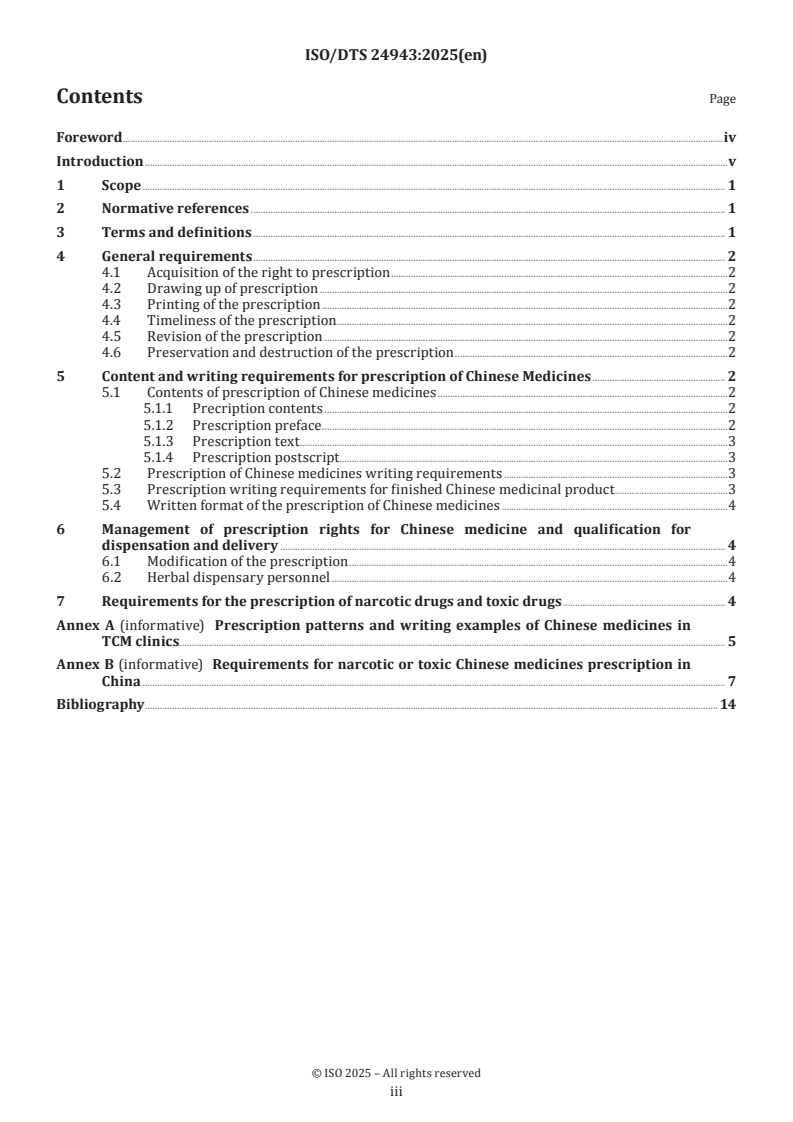
Contents Page
Foreword .iv
Introduction .v
1 Scope . 1
2 Normative references . 1
3 Terms and definitions . 1
4 General requirements . 2
4.1 Acquisition of the right to prescription .2
4.2 Drawing up of prescription .2
4.3 Printing of the prescription .2
4.4 Timeliness of the prescription . .2
4.5 Revision of the prescription .2
4.6 Preservation and destruction of the prescription .2
5 Content and writing requirements for prescription of Chinese Medicines . 2
5.1 Contents of prescription of Chinese medicines .2
5.1.1 Precription contents .2
5.1.2 Prescription preface .2
5.1.3 Prescription text .3
5.1.4 Prescription postscript.3
5.2 Prescription of Chinese medicines writing requirements .3
5.3 Prescription writing requirements for finished Chinese medicinal product .3
5.4 Written format of the prescription of Chinese medicines .4
6 Management of prescription rights for Chinese medicine and qualification for
dispensation and delivery . 4
6.1 Modification of the prescription .4
6.2 Herbal dispensary personnel .4
7 Requirements for the prescription of narcotic drugs and toxic drugs . 4
Annex A (informative) Prescription patterns and writing examples of Chinese medicines in
TCM clinics . . 5
Annex B (informative) Requirements for narcotic or toxic Chinese medicines prescription in
China . 7
Bibliography . 14
iii
Foreword
ISO (the International Organization for Standardization) is a worldwide federation of national standards
bodies (ISO member bodies). The work of preparing International Standards is normally carried out through
ISO technical committees. Each member body interested in a subject for which a technical committee
has been established has the right to be represented on that committee. International organizations,
governmental and non-governmental, in liaison with ISO, also take part in the work. ISO collaborates closely
with the International Electrotechnical Commission (IEC) on all matters of electrotechnical standardization.
The procedures used to develop this document and those intended for its further maintenance are described
in the ISO/IEC Directives, Part 1. In particular, the different approval criteria needed for the different types
of ISO document should be noted. This document was drafted in accordance with the editorial rules of the
ISO/IEC Directives, Part 2 (see www.iso.org/directives).
ISO draws attention to the possibility that the implementation of this document may involve the use of (a)
patent(s). ISO takes no position concerning the evidence, validity or applicability of any claimed patent
rights in respect thereof. As of the date of publication of this document, ISO had not received notice of (a)
patent(s) which may be required to implement this document. However, implementers are cautioned that
this may not represent the latest information, which may be obtained from the patent database available at
www.iso.org/patents. ISO shall not be held responsible for identifying any or all such patent rights.
Any trade name used in this document is information given for the convenience of users and does not
constitute an endorsement.
For an explanation of the voluntary nature of standards, the meaning of ISO specific terms and expressions
related to conformity assessment, as well as information about ISO's adherence to the World Trade
Organization (WTO) principles in the Technical Barriers to Trade (TBT), see www.iso.org/iso/foreword.html.
This document was prepared by Technical Committee ISO/TC 249, Traditional medicine, Subcommittee SC 1,
Traditional Chinese medicine.
Any feedback or questions on this document should be directed to the user’s national standards body. A
complete listing of these bodies can be found at www.iso.org/members.html.
iv
Introduction
The prescription requirements of Chinese medicines are a crucial component of the service process of
Chinese medicines. This encompasses the whole process, starting from the physician's medical treatment
guided by the traditional Chinese medicine (TCM) theory of syndrome differentiation and treatment, leading
to the writing of the patient prescription. Unfortunately, this aspect has not received adequate attention,
significantly affecting the quality of medical care and services, as well as the safety and effectiveness of TCM
medication, and the vital rights of consumers.
Therefore, it is vital to standardize and establish a traceable medication service process for Chinese
medicines. This will promote effective communication among physicians, pharmacists and patients,
improving relationships between physicians and patients, enhancing levels of medical service, reducing
medical errors and accidents, ensuring the safety and effectiveness of people's medication, safeguarding the
legitimate rights and interests of consumers, and making contributions to human health.
Prescribing is an important medical activity that requires serious and rigorous behavior. It is also the first
and most critical step in the entire service process.
[1] [2] [3]
This document is consistent with the provisions of ISO 18668-2 , ISO 18668-4 , ISO 20333 , ISO 20334
[4]
and other relevant international standards.
v
FINAL DRAFT Technical Specification ISO/DTS 24943:2025(en)
Traditional Chinese medicine — Requirements for decoction
pieces prescription
1 Scope
This document specifies the general requirements, content and writing requirements for the prescription of
decoction pieces. It notably regulates the qualification of prescription writing, the prescription of precious
medicines, the prescription of toxic and anaesthetic medicines, and institution-based prescriptions.
This document applies to prescription writing, dispensing and storage.
2 Normative references
There are no normative references in this document.
3 Terms and definitions
For the purposes of this document, the following terms and definitions apply.
ISO and IEC maintain terminology databases for use in standardization at the following addresses:
— ISO Online browsing platform: available at https:// www .iso .org/ obp
— IEC Electropedia: available at https:// www .electropedia .org/
3.1
prescription of Chinese medicines
medical document issued by a licenced physician for the diagnosis and treatment of patients
Note 1 to entry: The prescription of Chinese medicines includes details such as the names, quantities, preparation
methods and other specifications of Chinese medicinal herbs and formulations. It is subject to review, dispensation
and verification by a prescription-reviewing pharmacist (see Note 4 to entry), and it also serves as a voucher for the
distribution of medicinal products.
Note 2 to entry: The prescription of Chinese medicines is a written notice from doctors to traditional Chinese medicine
dispensing personnel (see Note 5 to entry) that represents both the basis of traditional Chinese medicine dispensing,
and the voucher of valuation and statistics, which has legal, technical and economic significance.
Note 3 to entry: The prescription of Chinese medicines provides a written record and evidence of doctors’ syndrome
differentiation and treatment, reflecting the physicians' syndrome differentiation and drug use requirements.
Note 4 to entry: The "prescription-reviewing pharmacist" refers to a professional in the herbal pharmacy responsible
for reviewing physicians' prescriptions.
Note 5 to entry: "Traditional Chinese medicine dispensing personnel" refers to a professional in the dispensing room
responsible for the preparation, dispensing and management of prescriptions.
4 General requirements
4.1 Acquisition of the right to prescription
Individuals in possession of the relevant educational background and knowledge, who have obtained
medical qualification(s) according to the local health and pharmaceutical industries, and who are employed
by medical institutions, are granted prescription rights by that medical institution.
NOTE Employees of medical institutions can include freelance doctors, self-employed persons and owners of
medical institutions.
4.2 Drawing up of prescription
A physician/doctor of traditional Chinese medicine should prescribe based on the principle of syndrome
differentiation and treatment, specific medical needs, prevention, health care, standard of diagnosis and
treatment, drug indication, pharmacological action, usage, dosage, contraindication, adverse reaction and
precautions, etc.
4.3 Printing of the prescription
Appropriate warning labels should be marked on prescriptions of narcotic and toxic drugs to ensure proper
handling and awareness of their special status and usage guidelines.
4.4 Timeliness of the prescription
Requirements for the timeliness of prescriptions should be specified based on the local situation.
4.5 Revision of the prescription
The prescription should be legibly written and should not be altered; if amendment is necessary, the
prescriber shall sign and date the amended section to indicate the revision.
4.6 Preservation and destruction of the prescription
Medical institutions responsible for dispensing prescriptions are required to maintain them properly.
NOTE The retention period for different types of prescriptions can be dependent on guidelines set by the medical
and health administrative authorities of the respective country or region.
5 Content and writing requirements for prescription of Chinese Medicines
5.1 Contents of prescription of Chinese medicines
5.1.1 Precription contents
The preface, text and postscript of the prescription contain standardized content, specified in the following
subclauses, and shall adhere to the requirements of safety, efficiency and cost-effectiveness.
5.1.2 Prescription preface
The prescription preface shall include:
a) the name of the medical treatment, prevention or health care institution;
b) the prescription number;
c) the patient’s name, sex and age;
d) the patient's inpatient record number, department or ward and bed number;
e) the patient's clinical diagnosis/TCM diagnosis, including the disease name and syndrome type (do not
write if the disease name is not clear);
f) the date of prescribing.
5.1.3 Prescription text
The prescription text shall be marked with a distinctive heading or symbol to label the prescription, such as
"Rp" or "R" (the abbreviation of Latin "recipe"). Decoction pieces shall include their name, dosage and usage.
5.1.4 Prescription postscript
The prescription postscript shall encompass the physician’s signature or authorized stamp, or both. Items
with special requirements can be added depending on the actual situation, such as price, drug amount or
the special signature of the pharmaceutical professional and technical personnel for reviewing, dispensing,
checking and distributing drugs.
5.2 Prescription of Chinese medicines writing requirements
5.2.1 The name of the decoction pieces should be written in the official local language.
5.2.2 The dosage should be expressed in statutory unit of measurement, using Arabic numerals. The
principle should be in "gram" (g) as a unit, i.e. With "g" (unit name) following the numerical value.
5.2.3 The number of decoction pieces should be used as a "dose".
The quantity of doses should be specified directly, followed by the prescription’s usage and dosage
instruction. This includes daily dosage, dosage forms (decocting, wine-soaking, powder-baking, pill-making,
capsules-filling, etc.), dosage frequency, medication methods (oral and external use, etc.) and administration
requirements (administered warm, administered cool, administered at draught, slow administration,
administered before meal, administered after meal, administered on empty stomach, etc.).
EXAMPLE One dose per day, decocting it with 400ml water, administered warm, in the morning and evening.
5.2.4 Regarding the use of decoction pieces under the administration of toxic drugs and anaesthetics,
local laws and regulations can apply.
5.2.5 Regarding prohibited or restricted use of certain decoction pieces, regulations of the local medical
and health management departments of the country or region can apply.
5.3 Prescription writing requirements for finished Chinese medicinal product
5.3.1 According to the TCM diagnosis (including disease name and syndrome type), syndrome
differentiation or a combination of syndrome differentiation and disease differentiation is used to select a
suitable finished Chinese medicinal product.
5.3.2 The name of the decoction pieces in the hospital should be approved by the drug supervision and
administration department.
5.3.3 Usage and dosage should be used according to the conventional usage and dosage prescribed in the
drug instructions. If the patient has a special condition and needs to exceed the dosage, the reasons should
be noted and signed again.
5.3.4 Tablets, pills, capsules and granules are taken as tablets, pellets, granules and bags. Ointments
and cream are taken as the unit in branches and boxes. Solution preparations and injections are in units of
branches and bottles, and the dosage should be marked.
5.3.5 Medicine with strong or toxic components should not be reused. Finished medicinal products with
the same function or with the same toxicity decoction pieces should not be superimposed.
5.3.6 Chinese Medicines injection should be prescribed separately.
5.3.7 The format of the prescription can be consistent with the electronic medical record.
5.4 Written format of the prescription of Chinese medicines
For the written format of decoction pieces and finished Chinese medicinal product prescription, local
authority requirements can apply. See Annex A for written examples of decoction pieces and finished
Chinese medicinal product prescription.
6 Management of prescription rights for Chinese medicine and qualification for
dispensation and delivery
6.1 Modification of the prescription
Each item on a prescription written by the physician shall remain unaltered. If changes are required, a
single line should be drawn through the revised content, ensuring
...
Style Definition: Heading 1: Indent: Left: 0 cm, First
line: 0 cm
ISO/TC 249/SC 1
Style Definition: Heading 2: Font: Bold, Indent: Left: 0
cm, First line: 0 cm
ISO/CD TS 24943(en)
Style Definition: Heading 3: Font: Bold, Indent: Left: 0
cm, First line: 0 cm
Secretariat: SAC
Style Definition: Heading 4: Font: Bold, Indent: Left: 0
cm, First line: 0 cm
Date: 2025-12-15
Style Definition: Heading 5: Font: Bold, Indent: Left: 0
cm, First line: 0 cm
Style Definition: Heading 6: Font: Bold
Style Definition: IntroHeading1: Font: Bold, Indent:
Left: 0 cm, First line: 0 cm
Style Definition: IntroHeading2: Font: Bold, Indent:
Traditional Chinese medicine — Requirements for decoction pieces
Left: 0 cm, First line: 0 cm
prescription
Style Definition: IntroHeading3: Font: Bold, Indent:
Left: 0 cm, First line: 0 cm
N.A.
Style Definition: IntroHeading4: Font: Bold, Indent:
Left: 0 cm, First line: 0 cm
Style Definition: IntroHeading5: Font: Bold, Indent:
Left: 0 cm, First line: 0 cm
Style Definition: IntroHeading6
Style Definition: IntroHeading7
Style Definition: IntroHeading8
Style Definition: IntroHeading9
Style Definition: ANNEX
Style Definition: Key Text
Style Definition: Key Title
Style Definition: List Continue 1
Style Definition: TermNum2: Font: Bold, Indent: Left:
0 cm, First line: 0 cm
Style Definition: TermNum3: Font: Bold, Indent: Left:
0 cm, First line: 0 cm
Style Definition: TermNum4: Font: Bold, Indent: Left:
0 cm, First line: 0 cm
Style Definition: TermNum5: Font: Bold, Indent: Left:
0 cm, First line: 0 cm
Style Definition: TermNum6: Font: Bold
Style Definition: Body Text
Style Definition: boxedText
Style Definition: Boxed List Continue 1
Style Definition: boxedTitle
Style Definition: FooterCentered
Style Definition: FooterPageNumber
Style Definition: FooterPageRomanNumber
Style Definition: FooterCenteredContinued
Style Definition: TPS Markup Base
ISO/CD TSDTS 24943:2025(en)
All rights reserved. Unless otherwise specified, or required in the context of its implementation, no part of this publication
may be reproduced or utilized otherwise in any form or by any means, electronic or mechanical, including photocopying,
or posting on the internet or an intranet, without prior written permission. Permission can be requested from either ISO
at the address below or ISO’s member body in the country of the requester.
ISO copyright office
CP 401 • Ch. de Blandonnet 8
CH-1214 Vernier, Geneva
Phone: + 41 22 749 01 11
Formatted: French (France)
E-mail: copyright@iso.org
Website: www.iso.org
Published in Switzerland
ii
ISO/CD TSDTS 24943:2025(en)
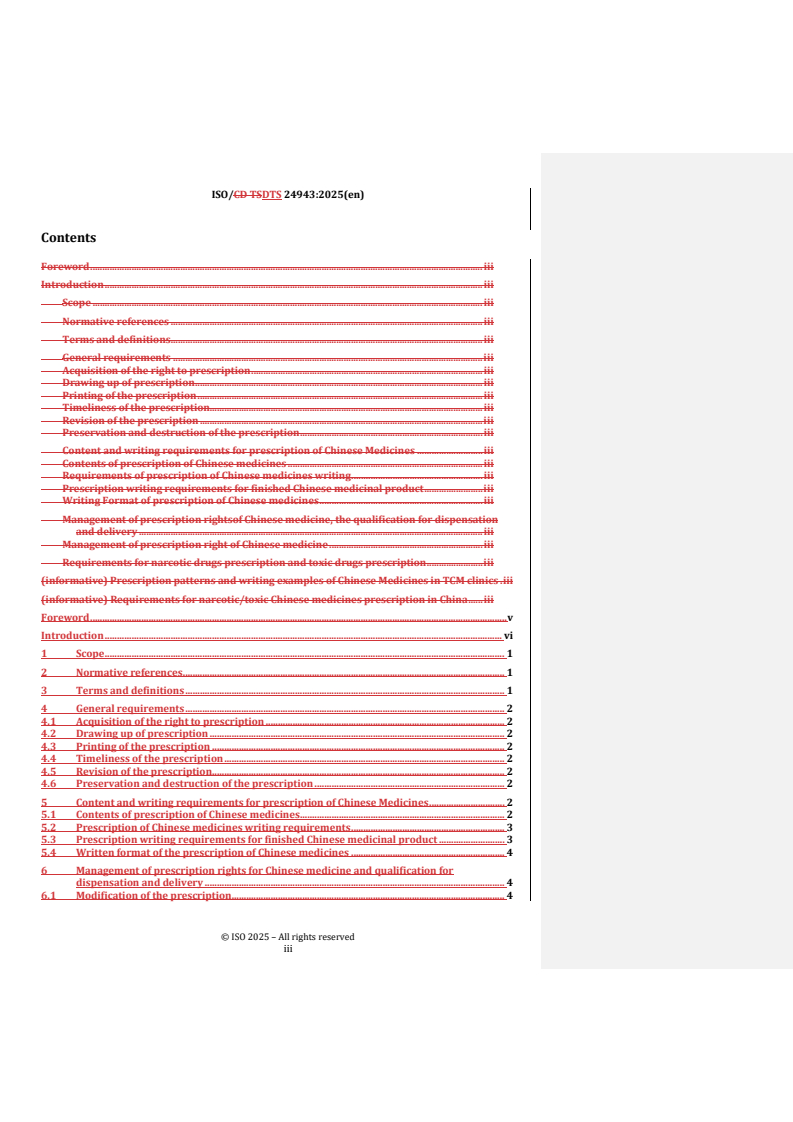
Contents
Foreword . iii
Introduction . iii
Scope . iii
Normative references . iii
Terms and definitions . iii
General requirements . iii
Acquisition of the right to prescription . iii
Drawing up of prescription . iii
Printing of the prescription . iii
Timeliness of the prescription. iii
Revision of the prescription . iii
Preservation and destruction of the prescription . iii
Content and writing requirements for prescription of Chinese Medicines . iii
Contents of prescription of Chinese medicines . iii
Requirements of prescription of Chinese medicines writing . iii
Prescription writing requirements for finished Chinese medicinal product . iii
Writing Format of prescription of Chinese medicines . iii
Management of prescription rightsof Chinese medicine, the qualification for dispensation
and delivery . iii
Management of prescription right of Chinese medicine . iii
Requirements for narcotic drugs prescription and toxic drugs prescription . iii
(informative) Prescription patterns and writing examples of Chinese Medicines in TCM clinics . iii
(informative) Requirements for narcotic/toxic Chinese medicines prescription in China . iii
Foreword . v
Introduction . vi
1 Scope . 1
2 Normative references . 1
3 Terms and definitions . 1
4 General requirements . 2
4.1 Acquisition of the right to prescription . 2
4.2 Drawing up of prescription . 2
4.3 Printing of the prescription . 2
4.4 Timeliness of the prescription . 2
4.5 Revision of the prescription . 2
4.6 Preservation and destruction of the prescription . 2
5 Content and writing requirements for prescription of Chinese Medicines . 2
5.1 Contents of prescription of Chinese medicines . 2
5.2 Prescription of Chinese medicines writing requirements . 3
5.3 Prescription writing requirements for finished Chinese medicinal product . 3
5.4 Written format of the prescription of Chinese medicines . 4
6 Management of prescription rights for Chinese medicine and qualification for
dispensation and delivery . 4
6.1 Modification of the prescription. 4
iii
ISO/CD TSDTS 24943:2025(en)
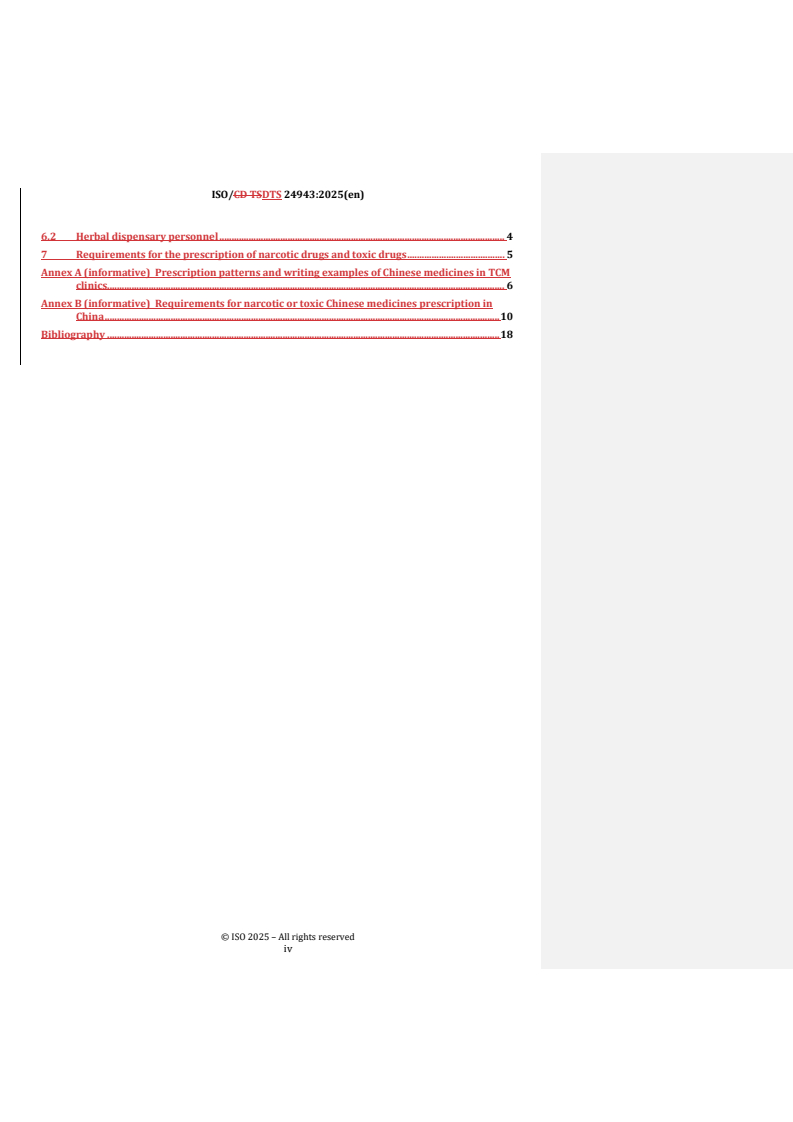
6.2 Herbal dispensary personnel . 4
7 Requirements for the prescription of narcotic drugs and toxic drugs . 5
Annex A (informative) Prescription patterns and writing examples of Chinese medicines in TCM
clinics. 6
Annex B (informative) Requirements for narcotic or toxic Chinese medicines prescription in
China . 10
Bibliography . 18
iv
ISO/CD TSDTS 24943:2025(en)
Foreword
ISO (the International Organization for Standardization) is a worldwide federation of national standards
bodies (ISO member bodies). The work of preparing International Standards is normally carried out through
ISO technical committees. Each member body interested in a subject for which a technical committee has been
established has the right to be represented on that committee. International organizations, governmental and
non-governmental, in liaison with ISO, also take part in the work. ISO collaborates closely with the
International Electrotechnical Commission (IEC) on all matters of electrotechnical standardization.
The procedures used to develop this document and those intended for its further maintenance are described
in the ISO/IEC Directives, Part 1Part 1. In particular, the different approval criteria needed for the different
types of ISO document should be noted. This document was drafted in accordance with the editorial rules of
the ISO/IEC Directives, Part 2IEC Directives, Part 2 (see www.iso.org/directives).
ISO draws attention to the possibility that the implementation of this document may involve the use of (a)
patent(s). ISO takes no position concerning the evidence, validity or applicability of any claimed patent rights
in respect thereof. As of the date of publication of this document, ISO [had/had not] received notice of (a)
patent(s) which may be required to implement this document. However, implementers are cautioned that this
may not represent the latest information, which may be obtained from the patent database available at
www.iso.org/patents. ISO shall not be held responsible for identifying any or all such patent rights.
Any trade name used in this document is information given for the convenience of users and does not
constitute an endorsement.
For an explanation of the voluntary nature of standards, the meaning of ISO specific terms and expressions
related to conformity assessment, as well as information about ISO's adherence to the World Trade
Organization (WTO) principles in the Technical Barriers to Trade (TBT), see www.iso.org/iso/foreword.html.
This document was prepared by Technical Committee ISO/TC 249,Tradiotional, Traditional medicine,
Formatted: Font: Italic
Subcommittee SC 1, Traditional Chinese medicine.
Formatted: Font: Italic
A list of all parts in the ISO/CD TS 24943 series can be found on the ISO website.
Any feedback or questions on this document should be directed to the user’s national standards body. A
complete listing of these bodies can be found at www.iso.org/members.html.
v
ISO/CD TSDTS 24943:2025(en)
Introduction
The prescription requirements of Chinese medicines are a crucial component of the service process of Chinese
medicines. This encompasses the whole process, starting from the physician's medical treatment guided by
the traditional Chinese medicine (TCM) theory of syndrome differentiation and treatment, leading to the
writing of the patient prescription. Unfortunately, this aspect has not received adequate attention,
significantly affecting the quality of medical care and services, as well as the safety and effectiveness of TCM
medication, and the vital rights of consumers.
Therefore, it is vital to standardize and establish a traceable medication service process offor Chinese
medicines. This promoteswill promote effective communication among physicians, pharmacists and patients,
improving relationshiprelationships between physicians and patients, enhancing level of medical service,
improving the levellevels of medical service, reducing medical errors and accidents, ensuring the safety and
effectiveness of people's medication, safeguarding the legitimate rights and interests of consumers, and
making contributions to human health.
Prescribing is an important medical activity that requires seriousnessserious and rigorous behavior. It’sIt is
also the first and most critical step in the entire service process.
This document is consistent with ISO 18668-2 "Traditional Chinese medicine—Coding System for Chinese
Medicines—Part 2: Codes for decoction Pieces", ISO 18668-4 “Traditional Chinese medicine—Coding system for
Chinese medicines— Part 4: Codes for granule forms of individual medicinal for prescriptions”, ISO 20333
“Traditional Chinese medicine—Coding rules for Chinese medicines in supply chain management”, ISO 20334
“Traditional Chinese medicine—Coding system of formulae”the provisions of ISO 18668-2, ISO 18668-4, ISO
20333, ISO 20334 and other relevant international standards.
vi
ISO/CD TSDTS 24943:2025(en)
Traditional Chinese medicine — Requirements for decoction pieces
prescription
1 Scope
This document specifies the general requirements, content, and writing requirementrequirements for the
prescription of decoction pieces prescriptions. It notably regulates the qualification of prescription writing,
the prescription of precious medicines, the prescription of toxic and anestheticanaesthetic medicines, and
institution-based prescription, etcprescriptions.
This document applies to prescription writing, dispensing and storage.
2 Normative references
There are no normative references in this document.
3 Terms and definitions
For the purposes of this document, the following terms and definitions apply.
Formatted: Font: Not Italic
ISO and IEC maintain terminologicalterminology databases for use in standardization at the following
addresses:
— IEC Electropedia: available at http://www.electropedia.org/
— — ISO Online browsing platform: available at
Formatted: Body Text
http://www.iso.org/obphttps://www.iso.org/obp
3.1
Prescription— IEC Electropedia: available at https://www.electropedia.org/
3.1
prescription of Chinese medicines
A medical document issued by a licensedlicenced physician for the diagnosis and treatment of patients.
Note 1 to entry: The medical documentprescription of Chinese medicines includes details such as the names, quantities,
preparation methods, and other specifications of Chinese medicinal herbs and formulations. This documentIt is subject
to review, dispensation, and verification by a prescription -reviewing pharmacist, (see Note 4 to entry), and it also serves
as a voucher for the distribution of medicinal products.
Note 2 to entry: The prescription of Chinese Medicinesmedicines is not only a written notice from doctors to
TCMtraditional Chinese medicine dispensing personnel, describing the prescription of decoction pieces, but it is also (see
Note 5 to entry) that represents both the basis of TCMtraditional Chinese medicine dispensing, as well asand the voucher
of valuation and statistics, which has legal, technical and economic significance.
Note 3 to entry: The prescription of Chinese Medicines aremedicines provides a written recordsrecord and evidence of
doctors’ syndrome differentiation and treatment, reflecting the physicians' syndrome differentiation and drug use
requirements.
Note 4 to entry: The "prescription -reviewing pharmacist" refers to a professional in the herbal pharmacy responsible
for reviewing physicians' prescriptionprescriptions.
Note 5 to entry: TCM"Traditional Chinese medicine dispensing personnel" refers to a professionalinprofessional in the
dispensing room responsible for the preparation, dispensing, and management of prescriptionprescriptions.
ISO/CD TSDTS 24943:2025(en)
4 General requirements
4.1 Acquisition of the right to prescription
Possessing correspondingIndividuals in possession of the relevant educational background and knowledge,
and havingwho have obtained themedical qualification of doctors in(s) according to the local health and
pharmaceutical industries, and who are employed by medical institutions, entitledare granted prescription
rights by that medical institution.
NOTE Employees of the medical institutions. can include freelance doctors, self-employed persons and owners of
Formatted: Note
medical institutions.
NOTE Employers Of Medical Institutions Include Freelance Doctors/Self-Employed Persons And Owners Of Medical
Institutions.
4.2 Drawing up of prescription
PhysicianA physician/doctor of traditional Chinese medicine should prescribe based on the principle of
syndrome differentiation and treatment, specific medical needs, prevention, health care, standard of diagnosis
and treatment, drug indication, pharmacological action, usage, dosage, contraindication, adverse reaction and
precautions, etc.
4.3 Printing of the prescription
Appropriate warning labels should be marked on prescriptions of narcotic and toxic drugs to ensure proper
handling and awareness of their special status and usage guidelines.
4.4 Timeliness of the prescription
Requirements for the timeliness of prescriptions should be specified based on the local situation.
4.5 Revision of the prescription
The prescription should be legibly written and should not be altered; in the event that theif amendment is
necessary, the prescriber mustshall sign and date the amended section to indicate the revision.
4.6 Preservation and destruction of the prescription
Medical institutions responsible for dispensing prescriptions are required to maintain them properly.
NOTE The retention period for different types of prescriptions should comply with thecan be dependent on
Formatted: Note
guidelines set by the medical and health administrative authorities of the respective country or region.
5 Content and writing requirements for prescription of Chinese Medicines
5.1 Contents of prescription of Chinese medicines
5.1.1 Precription contents
The preface, text and postscript of the prescription contain standardized content, specified in the following
subclauses, and shall adhere to the requirements of safety, efficiency, and cost-effectiveness.
5.1.2 Prescription preface
The prescription preface includes shall include:
a) the name of the medical treatment, prevention or health care institution,;
ISO/CD TSDTS 24943:2025(en)
b) the prescription number,;
c) the patient’s name, sex, and age and;
d) the patient's inpatient record number, department or ward and bed number,;
e) the patient's clinical diagnosis/TCM diagnosis, including the disease name and syndrome type (do not
write if the disease name is not clear), );
f) the date of prescribing, etc.
Formatted: List Number 1, Numbered + Level: 1 +
Numbering Style: a, b, c, … + Start at: 1 + Alignment:
5.1.3 Prescription text
Left + Aligned at: 0 cm + Indent at: 0 cm
The prescription text isshall be marked with a distinctive heading or symbol to label the prescription, such as
‘Rp’"Rp" or ‘"R" (the abbreviation of Latin Recipe), and decoction"recipe"). Decoction pieces shall include
itstheir name, dosage and usage.
5.1.4 Prescription postscript
The prescription postscript encompasses shall encompass the physician’s signature and/or authorized stamp,
and itemsor both. Items with special requirements can be added according todepending on the actual
situation, such as price, drug amount, and signature and/or covered or the special signature of the
pharmaceutical professional and technical personnel for reviewing, dispensing, checking and distributing
drugs.
5.2 Requirements of prescriptionPrescription of Chinese medicines writing requirements
5.2.1 The name of the decoction pieces should be written in the official local language.
5.2.2 The dosage should be expressed in statutory unit of measurement, using Arabic numerals, the. The
principle should be in "gram"(" (g) as a unit, i.e. With "g" (unit name) following the numerical value.
5.2.3 The number of decoction pieces should be used as a "dose".
The quantity of doses should be specified directly, followed by the prescription’s usage and
dosageinstruction.dosage instruction. This includes daily dosage, dosage forms (decocting, wine-soaking,
powder-baking, pill-making, capsules-filling, etc.), dosage frequency of taking, medication methods (oral and
external use, etc.),.) and administration requirements (administered warm, administered cool, administered
at draught, slow administration, administered before meal, administered after meal, administered on empty
stomach, etc).).
EXAMPLE oneOne dose per day, decocting it with 400ml water, administered warm, in the morning and evening ".
5.2.4 TheRegarding the use of decoction pieces under the administration of toxic drugs and anesthetics
should be strictly observed by theanaesthetics, local relevant laws, regulations and regulations can apply.
5.2.5 ProhibitedRegarding prohibited or restricted use of certain decoction pieces should strictly comply
with the relevant, regulations of the local medical and health management departments of the country or
region can apply.
5.3 Prescription writing requirements for finished Chinese medicinal product
5.3.1 According to the TCM diagnosis of TCM (including disease name and syndrome type), syndrome
differentiation or a combination of syndrome differentiation and disease differentiation is used to select a
suitable finished Chinese medicinal product.
ISO/CD TSDTS 24943:2025(en)
5.3.2 The name of the decoction pieces in the hospital should be approved by the drug supervision and
administration department.
5.3.3 Usage and dosage should be used according to the conventional usage and dosage prescribed in the
drug instructions. WhenIf the patient has a special condition and needs to exceed the dosage, the reasons
should be noted and signed again.
5.3.4 Tablets, pills, capsules and granules are taken as tablets, pellets, granules and bags. The
ointmentsOintments and cream are taken as the unit in the branches and boxes, and the solution. Solution
preparations and injections are in units of branches and bottles, and the dosage should be marked.
5.3.5 The medicineMedicine with strong or toxic components should avoid reusing. The finishednot be
reused. Finished medicinal products with the same function or with the same toxicity decoction pieces should
not be superimposed.
5.3.6 Chinese Medicines injection should be prescribed separately.
5.3.7 The format of the prescription can be consistent with the electronic medical record.
5.4 Writing FormatWritten format of the prescription of Chinese medicines
WritingFor the written format of decoction pieces and finished Chinese medicinal product prescription should
meet the relevant requirements of the , local authority. requirements can apply. See Appendix AAnnex A for
writingwritten examples of decoction pieces and finished Chinese medicinal product prescription.
6 Management of prescription rightsofrights for Chinese medicine, the and
qualification for dispensation and delivery
6.1 ManagementModification of the prescription right of Chinese medicine
6.1.1 Modifications of prescription
Each item on a prescription written by the physicians mustphysician shall remain una
...
Questions, Comments and Discussion
Ask us and Technical Secretary will try to provide an answer. You can facilitate discussion about the standard in here.
Loading comments...