

ISO/TS 17951-2:2016
(Main)Water quality — Determination of fluoride using flow analysis (FIA and CFA) — Part 2: Method using continuous flow analysis (CFA) with automated in-line distillation
General Information
- Abstract
ISO/TS 17951-2:2016 specifies a method for the determination of fluoride in waters, waste waters and effluents by continuous flow analysis (CFA). Any insoluble or complexed fluoride is converted to fluoride ion by an automated continuous flow distillation procedure from sulfuric/phosphoric acid. Fluoride ion in the distillate is measured using flow analysis with lanthanum alizarin complexone and spectrometric detection. This method is applicable to industrial waste waters, effluents, surface waters, ground waters, leachates. When this method is applied to the analysis of drinking water, a heater and a distillation unit is unnecessary. Some drinking water contains high concentration of aluminium and iron. In the case of drinking water, ISO/TS 17951-2:2016 is appropriate to drinking water with low interferences. It is not applicable to samples which contain large amount of suspended matter. In ISO/TS 17951-2:2016, two working ranges are described: - working range I: 0,1 mg/l to 1,0 mg/l; - working range II: 1,0 mg/l to 10 mg/l. The specification of the calibration solutions are to be adapted accordingly.
- Status
- Published
- Publication Date
- 16-Jun-2016
- Technical Committee
- ISO/TC 147/SC 2 - Physical, chemical and biochemical methods
- Drafting Committee
- ISO/TC 147/SC 2 - Physical, chemical and biochemical methods
- Current Stage
- 9020 - International Standard under periodical review
- Start Date
- 15-Jul-2026
- Completion Date
- 15-Jul-2026
Buy Documents
ISO/TS 17951-2:2016 - Water quality — Determination of fluoride using flow analysis (FIA and CFA) — Part 2: Method using continuous flow analysis (CFA) with automated in-line distillation Released:6/17/2016
ISO/TS 17951-2:2016 - Water quality — Determination of fluoride using flow analysis (FIA and CFA) — Part 2: Method using continuous flow analysis (CFA) with automated in-line distillation/17/2016
Overview
ISO/TS 17951-2:2016 sets out guidelines for the determination of fluoride concentrations in water, waste water, and effluent using continuous flow analysis (CFA) with automated in-line distillation. Developed by the International Organization for Standardization (ISO), this technical specification is essential for laboratories and industries tasked with monitoring and assessing water quality, particularly regarding fluoride content.
This method is designed to efficiently convert insoluble or complexed fluoride to fluoride ion through automated in-line distillation with sulfuric and phosphoric acids. The resulting fluoride ion is measured via spectrometric detection using lanthanum alizarin complexone, allowing for reliable quantification across a defined range.
Key Topics
Scope
The standard is applicable for:- Industrial waste waters and effluents
- Surface, ground, and leachate waters
- Drinking water with low interferences
It establishes two working measurement ranges:
- 0.1 mg/l to 1.0 mg/l (Range I)
- 1.0 mg/l to 10 mg/l (Range II)
Principle
- Samples are mixed with sulfuric/phosphoric acid and heated.
- Automated in-line distillation liberates fluoride ions.
- The distillate reacts with lanthanum alizarin complexone, and the resulting color change is measured at approximately 620 nm using a spectrophotometer.
Interferences
- Without distillation, metals such as aluminium, iron, and others can interfere, but these are eliminated by the distillation process.
- High chloride content (e.g., seawater) may reduce fluoride recovery, so recovery tests are recommended.
- Not suited for samples with significant suspended matter.
Calibration and Results
- Calibration uses at least five standards within the chosen working range.
- Results are expressed in mg/l (F⁻) with two significant figures.
Applications
The ISO/TS 17951-2:2016 method supports several critical applications in environmental and industrial water quality assessment:
Industrial Wastewater Monitoring
- Ensures that effluent discharge complies with environmental regulations regarding fluoride limits.
Drinking Water Analysis
- Suitable for waters with minimal chemical interferences, helping to confirm that fluoride concentrations stay within safe consumption thresholds.
Environmental Surveillance
- Used for surface water, groundwater, and leachate analysis to detect contamination sources and assess human and ecosystem risks.
Quality Control in Analytical Laboratories
- Provides a standardized, reliable approach for fluoride quantification required in regulatory reporting and interlaboratory comparisons.
Related Standards
Users of ISO/TS 17951-2:2016 may refer to related ISO standards to support comprehensive water quality analysis and laboratory practices:
- ISO 3696: Water for analytical laboratory use - Specification and test methods
- ISO 6353-2: Reagents for chemical analysis - Specifications
- ISO 8466-1: Calibration and evaluation of analytical methods; statistical evaluation of linear calibration functions
- ISO 8466-2: Calibration strategy for non-linear second-order calibration functions
- ISO 5667-3: Water sampling - Preservation and handling of water samples
- ISO/TS 17951-1: Water quality - Fluoride determination by FIA with off-line distillation
Implementing ISO/TS 17951-2:2016 not only enhances the reliability and comparability of fluoride determinations in water samples but also helps organizations meet environmental compliance and public health responsibilities. For laboratories handling varied water matrices, adopting this standardized method streamlines analysis and bolsters data integrity in reporting fluoride levels in water systems.
Buy Documents
ISO/TS 17951-2:2016 - Water quality — Determination of fluoride using flow analysis (FIA and CFA) — Part 2: Method using continuous flow analysis (CFA) with automated in-line distillation Released:6/17/2016
ISO/TS 17951-2:2016 - Water quality — Determination of fluoride using flow analysis (FIA and CFA) — Part 2: Method using continuous flow analysis (CFA) with automated in-line distillation/17/2016
Get Certified
Connect with accredited certification bodies for this standard

CIS Institut d.o.o.
Personal Protective Equipment (PPE) certification body. Notified Body NB-2890 for EU Regulation 2016/425 PPE.

Kiwa BDA Testing
Building and construction product certification.
Kmetijski inštitut Slovenije
Agricultural Institute of Slovenia. Soil testing, plant health, agricultural product analysis.
Sponsored listings
Frequently Asked Questions
ISO/TS 17951-2:2016 is a technical specification published by the International Organization for Standardization (ISO). Its full title is "Water quality — Determination of fluoride using flow analysis (FIA and CFA) — Part 2: Method using continuous flow analysis (CFA) with automated in-line distillation". This standard covers: ISO/TS 17951-2:2016 specifies a method for the determination of fluoride in waters, waste waters and effluents by continuous flow analysis (CFA). Any insoluble or complexed fluoride is converted to fluoride ion by an automated continuous flow distillation procedure from sulfuric/phosphoric acid. Fluoride ion in the distillate is measured using flow analysis with lanthanum alizarin complexone and spectrometric detection. This method is applicable to industrial waste waters, effluents, surface waters, ground waters, leachates. When this method is applied to the analysis of drinking water, a heater and a distillation unit is unnecessary. Some drinking water contains high concentration of aluminium and iron. In the case of drinking water, ISO/TS 17951-2:2016 is appropriate to drinking water with low interferences. It is not applicable to samples which contain large amount of suspended matter. In ISO/TS 17951-2:2016, two working ranges are described: - working range I: 0,1 mg/l to 1,0 mg/l; - working range II: 1,0 mg/l to 10 mg/l. The specification of the calibration solutions are to be adapted accordingly.
ISO/TS 17951-2:2016 specifies a method for the determination of fluoride in waters, waste waters and effluents by continuous flow analysis (CFA). Any insoluble or complexed fluoride is converted to fluoride ion by an automated continuous flow distillation procedure from sulfuric/phosphoric acid. Fluoride ion in the distillate is measured using flow analysis with lanthanum alizarin complexone and spectrometric detection. This method is applicable to industrial waste waters, effluents, surface waters, ground waters, leachates. When this method is applied to the analysis of drinking water, a heater and a distillation unit is unnecessary. Some drinking water contains high concentration of aluminium and iron. In the case of drinking water, ISO/TS 17951-2:2016 is appropriate to drinking water with low interferences. It is not applicable to samples which contain large amount of suspended matter. In ISO/TS 17951-2:2016, two working ranges are described: - working range I: 0,1 mg/l to 1,0 mg/l; - working range II: 1,0 mg/l to 10 mg/l. The specification of the calibration solutions are to be adapted accordingly.
ISO/TS 17951-2:2016 is classified under the following ICS (International Classification for Standards) categories: 13.060.50 - Examination of water for chemical substances. The ICS classification helps identify the subject area and facilitates finding related standards.
ISO/TS 17951-2:2016 is available in PDF format for immediate download after purchase. The document can be added to your cart and obtained through the secure checkout process. Digital delivery ensures instant access to the complete standard document.
Standards Content (Sample)
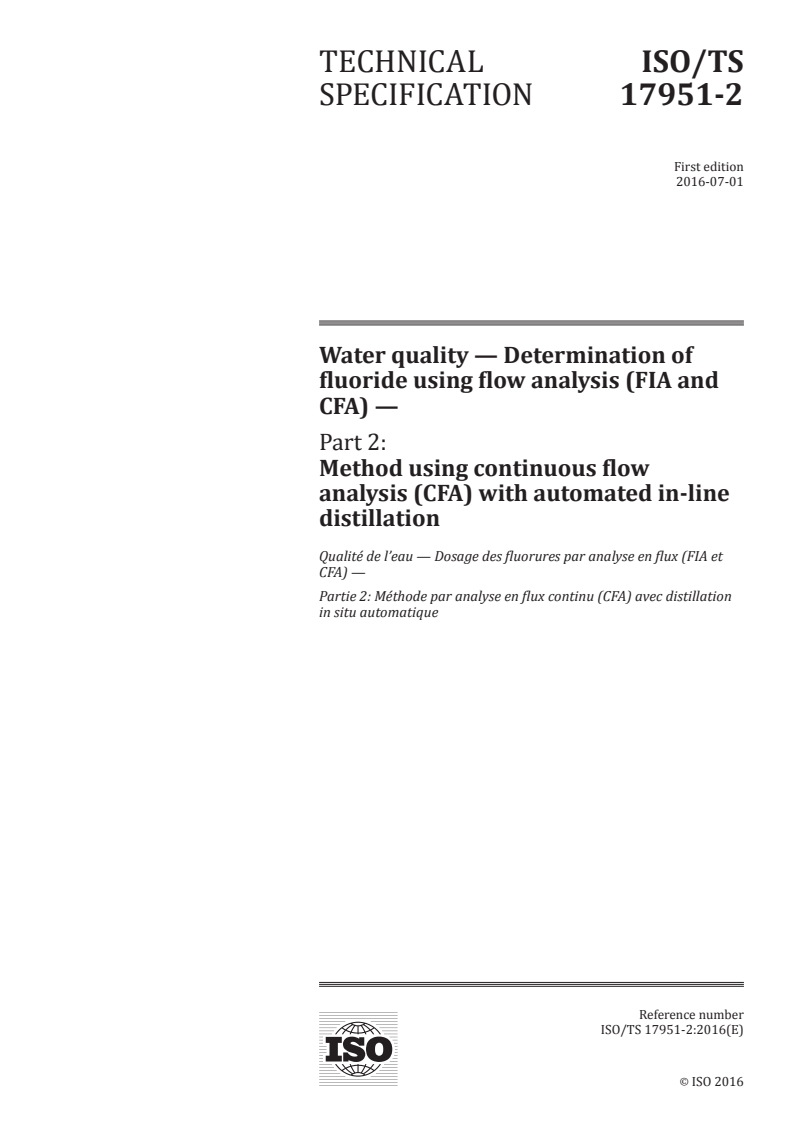
TECHNICAL ISO/TS
SPECIFICATION 17951-2
First edition
2016-07-01
Water quality — Determination of
fluoride using flow analysis (FIA and
CFA) —
Part 2:
Method using continuous flow
analysis (CFA) with automated in-line
distillation
Qualité de l’eau — Dosage des fluorures par analyse en flux (FIA et
CFA) —
Partie 2: Méthode par analyse en flux continu (CFA) avec distillation
in situ automatique
Reference number
©
ISO 2016
© ISO 2016, Published in Switzerland
All rights reserved. Unless otherwise specified, no part of this publication may be reproduced or utilized otherwise in any form
or by any means, electronic or mechanical, including photocopying, or posting on the internet or an intranet, without prior
written permission. Permission can be requested from either ISO at the address below or ISO’s member body in the country of
the requester.
ISO copyright office
Ch. de Blandonnet 8 • CP 401
CH-1214 Vernier, Geneva, Switzerland
Tel. +41 22 749 01 11
Fax +41 22 749 09 47
copyright@iso.org
www.iso.org
ii © ISO 2016 – All rights reserved
Contents Page
Foreword .iv
Introduction .v
1 Scope . 1
2 Normative references . 1
3 Principle . 2
4 Interferences . 2
5 Reagents . 2
6 Apparatus . 5
7 Sampling and sample preparation . 5
8 Procedure. 5
8.1 Setting up the system . 5
8.2 Reagent blank measurement . 5
8.3 Adjustment of sensitivity . 6
8.4 Confirmation of repeatability . 6
8.5 Calibration . 6
8.6 Measurement of samples . 6
9 Calculation . 7
10 Expression of results . 7
11 Test report . 7
Annex A (informative) Example of continuous flow analysis (CFA) with an in-line
distillation unit and spectrometric detection . 8
Annex B (informative) Determination of fluoride by automatic distillation continuous flow
analysis (CFA) and ion selective detection . 9
Annex C (informative) Examples of flow systems .12
Annex D (informative) Results of interlaboratory trial .13
Annex E (informative) Recovery test for fluoride .14
Annex F (informative) Analytical precision of fluoride .15
Bibliography .16
Foreword
ISO (the International Organization for Standardization) is a worldwide federation of national standards
bodies (ISO member bodies). The work of preparing International Standards is normally carried out
through ISO technical committees. Each member body interested in a subject for which a technical
committee has been established has the right to be represented on that committee. International
organizations, governmental and non-governmental, in liaison with ISO, also take part in the work.
ISO collaborates closely with the International Electrotechnical Commission (IEC) on all matters of
electrotechnical standardization.
The procedures used to develop this document and those intended for its further maintenance are
described in the ISO/IEC Directives, Part 1. In particular the different approval criteria needed for the
different types of ISO documents should be noted. This document was drafted in accordance with the
editorial rules of the ISO/IEC Directives, Part 2 (see www.iso.org/directives).
Attention is drawn to the possibility that some of the elements of this document may be the subject of
patent rights. ISO shall not be held responsible for identifying any or all such patent rights. Details of
any patent rights identified during the development of the document will be in the Introduction and/or
on the ISO list of patent declarations received (see www.iso.org/patents).
Any trade name used in this document is information given for the convenience of users and does not
constitute an endorsement.
For an explanation on the meaning of ISO specific terms and expressions related to conformity
assessment, as well as information about ISO’s adherence to the WTO principles in the Technical
Barriers to Trade (TBT) see the following URL: Foreword - Supplementary information
The committee responsible for this document is ISO/TC 147, Water quality, Subcommittee SC 2, Physical,
chemical and biochemical methods.
ISO 17951 consists of the following parts, under the general title Water quality — Determination of
fluoride using flow analysis (FIA and CFA):
— Part 1: Method using flow injection analysis (FIA) and spectrometric detection after off-line distillation
[Technical Specification]
— Part 2: Method using continuous flow analysis (CFA) with automated in-line distillation [Technical
Specification]
iv © ISO 2016 – All rights reserved
Introduction
Fluorine compounds in waters and effluents exist in various chemical forms, such as fluoride ion,
complexes of iron, aluminium, boron and etc., as well as insoluble forms, such as calcium and magnesium
fluorides. Excess fluoride can cause bone damage and fluorosis. In order to ensure conversion of any
insoluble fluorides into soluble fluoride for measurement, steam distillation is necessary.
This part of ISO 17951 describes a CFA method for flow analysis of fluoride with integrated in-line
distillation and spectrometric detection.
A CFA method with ion-selective detection is described in Annex B.
TECHNICAL SPECIFICATION ISO/TS 17951-2:2016(E)
Water quality — Determination of fluoride using flow
analysis (FIA and CFA) —
Part 2:
Method using continuous flow analysis (CFA) with
automated in-line distillation
WARNING — Persons using this part of ISO 17951 should be familiar with normal laboratory
practice. This part of ISO 17951 does not purport to address all of the safety problems, if any,
associated with its use. It is the responsibility of the user to establish appropriate safety and
health practices and to ensure compliance with any national regulatory conditions.
IMPORTANT — It is absolutely essential that tests conducted in accordance with this part of
ISO 17951 be carried out by suitably qualified staff.
1 Scope
This part of ISO 17951 specifies a method for the determination of fluoride in waters, waste waters
and effluents by continuous flow analysis (CFA). Any insoluble or complexed fluoride is converted to
fluoride ion by an automated continuous flow distillation procedure from sulfuric/phosphoric acid.
Fluoride ion in the distillate is measured using flow analysis with lanthanum alizarin complexone and
spectrometric detection. This method is applicable to industrial waste waters, effluents, surface waters,
ground waters, leachates. When this method is applied to the analysis of drinking water, a heater and
a distillation unit is unnecessary. Some drinking water contains high concentration of aluminium and
iron. In the case of drinking water, this part of ISO 17951 is appropriate to drinking water with low
interferences. It is not applicable to samples which contain large amount of suspended matter.
In this part of ISO 17951, two working ranges are described:
— working range I: 0,1 mg/l to 1,0 mg/l;
— working range II: 1,0 mg/l to 10 mg/l.
The specification of the calibration solutions are to be adapted accordingly.
2 Normative references
The following documents, in whole or in part, are normatively referenced in this document and are
indispensable for its application. For dated references, only the edition cited applies. For undated
references, the latest edition of the referenced document (including any amendments) applies.
ISO 3696, Water for analytical laboratory use — Specification and test methods
ISO 6353-2, Reagents for chemical analysis — Part 2: Specifications — First series
ISO 8466-1, Water quality — Calibration and evaluation of analytical methods and estimation of
performance characteristics — Part 1: Statistical evaluation of the linear calibration function
ISO 8466-2, Water quality — Calibration and evaluation of analytical methods and estimation of
performance characteristics — Part 2: Calibration strategy for non-linear second-order calibration
functions
3 Principle
Sample, water and mixture of sulfuric acid and phosphoric acid are gas-segmented and mixed in
a reaction coil. The mixture is transported through a heating device and a distillation unit. The
distillate is mixed with collection solution and lanthanum alizarin complexone solution. The mixture
is transported to a reaction coil and the formed blue colour is measured by spectrometric detection
around 620 nm.
4 Interferences
Without distillation, lanthanum alizarin complexone spectrophotometric method suffers from
the interferences by aluminium, cadmium, cobalt, iron, nickel, beryllium, lead, etc. However, these
interferences are removed by the distillation.
In the case of sample containing high chloride, the recovery of fluoride decreases. For example, in a sea
water sample, the response decreases to about 70 %. Thus, recovery test is necessary for the analysis
of such samples.
5 Reagents
Use only reagents of recognized analytical grade. The prepared solution is degassed, if necessary.
5.1 Water, grade 1, as specified in ISO 3696.
5.2 1,2-Dihydroxyanthraquinonyl-3-methylamine-N,N-diacetic acid dihydrate (alizarin
complexone), C H NO ·2H O.
19 15 8 2
5.3 Ammonia solution I, c(NH ) = 15 mol/l, as specified in ISO 6353-2.
5.4 Hydrochloric acid I, c(HCl) = 12 mol/l, as specified in ISO 6353-2.
5.5 Ammonium acetate, CH COONH , as specified in ISO 6353-2.
3 4
5.6 Sodium acetate trihydrate, CH COONa·3H O, as specified in ISO 6353-2.
3 2
5.7 Acetic acid, CH COOH, as specified in ISO 6353-2.
5.8 Lanthanum(III) oxide, La O .
2 3
5.9 Acetone, CH COCH , as specified in ISO 6353-2.
3 3
5.10 Sodium fluoride, NaF.
5.11 Ethanol (95), C H OH(95).
2 5
(95) = volume fraction.
5.12 Sulfuric acid, c(H SO ) = 18 mol/l.
2 4
5.13 Imidazole, C H N .
3 4 2
5.14 Poly(oxyethylene)octylphenylether, C H O(C H O) .
14 22 2 4 n
2 © ISO 2016 – All rights reserved
5.15 Phosphoric acid, c(H PO ) = 14,6 mol/l.
3 4
5.16 Ammonia solution II.
Mix 10 ml of ammonia solution I (5.3) and 100 ml of water (5.1).
5.17 Ammonium acetate solution, ρ(C H NO ) = 200 g/l.
2 7 2
Dissolve 200 g of ammonium acetate (5.5) to about 800 ml of water (5.1). Make up to 1 000 ml with
water (5.1).
5.18 Sodium acetate solution.
Dissolve 41 g of sodium acetate trihydrate (5.6) to 400 ml of water, and add 24 ml of acetic acid (5.7).
5.19 Hydrochloric acid II, c(HCl) = 2 mol/l.
Mix 20 ml of hydrochloric acid I (5.4) and 100 ml of water (5.1).
5.20 Lanthanum(III) oxide solution, c(La(III)) = 0,1 mol/l.
Add 0,163 g of lanthanum(III) oxide (5.8) to 10 ml of hydrochloric acid II (5.19) and dissolve it by heating
of the solution.
5.21 Lanthanum-alizarin complexone solution (solution A).
Dissolve 0,192 g of alizarin complexone (5.2) to 4 ml of ammonia solution II (5.16) and 4 ml of ammonium
acetate solution (200 g/l) (5.17). Add this solution into 425 ml of sodium acetate solution (5.18) with
stirring, and add 400 ml of acetone (5.9) gradually. Then, add 10 ml of lanthanum(III) oxide solution
(5.20) to the solution and mix it. After cooling, adjust the pH of the solution to 4,7 with acetic acid (5.7)
or ammonia solution I (5.3), then make it up to 1 000 ml with water (5.1).
1)
Lanthanum-alizarin complexone solution (solution A) (5.21) can be prepared by using alfusone. In
that case, after dissolving 1,2 g of alfusone to small amount of water (5.1), add 90 ml of acetone (5.9)
and mix the solution. Make up the solution to 300 ml with water (5.1). The solution shall be prepared at
the time of analysis.
5.22 Lanthanum-alizarin complexone solution (solution B).
Dissolve 10 g of imidazole (5.13) to about 200 ml of water (5.1). Add 40 ml of acetic acid (5.7), 45 ml of
acetone (5.9) and 0,5 ml of fluoride stock solution I (5.23). Make up the solution to 300 ml with water
(5.1). Add 200 ml of lanthanum-alizarin complexone solution (solution A) (5.21) and 5 ml of ethanol
solution of poly(oxyethylene)octylphenylether (5.25) and mix the solution.
Lanthanum-alizarin complexone solution (solution B) (5.22) can be prepared with alfusone. In that case,
dissolve 2,5 g of alfusone to about 300 ml of water (5.1). Add 40 ml of acetic acid (5.7), 10 g of imidazole
(5.13), 125 ml of acetone (5.9) and 0,5 ml of fluoride stock solution I (5.23), and mix the solution. After
making up the solution to 500 ml with water (5.1), add 5 ml of ethanol solution of poly(oxyethylene)
octylphenylether (5.25) and mix the solution. This solution shall be prepared at the time of analysis.
5.23 Fluoride stock solution, ρ(F‾) = 100 mg/l.
Take sodium fluoride (5.10) in a platinum plate and heat it at 105 °C at least 1 h. Then cool it in a
desiccator. Dissolve 0,221 g of NaF (5.10) in water (5.1) and in a 1 000 ml volumetric flask and make up
to volume with water (5.1). Store the solution in a polyethylene bottle.
1) Alfusone is a product commercially available. This information is given for the convenience of users of this
International Standard and does not constitute an endorsement by ISO of this product.
This solution is stable for one month at room temperature.
5.24 Fluoride standard solution, ρ(F‾) = 10 mg/l.
Take 10 ml of fluoride stock solution (5.23) to a 100 ml volumetric flask and make up to volume with
water (5.1). Store the solution in a polyethylene bottle.
This solution is stable for one week in the dark at 2 °C to 8 °C.
5.25 Ethanol solution of poly(oxyethylene)octylphenylether.
Dissolve 50 g of poly(oxyethylene)octylphenylether (5.14) in ethanol (95) (5.11) and make up to 100 ml
with ethanol (95) (5.11).
This solution is stable for one month at room temperature.
5.26 Mixed solution of sulfuric acid and phosphoric acid.
Add 50 ml of sulfuric acid (5.12), 10 ml of phosphoric acid (5.15) and 3 ml of fluoride stock solution
(5.23) into about 800 ml of water (5.1). Make up the solution to 1 000 ml with water (5.1).
This solution is stable for three months at room temperature.
5.27 Collection solution.
Add 1 ml of ethanol solution of poly(oxyethylene)octylphenylether (5.25) to 100 ml of water (5.1) and
mix the solution.
This solution is stable for one week at room temperature.
5.28 Calibration solutions.
Prepare at least five calibration solutions with fluoride concentrations roughly regularly distributed
over the working range, by dilution of the appropriate fluoride standard solution (5.24) or the fluoride
stock solution (5.23). Examples of calibration solutions for two possible working ranges are given in
5.28.1 and 5.28.2. For other working ranges, prepare calibration solutions appropriate to cover a decade
of concentrations, accordingly.
5.28.1 Calibration solutions for working range I, (0,1 mg/l to 1,0 mg/l).
For example, six calibration solutions should be prepared as follows.
Pipette, into 100 ml volumetric flasks, 1 ml, 2 ml, 4 ml, 6 ml, 8 ml, 10 ml, respectively, of the fluoride
standard solution I (5.24) and make up to volume with water (5.1).
These solutions contain 0,1 mg/l, 0,2 mg/l, 0,4 mg/l, 0,6 mg/l, 0,8 mg/l and 1 mg/l fluoride, respectively.
5.28.2 Calibration solutions for working range II (1,0 mg/l to 10 mg/l).
For example, six calibration solutions should be prepared as follows.
Pipette, into 100 ml volumetric flasks, 1 ml, 2 ml, 4 ml, 6 ml, 8 ml, 10 ml, respectively, of the fluoride
stock solution (5.
...
TECHNICAL ISO/TS
SPECIFICATION 17951-2
First edition
2016-07-01
Water quality — Determination of
fluoride using flow analysis (FIA and
CFA) —
Part 2:
Method using continuous flow
analysis (CFA) with automated in-line
distillation
Qualité de l’eau — Dosage des fluorures par analyse en flux (FIA et
CFA) —
Partie 2: Méthode par analyse en flux continu (CFA) avec distillation
in situ automatique
Reference number
©
ISO 2016
© ISO 2016, Published in Switzerland
All rights reserved. Unless otherwise specified, no part of this publication may be reproduced or utilized otherwise in any form
or by any means, electronic or mechanical, including photocopying, or posting on the internet or an intranet, without prior
written permission. Permission can be requested from either ISO at the address below or ISO’s member body in the country of
the requester.
ISO copyright office
Ch. de Blandonnet 8 • CP 401
CH-1214 Vernier, Geneva, Switzerland
Tel. +41 22 749 01 11
Fax +41 22 749 09 47
copyright@iso.org
www.iso.org
ii © ISO 2016 – All rights reserved
Contents Page
Foreword .iv
Introduction .v
1 Scope . 1
2 Normative references . 1
3 Principle . 2
4 Interferences . 2
5 Reagents . 2
6 Apparatus . 5
7 Sampling and sample preparation . 5
8 Procedure. 5
8.1 Setting up the system . 5
8.2 Reagent blank measurement . 5
8.3 Adjustment of sensitivity . 6
8.4 Confirmation of repeatability . 6
8.5 Calibration . 6
8.6 Measurement of samples . 6
9 Calculation . 7
10 Expression of results . 7
11 Test report . 7
Annex A (informative) Example of continuous flow analysis (CFA) with an in-line
distillation unit and spectrometric detection . 8
Annex B (informative) Determination of fluoride by automatic distillation continuous flow
analysis (CFA) and ion selective detection . 9
Annex C (informative) Examples of flow systems .12
Annex D (informative) Results of interlaboratory trial .13
Annex E (informative) Recovery test for fluoride .14
Annex F (informative) Analytical precision of fluoride .15
Bibliography .16
Foreword
ISO (the International Organization for Standardization) is a worldwide federation of national standards
bodies (ISO member bodies). The work of preparing International Standards is normally carried out
through ISO technical committees. Each member body interested in a subject for which a technical
committee has been established has the right to be represented on that committee. International
organizations, governmental and non-governmental, in liaison with ISO, also take part in the work.
ISO collaborates closely with the International Electrotechnical Commission (IEC) on all matters of
electrotechnical standardization.
The procedures used to develop this document and those intended for its further maintenance are
described in the ISO/IEC Directives, Part 1. In particular the different approval criteria needed for the
different types of ISO documents should be noted. This document was drafted in accordance with the
editorial rules of the ISO/IEC Directives, Part 2 (see www.iso.org/directives).
Attention is drawn to the possibility that some of the elements of this document may be the subject of
patent rights. ISO shall not be held responsible for identifying any or all such patent rights. Details of
any patent rights identified during the development of the document will be in the Introduction and/or
on the ISO list of patent declarations received (see www.iso.org/patents).
Any trade name used in this document is information given for the convenience of users and does not
constitute an endorsement.
For an explanation on the meaning of ISO specific terms and expressions related to conformity
assessment, as well as information about ISO’s adherence to the WTO principles in the Technical
Barriers to Trade (TBT) see the following URL: Foreword - Supplementary information
The committee responsible for this document is ISO/TC 147, Water quality, Subcommittee SC 2, Physical,
chemical and biochemical methods.
ISO 17951 consists of the following parts, under the general title Water quality — Determination of
fluoride using flow analysis (FIA and CFA):
— Part 1: Method using flow injection analysis (FIA) and spectrometric detection after off-line distillation
[Technical Specification]
— Part 2: Method using continuous flow analysis (CFA) with automated in-line distillation [Technical
Specification]
iv © ISO 2016 – All rights reserved
Introduction
Fluorine compounds in waters and effluents exist in various chemical forms, such as fluoride ion,
complexes of iron, aluminium, boron and etc., as well as insoluble forms, such as calcium and magnesium
fluorides. Excess fluoride can cause bone damage and fluorosis. In order to ensure conversion of any
insoluble fluorides into soluble fluoride for measurement, steam distillation is necessary.
This part of ISO 17951 describes a CFA method for flow analysis of fluoride with integrated in-line
distillation and spectrometric detection.
A CFA method with ion-selective detection is described in Annex B.
TECHNICAL SPECIFICATION ISO/TS 17951-2:2016(E)
Water quality — Determination of fluoride using flow
analysis (FIA and CFA) —
Part 2:
Method using continuous flow analysis (CFA) with
automated in-line distillation
WARNING — Persons using this part of ISO 17951 should be familiar with normal laboratory
practice. This part of ISO 17951 does not purport to address all of the safety problems, if any,
associated with its use. It is the responsibility of the user to establish appropriate safety and
health practices and to ensure compliance with any national regulatory conditions.
IMPORTANT — It is absolutely essential that tests conducted in accordance with this part of
ISO 17951 be carried out by suitably qualified staff.
1 Scope
This part of ISO 17951 specifies a method for the determination of fluoride in waters, waste waters
and effluents by continuous flow analysis (CFA). Any insoluble or complexed fluoride is converted to
fluoride ion by an automated continuous flow distillation procedure from sulfuric/phosphoric acid.
Fluoride ion in the distillate is measured using flow analysis with lanthanum alizarin complexone and
spectrometric detection. This method is applicable to industrial waste waters, effluents, surface waters,
ground waters, leachates. When this method is applied to the analysis of drinking water, a heater and
a distillation unit is unnecessary. Some drinking water contains high concentration of aluminium and
iron. In the case of drinking water, this part of ISO 17951 is appropriate to drinking water with low
interferences. It is not applicable to samples which contain large amount of suspended matter.
In this part of ISO 17951, two working ranges are described:
— working range I: 0,1 mg/l to 1,0 mg/l;
— working range II: 1,0 mg/l to 10 mg/l.
The specification of the calibration solutions are to be adapted accordingly.
2 Normative references
The following documents, in whole or in part, are normatively referenced in this document and are
indispensable for its application. For dated references, only the edition cited applies. For undated
references, the latest edition of the referenced document (including any amendments) applies.
ISO 3696, Water for analytical laboratory use — Specification and test methods
ISO 6353-2, Reagents for chemical analysis — Part 2: Specifications — First series
ISO 8466-1, Water quality — Calibration and evaluation of analytical methods and estimation of
performance characteristics — Part 1: Statistical evaluation of the linear calibration function
ISO 8466-2, Water quality — Calibration and evaluation of analytical methods and estimation of
performance characteristics — Part 2: Calibration strategy for non-linear second-order calibration
functions
3 Principle
Sample, water and mixture of sulfuric acid and phosphoric acid are gas-segmented and mixed in
a reaction coil. The mixture is transported through a heating device and a distillation unit. The
distillate is mixed with collection solution and lanthanum alizarin complexone solution. The mixture
is transported to a reaction coil and the formed blue colour is measured by spectrometric detection
around 620 nm.
4 Interferences
Without distillation, lanthanum alizarin complexone spectrophotometric method suffers from
the interferences by aluminium, cadmium, cobalt, iron, nickel, beryllium, lead, etc. However, these
interferences are removed by the distillation.
In the case of sample containing high chloride, the recovery of fluoride decreases. For example, in a sea
water sample, the response decreases to about 70 %. Thus, recovery test is necessary for the analysis
of such samples.
5 Reagents
Use only reagents of recognized analytical grade. The prepared solution is degassed, if necessary.
5.1 Water, grade 1, as specified in ISO 3696.
5.2 1,2-Dihydroxyanthraquinonyl-3-methylamine-N,N-diacetic acid dihydrate (alizarin
complexone), C H NO ·2H O.
19 15 8 2
5.3 Ammonia solution I, c(NH ) = 15 mol/l, as specified in ISO 6353-2.
5.4 Hydrochloric acid I, c(HCl) = 12 mol/l, as specified in ISO 6353-2.
5.5 Ammonium acetate, CH COONH , as specified in ISO 6353-2.
3 4
5.6 Sodium acetate trihydrate, CH COONa·3H O, as specified in ISO 6353-2.
3 2
5.7 Acetic acid, CH COOH, as specified in ISO 6353-2.
5.8 Lanthanum(III) oxide, La O .
2 3
5.9 Acetone, CH COCH , as specified in ISO 6353-2.
3 3
5.10 Sodium fluoride, NaF.
5.11 Ethanol (95), C H OH(95).
2 5
(95) = volume fraction.
5.12 Sulfuric acid, c(H SO ) = 18 mol/l.
2 4
5.13 Imidazole, C H N .
3 4 2
5.14 Poly(oxyethylene)octylphenylether, C H O(C H O) .
14 22 2 4 n
2 © ISO 2016 – All rights reserved
5.15 Phosphoric acid, c(H PO ) = 14,6 mol/l.
3 4
5.16 Ammonia solution II.
Mix 10 ml of ammonia solution I (5.3) and 100 ml of water (5.1).
5.17 Ammonium acetate solution, ρ(C H NO ) = 200 g/l.
2 7 2
Dissolve 200 g of ammonium acetate (5.5) to about 800 ml of water (5.1). Make up to 1 000 ml with
water (5.1).
5.18 Sodium acetate solution.
Dissolve 41 g of sodium acetate trihydrate (5.6) to 400 ml of water, and add 24 ml of acetic acid (5.7).
5.19 Hydrochloric acid II, c(HCl) = 2 mol/l.
Mix 20 ml of hydrochloric acid I (5.4) and 100 ml of water (5.1).
5.20 Lanthanum(III) oxide solution, c(La(III)) = 0,1 mol/l.
Add 0,163 g of lanthanum(III) oxide (5.8) to 10 ml of hydrochloric acid II (5.19) and dissolve it by heating
of the solution.
5.21 Lanthanum-alizarin complexone solution (solution A).
Dissolve 0,192 g of alizarin complexone (5.2) to 4 ml of ammonia solution II (5.16) and 4 ml of ammonium
acetate solution (200 g/l) (5.17). Add this solution into 425 ml of sodium acetate solution (5.18) with
stirring, and add 400 ml of acetone (5.9) gradually. Then, add 10 ml of lanthanum(III) oxide solution
(5.20) to the solution and mix it. After cooling, adjust the pH of the solution to 4,7 with acetic acid (5.7)
or ammonia solution I (5.3), then make it up to 1 000 ml with water (5.1).
1)
Lanthanum-alizarin complexone solution (solution A) (5.21) can be prepared by using alfusone. In
that case, after dissolving 1,2 g of alfusone to small amount of water (5.1), add 90 ml of acetone (5.9)
and mix the solution. Make up the solution to 300 ml with water (5.1). The solution shall be prepared at
the time of analysis.
5.22 Lanthanum-alizarin complexone solution (solution B).
Dissolve 10 g of imidazole (5.13) to about 200 ml of water (5.1). Add 40 ml of acetic acid (5.7), 45 ml of
acetone (5.9) and 0,5 ml of fluoride stock solution I (5.23). Make up the solution to 300 ml with water
(5.1). Add 200 ml of lanthanum-alizarin complexone solution (solution A) (5.21) and 5 ml of ethanol
solution of poly(oxyethylene)octylphenylether (5.25) and mix the solution.
Lanthanum-alizarin complexone solution (solution B) (5.22) can be prepared with alfusone. In that case,
dissolve 2,5 g of alfusone to about 300 ml of water (5.1). Add 40 ml of acetic acid (5.7), 10 g of imidazole
(5.13), 125 ml of acetone (5.9) and 0,5 ml of fluoride stock solution I (5.23), and mix the solution. After
making up the solution to 500 ml with water (5.1), add 5 ml of ethanol solution of poly(oxyethylene)
octylphenylether (5.25) and mix the solution. This solution shall be prepared at the time of analysis.
5.23 Fluoride stock solution, ρ(F‾) = 100 mg/l.
Take sodium fluoride (5.10) in a platinum plate and heat it at 105 °C at least 1 h. Then cool it in a
desiccator. Dissolve 0,221 g of NaF (5.10) in water (5.1) and in a 1 000 ml volumetric flask and make up
to volume with water (5.1). Store the solution in a polyethylene bottle.
1) Alfusone is a product commercially available. This information is given for the convenience of users of this
International Standard and does not constitute an endorsement by ISO of this product.
This solution is stable for one month at room temperature.
5.24 Fluoride standard solution, ρ(F‾) = 10 mg/l.
Take 10 ml of fluoride stock solution (5.23) to a 100 ml volumetric flask and make up to volume with
water (5.1). Store the solution in a polyethylene bottle.
This solution is stable for one week in the dark at 2 °C to 8 °C.
5.25 Ethanol solution of poly(oxyethylene)octylphenylether.
Dissolve 50 g of poly(oxyethylene)octylphenylether (5.14) in ethanol (95) (5.11) and make up to 100 ml
with ethanol (95) (5.11).
This solution is stable for one month at room temperature.
5.26 Mixed solution of sulfuric acid and phosphoric acid.
Add 50 ml of sulfuric acid (5.12), 10 ml of phosphoric acid (5.15) and 3 ml of fluoride stock solution
(5.23) into about 800 ml of water (5.1). Make up the solution to 1 000 ml with water (5.1).
This solution is stable for three months at room temperature.
5.27 Collection solution.
Add 1 ml of ethanol solution of poly(oxyethylene)octylphenylether (5.25) to 100 ml of water (5.1) and
mix the solution.
This solution is stable for one week at room temperature.
5.28 Calibration solutions.
Prepare at least five calibration solutions with fluoride concentrations roughly regularly distributed
over the working range, by dilution of the appropriate fluoride standard solution (5.24) or the fluoride
stock solution (5.23). Examples of calibration solutions for two possible working ranges are given in
5.28.1 and 5.28.2. For other working ranges, prepare calibration solutions appropriate to cover a decade
of concentrations, accordingly.
5.28.1 Calibration solutions for working range I, (0,1 mg/l to 1,0 mg/l).
For example, six calibration solutions should be prepared as follows.
Pipette, into 100 ml volumetric flasks, 1 ml, 2 ml, 4 ml, 6 ml, 8 ml, 10 ml, respectively, of the fluoride
standard solution I (5.24) and make up to volume with water (5.1).
These solutions contain 0,1 mg/l, 0,2 mg/l, 0,4 mg/l, 0,6 mg/l, 0,8 mg/l and 1 mg/l fluoride, respectively.
5.28.2 Calibration solutions for working range II (1,0 mg/l to 10 mg/l).
For example, six calibration solutions should be prepared as follows.
Pipette, into 100 ml volumetric flasks, 1 ml, 2 ml, 4 ml, 6 ml, 8 ml, 10 ml, respectively, of the fluoride
stock solution (5.
...