


ISO 10303-224:1999
(Main)Industrial automation systems and integration — Product data representation and exchange — Part 224: Application protocol: Mechanical product definition for process planning using machining features
Industrial automation systems and integration — Product data representation and exchange — Part 224: Application protocol: Mechanical product definition for process planning using machining features
Systèmes d'automatisation industrielle et intégration — Représentation et échange de données de produits — Partie 224: Protocole d'application: Définition de produits mécaniques pour la planification de procédés utilisant des caractéristiques d'usinage
General Information
- Status
- Withdrawn
- Publication Date
- 15-Dec-1999
- Withdrawal Date
- 15-Dec-1999
- Technical Committee
- ISO/TC 184/SC 4 - Industrial data
- Drafting Committee
- ISO/TC 184/SC 4/WG 3 - Oil, Gas, Process and Power
- Current Stage
- 9599 - Withdrawal of International Standard
- Start Date
- 03-May-2001
- Completion Date
- 12-Feb-2026
Relations
- Effective Date
- 15-Apr-2008
Get Certified
Connect with accredited certification bodies for this standard

National Aerospace and Defense Contractors Accreditation Program (NADCAP)
Global cooperative program for special process quality in aerospace.
CARES (UK Certification Authority for Reinforcing Steels)
UK certification for reinforcing steels and construction.
DVS-ZERT GmbH
German welding certification society.
Sponsored listings
Frequently Asked Questions
ISO 10303-224:1999 is a standard published by the International Organization for Standardization (ISO). Its full title is "Industrial automation systems and integration — Product data representation and exchange — Part 224: Application protocol: Mechanical product definition for process planning using machining features". This standard covers: Industrial automation systems and integration — Product data representation and exchange — Part 224: Application protocol: Mechanical product definition for process planning using machining features
Industrial automation systems and integration — Product data representation and exchange — Part 224: Application protocol: Mechanical product definition for process planning using machining features
ISO 10303-224:1999 is classified under the following ICS (International Classification for Standards) categories: 25.040.40 - Industrial process measurement and control. The ICS classification helps identify the subject area and facilitates finding related standards.
ISO 10303-224:1999 has the following relationships with other standards: It is inter standard links to ISO 10303-224:2001. Understanding these relationships helps ensure you are using the most current and applicable version of the standard.
ISO 10303-224:1999 is available in PDF format for immediate download after purchase. The document can be added to your cart and obtained through the secure checkout process. Digital delivery ensures instant access to the complete standard document.
Standards Content (Sample)
INTERNATIONAL ISO
STANDARD 10303-224
First edition
1999-12-01
Industrial automation systems and
integration — Product data representation
and exchange —
Part 224:
Application protocol: Mechanical product
definition for process planning using
machining features
Systèmes d'automatisation industrielle et intégration — Représentation et
échange de données de produits —
Partie 224: Protocole d'application: Définition de produits mécaniques pour
la planification de procédés utilisant des caractéristiques d'usinage
Reference number
©
ISO 1999
PDF disclaimer
This PDF file may contain embedded typefaces. In accordance with Adobe's licensing policy, this file may be printed or viewed but shall not
be edited unless the typefaces which are embedded are licensed to and installed on the computer performing the editing. In downloading this
file, parties accept therein the responsibility of not infringing Adobe's licensing policy. The ISO Central Secretariat accepts no liability in this
area.
Adobe is a trademark of Adobe Systems Incorporated.
Details of the software products used to create this PDF file can be found in the General Info relative to the file; the PDF-creation parameters
were optimized for printing. Every care has been taken to ensure that the file is suitable for use by ISO member bodies. In the unlikely event
that a problem relating to it is found, please inform the Central Secretariat at the address given below.
© ISO 1999
All rights reserved. Unless otherwise specified, no part of this publication may be reproduced or utilized in any form or by any means, electronic
or mechanical, including photocopying and microfilm, without permission in writing from either ISO at the address below or ISO's member body
in the country of the requester.
ISO copyright office
Case postale 56 � CH-1211 Geneva 20
Tel. + 41 22 749 01 11
Fax + 41 22 734 10 79
E-mail copyright@iso.ch
Web www.iso.ch
Printed in Switzerland
ii © ISO 1999 – All rights reserved
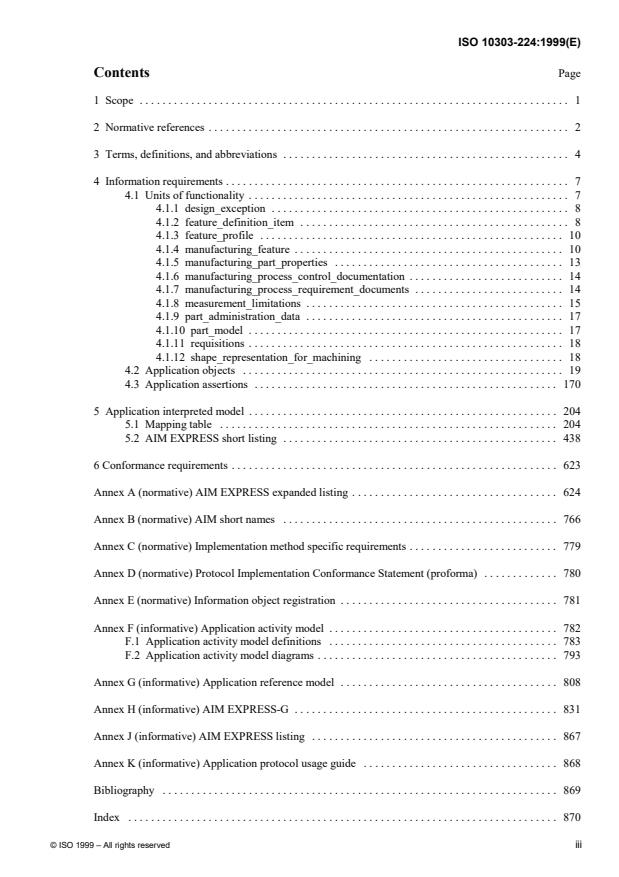
Contents Page
1 Scope . 1
2 Normative references . 2
3 Terms, definitions, and abbreviations . 4
4 Information requirements . 7
4.1 Units of functionality . 7
4.1.1 design_exception . 8
4.1.2 feature_definition_item . 8
4.1.3 feature_profile . 10
4.1.4 manufacturing_feature . 10
4.1.5 manufacturing_part_properties . 13
4.1.6 manufacturing_process_control_documentation . 14
4.1.7 manufacturing_process_requirement_documents . 14
4.1.8 measurement_limitations . 15
4.1.9 part_administration_data . 17
4.1.10 part_model . 17
4.1.11 requisitions . 18
4.1.12 shape_representation_for_machining . 18
4.2 Application objects . 19
4.3 Application assertions . 170
5 Application interpreted model . 204
5.1 Mapping table . 204
5.2 AIM EXPRESS short listing . 438
6 Conformance requirements . 623
Annex A (normative) AIM EXPRESS expanded listing . 624
Annex B (normative) AIM short names . 766
Annex C (normative) Implementation method specific requirements . 779
Annex D (normative) Protocol Implementation Conformance Statement (proforma) . 780
Annex E (normative) Information object registration . 781
Annex F (informative) Application activity model . 782
F.1 Application activity model definitions . 783
F.2 Application activity model diagrams . 793
Annex G (informative) Application reference model . 808
Annex H (informative) AIM EXPRESS-G . 831
Annex J (informative) AIM EXPRESS listing . 867
Annex K (informative) Application protocol usage guide . 868
Bibliography . 869
Index . 870
© ISO 1999 – All rights reserved iii
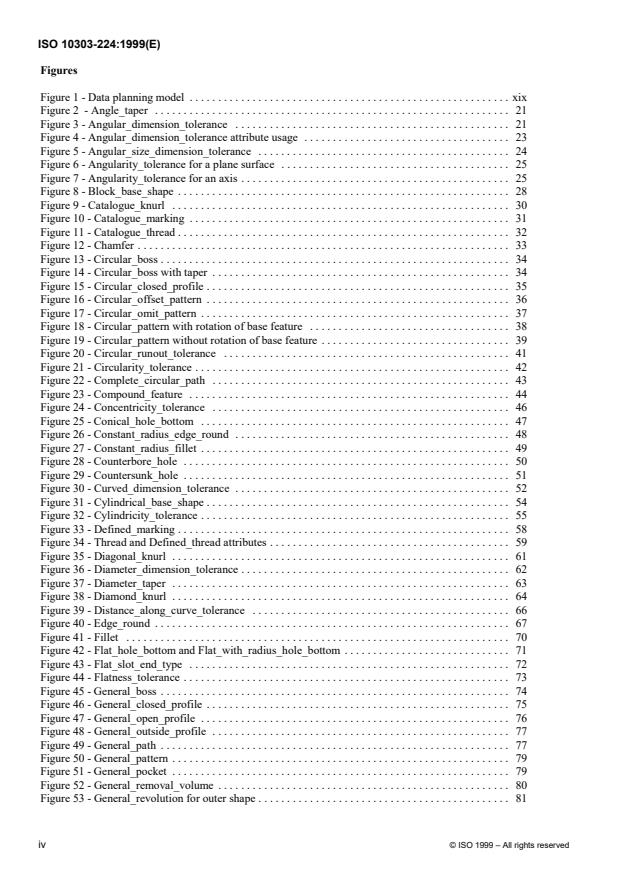
Figures
Figure 1 - Data planning model . xix
Figure 2 - Angle_taper . 21
Figure 3 - Angular_dimension_tolerance . 21
Figure 4 - Angular_dimension_tolerance attribute usage . 23
Figure 5 - Angular_size_dimension_tolerance . 24
Figure 6 - Angularity_tolerance for a plane surface . 25
Figure 7 - Angularity_tolerance for an axis . 25
Figure 8 - Block_base_shape . 28
Figure 9 - Catalogue_knurl . 30
Figure 10 - Catalogue_marking . 31
Figure 11 - Catalogue_thread . 32
Figure 12 - Chamfer . 33
Figure 13 - Circular_boss . 34
Figure 14 - Circular_boss with taper . 34
Figure 15 - Circular_closed_profile . 35
Figure 16 - Circular_offset_pattern . 36
Figure 17 - Circular_omit_pattern . 37
Figure 18 - Circular_pattern with rotation of base feature . 38
Figure 19 - Circular_pattern without rotation of base feature . 39
Figure 20 - Circular_runout_tolerance . 41
Figure 21 - Circularity_tolerance . 42
Figure 22 - Complete_circular_path . 43
Figure 23 - Compound_feature . 44
Figure 24 - Concentricity_tolerance . 46
Figure 25 - Conical_hole_bottom . 47
Figure 26 - Constant_radius_edge_round . 48
Figure 27 - Constant_radius_fillet . 49
Figure 28 - Counterbore_hole . 50
Figure 29 - Countersunk_hole . 51
Figure 30 - Curved_dimension_tolerance . 52
Figure 31 - Cylindrical_base_shape. 54
Figure 32 - Cylindricity_tolerance . 55
Figure 33 - Defined_marking . 58
Figure 34 - Thread and Defined_thread attributes . 59
Figure 35 - Diagonal_knurl . 61
Figure 36 - Diameter_dimension_tolerance . 62
Figure 37 - Diameter_taper . 63
Figure 38 - Diamond_knurl . 64
Figure 39 - Distance_along_curve_tolerance . 66
Figure 40 - Edge_round . 67
Figure 41 - Fillet . 70
Figure 42 - Flat_hole_bottom and Flat_with_radius_hole_bottom . 71
Figure 43 - Flat_slot_end_type . 72
Figure 44 - Flatness_tolerance . 73
Figure 45 - General_boss . 74
Figure 46 - General_closed_profile . 75
Figure 47 - General_open_profile . 76
Figure 48 - General_outside_profile . 77
Figure 49 - General_path . 77
Figure 50 - General_pattern . 79
Figure 51 - General_pocket . 79
Figure 52 - General_removal_volume . 80
Figure 53 - General_revolution for outer shape . 81
iv © ISO 1999 – All rights reserved
Figure 54 - General_revolution for volume removal . 82
Figure 55 - Groove . 85
Figure 56 - Implicit_base_shape_representation . 87
Figure 57 - Knurl . 88
Figure 58 - Linear_path . 89
Figure 59 - Linear_profile . 89
Figure 60 - Linear_profile_tolerance . 91
Figure 61 - Location_dimension_tolerance . 91
Figure 62 - Ngon_base_shape . 96
Figure 63 - Ngon_profile . 98
Figure 64 - Open_slot_end_type . 100
Figure 65 - Outer_diameter . 102
Figure 66 - Outer_diameter_to_shoulder . 103
Figure 67 - Parallelism_tolerance for a plane . 105
Figure 68 - Parallelism_tolerance for an axis . 105
Figure 69 - Partial_circular_path . 110
Figure 70 - Partial_circular_profile . 111
Figure 71 - Perpendicularity_tolerance . 113
Figure 72 - Planar_face . 116
Figure 73 - Position_tolerance . 120
Figure 74 - Protrusion . 125
Figure 75 - Radial_dimension_tolerance . 126
Figure 76 - Radiused_slot_end_type . 126
Figure 77 - Rectangular_closed_pocket . 127
Figure 78 - Rectangular_closed_profile . 128
Figure 79 - Rectangular_offset_pattern . 129
Figure 80 - Rectangular_omit_pattern . 130
Figure 81 - Rectangular_open_pocket . 131
Figure 82 - Rectangular_pattern . 132
Figure 83 - Revolved_flat . 137
Figure 84 - Revolved_round . 137
Figure 85 - Round_hole . 138
Figure 86 - Rounded_end . 140
Figure 87 - Rounded_U_profile . 141
Figure 88 - Slot . 145
Figure 89 - Spherical_cap . 148
Figure 90 - Spherical_hole_bottom . 148
Figure 91 - Square_U_profile . 149
Figure 92 - Step . 151
Figure 93 - Straight_knurl . 152
Figure 94 - Straightness_tolerance . 153
Figure 95 - Surface_profile_tolerance . 154
Figure 96 - Symmetry_tolerance . 155
Figure 97 - Tee_profile . 157
Figure 98 - Thread . 159
Figure 99 -Through_bottom_condition . 162
Figure 100 - Total_runout_tolerance . 165
Figure 101 -Turned_knurl . 167
Figure 102 - Vee_profile . 169
Figure 103 - Slot with Woodruff_slot_end_type at each end . 170
Figure 104 - Pattern offset required instances . 529
Figure 105 - Pattern omit required instances . 533
Figure F.1 - IDEF0 Basic notation . 782
Figure F.2 - Mechanical products definition for process planning using machining features . 794
Figure F.3 - A0 manufacture mechanical parts . 795
© ISO 1999 – All rights reserved v
Figure F.4 - A1 manage manufacturing process . 796
Figure F.5 - A13 manage equipment and materials . 797
Figure F.6 - A131 manage inventory . 798
Figure F.7 - A2 capture digital product definition . 799
Figure F.8 - A21 capture part data definition . 800
Figure F.9 - A214 create part model . 801
Figure F.10 - A3 generate manufacturing data . 802
Figure F.11 - A31 generate process plan . 803
Figure F.12 - A311 define resources . 804
Figure F.13 - A312 define operator data . 805
Figure F.14 - A315 define machine instructions . 806
Figure F.15 - A4 operate shop floor . 807
Figure G.1 - ARM diagram 1 of 22 in EXPRESS-G . 809
Figure G.2 - ARM diagram 2 of 22 in EXPRESS-G . 810
Figure G.3 - ARM diagram 3 of 22 in EXPRESS-G . 811
Figure G.4 - ARM diagram 4 of 22 in EXPRESS-G . 812
Figure G.5 - ARM diagram 5 of 22 in EXPRESS-G . 813
Figure G.6 - ARM diagram 6 of 22 in EXPRESS-G . 814
Figure G.7 - ARM diagram 7 of 22 in EXPRESS-G . 815
Figure G.8 - ARM diagram 8 of 22 in EXPRESS-G . 816
Figure G.9 - ARM diagram 9 of 22 in EXPRESS-G . 817
Figure G.10 - ARM diagram 10 of 22 in EXPRESS-G . 818
Figure G.11 - ARM diagram 11 of 22 in EXPRESS-G . 819
Figure G.12 - ARM diagram 12 of 22 in EXPRESS-G . 820
Figure G.13 - ARM diagram 13 of 22 in EXPRESS-G . 821
Figure G.14 - ARM diagram 14 of 22 in EXPRESS-G . 822
Figure G.15 - ARM diagram 15 of 22 in EXPRESS-G . 823
Figure G.16 - ARM diagram 16 of 22 in EXPRESS-G . 824
Figure G.17 - ARM diagram 17 of 22 in EXPRESS-G . 825
Figure G.18 - ARM diagram 18 of 22 in EXPRESS-G . 826
Figure G.19 - ARM diagram 19 of 22 in EXPRESS-G . 827
Figure G.20 - ARM diagram 20 of 22 in EXPRESS-G . 828
Figure G.21 - ARM diagram 21 of 22 in EXPRESS-G . 829
Figure G.22 - ARM diagram 22 of 22 in EXPRESS-G . 830
Figure H.1 - application context - AIM EXPRESS-G diagram 1 of 35 . 832
Figure H.2 - product definition - AIM EXPRESS-G diagram 2 of 35 . 833
Figure H.3 - property definition - AIM EXPRESS-G diagram 3 of 35 . 834
Figure H.4 - shape representation - AIM EXPRESS-G diagram 4 of 35 . 835
Figure H.5 - representation - AIM EXPRESS-G diagram 5 of 35 . 836
Figure H.6 - shape aspect - AIM EXPRESS-G diagram 6 of 35 . 837
Figure H.7 - machining feature - AIM EXPRESS-G diagram 7 of 35 . 838
Figure H.8 - replicate feature - AIM EXPRESS-G diagram 8 of 35 . 839
Figure H.9 - transition feature - AIM EXPRESS-G diagram 9 of 35 . 840
Figure H.10 - geometry topology - AIM EXPRESS-G diagram 10 of 35 . 841
Figure H.11 - point - AIM EXPRESS-G diagram 11 of 35 . 842
Figure H.12 - geometric orientation - AIM EXPRESS-G diagram 12 of 35 . 843
Figure H.13 - curve - AIM EXPRESS-G diagram 13 of 35. 844
Figure H.14 - bounded curve - AIM EXPRESS-G diagram 14 of 35 . 845
Figure H.15 - surface curve - AIM EXPRESS-G diagram 15 of 35 . 846
Figure H.16 - surface - AIM EXPRESS-G diagram 16 of 35 . 847
Figure H.17 - elementary surface - AIM EXPRESS-G diagram 17 of 35 . 848
Figure H.18 - bounded surface - AIM EXPRESS-G diagram 18 of 35 . 849
Figure H.19 - topology - AIM EXPRESS-G diagram 19 of 35 . 850
Figure H.20 - shell - AIM EXPRESS-G diagram 20 of 35 . 851
Figure H.21 - document - AIM EXPRESS-G diagram 21 of 35 . 852
vi © ISO 1999 – All rights reserved
Figure H.22 - approval - AIM EXPRESS-G diagram 22 of 35 . 853
Figure H.23 - person and organization - AIM EXPRESS-G diagram 23 of 35 . 854
Figure H.24 - person and organization assignment - AIM EXPRESS-G diagram 24 of 35 . 855
Figure H.25 - date - AIM EXPRESS-G diagram 25 of 35 . 856
Figure H.26 - action - AIM EXPRESS-G diagram 26 of 35 . 857
Figure H.27 - security classification - AIM EXPRESS-G diagram 27 of 35 . 858
Figure H.28 - units - AIM EXPRESS-G diagram 28 of 35 . 859
Figure H.29 - measure with units - AIM EXPRESS-G diagram 29 of 35 . 860
Figure H.30 - measures - AIM EXPRESS-G diagram 30 of 35 . 861
Figure H.31 - datums - AIM EXPRESS-G diagram 31 of 35 . 862
Figure H.32 - tolerances - AIM EXPRESS-G diagram 32 of 35 . 863
Figure H.33 - geometric tolerances - AIM EXPRESS-G diagram 33 of 35 . 864
Figure H.34 - tolerance zone - AIM EXPRESS-G diagram 34 of 35 . 865
Figure H.35 - material - AIM EXPRESS-G diagram 35 of 35 . 866
Tables
Table 1 - Mapping table for design_exception UoF . 206
Table 2 - Mapping table for feature_definition_item UoF . 209
Table 3 - Mapping table for feature_profile UoF . 237
Table 4 - Mapping table for manufacturing_feature UoF . 267
Table 5 - Mapping table for manufacturing_part_properties UoF . 382
Table 6 - Mapping table for manufacturing_process_control_documentation UoF . 388
Table 7 - Mapping table for manufacturing_process_requirement_documents UoF . 394
Table 8 - Mapping table for measurement_limitations UoF . 395
Table 9 - Mapping table for part_administration_data UoF . 422
Table 10 - Mapping table for part_model UoF . 424
Table 11 - Mapping table for requisitions UoF . 429
Table 12 - Mapping table for shape_representation_for_machining UoF . 431
Table B.1 - AIM short names of entities . 766
© ISO 1999 – All rights reserved vii
©ISO ISO 10303-224:1999(E)
— Part 41, Integrated generic resources: Fundamentals of product description and support;
— Part 42, Integrated generic resources: Geometric and topological representation;
— Part 43, Integrated generic resources: Representation structures;
— Part 44, Integrated generic resources: Product structure configuration;
— Part 45, Integrated generic resource: Materials;
— Part 46, Integrated generic resources: Visual presentation;
— Part 47, Integrated generic resource: Shape variation tolerances;
— Part 49, Integrated generic resource: Process structure and properties;
— Part 101, Integrated application resource: Draughting;
— Part 104, Integrated application resource: Finite element analysis;
— Part 105, Integrated application resource: Kinematics;
— Part 106, Integrated application resource: Building construction core model;
— Part 201, Application protocol: Explicit draughting;
— Part 202, Application protocol: Associative draughting;
— Part 203, Application protocol: Configuration controlled design;
— Part 204, Application protocol: Mechanical design using boundary representation;
— Part 205, Application protocol: Mechanical design using surface representation;
— Part 207, Application protocol: Sheet metal die planning and design;
— Part 208, Application protocol: Life cycle management - Change process;
— Part 209, Application protocol: Composite and metallic structural analysis and related design;
— Part 210, Application protocol: Electronic assembly, interconnet, and packaging design;
— Part 212, Application protocol: Electrotechnical design and installation
— Part 213, Application protocol: Numerical control process plans for machined parts;
ix
— Part 214, Application protocol: Core data for automotive mechanical design processes;
— Part 215, Application protocol: Ship arrangement;
— Part 216, Application protocol: Ship moulded forms;
— Part 217, Application protocol: Ship piping;
— Part 218, Application protocol: Ship structures;
— Part 221, Application protocol: Functional data and their schematic representation for process
plant;
— Part 222, Application protocol: Exchange of product data for composite structures;
— Part 223, Application protocol: Exchange of design and manufacturing product information for
casting parts;
— Part 224, Application protocol: Mechanical product definition for process plans using machining
features;
— Part 225, Application protocol: Building elements using explicit shape representation;
— Part 226, Application protocol: Ship mechanical systems;
— Part 227, Application protocol: Plant spatial configuration;
— Part 229, Application protocol: Exchange of design and manufacturing product information for
forged parts;
— Part 230, Application protocol: Building structural frame: Steelwork;
— Part 231, Application protocol: Process engineering data: Process design and process specification
of major equipment;
— Part 232, Application protocol: Technical data packaging core information and exchange;
— Part 301, Abstract test suite: Explicit draughting;
— Part 302, Abstract test suite: Associative draughting;
— Part 303, Abstract test suite: Configuration controlled design;
— Part 304, Abstract test suite: Mechanical design using boundary representation;
— Part 305, Abstract test suite: Mechanical design using surface representation;
xx
©ISO ISO 10303-224:1999(E)
— Part 307, Abstract test suite: Sheet metal die planning and design;
— Part 308, Abstract test suite: Life cycle management - Change process;
— Part 309, Abstract test suite: Composite and metallic structural analysis and related design;
— Part 310, Abstract test suite: Electronic assembly, interconnect, and packaging design;
— Part 312, Abstract test suite: Electrotechnical design and installation;
— Part 313, Abstract test suite: Numerical control process plans for machined parts;
— Part 314, Abstract test suite: Core data for automotive mechanical design processes;
— Part 315, Abstract test suite: Ship arrangement;
— Part 316, Abstract test suite: Ship moulded forms;
— Part 317, Abstract test suite: Ship piping;
— Part 318, Abstract test suite: Ship structures;
— Part 321, Abstract test suite: Functional data and their schematic representation for process plant;
— Part 322, Abstract test suite: Exchange of product data for composite structures;
— Part 323, Abstract test suite: Exchange of design and manufacturing product information for
casting parts;
— Part 324, Abstract test suite: Mechanical product definition for process plans using machining
features;
— Part 325, Abstract test suite: Building elements using explicit shape representation;
— Part 326, Abstract test suite: Ship mechanical systems;
— Part 327, Abstract test suite: Plant spatial configuration;
— Part 329, Abstract test suite: Exchange of design and manufacturing product information for forged
parts;
— Part 330, Abstract test suite: Building structural frame: Steelwork;
— Part 331, Abstract test suite: Process engineering data: Process design and process specification
of major equipment;
xi
— Part 332, Abstract test suite: Technical data packaging core information and exchange;
— Part 501, Application interpreted construct: Edge-based wireframe;
— Part 502, Application interpreted construct: Shell-based wireframe;
— Part 503, Application interpreted construct: Geometrically bounded 2D wireframe;
— Part 504, Application interpreted construct: Draughting annotation;
— Part 505, Application interpreted construct: Drawing structure and administration;
— Part 506, Application interpreted construct: Draughting elements;
— Part 507, Application interpreted construct: Geometrically bounded surface;
— Part 508, Application interpreted construct: Non-manifold surface;
— Part 509, Application interpreted construct: Manifold surface;
— Part 510, Application interpreted construct: Geometrically bounded wireframe;
— Part 511, Application interpreted construct: Topologically bounded surface;
— Part 512, Application interpreted construct: Faceted boundary representation;
— Part 513, Application interpreted construct: Elementary boundary representation;
— Part 514, Application interpreted construct: Advanced boundary representation;
— Part 515, Application interpreted construct: Constructive solid geometry;
— Part 517, Application interpreted construct: Mechanical design geometric presentation;
— Part 518, Application interpreted construct: Mechanical design shaded presentation.
The structure of this International Standard is described in ISO 10303-1. The numbering of the parts of the
International Standard reflects its structure:
— Parts 11 to 12 specify the description methods,
— Parts 21 to 26 specify the implementation methods,
— Parts 31 to 35 specify the conformance testing methodology and framework,
— Parts 41 to 49 specify the integrated generic resources,
xiixii
©ISO ISO 10303-224:1999(E)
— Parts 101 to 106 specify the integrated application resources,
— Parts 201 to 232 specify the application protocols,
— Parts 301 to 332 specify the abstract test suites, and
— Parts 501 to 518 specify the application interpreted constructs.
Should further parts be published, they will follow the same numbering pattern.
Annex A, B, C, D, and E form an integral part of this part of ISO 10303. Annexes F, G, H, J, and K are for
information only.
xiii
Introduction
ISO 10303 is an International Standard for the computer-interpretable representation and exchange of product
data. The objective is to provide a neutral mechanism capable of describing product data throughout the life
cycle of a product, independent from any particular system. The nature of this description makes it suitable
not only for neutral file exchange, but also as a basis for implementing and sharing product databases and
archiving.
This International Standard is organized as a series of parts, each published separately. The parts of ISO
10303 fall into one of the following series: description methods, integrated resources, application protocols,
application interpreted constructs, abstract test suites, implementation methods, and conformance testing.
The series are described in ISO 10303-1. This part of ISO 10303 is a member of the application protocol
series.
This part of ISO 10303 specifies an application protocol (AP) for the representation of information needed
to produce a single piece mechanical part definition for process planning, and specifies the integrated
resources necessary to satisfy these requirements.
This application protocol defines the context, scope, and information requirements for the representation of
information needed to produce a mechanical part definition. These requirements specify the part
identification, tracking, shape, representation of the shape and material data necessary for the definition of
a part for process planning. The process planning function in an organization can be assisted a great deal
by identifying machining oriented part shape features so that the process planner can more readily identify
machining tools and processes to manufacture a part.
This application protocol identifies specific characteristics of part shape used in manufacturing. These
characteristics are used to define manufacturing features. These shapes may be represented either by
machining features defined in this application protocol, or by a boundary representation solid model, shared
by other application protocols and used as application interpreted constructs in this part. The purpose of
manufacturing features is to facilitate the identification of manufacturing shapes that are human and
computer interpretable. Manufacturing features allow information about the shape to be used for decisions
in computerized process planning systems.
Information about the part material is supplied so the process planning activity can determine equipment and
material requirements. Also supplied is administrative information necessary for tracking customer
information, supplier information about the part, and internal control information for the manufacturing
operation to support process planning. Tracking of certain administrative information is a component of the
iterative process for creating a process plan.
Application protocols provide the basis for developing implementations of ISO 10303 and abstract test suites
for the conformance testing of AP implementations.
Clause 1 defines the scope of the application protocol and summarizes the functionality and data covered by
the AP. Clause 3 lists the words defined in this part of ISO 10303 and gives pointers to words defined
elsewhere. An application activity model that is the basis for the definition of the scope is provided in annex
xivxiv
©ISO ISO 10303-224:1999(E)
F. The information requirements of the application are specified in clause 4 using terminology appropriate
to the application. A graphical representation of the information requirements, referred to as the application
reference model, is given in annex G.
Resource constructs are interpreted to meet the information requirements. This interpretation produces the
application interpreted model (AIM). This interpretation, given in 5.1, shows the correspondence between
the information requirements and the AIM. The short listing of the AIM specifies the interface to the
integrated resources and is given in 5.2. Note that the definitions and EXPRESS provided in the integrated
resources for constructs used in the AIM may include select list items and subtypes which are not imported
into the AIM. The expanded listing given in Annex A contains the complete EXPRESS for the AIM without
annotation. A graphical representation of the AIM is given in annex H. Additional requirements for specific
implementation methods are given in annex D.
Figure 1 contains the data planning model that provides a high level description of the requirements for this
application protocol. This planning model was created from the in-scope data from the activities of the
application activity model (AAM) and grouped into logical units of functionality. This planning model is
used as a guide in developing the application reference model (ARM).
xv
Figure 1 - Data planning model
xvxvii
INTERNATIONAL STANDARD I© ISO SO 10303-224:1999(E)
Industrial automation systems and integration —
Product data representation and exchange —
Part 224: Application protocol: Mechanical product
definition for process planning using machining features
1 Scope
This part of ISO 10303 specifies the use of the integrated resources necessary for the scope and information
requirements for the representation and exchange of information needed to define product data necessary for
manufacturing single piece mechanical parts. The product data is based on existing part designs that have
their shapes represented by machining features. This part supports digital representation for computer
integrated manufacturing.
NOTE - The application activity model in annex F provides a graphical representation of the process and
information flows which are the basis for the definition of the scope of this Part of ISO 10303.
The following are within the scope of this part of ISO 10303:
— the manufacture of a single piece mechanical part;
— parts that are to be manufactured by either milling or turning processes;
— machining features for defining shapes necessary for manufacturing;
NOTE - The machining feature set is defined in this part of ISO 10303.
— Explicit representation of the 3D shape of machining features through bounded geometry
representations;
— implicit representation of machining features through selection of standard parameters;
— machining feature definition elements necessary for creating machining form features;
— customer order administrative data to track receipt of an order for a part to the shop floor, but not
including tracking of the order on the shop floor;
— approval data to authorize the manufacture of a part;
— requisition administrative data to identify requirements and track the status of materials and
equipment needed to manufacture a part;
— work order data to track and identify the status of a part;
— tracking the state of raw stock for documenting the manufacturing history of a part;
— tracking a design exception notice of a part.
NOTE - The design exception notice relates to discrepancies in the machining features used to describe a part's
shape.
The following are outside the scope of this part of ISO 10303:
— results from process planning functions;
— exchange of data within process planning systems;
— feature order or sequence;
— representation of assemblies;
— representation of composite material parts;
— representation of sheet metal parts;
— representation of part pedigree;
— design features of a part;
— schedule for completing a work order through the manufacturing process;
— configuration control for a part.
2 Normative references
The following normative documents contain provisions which, through reference in this text, constitute
provisions of this International Standard. For dated references, subsequent amendments to, or revisions of,
any of these publications do not apply. However, parties to agreements based on this International Standard
are encouraged to investigate the possibility of applying the most recent editions of the normative documents
indicated below. For undated references, the latest edition of the normative document referred to applies.
Members of ISO and IEC maintain registers of currently valid International Standards.
ISO 1101:1983, Technical drawings - Geometric tolerancing - Tolerance of form, orientation, location and
run-out - Generalities definitions, symbols, indications on drawings.
©ISO ISO 10303-224:1999(E)
ISO 5459:1981, Technical drawings - Geometric tolerancing - Datums and datum-systems for geometric
tolerances.
ISO/IEC 8824-1:1994, Information Technology - Open Systems Interconnection - Abstract Syntax Notation
One (ASN.1) - Part 1: Specification of Basic Notation.
ISO 10303-1:1994, Industrial automation systems and integration - Product data representation and
exchange - Part 1: Overview and fundamental principles.
ISO 10303-11:1994, Industrial automation systems and integration - Product data representation and
exchange - Part 11: Description methods: The EXPRESS language reference manual.
ISO 10303-21:1994, Industrial automation systems and integration - Product data representation and
exchange - Part 21: Implementation methods: Clear text encoding of the exchange structure.
ISO 10303-31:1994, Industrial automation systems and integration - Product data representation and
exchange - Part 31: Conformance testing methodology and framework: General concepts.
ISO 10303-41:1994, Industrial automation systems and integration - Product data representation and
exchange - Part 41: Integrated generic resources: Fundamentals of product description and support.
ISO 10303-42:1994, Industrial automation systems and integration - Product data representation and
exchange - Part 42: Integrated generic resources: Geometric and topological representation.
ISO 10303-43:1994, Industrial automation systems and integration - Product data representation and
exchange - Part 43: Integrated generic resources: Representation structures.
ISO 10303-44:1994, Industrial automation systems and integration - Product data representation and
exchange - Part 44: Integrated generic resources: Product structure configuration.
ISO 10303-45:1998, Industrial automation systems and integration - Product data representation and
exchange - Part 45: Integrated generic resources: Materials.
ISO 10303-47:1997, Industrial automation systems and integration - Product data representation and
exchange - Part 47: Integrated generic resources: Shape variation tolerances.
3 Terms, definitions, and abbreviations
3.1
Terms defined in ISO 1101
For the purpose of this part of ISO 10303, the following terms defined in ISO 1101 apply.
— dimension;
— tolerance.
3.2
Terms defined in ISO 5459
For the purpose of this part of ISO 10303, the following terms defined in ISO 5459 apply.
— datum.
3.3
Terms defined in ISO 10303-1
For the purpose of this part of ISO 10303, the following terms defined in ISO 10303-1 apply.
— application;
— application activity model (AAM);
— application interpreted model (AIM);
— application object;
— application protocol (AP);
— application reference model (ARM);
— implementation method;
— integrated resource;
— model;
— product;
— product data;
©ISO ISO 10303-224:1999(E)
— protocol implementation conformance statement (PICS);
— unit of functionality (UoF).
3.4
Terms defined in ISO 10303-31
For the purpose of this part of ISO 10303, the following terms defined in ISO 10303-31 apply.
— conformance class;
— conformance testing.
3.5
Terms defined in ISO 10303-42
For the purpose of this part of ISO 10303, the following terms defined in ISO 10303-42 apply.
— boundary representation (B-rep) solid model;
— manifold solid boundary representation.
3.6
Terms defined in ISO 10303-213
For the purpose of this part of ISO 10303, the following terms defined in ISO 10303-213 apply.
— process plan;
— workstation.
3.7
Other definitions
For the purpose of this part of ISO 10303, the following definitions apply.
3.7.1
basic angle
is implied where center lines of features in a pattern or surfaces shown on a drawing are located or defined
by the use of basic dimensions and no angle is specified.
3.7.2
cutting tool
an instrument used to remove material from a part.
3.7.3
dedicated fixture
a fixture designed for a particular part.
3.7.4
fixture
a device to hold and locate a part during manufacturing and inspection.
3.7.5
indirect material
consumable material used during the manufacture of a part.
EXAMPLE - Oil, cutting fluid, pallets, brooms, shop towels, etc.
3.7.6
machine
a structure consisting of a framework with various moving parts, used for material removal operations to a
part.
3.7.7
modular fixture
fixture component that is interchangeable and can be assembled into different configurations as needed.
3.8
Abbreviations
For the purpose of this part of ISO 10303, the following abbreviations apply:
AAM application activity model
AIC application interpreted construct
AIM application interpreted model
AP application protocol
ARM application reference model
B-rep boundary representation
ICOM input, control, output, mechanism
...
Questions, Comments and Discussion
Ask us and Technical Secretary will try to provide an answer. You can facilitate discussion about the standard in here.
Loading comments...