

ISO 18082:2014
(Main)Anaesthetic and respiratory equipment — Dimensions of non-interchangeable screw-threaded (NIST) low-pressure connectors for medical gases
General Information
- Abstract
ISO 18082:2014 specifies the dimensions, the allocation and marking of non-interchangeable screw-threaded (NIST) connectors intended to be used at operating pressures up to 1 400 kPa, and for vacuum systems at pressures not greater than 60 kPa absolute. ISO 18082:2014 specifies NIST connectors intended for use with the following medical gases: oxygen; nitrous oxide; medical air; helium; carbon dioxide; xenon; specified mixtures of the gases listed above; oxygen-enriched air; air for driving surgical tools; nitrogen for driving surgical tools; use with vacuum.
- Status
- Published
- Publication Date
- 05-Jun-2014
- Technical Committee
- ISO/TC 121/SC 1 - Breathing attachments and anaesthetic machines
- Drafting Committee
- ISO/TC 121/SC 1 - Breathing attachments and anaesthetic machines
- Current Stage
- 9092 - International Standard to be revised
- Start Date
- 06-Oct-2025
- Completion Date
- 29-Aug-2026
Buy Documents

ISO 18082:2014 - Anaesthetic and respiratory equipment -- Dimensions of non-interchangeable screw-threaded (NIST) low-pressure connectors for medical gases

ISO 18082:2014 - Anaesthetic and respiratory equipment — Dimensions of non-interchangeable screw-threaded (NIST) low-pressure connectors for medical gases/6/2014

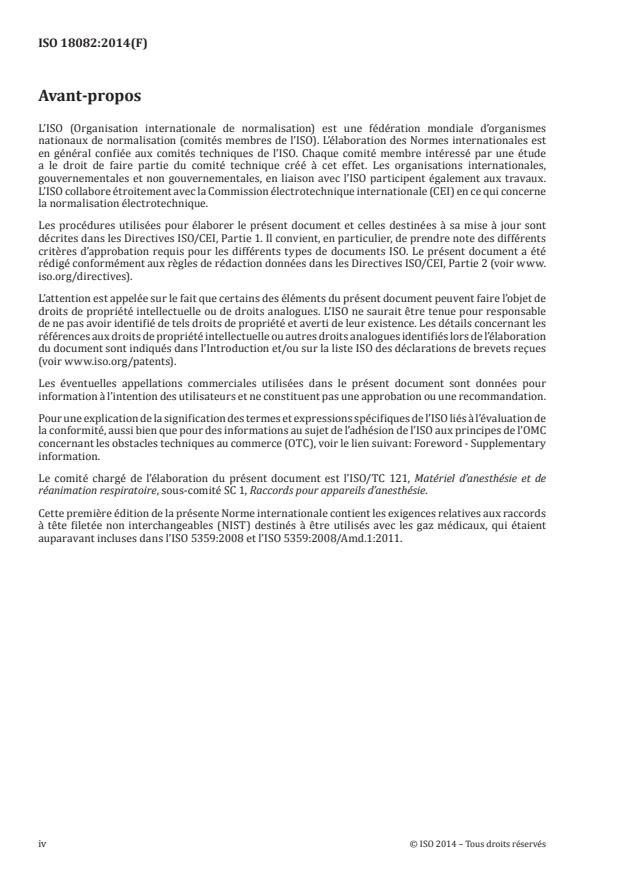
ISO 18082:2014 - Matériel respiratoire et anesthésique -- Raccords basse pression a tete filetée non interchangeables (NIST) pour gaz médicaux
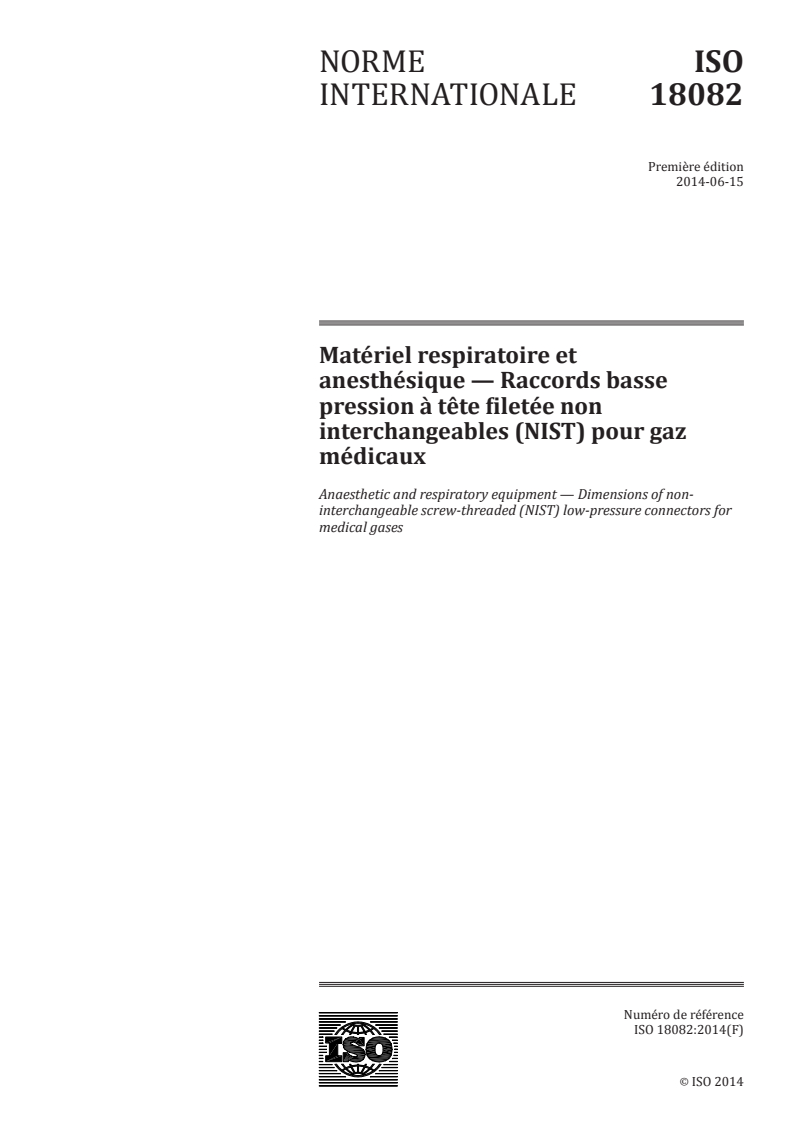

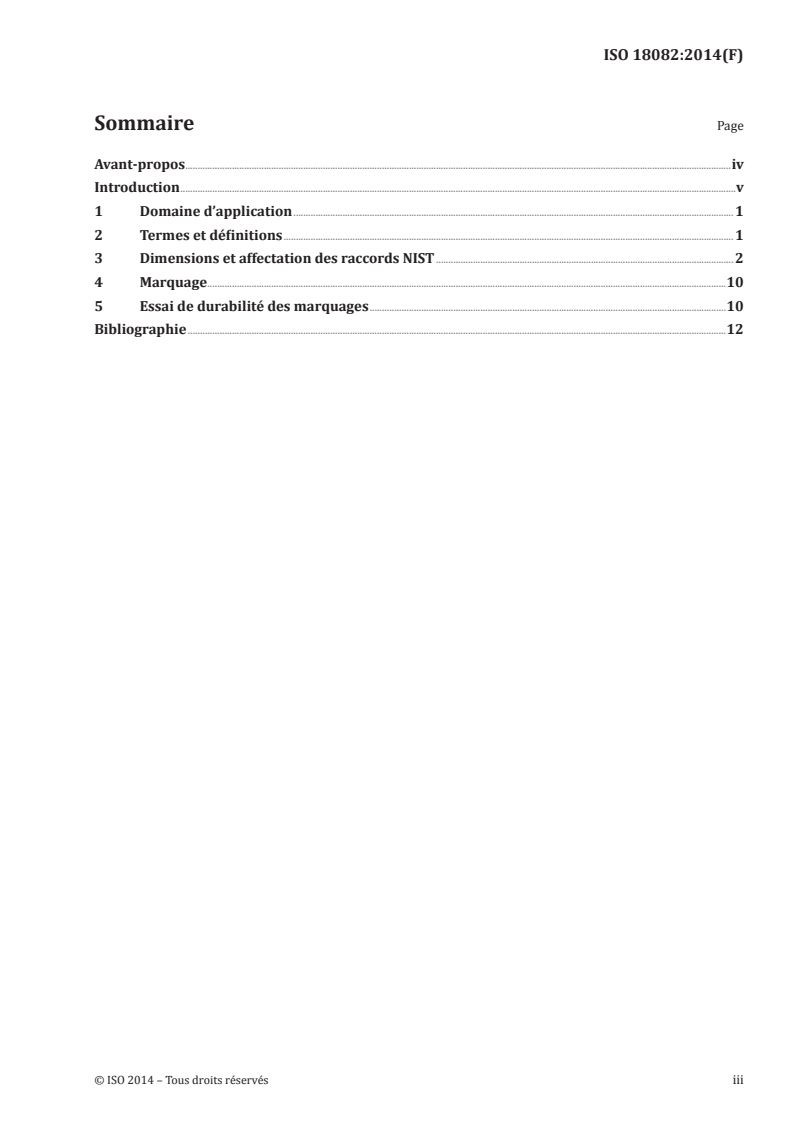
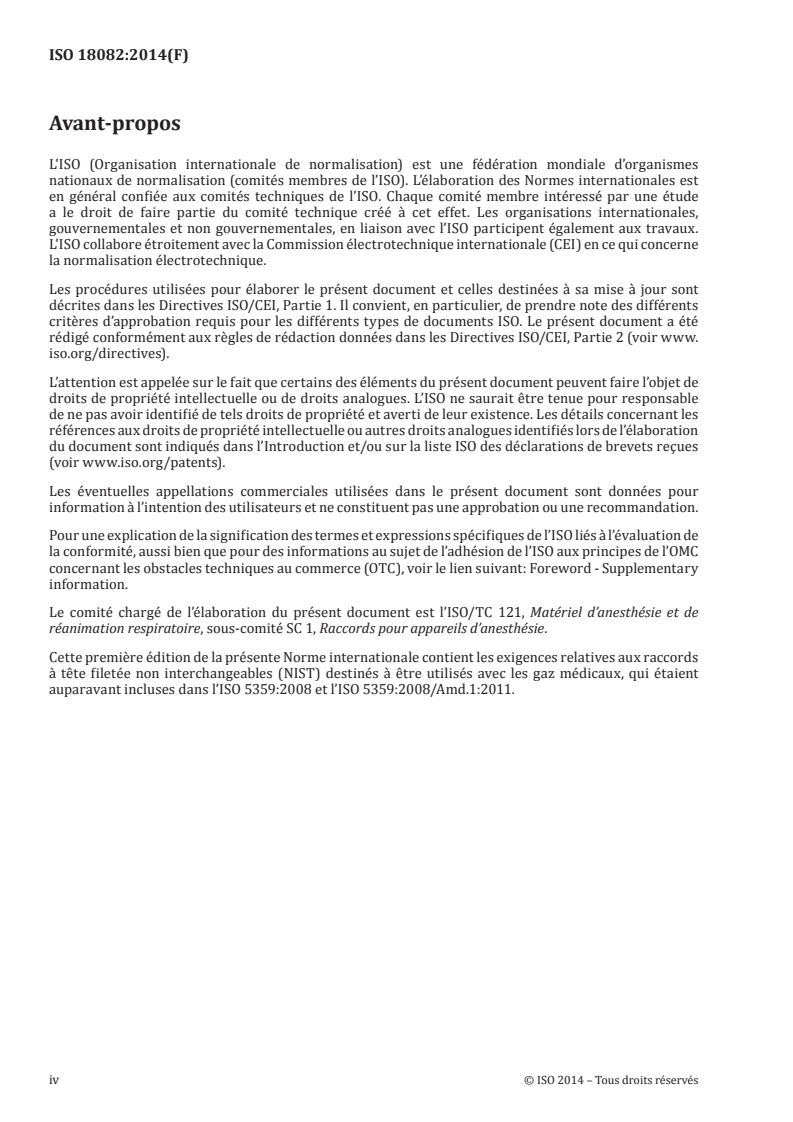
ISO 18082:2014 - Matériel respiratoire et anesthésique — Raccords basse pression à tête filetée non interchangeables (NIST) pour gaz médicaux/6/2014
Overview
ISO 18082:2014 - Anaesthetic and respiratory equipment - specifies the dimensions, allocation and marking of non-interchangeable screw-threaded (NIST) low-pressure connectors for medical gases. It covers NIST connectors used at operating pressures up to 1 400 kPa and vacuum systems down to 60 kPa absolute, and applies to gases such as oxygen, nitrous oxide, medical air, helium, carbon dioxide, xenon, oxygen-enriched air, driving air/nitrogen for surgical tools, specified mixtures and vacuum. The standard helps ensure gas-specific connections to prevent mis‑connection and improve patient safety.
Key topics and technical requirements
- Connector system: Defines NIST (non‑interchangeable screw‑threaded) male and female components, allocated by set diameters and thread hand to maintain gas specificity. (Note: left‑hand threads were not allocated in this edition.)
- Dimensions: Detailed dimensional requirements for NIST body, nipple and nut are given (figures and Tables 1–4). Indexing diameters and tolerances determine compatibility between gas services.
- O‑rings: Specifies “O” ring internal and section diameters for ranges A, B and C (e.g., Range A: 7.6 ±0.15 mm ID, 2.4 ±0.08 mm section) and recommends hardness (75° IRHD).
- Allocation and marking: Allocates connector references (A1…C24) to specific gases and mixtures (e.g., A8 = Oxygen, A3 = Medical air, A10 = Vacuum). Connectors must be durably and legibly marked with the relevant gas symbol (legible at 0.5 m and 215 lx).
- Durability test for markings: A simple, specified rub test - 15 s each with distilled water, methylated spirit and isopropyl alcohol - to verify marking legibility.
- Compliance verification: Compliance is checked by measurement and visual inspection; diagrams and tables provide exact tolerances.
Applications and who uses it
- Manufacturers of anaesthetic machines, ventilators, pressure regulators, hose assemblies, terminal units and prosthetic attachments use ISO 18082:2014 to design and produce NIST low‑pressure connectors that prevent cross‑connection.
- Hospital biomedical/clinical engineers and procurement teams rely on the standard to specify safe, gas‑specific fittings for clinical environments.
- Regulatory bodies and testing laboratories apply the dimensional, marking and durability requirements during product certification and inspection.
- Safety and risk managers use the standard to reduce the risk of wrong‑gas administration and to harmonize connector systems across facilities.
Related standards
- ISO 5359 (low‑pressure hose assemblies)
- ISO 9170‑1 (terminal units)
- ISO 7396‑1 (medical gas pipeline systems)
- ISO 15001 (compatibility with oxygen)
- ISO 4135, ISO 48, BS 4518, CGA V‑5, AS 2896 - referenced normative/supporting documents
Keywords: ISO 18082:2014, NIST connectors, non‑interchangeable screw‑threaded connectors, medical gases, low‑pressure connectors, anaesthetic and respiratory equipment, connector dimensions, marking durability.
Relations
- Effective Date
- 09-Feb-2026
- Effective Date
- 09-Feb-2026
- Effective Date
- 12-Feb-2026
- Effective Date
- 21-Aug-2021
Buy Documents
ISO 18082:2014 - Anaesthetic and respiratory equipment -- Dimensions of non-interchangeable screw-threaded (NIST) low-pressure connectors for medical gases
ISO 18082:2014 - Anaesthetic and respiratory equipment — Dimensions of non-interchangeable screw-threaded (NIST) low-pressure connectors for medical gases/6/2014
ISO 18082:2014 - Matériel respiratoire et anesthésique -- Raccords basse pression a tete filetée non interchangeables (NIST) pour gaz médicaux
ISO 18082:2014 - Matériel respiratoire et anesthésique — Raccords basse pression à tête filetée non interchangeables (NIST) pour gaz médicaux/6/2014
Get Certified
Connect with accredited certification bodies for this standard

BSI Group
BSI (British Standards Institution) is the business standards company that helps organizations make excellence a habit.

TÜV Rheinland
TÜV Rheinland is a leading international provider of technical services.

TÜV SÜD
TÜV SÜD is a trusted partner of choice for safety, security and sustainability solutions.
Sponsored listings
Frequently Asked Questions
ISO 18082:2014 is a standard published by the International Organization for Standardization (ISO). Its full title is "Anaesthetic and respiratory equipment — Dimensions of non-interchangeable screw-threaded (NIST) low-pressure connectors for medical gases". This standard covers: ISO 18082:2014 specifies the dimensions, the allocation and marking of non-interchangeable screw-threaded (NIST) connectors intended to be used at operating pressures up to 1 400 kPa, and for vacuum systems at pressures not greater than 60 kPa absolute. ISO 18082:2014 specifies NIST connectors intended for use with the following medical gases: oxygen; nitrous oxide; medical air; helium; carbon dioxide; xenon; specified mixtures of the gases listed above; oxygen-enriched air; air for driving surgical tools; nitrogen for driving surgical tools; use with vacuum.
ISO 18082:2014 specifies the dimensions, the allocation and marking of non-interchangeable screw-threaded (NIST) connectors intended to be used at operating pressures up to 1 400 kPa, and for vacuum systems at pressures not greater than 60 kPa absolute. ISO 18082:2014 specifies NIST connectors intended for use with the following medical gases: oxygen; nitrous oxide; medical air; helium; carbon dioxide; xenon; specified mixtures of the gases listed above; oxygen-enriched air; air for driving surgical tools; nitrogen for driving surgical tools; use with vacuum.
ISO 18082:2014 is classified under the following ICS (International Classification for Standards) categories: 11.040.10 - Anaesthetic, respiratory and reanimation equipment. The ICS classification helps identify the subject area and facilitates finding related standards.
ISO 18082:2014 has the following relationships with other standards: It is inter standard links to EN ISO 7396-1:2016, EN ISO 80601-2-13:2022, EN ISO 18082:2014, ISO 18082:2014/Amd 1:2017. Understanding these relationships helps ensure you are using the most current and applicable version of the standard.
ISO 18082:2014 is available in PDF format for immediate download after purchase. The document can be added to your cart and obtained through the secure checkout process. Digital delivery ensures instant access to the complete standard document.
Standards Content (Sample)
INTERNATIONAL ISO
STANDARD 18082
First edition
2014-06-15
Anaesthetic and respiratory
equipment — Dimensions of non-
interchangeable screw-threaded
(NIST) low-pressure connectors for
medical gases
Matériel respiratoire et anesthésique — Raccords basse pression à
tête filetée non interchangeables (NIST) pour gaz médicaux
Reference number
©
ISO 2014
© ISO 2014
All rights reserved. Unless otherwise specified, no part of this publication may be reproduced or utilized otherwise in any form
or by any means, electronic or mechanical, including photocopying, or posting on the internet or an intranet, without prior
written permission. Permission can be requested from either ISO at the address below or ISO’s member body in the country of
the requester.
ISO copyright office
Case postale 56 • CH-1211 Geneva 20
Tel. + 41 22 749 01 11
Fax + 41 22 749 09 47
E-mail copyright@iso.org
Web www.iso.org
Published in Switzerland
ii © ISO 2014 – All rights reserved
Contents Page
Foreword .iv
Introduction .v
1 Scope . 1
2 Terms and definitions . 1
3 Dimensions and allocation of NIST connectors . 2
4 Marking .11
5 Test for durability of markings .11
Bibliography .12
Foreword
ISO (the International Organization for Standardization) is a worldwide federation of national standards
bodies (ISO member bodies). The work of preparing International Standards is normally carried out
through ISO technical committees. Each member body interested in a subject for which a technical
committee has been established has the right to be represented on that committee. International
organizations, governmental and non-governmental, in liaison with ISO, also take part in the work.
ISO collaborates closely with the International Electrotechnical Commission (IEC) on all matters of
electrotechnical standardization.
The procedures used to develop this document and those intended for its further maintenance are
described in the ISO/IEC Directives, Part 1. In particular the different approval criteria needed for the
different types of ISO documents should be noted. This document was drafted in accordance with the
editorial rules of the ISO/IEC Directives, Part 2. www.iso.org/directives
Attention is drawn to the possibility that some of the elements of this document may be the subject of
patent rights. ISO shall not be held responsible for identifying any or all such patent rights. Details of
any patent rights identified during the development of the document will be in the Introduction and/or
on the ISO list of patent declarations received. www.iso.org/patents
Any trade name used in this document is information given for the convenience of users and does not
constitute an endorsement.
For an explanation on the meaning of ISO specific terms and expressions related to conformity
assessment, as well as information about ISO’s adherence to the WTO principles in the Technical Barriers
to Trade (TBT), see the following URL: Foreword - Supplementary information
The committee responsible for this document is ISO/TC 121, Anaesthetic and respiratory equipment,
Subcommittee SC 1, Breathing attachments and anaesthetic machines.
This is the first edition of this International Standard that contains the requirements for non-
interchangeable screw threaded (NIST) connectors for use with medical gases previously included in
ISO 5359:2008 and ISO 5359:2008/Amd.1:2011.
iv © ISO 2014 – All rights reserved
Introduction
This International Standard has been prepared in response to the need for a safe method of connecting
medical equipment intended to administer medical gases to patients or power medical devices.
Medical gases are stored in cylinders or cryogenic vessels, or can be produced on site; several medical
devices (e.g. pressure regulators, hose assemblies, flow-metering devices, lung ventilators, anaesthetic
workstations) can be fitted between the source of supply and the medical device. At each interface gas-
specific connectors are needed to ensure that the intended medical gas is administered to the patient.
While the desirability of achieving agreement on a single International Standard for screw-threaded
connectors has never been in doubt, the present pattern of usage has made such agreement impossible.
Nevertheless, fears that proliferation of individual national standards or practices will eventually result
in potentially dangerous cross-connection between components for different gases have led to the choice
of several different connector systems, all of which are intended to be incompatible with each other.
This International Standard specifies the dimensions and the allocation of non-interchangeable screw
threaded (NIST) connectors for use with medical gases.
This International Standard does not specify the dimensions and the allocation of
[9]
— diameter index safety system (DISS) connectors specified in CGA V-5 ,
[7]
— sleeve indexed system (SIS) connectors specified in AS 2896 , and
[5]
— quick connectors designed for terminal units specified in ISO 9170-1 .
INTERNATIONAL STANDARD ISO 18082:2014(E)
Anaesthetic and respiratory equipment — Dimensions of
non-interchangeable screw-threaded (NIST) low-pressure
connectors for medical gases
1 Scope
1.1 This International Standard specifies the dimensions, the allocation and marking of non-
interchangeable screw-threaded (NIST) connectors intended to be used at operating pressures up to
1 400 kPa, and for vacuum systems at pressures not greater than 60 kPa absolute.
1.2 This International Standard specifies NIST connectors intended for use with the following medical
gases:
— oxygen;
— nitrous oxide;
— medical air;
— helium;
— carbon dioxide;
— xenon;
— specified mixtures of the gases listed above;
— oxygen-enriched air;
— air for driving surgical tools;
— nitrogen for driving surgical tools;
and for use with vacuum.
[3]
NOTE Low-pressure hose assemblies for medical gases and vacuum are specified in ISO 5359 .
1.3 The information to be supplied by the manufacturer is excluded from the scope of this International
Standard because information about the use of NIST connectors is supplied by the manufacturer of each
medical device to which the connectors are permanently fitted.
NOTE Environmental aspects are dealt with in each International Standard concerning medical devices
fitted with NIST connectors.
2 Terms and definitions
For the purposes of this document, the following terms and definitions apply.
2.1
gas-specific
having characteristics which prevent connections between different gas services
[SOURCE: ISO 7396-1:2007, 3.14]
2.2
medical gas
any gas or mixture of gases intended for administration to patients for anaesthetic, therapeutic,
diagnostic or prophylactic purposes, or for surgical tool applications
[SOURCE: ISO 4135:2001, 1.1.1]
2.3
non-interchangeable screw-threaded connector
NIST connector
range of male and female components intended to maintain gas specificity by the allocation of a set of
different diameters and a left- or right-hand screw thread to the mating components for each particular
gas
[SOURCE: ISO 9170-1:2008, 3.10]
3 Dimensions and allocation of NIST connectors
The dimensions of the NIST body, nipple and nut shall comply with Figures 1, 2, 3 and 4 and Tables 2, 3
and 4.
Allocation of NIST c
...
INTERNATIONAL ISO
STANDARD 18082
First edition
2014-06-15
Anaesthetic and respiratory
equipment — Dimensions of non-
interchangeable screw-threaded
(NIST) low-pressure connectors for
medical gases
Matériel respiratoire et anesthésique — Raccords basse pression à
tête filetée non interchangeables (NIST) pour gaz médicaux
Reference number
©
ISO 2014
© ISO 2014
All rights reserved. Unless otherwise specified, no part of this publication may be reproduced or utilized otherwise in any form
or by any means, electronic or mechanical, including photocopying, or posting on the internet or an intranet, without prior
written permission. Permission can be requested from either ISO at the address below or ISO’s member body in the country of
the requester.
ISO copyright office
Case postale 56 • CH-1211 Geneva 20
Tel. + 41 22 749 01 11
Fax + 41 22 749 09 47
E-mail copyright@iso.org
Web www.iso.org
Published in Switzerland
ii © ISO 2014 – All rights reserved
Contents Page
Foreword .iv
Introduction .v
1 Scope . 1
2 Terms and definitions . 1
3 Dimensions and allocation of NIST connectors . 2
4 Marking .11
5 Test for durability of markings .11
Bibliography .12
Foreword
ISO (the International Organization for Standardization) is a worldwide federation of national standards
bodies (ISO member bodies). The work of preparing International Standards is normally carried out
through ISO technical committees. Each member body interested in a subject for which a technical
committee has been established has the right to be represented on that committee. International
organizations, governmental and non-governmental, in liaison with ISO, also take part in the work.
ISO collaborates closely with the International Electrotechnical Commission (IEC) on all matters of
electrotechnical standardization.
The procedures used to develop this document and those intended for its further maintenance are
described in the ISO/IEC Directives, Part 1. In particular the different approval criteria needed for the
different types of ISO documents should be noted. This document was drafted in accordance with the
editorial rules of the ISO/IEC Directives, Part 2. www.iso.org/directives
Attention is drawn to the possibility that some of the elements of this document may be the subject of
patent rights. ISO shall not be held responsible for identifying any or all such patent rights. Details of
any patent rights identified during the development of the document will be in the Introduction and/or
on the ISO list of patent declarations received. www.iso.org/patents
Any trade name used in this document is information given for the convenience of users and does not
constitute an endorsement.
For an explanation on the meaning of ISO specific terms and expressions related to conformity
assessment, as well as information about ISO’s adherence to the WTO principles in the Technical Barriers
to Trade (TBT), see the following URL: Foreword - Supplementary information
The committee responsible for this document is ISO/TC 121, Anaesthetic and respiratory equipment,
Subcommittee SC 1, Breathing attachments and anaesthetic machines.
This is the first edition of this International Standard that contains the requirements for non-
interchangeable screw threaded (NIST) connectors for use with medical gases previously included in
ISO 5359:2008 and ISO 5359:2008/Amd.1:2011.
iv © ISO 2014 – All rights reserved
Introduction
This International Standard has been prepared in response to the need for a safe method of connecting
medical equipment intended to administer medical gases to patients or power medical devices.
Medical gases are stored in cylinders or cryogenic vessels, or can be produced on site; several medical
devices (e.g. pressure regulators, hose assemblies, flow-metering devices, lung ventilators, anaesthetic
workstations) can be fitted between the source of supply and the medical device. At each interface gas-
specific connectors are needed to ensure that the intended medical gas is administered to the patient.
While the desirability of achieving agreement on a single International Standard for screw-threaded
connectors has never been in doubt, the present pattern of usage has made such agreement impossible.
Nevertheless, fears that proliferation of individual national standards or practices will eventually result
in potentially dangerous cross-connection between components for different gases have led to the choice
of several different connector systems, all of which are intended to be incompatible with each other.
This International Standard specifies the dimensions and the allocation of non-interchangeable screw
threaded (NIST) connectors for use with medical gases.
This International Standard does not specify the dimensions and the allocation of
[9]
— diameter index safety system (DISS) connectors specified in CGA V-5 ,
[7]
— sleeve indexed system (SIS) connectors specified in AS 2896 , and
[5]
— quick connectors designed for terminal units specified in ISO 9170-1 .
INTERNATIONAL STANDARD ISO 18082:2014(E)
Anaesthetic and respiratory equipment — Dimensions of
non-interchangeable screw-threaded (NIST) low-pressure
connectors for medical gases
1 Scope
1.1 This International Standard specifies the dimensions, the allocation and marking of non-
interchangeable screw-threaded (NIST) connectors intended to be used at operating pressures up to
1 400 kPa, and for vacuum systems at pressures not greater than 60 kPa absolute.
1.2 This International Standard specifies NIST connectors intended for use with the following medical
gases:
— oxygen;
— nitrous oxide;
— medical air;
— helium;
— carbon dioxide;
— xenon;
— specified mixtures of the gases listed above;
— oxygen-enriched air;
— air for driving surgical tools;
— nitrogen for driving surgical tools;
and for use with vacuum.
[3]
NOTE Low-pressure hose assemblies for medical gases and vacuum are specified in ISO 5359 .
1.3 The information to be supplied by the manufacturer is excluded from the scope of this International
Standard because information about the use of NIST connectors is supplied by the manufacturer of each
medical device to which the connectors are permanently fitted.
NOTE Environmental aspects are dealt with in each International Standard concerning medical devices
fitted with NIST connectors.
2 Terms and definitions
For the purposes of this document, the following terms and definitions apply.
2.1
gas-specific
having characteristics which prevent connections between different gas services
[SOURCE: ISO 7396-1:2007, 3.14]
2.2
medical gas
any gas or mixture of gases intended for administration to patients for anaesthetic, therapeutic,
diagnostic or prophylactic purposes, or for surgical tool applications
[SOURCE: ISO 4135:2001, 1.1.1]
2.3
non-interchangeable screw-threaded connector
NIST connector
range of male and female components intended to maintain gas specificity by the allocation of a set of
different diameters and a left- or right-hand screw thread to the mating components for each particular
gas
[SOURCE: ISO 9170-1:2008, 3.10]
3 Dimensions and allocation of NIST connectors
The dimensions of the NIST body, nipple and nut shall comply with Figures 1, 2, 3 and 4 and Tables 2, 3
and 4.
Allocation of NIST c
...
NORME ISO
INTERNATIONALE 18082
Première édition
2014-06-15
Matériel respiratoire et
anesthésique — Raccords basse
pression à tête filetée non
interchangeables (NIST) pour gaz
médicaux
Anaesthetic and respiratory equipment — Dimensions of non-
interchangeable screw-threaded (NIST) low-pressure connectors for
medical gases
Numéro de référence
©
ISO 2014
DOCUMENT PROTÉGÉ PAR COPYRIGHT
© ISO 2014
Droits de reproduction réservés. Sauf indication contraire, aucune partie de cette publication ne peut être reproduite ni utilisée
sous quelque forme que ce soit et par aucun procédé, électronique ou mécanique, y compris la photocopie, l’affichage sur
l’internet ou sur un Intranet, sans autorisation écrite préalable. Les demandes d’autorisation peuvent être adressées à l’ISO à
l’adresse ci-après ou au comité membre de l’ISO dans le pays du demandeur.
ISO copyright office
Case postale 56 • CH-1211 Geneva 20
Tel. + 41 22 749 01 11
Fax + 41 22 749 09 47
E-mail copyright@iso.org
Web www.iso.org
Publié en Suisse
ii © ISO 2014 – Tous droits réservés
Sommaire Page
Avant-propos .iv
Introduction .v
1 Domaine d’application . 1
2 Termes et définitions . 1
3 Dimensions et affectation des raccords NIST . 2
4 Marquage .10
5 Essai de durabilité des marquages .10
Bibliographie .12
Avant-propos
L’ISO (Organisation internationale de normalisation) est une fédération mondiale d’organismes
nationaux de normalisation (comités membres de l’ISO). L’élaboration des Normes internationales est
en général confiée aux comités techniques de l’ISO. Chaque comité membre intéressé par une étude
a le droit de faire partie du comité technique créé à cet effet. Les organisations internationales,
gouvernementales et non gouvernementales, en liaison avec l’ISO participent également aux travaux.
L’ISO collabore étroitement avec la Commission électrotechnique internationale (CEI) en ce qui concerne
la normalisation électrotechnique.
Les procédures utilisées pour élaborer le présent document et celles destinées à sa mise à jour sont
décrites dans les Directives ISO/CEI, Partie 1. Il convient, en particulier, de prendre note des différents
critères d’approbation requis pour les différents types de documents ISO. Le présent document a été
rédigé conformément aux règles de rédaction données dans les Directives ISO/CEI, Partie 2 (voir www.
iso.org/directives).
L’attention est appelée sur le fait que certains des éléments du présent document peuvent faire l’objet de
droits de propriété intellectuelle ou de droits analogues. L’ISO ne saurait être tenue pour responsable
de ne pas avoir identifié de tels droits de propriété et averti de leur existence. Les détails concernant les
références aux droits de propriété intellectuelle ou autres droits analogues identifiés lors de l’élaboration
du document sont indiqués dans l’Introduction et/ou sur la liste ISO des déclarations de brevets reçues
(voir www.iso.org/patents).
Les éventuelles appellations commerciales utilisées dans le présent document sont données pour
information à l’intention des utilisateurs et ne constituent pas une approbation ou une recommandation.
Pour une explication de la signification des termes et expressions spécifiques de l’ISO liés à l’évaluation de
la conformité, aussi bien que pour des informations au sujet de l’adhésion de l’ISO aux principes de l’OMC
concernant les obstacles techniques au commerce (OTC), voir le lien suivant: Foreword - Supplementary
information.
Le comité chargé de l’élaboration du présent document est l’ISO/TC 121, Matériel d’anesthésie et de
réanimation respiratoire, sous-comité SC 1, Raccords pour appareils d’anesthésie.
Cette première édition de la présente Norme internationale contient les exigences relatives aux raccords
à tête filetée non interchangeables (NIST) destinés à être utilisés avec les gaz médicaux, qui étaient
auparavant incluses dans l’ISO 5359:2008 et l’ISO 5359:2008/Amd.1:2011.
iv © ISO 2014 – Tous droits réservés
Introduction
La présente Norme internationale a été élaborée pour répondre au besoin d’établir une méthode
permettant de raccorder en toute sécurité des équipements médicaux destinés à administrer des
gaz médicaux à des patients ou à alimenter des dispositifs médicaux. Les gaz médicaux sont stockés
dans des bouteilles ou des récipients cryogéniques, ou ils peuvent être produits sur site; un dispositif
médical peut être relié à la source d’alimentation à travers plusieurs autres dispositifs médicaux (par
exemple des régulateurs de pression, des flexibles de raccordement, des débitmètres, des ventilateurs
pulmonaires ou des systèmes d’anesthésie). À chaque interface, des raccords spécifiques au gaz utilisé
sont nécessaires pour s’assurer que le gaz médical prévu est administré au patient.
Alors que la volonté de trouver un accord sur une Norme internationale unique pour les raccords à tête
filetée est incontestable, la diversité des utilisations actuelles a rendu un tel projet impossible.
Néanmoins, la crainte de voir les pratiques ou les différentes normes nationales proliférer et se traduire
finalement par une interversion potentiellement dangereuse entre les composants pour les différents
gaz, a conduit au choix de plusieurs systèmes de raccords différents, tous prévus pour être incompatibles
les uns avec les autres.
La présente Norme internationale spécifie les dimensions et l’affectation des raccords à tête filetée non
interchangeables (NIST) destinés à être utilisés avec les gaz médicaux.
La présente Norme internationale ne spécifie pas les dimensions et l’affectation
[9]
— des raccords de sécurité à diamètre indexé (DISS) spécifiés dans le document CGA V-5 ,
[7]
— des raccords à manchon indexé (SIS) spécifiés dans le document AS 2896 , et
[5]
— des raccords de prise rapide conçus pour les prises murales spécifiées dans l’ISO 9170-1 .
NORME INTERNATIONALE ISO 18082:2014(F)
Matériel respiratoire et anesthésique — Raccords basse
pression à tête filetée non interchangeables (NIST) pour
gaz médicaux
1 Domaine d’application
1.1 La présente Norme internationale spécifie les dimensions, l’affectation et le marquage des raccords
à tête filetée non interchangeables (NIST) destinés à être utilisés à des pressions de service allant jusqu’à
1 400 kPa et, pour les systèmes de vide, à des pressions absolues inférieures à 60 kPa.
1.2 La présente Norme internationale spécifie les exigences relatives aux raccords NIST destinés à être
utilisés avec les gaz médicaux suivants:
— oxygène;
— protoxyde d’azote;
— air médical;
— hélium;
— dioxyde de carbone;
— xénon;
— mélanges spécifiés des gaz précités;
— air enrichi en oxygène;
— air pour les instruments chirurgicaux;
— azote pour les instruments chirurgicaux;
et pour l’utilisation avec le vide.
NOTE Les flexibles de raccordement à basse pression destinés à être utilisés avec les gaz médicaux et le vide
[3]
sont spécifiés dans l’ISO 5359 .
1.3 Les informations à fournir par le fabricant sont exclues du domaine d’application de la présente
Norme internationale car les informations concernant les raccords NIST sont fournies par le fabricant de
chaque dispositif médical sur lequel les raccords sont fixés à demeure.
NOTE Les aspects environnementaux sont traités dans chaque Norme internationale portant sur des
dispositifs médicaux munis de raccords NIST.
2 Termes et définitions
Pour les besoins du présent document, les termes et définitions suivants s’appliquent.
2.1
spécifique à un gaz
doté des caractéristiques empêchant le raccordement entre alimentations de gaz différentes
[SOURCE: ISO 7396-1:2007, 3.14]
2.2
gaz médical
gaz ou mélange de gaz qu’il est prévu d’administrer aux patients à des fins d’anesthésie, de thérapie, de
diagnostic ou de prophylaxie ou pour l’utilisation d’instruments de chirurgie
[SOURCE: ISO 4135:2001, 1.1.1]
2.3
raccord à tête filetée non interchangeable
raccord NIST
éléments mâles ou femelles permettant un raccordement spécifique au gaz par le jeu de diamètres
différenciés et d’un filetage à droite ou à gauche
[SOURCE: ISO 9170-1:2008, 3.10]
3 Dimensions et affectation des raccords NIST
Les dimensions du corps et de la fiche à écrou des raccords NIST doivent être conformes aux Figures 1,
2, 3 et 4 et aux Tableaux 2, 3 e
...
NORME ISO
INTERNATIONALE 18082
Première édition
2014-06-15
Matériel respiratoire et
anesthésique — Raccords basse
pression à tête filetée non
interchangeables (NIST) pour gaz
médicaux
Anaesthetic and respiratory equipment — Dimensions of non-
interchangeable screw-threaded (NIST) low-pressure connectors for
medical gases
Numéro de référence
©
ISO 2014
DOCUMENT PROTÉGÉ PAR COPYRIGHT
© ISO 2014
Droits de reproduction réservés. Sauf indication contraire, aucune partie de cette publication ne peut être reproduite ni utilisée
sous quelque forme que ce soit et par aucun procédé, électronique ou mécanique, y compris la photocopie, l’affichage sur
l’internet ou sur un Intranet, sans autorisation écrite préalable. Les demandes d’autorisation peuvent être adressées à l’ISO à
l’adresse ci-après ou au comité membre de l’ISO dans le pays du demandeur.
ISO copyright office
Case postale 56 • CH-1211 Geneva 20
Tel. + 41 22 749 01 11
Fax + 41 22 749 09 47
E-mail copyright@iso.org
Web www.iso.org
Publié en Suisse
ii © ISO 2014 – Tous droits réservés
Sommaire Page
Avant-propos .iv
Introduction .v
1 Domaine d’application . 1
2 Termes et définitions . 1
3 Dimensions et affectation des raccords NIST . 2
4 Marquage .10
5 Essai de durabilité des marquages .10
Bibliographie .12
Avant-propos
L’ISO (Organisation internationale de normalisation) est une fédération mondiale d’organismes
nationaux de normalisation (comités membres de l’ISO). L’élaboration des Normes internationales est
en général confiée aux comités techniques de l’ISO. Chaque comité membre intéressé par une étude
a le droit de faire partie du comité technique créé à cet effet. Les organisations internationales,
gouvernementales et non gouvernementales, en liaison avec l’ISO participent également aux travaux.
L’ISO collabore étroitement avec la Commission électrotechnique internationale (CEI) en ce qui concerne
la normalisation électrotechnique.
Les procédures utilisées pour élaborer le présent document et celles destinées à sa mise à jour sont
décrites dans les Directives ISO/CEI, Partie 1. Il convient, en particulier, de prendre note des différents
critères d’approbation requis pour les différents types de documents ISO. Le présent document a été
rédigé conformément aux règles de rédaction données dans les Directives ISO/CEI, Partie 2 (voir www.
iso.org/directives).
L’attention est appelée sur le fait que certains des éléments du présent document peuvent faire l’objet de
droits de propriété intellectuelle ou de droits analogues. L’ISO ne saurait être tenue pour responsable
de ne pas avoir identifié de tels droits de propriété et averti de leur existence. Les détails concernant les
références aux droits de propriété intellectuelle ou autres droits analogues identifiés lors de l’élaboration
du document sont indiqués dans l’Introduction et/ou sur la liste ISO des déclarations de brevets reçues
(voir www.iso.org/patents).
Les éventuelles appellations commerciales utilisées dans le présent document sont données pour
information à l’intention des utilisateurs et ne constituent pas une approbation ou une recommandation.
Pour une explication de la signification des termes et expressions spécifiques de l’ISO liés à l’évaluation de
la conformité, aussi bien que pour des informations au sujet de l’adhésion de l’ISO aux principes de l’OMC
concernant les obstacles techniques au commerce (OTC), voir le lien suivant: Foreword - Supplementary
information.
Le comité chargé de l’élaboration du présent document est l’ISO/TC 121, Matériel d’anesthésie et de
réanimation respiratoire, sous-comité SC 1, Raccords pour appareils d’anesthésie.
Cette première édition de la présente Norme internationale contient les exigences relatives aux raccords
à tête filetée non interchangeables (NIST) destinés à être utilisés avec les gaz médicaux, qui étaient
auparavant incluses dans l’ISO 5359:2008 et l’ISO 5359:2008/Amd.1:2011.
iv © ISO 2014 – Tous droits réservés
Introduction
La présente Norme internationale a été élaborée pour répondre au besoin d’établir une méthode
permettant de raccorder en toute sécurité des équipements médicaux destinés à administrer des
gaz médicaux à des patients ou à alimenter des dispositifs médicaux. Les gaz médicaux sont stockés
dans des bouteilles ou des récipients cryogéniques, ou ils peuvent être produits sur site; un dispositif
médical peut être relié à la source d’alimentation à travers plusieurs autres dispositifs médicaux (par
exemple des régulateurs de pression, des flexibles de raccordement, des débitmètres, des ventilateurs
pulmonaires ou des systèmes d’anesthésie). À chaque interface, des raccords spécifiques au gaz utilisé
sont nécessaires pour s’assurer que le gaz médical prévu est administré au patient.
Alors que la volonté de trouver un accord sur une Norme internationale unique pour les raccords à tête
filetée est incontestable, la diversité des utilisations actuelles a rendu un tel projet impossible.
Néanmoins, la crainte de voir les pratiques ou les différentes normes nationales proliférer et se traduire
finalement par une interversion potentiellement dangereuse entre les composants pour les différents
gaz, a conduit au choix de plusieurs systèmes de raccords différents, tous prévus pour être incompatibles
les uns avec les autres.
La présente Norme internationale spécifie les dimensions et l’affectation des raccords à tête filetée non
interchangeables (NIST) destinés à être utilisés avec les gaz médicaux.
La présente Norme internationale ne spécifie pas les dimensions et l’affectation
[9]
— des raccords de sécurité à diamètre indexé (DISS) spécifiés dans le document CGA V-5 ,
[7]
— des raccords à manchon indexé (SIS) spécifiés dans le document AS 2896 , et
[5]
— des raccords de prise rapide conçus pour les prises murales spécifiées dans l’ISO 9170-1 .
NORME INTERNATIONALE ISO 18082:2014(F)
Matériel respiratoire et anesthésique — Raccords basse
pression à tête filetée non interchangeables (NIST) pour
gaz médicaux
1 Domaine d’application
1.1 La présente Norme internationale spécifie les dimensions, l’affectation et le marquage des raccords
à tête filetée non interchangeables (NIST) destinés à être utilisés à des pressions de service allant jusqu’à
1 400 kPa et, pour les systèmes de vide, à des pressions absolues inférieures à 60 kPa.
1.2 La présente Norme internationale spécifie les exigences relatives aux raccords NIST destinés à être
utilisés avec les gaz médicaux suivants:
— oxygène;
— protoxyde d’azote;
— air médical;
— hélium;
— dioxyde de carbone;
— xénon;
— mélanges spécifiés des gaz précités;
— air enrichi en oxygène;
— air pour les instruments chirurgicaux;
— azote pour les instruments chirurgicaux;
et pour l’utilisation avec le vide.
NOTE Les flexibles de raccordement à basse pression destinés à être utilisés avec les gaz médicaux et le vide
[3]
sont spécifiés dans l’ISO 5359 .
1.3 Les informations à fournir par le fabricant sont exclues du domaine d’application de la présente
Norme internationale car les informations concernant les raccords NIST sont fournies par le fabricant de
chaque dispositif médical sur lequel les raccords sont fixés à demeure.
NOTE Les aspects environnementaux sont traités dans chaque Norme internationale portant sur des
dispositifs médicaux munis de raccords NIST.
2 Termes et définitions
Pour les besoins du présent document, les termes et définitions suivants s’appliquent.
2.1
spécifique à un gaz
doté des caractéristiques empêchant le raccordement entre alimentations de gaz différentes
[SOURCE: ISO 7396-1:2007, 3.14]
2.2
gaz médical
gaz ou mélange de gaz qu’il est prévu d’administrer aux patients à des fins d’anesthésie, de thérapie, de
diagnostic ou de prophylaxie ou pour l’utilisation d’instruments de chirurgie
[SOURCE: ISO 4135:2001, 1.1.1]
2.3
raccord à tête filetée non interchangeable
raccord NIST
éléments mâles ou femelles permettant un raccordement spécifique au gaz par le jeu de diamètres
différenciés et d’un filetage à droite ou à gauche
[SOURCE: ISO 9170-1:2008, 3.10]
3 Dimensions et affectation des raccords NIST
Les dimensions du corps et de la fiche à écrou des raccords NIST doivent être conformes aux Figures 1,
2, 3 et 4 et aux Tableaux 2, 3 e
...