

ISO 247-1:2026
(Main)Rubber — Determination of ash — Part 1: Combustion method
General Information
- Abstract
This document specifies three methods for the determination of ash from raw rubbers, compounded rubbers and vulcanizates. The methods are applicable to raw, compounded or vulcanized rubbers of the M, N, O, R and U families described in ISO 1629 [1], except that: Method A is not used for the determination of ash from compounded or vulcanized rubbers containing chlorine, bromine or iodine; Method B is used for compounded or vulcanized rubbers containing chlorine, bromine or iodine. It is not applicable to uncompounded rubbers; Method C is intended to be used for the determination of ash from raw, compounded or vulcanized rubber not containing chlorine, bromine or iodine by wrapping the test portion in ashless filter paper; lithium and fluorine compounds can react with silica crucibles to form volatile compounds, giving low ash results. This document does not cover the interpretation of the ash results as to the inorganic chemical content of a compound or vulcanizate, which is the responsibility of the analyst, who must be aware of the behaviour of rubber additives at elevated temperatures.
- Status
- Published
- Publication Date
- 19-Aug-2026
- Technical Committee
- ISO/TC 45/SC 2 - Testing and analysis
- Drafting Committee
- ISO/TC 45/SC 2/WG 5 - Chemical tests
- Current Stage
- 6060 - International Standard published
- Start Date
- 20-Aug-2026
- Due Date
- 05-Jan-2027
- Completion Date
- 20-Aug-2026
Buy Documents
ISO 247-1:2026 - Rubber — Determination of ash — Part 1: Combustion method
ISO 247-1:2026 - Caoutchouc — Détermination du taux de cendres — Partie 1: Technique de combustion sèche
Overview
ISO 247-1:2026 – Rubber - Determination of ash - Part 1: Combustion method describes standardized procedures for determining the ash content in raw rubbers, compounded rubbers, and vulcanizates. Ash determination is critical for quality control in the rubber industry, providing valuable information about the inorganic content and process consistency. This International Standard outlines three reliable combustion methods, ensuring consistency for laboratories testing various types of rubber materials from the M, N, O, R, and U families, as referenced in ISO 1629.
Key Topics
Ash Determination Methods:
ISO 247-1:2026 details three analytical methods for ash determination:- Method A: Suitable for raw, compounded, or vulcanized rubbers not containing chlorine, bromine, or iodine.
- Method B: Designed for compounded or vulcanized rubber containing halogens (chlorine, bromine, iodine); not applicable to uncompounded rubbers.
- Method C: Utilizes ashless filter paper for samples not containing halogens; critical for materials reactive with silica crucibles.
Scope and Applicability:
- Applies to raw, compounded, or vulcanized rubbers across major synthetic and natural elastomer families (M, N, O, R, U).
- Excludes direct interpretation of inorganic composition from ash results.
- Analysts must consider the effect of rubber additives at elevated temperatures.
Equipment and Procedures:
- Requires laboratory apparatus such as crucibles (porcelain, silica, or platinum), muffle furnace (with air flow control), and analytical balances.
- Emphasizes strict procedural detail for test portion preparation, sample incineration, and consistent weighing to ensure accurate results.
Reporting and Precision:
- Specifies documentation requirements, including full sample identification, method used, temperature, ash content, and test date.
- Contains precision criteria and references interlaboratory testing for repeatability and reproducibility.
Applications
ISO 247-1:2026 delivers practical value to both manufacturers and testing laboratories by offering:
Quality Control:
Regular monitoring of ash content in rubber compounds and finished products helps identify contamination or variation in process materials, allowing manufacturers to maintain high quality standards.Material Identification:
Determining ash content assists in verifying compound formulations, detecting adulteration, and ensuring compliance with internal specifications or customer requirements.Research and Development:
Essential for developing new rubber compounds or troubleshooting production challenges, the ash determination methods support optimization of material properties.Regulatory Compliance:
Ensures that rubber products meet industry and international standards for ash content, which can impact performance, safety, and market acceptance.
Laboratories implementing ISO 247-1:2026 benefit from well-defined protocols, reducing uncertainty in test results and facilitating meaningful comparisons between different batches or suppliers.
Related Standards
ISO 1629: Rubber and latices - Nomenclature
Provides classification and designation for raw rubbers referenced in ISO 247-1:2026.ISO 248-1: Rubber, raw - Determination of volatile-matter content - Part 1
Describes methods for volatile matter analysis, often performed before ash determination.ISO 1795: Rubber, raw natural and raw synthetic - Sampling and further preparative procedures
Guides the sampling technique to ensure representative test portions.ISO/TR 9272: Rubber and rubber products - Determination of precision for test method standards
Framework for assessing repeatability and reproducibility in testing, referenced for precision in ISO 247-1:2026.ISO 19983: Rubber - Determination of precision of test methods
Details procedures for evaluating test method precision in the rubber industry.
Implementing ISO 247-1:2026 ensures reliable ash analysis, supporting quality assurance and compliance throughout the rubber product supply chain.
Relations
- Effective Date
- 06-Jan-2024
Buy Documents
ISO 247-1:2026 - Rubber — Determination of ash — Part 1: Combustion method
ISO 247-1:2026 - Caoutchouc — Détermination du taux de cendres — Partie 1: Technique de combustion sèche
Get Certified
Connect with accredited certification bodies for this standard

DIN CERTCO
DIN Group product certification.

Smithers Quality Assessments
US management systems and product certification.
Sponsored listings
Frequently Asked Questions
ISO 247-1:2026 is a standard published by the International Organization for Standardization (ISO). Its full title is "Rubber — Determination of ash — Part 1: Combustion method". This standard covers: This document specifies three methods for the determination of ash from raw rubbers, compounded rubbers and vulcanizates. The methods are applicable to raw, compounded or vulcanized rubbers of the M, N, O, R and U families described in ISO 1629 [1], except that: Method A is not used for the determination of ash from compounded or vulcanized rubbers containing chlorine, bromine or iodine; Method B is used for compounded or vulcanized rubbers containing chlorine, bromine or iodine. It is not applicable to uncompounded rubbers; Method C is intended to be used for the determination of ash from raw, compounded or vulcanized rubber not containing chlorine, bromine or iodine by wrapping the test portion in ashless filter paper; lithium and fluorine compounds can react with silica crucibles to form volatile compounds, giving low ash results. This document does not cover the interpretation of the ash results as to the inorganic chemical content of a compound or vulcanizate, which is the responsibility of the analyst, who must be aware of the behaviour of rubber additives at elevated temperatures.
This document specifies three methods for the determination of ash from raw rubbers, compounded rubbers and vulcanizates. The methods are applicable to raw, compounded or vulcanized rubbers of the M, N, O, R and U families described in ISO 1629 [1], except that: Method A is not used for the determination of ash from compounded or vulcanized rubbers containing chlorine, bromine or iodine; Method B is used for compounded or vulcanized rubbers containing chlorine, bromine or iodine. It is not applicable to uncompounded rubbers; Method C is intended to be used for the determination of ash from raw, compounded or vulcanized rubber not containing chlorine, bromine or iodine by wrapping the test portion in ashless filter paper; lithium and fluorine compounds can react with silica crucibles to form volatile compounds, giving low ash results. This document does not cover the interpretation of the ash results as to the inorganic chemical content of a compound or vulcanizate, which is the responsibility of the analyst, who must be aware of the behaviour of rubber additives at elevated temperatures.
ISO 247-1:2026 is classified under the following ICS (International Classification for Standards) categories: 83.060 - Rubber. The ICS classification helps identify the subject area and facilitates finding related standards.
ISO 247-1:2026 has the following relationships with other standards: It is inter standard links to ISO 247-1:2018. Understanding these relationships helps ensure you are using the most current and applicable version of the standard.
ISO 247-1:2026 is available in PDF format for immediate download after purchase. The document can be added to your cart and obtained through the secure checkout process. Digital delivery ensures instant access to the complete standard document.
Standards Content (Sample)
International
Standard
ISO 247-1
Second edition
Rubber — Determination of ash —
2026-08
Part 1:
Combustion method
Caoutchouc — Détermination du taux de cendres —
Partie 1: Technique de combustion sèche
Reference number
© ISO 2026
All rights reserved. Unless otherwise specified, or required in the context of its implementation, no part of this publication may
be reproduced or utilized otherwise in any form or by any means, electronic or mechanical, including photocopying, or posting on
the internet or an intranet, without prior written permission. Permission can be requested from either ISO at the address below
or ISO’s member body in the country of the requester.
ISO copyright office
CP 401 • Ch. de Blandonnet 8
CH-1214 Vernier, Geneva
Phone: +41 22 749 01 11
Email: copyright@iso.org
Website: www.iso.org
Published in Switzerland
ii
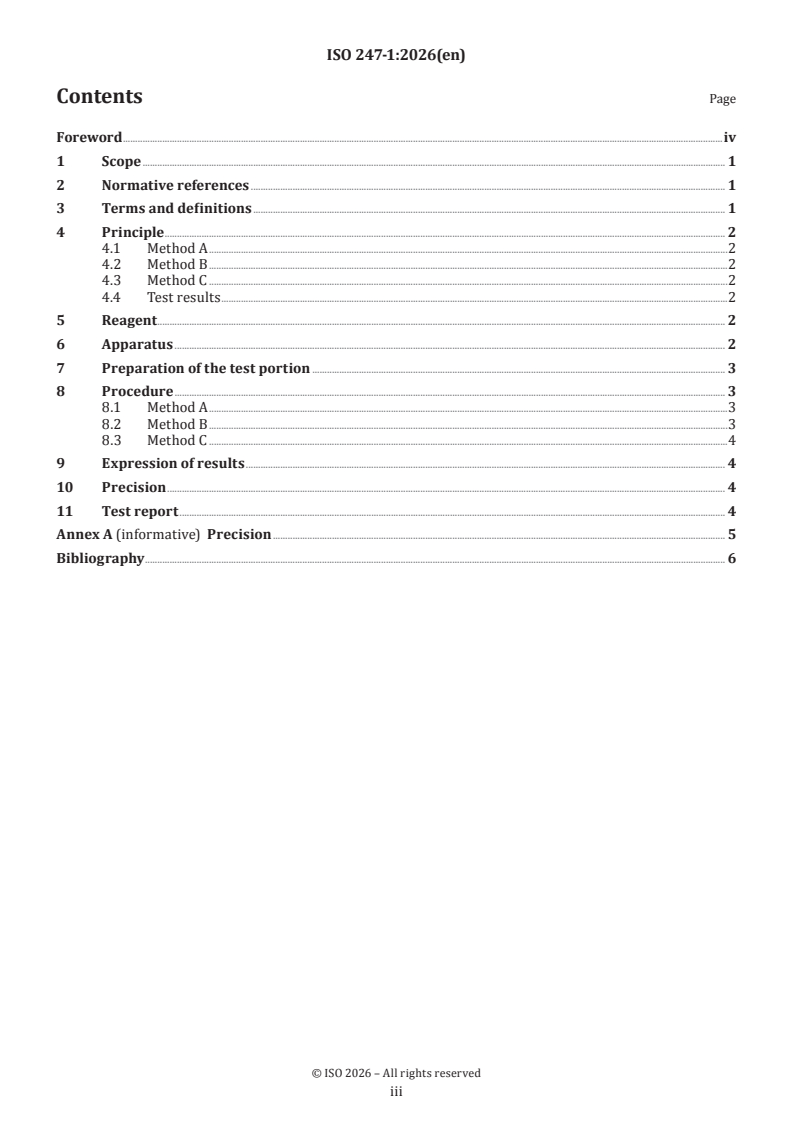
Contents Page
Foreword .iv
1 Scope . 1
2 Normative references . 1
3 Terms and definitions . 1
4 Principle . 2
4.1 Method A .2
4.2 Method B .2
4.3 Method C .2
4.4 Test results .2
5 Reagent . 2
6 Apparatus . 2
7 Preparation of the test portion . 3
8 Procedure . 3
8.1 Method A .3
8.2 Method B .3
8.3 Method C .4
9 Expression of results . 4
10 Precision . 4
11 Test report . 4
Annex A (informative) Precision . 5
Bibliography . 6
iii
Foreword
ISO (the International Organization for Standardization) is a worldwide federation of national standards
bodies (ISO member bodies). The work of preparing International Standards is normally carried out through
ISO technical committees. Each member body interested in a subject for which a technical committee
has been established has the right to be represented on that committee. International organizations,
governmental and non-governmental, in liaison with ISO, also take part in the work. ISO collaborates closely
with the International Electrotechnical Commission (IEC) on all matters of electrotechnical standardization.
The procedures used to develop this document and those intended for its further maintenance are described
in the ISO/IEC Directives, Part 1. In particular, the different approval criteria needed for the different types
of ISO document should be noted. This document was drafted in accordance with the editorial rules of the
ISO/IEC Directives, Part 2 (see www.iso.org/directives).
ISO draws attention to the possibility that the implementation of this document may involve the use of (a)
patent(s). ISO takes no position concerning the evidence, validity or applicability of any claimed patent
rights in respect thereof. As of the date of publication of this document, ISO [had/had not] received notice of
(a) patent(s) which may be required to implement this document. However, implementers are cautioned that
this may not represent the latest information, which may be obtained from the patent database available at
www.iso.org/patents. ISO shall not be held responsible for identifying any or all such patent rights.
Any trade name used in this document is information given for the convenience of users and does not
constitute an endorsement.
For an explanation of the voluntary nature of standards, the meaning of ISO specific terms and expressions
related to conformity assessment, as well as information about ISO's adherence to the World Trade
Organization (WTO) principles in the Technical Barriers to Trade (TBT), see www.iso.org/iso/foreword.html.
This document was prepared by Technical Committee ISO/TC 45, Rubber and rubber products, Subcommittee
SC 2, Testing and analysis.
This second edition cancels and replaces the first edition (ISO 247-1:2018), which has been technically
revised.
The main changes are as follows:
— addition of incineration temperature for compounds containing calcium carbonate in "Method C";
— revision of the condition for determining constant weight in "Method C".
A list of all parts in the ISO 247 series can be found on the ISO website.
Any feedback or questions on this document should be directed to the user’s national standards body. A
complete listing of these bodies can be found at www.iso.org/members.html.
iv
International Standard ISO 247-1:2026(en)
Rubber — Determination of ash —
Part 1:
Combustion method
1 Scope
This document specifies three methods for the determination of ash from raw rubbers, compounded rubbers
and vulcanizates. The methods are applicable to raw, compounded or vulcanized rubbers of the M, N, O, R
[1]
and U families described in ISO 1629 , except that:
— Method A is not used for the determination of ash from compounded or vulcanized rubbers containing
chlorine, bromine or iodine;
— Method B is used for compounded or vulcanized rubbers containing chlorine, bromine or iodine. It is not
applicable to uncompounded rubbers;
— Method C is intended to be used for the determination of ash from raw, compounded or vulcanized rubber
not containing chlorine, bromine or iodine by wrapping the test portion in ashless filter paper;
— lithium and fluorine compounds can react with silica crucibles to form volatile compounds, giving low
ash results.
This document does not cover the interpretation of the ash results as to the inorganic chemical content of a
compound or vulcanizate, which is the responsibility of the analyst, who must be aware of the behaviour of
rubber additives at elevated temperatures.
WARNING — Persons using this document should be familiar with normal laboratory practice. This
document does not purport to address all of the safety problems, if any, associated with its use. It is
the responsibility of the user to establish appropriate safety and health practices and to determine
the applicability of any other restrictions.
WARNING — Certain procedures specified in this document can involve the use or generation of
substances, or the generation of waste, that can constitute a local environmental hazard. Reference
should be made to appropriate documentation on safe handling and disposal after use.
2 Normative references
The following documents are referred to in the text in such a way that some or all of their content constitutes
requirements of this document. For dated references, only the edition cited applies. For undated references,
the latest edition of the referenced document (including any amendments) applies.
ISO 248-1, Rubber, raw — Determination of volatile-matter content — Part 1: Hot-mill method and oven method
ISO 1795, Rubber, raw natural and raw synthetic — Sampling and further preparative procedures
3 Terms and definitions
No terms and definitions are listed in th
...
Norme
internationale
ISO 247-1
Deuxième édition
Caoutchouc — Détermination du
2026-08
taux de cendres —
Partie 1:
Technique de combustion sèche
Rubber — Determination of ash —
Part 1: Combustion method
Numéro de référence
DOCUMENT PROTÉGÉ PAR COPYRIGHT
© ISO 2026
Tous droits réservés. Sauf prescription différente ou nécessité dans le contexte de sa mise en œuvre, aucune partie de cette
publication ne peut être reproduite ni utilisée sous quelque forme que ce soit et par aucun procédé, électronique ou mécanique,
y compris la photocopie, ou la diffusion sur l’internet ou sur un intranet, sans autorisation écrite préalable. Une autorisation peut
être demandée à l’ISO à l’adresse ci-après ou au comité membre de l’ISO dans le pays du demandeur.
ISO copyright office
Case postale 401 • Ch. de Blandonnet 8
CH-1214 Vernier, Genève
Tél.: +41 22 749 01 11
E-mail: copyright@iso.org
Web: www.iso.org
Publié en Suisse
ii
Sommaire Page
Avant-propos .iv
1 Domaine d’application . 1
2 Références normatives . 1
3 Termes et définitions . 2
4 Principe. 2
4.1 Méthode A .2
4.2 Méthode B .2
4.3 Méthode C .2
4.4 Résultats d’essai .2
5 Réactif . 2
6 Appareillage . 2
7 Préparation de la prise d’essai . 3
8 Mode opératoire . 3
8.1 Méthode A .3
8.2 Méthode B .4
8.3 Méthode C .4
9 Expression des résultats . 4
10 Fidélité . 4
11 Rapport d’essai . 5
Annexe A (informative) Fidélité . 6
Bibliographie . 7
iii
Avant-propos
L'ISO (Organisation internationale de normalisation) est une fédération mondiale d'organismes nationaux
de normalisation (comités membres de l'ISO). L'élaboration des Normes internationales est en général
confiée aux comités techniques de l'ISO. Chaque comité membre intéressé par une étude a le droit de faire
partie du comité technique créé à cet effet. Les organisations internationales, gouvernementales et non
gouvernementales, en liaison avec l'ISO participent également aux travaux. L'ISO collabore étroitement avec
la Commission électrotechnique internationale (IEC) en ce qui concerne la normalisation électrotechnique.
Les procédures utilisées pour élaborer le présent document et celles destinées à sa mise à jour sont
décrites dans les Directives ISO/IEC, Partie 1. Il convient, en particulier, de prendre note des différents
critères d'approbation requis pour les différents types de documents ISO. Le présent document a
été rédigé conformément aux règles de rédaction données dans les Directives ISO/IEC, Partie 2 (voir
www.iso.org/directives).
L’ISO attire l’attention sur le fait que la mise en application du présent document peut entraîner l’utilisation
d’un ou de plusieurs brevets. L’ISO ne prend pas position quant à la preuve, à la validité et à l’applicabilité de
tout droit de brevet revendiqué à cet égard. À la date de publication du présent document, l’ISO n'avait pas
reçu notification qu’un ou plusieurs brevets pouvaient être nécessaires à sa mise en application. Toutefois,
il y a lieu d’avertir les responsables de la mise en application du présent document que des informations
plus récentes sont susceptibles de figurer dans la base de données de brevets, disponible à l'adresse
www.iso.org/brevets. L’ISO ne saurait être tenue pour responsable de ne pas avoir identifié tout ou partie de
tels droits de propriété.
Les appellations commerciales éventuellement mentionnées dans le présent document sont données pour
information, par souci de commodité, à l’intention des utilisateurs et ne sauraient constituer un engagement.
Pour une explication de la nature volontaire des normes, la signification des termes et expressions
spécifiques de l'ISO liés à l'évaluation de la conformité, ou pour toute information au sujet de l'adhésion de
l'ISO aux principes de l’Organisation mondiale du commerce (OMC) concernant les obstacles techniques au
commerce (OTC), voir www.iso.org/avant-propos.
Le présent document a été élaboré par le comité technique ISO/TC 45, Élastomères et produits à base
d'élastomères, sous-comité SC 2, Essais et analyses.
Cette deuxième édition annule et remplace la première (ISO 247-1:2018), qui a fait l’objet d’une révision
technique.
Les principales modifications sont les suivantes:
— une température d'incinération pour les mélanges contenant du carbonate de calcium, a été ajoutée dans
la «Méthode C»;
— le critère de détermination de la masse constante a été révisé dans la «Méthode C».
Une liste de toutes les parties de la série ISO 247 se trouve sur le site web de l’ISO.
Il convient que l’utilisateur adresse tout retour d’information ou toute question concernant le présent
document à l’organisme national de normalisation de son pays. Une liste exhaustive desdits organismes se
trouve à l’adresse www.iso.org/fr/members.html.
iv
Norme internationale ISO 247-1:2026(fr)
Caoutchouc — Détermination du taux de cendres —
Partie 1:
Technique de combustion sèche
1 Domaine d’application
Le présent document spécifie trois méthodes pour la détermination du taux de cendres des caoutchoucs
bruts, des mélanges à base de caoutchouc et des vulcanisats. Les méthodes sont applicables aux caoutchoucs
bruts, en mélange ou vulcanisés, des groupes M, N, O, R et U décrits dans l'ISO 1629, à l'exception que:
— la Méthode A n’est pas applicable à la détermination de la cendre de caoutchoucs en mélange ou vulcanisés
contenant du chlore, du brome ou de l’iode;
— la Méthode B est utilisée pour les caoutchoucs en mélange ou vulcanisés contenant du chlore, du brome
ou de l'iode. Elle ne doit pas être utilisée pour les caoutchoucs qui ne sont pas en mélange;
— la Méthode C est destinée à la détermination de la cendre de caoutchouc en mélange ou vulcanisé ne
contenant pas de chlore, de brome ou d’iode, en enroulant la prise d’essai dans un papier filtre sans
cendre;
— les composés de lithium et de fluor peuvent réagir avec les creusets en silice pour former des composés
volatils, donnant des résultats faibles de taux de cendres.
Le présent document ne couvre pas l'interprétation des résultats du taux de cendre en tant que teneur en
matières chimiques inorganiques d'un mélange ou d'un vulcanisat. Cela est du ressort de l'analyste, qui doit
avoir connaissance du comportement des additifs présents dans le caoutchouc aux températures élevées.
AVERTISSEMENT — Il convient que l’utilisateur du présent document connaisse bien les pratiques
courantes de laboratoire. Le présent document n’a pas pour objet de traiter tous les problèmes de
sécurité qui sont, le cas échéant, liés à son utilisation. Il incombe à l’utilisateur d’établir des pratiques
appropriées en matière d’hygiène et de sécurité, et de déterminer l'applicabilité de toute autre
restriction.
AVERTISSEMENT — Certains modes opératoires spécifiés dans le présent document peuvent
impliquer l’utilisation ou la génération de substances ou de déchets qui pourraient constituer un
danger pour l’environnement local. Il convient de se référer à la documentation appropriée pour leur
manipulation et leur élimination après utilisation.
2 Références normatives
Les documents suivants sont cités dans le texte de sorte qu’ils constituent, pour tout ou partie de leur
contenu, des exigences du présent document. Pour les références datées, seule l’édition citée s’applique. Pour
les références non datées, la dernière édition du document de référence s'applique (y compris les éventuels
amendements).
ISO 248-1, Caoutchouc brut — Détermination des matières volatiles — Partie 1: Méthode par mélangeage à
chaud et méthode par étuvage
ISO 1795, Caoutchouc, naturel brut et synthétique brut — Méthodes d'échantillonnage et de préparation
ultérieure
3 Termes et définitions
Aucun terme n’est défini dans le présent document.
L’ISO et l’IEC tiennent à jour des bases de données terminologiques destinées à être utilisées en normalisation,
consultables aux adresses suivantes:
— ISO Online browsing platform: disponible à l’adresse https:// www .iso .org/ obp
— IEC Electropedia
...