

ISO/IEC 12246:1993
(Main)Information technology — 8 mm wide magnetic tape cartridge dual azimuth format for information interchange — Helical scan recording
General Information
- Abstract
This International Standard specifies the physical and magnetic characteristics of an 8 mm wide magnetic tape cartridge to enable interchangeability of such cartridges. It also specifies the quality of the recorded signals, the format and the recording method, thus allowing, together with ISO 1001 for Magnetic Tape Labelling, full data interchange by means of such magnetic tape cartridges. It is based on ISO/IEC 11319, but uses Dual Azimuth Recording to allow the raw capacity to be doubled. The format supports variable length Logical Records, high speed search, and the use of a registered data compression algorithm.
- Status
- Published
- Publication Date
- 22-Dec-1993
- Current Stage
- 9093 - International Standard confirmed
- Start Date
- 21-Aug-2020
- Completion Date
- 29-Aug-2026
Overview
ISO/IEC 12246:1993 specifies an 8 mm wide magnetic tape cartridge dual-azimuth format for information interchange using helical-scan recording. The standard defines the physical and magnetic characteristics of the cartridge and tape, the recorded-signal quality, the on-tape format and the recording method to enable reliable interchangeability of cartridges and data between compliant drives and systems. Based on ISO/IEC 11319, this variant uses Dual Azimuth Recording to increase raw capacity (roughly doubling it compared with single-azimuth formats) and supports variable-length logical records, high-speed search and registered data compression.
Key topics & technical requirements
- Physical cartridge and tape dimensions: detailed mechanical requirements for the cartridge case (examples: overall dimensions 62.5 mm × 95.0 mm × 15.0 mm with specified tolerances), lid, reel interfaces, label and datum areas, and tape access openings.
- Tape material and construction: unrecorded tape mechanical, dimensional and coating requirements (width, thickness, tensile strength, winding, layer adhesion, splices and leaders).
- Recording method & format: helical scan recording with Dual Azimuth tracks, definitions for bit cell, flux transition spacing, physical recording density and bit shift limits.
- Track & signal format: track geometry (track pitch, width, angle, azimuth), track types (data, format, tape-mark tracks), information segments, bit synchronization fields, information blocks and ID structures (physical/logical block and record IDs).
- Error control & integrity: use of CRC and Error Correcting Code (ECC) characters; requirements for recorded signal amplitude, resolution and narrow-band signal-to-noise.
- Servo, search & tape marks: servo zones, search fields, long and short tape marks and end-of-data markers to support high-speed locate and read operations.
- Environment & safety: specified test, operating and storage conditions (e.g., test: 23 °C ±2 °C, RH 40–60%; operating: 5–45 °C, RH 20–80%), transportation guidance and compliance with IEC 950 safety and flammability constraints.
- Measurement annexes: procedures for light transmittance, bit-shift measurement and byte representation patterns; calibration with Master/Secondary reference tapes.
Applications & users
- Data-storage manufacturers designing or validating 8 mm helical-scan drives and cartridges for archival, backup and interchange.
- System integrators and IT architects specifying media and interchange formats for backup, migration or long-term retention.
- Calibration and test labs implementing measurement procedures and reference tape calibration.
- Software/hardware vendors implementing on-tape formats, compression registration and ECC/CRC handling to ensure interoperability.
Related standards
- ISO/IEC 11319:1993 - 8 mm cartridge (single-azimuth) helical scan format
- ISO 1001:1986 - magnetic tape labelling and file structure
- ISO/IEC 11576:1993 - registration procedure for lossless compression algorithms
- IEC 950 - safety of information technology equipment
ISO/IEC 12246 is essential when interoperability, reliable data interchange and adherence to established helical-scan Dual Azimuth tape formats are required. Keywords: ISO/IEC 12246, 8 mm magnetic tape cartridge, dual azimuth, helical scan recording, tape format, data interchange, tape cartridge specifications.
Get Certified
Connect with accredited certification bodies for this standard

BSI Group
BSI (British Standards Institution) is the business standards company that helps organizations make excellence a habit.

NYCE
Mexican standards and certification body.
Sponsored listings
Frequently Asked Questions
ISO/IEC 12246:1993 is a standard published by the International Organization for Standardization (ISO). Its full title is "Information technology — 8 mm wide magnetic tape cartridge dual azimuth format for information interchange — Helical scan recording". This standard covers: This International Standard specifies the physical and magnetic characteristics of an 8 mm wide magnetic tape cartridge to enable interchangeability of such cartridges. It also specifies the quality of the recorded signals, the format and the recording method, thus allowing, together with ISO 1001 for Magnetic Tape Labelling, full data interchange by means of such magnetic tape cartridges. It is based on ISO/IEC 11319, but uses Dual Azimuth Recording to allow the raw capacity to be doubled. The format supports variable length Logical Records, high speed search, and the use of a registered data compression algorithm.
This International Standard specifies the physical and magnetic characteristics of an 8 mm wide magnetic tape cartridge to enable interchangeability of such cartridges. It also specifies the quality of the recorded signals, the format and the recording method, thus allowing, together with ISO 1001 for Magnetic Tape Labelling, full data interchange by means of such magnetic tape cartridges. It is based on ISO/IEC 11319, but uses Dual Azimuth Recording to allow the raw capacity to be doubled. The format supports variable length Logical Records, high speed search, and the use of a registered data compression algorithm.
ISO/IEC 12246:1993 is classified under the following ICS (International Classification for Standards) categories: 35.220.23 - Cassettes and cartridges for magnetic tapes. The ICS classification helps identify the subject area and facilitates finding related standards.
ISO/IEC 12246:1993 is available in PDF format for immediate download after purchase. The document can be added to your cart and obtained through the secure checkout process. Digital delivery ensures instant access to the complete standard document.
Standards Content (Sample)
INTERNATIONAL
ISO/IEC
STANDARD 12246
First edition
1993-12-15
Information technology - 8 mm wide
magnetic tape cartridge dual azimuth
format for information interchange -
Helical scan recording
Technologies de I’information - Cartouche de bande magnetique de
8 t~~rn de large de format double azimut pour Mchange
d’information - Enregistrement par balayage en spirale
ISO/IEC 12246: 1993 (E)
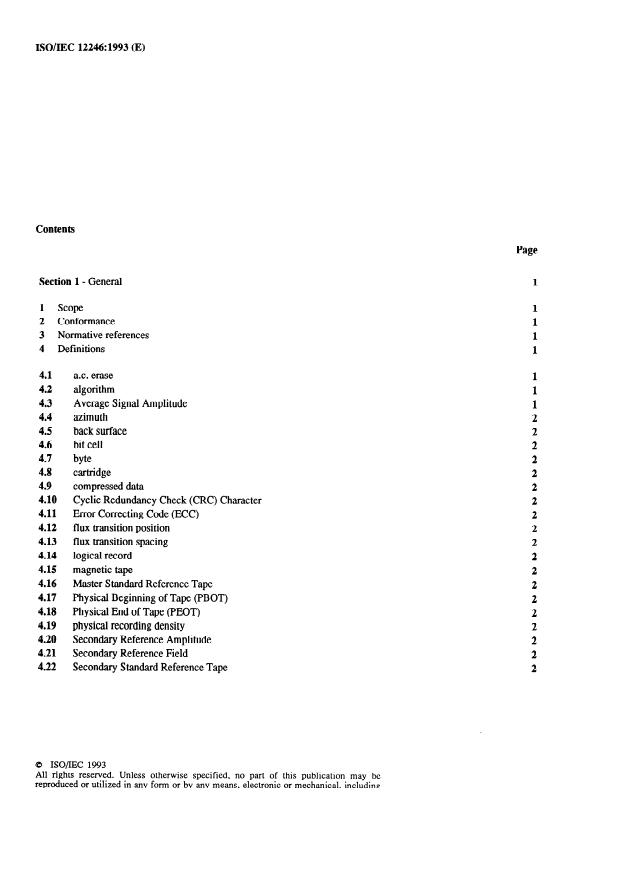
Contents
Page
Section 1 - General
1 scope
2 Conformance
3 Normative references
4 Definitions
41 . a.c. erase
42 0 algorithm
Average Signal Amplitude
43 .
. azimuth
45 . back surface
46 l bit cell
47 . byte
48 . cartridge
49 compressed data
4’10 Cyclic Redundancy Check (CRC) Character
4’11
Error Correcting Code (ECC)
4’12 flux transition Position
4’13 flux transition spacing
4’14 logical record
4’15 magnetic tape
4’16 Master Standard Reference Tape
4’17 Physical Beginning of Tape (PBOT)
4’18 Physical End of Tape (PEOT)
4’19 physical recording density
4’20 Secondary Reference Amplitude
4’21
Secondary Reference Field
4’22
. Secondary Standard Reference Tape
0 ISO/IEC 1993
All rights reserved. Unless otherwise specified, no part of this publication may be
reproduced or utilized in any form or by any means, electronie or mechanical, including
ISO/IEC 12246: 1993 (E)
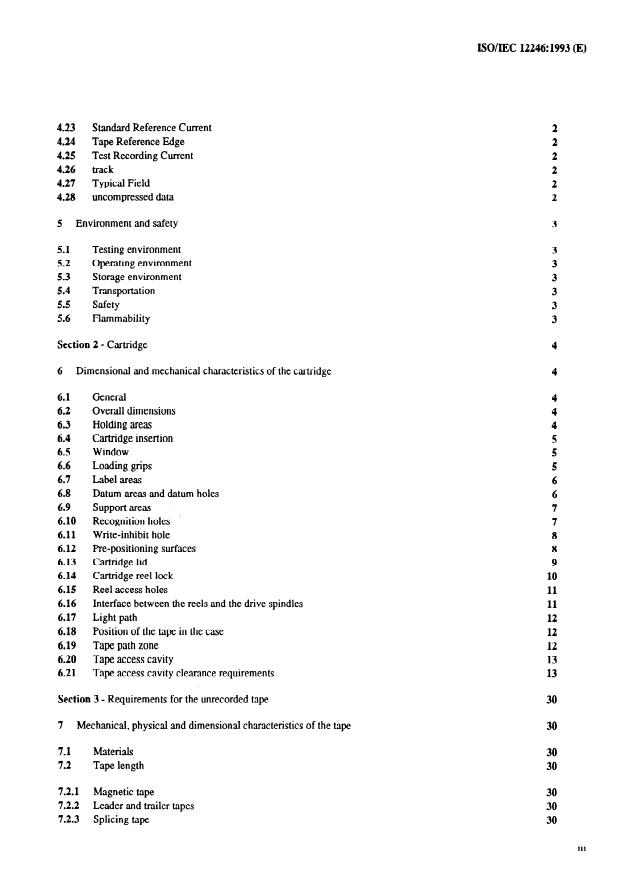
4.23 Standard Reference Current
Tape Reference Edge
4.24
Test Recording Current
4.25
4.26 track
4.27 Typical Field
uncompressed data
4.28
5 Environment and safety
51 . Testing environment
52 . Operating environment
53 . Storage environment
Transportation
54 .
Safety
55 .
56 . Flammability
Section 2 - Cartridge
6 Dimensional and mechanical characteristics of the cartridge
General
61 .
Overall dimensions
62 .
63 . Holding areas
64 . Cartridge insertion
65 . Window
Loading grips
66 *
67 . Label areas
68 . Datum areas and datum holes
69 Support areas
6’10 Recognition holes .
Write-inhibit hole
6’11
6’12 Pre-positioning sufaces
6’13 Cartridge lid
6’14 Cartridge reel leck
Ree1 access holes
6’15
6’16 Interface between the reels and the drive spindles
6’17 Light path
6’18 Position of the tape in the case
6’19 Tape path zone
6’20 Tape access cavity
6’21 . Tape access cavity clearance requirements
Section 3 - Requirements for the unrecorded tape
7 Mechanical, physical and dimensional characteristics of the tape
71 . Materials
72 . Tape length
7.2.1 Magnetit tape
Leader and trailer tapes
7.2.2
7.2.3 Splicing tape
. . .
ISOIIEC 12246: 1993 (E)
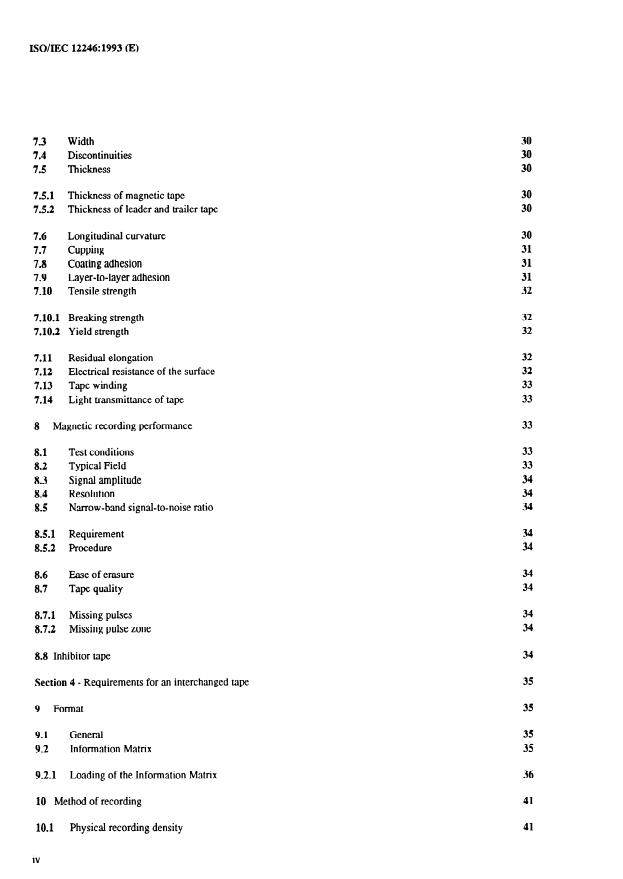
73 Width
.
74 . Discontinuities
Thickness
75 .
Thickness of magnetic tape
7.5.1
7.5.2 Thickness of leader and trailer tape
76 . LongitudinaI curvature
77 . Cupping
Coating adhesion
78 l
79 Layer-to-layer adhesion
7110 Tensile strength
7.10.1 Breaking strength
7.10.2 Yield strength
Residual elongation
7.11
7.12 Electrical resistance of the surface
7.13 Tape winding
7.14 Light transmittance of tape
8 Magnetit recording performante
Test conditions
81 .
Typical Field
82 .
83 . Signal amplitude
Resolution
84 .
Narrow-band signal-to-noise ratio
85 .
8.51 Requirement
8.5.2 Procedure
Ease of erasure
86 .
87 . Tape quality
8.7.1 Missing pulses
8.7.2 Missing pulse zone
8.8 Inhibitor tape
Section 4 - Requirements for an interchanged tape
9 Format
GeneraI
91 .
Information Matrix
92 .
9.2.1 Loading of the Information Matrix
10 Method of recording
10.1 Physical recording density
ISO/IEC 12246: 1993 (E)
Long-term average bit cell length
10.1.1
10.1.2 Short-term average bit cell length
10.1.3 Rate of Change
10.2 Bit shift
10.3 Read Signal amplitudes
Amplitude of data Signals
10.3.1
Amplitude of servo Signals
10.3.2
10.4 Erasure
11 Track geometry
11.1 Track positions
11.2 Track pitch
11.2.1 Adjacent track pitch
11.2.2 Average track pitch
11.3 Track width
11.4 Track angle
11.5 Straightness of track edge
Azimuth
11.6
12 Format of a track
12.1 Charme1 Bit
12.2 Information Segment
12.2.1 Bit Synchronization Field
12.2.2 Information Segment Number
12.2.3 Information Segment field
Information Block
12.3
Physical track types
12.4
12.4.1 Tl and T2 track layouts
12.5 Search Field Zones
Search Field Data Zones
12.5.1
12.5.2 Search Field Zone Sequence of recording
12.6 Servo Zone
Servo Zone 1
12.6.1
Servo Zone 2
12.6.2
Zone 3
12.6.3 Sewo
12.7 Information Tracks
ISO/IEC 12246: 1993 (E)
12.7.1 Format Track
12.7.2 Data Track
12.7.3 Long Tape Mark Track
12.7.4 Gap Track
12.7.5 End of Data Track 49
13 Tape Mark
13.1 Long Tape Mark
13.2 Short Tape Mark
14 End of Data
15 ID Information 50
15.1 Physical Block ID 50
15.2 Logical Block ID
15.3 Logical Record ID
15.4 Block type 50
15.4.1 Data Block 51
15.4.2 Gap Block
15.4.3 Format Block
15.4.4 Long/Short Tape Mark Block
15.4.5 End of Data Block
16 Rewritten Information Blocks 53
17 Physical Tape Format 54
17.1 Initial Erased Area 54
17.2 Logical Beginning of Tape Area (LBOT Area) 54
17.3 Usable area of the tape
Annexes
A - Measurement of light transmittance of tape and leaders 55
B - Measurement of bit shift 58
C - Representation of 8-bit bytes by 10.bit Patterns
D - Recommendations for transportation 64
E - Inhibitor tape 65
Vi
I!SO/IEC 12246: 1993 (E)
Foreword
ISO (the International Organization for Standardization) and IEC (the Inter-
national Electrotechnical Commission) form the specialized System for worldwide
standardization. National bodies that are members of ISO or IEC participate in
the development of International Standards through technical committees estab-
lished by the respective organization to deal with particular fields of technical
activity. ISO and IEC technical committees collaborate in fields of mutual inter-
est. Other international organizations, governmental and non-governmental, in
liaison with ISO and IEC, also take part in the work.
In the field of information technology, ISO and IEC have established a joint
technical committee, ISO/IEC JTC 1. Draft International Standards adopted by
the joint technical committee are circulated to national bodies for voting. Publi-
cation as an International Standard requires approval by at least 75 % of the na-
tional bodies casting a vote.
International Standard ISO/IEC 12246 was prepared by the European Computer
Manufacturers Association (ECMA) (as Standard ECMA-169) and was adopted,
by Joint Technical Committee ISO/IEC
under a special “fast-track procedure”,
JTC 1, Information technology, in parallel with its approval by national bodies
of ISO and IEC.
Annexes A, B and C form an integral part of this International Standard. Annexes
D, E and F are for information only .
Vii
ISODEC 12246:1993 (E)
Introduction
ISO/IEC have produced a series of International Standards for cassettes and cartridges containing magnetic tapes of different
width and characteristics.
The fllst International Standards (e.g. ISO 3407, ISO 4057, ISO 8063, ISO 8462, ISO/IEC 9661, ISO/IEC 11559) dealt with
media designed for the digital recording of data for storage and processing in data processing Systems. Later, other magnetic
media, originally developed for audio and Video applications, have been considered for use in data processing applications for
stomge as well as for information interchange. The recording method known as helical scan recording, together with new
types of magnetic tapes, allows to achieve capacities of more than 1 gigabyte of user data. International Standards ISO/IEC
10777, ISO/IEC 11319, ISO/IEC 11321, ISO/IEC 11557, ISO/IEC 12247 and ISO/IEC 12248 deal with such magnetic tape
cartridges.
This International Standard is based on ISO/IEC 11319 with extensions and modifications which specify the additional
features of the Dual Azimuth format. The specifications of the tape, cartridge, recorded Signal, recording method and much
of the recorded format are identical with those in ISO/IEC 113 19.
It is not intended that this International Standard replace ISO/lEC 11319. Existing drives and cartridges which conform to
ISO/IEC 11319 will continue to do so and will not conform to this International Standard. Future drives and tapes which
conform to ISO/IEC 11319 may, in addition, conform to this International Standard, but only if they support those features
herein which are not in ISO/IEC 113 19.
. . .
VW
INTERNATIONAL STANDARD ISO/IEC 12246:1993 (E)
Information technology - 8 mm wide magnetic tape cartridge dual azimuth formst for
information interchange - Helical scan recording
Section 1 - General
1 Scope
This International Standard specifies the physical and magnetic characteristics of an 8 mm wide magnetic tape cartridge to
enable interchangeability of such cartridges. It also specifies the quality of the recorded Signals, the formst and the recording
method, thus allowing, together with ISO 1001 for Magnetit Tape Labelling, full data interchange by means of such
magnetic tape cartridges. It is based on ISO/IEC 11319, but uses Dual Azimuth Recording to allow the raw capacity to be
doubled. The format supports variable length Logical Records, high speed search, and the use of a registered data
compression algorithm.
2 Conformance
A magnetic tape cartridge conforms b this International Standard if it satisfies all mandatory requirements specified herein.
The tape requirements shall be satisfied throughout the extent of the tape.
3 Normative references
The following Standards coniiun provisions which, through reference in this text, constitute provisions of this International
Standard. At the time of publication, the editions indicated were valid. All Standards are subject to revision, and Parties to
agreements based on this International Standard are encouraged to investigate the possibility of applying the most recent
editions of the Standards listed below. Members of IEC and ISO maintain registers of currently vaIid International Standards.
ISO/R 527: 1966, Plastics - Determination of tensiie properties.
ISO 1001: 1986, Information processing - File structure and labelling of magnetic tapes for information interchange.
ISO 1302: 1992, Technical drawings - Method of indicating surface texture.
ISO/IEC 11319: 1993, Information technology - 8 mm wide magnetic tape cartridge for information interchange - Helical
scan recording.
ISO/IEC 11576: 1993, Information technology - Procedure for the registration of algorithms for the lossless compression of
data.
IEC 950: 199 1, Safety of information technology equipment, including electrical business equipment.
4 Definitions
For the purposes of this International Standard, the following definitions apply.
4.1 a.c. erase: A process of erasure utilizing altemating magnetic Felds of decaying level.
4.2 algorithm: A set of rules for transforming the logical representation of data.
43 Average Signal Amplitude: The average peak-to-peak value of the Signal output of the read head measured over a
minimum of 1,40 mm of track, exclusive of missing pulses.
ISO/IEC 12246: 1993 (E)
4.4 azimuth: The angu1a.r deviation, in degrees of arc, of the recorded flux transitions on a track from the line normal to the
track centreline.
4.5 back surface: The surface of the tape opposite to the magnetic coating used to record data.
4.6 bit cell: A distance along the track allocated for the recording of a Channel Bit.
4.7 byte: An ordered set of bits acted upon as a unit.
4.8 cartridge: A case containing magnetic tape stored on twin reels.
4.9 compressed data: The representation of host-transmitted data after transformation by a data compression algorithm.
4.10 Cyclic Redundancy Check (CRC) Character: A Character used for error detection.
4.11 Error Correcting Code (ECC): A mathematical procedure yielding bytes used for the detection and correction of
errors.
4.12 flux transition positioo: That point which exhibits the maximum free-space flux density normal to the tape surface.
4.13 flux transition spacing: The distance along a track between successive flux transitions.
4.14 logical record: Related data, from the host, treated as a unit of information.
4.15 magnetic tape: A tape that accepts and retains magnetic Signals intended for input, output, and storage of data for
information processing.
4.16 Master Standard Reference Tape: A tape selected as the Standard for amplitude, Typical Field and Resolution.
NOTE - The Master Standard Reference Tape has txxn established by the SONY Corporation.
4.17 Physical Beginning of Tape (PBOT): The transition from the tape leader to the opaque area of the splice by which the
translucent leader tape is joined to the magnetic tape.
4.18 Physical End of Tape (PEOT): The transition from the opaque area of the splice to the translucent trailer tape.
4.19 physical recording density: The number of recorded flux transitions per unit length of track, expressed in flux
transitions per millimetre (ftpmm).
4.20 Secondary Reference Amplitude: The Average Signal Amplitude from the Secondary Standard Reference Tape when
it is recorded with the Test Recording Current at 2 236 ftpmm.
4.21 Secondary Reference Field: The Typical Field of the Secondary Standard Reference Tape.
4.22 Secondary Standard Reference Tape: A tape the Performance of which is known and stated in relation to that of the
Master Standard Reference Tape.
NOTE - Secondary Standani Refemce Tapes tan tx ordeml under the Part Number RSE-5001, until the year 2001, from the Sony Corporation, Magnetit Pmduct
Group, Data Media Sales Division, 6-7-35 Kitashinagawa, Shinagawa-ku, TOKYO 141, Japan. It is intended that these be used for calibrating Tertiw Refemce
Tapes for use in routine calibration.
4.23 Standard Reference Current: The current that produces the Secondary Reference Field.
4.24 Tape Reference Edge: The lower edge of the tape when the magnetic coati ng is facing the observer and the
SUPPlY
right.
reel i s to the observer’s
4.25 Test Recording Current: The current that is 1,5 times the Standard Reference Current.
4.26 track: A diagonally positioned area on the tape along which a series of magnetic transitions may be recorded.
4.27 Typical Field: In the plot of the Average Signal Amplitude against the recording field at the physical recording
density of 2 236 ftpmm, the minimum field that Causes an Average Signal Amplitude equal to 90 % of the maximum
Average Signal Amplitude.
4.28 uncompressed data: Data from the host which is not transformed by a data compression algorithm.
ISO/IEC 12246: 1993 (E)
5 Environment and safety
The conditions specifkd below refer to ambient conditions immediately surrounding the cartridge. Cartridges exposed to
environments outside these limits may still be able to function usefully; however, such exposure may cause permanent
darnage.
51 . Testing environment
Unless otherwise specified, tests and measurements made on the cartridge to check the requirements of this International
Standard shall be carried out under the following conditions
23”Ck2”C
temperature:
relative humidity: 40%to60%
24 h
conditioning period before testing:
52 . Bperating environment
Cartridges used for data interchange shall be capable of operating under the following conditions
5 OC to 45 OC
temperature:
relative humidity: 20 % to 80 %
26 OC max.
wet bulb temperature:
There shall be no deposit of moisture on or in the cartridge.
Conditioning before operating:
If a cartridge has been exposed during storage and/or transportation to a condition outside the above values, the cartridge
shall bc conditioned before use in the opemting environment for a time at least equal to the period during which it has been
out of the operating environment, up to a maximum of 24 h.
NOTE - Rapid variations of temperature should be avoided.
53 . Storage environment
For long-term or archival storage of cartridges the following conditions shall be observed
temperature: 5 OC to 32 OC
20 % to 60 %
relative humidity:
26 OC max.
wet bulb temperature:
The stray magnetic field at any point on the tape shall not exceed 4 000 A/m. There shall be no deposit of moisture on or in
the cartridge.
54 . Transportation
Recommended limits for the environment to which a cartridge may be subjected during transportation, and the precautions to
be tien to minimize the possibility of damage, arc provided in annex D.
SS . Safety
The cartridge and its components shall satisfy the requirements of EC 950.
56 . FIammability
The tape and the case components shall be made from materials which, if ignited from a match flame, do not continue to
bum in a still carbon dioxide atmosphere.
ISO/IEC 12246: 1993 (E)
Section 2 - Cartridge
6 Dimensional and mechanical characteristics of the cartridge
61 . General
The case of the cartridge shall consist of
- an upper half,
-
a lower half,
- a lid pivotally mounted on the upper haIf.
In the drawings, an embodiment of the cartridge is shown as an example.
Figure 1 is a perspcctive view of the cartridge secn from the top.
is a perspective view of the cartridge seen from the bottom.
Figure 2
Figure 3 Shows the top side with the lid closed using third angle projection.
Figure 4 Shows the bottom side, datum and support areas.
Figure 5 Shows the bottom side with the lid removed.
Shows the enlarged view of the datum and recognition holes.
Figure 6
Figure 7 Shows the Cross-sections through the light path holes, the recognition holes and the write-inhibit hole.
Figure 8 Shows details of the lid when closed, rotating and open.
Figure 9 Shows the details of the lid release insertion channel.
Figure 0 Shows the lid leck release requirements.
Figure 1 Shows the reel leck release requirements.
Figure Shows the reel unleck forte direction.
Figure 3 Shows the lid release forte direction.
Figure 4 Shows the lid opening forte direction.
Figure 5 Shows the light path and light window.
Figure 16 Shows the internal tape path and light path.
Figure 17 Shows the cartridge reel and a cross-section view of the cartridge reel.
Figure 18 Shows the cross-section view of the cartridge reel interface with the drive spindle.
Figure 19 Shows the tape access cavity clearance requirements.
The dimensions arc referred to three orthogonal Reference Planes X, Y and Z.
62 . Overall dimensions
See figure 3.
The Overall dimensions of the case with the lid in the closed position shall be
I, = 62,5 mm & 0,3 mm
I, = 95,0 mm * 0,2 mm
I, = 15,0 mm * 0,2 mm
The distance from the near side to plane X shall be
1, = 47,35 mm * 0,15 mm
The distance from the right side to plane Y shaIl be
l, = 13,0 mm * 0,l mm
63 . Holding areas
The holding areas shown hatched in figure 3 shall be the areas along which the cartridge shall be held down when inserted
the drive. Their position and dimensions shall be
ISO/IEC 12246: 1993 (E)
1, = 12,O mm max.
17 = 3,0 mm min.
64 . Cartridge insertion
The cartridge shall have asymmetrical features to prevent insertion in the drive in other than the correct orientation. These
consist of a channel, a recess and an incline.
The channel (figures 3 and 9) shall provide for an unobstructed path, when the lid is closed and lo&ed, to unlo& the lid and
the dimensions shall be
1, = 79,7 mm * 0,2 mm
1, = 1,0 mm * 0,l mm
1 1. = 0,7 mm * 0,l mm
I,, = 1,Omm min.
l,, = 12 mm * 0,l mm
1 13 = 0,8 mm k 0,l mm
1 14=12mmf0,1mm
l,, = 03 mm * 0,l mm
1 16=1~mmf0,1mm
l,, = 1,O mm k 0,l mm
.
18 = 3,8 mm =t 0,l mm
1 19=02mm*0,2mm
l,, = 2,3 mm min.
l,, = 25 mm * 0,2 mm
The recess dimensions (figures 3 and 5) shall be
I,, = 7,5 mm max.
l,, = 11,O mm * 0,2 mm
I,, = 1,5 mm i 0,l mm
l,, = 15 mm * 0,l mm
The incline (figure 8) is part of the lid structure and the dimensions shall be
l,, = 7,7 mm+ Oqo m
- 2,5
I,, = 0,55 mmo905-
- 0.10
= 17,5O * 4,0°
65 . Window
See figure 1.
A window may be provided on the top side so that a part of the reels is visible. The window, if provided, shall not extend
beyond the height of the cartridge.
66 . Loading grips
See figure 3.
ISOIIEC 12246: 1993 (E)
The cartridge shall have loading grips for automatic loading into a drive.
The dimensions and positions of the loading grips shall be
l,, = 39,35 mm i 0,20 mm
1, = 13 mm * 0,l mm
l,, = 5,O mm * 0,3 mm
l,, = 2,0 mm * 0,2 mm
A, = 90° f: 5’
67 Labe1 areas
.
See figure 3.
A Portion of the rear side of the cartridge and a Portion of the top side sf the cartridge may be used for labels. The rear side
area provides for readability of the label when it is stacked or inserted in the drive. The position and the size of the labels
shall not interfere with the Operation or clearance requirements of the cartridge component parts.
The area used for labels on the top side shall not extend beyond the inner edge of the holding areas defined by 1, and 1,.
The position and dimensions of the back side label area shall be
132 = 0,5 mm min.
l,, = 1,5 mm min.
l,, = 80,O mm max.
The depth of the label depression shall be 0,3 mm max.
68 . Datum areas and datum holes
See figures 4,5 and 6.
The annular datum areas A, B and C shall lie in plane Z. They determine the vertical position of the cartridge in the drive.
Esch shall have a diameter d, equal to 6,0 mm & 0,l mm and be concentric with the respective daturn hole.
The centres of datum holes A and B lie in plane X.
The centre of the circular datum hole A shall be at the intersection of planes X and Y (sec figure 5).
The distance from the centre of datum hole B to plane Y (see figure 4) shall be
l,, = 68,0 mm * 0,l mm
The distance from the centre of the circular datum hole C to plane Y (see figure 6) shall be
l,, = 10,20 mm * 0,05 mm
The distance from the centre of datum hole D to plane Y (see figure 6) shall be
I,, = 79,2 mm f: 0,l mm
The distance from the centres of datum holes C and D to plane X (see figure 5) shall be
l,, = 36,35 mm f: 0,08 mm
+ 0.05
The diameter of datum hole A and datum hole C shall be 3,00 mm- o o.
IIIIII. The dimensions of datum hole A and datum
hole C shall be
l,, = 1,2 mm+ lqo -
- 0.0
l,, = 2,6 mm min.
l,, = 1,5 mm min.
l,, = 4,0 mm min.
l,, = 0,3 mm max.
A, = 45’ k 1”
The dimensions of datum hole B and datum hole D shall be
l,, = 1,2 mm+ lPo -
- 0.0
l,, = 2,6 mm min.
1 41 = 1,5 mm min.
142 = 4,0 mm min.
l,, = 0,3 mm max.
I,, = 3,00 mm o*05~
- 0,oo
l,, = 3,5 mm f: 0,l mm
I,, = 3,00 mm * 0,05 mm
A, = 45’ =t 1”
q = 1,7 mm min.
69 . Support areas
The cartridge support areas arc shown shaded in figure 4. Support areas A, B and C shall be coplanar with datum areas A, B
and C, respectively, within k 0,l mm. Support area D shall be coplanar with datum plane Z within i 0,15 mm.
The areas within l,, of the edge of the cartridge shall be recessed from the support areas.
The dimensions and positions of the support areas shall be
I,, = 68,0 mm * 0,l mm
I,, = 10,O mm * 0,l mm
l,, = 11,O mm * 0,l mm
l,, = 0,5 mm * 0,l mm
l,, = 7,0 mm * 0,l mm
l,, = 30,O mm * 0,l mm
152 = 5,5 mm * 0,l mm
l,, = 64,5 mm * 0,2 mm
6.10 Recognition hob
See figures 5,6 and 7.
There shall be 5 recognition holes numbered 1 to 5 as shown in figure 6.
Their positions shall be defined by
154 = 43,35 mm * 0,15 mm
I,, = 3,7 mm * 0,l mm
ISO/IEC 12246: 1993 (E)
l,, = 2,3 mm f: 0,l mm
l,, = 6,4 mm i 0,l mm
l,, = 3,7 mm * 0,l mm
l,, = 2,3 mm i: 0,l mm
l,, = 6,4 mm f: 0,l mm
l,, = 79,0 mm * 0,2 mm
All recognition holes shall have the Cross-section F-F shown in figure 7 and shall have a diameter of 3,O mm k 0,l mm.
l,, = 1,2 mm+ OT3 IIPII
- 0,l
l,, = 5,0 mm min.
One of the cross-sections Shows a recognition hole closed by a plug, the other Shows the plug punched out. These plugs shall
withstand an applied forte of 0,5 N max. without being punched out.
This International Standard prescribes the following states of these holes.
- Recognition hole 1 shaI1 be closed.
Recognition hole 2 shall be closed for tape of 13 um nominal thickness.
- Recognition hole 2 shall be open for tape of 10 um nominal thickness.
- Recognition holes 3,4 and 5 shall be closed.
6.11 Write-inhibit hole
See figures 6 and 7.
The position and dimension of the write-inhibit hole shall be defined by
I,, = 3,7 mm f: 0,l mm
l,, = 1,2 mm+ o*3 m
- 0,l
l,, = 5,0 mm min.
1 64 = 10,o mm f: 0-1 mm
The diameter of the hole shall be 3,0 mm i: 0,l mm.
When the write-inhibit hole is open, recording on the tape is inhibited. When it is closed, recording is enabled.
The case may have a movable element allowing the write-inhibit hole to be opened or closed. If present, this element shall be
such that the state of the write-inhibit hole shall be visible (see figure 3 as an example). The write-inhibit hole closure shall
be constructed to withstand a forte of 0,5 N. The forte required t.o open or close the write-inhibit hole shall be between 1 N
and 15 N.
6.12 Pre-positioning surfaces
See figures 3 and 5.
These surfaces determine the Position of the cartridge in the Y direction when inserted into the drive loading slot.
The dimensions of the pre-positioning surfaces shall be
125 = 1,5 mm * 0,l mm
I,, = 2,4 mm+ “’ -
- 0,l
ISO/IEC 12246: 1993 (E)
1 66=2,4mm+o*o-
- 0,l
167 = l,o mm k o,l mm
1 68 = 69,0 mm k 0,2 mm
16, = 14,65 mm k 0,lO mm
I,, = 13,15 mm i OJO mm
A, = 45’ i: 1’
6.13 Cartridge lid
See figures 3 and 8.
The cartridge shall include a lid for protection of the tape during handling, storage and transportation. The lid consists of ~WQ
parts, the main part and an auxiliary part.
The main part rotates around axis A (see figure 8) which is fixed relative to the case. The location of axis A shall be defmed
bY l,, and
l,, = 7$ mm * 0,l mm
The auxiliary part rotates around axis B which is fixed relative to the main part of the lid and moves with it. When the lid is
in the closed position, the location of axis B shall be defined by
172 = 7,0 mm * 0,l mm
l,, = IO,1 mm * 0,l mm
The rotation of the auxiliary part is controlled, by a cam at each end, to give the path indicated in figure 8.
When the lid is completely open, neither part shall extend above a plane located l,, above and parallel to plane Z.
l,, = 14,8 mm min.
I,, = 11,5 mm * 0,2 mm
17, = 1,2 mm k 0,1 mm
l,, = 22,3 mm max.
A, = 85O k 2’
When the lid is in a partially open position, neither part shall extend above a plane located l,, above and parallel to plane Z.
I,, = 22,5 mm max.
= 14,9 mm max.
‘2
The main part is shown in figures 3 and 8.
I,, = 7,5 mm * 0,l mm
l,, = 8,4 mm max.
l,, = 15,2 mm’ “‘IIIIII
-05
+ 0,o
l,, = 15,3 mm
- 0,3 -
I,, = 13,15 mm * OJO mm
= 14,7 mm+ O”IIICTI
‘3
- 0.3
ISOIIEC 12246: 1993 (E)
The design of the locking mechanism is not specified by this International Standard except that it shall be operated by a
release pin in the drive. In the lid closed and locked position, access to the lid leck release shall be unobstructed in the
hatched area (see figure 10) defined by
l,, = 2,0 mm * 0,l mm
l,, = 6,3 mm f: 0,2 mm
l,, = 12 mm * 0,l mm
A, = 45O i l0
= 15O * 1”
A7
The lid release mechanism shaI1 be actuated when the drive release pin is in the shaded area (see figure 10) defined by
l,, = 2,0 mm * 0,l mm
1,6 = 8,2 mm i 0,2 mm
l,, = 0,7 mm * 0,2 mm
= 15O i 1”
A8
The forte needed to unleck the lid leck shall not exceed 0,25 N in the direction shown in figure 13.
The forte needed to open the lid shall not exceed 1,0 N in the direction shown in figure 14.
Cartridge reel leck
6.14
See figure 11.
The reels shaI1 be locked when the cartridge is removed from the tape drive. The design of the locking mechanism is not
specified by this International Standard except that it shall be operated by a release pin in the drive.
The release mechanism shaIl be accessed through a hole in the case (see figure 5) defined by
l,, = 34,5 mm * 0,l mm
l,, = 35,85 mm & 0,15 mm
l,, = 4,0 mm * 0,l mm
l,, = 6,5 mm min.
The reels shall be unlocked when the operating face of the release pin is located I,, from plane X. In this position there shaI1
be a clearance of 196 between the locking mechanism and the inside of the rear wall of the cartridge.
The dimensions of the release mechanism (see figure 11) shall be
l,, = 3,2 mm +OY3-
-02
l,, = 4,0 mm * 0,l mm
1 94 = 39,0 mm+ 2’o-
- 0,o
+
l,, =41,75 mm 0,50 -
- 0,oo
196 = 03 mm min.
1 97 = 7,8 mm max.
1 98 = 4,0 mm k o,l mm
A, = 60,OO zk l,O”
r4 = 0,3 mm max.
The forte needed to unleck the reel leck in the direction shown in figure 12 shall not exceed 1,O N.
6.15 Ree1 access holes
See figure 5.
The case shall have two circular reel access holes which shall allow penetrathn of t.he &ive Spindes.
The dimension and positions of the access holes shall be
l,, = 23,00 mm k 0,05 mm
1 1oo = 11,40 mm * 0,05 mm
I,,, = 46,2 mm Q OJ mm
= 18,80 mm * 0,05 mm
d2
6.16 Interface between the reels and the drive spindles
See figures 17 and 18.
The drive spindles shall engage the reels in the area defined by
l,,, = 5,4 mm * 0,l mm
lIo3 = 4,4 mm * 0,l mm
l,, = 0,6 mm max.
l,,, = 2,4 mm i 0,l mm
l,, = 0,2 mm max.
107 = 2,4 mm * 0,2 mm
A,, = 45O i: 1”
A 11= 15O * l0
A,,=60”* 1’
r5 = 0,2 mm max.
d3 = 6,50 mmf0?&
T
= 10,oO rn&OVo8-
d4
- 0,oo
= 16,0 mm max.
d5
= 18,0 rn$“‘-
d6
- 0.1
Depth 1 08 of reel driving hole shall be effective to the diameter d3.
l,,, = 9,4 mm min.
The ree 1 spring forte F shall be 0,6 N k 0,2 N in the direction shown in figure 18 when the cartridge is mounted in the drive
and the ! rupport area is 1, 1. from datum plane Z.
l,, = 7,05 mm * 0,lO mm
I,,, = 0,6 mm k 0,2 mm
1 11 1 = 7,5 mm max.
ISOIIEC 12246:1993 (E)
1112 = 8,0 mm max.
A,, =6O”i 1”
6.17 Light path
See figures $7, 15 and 16.
A light path shall be provided for sensing the leader and trailer tapes. When the lid is open, an unobstructed light path shall
exist from the d7 diameter light path hole to the outside of the cartridge via Square holes of side I, 16 (sec cross-section D-D in
figure 7) and the light window in the cartridge lid.
I,, = 345 mm * 0,l mm
l,,, = 8,35 mm i 0,lO mm
1 114 = 0,5 mm max.
1 115 = 6,05 mm i 0,lO mm
1 116=25mmf0,4mm
1 117 = 12,5 mm min.
1 118 = 3,8 mm * 0,l mm
l,,, = 2,5 mm i 0,4 mm
1 120 = 6,05 mm i 0,lO mm
A 14 = 45O fr 1”
.
A,, = 5,50° i 0,25’
= 6,5 mm+“*3-
d7
- 0,o
6.18 Position of the tape in the case
See figure 16.
The tape shall nm between two guide surfaces in a plane parallel to datum plane X and 1121 from it.
1121 = 12,46 mm i 0,lO mm
The guide surfaces shall have a radius of ‘6 and shall be tangential, as shown in figure 16, to lines tangential to the reel hubs
that extend to points outside the case. These points shall be defined by
1122 = 76,28 mm i 0,30 mm
1123 = 27,15 mm i 0,20 mm
1 124
= 31,15 mm * 0,20 mm
1 125 = 9,67 mm i 0,lO mm
= 1,5 mm min.
‘6
6.19
Tape path zone
See figures 16 and 17.
When the cartridge is inserted into the drive, the tape is pulled outside the case by tape guides and is no longer in contact
with the guide surfaces. The tape path zone of the case is the zone in which the tape shall be able to move 6eely. This zone
shall be maintained for both sides of the case and shall be defined by
I,,, = 76,28 mm i 0,30 mm
lSO/IEC 12246:1993 (E)
l,,, = 27,15 mm k 0,20 mm
l,,, = 31,15 mm * 0,20 mm
1 125 = 9,67 mm k 0,lO mm
1 126 = 23,0 mm i 0,l mm
1 127 = 0,3 mm min.
1 128 = 46,2 mm k 0,2 mm
1129 = 11,4 mm * 0,l
mm
1 130 = 0,3 mm min.
+ 0,oo
= 16,05 mm
dt3
- 0,lO -
6.20 Tape access cavity
See figure 5.
When the cartridge is inserted into the drive, tape guides in the drive pull out the tape into the drive tape path. The shape and
dimensions of the access cavity for these tape guides shall be defined as follows. The two radii r7 are centred on datum holes
AandB.
= 2,3 mm k 0,l mm
‘7
The two radii r8 are centred on the centres of the reel access holes.
= 24,15 mm k 0,lO mm
‘8
= 1,0 mm * 0,l mm
‘67
16, = 69,0 mm * 0,2 mm
1131 = 3,81 mm i 0,lO mm
6.21 Tape access cavity clearance requirements
See figure 19.
The case design shall provide clearance for drive tape threading mechanisms and shall be
1 132 = 1,2 mm max.
+ 0,20
I,,, = 1,15 mm
- 0,00-
134 = 14,0 mm+ O*O nim
- 0.2
I,,, = 66,8 mm min.
1 136 = lo,o mm min.
A 16 =49O mm
lSO/IEC 12246: 1993 (E)
Takeup Ree1
r
Half
Beginnin
SP
Tape Reference Edge
Recording Surfoce of 1
the Mognetic Tape
Figure 1 - Tape cartridge assembly top view (iid open)
Figure 2 - Tape cartridge assembly bottom view (lid closed)
ISO/IEC 12246: 1993 (E)
Incorrect Insertion
Channel
Incorrect Insertion
Protection Recess
Incorrect
Insertion
-z-
Protection
I
Incline
B
I
r- I \i
P
I I
I i
I
---- c
f
B
I
I
-F
I
I
1 f
I
Loodina
-iV
I
rJ&- Write-‘nhibit
Indicotor
t --‘,,
34 -
c-
-it-
@-+=
SECTION A-A
SECTION B-B
Figure 3 - Top side (lid closed)
ISO/IEC 12246: 1993 (E)
-Y-
P
'47 '48 ,
, ‘48 I,, ,
I r Datum - ---.- Hole . .-.- A -. I
turn Ar
DO
ri *. . i. <. J
Areo B
1 t I
Areo B
‘49
Hole D
Datum Hole C
Datum Area C
Support Area D
Support Area C-/
for Measurement
Figure 4 - Bottom side, datum and support areas
ISO/IEC 12246: 1993 (E)
I-y-l
L 1
I
‘89
Figure 5 - Bottom side (lid removed)
ISO/IEC 12246: 1993 (E)
Recognition
Hole 5
Datum
Re
I
Hole C
t
I
+
I
C I
3d
Write-lnhibit
Hole
it ion
I
-1
;mp4;” -+ $-
-7
VIEW R
VIEW S
Chomfer
SECTION C-C
VIEW Q
Figure 6 - Details of datum and recognition holes
ISO/IEC 12246: 1993 (E)
hl4 x h4 Chamfer
/
SECTION D-D
1 I
T
- -
I Z
hl
Removable Plug
Movable Element
SECTION F-F
Figure 7 - Cross-sections of light path holes, recognition holes and write-inhibit hole
ISOIIEC 12246: 1993 (E)
-9
-X-
-‘27
Axis
Axis A
I
I 9
-z-
I-z-]
I
I
I
/
1 l-173q-127
-i
Details of the Side of the Lid
In ternal Lid Structure
Lid Configuration Wen Rotating
Lid Configuration When the Lid is Open
Figure 8 - Lid
ISO/IEC 12246: 1993 (E)
m -
X
P
Insertion Area for the Releose
Pin of the Lid Lack
SECTION G-G
Figure 9 - Lid release insertion channel
ISO/IEC 12246: 1993 (E)
- 87
.........
. .
r .
.........
.........
. . .
........ .
. . .
........ .
..........
....... . .
... ......
....... . .
.........
.........
..........
.........
..........
..... ....
..........
........
..........
........
..........
........
.........
........
..........
........
Ti .
A
8 c
Figure 10 - Lid release requirement
ISO/IEC 12246: 1993 (E)
-4
t-
l2
-L
L- 95
&- ‘94
From Datum Plane X
From Datum Plane X
Ree1 Lack In Released Position
Ree1 Lack in Locked Position
Figure 11 - Ree1 Iock release
ISO/IEC 12246: 1993 (E)
Figure 12 - Direction of forte needed to unleck the reel leck
Figure 13 - Direction of forte needed to unleck the lid leck
Figure 14 - Direction of forte needed to open the lid
ISOIIEC 12246:1993 (E)
ha 4
Lid Opener
+
“r
J
r
I
I
Ligh t Window
Figure 15 - Light path and light window
ISO/IEC 12246: 1993 (E)
t--
I
----- 124
1 I
kp'128 -
b4zg
T
View S
Figure 16 - Internal tape path and light path
1106~ AlO
Chamfer
Section H-H
Section I-l
Figure 17 - Cartridge reel
ISO/IEC 12246: 1993 (E)
P------M
-v-----w-
T
t
Figure 18 - Interface with drive spindie
ISO/IEC 12246: 1993 (E)
- -
Z
P
1132 -
Socket
/f
Bottom View with the Lid Closed
Section J-J
. . .
. .,.,. .<<. .
. . . . . . . . . . . . . . . ., . . . .<. <. . . . . . .<.
. .
. . . . . . .,.< ., . . .
.,. . . . . . . . . . . ,, . .<. . .<. . . e.,.
. <.
<.
rc
I-Z-1
I f
Front View with the Lid Open
Figure 19 - Tape access cavity clearance
ISO/IEC 12246: 1993 (E)
Section 3 - Requirements for the unrecorded tape
7 Mechanical, physical and dimensional characteristics of the tape
*,.‘
71 . Materials
‘
The recordable area of the tape shall consist of a base material (oriented polyethylene terephthalate film or its equivalent)
coated on one side with a strong yet flexible layer of ferromagnetic material. The back surface of the tape may be coated.
The leader and trailer tapes shall consist of a translucent length of the same or equivalent base material without the
ferromagnetic coating or the back coating.
Tape Iength
72 .
7.2.1 Magnetit tape
The length of tape between PBOT and PEOT shall be 14,72 m min. and 113 m max.
7.2.2 Leader and trailer tapes
The length of the leader and trailer tapes shall be 70 mm min. and 90 mm max.
7.2.3 Splicing tape
The splicing tape shall have a maximum length of 13 mm.
73 . Widtb
The width of the magnetic tape shall be 8,OO mm * 0,Ol mm. The differente between the largest and smallest width shall be
no more than 6 pm peak-to-peak.
The width of the leader tape, trailer tape and splice shall be 8,OO mm * 0,02 mm.
The width shall be measured across the tape from edge to edge.
Procedure
Cover a section of the tape with a glass microscope slide. Measure the width with no tension applied to the tape using a
calibrated microscope, Profile projector, or equivalent having an accuracy of at least 2,5 Fm. Repeat the procedure to obtain
tape widths at five or more different positions along a minimum tape length of 1 m. The tape width is the average of the
widths measured.
74 . Discontiouities
There shall be no discontinuities in the tape between PBOT and PEOT, such as those produced by tape splicings or
perforations.
Thickness
75 .
7.5.1 Thickness of magnetic tape
This International Standard provides for two types of tape differing in thickness. The total thickness of a tape at any point
shall be between 12,0 um and 14,0 um, or between 9,2 um and 11,2 um.
7.52 Thickness of leader and trailer tape
The thickness of the leader and trailer tape shall be between 13 um and 17 um.
76 l Longitudinal curvature
The radius of curvature of the edge of the tape shall not be less than 33 m.
Procedure
Allow a 1 m length of tape to unroll and assume its natura1 curvature on a flat smooth surface. Measure the deviation from a
1 m chord.
The deviation shall not be greater than 3,8 mm.
Chis deviation corresponds to the minimum radius of curvature of 33 m if measured over an ä,rc of a circle.
77 .
CuPPbg
The departure across the width of tape from a flat surface shall not exceed 0,9 mm.
i Procedure
Cut a 1,0 m & 0,l m length of tape- Condition it for a minimum of 3 h in the test environment by hanging it so that the
coated surface is f&ely exposed to the test environment. From the centre portion of the conditioned tape tut a test piece of
length 25 mm approximately. Stand the test piece on its end in a cylinder which is at lmt 25 mm high with an minimum
inside diameter of 8 mm. With the cylinder standing on an Optical comparator measure the cupping by aligning the edges of
the test piece to the reticle and determining the distance from the aligned edges to the corresponding surface of the test piece
at its centre.
78 . Coating adhesion
See figure 20.
The forte required to peel any part of the coating from the tape base material shall not be less than 0,lO N.
Procedure
Take a test piece of the tape approximately 380 mm long and scribe a line through the coating across the width of the tape
125 mm Flom one end. Using a double-sided pressure sensitive tape, attach the test piece to a smooth metal plate, with the
coated surface facing the plate. Fold the test piece over 180° adjacent to, and parallel with the scribed line. Attach the metal
plate and the fiee end sf the test piece to the jaws of a tensometer such that when the jaws arc separated the tape is peeled. Set
the jaw separation rate to 254 mm/min. Note the forte at which any part of the coating fmt separates from the base material.
If this is less than OJO N, the test has failed. If the test piece peels away Biom the double-sided pressure sensitive tape before
the forte exceeds 0,lO N, an alternative type of double-sided pressure tape shall be used. If the back surface of the tape is
coated, repeat a) to d) for the back coating.
Pressure-sensitive tape
125 mm ->
I
ECMA-QMXWA
Figure 20 - Setup for measuring coating adhesion
79 . Layer-to-layer adhesion
There shall be no tendency for the test piece to stick or for the coating to peel.
ISOIIEC 12246: 1993 (E)
Procedure
Attach one end of a test piece of magnetic tape sf 1 m in length to the surface of a glass tube of extemal diameter 36 mm.
Wind the tape on to the tube at a tension of 1,l N. Store the wound test piece in a temperature of 45 OC =It 3 OC and a relative
humidity of 80 % for 4 h. Store for a further 24 h in the testing environment. Apply a forte of 0,l N to the Eree end of the test
piece and allow it to unwind slowly.
7.10 Tensile strength
The measurements shall be made in accordance with ISO/R 527.
The length of the test piece shall be 200 mm. The rate of elongation for all tensile tests shall be 100 mm/min (ISo/R 527,
rate D).
7.10.1 Breaking strength
Load the test piece until the breaking point of the test piece is reached. The forte required to resch that point is the breaking
strength of the tape. The breaking strength shall not be less than 17,6 N.
7.10.2 Yield strength
The yield strength is the forte necessary to produce a 5 % elongation of the tape.
The yield strength shall be greater than 4,9 N.
7.11 Residual elongation
The residual elongation, stated in per cent of the original tape length, shall be less than 0,03 %.
Procedure
Measure the initial length of a test piece of approximately 1 m with a maximum applied forte of 0,20 N. Apply an additional
forte per total Cross-sectional area of 20,5 N/mm2 for a period of 10 min. Remove the additional forte and measure the length
after 10 min.
7.12 Electrical resistan
...