

ISO/IEC 18809:2000
(Main)Information technology — 8 mm wide magnetic tape cartridge for information interchange — Helical scan recording AIT-1 with MIC format
General Information
- Abstract
This International Standard specifies the physical and magnetic characteristics of an 8 mm wide magnetic tape cartridge containing a memory chip to enable physical interchange of such cartridges between drives. It also specifies the quality of the recorded signals, the recording method and the recorded format - called Advanced Intelligent Tape No. 1 with Memory In Cartridge (AIT-1 with MIC) - thereby allowing data interchange between drives by means of such magnetic tape cartridges. The System Log is recorded in the MIC. This International Standard specifies two types of cartridge depending on the thickness of the magnetic tape contained in the case. Information interchange between systems also requires, at a minimum, agreement between the interchange parties upon the interchange code(s) and the specifications of the structure and labelling of the information on the interchanged cartridge.
- Status
- Published
- Publication Date
- 20-Dec-2000
- Current Stage
- 9093 - International Standard confirmed
- Start Date
- 21-Aug-2020
- Completion Date
- 29-Aug-2026


Overview
ISO/IEC 18809:2000 defines an interchange standard for 8 mm wide magnetic tape cartridges using helical scan recording AIT‑1 with Memory In Cartridge (MIC) format. The standard specifies the physical and magnetic characteristics of the cartridge and tape, the recorded signal quality and recording method, and the logical format (Advanced Intelligent Tape No.1 with MIC) that enables reliable data interchange between compatible drives. It also defines two cartridge types based on tape thickness and requires the System Log to be stored in the MIC.
Key topics and requirements
- Physical and mechanical characteristics of the cartridge case and tape: dimensional features, label areas, access cavities, reel interfaces and other case mechanics required for drive compatibility.
- Magnetic and signal characteristics: required quality of recorded signals, reference/test calibration and recording parameters to ensure readable interchange.
- Recording method and format: specification of the AIT‑1 helical scan recording mode and the MIC logical format (Advanced Intelligent Tape No.1).
- Memory In Cartridge (MIC): use and content of the embedded memory chip, including storage of the System Log and cartridge metadata.
- Cartridge types: two variants defined by magnetic tape thickness - both covered for interchange.
- Conformance roles: requirements for the physical cartridge, the generating drive (writer), and the receiving drive (reader) to achieve interoperable interchange.
- Environmental and safety considerations: test, operating, storage and transportation environments plus safety and flammability guidance.
- Interchange governance: interchange also requires agreement between parties on interchange codes and structure/labeling of data written to the cartridge.
Applications and practical value
- Ensures reliable media interchange across different manufacturers’ AIT‑1 tape drives for backup, archival and off‑site storage workflows.
- Useful for organizations managing long‑term archives, disaster recovery, media migration or multi‑vendor tape infrastructures.
- Supports quality control in tape production and drive manufacturing by providing standard physical and magnetic acceptance criteria.
- Facilitates forensic and preservation workflows where reading legacy AIT‑1 media across systems is required.
Who should use this standard
- Tape cartridge and magnetic media manufacturers
- Tape drive and recorder designers and test engineers
- Data center architects, backup/archival administrators and IT procurement teams
- Standards bodies, compliance engineers and system integrators involved in media interchange
Related standards (context)
- ISO/IEC standards on magnetic tape formats and information interchange (refer to normative references in ISO/IEC 18809 for exact cross‑references).
Keywords: ISO/IEC 18809, AIT‑1, Advanced Intelligent Tape, Memory In Cartridge, 8 mm tape cartridge, helical scan, magnetic tape standard, data interchange, tape drives.
Get Certified
Connect with accredited certification bodies for this standard

BSI Group
BSI (British Standards Institution) is the business standards company that helps organizations make excellence a habit.

NYCE
Mexican standards and certification body.
Sponsored listings
Frequently Asked Questions
ISO/IEC 18809:2000 is a standard published by the International Organization for Standardization (ISO). Its full title is "Information technology — 8 mm wide magnetic tape cartridge for information interchange — Helical scan recording AIT-1 with MIC format". This standard covers: This International Standard specifies the physical and magnetic characteristics of an 8 mm wide magnetic tape cartridge containing a memory chip to enable physical interchange of such cartridges between drives. It also specifies the quality of the recorded signals, the recording method and the recorded format - called Advanced Intelligent Tape No. 1 with Memory In Cartridge (AIT-1 with MIC) - thereby allowing data interchange between drives by means of such magnetic tape cartridges. The System Log is recorded in the MIC. This International Standard specifies two types of cartridge depending on the thickness of the magnetic tape contained in the case. Information interchange between systems also requires, at a minimum, agreement between the interchange parties upon the interchange code(s) and the specifications of the structure and labelling of the information on the interchanged cartridge.
This International Standard specifies the physical and magnetic characteristics of an 8 mm wide magnetic tape cartridge containing a memory chip to enable physical interchange of such cartridges between drives. It also specifies the quality of the recorded signals, the recording method and the recorded format - called Advanced Intelligent Tape No. 1 with Memory In Cartridge (AIT-1 with MIC) - thereby allowing data interchange between drives by means of such magnetic tape cartridges. The System Log is recorded in the MIC. This International Standard specifies two types of cartridge depending on the thickness of the magnetic tape contained in the case. Information interchange between systems also requires, at a minimum, agreement between the interchange parties upon the interchange code(s) and the specifications of the structure and labelling of the information on the interchanged cartridge.
ISO/IEC 18809:2000 is classified under the following ICS (International Classification for Standards) categories: 35.220.23 - Cassettes and cartridges for magnetic tapes. The ICS classification helps identify the subject area and facilitates finding related standards.
ISO/IEC 18809:2000 is available in PDF format for immediate download after purchase. The document can be added to your cart and obtained through the secure checkout process. Digital delivery ensures instant access to the complete standard document.
Standards Content (Sample)
INTERNATIONAL ISO/IEC
STANDARD 18809
First edition
2000-12-15
Information technology — 8 mm wide
magnetic tape cartridge for information
interchange — Helical scan recording AIT-1
with MIC format
Technologies de l'information — Cartouche à bande magnétique de 8mm
de large pour l'échange d'information — Enregistrement par balayage en
spirale AIT-1 avec format MIC
Reference number
©
ISO/IEC 2000
PDF disclaimer
This PDF file may contain embedded typefaces. In accordance with Adobe's licensing policy, this file may be printed or viewed but shall not
be edited unless the typefaces which are embedded are licensed to and installed on the computer performing the editing. In downloading this
file, parties accept therein the responsibility of not infringing Adobe's licensing policy. The ISO Central Secretariat accepts no liability in this
area.
Adobe is a trademark of Adobe Systems Incorporated.
Details of the software products used to create this PDF file can be found in the General Info relative to the file; the PDF-creation parameters
were optimized for printing. Every care has been taken to ensure that the file is suitable for use by ISO member bodies. In the unlikely event
that a problem relating to it is found, please inform the Central Secretariat at the address given below.
© ISO/IEC 2000
All rights reserved. Unless otherwise specified, no part of this publication may be reproduced or utilized in any form or by any means, electronic
or mechanical, including photocopying and microfilm, without permission in writing from either ISO at the address below or ISO's member body
in the country of the requester.
ISO copyright office
Case postale 56 � CH-1211 Geneva 20
Tel. + 41 22 749 01 11
Fax + 41 22 749 09 47
E-mail copyright@iso.ch
Web www.iso.ch
Printed in Switzerland
ii © ISO/IEC 2000 – All rights reserved
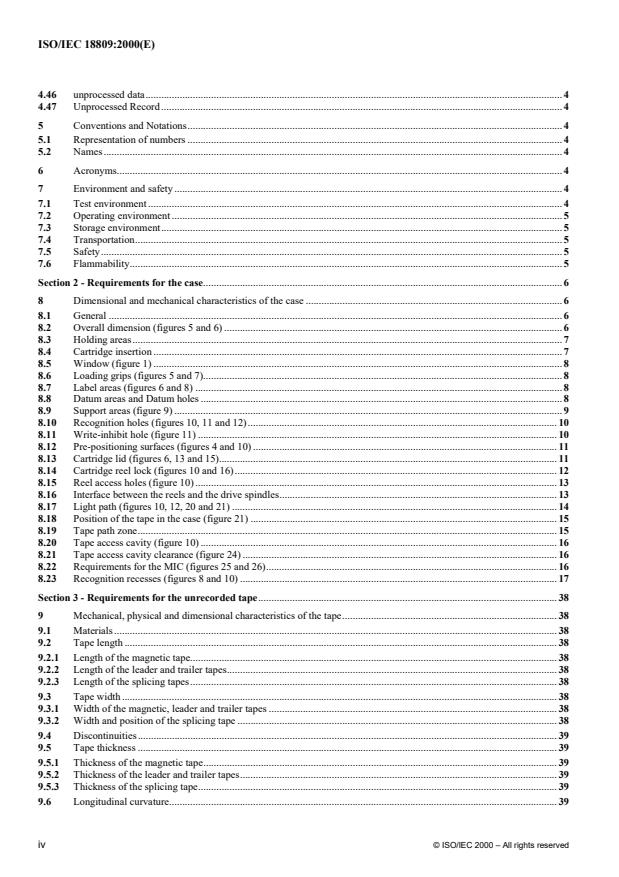
Contents
Section 1 - General.1
1 Scope.1
2 Conformance.1
2.1 Magnetic tape cartridge.1
2.2 Generating drive.1
2.3 Receiving drive .1
3 Normative references .2
4 Terms and definitions.2
4.1 Absolute Frame Number (AFN) .2
4.2 a.c. erase.2
4.3 Access .2
4.4 algorithm .2
4.5 Area ID.2
4.6 Automatic Track Finding (ATF).2
4.7 Average Signal Amplitude.2
4.8 azimuth.2
4.9 back surface.2
4.10 byte.2
4.11 cartridge .2
4.12 Channel bit .2
4.13 Codeword.2
4.14 Early Warning Point (EWP).2
4.15 End of Data (EOD).2
4.16 Entity.2
4.17 Error Correcting Code (ECC) .2
4.18 flux transition position .2
4.19 flux transition spacing.2
4.20 Frame .3
4.21 Housekeeping Frame.3
4.22 Logical Beginning of Tape (LBOT).3
4.23 magnetic tape .3
4.24 Master Standard Amplitude Calibration Tape.3
4.25 Master Standard Reference Tape .3
4.26 Memory In Cartridge (MIC) .3
4.27 Partition Boundary .3
4.28 Physical Beginning of Tape (PBOT) .3
4.29 Physical End of Tape (PEOT).3
4.30 physical recording density.3
4.31 pre-recording condition.3
4.32 processing.3
4.33 processed data .3
4.34 Processed Record .3
4.35 record .3
4.36 Reference Field .3
4.37 Secondary Standard Amplitude Calibration Tape.3
4.38 Secondary Standard Reference Tape.3
4.39 Separator Mark.3
4.40 Standard Reference Amplitude (SRA).3
4.41 Tape Reference Edge .4
4.42 Typical Field .4
4.43 Standard Reference Current .4
4.44 Test Recording Current .4
4.45 track.4
© ISO/IEC 2000 – All rights reserved iii
4.46 unprocessed data. 4
4.47 Unprocessed Record . 4
5 Conventions and Notations. 4
5.1 Representation of numbers . 4
5.2 Names . 4
6 Acronyms. 4
7 Environment and safety . 4
7.1 Test environment . 4
7.2 Operating environment . 5
7.3 Storage environment. 5
7.4 Transportation. 5
7.5 Safety. 5
7.6 Flammability. 5
Section 2 - Requirements for the case. 6
8 Dimensional and mechanical characteristics of the case . 6
8.1 General . 6
8.2 Overall dimension (figures 5 and 6) . 6
8.3 Holding areas. 7
8.4 Cartridge insertion . 7
8.5 Window (figure 1) . 8
8.6 Loading grips (figures 5 and 7). 8
8.7 Label areas (figures 6 and 8) . 8
8.8 Datum areas and Datum holes . 8
8.9 Support areas (figure 9) . 9
8.10 Recognition holes (figures 10, 11 and 12). 10
8.11 Write-inhibit hole (figure 11) . 10
8.12 Pre-positioning surfaces (figures 4 and 10) . 11
8.13 Cartridge lid (figures 6, 13 and 15). 11
8.14 Cartridge reel lock (figures 10 and 16). 12
8.15 Reel access holes (figure 10) . 13
8.16 Interface between the reels and the drive spindles. 13
8.17 Light path (figures 10, 12, 20 and 21) . 14
8.18 Position of the tape in the case (figure 21) . 15
8.19 Tape path zone. 15
8.20 Tape access cavity (figure 10) . 16
8.21 Tape access cavity clearance (figure 24) . 16
8.22 Requirements for the MIC (figures 25 and 26). 16
8.23 Recognition recesses (figures 8 and 10) . 17
Section 3 - Requirements for the unrecorded tape. 38
9 Mechanical, physical and dimensional characteristics of the tape. 38
9.1 Materials . 38
9.2 Tape length . 38
9.2.1 Length of the magnetic tape. 38
9.2.2 Length of the leader and trailer tapes. 38
9.2.3 Length of the splicing tapes. 38
9.3 Tape width . 38
9.3.1 Width of the magnetic, leader and trailer tapes . 38
9.3.2 Width and position of the splicing tape . 38
9.4 Discontinuities. 39
9.5 Tape thickness . 39
9.5.1 Thickness of the magnetic tape. 39
9.5.2 Thickness of the leader and trailer tapes. 39
9.5.3 Thickness of the splicing tape. 39
9.6 Longitudinal curvature. 39
iv © ISO/IEC 2000 – All rights reserved
9.7 Cupping.39
9.8 Coating adhesion.39
9.9 Layer-to-layer adhesion.40
9.10 Tensile strength.40
9.10.1 Breaking strength .40
9.10.2 Yield strength.40
9.11 Residual elongation.40
9.12 Electrical resistance of the recording surface.40
9.13 Tape winding.41
9.14 Light transmittance of the tape.41
10 Magnetic recording characteristics.41
10.1 Typical Field .42
10.2 Signal Amplitude .42
10.3 Resolution .42
10.4 Overwrite .42
10.5 Ease of erasure .42
10.6 Tape quality.42
10.6.1 Missing pulses.42
10.6.2 Missing pulse zone.43
10.7 Signal-to-Noise Ratio (SNR) characteristic .43
Section 4 - Requirements for an interchanged tape.43
11 Format .43
11.1 General.43
11.2 Basic Groups .43
11.2.1 Entity.44
11.2.2 Group Information Table .45
11.2.3 Block Access Table (BAT) .47
11.3 Sub-Groups .50
11.3.1 G1 Sub-Group .50
11.3.2 G2 Sub-Group - Randomizing .51
11.3.3 G3 Sub-Group .52
11.4 Data Block.53
11.4.1 ID information.54
11.4.2 Recording of the ID Information in the Data Block Headers.56
12 Method of recording.62
12.1 Physical recording density .62
12.2 Long-term average bit cell length .62
12.3 Short-term average bit cell length .62
12.4 Rate of change.62
12.5 Bit shift.63
12.6 Read signal amplitude.63
12.7 Maximum recorded levels.63
13 Track geometry .63
13.1 Track configuration.63
13.2 Average track pitch .63
13.3 Variations of the track pitch.64
13.4 Track width .64
13.5 Track angle.64
13.6 Track edge straightness .64
13.7 Track length .64
13.8 Azimuth angles.64
14 Recorded patterns.64
14.1 Recorded Data Block .64
© ISO/IEC 2000 – All rights reserved v
14.2 Margin blocks. 64
15 Format of a track. 64
15.1 Track structure. 64
15.2 Positioning accuracy. 65
15.3 Tracking scheme. 66
16 Layout of the tape . 66
16.1 Device Area . 67
16.2 Reference Area . 67
16.3 Position Tolerance Band No. 1. 68
16.4 System Area. 68
16.4.1 System Preamble . 68
16.4.2 System Log. 68
16.4.3 System Postamble. 72
16.4.4 Position Tolerance Band No. 2. 72
16.4.5 Vendor Group Preamble . 72
16.5 Data Area. 72
16.5.1 Vendor Group. 72
16.5.2 Recorded Data Group . 72
16.5.3 ECC3 . 72
16.5.4 Multiple Recorded Instances . 73
16.5.5 Repeated Frames. 73
16.5.6 Appending and overwriting . 74
16.6 EOD Area . 75
16.7 Optional Device Area . 75
16.8 Logical End Of Tape (LEOT). 76
16.9 Logical Beginning of Tape (LBOT) . 76
16.10 Early Warning Point - EWP. 76
16.11 Empty Partition. 76
16.12 Initialization. 76
17 Housekeeping Frames. 77
17.1 Amble Frames. 77
17.2 System Amble Frames. 77
18 Content of the MIC. 77
Annexes
A- Measurement of light transmittance. 79
B- Measurement of Signal-to-Noise Ratio. 82
C- Method for determining the nominal and the maximum allowable recorded levels . 83
D- Representation of 8-bit bytes by 10-bit patterns . 84
E- Measurement of bit shift . 96
F- Method of measuring the straightness of track edges. 98
G- ECC calculation . 99
H- Recommendations for transportation. 102
J- Read-After-Write . 103
K- Example of the content of a Basic Group No. 0 . 104
L- Examples of MIC chip . 105
vi © ISO/IEC 2000 – All rights reserved
Foreword
ISO (the International Organization for Standardization) and IEC (the International Electrotechnical Commission) form the
specialized system for worldwide standardization. National bodies that are members of ISO or IEC participate in the
development of International Standards through technical committees established by the respective organization to deal with
particular fields of technical activity. ISO and IEC technical committees collaborate in fields of mutual interest. Other
international organizations, governmental and non-governmental, in liaison with ISO and IEC, also take part in the work.
International Standards are drafted in accordance with the rules given in the ISO/IEC Directives, Part 3.
In the field of information technology, ISO and IEC have established a joint technical committee, ISO/IEC JTC 1. Draft
International Standards adopted by the joint technical committee are circulated to national bodies for voting. Publication as an
International Standard requires approval by at least 75 % of the national bodies casting a vote.
Attention is drawn to the possibility that some of the elements of this International Standard may be the subject of patent
rights. ISO and IEC shall not be held responsible for identifying any or all such patent rights.
This International Standard was prepared by ECMA (as ECMA-291) and was adopted, under a special “fast-track procedure”,
by Joint Technical Committee ISO/IEC JTC 1, Information technology, in parallel with its approval of national bodies of ISO
and IEC.
Annexes A to G form a normative part of this International Standard, annexes H to L are for information only.
© ISO/IEC 2000 – All rights reserved vii
.
Introduction
This International Standard constitutes a further development of the magnetic tape cartridge specified in International Standard
ISO/IEC 14833. A higher capacity is achieved by using a thinner, thus longer tape.
viii © ISO/IEC 2000 – All rights reserved
INTERNATIONAL STANDARD ISO/IEC 18809:2000(E)
Information technology — 8 mm wide magnetic tape cartridge for information
interchange — Helical scan recording AIT-1 with MIC format
Section 1 - General
1Scope
This International Standard specifies the physical and magnetic characteristics of an 8 mm wide magnetic tape cartridge
containing a memory chip to enable physical interchange of such cartridges between drives. It also specifies the quality of the
recorded signals, the recording method and the recorded format - called Advanced Intelligent Tape No. 1 with Memory In
Cartridge (AIT-1 with MIC) - thereby allowing data interchange between drives by means of such magnetic tape cartridges.
The System Log is recorded in the MIC.
This International Standard specifies two types of cartridge depending on the thickness of the magnetic tape contained in the
case.
Information interchange between systems also requires, at a minimum, agreement between the interchange parties upon the
interchange code(s) and the specifications of the structure and labelling of the information on the interchanged cartridge.
2 Conformance
2.1 Magnetic tape cartridge
A tape cartridge shall be in conformance with this International Standard if it meets all the mandatory requirements specified
herein. The tape requirements shall be satisfied throughout the extent of the tape.
2.2 Generating drive
A drive generating a magnetic tape cartridge for interchange shall be in conformance with this International Standard if all
recordings on the tape meet the mandatory requirements of this International Standard, and if either or both methods of
appending and overwriting are implemented. In addition, such a drive shall be able to record the System Log in the MIC.
A claim of conformance shall state which of the following optional features are implemented and which are not
� the performing of a Read-After-Write check and the recording of any necessary repeated frames;
� the generation of ECC3 Frames.
In addition a claim of conformance shall state
� whether or not one, or more, registered algorithm(s) are implemented within the system and are able to compress data
received from the host prior to collecting the data into Basic Groups, and
� the registered identification number(s) of the implemented compression algorithm(s).
2.3 Receiving drive
A drive receiving a magnetic tape cartridge for interchange shall be in conformance with this International Standard if it is able
to handle any recording made on the tape according to this International Standard. In particular it shall
� be able to read the System Log recorded in the MIC,
� be able to recognise repeated frames, and to make available to the host, data and Separator Marks from only one of these
frames;
� be able to recognise multiple representations of the same Basic Group, and to make available to the host, data and
Separator Marks from only one of these representations;
� be able to recognise an ECC3 frame, and ignore it if the system is not capable of using ECC3 check bytes in a process of
error correction;
� be able to recognise processed data within an Entity, identify the algorithm used, and make its registered identification
number available to the host;
� be able to make processed data available to the host.
� In addition a claim of conformance shall state
© ISO/IEC 2000 – All rights reserved 1
� whether or not the system is capable of using ECC3 check bytes in a process of error correction;
� whether or not one or more de-compression algorithm(s) are implemented within the system, and are able to be applied to
compressed data prior to making such data available to the host;
� the registered identification number(s) of the compression algorithm(s) for which a complementary de-compression
algorithm is implemented.
3 Normative references
The following nor
...