

ISO/IEC 17913:2000
(Main)Information technology — 12,7mm 128-track magnetic tape cartridge for information interchange — Parallel serpentine format
General Information
- Abstract
This International Standard specifies the physical and magnetic characteristics of a magnetic tape cartridge, using a magnetic tape 12,7 mm wide, so as to provide physical interchange of such cartridges between drives. It also specifies the quality of the recorded signals, the recording method and the recorded format known as Parallel Serpentine, thereby allowing data interchange between drives by means of such cartridges. The format supports variable length Logical Records, high speed search, and the use of the algorithm for data compression specified in International Standard ISO/IEC 15200. Information interchange between systems also requires, at a minimum, agreement between the interchange parties upon the interchange code(s) and the specification of the structure and labelling of the information on the interchanged cartridge. Together with a standard for volume and file structure, e.g. International Standard ISO 1001, this International Standard provides for full data interchange between data processing systems.
- Status
- Published
- Publication Date
- 21-Jun-2000
- Current Stage
- 9093 - International Standard confirmed
- Start Date
- 21-Aug-2020
- Completion Date
- 29-Aug-2026

Overview
ISO/IEC 17913:2000 specifies the physical and magnetic characteristics, recording method and recorded format for a 12,7 mm wide, 128‑track magnetic tape cartridge intended for cross‑drive information interchange. Known as the Parallel Serpentine format, the standard enables reliable data interchange between compliant drives by defining media geometry, signal quality, recorded formats and conformance requirements for cartridges, generating systems and receiving systems.
Key topics and technical requirements
- Media geometry and mechanics: physical cartridge dimensions, tape width (12,7 mm), reel and leader block design, case features and stacking/transportation recommendations.
- Unrecorded tape properties: base material thickness, coating adhesion, friction, abrasivity, surface roughness and durability tests.
- Magnetic recording characteristics: required signal amplitudes, resolution, broad‑band signal‑to‑noise ratio (BBSNR), Typical/Reference Field concepts and calibration against a Master Standard Reference Tape.
- Recording method and format: Parallel Serpentine format supporting multiple track groups (128 tracks), half‑wraps, variable‑length Logical Records and high‑speed search. The format includes packet and device‑block structures, tach count, interblock gaps and RLL (run‑length limited) bit cell considerations.
- Error detection and correction: CRC, ECC and codeblock/interleave schemes for reliable recovery from media errors.
- Servo and track control: pre‑recorded servo tracks, servo format and positioning tolerances to ensure head alignment across the dense multi‑track layout.
- Conformance and calibration: definitions for Master and Secondary Standard Reference Tapes (SSRTs) for traceable amplitude and performance checks.
Practical applications
- Ensures interchangeable tape cartridges across vendors and tape drives for backup, archival storage, data migration and long‑term preservation.
- Useful for high‑capacity, linear tape systems where parallel multi‑track recording is required for throughput and reliability.
- Supports use of the ALDC compression algorithm (ISO/IEC 15200) to optimize capacity and transfer rates.
Who should use this standard
- Tape media manufacturers and converters (to produce compliant cartridges).
- Tape drive and servo/formatter designers (to implement recording/readback and head alignment).
- Data center operators, archives and IT procurement teams (to specify interoperable media and drives).
- Test labs and calibration houses (to verify media characteristics and use SSRTs/Master tapes).
Related standards
- ISO/IEC 15200 (ALDC compression algorithm)
- ISO 1001 (file/volume structure and labelling)
- IEC 60950 (safety of IT equipment)
- ISO/IEC 646 and other referenced normative documents
Keywords: ISO/IEC 17913:2000, 12.7 mm, 128‑track, magnetic tape cartridge, Parallel Serpentine, data interchange, tape format, ECC, CRC, servo tracks, ALDC.
Get Certified
Connect with accredited certification bodies for this standard

BSI Group
BSI (British Standards Institution) is the business standards company that helps organizations make excellence a habit.

NYCE
Mexican standards and certification body.
Sponsored listings
Frequently Asked Questions
ISO/IEC 17913:2000 is a standard published by the International Organization for Standardization (ISO). Its full title is "Information technology — 12,7mm 128-track magnetic tape cartridge for information interchange — Parallel serpentine format". This standard covers: This International Standard specifies the physical and magnetic characteristics of a magnetic tape cartridge, using a magnetic tape 12,7 mm wide, so as to provide physical interchange of such cartridges between drives. It also specifies the quality of the recorded signals, the recording method and the recorded format known as Parallel Serpentine, thereby allowing data interchange between drives by means of such cartridges. The format supports variable length Logical Records, high speed search, and the use of the algorithm for data compression specified in International Standard ISO/IEC 15200. Information interchange between systems also requires, at a minimum, agreement between the interchange parties upon the interchange code(s) and the specification of the structure and labelling of the information on the interchanged cartridge. Together with a standard for volume and file structure, e.g. International Standard ISO 1001, this International Standard provides for full data interchange between data processing systems.
This International Standard specifies the physical and magnetic characteristics of a magnetic tape cartridge, using a magnetic tape 12,7 mm wide, so as to provide physical interchange of such cartridges between drives. It also specifies the quality of the recorded signals, the recording method and the recorded format known as Parallel Serpentine, thereby allowing data interchange between drives by means of such cartridges. The format supports variable length Logical Records, high speed search, and the use of the algorithm for data compression specified in International Standard ISO/IEC 15200. Information interchange between systems also requires, at a minimum, agreement between the interchange parties upon the interchange code(s) and the specification of the structure and labelling of the information on the interchanged cartridge. Together with a standard for volume and file structure, e.g. International Standard ISO 1001, this International Standard provides for full data interchange between data processing systems.
ISO/IEC 17913:2000 is classified under the following ICS (International Classification for Standards) categories: 35.220.23 - Cassettes and cartridges for magnetic tapes. The ICS classification helps identify the subject area and facilitates finding related standards.
ISO/IEC 17913:2000 is available in PDF format for immediate download after purchase. The document can be added to your cart and obtained through the secure checkout process. Digital delivery ensures instant access to the complete standard document.
Standards Content (Sample)
INTERNATIONAL ISO/IEC
STANDARD 17913
First edition
2000-06-15
Information technology — 12,7 mm
128-track magnetic tape cartridge for
information interchange — Parallel
serpentine format
Technologies de l'information — Cartouches de bande magnétique de
12,7 mm, 128 pistes pour l'échange d'information — Format serpentant
parallèle
Reference number
©
ISO/IEC 2000
PDF disclaimer
This PDF file may contain embedded typefaces. In accordance with Adobe's licensing policy, this file may be printed or viewed but shall not
be edited unless the typefaces which are embedded are licensed to and installed on the computer performing the editing. In downloading this
file, parties accept therein the responsibility of not infringing Adobe's licensing policy. The ISO Central Secretariat accepts no liability in this
area.
Adobe is a trademark of Adobe Systems Incorporated.
Details of the software products used to create this PDF file can be found in the General Info relative to the file; the PDF-creation parameters
were optimized for printing. Every care has been taken to ensure that the file is suitable for use by ISO member bodies. In the unlikely event
that a problem relating to it is found, please inform the Central Secretariat at the address given below.
© ISO/IEC 2000
All rights reserved. Unless otherwise specified, no part of this publication may be reproduced or utilized in any form or by any means, electronic
or mechanical, including photocopying and microfilm, without permission in writing from either ISO at the address below or ISO's member body
in the country of the requester.
ISO copyright office
Case postale 56 � CH-1211 Geneva 20
Tel. + 41 22 749 01 11
Fax + 41 22 734 10 79
E-mail copyright@iso.ch
Web www.iso.ch
Printed in Switzerland
© ISO/IEC 2000 – All rights reserved
ii
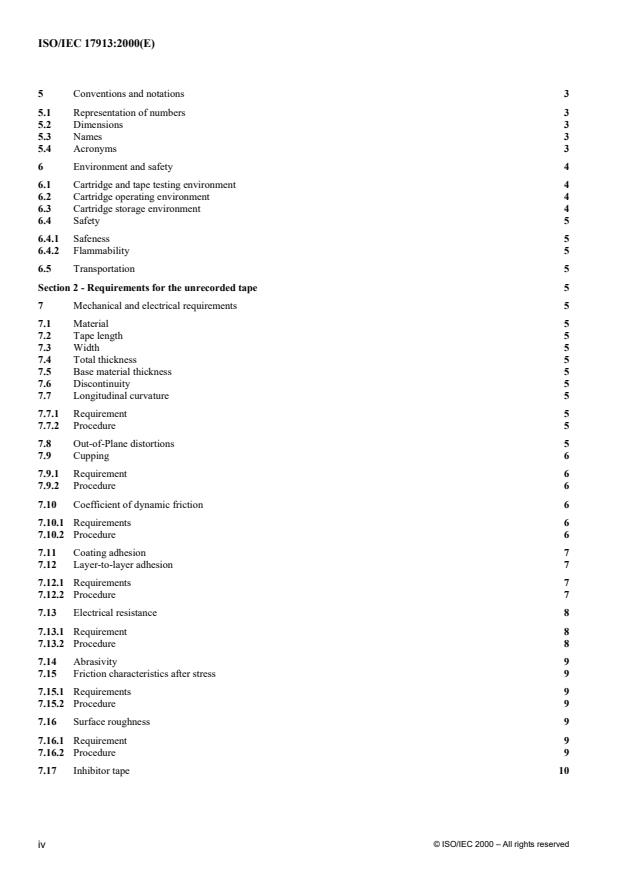
Contents Page
Section 1 - General 1
1 Scope 1
2 Conformance 1
2.1 Magnetic tape cartridge 1
2.2 Generating system 1
2.3 Receiving system 1
3 Normative references 1
4 Definitions 1
4.1 algorithm 1
4.2 anhysteretic erase 1
4.3 average signal amplitude 2
4.4 azimuth 2
4.5 back surface 2
4.6 beginning of partition (BOP) 2
4.7 beginning of tape (BOT) 2
4.8 cartridge 2
4.9 cyclic redundancy check (CRC) character 2
4.10 end of tape (EOT) 2
4.11 error-correcting code (ECC) 2
4.12 error-detecting code (EDC) 2
4.13 File Mark 2
4.14 flux transition position 2
4.15 flux transition spacing 2
4.16 half-wrap 2
4.17 logical block 2
4.18 logical forward 2
4.19 logical reverse 2
4.20 magnetic tape 2
4.21 mark tach count 2
4.22 Master Standard Reference Tape 2
4.23 physical recording density 2
4.24 pre-record condition 2
4.25 recorded element 2
4.26 Reference Field 2
4.27 resync character 2
4.28 SDM set 2
4.29 Secondary Standard Reference Tape (SSRT) 2
4.30 servo track 3
4.31 Standard Reference Amplitude (SRA) 3
4.32 Standard Reference Current (I ) 3
r
4.33 Test Recording Current (I ) 3
m
4.34 track 3
4.35 track group 3
4.36 trailer 3
4.37 Typical Field 3
4.38 write equalisation 3
© ISO/IEC 2000 – All rights reserved iii
5 Conventions and notations 3
5.1 Representation of numbers 3
5.2 Dimensions 3
5.3 Names 3
5.4 Acronyms 3
6 Environment and safety 4
6.1 Cartridge and tape testing environment 4
6.2 Cartridge operating environment 4
6.3 Cartridge storage environment 4
6.4 Safety 5
6.4.1 Safeness 5
6.4.2 Flammability 5
6.5 Transportation 5
Section 2 - Requirements for the unrecorded tape 5
7 Mechanical and electrical requirements 5
7.1 Material 5
7.2 Tape length 5
7.3 Width 5
7.4 Total thickness 5
7.5 Base material thickness 5
7.6 Discontinuity 5
7.7 Longitudinal curvature 5
7.7.1 Requirement 5
7.7.2 Procedure 5
7.8 Out-of-Plane distortions 5
7.9 Cupping 6
7.9.1 Requirement 6
7.9.2 Procedure 6
7.10 Coefficient of dynamic friction 6
7.10.1 Requirements 6
7.10.2 Procedure 6
7.11 Coating adhesion 7
7.12 Layer-to-layer adhesion 7
7.12.1 Requirements 7
7.12.2 Procedure 7
7.13 Electrical resistance 8
7.13.1 Requirement 8
7.13.2 Procedure 8
7.14 Abrasivity 9
7.15 Friction characteristics after stress 9
7.15.1 Requirements 9
7.15.2 Procedure 9
7.16 Surface roughness 9
7.16.1 Requirement 9
7.16.2 Procedure 9
7.17 Inhibitor tape 10
iv © ISO/IEC 2000 – All rights reserved
8 Magnetic recording characteristics 10
8.1 Typical Field 10
8.2 Signal amplitude 10
8.3 Resolution 10
8.4 Broad-band signal-to-noise ratio (BBSNR) 10
8.4.1 Requirement 10
8.4.2 Procedure 10
9 Tape quality 11
9.1 Missing pulse 11
9.1.1 Requirement 11
9.1.2 Procedure 11
9.2 Coincident missing pulse 11
9.2.1 Requirement 11
9.2.2 Procedure 11
9.3 Missing pulse density 12
9.3.1 Requirement 12
9.3.2 Procedure 12
9.4 Tape durability 12
Section 3 - Mechanical specifications of the tape cartridge 12
10 General 12
10.1 Overall dimensions 13
10.2 Write-inhibit mechanism 13
10.3 Label areas of the rear side 13
10.4 Label area on the top side 14
10.5 Case opening 14
10.6 Locating notches 14
10.7 Locating areas 15
10.8 Inside configuration of the case around the case opening 15
10.9 Other external dimensions of the case 15
10.10 Central window 15
10.11 Stacking ribs 16
10.12 Recessed area 16
10.13 Flexibility of the case 16
10.13.1 Requirements 16
10.13.2 Procedure 17
10.14 Tape reel 17
10.14.1 Locking mechanism 17
10.14.2 Axis of rotation of the reel 17
10.14.3 Metallic insert 17
10.14.4 Toothed rim 17
10.14.5 Hub of the reel 18
10.14.6 Relative positions 18
10.14.7 Characteristics of the toothed rim 19
10.15 Leader block 19
10.16 Attachment of the tape to the leader block 20
10.17 Latching mechanism 20
10.18 Tape wind 20
10.19 Wind tension 20
10.20 Circumference of the tape reel 20
10.21 Moment of inertia 21
10.22 Material 21
© ISO/IEC 2000 – All rights reserved v
10.23 Cartridge identification notches 21
10.24 Finger slot 21
Section 4 - Requirements for an interchanged tape 31
11 Method of recording 31
11.1 Physical recording density 31
11.2 Bit cell length 31
11.3 Average bit cell length 31
11.3.1 Long-term average RLL bit cell length 31
11.3.2 Short-term average RLL bit cell length 31
11.4 Rate of change of the short-term average RLL bit cell length 31
11.5 Bit shift 31
11.6 Total character skew 31
11.7 Missing zero-crossing zones 32
11.8 Coincident missing zero-crossing zones 32
12 Servo tracks 32
12.1 Locations of the servo tracks 32
12.2 Physical width of the servo tracks 33
12.3 Format of the servo tracks 33
12.4 Servo requirements 34
12.4.1 Servo amplitude 34
12.4.2 Servo azimuth 34
12.4.3 Servo errors 34
12.4.4 Servo edge spacing 35
12.5 Procedure 35
13 Data track format 35
13.1 Number of data tracks 35
13.2 Track positions 35
13.3 Track width 37
13.4 Data azimuth 37
13.5 Half-wraps 37
14 Tape format 37
14.1 General 37
14.2 Recording area 37
14.3 Tach count 39
14.4 Physical blocks 39
14.5 Servo acquisition region 40
14.6 Volume control region 40
14.7 Data region 40
14.8 Data entities 40
15 Packet format 42
15.1 Packet header 43
15.2 Packet data 45
15.3 Packet trailer 45
16 Device blocks 45
16.1 Data device blocks 45
16.2 Mark device blocks 45
16.3 File Mark 45
16.4 Void mark 46
16.5 Beginning of half-wrap mark 46
16.6 End of half-wrap mark 46
16.7 BOP mark 46
vi © ISO/IEC 2000 – All rights reserved
16.8 EOD mark 46
16.9 SDM mark 46
16.10 FID mark 47
16.11 DBM mark 48
16.11.1 DBM general information packet 48
16.11.2 DBM wrap region packet 49
16.11.3 DBM partitions packet 49
16.11.4 DBM servo demark packet 50
16.11.5 DBM File Mark packet 50
16.12 SARS mark 51
16.13 DBM checked out mark 51
16.14 DBM valid mark 51
17 Device block format 51
17.1 Device block header 51
17.1.1 Device block control 52
17.1.2 Device block sequence control 54
17.1.3 Vendor identification code 54
17.2 Device block data 54
17.3 Device block trailer 54
18 ECC 54
18.1 CRC 54
18.2 Code block 55
18.3 ECC encoded code block 55
18.4 Codeword correction code generation 56
18.5 MIE pointer code generation 57
18.6 ECC encoded interleave unit 57
18.7 Short error correction code generation 57
19 Recording of bytes on tape 59
19.1 Synchronisation format 59
19.2 Interblock gap formatting 62
19.3 RLL byte translation 63
19.4 Write equalisation bit translation 63
19.5 Writing bits on tape 63
Annexes
A- Tape abrasivity measurement procedure 64
B- Mediatypelabel 66
C- Measurement of bit shift 70
D- Vendor Identification Code 72
E- Recommendations for transportation 73
F- Inhibitor tape 74
G- Tape durability 75
© ISO/IEC 2000 – All rights reserved vii
Foreword
ISO (the International Organization for Standardization) and IEC (the International Electrotechnical Commission) form the
specialized system for worldwide standardization. National bodies that are members of ISO or IEC participate in the
development of International Standards through technical committees established by the respective organization to deal with
particular fields of technical activity. ISO and IEC technical committees collaborate in fields of mutual interest. Other
international organizations, governmental and non-governmental, in liaison with ISO and IEC, also take part in the work.
International Standards are drafted in accordance with the rules given in the ISO/IEC Directives, Part 3.
In the field of information technology, ISO and IEC have established a joint technical committee, ISO/IEC JTC 1. Draft
International Standards adopted by the joint technical committee are circulated to national bodies for voting. Publication as an
International Standard requires approval by at least 75 % of the national bodies casting a vote.
Attention is drawn to the possibility that some of the elements of this International Standard may be the subject of patent rights.
ISO and IEC shall not be held responsible for identifying any or all such patent rights.
International Standard ISO/IEC 117913 was prepared by ECMA (as ECMA-278) and was adopted, under a special “fast-track
procedure”, by Joint Technical Committee ISO/IEC JTC 1, Information technology, in parallel with its approval by national
bodies of ISO and IEC.
Annexes A, B, C and D form a normative part of this International Standard. Annexes E to G are for information only.
viii © ISO/IEC 2000 – All rights reserved
INTERNATIONAL STANDARD ISO/IEC 17913:2000(E)
Information technology — 12,7 mm 128-track magnetic tape cartridge for
information interchange — Parallel serpentine format
Section 1 - General
1Scope
This International Standard specifies the physical and magnetic characteristics of a magnetic tape cartridge, using a magnetic
tape 12,7 mm wide, so as to provide physical interchange of such cartridges between drives. It also specifies the quality of the
recorded signals, the recording method and the recorded format known as Parallel Serpentine, thereby allowing data
interchange between drives by means of such cartridges. The format supports variable length Logical Records, high speed
search, and the use of the algorithm for data compression specified in International Standard ISO/IEC 15200.
Information interchange between systems also requires, at a minimum, agreement between the interchange parties upon the
interchange code(s) and the specification of the structure and labelling of the information on the interchanged cartridge.
Together with a standard for volume and file structure, e.g. International Standard ISO 1001, this International Standard
provides for full data interchange between data processing systems.
2 Conformance
2.1 Magnetic tape cartridge
A tape cartridge shall be in conformance with this International Standard if it meets all the mandatory requirements specified
herein. The tape requirements shall be satisfied throughout the extent of the tape.
2.2 Generating system
A generating system shall be in conformance with this International Standard if it generates a tape according to 2.1.
2.3 Receiving system
A receiving system shall be in conformance with this International Standard if it can read all tapes according to 2.1.
3 Normative references
The following normative documents contain provisions which, through reference in this text, constitute provisions of this
International Standard. For dated references, subsequent amendments to, or revisions of, any of these publications do not
apply. However, parties to agreements based on this International Standard are encouraged to investigate the possibility of
applying the most recent editions of the normative documents indicated below. For undated references, the latest edition of the
normative document referred to applies. Members of ISO and IEC maintain registers of currently valid International Standards.
ISO 1001: 1986, Information processing — File structure and labelling of magnetic tapes for information interchange.
IEC 60950:1999, Safety of information technology equipment.
ISO/IEC 15200:1996, Information technology— Adaptive Lossless Data Compression algorithm (ALDC).
ISO/R 527:1966, Plastics — Determination of tensile properties.
ISO/IEC 646:1991, Information technology — ISO 7-bit coded character set for information interchange.
ISO 683-13:1986, Heat-treatable steels, alloy steels and free-cutting steels — Part 13: Wrought stainless steels.
ANSI MH10.8M-1993, Materials Handling — Unit Loads and Transport Packages — Bar Code Symbols.
4 Terms and definitions
For the purposes of this International Standard, the following terms and definitions apply.
4.1 algorithm: A set of rules for transforming the logical representation of data.
4.2 anhysteretic erase: A process of erasure utilising an alternating magnetic field of decaying level.
© ISO/IEC 2000 – All rights reserved 1
4.3 average signal amplitude: The average peak-to-peak value of the signal output measured over a minimum
of 25,4 mm, exclusive of missing pulses.
4.4 azimuth: The angle, in minutes of arc, of the mean flux transition line of a track from a line normal to the
tape Reference Edge.
4.5 back surface: The surface of the tape opposite the recording surface.
4.6 beginning of partition (BOP): The point along the length of the tape where recording in any partition
begins.
4.7 beginning of tape (BOT): The point along the length of the magnetic tape, indicated by the start of
recorded information.
4.8 cartridge: A container holding a single supply reel of magnetic tape with an attached leader block at the
BOT end.
4.9 cyclic redundancy check (CRC) character: A four-byte character used for error detection.
4.10 end of tape (EOT): The point on a track farthest from BOT up to which recording is allowed.
4.11 error-correcting code (ECC): An algorithm yielding bytes used for error detection and correction.
4.12 error-detecting code (EDC): An algorithm yielding bytes used for error detection.
4.13 File Mark: A recorded element requested by a host that marks the end of a host data file or aggregate.
4.14 flux transition position: The point on the magnetic tape that exhibits the maximum free-space flux density
normal to the tape surface.
4.15 flux transition spacing: The distance along a track between successive flux transitions.
4.16 half-wrap: A track group recorded in the physical forward or physical reverse direction.
4.17 logical block: User data or a File Mark that is received as input by the system or that is sent as output from
the system.
4.18 logical forward: The direction of tape motion that results in finding an ascending order of device block
identifiers.
4.19 logical reverse: The direction of tape motion that results in finding a descending order of device block
identifiers.
4.20 magnetic tape: A tape that accepts and retains magnetic signals intended for input, output, and storage of
data for information processing.
4.21 mark tach count: The value of the tach counter that exists at the starting point of an Interblock Gap prior
to the first device block of a mark.
4.22 Master Standard Reference Tape: A tape selected as the standard for Reference Field, signal amplitude,
resolution, and broad-band signal-to-noise ratio.
Note - A Master Standard Reference Tape has been established at Imation Corporation.
4.23 physical recording density: The number of recorded flux transitions per unit length of track expressed in
flux transitions per millimetre (ftpmm).
4.24 pre-record condition: The condition of the magnetic tape in preparation for data recording that has been
anhysteretically erased and subsequently servo written.
4.25 recorded element: A File Mark or a logical block.
4.26 Reference Field: The Typical Field of the Master Standard Reference Tape.
4.27 resync character: A control character identifying format resynchronisation points in a track. It is intended
that read-back circuits be capable of resynchronising operations when such characters are sensed.
4.28 SDM set: The group of SDM marks delineated by the beginning and end SDM marks, containing any
number of included middle SDM marks including zero middle SDM marks.
4.29 Secondary Standard Reference Tape (SSRT): A tape, the performance of which is known and stated in
relation to that of the Master Standard Reference Tape.
Note - Secondary Standard Reference Tapes can be ordered from the Imation Corporation, 1 Imation Place, Oakdale, MN 55128-
3414 under Part Number 84-9802-4185-9. In principle such tapes will be available for a period of 10 years from the publication of
2 © ISO/IEC 2000 – All rights reserved
this International Standard. However, by agreement between ECMA and Imation Corporation, this period may be shortened or
extended to take account of demands for such SSRTs.
It is intended that these SSRTs be used for calibrating tertiary reference tapes for use in routine calibration.
4.30 servo track: A pre-recorded non-data track that is used by the drive to locate the data recording head at
precise locations for recording data.
4.31 Standard Reference Amplitude (SRA): The average signal amplitude from the Master Standard
Reference Tape when it is recorded with the Test Recording Current at 2 550 ftpmm. Traceability to the
Standard Reference Amplitude is provided by the calibration factors supplied with each Secondary
Standard Reference Tape.
4.32 Standard Reference Current (I ): The current that produces the Reference Field.
r
4.33 Test Recording Current (I ): A current whose value is 1,5 times the Standard Reference Current (I =
m m
1,5xI ).
r
4.34 track: A longitudinal area on the tape along which a series of magnetic signals can be recorded.
4.35 track group: The set of tracks recorded simultaneously.
4.36 trailer: Data appended to a data entity to provide identification and checking.
4.37 Typical Field: The minimum recording field which, when applied to a magnetic tape, will cause an average
signal amplitude equal to 85 % of the maximum average signal amplitude at 2 550 ftpmm recording
density.
4.38 write equalisation: An algorithm that linearly transforms an input binary sequence into another binary
sequence.
5 Conventions and notations
5.1 Representation of numbers
The following conventions and notations apply in this International Standard, unless otherwise stated.
� A measured value is rounded off to the least significant digit of the corresponding specified value. It implies that a
specified value of 1,26 with a positive tolerance +0,01, and a negative tolerance -0,02 allows a range of measured values
from 1,235 to 1,275.
� In each block and in each field the bytes shall be arranged with Byte 0, the most significant, first. Within each byte the
bits shall be arranged with Bit 0, the most significant, first and Bit 7, the least significant bit, last. This order applies to the
data, and to the input and output of the error-detecting and error-correcting codes, and to the cyclic redundancy characters.
� Letters and digits in parentheses represent numbers in hexadecimal notation.
� The setting of bits is denoted by ZERO or ONE.
� Numbers in binary notation and bit patterns are represented by strings of digits 0 and 1 shown with the most significant bit
to the left.
5.2 Dimensions
The dimensions in figures 1 to 3 are nominal dimensions. Unless otherwise stated, the dimensions in figures 4 to 21 are in
millimetres with a tolerance of ± 50 mm.
5.3 Names
The names of basic elements, e.g. specific fields, are written with a capital initial letter.
5.4 Acronyms
BOP Beginning of Partition
BOT Beginning of Tape
BOW Beginning of half-Wrap mark
BVCR Beginning of Volume Control Region
CRC Cyclic Redundancy Check character
DBM Device Block Map
ECC Error-Correcting Code
EDC Error-Detecting Code
© ISO/IEC 2000 – All rights reserved 3
EEIU ECC encoded interleave unit
ELEOP Early Logical End of Partition
EOD End of Data mark
EOP End of Partition
EOT End of Tape
EOV End of Volume
EOW End of half-Wrap mark
EVCR End of Volume Control Region
FID Format Identification
IBG Interblock Gap
LEOP Logical End of Partition
LP1 Logical Point 1
LP2 Logical Point 2
LP3 Logical Point 3
MIE Minimum Interleave Element
MIU Minimum Interleave Unit
MSRT Master Standard Reference Tape
RLL Run Length Limited
SAQ Servo Acquisition Region
SARS Statistical Analysis and Reporting
SDM Servo Demark
SECC Short Error Correction Code
SRA Standard Reference Amplitude
SSRT Secondary Standard Reference Tape
VCR Volume Control Region
6 Environment and safety
Unless otherwise stated, the conditions specified below refer to the ambient conditions in the test or computer room and not to
those within the tape drive.
6.1 Cartridge and tape testing environment.
Unless otherwise stated, tests and measurements made on the cartridge and tape to check the requirements of this International
Standard shall be carried out under the following conditions:
� temperature: 23 °C�2°C
� relative humidity: 40 % to 60 %
� conditioning before testing: 24 h min.
6.2 Cartridge operating environment
Cartridges used for data interchange shall be capable of operating under the following conditions:
� temperature: 16 °C to 32 °C
� relative humidity: 20 % to 80 %
� wet bulb temperature: 26 °C max.
Note - Localised tape temperatures in excess of 48 °C may cause tape damage.
If during storage and/or transportation a cartridge has been exposed to conditions outside the above values, it shall be
conditioned before use by exposure to the operating environment for a time equal to, or greater than, the time away from the
operating environment up to a maximum of 24 h. There shall be no deposit of moisture on or in the cartridge.
6.3 Cartridge storage environment
Cartridges shall be stored under the following conditions:
� temperature: 5 °C to 32 °C
� relative humidity: 5 % to 80 %
� wet bulb temperature: 26 °C max.
The stray magnetic field at any point on the tape shall not exceed 4 000 A/m. There shall be no deposit of moisture on or in the
cartridge.
4 © ISO/IEC 2000 – All rights reserved
6.4 Safety
6.4.1 Safeness
The cartridge and its components shall not constitute any safety or health hazard when used in the intended manner, or through
any foreseeable misuse in an information processing system.
6.4.2 Flammability
The cartridge and its components shall be made from materials which, if ignited from a match flame, and when so ignited do
not continue to burn in a still carbon dioxide atmosphere.
6.5 Transportation
This International Standard does not specify parameters for the environment in which cartridges should be transported.
Annex E gives some recommendations for transportation.
Section 2 - Requirements for the unrecorded tape
7 Mechanical and electrical requirements
7.1 Material
The tape shall consist of a base material (oriented polyethylene terephthalate film or its equivalent) coated on one surface with
a strong yet flexible layer of ferromagnetic material dispersed in a suitable binder. The other surface of the tape may be coated
to enhance electrical conduction, tape handling and mechanical properties.
7.2 Tape length
The length of the tape shall be 320 m ± 5 m.
7.3 Width
The width of the tape shall be 12,650 mm ± 0,025 mm.
The width shall be measured across the tape from edge to edge when the tape is under a tension of less than 0,28 N.
7.4 Total thickness
The total thickness of the magnetic tape at any point shall be 17,0�m± 1,0�m.
7.5 Base material thickness
The thickness of the base material shall be 14,2�m± 0,7 �m.
7.6 Discontinuity
There shall be no discontinuities in the tape such as those produced by tape splicing or perforations.
7.7 Longitudinal curvature
The longitudinal curvature is measured as the departure of the Reference Edge of the tape from a straight line along the
longitudinal dimension of the tape in the plane of the tape surface.
7.7.1 Requirement
The radius of curvature of the edge of the tape shall be greater than 33,75 m.
7.7.2 Procedure
Allow a 1 m length of tape to unroll and measure its natural curvature on a flat, smooth surface. Measure the deviation from a 1
m chord. The deviation shall not be greater than 3,0 mm within a span of 900 mm. This corresponds to the minimum radius of
curvature of 33,75 m when measured over an arc of circle.
7.8 Out-of-Plane distortions
Out-of-plane distortions are local deformations which cause portions of the tape to deviate from the plane of the surface of the
tape. Out-of-plane distortions are most readily observed when the tape is lying on a flat surface under no tension.
There shall be no visual evidence of out-of-plane distortion when the tape is subjected to a uniform tension of 0,4 N.
© ISO/IEC 2000 – All rights reserved 5
7.9 Cupping
Cupping is the departure across the width of the tape (transverse to motion) from a flat surface.
7.9.1 Requirement
There shall be no cupping toward the recording surface of the tape. Cupping away from the recording surface shall be 0,4 mm
max.
7.9.2 Procedure
i. Cut a tape sample at least 1,0 m in length.
ii. Condition the sample by hanging it so that the coated surface is freely exposed to the test environment for a minimum
of 3 h.
iii. From the centre portion of the tape, cut a sample 0,5 m ± 0,1 m in length.
iv. Install the tape sample on a fixture that uses a clamping bar to hold one end of the sample and a 3,5 g tensioning
weight to pull the other end of the tape sample across a roller. There shall be a minimum distance of 200 mm between
the roller and the clam.
v. Place the fixture on a 40X microscope stage so that the centre of the fixture is under the microscope. Adjust the
microscope to focus on the first edge of the tape, and record the vertical positioning of the focusing adjustment. The
microscope focusing adjustment shall be known to 1 μm.
vi. While positioning the tape laterally under the microscope, use the focusing adjustment to find the point of maximum
departure of the tape surface from the reference edge height. Note the vertical height and determine the difference
between the first reference of step v and the departed surface height.
vii. Move the tape under the microscope to view the other reference edge. Adjust the microscope focus and note the
focused vertical scope position.
viii. Calculate cupping as the average of the height departures from the two reference edges determined in steps vi and vii.
No individual measurement shall exceed the allowed maximum.
7.10 Coefficient of dynamic friction
The dynamic friction between the recording surface and the back surface is the resistance to motion between the recording
surface and the back surface of the tape.
7.10.1 Requirements
The coefficient of dynamic friction between the magnetic surface and the back surface shall be greater than 0,28.
7.10.2 Procedure
i. Wrap a first piece of tape around a cylinder of diameter 25,4 mm and wrap it with a total wrap angle of more than 90 °
with the back surface outwards.
ii. Wrap a second test piece, with the magnetic surface inwards, around the first test piece with a total wrap angle of 90 °.
iii. Exert on one end of the outer test piece a force of F =0,64N.
iv. Attach the other end to a force gauge mounted on a linear slide.
v. Drive the slide at a speed of 1 mm/s, measure the force F required.
vi. Calculate the coefficient of dynamic friction � from the equation
� �
1 F
��� ln� �
� F
� �
where� is the value of the wrap angle in radians.
6 © ISO/IEC 2000 – All rights reserved
7.11 Coating adhesion
The force required to peel any part of the coating from the tape base material shall not be less than 0,44 N.
Procedure
i. Take a test piece of the tape approximately 380 mm long and scribe a line through the recording coating across the
width of the tape 125 mm from one end.
ii. Using a double-sided pressure sensitive tape, attach the full width of the test piece to a smooth metal plate, with the
magnetic coating (recording surface) facing the plate, as shown in figure 1.
iii. Fold the test piece over 180 °, adjacent to, and parallel with, the scribed line. Attach the metal plate and the free end
of the test piece to the jaws of a universal testing machine and set the speed of the jaw separation to 254 mm per min.
iv. Note the force at which any part of the coating first separates from the base material. If this is less than 0,44 N, the
tape has failed the test. If the test piece peels away from the double-sided pressure sensitive tape before the force
exceeds 0,44 N, an alternative type of double-sided pressure sensitive tape shall be used.
v. Repeat i to iv for the back coating, if any.
Recording surface Scribed line
Pressure-sensitive tape
125 mm
Figure 1 - Measurement of the coating adhesion
7.12 Layer-to-layer adhesion
Layer-to-layer adhesion refers to the tendency of a layer, when held in close proximity to the adjacent layer, to bond itself to an
adjacent layer so that free and smooth separation of the layers is difficult.
7.12.1 Requirements
There shall be no evidence of delamination or other damage to the coatings.
7.12.2 Procedure
i. Fasten one end of a 914 mm length of tape, magnetic coating inwards, to a horizontally mounted stainless steel
cylinder with a low cold-flow adhesive material.
ii. The dimensions of the cylinder shall be:
- diameter: 12,7 mm
- length: 102 mm
iii. Attach a mass of 1 000 g to the opposite end of the tape.
iv. Attach, 25,4 mm above the mass, a narrow strip of double-sided adhesive tape to the magnetic coating.
v. Slowly rotate the cylinder, so that the tape winds uniformly around it into a compact and even roll. The double-sided
tape secures the end and prevents unwinding when the mass is removed.
vi. The cylinder with the tape shall then be exposed to the following temperature and humidity cycle:
Time Temperature RH
16 h to 18 h 54 °C 85 %
4 h 54 °C 10 % or less
1hto2h 21°C 45%
© ISO/IEC 2000 – All rights reserved 7
vii. Open the end of the roll and remove the double-sided adhesive tape.
viii. Release the free end of the tape.
ix. The outer one or two wraps shall spring loose without adhesion.
x. Hold the free end of the tape and allow the cylinder to fall, thereby unwinding the tape.
xi. The tape shall show no coating delamination, except for the 51 mm of tape nearest to the cylinder.
12,7
25,4
strip
1000 g
Figure 2 - Measurement of layer-to-layer adhesion
7.13 Electrical resistance
7.13.1 Requirement
The electrical resistance of any square area of the magnetic coating shall
� be greater than 1 x 10 �
� not exceed 10 x 10 �
The electrical resistance of any square area of the back coating shall
� not exceed 100 x 10 �
7.13.2 Procedure
Condition a test piece of tape in the test environment for 24 h. Position the test piece over two 24-carat gold-plated, semi-
circular electrodes having a radius r = 25,4 mm and a finish of at least N4, so that the recording surface is in contact with each
electrode. These electrodes shall be placed parallel to the ground and parallel to each other at a distance d = 12,7 mm between
their centres. Apply a force F of 1,62 N ± 0,41 N to each end of the test piece. Apply a d.c. voltage of 500 V ± 10 V across the
electrodes and measure the resulting current flow. From this value, determine the electrical resistance.
Repeat for a total of 5 positions along the test piece and average the 5 resistance readings. For back-coated tape repeat the
procedure with the back surface in contact with the electrodes.
8 © ISO/IEC 2000 – All rights reserved
12,7
r r
d
F F
Figure 3 - Measurement of electrical resistance
When mounting the test piece, make sure that no conducting paths exist between the electrodes except that through the coating
under test.
Note - Particular attention should be given to keeping the surfaces clean.
7.14 Abrasivity
Tape abrasivity is the tendency of the tape to wear the tape transport. When measured according to annex A, the depth of the
wear pattern on the wear bar shall not exceed 35�m.
7.15 Friction characteristics after stress
Friction is the force required to move the tape recording surfaces near the leader block end and near the hub end over a ferrite
surface when measured after stress.
7.15.1 Requirements
The force required to move the tape at the leader block end shall not exceed 1,50 N. The maximum force required at the hub
end shall not exceed the smaller of 6,0 N or ten times the value measured at the leader block end.
7.15.2 Procedure
i. Wind a sample of tape on a 50 mm diameter spool hub to an outside diameter of 99 mm. The wind tension shall be 1,4
N;
ii. Store at 50 °C, 10 % to 20 % relative humidity for 48 h;
iii. Acclimatise at 23 °C for 2 h. Then reapply the wind tension to 1,4 N by unwinding and rewinding tape;
iv. Repeat steps ii and iii five times for a total of 240 h at 50 °C;
v. Acclimatise the tape for 48 h at 30,5 °C, 85 % relative humidity. At that environment measure the force required to
pull the recording surface over 90 ° of a polished ferrite rod of 25,4 mm diameter made of the material specified in
annex A.
vi. Pull the sample over the rod at 1,0 mm/s while exerting a force of 0,64 N at the other end. Take force measurements
with the tape sample near the outer diameter end and near the hub.
Note - The rod shall have been polished to a roughness value N2 (ISO 1302) or smoother.
7.16 Surface roughness
The surface roughness of the magnetic coating is the root mean square (RMS) of the surface topography.
7.16.1 Requirement
The surface roughness shall be between 4 nm and 7 nm.
7.16.2 Procedure
Use a WYKO 3D Profiler with a 512 by 512 pixel array detector and 20X magnification, or equivalent. Take the average of at
least three samples.
© ISO/IEC 2000 – All rights reserved 9
7.17 Inhibitor tape
This International Standard does not specify parameters for assessing whether or not a tape is an inhibitor tape. However,
annex F gives further information on inhibitor tapes.
8 Magnetic recording characteristics
The magnetic recording characteristics shall be defined by testing the requirements given below.
When performing the tests, the output or resultant signal shall be measured on the same relative pass for both a tape calibrated
to the Master Standard Reference Tape and the tape under test (read-while-write, or on equipment without read-while-write
capability, on the first forward-read-pass) on the same equipment.
The following conditions shall apply to the testing of all magnetic recording characteristics, unless otherwise noted.
� Tape condition: anhysteretically erased
� Tape speed: 2,00 m/s ± 0,05 m/s
� Read track: within the written track
� Azimuth alignment: 6 ' max. between the mean write transitions and the read gap
� Write gap length: 0,9 μm ± 0,1 μm
� Write head saturation density: 8 000 G��800 G
� Tape tension: 1,4 N� 0,2 N
� Recording current: Test Recording Current (I )
m
� Physical recording densities: 1f=2550ftpmm
4f = 10 200 ftpmm
The method of recording shall be as defined in clause 11.
8.1 Typical Field
The Typical Field shall be between 90 % and 110 % of the Reference Field.
Traceability to the Reference Field is provided by the calibration factors supplied with each Secondary Standard Reference
Tape.
8.2 Signal amplitude
The Average Signal Amplitude at the physical recording density of 2 550 ftpmm shall be between 75 % and 125 % of the SRA.
Traceability to the SRA is provided by the calibration factors supplied with each Secondary Standard Reference Tape.
8.3 Resolution
The ratio of the average signal amplitude at the physical recording density of 2 550 ftpmm to that at the physical recording
density of 4 000 ftpmm shall be between 80 % and 120 % of the same ratio for the Master Standard Reference Tape.
Traceability to the resolution of the Master Standard Reference Tape is provided by the calibration factors supplied with each
Secondary Standard Reference Tape.
8.4 Broad-band signal-to-noise ratio (BBSNR)
The BBSNR is the ratio of average signal power to average integrated broad band (floor) noise power.
8.4.1 Requirement
The BBSNR of the tape shall not be lower than that of the Master Standard Reference Tape by more than 2,8 dB.
Traceability to the standard reference BBSNR is provided by the calibration factors supplied with each Secondary Standard
Reference Tape.
The noise level of the measuring system shall be well below the noise level of the tape under test.
8.4.2 Procedure
i. Record a signal on the track at 2 550 ftpmm;
ii. Measure the signal power, averaging a minimum of 100 samples over 50 m of tape;
10 © ISO/IEC 2000 – All rights reserved
iii. Measure the noise power of the written signal over a 300 kHz to 1 500 kHz bandwidth;
iv. Calculate the BBSNR as the average signal power divided by the integrated noise power, converted to dB using the
equation BBSNR = 10� log (S/N).
9 Tape quality
The quality of the tape (including the effects of exposure to storage and shipping environments) shall be defined by the testing
requirements given in the following paragraphs. The following conditions shall apply to all quality testing requirements:
� Tape condition: pre-record condition
� Tape speed: 2,00 m/s� 0,05 m/s
� Write-track width: 35�mmin.
� Read-track: 35�m
� Azimuth alignment: 6 ' max. between the mean write transitions and the read gap
� Write-gap length: 0,9�m��0,1�m
� Write head saturation density: 8 000 G��800 G
� Tape tension: 1,4 N ± 0,2 N
� Recording current: Test Recording Current (I )
m
� Recording density: 2 550 ftpmm
9.1 Missing pulse
A missing pulse is a loss of read signal amplitude detected after writing at the physical recording density of 2 550 ftpmm. A
missing pulse shall exist when the base-to-peak read signal amplitude is 25 % or less of half of the average signal amplitude
(peak-to-peak) for the preceding 25,4 mm of tape.
9.1.1 Requirement
The average missing pulse rate shall be less than one missing pulse for each 5� 10 flux transitions recorded. In addition, no
single track shall have a mean missing pulse separation less than 2,5� 10 flux transitions recorded.
9.1.2 Procedure
i. While reading the signal of single tracks, observe and count all missing pulses. When a missing pulse is detected, a
second missing pulse shall not be counted until 48 consecutive missing pulse-free flux transitions are read. If a missing
pulse persists for a distance of 0,7 mm, another missing pulse shall be counted.
ii. Calculate the missing pulse rate by dividing the number of missing pulses counted by the total number of flux
transitions recorded on the tape.
iii. Calculate the mean missing pulse separation for each individual track by dividing the number of flux transitions
recorded on a track by the number of missing pulses on the same track.
iv. The average missing pulse rate shall be the total number of flux transitions recorded on tape divided by the number of
missing pulses counted.
9.2 Coincident missing pulse
A coincident missing pulse is a simultaneous missing pulse condition on five or more tracks of a sixteen-track group. A
coincident missing pulse shall be counted as a single event regardless of length. There are eight sixteen-track groups in the
format, as shown in table 2. (See 13.5.)
9.2.1 Requirement
No cartridge shall have more than 10 coincident missing pulses. No coincident missing pulse shall be longer than 25 mm.
9.2.2 Procedure
i. While reading the signals of a sixteen-track group, observe and count all coincident missing pulses.
ii. Measure the length of each coincident missing pulse from the start of the earliest event to the completion of the last
event.
© ISO/IEC 2000 – All rights reserved 11
9.3 Missing pulse density
Missing pulse density is the number of tracks within a sixteen-track group that contain missing pulses in a given section of
tape. A section of tape for a 16-track group for this requirement shall be a tape length of 0,7 mm.
9.3.1 Requirement
There shall be no events as defined in the following procedure for a cartridge.
9.3.2 Procedure
i. While reading the signals of a 16-track group, observe for the occurrence of a missing pulse longer than 0,16 mm and
start counting the tracks of the 16-track group that have missing pulses during the subsequent 8 sections;
ii. Count the number of tracks that have missing pulses over the first 2 sections and also over the first 8 sections. An
event shall be having 5 or more error tracks in the first 2 sections, or 13 or more error tracks in the 8 sections.
9.4 Tape durability
This International Standard does not specify parameters for assessing tape durability. However, a recommended procedure is
described in annex G.
Section 3 - Mechanical specifications of the tape cartridge
10 General
The tape cartridge shall consist of the following elements
� a case,
� a reel for the magnetic tape,
� a locking mechanism for the reel,
� a magnetic tape wound on the hub of the reel,
� a write-inhibit mechanism,
� a leader block,
� a latching mechanism for the leader block.
Dimensional characteristics are specified for those parameters deemed mandatory for interchange and compatible use of the
cartridge. Where there is freedom of design, only the functional characteristics of the elements described are indicated. In the
enclosed drawings a typical implementation is represented in third angle projection. Figures 4 to 21 show a typical
implementation.
Where they are purely descriptive, the dimensions refer to three reference surfaces; A, B, and C which form a geometrical
trihedral (see figure 4). Where the dimensions are related to the position of the cartridge in the drive, they may be referred to
another surface of the cartridge.
Figure 4 shows a general view of the whole cartridge.
Figure 5 shows the top side of the case.
Figure 6 shows the front side of the case.
Figure 7 shows the rear side of the case.
Figure 8 shows the bottom side of the case.
Figure 8a shows an enlarged partial view of figure 8.
Figure 9 shows the side of the case.
Figure 10 shows an enlarged cross-section of leader block opening.
Figure 11 shows an enlarged view of a location notch.
Figure 12 shows a detail view of the opening in the case.
Figure 13 shows an enlarged partial cross-section of the cartridge in the non-operating position.
Figure 14 shows an enlarged view of the cartridge button.
Figure 15 shows the same cross-section as figure 15 but of a cartridge in the operating position.
Figure 16 shows schematically the teeth of the toothed rim.
Figure 17 shows two views of the leader block.
Figure 18 shows the attachment of the tape to the leader block.
Figure 19 shows the leader block inserted into the case.
12 © ISO/IEC 2000 – All rights reserved
10.1 Overall dimensions (figures 5 and 7)
The overall dimensions of the cartridge shall be
l =125,00mm� 0,32 mm
l =109,00mm� 0,32 mm
+0,50 mm
l =24,50 mm
-0,32 mm
The corners of the case shall be rounded off as sp
...