

ISO 15552:2018
(Main)Pneumatic fluid power — Cylinders with detachable mountings, 1 000 kPa (10 bar) series, bores from 32 mm to 320 mm — Basic, mounting and accessories dimensions
General Information
- Abstract
ISO 15552:2018 establishes a metric series of basic, mounting and accessories dimensions as required for interchangeability of single or double rod pneumatic cylinders with or without provision for magnetic sensors for a maximum rated pressure of 1 000 kPa (10 bar). ISO 15552:2018 applies to pneumatic cylinders with detachable mountings.
- Status
- Published
- Publication Date
- 04-Apr-2018
- Technical Committee
- ISO/TC 131/SC 3 - Cylinders
- Drafting Committee
- ISO/TC 131/SC 3/WG 2 - Pneumatic cylinder mounting dimensions
- Current Stage
- 9093 - International Standard confirmed
- Start Date
- 04-Feb-2025
- Completion Date
- 29-Aug-2026
Buy Documents






ISO 15552:2018 - Pneumatic fluid power -- Cylinders with detachable mountings, 1 000 kPa (10 bar) series, bores from 32 mm to 320 mm -- Basic, mounting and accessories dimensions

ISO 15552:2018 - Pneumatic fluid power — Cylinders with detachable mountings, 1 000 kPa (10 bar) series, bores from 32 mm to 320 mm — Basic, mounting and accessories dimensions/5/2018


ISO 15552:2018 - Transmissions pneumatiques -- Vérins avec fixations détachables, série 1 000 kPa (10 bar), alésages de 32 mm a 320 mm -- Dimensions de base, des fixations et des accessoires


ISO 15552:2018 - Transmissions pneumatiques — Vérins avec fixations détachables, série 1 000 kPa (10 bar), alésages de 32 mm à 320 mm — Dimensions de base, des fixations et des accessoires/5/2018
Overview
ISO 15552:2018 - Pneumatic fluid power - Cylinders with detachable mountings, 1 000 kPa (10 bar) series, bores from 32 mm to 320 mm - establishes a metric series of basic, mounting and accessories dimensions to ensure interchangeability of single- and double-rod pneumatic cylinders (with or without provision for magnetic sensors). The standard covers cylinders rated to a maximum of 1 000 kPa (10 bar) and defines dimensions, nominal stroke rules and tolerances for bores 32–320 mm.
Key topics and technical requirements
- Interchangeability and dimensional series: Metric basic dimensions for single- and double-rod cylinders to enable component interchange across manufacturers.
- Rated pressure: Applies to the 1 000 kPa (10 bar) series of pneumatic cylinders.
- Bore sizes: Includes AL = 32, 40, 50, 63, 80, 100, 125, 160, 200, 250, 320 mm (per ISO 3320).
- Mounting and accessory dimensions: Detailed tables and figures define mounting types (e.g., MF1, MF2, MP2, MP4, MP6, MS1, MT4) and accessory types (e.g., AA4, AA6, AB6, AB7, AT4) consistent with ISO 6099 symbols.
- Nominal stroke selection and tolerances: Nominal strokes are to be selected from ISO 4393; stroke tolerances are specified (with tolerances given for strokes up to and including 1 250 mm; for longer strokes tolerances are by national standard or agreement).
- Product designation and identification: Provides product designation format (example: ISO 15552 – MT 4 – 80×200) and recommended identification statement for catalogs and test reports.
- Piston rod and port details: Includes requirements such as piston rod diameter relative to thread diameter and port size assignments for each bore.
Practical applications and who uses this standard
ISO 15552:2018 is practical for:
- Pneumatic cylinder manufacturers - to design products that meet common mounting and accessory dimensions for interchangeability.
- Machine designers and OEMs - to specify cylinders that fit standard mounts and accessories, simplifying assembly and maintenance.
- Procurement and maintenance teams - to confirm compatibility when replacing or sourcing cylinders and spare parts.
- System integrators and automation engineers - to ensure mechanical interfaces, mounting types and sensor provisions match system requirements.
Typical application areas include industrial automation, material handling, packaging machines, robotics and general pneumatic actuation systems where standardized mounting and accessory interchangeability reduces downtime and inventory complexity.
Related standards
- ISO 3320 - Cylinder bores and piston rod diameters (metric series)
- ISO 4393 - Basic series of piston strokes
- ISO 4395 - Piston rod end types and dimensions
- ISO 6099 - Mounting and accessory symbols (referenced for types)
- ISO 16030 - Ports and stud ends
- ISO 5598 - Fluid power vocabulary
For specification text in sales literature or test reports, use the identification statement given in ISO 15552:2018: “Basic, mounting and accessories dimensions of pneumatic cylinder according to ISO 15552 …”
Relations
- Effective Date
- 05-Jul-2014
Buy Documents
ISO 15552:2018 - Pneumatic fluid power -- Cylinders with detachable mountings, 1 000 kPa (10 bar) series, bores from 32 mm to 320 mm -- Basic, mounting and accessories dimensions
ISO 15552:2018 - Pneumatic fluid power — Cylinders with detachable mountings, 1 000 kPa (10 bar) series, bores from 32 mm to 320 mm — Basic, mounting and accessories dimensions/5/2018
ISO 15552:2018 - Transmissions pneumatiques -- Vérins avec fixations détachables, série 1 000 kPa (10 bar), alésages de 32 mm a 320 mm -- Dimensions de base, des fixations et des accessoires
ISO 15552:2018 - Transmissions pneumatiques — Vérins avec fixations détachables, série 1 000 kPa (10 bar), alésages de 32 mm à 320 mm — Dimensions de base, des fixations et des accessoires/5/2018
Get Certified
Connect with accredited certification bodies for this standard

Institut za varilstvo d.o.o. (Welding Institute)
Slovenia's leading welding institute since 1952. ISO 3834, EN 1090, pressure equipment certification, NDT personnel, welder qualification. Only IIW Au
Sponsored listings
Frequently Asked Questions
ISO 15552:2018 is a standard published by the International Organization for Standardization (ISO). Its full title is "Pneumatic fluid power — Cylinders with detachable mountings, 1 000 kPa (10 bar) series, bores from 32 mm to 320 mm — Basic, mounting and accessories dimensions". This standard covers: ISO 15552:2018 establishes a metric series of basic, mounting and accessories dimensions as required for interchangeability of single or double rod pneumatic cylinders with or without provision for magnetic sensors for a maximum rated pressure of 1 000 kPa (10 bar). ISO 15552:2018 applies to pneumatic cylinders with detachable mountings.
ISO 15552:2018 establishes a metric series of basic, mounting and accessories dimensions as required for interchangeability of single or double rod pneumatic cylinders with or without provision for magnetic sensors for a maximum rated pressure of 1 000 kPa (10 bar). ISO 15552:2018 applies to pneumatic cylinders with detachable mountings.
ISO 15552:2018 is classified under the following ICS (International Classification for Standards) categories: 23.100.20 - Cylinders. The ICS classification helps identify the subject area and facilitates finding related standards.
ISO 15552:2018 has the following relationships with other standards: It is inter standard links to ISO 15552:2004. Understanding these relationships helps ensure you are using the most current and applicable version of the standard.
ISO 15552:2018 is available in PDF format for immediate download after purchase. The document can be added to your cart and obtained through the secure checkout process. Digital delivery ensures instant access to the complete standard document.
Standards Content (Sample)
SLOVENSKI STANDARD
01-julij-2021
Nadomešča:
SIST ISO 15552:2005
Fluidna tehnika - Pnevmatika - Valji z ločljivimi pritrditvami vrste 1000 kPa (10 bar)
in s premeri 32 mm do 320 mm - Mere osnovnega valja in njegovih pritrditev
Pneumatic fluid power -- Cylinders with detachable mountings, 1 000 kPa (10 bar)
series, bores from 32 mm to 320 mm -- Basic, mounting and accessories dimensions
Transmissions pneumatiques -- Vérins avec fixations détachables, série 1 000 kPa (10
bar), alésages de 32 mm à 320 mm -- Dimensions de base, des fixations et des
accessoires
Ta slovenski standard je istoveten z: ISO 15552:2018
ICS:
23.100.20 Hidravlični valji Cylinders
2003-01.Slovenski inštitut za standardizacijo. Razmnoževanje celote ali delov tega standarda ni dovoljeno.
INTERNATIONAL ISO
STANDARD 15552
Second edition
2018-04
Pneumatic fluid power — Cylinders
with detachable mountings,
1 000 kPa (10 bar) series, bores from
32 mm to 320 mm — Basic, mounting
and accessories dimensions
Transmissions pneumatiques — Vérins avec fixations détachables,
série 1 000 kPa (10 bar), alésages de 32 mm à 320 mm — Dimensions
de base, des fixations et des accessoires
Reference number
©
ISO 2018
© ISO 2018
All rights reserved. Unless otherwise specified, or required in the context of its implementation, no part of this publication may
be reproduced or utilized otherwise in any form or by any means, electronic or mechanical, including photocopying, or posting
on the internet or an intranet, without prior written permission. Permission can be requested from either ISO at the address
below or ISO’s member body in the country of the requester.
ISO copyright office
CP 401 • Ch. de Blandonnet 8
CH-1214 Vernier, Geneva
Phone: +41 22 749 01 11
Fax: +41 22 749 09 47
Email: copyright@iso.org
Website: www.iso.org
Published in Switzerland
ii © ISO 2018 – All rights reserved
Contents Page
Foreword .iv
Introduction .v
1 Scope . 1
2 Normative references . 1
3 Terms and definitions . 1
4 Dimensions . 1
4.1 Basic dimensions . 1
4.2 Mounting dimensions . 1
4.3 Accessories dimensions . 2
5 Nominal stroke . 2
6 Bore sizes . 2
7 Mounting types . 3
8 Accessory types . 3
9 Product designation codes . 3
10 Identification statement (reference to this document) . 3
Bibliography .18
Foreword
ISO (the International Organization for Standardization) is a worldwide federation of national standards
bodies (ISO member bodies). The work of preparing International Standards is normally carried out
through ISO technical committees. Each member body interested in a subject for which a technical
committee has been established has the right to be represented on that committee. International
organizations, governmental and non-governmental, in liaison with ISO, also take part in the work.
ISO collaborates closely with the International Electrotechnical Commission (IEC) on all matters of
electrotechnical standardization.
The procedures used to develop this document and those intended for its further maintenance are
described in the ISO/IEC Directives, Part 1. In particular the different approval criteria needed for the
different types of ISO documents should be noted. This document was drafted in accordance with the
editorial rules of the ISO/IEC Directives, Part 2 (see www .iso .org/ directives).
Attention is drawn to the possibility that some of the elements of this document may be the subject of
patent rights. ISO shall not be held responsible for identifying any or all such patent rights. Details of
any patent rights identified during the development of the document will be in the Introduction and/or
on the ISO list of patent declarations received (see www .iso .org/ patents).
Any trade name used in this document is information given for the convenience of users and does not
constitute an endorsement.
For an explanation on the voluntary nature of standards, the meaning of ISO specific terms and
expressions related to conformity assessment, as well as information about ISO's adherence to the
World Trade Organization (WTO) principles in the Technical Barriers to Trade (TBT) see the following
URL: www .iso .org/ iso/ foreword .html.
This document was prepared by Technical Committee ISO/TC 131, Fluid power systems, Subcommittee
SC 3, Cylinders.
This second edition cancels and replaces the first edition (ISO 15552:2004), which has been technically
revised.
The main changes made are:
— Symbols for the accessory types have been made to be the same as the symbols in ISO 6099;
— Characteristics of the piston rod were added to 4.1;
— Product designation codes were added;
— The port size for each piston bore diameter was added to "Basic dimensions".
iv © ISO 2018 – All rights reserved
Introduction
In pneumatic fluid power systems, power is transmitted and controlled through a gas under pressure
within a circuit.
One component of such systems is the pneumatic cylinder. This is a device which converts power into
linear mechanical force and motion. It consists of a movable element, i.e. a piston, and a piston rod,
operating within a cylindrical bore.
To enable them to be fastened to user mechanisms, pneumatic cylinders comprise, in addition, some
devices called “mountings”.
INTERNATIONAL STANDARD ISO 15552:2018(E)
Pneumatic fluid power — Cylinders with detachable
mountings, 1 000 kPa (10 bar) series, bores from 32 mm
to 320 mm — Basic, mounting and accessories dimensions
1 Scope
This document establishes a metric series of basic, mounting and accessories dimensions as required for
interchangeability of single or double rod pneumatic cylinders with or without provision for magnetic
sensors for a maximum rated pressure of 1 000 kPa (10 bar).
It applies to pneumatic cylinders with detachable mountings.
2 Normative references
The following documents are referred to in the text in such a way that some or all of their content
constitutes requirements of this document. For dated references, only the edition cited applies. For
undated references, the latest edition of the referenced document (including any amendments) applies.
ISO 273, Fasteners — Clearance holes for bolts and screws
ISO 3320, Fluid power systems and components — Cylinder bores and piston rod diameters and area
ratios — Metric series
ISO 4393, Fluid power systems and components — Cylinders — Basic series of piston strokes
ISO 4395, Fluid power systems and components — Cylinder piston rod end types and dimensions
ISO 5598, Fluid power systems and components — Vocabulary
ISO 16030, Pneumatic fluid power — Connections — Ports and stud ends
3 Terms and definitions
For the purposes of this document, the terms and definitions given in ISO 5598 apply.
ISO and IEC maintain terminological databases for use in standardization at the following addresses:
— IEC Electropedia: available at http:// www .electropedia .org/
— ISO Online browsing platform: available at https:// www .iso .org/ obp
4 Dimensions
4.1 Basic dimensions
The basic dimensions are given in Tables 2 and 3 and shown in Figures 2 and 3. The piston rod diameter
shall be larger than the thread diameter (KK) to have a shouldered male thread end.
4.2 Mounting dimensions
The mounting dimensions are given in Tables 4 to 9 and shown in Figures 4 to 9.
The sign + after letters means that the stroke is to be added to the actual dimension.
4.3 Accessories dimensions
The accessories dimensions are given in Tables 10 to 14 and shown in Figures 10 to 14.
The tolerances of dimensions dependent on stroke included in the tables apply for strokes up to and
including 1 250 mm. If strokes are longer than 1 250 mm, tolerances should be selected from national
standards or by agreement between the manufacturer and user.
5 Nominal stroke
5.1 The nominal strokes shall be selected from the recommended values given in ISO 4393.
5.2 The nominal stroke tolerances are given in Table 1 and shown in Figure 1.
Figure 1 — Nominal stroke tolerances
Table 1 — Nominal stroke tolerances
Dimensions in millimetres
a
Bore Nominal stroke Nominal stroke tolerance
AL
S
+2
S ≤ 500
+32,
500 < S ≤ 1 250
+25,
S ≤ 500
63 0
+4
500 < S ≤ 1 250
+4
S ≤ 500
+5
500 < S ≤ 1 250
a
See 4.3, paragraph 2.
6 Bore sizes
Included in this series are the following bore sizes AL in accordance with ISO 3320:
32 – 40 – 50 – 63 – 80 – 100 – 125 – 160 – 200 – 250 – 320 (in millimetres)
2 © ISO 2018 – All rights reserved
7 Mounting types
This document includes the following mounting types as described in ISO 6099:
— MF1 Head, rectangular flange (see Table 4 and Figure 4);
— MF2 Cap, rectangular flange (see Table 4 and Figure 4);
— MP2 Cap, detachable clevis (see Table 5 and Figure 5);
— MP4 Cap, detachable plain eye (see Table 6 and Figure 6);
— MP6 Cap, detachable eye with spherical bearing (see Table 7 and Figure 7);
— MS1 End angles (see Table 8 and Figure 8);
— MT4 Intermediate trunnion (male) fixed or mobile (see Table 9 and Figure 9).
8 Accessory types
This document includes the following accessory types as described in ISO 6099:
— AA4-R Pivot pin plain (cotter pin or snap ring type) (see Table 10 and Figure 10);
— AA4-S Pivot pin plain (split pins) (see Table 10 and Figure 10);
— AA6-R Pivot pin, spherical bearing (cotter pin or snap ring type) (see Table 11 and Figure 11);
— AA6-S Pivot pin, spherical bearing (split pins) (see Table 11 and Figure 11);
— AB6 Clevis bracket, spherical eye, straight (see Table 12 and Figure 12);
— AB7 Eye bracket, in angle (see Table 13 and Figure 13);
— AT4 Trunnion bracket (see Table 14 and Figure 14).
9 Product designation codes
A pneumatic cylinder with detachable mountings, mounting type = MT 4, bore = 80 mm, stroke = 200 mm,
shall be designated as follows:
ISO 15552 – MT 4 – 80×200
10 Identification statement (reference to this document)
Use the following statement in test reports, catalogues, and sales literature when electing to comply
with this document:
Basic, mounting and accessories dimensions of pneumatic cylinder according to ISO 15552 “Pneumatic
fluid power — Cylinders with detachable mou
...
INTERNATIONAL ISO
STANDARD 15552
Second edition
2018-04
Pneumatic fluid power — Cylinders
with detachable mountings,
1 000 kPa (10 bar) series, bores from
32 mm to 320 mm — Basic, mounting
and accessories dimensions
Transmissions pneumatiques — Vérins avec fixations détachables,
série 1 000 kPa (10 bar), alésages de 32 mm à 320 mm — Dimensions
de base, des fixations et des accessoires
Reference number
©
ISO 2018
© ISO 2018
All rights reserved. Unless otherwise specified, or required in the context of its implementation, no part of this publication may
be reproduced or utilized otherwise in any form or by any means, electronic or mechanical, including photocopying, or posting
on the internet or an intranet, without prior written permission. Permission can be requested from either ISO at the address
below or ISO’s member body in the country of the requester.
ISO copyright office
CP 401 • Ch. de Blandonnet 8
CH-1214 Vernier, Geneva
Phone: +41 22 749 01 11
Fax: +41 22 749 09 47
Email: copyright@iso.org
Website: www.iso.org
Published in Switzerland
ii © ISO 2018 – All rights reserved
Contents Page
Foreword .iv
Introduction .v
1 Scope . 1
2 Normative references . 1
3 Terms and definitions . 1
4 Dimensions . 1
4.1 Basic dimensions . 1
4.2 Mounting dimensions . 1
4.3 Accessories dimensions . 2
5 Nominal stroke . 2
6 Bore sizes . 2
7 Mounting types . 3
8 Accessory types . 3
9 Product designation codes . 3
10 Identification statement (reference to this document) . 3
Bibliography .18
Foreword
ISO (the International Organization for Standardization) is a worldwide federation of national standards
bodies (ISO member bodies). The work of preparing International Standards is normally carried out
through ISO technical committees. Each member body interested in a subject for which a technical
committee has been established has the right to be represented on that committee. International
organizations, governmental and non-governmental, in liaison with ISO, also take part in the work.
ISO collaborates closely with the International Electrotechnical Commission (IEC) on all matters of
electrotechnical standardization.
The procedures used to develop this document and those intended for its further maintenance are
described in the ISO/IEC Directives, Part 1. In particular the different approval criteria needed for the
different types of ISO documents should be noted. This document was drafted in accordance with the
editorial rules of the ISO/IEC Directives, Part 2 (see www .iso .org/ directives).
Attention is drawn to the possibility that some of the elements of this document may be the subject of
patent rights. ISO shall not be held responsible for identifying any or all such patent rights. Details of
any patent rights identified during the development of the document will be in the Introduction and/or
on the ISO list of patent declarations received (see www .iso .org/ patents).
Any trade name used in this document is information given for the convenience of users and does not
constitute an endorsement.
For an explanation on the voluntary nature of standards, the meaning of ISO specific terms and
expressions related to conformity assessment, as well as information about ISO's adherence to the
World Trade Organization (WTO) principles in the Technical Barriers to Trade (TBT) see the following
URL: www .iso .org/ iso/ foreword .html.
This document was prepared by Technical Committee ISO/TC 131, Fluid power systems, Subcommittee
SC 3, Cylinders.
This second edition cancels and replaces the first edition (ISO 15552:2004), which has been technically
revised.
The main changes made are:
— Symbols for the accessory types have been made to be the same as the symbols in ISO 6099;
— Characteristics of the piston rod were added to 4.1;
— Product designation codes were added;
— The port size for each piston bore diameter was added to "Basic dimensions".
iv © ISO 2018 – All rights reserved
Introduction
In pneumatic fluid power systems, power is transmitted and controlled through a gas under pressure
within a circuit.
One component of such systems is the pneumatic cylinder. This is a device which converts power into
linear mechanical force and motion. It consists of a movable element, i.e. a piston, and a piston rod,
operating within a cylindrical bore.
To enable them to be fastened to user mechanisms, pneumatic cylinders comprise, in addition, some
devices called “mountings”.
INTERNATIONAL STANDARD ISO 15552:2018(E)
Pneumatic fluid power — Cylinders with detachable
mountings, 1 000 kPa (10 bar) series, bores from 32 mm
to 320 mm — Basic, mounting and accessories dimensions
1 Scope
This document establishes a metric series of basic, mounting and accessories dimensions as required for
interchangeability of single or double rod pneumatic cylinders with or without provision for magnetic
sensors for a maximum rated pressure of 1 000 kPa (10 bar).
It applies to pneumatic cylinders with detachable mountings.
2 Normative references
The following documents are referred to in the text in such a way that some or all of their content
constitutes requirements of this document. For dated references, only the edition cited applies. For
undated references, the latest edition of the referenced document (including any amendments) applies.
ISO 273, Fasteners — Clearance holes for bolts and screws
ISO 3320, Fluid power systems and components — Cylinder bores and piston rod diameters and area
ratios — Metric series
ISO 4393, Fluid power systems and components — Cylinders — Basic series of piston strokes
ISO 4395, Fluid power systems and components — Cylinder piston rod end types and dimensions
ISO 5598, Fluid power systems and components — Vocabulary
ISO 16030, Pneumatic fluid power — Connections — Ports and stud ends
3 Terms and definitions
For the purposes of this document, the terms and definitions given in ISO 5598 apply.
ISO and IEC maintain terminological databases for use in standardization at the following addresses:
— IEC Electropedia: available at http:// www .electropedia .org/
— ISO Online browsing platform: available at https:// www .iso .org/ obp
4 Dimensions
4.1 Basic dimensions
The basic dimensions are given in Tables 2 and 3 and shown in Figures 2 and 3. The piston rod diameter
shall be larger than the thread diameter (KK) to have a shouldered male thread end.
4.2 Mounting dimensions
The mounting dimensions are given in Tables 4 to 9 and shown in Figures 4 to 9.
The sign + after letters means that the stroke is to be added to the actual dimension.
4.3 Accessories dimensions
The accessories dimensions are given in Tables 10 to 14 and shown in Figures 10 to 14.
The tolerances of dimensions dependent on stroke included in the tables apply for strokes up to and
including 1 250 mm. If strokes are longer than 1 250 mm, tolerances should be selected from national
standards or by agreement between the manufacturer and user.
5 Nominal stroke
5.1 The nominal strokes shall be selected from the recommended values given in ISO 4393.
5.2 The nominal stroke tolerances are given in Table 1 and shown in Figure 1.
Figure 1 — Nominal stroke tolerances
Table 1 — Nominal stroke tolerances
Dimensions in millimetres
a
Bore Nominal stroke Nominal stroke tolerance
AL
S
+2
S ≤ 500
+32,
500 < S ≤ 1 250
+25,
S ≤ 500
63 0
+4
500 < S ≤ 1 250
+4
S ≤ 500
+5
500 < S ≤ 1 250
a
See 4.3, paragraph 2.
6 Bore sizes
Included in this series are the following bore sizes AL in accordance with ISO 3320:
32 – 40 – 50 – 63 – 80 – 100 – 125 – 160 – 200 – 250 – 320 (in millimetres)
2 © ISO 2018 – All rights reserved
7 Mounting types
This document includes the following mounting types as described in ISO 6099:
— MF1 Head, rectangular flange (see Table 4 and Figure 4);
— MF2 Cap, rectangular flange (see Table 4 and Figure 4);
— MP2 Cap, detachable clevis (see Table 5 and Figure 5);
— MP4 Cap, detachable plain eye (see Table 6 and Figure 6);
— MP6 Cap, detachable eye with spherical bearing (see Table 7 and Figure 7);
— MS1 End angles (see Table 8 and Figure 8);
— MT4 Intermediate trunnion (male) fixed or mobile (see Table 9 and Figure 9).
8 Accessory types
This document includes the following accessory types as described in ISO 6099:
— AA4-R Pivot pin plain (cotter pin or snap ring type) (see Table 10 and Figure 10);
— AA4-S Pivot pin plain (split pins) (see Table 10 and Figure 10);
— AA6-R Pivot pin, spherical bearing (cotter pin or snap ring type) (see Table 11 and Figure 11);
— AA6-S Pivot pin, spherical bearing (split pins) (see Table 11 and Figure 11);
— AB6 Clevis bracket, spherical eye, straight (see Table 12 and Figure 12);
— AB7 Eye bracket, in angle (see Table 13 and Figure 13);
— AT4 Trunnion bracket (see Table 14 and Figure 14).
9 Product designation codes
A pneumatic cylinder with detachable mountings, mounting type = MT 4, bore = 80 mm, stroke = 200 mm,
shall be designated as follows:
ISO 15552 – MT 4 – 80×200
10 Identification statement (reference to this document)
Use the following statement in test reports, catalogues, and sales literature when electing to comply
with this document:
Basic, mounting and accessories dimensions of pneumatic cylinder according to ISO 15552 “Pneumatic
fluid power — Cylinders with detachable mountings, 1 000 kPa (10 bar) series, bores from 32 mm to 320 mm
— Basic, mounting and accessories dimensions”.
Key
TRP theoretical reference point
Figure 2 — Basic dimensions — Single rod cylinder
The connecting port and the cushion adjusting screw is placed on the same side as the port connection.
The cushion adjusting screw has to be located within dimension E.
Table 2 — Basic dimensions — Single rod cy
...
INTERNATIONAL ISO
STANDARD 15552
Second edition
2018-04
Pneumatic fluid power — Cylinders
with detachable mountings,
1 000 kPa (10 bar) series, bores from
32 mm to 320 mm — Basic, mounting
and accessories dimensions
Transmissions pneumatiques — Vérins avec fixations détachables,
série 1 000 kPa (10 bar), alésages de 32 mm à 320 mm — Dimensions
de base, des fixations et des accessoires
Reference number
©
ISO 2018
© ISO 2018
All rights reserved. Unless otherwise specified, or required in the context of its implementation, no part of this publication may
be reproduced or utilized otherwise in any form or by any means, electronic or mechanical, including photocopying, or posting
on the internet or an intranet, without prior written permission. Permission can be requested from either ISO at the address
below or ISO’s member body in the country of the requester.
ISO copyright office
CP 401 • Ch. de Blandonnet 8
CH-1214 Vernier, Geneva
Phone: +41 22 749 01 11
Fax: +41 22 749 09 47
Email: copyright@iso.org
Website: www.iso.org
Published in Switzerland
ii © ISO 2018 – All rights reserved
Contents Page
Foreword .iv
Introduction .v
1 Scope . 1
2 Normative references . 1
3 Terms and definitions . 1
4 Dimensions . 1
4.1 Basic dimensions . 1
4.2 Mounting dimensions . 1
4.3 Accessories dimensions . 2
5 Nominal stroke . 2
6 Bore sizes . 2
7 Mounting types . 3
8 Accessory types . 3
9 Product designation codes . 3
10 Identification statement (reference to this document) . 3
Bibliography .18
Foreword
ISO (the International Organization for Standardization) is a worldwide federation of national standards
bodies (ISO member bodies). The work of preparing International Standards is normally carried out
through ISO technical committees. Each member body interested in a subject for which a technical
committee has been established has the right to be represented on that committee. International
organizations, governmental and non-governmental, in liaison with ISO, also take part in the work.
ISO collaborates closely with the International Electrotechnical Commission (IEC) on all matters of
electrotechnical standardization.
The procedures used to develop this document and those intended for its further maintenance are
described in the ISO/IEC Directives, Part 1. In particular the different approval criteria needed for the
different types of ISO documents should be noted. This document was drafted in accordance with the
editorial rules of the ISO/IEC Directives, Part 2 (see www .iso .org/ directives).
Attention is drawn to the possibility that some of the elements of this document may be the subject of
patent rights. ISO shall not be held responsible for identifying any or all such patent rights. Details of
any patent rights identified during the development of the document will be in the Introduction and/or
on the ISO list of patent declarations received (see www .iso .org/ patents).
Any trade name used in this document is information given for the convenience of users and does not
constitute an endorsement.
For an explanation on the voluntary nature of standards, the meaning of ISO specific terms and
expressions related to conformity assessment, as well as information about ISO's adherence to the
World Trade Organization (WTO) principles in the Technical Barriers to Trade (TBT) see the following
URL: www .iso .org/ iso/ foreword .html.
This document was prepared by Technical Committee ISO/TC 131, Fluid power systems, Subcommittee
SC 3, Cylinders.
This second edition cancels and replaces the first edition (ISO 15552:2004), which has been technically
revised.
The main changes made are:
— Symbols for the accessory types have been made to be the same as the symbols in ISO 6099;
— Characteristics of the piston rod were added to 4.1;
— Product designation codes were added;
— The port size for each piston bore diameter was added to "Basic dimensions".
iv © ISO 2018 – All rights reserved
Introduction
In pneumatic fluid power systems, power is transmitted and controlled through a gas under pressure
within a circuit.
One component of such systems is the pneumatic cylinder. This is a device which converts power into
linear mechanical force and motion. It consists of a movable element, i.e. a piston, and a piston rod,
operating within a cylindrical bore.
To enable them to be fastened to user mechanisms, pneumatic cylinders comprise, in addition, some
devices called “mountings”.
INTERNATIONAL STANDARD ISO 15552:2018(E)
Pneumatic fluid power — Cylinders with detachable
mountings, 1 000 kPa (10 bar) series, bores from 32 mm
to 320 mm — Basic, mounting and accessories dimensions
1 Scope
This document establishes a metric series of basic, mounting and accessories dimensions as required for
interchangeability of single or double rod pneumatic cylinders with or without provision for magnetic
sensors for a maximum rated pressure of 1 000 kPa (10 bar).
It applies to pneumatic cylinders with detachable mountings.
2 Normative references
The following documents are referred to in the text in such a way that some or all of their content
constitutes requirements of this document. For dated references, only the edition cited applies. For
undated references, the latest edition of the referenced document (including any amendments) applies.
ISO 273, Fasteners — Clearance holes for bolts and screws
ISO 3320, Fluid power systems and components — Cylinder bores and piston rod diameters and area
ratios — Metric series
ISO 4393, Fluid power systems and components — Cylinders — Basic series of piston strokes
ISO 4395, Fluid power systems and components — Cylinder piston rod end types and dimensions
ISO 5598, Fluid power systems and components — Vocabulary
ISO 16030, Pneumatic fluid power — Connections — Ports and stud ends
3 Terms and definitions
For the purposes of this document, the terms and definitions given in ISO 5598 apply.
ISO and IEC maintain terminological databases for use in standardization at the following addresses:
— IEC Electropedia: available at http:// www .electropedia .org/
— ISO Online browsing platform: available at https:// www .iso .org/ obp
4 Dimensions
4.1 Basic dimensions
The basic dimensions are given in Tables 2 and 3 and shown in Figures 2 and 3. The piston rod diameter
shall be larger than the thread diameter (KK) to have a shouldered male thread end.
4.2 Mounting dimensions
The mounting dimensions are given in Tables 4 to 9 and shown in Figures 4 to 9.
The sign + after letters means that the stroke is to be added to the actual dimension.
4.3 Accessories dimensions
The accessories dimensions are given in Tables 10 to 14 and shown in Figures 10 to 14.
The tolerances of dimensions dependent on stroke included in the tables apply for strokes up to and
including 1 250 mm. If strokes are longer than 1 250 mm, tolerances should be selected from national
standards or by agreement between the manufacturer and user.
5 Nominal stroke
5.1 The nominal strokes shall be selected from the recommended values given in ISO 4393.
5.2 The nominal stroke tolerances are given in Table 1 and shown in Figure 1.
Figure 1 — Nominal stroke tolerances
Table 1 — Nominal stroke tolerances
Dimensions in millimetres
a
Bore Nominal stroke Nominal stroke tolerance
AL
S
+2
S ≤ 500
+32,
500 < S ≤ 1 250
+25,
S ≤ 500
63 0
+4
500 < S ≤ 1 250
+4
S ≤ 500
+5
500 < S ≤ 1 250
a
See 4.3, paragraph 2.
6 Bore sizes
Included in this series are the following bore sizes AL in accordance with ISO 3320:
32 – 40 – 50 – 63 – 80 – 100 – 125 – 160 – 200 – 250 – 320 (in millimetres)
2 © ISO 2018 – All rights reserved
7 Mounting types
This document includes the following mounting types as described in ISO 6099:
— MF1 Head, rectangular flange (see Table 4 and Figure 4);
— MF2 Cap, rectangular flange (see Table 4 and Figure 4);
— MP2 Cap, detachable clevis (see Table 5 and Figure 5);
— MP4 Cap, detachable plain eye (see Table 6 and Figure 6);
— MP6 Cap, detachable eye with spherical bearing (see Table 7 and Figure 7);
— MS1 End angles (see Table 8 and Figure 8);
— MT4 Intermediate trunnion (male) fixed or mobile (see Table 9 and Figure 9).
8 Accessory types
This document includes the following accessory types as described in ISO 6099:
— AA4-R Pivot pin plain (cotter pin or snap ring type) (see Table 10 and Figure 10);
— AA4-S Pivot pin plain (split pins) (see Table 10 and Figure 10);
— AA6-R Pivot pin, spherical bearing (cotter pin or snap ring type) (see Table 11 and Figure 11);
— AA6-S Pivot pin, spherical bearing (split pins) (see Table 11 and Figure 11);
— AB6 Clevis bracket, spherical eye, straight (see Table 12 and Figure 12);
— AB7 Eye bracket, in angle (see Table 13 and Figure 13);
— AT4 Trunnion bracket (see Table 14 and Figure 14).
9 Product designation codes
A pneumatic cylinder with detachable mountings, mounting type = MT 4, bore = 80 mm, stroke = 200 mm,
shall be designated as follows:
ISO 15552 – MT 4 – 80×200
10 Identification statement (reference to this document)
Use the following statement in test reports, catalogues, and sales literature when electing to comply
with this document:
Basic, mounting and accessories dimensions of pneumatic cylinder according to ISO 15552 “Pneumatic
fluid power — Cylinders with detachable mountings, 1 000 kPa (10 bar) series, bores from 32 mm to 320 mm
— Basic, mounting and accessories dimensions”.
Key
TRP theoretical reference point
Figure 2 — Basic dimensions — Single rod cylinder
The connecting port and the cushion adjusting screw is placed on the same side as the port connection.
The cushion adjusting screw has to be located within dimension E.
Table 2 — Basic dimensions — Single rod cy
...
NORME ISO
INTERNATIONALE 15552
Deuxième édition
2018-04
Transmissions pneumatiques —
Vérins avec fixations détachables,
série 1 000 kPa (10 bar), alésages de
32 mm à 320 mm — Dimensions de
base, des fixations et des accessoires
Pneumatic fluid power — Cylinders with detachable mountings, 1
000 kPa (10 bar) series, bores from 32 mm to 320 mm — Basic,
mounting and accessories dimensions
Numéro de référence
©
ISO 2018
DOCUMENT PROTÉGÉ PAR COPYRIGHT
© ISO 2018
Tous droits réservés. Sauf prescription différente ou nécessité dans le contexte de sa mise en oeuvre, aucune partie de cette
publication ne peut être reproduite ni utilisée sous quelque forme que ce soit et par aucun procédé, électronique ou mécanique,
y compris la photocopie, ou la diffusion sur l’internet ou sur un intranet, sans autorisation écrite préalable. Une autorisation peut
être demandée à l’ISO à l’adresse ci-après ou au comité membre de l’ISO dans le pays du demandeur.
ISO copyright office
Case postale 401 • Ch. de Blandonnet 8
CH-1214 Vernier, Geneva
Tél.: +41 22 749 01 11
Fax: +41 22 749 09 47
E-mail: copyright@iso.org
Web: www.iso.org
Publié en Suisse
ii © ISO 2018 – Tous droits réservés
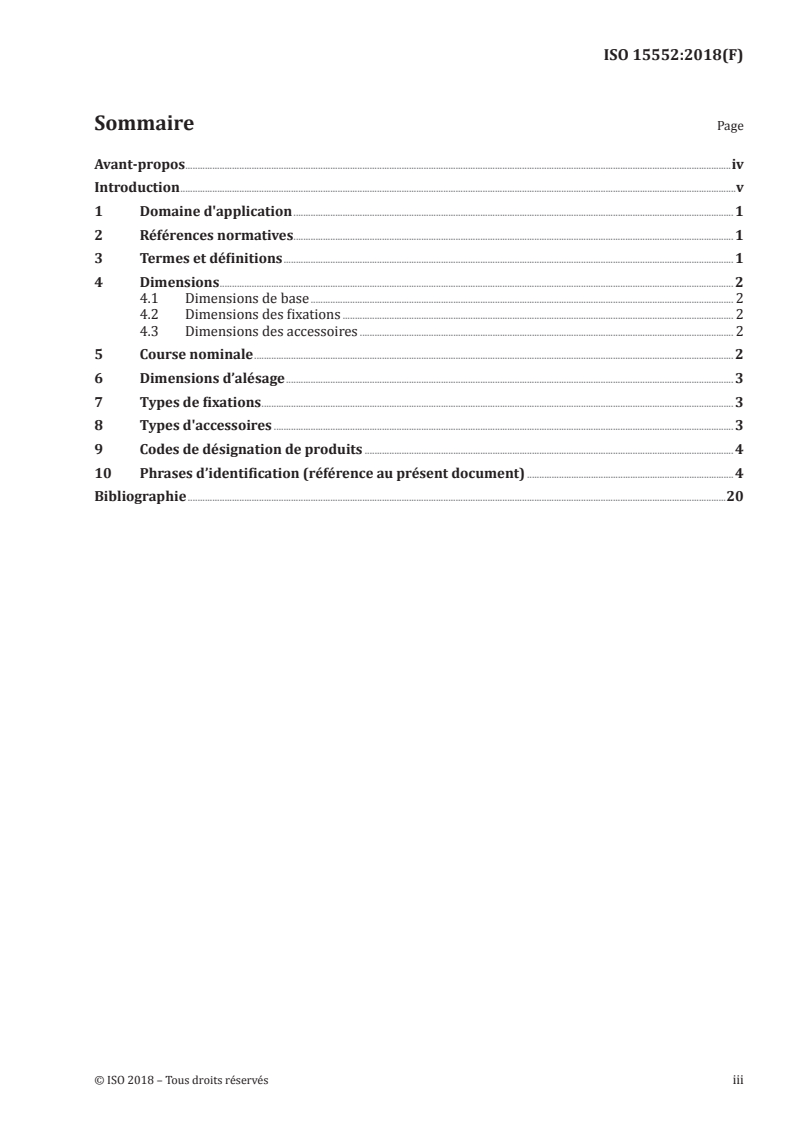
Sommaire Page
Avant-propos .iv
Introduction .v
1 Domaine d'application . 1
2 Références normatives . 1
3 Termes et définitions . 1
4 Dimensions . 2
4.1 Dimensions de base . 2
4.2 Dimensions des fixations . 2
4.3 Dimensions des accessoires . 2
5 Course nominale . 2
6 Dimensions d’alésage . 3
7 Types de fixations . 3
8 Types d'accessoires . 3
9 Codes de désignation de produits . 4
10 Phrases d’identification (référence au présent document) . 4
Bibliographie .20
Avant-propos
L'ISO (Organisation internationale de normalisation) est une fédération mondiale d'organismes
nationaux de normalisation (comités membres de l'ISO). L'élaboration des Normes internationales est
en général confiée aux comités techniques de l'ISO. Chaque comité membre intéressé par une étude
a le droit de faire partie du comité technique créé à cet effet. Les organisations internationales,
gouvernementales et non gouvernementales, en liaison avec l'ISO participent également aux travaux.
L'ISO collabore étroitement avec la Commission électrotechnique internationale (IEC) en ce qui
concerne la normalisation électrotechnique.
Les procédures utilisées pour élaborer le présent document et celles destinées à sa mise à jour sont
décrites dans les Directives ISO/IEC, Partie 1. Il convient, en particulier de prendre note des différents
critères d'approbation requis pour les différents types de documents ISO. Le présent document a été
rédigé conformément aux règles de rédaction données dans les Directives ISO/IEC, Partie 2 (voir www
.iso .org/ directives).
L'attention est attirée sur le fait que certains des éléments du présent document peuvent faire l'objet de
droits de propriété intellectuelle ou de droits analogues. L'ISO ne saurait être tenue pour responsable
de ne pas avoir identifié de tels droits de propriété et averti de leur existence. Les détails concernant
les références aux droits de propriété intellectuelle ou autres droits analogues identifiés lors de
l'élaboration du document sont indiqués dans l'Introduction et/ou dans la liste des déclarations de
brevets reçues par l'ISO (voir www .iso .org/ brevets).
Les appellations commerciales éventuellement mentionnées dans le présent document sont données
pour information, par souci de commodité, à l’intention des utilisateurs et ne sauraient constituer un
engagement.
Pour une explication de la nature volontaire des normes, la signification des termes et expressions
spécifiques de l'ISO liés à l'évaluation de la conformité, ou pour toute information au sujet de l'adhésion
de l'ISO aux principes de l’Organisation mondiale du commerce (OMC) concernant les obstacles
techniques au commerce (OTC), voir le lien suivant: www .iso .org/ avant -propos.
Le présent document a été élaboré par le comité technique ISO/TC 131, Transmissions hydrauliques et
pneumatiques, sous-comité SC 3, Vérins.
Cette deuxième édition annule et remplace la première (ISO 15552:2004), qui a fait l’objet d’une révision
technique.
Les principales modifications sont:
— Les symboles pour les accessoires ont été mis en homogénéité avec ceux de l’ISO 6099;
— Les caractéristiques de la tige de piston ont été ajoutées au 4.1;
— Des codes de désignation de produis ont été ajoutés;
— La taille de l'orifice pour chaque diamètre d'alésage du piston a été ajoutée à la rubrique «Dimensions
de base».
iv © ISO 2018 – Tous droits réservés
Introduction
Dans les systèmes de transmissions pneumatiques, la puissance est transmise et commandée par
l'intermédiaire d'un gaz sous pression circulant dans un circuit.
L'un des composants de ces systèmes est le vérin pneumatique. Il s'agit d'un appareil qui transforme
la puissance en force et en mouvement mécanique agissant linéairement. Il se compose d'un élément
mobile, c'est-à-dire un piston et une tige de piston se déplaçant dans un alésage cylindrique.
Pour leur permettre d'être reliés aux mécanismes utilisateurs, les vérins pneumatiques comportent en
outre des dispositifs appelés «fixations».
NORME INTERNATIONALE ISO 15552:2018(F)
Transmissions pneumatiques — Vérins avec fixations
détachables, série 1 000 kPa (10 bar), alésages de 32 mm
à 320 mm — Dimensions de base, des fixations et des
accessoires
1 Domaine d'application
Le présent document établit une série métrique des dimensions de base, des fixations et des accessoires
nécessaires pour l’interchangeabilité des vérins pneumatiques d’alésage 32 mm à 320 mm, à simple
ou double tige, avec ou sans disposition pour capteurs magnétiques pour une pression maximale de
fonctionnement de 1 000 kPa (10 bar).
Il s’applique aux vérins pneumatiques à fixations détachables.
2 Références normatives
Les documents suivants cités dans le texte constituent, pour tout ou partie de leur contenu, des
exigences du présent document. Pour les références datées, seule l’édition citée s’applique. Pour les
références non datées, la dernière édition du document de référence s’applique (y compris les éventuels
amendements).
ISO 273, Éléments de fixation — Trous de passage pour vis
ISO 3320, Transmissions et composants hydrauliques et pneumatiques — Alésages des vérins et diamètres
des tiges de piston et rapports de surface — Série métrique
ISO 4393, Transmissions hydrauliques et pneumatiques — Vérins — Série de base de courses de piston
ISO 4395, Transmissions hydrauliques et pneumatiques — Dimensions et types des extrémités des tiges de
pistons pour vérins
ISO 5598, Transmissions hydrauliques et pneumatiques — Vocabulaire
ISO 16030, Transmissions pneumatiques — Raccordements — Orifices et éléments mâles
3 Termes et définitions
Pour les besoins du présent document, les termes et définitions donnés dans l’ISO 5598 s’appliquent.
L’ISO et l’IEC tiennent à jour des bases de données terminologiques destinées à être utilisées en
normalisation, consultables aux adresses suivantes:
— IEC Electropedia: disponible à l’adresse http:// www .electropedia .org/
— ISO Online browsing platform: disponible à l’adresse https:// www .iso .org/ obp
4 Dimensions
4.1 Dimensions de base
Les dimensions de base sont données dans les Tableaux 2 et 3 et représentées dans les Figures 2 et 3.
Le diamètre de la tige de piston doit être plus important que le diamètre du filetage (KK) pour avoir un
épaulement après le filetage en bout de tige.
4.2 Dimensions des fixations
Les dimensions des fixations sont données dans les Tableaux 4 à 9 et représentées dans les Figures 4 à 9.
Le signe + placé à la suite des lettres signifie qu'il faut ajouter la course à la dimension réelle.
4.3 Dimensions des accessoires
Les dimensions des accessoires sont données dans les Tableaux 10 à 14 et représentées dans les
Figures 10 à 14.
Les tolérances des dimensions dépendantes de la course incluse dans les tableaux s'appliquent pour des
courses inférieure ou égale à 1 250 mm. Si les courses sont plus longues que 1 250 mm, il convient de
choisir les tolérances parmi les normes nationales ou par accord entre le constructeur et l'utilisateur.
5 Course nominale
5.1 Les courses nominales doivent être choisies parmi les valeurs recommandées données dans
l'ISO 4393.
5.2 Les tolérances sur courses nominales sont données dans le Tableau 1 et représentées dans la
Figure 1.
Figure 1 — Tolérances sur course nominale
2 © ISO 2018 – Tous droits réservés
Tableau 1 — Tolérances sur course nominale
Dimensions en millimètres
a
Alésage Course nominale Tolérance sur course nominale
AL S
+2
S ≤ 500
+32,
500 < S ≤ 1 250
+25,
S ≤ 500
+4
500 < S ≤ 1 250
+4
200 S ≤ 500
+5
500 < S ≤ 1 250
a
Voir 4.3, alinéa 2.
6 Dimensions d’alésage
Les dimensions d'alésage AL suivantes sont incluses dans cette série en conformité avec l'ISO 3320:
32 – 40 – 50 – 63 – 80 – 100 – 125 – 160 – 200 – 250 – 320 (en millimètres)
7 Types de fixations
Le présent document comprend les types de fixation suivants tels que décrits dans l'ISO 6099:
— MF1 Bride avant rectangulaire (voir Tableau 4 et Figure 4);
— MF2 Bride arrière rectangulaire (voir Tableau 4 et Figure 4);
— MP2 Cap, detachable clevis (voir Tableau 5 et Figure 5);
— MP4 Tenon arrière démontable (voir Tableau 6 et Figure 6);
— MP6 Tenon arrière démontable avec rotule (voir Tableau 7 et Figure 7);
— MS1 Pattes à l'équerre sur extrémités (voir Tableau 8 et Figure 8);
— MT4 Tourillon mâle intermédiaire fixe ou déplaçable (voir Tableau 9 et Figure 9).
8 Types d'accessoires
Le présent document comprend les types d'accessoires suivants tels que décrits dans l'ISO 6099:
— AA4-R Axe d'articulation lisse (clavette ou anneau d’arrêt) (voir Tableau 10 et Figure 10);
— AA4-S Axe d'articulation lisse (goupilles fendues) (voir Tableau 10 et Figure 10);
— AA6-R Axe d'articulation à rotule (clavette ou anneau d’arrêt) (voir Tableau 11 et Figure 11);
— AA6-S Axe d'articulation à rotule (goupilles fendues) (voir Tableau 11 et Figure 11);
— AB6 Chape rapportée à rotule, droite (voir Tableau 12 et Figure 12);
— AB7 Tenon rapporté, déporté (voir Tableau 13 et Figure 13);
— AT4 Tourillon rapporté (voir Tableau 14 et Figure 14).
9 Codes de désignation de produits
Un vérin pneumatique avec des fixations détachables, type de fixation = MT 4, alésage = 80 mm,
course = 200 mm, doit être désigné comme suit:
ISO 15552 – MT 4 – 80×200
10 Phrases d’identification (référence au présent document)
Utiliser la phrase d'identification suivante dans les rapports d'essai, catalogues et documentation
commerciale, lorsqu'il a été décidé de se conformer au présent document:
Dimensions de base, des fixations et des accessoires des vérins pneumatiques conformes l'ISO 15552
«Transmissions pneumatiques — Vérins avec fixations détachables, série 1 000 kPa (10 bar), a
...
NORME ISO
INTERNATIONALE 15552
Deuxième édition
2018-04
Transmissions pneumatiques —
Vérins avec fixations détachables,
série 1 000 kPa (10 bar), alésages de
32 mm à 320 mm — Dimensions de
base, des fixations et des accessoires
Pneumatic fluid power — Cylinders with detachable mountings, 1
000 kPa (10 bar) series, bores from 32 mm to 320 mm — Basic,
mounting and accessories dimensions
Numéro de référence
©
ISO 2018
DOCUMENT PROTÉGÉ PAR COPYRIGHT
© ISO 2018
Tous droits réservés. Sauf prescription différente ou nécessité dans le contexte de sa mise en oeuvre, aucune partie de cette
publication ne peut être reproduite ni utilisée sous quelque forme que ce soit et par aucun procédé, électronique ou mécanique,
y compris la photocopie, ou la diffusion sur l’internet ou sur un intranet, sans autorisation écrite préalable. Une autorisation peut
être demandée à l’ISO à l’adresse ci-après ou au comité membre de l’ISO dans le pays du demandeur.
ISO copyright office
Case postale 401 • Ch. de Blandonnet 8
CH-1214 Vernier, Geneva
Tél.: +41 22 749 01 11
Fax: +41 22 749 09 47
E-mail: copyright@iso.org
Web: www.iso.org
Publié en Suisse
ii © ISO 2018 – Tous droits réservés
Sommaire Page
Avant-propos .iv
Introduction .v
1 Domaine d'application . 1
2 Références normatives . 1
3 Termes et définitions . 1
4 Dimensions . 2
4.1 Dimensions de base . 2
4.2 Dimensions des fixations . 2
4.3 Dimensions des accessoires . 2
5 Course nominale . 2
6 Dimensions d’alésage . 3
7 Types de fixations . 3
8 Types d'accessoires . 3
9 Codes de désignation de produits . 4
10 Phrases d’identification (référence au présent document) . 4
Bibliographie .20
Avant-propos
L'ISO (Organisation internationale de normalisation) est une fédération mondiale d'organismes
nationaux de normalisation (comités membres de l'ISO). L'élaboration des Normes internationales est
en général confiée aux comités techniques de l'ISO. Chaque comité membre intéressé par une étude
a le droit de faire partie du comité technique créé à cet effet. Les organisations internationales,
gouvernementales et non gouvernementales, en liaison avec l'ISO participent également aux travaux.
L'ISO collabore étroitement avec la Commission électrotechnique internationale (IEC) en ce qui
concerne la normalisation électrotechnique.
Les procédures utilisées pour élaborer le présent document et celles destinées à sa mise à jour sont
décrites dans les Directives ISO/IEC, Partie 1. Il convient, en particulier de prendre note des différents
critères d'approbation requis pour les différents types de documents ISO. Le présent document a été
rédigé conformément aux règles de rédaction données dans les Directives ISO/IEC, Partie 2 (voir www
.iso .org/ directives).
L'attention est attirée sur le fait que certains des éléments du présent document peuvent faire l'objet de
droits de propriété intellectuelle ou de droits analogues. L'ISO ne saurait être tenue pour responsable
de ne pas avoir identifié de tels droits de propriété et averti de leur existence. Les détails concernant
les références aux droits de propriété intellectuelle ou autres droits analogues identifiés lors de
l'élaboration du document sont indiqués dans l'Introduction et/ou dans la liste des déclarations de
brevets reçues par l'ISO (voir www .iso .org/ brevets).
Les appellations commerciales éventuellement mentionnées dans le présent document sont données
pour information, par souci de commodité, à l’intention des utilisateurs et ne sauraient constituer un
engagement.
Pour une explication de la nature volontaire des normes, la signification des termes et expressions
spécifiques de l'ISO liés à l'évaluation de la conformité, ou pour toute information au sujet de l'adhésion
de l'ISO aux principes de l’Organisation mondiale du commerce (OMC) concernant les obstacles
techniques au commerce (OTC), voir le lien suivant: www .iso .org/ avant -propos.
Le présent document a été élaboré par le comité technique ISO/TC 131, Transmissions hydrauliques et
pneumatiques, sous-comité SC 3, Vérins.
Cette deuxième édition annule et remplace la première (ISO 15552:2004), qui a fait l’objet d’une révision
technique.
Les principales modifications sont:
— Les symboles pour les accessoires ont été mis en homogénéité avec ceux de l’ISO 6099;
— Les caractéristiques de la tige de piston ont été ajoutées au 4.1;
— Des codes de désignation de produis ont été ajoutés;
— La taille de l'orifice pour chaque diamètre d'alésage du piston a été ajoutée à la rubrique «Dimensions
de base».
iv © ISO 2018 – Tous droits réservés
Introduction
Dans les systèmes de transmissions pneumatiques, la puissance est transmise et commandée par
l'intermédiaire d'un gaz sous pression circulant dans un circuit.
L'un des composants de ces systèmes est le vérin pneumatique. Il s'agit d'un appareil qui transforme
la puissance en force et en mouvement mécanique agissant linéairement. Il se compose d'un élément
mobile, c'est-à-dire un piston et une tige de piston se déplaçant dans un alésage cylindrique.
Pour leur permettre d'être reliés aux mécanismes utilisateurs, les vérins pneumatiques comportent en
outre des dispositifs appelés «fixations».
NORME INTERNATIONALE ISO 15552:2018(F)
Transmissions pneumatiques — Vérins avec fixations
détachables, série 1 000 kPa (10 bar), alésages de 32 mm
à 320 mm — Dimensions de base, des fixations et des
accessoires
1 Domaine d'application
Le présent document établit une série métrique des dimensions de base, des fixations et des accessoires
nécessaires pour l’interchangeabilité des vérins pneumatiques d’alésage 32 mm à 320 mm, à simple
ou double tige, avec ou sans disposition pour capteurs magnétiques pour une pression maximale de
fonctionnement de 1 000 kPa (10 bar).
Il s’applique aux vérins pneumatiques à fixations détachables.
2 Références normatives
Les documents suivants cités dans le texte constituent, pour tout ou partie de leur contenu, des
exigences du présent document. Pour les références datées, seule l’édition citée s’applique. Pour les
références non datées, la dernière édition du document de référence s’applique (y compris les éventuels
amendements).
ISO 273, Éléments de fixation — Trous de passage pour vis
ISO 3320, Transmissions et composants hydrauliques et pneumatiques — Alésages des vérins et diamètres
des tiges de piston et rapports de surface — Série métrique
ISO 4393, Transmissions hydrauliques et pneumatiques — Vérins — Série de base de courses de piston
ISO 4395, Transmissions hydrauliques et pneumatiques — Dimensions et types des extrémités des tiges de
pistons pour vérins
ISO 5598, Transmissions hydrauliques et pneumatiques — Vocabulaire
ISO 16030, Transmissions pneumatiques — Raccordements — Orifices et éléments mâles
3 Termes et définitions
Pour les besoins du présent document, les termes et définitions donnés dans l’ISO 5598 s’appliquent.
L’ISO et l’IEC tiennent à jour des bases de données terminologiques destinées à être utilisées en
normalisation, consultables aux adresses suivantes:
— IEC Electropedia: disponible à l’adresse http:// www .electropedia .org/
— ISO Online browsing platform: disponible à l’adresse https:// www .iso .org/ obp
4 Dimensions
4.1 Dimensions de base
Les dimensions de base sont données dans les Tableaux 2 et 3 et représentées dans les Figures 2 et 3.
Le diamètre de la tige de piston doit être plus important que le diamètre du filetage (KK) pour avoir un
épaulement après le filetage en bout de tige.
4.2 Dimensions des fixations
Les dimensions des fixations sont données dans les Tableaux 4 à 9 et représentées dans les Figures 4 à 9.
Le signe + placé à la suite des lettres signifie qu'il faut ajouter la course à la dimension réelle.
4.3 Dimensions des accessoires
Les dimensions des accessoires sont données dans les Tableaux 10 à 14 et représentées dans les
Figures 10 à 14.
Les tolérances des dimensions dépendantes de la course incluse dans les tableaux s'appliquent pour des
courses inférieure ou égale à 1 250 mm. Si les courses sont plus longues que 1 250 mm, il convient de
choisir les tolérances parmi les normes nationales ou par accord entre le constructeur et l'utilisateur.
5 Course nominale
5.1 Les courses nominales doivent être choisies parmi les valeurs recommandées données dans
l'ISO 4393.
5.2 Les tolérances sur courses nominales sont données dans le Tableau 1 et représentées dans la
Figure 1.
Figure 1 — Tolérances sur course nominale
2 © ISO 2018 – Tous droits réservés
Tableau 1 — Tolérances sur course nominale
Dimensions en millimètres
a
Alésage Course nominale Tolérance sur course nominale
AL S
+2
S ≤ 500
+32,
500 < S ≤ 1 250
+25,
S ≤ 500
+4
500 < S ≤ 1 250
+4
200 S ≤ 500
+5
500 < S ≤ 1 250
a
Voir 4.3, alinéa 2.
6 Dimensions d’alésage
Les dimensions d'alésage AL suivantes sont incluses dans cette série en conformité avec l'ISO 3320:
32 – 40 – 50 – 63 – 80 – 100 – 125 – 160 – 200 – 250 – 320 (en millimètres)
7 Types de fixations
Le présent document comprend les types de fixation suivants tels que décrits dans l'ISO 6099:
— MF1 Bride avant rectangulaire (voir Tableau 4 et Figure 4);
— MF2 Bride arrière rectangulaire (voir Tableau 4 et Figure 4);
— MP2 Cap, detachable clevis (voir Tableau 5 et Figure 5);
— MP4 Tenon arrière démontable (voir Tableau 6 et Figure 6);
— MP6 Tenon arrière démontable avec rotule (voir Tableau 7 et Figure 7);
— MS1 Pattes à l'équerre sur extrémités (voir Tableau 8 et Figure 8);
— MT4 Tourillon mâle intermédiaire fixe ou déplaçable (voir Tableau 9 et Figure 9).
8 Types d'accessoires
Le présent document comprend les types d'accessoires suivants tels que décrits dans l'ISO 6099:
— AA4-R Axe d'articulation lisse (clavette ou anneau d’arrêt) (voir Tableau 10 et Figure 10);
— AA4-S Axe d'articulation lisse (goupilles fendues) (voir Tableau 10 et Figure 10);
— AA6-R Axe d'articulation à rotule (clavette ou anneau d’arrêt) (voir Tableau 11 et Figure 11);
— AA6-S Axe d'articulation à rotule (goupilles fendues) (voir Tableau 11 et Figure 11);
— AB6 Chape rapportée à rotule, droite (voir Tableau 12 et Figure 12);
— AB7 Tenon rapporté, déporté (voir Tableau 13 et Figure 13);
— AT4 Tourillon rapporté (voir Tableau 14 et Figure 14).
9 Codes de désignation de produits
Un vérin pneumatique avec des fixations détachables, type de fixation = MT 4, alésage = 80 mm,
course = 200 mm, doit être désigné comme suit:
ISO 15552 – MT 4 – 80×200
10 Phrases d’identification (référence au présent document)
Utiliser la phrase d'identification suivante dans les rapports d'essai, catalogues et documentation
commerciale, lorsqu'il a été décidé de se conformer au présent document:
Dimensions de base, des fixations et des accessoires des vérins pneumatiques conformes l'ISO 15552
«Transmissions pneumatiques — Vérins avec fixations détachables, série 1 000 kPa (10 bar), a
...