

ISO 25862:2019
(Main)Ships and marine technology — Marine magnetic compasses, binnacles and azimuth reading devices
General Information
- Abstract
This document specifies requirements for the construction and performance of marine magnetic compasses for navigation and steering purposes, binnacles and azimuth reading devices. Two types of binnacle are specified; the appropriate type for a given vessel is determined by the design of the ship (see Clause 5). This document applies to liquid-filled magnetic compasses: — intended for use in ship's navigation and steering in sea navigation; — having a direct reading system; and — which can be of the reflecting, projecting or transmitting types. In the context of this document, a magnetic compass is an instrument consisting of a directional system supported by a single pivot inside a bowl that is completely filled with liquid and supported by gimbals inside or outside the bowl. However, this document also addresses compasses without gimbals; the requirements relating to gimbals do not apply to such compasses. This document applies to magnetic compasses carried on board: a) all ships required to carry a standard compass as per SOLAS Chapter V, the Class A magnetic compass; b) lifeboats and rescue boats as per the IMO Lifesaving Appliances (LSA) Code, fitted with the Class B magnetic compass; and c) all ships to which a) and b) above do not apply, but which are fitted with a Class A or B magnetic compass. This document does not apply to: a) dry card compasses; b) types of compass designed on principles different from those stated above or not complying with the descriptions given; or c) hand bearing compasses. The requirements for the testing and certification of marine magnetic compasses, azimuth reading devices and binnacles are given in Annexes A, B, C, and D. The requirements for the positioning in ships, the determination of safe distances and the deviation adjustment of compasses are given in Annexes E, F and G, respectively. The special requirements of the magnetic compass for lifeboats/rescue boats are given in Annex H.
- Status
- Published
- Publication Date
- 11-Jul-2019
- Technical Committee
- ISO/TC 8/SC 6 - Navigation and ship operations
- Drafting Committee
- ISO/TC 8/SC 6/WG 3 - Magnetic compasses and binnacles
- Current Stage
- 9093 - International Standard confirmed
- Start Date
- 19-Sep-2025
- Completion Date
- 29-Aug-2026
Buy Documents


ISO 25862:2019 - Ships and marine technology -- Marine magnetic compasses, binnacles and azimuth reading devices
ISO 25862:2019 - Ships and marine technology — Marine magnetic compasses, binnacles and azimuth reading devices/12/2019
Overview
ISO 25862:2019 - "Ships and marine technology - Marine magnetic compasses, binnacles and azimuth reading devices" - specifies construction, performance and testing requirements for liquid-filled marine magnetic compasses, associated binnacles and azimuth reading devices used for ship navigation and steering. The standard covers compasses with a direct-reading system (reflecting, projecting or transmitting types) and defines two types of binnacles; the appropriate binnacle type is selected according to ship design (see Clause 5). It applies to Class A compasses (SOLAS-required standard compasses) and Class B compasses for lifeboats/rescue boats (IMO LSA Code), and excludes dry card compasses, hand-bearing compasses and devices using fundamentally different principles.
Key Topics and Technical Requirements
- Scope and applicability: liquid-filled, single-pivot directional systems supported inside a bowl; both gimballed and non-gimballed designs addressed.
- Construction and materials: magnetic materials, card position, top glass thickness (Class A), temperature and environmental conditions (Clauses 4 and 5).
- Directional system and dynamics: moment of inertia, suspension (Class A), magnetic moment, settling time, tilt and supporting forces.
- Compass card and readability: graduation intervals, card diameter and markings for Class A/B; visibility and lubber mark accuracy.
- Accuracy and errors: directional error, friction, swirl and induction errors, mounting errors for azimuth devices (Clause 4.6).
- Binnacle specifications: two binnacle types with requirements for correction provision, fore-and-aft marks, illumination and environmental tests (Clause 5).
- Azimuth reading devices: sights, vanes and level requirements (Clause 6).
- Testing, certification and installation: normative Annexes A–D cover testing/certification; Annexes E–G cover positioning on ship, determination of safe distances and deviation adjustment; Annex H gives lifeboat/rescue boat special requirements.
Practical Applications and Users
ISO 25862 is intended for:
- Marine equipment manufacturers (compass, binnacle and azimuth device designers)
- Shipbuilders and shipyards specifying navigation gear
- Classification societies and flag State surveyors for type approval and certification
- Lifeboat and rescue-boat equipment manufacturers (Class B requirements)
- Marine navigation officers and ship technical managers responsible for installation, adjustment and maintenance
- Maritime safety assessors and procurement teams seeking compliant navigation instruments
Using ISO 25862 helps ensure reliable heading information, reduced magnetic deviation risk, and regulatory compliance (SOLAS, IMO LSA).
Related Standards and References
- SOLAS Chapter V (navigation equipment requirements)
- IMO Lifesaving Appliances (LSA) Code (lifeboat compasses)
- ISO 1069 - Magnetic compasses and binnacles - Vocabulary
- Referenced bibliographic items in ISO 25862 (e.g., IMO Resolutions, EN standards)
Keywords: ISO 25862, marine magnetic compasses, binnacles, azimuth reading devices, Class A compass, Class B compass, SOLAS, lifeboats, compass testing, compass positioning, deviation adjustment.
Relations
- Effective Date
- 06-Jun-2022
- Effective Date
- 05-Nov-2015
Buy Documents
ISO 25862:2019 - Ships and marine technology -- Marine magnetic compasses, binnacles and azimuth reading devices
ISO 25862:2019 - Ships and marine technology — Marine magnetic compasses, binnacles and azimuth reading devices/12/2019
Get Certified
Connect with accredited certification bodies for this standard

DNV
DNV is an independent assurance and risk management provider.

Lloyd's Register
Lloyd's Register is a global professional services organisation specialising in engineering and technology.

FSC International
Forest Stewardship Council certification.
Sponsored listings
Frequently Asked Questions
ISO 25862:2019 is a standard published by the International Organization for Standardization (ISO). Its full title is "Ships and marine technology — Marine magnetic compasses, binnacles and azimuth reading devices". This standard covers: This document specifies requirements for the construction and performance of marine magnetic compasses for navigation and steering purposes, binnacles and azimuth reading devices. Two types of binnacle are specified; the appropriate type for a given vessel is determined by the design of the ship (see Clause 5). This document applies to liquid-filled magnetic compasses: — intended for use in ship's navigation and steering in sea navigation; — having a direct reading system; and — which can be of the reflecting, projecting or transmitting types. In the context of this document, a magnetic compass is an instrument consisting of a directional system supported by a single pivot inside a bowl that is completely filled with liquid and supported by gimbals inside or outside the bowl. However, this document also addresses compasses without gimbals; the requirements relating to gimbals do not apply to such compasses. This document applies to magnetic compasses carried on board: a) all ships required to carry a standard compass as per SOLAS Chapter V, the Class A magnetic compass; b) lifeboats and rescue boats as per the IMO Lifesaving Appliances (LSA) Code, fitted with the Class B magnetic compass; and c) all ships to which a) and b) above do not apply, but which are fitted with a Class A or B magnetic compass. This document does not apply to: a) dry card compasses; b) types of compass designed on principles different from those stated above or not complying with the descriptions given; or c) hand bearing compasses. The requirements for the testing and certification of marine magnetic compasses, azimuth reading devices and binnacles are given in Annexes A, B, C, and D. The requirements for the positioning in ships, the determination of safe distances and the deviation adjustment of compasses are given in Annexes E, F and G, respectively. The special requirements of the magnetic compass for lifeboats/rescue boats are given in Annex H.
This document specifies requirements for the construction and performance of marine magnetic compasses for navigation and steering purposes, binnacles and azimuth reading devices. Two types of binnacle are specified; the appropriate type for a given vessel is determined by the design of the ship (see Clause 5). This document applies to liquid-filled magnetic compasses: — intended for use in ship's navigation and steering in sea navigation; — having a direct reading system; and — which can be of the reflecting, projecting or transmitting types. In the context of this document, a magnetic compass is an instrument consisting of a directional system supported by a single pivot inside a bowl that is completely filled with liquid and supported by gimbals inside or outside the bowl. However, this document also addresses compasses without gimbals; the requirements relating to gimbals do not apply to such compasses. This document applies to magnetic compasses carried on board: a) all ships required to carry a standard compass as per SOLAS Chapter V, the Class A magnetic compass; b) lifeboats and rescue boats as per the IMO Lifesaving Appliances (LSA) Code, fitted with the Class B magnetic compass; and c) all ships to which a) and b) above do not apply, but which are fitted with a Class A or B magnetic compass. This document does not apply to: a) dry card compasses; b) types of compass designed on principles different from those stated above or not complying with the descriptions given; or c) hand bearing compasses. The requirements for the testing and certification of marine magnetic compasses, azimuth reading devices and binnacles are given in Annexes A, B, C, and D. The requirements for the positioning in ships, the determination of safe distances and the deviation adjustment of compasses are given in Annexes E, F and G, respectively. The special requirements of the magnetic compass for lifeboats/rescue boats are given in Annex H.
ISO 25862:2019 is classified under the following ICS (International Classification for Standards) categories: 47.020.70 - Navigation and control equipment. The ICS classification helps identify the subject area and facilitates finding related standards.
ISO 25862:2019 has the following relationships with other standards: It is inter standard links to ISO 25862:2019/Amd 1:2024, ISO 25862:2009. Understanding these relationships helps ensure you are using the most current and applicable version of the standard.
ISO 25862:2019 is available in PDF format for immediate download after purchase. The document can be added to your cart and obtained through the secure checkout process. Digital delivery ensures instant access to the complete standard document.
Standards Content (Sample)
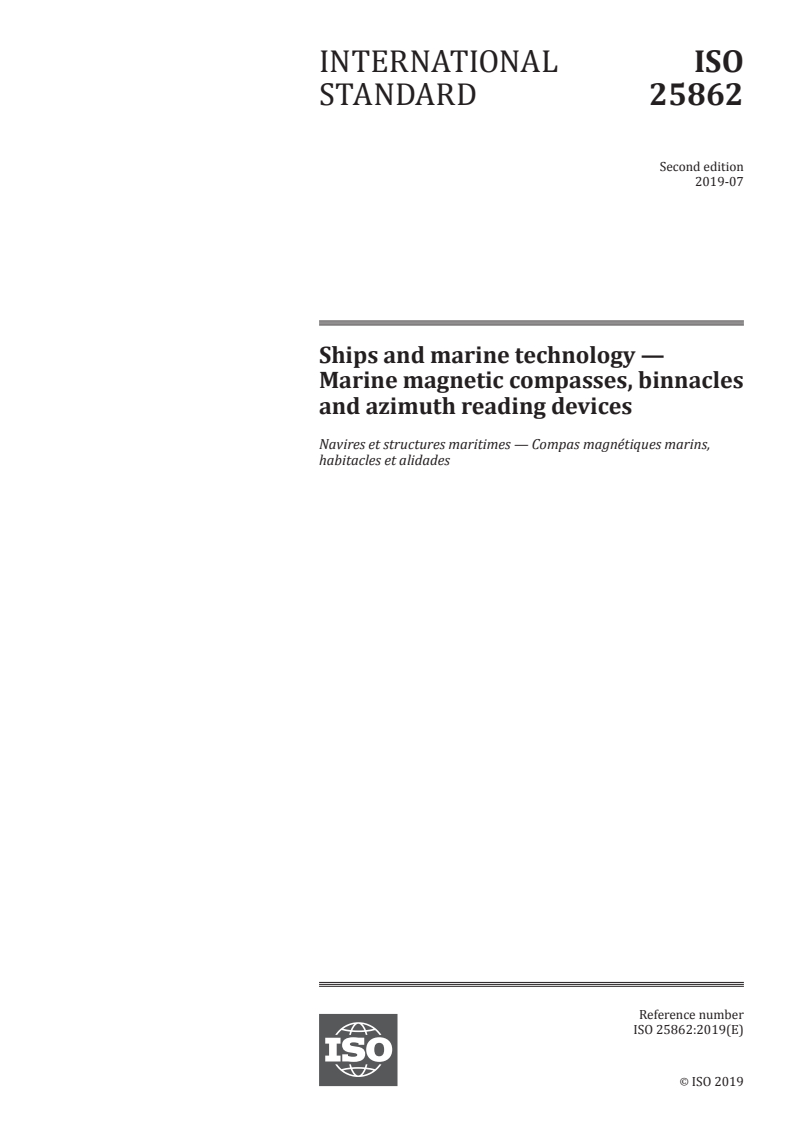
INTERNATIONAL ISO
STANDARD 25862
Second edition
2019-07
Ships and marine technology —
Marine magnetic compasses, binnacles
and azimuth reading devices
Navires et structures maritimes — Compas magnétiques marins,
habitacles et alidades
Reference number
©
ISO 2019
© ISO 2019
All rights reserved. Unless otherwise specified, or required in the context of its implementation, no part of this publication may
be reproduced or utilized otherwise in any form or by any means, electronic or mechanical, including photocopying, or posting
on the internet or an intranet, without prior written permission. Permission can be requested from either ISO at the address
below or ISO’s member body in the country of the requester.
ISO copyright office
CP 401 • Ch. de Blandonnet 8
CH-1214 Vernier, Geneva
Phone: +41 22 749 01 11
Fax: +41 22 749 09 47
Email: copyright@iso.org
Website: www.iso.org
Published in Switzerland
ii © ISO 2019 – All rights reserved
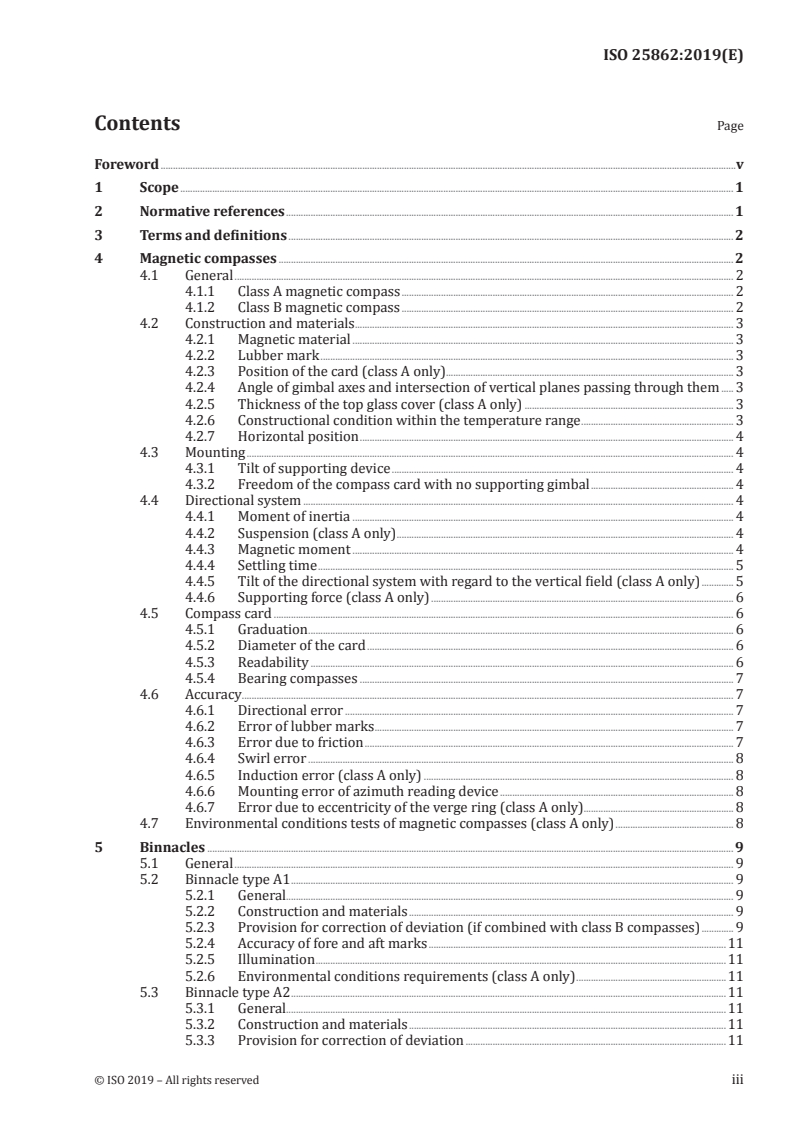
Contents Page
Foreword .v
1 Scope . 1
2 Normative references . 1
3 Terms and definitions . 2
4 Magnetic compasses . 2
4.1 General . 2
4.1.1 Class A magnetic compass . 2
4.1.2 Class B magnetic compass . 2
4.2 Construction and materials . 3
4.2.1 Magnetic material . 3
4.2.2 Lubber mark . 3
4.2.3 Position of the card (class A only) . 3
4.2.4 Angle of gimbal axes and intersection of vertical planes passing through them . 3
4.2.5 Thickness of the top glass cover (class A only) . 3
4.2.6 Constructional condition within the temperature range . 3
4.2.7 Horizontal position . 4
4.3 Mounting . 4
4.3.1 Tilt of supporting device . 4
4.3.2 Freedom of the compass card with no supporting gimbal . 4
4.4 Directional system . 4
4.4.1 Moment of inertia . 4
4.4.2 Suspension (class A only) . 4
4.4.3 Magnetic moment . 4
4.4.4 Settling time . 5
4.4.5 Tilt of the directional system with regard to the vertical field (class A only) . 5
4.4.6 Supporting force (class A only) . 6
4.5 Compass card . 6
4.5.1 Graduation . 6
4.5.2 Diameter of the card . 6
4.5.3 Readability . 6
4.5.4 Bearing compasses . 7
4.6 Accuracy . 7
4.6.1 Directional error . 7
4.6.2 Error of lubber marks . . 7
4.6.3 Error due to friction . 7
4.6.4 Swirl error . 8
4.6.5 Induction error (class A only) . 8
4.6.6 Mounting error of azimuth reading device . 8
4.6.7 Error due to eccentricity of the verge ring (class A only). 8
4.7 Environmental conditions tests of magnetic compasses (class A only) . 8
5 Binnacles . 9
5.1 General . 9
5.2 Binnacle type A1 . 9
5.2.1 General. 9
5.2.2 Construction and materials . 9
5.2.3 Provision for correction of deviation (if combined with class B compasses) . 9
5.2.4 Accuracy of fore and aft marks .11
5.2.5 Illumination .11
5.2.6 Environmental conditions requirements (class A only) .11
5.3 Binnacle type A2 .11
5.3.1 General.11
5.3.2 Construction and materials .11
5.3.3 Provision for correction of deviation .11
5.3.4 Accuracy of fore and aft marks .12
5.3.5 Illumination .13
5.3.6 Environmental conditions requirements (class A only) .13
6 Azimuth reading devices .13
6.1 General .13
6.2 Azimuth sight .13
6.3 Azimuth reading devices with vanes .13
6.4 Level .13
7 Marking .13
8 Designation .14
Annex A (normative) Testing and certification of marine magnetic compasses, binnacles
and azimuth reading devices — General requirements .15
Annex B (normative) Testing and certification of marine magnetic compasses .17
Annex C (normative) Testing and certification of azimuth reading devices .27
Annex D (normative) Type-testing and certification of binnacles .32
Annex E (normative) Positioning of magnetic compasses in ships .40
Annex F (normative) Determination of safe distances .45
Annex G (normative) Adjustment of magnetic compass deviation .46
Annex H (normative) Requirements of magnetic compass for lifeboats/rescue boats .48
Bibliography .49
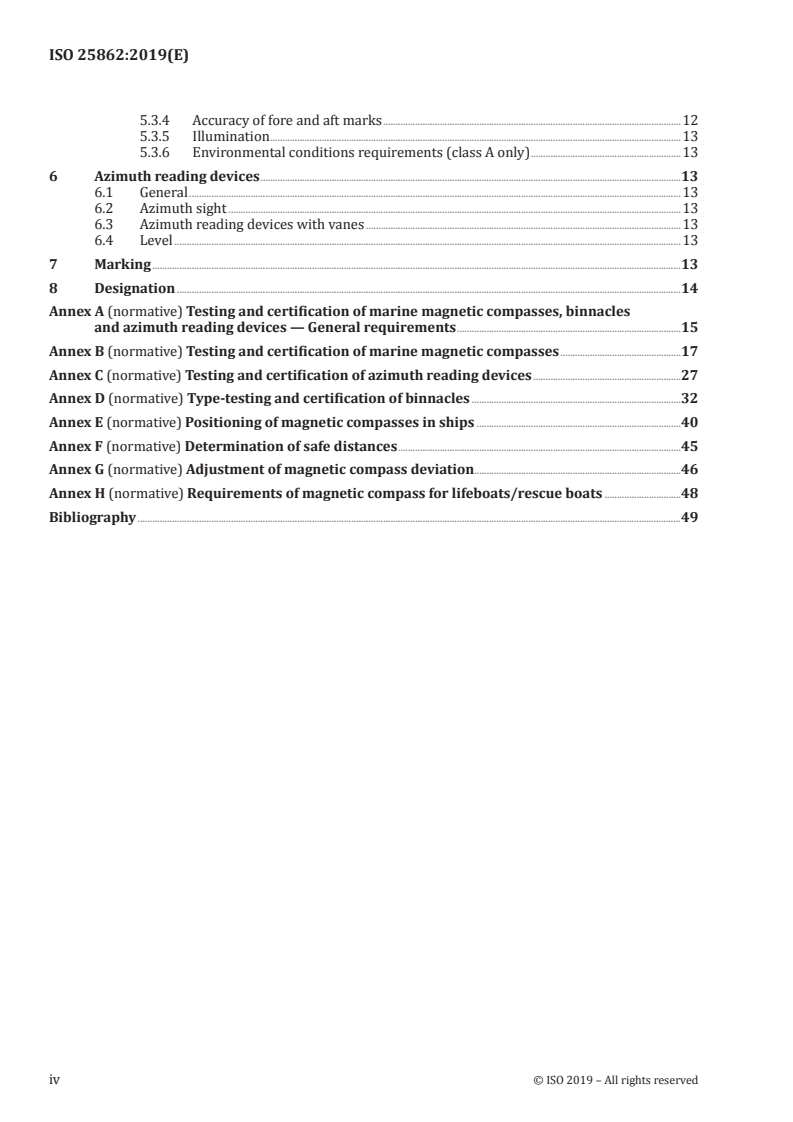
iv © ISO 2019 – All rights reserved
Foreword
ISO (the International Organization for Standardization) is a worldwide federation of national standards
bodies (ISO member bodies). The work of preparing International Standards is normally carried out
through ISO technical committees. Each member body interested in a subject for which a technical
committee has been established has the right to be represented on that committee. International
organizations, governmental and non-governmental, in liaison with ISO, also take part in the work.
ISO collaborates closely with the International Electrotechnical Commission (IEC) on all matters of
electrotechnical standardization.
The procedures used to develop this document and those intended for its further maintenance are
described in the ISO/IEC Directives, Part 1. In particular the different approval criteria needed for the
different types of ISO documents should be noted. This document was drafted in accordance with the
editorial rules of the ISO/IEC Directives, Part 2 (see www .iso .org/directives).
Attention is drawn to the possibility that some of the elements of this document may be the subject of
patent rights. ISO shall not be held responsible for identifying any or all such patent rights. Details of
any patent rights identified during the development of the document will be in the Introduction and/or
on the ISO list of patent declarations received (see www .iso .org/patents).
Any trade name used in this document is information given for the convenience of users and does not
constitute an endorsement.
For an explanation of the voluntary nature of standards, the meaning of ISO specific terms and
expressions related to conformity assessment, as well as information about ISO's adherence to the
World Trade Organization (WTO) principles in the Technical Barriers to Trade (TBT), see www .iso
.org/iso/foreword .html.
This document was prepared by Technical Committee ISO/TC 8, Ships and marine technology,
Subcommittee SC 6, Navigation and ship operations.
This second edition cancels and replaces the first edition (ISO 25862:2009), which has been technically
revised.
The main changes compared to the previous edition are as follows:
— Clause 1: an overview of the annexes was added.
— Clause 2: moved IMO Resolution A. 382 (X) to the Bibliography.
— Clause 3: 3.4 and 3.5 were added.
— Clause 4: 4.1 was added. The temperature range of Class B magnetic compasses was changed to
“−30 °C to +60 °C” (4.2.6). The magnetic moment of Class B magnetic compasses was added to
Figure 1. Table 2 was updated (Equal interval of the graduation of Class B magnetic compasses was
changed to “1°, 2°, 2,5° or 5°”. Card numbered of Class B magnetic compasses was changed to “Every
30° or every 10°”.) and 4.7 was updated.
— Clause 5: 5.1, 5.2.1, and 5.3.1 were added. 5.2.6 and 5.3.6 were updated.
— Clause 6: 6.1 was added.
— Annex D: D.2.4.1 and D.2.6.1 were added.
— Annex H: H.2.1 was added.
— Bibliography: IMO Resolution A. 382 (X) and EN 166 were added.
Any feedback or questions on this document should be directed to the user’s national standards body. A
complete listing of these bodies can be found at www .iso .org/members .html.
INTERNATIONAL STANDARD ISO 25862:2019(E)
Ships and marine technology — Marine magnetic
compasses, binnacles and azimuth reading devices
1 Scope
This document specifies requirements for the construction and performance of marine magnetic
compasses for navigation and steering purposes, binnacles and azimuth reading devices.
Two types of binnacle are specified; the appropriate type for a given vessel is determined by the design
of the ship (see Clause 5).
This document applies to liquid-filled magnetic compasses:
— intended for use in ship's navigation and steering in sea navigation;
— having a direct reading system; and
— which can be of the reflecting, projecting or transmitting types.
In the context of this document, a magnetic compass is an instrument consisting of a directional system
supported by a single pivot inside a bowl that is completely filled with liquid and supported by gimbals
inside or outside the bowl. However, this document also addresses compasses without gimbals; the
requirements relating to gimbals do not apply to such compasses.
This document applies to magnetic compasses carried on board:
a) all ships required to carry a standard compass as per SOLAS Chapter V, the Class A magnetic
compass;
b) lifeboats and rescue boats as per the IMO Lifesaving Appliances (LSA) Code, fitted with the Class B
magnetic compass; and
c) all ships to which a) and b) above do not apply, but which are fitted with a Class A or B magnetic
compass.
This document does not apply to:
a) dry card compasses;
b) types of compass designed on principles different from those stated above or not complying with
the descriptions given; or
c) hand bearing compasses.
The requirements for the testing and certification of marine magnetic compasses, azimuth reading
devices and binnacles are given in Annexes A, B, C, and D. The requirements for the positioning in ships,
the determination of safe distances and the deviation adjustment of compasses are given in Annexes E,
F and G, respectively. The special requirements of the magnetic compass for lifeboats/rescue boats are
given in Annex H.
2 Normative references
The following documents are referred to in the text in such a way that some or all of their content
constitutes requirements of this document. For dated references, only the edition cited applies. For
undated references, the latest edition of the referenced document (including any amendments) applies.
ISO 1069, Magnetic compasses and binnacles for sea navigation — Vocabulary
lEC 60945, Maritime navigation and radiocommunication equipment and systems — General
requirements — Methods of testing and required test results
3 Terms and definitions
For the purposes of this document, the terms and definitions given in ISO 1069 and the following apply.
ISO and IEC maintain terminological databases for use in standardization at the following addresses:
— ISO Online browsing platform: available at https: //www .iso .org/obp
— IEC Electropedia: available at http: //www .electropedia .org/
3.1
magnetic control sensor
sensor using the geomagnetic field for feeding an automatic heading-control system, or controlling an
off-course alarm unit, or feeding other devices
3.2
minimum distance
distance measured between the nearest point of magnetic material which is part of the ship's structure
and the centre of the compass
Note 1 to entry: The minimum distance for a standard compass is given in Figure E.1 and for a steering compass
is given in Figure E.2.
3.3
safe distance
distance measured between the nearest point of the item concerned and the centre of the compass
Note 1 to entry: The safe distance is determined as specified in Annex F.
3.4
settling time
time taken to return finally to within ±1° of the magnetic meridian after an initial deflection of 90°
from that meridian
3.5
pelorus
device used for taking bearings of distant objects or the sun, which are obscured from view at the
compass position and whose altitudes are between 5° below and 30° above the horizontal
4 Magnetic compasses
4.1 General
4.1.1 Class A magnetic compass
— intended for ship's navigation and steering purposes in sea navigation;
— liquid-filled magnetic compass, with or without gimbals; and
— having a direct reading system, which can be of the reflecting, projecting or transmitting types.
4.1.2 Class B magnetic compass
— intended for sea navigation on board ships for "restricted service, lifeboats or rescue boats";
— liquid-filled magnetic compasses, with or without gimbals; and
2 © ISO 2019 – All rights reserved
— having a direct reading system; which can be of the reflecting, projecting or transmitting types.
4.2 Construction and materials
4.2.1 Magnetic material
The magnets used in the directional systems of magnetic compasses shall be of a suitable magnetic
material having a high remanence and coercivity of at least 18 kA/m. All other fixtures used in magnetic
compasses, other than transmitting compasses, shall be made of non-magnetic material.
4.2.2 Lubber mark
In class A compasses, the distance between the lubber mark and the outer edge of the card shall be
between 1,5 mm and 3,0 mm for direct reading and reflecting types and between 0,5 mm and 1,5 mm
for projecting compasses. The width of the lubber mark shall not be greater than 0,5° of the graduation
of the card.
In class B compasses, the compass shall be fitted with at least one lubber mark, indicating the direction
of the ships head (the main lubber mark). Additional lubber marks are permissible.
The lubber mark shall be of such design as to allow the compass to be read from the steering position
when the bowl is tilted 10° in the case of a gimbal compass or 30° in other cases.
4.2.3 Position of the card (class A only)
When the verge ring and the seating for the azimuth reading device are both horizontal, the graduated
edge of the card, the lubber mark if a point, the pivot point and the outer gimbal axis shall lie within
1 mm of the horizontal plane passing through the gimbal axis fixed to the bowl.
4.2.4 Angle of gimbal axes and intersection of vertical planes passing through them
The angle formed by the outer and inner gimbal axes shall be of the values given in Table 1. The vertical
planes through the gimbal axes shall intersect to within 1 mm of the pivot point. Any end play shall not
cause these tolerances to be exceeded.
Table 1 — Angle of gimbal axes
Magnetic compasses Angle of gimbal axes
Class A (90 ± 1)°
Class B (90 ± 2)°
The outer gimbal axis shall be in the fore and aft direction. For compasses without gimbals, which are
also covered by this document, the requirements relating to gimbals do not apply.
4.2.5 Thickness of the top glass cover (class A only)
The thickness of the top glass cover and of the bottom glass of the compass shall be not less than
4,5 mm, if non-toughened, and not less than 3,0 mm, if toughened. These values do not apply to the
thickness of the top glass in hemispherical compasses. If material other than glass is used, it shall fulfil
the requirement of B.1 d).
4.2.6 Constructional condition within the temperature range
All class A and class B compasses shall operate satisfactorily throughout the temperature range −30 °C
to +60 °C, and:
a) the liquid in the compass bowl shall remain clear and free from bubbles and neither emulsify
nor freeze;
b) there shall be neither inward leakage of air nor outward leakage of liquid. No bubble shall form
in a compass unless it is specially provided to compensate for expansion. A bubble provided in a
compass to compensate for expansion shall not inconvenience the functioning and reading of the
compass;
c) the internal paint shall not blister, crack or discolour appreciably;
d) the supporting force shall be such that the directional system always remains in contact with
its pivot;
e) the material of the compass card shall not distort.
4.2.7 Horizontal position
The compass bowl shall be balanced so that its verge ring or top glass cover settles within 2° of the
horizontal plane when the gimbal ring is fixed in a horizontal position; this shall be so with, or without,
an azimuth reading device or magnifying glass is in place.
4.3 Mounting
4.3.1 Tilt of supporting device
The bowl of the compass shall be mounted in such a manner that the compass cannot be dislodged
under any conditions of sea or weather and so that the verge ring remains within 2° of the horizontal
plane when the binnacle is tilted in any direction to a maximum of:
a) 40° for class A compasses, and
b) 30° for class B compasses.
The inner and outer gimbal bearings shall be of the same type.
4.3.2 Freedom of the compass card with no supporting gimbal
In compasses in which no supporting gimbal is provided, the card shall be free to move at least 30° in
all directions.
4.4 Directional system
4.4.1 Moment of inertia
The moment of inertia of the directional system shall be approximately the same about all horizontal
axes passing through the point of support on the pivot jewel.
4.4.2 Suspension (class A only)
The directional system shall be retained in position by suitable means and remain free when the bowl
is tilted 10° in any direction.
4.4.3 Magnetic moment
The magnetic moment of the magnets in the directional system shall not be less than the value given in
Figure 1.
4 © ISO 2019 – All rights reserved
Key
X card diameter, expressed in mm
Y magnetic moment, expressed in A·m
class A magnetic compass
class B magnetic compass
Figure 1 — Magnetic moment of liquid filled compasses (minimum requirements)
4.4.4 Settling time
The settling time of a directional system shall not exceed 240/ H s at a temperature of (20 ± 3) °C,
where H is the horizontal component of the magnetic flux density in microteslas (µT) at the place of
testing.
4.4.5 Tilt of the directional system with regard to the vertical field (class A only)
The directional system shall be so constructed, or balanced in such a way, that it does not incline more
than 0,5° from the horizontal plane when the vertical flux density is zero. The inclination shall not
change by more than 3° when the vertical flux density changes by 100 μT.
4.4.6 Supporting force (class A only)
The force exerted on the pivot bearing, in the liquid used at a temperature of (20 ± 3) °C, by the
directional system shall be between 0,04 N and 0,14 N.
4.5 Compass card
4.5.1 Graduation
The compass card shall be graduated in 360 single degrees, starting from North in the clockwise
direction as viewed from above. The marks shall be at intervals as given in Table 2. In addition, as given
in Table 2, at least every ten degrees (class A) and every ten or thirty degrees (class B) shall be marked
with their corresponding three figure number (e.g. 030). North shall be indicated by “000°”.
The cardinal points shall be indicated by the capital letters “N”, “S”, “E” and “W”; the intermediate points
may also be marked. Alternatively, the North point may be indicated by a suitable symbol.
Table 2 — Graduation of the card
Magnetic compasses Equal interval of the graduation Card numbered
Class A 1° Every 10°
Every 30°or
Class B 1°, 2°, 2,5° or 5°
every 10°
Where the compass card is printed on both sides, the graduations shall coincide with a tolerance of 0,2°.
4.5.2 Diameter of the card
The diameter of the compass cards shall be as given in Table 3.
Table 3 — Diameter of the card
Magnetic compasses Binnacle types Diameter of the card
A1 165 mm or more
Class A
A2 125 mm or more
A1
Class B 125 mm or more
A2
NOTE 1 Binnacle types are defined in 5.2 (Type A1) and 5.3 (Type A2).
NOTE 2 The required diameter of a compass card for use in lifeboats/rescue boats is given
in H.2.2.
4.5.3 Readability
Steering compasses of each class shall be able to be read by a person with normal vision at a distance
from the magnetic compasses as given in Table 4 in both daylight and artificial light, the graduations
on the card being contained within a sector whose width is not less than 15° to each side of the lubber
mark. The use of a magnifying glass is permitted.
For reflecting and projecting compasses, the lubber mark shall be visible, and the 30° sector of the card
shall be readable by a person with normal vision at a distance of 1 m from the reproduced compass image.
Table 4 — Readable distance
Magnetic compasses Readable distance of compasses
Class A 1,4 m
Class B 1,0 m
6 © ISO 2019 – All rights reserved
4.5.4 Bearing compasses
If a bearing compass is provided with a scale for the measurement of bearings relative to the ship's
head, the scale shall be graduated in degrees from 0° to 360° in a clockwise direction, where zero, as
seen through the azimuth reading device, indicates the direction of the ship's head.
4.6 Accuracy
4.6.1 Directional error
The directional error results from inaccuracies in the construction of a directional system. It is
composed of:
a) misalignment between magnet orientation and the graduation of the system compass card
(collimation error);
b) inaccuracies of the compass card graduation;
c) eccentricity of the compass card graduation in relation to the centre of rotation of the card.
Irrespective of heading, the directional error shall not exceed the values given in Table 5.
Table 5 — Directional error
Magnetic compasses Permissible directional error
Class A 0,5°
Class B 1,5°
In transmitting magnetic compasses, the directional error applies to the compass without magnetic
sensor and electronics for generating a suitable output signal for other devices. The magnetic sensor
of a transmitting magnetic compass shall be placed so that the influence on the card heading shall not
exceed 0,5° in the case of class A.
NOTE If the test is undertaken in the compass bowl, the resulting value then includes the deviation due to
any magnetic material in the compass and/or in the magnetic sensor and electronics for generating a suitable
output signal for other devices.
4.6.2 Error of lubber marks
The lubber error is a constructional error of the compass bowl and gimbal, which depends on the
relative position of the main lubber mark (if it is fixed), the pivot bearing, and the direction of the outer
gimbal axis.
No lubber error shall exceed the values given in Table 6.
Table 6 — Lubber error
Magnetic compasses Permissible lubber error
Class A 0,5°
Class B 1,0°
4.6.3 Error due to friction
With the compass at a temperature of (20 ± 3) °C, the card is given an initial deflection (for values see
Table 8) first on one side of the meridian and then on the other. It shall return to its original position
within the values given in Table 7, where H is as defined in 4.4.4.
Table 7 — Friction error
Magnetic compasses Initial deflection Permissible friction error
Class A 2° Less than (3/H)°
Class B 5° Less than (9/H)°
4.6.4 Swirl error
With the compass at a temperature of (20 ± 3) °C and rotating at a uniform angular speed of 6°/s in the
horizontal plane, the card deflection from the magnetic meridian when the bowl has been rotated 180°
shall not exceed the values given in Table 8.
Alternatively, when rotating at a uniform angular speed of 1,5°/s, the card deflection, measured after
the bowl has been rotated 360°, shall at no point exceed the values given in Table 8, where H is as
defined in 4.4.4.
Table 8 — Swirl error
Permissible card deflection
Magnetic compasses
Angular speed: 6°/s Angular speed: 1,5°/s
measured after 180° rotation measured after 360° rotation
Card diameter: 200 mm or more (54/H)°
Class A
Card diameter: less than 200 mm (108/H)° (36/H)°
Class B (40/H)°
4.6.5 Induction error (class A only)
If the arrangement of magnetic elements in a directional system is inadequate, magnetic induction in
correctors (soft iron spheres or similar conventional correctors) of coefficient D due to those elements
results in a compass error. Such an error is described as induction error.
In order to avoid the effect of induction error, one of the following requirements shall be fulfilled:
a) the ratio of coefficient H to coefficient D shall not exceed 0,08; or
b) the coefficient F of the sextantal deviation (caused by a small magnet, less than 50 mm in length —
placed in the same horizontal plane as the magnetic elements and at a tangential distance of about
40 cm from the centre of the directional system) shall be less than 0,01 of coefficient B of the
semicircular deviation.
NOTE The coefficients B, D, F, and H are defined in ISO 1069.
4.6.6 Mounting error of azimuth reading device
Where the azimuth reading device is pivoted on an arrangement within the compass bowl, the vertical
axis of the device shall be within 0,5 mm of the pivot point.
4.6.7 Error due to eccentricity of the verge ring (class A only)
If the verge ring is graduated, the perpendicular to the plane of this ring through the centre of the
graduations shall be within 0,5 mm of the pivot point.
4.7 Environmental conditions tests of magnetic compasses (class A only)
The magnetic compass shall be subjected to, and meet the requirements of, the following environmental
tests specified in IEC 60945:
a) damp heat;
8 © ISO 2019 – All rights reserved
b) rain and spray.
Optionally, the vibration test may be additionally carried out assembled in the binnacle as specified in
IEC 60945.
NOTE Environmental conditions tests of the magnetic compass for lifeboat/rescue boats are given in H.2.4.
5 Binnacles
5.1 General
There are two types of binnacle that may be used in ships, type A1 or type A2. Selection of the correct
type to be used is dependent upon the nature of the ship in which the binnacle will be fixed. Descriptions
of, and performance requirements for, the two types are given in 5.2 and 5.3.
Magnetic compasses and binnacles are combined to be used as shown in Table 9.
Table 9 — Types of binnacles
Magnetic compasses Binnacles
Class A Type A1 Type A2
Class B Type A1 Type A2
5.2 Binnacle type A1
5.2.1 General
Binnacles type A1 shall be of such a height that the magnets of the directional system of the compass
are at least 1,0 m above the bottom-most part of the binnacle deck fittings and meet the requirements
given in 5.2.2 to 5.2.6.
5.2.2 Construction and materials
5.2.2.1 Only high-quality non-magnetic materials of sufficient strength shall be used for the
construction of type A1 binnacles and the helmet and boxes, brackets and holding-down bolts.
5.2.2.2 Provision shall be made in the binnacle to allow correction of any misalignment thereof in
respect of the fore and aft line of the ship, by an angle of not less than 4° and not more than 6°.
5.2.3 Provision for correction of deviation (if combined with class B compasses)
5.2.3.1 Material
Where corrector magnets are used, they shall be of a suitable magnetic material of high remanence and
coercivity of not less than 11,2 kA/m.
Material used for correcting induced fields shall have a high permeability, a low coercivity and a
negligible remanence.
Built-in magnets shall be capable of being put into a neutral position or be removable. Built-in magnets
for B and C correction shall not produce a heeling error.
5.2.3.2 Compensation for horizontal permanent magnetism
Type A1 binnacles shall contain a device for correcting the deviation due to the horizontal components
of the ship's permanent magnetism. This device shall be capable of correcting a coefficient B of up to at
least (720/H)° and a coefficient C of up to at least (720/H)°, where H is as defined in 4.4.4.
Provision shall be made in type A1 binnacles so that no magnets of the correcting system come so close
to the directional system as to distort the field and produce a deviation of more than (20/H)° on any
heading, and at any angle of heel or pitch up to 15°.
NOTE The coefficients B and C are defined in ISO 1069.
5.2.3.3 Correction for heeling error
Type A1 binnacles shall contain a device for correcting the heeling error. This device shall be adjustable
and capable of providing a vertical magnetic field at the magnets of the directional system over the
range +75 µT to −75 µT.
Provision shall be made in type A1 binnacles so that no magnets of the correcting system come so close
to the directional system as to distort the field and produce a deviation of more than (20/H)° on any
heading, and at any angle of heel or pitch up to 15°, where H is as defined in 4.4.4.
5.2.3.4 Compensation for horizontal induced fields due to the horizontal component of the
Earth's magnetic field in the soft iron in a ship
Type A1 binnacles shall be provided with a device for compensating the horizontal magnetic fields due
to induction caused by the horizontal component of the Earth's magnetic field in the soft iron in a ship.
This device shall be capable of correcting a coefficient D of up to 10°.
When binnacles are vertical, and compensation is effected by soft iron spheres or other soft iron
arrangements, the centre of the device shall not be further than 15 mm from the horizontal plane
passing through the magnetic element of the directional system.
NOTE The coefficient D is defined in ISO 1069.
5.2.3.5 Compensation for horizontal induced fields due to the vertical component of the Earth’s
magnetic field in the soft iron in a ship
Type A1 binnacles shall be provided with a device for compensating the horizontal magnetic fields due
to induction caused by the vertical component of the Earth's magnetic fields in the soft iron in a ship.
When a Flinders' bar is used, it may be hollow, provided the diameter of the hole does not exceed 40 %
of the diameter of the bar.
When binnacles are vertical, the magnetic pole of the compensating device shall lie in the same
horizontal plane as the centres of the magnets of the directional system. When a Flinders' bar is used,
its magnetic pole shall be taken at 1/12 of its length from the end.
5.2.3.6 Positions and attachment of correcting devices
Provision shall be made in type A1 binnacles for recording the positions of the correcting devices
referred to in 5.2.3.2, 5.2.3.3 and 5.2.3.4.
Provision shall be made for all correcting devices to be satisfactorily secured after adjustment.
5.2.3.7 Corrector coils
Provision may be made for the fitting of corrector coils to provide compensation if the ship is fitted
with degaussing coils.
10 © ISO 2019 – All rights reserved
5.2.4 Accuracy of fore and aft marks
Where fore and aft marks are provided on binnacles, they shall be in the same vertical plane to within
0,5° as the axis of the fore and aft gimbal bearings.
5.2.5 Illumination
A type A1 binnacle shall, at least, contain adequate provision for the illuminating of the card and the
lubber mark by a light source supplied from the ship's normal electrical supply and from an emergency
supply. An alternative electrical power supply from the main distribution system may be provided.
Projector and reflector binnacles shall provide a clear image readable by a person at the helm position.
A device shall be provided for dimming the electric light.
The electric lamps, fittings and wirings shall have no influence on the directional system.
5.2.6 Environmental conditions requirements (class A only)
Type A1 binnacles shall satisfy the following tests specified in IEC 60945:
a) damp heat;
b) rain and spray; and
c) corrosion (salt mist).
Optionally, the vibration test may be additionally carried out as specified in IEC 60945.
5.3 Binnacle type A2
5.3.1 General
Type A2 binnacles are used in sea navigation when the design of the ship makes the provision of a full-
sized binnacle impracticable.
With regard to height, there are no requirements provided that binnacles meet the requirements given
in 5.3.2 to 5.3.6.
5.3.2 Construction and materials
Only high-quality non-magnetic material of sufficient strength shall be used.
5.3.3 Provision for correction of deviation
5.3.3.1 Material
Where correcting magnets are used, they shall be of suitable magnetic material of high remanence and
coercivity not less than 11,2 kA/m.
Material used for correcting induced fields shall have a high permeability, a low coercivity and a low
remanence.
5.3.3.2 Compensation for horizontal permanent magnetism
Type A2 binnacles shall contain a device for correcting the deviation due to the horizontal components
of the ship's permanent magnetism. This device shall be capable of correcting a coefficient B of up to at
least (720/H)° and a coefficient C of up to at least (720/H)°, where H is as defined in 4.4.4.
Provision shall be made in type A2 binnacles so that no magnets of the correcting system come so close
to the directional system as to distort the field and produce a deviation of more than (40/H)° on any
heading, and any angle of heel or pitch up to 15°.
NOTE The coefficients B and C are defined in ISO 1069.
5.3.3.3 Correction for heeling error
Type A2 binnacles shall contain a device for correcting the heeling error. This device shall be adjustable
and capable of providing a vertical field at the position of the directional system over the range of
+75 µT to −75 µT.
Provision shall be made in type A2 binnacles so that no magnets of the correcting system come so close
to the directional system as to distort the field and produce a deviation of more than (80/H)° on any
heading, at any angle of heel or pitch up to 15°, where H is as defined in 4.4.4.
The magnetic fields produced by the devices referred to in 5.3.3.2 and 5.3.3.3 shall be as uniform as
possible in the space swept by the directional system and should in no case introduce a significant
sextantal error.
5.3.3.4 Compensation for horizontal induced fields due to the horizontal component of the
Earth's magnetic field in the soft iron of the ship
Type A2 binnacles may be provided with a device for compensating the horizontal magnetic fields due
to induction caused by the horizontal component of the Earth's magnetic field in the soft iron of the
ship. This device shall be capable of correcting a coefficient D of up to 7°.
When type A2 binnacles are vertical and compensation is effected by spheres, the centre of the device
shall not be further than 15 mm from the horizontal plane passing through the magnetic element of the
directional system.
NOTE The coefficient D is defined in ISO 1069.
5.3.3.5 Compensation for horizontal induced fields due to the vertical component of the Earth's
magnetic field in the soft iron of the ship
Type A2 binnacles may be provided with a dev
...
INTERNATIONAL ISO
STANDARD 25862
Second edition
2019-07
Ships and marine technology —
Marine magnetic compasses, binnacles
and azimuth reading devices
Navires et structures maritimes — Compas magnétiques marins,
habitacles et alidades
Reference number
©
ISO 2019
© ISO 2019
All rights reserved. Unless otherwise specified, or required in the context of its implementation, no part of this publication may
be reproduced or utilized otherwise in any form or by any means, electronic or mechanical, including photocopying, or posting
on the internet or an intranet, without prior written permission. Permission can be requested from either ISO at the address
below or ISO’s member body in the country of the requester.
ISO copyright office
CP 401 • Ch. de Blandonnet 8
CH-1214 Vernier, Geneva
Phone: +41 22 749 01 11
Fax: +41 22 749 09 47
Email: copyright@iso.org
Website: www.iso.org
Published in Switzerland
ii © ISO 2019 – All rights reserved
Contents Page
Foreword .v
1 Scope . 1
2 Normative references . 1
3 Terms and definitions . 2
4 Magnetic compasses . 2
4.1 General . 2
4.1.1 Class A magnetic compass . 2
4.1.2 Class B magnetic compass . 2
4.2 Construction and materials . 3
4.2.1 Magnetic material . 3
4.2.2 Lubber mark . 3
4.2.3 Position of the card (class A only) . 3
4.2.4 Angle of gimbal axes and intersection of vertical planes passing through them . 3
4.2.5 Thickness of the top glass cover (class A only) . 3
4.2.6 Constructional condition within the temperature range . 3
4.2.7 Horizontal position . 4
4.3 Mounting . 4
4.3.1 Tilt of supporting device . 4
4.3.2 Freedom of the compass card with no supporting gimbal . 4
4.4 Directional system . 4
4.4.1 Moment of inertia . 4
4.4.2 Suspension (class A only) . 4
4.4.3 Magnetic moment . 4
4.4.4 Settling time . 5
4.4.5 Tilt of the directional system with regard to the vertical field (class A only) . 5
4.4.6 Supporting force (class A only) . 6
4.5 Compass card . 6
4.5.1 Graduation . 6
4.5.2 Diameter of the card . 6
4.5.3 Readability . 6
4.5.4 Bearing compasses . 7
4.6 Accuracy . 7
4.6.1 Directional error . 7
4.6.2 Error of lubber marks . . 7
4.6.3 Error due to friction . 7
4.6.4 Swirl error . 8
4.6.5 Induction error (class A only) . 8
4.6.6 Mounting error of azimuth reading device . 8
4.6.7 Error due to eccentricity of the verge ring (class A only). 8
4.7 Environmental conditions tests of magnetic compasses (class A only) . 8
5 Binnacles . 9
5.1 General . 9
5.2 Binnacle type A1 . 9
5.2.1 General. 9
5.2.2 Construction and materials . 9
5.2.3 Provision for correction of deviation (if combined with class B compasses) . 9
5.2.4 Accuracy of fore and aft marks .11
5.2.5 Illumination .11
5.2.6 Environmental conditions requirements (class A only) .11
5.3 Binnacle type A2 .11
5.3.1 General.11
5.3.2 Construction and materials .11
5.3.3 Provision for correction of deviation .11
5.3.4 Accuracy of fore and aft marks .12
5.3.5 Illumination .13
5.3.6 Environmental conditions requirements (class A only) .13
6 Azimuth reading devices .13
6.1 General .13
6.2 Azimuth sight .13
6.3 Azimuth reading devices with vanes .13
6.4 Level .13
7 Marking .13
8 Designation .14
Annex A (normative) Testing and certification of marine magnetic compasses, binnacles
and azimuth reading devices — General requirements .15
Annex B (normative) Testing and certification of marine magnetic compasses .17
Annex C (normative) Testing and certification of azimuth reading devices .27
Annex D (normative) Type-testing and certification of binnacles .32
Annex E (normative) Positioning of magnetic compasses in ships .40
Annex F (normative) Determination of safe distances .45
Annex G (normative) Adjustment of magnetic compass deviation .46
Annex H (normative) Requirements of magnetic compass for lifeboats/rescue boats .48
Bibliography .49
iv © ISO 2019 – All rights reserved
Foreword
ISO (the International Organization for Standardization) is a worldwide federation of national standards
bodies (ISO member bodies). The work of preparing International Standards is normally carried out
through ISO technical committees. Each member body interested in a subject for which a technical
committee has been established has the right to be represented on that committee. International
organizations, governmental and non-governmental, in liaison with ISO, also take part in the work.
ISO collaborates closely with the International Electrotechnical Commission (IEC) on all matters of
electrotechnical standardization.
The procedures used to develop this document and those intended for its further maintenance are
described in the ISO/IEC Directives, Part 1. In particular the different approval criteria needed for the
different types of ISO documents should be noted. This document was drafted in accordance with the
editorial rules of the ISO/IEC Directives, Part 2 (see www .iso .org/directives).
Attention is drawn to the possibility that some of the elements of this document may be the subject of
patent rights. ISO shall not be held responsible for identifying any or all such patent rights. Details of
any patent rights identified during the development of the document will be in the Introduction and/or
on the ISO list of patent declarations received (see www .iso .org/patents).
Any trade name used in this document is information given for the convenience of users and does not
constitute an endorsement.
For an explanation of the voluntary nature of standards, the meaning of ISO specific terms and
expressions related to conformity assessment, as well as information about ISO's adherence to the
World Trade Organization (WTO) principles in the Technical Barriers to Trade (TBT), see www .iso
.org/iso/foreword .html.
This document was prepared by Technical Committee ISO/TC 8, Ships and marine technology,
Subcommittee SC 6, Navigation and ship operations.
This second edition cancels and replaces the first edition (ISO 25862:2009), which has been technically
revised.
The main changes compared to the previous edition are as follows:
— Clause 1: an overview of the annexes was added.
— Clause 2: moved IMO Resolution A. 382 (X) to the Bibliography.
— Clause 3: 3.4 and 3.5 were added.
— Clause 4: 4.1 was added. The temperature range of Class B magnetic compasses was changed to
“−30 °C to +60 °C” (4.2.6). The magnetic moment of Class B magnetic compasses was added to
Figure 1. Table 2 was updated (Equal interval of the graduation of Class B magnetic compasses was
changed to “1°, 2°, 2,5° or 5°”. Card numbered of Class B magnetic compasses was changed to “Every
30° or every 10°”.) and 4.7 was updated.
— Clause 5: 5.1, 5.2.1, and 5.3.1 were added. 5.2.6 and 5.3.6 were updated.
— Clause 6: 6.1 was added.
— Annex D: D.2.4.1 and D.2.6.1 were added.
— Annex H: H.2.1 was added.
— Bibliography: IMO Resolution A. 382 (X) and EN 166 were added.
Any feedback or questions on this document should be directed to the user’s national standards body. A
complete listing of these bodies can be found at www .iso .org/members .html.
INTERNATIONAL STANDARD ISO 25862:2019(E)
Ships and marine technology — Marine magnetic
compasses, binnacles and azimuth reading devices
1 Scope
This document specifies requirements for the construction and performance of marine magnetic
compasses for navigation and steering purposes, binnacles and azimuth reading devices.
Two types of binnacle are specified; the appropriate type for a given vessel is determined by the design
of the ship (see Clause 5).
This document applies to liquid-filled magnetic compasses:
— intended for use in ship's navigation and steering in sea navigation;
— having a direct reading system; and
— which can be of the reflecting, projecting or transmitting types.
In the context of this document, a magnetic compass is an instrument consisting of a directional system
supported by a single pivot inside a bowl that is completely filled with liquid and supported by gimbals
inside or outside the bowl. However, this document also addresses compasses without gimbals; the
requirements relating to gimbals do not apply to such compasses.
This document applies to magnetic compasses carried on board:
a) all ships required to carry a standard compass as per SOLAS Chapter V, the Class A magnetic
compass;
b) lifeboats and rescue boats as per the IMO Lifesaving Appliances (LSA) Code, fitted with the Class B
magnetic compass; and
c) all ships to which a) and b) above do not apply, but which are fitted with a Class A or B magnetic
compass.
This document does not apply to:
a) dry card compasses;
b) types of compass designed on principles different from those stated above or not complying with
the descriptions given; or
c) hand bearing compasses.
The requirements for the testing and certification of marine magnetic compasses, azimuth reading
devices and binnacles are given in Annexes A, B, C, and D. The requirements for the positioning in ships,
the determination of safe distances and the deviation adjustment of compasses are given in Annexes E,
F and G, respectively. The special requirements of the magnetic compass for lifeboats/rescue boats are
given in Annex H.
2 Normative references
The following documents are referred to in the text in such a way that some or all of their content
constitutes requirements of this document. For dated references, only the edition cited applies. For
undated references, the latest edition of the referenced document (including any amendments) applies.
ISO 1069, Magnetic compasses and binnacles for sea navigation — Vocabulary
lEC 60945, Maritime navigation and radiocommunication equipment and systems — General
requirements — Methods of testing and required test results
3 Terms and definitions
For the purposes of this document, the terms and definitions given in ISO 1069 and the following apply.
ISO and IEC maintain terminological databases for use in standardization at the following addresses:
— ISO Online browsing platform: available at https: //www .iso .org/obp
— IEC Electropedia: available at http: //www .electropedia .org/
3.1
magnetic control sensor
sensor using the geomagnetic field for feeding an automatic heading-control system, or controlling an
off-course alarm unit, or feeding other devices
3.2
minimum distance
distance measured between the nearest point of magnetic material which is part of the ship's structure
and the centre of the compass
Note 1 to entry: The minimum distance for a standard compass is given in Figure E.1 and for a steering compass
is given in Figure E.2.
3.3
safe distance
distance measured between the nearest point of the item concerned and the centre of the compass
Note 1 to entry: The safe distance is determined as specified in Annex F.
3.4
settling time
time taken to return finally to within ±1° of the magnetic meridian after an initial deflection of 90°
from that meridian
3.5
pelorus
device used for taking bearings of distant objects or the sun, which are obscured from view at the
compass position and whose altitudes are between 5° below and 30° above the horizontal
4 Magnetic compasses
4.1 General
4.1.1 Class A magnetic compass
— intended for ship's navigation and steering purposes in sea navigation;
— liquid-filled magnetic compass, with or without gimbals; and
— having a direct reading system, which can be of the reflecting, projecting or transmitting types.
4.1.2 Class B magnetic compass
— intended for sea navigation on board ships for "restricted service, lifeboats or rescue boats";
— liquid-filled magnetic compasses, with or without gimbals; and
2 © ISO 2019 – All rights reserved
— having a direct reading system; which can be of the reflecting, projecting or transmitting types.
4.2 Construction and materials
4.2.1 Magnetic material
The magnets used in the directional systems of magnetic compasses shall be of a suitable magnetic
material having a high remanence and coercivity of at least 18 kA/m. All other fixtures used in magnetic
compasses, other than transmitting compasses, shall be made of non-magnetic material.
4.2.2 Lubber mark
In class A compasses, the distance between the lubber mark and the outer edge of the card shall be
between 1,5 mm and 3,0 mm for direct reading and reflecting types and between 0,5 mm and 1,5 mm
for projecting compasses. The width of the lubber mark shall not be greater than 0,5° of the graduation
of the card.
In class B compasses, the compass shall be fitted with at least one lubber mark, indicating the direction
of the ships head (the main lubber mark). Additional lubber marks are permissible.
The lubber mark shall be of such design as to allow the compass to be read from the steering position
when the bowl is tilted 10° in the case of a gimbal compass or 30° in other cases.
4.2.3 Position of the card (class A only)
When the verge ring and the seating for the azimuth reading device are both horizontal, the graduated
edge of the card, the lubber mark if a point, the pivot point and the outer gimbal axis shall lie within
1 mm of the horizontal plane passing through the gimbal axis fixed to the bowl.
4.2.4 Angle of gimbal axes and intersection of vertical planes passing through them
The angle formed by the outer and inner gimbal axes shall be of the values given in Table 1. The vertical
planes through the gimbal axes shall intersect to within 1 mm of the pivot point. Any end play shall not
cause these tolerances to be exceeded.
Table 1 — Angle of gimbal axes
Magnetic compasses Angle of gimbal axes
Class A (90 ± 1)°
Class B (90 ± 2)°
The outer gimbal axis shall be in the fore and aft direction. For compasses without gimbals, which are
also covered by this document, the requirements relating to gimbals do not apply.
4.2.5 Thickness of the top glass cover (class A only)
The thickness of the top glass cover and of the bottom glass of the compass shall be not less than
4,5 mm, if non-toughened, and not less than 3,0 mm, if toughened. These values do not apply to the
thickness of the top glass in hemispherical compasses. If material other than glass is used, it shall fulfil
the requirement of B.1 d).
4.2.6 Constructional condition within the temperature range
All class A and class B compasses shall operate satisfactorily throughout the temperature range −30 °C
to +60 °C, and:
a) the liquid in the compass bowl shall remain clear and free from bubbles and neither emulsify
nor freeze;
b) there shall be neither inward leakage of air nor outward leakage of liquid. No bubble shall form
in a compass unless it is specially provided to compensate for expansion. A bubble provided in a
compass to compensate for expansion shall not inconvenience the functioning and reading of the
compass;
c) the internal paint shall not blister, crack or discolour appreciably;
d) the supporting force shall be such that the directional system always remains in contact with
its pivot;
e) the material of the compass card shall not distort.
4.2.7 Horizontal position
The compass bowl shall be balanced so that its verge ring or top glass cover settles within 2° of the
horizontal plane when the gimbal ring is fixed in a horizontal position; this shall be so with, or without,
an azimuth reading device or magnifying glass is in place.
4.3 Mounting
4.3.1 Tilt of supporting device
The bowl of the compass shall be mounted in such a manner that the compass cannot be dislodged
under any conditions of sea or weather and so that the verge ring remains within 2° of the horizontal
plane when the binnacle is tilted in any direction to a maximum of:
a) 40° for class A compasses, and
b) 30° for class B compasses.
The inner and outer gimbal bearings shall be of the same type.
4.3.2 Freedom of the compass card with no supporting gimbal
In compasses in which no supporting gimbal is provided, the card shall be free to move at least 30° in
all directions.
4.4 Directional system
4.4.1 Moment of inertia
The moment of inertia of the directional system shall be approximately the same about all horizontal
axes passing through the point of support on the pivot jewel.
4.4.2 Suspension (class A only)
The directional system shall be retained in position by suitable means and remain free when the bowl
is tilted 10° in any direction.
4.4.3 Magnetic moment
The magnetic moment of the magnets in the directional system shall not be less than the value given in
Figure 1.
4 © ISO 2019 – All rights reserved
Key
X card diameter, expressed in mm
Y magnetic moment, expressed in A·m
class A magnetic compass
class B magnetic compass
Figure 1 — Magnetic moment of liquid filled compasses (minimum requirements)
4.4.4 Settling time
The settling time of a directional system shall not exceed 240/ H s at a temperature of (20 ± 3) °C,
where H is the horizontal component of the magnetic flux density in microteslas (µT) at the place of
testing.
4.4.5 Tilt of the directional system with regard to the vertical field (class A only)
The directional system shall be so constructed, or balanced in such a way, that it does not incline more
than 0,5° from the horizontal plane when the vertical flux density is zero. The inclination shall not
change by more than 3° when the vertical flux density changes by 100 μT.
4.4.6 Supporting force (class A only)
The force exerted on the pivot bearing, in the liquid used at a temperature of (20 ± 3) °C, by the
directional system shall be between 0,04 N and 0,14 N.
4.5 Compass card
4.5.1 Graduation
The compass card shall be graduated in 360 single degrees, starting from North in the clockwise
direction as viewed from above. The marks shall be at intervals as given in Table 2. In addition, as given
in Table 2, at least every ten degrees (class A) and every ten or thirty degrees (class B) shall be marked
with their corresponding three figure number (e.g. 030). North shall be indicated by “000°”.
The cardinal points shall be indicated by the capital letters “N”, “S”, “E” and “W”; the intermediate points
may also be marked. Alternatively, the North point may be indicated by a suitable symbol.
Table 2 — Graduation of the card
Magnetic compasses Equal interval of the graduation Card numbered
Class A 1° Every 10°
Every 30°or
Class B 1°, 2°, 2,5° or 5°
every 10°
Where the compass card is printed on both sides, the graduations shall coincide with a tolerance of 0,2°.
4.5.2 Diameter of the card
The diameter of the compass cards shall be as given in Table 3.
Table 3 — Diameter of the card
Magnetic compasses Binnacle types Diameter of the card
A1 165 mm or more
Class A
A2 125 mm or more
A1
Class B 125 mm or more
A2
NOTE 1 Binnacle types are defined in 5.2 (Type A1) and 5.3 (Type A2).
NOTE 2 The required diameter of a compass card for use in lifeboats/rescue boats is given
in H.2.2.
4.5.3 Readability
Steering compasses of each class shall be able to be read by a person with normal vision at a distance
from the magnetic compasses as given in Table 4 in both daylight and artificial light, the graduations
on the card being contained within a sector whose width is not less than 15° to each side of the lubber
mark. The use of a magnifying glass is permitted.
For reflecting and projecting compasses, the lubber mark shall be visible, and the 30° sector of the card
shall be readable by a person with normal vision at a distance of 1 m from the reproduced compass image.
Table 4 — Readable distance
Magnetic compasses Readable distance of compasses
Class A 1,4 m
Class B 1,0 m
6 © ISO 2019 – All rights reserved
4.5.4 Bearing compasses
If a bearing compass is provided with a scale for the measurement of bearings relative to the ship's
head, the scale shall be graduated in degrees from 0° to 360° in a clockwise direction, where zero, as
seen through the azimuth reading device, indicates the direction of the ship's head.
4.6 Accuracy
4.6.1 Directional error
The directional error results from inaccuracies in the construction of a directional system. It is
composed of:
a) misalignment between magnet orientation and the graduation of the system compass card
(collimation error);
b) inaccuracies of the compass card graduation;
c) eccentricity of the compass card graduation in relation to the centre of rotation of the card.
Irrespective of heading, the directional error shall not exceed the values given in Table 5.
Table 5 — Directional error
Magnetic compasses Permissible directional error
Class A 0,5°
Class B 1,5°
In transmitting magnetic compasses, the directional error applies to the compass without magnetic
sensor and electronics for generating a suitable output signal for other devices. The magnetic sensor
of a transmitting magnetic compass shall be placed so that the influence on the card heading shall not
exceed 0,5° in the case of class A.
NOTE If the test is undertaken in the compass bowl, the resulting value then includes the deviation due to
any magnetic material in the compass and/or in the magnetic sensor and electronics for generating a suitable
output signal for other devices.
4.6.2 Error of lubber marks
The lubber error is a constructional error of the compass bowl and gimbal, which depends on the
relative position of the main lubber mark (if it is fixed), the pivot bearing, and the direction of the outer
gimbal axis.
No lubber error shall exceed the values given in Table 6.
Table 6 — Lubber error
Magnetic compasses Permissible lubber error
Class A 0,5°
Class B 1,0°
4.6.3 Error due to friction
With the compass at a temperature of (20 ± 3) °C, the card is given an initial deflection (for values see
Table 8) first on one side of the meridian and then on the other. It shall return to its original position
within the values given in Table 7, where H is as defined in 4.4.4.
Table 7 — Friction error
Magnetic compasses Initial deflection Permissible friction error
Class A 2° Less than (3/H)°
Class B 5° Less than (9/H)°
4.6.4 Swirl error
With the compass at a temperature of (20 ± 3) °C and rotating at a uniform angular speed of 6°/s in the
horizontal plane, the card deflection from the magnetic meridian when the bowl has been rotated 180°
shall not exceed the values given in Table 8.
Alternatively, when rotating at a uniform angular speed of 1,5°/s, the card deflection, measured after
the bowl has been rotated 360°, shall at no point exceed the values given in Table 8, where H is as
defined in 4.4.4.
Table 8 — Swirl error
Permissible card deflection
Magnetic compasses
Angular speed: 6°/s Angular speed: 1,5°/s
measured after 180° rotation measured after 360° rotation
Card diameter: 200 mm or more (54/H)°
Class A
Card diameter: less than 200 mm (108/H)° (36/H)°
Class B (40/H)°
4.6.5 Induction error (class A only)
If the arrangement of magnetic elements in a directional system is inadequate, magnetic induction in
correctors (soft iron spheres or similar conventional correctors) of coefficient D due to those elements
results in a compass error. Such an error is described as induction error.
In order to avoid the effect of induction error, one of the following requirements shall be fulfilled:
a) the ratio of coefficient H to coefficient D shall not exceed 0,08; or
b) the coefficient F of the sextantal deviation (caused by a small magnet, less than 50 mm in length —
placed in the same horizontal plane as the magnetic elements and at a tangential distance of about
40 cm from the centre of the directional system) shall be less than 0,01 of coefficient B of the
semicircular deviation.
NOTE The coefficients B, D, F, and H are defined in ISO 1069.
4.6.6 Mounting error of azimuth reading device
Where the azimuth reading device is pivoted on an arrangement within the compass bowl, the vertical
axis of the device shall be within 0,5 mm of the pivot point.
4.6.7 Error due to eccentricity of the verge ring (class A only)
If the verge ring is graduated, the perpendicular to the plane of this ring through the centre of the
graduations shall be within 0,5 mm of the pivot point.
4.7 Environmental conditions tests of magnetic compasses (class A only)
The magnetic compass shall be subjected to, and meet the requirements of, the following environmental
tests specified in IEC 60945:
a) damp heat;
8 © ISO 2019 – All rights reserved
b) rain and spray.
Optionally, the vibration test may be additionally carried out assembled in the binnacle as specified in
IEC 60945.
NOTE Environmental conditions tests of the magnetic compass for lifeboat/rescue boats are given in H.2.4.
5 Binnacles
5.1 General
There are two types of binnacle that may be used in ships, type A1 or type A2. Selection of the correct
type to be used is dependent upon the nature of the ship in which the binnacle will be fixed. Descriptions
of, and performance requirements for, the two types are given in 5.2 and 5.3.
Magnetic compasses and binnacles are combined to be used as shown in Table 9.
Table 9 — Types of binnacles
Magnetic compasses Binnacles
Class A Type A1 Type A2
Class B Type A1 Type A2
5.2 Binnacle type A1
5.2.1 General
Binnacles type A1 shall be of such a height that the magnets of the directional system of the compass
are at least 1,0 m above the bottom-most part of the binnacle deck fittings and meet the requirements
given in 5.2.2 to 5.2.6.
5.2.2 Construction and materials
5.2.2.1 Only high-quality non-magnetic materials of sufficient strength shall be used for the
construction of type A1 binnacles and the helmet and boxes, brackets and holding-down bolts.
5.2.2.2 Provision shall be made in the binnacle to allow correction of any misalignment thereof in
respect of the fore and aft line of the ship, by an angle of not less than 4° and not more than 6°.
5.2.3 Provision for correction of deviation (if combined with class B compasses)
5.2.3.1 Material
Where corrector magnets are used, they shall be of a suitable magnetic material of high remanence and
coercivity of not less than 11,2 kA/m.
Material used for correcting induced fields shall have a high permeability, a low coercivity and a
negligible remanence.
Built-in magnets shall be capable of being put into a neutral position or be removable. Built-in magnets
for B and C correction shall not produce a heeling error.
5.2.3.2 Compensation for horizontal permanent magnetism
Type A1 binnacles shall contain a device for correcting the deviation due to the horizontal components
of the ship's permanent magnetism. This device shall be capable of correcting a coefficient B of up to at
least (720/H)° and a coefficient C of up to at least (720/H)°, where H is as defined in 4.4.4.
Provision shall be made in type A1 binnacles so that no magnets of the correcting system come so close
to the directional system as to distort the field and produce a deviation of more than (20/H)° on any
heading, and at any angle of heel or pitch up to 15°.
NOTE The coefficients B and C are defined in ISO 1069.
5.2.3.3 Correction for heeling error
Type A1 binnacles shall contain a device for correcting the heeling error. This device shall be adjustable
and capable of providing a vertical magnetic field at the magnets of the directional system over the
range +75 µT to −75 µT.
Provision shall be made in type A1 binnacles so that no magnets of the correcting system come so close
to the directional system as to distort the field and produce a deviation of more than (20/H)° on any
heading, and at any angle of heel or pitch up to 15°, where H is as defined in 4.4.4.
5.2.3.4 Compensation for horizontal induced fields due to the horizontal component of the
Earth's magnetic field in the soft iron in a ship
Type A1 binnacles shall be provided with a device for compensating the horizontal magnetic fields due
to induction caused by the horizontal component of the Earth's magnetic field in the soft iron in a ship.
This device shall be capable of correcting a coefficient D of up to 10°.
When binnacles are vertical, and compensation is effected by soft iron spheres or other soft iron
arrangements, the centre of the device shall not be further than 15 mm from the horizontal plane
passing through the magnetic element of the directional system.
NOTE The coefficient D is defined in ISO 1069.
5.2.3.5 Compensation for horizontal induced fields due to the vertical component of the Earth’s
magnetic field in the soft iron in a ship
Type A1 binnacles shall be provided with a device for compensating the horizontal magnetic fields due
to induction caused by the vertical component of the Earth's magnetic fields in the soft iron in a ship.
When a Flinders' bar is used, it may be hollow, provided the diameter of the hole does not exceed 40 %
of the diameter of the bar.
When binnacles are vertical, the magnetic pole of the compensating device shall lie in the same
horizontal plane as the centres of the magnets of the directional system. When a Flinders' bar is used,
its magnetic pole shall be taken at 1/12 of its length from the end.
5.2.3.6 Positions and attachment of correcting devices
Provision shall be made in type A1 binnacles for recording the positions of the correcting devices
referred to in 5.2.3.2, 5.2.3.3 and 5.2.3.4.
Provision shall be made for all correcting devices to be satisfactorily secured after adjustment.
5.2.3.7 Corrector coils
Provision may be made for the fitting of corrector coils to provide compensation if the ship is fitted
with degaussing coils.
10 © ISO 2019 – All rights reserved
5.2.4 Accuracy of fore and aft marks
Where fore and aft marks are provided on binnacles, they shall be in the same vertical plane to within
0,5° as the axis of the fore and aft gimbal bearings.
5.2.5 Illumination
A type A1 binnacle shall, at least, contain adequate provision for the illuminating of the card and the
lubber mark by a light source supplied from the ship's normal electrical supply and from an emergency
supply. An alternative electrical power supply from the main distribution system may be provided.
Projector and reflector binnacles shall provide a clear image readable by a person at the helm position.
A device shall be provided for dimming the electric light.
The electric lamps, fittings and wirings shall have no influence on the directional system.
5.2.6 Environmental conditions requirements (class A only)
Type A1 binnacles shall satisfy the following tests specified in IEC 60945:
a) damp heat;
b) rain and spray; and
c) corrosion (salt mist).
Optionally, the vibration test may be additionally carried out as specified in IEC 60945.
5.3 Binnacle type A2
5.3.1 General
Type A2 binnacles are used in sea navigation when the design of the ship makes the provision of a full-
sized binnacle impracticable.
With regard to height, there are no requirements provided that binnacles meet the requirements given
in 5.3.2 to 5.3.6.
5.3.2 Construction and materials
Only high-quality non-magnetic material of sufficient strength shall be used.
5.3.3 Provision for correction of deviation
5.3.3.1 Material
Where correcting magnets are used, they shall be of suitable magnetic material of high remanence and
coercivity not less than 11,2 kA/m.
Material used for correcting induced fields shall have a high permeability, a low coercivity and a low
remanence.
5.3.3.2 Compensation for horizontal permanent magnetism
Type A2 binnacles shall contain a device for correcting the deviation due to the horizontal components
of the ship's permanent magnetism. This device shall be capable of correcting a coefficient B of up to at
least (720/H)° and a coefficient C of up to at least (720/H)°, where H is as defined in 4.4.4.
Provision shall be made in type A2 binnacles so that no magnets of the correcting system come so close
to the directional system as to distort the field and produce a deviation of more than (40/H)° on any
heading, and any angle of heel or pitch up to 15°.
NOTE The coefficients B and C are defined in ISO 1069.
5.3.3.3 Correction for heeling error
Type A2 binnacles shall contain a device for correcting the heeling error. This device shall be adjustable
and capable of providing a vertical field at the position of the directional system over the range of
+75 µT to −75 µT.
Provision shall be made in type A2 binnacles so that no magnets of the correcting system come so close
to the directional system as to distort the field and produce a deviation of more than (80/H)° on any
heading, at any angle of heel or pitch up to 15°, where H is as defined in 4.4.4.
The magnetic fields produced by the devices referred to in 5.3.3.2 and 5.3.3.3 shall be as uniform as
possible in the space swept by the directional system and should in no case introduce a significant
sextantal error.
5.3.3.4 Compensation for horizontal induced fields due to the horizontal component of the
Earth's magnetic field in the soft iron of the ship
Type A2 binnacles may be provided with a device for compensating the horizontal magnetic fields due
to induction caused by the horizontal component of the Earth's magnetic field in the soft iron of the
ship. This device shall be capable of correcting a coefficient D of up to 7°.
When type A2 binnacles are vertical and compensation is effected by spheres, the centre of the device
shall not be further than 15 mm from the horizontal plane passing through the magnetic element of the
directional system.
NOTE The coefficient D is defined in ISO 1069.
5.3.3.5 Compensation for horizontal induced fields due to the vertical component of the Earth's
magnetic field in the soft iron of the ship
Type A2 binnacles may be provided with a dev
...