

ISO 10303-104:2000/Cor 2:2014
(Corrigendum)Industrial automation systems and integration — Product data representation and exchange — Part 104: Integrated application resource: Finite element analysis — Technical Corrigendum 2
General Information
- Abstract
- Status
- Published
- Publication Date
- 01-Dec-2014
- Technical Committee
- ISO/TC 184/SC 4 - Industrial data
- Drafting Committee
- ISO/TC 184/SC 4/WG 12 - STEP product modelling and resources
- Current Stage
- 6060 - International Standard published
- Start Date
- 02-Dec-2014
- Due Date
- 04-Oct-2016
- Completion Date
- 04-Oct-2016
Buy Documents


ISO 10303-104:2000/Cor 2:2014 - Industrial automation systems and integration — Product data representation and exchange — Part 104: Integrated application resource: Finite element analysis — Technical Corrigendum 2 Released:12/2/2014
Overview
ISO 10303-104:2000/Cor 2:2014 is a vital technical corrigendum to the Part 104 section of the ISO 10303 standard, also known as STEP (Standard for the Exchange of Product Model Data). Published by the International Organization for Standardization (ISO), this document addresses corrections for the integrated application resource covering finite element analysis (FEA) within industrial automation systems and product data representation and exchange. The corrigendum resolves specification errors in data structure definitions crucial for FEA interoperability, ensuring reliable data exchanges in open, automated environments.
Key Topics
- Finite Element Analysis Data Structures: Provides EXPRESS definitions for FEA element nodes and variable value types to standardize data representation across systems.
- Corrections in Node Function Definitions: Revises the
required_2d_nodesandrequired_3d_nodesfunctions, addressing namespace clarity for different element shapes (e.g., triangle, quadrilateral, hexahedron, wedge). - Consistent Variable Typing: Updates how variable types are returned, specifically ensuring correct distinction between 2D and 3D tensor variables.
- Schema and Object Identification: Clarifies the schema identification for structural response, control, and result schemas within open information systems, supporting unambiguous data exchange.
- EXPRESS Specification Updates: Integrates specific corrections in EXPRESS language definitions to improve implementation accuracy for software tools.
Applications
ISO 10303-104:2000/Cor 2:2014 is key for software developers, engineers, and manufacturers who:
- Integrate FEA Data in Product Lifecycle Management (PLM) Systems: Standardized EXPRESS definitions improve the import, export, and validation of FEA data across CAD, CAE, and simulation tools.
- Support Automated Manufacturing Processes: Consistent interpretation of FEA data is essential for automated quality control, digital twin strategies, and manufacturing automation.
- Ensure Data Consistency for Regulatory and Compliance Purposes: Accurate and standardized data structures for FEA improve traceability and compliance with international regulations.
- Enable Interoperability in Supply Chains: Updated schemas and identifiers allow seamless FEA data integration in collaborative environments spanning OEMs, suppliers, and analysis vendors.
- Facilitate Open Information Systems: Clear identification of schemas and object identifiers enhances the robustness and transparency of distributed, open systems in industrial automation.
Related Standards
Professionals using ISO 10303-104:2000/Cor 2:2014 for finite element analysis and product data exchange should also consider related standards for comprehensive implementation:
- ISO 10303-1: Overview and fundamental principles of product data representation and exchange.
- ISO 10303-11: EXPRESS language reference manual for the formal specification of data models.
- ISO 10303-21: Specifies the clear text encoding for STEP data exchange.
- ISO/IEC 8824-1: Abstract Syntax Notation One (ASN.1) - referenced for object identifier structures within the schema.
- Other ISO 10303 Parts: Covering specific integrated resources, application protocols, and implementation methods relevant to industrial data.
Conclusion
Adopting ISO 10303-104:2000/Cor 2:2014 ensures accurate, consistent, and interoperable finite element analysis data across diverse industrial automation and integration platforms. By implementing these corrections, organizations can improve product data integrity, optimize automated processes, and enable seamless collaboration in modern engineering environments.
Relations
- Effective Date
- 08-May-2020
Buy Documents
ISO 10303-104:2000/Cor 2:2014 - Industrial automation systems and integration — Product data representation and exchange — Part 104: Integrated application resource: Finite element analysis — Technical Corrigendum 2 Released:12/2/2014
Get Certified
Connect with accredited certification bodies for this standard

DVS-ZERT GmbH
German welding certification society.
CARES (UK Certification Authority for Reinforcing Steels)
UK certification for reinforcing steels and construction.
EWF/IIW (European/International Welding Federation)
International welding personnel certification.
Sponsored listings
Frequently Asked Questions
ISO 10303-104:2000/Cor 2:2014 is a standard published by the International Organization for Standardization (ISO). Its full title is "Industrial automation systems and integration — Product data representation and exchange — Part 104: Integrated application resource: Finite element analysis — Technical Corrigendum 2". This standard covers: Industrial automation systems and integration — Product data representation and exchange — Part 104: Integrated application resource: Finite element analysis — Technical Corrigendum 2
Industrial automation systems and integration — Product data representation and exchange — Part 104: Integrated application resource: Finite element analysis — Technical Corrigendum 2
ISO 10303-104:2000/Cor 2:2014 is classified under the following ICS (International Classification for Standards) categories: 25.040.40 - Industrial process measurement and control. The ICS classification helps identify the subject area and facilitates finding related standards.
ISO 10303-104:2000/Cor 2:2014 has the following relationships with other standards: It is inter standard links to ISO 10303-104:2000. Understanding these relationships helps ensure you are using the most current and applicable version of the standard.
ISO 10303-104:2000/Cor 2:2014 is available in PDF format for immediate download after purchase. The document can be added to your cart and obtained through the secure checkout process. Digital delivery ensures instant access to the complete standard document.
Standards Content (Sample)
INTERNATIONAL STANDARD ISO 10303-104:2000
TECHNICAL CORRIGENDUM 2
Published 2014-07-01
INTERNATIONAL ORGANIZATION FOR STANDARDIZATION • МЕЖДУНАРОДНАЯ ОРГАНИЗАЦИЯ ПО СТАНДАРТИЗАЦИИ • ORGANISATION INTERNATIONALE DE NORMALISATION
Industrial automation systems and integration —
Product data representation and exchange —
Part 104:
Integrated generic resource:
Finite element analysis
TECHNICAL CORRIGENDUM 2
Systèmes d’ automatisation industrielle et intégration – Représentation et échange de données de produits
- Partie 104 Ressources génériques intégrées: Analyse par elements finis
RECTIFICATIF TECHNIQUE 2
Technical Corrigendum 2 to International Standard ISO 10303-104:2000 was prepared by Technical Committee ISO/TC
184, Automation systems and integration, Subcommittee SC 4, Industrial data.
The purpose of the modifications to the text of ISO 10303-104:2000 is to correct a scoping issue in the FUNCTION required jd_nodes
and the FUNCTION required_3d_nodes. In addition, the FUNCTION variable_value_type is corrected to return the correct value for a
surface _tensor2 _ 2d _variable.
ICS 25.040.40 Ref. No. ISO 10303-104:2000/Cor.2:2014(E)
© ISO 2014 – All rights reserved
Published in Switzerland
Modifications to the text of ISO 10303-104:2000
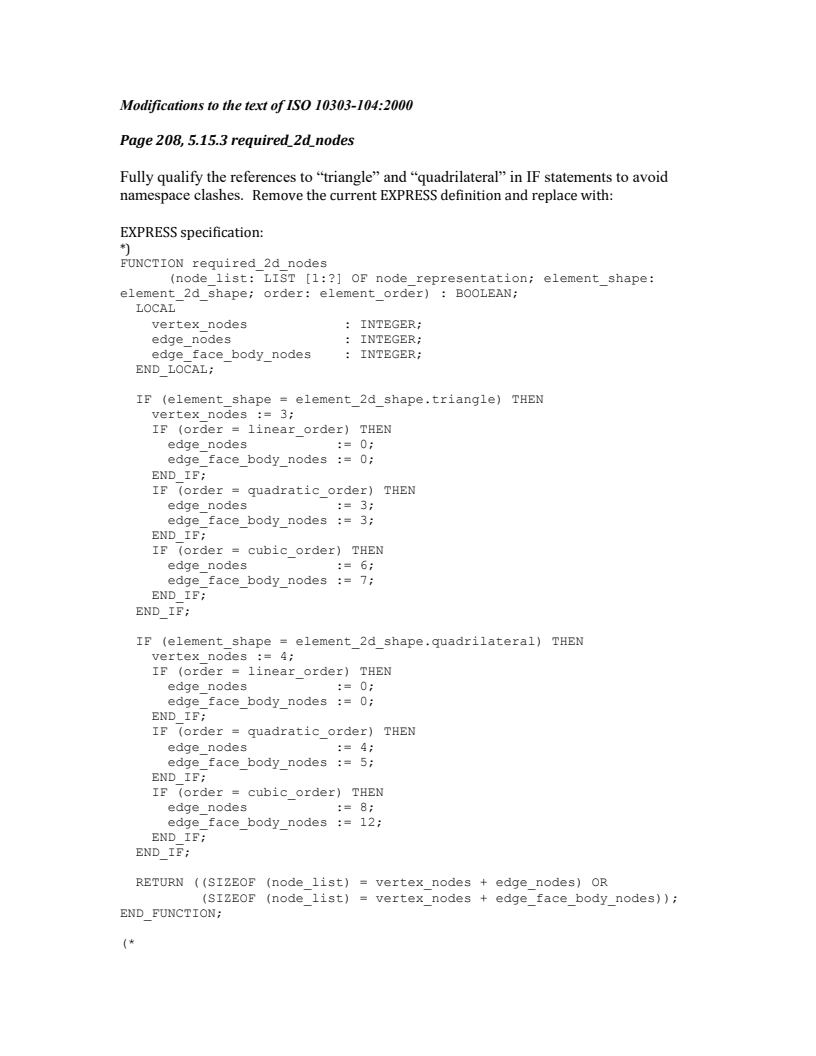
Page 208, 5.15.3 required_2d_nodes
Fully qualify the references to “triangle” and “quadrilateral” in IF statements to avoid
namespace clashes. Remove the current EXPRESS definition and replace with:
EXPRESS specification:
*)
FUNCTION required_2d_nodes
(node_list: LIST [1:?] OF node_representation; element_shape:
element_2d_shape; order: element_order) : BOOLEAN;
LOCAL
vertex_nodes : INTEGER;
edge_nodes : INTEGER;
edge_face_body_nodes : INTEGER;
END_LOCAL;
IF (element_shape = element_2d_shape.triangle) THEN
vertex_nodes := 3;
IF (order = linear_order) THEN
edge_nodes := 0;
edge_face_body_nodes := 0;
END_IF;
IF (order = quadratic_order) THEN
edge_nodes := 3;
edge_face_body_nodes := 3;
END_IF;
IF (order = cubic_order) THEN
edge_nodes := 6;
edge_face_body_nodes := 7;
END_IF;
END_IF;
IF (element_shape = element_2d_shape.quadrilateral) THEN
vertex_nodes := 4;
IF (order = linear_order) THEN
edge_nodes := 0;
edge_face_body_nodes := 0;
END_IF;
IF (order = quadratic_order) THEN
edge_nodes := 4;
edge_face_body_nodes := 5;
END_IF;
IF (order = cubic_order) THEN
edge_nodes := 8;
edge_face_body_nodes := 12;
END_IF;
END_IF;
RETURN ((SIZEOF (node_list) = vertex_nodes + edge_nodes) OR
(SIZEOF (node_list) = vertex_nodes + edge_face_body_nodes));
END_FUNCTION;
(*
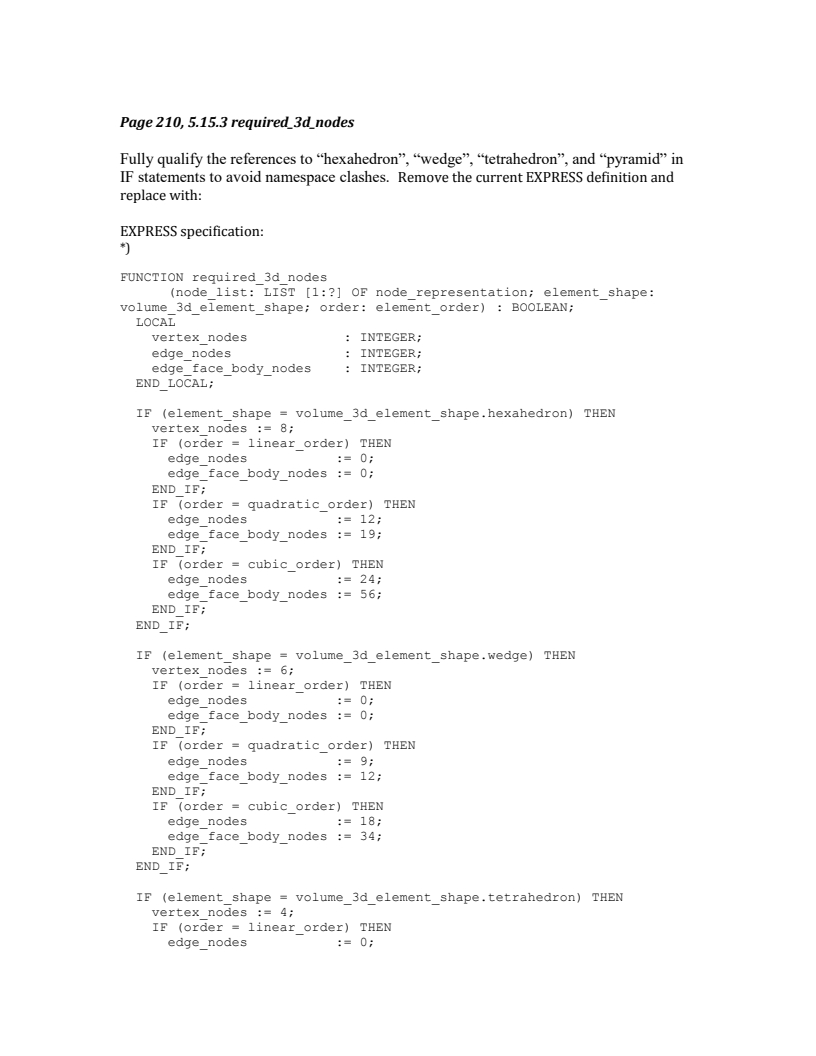
Page 210, 5.15.3 required_3d_nodes
Fully qualify the references to “hexahedron”, “wedge”, “tetrahedron”, and “pyramid” in
IF statements to avoid namespace clashes. Remove the current EXPRESS definition and
replace with:
EXPRESS specification:
*)
FUNCTION required_3d_nodes
(node_list: LIST [1:?] OF node_representation; element_shape:
volume_3d_element_shape; order: element_order) : BOOLEAN;
LOCAL
vertex_nodes : INTEGER;
edge_nodes : INTEGER;
edge_face_body_nodes : INTEGER;
END_LOCAL;
IF (element_shape = volume_3d_element_shape.hexahedron) THEN
vertex_nodes := 8;
IF (order = linear_order) THEN
edge_nodes := 0;
edge_face_body_nodes := 0;
END_IF;
IF (order = quadratic_order) THEN
edge_nodes := 12;
edge_face_body_nodes := 19;
END_IF;
IF (order = cubic_order) THEN
edge_nodes := 24;
edge_face_body_nodes := 56;
END_IF;
END_IF;
IF (element_shape = volume_3d_element_shape.wedge) THEN
vertex_nodes := 6;
IF (order = linear_order) THEN
edge_nodes := 0;
edge_face_body_nodes := 0;
END_IF;
IF (order = quadratic_order) THEN
edge_nodes := 9;
edge_face_body_nodes := 12;
END_IF;
IF (order = cubic_order) THEN
edge_nodes := 18;
edge_face_body_nodes := 34;
END_IF;
END_IF;
IF (element_shape = volume_3d_element_shape.tetrahedron) THEN
vertex_nodes := 4;
IF (order = linear_order) THEN
edge_nodes := 0;
edge_face_body_nodes := 0;
END_IF;
IF (order = quadratic_order) THEN
edge_nodes := 6;
edge_face_body_nodes := 6;
END_IF;
IF (order = cubic_order) THEN
edge_nodes := 12;
edge_face_body_nodes := 16;
END_IF;
END_IF;
IF (element_shape = volume_3d_element_shape.pyramid) THEN
vertex_nodes := 5;
IF (order = linear_order) THEN
edge_nodes := 0;
edge_face_body_nodes := 0;
END_IF;
IF (order = quadratic_order) THEN
edge_nodes := 8;
edge_face_body_nodes := 9;
END_IF;
IF (order = cubic_order) THEN
edge_nodes := 16;
edge_face_body_nodes := 25;
END_IF;
END_IF;
RETURN ((SIZEOF (node_list) = vertex_nodes + edge_nodes) OR
(SIZEOF (node_list) = vertex
...