


ISO/TS 4966:2026
(Main)Nanotechnologies — Silica nanomaterials — Specification of characteristics and measurement methods for nanoporous silica microparticles applied in liquid chromatography
Nanotechnologies — Silica nanomaterials — Specification of characteristics and measurement methods for nanoporous silica microparticles applied in liquid chromatography
This document specifies characteristics to be measured and applicable measurement methods of nanoporous silica microparticles in powder form used as stationary phases in liquid chromatography. This document does not cover materials with surface treatments after manufacturing, and characteristics specific for health, the environment and safety issues. NOTE 1 Silica and hybrid silica are both covered.
Nanotechnologies — Nanomatériaux de silice — Spécification des caractéristiques et des méthodes de mesure des microparticules de silice nanoporeuse utilisées en chromatographie liquide
General Information
- Status
- Published
- Publication Date
- 04-Jun-2026
- Technical Committee
- ISO/TC 229 - Nanotechnologies
- Drafting Committee
- ISO/TC 229/WG 4 - Material specifications
- Current Stage
- 6060 - International Standard published
- Start Date
- 05-Jun-2026
- Due Date
- 17-Jan-2027
- Completion Date
- 05-Jun-2026
Buy Documents
ISO/TS 4966:2026 - Nanotechnologies — Silica nanomaterials — Specification of characteristics and measurement methods for nanoporous silica microparticles applied in liquid chromatography
Overview
ISO/TS 4966:2026 specifies the critical characteristics and measurement methods for nanoporous silica microparticles in powder form used as stationary phases in liquid chromatography. As an international technical specification produced by ISO TC229 (Nanotechnologies), this document ensures that both pure silica and hybrid silica nanomaterial products used in chromatography applications are assessed and described using standardized terminology and validated testing methods.
This standard assists manufacturers, suppliers, and laboratories in characterizing and comparing the performance of silica microparticles intended for high-efficiency liquid chromatographic separations. It applies to particle and pore structure characterization prior to any further surface treatment. The document does not address health, environmental, or safety characteristics.
Key Topics
ISO/TS 4966:2026 covers the following essential topics related to nanoporous silica microparticles:
Critical characteristics to be measured, including:
- Particle size and particle size distribution
- Specific surface area
- Pore size and specific pore volume
Additional characteristics, such as:
- Metal impurity content
- Loss on drying
- Tap density (bulk density)
- Surface silanol acidity
- Carbon content
Measurement methods, referencing internationally recognized test protocols for:
- Laser diffraction, dynamic light scattering, SEM/TEM, and sieving analysis for particle size
- Gas adsorption (BET/BJH) and mercury porosimetry for porosity and surface area
- Elemental analysis, AAS, ICP-OES for impurities and carbon content
- Thermogravimetric analysis for drying loss
- Volume tapping for bulk/tap density
- pH measurements for surface silanol acidity
Sample preparation considerations to ensure representative, reproducible measurements
Comprehensive test report guidelines, including full disclosure of particle characteristics, methods applied, batch information, measurement uncertainty, and shelf life under specified conditions.
Applications
Nanoporous silica microparticles standardized according to ISO/TS 4966:2026 are widely used as stationary phases in a variety of liquid chromatography (LC) techniques, such as:
- High-performance liquid chromatography (HPLC)
- Preparative and analytical chromatography
- Reversed-phase and ion-exchange chromatography
- Bioseparations and pharmaceutical analysis
- Environmental sample analysis
The standardization of characteristics such as particle size, pore size, and specific surface area is crucial for ensuring consistent chromatographic performance, such as separation efficiency, flow rate stability, and sample throughput. Spherical silica particles with controlled nanoporous structures enhance column packing homogeneity, allow for better reproducibility, and support high-pressure operation for demanding applications.
By following ISO/TS 4966:2026, users can reliably compare commercial silica products, optimize column performance, and facilitate quality control in research, pharmaceutical, and industrial laboratories.
Related Standards
Several standards are referenced in ISO/TS 4966:2026 for both terminology and measurement methods. Key related standards include:
- ISO 80004-1 / ISO/TS 80004-6 - Vocabulary for nanotechnologies and nano-object characterization
- ISO 13320 / ISO 13322-1 - Particle size analysis by laser diffraction and image analysis
- ISO 15901-2 / ISO 15901-1 - Pore size and surface area determination by gas adsorption and mercury porosimetry
- ISO 10694 / ISO 11885 - Carbon and metal impurity analysis by combustion and ICP-OES
- ISO 23145-1 - Determination of tap (bulk) density of ceramic powders
- ISO 17860 - Loss on drying for fine ceramics
- JIS Z 0701 - Surface silanol acidity measurement
By adhering to ISO/TS 4966:2026 and these related standards, organizations can ensure accurate, reproducible characterization of nanoporous silica microparticles, supporting confident selection and regulatory compliance within the chromatographic and nanotechnology sectors.
Buy Documents
ISO/TS 4966:2026 - Nanotechnologies — Silica nanomaterials — Specification of characteristics and measurement methods for nanoporous silica microparticles applied in liquid chromatography
Frequently Asked Questions
ISO/TS 4966:2026 is a technical specification published by the International Organization for Standardization (ISO). Its full title is "Nanotechnologies — Silica nanomaterials — Specification of characteristics and measurement methods for nanoporous silica microparticles applied in liquid chromatography". This standard covers: This document specifies characteristics to be measured and applicable measurement methods of nanoporous silica microparticles in powder form used as stationary phases in liquid chromatography. This document does not cover materials with surface treatments after manufacturing, and characteristics specific for health, the environment and safety issues. NOTE 1 Silica and hybrid silica are both covered.
This document specifies characteristics to be measured and applicable measurement methods of nanoporous silica microparticles in powder form used as stationary phases in liquid chromatography. This document does not cover materials with surface treatments after manufacturing, and characteristics specific for health, the environment and safety issues. NOTE 1 Silica and hybrid silica are both covered.
ISO/TS 4966:2026 is classified under the following ICS (International Classification for Standards) categories: 07.120 - Nanotechnologies. The ICS classification helps identify the subject area and facilitates finding related standards.
ISO/TS 4966:2026 is available in PDF format for immediate download after purchase. The document can be added to your cart and obtained through the secure checkout process. Digital delivery ensures instant access to the complete standard document.
Standards Content (Sample)
Technical
Specification
ISO/TS 4966
First edition
Nanotechnologies — Silica
2026-06
nanomaterials — Specification of
characteristics and measurement
methods for nanoporous silica
microparticles applied in liquid
chromatography
Nanotechnologies — Nanomatériaux de silice — Spécification des
caractéristiques et des méthodes de mesure des microparticules
de silice nanoporeuse utilisées en chromatographie liquide
Reference number
© ISO 2026
All rights reserved. Unless otherwise specified, or required in the context of its implementation, no part of this publication may
be reproduced or utilized otherwise in any form or by any means, electronic or mechanical, including photocopying, or posting on
the internet or an intranet, without prior written permission. Permission can be requested from either ISO at the address below
or ISO’s member body in the country of the requester.
ISO copyright office
CP 401 • Ch. de Blandonnet 8
CH-1214 Vernier, Geneva
Phone: +41 22 749 01 11
Email: copyright@iso.org
Website: www.iso.org
Published in Switzerland
ii
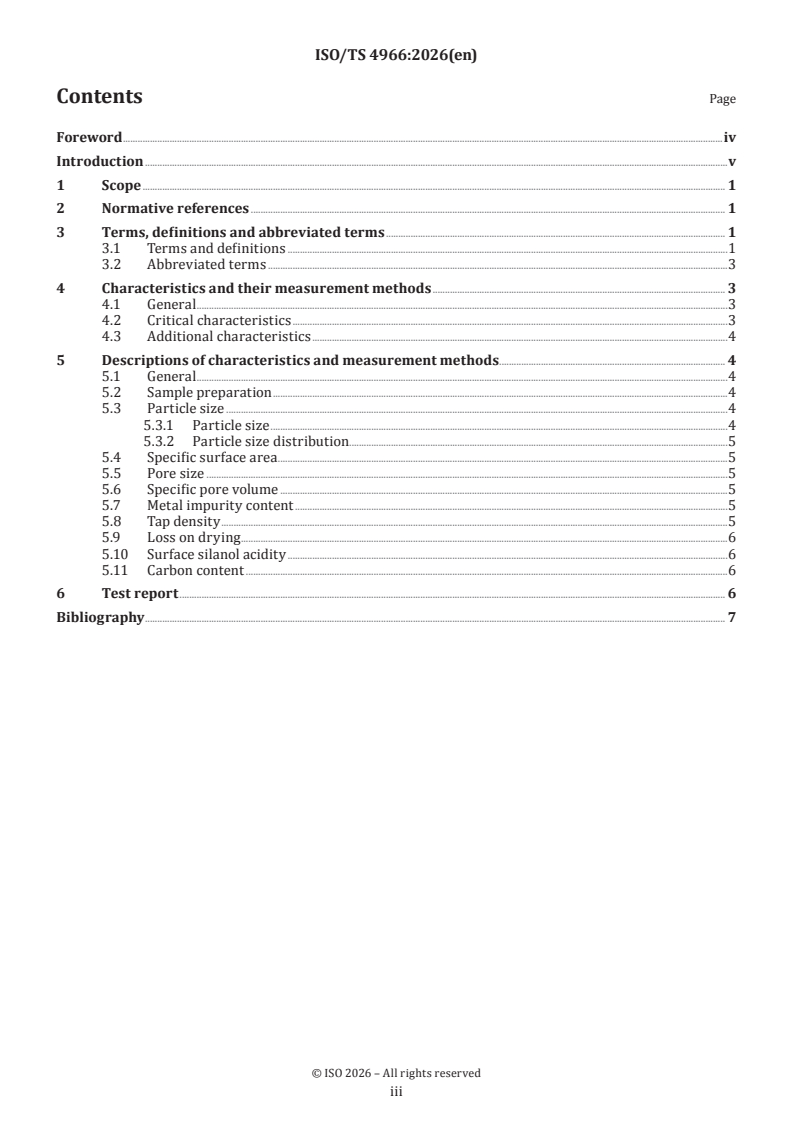
Contents Page
Foreword .iv
Introduction .v
1 Scope . 1
2 Normative references . 1
3 Terms, definitions and abbreviated terms . 1
3.1 Terms and definitions .1
3.2 Abbreviated terms .3
4 Characteristics and their measurement methods . 3
4.1 General .3
4.2 Critical characteristics .3
4.3 Additional characteristics .4
5 Descriptions of characteristics and measurement methods. 4
5.1 General .4
5.2 Sample preparation .4
5.3 Particle size .4
5.3.1 Particle size .4
5.3.2 Particle size distribution.5
5.4 Specific surface area .5
5.5 Pore size .5
5.6 Specific pore volume .5
5.7 Metal impurity content .5
5.8 Tap density .5
5.9 Loss on drying .6
5.10 Surface silanol acidity .6
5.11 Carbon content .6
6 Test report . 6
Bibliography . 7
iii
Foreword
ISO (the International Organization for Standardization) is a worldwide federation of national standards
bodies (ISO member bodies). The work of preparing International Standards is normally carried out through
ISO technical committees. Each member body interested in a subject for which a technical committee
has been established has the right to be represented on that committee. International organizations,
governmental and non-governmental, in liaison with ISO, also take part in the work. ISO collaborates closely
with the International Electrotechnical Commission (IEC) on all matters of electrotechnical standardization.
The procedures used to develop this document and those intended for its further maintenance are described
in the ISO/IEC Directives, Part 1. In particular, the different approval criteria needed for the different types
of ISO document should be noted. This document was drafted in accordance with the editorial rules of the
ISO/IEC Directives, Part 2 (see www.iso.org/directives).
ISO draws attention to the possibility that the implementation of this document may involve the use of (a)
patent(s). ISO takes no position concerning the evidence, validity or applicability of any claimed patent
rights in respect thereof. As of the date of publication of this document, ISO had not received notice of (a)
patent(s) which may be required to implement this document. However, implementers are cautioned that
this may not represent the latest information, which may be obtained from the patent database available at
www.iso.org/patents. ISO shall not be held responsible for identifying any or all such patent rights.
Any trade name used in this document is information given for the convenience of users and does not
constitute an endorsement.
For an explanation of the voluntary nature of standards, the meaning of ISO specific terms and expressions
related to conformity assessment, as well as information about ISO's adherence to the World Trade
Organization (WTO) principles in the Technical Barriers to Trade (TBT), see www.iso.org/iso/foreword.html.
This document was prepared by Technical Committee ISO/TC229, Nanotechnologies.
Any feedback or questions on this document should be directed to the user’s national standards body. A
complete listing of these bodies can be found at www.iso.org/members.html.
iv
Introduction
Owing to their excellent physicochemical properties, silica-based materials have been used in various
[1]
fields, such as electronics, optics, and materials. Silica materials with nanopores (1-100 nm) have widely
been applied in separation due to their chemical inertness, naturally porous structure, large surface area,
[2]
and reversible adsorption-desorption ability under certain circumstances. These features also make it
an ideal candidate as liquid chromatography packing materials since liquid chromatography is essentially
based on selective adsorption and desorption of molecules in nanopores of stationary phases to achieve
[3]
desired separation of target molecules.
Originally, nanoporous silica materials as liquid chromatography media were mainly produced by sol-gel
[4]
methodology. The particles produced by this method had an irregular shape and broad size distribution,
from nanometres to millimetres. Typically, those particles needed to be further separated by passing through
a series of sieves with different meshes; thus irregular nanoporous silica particles, when used as liquid
chromatography media, were usually labelled with mesh size to indicate their particle size distribution.
[5]
Nowadays, more advanced synthetic techniques enable the production of spherical silica particles for a
new generation of liquid chromatography media. Compared to the irregular silica particles, spherical silica
particles exhibit narrower size distribution, leading to more even column packing and better separation
[6]
efficiency. Also, the packing of spherical silica particles minimizes voids and variability inside the column
bed, which can endure higher column pressure and flow rates and, consequently, are welcomed by engineers
who desire higher throughput of products when using liquid chromatography for preparative purposes.
Despite these advancements in particle morphology and packing performance, pure silica faces limitations
in chemical stability under extreme pH conditions. Ongoing research has led to the development of spherical
hybrid silica-based phases integrating organic moieties within the silica framework, offering enhanced
chemical stability, reduced silanol interactions, and greater mechanical robustness. This represents an
active technological direction aimed at expanding the operational range of silica materials. Currently,
major chromatography suppliers offer hybrid silica products as part of their portfolio. Nevertheless, pure
silica materials continue to be extensively utilized across diverse separation scenarios due to their well-
established manufacturing processes, consistent performance profiles, and cost efficiency.
The particle size of nanoporous silica microparticles determine the separation efficiency when the particles
are packed in liquid chromatography columns. Smaller particles provide better efficiency. Nevertheless,
the column back pressure is inversely proportional to the size of the particles. So, when high resolution for
complex samples or high-speed separation is desired, smaller particles packed in high-pressure columns
are the best candidates. When loading capacity is of high importance, e.g. in preparative chromatography,
larger particles are used to pack columns with larger volume and slower flow speed. The nanopores in silica
microparticles play a key role in separation processes. Most of the surface area of silica particles used as
liquid chromatography media is provided by the internal nanopores of the particles. Spherical particles will
have larger surface area when the pore size decreases, which is more suitable for the separation of smaller
molecules. Other factors influencing the chromatographic performance of nanoporous silica microparticles
[7]
include bulk density, water content, surface silanol group density, etc.
In common with other nanostructured materials, the manufacturing and material specification of
nanoporous silica microparticles are complex. Small variations in the synthesis conditions during
manufacturing and functionalization can lead to dramatic shifts in chromatographic properties. Moreover,
characterization methods can vary between different manufacturers and are typically not mentioned in the
document provided along with commercial products. Standardization of nanoporous silica microparticles
for liquid chromatography is therefore critical to harmonize test methodologies and specifications across
both pure and hybrid silica materials. Such standardization will enable users to compare or select the most
suitable and qualified silica microparticles for their applications.
v
Technical Specification ISO/TS 4966:2026(en)
Nanotechnologies — Silica nanomaterials — Specification of
characteristics and measurement methods for nanoporous
silica microparticles applied in liquid chromatography
1 Scope
This document specifies characteristics to be measured and applicable measurement methods of nanoporous
silica microparticles in powder form used as stationary phases in liquid chromatography.
This document does not cover materials with surface treatments after manufacturing, and characteristics
specific for health, the environment and safety issues.
NOTE 1 Silica and hybrid silica are both covered.
2 Normative references
The following documents are referred to in the text in such a way that some or all of their content constitutes
requirements of this document. For dated references, only the edition cited applies. For undated references,
the latest edition of the referenced document (including any amendments) applies.
ISO 80004-1, Nanotechnologies – Vocabulary — Part 1: Core vocabulary
ISO/TS 80004-6, Nanotechnologies — Vocabulary — Part 6: Nano-object characterization
3 Terms, definitions and abbreviated terms
3.1 Terms and definitions
For the purposes of this document, the terms and definitions given in ISO 80004-1, ISO/TS 80004-6 and the
following apply.
ISO and IEC maintain terminology databases for use in standardization at the following addresses:
— ISO Online browsing platform: available at https:// www .iso .org/ obp
— IEC Electropedia: available at https:// www .electropedia .org/
3.1.1
particle
minute piece of matter with defined physical boundaries
[SOURCE: ISO 26824:2022, 3.1.1]
3.1.2
particle size
linear dimension of a particle determined by a specified measur
...