

ISO/TS 11633-1:2019
(Main)Health informatics — Information security management for remote maintenance of medical devices and medical information systems — Part 1: Requirements and risk analysis
General Information
- Abstract
This document focuses on remote maintenance services (RMS) for information systems in healthcare facilities (HCFs) as provided by vendors of medical devices and health information systems. This document specifies the risk assessment necessary to protect remote maintenance activities, taking into consideration the special characteristics of the healthcare field such as patient safety, regulations and privacy protections. This document provides practical examples of risk analysis to protect both the HCF and RMS provider information assets in a safe and efficient (i.e. economical) manner. These assets are primarily the information system itself and personal health data held in the information system.
- Status
- Withdrawn
- Publication Date
- 13-Aug-2019
- Technical Committee
- ISO/TC 215 - Health informatics
- Drafting Committee
- ISO/TC 215/WG 4 - Security, Safety and Privacy
- Current Stage
- 9599 - Withdrawal of International Standard
- Start Date
- 02-Sep-2026
- Completion Date
- 05-Sep-2026
Buy Documents
ISO/TS 11633-1:2019 - Health informatics — Information security management for remote maintenance of medical devices and medical information systems — Part 1: Requirements and risk analysis Released:8/14/2019
ISO/TS 11633-1:2019 - Health informatics — Information security management for remote maintenance of medical devices and medical information systems — Part 1: Requirements and risk analysis/14/2019
Overview
Standard Reference: ISO/TS 11633-1:2019 - Health informatics - Information security management for remote maintenance of medical devices and medical information systems - Part 1: Requirements and risk analysis
This technical specification defines the risk assessment and security requirements for Remote Maintenance Services (RMS) provided by vendors to Healthcare Facilities (HCFs). It addresses the special characteristics of healthcare - patient safety, privacy of personal health data, regulatory obligations - and provides practical examples and use cases to guide risk analysis and selection of security controls to protect information assets and medical devices.
Key Topics
- Risk assessment framework for RMS: identification, analysis and evaluation tailored to healthcare information systems and medical devices.
- RMS architectures considered: HCF internal network, external network to Remote Service Centre (RSC), and RSC internal network.
- Connection types & controls:
- RMS over Public Switched Telephone Network (dial-up): caller ID/callback, one-time passwords, audit logs.
- RMS over Internet: firewalls, anti‑malware, VPN encryption, multi‑factor authentication, digital certificates.
- Security requirement categories:
- Technical measures (access control, logging, encryption).
- Operational measures (incident response, secure operations, mobile access controls).
- Contractual measures (HCF–RSC contracts, responsibilities, confidentiality, availability).
- Protection of personal health information (PHI): measures and responsibilities to meet privacy and regulatory obligations.
- Roles & responsibilities: clear delineation of HCF oversight and RMS provider implementation responsibilities.
- Supporting material: Annexes containing RMS use cases, example risk analysis results and risk criteria.
Applications and Who Should Use It
ISO/TS 11633-1:2019 is practical for:
- Medical device manufacturers and RMS providers designing secure remote maintenance solutions.
- Healthcare IT/security teams evaluating RMS contracts, performing risk assessments and oversight.
- Compliance officers and procurement teams requiring documented security assurances from vendors.
- Risk assessors and auditors needing healthcare-specific examples and analysis criteria. Practical benefits include reduced downtime via secure RMS, documented justification of controls for regulators, consistent security across multiple sites, and economically efficient countermeasure selection.
Related standards
- ISO/IEC 27001 / ISO/IEC 27002 - information security management system controls (referenced for alignment).
- ISO/TS 11633-2 - practical examples for risk analysis (companion guidance).
- ISO/IEC 31000 - risk management principles (used for definitions and concepts).
Keywords: ISO/TS 11633-1:2019, health informatics, remote maintenance, medical devices, RMS, RSC, HCF, information security, risk assessment, personal health data, VPN, multi-factor authentication.
Relations
- Effective Date
- 02-Dec-2023
- Effective Date
- 05-Nov-2015
Buy Documents
ISO/TS 11633-1:2019 - Health informatics — Information security management for remote maintenance of medical devices and medical information systems — Part 1: Requirements and risk analysis Released:8/14/2019
ISO/TS 11633-1:2019 - Health informatics — Information security management for remote maintenance of medical devices and medical information systems — Part 1: Requirements and risk analysis/14/2019
Get Certified
Connect with accredited certification bodies for this standard

BSI Group
BSI (British Standards Institution) is the business standards company that helps organizations make excellence a habit.

NYCE
Mexican standards and certification body.
Sponsored listings
Frequently Asked Questions
ISO/TS 11633-1:2019 is a technical specification published by the International Organization for Standardization (ISO). Its full title is "Health informatics — Information security management for remote maintenance of medical devices and medical information systems — Part 1: Requirements and risk analysis". This standard covers: This document focuses on remote maintenance services (RMS) for information systems in healthcare facilities (HCFs) as provided by vendors of medical devices and health information systems. This document specifies the risk assessment necessary to protect remote maintenance activities, taking into consideration the special characteristics of the healthcare field such as patient safety, regulations and privacy protections. This document provides practical examples of risk analysis to protect both the HCF and RMS provider information assets in a safe and efficient (i.e. economical) manner. These assets are primarily the information system itself and personal health data held in the information system.
This document focuses on remote maintenance services (RMS) for information systems in healthcare facilities (HCFs) as provided by vendors of medical devices and health information systems. This document specifies the risk assessment necessary to protect remote maintenance activities, taking into consideration the special characteristics of the healthcare field such as patient safety, regulations and privacy protections. This document provides practical examples of risk analysis to protect both the HCF and RMS provider information assets in a safe and efficient (i.e. economical) manner. These assets are primarily the information system itself and personal health data held in the information system.
ISO/TS 11633-1:2019 is classified under the following ICS (International Classification for Standards) categories: 35.240.80 - IT applications in health care technology. The ICS classification helps identify the subject area and facilitates finding related standards.
ISO/TS 11633-1:2019 has the following relationships with other standards: It is inter standard links to ISO/TS 11633-1:2026, ISO/TR 11633-1:2009. Understanding these relationships helps ensure you are using the most current and applicable version of the standard.
ISO/TS 11633-1:2019 is available in PDF format for immediate download after purchase. The document can be added to your cart and obtained through the secure checkout process. Digital delivery ensures instant access to the complete standard document.
Standards Content (Sample)
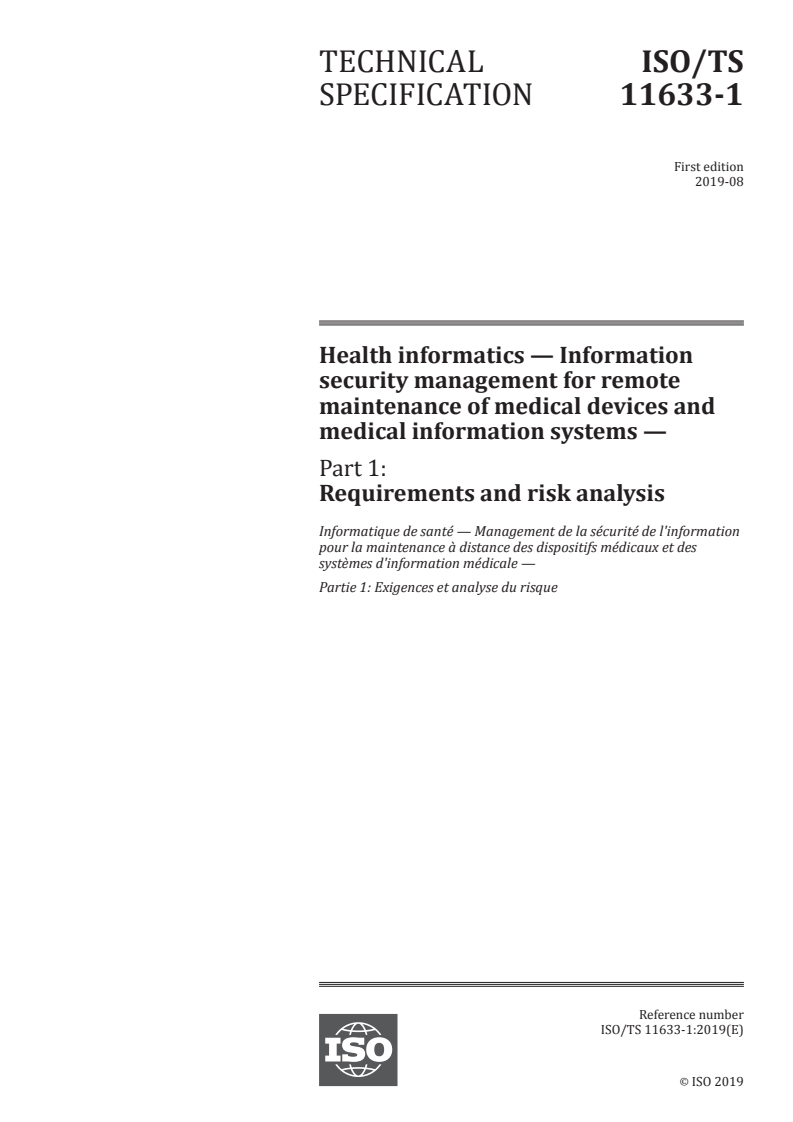
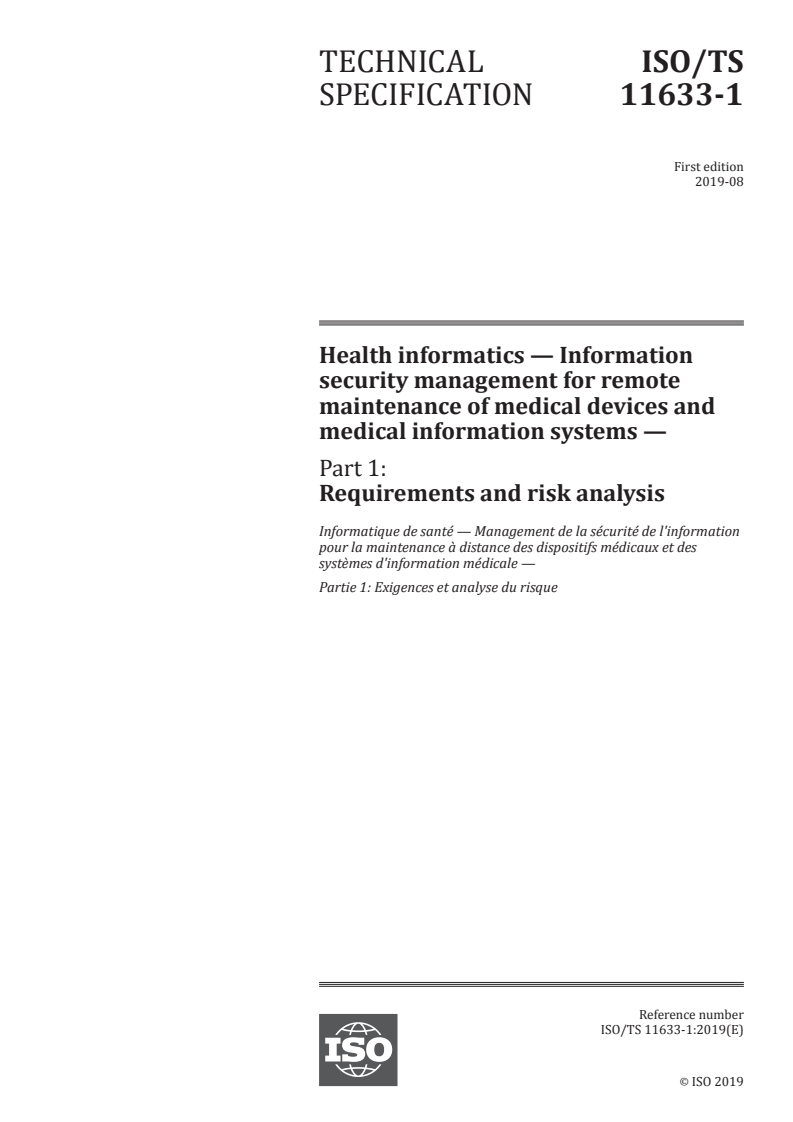
TECHNICAL ISO/TS
SPECIFICATION 11633-1
First edition
2019-08
Health informatics — Information
security management for remote
maintenance of medical devices and
medical information systems —
Part 1:
Requirements and risk analysis
Informatique de santé — Management de la sécurité de l'information
pour la maintenance à distance des dispositifs médicaux et des
systèmes d'information médicale —
Partie 1: Exigences et analyse du risque
Reference number
©
ISO 2019
© ISO 2019
All rights reserved. Unless otherwise specified, or required in the context of its implementation, no part of this publication may
be reproduced or utilized otherwise in any form or by any means, electronic or mechanical, including photocopying, or posting
on the internet or an intranet, without prior written permission. Permission can be requested from either ISO at the address
below or ISO’s member body in the country of the requester.
ISO copyright office
CP 401 • Ch. de Blandonnet 8
CH-1214 Vernier, Geneva
Phone: +41 22 749 01 11
Fax: +41 22 749 09 47
Email: copyright@iso.org
Website: www.iso.org
Published in Switzerland
ii © ISO 2019 – All rights reserved
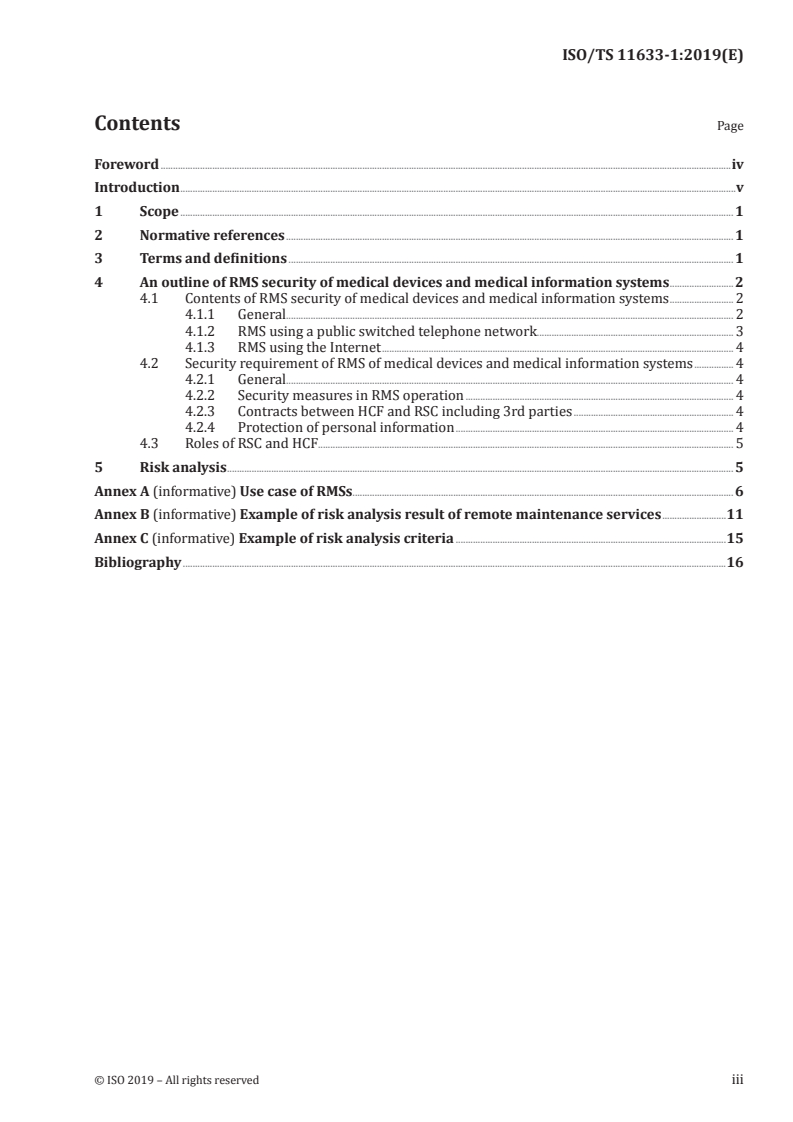
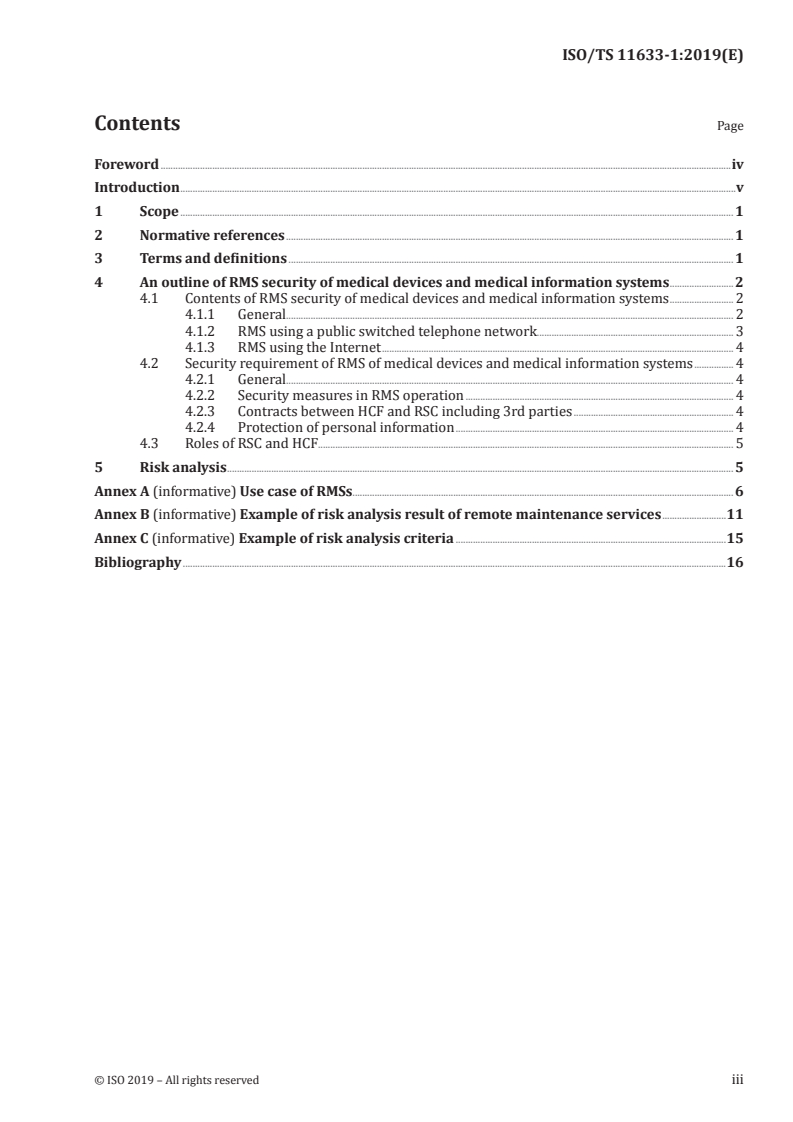
Contents Page
Foreword .iv
Introduction .v
1 Scope . 1
2 Normative references . 1
3 Terms and definitions . 1
4 An outline of RMS security of medical devices and medical information systems .2
4.1 Contents of RMS security of medical devices and medical information systems . 2
4.1.1 General. 2
4.1.2 RMS using a public switched telephone network. 3
4.1.3 RMS using the Internet . 4
4.2 Security requirement of RMS of medical devices and medical information systems . 4
4.2.1 General. 4
4.2.2 Security measures in RMS operation . 4
4.2.3 Contracts between HCF and RSC including 3rd parties . 4
4.2.4 Protection of personal information . 4
4.3 Roles of RSC and HCF. 5
5 Risk analysis . 5
Annex A (informative) Use case of RMSs. 6
Annex B (informative) Example of risk analysis result of remote maintenance services .11
Annex C (informative) Example of risk analysis criteria .15
Bibliography .16
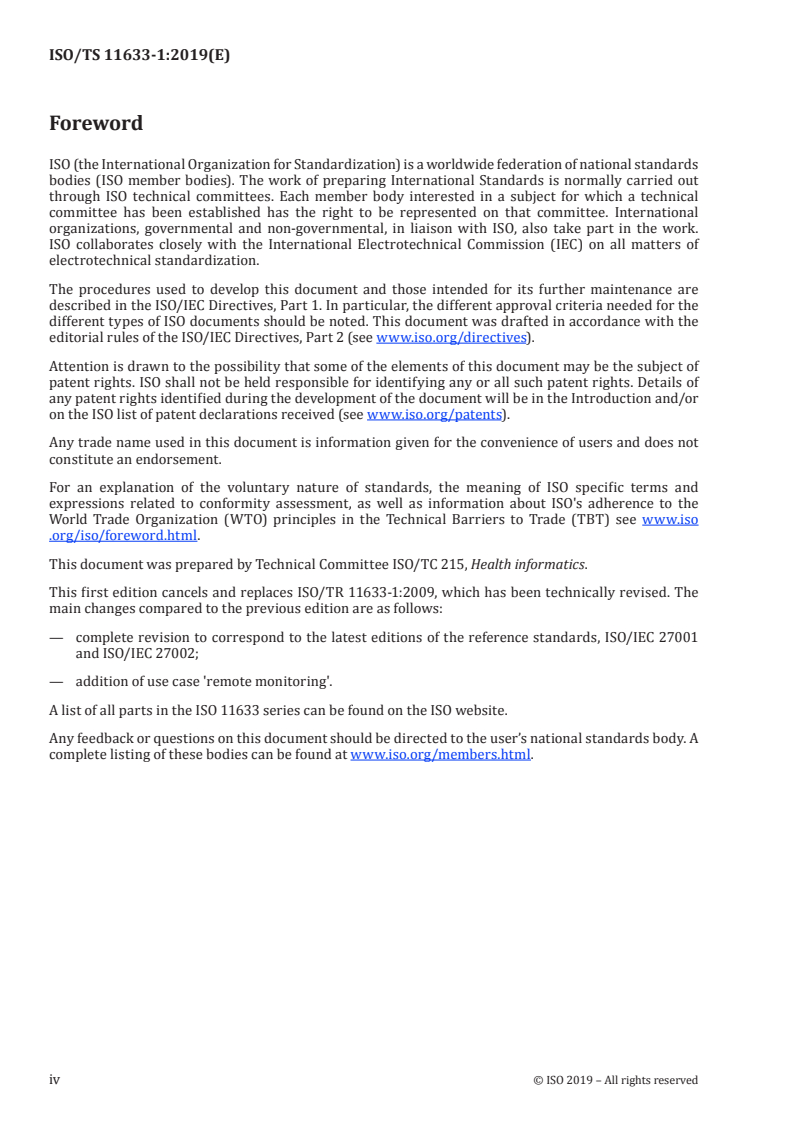
Foreword
ISO (the International Organization for Standardization) is a worldwide federation of national standards
bodies (ISO member bodies). The work of preparing International Standards is normally carried out
through ISO technical committees. Each member body interested in a subject for which a technical
committee has been established has the right to be represented on that committee. International
organizations, governmental and non-governmental, in liaison with ISO, also take part in the work.
ISO collaborates closely with the International Electrotechnical Commission (IEC) on all matters of
electrotechnical standardization.
The procedures used to develop this document and those intended for its further maintenance are
described in the ISO/IEC Directives, Part 1. In particular, the different approval criteria needed for the
different types of ISO documents should be noted. This document was drafted in accordance with the
editorial rules of the ISO/IEC Directives, Part 2 (see www .iso .org/directives).
Attention is drawn to the possibility that some of the elements of this document may be the subject of
patent rights. ISO shall not be held responsible for identifying any or all such patent rights. Details of
any patent rights identified during the development of the document will be in the Introduction and/or
on the ISO list of patent declarations received (see www .iso .org/patents).
Any trade name used in this document is information given for the convenience of users and does not
constitute an endorsement.
For an explanation of the voluntary nature of standards, the meaning of ISO specific terms and
expressions related to conformity assessment, as well as information about ISO's adherence to the
World Trade Organization (WTO) principles in the Technical Barriers to Trade (TBT) see www .iso
.org/iso/foreword .html.
This document was prepared by Technical Committee ISO/TC 215, Health informatics.
This first edition cancels and replaces ISO/TR 11633-1:2009, which has been technically revised. The
main changes compared to the previous edition are as follows:
— complete revision to correspond to the latest editions of the reference standards, ISO/IEC 27001
and ISO/IEC 27002;
— addition of use case 'remote monitoring'.
A list of all parts in the ISO 11633 series can be found on the ISO website.
Any feedback or questions on this document should be directed to the user’s national standards body. A
complete listing of these bodies can be found at www .iso .org/members .html.
iv © ISO 2019 – All rights reserved
Introduction
The advancement and spread of technology in the information and communication technology field,
and the infrastructure based on them, have brought many changes in how technology and networks
are used in modern society. Similarly, in healthcare, information systems which were once closed in
each healthcare facility (HCF) are now connected to the outside by networks and are progressing to
the point of being able to facilitate mutual use of health information accumulated in these information
systems. Such information and communication networks are spreading not only in between HCFs but
also between HCFs and vendors of medical devices and healthcare information systems. Maintenance
of such systems is paramount to keeping them up-to-date. By practicing so-called 'remote maintenance
services', it becomes possible to reduce down-time and lower costs for this maintenance activity.
Whilst there are benefits to remote maintenance, such remote connections with external organizations
also expose HCFs and vendors to risks regarding confidentiality, integrity and availability of information
and systems; risks which previously received scant consideration.
Although normal remote maintenance is generally done on a contract basis, in the case of medical
devices, risk assessment is commonly a legal prerequisite. Therefore, it is necessary to implement
appropriate risk assessment where remote maintenance is provided in any healthcare context. The
risk assessment examples provided in ISO/TR 11633-2 provide support for HCFs and RMS providers to
implement risk assessment effectively.
By implementing the risk assessment process and employing controls referencing ISO/TR 11633-2,
HCFs owners and RMS providers will be able to obtain the following benefits:
— Risk assessment can result in improved efficiency. If the risk assessment document created through
the use of ISO/TR 11633-2 does not fully conform to ISO/IEC 27001, it can be used in part in a risk
assessment of an incompatible area, thus reducing the risk assessment effort required.
— Documented validity of the RMS security countermeasures in place will be available to third parties.
If providing RMS to two or more sites, the provider can apply countermeasures consistently and
effectively.
TECHNICAL SPECIFICATION ISO/TS 11633-1:2019(E)
Health informatics — Information security management
for remote maintenance of medical devices and medical
information systems —
Part 1:
Requirements and risk analysis
1 Scope
This document focuses on remote maintenance services (RMS) for information systems in healthcare
facilities (HCFs) as provided by vendors of medical devices and health information systems.
This document specifies the risk assessment necessary to protect remote maintenance activities, taking
into consideration the special characteristics of the healthcare field such as patient safety, regulations
and privacy protections.
This document provides practical examples of risk analysis to protect both the HCF and RMS provider
information assets in a safe and efficient (i.e. economical) manner. These assets are primarily the
information system itself and personal health data held in the information system.
2 Normative references
There are no normative references in this document.
3 Terms and definitions
For the purposes of this document, the following terms and definitions apply.
ISO and IEC maintain terminological databases for use in standardization at the following addresses:
— ISO Online browsing platform: available at https: //www .iso .org/obp
— IEC Electropedia: available at http: //www .electropedia .org/
3.1
asset
anything that has value to the organization
[SOURCE: ISO/IEC 21827:2008, 3.4]
Note 1 to entry: In the context of health information security, information assets include
a) health information,
b) technical information (credentials, passwords, calibration data, etc.),
c) non-health information (e.g. financials, administrative, legal, human resources, etc.),
d) IT services,
e) hardware,
f) software,
g) communications facilities,
h) media,
i) IT facilities, and
j) medical devices that record or report data.
3.2
availability
property of being accessible and usable upon demand by an authorized entity
[SOURCE: ISO/IEC 21547:2010, 3.2.7]
3.3
confidentiality
property that information is not made available or disclosed to unauthorized individuals, entities, or
processes
[SOURCE: ISO/IEC 21827:2008, 3.13]
3.4
information security
preservation of confidentiality (3.3), integrity and availability (3.2) of information
Note 1 to entry: Other properties, particularly accountability of users, but also authenticity, non-repudiation, and
reliability are often mentioned as aspects of information security but could be considered as derived from the
three core properties in the definition.
3.5
risk
effect of uncertainty on objectives
Note 1 to entry: An effect is a deviation from the expected. It can be positive, negative or both, and can address,
create or result in opportunities and threats.
Note 2 to entry: Objectives can have different aspects and categories, and can be applied at different levels.
Note 3 to entry: Risk is usually expressed in terms of risk sources, potential events, their consequences and their
likelihood.
[SOURCE: ISO/IEC 31000:2018, 3.1]
3.6
risk assessment
overall process of risk identification, risk analysis, and risk evaluation
[SOURCE: ISO/TS 13131:2014, 3.5.4]
3.7
threat
potential cause of an unwanted incident, which may result in harm to a system or organization
4 An outline of RMS security of medical devices and medical information systems
4.1 Contents of RMS security of medical devices and medical information systems
4.1.1 General
The following architectural configuration is assumed in this document (Figure 1):
— target device;
— internal network within a HCF;
2 © ISO 2019 – All rights reserved
— external network connecting a HCF and remote service centre (RSC);
— internal network within a RSC;
— equipment and services in the RSC.
Figure 1 — Assumed RMS architecture
This document introduces the potential types of RMSs and provides options for appropriate security
controls to be considered in the risk analysis phase.
Use cases of RMSs are provided in Annex A.
The types of RMS and technical security measures related to each type are explained in 4.1.2 and 4.1.3.
4.1.2 RMS using a public switched telephone network
Where a HCF sets up a machine for dial-up server function, the machine connects with a public switched
telephone network via modem and waits for access from a RSC remote connection. Telecommunications
equipment that offer these functions such as dial-up routers are in widespread use.
In the use of the public switched telephone network, telecommunication lines have the following
features:
— a one-to-one communication pathway between a HCF and the RSC can be secured;
— tapping is difficult because a public switched telephone network is fully-digitalized.
Using these features, security can be maintained by the following technical measures:
— determination of caller number — use of call back certification function or caller ID specification
certification function;
— user certification — use of one-time password and encryption of password; and
— review of communication audit logs to detect illegal access attempts to a HCF.
4.1.3 RMS using the Internet
A device using an Internet connection with an externally accessible IP address is placed at the HCF. The
RSC prepares the Internet connection environment and connects itself to the HCF through the Internet.
This subclause specifies the technologies for communication and user authentication between a HCF
and a RSC using the Internet for connection. This is the same as a typical Internet connection and not a
one-to-one communication like the public switched telephone network.
Examples of security control are shown below:
— using firewall(s);
— using tools such as anti-virus software;
— communication using VPN for encryption of the communication path; and
— use of a variety of user authentication methods such as one-time passwords, multi-factor
authentication and digital certificates
4.2 Security requirement of RMS of medical devices and medical information systems
4.2.1 General
The RMS security requirements can be classified into three categories: measures, contracts and
protection measures.
4.2.2 Security measures in RMS operation
Regulations and legislation commonly drive specific requirements on how to operate a system securely
and protect the privacy of personal information. Examples are shown below:
— those concerning the RSC operator;
— measures for excluding unauthorized operations;
— requirements for when RSC remote terminals are increased or relocated; and
— requirements for access from mobile terminals.
4.2.3 Contracts between HCF and RSC including 3rd parties
The following can be used to prepare for security incidents:
— requirements for responsibility demarcation between a HCF and a RSC;
— establishment of contracts between a HCF and a RSC, including requirements for confidentiality,
integrity and availability of information.
4.2.4 Protection of personal information
There might be provisions that impose obligations on a HCF for the protection of personal health
information. As remote services provide an interface with a health information system which potentially
contains personal health information, the RMS provider shall incorporate security measures to protect
personal information.
There are various means for providing security measures in a RMS. Each RMS provider maintains
security by using these mean, taking into account the relevant provisions.
4 © ISO 2019 – All rights reserved
4.3 Roles of RSC and HCF
Where the HCF has entrusted the RMS provider with providing security for the RMS by establishing
a maintenance contract with the RMS providers, t
...
TECHNICAL ISO/TS
SPECIFICATION 11633-1
First edition
2019-08
Health informatics — Information
security management for remote
maintenance of medical devices and
medical information systems —
Part 1:
Requirements and risk analysis
Informatique de santé — Management de la sécurité de l'information
pour la maintenance à distance des dispositifs médicaux et des
systèmes d'information médicale —
Partie 1: Exigences et analyse du risque
Reference number
©
ISO 2019
© ISO 2019
All rights reserved. Unless otherwise specified, or required in the context of its implementation, no part of this publication may
be reproduced or utilized otherwise in any form or by any means, electronic or mechanical, including photocopying, or posting
on the internet or an intranet, without prior written permission. Permission can be requested from either ISO at the address
below or ISO’s member body in the country of the requester.
ISO copyright office
CP 401 • Ch. de Blandonnet 8
CH-1214 Vernier, Geneva
Phone: +41 22 749 01 11
Fax: +41 22 749 09 47
Email: copyright@iso.org
Website: www.iso.org
Published in Switzerland
ii © ISO 2019 – All rights reserved
Contents Page
Foreword .iv
Introduction .v
1 Scope . 1
2 Normative references . 1
3 Terms and definitions . 1
4 An outline of RMS security of medical devices and medical information systems .2
4.1 Contents of RMS security of medical devices and medical information systems . 2
4.1.1 General. 2
4.1.2 RMS using a public switched telephone network. 3
4.1.3 RMS using the Internet . 4
4.2 Security requirement of RMS of medical devices and medical information systems . 4
4.2.1 General. 4
4.2.2 Security measures in RMS operation . 4
4.2.3 Contracts between HCF and RSC including 3rd parties . 4
4.2.4 Protection of personal information . 4
4.3 Roles of RSC and HCF. 5
5 Risk analysis . 5
Annex A (informative) Use case of RMSs. 6
Annex B (informative) Example of risk analysis result of remote maintenance services .11
Annex C (informative) Example of risk analysis criteria .15
Bibliography .16
Foreword
ISO (the International Organization for Standardization) is a worldwide federation of national standards
bodies (ISO member bodies). The work of preparing International Standards is normally carried out
through ISO technical committees. Each member body interested in a subject for which a technical
committee has been established has the right to be represented on that committee. International
organizations, governmental and non-governmental, in liaison with ISO, also take part in the work.
ISO collaborates closely with the International Electrotechnical Commission (IEC) on all matters of
electrotechnical standardization.
The procedures used to develop this document and those intended for its further maintenance are
described in the ISO/IEC Directives, Part 1. In particular, the different approval criteria needed for the
different types of ISO documents should be noted. This document was drafted in accordance with the
editorial rules of the ISO/IEC Directives, Part 2 (see www .iso .org/directives).
Attention is drawn to the possibility that some of the elements of this document may be the subject of
patent rights. ISO shall not be held responsible for identifying any or all such patent rights. Details of
any patent rights identified during the development of the document will be in the Introduction and/or
on the ISO list of patent declarations received (see www .iso .org/patents).
Any trade name used in this document is information given for the convenience of users and does not
constitute an endorsement.
For an explanation of the voluntary nature of standards, the meaning of ISO specific terms and
expressions related to conformity assessment, as well as information about ISO's adherence to the
World Trade Organization (WTO) principles in the Technical Barriers to Trade (TBT) see www .iso
.org/iso/foreword .html.
This document was prepared by Technical Committee ISO/TC 215, Health informatics.
This first edition cancels and replaces ISO/TR 11633-1:2009, which has been technically revised. The
main changes compared to the previous edition are as follows:
— complete revision to correspond to the latest editions of the reference standards, ISO/IEC 27001
and ISO/IEC 27002;
— addition of use case 'remote monitoring'.
A list of all parts in the ISO 11633 series can be found on the ISO website.
Any feedback or questions on this document should be directed to the user’s national standards body. A
complete listing of these bodies can be found at www .iso .org/members .html.
iv © ISO 2019 – All rights reserved
Introduction
The advancement and spread of technology in the information and communication technology field,
and the infrastructure based on them, have brought many changes in how technology and networks
are used in modern society. Similarly, in healthcare, information systems which were once closed in
each healthcare facility (HCF) are now connected to the outside by networks and are progressing to
the point of being able to facilitate mutual use of health information accumulated in these information
systems. Such information and communication networks are spreading not only in between HCFs but
also between HCFs and vendors of medical devices and healthcare information systems. Maintenance
of such systems is paramount to keeping them up-to-date. By practicing so-called 'remote maintenance
services', it becomes possible to reduce down-time and lower costs for this maintenance activity.
Whilst there are benefits to remote maintenance, such remote connections with external organizations
also expose HCFs and vendors to risks regarding confidentiality, integrity and availability of information
and systems; risks which previously received scant consideration.
Although normal remote maintenance is generally done on a contract basis, in the case of medical
devices, risk assessment is commonly a legal prerequisite. Therefore, it is necessary to implement
appropriate risk assessment where remote maintenance is provided in any healthcare context. The
risk assessment examples provided in ISO/TR 11633-2 provide support for HCFs and RMS providers to
implement risk assessment effectively.
By implementing the risk assessment process and employing controls referencing ISO/TR 11633-2,
HCFs owners and RMS providers will be able to obtain the following benefits:
— Risk assessment can result in improved efficiency. If the risk assessment document created through
the use of ISO/TR 11633-2 does not fully conform to ISO/IEC 27001, it can be used in part in a risk
assessment of an incompatible area, thus reducing the risk assessment effort required.
— Documented validity of the RMS security countermeasures in place will be available to third parties.
If providing RMS to two or more sites, the provider can apply countermeasures consistently and
effectively.
TECHNICAL SPECIFICATION ISO/TS 11633-1:2019(E)
Health informatics — Information security management
for remote maintenance of medical devices and medical
information systems —
Part 1:
Requirements and risk analysis
1 Scope
This document focuses on remote maintenance services (RMS) for information systems in healthcare
facilities (HCFs) as provided by vendors of medical devices and health information systems.
This document specifies the risk assessment necessary to protect remote maintenance activities, taking
into consideration the special characteristics of the healthcare field such as patient safety, regulations
and privacy protections.
This document provides practical examples of risk analysis to protect both the HCF and RMS provider
information assets in a safe and efficient (i.e. economical) manner. These assets are primarily the
information system itself and personal health data held in the information system.
2 Normative references
There are no normative references in this document.
3 Terms and definitions
For the purposes of this document, the following terms and definitions apply.
ISO and IEC maintain terminological databases for use in standardization at the following addresses:
— ISO Online browsing platform: available at https: //www .iso .org/obp
— IEC Electropedia: available at http: //www .electropedia .org/
3.1
asset
anything that has value to the organization
[SOURCE: ISO/IEC 21827:2008, 3.4]
Note 1 to entry: In the context of health information security, information assets include
a) health information,
b) technical information (credentials, passwords, calibration data, etc.),
c) non-health information (e.g. financials, administrative, legal, human resources, etc.),
d) IT services,
e) hardware,
f) software,
g) communications facilities,
h) media,
i) IT facilities, and
j) medical devices that record or report data.
3.2
availability
property of being accessible and usable upon demand by an authorized entity
[SOURCE: ISO/IEC 21547:2010, 3.2.7]
3.3
confidentiality
property that information is not made available or disclosed to unauthorized individuals, entities, or
processes
[SOURCE: ISO/IEC 21827:2008, 3.13]
3.4
information security
preservation of confidentiality (3.3), integrity and availability (3.2) of information
Note 1 to entry: Other properties, particularly accountability of users, but also authenticity, non-repudiation, and
reliability are often mentioned as aspects of information security but could be considered as derived from the
three core properties in the definition.
3.5
risk
effect of uncertainty on objectives
Note 1 to entry: An effect is a deviation from the expected. It can be positive, negative or both, and can address,
create or result in opportunities and threats.
Note 2 to entry: Objectives can have different aspects and categories, and can be applied at different levels.
Note 3 to entry: Risk is usually expressed in terms of risk sources, potential events, their consequences and their
likelihood.
[SOURCE: ISO/IEC 31000:2018, 3.1]
3.6
risk assessment
overall process of risk identification, risk analysis, and risk evaluation
[SOURCE: ISO/TS 13131:2014, 3.5.4]
3.7
threat
potential cause of an unwanted incident, which may result in harm to a system or organization
4 An outline of RMS security of medical devices and medical information systems
4.1 Contents of RMS security of medical devices and medical information systems
4.1.1 General
The following architectural configuration is assumed in this document (Figure 1):
— target device;
— internal network within a HCF;
2 © ISO 2019 – All rights reserved
— external network connecting a HCF and remote service centre (RSC);
— internal network within a RSC;
— equipment and services in the RSC.
Figure 1 — Assumed RMS architecture
This document introduces the potential types of RMSs and provides options for appropriate security
controls to be considered in the risk analysis phase.
Use cases of RMSs are provided in Annex A.
The types of RMS and technical security measures related to each type are explained in 4.1.2 and 4.1.3.
4.1.2 RMS using a public switched telephone network
Where a HCF sets up a machine for dial-up server function, the machine connects with a public switched
telephone network via modem and waits for access from a RSC remote connection. Telecommunications
equipment that offer these functions such as dial-up routers are in widespread use.
In the use of the public switched telephone network, telecommunication lines have the following
features:
— a one-to-one communication pathway between a HCF and the RSC can be secured;
— tapping is difficult because a public switched telephone network is fully-digitalized.
Using these features, security can be maintained by the following technical measures:
— determination of caller number — use of call back certification function or caller ID specification
certification function;
— user certification — use of one-time password and encryption of password; and
— review of communication audit logs to detect illegal access attempts to a HCF.
4.1.3 RMS using the Internet
A device using an Internet connection with an externally accessible IP address is placed at the HCF. The
RSC prepares the Internet connection environment and connects itself to the HCF through the Internet.
This subclause specifies the technologies for communication and user authentication between a HCF
and a RSC using the Internet for connection. This is the same as a typical Internet connection and not a
one-to-one communication like the public switched telephone network.
Examples of security control are shown below:
— using firewall(s);
— using tools such as anti-virus software;
— communication using VPN for encryption of the communication path; and
— use of a variety of user authentication methods such as one-time passwords, multi-factor
authentication and digital certificates
4.2 Security requirement of RMS of medical devices and medical information systems
4.2.1 General
The RMS security requirements can be classified into three categories: measures, contracts and
protection measures.
4.2.2 Security measures in RMS operation
Regulations and legislation commonly drive specific requirements on how to operate a system securely
and protect the privacy of personal information. Examples are shown below:
— those concerning the RSC operator;
— measures for excluding unauthorized operations;
— requirements for when RSC remote terminals are increased or relocated; and
— requirements for access from mobile terminals.
4.2.3 Contracts between HCF and RSC including 3rd parties
The following can be used to prepare for security incidents:
— requirements for responsibility demarcation between a HCF and a RSC;
— establishment of contracts between a HCF and a RSC, including requirements for confidentiality,
integrity and availability of information.
4.2.4 Protection of personal information
There might be provisions that impose obligations on a HCF for the protection of personal health
information. As remote services provide an interface with a health information system which potentially
contains personal health information, the RMS provider shall incorporate security measures to protect
personal information.
There are various means for providing security measures in a RMS. Each RMS provider maintains
security by using these mean, taking into account the relevant provisions.
4 © ISO 2019 – All rights reserved
4.3 Roles of RSC and HCF
Where the HCF has entrusted the RMS provider with providing security for the RMS by establishing
a maintenance contract with the RMS providers, t
...