

ISO/TR 14872:2025
(Main)Health informatics — Identification of medicinal products — Core principles for maintenance of identifiers and terms
General Information
- Abstract
This document describes the core principles for supporting the development, implementation and ongoing maintenance of IDMP identifiers and terminologies. This document provides considerations for the evaluation and/or design when considering current or future operations and service level agreements for systems and terminology support services in conformity with IDMP.
- Status
- Published
- Publication Date
- 09-Dec-2025
- Technical Committee
- ISO/TC 215 - Health informatics
- Drafting Committee
- ISO/TC 215 - Health informatics
- Current Stage
- 6060 - International Standard published
- Start Date
- 10-Dec-2025
- Completion Date
- 10-Dec-2025
Overview
ISO/TR 14872:2025 - "Health informatics - Identification of medicinal products - Core principles for maintenance of identifiers and terms" is a Technical Report from ISO/TC 215 that defines core principles for the development, implementation and ongoing maintenance of IDMP identifiers and terminologies. The second edition (2025) documents current implementation experiences, governance models and service delivery considerations for systems and terminology support services in conformity with IDMP.
Key topics and technical requirements
This report focuses on practical, governance and operational aspects rather than prescriptive syntax. Major topics include:
- Governance and maintenance processes
- Generic governance models and service delivery practices for IDMP terminology maintenance
- Considerations for Quality Management Systems (QMS) and service level agreements (SLAs)
- Domain-specific maintenance (descriptions of existing maintenance relationships)
- Substances and Global Pharmaceutical Product Identifier (PhPID)
- Pharmaceutical dose forms, routes of administration and units (UCUM)
- Interactions with SNOMED CT, MedDRA, ATC/DDD and INN
- GS1 identifiers (GTIN, EPC) and AIDC considerations
- Terminology processes
- Creation, reconciliation, distribution and versioning of controlled vocabularies
- Emphasis on unambiguity, mapping and reconciliation when global terms differ from regional terms
- International mapping and translations
- Principles for mapping IDMP core terms to derived or regional sources
- Considerations for multilingual translations and cross-jurisdiction interoperability
- Integration with derived data sources
- How IDMP core maintenance should interface with data considered “derived” from other organizations
The report references and complements related ISO/TS specifications and international standards for health terminology and IT service management (e.g., ISO/TS 20440, ISO/TS 20451, ISO/IEC 20000-1/2, ISO/IEC 33002).
Practical applications and who uses it
ISO/TR 14872:2025 is practical for organizations implementing IDMP and those responsible for medicinal product data governance:
- Regulators and national health authorities aligning product identification and pharmacovigilance processes
- Pharmaceutical / biopharmaceutical companies managing product master data, submissions and global registrations
- Maintenance organizations and terminology providers (EDQM, UMC, Regenstrief, GS1, UCUM stewards) designing governance and distribution models
- Healthcare IT vendors, clinical research organizations (CROs) and implementers building IDMP-compliant systems, APIs and SLAs
Use cases include regulatory submissions, creation of medicinal product dictionaries, global product identification (PhPID/GSID), interoperability across EHRs and safety reporting systems.
Related standards
- IDMP family: ISO 11238, ISO 11239, ISO 11240, ISO 11615, ISO 11616
- Supporting technical specs: ISO/TS 20440, ISO/TS 20451, ISO/TS 19844, ISO/TS 20443
- Service & quality: ISO/IEC 20000-1, ISO/IEC 20000-2, ISO/IEC 33002
Keywords: ISO/TR 14872:2025, IDMP, health informatics, medicinal product identifiers, terminology maintenance, governance, PhPID, UCUM, EDQM, SNOMED, MedDRA, mapping, translations.
Relations
- Effective Date
- 28-Jan-2023
Get Certified
Connect with accredited certification bodies for this standard

BSI Group
BSI (British Standards Institution) is the business standards company that helps organizations make excellence a habit.

NYCE
Mexican standards and certification body.
Sponsored listings
Frequently Asked Questions
ISO/TR 14872:2025 is a technical report published by the International Organization for Standardization (ISO). Its full title is "Health informatics — Identification of medicinal products — Core principles for maintenance of identifiers and terms". This standard covers: This document describes the core principles for supporting the development, implementation and ongoing maintenance of IDMP identifiers and terminologies. This document provides considerations for the evaluation and/or design when considering current or future operations and service level agreements for systems and terminology support services in conformity with IDMP.
This document describes the core principles for supporting the development, implementation and ongoing maintenance of IDMP identifiers and terminologies. This document provides considerations for the evaluation and/or design when considering current or future operations and service level agreements for systems and terminology support services in conformity with IDMP.
ISO/TR 14872:2025 is classified under the following ICS (International Classification for Standards) categories: 35.240.80 - IT applications in health care technology. The ICS classification helps identify the subject area and facilitates finding related standards.
ISO/TR 14872:2025 has the following relationships with other standards: It is inter standard links to ISO/TR 14872:2019. Understanding these relationships helps ensure you are using the most current and applicable version of the standard.
ISO/TR 14872:2025 is available in PDF format for immediate download after purchase. The document can be added to your cart and obtained through the secure checkout process. Digital delivery ensures instant access to the complete standard document.
Standards Content (Sample)
Technical
Report
ISO/TR 14872
Second edition
Health informatics — Identification
2025-12
of medicinal products — Core
principles for maintenance of
identifiers and terms
Informatique de santé — Identification des médicaments —
Principes essentiels pour la mise à jour des identifiants et des
termes
Reference number
© ISO 2025
All rights reserved. Unless otherwise specified, or required in the context of its implementation, no part of this publication may
be reproduced or utilized otherwise in any form or by any means, electronic or mechanical, including photocopying, or posting on
the internet or an intranet, without prior written permission. Permission can be requested from either ISO at the address below
or ISO’s member body in the country of the requester.
ISO copyright office
CP 401 • Ch. de Blandonnet 8
CH-1214 Vernier, Geneva
Phone: +41 22 749 01 11
Email: copyright@iso.org
Website: www.iso.org
Published in Switzerland
ii
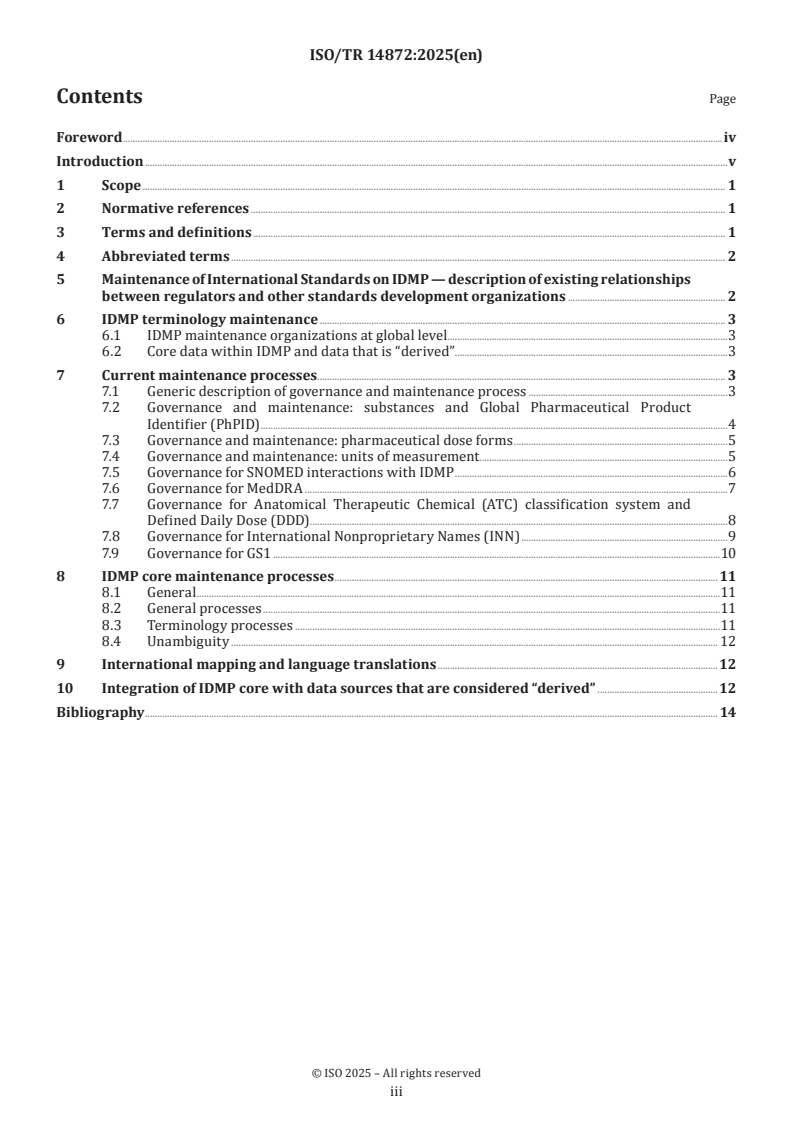
Contents Page
Foreword .iv
Introduction .v
1 Scope . 1
2 Normative references . 1
3 Terms and definitions . 1
4 Abbreviated terms . 2
5 Maintenance of International Standards on IDMP — description of existing relationships
between regulators and other standards development organizations . 2
6 IDMP terminology maintenance . 3
6.1 IDMP maintenance organizations at global level .3
6.2 Core data within IDMP and data that is “derived” .3
7 Current maintenance processes. 3
7.1 Generic description of governance and maintenance process .3
7.2 Governance and maintenance: substances and Global Pharmaceutical Product
Identifier (PhPID) .4
7.3 Governance and maintenance: pharmaceutical dose forms .5
7.4 Governance and maintenance: units of measurement .5
7.5 Governance for SNOMED interactions with IDMP .6
7.6 Governance for MedDRA .7
7.7 Governance for Anatomical Therapeutic Chemical (ATC) classification system and
Defined Daily Dose (DDD) . . .8
7.8 Governance for International Nonproprietary Names (INN) .9
7.9 Governance for GS1 .10
8 IDMP core maintenance processes .11
8.1 General .11
8.2 General processes .11
8.3 Terminology processes .11
8.4 Unambiguity . 12
9 International mapping and language translations .12
10 Integration of IDMP core with data sources that are considered “derived” .12
Bibliography . 14
iii
Foreword
ISO (the International Organization for Standardization) is a worldwide federation of national standards
bodies (ISO member bodies). The work of preparing International Standards is normally carried out through
ISO technical committees. Each member body interested in a subject for which a technical committee
has been established has the right to be represented on that committee. International organizations,
governmental and non-governmental, in liaison with ISO, also take part in the work. ISO collaborates closely
with the International Electrotechnical Commission (IEC) on all matters of electrotechnical standardization.
The procedures used to develop this document and those intended for its further maintenance are described
in the ISO/IEC Directives, Part 1. In particular, the different approval criteria needed for the different types
of ISO documents should be noted. This document was drafted in accordance with the editorial rules of the
ISO/IEC Directives, Part 2 (see www.iso.org/directives).
ISO draws attention to the possibility that the implementation of this document may involve the use of (a)
patent(s). ISO takes no position concerning the evidence, validity or applicability of any claimed patent
rights in respect thereof. As of the date of publication of this document, ISO had not received notice of (a)
patent(s) which may be required to implement this document. However, implementers are cautioned that
this may not represent the latest information, which may be obtained from the patent database available at
www.iso.org/patents. ISO shall not be held responsible for identifying any or all such patent rights.).
Any trade name used in this document is information given for the convenience of users and does not
constitute an endorsement.
For an explanation of the voluntary nature of standards, the meaning of ISO specific terms and expressions
related to conformity assessment, as well as information about ISO’s adherence to the World Trade
Organization (WTO) principles in the Technical Barriers to Trade (TBT) see www.iso.org/iso/foreword.html.
This document was prepared by Technical Committee ISO/TC 215, Health informatics.
This second edition cancels and replaces the first edition (ISO/TR 14872:2019), which has been technically
revised.
The main changes are as follows:
— the focus on describing the current (2025) implementation experiences and processes has been
strengthened;
— references to a “federated service delivery model” have been removed, since this remains inspirational
and does not correspond to the current practice;
— information about operating models (governance) of existing maintenance organizations impacting
IDMP on a global level has been included.
Any feedback or questions on this document should be directed to the user’s national standards body. A
complete listing of these bodies can be found at www.iso.org/members.html.
iv
Introduction
This document describes the core operating principles and presents a description of the current service
delivery models for terminology and identifier maintenance services in support of five International
[1] [2]
Standards on the Identification of Medicinal Products (IDMP), i.e. ISO 11615 , ISO 11616 , ISO 11238
[3] [4] [5]
, ISO 11239 , ISO 11240 . Collectively, the International Standards on IDMP provide the basis for data
collection and information exchange about key medicinal product characteristics that support the unique
and unambiguous identification of medicinal products for a variety of regulatory and business objectives
and use cases, with a global focus. The document includes descriptions of maintenance and governance
processes for a number of organizations that are involved in the provision of core and derived data.
Since the International Standards on IDMP can be applied to a broad range of use cases, (e.g. regulatory
product applications, product registration, creation of medicinal product dictionaries, etc.), description of
common coordination and maintenance principles is critical to help ensure consistent adoption, use and
maintenance of the International Standards associated with IDMP.
Currently, many organizations serve as data owners or terminology service providers in several
jurisdictions. These organizations maintain and distribute their own medicinal product terminology which
does not necessarily fully correspond to terminology mapping and format criteria described in Technical
[6] [7] [8] [9]
Specifications on IDMP (i.e. ISO/TS 20443 , ISO/TS 20451 , ISO/TS 19844 , ISO/TS 20440 ). It is
recognized that a structured and neutral description of current operating principles for terminology
maintenance at global level not only facilitates a harmonized approach to IDMP implementation globally, but
provides guidance for regional and local service providers to make use of these descriptions.
Since IDMP standards are in the process of adoption internationally, it is anticipated that this document
will be periodically revised to reflect real-world experience in how the information models, data elements
and their associated terminologies are used, as well as to accommodate any potential gaps in mapping,
translation and governance for specific IDMP terminology domains (e.g. substance/specified substance,
dosage form, route of administration).
This document leverages and complements several ISO and joint ISO/IEC specifications, guiding principles
and processes that are exhibited by developers of healthcare terminologies in support of international
healthcare terminology standardization, information technology service management and the design
[10]
and maintenance of quality systems. The applicable International Standards are ISO/IEC 20000-1 ,
[11] [12]
ISO/IEC 20000-2 and ISO/IEC 33002 .
The intended audience for this document includes:
— organizations that have already created or are maintaining IDMP terminologies;
— organizations seeking an opportunity to support creation and/or dissemination of IDMP terminologies;
— organizations interested in implementing or applying the International Standards on IDMP (e.g. technical
format or scientific content, or both) to their internal processes and systems in support of regulatory or
healthcare-related business;
— regulators, pharmaceutical/biopharmaceutical companies, clinical research organizations (CROs) and
universities/scientific institutes involved in the development, authorization and marketing of medicinal
products.
v
Technical Report ISO/TR 14872:2025(en)
Health informatics — Identification of medicinal products —
Core principles for maintenance of identifiers and terms
1 Scope
This document describes the core principles for supporting the development, implementation and ongoing
maintenance of IDMP identifiers and terminologies.
This document provides considerations for the evaluation and/or design when considering current or future
operations and service level agreements for systems and terminology support services in conformity with
IDMP.
2 Normative references
There are no normative references in this document.
3 Terms and definitions
For the purposes of this document, the following terms and definitions apply.
ISO and IEC maintain terminology databases for use in standardization at the following addresses:
— ISO Online browsing platform: available at https:// www .iso .org/ obp
— IEC Electropedia: available at http:// www .electropedia .org/
3.1
controlled vocabulary
finite list of values that represent the only allowed values for a data item
Note 1 to entry: These values can be codes, text, or numeric.
Note 2 to entry: It includes the use of a taxonomy to classify terms into parent/child or broad-to-narrow relationships.
The terms within a taxonomy can be referred to as a sub-vocabulary.
3.2
data owner
organization that is in the position to obtain, create, and have significant control over the content, access
and distribution of data
3.3
data governance
process focused on managing the quality, consistency, usability, security, and availability of information
Note 1 to entry: This process is closely linked to the notions of data ownership and stewardship.
3.4
maintenance organization
formal and recognized group or legal business entity involved in the direct or indirect provision of
terminology services such as the creation, reconciliation, maintenance and distribution of IDMP controlled
vocabularies
3.5
use case
description of a sequence of interactions between a user and a system (e.g. IT or business process component)
used to help identify, clarify, and organize requirements to support a specific business goal
4 Abbreviated terms
The following abbreviations are used in this document.
AIDC automatic identification and data capture
ATC anatomical therapeutic chemical
DDD defined daily dose
EDQM European directorate for the quality of medicines and healthcare
EPC electronic product code
GS1 global standards one
GSID global substance identifier
GTIN global trade item number
HDS health data standards
ICH international council for harmonisation of technical requirements for pharmaceuticals for
human use
IDMP identification of medicinal products
LOINC logical observation identifiers names and codes
MedDRA medical dictionary for regulatory activities
MSSO maintenance and support services organization
PhPID global pharmaceutical product identifier
QMS quality management system
RFID radio frequency identification
SDO standards development organization
SNOMED CT SNOMED clinical terminology
ST standard terms
ST WP standard terms working party
UCUM unified code for units of measure
5 Maintenance of International Standards on IDMP — description of existing
relationships between regulators and other standards development organizations
IDMP terminology maintenance is based on several existing sources such as cooperative or collaboration
agreements between regulators (for example the International Council for Harmonization of Technical
[[13]]
Requirements for Pharmaceuticals for Human Use (ICH) or International Pharmaceutical Regulators
[14]
Programme (IPRP) ) or collaborations between standards development organizations, such as the ISO/
[15]
CEN Vienna Agreement .
Key features of these agreements and collaborations include:
— mutual agreement on goals, objectives, work plans and decision-making processes;
— mutual agreement to harmonize standards to eliminate redundancy and duplication of effort;
— mutual agreement on all deliverables to meet broader aims to protect and promote public health globally.
Organizations serving as data owners or service providers usually have well established processes in
place and usually adopt the international IDMP terms or identifiers, or both, once they become available.
[9]
ISO/TS 20440 recommends a terminology mapping approach to address mapping challenges when
a common or global terminology cannot be agreed upon, is precluded by regional requirements or when
[9]
there are differences in granularity between high- and low-level terms. Refer to ISO/TS 20440 for more
information about the mapping and reconciliation of regional terms.
6 IDMP terminology maintenance
6.1 IDMP maintenance organizations at global level
The objective of this technical report is to provide a reliable description of the maintenance of IDMP on a
global scale, as opposed to the regional or local levels. IDMP necessitates adherence to established standards,
[3] [8] [4] [9] [5] [1]
namely ISO 11238 , ISO/TS 19844 , ISO 11239 , ISO/TS 20440 , ISO 11240 , ISO 11615 , ISO 11616
[2] [7]
and ISO/TS 20451 .
There is a consensus among health authorities and the pharmaceutical industry to establish specific
maintenance organizations for these domains.
The report recognizes that there could be a comparable structure for regional or local implementation, but
[4]
this document does not provide additional details on this matter. Notably, ISO 11239 and ISO/TS 20440
[9]
offer guiding principles for term mapping in cases where regional or local jurisdictions are unable to
directly adopt international terms.
6.2 Core data within IDMP and data that is “derived”
[16]
Core maintenance organizations include Regenstrief Institute , Unified Code for Units of Measure (UCUM)
[17] [18] [19]
, the European Directorate for the Quality of Medicines & HealthCare , EDQM (Standard Terms) and
[20]
UMC [Global Substance Identifier and Global Pharmaceutical Product Identifer] .
Multiple organizations engage with IDMP, collaborating with the aforementioned core maintenance
organizations to ensure the consistent utilization of data throughout the life cycle of medicinal products.
[21]
These include for example SNOMED International , SNOMED Clinical Terminology (SNOMED CT), the WHO
[22] [23]
Collaborating Centre for Drug Statistics Methodology [DDD-ATC] , and GS1 (data carrier identifier) .
The development and maintenance of IDMP is in progress, but, currently, each maintenance organization
operates independently with its own set of governance rules and systems, functioning in relative isolation
from other entities in the field. However, it can be beneficial to strive for more common governance principles
for consistent IDMP implementations.
7 Current maintenance processes
7.1 Generic description of governance and maintenance process
Data owners bear accountability and responsibility for information accuracy. Ownership entails both power
and control, encompassing the authority to access, create, modify, package, derive benefits from, sell, or
remove data. Additionally, it grants the right to assign these access privileges to others.
The current data governance rules, summarized briefly at a high level, outline the governance process based
on the below questions.
— How does the change management process reflect practical realities and best practice?
— How are changes introduced, initiated or requested?
— What body is involved or consulted in the revision?
— How are changes in one’s organization assessed towards impact on others (to prevent IDMP
implementation divergences or inconsistencies)?
— What happens when changes are approved?
— What happens when testing changes?
— What happens when the frequency changes?
— How are third parties such as people and organizations informed about the changes?
— What education is offered to users?
7.2 Governance and maintenance: substances and Global Pharmaceutical Product Identifier
(PhPID)
— How does the change management process reflect practical realities and best practice?
The Global Identification of Medicinal Products Working Group (GIDWG), co-chaired by the United States
Food and Drug Administration (FDA), the European Medicines Agency (EMA) and the Uppsala Monitoring
Centre, develops consensus on best practices, processes and operating models to provide robut data
governance. The Uppsala Monitoring Centre has the responsibility of creating and sustaining universal
Global Substance Identifier (GSID) and Global Pharmaceutical Product Identifier (PhPID). The process for
changes involves requesting a PhPID (currently limited to regulatory authorities) through a service, with a
GSID request only in connection with a PhPID request. The framework for the change management process
is in progress.
— How are changes introduced, initiated or requested?
The changes are submitted through the PhPID service.
— What body is involved or consulted in the revision?
The governance for GSID and PhPID is still in development. GSID and PhPID assignments follow ISO
standards, and validation and harmonization occur based on agreed-upon business rules. A global IDMP
working group handles interpretation and clarification, with potential referral to ISO.
A proposed expert working group is being considered, with responsibilities including reviewing and
approving proposals for procedures and guidelines related to PhPIDs, providing recommendations for global
implementation of IDMP, and collaborating with stakeholders.
— How are changes in one’s organization assessed towards impact on others (to prevent IDMP
implementation divergences or inconsistencies)?
GSID and PhPID assignments follow ISO standards, and validation and harmonization occur based on agreed-
upon business rules. A global IDMP working group handles interpretation and clarification, with potential
referral to ISO.
— What happens when changes are approved?
Identifications, including GSID and PhPID, are accessible through a publishing service.
— How are third parties such as people and organizations informed about the changes?
Identifications, including GSID and PhPID, are accessible through a publishing service.
7.3 Governance and maintenance: pharmaceutical dose forms
— How does the change management process reflect practical realities and best practice?
The standard terms working party (ST WP), appointed by the European Pharmacopoeia (Ph. Eur.)
Commission, develops standard terms (ST) and definitions upon request from competent authorities
of member and certain non-member states. Standard terms include relevant terminologies for IDMP,
particularly Routes of Administration and Units of Presentation. The European Directorate for the Quality
of Medicines & HealthCare (EDQM) manages the ST database and serves as the secretariat for the ST WP.
Changes are implemented as decisions are finalized, and the revision history is updated for users.
— How are changes introduced, initiated or requested?
The applicant (national or regional authority) submits a change request along with relevant product
information. It may be withdrawn or distributed among ST WP members for consultation. Comments are
collected via an online tool and, once a decision is reached, the proposal is shared with the applicant and
added to the ST database.
— What body is involved or consulted in the revision?
The request may be distributed among ST WP members for consultation and, in some cases, it is escalated to
the Ph. Eur. Commission for further consultation and adoption.
— How are changes in one’s organization assessed towards impact on others (to prevent IDMP
implementation divergences or inconsistencies)?
The ST WP follows editorial rules for consistency and harmonization, as outlined in the publicly available
[24]
document Introduction and Guidance for Use . This helps to ensure that changes align with established
standards and prevent divergences.
— What happens when changes are approved?
Once a decision is reached, the proposal is added to the ST database.
— What is the frequency of the changes?
The frequency of changes is not tied to a regular update schedule. Simple concepts can be processed in
as little as four weeks, while more complex ones can require longer consultations. Changes are made as
decisions are finalized, and translators submit and validate changes via the database.
— How are third parties such as people and organizations informed about the changes?
Users can update their systems directly via an available application programming interface (API), and the
revision history is updated for transparency.
— What education is offered to users?
[24]
The publicly available Introduction and Guidance for Use document covers change request procedures,
term descriptions, navigation instructions and translator guidelines. Users also have access to FAQs and the
EDQM HelpDesk for assistance.
7.4 Governance and maintenance: units of measurement
— How does the change management process reflect practical realities and best practice?
The Regenstrief Institute is the organizational entity that governs UCUM. The Health Data Standards (HDA)
unit of the Regenstrief Institute has oversight for UCUM.
To help guide UCUM development, Regenstrief has organized a UCUM committee. Comprising volunteers
from academia, industry, and government, the UCUM committee serves as the main advisory body for
UCUM. The purpose of the UCUM committee is to serve as an advisory body to the Regenstrief Institute in
its development and distribution of UCUM by establishing policies for the development process. Members of
the UCUM committee also serve as subject matter experts in their domains of expertise. The purpose of the
UCUM committee is to publish, maintain and promote the Unified Cod
...