


ISO 22442-1:2007
(Main)Medical devices utilizing animal tissues and their derivatives — Part 1: Application of risk management
Medical devices utilizing animal tissues and their derivatives — Part 1: Application of risk management
ISO 22442-1:2007 applies to medical devices other than in vitro diagnostic medical devices manufactured utilizing materials of animal origin, which are non-viable or have been rendered non-viable. It specifies, in conjunction with ISO 14971, a procedure to identify the hazards and hazardous situations associated with such devices, to estimate and evaluate the resulting risks, to control these risks, and to monitor the effectiveness of that control. Furthermore, it outlines the decision process for the residual risk acceptability, taking into account the balance of residual risk, as defined in ISO 14971, and expected medical benefit as compared to available alternatives. ISO 22442-1:2007 is intended to provide requirements and guidance on risk management related to the hazards typical of medical devices manufactured utilizing animal tissues or derivatives such as: contamination by bacteria, moulds or yeasts; contamination by viruses; contamination by agents causing Transmissible Spongiform Encephalopathies (TSE); material responsible for undesired pyrogenic, immunological or toxicological reactions.
Dispositifs médicaux utilisant des tissus animaux et leurs dérivés — Partie 1: Application de la gestion des risques
L'ISO 22442-1:2007 s'applique aux dispositifs médicaux autres que des dispositifs médicaux de diagnostic in vitro, dans la fabrication desquels entrent des matériaux d'origine animale non viables ou rendus non viables. Associée à l'ISO 14971, elle spécifie un mode opératoire permettant d'identifier les phénomènes dangereux et les situations dangereuses associés à de tels dispositifs, d'estimer et d'évaluer les risques qui en découlent, de maîtriser ces risques et de surveiller l'efficacité de cette maîtrise. En outre, elle décrit le processus décisionnel relatif à l'acceptabilité du risque résiduel, en tenant compte du rapport entre le risque résiduel, tel que défini dans l'ISO 14971 et le bénéfice médical escompté par rapport aux solutions de remplacement disponibles. La présente partie de l'ISO 22442 est destinée à fournir des exigences et des directives pour la gestion des risques associés aux phénomènes dangereux typiques présentés par les dispositifs médicaux dans la fabrication desquels entrent des tissus ou des dérivés d'origine animale et notamment la contamination par des bactéries, moisissures ou levures la contamination par des virus, la contamination par des agents responsables d'Encéphalopathies Spongiformes Transmissibles (EST), un matériau provoquant des réactions pyrogènes, immunologiques ou toxicologiques indésirables.
General Information
- Status
- Withdrawn
- Publication Date
- 26-Nov-2007
- Withdrawal Date
- 26-Nov-2007
- Technical Committee
- ISO/TC 194 - Biological and clinical evaluation of medical devices
- Drafting Committee
- ISO/TC 194 - Biological and clinical evaluation of medical devices
- Current Stage
- 9599 - Withdrawal of International Standard
- Start Date
- 02-Nov-2015
- Completion Date
- 14-Feb-2026
Relations
- Effective Date
- 12-Feb-2026
- Effective Date
- 06-Jun-2022
- Effective Date
- 04-Nov-2015
Buy Documents
ISO 22442-1:2007 - Medical devices utilizing animal tissues and their derivatives
ISO 22442-1:2007 - Dispositifs médicaux utilisant des tissus animaux et leurs dérivés
Get Certified
Connect with accredited certification bodies for this standard

BSI Group
BSI (British Standards Institution) is the business standards company that helps organizations make excellence a habit.

TÜV Rheinland
TÜV Rheinland is a leading international provider of technical services.

TÜV SÜD
TÜV SÜD is a trusted partner of choice for safety, security and sustainability solutions.
Sponsored listings
Frequently Asked Questions
ISO 22442-1:2007 is a standard published by the International Organization for Standardization (ISO). Its full title is "Medical devices utilizing animal tissues and their derivatives — Part 1: Application of risk management". This standard covers: ISO 22442-1:2007 applies to medical devices other than in vitro diagnostic medical devices manufactured utilizing materials of animal origin, which are non-viable or have been rendered non-viable. It specifies, in conjunction with ISO 14971, a procedure to identify the hazards and hazardous situations associated with such devices, to estimate and evaluate the resulting risks, to control these risks, and to monitor the effectiveness of that control. Furthermore, it outlines the decision process for the residual risk acceptability, taking into account the balance of residual risk, as defined in ISO 14971, and expected medical benefit as compared to available alternatives. ISO 22442-1:2007 is intended to provide requirements and guidance on risk management related to the hazards typical of medical devices manufactured utilizing animal tissues or derivatives such as: contamination by bacteria, moulds or yeasts; contamination by viruses; contamination by agents causing Transmissible Spongiform Encephalopathies (TSE); material responsible for undesired pyrogenic, immunological or toxicological reactions.
ISO 22442-1:2007 applies to medical devices other than in vitro diagnostic medical devices manufactured utilizing materials of animal origin, which are non-viable or have been rendered non-viable. It specifies, in conjunction with ISO 14971, a procedure to identify the hazards and hazardous situations associated with such devices, to estimate and evaluate the resulting risks, to control these risks, and to monitor the effectiveness of that control. Furthermore, it outlines the decision process for the residual risk acceptability, taking into account the balance of residual risk, as defined in ISO 14971, and expected medical benefit as compared to available alternatives. ISO 22442-1:2007 is intended to provide requirements and guidance on risk management related to the hazards typical of medical devices manufactured utilizing animal tissues or derivatives such as: contamination by bacteria, moulds or yeasts; contamination by viruses; contamination by agents causing Transmissible Spongiform Encephalopathies (TSE); material responsible for undesired pyrogenic, immunological or toxicological reactions.
ISO 22442-1:2007 is classified under the following ICS (International Classification for Standards) categories: 11.100.20 - Biological evaluation of medical devices. The ICS classification helps identify the subject area and facilitates finding related standards.
ISO 22442-1:2007 has the following relationships with other standards: It is inter standard links to EN ISO 22442-1:2007, ISO 14864:1998, ISO 22442-1:2015. Understanding these relationships helps ensure you are using the most current and applicable version of the standard.
ISO 22442-1:2007 is available in PDF format for immediate download after purchase. The document can be added to your cart and obtained through the secure checkout process. Digital delivery ensures instant access to the complete standard document.
Standards Content (Sample)
INTERNATIONAL ISO
STANDARD 22442-1
First edition
2007-12-15
Medical devices utilizing animal tissues
and their derivatives —
Part 1:
Application of risk management
Dispositifs médicaux utilisant des tissus animaux et leurs dérivés —
Partie 1: Application de la gestion des risques
Reference number
©
ISO 2007
PDF disclaimer
This PDF file may contain embedded typefaces. In accordance with Adobe's licensing policy, this file may be printed or viewed but
shall not be edited unless the typefaces which are embedded are licensed to and installed on the computer performing the editing. In
downloading this file, parties accept therein the responsibility of not infringing Adobe's licensing policy. The ISO Central Secretariat
accepts no liability in this area.
Adobe is a trademark of Adobe Systems Incorporated.
Details of the software products used to create this PDF file can be found in the General Info relative to the file; the PDF-creation
parameters were optimized for printing. Every care has been taken to ensure that the file is suitable for use by ISO member bodies. In
the unlikely event that a problem relating to it is found, please inform the Central Secretariat at the address given below.
© ISO 2007
All rights reserved. Unless otherwise specified, no part of this publication may be reproduced or utilized in any form or by any means,
electronic or mechanical, including photocopying and microfilm, without permission in writing from either ISO at the address below or
ISO's member body in the country of the requester.
ISO copyright office
Case postale 56 • CH-1211 Geneva 20
Tel. + 41 22 749 01 11
Fax + 41 22 749 09 47
E-mail copyright@iso.org
Web www.iso.org
Published in Switzerland
ii © ISO 2007 – All rights reserved
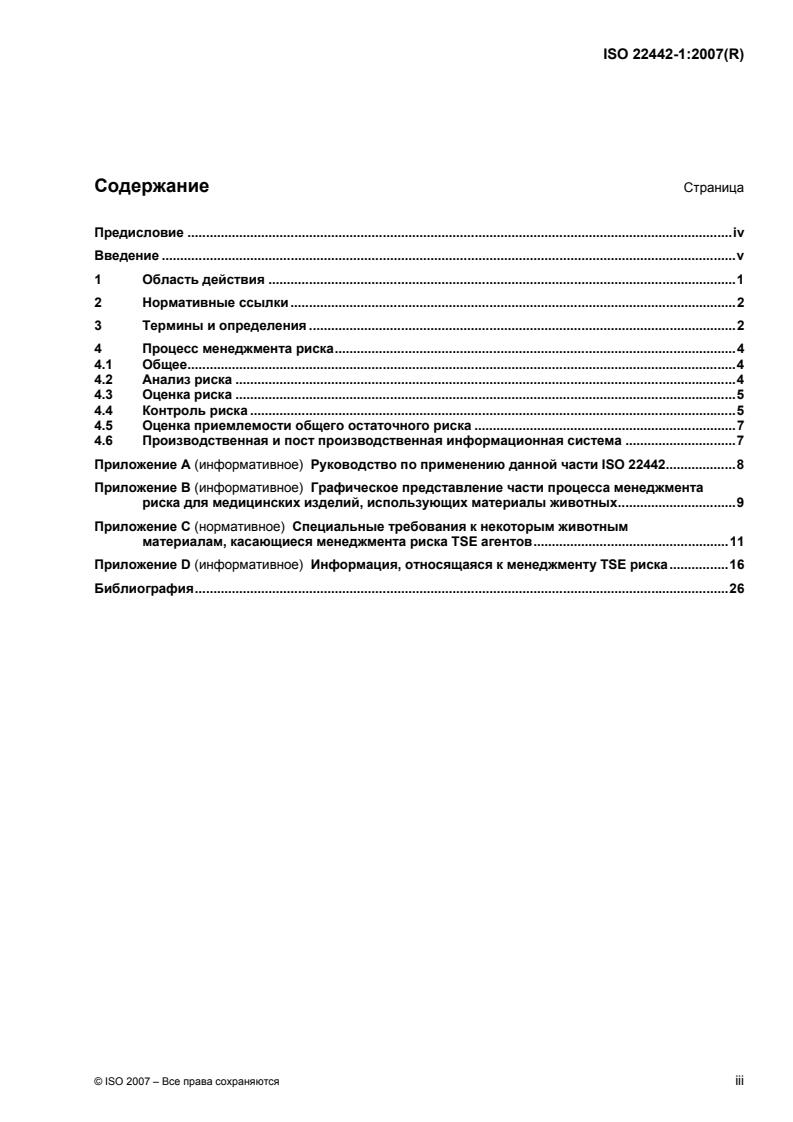
Contents Page
Foreword. iv
Introduction . v
1 Scope . 1
2 Normative references . 2
3 Terms and definitions. 2
4 Risk management process . 3
4.1 General. 3
4.2 Risk analysis . 4
4.3 Risk evaluation. 5
4.4 Risk control . 5
4.5 Evaluation of overall residual risk acceptability .7
4.6 Production and post-production information system . 7
Annex A (informative) Guidance on the application of this part of ISO 22442 . 8
Annex B (informative) Graphical representation of part of the risk management process for
medical devices utilizing animal material . 9
Annex C (normative) Special requirements for some animal materials considering the risk
management for TSE agents . 11
Annex D (informative) Information relevant to the management of TSE risk . 16
Bibliography . 24
Foreword
ISO (the International Organization for Standardization) is a worldwide federation of national standards bodies
(ISO member bodies). The work of preparing International Standards is normally carried out through ISO
technical committees. Each member body interested in a subject for which a technical committee has been
established has the right to be represented on that committee. International organizations, governmental and
non-governmental, in liaison with ISO, also take part in the work. ISO collaborates closely with the
International Electrotechnical Commission (IEC) on all matters of electrotechnical standardization.
International Standards are drafted in accordance with the rules given in the ISO/IEC Directives, Part 2.
The main task of technical committees is to prepare International Standards. Draft International Standards
adopted by the technical committees are circulated to the member bodies for voting. Publication as an
International Standard requires approval by at least 75 % of the member bodies casting a vote.
Attention is drawn to the possibility that some of the elements of this document may be the subject of patent
rights. ISO shall not be held responsible for identifying any or all such patent rights.
ISO 22442-1 was prepared by Technical Committee ISO/TC 194, Biological evaluation of medical devices,
Subcommittee SC 1, Tissue product safety.
ISO 22442 consists of the following parts, under the general title Medical devices utilizing animal tissues and
their derivatives:
⎯ Part 1: Application of risk management
⎯ Part 2: Controls on sourcing, collection and handling
⎯ Part 3: Validation of the elimination and/or inactivation of viruses and transmissible spongiform
encephalopathy (TSE) agents
iv © ISO 2007 – All rights reserved
Introduction
Certain medical devices utilize materials of animal origin.
Animal tissues and their derivatives are used in the design and manufacture of medical devices to provide
performance characteristics that have been chosen for advantages over non-animal based materials. The
range and quantities of materials of animal origin in medical devices vary. These materials can comprise a
major part of the device (e.g. bovine/porcine heart valves, bone substitutes for use in dental or orthopaedic
applications, haemostatic devices), can be a product coating or impregnation (e.g. collagen, gelatine, heparin),
or can be used in the device manufacturing process (e.g. tallow derivatives such as oleates and stearates,
foetal calf serum, enzymes, culture media).
ISO 14971 is a general standard which specifies a process for a manufacturer by identifying hazards and
hazardous situations associated with medical devices, including in vitro medical devices, to estimate and
evaluate the risks associated with those hazards, to control these risks and to monitor the effectiveness of the
control throughout the life cycle. This part of ISO 22442 provides additional requirements and guidance for the
evaluation of medical devices manufactured utilizing animal tissues or derivatives which are non-viable or
rendered non-viable.
This part of ISO 22442 is intended to cover medical devices including active implantable medical devices such
as implantable infusion pumps.
This part of ISO 22442 does not apply to in vitro diagnostic devices.
This part of ISO 22442 can only be used in combination with ISO 14971 and is not a “stand-alone” Standard.
NOTE To show compliance with this part of ISO 22442, its specified requirements should be fulfilled. The guidance
given in the Notes and informative annexes is not normative and is not provided as a checklist for auditors.
INTERNATIONAL STANDARD ISO 22442-1:2007(E)
Medical devices utilizing animal tissues and their derivatives —
Part 1:
Application of risk management
1 Scope
This part of ISO 22442 applies to medical devices other than in vitro diagnostic medical devices manufactured
utilizing materials of animal origin, which are non-viable or have been rendered non-viable. It specifies, in
conjunction with ISO 14971, a procedure to identify the hazards and hazardous situations associated with
such devices, to estimate and evaluate the resulting risks, to control these risks, and to monitor the
effectiveness of that control. Furthermore, it outlines the decision process for the residual risk acceptability,
taking into account the balance of residual risk, as defined in ISO 14971, and expected medical benefit as
compared to available alternatives. This part of ISO 22442 is intended to provide requirements and guidance
on risk management related to the hazards typical of medical devices manufactured utilizing animal tissues or
derivatives such as:
a) contamination by bacteria, moulds or yeasts;
b) contamination by viruses;
c) contamination by agents causing Transmissible Spongiform Encephalopathies (TSE);
d) material responsible for undesired pyrogenic, immunological or toxicological reactions.
For parasites and other unclassified pathogenic entities, similar principles can apply.
This part of ISO 22442 does not stipulate levels of acceptability which, because they are determined by a
multiplicity of factors, cannot be set down in such an International Standard except for some particular
derivatives mentioned in Annex C. Annex C stipulates levels of TSE risk acceptability for tallow derivatives,
animal charcoal, milk and milk derivatives, wool derivatives and amino acids.
This part of ISO 22442 does not specify a quality management system for the control of all stages of
production of medical devices.
This part of ISO 22442 does not cover the utilization of human tissues in medical devices.
NOTE 1 It is not a requirement of this part of ISO 22442 to have a full quality management system during manufacture.
However, attention is drawn to International Standards for quality management systems (see ISO 13485) that control all
stages of production or reprocessing of medical devices.
NOTE 2 For guidance on the application of this part of ISO 22442 see Annex A.
2 Normative references
The following referenced documents are indispensable for the application of this document. For dated
references, only the edition cited applies. For undated references, the latest edition of the referenced
document (including any amendments) applies.
ISO 10993-1, Biological evaluation of medical devices — Part 1: Evaluation and testing within a risk
management system
ISO 14971:2007, Medical devices — Application of risk management to medical devices
ISO 22442-2:2007, Medical devices utilizing animal tissues and their derivatives — Part 2: Control on sourcing,
collection and handling
ISO 22442-3:2007, Medical devices utilizing animal tissues and their derivatives — Part 3: Validation of the
elimination and/or inactivation of viruses and transmissible spongiform encephalopathy (TSE) agents
3 Terms and definitions
For the purposes of this document, the terms and definitions given in ISO 14971 and the following apply.
3.1
animal
any vertebrate or invertebrate [including amphibian, arthropod (e.g. crustacean), bird, coral, fish, reptile,
mollusc and mammal] excluding humans (Homo sapiens)
3.2
cell
smallest organized unit of any living form which is capable of independent existence and of replacement of its
own substance in a suitable environment
3.3
derivative
substance obtained from an animal material by a manufacturing process
EXAMPLE hyaluronic acid, collagen, gelatine, monoclonal antibodies, chitosan, albumin.
3.4
elimination
removal
process by which the number of transmissible agents is reduced
NOTE 1 The effectiveness of the process for the elimination of viruses and TSE agents should be expressed
mathematically in terms of a reduction factor (see C.2 and Annex F of ISO 22442-3:2007).
NOTE 2 Elimination aims to prevent infection or pathogenic reaction caused by transmissible agents.
3.5
inactivation
process by which the ability to cause infection or pathogenic reaction by a transmissible agent is reduced
NOTE 1 The effectiveness of the process for inactivation of viruses and TSE agents should be expressed
mathematically in terms of a reduction factor (see Annex F of ISO 22442-3:2007).
NOTE 2 Inactivation aims to prevent infection by, and replication of, transmissible agents.
2 © ISO 2007 – All rights reserved
3.6
medical device
any instrument, apparatus, implement, machine, appliance, implant, in vitro reagent or calibrator, software,
material or other similar or related article, intended by the manufacturer to be used, alone or in combination,
for human beings for one or more of the specific purpose(s):
⎯ diagnosis, prevention, monitoring, treatment or alleviation of disease;
⎯ diagnosis, monitoring, treatment, alleviation of, or compensation for, an injury;
⎯ investigation, replacement, modification, or support of the anatomy or of a physiological process;
⎯ supporting or sustaining life;
⎯ control of conception;
⎯ disinfection of medical devices;
⎯ providing information for medical purposes by means of in vitro examination of specimens derived from
the human body;
and which does not achieve its primary intended action in or on the human body by pharmacological,
immunological or metabolic means, but which may be assisted in its intended function by such means
[39]
NOTE 1 This definition has been developed by the Global Harmonization Task Force (GHTF)
NOTE 2 ISO 22442 does not apply to in vitro diagnostic devices.
3.7
non-viable
having no potential for metabolism or multiplication
3.8
technical agreement
binding contract between two or more parties that assigns responsibilities for technical requirements
3.9
tissue
organization of cells and/or extra-cellular constituents
3.10
transmissible agents
bacteria, mould, yeast, parasites, viruses, TSE agents and unclassified pathogenic entities
4 Risk management process
4.1 General
The manufacturer shall justify the use of animal material (including the choice of animal species and tissues)
based on the residual risk acceptability, taking into account the balance of residual risk and expected medical
benefit, as compared to available alternatives.
The requirements of ISO 14971 and 4.2 to 4.5 apply. Compliance with these requirements shall be verified by
inspection of the risk management file.
NOTE Further discussion of medical benefits and the risk/benefit analysis can be found in ISO 14971:2007,
Clause D.6.
4.2 Risk analysis
4.2.1 Identification of qualitative and quantitative characteristics related to the safety of medical
devices
4.2.1.1 Does the device come into contact with the patient or other persons?
The quantity of material, the contact surface area and the type(s) of the material coming into contact with body
tissues or fluids as well as the type of body tissue or fluid it comes into contact with, shall be addressed in the
risk analysis. For TSE, guidance can be found in D.3.7.
NOTE 1 Medical devices such as orthopaedic shoes or components such as leather straps that come into contact only
with intact skin represent a low infective risk.
NOTE 2 The quantity of material coming into contact is one of the factors in producing biological effects. See
ISO 10993 for the evaluation of such effects.
NOTE 3 The structure of animal tissues being processed can affect the inactivation and/or elimination of transmissible
agents, and the potential for retaining viable cells can be affected by the structure of the animal tissues and derivatives
being processed.
4.2.1.2 What materials and/or components are incorporated in the medical device or are used with,
or are in contact with, the medical device?
The following factors shall be addressed, if applicable:
a) if viable animal materials are utilized in the manufacture of the medical device, verification that the final
medical device contains no viable animal material;
b) the intended use of any animal tissue or derivative;
c) geographical source, species, age and feeding (including use of animal-derived protein) of animals;
d) veterinary control, conditions under which the animal materials are recovered, potential for cross-
contamination;
e) the type and anatomical source of tissue;
f) the production process, particularly if it uses materials pooled from more than one animal;
g) the nature of material utilized in the medical device, (e.g. intact tissue, highly purified derivative);
h) the method of utilization or incorporation into the medical device.
NOTE In the case of medical devices utilizing several relevant constituents (e.g. from various species, origin or
tissues) or several similar types of constituents produced using different methods, each individual constituent should be
analysed separately.
4.2.1.3 Is the device supplied sterile or intended to be sterilized by the user or are other
microbiological controls applicable?
Given the biological nature of animal tissues or derivatives, variations in the bioburden of bacteria, mould and
yeast of the animal material shall be estimated.
NOTE See also ISO 11737-1 and ISO 14160.
4 © ISO 2007 – All rights reserved
4.2.1.4 Are there unwanted outputs of substances?
The possible presence of toxic residue related to the manufacturing process utilized or degradation by-
products shall be addressed taking into account the physical characteristics (e.g. porosity, heterogeneity) and
chemical composition of animal tissues or derivatives.
NOTE See also ISO 10993-1, -9, -17, -18 and -19.
4.2.2 Identification of hazards and hazardous situations
The possible hazards associated with animal tissues or derivatives shall be identified and documented.
Particular attention shall be applied to possible hazards posed by animal tissues or derivatives with regard to:
⎯ potential contamination by transmissible agents and their susceptibility to elimination and/or inactivation
during processing;
⎯ potential for contaminants on the finished material which can cause an undesired pyrogenic,
immunological or toxicological reaction;
⎯ potential for the finished material itself to cause an undesired pyrogenic, immunological or toxicological
reaction.
4.3 Risk evaluation
In accordance with ISO 14971, all identified risks shall be evaluated. Biological safety shall be evaluated in
accordance with ISO 10993-1. Risk evaluation for transmissible agents shall be implemented by separately
addressing the risks related to different categories of transmissible agents. Annex B identifies the main
categories of risk that should be considered. Regarding the TSE risk, compliance with requirements specified
in Annex C for certain animal materials can indicate risk acceptability.
NOTE Annex C combines elements of risk evaluation and risk control.
4.4 Risk control
4.4.1 General
The risk control options shall be documented and justified.
The flowchart in Annex B gives an overview of the risk management process. If additional risks are identified
when using this part of ISO 22442, the medical device manufacturer may choose to follow any other relevant
standard or any other route. The decision should be justified and documented.
4.4.2 Risk control for viruses and TSE agents
Risk control shall be implemented by separately addressing the risks related to different categories of viruses
and TSE agents. After defining the characteristics of the product, the medical device manufacturer shall
comply with the relevant requirements of both ISO 22442-2 and ISO 22442-3, except where either the animal
species is such that manufacturers cannot fully meet the requirements of ISO 22442-2 or an inactivation
process in accordance with ISO 22442-3 would cause unacceptable degradation.
Tallow derivatives, animal charcoal, and amino acids that are acceptable for TSE risk as discussed in
Annex C, due to their processing and not their sourcing, shall also be considered to have acceptable risk
regarding viruses.
Regarding TSE risk, risk control measures specified in Annex C for certain animal materials shall be applied
where relevant. If the manufacturer considers any requirement not to be relevant, the rationale and
justification shall be documented.
For medical devices where an inactivation process causes unacceptable degradation, manufacturers may rely
on ISO 22442-2 in order to meet the requirements of this part of ISO 22442.
If the animal species is such that manufacturers cannot fully meet the requirements of ISO 22442-2, they shall
demonstrate that the level of inactivation of transmissible agents in a validated manufacturing process, as
required in ISO 22442-3, is sufficient to achieve an acceptable level of risk.
NOTE Criteria and principles relevant to the management of TSE risks are described in Annex D. Annex D contains
information on relevant risk control measures
4.4.3 Risk control of other hazards
Risk control related to bacteria, moulds and yeasts, as well as undesired pyrogenic, immunological and
toxicological reactions shall be implemented according to available standards.
Tallow derivatives, animal charcoal, and amino acids that are acceptable for TSE risk as discussed in
Annex C, due to their processing and not their sourcing, shall also be considered to have acceptable risk
regarding bacteria, moulds and yeasts, subject to maintenance of proper storage conditions.
The manufacturer shall conduct periodic microbiological studies to identify and quantify the initial bioburden of
the incoming animal material for the production of the medical device.
NOTE International Standards which can be relevant are:
a) ISO 11135, ISO 11137, ISO 11737-1, ISO 13408, ISO 14160, ISO 14937, ISO 17664 and ISO 17665-1, which can
be relevant for bacteria, moulds and yeasts (see Bibliography);
b) all relevant parts of ISO 10993, which can be used to manage risks related to undesired pyrogenic, immunological or
toxicological reactions (see Bibliography).
The use of these International Standards is illustrated in Annex B.
4.4.4 Residual risk evaluation
4.4.4.1 General
Residual risk evaluation shall be performed for each risk.
4.4.4.2 TSE risk
The TSE risk may be judged acceptable if the following criteria are both met, taking into account the
availability of alternative materials:
a) the residual risk estimate indicates that the TSE risk has been controlled at an acceptable level;
b) the medical benefit arising from the intended use of the device is judged to outweigh the residual risk
estimate.
NOTE Guidance on risk management applicable to TSE agents is given in Annex D. Acceptability can be based on
conformity with requirements specific to some animal materials given in Annex C or requirements relevant to sourcing,
collection and handling of bovine materials given in Annex A of ISO 22442-2:2007.
Regarding the TSE residual risk, specific considerations are provided in Annex C. Some derivatives such as
tallow derivatives, animal charcoal, milk derivatives, wool derivatives and amino acids manufactured
according to conditions mentioned in Annex C are considered as presenting an acceptable TSE risk.
Where the TSE risk has not been controlled at a level that presents an acceptable level of risk to users or
recipients, the overall risk may only be judged acceptable when balanced by exceptional benefit and feasibility
considerations.
6 © ISO 2007 – All rights reserved
4.5 Evaluation of overall residual risk acceptability
4.5.1 General
The evaluation of the overall residual risk acceptability shall take into account the balance between the
residual risk after implementation of all risk control measures and the expected medical benefit, as compared
to available alternatives. Where residual risks exist with regard to the contamination with transmissible agents,
the evaluation should specifically discuss the risks and benefits of
⎯ using alternative materials that do not present the risk of contamination with these transmissible agents,
such as synthetic materials, materials from other animal species, or materials from human origin and
⎯ applying whole product alternatives for the same intended purposes.
Where the risk has not been controlled at a level that presents an acceptable level of risk to users or
recipients, the overall risk may only be judged acceptable when balanced by exceptional benefit and feasibility
considerations.
4.5.2 Documentation
The rationale that the risk is acceptable shall be documented in the risk management file.
4.6 Production and post-production information system
Manufacturers shall ensure that the system will identify changes in the zoonosis status of the chosen source
of animal materials.
Annex A
(informative)
Guidance on the application of this part of ISO 22442
A.1 General
Wherever in this document it is stated that something “be addressed”, the reader should either take action to
control the risk or justify in the risk management report why they have not done so.
A.2 Application to materials from animal sources
This International Standard is applicable to materials such as:
⎯ porcine heart valves, bovine bones, cattle ligaments and bovine pericardium;
⎯ derivatives of animal tissues, such as chondroitin sulfate obtained from shark and collagen derived from
hides, and of animal blood or serum;
⎯ materials produced in vivo by relevant animals, e.g. antibodies utilized in the manufacturing process;
⎯ starting materials such as bovine serum albumin, enzymes, culture media including those used to prepare
working cell banks, master cell banks or master seeds for products such as hyaluronic acid.
A.3 Application to materials supplied by third parties
This part of ISO 22442 can be applied when the materials used by medical device manufacturers have been
prepared from animal sources by third parties or subcontractors. An example is gelatine derived from animal
hides or bones. In considering the risks associated with the use of these products, the medical device
manufacturers should seek evidence from their suppliers as to whether relevant requirements of ISO 22442
have been applied in assessing the suitability of the animal material or whether alternative approaches were
applied. The information obtained should be incorporated in the risk management report relating to the
medical device, as appropriate, but may need to be supplemented by information supplied by the third party or
subcontractor.
8 © ISO 2007 – All rights reserved
Annex B
(informative)
Graphical representation of part of the risk management process for
medical devices utilizing animal material
See Figure B.1 overleaf.
Figure B.1 — Graphical representation of part of the risk management process
This chart illustrates part of the risk management process in accordance with ISO 14971 and this part of
ISO 22442. The risk management process should address all relevant risks shown in this chart.
10 © ISO 2007 – All rights reserved
Annex C
(normative)
Special requirements for some animal materials considering the risk
management for TSE agents
C.1 General
The requirements of this annex do not obviate the need to undertake a risk assessment for TSE risks,
including the requirements in Clause 4, as part of the risk assessment and management process described in
ISO 14971.
Risk management can be addressed by processing, sourcing, or a combination of both. Tallow derivatives,
animal charcoal and amino acids are acceptable for TSE risk due to their processing and not their sourcing.
Annex A of ISO 22442-2:2007 contains additional requirements relating to the application of this part of
ISO 22442 to bovine-sourced materials.
To demonstrate compliance with the requirements of this part of ISO 22442 it is necessary to implement a
technical agreement between the medical device manufacturer and the animal material/derivative supplier
(see ISO 22442-2:2007, Clause 6).
C.2 Collagen
Collagen is a fibrous protein component of mammalian connective tissue.
For collagen, documentation to demonstrate compliance with this part of ISO 22442 shall be provided, taking
into account the relevant requirements of this annex.
When completing the risk management required by this part of ISO 22442, consider the following.
⎯ For collagen produced from bone, the bone shall be sourced from countries with minimal exposure to
BSE. Sourcing bone from countries with limited exposure to BSE shall be justified by reference to other
applicable risk control measures. (See Annex A of ISO 22442-2:2007.) Bone shall not be sourced from
countries where infection with the BSE agent is confirmed at a higher level, unless from a low risk herd as
defined in ISO 22442-2.
⎯ For collagen produced from bones, the manufacturing conditions specified for gelatine are applicable
(see below).
⎯ Collagen produced from hides and skins does not usually present a significant TSE risk provided that
cross-contamination with potentially infected materials, for example central nervous tissues, is avoided
during their procurement. To demonstrate compliance with the requirements of this part of ISO 22442, it
is necessary to incorporate measures to prevent cross-contamination (see ISO 22442-2) and to
document the measures that are adopted in the technical agreement between the collagen supplier and
the medical device manufacturer to prevent such cross-contamination.
Collagen shall be obtained from animals declared as fit for human consumption (see ISO 22442-2).
1) 2)
NOTE 1 “Minimal exposure to BSE” should be interpreted as GBR I , or countries on the APHIS List or from low risk
herds as defined in ISO 22442-2.
NOTE 2 “Limited exposure to BSE” should be interpreted as GBR II or GBR III.
C.3 Gelatine derived from hides and bones
C.3.1 General
Gelatine is a natural, soluble protein, gelling or non-gelling, obtained by the partial hydrolysis of collagen
produced from bones, hides and skins, tendons and sinews of animals.
For gelatine, documentation to demonstrate compliance with this part of ISO 22442 shall be provided, taking
into account the relevant requirements listed in this annex.
Gelatine shall be obtained from animals declared as fit for human consumption.
When completing the risk evaluation and control required by this part of ISO 22442, consider C.3.2 to C.3.4.
C.3.2 Hides as the starting material
On the basis of current knowledge, hides used for gelatine production represent a safer source material when
compared to bones.
Gelatine produced from hides does not usually present a significant TSE risk provided that cross-
contamination with potentially infected materials, for example central nervous tissues, is avoided during their
procurement. To demonstrate compliance with the requirements of this part of ISO 22442, it is necessary to
incorporate measures to prevent cross-contamination (see ISO 22442-2) and to document the measures that
are adopted to prevent such cross-contamination in the technical agreement between the gelatine supplier
and the medical device manufacturer.
C.3.3 Bones as the starting material
Where bones are used to manufacture gelatine, the quality of the starting materials is the primary parameter
that will ensure the safety of the final product. Therefore, the following shall be applied.
⎯ Subject to national legislation, bone shall be sourced from countries with minimal or limited exposure to
BSE. Bone shall not be sourced from countries where infection with the BSE agent is confirmed at a
higher level, unless from a low risk herd as defined in ISO 22442-2.
⎯ Skulls and spinal cords shall be removed from the collected bones (raw/starting material) from cattle of a
specific age as defined in national legislation.
⎯ Additionally, vertebrae shall be removed from the raw/starting materials from cattle of all ages from
countries with limited exposure to BSE.
1) The European Union has published documents on Geographical BSE Risks for a number of countries, available on
the Web site of the Scientific Steering Committee of the Commission of the European Union:
http://europa.eu.int/comm/food/fs/sc/ssc/outcome_en.html
The EFSA permitted list can be found under the following url:
http://www.efsa.eu.int/science/tse_assessments/gbr_assessments/catindex_en.html
2) The permitted list published by the Animal And Plant Health Inspection Service can be found under
http://www.aphis.usda.gov/vs/ncie/country.html#BSE
12 © ISO 2007 – All rights reserved
C.3.4 Manufacturing methods
No specific measures with regard to the processing conditions are required for gelatine produced from hides
provided that control measures be put in place to avoid cross-contamination both during the sourcing of the
hides and during the manufacturing process (see C.3.2).
Where bones are used as the starting material, use one of the manufacturing methods described below.
⎯ Although the alkaline extraction process (prior to the finishing steps) has shown a slightly higher
inactivation/elimination capacity compared to the acid process, both the acid and the alkaline
manufacturing methods to produce the final gelatine have shown similar overall inactivation/elimination of
TSE infectivity in the gelatine validation experiments. Studies have shown that an additional alkaline
treatment (pH 13, 1 h) of the bones/ossein further increases the TSE inactivation/elimination capacity of
the acid manufacturing process.
⎯ For a typical alkaline manufacturing process, bones are finely crushed, degreased with hot water and
demineralized with diluted hydrochloric acid (at a minimum of 4 % and pH < 1,5) over a period of at least
two days to produce the ossein. This is followed by an alkaline treatment with saturated lime solution
(at least pH 12,5) for a period of at least 20 d. The gelatine is extracted, washed, filtered and
concentrated. A flash heat treatment step using 138 °C to 140 °C for 4 s is applied. Bovine bones may
also be treated by an acid process. The liming step is then replaced by an acid pre-treatment where the
ossein is soaked overnight at pH < 4. In the heat/pressure process, the dried, degreased, crushed bones
are autoclaved with saturated steam at a pressure greater than 3 bar and a minimum temperature of
133 °C for at least 20 min, followed by extraction of the protein with hot water. The finishing steps for both
the acid and heat/pressure process are similar to the alkaline process.
C.4 Bovine blood derivatives
C.4.1 General
Foetal bovine serum is commonly used in cell cultures. Foetal bovine serum should be obtained from foetuses
harvested in abattoirs from healthy dams fit for human consumption and the womb should be completely
removed. The foetal blood shall be harvested in a dedicated space or area by cardiac puncture into a closed
collection system using an aseptic technique.
New born calf serum is obtained from calves aged less than 20 d; calf serum from animals aged less than
12 months. In the case of donor bovine serum, given that it can be derived from animals less than 36 months
old, the BSE status of the donor herd shall be well defined and documented. In all cases, serum shall be
collected according to specified protocols by personnel trained in these procedures and the precautions
necessary to avoid cross-contamination with higher risk tissues.
For bovine blood derivatives, documentation to demonstrate compliance with this part of ISO 22442 shall be
provided, taking into account the relevant requirements listed in this annex. When completing the risk
management required by this part of ISO 22442, consider C.4.2 to C.4.4.
C.4.2 Traceability
Traceability to the slaughterhouse shall be assured for each batch of serum or plasma. Slaughterhouses shall
have available lists of farms from which the animals are sourced. If serum is produced from living animals,
records shall be available for each serum batch to assure traceability to the farms and to the individual animal.
When traceability to the individual animal is not possible, this shall be justified in the risk management file.
C.4.3 Geographical origin
Bovine blood shall be sourced from countries with minimal exposure to BSE unless otherwise justified and
authorized.
C.4.4 Stunning methods
If blood is obtained from slaughtered animals, the method of slaughter is of importance to assure the safety of
the material. It has been demonstrated that stunning by a captive bolt stunner with or without pithing, as well
as by pneumatic stunner, especially if it injects air, can destroy the brain and disseminate brain material into
the blood stream. There is evidence that non-penetrative stunning can cause some Central Nervous System
(CNS) embolism. The stunning methods shall be described for the bovine blood collection process unless the
material is sourced from a country of negligible geographical BSE risk (see A.3.1 of ISO 22442-2:2007).
Where sourcing of blood is from countries with limited exposure to BSE, a non-penetrative stunner or electro-
narcosis shall be used for slaughter of animals over 12 months of age. The use of non-penetrative stunning
shall be justified on the basis of an estimate of the risk of dissemination of brain particles into the blood.
NOTE Additional information on stunning techniques can be found in SSC Opinion on stunning methods and BSE
risk (The risk of dissemination of brain particles into the blood and carcass when applying certain stunning methods)
adopted at the meeting on 10-11 January 2002 (http://www.europa.eu.int/comm/food/fs/sc/ssc/out245_en.pdf) and Report
of the EFSA Working Group on BSE risk from dissemination of brain particles in blood and carcass. Question
N° EFSA-Q-2003-122 adopted on 21 October 2004 (http://www.efsa.europa.eu/en/science/biohaz/biohaz_opinions/731.html).
C.5 Tallow Derivatives
Tallow is fat obtained from tissues including subcutaneous, abdominal and inter-muscular areas and bones.
Tallow derivatives, such as glycerol and fatty acids, manufactured from tallow by rigorous processes, are
thought unlikely to be infectious. For this reason, such materials manufactured under the conditions at least as
rigorous as those given below shall be considered as presenting an acceptable TSE risk, irrespective of the
geographical origin and the nature of the tissues from which tallow derivatives are derived. Examples of
rigorous processes are:
a) trans-esterification or hydrolysis at not less than 200 °C for not less than 20 min under pressure (glycerol,
fatty acids and fatty acid esters production);
b) saponification with sodium hydroxide solution, at a concentration of 12 mol/l (glycerol and soap
production);
1) batch process: at not less than 95 °C for not less than 3 h;
2) continuous process: at not less than 140 °C, under pressure for not less than 8 min, or equivalent;
c) distillation at 200 °C.
C.6 Animal charcoal
Animal charcoal is prepared by carbonization of animal tissues, such as bones, using a temperature > 800 °C.
Irrespective of the geographical origin and the nature of the tissue, animal charcoal prepared under these
conditions shall be considered as presenting an acceptable TSE risk.
C.7 Milk and milk derivatives
Certain materials, including lactose, are extracted from whey, the spent liquid from cheese production
following coagulation. Coagulation can involve the use of calf rennet, an extract from abomasums, or rennet
derived from other ruminants. A risk assessment for lactose and other whey derivatives produced using calf
14 © ISO 2007 – All rights reserved
3)
rennet was performed and concluded that the TSE risk is negligible if the calf rennet is produced in
[42]
accordance with the process described in the CPMP risk assessment report .
Subject to national legislation, milk derivatives manufactured according to the conditions below are considered
as presenting an acceptable TSE risk:
⎯ the milk is sourced from healthy animals under the same conditions as milk collected for human
consumption;
⎯ no other ruminant-derived materials, with the exception of calf rennet, are used in the preparation of such
derivatives (e.g. pancreatic enzyme digests of casein).
C.8 Wool and its derivatives
Wool and its derivatives, such as lanolin and wool alcohols, shall be considered in compliance with this part of
ISO 22442, provided the wool is sourced from live healthy animals.
Wool derivatives produced from wool that is sourced from slaughtered animals declared ‘fit for human
consumption’ are considered as presenting an acceptable TSE risk if the manufacturing process in relation to
pH, temperature and duration of treatment meets at least one of the stipulated processing conditions listed
below:
⎯ treatment at pH W 13 (initial; corresponding to concentrations of sodium hydroxide W 0,1 mol/l) at W 60 °C
for at least 1 h; this normally occurs during the reflux stage of the organic-alkaline treatment;
⎯ molecular distillation at W 220 °C under reduced pressure.
C.9 Amino acids
Amino acids can be obtained by hydrolysis of animal materials from various sources.
Amino acids prepared using the following processing conditions are considered as presenting an acceptable
TSE risk:
⎯ amino acids produced from hides and skins by a process which involves exposure of the material to a pH
of 1 to 2, followed by a pH > 11, followed by heat treatment at 140 °C for 30 min at 3 bar;
⎯ the resulting amino acids or peptides shall be filtered after production;
⎯ analysis shall be performed using a validated and sensitive method to control any residual intact
macromolecules with a justified limit set.
3) The committee for Proprietary Medicinal Products and its Biotechnology Working Party conducted a risk and
regulatory assessment of lactose prepared using calf rennet. The risk assessment included the source of the animals, the
excision of the abomasums and the availability of well-defined quality assurance procedures. The quality of any milk
replacers used as feed for the animal from which abomasums are obtained is particularly important.
Annex D
(informative)
Information relevant to the management of TSE risk
D.1 General
The naturally occurring transmissible spongiform en
...
NORME ISO
INTERNATIONALE 22442-1
Première édition
2007-12-15
Dispositifs médicaux utilisant des tissus
animaux et leurs dérivés —
Partie 1:
Application de la gestion des risques
Medical devices utilizing animal tissues and their derivatives —
Part 1: Application of risk management
Numéro de référence
©
ISO 2007
PDF – Exonération de responsabilité
Le présent fichier PDF peut contenir des polices de caractères intégrées. Conformément aux conditions de licence d'Adobe, ce fichier
peut être imprimé ou visualisé, mais ne doit pas être modifié à moins que l'ordinateur employé à cet effet ne bénéficie d'une licence
autorisant l'utilisation de ces polices et que celles-ci y soient installées. Lors du téléchargement de ce fichier, les parties concernées
acceptent de fait la responsabilité de ne pas enfreindre les conditions de licence d'Adobe. Le Secrétariat central de l'ISO décline toute
responsabilité en la matière.
Adobe est une marque déposée d'Adobe Systems Incorporated.
Les détails relatifs aux produits logiciels utilisés pour la création du présent fichier PDF sont disponibles dans la rubrique General Info
du fichier; les paramètres de création PDF ont été optimisés pour l'impression. Toutes les mesures ont été prises pour garantir
l'exploitation de ce fichier par les comités membres de l'ISO. Dans le cas peu probable où surviendrait un problème d'utilisation,
veuillez en informer le Secrétariat central à l'adresse donnée ci-dessous.
DOCUMENT PROTÉGÉ PAR COPYRIGHT
© ISO 2007
Droits de reproduction réservés. Sauf prescription différente, aucune partie de cette publication ne peut être reproduite ni utilisée sous
quelque forme que ce soit et par aucun procédé, électronique ou mécanique, y compris la photocopie et les microfilms, sans l'accord écrit
de l'ISO à l'adresse ci-après ou du comité membre de l'ISO dans le pays du demandeur.
ISO copyright office
Case postale 56 • CH-1211 Geneva 20
Tel. + 41 22 749 01 11
Fax. + 41 22 749 09 47
E-mail copyright@iso.org
Web www.iso.org
Publié en Suisse
ii © ISO 2007 – Tous droits réservés
Sommaire Page
Avant-propos. iv
Introduction . v
1 Domaine d'application. 1
2 Références normatives . 2
3 Termes et définitions. 2
4 Processus de gestion des risques. 3
4.1 Généralités . 3
4.2 Analyse du risque. 4
4.3 Évaluation des risques. 5
4.4 Maîtrise des risques . 5
4.5 Évaluation de l'acceptabilité du risque résiduel global. 7
4.6 Système d'information de production et de postproduction . 7
Annexe A (informative) Directives concernant l'application de la présente partie de l'ISO 22442. 8
Annexe B (informative) Représentation graphique d'une partie du processus de gestion
des risques pour les dispositifs médicaux utilisant un matériau d'origine animale. 9
Annexe C (normative) Exigences particulières applicables à certains matériaux d'origine animale
en rapport avec la gestion des risques pour les agents EST . 11
Annexe D (informative) Informations relatives à la gestion du risque d'EST . 17
Bibliographie . 26
Avant-propos
L'ISO (Organisation internationale de normalisation) est une fédération mondiale d'organismes nationaux de
normalisation (comités membres de l'ISO). L'élaboration des Normes internationales est en général confiée
aux comités techniques de l'ISO. Chaque comité membre intéressé par une étude a le droit de faire partie du
comité technique créé à cet effet. Les organisations internationales, gouvernementales et non
gouvernementales, en liaison avec l'ISO participent également aux travaux. L'ISO collabore étroitement avec
la Commission électrotechnique internationale (CEI) en ce qui concerne la normalisation électrotechnique.
Les Normes internationales sont rédigées conformément aux règles données dans les Directives ISO/CEI,
Partie 2.
La tâche principale des comités techniques est d'élaborer les Normes internationales. Les projets de Normes
internationales adoptés par les comités techniques sont soumis aux comités membres pour vote. Leur
publication comme Normes internationales requiert l'approbation de 75 % au moins des comités membres
votants.
L'attention est appelée sur le fait que certains des éléments du présent document peuvent faire l'objet de
droits de propriété intellectuelle ou de droits analogues. L'ISO ne saurait être tenue pour responsable de ne
pas avoir identifié de tels droits de propriété et averti de leur existence.
L'ISO 22442-1 a été élaborée par le comité technique ISO/TC 194, Évaluation biologique des dispositifs
médicaux, sous-comité SC 1, Sécurité des produits tissulaires.
L'ISO 22442 comprend les parties suivantes, présentées sous le titre général Dispositifs médicaux utilisant
des tissus animaux et leurs dérivés:
⎯ Partie 1: Application de la gestion des risques
⎯ Partie 2: Contrôles de l'origine, de la collecte et du traitement
⎯ Partie 3: Validation de l'élimination et/ou de l'inactivation des virus et autres agents responsables
d'encéphalopathie spongiforme transmissible (EST)
iv © ISO 2007 – Tous droits réservés
Introduction
Certains dispositifs médicaux utilisent des matériaux d'origine animale.
Des tissus animaux et leurs dérivés sont utilisés dans la conception et la fabrication de dispositifs médicaux
pour obtenir des caractéristiques de performance présentant des avantages par rapport à celles offertes par
des matériaux d'origine non animale. La diversité et la quantité de matériaux d'origine animale utilisés dans
les dispositifs médicaux sont variables. Ces matériaux peuvent constituer une partie importante du dispositif
(par exemple les valves cardiaques d'origine bovine/porcine, les substituts osseux destinés à être utilisés
dans des applications dentaires ou orthopédiques, les dispositifs hémostatiques), ces matières peuvent être
un revêtement ou une enduction du produit (par exemple collagène, gélatine, héparine) ou peuvent être
utilisées dans le procédé de fabrication du dispositif (par exemple les dérivés du suif tels que les oléates et les
stéarates, le sérum de veau fœtal, les enzymes, les milieux de culture).
L'ISO 14971 est une norme générale qui spécifie un processus permettant au fabricant, par une identification
des phénomènes dangereux et des situations dangereuses associés aux dispositifs médicaux, y compris les
dispositifs médicaux de diagnostic in vitro, d'estimer et d'évaluer les risques associés à ces phénomènes
dangereux, de maîtriser ces risques et de surveiller l'efficacité de cette maîtrise tout au long du cycle de vie.
La présente partie de l'ISO 22442 fournit des exigences et des lignes directrices complémentaires pour
l'évaluation des dispositifs médicaux dans la fabrication desquels des tissus ou des dérivés d'origine animale
non viables ou rendus non viables sont utilisés.
La présente partie de l'ISO 22442 est destinée à couvrir les dispositifs médicaux, y compris les dispositifs
médicaux implantables actifs comme les pompes à perfusion implantables.
La présente partie de l'ISO 22442 ne s'applique pas aux dispositifs de diagnostic in vitro.
La présente partie de l'ISO 22442 ne peut être utilisée qu'associée à l'ISO 14971 et n'est donc pas une norme
«qui se suffit à elle-même».
NOTE Afin d'assurer la conformité avec la présente partie de l'ISO 22442, il est préférable que les exigences
spécifiées soient respectées. Les directives données dans les NOTES et les annexes informatives ne sont pas normatives
et ne constituent pas une liste de contrôle pour les auditeurs.
NORME INTERNATIONALE ISO 22442-1:2007(F)
Dispositifs médicaux utilisant des tissus animaux et leurs
dérivés —
Partie 1:
Application de la gestion des risques
1 Domaine d'application
La présente partie de l'ISO 22442 s'applique aux dispositifs médicaux autres que des dispositifs médicaux de
diagnostic in vitro, dans la fabrication desquels entrent des matériaux d'origine animale non viables ou rendus
non viables. Associée à l'ISO 14971, elle spécifie un mode opératoire permettant d'identifier les phénomènes
dangereux et les situations dangereuses associés à de tels dispositifs, d'estimer et d'évaluer les risques qui
en découlent, de maîtriser ces risques et de surveiller l'efficacité de cette maîtrise. En outre, elle décrit le
processus décisionnel relatif à l'acceptabilité du risque résiduel, en tenant compte du rapport entre le risque
résiduel, tel que défini dans l'ISO 14971, et le bénéfice médical escompté par rapport aux solutions de
remplacement disponibles. La présente partie de l'ISO 22442 est destinée à fournir des exigences et des
directives pour la gestion des risques associés aux phénomènes dangereux typiques, présentés par les
dispositifs médicaux dans la fabrication desquels entrent des tissus ou des dérivés d'origine animale et
notamment
a) la contamination par des bactéries, des moisissures ou des levures,
b) la contamination par des virus,
c) la contamination par des agents responsables d'encéphalopathies spongiformes transmissibles (EST),
d) un matériau provoquant des réactions pyrogènes, immunologiques ou toxicologiques indésirables.
Des principes similaires peuvent s'appliquer aux parasites et autres entités pathogènes non classées.
La présente partie de l'ISO 22442 ne stipule pas de niveaux d'acceptabilité qui, du fait qu'ils sont déterminés
par de multiples facteurs, ne peuvent s'inscrire dans une telle Norme internationale, excepté pour certains
dérivés particuliers mentionnés dans l'Annexe C. L'Annexe C stipule des niveaux d'acceptabilité du risque
d'EST pour les dérivés du suif, le noir animal, le lait et les dérivés du lait, les dérivés de la laine et les acides
aminés.
La présente partie de l'ISO 22442 ne spécifie pas un système de management de la qualité permettant le
contrôle de toutes les étapes de fabrication des dispositifs médicaux.
La présente partie de l'ISO 22442 ne couvre pas l'utilisation de tissus humains dans les dispositifs médicaux.
NOTE 1 La présente partie de l'ISO 22442 n'exige pas un système de management de la qualité complet lors de la
fabrication. Toutefois, il est préférable de se référer aux Normes internationales relatives aux systèmes de management
de la qualité (voir l'ISO 13485) qui contrôlent toutes les étapes de fabrication ou de retraitement des dispositifs médicaux.
NOTE 2 Se reporter à l'Annexe A pour les directives relatives à l'application de la présente partie de l'ISO 22442.
2 Références normatives
Les documents de référence suivants sont indispensables pour l'application du présent document. Pour les
références datées, seule l'édition citée s'applique. Pour les références non datées, la dernière édition du
document de référence s'applique (y compris les éventuels amendements).
ISO 10993-1, Évaluation biologique des dispositifs médicaux — Partie 1: Évaluation et essais
ISO 14971:2007 Dispositifs médicaux — Application de la gestion des risques aux dispositifs médicaux
ISO 22442-2:2007, Dispositifs médicaux utilisant des tissus animaux et leurs dérivés — Partie 2: Contrôles de
l'origine, de la collecte et du traitement
ISO 22442-3:2007, Dispositifs médicaux utilisant des tissus animaux et leurs dérivés — Partie 3: Validation de
l'élimination et/ou de l'inactivation des virus et autres agents responsables d'encéphalopathie spongiforme
transmissible (EST)
3 Termes et définitions
Pour les besoins du présent document, les termes et définitions donnés dans l'ISO 14971 ainsi que les
suivants s'appliquent.
3.1
animal
tout vertébré ou invertébré [y compris les amphibiens, arthropodes (par exemple crustacés), oiseaux, coraux,
poissons, reptiles, mollusques et mammifères] à l'exclusion des êtres humains (Homo sapiens)
3.2
cellule
plus petite unité organisée de toute forme de vie capable d'avoir une existence indépendante et de renouveler
ses propres composants dans un environnement adapté
3.3
dérivé
substance obtenue à partir d'un matériau d'origine animale par un procédé de fabrication
EXEMPLE Acide hyaluronique, collagène, gélatine, anticorps monoclonaux, chitosane, albumine.
3.4
élimination
suppression
processus permettant de réduire le nombre d'agents transmissibles
NOTE 1 Il est préférable que l'efficacité du processus d'élimination des virus et des agents EST soit exprimée
mathématiquement par un facteur de réduction (voir l'ISO 22442-3:2007, C.2 et Annexe F).
NOTE 2 L'élimination a pour but de prévenir l'infection ou la réaction pathogène due à des agents transmissibles.
3.5
inactivation
processus permettant de réduire le potentiel infectieux ou pathogénique d'un agent transmissible
NOTE 1 Il est préférable que l'efficacité du processus d'inactivation des virus et des agents EST soit exprimée
mathématiquement par un facteur de réduction (voir l'ISO 22442-3:2007, Annexe F).
NOTE 2 L'inactivation a pour but de prévenir l'infection et la multiplication d'agents transmissibles.
2 © ISO 2007 – Tous droits réservés
3.6
dispositif médical
tout instrument, appareil, équipement, machine, dispositif, implant, réactif in vitro ou calibreur, logiciel,
matériau ou autre article similaire ou associé, dont le fabricant prévoit l'utilisation seul ou en association chez
l'être humain pour la ou les fins spécifiques suivantes:
⎯ diagnostic, prévention, contrôle, traitement ou atténuation d'une maladie;
⎯ diagnostic, contrôle, traitement, atténuation ou compensation d'une blessure;
⎯ étude, remplacement, modification ou entretien de l'anatomie ou d'un processus physiologique;
⎯ entretien (artificiel) ou maintien de la vie;
⎯ maîtrise de la conception;
⎯ désinfection des dispositifs médicaux;
⎯ communication d'informations à des fins médicales par un examen in vitro de prélèvements provenant du
corps humain;
dont l'action principale voulue dans ou sur le corps humain n'est pas obtenue par des moyens
pharmacologiques, immunologiques ou métaboliques, mais dont la fonction prévue peut être assistée par de
tels moyens
[40]
NOTE 1 Cette définition a été élaborée par le Global Harmonization Task Force (GHTF) .
NOTE 2 L'ISO 22442 ne s'applique pas aux dispositifs de diagnostic in vitro.
3.7
non viable
ne possédant pas de potentiel de métabolisme ou de multiplication
3.8
cahier des charges technique
contrat liant deux parties ou plus, qui assigne les responsabilités associées aux exigences techniques
3.9
tissu
organisation de cellules et/ou de composants extra-cellulaires
3.10
agents transmissibles
bactéries, moisissures, levures, parasites, virus, agents EST et entités pathogènes non classées
4 Processus de gestion des risques
4.1 Généralités
Le fabricant doit, sur la base de l'acceptabilité du risque résiduel, justifier l'utilisation de matériau d'origine
animale (y compris le choix de l'espèce animale et des tissus animaux), en tenant compte du rapport entre le
risque résiduel et le bénéfice médical escompté par rapport aux solutions de remplacement disponibles.
Les exigences de l'ISO 14971 et celles de 4.2 à 4.5 ci-après s'appliquent. La conformité à ces exigences doit
être vérifiée par inspection du fichier de gestion du risque.
NOTE Les bénéfices médicaux et l'analyse du rapport bénéfice/risque sont traités dans l'ISO 14971:2007, D.6.
4.2 Analyse du risque
4.2.1 Identification des caractéristiques qualitatives et quantitatives relatives à la sécurité
des dispositifs médicaux
4.2.1.1 Le dispositif entre-t-il en contact avec le patient ou une autre personne?
La quantité de matériau, la surface de contact et le(s) type(s) de matériau entrant en contact avec les tissus
ou les fluides corporels ainsi que la nature du tissu ou du fluide corporel avec lequel il entre en contact doivent
être pris en compte dans l'analyse du risque. En ce qui concerne les EST, des directives sont fournies en
D.3.7.
NOTE 1 Les dispositifs médicaux tels que les chaussures orthopédiques ou les composants tels que les lanières de
cuir qui entrent en contact avec une peau intacte présentent un faible risque infectieux.
NOTE 2 La quantité de matériau entrant en contact est l'un des facteurs susceptibles de produire des effets
biologiques. Voir l'ISO 10993 pour l'évaluation de ces effets.
NOTE 3 La structure des tissus animaux traités peut avoir un effet sur l'inactivation et/ou l'élimination d'agents
transmissibles et la possibilité de persistance de cellules viables peut aussi être affectée par la structure des tissus
animaux et des dérivés.
4.2.1.2 Quels sont les matériaux et/ou les composants incorporés dans, utilisés avec ou en contact
avec le dispositif médical?
Le cas échéant, les facteurs suivants doivent être pris en compte:
a) si des matériaux d'origine animale viables sont utilisés dans la fabrication du dispositif médical, il est
nécessaire de vérifier que le dispositif médical final ne contient pas de matériau d'origine animale viable;
b) l'usage prévu du tissu ou du dérivé d'origine animale;
c) l'origine géographique, l'espèce, l'âge et l'alimentation des animaux (y compris l'utilisation de protéines
d'origine animale);
d) le contrôle vétérinaire, les conditions dans lesquelles les matériaux d'origine animale sont récupérés, la
possibilité de contamination croisée;
e) la nature et l'origine anatomique du tissu;
f) le processus de production, notamment s'il utilise un pool de matériaux provenant de plusieurs animaux;
g) la nature du matériau utilisé dans le dispositif médical (par exemple tissu intact, dérivé hautement purifié);
h) la méthode d'utilisation ou d'incorporation dans le dispositif médical.
NOTE Pour les dispositifs médicaux utilisant différents composants appropriés (par exemple de différentes espèces,
origines ou tissus) ou plusieurs types d'un même composant, produit par différentes méthodes, il est préférable d'analyser
individuellement chaque constituant.
4.2.1.3 Le dispositif est-il fourni stérile ou est-il prévu qu'il soit stérilisé par l'utilisateur, ou bien
d'autres contrôles microbiologiques sont-ils applicables?
Étant donné la nature biologique des tissus ou des dérivés d'origine animale, la variabilité de la charge
biologique en bactéries, en moisissures et en levures du matériau d'origine animale doit être estimée.
NOTE Voir également l'ISO 11737-1 et l'ISO 14160.
4 © ISO 2007 – Tous droits réservés
4.2.1.4 Y a-t-il des émissions non souhaitées de substances?
En raison des caractéristiques physiques (par exemple porosité, hétérogénéité) et de la composition chimique
des tissus ou des dérivés d'origine animale, il faut tenir compte de l'éventuelle présence de résidus toxiques
liés au processus de fabrication utilisé ou de sous-produits de dégradation.
NOTE Voir également l'ISO 10993-1, l'ISO 10993-9, l'ISO 10993-17, l'ISO 10993-18 et l'ISO 10993-19.
4.2.2 Identification des phénomènes dangereux et des situations dangereuses
Les dangers potentiels associés aux tissus ou aux dérivés d'origine animale doivent être identifiés et
documentés. II faut accorder une attention particulière aux dangers potentiels que présentent les tissus ou les
dérivés d'origine animale en ce qui concerne
⎯ une contamination éventuelle par des agents transmissibles et leur sensibilité aux étapes d'élimination
et/ou d'inactivation durant le processus de traitement,
⎯ la possibilité d'une présence d'agents contaminants dans le produit fini, pouvant entraîner une réaction
pyrogène, immunologique ou toxicologique indésirable,
⎯ la possibilité pour le produit fini de provoquer lui-même une réaction pyrogène, immunologique ou
toxicologique indésirable.
4.3 Évaluation des risques
Tous les risques identifiés doivent être évalués conformément à l'ISO 14971. La sécurité biologique doit être
évaluée conformément à l'ISO 10993-1. L'évaluation des risques associés aux agents transmissibles doit être
mise en œuvre en traitant séparément les risques liés aux différentes catégories d'agents transmissibles.
L'Annexe B identifie les principales catégories de risque devant être prises en considération. En ce qui
concerne le risque d'EST, la conformité aux exigences spécifiées dans l'Annexe C pour certains matériaux
d'origine animale peut indiquer l'acceptabilité du risque.
NOTE L'Annexe C combine les éléments de l'évaluation et de la maîtrise des risques.
4.4 Maîtrise des risques
4.4.1 Généralités
Les options de maîtrise des risques doivent être documentées et justifiées.
L'organigramme de l'Annexe B donne une vue d'ensemble du processus de gestion des risques. Si des
risques supplémentaires sont identifiés en utilisant la présente partie de l'ISO 22442, le fabricant du dispositif
médical peut choisir de suivre toute autre norme appropriée ou toute autre méthode, à condition que cette
décision soit justifiée et documentée.
4.4.2 Maîtrise des risques liés aux virus et agents EST
La maîtrise des risques doit être mise en œuvre en traitant séparément les risques liés aux différentes
catégories de virus et d'agents EST. Après avoir défini les caractéristiques du produit, le fabricant du dispositif
médical doit satisfaire à toutes les exigences applicables de l'ISO 22442-2 et de l'ISO 22442-3, excepté si,
soit l'espèce animale est telle que les fabricants ne peuvent pas satisfaire pleinement aux exigences de
l'ISO 22442-2, soit un procédé d'inactivation conformément à l'ISO 22442-3 pourrait causer une dégradation
inacceptable.
Les dérivés du suif, le noir animal et les acides aminés qui sont acceptables pour le risque d'EST, comme
indiqué dans l'Annexe C, en raison de leur processus de fabrication et non de leur origine, doivent également
être considérés comme présentant un risque viral acceptable.
En ce qui concerne le risque d'EST, les mesures de maîtrise du risque spécifiées dans l'Annexe C pour
certains matériaux d'origine animale doivent être appliquées le cas échéant. Le fabricant doit justifier et
documenter toute exigence qu'il juge non applicable.
Pour les dispositifs médicaux dans lesquels un processus d'inactivation entraîne des détériorations
inacceptables, les fabricants peuvent s'appuyer principalement sur l'ISO 22442-2 afin de satisfaire aux
exigences de la présente partie de l'ISO 22442.
Lorsque l'espèce animale ne permet pas aux fabricants de satisfaire entièrement aux exigences de
l'ISO 22442-2, ces derniers doivent démontrer qu'ils ont atteint, par un processus de fabrication validé, un
niveau d'inactivation des agents transmissibles, conformément aux exigences de l'ISO 22442-3, suffisant pour
atteindre un niveau de risque acceptable.
NOTE Les critères et les principes applicables à la gestion des risques d'EST sont décrits dans l'Annexe D. Cette
dernière contient des informations sur les mesures de maîtrise du risque pertinentes.
4.4.3 Maîtrise des risques liés à d'autres phénomènes dangereux
Une maîtrise des risques doit être mise en œuvre pour les bactéries, les levures et les moisissures, ainsi que
pour les réactions pyrogènes, immunologiques et toxicologiques indésirables, conformément aux normes
disponibles.
Les dérivés du suif, le noir animal et les acides aminés qui sont acceptables pour le risque d'EST, comme
indiqué dans l'Annexe C, en raison de leur processus de fabrication et non de leur origine, doivent également
être considérés comme présentant un risque acceptable associé aux bactéries, moisissures et levures, sous
réserve du maintien de conditions de stockage appropriées.
Le fabricant doit réaliser des études microbiologiques périodiques afin d'identifier et de quantifier la charge
biologique initiale du matériau d'origine animale réceptionné, en vue de la fabrication du dispositif médical.
NOTE Les Normes internationales qui peuvent être applicables sont les suivantes:
a) ISO 11135, ISO 11137, ISO 11737-1, ISO 13408, ISO 14160, ISO 14937, ISO 17664 et ISO 17665-1,
pour les bactéries, les moisissures et les levures (voir Bibliographie);
b) toutes les parties applicables de l'ISO 10993 pour la gestion des risques liés aux réactions pyrogènes,
immunologiques ou toxicologiques indésirables (voir Bibliographie).
L'utilisation de ces Normes internationales est illustrée à l'Annexe B.
4.4.4 Évaluation du risque résiduel
4.4.4.1 Généralités
Une évaluation du risque résiduel doit être effectuée pour chaque risque.
4.4.4.2 Risque d'EST
Le risque d'EST peut être considéré comme acceptable si tous les critères suivants sont satisfaits, en tenant
compte de la disponibilité de matériaux de substitution:
a) l'estimation du risque résiduel indique que le risque d'EST a été maîtrisé à un niveau acceptable;
b) le bénéfice médical lié à l'emploi prévu du dispositif est jugé l'emporter sur l'estimation du risque résiduel.
NOTE Des directives sur la gestion des risques applicable aux agents EST sont données dans l'Annexe D.
L'acceptabilité peut être basée sur la conformité aux exigences spécifiques à certains matériaux d'origine animale
données dans l'Annexe C ou aux exigences applicables à l'origine, à la collecte et au traitement des matériaux d'origine
bovine données dans l'ISO 22442-2:2007, Annexe A.
6 © ISO 2007 – Tous droits réservés
En ce qui concerne le risque résiduel d'EST, des considérations spécifiques sont fournies dans l'Annexe C.
Certains dérivés, tels que les dérivés du suif, le noir animal, les dérivés du lait, les dérivés de la laine, les
acides aminés fabriqués conformément aux conditions mentionnées dans l'Annexe C, sont considérés
comme présentant un risque d'EST acceptable.
Lorsque le risque d'EST n'a pas été maîtrisé à un niveau de risque acceptable pour les utilisateurs ou les
receveurs, le risque global ne peut être considéré comme acceptable que lorsqu'il est contrebalancé par un
bénéfice et une faisabilité exceptionnels.
4.5 Évaluation de l'acceptabilité du risque résiduel global
4.5.1 Généralités
L'évaluation de l'acceptabilité du risque résiduel global doit prendre en compte le rapport entre le risque
résiduel après mise en œuvre de toutes les mesures de maîtrise du risque et le bénéfice médical escompté,
par rapport aux solutions de remplacement disponibles. En présence de risques résiduels liés à la
contamination par des agents transmissibles, il convient que l'évaluation examine spécifiquement les risques
et les bénéfices de
⎯ l'utilisation de matériaux de substitution qui ne présentent pas de risque de contamination par ces agents
transmissibles, tels que des matériaux synthétiques, des matériaux provenant d'autres espèces animales
ou des matériaux d'origine humaine, et
⎯ l'application de l'ensemble des substituts pour les mêmes objectifs prévus.
Lorsque le risque n'a pas été maîtrisé à un niveau de risque acceptable pour les utilisateurs ou les receveurs,
le risque global ne peut être considéré comme acceptable que lorsqu'il est contrebalancé par un bénéfice et
une faisabilité exceptionnels.
4.5.2 Documentation
La justification de l'acceptabilité du risque doit être documentée dans le dossier de gestion des risques.
4.6 Système d'information de production et de postproduction
Les fabricants doivent s'assurer que le système identifiera les variations du statut sanitaire de la source
choisie de matériaux d'origine animale choisie.
Annexe A
(informative)
Directives concernant l'application de la présente partie de l'ISO 22442
A.1 Généralités
Dans la présente partie de l'ISO 22442, chaque fois qu'il est spécifié que quelque chose doit «être traité», il
convient que le lecteur prenne des mesures pour maîtriser le risque ou précise dans le rapport de gestion des
risques les raisons pour lesquelles il ne l'a pas fait.
A.2 Application à des matériaux d'origine animale
La présente présente partie de l'ISO 22442 est applicable à des matériaux tels que
⎯ les valves cardiaques d'origine porcine, les os d'origine bovine, les ligaments d'animaux d'élevage et les
péricardes d'origine bovine,
⎯ les dérivés de tissus animaux, tels que le sulfate de chondroïtine provenant des requins et le collagène
provenant des peaux d'animaux, et les dérivés de sang ou de sérum d'origine animale,
⎯ les matériaux produits in vivo par des animaux appropriés, par exemple les anticorps utilisés dans le
processus de fabrication,
⎯ les matériaux de départ, tels que l'albumine bovine, les enzymes, les milieux de culture, y compris ceux
utilisés pour préparer des banques de cellules de travail, des banques de cellules primaires ou des
semences primaires pour des produits tels que l'acide hyaluronique.
A.3 Application à des matériaux fournis par des tierces parties
La présente partie de l'ISO 22442 peut s'appliquer lorsque les matériaux d'origine animale utilisés par les
fabricants de dispositifs médicaux ont été préparés par des tierces parties ou des sous-traitants. C'est le cas,
par exemple, pour la gélatine dérivée de peaux ou d'os d'animaux. Lors de l'analyse des risques liés à
l'utilisation de ces produits, il convient que les fabricants de dispositifs médicaux demandent à leurs
fournisseurs de leur apporter la preuve qu'ils ont suivi les exigences de l'ISO 22442-1, de l'ISO 22442-2 et de
l'ISO 22442-3 ou utilisé d'autres méthodes équivalentes pour évaluer l'adéquation du matériau d'origine
animale. II convient que les renseignements obtenus soient inclus dans le rapport de gestion des risques
relatif au dispositif médical, complétés, le cas échéant, par les informations fournies par la tierce partie ou le
sous-traitant.
8 © ISO 2007 – Tous droits réservés
Annexe B
(informative)
Représentation graphique d'une partie du processus de gestion
des risques pour les dispositifs médicaux utilisant un matériau
d'origine animale
Voir Figure B.1.
Figure A.1 — Représentation graphique d'une partie du processus de gestion des risques
Ce graphique représente une partie du processus de gestion des risques conformément à l'ISO 14971 et à la
présente partie de l'ISO 22442. Il convient que le processus de gestion des risques traite tous les risques
pertinents représentés dans ce graphique.
10 © ISO 2007 – Tous droits réservés
Annexe C
(normative)
Exigences particulières applicables à certains matériaux d'origine
animale en rapport avec la gestion des risques pour les agents EST
C.1 Généralités
Les exigences de la présente annexe ne suppriment pas la nécessité d'effectuer une estimation du risque lié
aux EST, y compris les exigences de l'Article 4, dans le cadre du processus d'évaluation et de gestion des
risques décrit dans l'ISO 14971.
La gestion des risques peut être abordée par le processus de fabrication, l'origine ou une combinaison des
deux. Les dérivés du suif, le noir animal et les acides aminés sont acceptables pour le risque d'EST en raison
de leur processus de fabrication et non de leur origine.
L'ISO 22442-2:2007, Annexe A, contient des exigences complémentaires relatives à l'application de la
présente partie de l'ISO 22442 à des matériaux d'origine bovine.
Pour démontrer la conformité aux exigences de la présente partie de l'ISO 22442, il est nécessaire de mettre
en œuvre un cahier des charges technique entre le fabricant du dispositif médical et le fournisseur de
matériaux/de dérivés d'origine animale (voir l'ISO 22442-2:2007, Article 6).
C.2 Collagène
Le collagène est une protéine fibreuse entrant dans la composition du tissu conjonctif des mammifères.
Pour le collagène, la documentation démontrant la conformité à la présente partie de l'ISO 22442 doit être
fournie en tenant compte des exigences applicables de la présente annexe.
Lors du processus de gestion des risques exigé par la présente partie de l'ISO 22442, tenir compte des points
suivants.
⎯ En ce qui concerne le collagène produit à partir d'os, les os doivent provenir de pays présentant une
exposition minimale à l'ESB. Le choix d'un approvisionnement en os dans des pays ayant une exposition
limitée à l'ESB doit être justifié par référence à d'autres mesures de maîtrise du risque applicables. (Voir
l'ISO 22442-2:2007, Annexe A.) Les os ne doivent pas provenir de pays dans lesquels l'infection par
l'agent EST est confirmée à un niveau supérieur, à moins qu'ils ne proviennent d'un élevage à faible
risque tel que défini dans l'ISO 22442-2.
⎯ En ce qui concerne le collagène produit à partir d'os, les conditions de fabrication spécifiées pour la
gélatine sont applicables (voir ci-dessous).
⎯ Le collagène produit à partir de peaux ne présente généralement pas de risque d'EST significatif, sous
réserve que la contamination croisée par des matériaux potentiellement infectés, par exemple des tissus
du système nerveux central, soit évitée au cours du prélèvement. Pour démontrer la conformité aux
exigences de la présente partie de l'ISO 22442, il est nécessaire d'intégrer des mesures de prévention de
la contamination croisée (voir l'ISO 22442-2) et de documenter les mesures adoptées dans le cadre du
cahier des charges technique entre le fournisseur de collagène et le fabricant de dispositifs médicaux
pour éviter une telle contamination croisée.
Le collagène doit provenir d'animaux déclarés propres à la consommation humaine (voir l'ISO 22442-2).
1)
NOTE 1 Il est préférable d'interpréter «Exposition minimale à l'ESB» comme RGE I , ou pays figurant sur la liste
2)
APHIS ou provenant d'élevages à faible risque tels que définis dans l'ISO 22442-2.
NOTE 2 Il est préférable d'interpréter «Exposition limitée à l'ESB» comme RGE II ou III.
C.3 Gélatine dérivée de peaux et d'os
C.3.1 Généralités
La gélatine est une protéine naturelle soluble, gélifiante ou non gélifiante, obtenue par l'hydrolyse partielle du
collagène produit à partir d'os, de peaux, de tendons et de muscles d'animaux.
Pour la gélatine, la documentation démontrant la conformité à la présente partie de l'ISO 22442 doit être
fournie en tenant compte des exigences applicables énumérées dans la présente annexe.
La gélatine doit provenir d'animaux déclarés propres à la consommation humaine.
Lors du processus d'évaluation et de maîtrise des risques exigé par la présente partie de l'ISO 22442, tenir
compte de C.3.2 à C.3.4.
C.3.2 Peaux comme matériau de départ
Sur la base des connaissances actuelles, les peaux utilisées pour la production de gélatine représentent un
matériau d'origine plus sûr que les os.
La gélatine produite à partir de peaux ne présente généralement pas de risque d'EST significatif sous réserve
que la contamination croisée avec des matériaux potentiellement infectés, par exemple des tissus du système
nerveux central, soit évitée lors du prélèvement. Pour démontrer la conformité aux exigences de la présente
partie de l'ISO 22442, il est nécessaire d'intégrer des mesures permettant d'éviter la contamination croisée
(voir l'ISO 22442-2) et de documenter les mesures adoptées dans le cadre du cahier des charges technique
entre le fournisseur de gélatine et le fabricant de dispositifs médicaux pour éviter une telle contamination
croisée.
C.3.3 Os comme matériau de départ
Lorsque des os sont utilisés pour produire de la gélatine, la qualité des matériaux de départ est le principal
paramètre permettant de garantir la sécurité du produit final. Par conséquent, ce qui suit doit être appliqué.
⎯ Selon la législation nationale, l'os doit provenir de pays présentant une exposition minimale ou limitée à
l'ESB. L'os ne doit pas provenir de pays dans lesquels l'infection par l'agent ESB est confirmée à un
niveau supérieur, à moins qu'il ne provienne d'un élevage à faible risque tel que défini dans l'ISO 22442-2.
⎯ Les crânes et les moelles épinières doivent être éliminés des os prélevés (matériau de départ/matière
première) sur des animaux d'élevage d'un âge spécifique tel que défini dans la législation nationale.
⎯ En outre, les vertèbres doivent être retirées des matériaux de départ/des matières premières issus
d'animaux d‘élevage de tous les âges provenant de pays ayant une exposition limitée à l'ESB.
1) L’Union européenne a publié des documents sur les risques géographiques d’ESB pour de nombreux pays. Ces
documents sont disponibles sur le site Internet du Comité scientifique directeur de la Commission de l’Union européenne:
http://europa.eu.int/comm/food/fs/sc/ssc/outcome_en.html.
La liste autorisée par l’EFSA (Autorité européenne de sécurité des aliments) est disponible à l’adresse suivante:
http://www.efsa.eu.int/science/tse_assessments/gbr_assessments/catindex_en.html.
2) La liste autorisée publiée par l’APHIS (Animal and Plant Health Inspection Service) est disponible à l’adresse:
http://www.aphis.usda.gov/vs/ncie/country.html#BSE.
12 © ISO 2007 – Tous droits réservés
C.3.4 Méthodes de fabrication
Concernant la gélatine produite à partir de peaux, il n'est exigé aucune mesure spécifique quant aux
conditions de manipulation sous réserve que des mesures de contrôle soient mises en place pour éviter une
contamination croisée, que ce soit pendant le prélèvement des peaux ou pendant le processus de fabrication
(voir C.3.2).
Lorsque des os sont utilisés comme matériau de départ, employer l'un des processuss de fabrication décrits
ci-dessous.
⎯ Bien que le processus d'extraction par voie alcaline (avant les étapes de finition) ait fait preuve d'une
capacité d'inactivation/d'élimination légèrement plus élevée que le processus par voie acide, les
processus de fabrication acide et alcalin permettant de produire la gélatine finale ont montré une
inactivation/une élimination globale similaire de l'infectivité EST au cours des expériences de validation
de la gélatine. Des études ont montré qu'un traitement alcalin supplémentaire (pH 13, 1 h) des os ou de
l'osséine augmente encore la capacité d'inactivation/d'élimination des agents EST du processus de
fabrication acide.
⎯ Un processus typique de fabrication alcaline consiste à finement broyer les os, à les dégraisser à l'eau
chaude et à les déminéraliser à l'acide chlorhydrique dilué (à une concentration minimale de 4 % et à un
pH inférieur à 1,5) pendant une période d'au moins deux jours pour produire l'osséine. Il s'ensuit un
traitement alcalin par une solution de chaux saturée (pH minimal de 12,5) pendant une période d'au
moins 20 jours. La gélatine est extraite, rincée, filtrée et concentrée. Une étape de chauffage instantané
par la vapeur est appliquée de 138 °C à 140 °C pendant 4 s. Les os de bovins peuvent en outre être
traités par un processus acide. L'étape de traitement par la chaux est alors remplacée par un
prétraitement acide durant lequel l'osséine est imbibée à un pH inférieur à 4 pendant toute une nuit. Dans
le processus employant chaleur et pression, les os broyés, dégraissés et séchés, sont placés pendant au
moins 20 min dans un autoclave contenant de la vapeur saturée à une pression supérieure à 3 bar et à
une température minimale de 133 °C. La protéine est ensuite extraite à l'eau chaude. Les étapes de
finition du processus acide et du processus par chaleur/pression sont similaires à celles du processus
alcalin.
C.4 Dérivés de sang bovin
C.4.1 Généralités
Le sérum fœtal bovin est couramment utilisé pour les cultures cellulaires. Il convient que le sérum fœtal bovin
soit obtenu à partir de fœtus prélevés dans des abattoirs sur des vaches en bonne santé et propres à la
consommation humaine et que la totalité de l'utérus soit prélevé. Le sang fœtal doit être recueilli dans un
espace ou une zone dédiés par ponction cardiaque vers un système de prélèvement fermé, dans des
conditions d'asepsie.
Le sérum de veau nouveau-né est obtenu à partir de veaux âgés de moins de 20 jours et le sérum de veau à
partir d'animaux âgés de moins de 12 mois. Dans le cas du sérum bovin issu d'un donneur, sous réserve qu'il
provienne d'animaux âgés de moins de 36 mois, le statut du troupeau donneur au regard de l'ESB doit être
bien défini et documenté. Dans tous les cas, le sérum doit être prélevé selon les protocoles spécifiés par le
personnel formé à ces modes opératoires et aux précautions à prendre pour éviter une contamination croisée
avec des tissus à risque élevé.
En ce qui concerne les dérivés de sang bovin, les documents démontrant la conformité à la présente partie de
l'ISO 22442 doivent être fournis, en tenant compte des exigences applicables spécifiées dans la présente
annexe. Lors du processus de gestion des risques exigé par la présente partie de l'ISO 22442, prendre en
considération C.4.2 à C.4.4.
C.4.2 Traçabilité
L'abattoir d'origine doit être traçable pour chaque lot de sérum ou de plasma. Les abattoirs doivent disposer
de listes disponibles des fermes d'où proviennent les animaux. Si le sérum est produit à partir d'animaux
vivants, des enregistrements doivent être disponibles pour chaque lot de sérum afin de garantir la traçabilité
jusqu'aux fermes et jusqu'à l'animal individuel. L'impossibilité d'assurer la traçabilité jusqu'à l'animal individuel
doit être justifiée dans le dossier de gestion des risques.
C.4.3 Origine géographique
Sauf justification et autorisation contraires, le sang bovin doit provenir de pays ayant une exposition minimale
à l'ESB.
C.4.4 Méthodes d'étourdissement
Si le sang est prélevé sur des animaux abattus, la méthode d'abattage est importante pour la garantie de
l'innocuité du matériau. Il a été démontré que l'étourdissement au moyen d'un pistolet à tige perforante avec
ou sans énuquage, ou au moyen d'un pistolet pneumatique, notamment s'il injecte de l'air, peut détruire le
cerveau et disséminer
...
МЕЖДУНАРОДНЫЙ ISO
СТАНДАРТ 22442-1
Первое издание
2007-12-15
Медицинские изделия, использующие
ткани животных и их производные.
Часть 1.
Применение менеджмента риска
Medical devices utilizing animal tissues and their derivatives —
Part 1: Application of risk management
Ответственность за подготовку русской версии несёт GOST R
(Российская Федерация) в соответствии со статьёй 18.1 Устава ISO
Ссылочный номер
©
ISO 2007
Отказ от ответственности при работе в PDF
Настоящий файл PDF может содержать интегрированные шрифты. В соответствии с условиями лицензирования, принятыми
фирмой Adobe, этот файл можно распечатать или смотреть на экране, но его нельзя изменить, пока не будет получена
лицензия на интегрированные шрифты и они не будут установлены на компьютере, на котором ведется редактирование. В
случае загрузки настоящего файла заинтересованные стороны принимают на себя ответственность за соблюдение
лицензионных условий фирмы Adobe. Центральный секретариат ISO не несет никакой ответственности в этом отношении.
Adobe - торговый знак фирмы Adobe Systems Incorporated.
Подробности, относящиеся к программным продуктам, использованные для создания настоящего файла PDF, можно найти в
рубрике General Info файла; параметры создания PDF были оптимизированы для печати. Были приняты во внимание все
меры предосторожности с тем, чтобы обеспечить пригодность настоящего файла для использования комитетами-членами
ISO. В редких случаях возникновения проблемы, связанной со сказанным выше, просьба проинформировать Центральный
секретариат по адресу, приведенному ниже.
ДОКУМЕНТ ЗАЩИЩЕН АВТОРСКИМ ПРАВОМ
Все права сохраняются. Если не указано иное, никакую часть настоящей публикации нельзя копировать или использовать в
какой-либо форме или каким-либо электронным или механическим способом, включая фотокопии и микрофильмы, без
предварительного письменного согласия ISO по адресу ниже или представительства ISO в соответствующей стране.
Бюро авторского права ISO
Почтовый ящик 56 • CH-1211 Женева 20
Тел. + 41 22 749 01 11
Факс + 41 22 749 09 47
E-mail copyright@iso.org
Web www.iso.org
Опубликовано в Швейцарии
ii © ISO 2007 – Все права сохраняются
Содержание Страница
Предисловие . iv
Введение . v
1 Область действия . 1
2 Нормативные ссылки . 2
3 Термины и определения . 2
4 Процесс менеджмента риска . 4
4.1 Общее . 4
4.2 Анализ риска . 4
4.3 Оценка риска . 5
4.4 Контроль риска . 5
4.5 Оценка приемлемости общего остаточного риска . 7
4.6 Производственная и пост производственная информационная система . 7
Приложение A (информативное) Руководство по применению данной части ISO 22442. 8
Приложение B (информативное) Графическое представление части процесса менеджмента
риска для медицинских изделий, использующих материалы животных . 9
Приложение C (нормативное) Специальные требования к некоторым животным
материалам, касающиеся менеджмента риска TSE агентов . 11
Приложение D (информативное) Информация, относящаяся к менеджменту TSE риска . 16
Библиография . 26
Предисловие
Международная организация по стандартизации (ISO) является всемирной федерацией национальных
организаций по стандартизации (комитетов-членов ISO). Разработка международных стандартов
обычно осуществляется техническими комитетами ISO. Каждый комитет-член, заинтересованный в
деятельности, для которой был создан технический комитет, имеет право быть представленным в этом
комитете. Международные правительственные и неправительственные организации, имеющие связи с
ISO, также принимают участие в работах. Что касается стандартизации в области электротехники, то
ISO работает в тесном сотрудничестве с Международной электротехнической комиссией (IEC).
Проекты международных стандартов разрабатываются в соответствии с правилами Директив ISO/IEC,
Часть 2.
Основная задача технических комитетов заключается в подготовке международных стандартов.
Проекты международных стандартов, принятые техническими комитетами, рассылаются комитетам-
членам на голосование. Их опубликование в качестве международных стандартов требует одобрения
не менее 75% комитетов-членов, принимающих участие в голосовании.
Следует иметь в виду, что некоторые элементы настоящего международного стандарта могут быть
объектом патентных прав. ISO не может нести ответственность за идентификацию какого-либо одного
или всех патентных прав.
ISO 22442-1 подготовлен техническим комитетом ISO/TC 194, Биологическая оценка медицинских
изделий, Подкомитетом SC 1, Безопасность тканевых продуктов.
ISO 22442 состоит из следующих частей под общим заголовком Медицинские изделия, использующие
ткани животных и их производные:
Часть 1. Применение менеджмента риска
Часть 2. Контроль источников, забора и обработки
Часть 3. Валидация уничтожения и/или инактивации вирусов и агентов заразной спонгиозной
энцефалопатии (transmissible spongiform encephalopathy, TSE)
iv © ISO 2007 – Все права сохраняются
Введение
Некоторые медицинские изделия используют материалы животного происхождения.
Ткани животных и их производные используются при проектировании и производстве медицинских
изделий для обеспечения рабочих характеристик, которые были выбраны как обеспечивающие
преимущество по сравнению с материалами не животного происхождения. Диапазон и количество
материалов животного происхождения в медицинских изделиях значительно различается. Эти
материалы могут составлять основную часть изделия (например, бычьи/свиные клапаны сердца,
костные заместители для использования в стоматологии или ортопедии), могут быть продуктами
покрытия или пропитки (например, коллаген, желатин, гепарин) или могут быть использованы в
процессе производства изделия (например, производные жира, такие как олеаты и стеараты,
фетальная сыворотка телят, энзимы, культурные среды).
ISO 14971 общий стандарт, которые определяет процесс производства, идентифицируя опасности и
опасные ситуации, связанные с медицинскими изделиями, включая in vitro медицинские изделия, для
определения и оценки рисков, связанных с этими опасностями, для контроля этих рисков и
определения эффективности контроля в течение всего жизненного цикла. Данная часть ISO 22442
обеспечивает дополнительные требования и руководства по оценке медицинских изделий,
произведенных с использованием тканей животных и их производных, которые нежизнеспособны или
представлены нежизнеспособными.
Предполагается, что данная часть ISO 22442 будет покрывать медицинские изделия, включая
активные имплантируемые медицинские изделия, такие как имплантируемые инфузионные насосы.
Данная часть ISO 22442 не применяется к to in vitro диагностическим изделиям.
Данная часть ISO 22442 может быть использована только в комбинации с ISO 14971, а не как
“самостоятельный” Стандарт.
ПРИМЕЧАНИЕ Чтобы показать соответствие данной части ISO 22442, в ней определены требования, которые
должны быть выполнены. Руководства, данные в примечаниях и информативных приложениях, не являются
нормативными и не представляют собой список контрольных вопросов для аудиторов.
МЕЖДУНАРОДНЫЙ СТАНДАРТ ISO 22442-1:2007(R)
Медицинские изделия, использующие ткани животных и их
производные.
Часть 1.
Применение менеджмента риска
1 Область применения
Данная часть ISO 22442 применяется к медицинским изделиям, кроме in vitro диагностических
медицинских изделий, изготовленных с использованием материалов животного происхождения,
которые нежизнеспособны или представлены нежизнеспособными. Он определяет совместно с
ISO 14971, процедуры для определения опасностей и опасных ситуаций, связанных с подобными
изделиями для определения и оценки итоговых рисков, для контроля этих рисков и определения
эффективности данного контроля. Кроме того, он описывает процесс принятия решений по
приемлемости остаточных рисков, как определено в ISO 14971, и ожидаемой медицинской пользы по
сравнению с доступными альтернативными вариантами. Данная часть ISO 22442 предназначена для
определения требований и рекомендаций по менеджменту риска, связанного с опасностями
типичными для медицинских изделий, произведенных с использованием животных тканей и их
производных, такими как:
a) загрязнение бактериям, плесенью или дрожжами;
b) загрязнение вирусами;
c) загрязнение агентами, вызывающими заразную спонгиозную энцефалопатию (transmissible
spongiform encephalopathy, TSE);
d) материалы, вызывающие нежелательные пирогенные, иммунологические или токсикологические
реакции.
Для паразитов и других неклассифицированных патогенных организмов могут применяться сходные
принципы.
Данная часть ISO 22442 не устанавливает уровни приемлемости, которые, в связи с тем, что они
определяются множеством факторов, не могут быть определены в данном международном стандарте
за исключением некоторых частных производных, упомянутых в Приложении С. В Приложении С
установлены уровни приемлемости рисков TSE для производных жира, животного угля, молока и
производных молока, производных шерсти и аминокислот.
Данная часть ISO 22442 не определяет системы менеджмента качества для контроля всех стадий
производства медицинских изделий.
Данная часть ISO 22442 не покрывает использование человеческих тканей в медицинских изделиях.
ПРИМЕЧАНИЕ 1 Обеспечение полной системы менеджмента качества в процессе производства не является
задачей данной части ISO 22442. Тем не менее, обратите внимание на международные стандарты по системам
менеджмента качества (см. ISO 13485), которые контролируют все стадии производства или обработки
медицинских изделий.
ПРИМЕЧАНИЕ 2 Для руководств по применению данной части ISO 22442 см. Приложение A.
2 Нормативные ссылки
Ссылка на следующие документы обязательна при использовании данного документа. Для жестких
ссылок применяются только указанное по тексту издание. Для плавающих ссылок необходимо
использовать самое последнее издание нормативного ссылочного документа (включая любые
изменения).
ISO 10993-1, Биологическая оценка медицинских изделий. Часть 1. Оценка и испытания в рамках
системы менеджмента качества
ISO 14971:2007, Медицинские изделия. Применение менеджмента риска к медицинским изделиям
ISO 22442-2:2007, Медицинские изделия, использующие ткани животных и их производные. Часть 2.
Контроль источников, отбора и обслуживания
ISO 22442-3:2007, Медицинские изделия, использующие ткани животных и их производные. Часть 3.
Валидация уничтожения и/или инактивации вирусов и агентов заразной спонгиозной
энцефалопатии (transmissible spongiform encephalopathy, TSE)
3 Термины и определения
В рамах данного документа применяются термины и определения данные в ISO 14971 и следующие.
3.1
животное
animal
любое позвоночное или беспозвоночное [включая земноводных, членистоногих (например,
ракообразных), птиц, кораллы, рыб, рептилий, моллюсков и млекопитающих] за исключением людей
(Homo sapiens)
3.2
клетка
cell
минимальная организованная единица любой живой формы, которая способна к независимому
существованию и переносу их собственных веществ в подходящую окружающую среду
3.3
производные
derivative
вещества, полученные из животных материалов в процессе производства
ПРИМЕР Гиалуроновая кислота, коллаген, желатин, моноклональные антитела, хитозан, альбумины.
3.4
уничтожение
удаление
elimination
removal
процесс, в результате которого уменьшается число возбудителей
ПРИМЕЧАНИЕ 1 Эффективность процесса по уничтожению вирусов и TSE агентов должна быть выражена
математически в терминах коэффициента уменьшения (см. C.2 и Приложение F ISO 22442-3:2007).
ПРИМЕЧАНИЕ 2 Целью уничтожения является предотвращение инфицирования или патогенных реакций,
вызванных возбудителями.
2 © ISO 2007 – Все права сохраняются
3.5
инактивация
inactivation
процесс, в результате которого снижается способность возбудителей вызывать инфицирование или
патогенные реакции
ПРИМЕЧАНИЕ 1 Эффективность процесса инактивации вирусов и TSE агентов должна быть выражена
математически в терминах коэффициента уменьшения (см. Приложение F ISO 22442-3:2007).
ПРИМЕЧАНИЕ 2 Целью уничтожения является предотвращение инфицирования возбудителями и их воспроизведения.
3.6
медицинское изделие
medical device
любой инструмент, аппаратура, орудие, машина, приспособление, имплантат, in vitro реагент или
калибратор, программное обеспечение, материал или другое сходное или сопутствующее изделие,
предназначенное производителем для использования, в одиночку или в комбинации, для человека для
одного или более специального назначения(ий):
диагностика, профилактика, мониторинг, лечение или облегчение заболеваний;
диагностика, мониторинг, лечение, облегчение или компенсация повреждений;
исследование, замещение, модификация или поддержка анатомии или физиологических
процессов;
обеспечение или поддержание жизни;
контроль оплодотворения;
дезинфекция медицинских изделий;
обеспечение информации медицинского назначения посредством in vitro исследования образцов,
извлеченных из человеческого тела;
и которое не достигает основной предполагаемой цели в или на человеческом теле
фармакологическими, иммунологическими или метаболическими средствами, но которому данные
средства помогают в выполнении предполагаемой функции
ПРИМЕЧАНИЕ 1 Данное определение было принято всемирной рабочей группой по гармонизации Global
[39]
Harmonization Task Force (GHTF)
ПРИМЕЧАНИЕ 2 ISO 22442 не применяется к in vitro диагностическим изделиям.
3.7
нежизнеспособный
non-viable
не имеющий возможностей для метаболизма или воспроизводства
3.8
техническое соглашение
technical agreement
юридически обязательный договор между двумя или более сторонами, который определяет
ответственности за технические требования
3.9
ткань
tissue
организация клеток и/или внеклеточных элементов
3.10
возбудители
transmissible agents
бактерии, плесень, дрожжи, паразиты, вирусы, TSE агенты и неклассифицированные патогенные
организмы
4 Процесс менеджмента риска
4.1 Общие положения
Производитель должен обосновать использование животного материала (включая выбор вида животного и
тканей), основываясь на приемлемости остаточных рисков, принимая во внимание баланс между
остаточным риском и ожидаемой медицинской пользой по сравнению с доступными альтернативами.
Применяются требования ISO 14971 и 4.2 – 4.5. Соответствие данному требованию должно быть
проверено инспекцией файла менеджмента риска.
ПРИМЕЧАНИЕ Дальнейшее обсуждение медицинской пользы и анализа риск/польза можно найти в
ISO 14971:2007, Раздел D.6.
4.2 Анализ риска
4.2.1 Определение количественных и качественных характеристик, связанных с
безопасностью медицинского изделия
4.2.1.1 Вступает ли изделие в контакт с пациентом или другими лицами?
При анализе риска нужно учитывать количество материала, площадь поверхности контакта и тип(ы)
материала, вступающего в контакт с тканями или жидкостями тела, также как и тип ткани или жидкости
тела, с которыми он вступает в контакт. Для TSE можно найти руководства в D.3.7.
ПРИМЕЧАНИЕ 1 Такие медицинские изделия как ортопедическая обувь или компоненты, такие как кожаный
ремень, которые вступают в контакт только с неповрежденной кожей, представляют низкий риск заражения.
ПРИМЕЧАНИЕ 2 Количество материала, вступающего в контакт, является одним из факторов образования
биологического эффекта. См. ISO 10993 для оценки подобного влияния.
ПРИМЕЧАНИЕ 3 Структура используемых тканей животных может влиять на инактивацию и/или уничтожение
возбудителей, и вероятность того, что останутся жизнеспособные клетки, может зависеть от структуры
используемых тканей животных и их производных.
4.2.1.2 Какие материалы и/или компоненты включено в медицинское изделие или
используется или контактирует с медицинским изделием?
Если применимо, должны быть учтены следующие факторы:
a) если при производстве медицинского изделия используются жизнеспособные животные материалы,
проверку того, что медицинское изделие не содержит жизнеспособных животных материалов;
b) предполагаемое использование любых тканей животных и их производных;
c) географическое происхождение, вид, возраст и питание (включая использование белков животного
происхождения) животных;
d) ветеринарный контроль, условия, при которых получен животный материал, вероятность
перекрестного загрязнения;
e) тип и анатомический источник ткани;
4 © ISO 2007 – Все права сохраняются
f) процесс производства, особенно если используются материалы, объединенные от более чем
одного животного;
g) природа материала, используемого в медицинском изделии (например, неповрежденные ткани,
высокоочищенные производные);
h) метод использования или включения в медицинское изделие.
ПРИМЕЧАНИЕ В случае, если медицинское изделие использует несколько сходных составляющих (например,
от различных видов, источников или тканей) несколько сходных типов производства составляющих, использующих
различные методы, каждая отдельная составляющих должна анализироваться отдельно.
4.2.1.3 Поставляется ли изделие стерильным или одно предназначено для стерилизации
пользователем или применимы другие способы микробиологического контроля?
Должны быть оценены данная биологическая природа тканей животных или их производных, различия
в бионагрузке бактериями, плесенью и дрожжами животного материала.
ПРИМЕЧАНИЕ См. также ISO 11737-1 и ISO 14160.
4.2.1.4 Присутствуют ли нежелательные выходы веществ?
Должно учитываться возможное присутствие токсических остаточных веществ, связанных с
используемым процессом производства или нежелательных побочных продуктов, принимая во
внимание физические характеристики (например, пористость, гетерогенность) и химический состав
тканей животных или их производных.
ПРИМЕЧАНИЕ См. также ISO 10993-1, -9, -17, -18 и -19.
4.2.2 Идентификация опасностей и опасных ситуаций
Должны быть определены и задокументированы возможные опасности, связанные с тканями животных
или их производными. Особое внимание следует уделить возможным опасностям, связанным с
тканями животных или их производными, принимая во внимание:
возможность загрязнения возбудителями и их устойчивость к удалению и/или инактивации в
процессе обработки;
вероятность загрязнения готового изделия, которое может вызвать нежелательные пирогенные,
иммунологические или токсикологические реакции;
вероятность того, что готовое изделие само по себе вызывает нежелательные пирогенные,
иммунологические или токсикологические реакции.
4.3 Оценка риска
В соответствии с ISO 14971 все определенные риски должны быть оценены. Биологическая
безопасность должна быть оценена в соответствии с ISO 10993-1. Оценка риска для возбудителей
должна быть выполнена посредством отдельного рассмотрения рисков, связанных с различными
категориями возбудителей. В Приложении В определены основные категории рисков, которые должны
быть рассмотрены. Что касается TSE рисков, соответствие требованиям, определенным в
Приложении С для соответствующих животных материалов, может показывать приемлемость риска.
ПРИМЕЧАНИЕ Приложение C объединяет элементы оценки риска и контроля риска.
4.4 Контроль риска
4.4.1 Общие положения
Параметры контроля риска должны быть задокументированы и обоснованы.
На блок-схеме в Приложении B дан обзор процесса менеджмента риска. Если определены
дополнительные риски при использовании данной части ISO 22442, производитель медицинского
изделия может выбрать для соблюдения любой другой подходящий стандарт или любой другой путь.
Решение должно быть обосновано и задокументировано.
4.4.2 Контроль риска для вирусов и TSE агентов
Контроль риска должен быть выполнен посредством отдельного рассмотрения рисков, связанных с
различными категориями вирусов и TSE агентов. После определения характеристик продукта
производитель медицинского изделия должен обеспечить соответствие требованиям как ISO 22442-2,
так и ISO 22442-3, за исключением случаев, когда животный образец такой, что производитель не
может обеспечить полное соответствие требованиям ISO 22442-2 или процесс инактивации в
соответствии с ISO 22442-3 вызывает неприемлемое ухудшение свойств.
Производны жира, животный уголь, и аминокислоты, которые приемлемы для TSE рисков, как
обсуждается в Приложении С, из-за их обработки, а не источника, должны быть также рассмотрены на
приемлемость риска, связанного с вирусами.
Что касается TSE риска, для соответствующих животных материалов должны быть выполнены, где
необходимо, измерения, связанные с контролем риска, определенные в Приложении С. Если
производитель считает какие-либо требования не подходящими, то должны быть задокументированы
объяснение и обоснование.
Для медицинских изделий, в которых процесс инактивации вызывает неприемлемое ухудшение
свойств, производитель может опираться на ISO 22442-2 для того, чтобы соответствовать
требованиям данной части ISO 22442.
Если животный образец такой, что производитель не может обеспечить полное соответствие
требованиям ISO 22442-2, он должен продемонстрировать, что уровень инактивации возбудителей в
валидированном процессе производства, как определено в ISO 22442-3, достаточен для достижения
приемлемого уровня риска.
ПРИМЕЧАНИЕ Критерии и принципы, соответствующие менеджменту рисков TSE описаны в Приложении D.
Приложение D содержит информацию по соответствующим мерам по контролю рисков.
4.4.3 Контроль риска по другим опасностям
Контроль риска, связанного с бактериями, плесенью и дрожжами, также как и нежелательными
пирогенными, иммунологическими и токсикологическими реакциями, должен быть выполнен в
соответствии с доступными стандартами.
Производны жира, животный уголь, и аминокислоты, которые приемлемы для TSE рисков, как
обсуждается в Приложении С, из-за их обработки, а не источника, должны быть также рассмотрены на
приемлемость риска, связанного с бактериями, плесенью и дрожжами после подвергания
соответствующим условиям хранения.
Производитель должен проводить периодические микробиологические исследования для
количественного и качественного определения начальной бионагрузки входного животного материала
для производства медицинских изделий.
ПРИМЕЧАНИЕ Международные стандарты, которые могут подойти:
a) ISO 11135, ISO 11137, ISO 11737-1, ISO 13408, ISO 14160, ISO 14937, ISO 17664 и ISO 17665-1, которые могут
подойти для бактерий, плесени и дрожжей (см. Библиографию);
b) все подходящие части ISO 10993, который может использоваться для управления рисками, связанными с
нежелательными пирогенными, иммунологическими или токсикологическими реакциями (см. Библиографию).
Использование данных международных стандартов проиллюстрировано в Приложении B.
6 © ISO 2007 – Все права сохраняются
4.4.4 Оценка остаточного риска
4.4.4.1 Общие положения
Оценка остаточного риска должна быть проведена для каждого риска.
4.4.4.2 Риск TSE
Риск TSE может быть принят приемлемым, если выполняются оба критерия, с учетом доступности
альтернативных материалов:
a) оценка остаточного риска показывает, что риск TSE выдерживался на приемлемом уровне;
b) предполагаемая медицинская польза, получаемая в процессе предполагаемого использования,
превосходит оценку остаточного риска.
ПРИМЕЧАНИЕ Руководство по менеджменту риска, приемлемому для TSE агентов, дано в Приложении D.
Приемлемость может основываться на соответствии требованиям, определенным для некоторых животных
материалов, определенных в Приложении C или требованиях, соответствующих источнику, отбору и обработке
бычьего материала, данных в Приложении A ISO 22442-2:2007.
Что касается остаточного TSE риска, специальные соображения приведены в Приложении C.
некоторые производные, такие как производные жира, животный уголь, производные молока,
производные шерсти и аминокислоты, произведенные в соответствии с условиями, описанными в
Приложении C, считаются представляющими приемлемый TSE риск.
Если TSE риск не выдерживался на уровне, представляющем приемлемый уровень риска для
пользователей или реципиентов, общий риск может считаться приемлемым только, если он
сбалансирован исключительной пользой и возможностью компенсации.
4.5 Оценка приемлемости общего остаточного риска
4.5.1 Общие положения
Оценка приемлемости общего остаточного риска должна принимать во внимание баланс между
остаточным риском после применения всех мер по контролю риска и ожидаемой медицинской пользы
по сравнению с доступными альтернативами. Если существует остаточный риск, связанный с
загрязнением возбудителями, оценка должна отдельно рассматривать риски и пользу
использования альтернативных материалов, которые не представляют риска загрязнения
данными возбудителями, таких как синтетические материалы, материалы от животных другого
вида или материалы животного происхождения и
применение альтернативы всему изделию для данного предполагаемого использования.
Если риск не выдерживался на уровне, представляющем приемлемый уровень риска для
пользователей или реципиентов, общий риск может считаться приемлемым только, если он
сбалансирован исключительной пользой и возможностью компенсации.
4.5.2 Документация
Обоснование того, что риск приемлем, должно быть зафиксировано в файле менеджмента риска.
4.6 Производственная и пост производственная информационная система
Производитель должен обеспечить, что система определяет изменения в статусе зоонозов выбранных
источников животного материала.
Приложение A
(информативное)
Руководство по применению данной части ISO 22442
A.1 Общие положения
Где бы ни встречалось в данном документе, что что-то должно быть “учтено”, читатель должен либо
принять меры по контролю риска, либо обосновать в отчете по менеджменту риска, почему это не
было сделано.
A.2 Применение материалов животного происхождения
Данный международный стандарт применим к таким материалам как:
свиные клапаны сердца, бычьи кости, связки крупного рогатого скота и бычий перикард;
производные тканей животных такие как, хондроитинсульфат, полученный из акул и коллаген,
полученный из шкур, крови или сыворотки животных;
материалы, произведенные in vivo соответствующими животными, например, антитела,
произведенные в процессе производства;
исходные материалы, такие как альбумин из бычьей сыворотки, энзимы, питательные среды,
включая те, которые используются для подготовки блоков рабочих клеток, блоки базовых клеток
или базовая затравка для производства, к примеру, гиалуроновой кислоты.
A.3 Применение материалов, поставляемых третьей стороной
Данная часть ISO 22442 может применяться, если материалы, если материалы, используемые при
производстве медицинских изделий, были изготовлены из животного источника третьей стороной или
субподрядчиком. Примером является желатин, полученный из кожи или костей животного. При
рассмотрении рисков, связанных с использованием данных продуктов, производитель медицинских
изделий должен потребовать доказательств от поставщиков либо того, что применялись
соответствующие требования ISO 22442 при оценке соответствия животного материала, или
использовались альтернативные подходы. Полученная информация должна быть включена в отчет по
менеджменту риска, касающийся медицинского изделия, но может быть необходимость в дополнении
информацией, поставляемой третьей стороной или субподрядчиком.
8 © ISO 2007 – Все права сохраняются
Приложение B
(информативное)
Графическое представление части процесса менеджмента риска для
медицинских изделий, использующих материалы животных
См. Рисунок B.1 на обратной стороне листа.
Старт
Установите опасность
и определите риск,
используя ISO 14971 и
ISO 22442-1
Риск, связанный с
нежелательными:
Риск, связанный Риск, связанный с:
-пирогенными реакциями
Риск, связанный с Риск, связанный с
с паразитами и - бактериями
- иммунологическими
вирусами TSE агентами
патогенными - плесенью
реакциями
- токсикологическими
организмами - дрожжами
реакциями
ISO 11135, ISO 11137,
ISO 11137-1, ISO 13408,
Соответствующие
ISO 14160, ISO 14937,
Серия ISO 22442 или другие
части серии ISO или
ISO 17664, ISO 17665
варианты контроля риска
другие варианты
(см. также 4.4.3) или
контроля риска
другие варианты
контроля риска
Были ли
проведены измерения
снижения риска?
Допустим ли
Нет
Да
Провести повторную
баланс между медицинской
оценку проекта?
пользой и остаточным
риском?
Да Нет
Подготовьте отчет по
НЕПРИЕМЛЕМОЕ
менеджменту риска
(см. ISO 14971:2007,
ИЗДЕЛИЕ
Раздел В)
Соберите
информацию по
производству и пост-
производству
Рисунок B.1 — Графическое представление части процесса менеджмента риска
Данная схема иллюстрирует часть процесса менеджмента риска в соответствии с ISO 14971 и данной
частью ISO 22442. Процесс менеджмента риска должен рассматривать все соответствующие риски,
показанные на схеме.
10 © ISO 2007 – Все права сохраняются
Приложение C
(нормативное)
Специальные требования к некоторым животным материалам,
касающиеся менеджмента риска TSE агентов
C.1 Общие положения
Требования данного приложения не избавляют от необходимости проведения оценки риска для TSE
рисков, включая требования Раздела 4, как части оценки риска и процесса менеджмента, описанных в
ISO 14971.
Менеджмент риска может относиться к обработке, источникам или комбинации и того, и другого.
Производные жира, животный уголь и аминокислоты подвержены TSE риску из-за их обработки, а не
происхождения.
Приложение A ISO 22442-2:2007 содержит дополнительные требования, касающиеся применения
данной части ISO 22442 к материалам бычьего происхождения.
Для демонстрации соответствия требованиям данной части ISO 22442 необходимо принять и
соответствовать техническому соглашению между производителем медицинских изделий и
поставщиком животных материалов/производных (см. ISO 22442-2:2007, Раздел 6).
C.2 Коллаген
Коллаген это компонент фибриллярного белка соединительных тканей млекопитающих.
Для коллагена должна предоставляться документация, демонстрирующая соответствие данной части
ISO 22442, принимая во внимание соответствующие требования данного приложения.
Для завершения менеджмента риска, требуемого данной частью ISO 22442, рассмотрите следующее.
Для коллагена полученного из костей, кости должны поставляться из стран с минимальным
воздействием BSE. Поставка костей из стран с ограниченным воздействием BSE должна быть
обоснована сравнением с другими применимыми мерами контроля риска. (См. Приложение A
ISO 22442-2:2007.) Кость не должна поставляться из стран, где инфицирование BSE агентами
подтверждена на высоком уровне, за исключением стад с низким риском, как определено в
ISO 22442-2.
Для коллагена, полученного из костей, применимы условия производства, определенные для
желатина (см. ниже).
Коллаген, полученный из шкур и кожи, обычно не представляет значительного TSE риска, при
условии, что при их производстве избегают перекрестного загрязнения с потенциально
зараженным материалом, например, тканями центральной нервной системы. Для демонстрации
соответствия требованиям данной части ISO 22442, необходимо принимать меры по
предотвращению перекрестного загрязнения (см. ISO 22442-2) и документировать меры, принятые
в техническом соглашении между поставщиком коллагена и производителем медицинского
изделия для предотвращения подобного перекрестного загрязнения.
Коллаген должен быть получен от животных, заявленных как подходящие для потребления человеком
(см. ISO 22442-2).
1)
ПРИМЕЧАНИЕ 1 “Минимальное воздействие BSE” должно интерпретироваться как GBR I , или страны из APHIS
2)
списка или из стад с низким риском, как определено в ISO 22442-2.
ПРИМЕЧАНИЕ 2 “Ограниченное воздействие BSE” должно интерпретироваться как GBR II или GBR III.
C.3 Желатин, полученный из шкур и костей
C.3.1 Общие положения
Желатин это натуральный растворимый белок, загустевающий или не загустевающий, полученный
частичным гидролизом коллагена, полученного из костей, шкур и кожи, жил и сухожилий животных.
Для желатина должна быть предоставлена документация, демонстрирующая соответствие данной
части ISO 22442 с учетом, соответствующих требований, перечисленных в данном приложении.
Желатин должен быть получен от животных, заявленных как подходящие для потребления человеком.
Для завершения оценки и контроля риска, требуемых данной частью ISO 22442, рассмотрите C.3.2 - C.3.4.
C.3.2 Шкуры, как исходный материал
Основываясь на современных представлениях, шкуры, используемые для получения желатина,
представляют собой более безопасный исходный материал, чем кости.
Желатин, полученный из шкур, обычно не представляет значительного TSE риска, при условии, что при их
получении избегают перекрестного загрязнения с потенциально зараженным материалом, например, тканями
центральной нервной системы. Для демонстрации соответствия требованиям данной части ISO 22442,
необходимо принимать меры по предотвращению перекрестного загрязнения (см. ISO 22442-2) и
документировать меры, принятые в техническом соглашении между поставщиком желатина и
производителем медицинского изделия для предотвращения подобного перекрестного загрязнения.
C.3.3 Кости, как исходный материал
Если для производства желатина используются кости, качество исходного материала является
основным параметром, обеспечивающим безопасность конечного продукта. Следовательно, должно
применяться следующее.
Руководствуясь национальным законодательством, кости должны быть получены из стран с
минимальным или ограниченным воздействием BSE. Кость не должна поставляться из стран, где
инфицирование BSE агентами подтверждена на высоком уровне, за исключением стад с низким
риском, как определено в ISO 22442-2.
Череп и спинной мозг должны быть удалены из отобранных костей (сырой/исходный материал) от
крупного рогатого скота определенного возраста, как определено в национальном
законодательстве.
Кроме того, позвоночник должен быть удален из сырого/исходного материала от крупного рогатого
скота всех возрастов из стран с ограниченным воздействием BSE.
1) Европейский союз опубликовал документы по Географии BSE Рисков для ряда стран, доступный на Web сайте
научного организационного комитета Европейского союза: http://europa.eu.int/comm/food/fs/sc/ssc/outcome_en.html
Разрешенный список EFSA может быть найден по следующему url:
http://www.efsa.eu.int/science/tse_assessments/gbr_assessments/catindex_en.html
2) Разрешенный список, опубликованный Animal And Plant Health Inspection Service может быть найден по
http://www.aphis.usda.gov/vs/ncie/country.html#BSE
12 © ISO 2007 – Все права сохраняются
C.3.4 Методы производства
Не требуется специальных мер по созданию условий производства, необходимых для получения
желатина из шкур при условии обеспечения контрольных мер по предотвращению перекрестного
загрязнения, как в процессе заготовки шкур, так и в процессе производства (см. C.3.2).,
Если как исходный материал используются кости, используйте один из методов производства, описанных ниже.
Хотя и процесс щелочной обработки (до завершающих этапов) показал несколько большую
способность к инактивации/уничтожению по сравнению с обработкой кислотой, метод
производства, как с применением кислоты, так и с применением щелочи для получения готового
желатина показали одинаковую эффективность инактивации/уничтожения инфекционных свойств
TSE в валидационных экспериментах для желатина. Исследования показали, что дополнительная
обработка щелочью (pH 13, 1 ч) костей/костного коллагена в дальнейшем увеличивает
способность инактивации/удаления TSE в процессе производства с использованием кислоты.
При типичном процессе производства с использование щелочи кости измельчаются, обезжириваются в
горячей воде и деминерализуются разведенной соляной кислотой (как минимум, 4 % и pH < 1,5) в
течение, по крайней мере, двух дней для получения костного коллагена. Далее следует обработка
щелочью в насыщенном растворе извести (по крайней мере, pH 12,5) в течение, по крайней мере, 20 д.
Желатин извлекается, промывается, фильтруется и концентрируется. Применяется обработка быстрым
нагревом с использованием 138 °C – 140 °C на 4 с. Бычьи кости могут быть также обработаны кислотой.
Этап обработки известью сменяется предварительной обработкой кислотой, в котором костный коллаген
вымачивается всю ночь при pH < 4. В процессе обработки жаром/давлением, высушенные,
обезжиренные, измельченные кости обрабатываются в автоклаве с влажным паром под давлением
более 3 бар и минимальной температурой 133 °C по крайней мере, 20 мин, после чего с горячей водой
извлекается белок. Завершающий этап для процессов с использованием кислоты и процесса с
использованием жара/давления сходен с процессом обработки щелочью.
C.4 Производные бычьей крови
C.4.1 Общие положения
Плодная бычья сыворотка крови обычно используется при культивировании клеток. Плодная бычья
сыворотка крови должна быть получена от эмбрионов, собранных на скотобойне от здоровых самок,
подходящих для человеческого использования, и матка должна быть полностью удалена. Плодная
кровь должна быть собрана в специальном месте или области пункцией сердца в закрытую систему
отбора, используя асептическую методику.
Сыворотка крови новорожденных телят получают от телят возрастом менее 20 д.; сыворотка крови
телят от животных возрастом менее 12 месяцев. В случае если бычья сыворотка крови отбирается от
животных возрастом менее 36 месяцев, BSE статус стад доноров должен быть хорошо определен и
задокументирован. Во всех случаях, сыворотка должна быть собрана с соблюдением специальных
протоколов персоналом, обученным данной процедуре и мерам, необходимым для предотвращения
перекрестного загрязнения с тканями с более высоким риском.
Для производных бычьей крови должна быть представлена документация, демонстрирующая
соответствие данной части ISO 22442 с учетом соответствующих требований, перечисленных в данном
приложении. Для завершения менеджмента риска, требуемого в данной части ISO 22442, рассмотрите
C.4.2 – C.4.4.
C.4.2 Прослеживаемость
Для каждой партии сыворотки или плазмы должна быть обеспечена прослеживаемость до скотобойни.
Скотобойни должны иметь доступный список ферм, с которых доставляются животные. Если
сыворотка получена от живых животных, для каждой партии сыворотки должны быть доступны записи,
обеспечивающие прослеживаемость до фермы и до отдельного животного. Если прослеживаемость до
отдельного животного недоступна, это должно быть обосновано в фале менеджмента риска.
C.4.3 Географическое происхождение
Бычья кровь должна поставляться из стран с минимальным воздействием BSE, если не обосновано и
установлено иное.
C.4.4 Методы умерщвления
Если кровь забирается у забитых животных, метод умерщвления важен для обеспечения безопасности
материала. Было продемонстрировано, что оглушения аппаратом для оглушения с невыпадающим
болтом с или без разрушением спинного мозга или центральной нервной системы, наравне с
пневматическими аппаратами для оглушения, особенно если они вводят воздух, могут разрушить мозг
и привести к попаданию мозгового материала в кровеносное русло. Есть указания на то, что
непроникающее оглушение может привести к некоторой эмболии центральной нервной системы
(Central Nervous System, CNS). Методы умерщвления должны быть описаны для процесса забора
бычьей крови, если только материал не поступает из стран с незначительным географическим риском
BSE (см. A.3.1 ISO 22442-2:2007).
Если источником крови являются страны с ограниченным воздействием BSE, для умерщвления
животных возрастом более 12 месяцев должны использоваться непроникающие аппараты для
оглушения или электронаркоз. Использование непроникающих аппаратов для оглушения должно быть
обосновано на основании оценки риска попадания частиц мозга в кровь.
ПРИМЕЧАНИЕ Дополнительную информацию по методам умерщвления можно найти во Мнении SSC по методам
умерщвления и BSE риску (Риск попадания частиц мозга в кровь и тушу при применении некоторых методов
умерщвления), принятом на сессии 10-11 Января 2002 (http://www.europa.eu.int/comm/food/fs/sc/ssc/out245_en.pdf) и Отчете
EFSA Рабочей группы по риску BSE от попадания частиц мозга в кровь и тушу. Вопрос N° EFSA-Q-2003-122 принятый 21
Октября 2004 (http://www.efsa.europa.eu/en/science/biohaz/biohaz_opinions/731.html).
C.5 Производные жира
Животный жир – это жир, полученный из тканей, включая подкожную, брюшную и междумускульные
области и кости.
Производные жира, такие как глицерин и жирные кислоты, произведенные из жира в процессе с
жесткими условиями, считаются маловероятно зараженными. По этой причине такие материалы,
произведенные при условиях, по крайней мере, настолько жестких, насколько приведено ниже, должны
считаться представляющими приемлемый TSE риск, независимо от географического происхождения и
природы тканей, из которых получаются производные жира. Пример процесса с жесткими условиями:
a) трансэстерификация или гидролиз при не менее чем 200 °C не менее чем 20 мин под давлением
(производства глицерина, жирных кислот и сложных эфиров жирных кислот);
b) сапонификация раствором гидроксида натрия концентрацией 12 моль/л (производства глицерина и мыла);
1) циклический процесс: при не менее чем 95 °C не менее чем3 ч;
2) непрерывный процесс: при не менее чем 140 °C, под давлением не менее чем 8 мин, или эквивалент;
c) дистилляция при 200 °C.
C.6 Животный уголь
Животный уголь готовится карбонизацией животных тканей, таких как кости, используя температуру > 800 °C.
Независимо от географического происхождения и природы тканей, животный уголь, который готовится
при таких условиях, должен считаться представляющим приемлемый TSE риск.
14 © ISO 2007 – Все права с
...
Questions, Comments and Discussion
Ask us and Technical Secretary will try to provide an answer. You can facilitate discussion about the standard in here.
Loading comments...